Presentation on
Transaction
Submitted By:
PINKY KUMARI
M.Sc(I.T)
Submitted to:
Bharti Singh
OBJECTIVE
• Transaction
• Transaction Property
• Transaction State
• Implementation of Atomicity & Durability
• Schedule
• Serialization
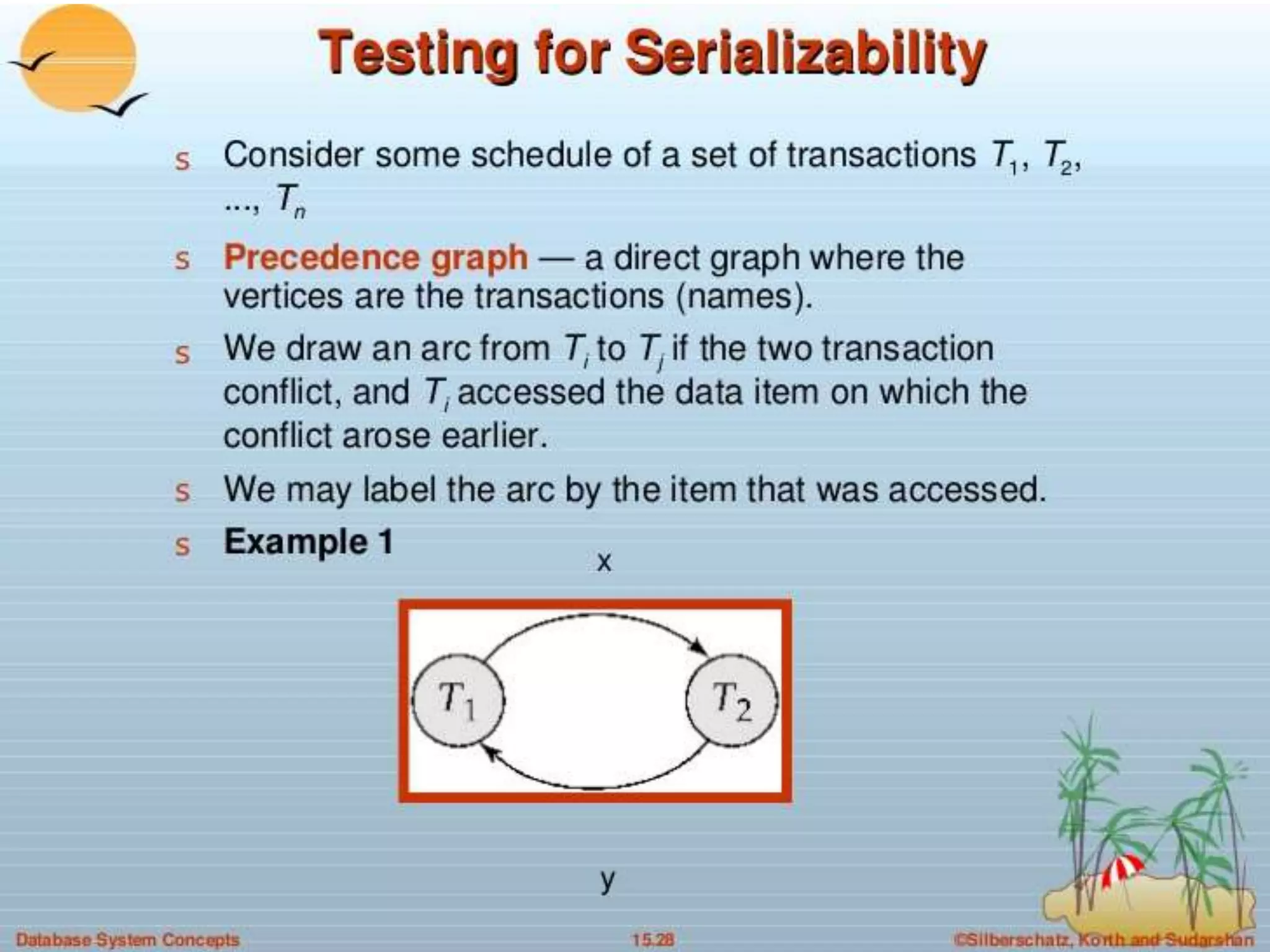
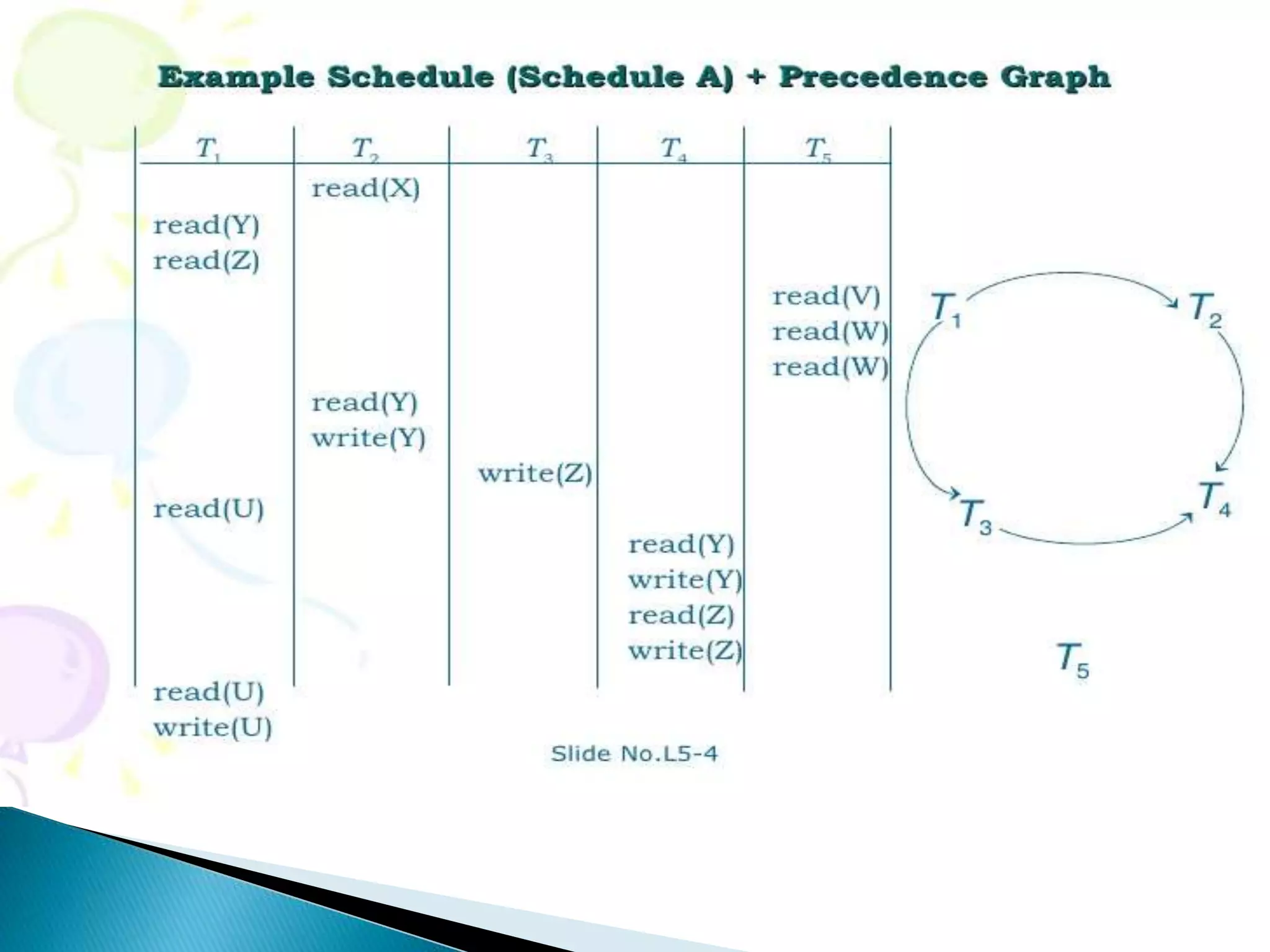
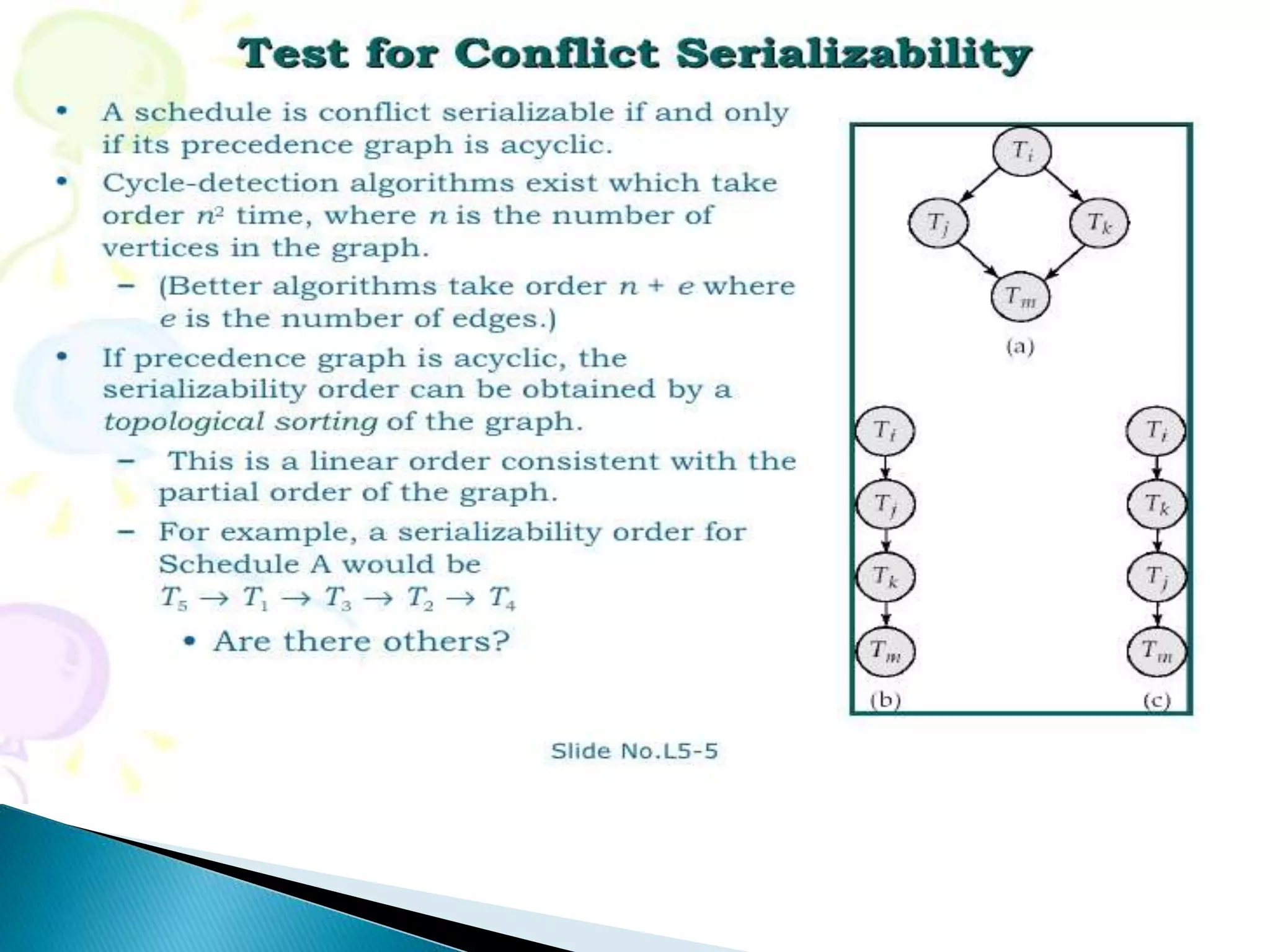
• Testing of Serialization
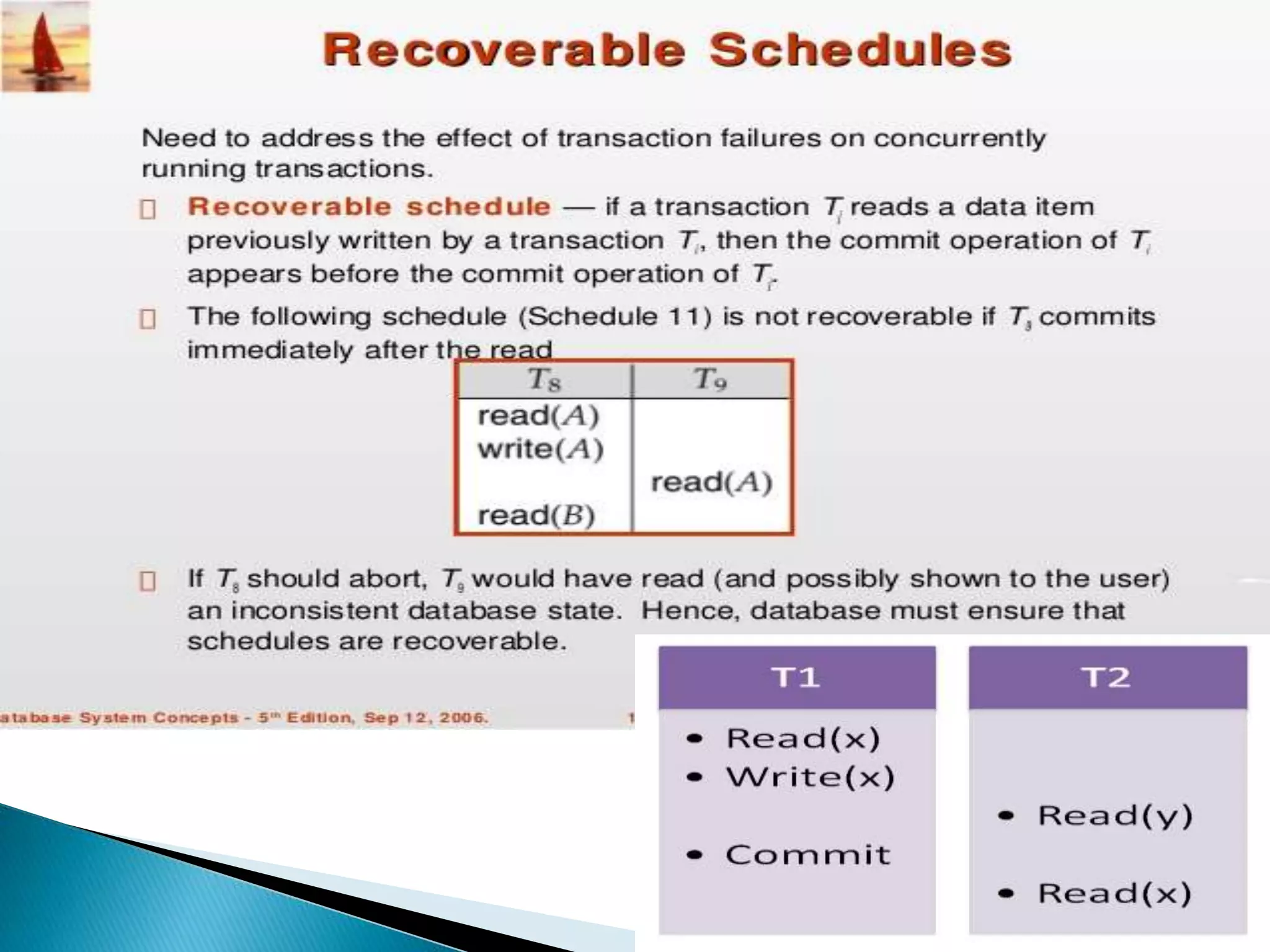
• Recoverable Schedule
Transaction
• A Transaction is a unit of program execution that
accesses and possibly updates various data
items.
• A transaction must see a consistent database.
• During transaction execution the database may
be inconsistent.
• When the transaction is committed, the database
must be consistent.
• Two main issues to deal with:
Failures of various kinds, such as hardware
failures and system crashes
Concurrent execution of multiple transactions
Transaction Property
■ Atomicity:- Either all operations of the transaction are properly
reflected in the database or none are.
■ Consistency:-Execution of a transaction in isolation preserves
the consistency of the database.
■ Isolation:- Although multiple transactions may execute
concurrently, each transaction must be unaware of other
concurrently executing transactions. Intermediate transaction results
must be hidden from other concurrently executed transactions.
That is, for every pair of transactions Ti and Tj , it appears to Ti
that either Tj , finished execution before Ti started, or Tj started
execution after Ti finished.
■ Durability:- After a transaction completes successfully,the
changes it has made to the database persist,even if there are system
failures.
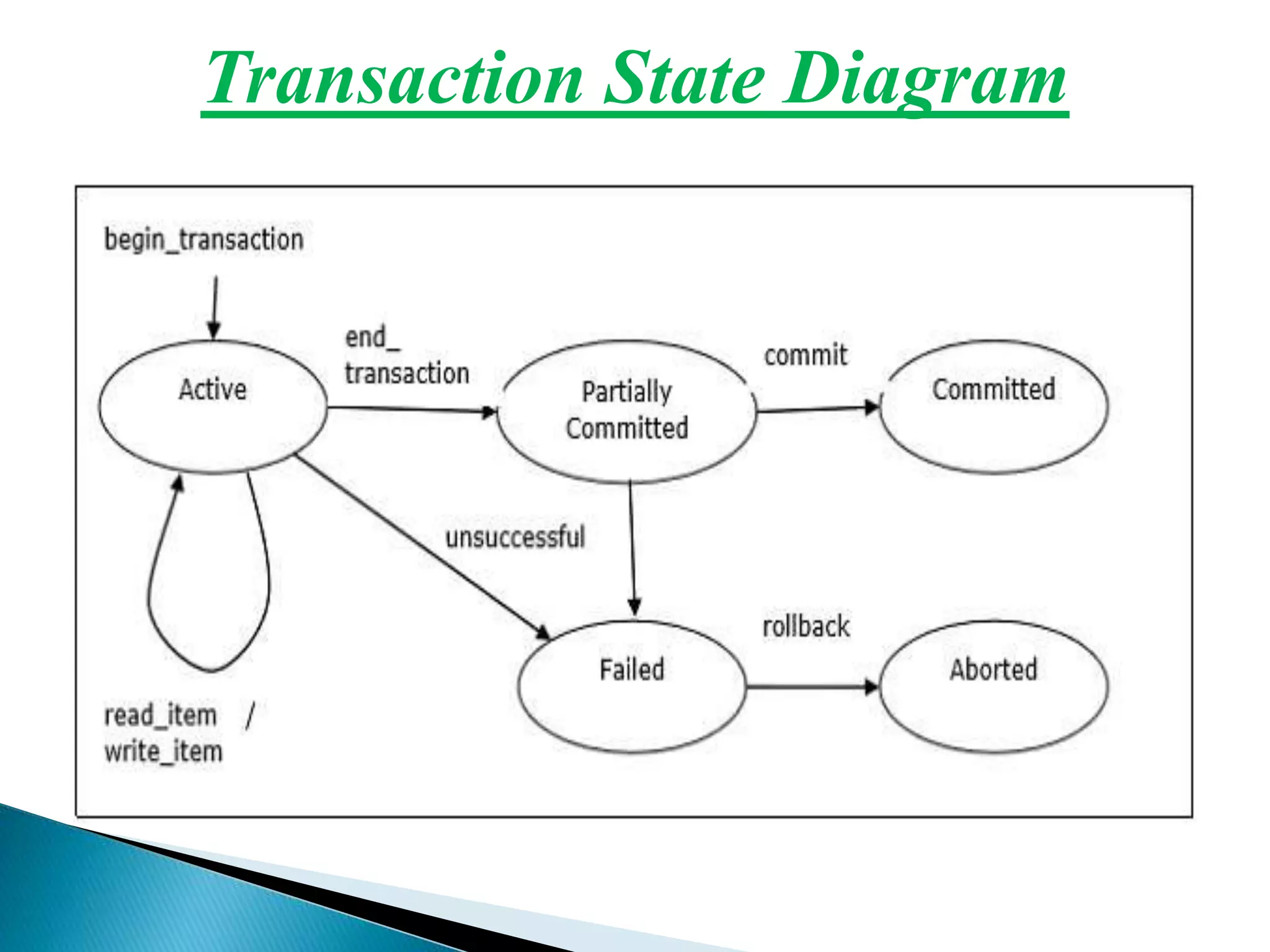
Transaction State
 Active, the initial state; the transaction stays in this state while
it is executing
 Partially committed, after the final statement has been
executed.
 Failed, after the discovery that normal execution can no longer
proceed.
 Aborted, after the transaction has been rolled back and the
database restored to its state prior to the start of the transaction.
Two options after it has been aborted:
 restart the transaction – only if no internal logical error
 kill the transaction
 Committed, after successful completion.
Transaction State Diagram
Implementation of Atomicity & Durability
 The recovery-management component of a database system
implements the support for atomicity and durability.
 The shadow-database scheme:
 Assume that only one transaction is active at a time.
 A pointer called db_pointer always points to the current
consistent copy of the database.
 All updates are made on a shadow copy of the database,
and db_pointer is made to point to the updated shadow copy
only after the transaction reaches partial commit and all
updated pages have been flushed to disk.
 In case transaction fails, old consistent copy pointed to by
db_pointer can be used,and the shadow copy can be deleted.
Atomicity & Durability Model
The shadow-database scheme:-
 Assumes disks to not fail
 Useful for text editors, but extremely inefficient for
large databases: executing a single transaction
requires copying the entire database.
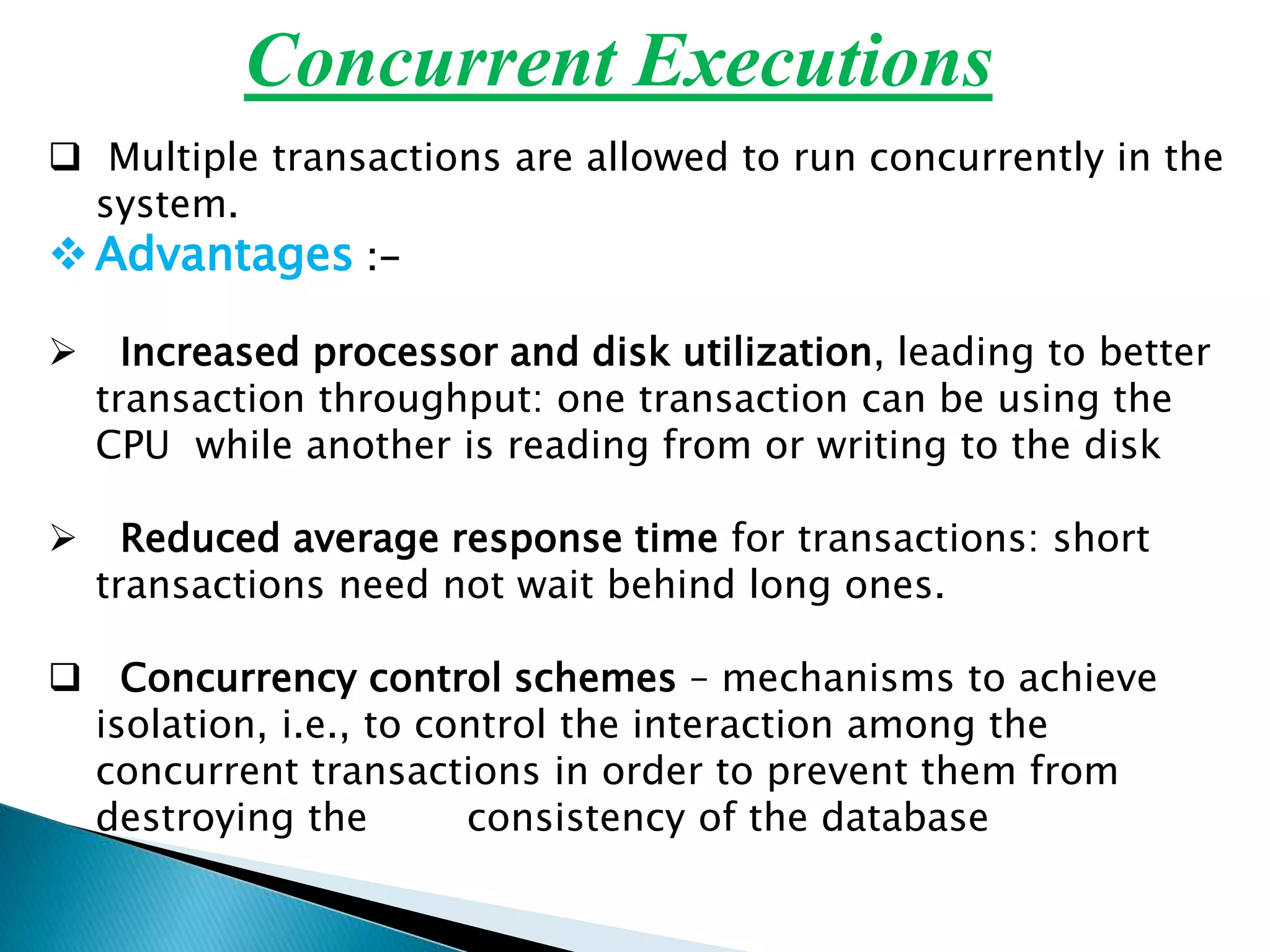
Concurrent Executions
 Multiple transactions are allowed to run concurrently in the
system.
Advantages :-
 Increased processor and disk utilization, leading to better
transaction throughput: one transaction can be using the
CPU while another is reading from or writing to the disk
 Reduced average response time for transactions: short
transactions need not wait behind long ones.
 Concurrency control schemes – mechanisms to achieve
isolation, i.e., to control the interaction among the
concurrent transactions in order to prevent them from
destroying the consistency of the database
Schedules
Schedule :– A sequences of instructions that specify the
chronological order in which instructions of concurrent
transactions are executed
 A schedule for a set of transactions must consist of all
instructions of those transactions
 must preserve the order in which the instructions
appear in each individual transaction.
 A transaction that successfully completes its
execution will have a commit instructions as the last
statement.
 A transaction that fails to successfully complete its
execution will have an abort instruction as the last
statement.
Serialization
Basic Assumption – Each transaction preserves database
consistency.
Thus serial execution of a set of transactions preserves
database consistency.
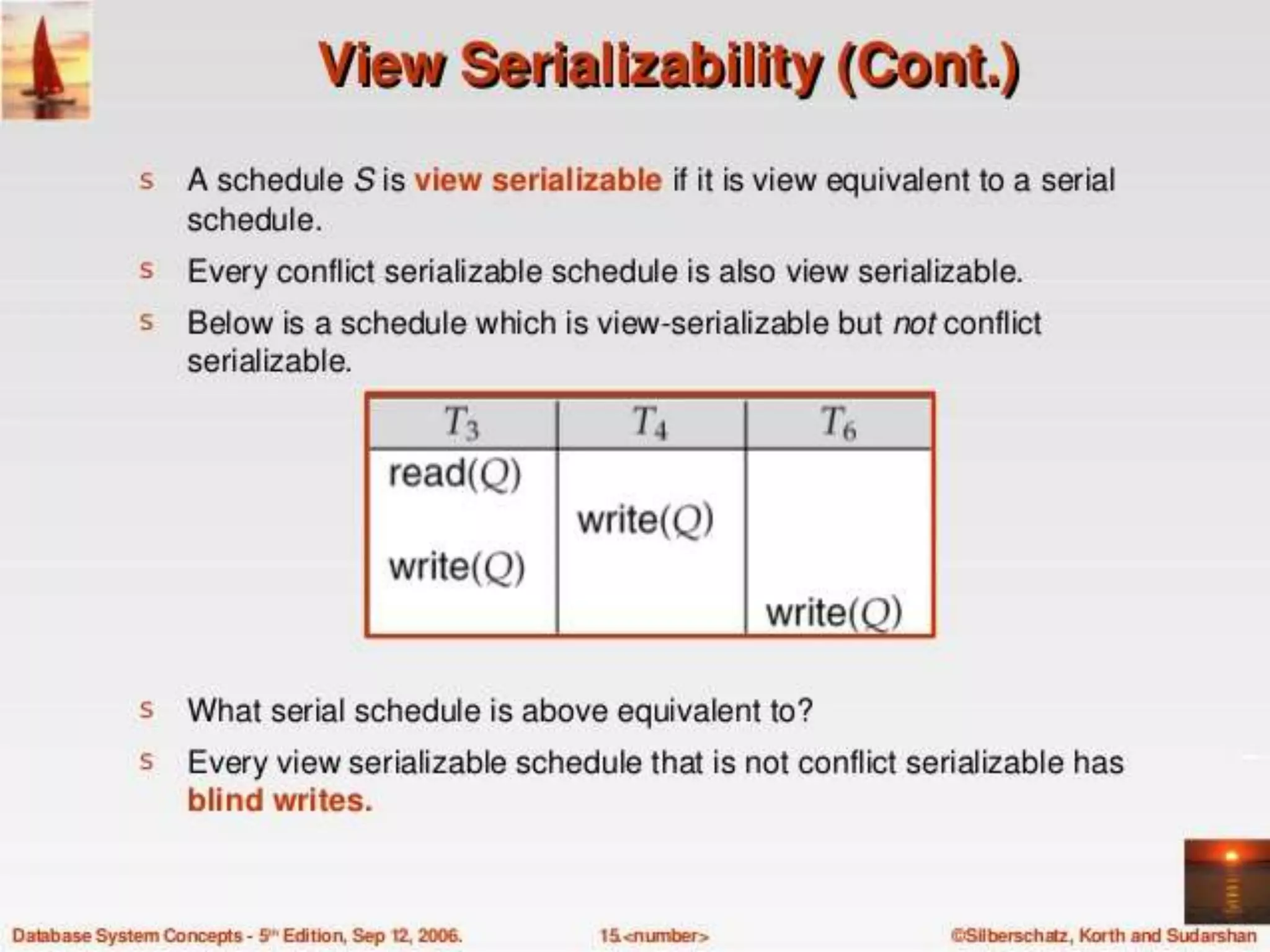
A (possibly concurrent) schedule is serializable,if it is
equivalent to a serial schedule. Different forms of schedule
equivalence give rise to the notions of:
1. conflict serializability
2. view serializability
 Simplified view of transactions
 We ignore operations other than read and write instructions.
 Our simplified schedules consist of only read and write
instructions.
Presentation on Transaction

Presentation on Transaction

  • 1.
    Presentation on Transaction Submitted By: PINKYKUMARI M.Sc(I.T) Submitted to: Bharti Singh
  • 2.
    OBJECTIVE • Transaction • TransactionProperty • Transaction State • Implementation of Atomicity & Durability • Schedule • Serialization • Testing of Serialization • Recoverable Schedule
  • 3.
    Transaction • A Transactionis a unit of program execution that accesses and possibly updates various data items. • A transaction must see a consistent database. • During transaction execution the database may be inconsistent. • When the transaction is committed, the database must be consistent. • Two main issues to deal with: Failures of various kinds, such as hardware failures and system crashes Concurrent execution of multiple transactions
  • 4.
    Transaction Property ■ Atomicity:-Either all operations of the transaction are properly reflected in the database or none are. ■ Consistency:-Execution of a transaction in isolation preserves the consistency of the database. ■ Isolation:- Although multiple transactions may execute concurrently, each transaction must be unaware of other concurrently executing transactions. Intermediate transaction results must be hidden from other concurrently executed transactions. That is, for every pair of transactions Ti and Tj , it appears to Ti that either Tj , finished execution before Ti started, or Tj started execution after Ti finished. ■ Durability:- After a transaction completes successfully,the changes it has made to the database persist,even if there are system failures.
  • 5.
    Transaction State  Active,the initial state; the transaction stays in this state while it is executing  Partially committed, after the final statement has been executed.  Failed, after the discovery that normal execution can no longer proceed.  Aborted, after the transaction has been rolled back and the database restored to its state prior to the start of the transaction. Two options after it has been aborted:  restart the transaction – only if no internal logical error  kill the transaction  Committed, after successful completion.
  • 6.
  • 7.
    Implementation of Atomicity& Durability  The recovery-management component of a database system implements the support for atomicity and durability.  The shadow-database scheme:  Assume that only one transaction is active at a time.  A pointer called db_pointer always points to the current consistent copy of the database.  All updates are made on a shadow copy of the database, and db_pointer is made to point to the updated shadow copy only after the transaction reaches partial commit and all updated pages have been flushed to disk.  In case transaction fails, old consistent copy pointed to by db_pointer can be used,and the shadow copy can be deleted.
  • 8.
    Atomicity & DurabilityModel The shadow-database scheme:-  Assumes disks to not fail  Useful for text editors, but extremely inefficient for large databases: executing a single transaction requires copying the entire database.
  • 9.
    Concurrent Executions  Multipletransactions are allowed to run concurrently in the system. Advantages :-  Increased processor and disk utilization, leading to better transaction throughput: one transaction can be using the CPU while another is reading from or writing to the disk  Reduced average response time for transactions: short transactions need not wait behind long ones.  Concurrency control schemes – mechanisms to achieve isolation, i.e., to control the interaction among the concurrent transactions in order to prevent them from destroying the consistency of the database
  • 10.
    Schedules Schedule :– Asequences of instructions that specify the chronological order in which instructions of concurrent transactions are executed  A schedule for a set of transactions must consist of all instructions of those transactions  must preserve the order in which the instructions appear in each individual transaction.  A transaction that successfully completes its execution will have a commit instructions as the last statement.  A transaction that fails to successfully complete its execution will have an abort instruction as the last statement.
  • 12.
    Serialization Basic Assumption –Each transaction preserves database consistency. Thus serial execution of a set of transactions preserves database consistency. A (possibly concurrent) schedule is serializable,if it is equivalent to a serial schedule. Different forms of schedule equivalence give rise to the notions of: 1. conflict serializability 2. view serializability  Simplified view of transactions  We ignore operations other than read and write instructions.  Our simplified schedules consist of only read and write instructions.