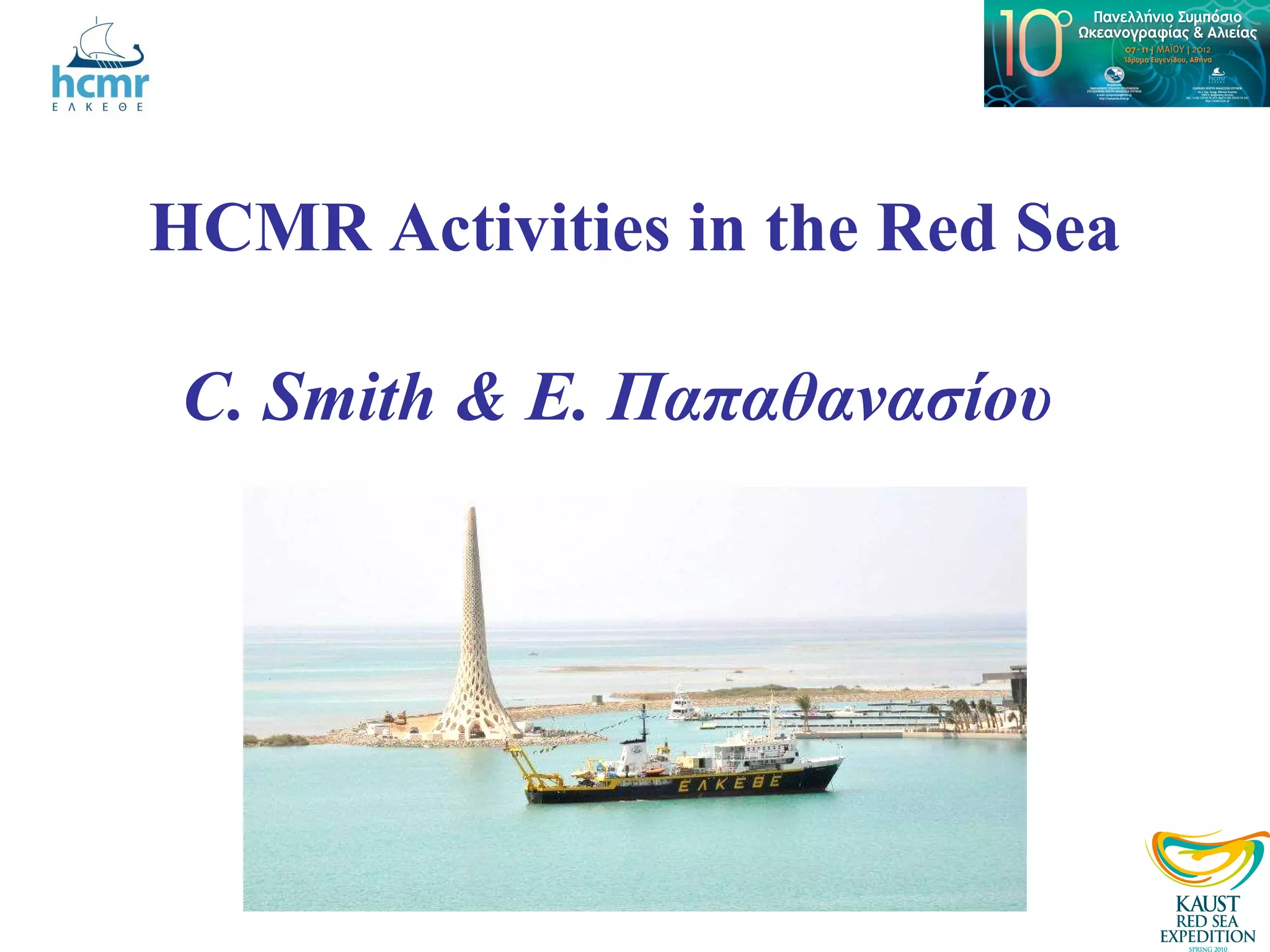
HCMR Activities in the Red Sea

 C. Smith & Ε. Παπαθανασίου
HCMR in the Red Sea
•   The Hellenic Centre for Marine Research (HCMR) started
    activities in the Red Sea in March 2010.
•   This was the result of a framework agreement between,
    SETE Facilities Management Saudia Ltd (Latsis Group), to
    cover 3 major long term missions up to 2012-13 with
    KAUST University in Saudi Arabia with the Greek
    Oceanographic Vessel “Aegaeo”, in the Red Sea
•   This opened a great opportunity for cooperation at the
    scientific and political level,
•   Participation in a wide range of activities at the national,
    bilateral and international level, with Greece being one of the
    first countries to cooperate scientifically in this little
    explored area through common research interests.
Aims
1. High resolution mapping of the seabed in the Red Sea,
2. Characterisation of water masses,
3. High level environmental study of deep brine lakes
4. The search for deep corals in the Red Sea and their relationships
   with deep corals in the Eastern Mediterranean.
5. Direct cooperation with scientists from KAUST university, also
   with the USA (Wood Hole Oceanographic Institute), China (Hong
   Kong University) and Egypt (American University of Cairo), also
   actively involved in scientific research in the area.

HCMR Personnel: 18 research and technical staff were involved
  in 2010-11
Utilising: Submarine ‘Thetis” and the robot vehicle “MAXROV”
Targets
Medium Term Targets and Directions:
• 2010: Charter out the vessel for physical chemistry
  and biological studies
• 2011: Research collaboration between HCMR and
  KAUST, Woods Hole and the University of Hong
  Kong (already have 3 publications and 1 in press)
• 2013-14: Increasing cooperation with new
  agreements for more research at different levels in the
  area.
KAUST Red Sea Expedition 2010

• 2010 Mission: 63 days.
• Research in Saudi Arabian territorial waters, looking at
  many things for the first time
• The research results are particularly important for
  world level publication.
• New discovery: during HCMR MAXROV dives, we
  found a new brine lake at approximately 860 m depth.
KAUST Red Sea Expedition 2010
• Leg - I (15th March – 1st April)
   – Mission
     Collection of biological and oceanographic data to study Red Sea
     hydrography and microbial diversity
   – Sampling locations
     10 perpendicular transects along the Saudi coast of the Red Sea
• Leg - II (6th – 17th April)
   – Mission
     Collection of water and plankton samples from different depth layers to
     study brine pool biota
   – Sampling locations
     Brine pool systems: Atlantis II Deep (AIID) and Discovery Deep (DD)
• Leg - III (20th – 29th April)
   – Mission
     Collection of sediment and benthos samples to study brine pool biota
     and geology
   – Sampling locations
     1 transect from Jeddah to AIID, 2 transects at AIID and 1 at DD
ROV Video Capture of new
  Thuwal Cold Seeps


                                                            g
                                  f


a

                              c


b                                               g
                              f

         Thuwal Cold Seep I           Thuwal Cold Seep II
KAUST Red Sea Expedition 2011 (3/9-23/12)
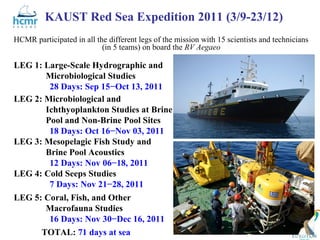
HCMR participated in all the different legs of the mission with 15 scientists and technicians
                           (in 5 teams) on board the RV Aegaeo

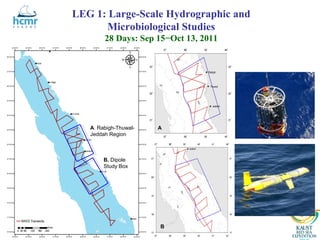
LEG 1: Large-Scale Hydrographic and
       Microbiological Studies
        28 Days: Sep 15−Oct 13, 2011
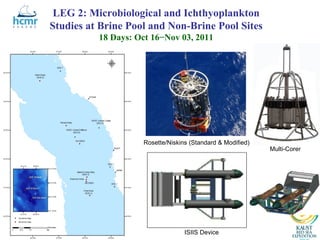
LEG 2: Microbiological and
       Ichthyoplankton Studies at Brine
       Pool and Non-Brine Pool Sites
        18 Days: Oct 16−Nov 03, 2011
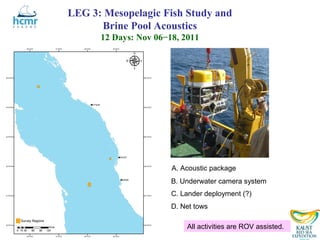
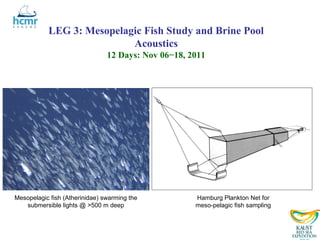
LEG 3: Mesopelagic Fish Study and
       Brine Pool Acoustics
        12 Days: Nov 06−18, 2011
LEG 4: Cold Seeps Studies
        7 Days: Nov 21−28, 2011
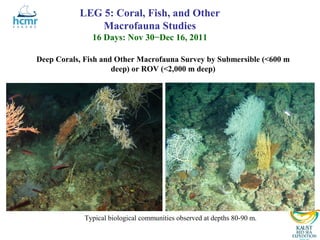
LEG 5: Coral, Fish, and Other
       Macrofauna Studies
        16 Days: Nov 30−Dec 16, 2011
      TOTAL: 71 days at sea                                                       R/V Aegaeo
KAUST Red Sea Expedition III (2011)

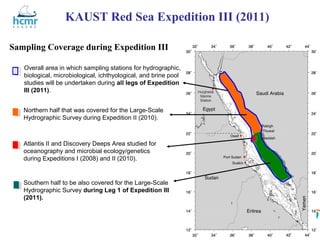
Sampling Coverage during Expedition III

   Overall area in which sampling stations for hydrographic,
   biological, microbiological, ichthyological, and brine pool
   studies will be undertaken during all legs of Expedition
   III (2011).                                                   Hurghada
                                                                  Marine
                                                                  Station

   Northern half that was covered for the Large-Scale
   Hydrographic Survey during Expedition II (2010).


   Atlantis II and Discovery Deeps Area studied for
   oceanography and microbial ecology/genetics
   during Expeditions I (2008) and II (2010).


   Southern half to be also covered for the Large-Scale
   Hydrographic Survey during Leg 1 of Expedition III
   (2011).
LEG 1: Large-Scale Hydrographic and
       Microbiological Studies
        28 Days: Sep 15−Oct 13, 2011


   A. Rabigh-Thuwal-   A
   Jeddah Region


        B. Dipole
        Study Box


                       B
LEG 2: Microbiological and Ichthyoplankton
Studies at Brine Pool and Non-Brine Pool Sites
          18 Days: Oct 16−Nov 03, 2011


                    Rosette/Niskins (Standard & Modified)
                                                            Multi-Corer


                                  ISIIS Device
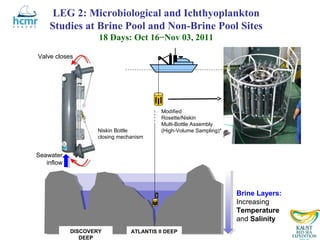
LEG 2: Microbiological and Ichthyoplankton
    Studies at Brine Pool and Non-Brine Pool Sites
                    18 Days: Oct 16−Nov 03, 2011

Valve closes


                                         Modified
                                         Rosette/Niskin
                                         Multi-Bottle Assembly
                   Niskin Bottle         (High-Volume Sampling)*
                   closing mechanism


Seawater
   inflow


                                                                   Brine Layers:
                                                                   Increasing
                                                                   Temperature
                                                                   and Salinity
            DISCOVERY          ATLANTIS II DEEP
               DEEP
LEG 3: Mesopelagic Fish Study and
      Brine Pool Acoustics
      12 Days: Nov 06−18, 2011


                       A. Acoustic package
                       B. Underwater camera system
                       C. Lander deployment (?)
                       D. Net tows

                           All activities are ROV assisted.
LEG 3: Mesopelagic Fish Study and Brine Pool
                           Acoustics
                                12 Days: Nov 06−18, 2011


Mesopelagic fish (Atherinidae) swarming the          Hamburg Plankton Net for
   submersible lights @ >500 m deep                  meso-pelagic fish sampling
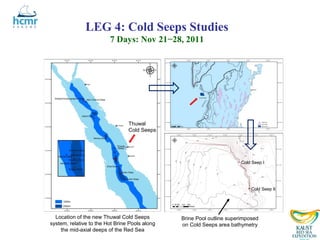
LEG 4: Cold Seeps Studies
                         7 Days: Nov 21−28, 2011


                                 Thuwal
                                 Cold Seeps


                                                                        Cold Seep I


                                                                            Cold Seep II


  Location of the new Thuwal Cold Seeps         Brine Pool outline superimposed
system, relative to the Hot Brine Pools along   on Cold Seeps area bathymetry
    the mid-axial deeps of the Red Sea
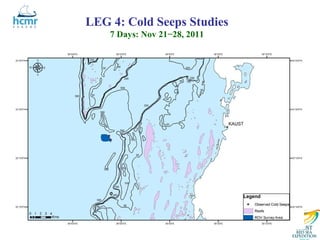
LEG 4: Cold Seeps Studies
    7 Days: Nov 21−28, 2011
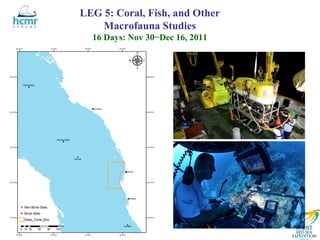
LEG 5: Coral, Fish, and Other
    Macrofauna Studies
  16 Days: Nov 30−Dec 16, 2011
LEG 5: Coral, Fish, and Other
               Macrofauna Studies
               16 Days: Nov 30−Dec 16, 2011

Deep Corals, Fish and Other Macrofauna Survey by Submersible (<600 m
                     deep) or ROV (<2,000 m deep)


            Typical biological communities observed at depths 80-90 m.
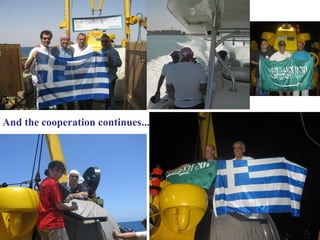
And the cooperation continues...

HCMR Activities in the Red Sea. C. Smith & Ε. Παπαθανασίου

  • 1.
    HCMR Activities inthe Red Sea C. Smith & Ε. Παπαθανασίου
  • 2.
    HCMR in theRed Sea • The Hellenic Centre for Marine Research (HCMR) started activities in the Red Sea in March 2010. • This was the result of a framework agreement between, SETE Facilities Management Saudia Ltd (Latsis Group), to cover 3 major long term missions up to 2012-13 with KAUST University in Saudi Arabia with the Greek Oceanographic Vessel “Aegaeo”, in the Red Sea • This opened a great opportunity for cooperation at the scientific and political level, • Participation in a wide range of activities at the national, bilateral and international level, with Greece being one of the first countries to cooperate scientifically in this little explored area through common research interests.
  • 3.
    Aims 1. High resolutionmapping of the seabed in the Red Sea, 2. Characterisation of water masses, 3. High level environmental study of deep brine lakes 4. The search for deep corals in the Red Sea and their relationships with deep corals in the Eastern Mediterranean. 5. Direct cooperation with scientists from KAUST university, also with the USA (Wood Hole Oceanographic Institute), China (Hong Kong University) and Egypt (American University of Cairo), also actively involved in scientific research in the area. HCMR Personnel: 18 research and technical staff were involved in 2010-11 Utilising: Submarine ‘Thetis” and the robot vehicle “MAXROV”
  • 4.
    Targets Medium Term Targetsand Directions: • 2010: Charter out the vessel for physical chemistry and biological studies • 2011: Research collaboration between HCMR and KAUST, Woods Hole and the University of Hong Kong (already have 3 publications and 1 in press) • 2013-14: Increasing cooperation with new agreements for more research at different levels in the area.
  • 5.
    KAUST Red SeaExpedition 2010 • 2010 Mission: 63 days. • Research in Saudi Arabian territorial waters, looking at many things for the first time • The research results are particularly important for world level publication. • New discovery: during HCMR MAXROV dives, we found a new brine lake at approximately 860 m depth.
  • 6.
    KAUST Red SeaExpedition 2010 • Leg - I (15th March – 1st April) – Mission Collection of biological and oceanographic data to study Red Sea hydrography and microbial diversity – Sampling locations 10 perpendicular transects along the Saudi coast of the Red Sea • Leg - II (6th – 17th April) – Mission Collection of water and plankton samples from different depth layers to study brine pool biota – Sampling locations Brine pool systems: Atlantis II Deep (AIID) and Discovery Deep (DD) • Leg - III (20th – 29th April) – Mission Collection of sediment and benthos samples to study brine pool biota and geology – Sampling locations 1 transect from Jeddah to AIID, 2 transects at AIID and 1 at DD
  • 7.
    ROV Video Captureof new Thuwal Cold Seeps g f a c b g f Thuwal Cold Seep I Thuwal Cold Seep II
  • 8.
    KAUST Red SeaExpedition 2011 (3/9-23/12) HCMR participated in all the different legs of the mission with 15 scientists and technicians (in 5 teams) on board the RV Aegaeo LEG 1: Large-Scale Hydrographic and Microbiological Studies 28 Days: Sep 15−Oct 13, 2011 LEG 2: Microbiological and Ichthyoplankton Studies at Brine Pool and Non-Brine Pool Sites 18 Days: Oct 16−Nov 03, 2011 LEG 3: Mesopelagic Fish Study and Brine Pool Acoustics 12 Days: Nov 06−18, 2011 LEG 4: Cold Seeps Studies 7 Days: Nov 21−28, 2011 LEG 5: Coral, Fish, and Other Macrofauna Studies 16 Days: Nov 30−Dec 16, 2011 TOTAL: 71 days at sea R/V Aegaeo
  • 9.
    KAUST Red SeaExpedition III (2011) Sampling Coverage during Expedition III Overall area in which sampling stations for hydrographic, biological, microbiological, ichthyological, and brine pool studies will be undertaken during all legs of Expedition III (2011). Hurghada Marine Station Northern half that was covered for the Large-Scale Hydrographic Survey during Expedition II (2010). Atlantis II and Discovery Deeps Area studied for oceanography and microbial ecology/genetics during Expeditions I (2008) and II (2010). Southern half to be also covered for the Large-Scale Hydrographic Survey during Leg 1 of Expedition III (2011).
  • 10.
    LEG 1: Large-ScaleHydrographic and Microbiological Studies 28 Days: Sep 15−Oct 13, 2011 A. Rabigh-Thuwal- A Jeddah Region B. Dipole Study Box B
  • 11.
    LEG 2: Microbiologicaland Ichthyoplankton Studies at Brine Pool and Non-Brine Pool Sites 18 Days: Oct 16−Nov 03, 2011 Rosette/Niskins (Standard & Modified) Multi-Corer ISIIS Device
  • 12.
    LEG 2: Microbiologicaland Ichthyoplankton Studies at Brine Pool and Non-Brine Pool Sites 18 Days: Oct 16−Nov 03, 2011 Valve closes Modified Rosette/Niskin Multi-Bottle Assembly Niskin Bottle (High-Volume Sampling)* closing mechanism Seawater inflow Brine Layers: Increasing Temperature and Salinity DISCOVERY ATLANTIS II DEEP DEEP
  • 13.
    LEG 3: MesopelagicFish Study and Brine Pool Acoustics 12 Days: Nov 06−18, 2011 A. Acoustic package B. Underwater camera system C. Lander deployment (?) D. Net tows All activities are ROV assisted.
  • 14.
    LEG 3: MesopelagicFish Study and Brine Pool Acoustics 12 Days: Nov 06−18, 2011 Mesopelagic fish (Atherinidae) swarming the Hamburg Plankton Net for submersible lights @ >500 m deep meso-pelagic fish sampling
  • 15.
    LEG 4: ColdSeeps Studies 7 Days: Nov 21−28, 2011 Thuwal Cold Seeps Cold Seep I Cold Seep II Location of the new Thuwal Cold Seeps Brine Pool outline superimposed system, relative to the Hot Brine Pools along on Cold Seeps area bathymetry the mid-axial deeps of the Red Sea
  • 16.
    LEG 4: ColdSeeps Studies 7 Days: Nov 21−28, 2011
  • 17.
    LEG 5: Coral,Fish, and Other Macrofauna Studies 16 Days: Nov 30−Dec 16, 2011
  • 18.
    LEG 5: Coral,Fish, and Other Macrofauna Studies 16 Days: Nov 30−Dec 16, 2011 Deep Corals, Fish and Other Macrofauna Survey by Submersible (<600 m deep) or ROV (<2,000 m deep) Typical biological communities observed at depths 80-90 m.
  • 19.
    And the cooperationcontinues...