Making cyber friends is fun
A teacher’s opinion
1 As a teacher, I’m always looking for new and exiting ways for my students to
enhance their English skills. Therefore I was thrilled when I was told about the EFL
Plaza, a chat community on the Internet for individuals that are learning English.
2 I thought that this Internet site could be a wonderful teaching tool. Students would
not only have the opportunity to practice their English speaking and writing skills, but
also get to chat with other learners of English all over the world.
3 After deciding to use the EFL Plaza in my classroom, I polled my students regarding
their knowledge of computers and the Internet. Luckily, they represented the entire
spectrum of computer knowledge. Three of them had the Internet on their home
computers; two of them had never been exposed to the Internet and the rest of my
learners had been on the Net but had no readily available access to it.
4 After explaining the “chat” concept to the class, I informed the learners who had Net
access at home that they would be responsible for working together to teach their
classmates how to use the service. What a magnificent opportunity for real
communication in English!
5 The entire group appeared to enjoy the activity. All my learners huddled around the
computer and constantly suggested what their friends should type next. I knew the
lesson had been a success when all of the students with Internet in their homes asked
for instructions on finding the EFL Plaza on their own. By the end of the class period, I
felt certain that a great deal of language learning had also taken place.
Paula Watson
1. After reading the text, match the headlines given with the paragraphs:
a. Communication worldwide
b. Team work
c. The project
d. A brilliant experience
e. A mixed class
2. Find evidence in the text of the following statements:
a) Paula Watson is a creative teacher of English.
b) EFL Plaza is the name given to an international chat group.
c) Paula didn’t know much about her students’ computer skills.
d) Some students helped others during the chat.
e) The students showed a lot of enthusiasm about the activity.
f) Paula Watson is sure they’ve learned a lot.
3. Match the words from the text (paragraphs 1 – 3) to their equivalent
expressions:
1. enhance
2. thrilled
3. tool
4. polled
5. spectrum
a. instrument, means
b. surveyed
c. improve, further
d. range, variety
e. excited
GRAMMAR
MODAL VERBS: CAN – COULD – WILL – WOULD – SHOULD
1. This Internet site can be a wonderful teaching tool.
2. Can I use the PC, Miss Evans?
3. I could talk with people from Merida.
4. Students will have the opportunity to practice their English.
5. All my learners constantly suggested what their friends should type next.
6. You would improve your English if you practiced more.
Remember:
 Modal verbs never take –s in the 3rd
person singular;
 Modal verbs never need an auxiliary to build the negative or
interrogative;
 Modal verbs are followed by a bare infinitive (infinitive without
to) except for ought to.
1. Fill in the blanks with one of the modal verbs above:
a) Mum, __________ go to the cinema today?
b) If I _________ pay for a new house I would buy the one I saw last week.
c) My dad suggested that I __________________ try a new job.
d) Rita _________ a fantastic painter if she had the chance.
e) What do you think I _______________ do?
f) Mum said I _______________ go on the trip.
2. Rephrase the sentences below replacing the italicised expressions by a modal verb
and making all the necessary changes.
a) My teacher said that we were allowed to use bilingual dictionaries during the text.
b) Do you think it would be better for me to see a doctor?
c) Peter has the possibility to fly to German next week.
d) If I study more I will have a chance to pass.
e) I think you have the duty to protect your family in this situation.
3. Insert a modal verb into each gap. Note that some sentences are negative.
a) Mummy ___________ I go to the party with my friends tonight?
b) You ____________ talk that way. It’s rude.
c) ______________ we take the dog for a walk in the park?
d) Matt _____________ play football this week; he’s injured his knee.
e) Children ___________ walk alone from school after 6. it’s dangerous.
RELATIVE PRONOUNS – EXERCISES
1. Rephrase the following sentences by means of a relative pronouns:
He is a famous architect. His designs won an international award last year.
_____________________________________________________________________
_____________________________________________________________________
He is the one. The award should be given to him.
_____________________________________________________________________
_____________________________________________________________________
This is Mary. She is taking over my job when I leave.
_____________________________________________________________________
_____________________________________________________________________
Its the invoice. You sent it to us last week.
_____________________________________________________________________
_____________________________________________________________________
He is a consultant. I rely on his advice.
_____________________________________________________________________
_____________________________________________________________________
The photocopier has a two-year guarantee. It cost £2000.
_____________________________________________________________________
_____________________________________________________________________
The people were stopped at the border. They were all from Eastern Europe.
_____________________________________________________________________
_____________________________________________________________________
They expect his decision soon. This decision should help us solve the problem.
_____________________________________________________________________
_____________________________________________________________________
The President of the company is visiting us next week. I really admire him.
_____________________________________________________________________
_____________________________________________________________________
2. Fill in the gaps with a suitable relative pronoun:
The man _________________ we met on the street is my uncle.
whose
whom
where
The cafe _________________ she usually has breakfast is around the corner.
whom
whose
where
The girl _________________ wrote this poem is still in high school.
whose
who
where
The girl _________________ poem I read is still in high school.
whose
who
where
The neighbourhood _________________ we live is safe.
where
whose
who
The people _________________ we saw yesterday are my neighbours.
whose
where
whom
The boy _________________ bike was stolen is crying.
whose
where
whom
The people _________________ live across the street are from Portugal.
who
whose
where
The hotel _________________ we stayed was very noisy.
whom
where
whose
The man _________________ wallet was stolen was very upset.
whom
where
whose

1 making cyberfriends

  • 1.
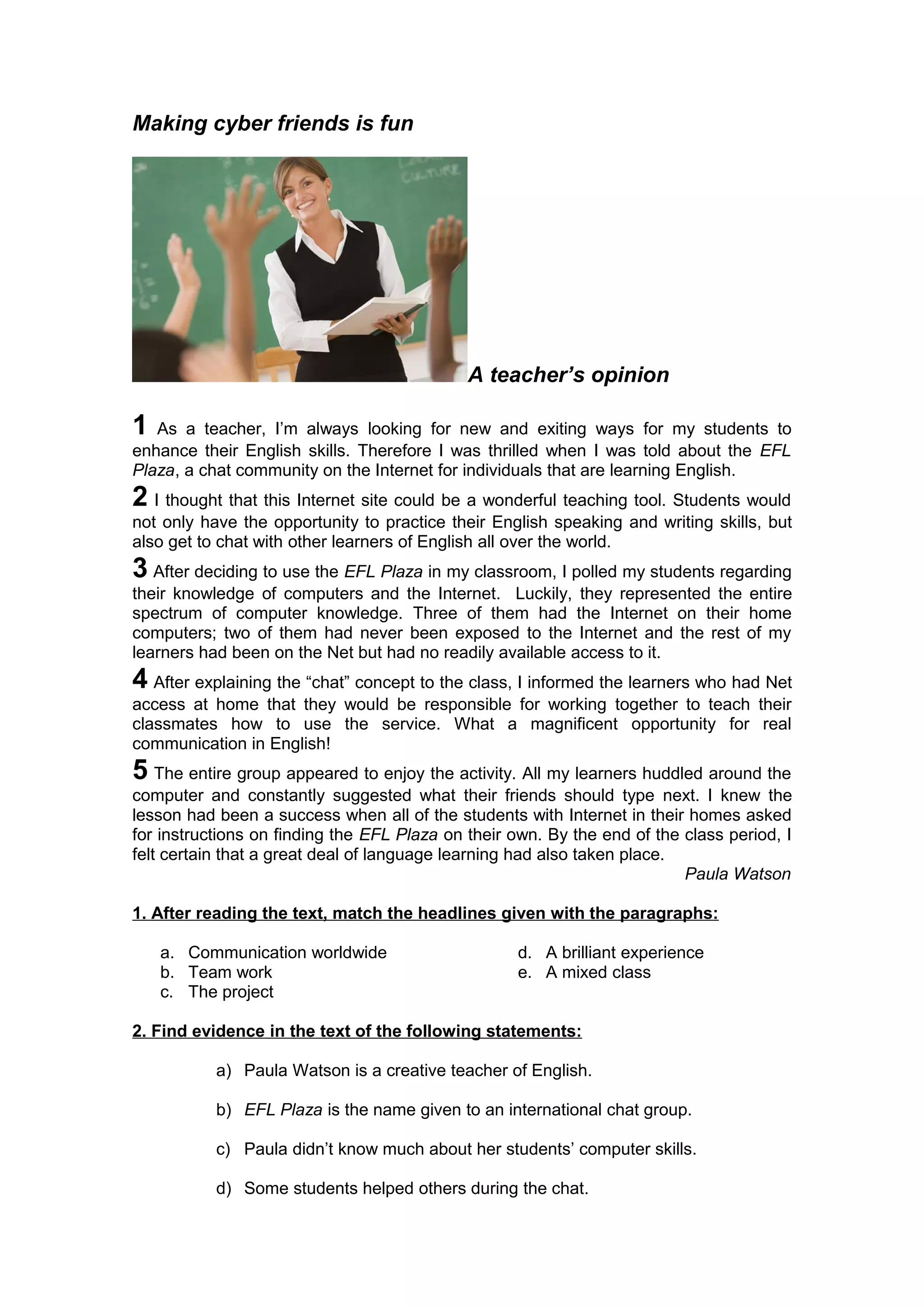
    Making cyber friendsis fun A teacher’s opinion 1 As a teacher, I’m always looking for new and exiting ways for my students to enhance their English skills. Therefore I was thrilled when I was told about the EFL Plaza, a chat community on the Internet for individuals that are learning English. 2 I thought that this Internet site could be a wonderful teaching tool. Students would not only have the opportunity to practice their English speaking and writing skills, but also get to chat with other learners of English all over the world. 3 After deciding to use the EFL Plaza in my classroom, I polled my students regarding their knowledge of computers and the Internet. Luckily, they represented the entire spectrum of computer knowledge. Three of them had the Internet on their home computers; two of them had never been exposed to the Internet and the rest of my learners had been on the Net but had no readily available access to it. 4 After explaining the “chat” concept to the class, I informed the learners who had Net access at home that they would be responsible for working together to teach their classmates how to use the service. What a magnificent opportunity for real communication in English! 5 The entire group appeared to enjoy the activity. All my learners huddled around the computer and constantly suggested what their friends should type next. I knew the lesson had been a success when all of the students with Internet in their homes asked for instructions on finding the EFL Plaza on their own. By the end of the class period, I felt certain that a great deal of language learning had also taken place. Paula Watson 1. After reading the text, match the headlines given with the paragraphs: a. Communication worldwide b. Team work c. The project d. A brilliant experience e. A mixed class 2. Find evidence in the text of the following statements: a) Paula Watson is a creative teacher of English. b) EFL Plaza is the name given to an international chat group. c) Paula didn’t know much about her students’ computer skills. d) Some students helped others during the chat.
  • 2.
    e) The studentsshowed a lot of enthusiasm about the activity. f) Paula Watson is sure they’ve learned a lot. 3. Match the words from the text (paragraphs 1 – 3) to their equivalent expressions: 1. enhance 2. thrilled 3. tool 4. polled 5. spectrum a. instrument, means b. surveyed c. improve, further d. range, variety e. excited GRAMMAR MODAL VERBS: CAN – COULD – WILL – WOULD – SHOULD 1. This Internet site can be a wonderful teaching tool. 2. Can I use the PC, Miss Evans? 3. I could talk with people from Merida. 4. Students will have the opportunity to practice their English. 5. All my learners constantly suggested what their friends should type next. 6. You would improve your English if you practiced more. Remember:  Modal verbs never take –s in the 3rd person singular;  Modal verbs never need an auxiliary to build the negative or interrogative;  Modal verbs are followed by a bare infinitive (infinitive without to) except for ought to. 1. Fill in the blanks with one of the modal verbs above: a) Mum, __________ go to the cinema today? b) If I _________ pay for a new house I would buy the one I saw last week. c) My dad suggested that I __________________ try a new job. d) Rita _________ a fantastic painter if she had the chance. e) What do you think I _______________ do? f) Mum said I _______________ go on the trip. 2. Rephrase the sentences below replacing the italicised expressions by a modal verb and making all the necessary changes. a) My teacher said that we were allowed to use bilingual dictionaries during the text. b) Do you think it would be better for me to see a doctor? c) Peter has the possibility to fly to German next week. d) If I study more I will have a chance to pass. e) I think you have the duty to protect your family in this situation.
  • 3.
    3. Insert amodal verb into each gap. Note that some sentences are negative. a) Mummy ___________ I go to the party with my friends tonight? b) You ____________ talk that way. It’s rude. c) ______________ we take the dog for a walk in the park? d) Matt _____________ play football this week; he’s injured his knee. e) Children ___________ walk alone from school after 6. it’s dangerous. RELATIVE PRONOUNS – EXERCISES 1. Rephrase the following sentences by means of a relative pronouns: He is a famous architect. His designs won an international award last year. _____________________________________________________________________ _____________________________________________________________________ He is the one. The award should be given to him. _____________________________________________________________________ _____________________________________________________________________ This is Mary. She is taking over my job when I leave. _____________________________________________________________________ _____________________________________________________________________ Its the invoice. You sent it to us last week. _____________________________________________________________________ _____________________________________________________________________ He is a consultant. I rely on his advice. _____________________________________________________________________ _____________________________________________________________________ The photocopier has a two-year guarantee. It cost £2000. _____________________________________________________________________ _____________________________________________________________________ The people were stopped at the border. They were all from Eastern Europe. _____________________________________________________________________ _____________________________________________________________________ They expect his decision soon. This decision should help us solve the problem. _____________________________________________________________________ _____________________________________________________________________ The President of the company is visiting us next week. I really admire him. _____________________________________________________________________ _____________________________________________________________________ 2. Fill in the gaps with a suitable relative pronoun: The man _________________ we met on the street is my uncle. whose whom where
  • 4.
    The cafe _________________she usually has breakfast is around the corner. whom whose where The girl _________________ wrote this poem is still in high school. whose who where The girl _________________ poem I read is still in high school. whose who where The neighbourhood _________________ we live is safe. where whose who The people _________________ we saw yesterday are my neighbours. whose where whom The boy _________________ bike was stolen is crying. whose where whom The people _________________ live across the street are from Portugal. who whose where The hotel _________________ we stayed was very noisy. whom where whose The man _________________ wallet was stolen was very upset. whom where whose