K
1 2
3 4
5 6
Kickstart
Activity Book
poh
+ 32
Blended Math and Language Activities
Kickstart
This book is printed on paper containing
a minimum of 10% post-consumer waste.
www.triumphlearning.com
Phone: (800) 338-6519 • Fax: (866) 805-5723 • E-mail: customerservice@triumphlearning.com
www.triumphlearning.com
Phone: (800) 338-6519 • Fax: (866) 805-5723 • E-mail: customerservice@triumphlearning.com
ISBN-13: 978-1-62362-249-7
9 7 8 1 6 2 3 6 2 2 4 9 7
9 0 0 0 0
T001NA
Activity Book
Blended Math and Language Activities
18	 Chapter X Duplicating any part of this book is prohibited by law. © 2014 Triumph Learning, LLC Title  19Duplicating any part of this book is prohibited by law. © 2014 Triumph Learning, LLC
Common Core
State
Standard
Grade K
Common
Core Coach
Lesson(s)
Range of Reading and Level of Text Complexity
RI.K.10 Actively engage in group reading activities with purpose and understanding.
Reading: Foundational Skills
Print Concepts
RF.K.1 Demonstrate understanding of the organization and basic features of print.
RF.K.1a Follow words from left to right, top to bottom, and page by page.
RF.K.1b
Recognize that spoken words are represented in written language by specific sequences
of letters.
RF.K.1c Understand that words are separated by spaces in print.
RF.K.1d Recognize and name all upper- and lowercase letters of the alphabet.
Phonological Awareness
RF.K.2 Demonstrate understanding of spoken words, syllables, and sounds (phonemes).
RF.K.2a Recognize and produce rhyming words.
RF.K.2b Count, pronounce, blend, and segment syllables in spoken words.
RF.K.2c Blend and segment onsets and rimes of single-syllable spoken words.
RF.K.2d
Isolate and pronounce the initial, medial vowel, and final sounds (phonemes) in three-
phoneme (consonant-vowel-consonant, or CVC) words.1 (This does not include CVCs
ending with /l/, /r/, or /x/.)
RF.K.2e
Add or substitute individual sounds (phonemes) in simple, one-syllable words to make
new words.
Phonics and Word Recognition
RF.K.3 Know and apply grade-level phonics and word analysis skills in decoding words.
RF.K.3a
Demonstrate basic knowledge of one-to-one letter-sound correspondences by producing
the primary sound or many of the most frequent sounds for each consonant.
RF.K.3b
Associate the long and short sounds with the common spellings (graphemes) for the five
major vowels.
RF.K.3c Read common high-frequency words by sight (e.g., the, of, to, you, she, my, is, are, do, does).
RF.K.3d Distinguishbetweensimilarlyspelledwordsbyidentifyingthesoundsofthelettersthatdiffer.
Fluency
RF.K.4 Read emergent-reader texts with purpose and understanding.
Writing
Text Types and Purposes
W.K.1
Use a combination of drawing, dictating, and writing to compose opinion pieces in which
they tell a reader the topic or the name of the book they are writing about and state an
opinion or preference about the topic or book (e.g., My favorite book is...).
Common Core
State
Standard
Grade K
Common
Core Coach
Lesson(s)
Reading: Literature
Key Ideas and Details
RL.K.1 With prompting and support, ask and answer questions about key details in a text.
RL.K.2 With prompting and support, retell familiar stories, including key details.
RL.K.3 With prompting and support, identify characters, settings, and major events in a story.
Craft and Structure
RL.K.4 Ask and answer questions about unknown words in a text.
RL.K.5 Recognize common types of texts (e.g., storybooks, poems).
RL.K.6
With prompting and support, name the author and illustrator of a story and define the
role of each in telling the story.
Integration of Knowledge and Ideas
RL.K.7
With prompting and support, describe the relationship between illustrations and the
story in which they appear (e.g., what moment in a story an illustration depicts).
(RL.K.9 not applicable to literature)
RL.K.9
With prompting and support, compare and contrast the adventures and experiences of
characters in familiar stories.
Range of Reading and Level of Text Complexity
RL.K.10 Actively engage in group reading activities with purpose and understanding.
Reading: Informational Text
Key Ideas and Details
RI.K.1 Withpromptingandsupport,askandanswerquestionsaboutkeydetailsinatext.
RI.K.2 Withpromptingandsupport,identifythemaintopicandretellkeydetailsofatext.
RI.K.3
With prompting and support, describe the connection between two individuals, events,
ideas, or pieces of information in a text.
Craft and Structure
RI.K.4 With prompting and support, ask and answer questions about unknown words in a text.
RI.K.5 Identify the front cover, back cover, and title page of a book.
RI.K.6
Name the author and illustrator of a text and define the role of each in presenting the
ideas or information in a text.
Integration of Knowledge and Ideas
RI.K.7
With prompting and support, describe the relationship between illustrations and the text in
which they appear (e.g., what person, place, thing, or idea in the text an illustration depicts).
RI.K.8 Withpromptingandsupport,identifythereasonsanauthorgivestosupportpointsinatext.
RI.K.9
With prompting and support, identify basic similarities in and differences between two texts
on the same topic (e.g., in illustrations, descriptions, or procedures).
Correlations Correlations
20	 Chapter X Duplicating any part of this book is prohibited by law. © 2014 Triumph Learning, LLC Title  21Duplicating any part of this book is prohibited by law. © 2014 Triumph Learning, LLC
Common Core
State
Standard
Grade K
Common
Core Coach
Lesson(s)
W.K.2
Use a combination of drawing, dictating, and writing to compose informative/
explanatory texts in which they name what they are writing about and supply some
information about the topic.
W.K.3
Use a combination of drawing, dictating, and writing to narrate a single event or several
loosely linked events, tell about the events in the order in which they occurred, and
provide a reaction to what happened.
Production and Distribution of Writing
(W.K.4 begins in grade 3)
W.K.5
With guidance and support from adults, respond to questions and suggestions from
peers and add details to strengthen writing as needed.
W.K.6
With guidance and support from adults, explore a variety of digital tools to produce and
publish writing, including in collaboration with peers.
Research to Build and Present Knowledge
W.K.7
Participate in shared research and writing projects (e.g., explore a number of books by a
favorite author and express opinions about them).
W.K.8
With guidance and support from adults, recall information from experiences or gather
information from provided sources to answer a question.
(W.K.9 begins in grade 4)
Speaking  Listening
Comprehension and Collaboration
SL.K.1
Participate in collaborative conversations with diverse partners about kindergarten topics
and texts with peers and adults in small and larger groups.
SL.K.1a
Follow agreed-upon rules for discussions (e.g., listening to others and taking turns
speaking about the topics and texts under discussion).
SL.K.1b Continue a conversation through multiple exchanges.
SL.K.2
Confirm understanding of a text read aloud or information presented orally or through
other media by asking and answering questions about key details and requesting
clarification if something is not understood.
SL.K.3
Ask and answer questions in order to seek help, get information, or clarify something that
is not understood.
SL.K.4
Describe familiar people, places, things, and events and, with prompting and support,
provide additional detail.
SL.K.5 Add drawings or other visual displays to descriptions as desired to provide additional detail.
SL.K.6 Speak audibly and express thoughts, feelings, and ideas clearly.
Common Core
State
Standard
Grade K
Common
Core Coach
Lesson(s)
Language
Conventions of Standard English
L.K.1
Demonstrate command of the conventions of standard English grammar and usage
when writing or speaking.
L.K.1a Print many upper- and lowercase letters.
L.K.1b Use frequently occurring nouns and verbs.
L.K.1c Formregularpluralnounsorallybyadding/s/or/es/(e.g.,dog,dogs;wish,wishes).
L.K.1d Understandandusequestionwords(interrogatives)(e.g.,who,what,where,when,why,how).
L.K.1e Use the most frequently occurring prepositions (e.g., to, from, in, out, on, off, for, of, by, with).
L.K.1f Produce and expand complete sentences in shared language activities.
L.K.2
Demonstrate command of the conventions of standard English capitalization,
punctuation, and spelling when writing.
L.K.2a Capitalize the first word in a sentence and the pronoun I
L.K.2b Recognize and name end punctuation.
L.K.2c Write a letter or letters for most consonant and short-vowel sounds (phonemes).
L.K.2d Spell simple words phonetically, drawing on knowledge of sound-letter relationships.
Knowledge of Language
(L.K.3 begins in grade 2)
Vocabulary Acquisition and Use
L.K.4
Determine or clarify the meaning of unknown and multiple-meaning words and phrases
based on kindergarten reading and content.
L.K.4a
Identify new meanings for familiar words and apply them accurately (e.g., knowing duck
is a bird and learning the verb to duck).
L.K.4b
Use the most frequently occurring inflections and affixes (e.g., -ed, -s, re-, un-, pre-, -ful,
-less) as a clue to the meaning of an unknown word.
L.K.5
With guidance and support from adults, explore word relationships and nuances in word
meanings.
L.K.5a
Sort common objects into categories (e.g., shapes, foods) to gain a sense of the concepts
the categories represent.
L.K.5b
Demonstrate understanding of frequently occurring verbs and adjectives by relating
them to their opposites (antonyms).
L.K.5c
Identify real-life connections between words and their use (e.g., note places at school that
are colorful).
L.K.5d
Distinguish shades of meaning among verbs describing the same general action (e.g.,
walk, march, strut, prance) by acting out the meanings.
L.K.6
Use words and phrases acquired through conversations, reading and being read to, and
responding to texts.
Correlations Correlations
22	 Chapter X Duplicating any part of this book is prohibited by law. © 2014 Triumph Learning, LLC Title  23Duplicating any part of this book is prohibited by law. © 2014 Triumph Learning, LLC
Common Core
State
Standard
Grade K
Common
Core Coach
Lesson(s)
Domain: Know number names and the count sequence
K.CC.A.1 Count to 100 by ones and by tens.
K.CC.A.2
Count forward beginning from a given number within the known sequence (instead of
having to begin at 1).
Domain: Count to tell the number of objects.
K.CC.B.4
Understand the relationship between numbers and quantities; connect counting to
cardinality.
K.CC.B.4a
Whencountingobjects,saythenumbernamesinthestandardorder,pairingeachobjectwith
oneandonlyonenumbernameandeachnumbernamewithoneandonlyoneobject.
K.CC.B.4b
Understand that the last number name said tells the number of objects counted.The
number of objects is the same regardless of their arrangement or the order in which they
were counted.
K.CC.B.4c Understand that each successive number name refers to a quantity that is one larger.
K.CC.B.5
Count to answer“how many?”questions about as many as 20 things arranged in a line, a
rectangular array, or a circle, or as many as 10 things in a scattered configuration; given a
number from 1–20, count out that many objects.
Domain: Compare numbers
K.CC.6
Identify whether the number of objects in one group is greater than, less than, or equal to
the number of objects in another group, e.g., by using matching and counting strategies.
K.CC.7 Compare two numbers between 1 and 10 presented as written numerals.
Domain: Understand addition as putting together and adding to,
and understanding subtraction as taking apart and taking from
K.OA.1
Represent addition and subtraction with objects, fingers, mental images, drawings1,
sounds (e.g., claps), acting out situations, verbal explanations, expressions, or equations.
K.OA.2
Solve addition and subtraction word problems, and add and subtract within 10, e.g., by
using objects or drawings to represent the problem.
K.OA.3
Decompose numbers less than or equal to 10 into pairs in more than one way, e.g., by
using objects or drawings, and record each decomposition by a drawing or equation (e.g.,
5 = 2 + 3 and 5 = 4 + 1).
K.OA.A.4
Foranynumberfrom1to9,findthenumberthatmakes10whenaddedtothegivennumber,
e.g.,byusingobjectsordrawings,andrecordtheanswerwithadrawingorequation.
K.OA.A.5 Fluently add and subtract within 5.
Common Core
State
Standard
Grade K
Common
Core Coach
Lesson(s)
Domain: Work with numbers 11-19 to gain foundations for place value.
K.NBT.A.1
Compose and decompose numbers from 11 to 19 into ten ones and some further ones,
e.g., by using objects or drawings, and record each composition or decomposition by a
drawing or equation (such as 18 = 10 + 8); understand that these numbers are composed
of ten ones and one, two, three, four, five, six, seven, eight, or nine ones.
Domain: Measurement and Data
K.MD.A.1
Describe measurable attributes of objects, such as length or weight. Describe several
measurable attributes of a single object.
K.MD.A.2
Directly compare two objects with a measurable attribute in common, to see which
object has“more of”/“less of”the attribute, and describe the difference. For example,
directly compare the heights of two children and describe one child as taller/shorter.
Domain: Classify objects and count the number of objects in each category.
K.MD.B.3
Classify objects into given categories; count the numbers of objects in each category and
sort the categories by count.
Domain: Identify and describe shapes (squares, circles, triangles, rectangles, hexagons, cubes, cones,
cylinders, and spheres
K.G.A.1
Describe objects in the environment using names of shapes, and describe the relative
positions of these objects using terms such as above, below, beside, in front of, behind,
and next to.
K.G.A.2 Correctly name shapes regardless of their orientations or overall size
K.G.A.3 Identify shapes as two-dimensional (lying in a plane,“flat”) or three-dimensional (“solid”).
Domain: Analyze, compare, create, and compose shapes
K.G.B.4
Analyzeandcomparetwo-andthree-dimensionalshapes,indifferentsizesandorientations,
usinginformallanguagetodescribetheirsimilarities,differences,parts(e.g.,numberofsides
andvertices/“corners”)andotherattributes(e.g.,havingsidesofequallength).
K.G.B.5
Model shapes in the world by building shapes from components (e.g., sticks and clay
balls) and drawing shapes.
K.G.B.6
Compose simple shapes to form larger shapes. For example,“Can you join these two
triangles with full sides touching to make a rectangle?”
Correlations Correlations
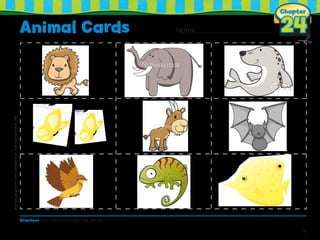
Animal Cards
Chapter
24Name
31
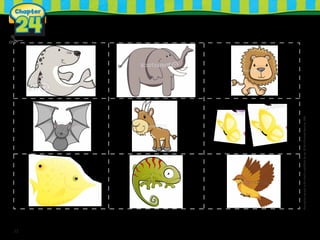
Directions Have children cut apart the pictures.
Duplicatinganypartofthisbookisprohibitedbylaw.©2014TriumphLearning,LLC
32
Chapter
24
Duplicatinganypartofthisbookisprohibitedbylaw.©2014TriumphLearning,LLC
My Sorting Chart
Fly Walk
33
Chapter
24Name
Directions Work with children to sort the animal cards. Encourage children to explain their reasoning
as they sort. Have children count the objects in each category and tell which has the most/fewest.
Duplicatinganypartofthisbookisprohibitedbylaw.©2014TriumphLearning,LLC
[bat, bird,
butterflies]
[Students place animal cards in categories as shown.]
[lion, elephant,
horse, dog]
[dolphin, fish]
Swim
Directions Have children use this page to practice sorting. At Home Encourage children to use the mat to show
how to compare and sort different categories of items.
34
Sorting Mat
Chapter
24 Name
Duplicatinganypartofthisbookisprohibitedbylaw.©2014TriumphLearning,LLC
Gray
[elephant, dog]
Brown
[lion, horse, bird]
Yellow
[butterflies, fish]
Black
[dolphin, bat]

Kindergarten Common Core Activity Program, English Language and Mathematics

  • 1.
    K 1 2 3 4 56 Kickstart Activity Book poh + 32 Blended Math and Language Activities
  • 2.
    Kickstart This book isprinted on paper containing a minimum of 10% post-consumer waste. www.triumphlearning.com Phone: (800) 338-6519 • Fax: (866) 805-5723 • E-mail: customerservice@triumphlearning.com www.triumphlearning.com Phone: (800) 338-6519 • Fax: (866) 805-5723 • E-mail: customerservice@triumphlearning.com ISBN-13: 978-1-62362-249-7 9 7 8 1 6 2 3 6 2 2 4 9 7 9 0 0 0 0 T001NA Activity Book Blended Math and Language Activities
  • 3.
    18 Chapter XDuplicating any part of this book is prohibited by law. © 2014 Triumph Learning, LLC Title  19Duplicating any part of this book is prohibited by law. © 2014 Triumph Learning, LLC Common Core State Standard Grade K Common Core Coach Lesson(s) Range of Reading and Level of Text Complexity RI.K.10 Actively engage in group reading activities with purpose and understanding. Reading: Foundational Skills Print Concepts RF.K.1 Demonstrate understanding of the organization and basic features of print. RF.K.1a Follow words from left to right, top to bottom, and page by page. RF.K.1b Recognize that spoken words are represented in written language by specific sequences of letters. RF.K.1c Understand that words are separated by spaces in print. RF.K.1d Recognize and name all upper- and lowercase letters of the alphabet. Phonological Awareness RF.K.2 Demonstrate understanding of spoken words, syllables, and sounds (phonemes). RF.K.2a Recognize and produce rhyming words. RF.K.2b Count, pronounce, blend, and segment syllables in spoken words. RF.K.2c Blend and segment onsets and rimes of single-syllable spoken words. RF.K.2d Isolate and pronounce the initial, medial vowel, and final sounds (phonemes) in three- phoneme (consonant-vowel-consonant, or CVC) words.1 (This does not include CVCs ending with /l/, /r/, or /x/.) RF.K.2e Add or substitute individual sounds (phonemes) in simple, one-syllable words to make new words. Phonics and Word Recognition RF.K.3 Know and apply grade-level phonics and word analysis skills in decoding words. RF.K.3a Demonstrate basic knowledge of one-to-one letter-sound correspondences by producing the primary sound or many of the most frequent sounds for each consonant. RF.K.3b Associate the long and short sounds with the common spellings (graphemes) for the five major vowels. RF.K.3c Read common high-frequency words by sight (e.g., the, of, to, you, she, my, is, are, do, does). RF.K.3d Distinguishbetweensimilarlyspelledwordsbyidentifyingthesoundsofthelettersthatdiffer. Fluency RF.K.4 Read emergent-reader texts with purpose and understanding. Writing Text Types and Purposes W.K.1 Use a combination of drawing, dictating, and writing to compose opinion pieces in which they tell a reader the topic or the name of the book they are writing about and state an opinion or preference about the topic or book (e.g., My favorite book is...). Common Core State Standard Grade K Common Core Coach Lesson(s) Reading: Literature Key Ideas and Details RL.K.1 With prompting and support, ask and answer questions about key details in a text. RL.K.2 With prompting and support, retell familiar stories, including key details. RL.K.3 With prompting and support, identify characters, settings, and major events in a story. Craft and Structure RL.K.4 Ask and answer questions about unknown words in a text. RL.K.5 Recognize common types of texts (e.g., storybooks, poems). RL.K.6 With prompting and support, name the author and illustrator of a story and define the role of each in telling the story. Integration of Knowledge and Ideas RL.K.7 With prompting and support, describe the relationship between illustrations and the story in which they appear (e.g., what moment in a story an illustration depicts). (RL.K.9 not applicable to literature) RL.K.9 With prompting and support, compare and contrast the adventures and experiences of characters in familiar stories. Range of Reading and Level of Text Complexity RL.K.10 Actively engage in group reading activities with purpose and understanding. Reading: Informational Text Key Ideas and Details RI.K.1 Withpromptingandsupport,askandanswerquestionsaboutkeydetailsinatext. RI.K.2 Withpromptingandsupport,identifythemaintopicandretellkeydetailsofatext. RI.K.3 With prompting and support, describe the connection between two individuals, events, ideas, or pieces of information in a text. Craft and Structure RI.K.4 With prompting and support, ask and answer questions about unknown words in a text. RI.K.5 Identify the front cover, back cover, and title page of a book. RI.K.6 Name the author and illustrator of a text and define the role of each in presenting the ideas or information in a text. Integration of Knowledge and Ideas RI.K.7 With prompting and support, describe the relationship between illustrations and the text in which they appear (e.g., what person, place, thing, or idea in the text an illustration depicts). RI.K.8 Withpromptingandsupport,identifythereasonsanauthorgivestosupportpointsinatext. RI.K.9 With prompting and support, identify basic similarities in and differences between two texts on the same topic (e.g., in illustrations, descriptions, or procedures). Correlations Correlations
  • 4.
    20 Chapter XDuplicating any part of this book is prohibited by law. © 2014 Triumph Learning, LLC Title  21Duplicating any part of this book is prohibited by law. © 2014 Triumph Learning, LLC Common Core State Standard Grade K Common Core Coach Lesson(s) W.K.2 Use a combination of drawing, dictating, and writing to compose informative/ explanatory texts in which they name what they are writing about and supply some information about the topic. W.K.3 Use a combination of drawing, dictating, and writing to narrate a single event or several loosely linked events, tell about the events in the order in which they occurred, and provide a reaction to what happened. Production and Distribution of Writing (W.K.4 begins in grade 3) W.K.5 With guidance and support from adults, respond to questions and suggestions from peers and add details to strengthen writing as needed. W.K.6 With guidance and support from adults, explore a variety of digital tools to produce and publish writing, including in collaboration with peers. Research to Build and Present Knowledge W.K.7 Participate in shared research and writing projects (e.g., explore a number of books by a favorite author and express opinions about them). W.K.8 With guidance and support from adults, recall information from experiences or gather information from provided sources to answer a question. (W.K.9 begins in grade 4) Speaking Listening Comprehension and Collaboration SL.K.1 Participate in collaborative conversations with diverse partners about kindergarten topics and texts with peers and adults in small and larger groups. SL.K.1a Follow agreed-upon rules for discussions (e.g., listening to others and taking turns speaking about the topics and texts under discussion). SL.K.1b Continue a conversation through multiple exchanges. SL.K.2 Confirm understanding of a text read aloud or information presented orally or through other media by asking and answering questions about key details and requesting clarification if something is not understood. SL.K.3 Ask and answer questions in order to seek help, get information, or clarify something that is not understood. SL.K.4 Describe familiar people, places, things, and events and, with prompting and support, provide additional detail. SL.K.5 Add drawings or other visual displays to descriptions as desired to provide additional detail. SL.K.6 Speak audibly and express thoughts, feelings, and ideas clearly. Common Core State Standard Grade K Common Core Coach Lesson(s) Language Conventions of Standard English L.K.1 Demonstrate command of the conventions of standard English grammar and usage when writing or speaking. L.K.1a Print many upper- and lowercase letters. L.K.1b Use frequently occurring nouns and verbs. L.K.1c Formregularpluralnounsorallybyadding/s/or/es/(e.g.,dog,dogs;wish,wishes). L.K.1d Understandandusequestionwords(interrogatives)(e.g.,who,what,where,when,why,how). L.K.1e Use the most frequently occurring prepositions (e.g., to, from, in, out, on, off, for, of, by, with). L.K.1f Produce and expand complete sentences in shared language activities. L.K.2 Demonstrate command of the conventions of standard English capitalization, punctuation, and spelling when writing. L.K.2a Capitalize the first word in a sentence and the pronoun I L.K.2b Recognize and name end punctuation. L.K.2c Write a letter or letters for most consonant and short-vowel sounds (phonemes). L.K.2d Spell simple words phonetically, drawing on knowledge of sound-letter relationships. Knowledge of Language (L.K.3 begins in grade 2) Vocabulary Acquisition and Use L.K.4 Determine or clarify the meaning of unknown and multiple-meaning words and phrases based on kindergarten reading and content. L.K.4a Identify new meanings for familiar words and apply them accurately (e.g., knowing duck is a bird and learning the verb to duck). L.K.4b Use the most frequently occurring inflections and affixes (e.g., -ed, -s, re-, un-, pre-, -ful, -less) as a clue to the meaning of an unknown word. L.K.5 With guidance and support from adults, explore word relationships and nuances in word meanings. L.K.5a Sort common objects into categories (e.g., shapes, foods) to gain a sense of the concepts the categories represent. L.K.5b Demonstrate understanding of frequently occurring verbs and adjectives by relating them to their opposites (antonyms). L.K.5c Identify real-life connections between words and their use (e.g., note places at school that are colorful). L.K.5d Distinguish shades of meaning among verbs describing the same general action (e.g., walk, march, strut, prance) by acting out the meanings. L.K.6 Use words and phrases acquired through conversations, reading and being read to, and responding to texts. Correlations Correlations
  • 5.
    22 Chapter XDuplicating any part of this book is prohibited by law. © 2014 Triumph Learning, LLC Title  23Duplicating any part of this book is prohibited by law. © 2014 Triumph Learning, LLC Common Core State Standard Grade K Common Core Coach Lesson(s) Domain: Know number names and the count sequence K.CC.A.1 Count to 100 by ones and by tens. K.CC.A.2 Count forward beginning from a given number within the known sequence (instead of having to begin at 1). Domain: Count to tell the number of objects. K.CC.B.4 Understand the relationship between numbers and quantities; connect counting to cardinality. K.CC.B.4a Whencountingobjects,saythenumbernamesinthestandardorder,pairingeachobjectwith oneandonlyonenumbernameandeachnumbernamewithoneandonlyoneobject. K.CC.B.4b Understand that the last number name said tells the number of objects counted.The number of objects is the same regardless of their arrangement or the order in which they were counted. K.CC.B.4c Understand that each successive number name refers to a quantity that is one larger. K.CC.B.5 Count to answer“how many?”questions about as many as 20 things arranged in a line, a rectangular array, or a circle, or as many as 10 things in a scattered configuration; given a number from 1–20, count out that many objects. Domain: Compare numbers K.CC.6 Identify whether the number of objects in one group is greater than, less than, or equal to the number of objects in another group, e.g., by using matching and counting strategies. K.CC.7 Compare two numbers between 1 and 10 presented as written numerals. Domain: Understand addition as putting together and adding to, and understanding subtraction as taking apart and taking from K.OA.1 Represent addition and subtraction with objects, fingers, mental images, drawings1, sounds (e.g., claps), acting out situations, verbal explanations, expressions, or equations. K.OA.2 Solve addition and subtraction word problems, and add and subtract within 10, e.g., by using objects or drawings to represent the problem. K.OA.3 Decompose numbers less than or equal to 10 into pairs in more than one way, e.g., by using objects or drawings, and record each decomposition by a drawing or equation (e.g., 5 = 2 + 3 and 5 = 4 + 1). K.OA.A.4 Foranynumberfrom1to9,findthenumberthatmakes10whenaddedtothegivennumber, e.g.,byusingobjectsordrawings,andrecordtheanswerwithadrawingorequation. K.OA.A.5 Fluently add and subtract within 5. Common Core State Standard Grade K Common Core Coach Lesson(s) Domain: Work with numbers 11-19 to gain foundations for place value. K.NBT.A.1 Compose and decompose numbers from 11 to 19 into ten ones and some further ones, e.g., by using objects or drawings, and record each composition or decomposition by a drawing or equation (such as 18 = 10 + 8); understand that these numbers are composed of ten ones and one, two, three, four, five, six, seven, eight, or nine ones. Domain: Measurement and Data K.MD.A.1 Describe measurable attributes of objects, such as length or weight. Describe several measurable attributes of a single object. K.MD.A.2 Directly compare two objects with a measurable attribute in common, to see which object has“more of”/“less of”the attribute, and describe the difference. For example, directly compare the heights of two children and describe one child as taller/shorter. Domain: Classify objects and count the number of objects in each category. K.MD.B.3 Classify objects into given categories; count the numbers of objects in each category and sort the categories by count. Domain: Identify and describe shapes (squares, circles, triangles, rectangles, hexagons, cubes, cones, cylinders, and spheres K.G.A.1 Describe objects in the environment using names of shapes, and describe the relative positions of these objects using terms such as above, below, beside, in front of, behind, and next to. K.G.A.2 Correctly name shapes regardless of their orientations or overall size K.G.A.3 Identify shapes as two-dimensional (lying in a plane,“flat”) or three-dimensional (“solid”). Domain: Analyze, compare, create, and compose shapes K.G.B.4 Analyzeandcomparetwo-andthree-dimensionalshapes,indifferentsizesandorientations, usinginformallanguagetodescribetheirsimilarities,differences,parts(e.g.,numberofsides andvertices/“corners”)andotherattributes(e.g.,havingsidesofequallength). K.G.B.5 Model shapes in the world by building shapes from components (e.g., sticks and clay balls) and drawing shapes. K.G.B.6 Compose simple shapes to form larger shapes. For example,“Can you join these two triangles with full sides touching to make a rectangle?” Correlations Correlations
  • 6.
    Animal Cards Chapter 24Name 31 Directions Havechildren cut apart the pictures. Duplicatinganypartofthisbookisprohibitedbylaw.©2014TriumphLearning,LLC
  • 7.
  • 8.
    My Sorting Chart FlyWalk 33 Chapter 24Name Directions Work with children to sort the animal cards. Encourage children to explain their reasoning as they sort. Have children count the objects in each category and tell which has the most/fewest. Duplicatinganypartofthisbookisprohibitedbylaw.©2014TriumphLearning,LLC [bat, bird, butterflies] [Students place animal cards in categories as shown.] [lion, elephant, horse, dog] [dolphin, fish] Swim
  • 9.
    Directions Have childrenuse this page to practice sorting. At Home Encourage children to use the mat to show how to compare and sort different categories of items. 34 Sorting Mat Chapter 24 Name Duplicatinganypartofthisbookisprohibitedbylaw.©2014TriumphLearning,LLC Gray [elephant, dog] Brown [lion, horse, bird] Yellow [butterflies, fish] Black [dolphin, bat]