MANAGEMENT AND
LEADERSHIP IN NURSING
Dr Ahmad Al-Nawafleh
RN, MPA, CI, PhD
alnawafleh@mutah.edu.jo
1
House Rules
◼ Come on time
◼ Come in complete uniform to practice setting
◼ All cell phones must be in your bags and in
silent mode
◼ No gum during the class
◼ Strictly conforms to break time
◼ Come prepared (meaning read…read…read)
◼ Submit written assignment on time, late
papers will lose 10% credit / day late
◼ Participate during discussion
◼ Talk when you have been recognized already
2
Contents
◼ Definitions
◼ Definitions of Nursing Leadership and Management
◼ Management Theories
◼ Types and styles of Management Levels of
Management
◼ Leadership and Management Skills and Behaviors
◼ Management Functions
◼ Roles of the Nurse Manager
3
What comes into mind when
you talk about management?
4
What comes into mind when
you talk about management?
People Processes Structure
Function Policies Authority
Organization Procedures Responsibility
Communication Resources
5
Key Concepts in Management
Planning
Organizing
Directing
Controlling
Staffing
Budgeting
Productivity
Leadership
Power
Delegation
Efficiency
Effectiveness
❖Structure
❖Function
❖Authority
❖Accountability
❖Hierarchy
6
- came from the word “to manage” (Henri
Fayol)
- to manage is to forecast and plan, to
organize, to command, and to control
Management is……
 “getting things done in right way in right
time by right persons with right amount
of resources and with effective use of
resources”.
 process of working with and through
others to achieve organizational
objectives in a changing environment
Management
7
Importance of Management
in nursing
◼ to facilitate the act
◼ to achieve certain objective and
goal
◼ to deliver quality nursing care to
our patients
8
What is Nursing Management?
Relates to planning , organizing,
staffing, directing and controlling the
activities of a nursing enterprise or
division of nursing departments and
of the subunits of the departments
9
Management Defined
Management -
◼ coordinates people, time, and supplies
to achieve desired outcomes,
◼ involves problem-solving and decision-
making processes.
Managers responsibility:
◼ maintain control of the day-to-day
operations,
◼ achieve established goals and
objectives.
10
11
Management Theories
Frederick Taylor
Lillian and Frank Gilbreth
Henry Gantt
Scientific Management
Henri Fayol
Max Weber
Classic Organization
Mary Parker Follett
Elton Mayo
Kurt Lewin
Human Relation
Abraham Maslow
Frederick Herzberg
Douglas McGregor
William Ouchi
Chris Argyris
Rensis Likert
Peter Drucker
Behavioral Science
12
Human Relations
•focused on the effect individuals have on the success or failure of organization
•stresses the social environment
•chief concerns are individuals, group process, interpersonal relations, leadership, and
communication
Scientific Management Theory
• scientific procedures to solve managerial problems
•focus on productivity and profit
Behavioral Science
•Emphasized a positive attitude towards people, training managers, meeting employees’
needs, and obtaining commitment through participation in planning and decision
making
Classic Organization
o views the organization as a whole rather than focusing solely on production
o managerial activities are classified as planning, organizing, and controlling
Functions of
Management
◼Planning
◼Organizing
◼Staffing
◼Directing
◼Controlling
13
◼ Planning includes defining goals and objectives,
developing policies and procedures; determining
resource allocation; and developing evaluation
methods.
◼ Organizing includes identifying the management
structure to accomplish work, determining
communication processes, and coordinating people,
time and work.
◼ Staffing includes those activities required to have
qualified people accomplish work such as
recruiting, hiring, training, scheduling and ongoing
staff development.
◼ Directing encourages employees to accomplish
goals and objectives and involves communicating,
delegating, motivating, and managing conflict.
◼ Controlling analyzes results to evaluate
accomplishments and includes evaluating employee
performance, analyzing financial activities, and
monitoring quality of care. 14
Roles of the Nurse Manager
❑ Customer Service Provider
❑ create an environment of caring
❑ Team Builder
❑ Resource Manager
❑ Decision Maker and
❑ Problem Solver
❑ Change Agent
15
Customer Service Provider
◼ Providing service or care to customers
(patient or clients).
◼ Nurse must keep customer service first
and foremost as the motivator of all plans
and activities.
◼ Without customers, the organization will
go out of business.
◼ The most important role is to create an
environment of caring - caring for staff
members as well as for patients and families.
Staff members who believe that their
manager sincerely cares about them and
the work they do are able to pass that
feeling of caring on to their patients and
other customers.
16
Caring for the staff members can be
demonstrated through (McNeese-Smith,
1997):
◼ Offering sincere positive recognition for both
individuals and teams.
◼ Praising and giving thanks for a job well done.
◼ Spending time with staff members to reinforce
positive work behaviors.
◼ Meeting the staff member's personal needs
whenever possible, such as accommodating
scheduling needs for family events and being
flexible in times of illness.
◼ Providing guidance and support for
professional and personal growth.
◼ Maintaining a positive, confident attitude and a
pleasant work environment.
17
Team Builder
◼ A team is a group of people organized to
accomplish the necessary work of an organization.
◼ Teams have become important in the changing
health care environment.
◼ Teams bring together a range of people with
different knowledge, skills, and experiences to meet
customer.
18
Resource Manager
◼ Resources include the personnel, time, and supplies
needed to accomplish the goals of the organization.
◼ Nurse manager has the responsibility - effectively
manage resources in providing safe, effective patient
care in an economic manner.
The nurse is managing resources using three types of
Budgets:
1. Personnel
Allocates funds for salaries, overtime, benefits, staff
development and training, and employee turnover costs
2. Operating budget
Allocates funds for daily expenses such as utilities, repairs,
maintenance, and patient care supplies
3. Capital budget
Allocates funds for construction projects and/or long-life
equipment such as cardiac monitors, defibrillators, and
computer hardware; capital budget items are generally
more expensive than operating supplies.
19
Decision Maker and Problem Solver
◼ components of effective leadership and management
in clinical patient care.
◼ Problem solving is focused on solving an immediate
problem and
◼ decision maker includes a decision-making
step.
Nursing process = problem-solving
process includes :
◼ assessment,
◼ analysis and diagnosis,
◼ planning,
◼ implementation,
◼ evaluation;
◼ has proven to be effective to manage the complex
decisions.
20
The nurse - change agent
◼ is responsible for guiding people
◼ through the change process and
needs
◼ to develop an understanding about
the nature of change and effective
change strategies.
1. Change should be implemented only for good
reason.
2. Change should always be planned and implemented
gradually.
3. Change should never be unexpected or abrupt.
4. All people who may be affected by the change
should be involved in planning for the change.
21
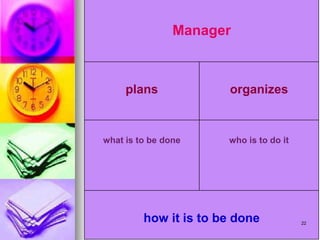
Manager
plans organizes
what is to be done who is to do it
how it is to be done 22
Nurse manager will have:
an appointed management position within
the organization with responsibilities to
perform administrative tasks:
◼ planning staffing requirements,
◼ performing employee performance
appraisals,
◼ controlling use of supplies and time,
◼ meeting budget and productivity goals.
23
Leadership Defined
Leadership is the ability to persuade others to
follow your direction, to motivate, to inspire, and
to instill vision and purpose.
Leadership combines:
◼ intrinsic personality traits,
◼ learned leadership skills,
◼ characteristics of the situation.
Leader -
◼ guides people and groups to
accomplish common goals,
◼ influences the beliefs, opinions, or
behaviors of a person, group, or
groups of people.
24
Nurse leader
◼ is able to inspire others on the health
care team to make patient education an
important aspect of all care activities.
Leadership qualities:
◼ unique personality characteristics,
◼ exceptional clinical expertise,
◼ relationships with others in the
organization.
25
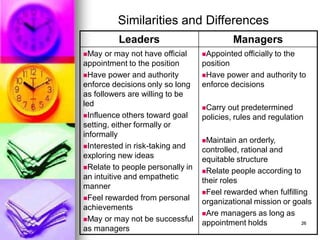
Leaders Managers
◼May or may not have official
appointment to the position
◼Have power and authority
enforce decisions only so long
as followers are willing to be
led
◼Influence others toward goal
setting, either formally or
informally
◼Interested in risk-taking and
exploring new ideas
◼Relate to people personally in
an intuitive and empathetic
manner
◼Feel rewarded from personal
achievements
◼May or may not be successful
as managers
◼Appointed officially to the
position
◼Have power and authority to
enforce decisions
◼Carry out predetermined
policies, rules and regulation
◼Maintain an orderly,
controlled, rational and
equitable structure
◼Relate people according to
their roles
◼Feel rewarded when fulfilling
organizational mission or goals
◼Are managers as long as
appointment holds
Similarities and Differences
26
LEADERSHIP AND MANAGEMENT
SKILLS AND BEHAVIORS
Hersey and Blanchard (1988) have identified that
effective leadership and management requires skills in
three major areas:
1. Technical skills—such as clinical expertise
and nursing knowledge.
2. Human skills—the ability and judgment to
work with people in an effective leadership
role.
3. Conceptual skills—the ability to understand
the complexities of the overall organization
and where one's own area of management
fits into the overall organization.
27
◼ MANAGEMENT SKILLS IN
NURSING
◼ 1. Conceptual
◼ 2. Interpersonal
◼ 3. Diagnostic
◼ 4. Technical Skills
◼ 5. Coach and Mentor Skills
28
Types and styles of Management
◼ Authoritarian management style
◼ Democratic management style
◼ Laissez-Faire management style
◼ Multicratic leadership
29
Types of Management
Authoritarian management style
◼ Autocratic
◼ Manager makes most of the decisions in isolation
◼ Found in bureaucratic organizations that reinforce
centrality of authority and reliance upon formal rules
◼ Managers issue orders and expect to be obeyed
◼ Authority derives from position power tied to official
hierarchical title
◼ Authoritarian managers will have subordinate support if
they are involved in overall goals and process
◼ Strong control is maintained
◼ Others are motivated by coercion
◼ Others are directed with command
◼ Communication is downwards
◼ “I” and “You”
◼ Punitive criticism 30
Types of Management
Authoritarian management style
Advantages
◼ Results to well-defined group actions
◼ Decision making can be done expeditiously
◼ Appropriate when immediate action is needed
◼ Authoritarian managers will have subordinate support if they
are involved in overall goals and process
Disadvantages
◼ Subordinates don’t have stake in achievement/failure of
management goals
◼ Employee may subvert goals
◼ Managers issue orders and expect to be obeyed
◼ Authority derives from position power tied to official
hierarchical title
31
Types of Management
Democratic Management Style
◼ Involves subordinates in decision making
◼ Democratic managers see themselves as
coworkers
◼ Stresses importance of communication and
consensus
◼ Promotes autonomy and growth
◼ Manager leads by providing information,
suggesting direction and being supportive of
coworkers
◼ Function best in less centralized and where
there is less reliance on formal rules and
policies
◼ Emphasis “We”
◼ Constructive criticism 32
Types of Management
Democratic management style
Advantages
◼ Coworkers are consulted
◼ Coworkers have input on decision making
◼ Employees are involved in all the processes prior to
decision making
◼ It is appropriate if decision at hand does not require
urgent action
Disadvantages
◼ Decision becomes lengthy process
◼ Coworkers not confident in participating in decision
making
◼ Employees may think manager is not capable to DM
◼ Employees think they are made to do something they are
not paid for
◼ If decision not implemented employees think their time is
33
Types of Management
Laissez-Faire
◼ Permissive management
◼ Least structure and control
◼ Requires coworkers to make own goals,
decisions
◼ Managers provide maximum support and
freedom for workers
◼ Provision of little or no direction
◼ Communication upward and downward
◼ DM is dispersed throughout group
◼ Criticism withheld
34
Types of Management
Laissez-Faire
Advantages
◼ Providing maximum support and freedom
◼ Allows practice of high levels of
independence
Disadvantages
◼ Not possible to let workers arrive at an
individual decisions about patient care
◼ Because of multidisciplinary care, decision
must be centralized
35
Types of Management
Multicratic
◼ One skill of a manager is
identifying which style a
particular situation requires
◼ Combines the best of all
approaches
◼ Provides maximum structure
when the situation requires
36
Levels of Management
◼ Top level managers
◼ Middle-level managers
◼ First-level managers
37
Levels of Management
Top level managers
◼ Looks at the whole organization
◼ Coordinate internal and external
influences
◼ Makes decisions with few
guidelines
38
Levels of Management
Responsibilities of top-level
managers
◼ Determining philosophy
◼ Setting policies
◼ Creating goals and priorities for
resource allocation
◼ Need great leadership, not part
of day-to-day operation
39
Levels of Management
Middle-level managers
◼ Coordinates effort of lower levels of
the hierarchy
◼ Conduit between lower and top-level
managers
◼ Carry out day-to-day operation
◼ Involved in long term planning
◼ Establishing unit policies
◼ Nurse supervisors, head nurse, unit
managers
40
Levels of Management
First-level managers
◼ Concerned with specific unit
workflow
◼ Deal with immediate problems in
daily operations
41

1 introduction to nursing management (1).pdf

  • 1.
    MANAGEMENT AND LEADERSHIP INNURSING Dr Ahmad Al-Nawafleh RN, MPA, CI, PhD alnawafleh@mutah.edu.jo 1
  • 2.
    House Rules ◼ Comeon time ◼ Come in complete uniform to practice setting ◼ All cell phones must be in your bags and in silent mode ◼ No gum during the class ◼ Strictly conforms to break time ◼ Come prepared (meaning read…read…read) ◼ Submit written assignment on time, late papers will lose 10% credit / day late ◼ Participate during discussion ◼ Talk when you have been recognized already 2
  • 3.
    Contents ◼ Definitions ◼ Definitionsof Nursing Leadership and Management ◼ Management Theories ◼ Types and styles of Management Levels of Management ◼ Leadership and Management Skills and Behaviors ◼ Management Functions ◼ Roles of the Nurse Manager 3
  • 4.
    What comes intomind when you talk about management? 4
  • 5.
    What comes intomind when you talk about management? People Processes Structure Function Policies Authority Organization Procedures Responsibility Communication Resources 5
  • 6.
    Key Concepts inManagement Planning Organizing Directing Controlling Staffing Budgeting Productivity Leadership Power Delegation Efficiency Effectiveness ❖Structure ❖Function ❖Authority ❖Accountability ❖Hierarchy 6
  • 7.
    - came fromthe word “to manage” (Henri Fayol) - to manage is to forecast and plan, to organize, to command, and to control Management is……  “getting things done in right way in right time by right persons with right amount of resources and with effective use of resources”.  process of working with and through others to achieve organizational objectives in a changing environment Management 7
  • 8.
    Importance of Management innursing ◼ to facilitate the act ◼ to achieve certain objective and goal ◼ to deliver quality nursing care to our patients 8
  • 9.
    What is NursingManagement? Relates to planning , organizing, staffing, directing and controlling the activities of a nursing enterprise or division of nursing departments and of the subunits of the departments 9
  • 10.
    Management Defined Management - ◼coordinates people, time, and supplies to achieve desired outcomes, ◼ involves problem-solving and decision- making processes. Managers responsibility: ◼ maintain control of the day-to-day operations, ◼ achieve established goals and objectives. 10
  • 11.
    11 Management Theories Frederick Taylor Lillianand Frank Gilbreth Henry Gantt Scientific Management Henri Fayol Max Weber Classic Organization Mary Parker Follett Elton Mayo Kurt Lewin Human Relation Abraham Maslow Frederick Herzberg Douglas McGregor William Ouchi Chris Argyris Rensis Likert Peter Drucker Behavioral Science
  • 12.
    12 Human Relations •focused onthe effect individuals have on the success or failure of organization •stresses the social environment •chief concerns are individuals, group process, interpersonal relations, leadership, and communication Scientific Management Theory • scientific procedures to solve managerial problems •focus on productivity and profit Behavioral Science •Emphasized a positive attitude towards people, training managers, meeting employees’ needs, and obtaining commitment through participation in planning and decision making Classic Organization o views the organization as a whole rather than focusing solely on production o managerial activities are classified as planning, organizing, and controlling
  • 13.
  • 14.
    ◼ Planning includesdefining goals and objectives, developing policies and procedures; determining resource allocation; and developing evaluation methods. ◼ Organizing includes identifying the management structure to accomplish work, determining communication processes, and coordinating people, time and work. ◼ Staffing includes those activities required to have qualified people accomplish work such as recruiting, hiring, training, scheduling and ongoing staff development. ◼ Directing encourages employees to accomplish goals and objectives and involves communicating, delegating, motivating, and managing conflict. ◼ Controlling analyzes results to evaluate accomplishments and includes evaluating employee performance, analyzing financial activities, and monitoring quality of care. 14
  • 15.
    Roles of theNurse Manager ❑ Customer Service Provider ❑ create an environment of caring ❑ Team Builder ❑ Resource Manager ❑ Decision Maker and ❑ Problem Solver ❑ Change Agent 15
  • 16.
    Customer Service Provider ◼Providing service or care to customers (patient or clients). ◼ Nurse must keep customer service first and foremost as the motivator of all plans and activities. ◼ Without customers, the organization will go out of business. ◼ The most important role is to create an environment of caring - caring for staff members as well as for patients and families. Staff members who believe that their manager sincerely cares about them and the work they do are able to pass that feeling of caring on to their patients and other customers. 16
  • 17.
    Caring for thestaff members can be demonstrated through (McNeese-Smith, 1997): ◼ Offering sincere positive recognition for both individuals and teams. ◼ Praising and giving thanks for a job well done. ◼ Spending time with staff members to reinforce positive work behaviors. ◼ Meeting the staff member's personal needs whenever possible, such as accommodating scheduling needs for family events and being flexible in times of illness. ◼ Providing guidance and support for professional and personal growth. ◼ Maintaining a positive, confident attitude and a pleasant work environment. 17
  • 18.
    Team Builder ◼ Ateam is a group of people organized to accomplish the necessary work of an organization. ◼ Teams have become important in the changing health care environment. ◼ Teams bring together a range of people with different knowledge, skills, and experiences to meet customer. 18
  • 19.
    Resource Manager ◼ Resourcesinclude the personnel, time, and supplies needed to accomplish the goals of the organization. ◼ Nurse manager has the responsibility - effectively manage resources in providing safe, effective patient care in an economic manner. The nurse is managing resources using three types of Budgets: 1. Personnel Allocates funds for salaries, overtime, benefits, staff development and training, and employee turnover costs 2. Operating budget Allocates funds for daily expenses such as utilities, repairs, maintenance, and patient care supplies 3. Capital budget Allocates funds for construction projects and/or long-life equipment such as cardiac monitors, defibrillators, and computer hardware; capital budget items are generally more expensive than operating supplies. 19
  • 20.
    Decision Maker andProblem Solver ◼ components of effective leadership and management in clinical patient care. ◼ Problem solving is focused on solving an immediate problem and ◼ decision maker includes a decision-making step. Nursing process = problem-solving process includes : ◼ assessment, ◼ analysis and diagnosis, ◼ planning, ◼ implementation, ◼ evaluation; ◼ has proven to be effective to manage the complex decisions. 20
  • 21.
    The nurse -change agent ◼ is responsible for guiding people ◼ through the change process and needs ◼ to develop an understanding about the nature of change and effective change strategies. 1. Change should be implemented only for good reason. 2. Change should always be planned and implemented gradually. 3. Change should never be unexpected or abrupt. 4. All people who may be affected by the change should be involved in planning for the change. 21
  • 22.
    Manager plans organizes what isto be done who is to do it how it is to be done 22
  • 23.
    Nurse manager willhave: an appointed management position within the organization with responsibilities to perform administrative tasks: ◼ planning staffing requirements, ◼ performing employee performance appraisals, ◼ controlling use of supplies and time, ◼ meeting budget and productivity goals. 23
  • 24.
    Leadership Defined Leadership isthe ability to persuade others to follow your direction, to motivate, to inspire, and to instill vision and purpose. Leadership combines: ◼ intrinsic personality traits, ◼ learned leadership skills, ◼ characteristics of the situation. Leader - ◼ guides people and groups to accomplish common goals, ◼ influences the beliefs, opinions, or behaviors of a person, group, or groups of people. 24
  • 25.
    Nurse leader ◼ isable to inspire others on the health care team to make patient education an important aspect of all care activities. Leadership qualities: ◼ unique personality characteristics, ◼ exceptional clinical expertise, ◼ relationships with others in the organization. 25
  • 26.
    Leaders Managers ◼May ormay not have official appointment to the position ◼Have power and authority enforce decisions only so long as followers are willing to be led ◼Influence others toward goal setting, either formally or informally ◼Interested in risk-taking and exploring new ideas ◼Relate to people personally in an intuitive and empathetic manner ◼Feel rewarded from personal achievements ◼May or may not be successful as managers ◼Appointed officially to the position ◼Have power and authority to enforce decisions ◼Carry out predetermined policies, rules and regulation ◼Maintain an orderly, controlled, rational and equitable structure ◼Relate people according to their roles ◼Feel rewarded when fulfilling organizational mission or goals ◼Are managers as long as appointment holds Similarities and Differences 26
  • 27.
    LEADERSHIP AND MANAGEMENT SKILLSAND BEHAVIORS Hersey and Blanchard (1988) have identified that effective leadership and management requires skills in three major areas: 1. Technical skills—such as clinical expertise and nursing knowledge. 2. Human skills—the ability and judgment to work with people in an effective leadership role. 3. Conceptual skills—the ability to understand the complexities of the overall organization and where one's own area of management fits into the overall organization. 27
  • 28.
    ◼ MANAGEMENT SKILLSIN NURSING ◼ 1. Conceptual ◼ 2. Interpersonal ◼ 3. Diagnostic ◼ 4. Technical Skills ◼ 5. Coach and Mentor Skills 28
  • 29.
    Types and stylesof Management ◼ Authoritarian management style ◼ Democratic management style ◼ Laissez-Faire management style ◼ Multicratic leadership 29
  • 30.
    Types of Management Authoritarianmanagement style ◼ Autocratic ◼ Manager makes most of the decisions in isolation ◼ Found in bureaucratic organizations that reinforce centrality of authority and reliance upon formal rules ◼ Managers issue orders and expect to be obeyed ◼ Authority derives from position power tied to official hierarchical title ◼ Authoritarian managers will have subordinate support if they are involved in overall goals and process ◼ Strong control is maintained ◼ Others are motivated by coercion ◼ Others are directed with command ◼ Communication is downwards ◼ “I” and “You” ◼ Punitive criticism 30
  • 31.
    Types of Management Authoritarianmanagement style Advantages ◼ Results to well-defined group actions ◼ Decision making can be done expeditiously ◼ Appropriate when immediate action is needed ◼ Authoritarian managers will have subordinate support if they are involved in overall goals and process Disadvantages ◼ Subordinates don’t have stake in achievement/failure of management goals ◼ Employee may subvert goals ◼ Managers issue orders and expect to be obeyed ◼ Authority derives from position power tied to official hierarchical title 31
  • 32.
    Types of Management DemocraticManagement Style ◼ Involves subordinates in decision making ◼ Democratic managers see themselves as coworkers ◼ Stresses importance of communication and consensus ◼ Promotes autonomy and growth ◼ Manager leads by providing information, suggesting direction and being supportive of coworkers ◼ Function best in less centralized and where there is less reliance on formal rules and policies ◼ Emphasis “We” ◼ Constructive criticism 32
  • 33.
    Types of Management Democraticmanagement style Advantages ◼ Coworkers are consulted ◼ Coworkers have input on decision making ◼ Employees are involved in all the processes prior to decision making ◼ It is appropriate if decision at hand does not require urgent action Disadvantages ◼ Decision becomes lengthy process ◼ Coworkers not confident in participating in decision making ◼ Employees may think manager is not capable to DM ◼ Employees think they are made to do something they are not paid for ◼ If decision not implemented employees think their time is 33
  • 34.
    Types of Management Laissez-Faire ◼Permissive management ◼ Least structure and control ◼ Requires coworkers to make own goals, decisions ◼ Managers provide maximum support and freedom for workers ◼ Provision of little or no direction ◼ Communication upward and downward ◼ DM is dispersed throughout group ◼ Criticism withheld 34
  • 35.
    Types of Management Laissez-Faire Advantages ◼Providing maximum support and freedom ◼ Allows practice of high levels of independence Disadvantages ◼ Not possible to let workers arrive at an individual decisions about patient care ◼ Because of multidisciplinary care, decision must be centralized 35
  • 36.
    Types of Management Multicratic ◼One skill of a manager is identifying which style a particular situation requires ◼ Combines the best of all approaches ◼ Provides maximum structure when the situation requires 36
  • 37.
    Levels of Management ◼Top level managers ◼ Middle-level managers ◼ First-level managers 37
  • 38.
    Levels of Management Toplevel managers ◼ Looks at the whole organization ◼ Coordinate internal and external influences ◼ Makes decisions with few guidelines 38
  • 39.
    Levels of Management Responsibilitiesof top-level managers ◼ Determining philosophy ◼ Setting policies ◼ Creating goals and priorities for resource allocation ◼ Need great leadership, not part of day-to-day operation 39
  • 40.
    Levels of Management Middle-levelmanagers ◼ Coordinates effort of lower levels of the hierarchy ◼ Conduit between lower and top-level managers ◼ Carry out day-to-day operation ◼ Involved in long term planning ◼ Establishing unit policies ◼ Nurse supervisors, head nurse, unit managers 40
  • 41.
    Levels of Management First-levelmanagers ◼ Concerned with specific unit workflow ◼ Deal with immediate problems in daily operations 41