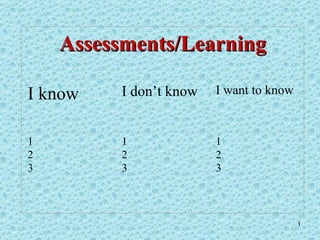
Assessments/Learning I know I don’t know I want to know 1 2 3 1 2 3 1 2 3
Developing and Using Classroom Assessments Fourth Edition Albert Oosterhof
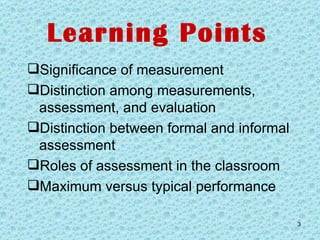
Learning Points Significance of measurement Distinction among measurements, assessment, and evaluation Distinction between formal and informal assessment Roles of assessment in the classroom Maximum versus typical performance
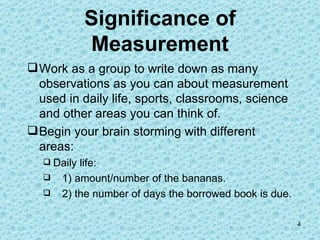
Significance of Measurement Work as a group to write down as many observations as you can about measurement used in daily life, sports, classrooms, science and other areas you can think of. Begin your brain storming with different areas: Daily life:  1) amount/number of the bananas.   2) the number of days the borrowed book is due.
Significance of Measurement,  Definitions of “measure” (verb) includes:  Determine the characteristics of something Regulation through the use of a standard and  Make comparisons to a reference such as the performance of others. Analyze two of the measurement examples you come up with.
Measurement, Assessment, and Evaluation Measurement - establishing characteristic of individuals or group of individuals Evaluation - combining our measures with other information to establish the desirability and importance of what we have observed. Measurement and assessment are more interchangeable.
Refer to page 2 and 3 for pairs of examples of  measurement and evaluation. Make a pair of examples of measurement and evaluation
How to you compare things? Choose two or three things.  Decide what characteristics to compare. Find to similarities and differences. Use a comparison matrix (table) to record the information.
How Would You Compare…. Formal  & informal assessments?
Roles of Assessment in the Classroom Preliminary evaluation Formative evaluation Summative evaluation Diagnostic evaluation
Use Any Way to Present:  Preliminary evaluation Formative evaluation Summative evaluation Diagnostic evaluation Each group will work on one term by using monologue, role-play, interview between a journalist and education expert, or any methods that fit the definition of the term.
With what type of evaluation are f ormal  assessments most commonly associated? A.       Diagnostic B.       Formative C.       Preliminary D.       Summative Summative
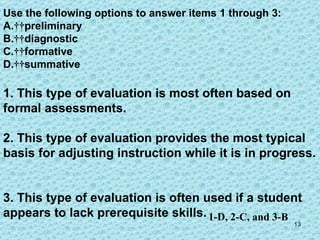
Use the following options to answer items 1 through 3:  A.    preliminary  B.    diagnostic C.    formative D.    summative 1. This type of evaluation is most often based on formal assessments. 2. This type of evaluation provides the most typical basis for adjusting instruction while it is in progress.  3. This type of evaluation is often used if a student appears to lack prerequisite skills.  1-D, 2-C, and 3-B
Maximum vs. Typical Performance Maximum performance Typical performance (attitude)
Reflection One thing you learned. One thing you feel puzzled about.

1 Introduction

  • 1.
      Assessments/Learning Iknow I don’t know I want to know 1 2 3 1 2 3 1 2 3
  • 2.
    Developing and UsingClassroom Assessments Fourth Edition Albert Oosterhof
  • 3.
    Learning Points Significanceof measurement Distinction among measurements, assessment, and evaluation Distinction between formal and informal assessment Roles of assessment in the classroom Maximum versus typical performance
  • 4.
    Significance of MeasurementWork as a group to write down as many observations as you can about measurement used in daily life, sports, classrooms, science and other areas you can think of. Begin your brain storming with different areas: Daily life: 1) amount/number of the bananas. 2) the number of days the borrowed book is due.
  • 5.
    Significance of Measurement, Definitions of “measure” (verb) includes: Determine the characteristics of something Regulation through the use of a standard and Make comparisons to a reference such as the performance of others. Analyze two of the measurement examples you come up with.
  • 6.
    Measurement, Assessment, andEvaluation Measurement - establishing characteristic of individuals or group of individuals Evaluation - combining our measures with other information to establish the desirability and importance of what we have observed. Measurement and assessment are more interchangeable.
  • 7.
    Refer to page2 and 3 for pairs of examples of measurement and evaluation. Make a pair of examples of measurement and evaluation
  • 8.
    How to youcompare things? Choose two or three things. Decide what characteristics to compare. Find to similarities and differences. Use a comparison matrix (table) to record the information.
  • 9.
    How Would YouCompare…. Formal & informal assessments?
  • 10.
    Roles of Assessmentin the Classroom Preliminary evaluation Formative evaluation Summative evaluation Diagnostic evaluation
  • 11.
    Use Any Wayto Present: Preliminary evaluation Formative evaluation Summative evaluation Diagnostic evaluation Each group will work on one term by using monologue, role-play, interview between a journalist and education expert, or any methods that fit the definition of the term.
  • 12.
    With what typeof evaluation are f ormal assessments most commonly associated? A.       Diagnostic B.       Formative C.       Preliminary D.       Summative Summative
  • 13.
    Use the followingoptions to answer items 1 through 3: A.    preliminary B.    diagnostic C.    formative D.    summative 1. This type of evaluation is most often based on formal assessments. 2. This type of evaluation provides the most typical basis for adjusting instruction while it is in progress. 3. This type of evaluation is often used if a student appears to lack prerequisite skills. 1-D, 2-C, and 3-B
  • 14.
    Maximum vs. TypicalPerformance Maximum performance Typical performance (attitude)
  • 15.
    Reflection One thingyou learned. One thing you feel puzzled about.