15B1WCI731
Android Operating System
Windows Operating System
Android Operating System
Windows Operating System
Cellular Networks
Android Operating System
Windows Operating System
Cellular Networks
Mobile IP
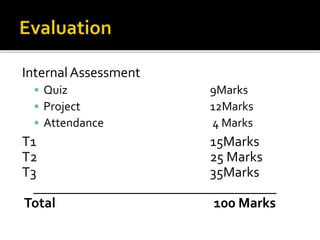
InternalAssessment
 Quiz 9Marks
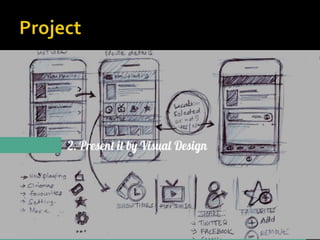
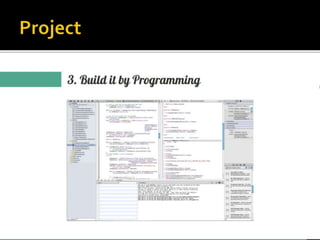
 Project 12Marks
 Attendance 4 Marks
T1 15Marks
T2 25 Marks
T3 35Marks
___________________________________
Total 100 Marks
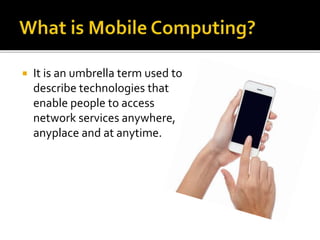
 It is an umbrella term used to
describe technologies that
enable people to access
network services anywhere,
anyplace and at anytime.
 User mobility
 Between different geographical locations
 Between different networks
 Between different communication devices
 Between different applications
 Device portability
 Between different geographical locations
 Between different networks
 Mobile Computing is a generic term describing the
application of small, portable, and wireless computing
and communication devices.This includes devices like
laptops with wireless LAN technology, mobile phones,
wearable computers and Personal Digital Assistants
(PDAs) with Bluetooth or IRDA interfaces, and USB flash
drives.
 Ubiquitous computing (ubicomp, or sometimes
ubiqcomp) integrates computation into the
environment, rather than having computers which are
distinct objects. Another term for ubiquitous computing
is pervasive computing. Promoters of this idea hope
that embedding computation into the environment
would enable people to move around and interact with
computers more naturally than they currently do.
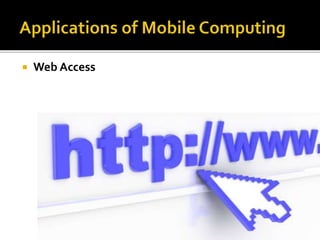
 Web Access
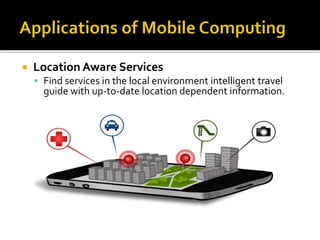
 Location Aware Services
 Find services in the local environment intelligent travel
guide with up-to-date location dependent information.
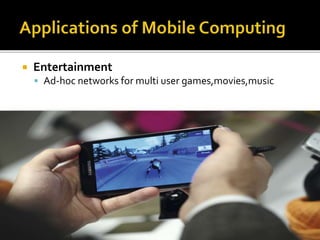
 Entertainment
 Ad-hoc networks for multi user games,movies,music
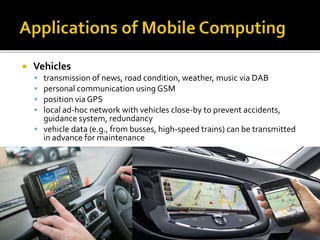
 Vehicles
 transmission of news, road condition, weather, music via DAB
 personal communication using GSM
 position via GPS
 local ad-hoc network with vehicles close-by to prevent accidents,
guidance system, redundancy
 vehicle data (e.g., from busses, high-speed trains) can be transmitted
in advance for maintenance
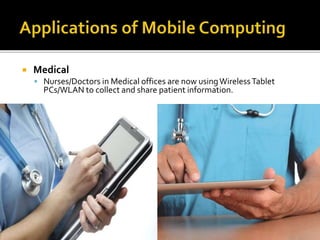
 Medical
 Nurses/Doctors in Medical offices are now usingWirelessTablet
PCs/WLAN to collect and share patient information.
 Sales
 Sales representatives are usingTablet PCs with Smart phones for
presentation, transmitting/access information among office, hotel,
and customer location.
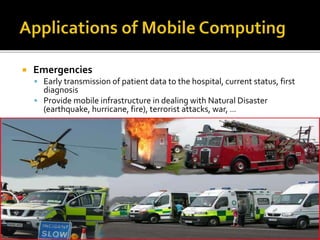
 Emergencies
 Early transmission of patient data to the hospital, current status, first
diagnosis
 Provide mobile infrastructure in dealing with Natural Disaster
(earthquake, hurricane, fire), terrorist attacks, war, ...
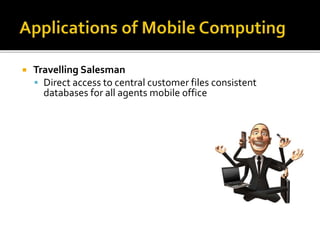
 Travelling Salesman
 Direct access to central customer files consistent
databases for all agents mobile office
 Resource constraints: Battery
 Interference: the quality of service (QoS)
 Bandwidth: connection latency
 Dynamic changes in communication environment: variations in signal
power within a region, thus link delays and connection losses
 Network Issues: discovery of the connection-service to destination and
connection stability
 Interoperability issues: the varying protocol standards
 Security constraints: Protocols conserving privacy of communication
 Pervasive Computing:Vision and Challenges,
M. Satyanarayanan,Carnegie Mellon
University, IEEE Personal Communications,
August 2001

1 introduction

  • 1.
  • 10.
  • 11.
  • 12.
    Android Operating System WindowsOperating System Cellular Networks
  • 13.
    Android Operating System WindowsOperating System Cellular Networks Mobile IP
  • 14.
    InternalAssessment  Quiz 9Marks Project 12Marks  Attendance 4 Marks T1 15Marks T2 25 Marks T3 35Marks ___________________________________ Total 100 Marks
  • 19.
     It isan umbrella term used to describe technologies that enable people to access network services anywhere, anyplace and at anytime.
  • 20.
     User mobility Between different geographical locations  Between different networks  Between different communication devices  Between different applications
  • 21.
     Device portability Between different geographical locations  Between different networks
  • 22.
     Mobile Computingis a generic term describing the application of small, portable, and wireless computing and communication devices.This includes devices like laptops with wireless LAN technology, mobile phones, wearable computers and Personal Digital Assistants (PDAs) with Bluetooth or IRDA interfaces, and USB flash drives.
  • 23.
     Ubiquitous computing(ubicomp, or sometimes ubiqcomp) integrates computation into the environment, rather than having computers which are distinct objects. Another term for ubiquitous computing is pervasive computing. Promoters of this idea hope that embedding computation into the environment would enable people to move around and interact with computers more naturally than they currently do.
  • 24.
  • 25.
     Location AwareServices  Find services in the local environment intelligent travel guide with up-to-date location dependent information.
  • 26.
     Entertainment  Ad-hocnetworks for multi user games,movies,music
  • 27.
     Vehicles  transmissionof news, road condition, weather, music via DAB  personal communication using GSM  position via GPS  local ad-hoc network with vehicles close-by to prevent accidents, guidance system, redundancy  vehicle data (e.g., from busses, high-speed trains) can be transmitted in advance for maintenance
  • 28.
     Medical  Nurses/Doctorsin Medical offices are now usingWirelessTablet PCs/WLAN to collect and share patient information.
  • 29.
     Sales  Salesrepresentatives are usingTablet PCs with Smart phones for presentation, transmitting/access information among office, hotel, and customer location.
  • 30.
     Emergencies  Earlytransmission of patient data to the hospital, current status, first diagnosis  Provide mobile infrastructure in dealing with Natural Disaster (earthquake, hurricane, fire), terrorist attacks, war, ...
  • 31.
     Travelling Salesman Direct access to central customer files consistent databases for all agents mobile office
  • 32.
     Resource constraints:Battery  Interference: the quality of service (QoS)  Bandwidth: connection latency  Dynamic changes in communication environment: variations in signal power within a region, thus link delays and connection losses  Network Issues: discovery of the connection-service to destination and connection stability  Interoperability issues: the varying protocol standards  Security constraints: Protocols conserving privacy of communication
  • 33.
     Pervasive Computing:Visionand Challenges, M. Satyanarayanan,Carnegie Mellon University, IEEE Personal Communications, August 2001