HPLC Column Selection Companion
Flow chart for ZORBAX HPLC Columns Selection
for Small and Large Molecules
Most chromatographers use reversed-phase HPLC as one of their key analysis techniques.
Reversed-phase HPLC can be used to analyze ionic and nonionic analytes. Therefore this
ZORBAX Column Selection Flow Chart will focus on reversed-phase columns. To more easily
select a reversed-phase column for method development of small and large molecules, follow
the outline on these pages.
This flow chart provides information on choosing an initial column for method development
of small molecule and protein and peptide samples, and includes decisions on bonded phase
and column configuration.
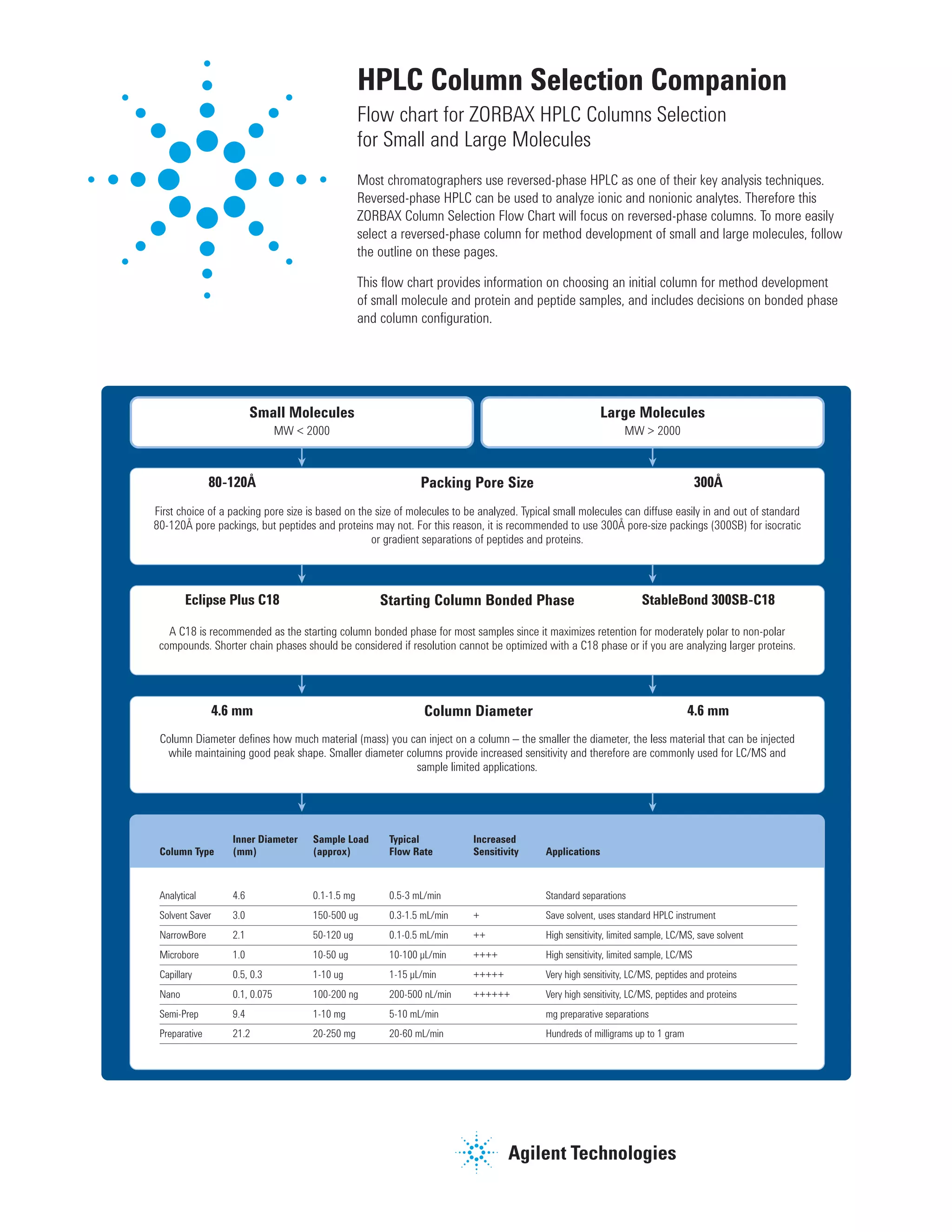
First choice of a packing pore size is based on the size of molecules to be analyzed. Typical small molecules can diffuse easily in and out of standard
80-120Å pore packings, but peptides and proteins may not. For this reason, it is recommended to use 300Å pore-size packings (300SB) for isocratic
or gradient separations of peptides and proteins.
A C18 is recommended as the starting column bonded phase for most samples since it maximizes retention for moderately polar to non-polar
compounds. Shorter chain phases should be considered if resolution cannot be optimized with a C18 phase or if you are analyzing larger proteins.
Column Diameter defines how much material (mass) you can inject on a column – the smaller the diameter, the less material that can be injected
while maintaining good peak shape. Smaller diameter columns provide increased sensitivity and therefore are commonly used for LC/MS and
sample limited applications.
Column Type
Inner Diameter
(mm)
Sample Load
(approx)
Typical
Flow Rate
Increased
Sensitivity Applications
Analytical 4.6 0.1-1.5 mg 0.5-3 mL/min Standard separations
Solvent Saver 3.0 150-500 ug 0.3-1.5 mL/min + Save solvent, uses standard HPLC instrument
NarrowBore 2.1 50-120 ug 0.1-0.5 mL/min ++ High sensitivity, limited sample, LC/MS, save solvent
Microbore 1.0 10-50 ug 10-100 µL/min ++++ High sensitivity, limited sample, LC/MS
Capillary 0.5, 0.3 1-10 ug 1-15 µL/min +++++ Very high sensitivity, LC/MS, peptides and proteins
Nano 0.1, 0.075 100-200 ng 200-500 nL/min ++++++ Very high sensitivity, LC/MS, peptides and proteins
Semi-Prep 9.4 1-10 mg 5-10 mL/min mg preparative separations
Preparative 21.2 20-250 mg 20-60 mL/min Hundreds of milligrams up to 1 gram
Small Molecules
MW < 2000
Large Molecules
MW > 2000
Packing Pore Size 300Å
Eclipse Plus C18 Starting Column Bonded Phase StableBond 300SB-C18
4.6 mm Column Diameter 4.6 mm
80-120Å
Information, descriptions, and specifications
in this publication are subject to change without notice.
© Agilent Technologies, Inc. 2007
Printed in the USA July 2, 2007
5989-7061EN
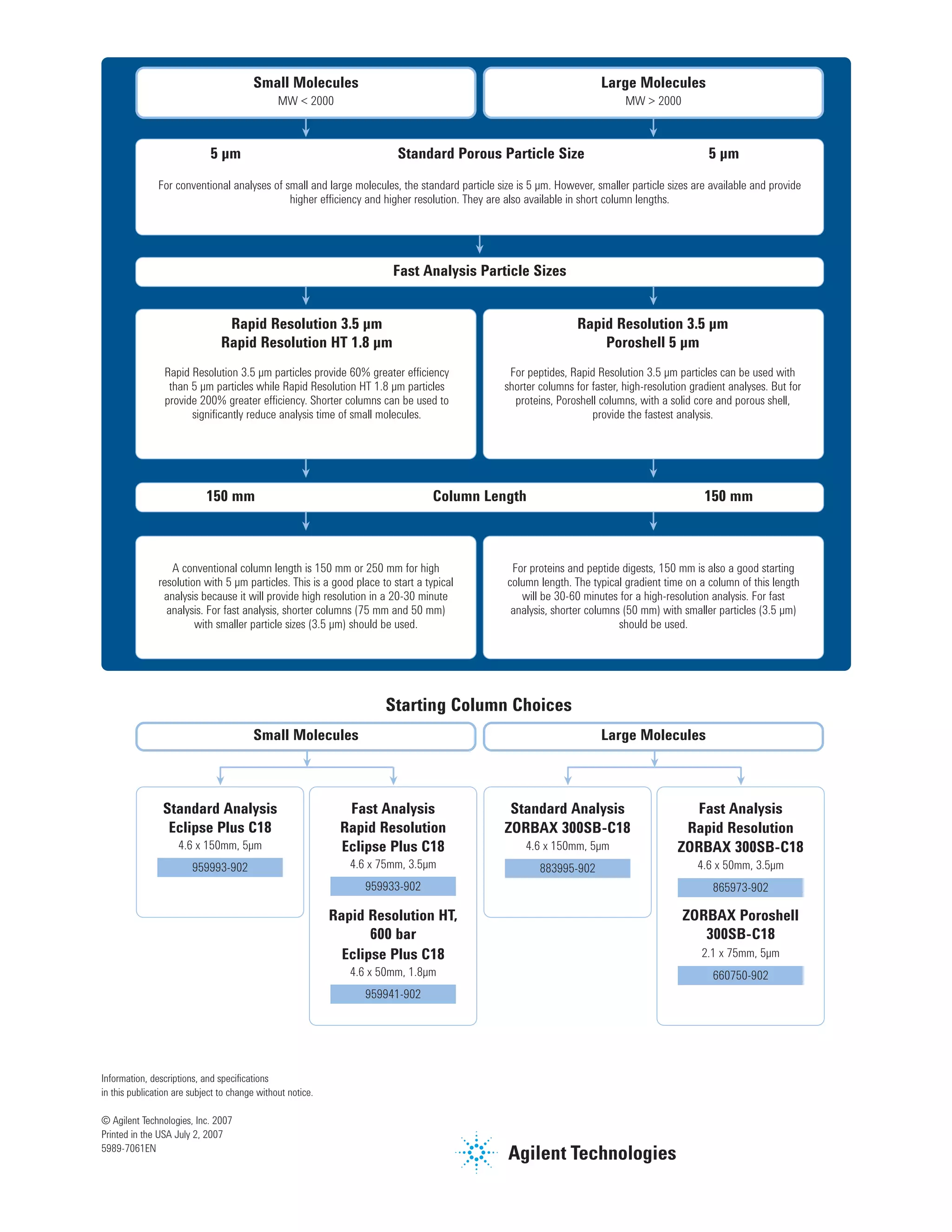
Starting Column Choices
Small Molecules
MW < 2000
Large Molecules
MW > 2000
5 µm Standard Porous Particle Size 5 µm
For conventional analyses of small and large molecules, the standard particle size is 5 µm. However, smaller particle sizes are available and provide
higher efficiency and higher resolution. They are also available in short column lengths.
Fast Analysis Particle Sizes
Rapid Resolution 3.5 µm
Rapid Resolution HT 1.8 µm
Rapid Resolution 3.5 µm particles provide 60% greater efficiency
than 5 µm particles while Rapid Resolution HT 1.8 µm particles
provide 200% greater efficiency. Shorter columns can be used to
significantly reduce analysis time of small molecules.
Rapid Resolution 3.5 µm
Poroshell 5 µm
For peptides, Rapid Resolution 3.5 µm particles can be used with
shorter columns for faster, high-resolution gradient analyses. But for
proteins, Poroshell columns, with a solid core and porous shell,
provide the fastest analysis.
150 mm Column Length 150 mm
A conventional column length is 150 mm or 250 mm for high
resolution with 5 µm particles. This is a good place to start a typical
analysis because it will provide high resolution in a 20-30 minute
analysis. For fast analysis, shorter columns (75 mm and 50 mm)
with smaller particle sizes (3.5 µm) should be used.
For proteins and peptide digests, 150 mm is also a good starting
column length. The typical gradient time on a column of this length
will be 30-60 minutes for a high-resolution analysis. For fast
analysis, shorter columns (50 mm) with smaller particles (3.5 µm)
should be used.
Small Molecules
Standard Analysis
Eclipse Plus C18
4.6 x 150mm, 5µm
959993-902
Fast Analysis
Rapid Resolution
Eclipse Plus C18
4.6 x 75mm, 3.5µm
959933-902
Rapid Resolution HT,
600 bar
Eclipse Plus C18
4.6 x 50mm, 1.8µm
959941-902
Large Molecules
Standard Analysis
ZORBAX 300SB-C18
4.6 x 150mm, 5µm
883995-902
Fast Analysis
Rapid Resolution
ZORBAX 300SB-C18
4.6 x 50mm, 3.5µm
865973-902
ZORBAX Poroshell
300SB-C18
2.1 x 75mm, 5µm
660750-902

1 hplc columnselectionshort

  • 1.
    HPLC Column SelectionCompanion Flow chart for ZORBAX HPLC Columns Selection for Small and Large Molecules Most chromatographers use reversed-phase HPLC as one of their key analysis techniques. Reversed-phase HPLC can be used to analyze ionic and nonionic analytes. Therefore this ZORBAX Column Selection Flow Chart will focus on reversed-phase columns. To more easily select a reversed-phase column for method development of small and large molecules, follow the outline on these pages. This flow chart provides information on choosing an initial column for method development of small molecule and protein and peptide samples, and includes decisions on bonded phase and column configuration. First choice of a packing pore size is based on the size of molecules to be analyzed. Typical small molecules can diffuse easily in and out of standard 80-120Å pore packings, but peptides and proteins may not. For this reason, it is recommended to use 300Å pore-size packings (300SB) for isocratic or gradient separations of peptides and proteins. A C18 is recommended as the starting column bonded phase for most samples since it maximizes retention for moderately polar to non-polar compounds. Shorter chain phases should be considered if resolution cannot be optimized with a C18 phase or if you are analyzing larger proteins. Column Diameter defines how much material (mass) you can inject on a column – the smaller the diameter, the less material that can be injected while maintaining good peak shape. Smaller diameter columns provide increased sensitivity and therefore are commonly used for LC/MS and sample limited applications. Column Type Inner Diameter (mm) Sample Load (approx) Typical Flow Rate Increased Sensitivity Applications Analytical 4.6 0.1-1.5 mg 0.5-3 mL/min Standard separations Solvent Saver 3.0 150-500 ug 0.3-1.5 mL/min + Save solvent, uses standard HPLC instrument NarrowBore 2.1 50-120 ug 0.1-0.5 mL/min ++ High sensitivity, limited sample, LC/MS, save solvent Microbore 1.0 10-50 ug 10-100 µL/min ++++ High sensitivity, limited sample, LC/MS Capillary 0.5, 0.3 1-10 ug 1-15 µL/min +++++ Very high sensitivity, LC/MS, peptides and proteins Nano 0.1, 0.075 100-200 ng 200-500 nL/min ++++++ Very high sensitivity, LC/MS, peptides and proteins Semi-Prep 9.4 1-10 mg 5-10 mL/min mg preparative separations Preparative 21.2 20-250 mg 20-60 mL/min Hundreds of milligrams up to 1 gram Small Molecules MW < 2000 Large Molecules MW > 2000 Packing Pore Size 300Å Eclipse Plus C18 Starting Column Bonded Phase StableBond 300SB-C18 4.6 mm Column Diameter 4.6 mm 80-120Å
  • 2.
    Information, descriptions, andspecifications in this publication are subject to change without notice. © Agilent Technologies, Inc. 2007 Printed in the USA July 2, 2007 5989-7061EN Starting Column Choices Small Molecules MW < 2000 Large Molecules MW > 2000 5 µm Standard Porous Particle Size 5 µm For conventional analyses of small and large molecules, the standard particle size is 5 µm. However, smaller particle sizes are available and provide higher efficiency and higher resolution. They are also available in short column lengths. Fast Analysis Particle Sizes Rapid Resolution 3.5 µm Rapid Resolution HT 1.8 µm Rapid Resolution 3.5 µm particles provide 60% greater efficiency than 5 µm particles while Rapid Resolution HT 1.8 µm particles provide 200% greater efficiency. Shorter columns can be used to significantly reduce analysis time of small molecules. Rapid Resolution 3.5 µm Poroshell 5 µm For peptides, Rapid Resolution 3.5 µm particles can be used with shorter columns for faster, high-resolution gradient analyses. But for proteins, Poroshell columns, with a solid core and porous shell, provide the fastest analysis. 150 mm Column Length 150 mm A conventional column length is 150 mm or 250 mm for high resolution with 5 µm particles. This is a good place to start a typical analysis because it will provide high resolution in a 20-30 minute analysis. For fast analysis, shorter columns (75 mm and 50 mm) with smaller particle sizes (3.5 µm) should be used. For proteins and peptide digests, 150 mm is also a good starting column length. The typical gradient time on a column of this length will be 30-60 minutes for a high-resolution analysis. For fast analysis, shorter columns (50 mm) with smaller particles (3.5 µm) should be used. Small Molecules Standard Analysis Eclipse Plus C18 4.6 x 150mm, 5µm 959993-902 Fast Analysis Rapid Resolution Eclipse Plus C18 4.6 x 75mm, 3.5µm 959933-902 Rapid Resolution HT, 600 bar Eclipse Plus C18 4.6 x 50mm, 1.8µm 959941-902 Large Molecules Standard Analysis ZORBAX 300SB-C18 4.6 x 150mm, 5µm 883995-902 Fast Analysis Rapid Resolution ZORBAX 300SB-C18 4.6 x 50mm, 3.5µm 865973-902 ZORBAX Poroshell 300SB-C18 2.1 x 75mm, 5µm 660750-902