Digital Printing: Mass Customization R.B.Chavan Department ofTextile Technology Indian Institute of Technology Hauz-Khas, New Delhi 110016
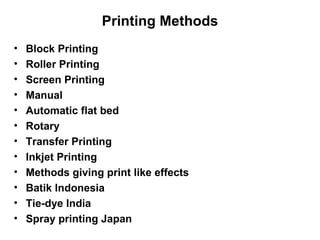
Printing Methods Block Printing Roller Printing Screen Printing Manual Automatic flat bed Rotary Transfer Printing Inkjet Printing Methods giving print like effects Batik Indonesia Tie-dye India Spray printing Japan
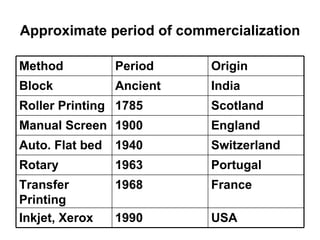
Approximate period of commercialization  USA 1990 Inkjet, Xerox France 1968 Transfer Printing Portugal 1963 Rotary Switzerland 1940 Auto. Flat bed England 1900 Manual Screen Scotland 1785 Roller Printing India Ancient Block Origin Period Method
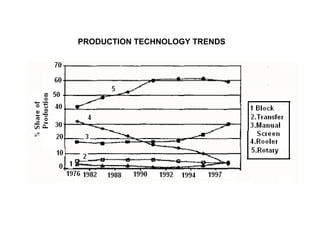
PRODUCTION TECHNOLOGY TRENDS
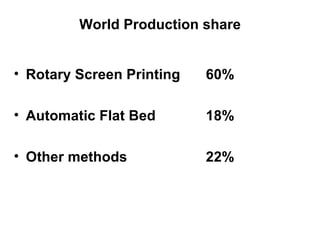
World Production share Rotary Screen Printing 60% Automatic Flat Bed 18% Other methods 22%
Heritage based Technologies Block Printing   Tie-dye Batik Spray/Stencil Human skill based Nation’s pride  Non replaceable Unlimited life
Science based Technologies Roller printing Screen printing: Flat bed, Rotary Transfer printing Machine based Replaceable Limited life
Textile printing methods yet to be commercialized  Inkjet printing Xerox printing
Textile Printing Trends Fashion dependent Shorter fashion seasons,  5-6 fashion forecasts in a year.  Customers  demand for  unique designs with variety of colours  Rapid drop in Average run lengths. Rare  chances of repeat orders. There has to be quick sampling and quick  production delivery World scenario: Globalization, quick response  and reduced environment pollution Market demands: flexibility and versatility. Technology which will facilitate Mass Customization.  production which specializes in short runs as little as one unit.  production of  unlimited designs of customer’s choice.
Present Trend  Demand Activated Manufacturing Architecht Just in Time sales and marketing concepts The textile printing must respond to the delivery of high quality fashion designs with wide range of colour combinations in extremely short time The process must be eco-friendly
Rotary screen printing status Although Rotary screen printing machines are most suited for production runs they are not ideal to meet the requirements of Demand activated manufacturing architecht and just in time concepts
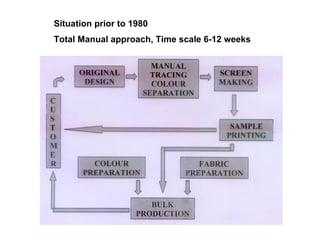
Situation prior to 1980 Total Manual approach, Time scale 6-12 weeks
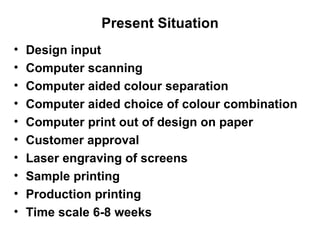
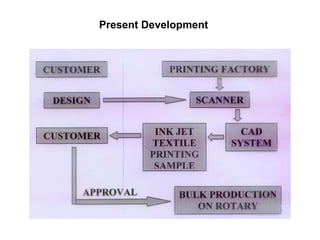
Present Situation Design input Computer scanning Computer aided colour separation Computer aided choice of colour combination Computer print out of design on paper Customer approval Laser engraving of screens  Sample printing Production printing Time scale 6-8 weeks
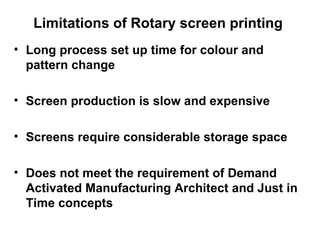
Limitations of Rotary screen printing  Long process set up time for colour and pattern change Screen production is slow and expensive Screens require considerable storage space Does not meet the requirement of Demand Activated Manufacturing Architect and Just in Time concepts
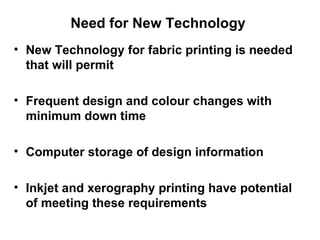
Need for New Technology  New Technology for fabric printing is needed that will permit  Frequent design and colour changes with minimum down time Computer storage of design information Inkjet and xerography printing have potential of meeting these requirements
Present Development
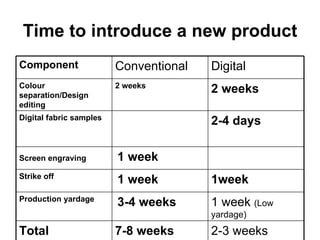
Time to introduce a new product 2-3 weeks 7-8 weeks   Total   1 week  (Low yardage) 3-4 weeks Production yardage   1week   1 week Strike off   1 week   Screen engraving   2-4 days Digital fabric samples  2 weeks 2 weeks  Colour separation/Design editing  Digital Conventional  Component
Future Development  With the current speed of technology advancement the use of inkjet printing will not only be restricted to sample printing.  Further into future lie the prospects of semi-bulk production and  eventually full scale production  thus replacing Rotary screen printing technology
Future Development It is envisaged that a customer instead of purchasing a printed fabric available in the stores View the design collections on computer Select the design and colour combination  OR Create new design Load the information to the printer Get printed length of fabric with design of  choice

1. digital printing mass customization

  • 1.
    Digital Printing: MassCustomization R.B.Chavan Department ofTextile Technology Indian Institute of Technology Hauz-Khas, New Delhi 110016
  • 2.
    Printing Methods BlockPrinting Roller Printing Screen Printing Manual Automatic flat bed Rotary Transfer Printing Inkjet Printing Methods giving print like effects Batik Indonesia Tie-dye India Spray printing Japan
  • 3.
    Approximate period ofcommercialization USA 1990 Inkjet, Xerox France 1968 Transfer Printing Portugal 1963 Rotary Switzerland 1940 Auto. Flat bed England 1900 Manual Screen Scotland 1785 Roller Printing India Ancient Block Origin Period Method
  • 4.
  • 5.
    World Production shareRotary Screen Printing 60% Automatic Flat Bed 18% Other methods 22%
  • 6.
    Heritage based TechnologiesBlock Printing Tie-dye Batik Spray/Stencil Human skill based Nation’s pride Non replaceable Unlimited life
  • 7.
    Science based TechnologiesRoller printing Screen printing: Flat bed, Rotary Transfer printing Machine based Replaceable Limited life
  • 8.
    Textile printing methodsyet to be commercialized Inkjet printing Xerox printing
  • 9.
    Textile Printing TrendsFashion dependent Shorter fashion seasons, 5-6 fashion forecasts in a year. Customers demand for unique designs with variety of colours Rapid drop in Average run lengths. Rare chances of repeat orders. There has to be quick sampling and quick production delivery World scenario: Globalization, quick response and reduced environment pollution Market demands: flexibility and versatility. Technology which will facilitate Mass Customization. production which specializes in short runs as little as one unit. production of unlimited designs of customer’s choice.
  • 10.
    Present Trend Demand Activated Manufacturing Architecht Just in Time sales and marketing concepts The textile printing must respond to the delivery of high quality fashion designs with wide range of colour combinations in extremely short time The process must be eco-friendly
  • 11.
    Rotary screen printingstatus Although Rotary screen printing machines are most suited for production runs they are not ideal to meet the requirements of Demand activated manufacturing architecht and just in time concepts
  • 12.
    Situation prior to1980 Total Manual approach, Time scale 6-12 weeks
  • 13.
    Present Situation Designinput Computer scanning Computer aided colour separation Computer aided choice of colour combination Computer print out of design on paper Customer approval Laser engraving of screens Sample printing Production printing Time scale 6-8 weeks
  • 14.
    Limitations of Rotaryscreen printing Long process set up time for colour and pattern change Screen production is slow and expensive Screens require considerable storage space Does not meet the requirement of Demand Activated Manufacturing Architect and Just in Time concepts
  • 15.
    Need for NewTechnology New Technology for fabric printing is needed that will permit Frequent design and colour changes with minimum down time Computer storage of design information Inkjet and xerography printing have potential of meeting these requirements
  • 16.
  • 17.
    Time to introducea new product 2-3 weeks 7-8 weeks Total 1 week (Low yardage) 3-4 weeks Production yardage 1week 1 week Strike off 1 week Screen engraving 2-4 days Digital fabric samples 2 weeks 2 weeks Colour separation/Design editing Digital Conventional Component
  • 18.
    Future Development With the current speed of technology advancement the use of inkjet printing will not only be restricted to sample printing. Further into future lie the prospects of semi-bulk production and eventually full scale production thus replacing Rotary screen printing technology
  • 19.
    Future Development Itis envisaged that a customer instead of purchasing a printed fabric available in the stores View the design collections on computer Select the design and colour combination OR Create new design Load the information to the printer Get printed length of fabric with design of choice