12/4/18 4:00 PM
1
1 Corinthians 11:23-31 Exegesis Paper
ŠDcn. Patric Nikolas, SDS
Sacred Heart Seminary and School of Theology, Hales Corners, WI
DRAFT: NOT FOR CITATION OR DISTRIBUTION WITHOUT AUTHOR’S PERMISSION
Comparable to a 19th
century Wild West town where “anything goes,” and known as a
hotbed of sexual activity, the port city of Corinth was a popular destination for thrill-seekers in
1st
century Greece. When portrayed in fiction, an inevitable civilizing presence looms in the
background of such places, with a pervading sense that the established ways will soon be
displaced by an encroaching new order. Rome had already assumed control of the city in 146
BC, and Julius Caesar gave it specialized status as a retirement colony for soldiers in 44 BC, yet
this historical context for Latinized, cosmopolitan Corinth was marked by a robust diversity.
There were Egyptian and Syrian immigrants and freed slaves, manufacturing of quality bronze
and terracotta goods, and temples to not only Greek gods including Asclepius, Apollo, and
Aphrodite (in her case featuring cultic prostitutes), but also to Egyptian gods such as Osiris and
Isis. Among these various cults, there is also evidence of a synagogue, referred to in Acts 18:4.1
Driven to provide Corinth with a new order based on what God has done in Jesus Christ,
the Apostle Paul arrived around AD 51-52.2
Paul was initially drawn there because his apostolic
preaching would not be seen as strange, for there were many philosophers there preaching
various ideologies. As a port city, he was also aware that it would be a great launching pad for
future missionary journeys to Rome and Spain. Overall, the sexualized and pluralistic
1
“Every Sabbath he would argue in the synagogue and would try to convince Jews and Greeks.” Cf. Brown, SCJ,
C.T. “Pauline Literature,” verbal notes (Sacred Heart Seminary and School of Theology, Hales Corners, WI.) Fall
Semester, 2017-2018.
2
This was after he fell out with Peter in AD 49, arriving in Corinth where he wrote 1 Thessalonians. By 54 Paul
was in Ephesus where he probably founded their church, which also became a base of operations and a Pauline
theological school. From there he wrote Galatians, Philippians, Philemon, Romans, and about seven letters to his
friends at Corinth, which had become a troubled faith community in his absence. 2 Cor is a patchwork of as many
as five or six letters, with 1 and 2 Cor combined comprising the seven (Brown, ibid).
12/4/18 4:00 PM
2
Corinthian sitz im leben that colored the preaching of Paul’s gospel was something many United
States Catholics could relate to today, for a central question remains relevant: How to
authentically maintain Christian faith in a pluralistic society of competing ideologies whose
values are often at odds with the faith?3
Most relevant to this exegesis of 1 Cor 11:23-31
however, is a related, but more applicable question I will address throughout this paper: How in a
society of competing ideologies and moral relativism are we to properly observe the Eucharist?
As a means of becoming more thoroughly centered on what Paul wanted to communicate
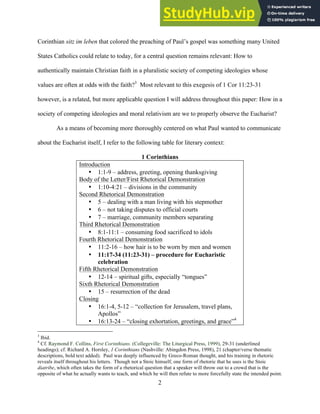
about the Eucharist itself, I refer to the following table for literary context:
1 Corinthians
Introduction
• 1:1-9 – address, greeting, opening thanksgiving
Body of the Letter/First Rhetorical Demonstration
• 1:10-4:21 – divisions in the community
Second Rhetorical Demonstration
• 5 – dealing with a man living with his stepmother
• 6 – not taking disputes to official courts
• 7 – marriage, community members separating
Third Rhetorical Demonstration
• 8:1-11:1 – consuming food sacrificed to idols
Fourth Rhetorical Demonstration
• 11:2-16 – how hair is to be worn by men and women
• 11:17-34 (11:23-31) – procedure for Eucharistic
celebration
Fifth Rhetorical Demonstration
• 12-14 – spiritual gifts, especially “tongues”
Sixth Rhetorical Demonstration
• 15 – resurrection of the dead
Closing
• 16:1-4, 5-12 – “collection for Jerusalem, travel plans,
Apollos”
• 16:13-24 – “closing exhortation, greetings, and grace”4
3
Ibid.
4
Cf. Raymond F. Collins, First Corinthians. (Collegeville: The Liturgical Press, 1999), 29-31 (underlined
headings); cf. Richard A. Horsley, 1 Corinthians (Nashville: Abingdon Press, 1998), 21 (chapter/verse thematic
descriptions, bold text added). Paul was deeply influenced by Greco-Roman thought, and his training in rhetoric
reveals itself throughout his letters. Though not a Stoic himself, one form of rhetoric that he uses is the Stoic
diatribe, which often takes the form of a rhetorical question that a speaker will throw out to a crowd that is the
opposite of what he actually wants to teach, and which he will then refute to more forcefully state the intended point.
12/4/18 4:00 PM
3
1 Cor 11:23-31 deals with worthily receiving the Eucharist that has been handed on from the
Lord and is the core of 11:17-34; which itself is the climax of the fourth out of six rhetorical
demonstrations. Examining the passages immediately before and after 11:23-31 further
contextualizes and clarifies what Paul is saying.
In verses 11:2-16 Paul addresses how men and women are to wear their hair, which
speaks to a greater ontological point he was trying to make about accurately living out gender
roles as Christians in a Greco-Roman world. He did this so that the Corinthian church members
would have proper self-understanding as members of the Body of Christ in spite of a libidinous
cultural context, which would enable them to coherently live their faith and thereby “worthily”
receive the Eucharist.5
With right self-understanding and worthy celebration of the Lord’s
Supper, Christians can then consider receiving the spiritual gifts referred to in the fifth
demonstration of chapters 12-14. This thematic procession points to a mystical fullness of life
and love, which leads into discussing the ultimate continuance of life in the sixth demonstration,
the resurrection of the dead.
The main issue with this pericope is “that the assembly of saints in Corinth, in its social
relationships, was beginning to resemble the dominant imperial society to which it was supposed
to be God’s alternative.”6
This “first historical witness to the institution of the Eucharist,
predating the Gospel of Mark by at least five to ten years,” that Paul affirms “was instituted on
the night on which Jesus was handed over,” was written to “alert the Corinthians to the gravity of
Another device is listing virtues and vices – the virtues are associated with higher forms of matter, and vices with
lower forms, revealing a Platonic influence (see 1 Cor 4:10-13, and 2 Cor 4:8-12). The influence of Cynics, who
shunned societal conventions and deliberately used shocking language, is also occasionally reflected in Paul: for
example: “Each of you says, ‘I belong to Paul,’ or ‘I belong to Apollos,’ or ‘I belong to Cephas,’ or ‘I belong to
Christ.’ Has Christ been divided? Was Paul crucified for you? Or were you baptized in the name of Paul? I thank
God that I baptized none of you except Crispus and Gaius, so that no one can say that you were baptized in my name”
(1 Cor 1:12-15), cf. Brown, ibid.
5
“Worthy” as opposed eating the bread or drinking “the cup of the Lord in an unworthy manner” (1 Cor 11:27),
which this exegesis will reveal as an individualistic and/or exclusionary Eucharistic observance.
6
Horsley, 1 Corinthians, 164.
12/4/18 4:00 PM
4
the occasion they are commemorating.”7
Any cultural influences that create undue confusion
about how Christians are to publicly appear and present themselves (as anachronistic as the
gender role and hairstyles argument may seem to a contemporary reader), or determining who
gets what spiritual gifts, place a shabbily mundane cart before an infinitely greater horse: the
community has forgotten that they are celebrating the Lord’s Supper, and is instead assembling
“to eat their own.”8
The accepted practice was to bring separate meals to the common place, but
they were starting to eat before others arrived so that there was no common
supper and no sharing. Since some of the members were very poor, they did
not have enough to eat and were hungry after supper while the prosperous were
sated, some beyond propriety. It is not the vicious quality of gluttony and
drunkenness that occupies Paul’s attention at this point but the selfish
indifference of each person or family to the needs and situation of the
deprived and poor.9
Paul is deeply concerned that the church at Corinth has devolved into a socio-
economically self-centered society of selective inclusion and exclusion among classes. This both
reflects an order antithetical to what God has done in Jesus Christ and has nothing to do with
authentic Eucharistic celebration, which necessarily strives toward greater God-centeredness and
inclusion of other people. His didactic presentation of the Lord’s Supper is therefore meant to
remind the community of who they are really celebrating, and what they are supposed to be
about.
To a certain extent it is understandable that a pluralistic and economically disparate
society would separate itself into familiar groupings, even while worshipping, for people are
drawn to what they know. Yet, Paul is pointing out they have become a degraded caricature of
7
George Montague, SM. First Corinthians (Grand Rapids: Baker Academic, 2011), 195. “The translation ‘handed
over’ instead of ‘betrayed’ has the advantage of ambiguity about it, since Jesus was ‘handed over’ not only by Judas
(Mark 14:10, 42, 44) but also by the chief priests (to Pilate; Mark 15:1), and by Pilate (to crucifixion; Mark 15:15).
It can also refer to God’s handing over Jesus for the salvation of the world (Rom 8:32)” (ibid).
8
William F. Orr and James Arthur Walther, 1 Corinthians (New York: Doubleday, 1976), 270.
9
Orr and Walther, 1 Corinthians, 270.
12/4/18 4:00 PM
5
Christianity, for “to dine alone at church means to decline to join with the church in this great
expression of common, Christian, social life; and it therefore manifests contempt for the whole
assembly.”10
Paul’s teaching is clearly designed to influence the reader as to how, in their
society of competing ideologies and moral relativism that is insensitive to the poor, they are to
properly observe the Eucharist.11
In order to arrive at a more complete understanding of what
the Apostle wants his community to understand, a verse-by-verse analysis of 1 Cor 11:23-31
follows.
23 Paul wants the Corinthians to take the Eucharist to heart, which they are devaluing by not
celebrating it communally. He initially does this through the key words “received” and “handed
on.”12
These were “virtually technical terms in Jewish culture for the transmission of important
traditions such as customs, rituals, and ethical teachings.”13
“Received” and “handed on” are
very important terms to the Apostle, for in emphasizing the central authority of this community
tradition, “Paul identifies it as having come ‘from the Lord,’ the ultimate founder and source of
the celebration of the Lord’s Supper.”14
By bringing up “the night when he was betrayed” Paul
wants to underscore Jesus’ death, for Pauline tradition regarded the Eucharist as a “continuing
observance of the Last Supper,” from which Jesus’ death is inseparable.15
The community
celebration that the Corinthians are disregarding through their individualistic observances was
bought and paid for by the life of Christ, and the Apostle wants them to know it.
24 Paul places great significance on the command, “Do this in remembrance of me,”
10
Orr and Walther, ibid, 270.
11
Though Paul’s rhetoric does not literally refer to a “simple conflict between ‘rich’ and ‘poor,’ the hellenistic-
Roman obsession with social status (probably especially intense in Corinth) that carried over into dining patterns
must have affected celebrations of the Lord’s Supper in the ways Paul found objectionable” (Horsley, ibid, 160).
12
The Latin word for tradition, tradere or traditio, means to hand on: “The transmission of knowledge,
teaching…an item of traditional knowledge” or “belief” (Glare, Oxford Latin Dictionary, 1956). “Hellenistic
philosophies used the same terms in transmitting their standard doctrines” (Horsley, ibid, 160).
13
Ibid.
14
Ibid.
15
Ibid.
12/4/18 4:00 PM
6
including it in both verses 11:24 and 11:25.16
He does this in order to drive home the point that
“Jesus’ sacrificial meal was intended by the Lord, just as the Passover of the Jews was celebrated
regularly to recall the great saving events (Exod 12; 13:9).”17
By making this reference, Paul is
trying to help his audience make as serious and personal a connection with the Eucharist as Jews
would have with the Passover: “The LORD your God brought you out of Egypt by night. You
shall offer the passover sacrifice to the LORD your God…you came out of the land of Egypt in
great haste, so that all the days of your life you may remember the day of your departure from the
land of Egypt” (Deut 16:1-3).18
Paul intends his community to understand that the Passover that brought the Israelites out
of Egypt has become a Christian Passover “in remembrance of me, the Lord Jesus Christ.”19
Through the power of the invoked Holy Spirit upon the bread and wine in the epiklēsis that
transforms them into the body and blood of Christ, Christians partake in the “mystery of the
Christian exodus, the death and resurrection of Christ.”20
In light of this mystery, Paul cannot
conceive of a private Eucharist that willfully includes some while alienating others, and thinks
his community should be just as incredulous at the idea.
25 Though referring to the cup as “the new covenant in (his) blood,” Paul again hearkens
back to the Exodus: “See the blood of the covenant that the LORD has made with you in
accordance with all these words” (Exod 24:8).21
The Apostle wants to establish the sacrificially
sealed old covenant as conceptually parallel with the new, and by continuing the theme from
16
Cf. Montague, First Corinthians, 196. Whereas this command is only found once in Luke (22:19), and omitted in
both Mark and Matthew (ibid).
17
Montague, ibid, 196. “Paul seems to have written this letter around the time of the Jewish Passover, in the spring
of AD 57” (ibid). For context, see 1 Cor 5:7-8: “Clean out the old yeast so that you may be a new batch, as you
really are unleavened. For our paschal lamb, Christ, has been sacrificed. Therefore, let us celebrate the festival, not
with the old yeast, the yeast of malice and evil, but with the unleavened bread of sincerity and truth” (cf. ibid).
18
Cf. Montague, ibid, 196 (italics added).
19
Ibid.
20
Ibid.
21
Cf. Montague, ibid, 195.
12/4/18 4:00 PM
7
verse 24, “that is for you,” establishes the sacrificial nature of Christ’s own body and blood,
which bring salvation.22
While Christ is present under both species, Paul understands that
separately consecrating the bread and wine “signifies the separation of the blood from the body
of Christ in death,” and the body of Christ is to be “identified with the body immolated on the
cross.”23
Regardless of their inclinations at the time Paul wrote 1 Corinthians, the dignity of this
sacrifice demands that his faith community at least properly celebrate it in the communal context
intended by Christ himself.
26 In order to stress the salvific purpose of the Eucharist, this verse utilizes a double
emphasis. By using the phrase “as often as” which includes “both eating the bread and drinking
the cup, he focuses attention both on Jesus’ death (‘you proclaim the Lord’s death’; cf. 1:23; 2:6-
8) and on his return (parousia; ‘until he comes’).”24
Here Paul acts in harmony with other
Eucharistic traditions such as Mk 14:25: “Truly I tell you, I will never again drink of the fruit of
the vine until that day when I drink it new in the kingdom of God;” and in the Didache, which
includes Maranatha, “Our Lord, come,” where there is an eschatological orientation toward “the
kingdom of God.”25
The communal celebration of the Eucharist demands that we look beyond
contemporaneous circumstances that might affect how we approach it, realizing that we are not
only in the sacramental presence of Christ, but by our very actions participating in the life of the
church towards his immanent return. Would we want Jesus to arrive and see the poor we ought
22
Cf. ibid.
23
Cf. Montague ibid, 195-196. “Paul’s version of the words of institution are more than Mark’s and Matthew’s,
which lack that is for you, and less than Luke’s (in 22:19), which has “given for you” (ibid). Christ’s death is also
treated as a sacrifice in Matt 20:28 and Mark 10:45, with the body of Christ also identified “with the body
immolated on the cross” in Jn 6:51: “I am the living bread that comes down from heaven. Whoever eats of this
bread will live forever; and the bread that I will give for the life of the world is my flesh” (ibid).
24
Horsley, ibid, 161.
25
Cf. Did. 9:4; 10:5-6 (Horsley, ibid, 162).
12/4/18 4:00 PM
8
to prioritize being carelessly neglected, while others drink and glut themselves alone or with a
few select others?
27 Abusing the Eucharist is very serious, for “an unworthy manner” not only refers to “any
state of serious unrepented or unconfessed sin;” but in this context to “the disorder and
selfishness shown in the context of the Eucharist itself, a sacrilegious disrespect for the
sacrament,” literally sinning against “the body and blood of the Lord.”26
Sacrilege brings divine
judgment, which Paul understands as “already happening in the community (11:29-30).”27
The church is the body of Christ, and “to receive the sacrament in the state of disharmony with
the community, as some are doing,” is flat-out sacrilegious.28
28-31 When Paul tells the Corinthians to “examine” themselves, he is addressing the members
whose wealth and status lead them to believe they are superior to the rest of the community.29
God’s eschatological “examination” looms in the background of this self-scrutiny, and the
community would not want to be found lacking in authentically living out the reality that “we
who are many are one body.”30
Failure to rightly appreciate and include members of the
community is a failure to discern “the body,” and Paul is even equating physical problems and
death to the body being violated by Corinthian ambivalence and neglect.
This violation hampers and restricts the redemptive and healing nature of the
fellowship wherein the poor are fed, the lonely are befriended, the sick are visited,
the grieving are comforted, and sinners are forgiven. Such a redemptive
fellowship can produce both spiritual and physical health while the breaking of
26
Verse 27 reads: “Whoever, therefore, eats the bread or drinks the cup of the Lord in an unworthy manner will be
answerable for the body and blood of the Lord” (bold text added). “The NAB translates the Greek word enochos as
‘answer for’ (‘answerable for’ NRSV, NJB), the NIV the milder ‘guilty of sinning against.’ The former is more
exact, because the idea of divine judgment is clearer” (Montague, ibid, 198).
27
Ibid.
28
Ibid, 198-199.
29
The verb “examine” at the opening of verse 28 is cognate with “the distinguished ones” (NRSV: “genuine”) in
11:19, alluding to certain Corinthians’ sense of their own importance (Horsley ibid, 162).
30
This is from an earlier reference in 1 Cor 10:16-17: “The cup of blessing that we bless, is it not a sharing in the
blood of Christ? The bread that we break, is it not a sharing in the body of Christ? Because there is one bread, we
who are many are one body, for we all partake of the one bread” (cf. Horsley, ibid, 162).
12/4/18 4:00 PM
9
the fellowship may cause the converse. So serious is this situation in Corinth that
Paul posits a connection between it and the death rate there.31
The Apostle wants his readers to understand that irrespective of rank or station, “the body
of the Lord equals ourselves, in this context distinguished by common participation in eating his
supper.”32
We seriously diminish the meaning of celebrating the Eucharist when we fail to see
ourselves in each other, for this denotes an inability to perceive the presence of Christ in the
same people who consume him at the Lord’s Supper. We must always remember what the
Corinthians forgot, namely to recognize “that people together in the church constitute the very
presence of Christ and are to be treated appropriately.”33
In summary of Paul’s message throughout the entire pericope, the Apostle is telling the
Christians at Corinth to take the Eucharist very personally and to heart, celebrating it
communally as divinely “received” and “handed on” tradition which Jesus intended to be
perpetually observed. This continuance of the Last Supper is like the Passover which, through
regular celebration, recalls the great saving events in salvation history, and has become a
Christian Passover in remembrance of the Lord Jesus. God has done this in Jesus that we may
partake of the mysterious Christian exodus of his death and resurrection, whose body and blood
now bring salvation, and from which we are to partake in community until he returns.34
At the same time it is possible to partake of the Eucharist unworthily, which happens
when we remain in a state of unrepentant sin and communal disharmony. In order to help move
beyond this unfortunate situation, people with wealth and status are not to see themselves as
superior to those who are poor and less valued in society. Failure to discern “the body” as “one”
31
Orr and Walther, ibid, 274. Though Paul may be using hyperbole here, the extent to which he literally connects
his community’s actions with illness and death “is difficult to interpret except in very general terms” (ibid).
32
Orr and Walther, ibid, 274. “There is a parallel connection between vss. 29 and 31. There is no reason to
differentiate the judgment in the two verses; so the objects of discrimination are evidently the same – the body and
ourselves” (ibid).
33
Ibid.
34
Cf. 1 Cor 11:23-26.
12/4/18 4:00 PM
10
can lead to serious problems including death, and Paul wants them to know that, particularly in
light of God’s eschatological judgment, when we fail to see ourselves in other people,
celebrating the Eucharist becomes negatively caricaturized. Christ is present in everyone who
consumes him at the Lord’s Supper, and all are to be treated with appropriate and inclusive
dignity.35
So what does any of this have to do with us today? The institutional church is now vastly
more established than during Paul’s ministry, and while the Eucharist as celebrated in Roman
Catholicism is ordinarily reserved for baptized and/or confirmed Catholics, we do not keep
people without money or connections from receiving communion. In spite of this, however, one
way Paul’s message can continue resonating involves the extent to which we associate with
members of the body who are poor, in that they are habitually excluded from mainstream
society, outside of the familiar context of mass.
The tension is palpable when homeless or mentally ill people wander into our
comfortable, well-lit churches, and volunteers who move beyond simple mass attendance and
into actually spending time with those people, through St. Vincent DePaul or any number of
social justice ministries, are few and far between. Yet the context for the intimately personal
connection we are all to make with the Christian Exodus, namely that we are all part of the one
body that brings every one us out of slavery to sin and into union with God, seems to demand
nothing less than radical inclusivity!
What if the very types of people the Corinthians once shunned at the Eucharist, and
whom we now welcome (or at least tolerate) at mass, were people with whom we would freely
choose to associate both during and outside of the liturgy, meeting them where they are even if it
meant serving them? When acted upon for love of God and respect for fellow members of the
35
Cf. 1 Cor 11:27-31.
12/4/18 4:00 PM
11
body, would not such inclusive activity represent an authentic way of living out our faith as a
result of actually embodying what we dare to consume?
Were I to preach on 1 Cor 11:23-31, these are the types of questions I would ask,
especially regarding the question I posed at the beginning of this exegesis – How in a society of
competing ideologies and moral relativism are we to properly observe the Eucharist? At the
same time, I would be careful not to badger my congregation by overstating the point, for I have
occasionally seen priests alienate people that were at least willing to be sympathetic, because
they could not stop telling their congregations what to do. While it is true that judgment is
inseparable from this pericope, it is absolutely vital to keep in mind that “the judgment is of the
nature of discipline, not of final condemnation.”36
Accordingly, in a contemporary United States
context, the Eucharistic discipline I have in mind is not one of condemnation, but joy!
When we are faced with people who are different than we are, we are often confronted by
our own fears and dislikes. Yet upon cultivating an active interior life and acknowledging our
projections and what triggers them, we can utilize encountering others as a means of dissolving
what blocks us by focusing on their needs, even it only means being emotionally present and
available to listen. This is joyful because when we prayerfully engage in this type of discipline,
even as a means of contemplative union with God, great things come to pass: we become more
than we are as the Lord is magnified in us and made all the more present through a unified
community spirit, and we know the incredible joy of authentically living out our Catholic faith!
Whether at mass or anywhere else, we can never love God enough, especially when we
encounter him through other people. Yet to at least attempt doing so by including others not
only in the Eucharist itself, but also in how we live as a result of partaking of it in the first place,
will surely suffice as a proper observance in the eyes of our loving God.
36
Orr and Walther, ibid, 274.
12/4/18 4:00 PM
12
Bibliography
Brown, SCJ, C.T. “Pauline Literature.” Verbal notes. Sacred Heart Seminary and School of
Theology, Hales Corners, WI. Fall Semester, 2017-2018.
Collins, Raymond F. First Corinthians. Sacra Pagina 7. Edited by Daniel J. Harrington, S.J.
Collegeville, MN: The Liturgical Press, 1999.
Horsley, Richard A. 1 Corinthians. Abingdon New Testament Commentaries. Nashville:
Abingdon Press, 1998.
Montague, SM, George T. First Corinthians. Catholic Commentary on Sacred Scripture.
Grand Rapids, MI: Baker Academic, 2011.
P.G.W. Glare, ed. Oxford Latin Dictionary. Oxford: Clarendon Press, 1982.
William F. Orr and James Arthur Walther. 1 Corinthians. The Anchor Bible. New York:
Doubleday, 1976.

1 Corinthians Exegesis Paper.Pdf

  • 1.
    12/4/18 4:00 PM 1 1Corinthians 11:23-31 Exegesis Paper ©Dcn. Patric Nikolas, SDS Sacred Heart Seminary and School of Theology, Hales Corners, WI DRAFT: NOT FOR CITATION OR DISTRIBUTION WITHOUT AUTHOR’S PERMISSION Comparable to a 19th century Wild West town where “anything goes,” and known as a hotbed of sexual activity, the port city of Corinth was a popular destination for thrill-seekers in 1st century Greece. When portrayed in fiction, an inevitable civilizing presence looms in the background of such places, with a pervading sense that the established ways will soon be displaced by an encroaching new order. Rome had already assumed control of the city in 146 BC, and Julius Caesar gave it specialized status as a retirement colony for soldiers in 44 BC, yet this historical context for Latinized, cosmopolitan Corinth was marked by a robust diversity. There were Egyptian and Syrian immigrants and freed slaves, manufacturing of quality bronze and terracotta goods, and temples to not only Greek gods including Asclepius, Apollo, and Aphrodite (in her case featuring cultic prostitutes), but also to Egyptian gods such as Osiris and Isis. Among these various cults, there is also evidence of a synagogue, referred to in Acts 18:4.1 Driven to provide Corinth with a new order based on what God has done in Jesus Christ, the Apostle Paul arrived around AD 51-52.2 Paul was initially drawn there because his apostolic preaching would not be seen as strange, for there were many philosophers there preaching various ideologies. As a port city, he was also aware that it would be a great launching pad for future missionary journeys to Rome and Spain. Overall, the sexualized and pluralistic 1 “Every Sabbath he would argue in the synagogue and would try to convince Jews and Greeks.” Cf. Brown, SCJ, C.T. “Pauline Literature,” verbal notes (Sacred Heart Seminary and School of Theology, Hales Corners, WI.) Fall Semester, 2017-2018. 2 This was after he fell out with Peter in AD 49, arriving in Corinth where he wrote 1 Thessalonians. By 54 Paul was in Ephesus where he probably founded their church, which also became a base of operations and a Pauline theological school. From there he wrote Galatians, Philippians, Philemon, Romans, and about seven letters to his friends at Corinth, which had become a troubled faith community in his absence. 2 Cor is a patchwork of as many as five or six letters, with 1 and 2 Cor combined comprising the seven (Brown, ibid).
  • 2.
    12/4/18 4:00 PM 2 Corinthiansitz im leben that colored the preaching of Paul’s gospel was something many United States Catholics could relate to today, for a central question remains relevant: How to authentically maintain Christian faith in a pluralistic society of competing ideologies whose values are often at odds with the faith?3 Most relevant to this exegesis of 1 Cor 11:23-31 however, is a related, but more applicable question I will address throughout this paper: How in a society of competing ideologies and moral relativism are we to properly observe the Eucharist? As a means of becoming more thoroughly centered on what Paul wanted to communicate about the Eucharist itself, I refer to the following table for literary context: 1 Corinthians Introduction • 1:1-9 – address, greeting, opening thanksgiving Body of the Letter/First Rhetorical Demonstration • 1:10-4:21 – divisions in the community Second Rhetorical Demonstration • 5 – dealing with a man living with his stepmother • 6 – not taking disputes to official courts • 7 – marriage, community members separating Third Rhetorical Demonstration • 8:1-11:1 – consuming food sacrificed to idols Fourth Rhetorical Demonstration • 11:2-16 – how hair is to be worn by men and women • 11:17-34 (11:23-31) – procedure for Eucharistic celebration Fifth Rhetorical Demonstration • 12-14 – spiritual gifts, especially “tongues” Sixth Rhetorical Demonstration • 15 – resurrection of the dead Closing • 16:1-4, 5-12 – “collection for Jerusalem, travel plans, Apollos” • 16:13-24 – “closing exhortation, greetings, and grace”4 3 Ibid. 4 Cf. Raymond F. Collins, First Corinthians. (Collegeville: The Liturgical Press, 1999), 29-31 (underlined headings); cf. Richard A. Horsley, 1 Corinthians (Nashville: Abingdon Press, 1998), 21 (chapter/verse thematic descriptions, bold text added). Paul was deeply influenced by Greco-Roman thought, and his training in rhetoric reveals itself throughout his letters. Though not a Stoic himself, one form of rhetoric that he uses is the Stoic diatribe, which often takes the form of a rhetorical question that a speaker will throw out to a crowd that is the opposite of what he actually wants to teach, and which he will then refute to more forcefully state the intended point.
  • 3.
    12/4/18 4:00 PM 3 1Cor 11:23-31 deals with worthily receiving the Eucharist that has been handed on from the Lord and is the core of 11:17-34; which itself is the climax of the fourth out of six rhetorical demonstrations. Examining the passages immediately before and after 11:23-31 further contextualizes and clarifies what Paul is saying. In verses 11:2-16 Paul addresses how men and women are to wear their hair, which speaks to a greater ontological point he was trying to make about accurately living out gender roles as Christians in a Greco-Roman world. He did this so that the Corinthian church members would have proper self-understanding as members of the Body of Christ in spite of a libidinous cultural context, which would enable them to coherently live their faith and thereby “worthily” receive the Eucharist.5 With right self-understanding and worthy celebration of the Lord’s Supper, Christians can then consider receiving the spiritual gifts referred to in the fifth demonstration of chapters 12-14. This thematic procession points to a mystical fullness of life and love, which leads into discussing the ultimate continuance of life in the sixth demonstration, the resurrection of the dead. The main issue with this pericope is “that the assembly of saints in Corinth, in its social relationships, was beginning to resemble the dominant imperial society to which it was supposed to be God’s alternative.”6 This “first historical witness to the institution of the Eucharist, predating the Gospel of Mark by at least five to ten years,” that Paul affirms “was instituted on the night on which Jesus was handed over,” was written to “alert the Corinthians to the gravity of Another device is listing virtues and vices – the virtues are associated with higher forms of matter, and vices with lower forms, revealing a Platonic influence (see 1 Cor 4:10-13, and 2 Cor 4:8-12). The influence of Cynics, who shunned societal conventions and deliberately used shocking language, is also occasionally reflected in Paul: for example: “Each of you says, ‘I belong to Paul,’ or ‘I belong to Apollos,’ or ‘I belong to Cephas,’ or ‘I belong to Christ.’ Has Christ been divided? Was Paul crucified for you? Or were you baptized in the name of Paul? I thank God that I baptized none of you except Crispus and Gaius, so that no one can say that you were baptized in my name” (1 Cor 1:12-15), cf. Brown, ibid. 5 “Worthy” as opposed eating the bread or drinking “the cup of the Lord in an unworthy manner” (1 Cor 11:27), which this exegesis will reveal as an individualistic and/or exclusionary Eucharistic observance. 6 Horsley, 1 Corinthians, 164.
  • 4.
    12/4/18 4:00 PM 4 theoccasion they are commemorating.”7 Any cultural influences that create undue confusion about how Christians are to publicly appear and present themselves (as anachronistic as the gender role and hairstyles argument may seem to a contemporary reader), or determining who gets what spiritual gifts, place a shabbily mundane cart before an infinitely greater horse: the community has forgotten that they are celebrating the Lord’s Supper, and is instead assembling “to eat their own.”8 The accepted practice was to bring separate meals to the common place, but they were starting to eat before others arrived so that there was no common supper and no sharing. Since some of the members were very poor, they did not have enough to eat and were hungry after supper while the prosperous were sated, some beyond propriety. It is not the vicious quality of gluttony and drunkenness that occupies Paul’s attention at this point but the selfish indifference of each person or family to the needs and situation of the deprived and poor.9 Paul is deeply concerned that the church at Corinth has devolved into a socio- economically self-centered society of selective inclusion and exclusion among classes. This both reflects an order antithetical to what God has done in Jesus Christ and has nothing to do with authentic Eucharistic celebration, which necessarily strives toward greater God-centeredness and inclusion of other people. His didactic presentation of the Lord’s Supper is therefore meant to remind the community of who they are really celebrating, and what they are supposed to be about. To a certain extent it is understandable that a pluralistic and economically disparate society would separate itself into familiar groupings, even while worshipping, for people are drawn to what they know. Yet, Paul is pointing out they have become a degraded caricature of 7 George Montague, SM. First Corinthians (Grand Rapids: Baker Academic, 2011), 195. “The translation ‘handed over’ instead of ‘betrayed’ has the advantage of ambiguity about it, since Jesus was ‘handed over’ not only by Judas (Mark 14:10, 42, 44) but also by the chief priests (to Pilate; Mark 15:1), and by Pilate (to crucifixion; Mark 15:15). It can also refer to God’s handing over Jesus for the salvation of the world (Rom 8:32)” (ibid). 8 William F. Orr and James Arthur Walther, 1 Corinthians (New York: Doubleday, 1976), 270. 9 Orr and Walther, 1 Corinthians, 270.
  • 5.
    12/4/18 4:00 PM 5 Christianity,for “to dine alone at church means to decline to join with the church in this great expression of common, Christian, social life; and it therefore manifests contempt for the whole assembly.”10 Paul’s teaching is clearly designed to influence the reader as to how, in their society of competing ideologies and moral relativism that is insensitive to the poor, they are to properly observe the Eucharist.11 In order to arrive at a more complete understanding of what the Apostle wants his community to understand, a verse-by-verse analysis of 1 Cor 11:23-31 follows. 23 Paul wants the Corinthians to take the Eucharist to heart, which they are devaluing by not celebrating it communally. He initially does this through the key words “received” and “handed on.”12 These were “virtually technical terms in Jewish culture for the transmission of important traditions such as customs, rituals, and ethical teachings.”13 “Received” and “handed on” are very important terms to the Apostle, for in emphasizing the central authority of this community tradition, “Paul identifies it as having come ‘from the Lord,’ the ultimate founder and source of the celebration of the Lord’s Supper.”14 By bringing up “the night when he was betrayed” Paul wants to underscore Jesus’ death, for Pauline tradition regarded the Eucharist as a “continuing observance of the Last Supper,” from which Jesus’ death is inseparable.15 The community celebration that the Corinthians are disregarding through their individualistic observances was bought and paid for by the life of Christ, and the Apostle wants them to know it. 24 Paul places great significance on the command, “Do this in remembrance of me,” 10 Orr and Walther, ibid, 270. 11 Though Paul’s rhetoric does not literally refer to a “simple conflict between ‘rich’ and ‘poor,’ the hellenistic- Roman obsession with social status (probably especially intense in Corinth) that carried over into dining patterns must have affected celebrations of the Lord’s Supper in the ways Paul found objectionable” (Horsley, ibid, 160). 12 The Latin word for tradition, tradere or traditio, means to hand on: “The transmission of knowledge, teaching…an item of traditional knowledge” or “belief” (Glare, Oxford Latin Dictionary, 1956). “Hellenistic philosophies used the same terms in transmitting their standard doctrines” (Horsley, ibid, 160). 13 Ibid. 14 Ibid. 15 Ibid.
  • 6.
    12/4/18 4:00 PM 6 includingit in both verses 11:24 and 11:25.16 He does this in order to drive home the point that “Jesus’ sacrificial meal was intended by the Lord, just as the Passover of the Jews was celebrated regularly to recall the great saving events (Exod 12; 13:9).”17 By making this reference, Paul is trying to help his audience make as serious and personal a connection with the Eucharist as Jews would have with the Passover: “The LORD your God brought you out of Egypt by night. You shall offer the passover sacrifice to the LORD your God…you came out of the land of Egypt in great haste, so that all the days of your life you may remember the day of your departure from the land of Egypt” (Deut 16:1-3).18 Paul intends his community to understand that the Passover that brought the Israelites out of Egypt has become a Christian Passover “in remembrance of me, the Lord Jesus Christ.”19 Through the power of the invoked Holy Spirit upon the bread and wine in the epiklēsis that transforms them into the body and blood of Christ, Christians partake in the “mystery of the Christian exodus, the death and resurrection of Christ.”20 In light of this mystery, Paul cannot conceive of a private Eucharist that willfully includes some while alienating others, and thinks his community should be just as incredulous at the idea. 25 Though referring to the cup as “the new covenant in (his) blood,” Paul again hearkens back to the Exodus: “See the blood of the covenant that the LORD has made with you in accordance with all these words” (Exod 24:8).21 The Apostle wants to establish the sacrificially sealed old covenant as conceptually parallel with the new, and by continuing the theme from 16 Cf. Montague, First Corinthians, 196. Whereas this command is only found once in Luke (22:19), and omitted in both Mark and Matthew (ibid). 17 Montague, ibid, 196. “Paul seems to have written this letter around the time of the Jewish Passover, in the spring of AD 57” (ibid). For context, see 1 Cor 5:7-8: “Clean out the old yeast so that you may be a new batch, as you really are unleavened. For our paschal lamb, Christ, has been sacrificed. Therefore, let us celebrate the festival, not with the old yeast, the yeast of malice and evil, but with the unleavened bread of sincerity and truth” (cf. ibid). 18 Cf. Montague, ibid, 196 (italics added). 19 Ibid. 20 Ibid. 21 Cf. Montague, ibid, 195.
  • 7.
    12/4/18 4:00 PM 7 verse24, “that is for you,” establishes the sacrificial nature of Christ’s own body and blood, which bring salvation.22 While Christ is present under both species, Paul understands that separately consecrating the bread and wine “signifies the separation of the blood from the body of Christ in death,” and the body of Christ is to be “identified with the body immolated on the cross.”23 Regardless of their inclinations at the time Paul wrote 1 Corinthians, the dignity of this sacrifice demands that his faith community at least properly celebrate it in the communal context intended by Christ himself. 26 In order to stress the salvific purpose of the Eucharist, this verse utilizes a double emphasis. By using the phrase “as often as” which includes “both eating the bread and drinking the cup, he focuses attention both on Jesus’ death (‘you proclaim the Lord’s death’; cf. 1:23; 2:6- 8) and on his return (parousia; ‘until he comes’).”24 Here Paul acts in harmony with other Eucharistic traditions such as Mk 14:25: “Truly I tell you, I will never again drink of the fruit of the vine until that day when I drink it new in the kingdom of God;” and in the Didache, which includes Maranatha, “Our Lord, come,” where there is an eschatological orientation toward “the kingdom of God.”25 The communal celebration of the Eucharist demands that we look beyond contemporaneous circumstances that might affect how we approach it, realizing that we are not only in the sacramental presence of Christ, but by our very actions participating in the life of the church towards his immanent return. Would we want Jesus to arrive and see the poor we ought 22 Cf. ibid. 23 Cf. Montague ibid, 195-196. “Paul’s version of the words of institution are more than Mark’s and Matthew’s, which lack that is for you, and less than Luke’s (in 22:19), which has “given for you” (ibid). Christ’s death is also treated as a sacrifice in Matt 20:28 and Mark 10:45, with the body of Christ also identified “with the body immolated on the cross” in Jn 6:51: “I am the living bread that comes down from heaven. Whoever eats of this bread will live forever; and the bread that I will give for the life of the world is my flesh” (ibid). 24 Horsley, ibid, 161. 25 Cf. Did. 9:4; 10:5-6 (Horsley, ibid, 162).
  • 8.
    12/4/18 4:00 PM 8 toprioritize being carelessly neglected, while others drink and glut themselves alone or with a few select others? 27 Abusing the Eucharist is very serious, for “an unworthy manner” not only refers to “any state of serious unrepented or unconfessed sin;” but in this context to “the disorder and selfishness shown in the context of the Eucharist itself, a sacrilegious disrespect for the sacrament,” literally sinning against “the body and blood of the Lord.”26 Sacrilege brings divine judgment, which Paul understands as “already happening in the community (11:29-30).”27 The church is the body of Christ, and “to receive the sacrament in the state of disharmony with the community, as some are doing,” is flat-out sacrilegious.28 28-31 When Paul tells the Corinthians to “examine” themselves, he is addressing the members whose wealth and status lead them to believe they are superior to the rest of the community.29 God’s eschatological “examination” looms in the background of this self-scrutiny, and the community would not want to be found lacking in authentically living out the reality that “we who are many are one body.”30 Failure to rightly appreciate and include members of the community is a failure to discern “the body,” and Paul is even equating physical problems and death to the body being violated by Corinthian ambivalence and neglect. This violation hampers and restricts the redemptive and healing nature of the fellowship wherein the poor are fed, the lonely are befriended, the sick are visited, the grieving are comforted, and sinners are forgiven. Such a redemptive fellowship can produce both spiritual and physical health while the breaking of 26 Verse 27 reads: “Whoever, therefore, eats the bread or drinks the cup of the Lord in an unworthy manner will be answerable for the body and blood of the Lord” (bold text added). “The NAB translates the Greek word enochos as ‘answer for’ (‘answerable for’ NRSV, NJB), the NIV the milder ‘guilty of sinning against.’ The former is more exact, because the idea of divine judgment is clearer” (Montague, ibid, 198). 27 Ibid. 28 Ibid, 198-199. 29 The verb “examine” at the opening of verse 28 is cognate with “the distinguished ones” (NRSV: “genuine”) in 11:19, alluding to certain Corinthians’ sense of their own importance (Horsley ibid, 162). 30 This is from an earlier reference in 1 Cor 10:16-17: “The cup of blessing that we bless, is it not a sharing in the blood of Christ? The bread that we break, is it not a sharing in the body of Christ? Because there is one bread, we who are many are one body, for we all partake of the one bread” (cf. Horsley, ibid, 162).
  • 9.
    12/4/18 4:00 PM 9 thefellowship may cause the converse. So serious is this situation in Corinth that Paul posits a connection between it and the death rate there.31 The Apostle wants his readers to understand that irrespective of rank or station, “the body of the Lord equals ourselves, in this context distinguished by common participation in eating his supper.”32 We seriously diminish the meaning of celebrating the Eucharist when we fail to see ourselves in each other, for this denotes an inability to perceive the presence of Christ in the same people who consume him at the Lord’s Supper. We must always remember what the Corinthians forgot, namely to recognize “that people together in the church constitute the very presence of Christ and are to be treated appropriately.”33 In summary of Paul’s message throughout the entire pericope, the Apostle is telling the Christians at Corinth to take the Eucharist very personally and to heart, celebrating it communally as divinely “received” and “handed on” tradition which Jesus intended to be perpetually observed. This continuance of the Last Supper is like the Passover which, through regular celebration, recalls the great saving events in salvation history, and has become a Christian Passover in remembrance of the Lord Jesus. God has done this in Jesus that we may partake of the mysterious Christian exodus of his death and resurrection, whose body and blood now bring salvation, and from which we are to partake in community until he returns.34 At the same time it is possible to partake of the Eucharist unworthily, which happens when we remain in a state of unrepentant sin and communal disharmony. In order to help move beyond this unfortunate situation, people with wealth and status are not to see themselves as superior to those who are poor and less valued in society. Failure to discern “the body” as “one” 31 Orr and Walther, ibid, 274. Though Paul may be using hyperbole here, the extent to which he literally connects his community’s actions with illness and death “is difficult to interpret except in very general terms” (ibid). 32 Orr and Walther, ibid, 274. “There is a parallel connection between vss. 29 and 31. There is no reason to differentiate the judgment in the two verses; so the objects of discrimination are evidently the same – the body and ourselves” (ibid). 33 Ibid. 34 Cf. 1 Cor 11:23-26.
  • 10.
    12/4/18 4:00 PM 10 canlead to serious problems including death, and Paul wants them to know that, particularly in light of God’s eschatological judgment, when we fail to see ourselves in other people, celebrating the Eucharist becomes negatively caricaturized. Christ is present in everyone who consumes him at the Lord’s Supper, and all are to be treated with appropriate and inclusive dignity.35 So what does any of this have to do with us today? The institutional church is now vastly more established than during Paul’s ministry, and while the Eucharist as celebrated in Roman Catholicism is ordinarily reserved for baptized and/or confirmed Catholics, we do not keep people without money or connections from receiving communion. In spite of this, however, one way Paul’s message can continue resonating involves the extent to which we associate with members of the body who are poor, in that they are habitually excluded from mainstream society, outside of the familiar context of mass. The tension is palpable when homeless or mentally ill people wander into our comfortable, well-lit churches, and volunteers who move beyond simple mass attendance and into actually spending time with those people, through St. Vincent DePaul or any number of social justice ministries, are few and far between. Yet the context for the intimately personal connection we are all to make with the Christian Exodus, namely that we are all part of the one body that brings every one us out of slavery to sin and into union with God, seems to demand nothing less than radical inclusivity! What if the very types of people the Corinthians once shunned at the Eucharist, and whom we now welcome (or at least tolerate) at mass, were people with whom we would freely choose to associate both during and outside of the liturgy, meeting them where they are even if it meant serving them? When acted upon for love of God and respect for fellow members of the 35 Cf. 1 Cor 11:27-31.
  • 11.
    12/4/18 4:00 PM 11 body,would not such inclusive activity represent an authentic way of living out our faith as a result of actually embodying what we dare to consume? Were I to preach on 1 Cor 11:23-31, these are the types of questions I would ask, especially regarding the question I posed at the beginning of this exegesis – How in a society of competing ideologies and moral relativism are we to properly observe the Eucharist? At the same time, I would be careful not to badger my congregation by overstating the point, for I have occasionally seen priests alienate people that were at least willing to be sympathetic, because they could not stop telling their congregations what to do. While it is true that judgment is inseparable from this pericope, it is absolutely vital to keep in mind that “the judgment is of the nature of discipline, not of final condemnation.”36 Accordingly, in a contemporary United States context, the Eucharistic discipline I have in mind is not one of condemnation, but joy! When we are faced with people who are different than we are, we are often confronted by our own fears and dislikes. Yet upon cultivating an active interior life and acknowledging our projections and what triggers them, we can utilize encountering others as a means of dissolving what blocks us by focusing on their needs, even it only means being emotionally present and available to listen. This is joyful because when we prayerfully engage in this type of discipline, even as a means of contemplative union with God, great things come to pass: we become more than we are as the Lord is magnified in us and made all the more present through a unified community spirit, and we know the incredible joy of authentically living out our Catholic faith! Whether at mass or anywhere else, we can never love God enough, especially when we encounter him through other people. Yet to at least attempt doing so by including others not only in the Eucharist itself, but also in how we live as a result of partaking of it in the first place, will surely suffice as a proper observance in the eyes of our loving God. 36 Orr and Walther, ibid, 274.
  • 12.
    12/4/18 4:00 PM 12 Bibliography Brown,SCJ, C.T. “Pauline Literature.” Verbal notes. Sacred Heart Seminary and School of Theology, Hales Corners, WI. Fall Semester, 2017-2018. Collins, Raymond F. First Corinthians. Sacra Pagina 7. Edited by Daniel J. Harrington, S.J. Collegeville, MN: The Liturgical Press, 1999. Horsley, Richard A. 1 Corinthians. Abingdon New Testament Commentaries. Nashville: Abingdon Press, 1998. Montague, SM, George T. First Corinthians. Catholic Commentary on Sacred Scripture. Grand Rapids, MI: Baker Academic, 2011. P.G.W. Glare, ed. Oxford Latin Dictionary. Oxford: Clarendon Press, 1982. William F. Orr and James Arthur Walther. 1 Corinthians. The Anchor Bible. New York: Doubleday, 1976.