
CLASS 7
EWRT 1B
AGENDA

 Presentation: Terms List 2

    QHQ Discussion: Who's Passing for Who? and
    "Recitatif"
   Lecture: Thesis statements, outlining, using
    evidence, introductions.
 In-Class Writing: Essay #2

 Author Lecture: Leslie Feinberg

 Return Essay #1
TERMS LIST 2
 Ableism: A pervasive system of discrimination and exclusion that
   oppresses people who have mental, emotional, and physical
   disabilities.
 Ally: A person who supports marginalized, silenced, or less privilege
   groups without actually being a member of those groups. This person
   will often directly confront and challenge biphobia, homophobia,
   heterosexism, racism, transphobia and other systems of oppression.
 Binary Gender: A system that defines and makes room for two and
   only two distinct, natural and opposite genders (i.e. male and female).
   These two genders are defined in opposition to each other, such that
   masculinity and femininity are seen as mutually exclusive. In this
   system, there is no room for any ambiguity or intermingling of gender
   traits.
 Classism: Bias based on social or economic class.

 Critical Consciousness: a process of continuous self-reflection and action to
    discover and uncover how we continue to be shaped by societal
    assumptions and power dynamics: an essential tool to help us to
    recognize, understand and work to change the social forces that shape our
    societies an ourselves.
 Cultural Appropriation: The adoption of cultural elements not in one’s own
    culture, without full knowledge of or respect for its value within the
    original culture.
 Cultural Oppression: Social norms, roles, rituals, language, music, and art
    that reflect and reinforce the belief that one social group is superior to
    anther.
 Dominance: The systematic attitudes and actions of prejudice, superiority,
    and self- righteousness of one group (a non-target group) in relation to
    another (a target group). Internalized dominance includes the inability of a
    group or individual to see privilege as a member of the non-target group.
QHQ Discussion: "Recitatif"
 Between Roberta and Twyla, who is white and who is black?
 Does the article/narrative show how stereotypes can emerge
  unconsciously?
 Does it matter what races the characters belong to?
 Should we try to understand their personal and cultural
  background as opposed to color?

“Who’s Passing for Who?”
By Langston Hughes

 •   Who’s really passing in the story here?
 •   Were the light-skinned couple white or African American?
 •   Can the writers be mad that the Iowans pretended to pass?
 •   What did the narrator mean when he said “they had too much fun
     at our expense- even If they did pay for all the drinks.”
 •   Why do the Iowans pretend to be African American?
 •   Was the red-headed man from Iowa passing?
 •   How are the couple able to pass so easily as black, so much so that
     a group of black people are completely convinced that they are?
 •   Who was narrow minded?

“Who’s Passing for Who?”
By Langston Hughes

 •   Why was Caleb so nice to the “overearnest uplifters?”
 •   Why did the writers hate on Caleb so much?
 •   Why were the white friends of Caleb’s so surprised about black writers?
 •   How does Caleb seem contradictory after he and his group was kicked out of the
     restaurant for “disturbing the peace”?
 •   Why are the black men so rude to the couple and the red-haired man in the
     beginning?
 •   Why does the red-haired Iowan care about the unknown woman?
 •   Are Hughes and his friends being hypocritical when they tell the Iowan that he
     shouldn’t stop protecting a woman just because of her race?
 •   Is Hughes’ bias any worse/better than the man from Iowa?
 •   Why did the red haired man leave the group after the group was told to leave the
     bar?
 •   Why would the woman who appeared white be so okay with being pushed down
     by her husband?

 •
Comparing Works We Have Read

  What does “Who’s Passing for Who?” have in common
    with Morrison’s “Recitatif”?

  What do they share with other works? How are they
    different?
       “Passing” the poem
       “Passing” the short story
       “The Passing of Grandison”

  Do you have any other insights into “passing” that you
    have realized through our readings or discussions.

Writing The Essay
#2
The Prompt:

If passing for white will get a fellow better accommodations on the train, better seats
in the theatre, immunity from insults in public places, and may even save his life from
a mob,” only idiots would fail to seize the advantages of passing, at least occasionally if
not permanently.”

Write an essay of 750 to 1000 words arguing for or against William Pickens’s
statement. Use support from the texts you have read so far, our discussions, and your
own insights.


               Do you agree with Pickens's statement?
               If yes, why?
               If no, why not?
Your Thesis

In this case, your thesis will be your position
on William Pickens’s Statement: Do you agree
with him or not? Why or why not? You may
refer to Pickens or not in your thesis.
What are your “reasons” for agreeing or
 disagreeing with the act of passing? Your reasons
should connect to your thesis. Each one should be
            a topic for at least one body paragraph
   Consider your best support for your
     assertion. This will likely be from your
     brainstorming using FREECASH.
   Find textual evidence to support your
     position.
   Explain how your examples support your
     thesis.
   You can also use secondary sources if
     you would like to, but they are not
     necessary for this paper.
Introductions
You never get a second chance to make a first impression. The
opening paragraph of your paper will provide your readers with
their initial impressions of your argument, your writing style, and
the overall quality of your work. A vague, disorganized, error-
filled, off-the-wall, or boring introduction will probably create a
negative impression. On the other hand, a concise, engaging, and
well-written introduction will start your readers off thinking highly
of you, your analytical skills, your writing, and your paper.
Start by thinking about the
        question you are trying to answer:
Write an essay of 500 to 750 words arguing for or against William Pickens’s statement:

"If passing for white will get a fellow better accommodations on the train, better seats in the
theatre, immunity from insults in public places, and may even save his life from a mob," wrote
William Pickens, "only idiots would fail to seize the advantages of passing, at least occasionally if
not permanently"


Your entire essay will be a response to this question, and your introduction is the first step toward
that end. Your direct answer to the assigned question will be your thesis, and your thesis will be
included in your introduction, so it is a good idea to use the question as a jumping off point.
Open with an attention grabber. Consider
                          these options:
• A provocative quotation: Consider a line or two from one of the texts we
  read.
• An intriguing example of passing: Provide a situation or two in which a
  person might be inclined to pass.
• A puzzling scenario: Imagine a scene that makes a reader consider the
  consequences or benefits of passing.
• A vivid and perhaps unexpected anecdote: Open with a short story about
  a successful or failed passing attempt.
• Find common ground with your reader: Offer a contemporary example of
  passing (maybe a humorous one, even) and then explain the more
  reasons for passing in this earlier time period.
       Avoid statements like "In this paper, I will argue
    that racial passing destabilizes the social construction
    of race and is therefore beneficial to society."

         While this sentence points toward your main
    argument, it isn't especially interesting. It might be
    more effective to say what you mean in a declarative
    sentence: “Racial passing destabilizes the social
    construction of race and is therefore beneficial to
    society."

        It is much more convincing to tell your readers that
    than to tell them that you are going to say that it does.
    Assert your main argument confidently. After all, you
    can't expect your reader to believe it if it doesn't sound
    like you believe it!
Introductions to Avoid

1. The restated question introduction: Twists the question to take up space in the
   introduction.
2. The place holder introduction: Offers several vague sentences that don’t really say
   much.
3. The Webster's Dictionary introduction. This introduction begins by giving the dictionary
   definition of one or more of the words in the assigned question.
4. The "dawn of man" introduction. This kind of introduction generally makes
   broad, sweeping statements about the relevance of this topic since the beginning of
   time.
5. The book report introduction. This introduction gives the name and author of the book
   you are writing about, tells what the book is about, and offers other basic facts about
   the book.
Let’s Try to Write an Introduction or Two Now.


 An intriguing example of         A vivid and perhaps
   passing: Provide a situation      unexpected anecdote: Open
   or two in which a person          with a short story about a
   might be inclined to pass.        successful or failed passing
                                     attempt.
 A provocative quotation:
   Consider a line or two from     Find common ground with
   one of the texts we read.         your reader: Offer a
                                     contemporary example of
 A puzzling scenario: Imagine       passing (maybe a humorous
   a scene that makes a reader       one, even) and then explain
   consider the consequences         the more reasons for passing
   or benefits of passing.           in this earlier time period.
Possible Outline
Introduction:

Thesis: This will likely be near the end of your introduction

Multiple Body Paragraphs supporting your thesis: The topic sentences of your body paragraphs
(probably situated fairly early in the paragraph) should connect directly to your thesis. You should use the
following rhetorical strategies to support your topic sentence:
           define (describe and/or characterize unfamiliar terms, situations, or events)
           classify (briefly distinguish between types)
           exemplify (provide examples from primary or secondary texts)
           analyze (explore and/or evaluate, particularly in terms of the connections of the
           examples to your reasons or thesis)
           explain (give details about) the connection between your example and your assertions.
           conclude (provide a logical conclusion for your readers)
           Transition (prepare your reader for the next paragraph.

Counter Argument: Anticipate your readers questions or doubts. Will will discuss this in class on
Wednesday.

Conclusion: We will discuss this in class Wednesday
Writing

Sketch out a rough outline.

Intro: What kind?
Thesis: Write out a working thesis
Body 1: One of your strongest arguments supporting your thesis.
         support/example
Body 2: Another reason
         support/example
Body 3: Another reason
         support/example
Body 4:One of your strongest arguments supporting your thesis.
         support/example
Counterargument:
Conclusion:
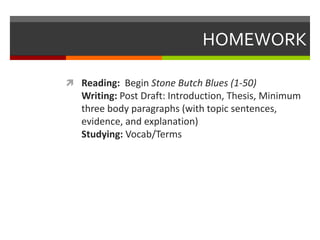
HOMEWORK

 Reading: Begin Stone Butch Blues (1-50)
   Writing: Post Draft: Introduction, Thesis, Minimum
   three body paragraphs (with topic sentences,
   evidence, and explanation)
   Studying: Vocab/Terms

Class 7 1 b

  • 1.
  • 2.
    AGENDA  Presentation: TermsList 2  QHQ Discussion: Who's Passing for Who? and "Recitatif"  Lecture: Thesis statements, outlining, using evidence, introductions.  In-Class Writing: Essay #2  Author Lecture: Leslie Feinberg  Return Essay #1
  • 3.
    TERMS LIST 2 Ableism: A pervasive system of discrimination and exclusion that oppresses people who have mental, emotional, and physical disabilities.  Ally: A person who supports marginalized, silenced, or less privilege groups without actually being a member of those groups. This person will often directly confront and challenge biphobia, homophobia, heterosexism, racism, transphobia and other systems of oppression.  Binary Gender: A system that defines and makes room for two and only two distinct, natural and opposite genders (i.e. male and female). These two genders are defined in opposition to each other, such that masculinity and femininity are seen as mutually exclusive. In this system, there is no room for any ambiguity or intermingling of gender traits.
  • 4.
     Classism: Biasbased on social or economic class.  Critical Consciousness: a process of continuous self-reflection and action to discover and uncover how we continue to be shaped by societal assumptions and power dynamics: an essential tool to help us to recognize, understand and work to change the social forces that shape our societies an ourselves.  Cultural Appropriation: The adoption of cultural elements not in one’s own culture, without full knowledge of or respect for its value within the original culture.  Cultural Oppression: Social norms, roles, rituals, language, music, and art that reflect and reinforce the belief that one social group is superior to anther.  Dominance: The systematic attitudes and actions of prejudice, superiority, and self- righteousness of one group (a non-target group) in relation to another (a target group). Internalized dominance includes the inability of a group or individual to see privilege as a member of the non-target group.
  • 5.
    QHQ Discussion: "Recitatif" Between Roberta and Twyla, who is white and who is black?  Does the article/narrative show how stereotypes can emerge unconsciously?  Does it matter what races the characters belong to?  Should we try to understand their personal and cultural background as opposed to color?
  • 6.
     “Who’s Passing forWho?” By Langston Hughes • Who’s really passing in the story here? • Were the light-skinned couple white or African American? • Can the writers be mad that the Iowans pretended to pass? • What did the narrator mean when he said “they had too much fun at our expense- even If they did pay for all the drinks.” • Why do the Iowans pretend to be African American? • Was the red-headed man from Iowa passing? • How are the couple able to pass so easily as black, so much so that a group of black people are completely convinced that they are? • Who was narrow minded?
  • 7.
     “Who’s Passing forWho?” By Langston Hughes • Why was Caleb so nice to the “overearnest uplifters?” • Why did the writers hate on Caleb so much? • Why were the white friends of Caleb’s so surprised about black writers? • How does Caleb seem contradictory after he and his group was kicked out of the restaurant for “disturbing the peace”? • Why are the black men so rude to the couple and the red-haired man in the beginning? • Why does the red-haired Iowan care about the unknown woman? • Are Hughes and his friends being hypocritical when they tell the Iowan that he shouldn’t stop protecting a woman just because of her race? • Is Hughes’ bias any worse/better than the man from Iowa? • Why did the red haired man leave the group after the group was told to leave the bar? • Why would the woman who appeared white be so okay with being pushed down by her husband? •
  • 8.
    Comparing Works WeHave Read  What does “Who’s Passing for Who?” have in common with Morrison’s “Recitatif”?  What do they share with other works? How are they different?  “Passing” the poem  “Passing” the short story  “The Passing of Grandison”  Do you have any other insights into “passing” that you have realized through our readings or discussions.
  • 9.
  • 10.
    The Prompt: If passingfor white will get a fellow better accommodations on the train, better seats in the theatre, immunity from insults in public places, and may even save his life from a mob,” only idiots would fail to seize the advantages of passing, at least occasionally if not permanently.” Write an essay of 750 to 1000 words arguing for or against William Pickens’s statement. Use support from the texts you have read so far, our discussions, and your own insights. Do you agree with Pickens's statement? If yes, why? If no, why not?
  • 11.
    Your Thesis In thiscase, your thesis will be your position on William Pickens’s Statement: Do you agree with him or not? Why or why not? You may refer to Pickens or not in your thesis.
  • 12.
    What are your“reasons” for agreeing or disagreeing with the act of passing? Your reasons should connect to your thesis. Each one should be a topic for at least one body paragraph  Consider your best support for your assertion. This will likely be from your brainstorming using FREECASH.  Find textual evidence to support your position.  Explain how your examples support your thesis.  You can also use secondary sources if you would like to, but they are not necessary for this paper.
  • 13.
    Introductions You never geta second chance to make a first impression. The opening paragraph of your paper will provide your readers with their initial impressions of your argument, your writing style, and the overall quality of your work. A vague, disorganized, error- filled, off-the-wall, or boring introduction will probably create a negative impression. On the other hand, a concise, engaging, and well-written introduction will start your readers off thinking highly of you, your analytical skills, your writing, and your paper.
  • 14.
    Start by thinkingabout the question you are trying to answer: Write an essay of 500 to 750 words arguing for or against William Pickens’s statement: "If passing for white will get a fellow better accommodations on the train, better seats in the theatre, immunity from insults in public places, and may even save his life from a mob," wrote William Pickens, "only idiots would fail to seize the advantages of passing, at least occasionally if not permanently" Your entire essay will be a response to this question, and your introduction is the first step toward that end. Your direct answer to the assigned question will be your thesis, and your thesis will be included in your introduction, so it is a good idea to use the question as a jumping off point.
  • 15.
    Open with anattention grabber. Consider these options: • A provocative quotation: Consider a line or two from one of the texts we read. • An intriguing example of passing: Provide a situation or two in which a person might be inclined to pass. • A puzzling scenario: Imagine a scene that makes a reader consider the consequences or benefits of passing. • A vivid and perhaps unexpected anecdote: Open with a short story about a successful or failed passing attempt. • Find common ground with your reader: Offer a contemporary example of passing (maybe a humorous one, even) and then explain the more reasons for passing in this earlier time period.
  • 16.
    Avoid statements like "In this paper, I will argue that racial passing destabilizes the social construction of race and is therefore beneficial to society."  While this sentence points toward your main argument, it isn't especially interesting. It might be more effective to say what you mean in a declarative sentence: “Racial passing destabilizes the social construction of race and is therefore beneficial to society."  It is much more convincing to tell your readers that than to tell them that you are going to say that it does. Assert your main argument confidently. After all, you can't expect your reader to believe it if it doesn't sound like you believe it!
  • 17.
    Introductions to Avoid 1.The restated question introduction: Twists the question to take up space in the introduction. 2. The place holder introduction: Offers several vague sentences that don’t really say much. 3. The Webster's Dictionary introduction. This introduction begins by giving the dictionary definition of one or more of the words in the assigned question. 4. The "dawn of man" introduction. This kind of introduction generally makes broad, sweeping statements about the relevance of this topic since the beginning of time. 5. The book report introduction. This introduction gives the name and author of the book you are writing about, tells what the book is about, and offers other basic facts about the book.
  • 18.
    Let’s Try toWrite an Introduction or Two Now.  An intriguing example of  A vivid and perhaps passing: Provide a situation unexpected anecdote: Open or two in which a person with a short story about a might be inclined to pass. successful or failed passing attempt.  A provocative quotation: Consider a line or two from  Find common ground with one of the texts we read. your reader: Offer a contemporary example of  A puzzling scenario: Imagine passing (maybe a humorous a scene that makes a reader one, even) and then explain consider the consequences the more reasons for passing or benefits of passing. in this earlier time period.
  • 19.
    Possible Outline Introduction: Thesis: Thiswill likely be near the end of your introduction Multiple Body Paragraphs supporting your thesis: The topic sentences of your body paragraphs (probably situated fairly early in the paragraph) should connect directly to your thesis. You should use the following rhetorical strategies to support your topic sentence: define (describe and/or characterize unfamiliar terms, situations, or events) classify (briefly distinguish between types) exemplify (provide examples from primary or secondary texts) analyze (explore and/or evaluate, particularly in terms of the connections of the examples to your reasons or thesis) explain (give details about) the connection between your example and your assertions. conclude (provide a logical conclusion for your readers) Transition (prepare your reader for the next paragraph. Counter Argument: Anticipate your readers questions or doubts. Will will discuss this in class on Wednesday. Conclusion: We will discuss this in class Wednesday
  • 20.
    Writing Sketch out arough outline. Intro: What kind? Thesis: Write out a working thesis Body 1: One of your strongest arguments supporting your thesis. support/example Body 2: Another reason support/example Body 3: Another reason support/example Body 4:One of your strongest arguments supporting your thesis. support/example Counterargument: Conclusion:
  • 21.
    HOMEWORK  Reading: BeginStone Butch Blues (1-50) Writing: Post Draft: Introduction, Thesis, Minimum three body paragraphs (with topic sentences, evidence, and explanation) Studying: Vocab/Terms