Careers in Nat Resources Career:  Wildlife Biologist Website http://www.worksmart.ca.gov/tips_application.html Complete the worksheet
Wildlife Biologist Study the origins, behavior, diseases, genetics, and life processes of animals and wildlife.  Must conduct wildlife research and management,  collection and analysis of biological data determine the environmental effects of present and potential use of land and water areas Job Description for Virginia  Starting salary: $32,000, max salary $108,000
Wildlife Biologist Education: Masters of Science in applied biology: Zoology, Soils, Wildlife, Forestry, Environmental Science, Computers, Statistics, Genetics etc. Job outlook – slight growth, currently 20,000 jobs nationwide Entry level – data collection (graduate students)  Mid-level – area management Upper-levels – state government Many jobs in the west – National Parks
Careers Project – Due Friday Select a career Research: Description Entry and education requirements Career progression Where you could live/work Salary expectations Job outlook Find jobs advertising or offers on-line for this career. Print out job description & requirements Collect or create everything required to apply.  For example: Completed job application Resume Letter of reference Diploma(s)
Career Project Prepare either: 3-4 page report on your potential career Or A 15 minute presentation on you career Or  Find a guest speaker who has that career and is willing to speak to the class about it. Due Friday
Career websites http://www.khake.com/ Explore careers in Agriculture or Natural resources. Decide the career for your report during class today
Job Applications First impressions are important.  Remember to bring everything with you that you will need when filling out applications.  Ball point pens (black or blue ink)  Your fact sheet Copies of your resume  Your completed application is a reflection of you. Make it a good one!  Employers use applications to decide who to interview
Filling Out Applications Read the entire application form first: especially the instructions Be polite when requesting or submitting an application.  Be honest in your answers.  Use blue or black ink pens. Have a fact sheet  Print clearly and legibly.  Apply for a specific position, not "anything,"  Leave no blanks. Write "Does Not Apply" (or "N/A")  Read and check the application for completeness before turning it in to the employer.  Be sure to sign and date the application.  Mail or turn the application into the correct person or place.
Personal Data  In the  name  field, be sure to note in what order the employer wants your first and last names. Print neatly.  Use an  address  where you can receive mail.  Provide your  telephone number  with an area code. If you use a message number, make sure that everyone at that number knows what to say for you or that the message on a message machine is appropriate.  Be sure that you meet the  health requirements  for the job. If a physical examination is a condition of employment, the employer must pay for it and can only request it after you are hired.  All applications ask for information about the schools you've attended. List your  education , detailing any special courses.  If you have any professional  certification, licenses, or registrations,  ie. special class driver's license.  List any  hobbies  or interests you may have. This will provide the employer with additional information about related skills.  If possible,  avoid  entering  birth dates  or school  graduation dates  on an application.
Work Data Always fill in the space for the  "Position Desired."   Never write "any" or "will do anything!"  It is acceptable to list more than one position.  In the  salary  desired field write "open" or "negotiable“ Don’t put in a salary figure that might be too high or too low.  In the  availability  field write "immediately," if you are available to start right away.  If you are currently employed, indicate that you are available to start after giving two weeks notice.  Giving two weeks notice makes it more likely that you will get a good reference from the employer.  Be knowledgeable about the hours required for the job.
Work Experience Give your job title and dates of employment; the name, address, and phone number of the employer; and a description of your duties.  Might need your salary and your supervisor's name.  Include part-time and full-time jobs.  Make sure that the dates of employment don't overlap or conflict.  Highlight any  club activities, or volunteer work, or organizations  you belong to, that may relate to the job you are seeking.  List any  special skills, abilities, experience and/or training  that relate to the position you want.  Always talk to your  references  before beginning your work search, to ask permission to use their names, addresses, and phone numbers on your application(s).  Former employers, business acquaintances, teachers, and the clergy are all acceptable references. Be sure to keep your reference list updated and let them know when you find a job.
Leaving Jobs If asked for the  reason you left  a job, use positive phrases "to take a job with more responsibility," "moved," "seasonal," "business closed," "job or contract ended," "temporary work," " laid off," " reorganization," "returned to school," " or "career change."  Avoid negative words "fired," "quit," "absenteeism," or "tardiness."
Mistakes Not following directions  Misspelled words  Crossed out writing  Not printed  Wrinkled or messy application form  Incomplete information or unanswered questions  Not applying for a specific position  Application not turned in by the deadline  Use of troublesome words, such as "quit" or "fired"  Forgetting to sign the application
Fact Sheet Find out all information before going to put in your application Keep the form – just use it to copy information Update it with names, addresses and phone numbers Be detailed in duties preformed Complete the worksheet now
 
 
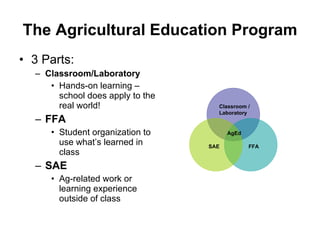
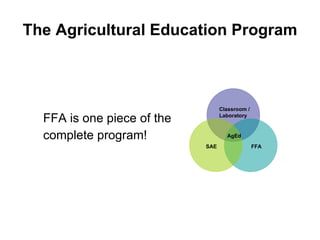
The Agricultural Education Program 3 Parts: Classroom/Laboratory Hands-on learning – school does apply to the real world! FFA Student organization to use what’s learned in class SAE Ag-related work or learning experience outside of class Classroom / Laboratory FFA SAE AgEd
The Agricultural Education Program FFA is one piece of the  complete program! Classroom / Laboratory AgEd FFA SAE
FFA Mission What is FFA all about? FFA makes a positive difference in the lives of students by developing their potential for… Premier Leadership , Personal Growth  and Career Success …through agricultural education.
What is FFA? Premier Leadership Leadership is Influence Action Relationship Vision Character Awareness Continuous Improvement
What is FFA? Personal Growth The positive evolution of the whole person. Physical Growth Social Growth Mental Growth Emotional Growth Spiritual Growth
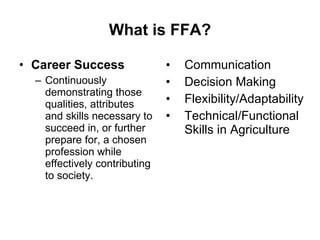
What is FFA? Career Success Continuously demonstrating those qualities, attributes and skills necessary to succeed in, or further prepare for, a chosen profession while effectively contributing to society. Communication Decision Making Flexibility/Adaptability Technical/Functional Skills in Agriculture
What is FFA? Beyond the Mission… Lead Travel Earn Money Be Part of the Team/Family Serve the Community Succeed Have Fun!
 
The Basics FFA Mission 3 Significant Levels Local State National Sometimes districts,  regions and areas
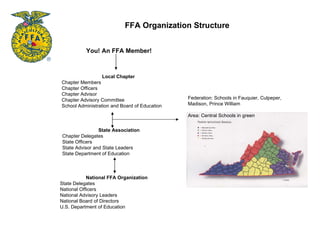
FFA Organization Structure Federation: Schools in Fauquier, Culpeper, Madison, Prince William Area: Central Schools in green Local Chapter Chapter Members Chapter Officers Chapter Advisor Chapter Advisory Committee School Administration and Board of Education State Association Chapter Delegates State Officers State Advisor and State Leaders State Department of Education National FFA Organization State Delegates National Officers National Advisory Leaders National Board of Directors U.S. Department of Education You! An FFA Member!
The Basics Levels of FFA Membership Like moving from pre-school to elementary to   middle school to high school 4 levels for membership Enter a new level as we get older and more  experienced
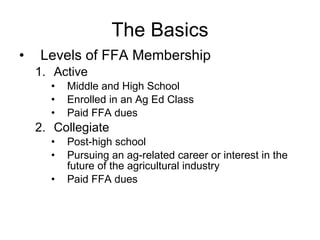
The Basics Levels of FFA Membership Active Middle and High School Enrolled in an Ag Ed Class Paid FFA dues Collegiate Post-high school Pursuing an ag-related career or interest in the future of the agricultural industry Paid FFA dues
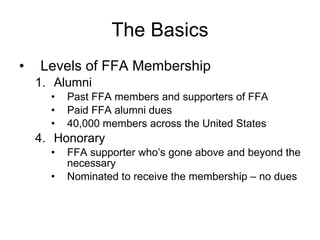
The Basics Levels of FFA Membership Alumni Past FFA members and supporters of FFA Paid FFA alumni dues 40,000 members across the United States 4.  Honorary FFA supporter who’s gone above and beyond the necessary Nominated to receive the membership – no dues
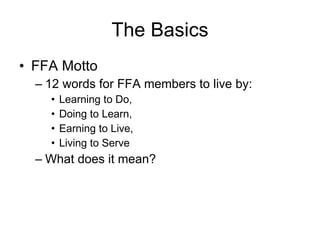
The Basics FFA Motto 12 words for FFA members to live by: Learning to Do, Doing to Learn, Earning to Live, Living to Serve What does it mean?
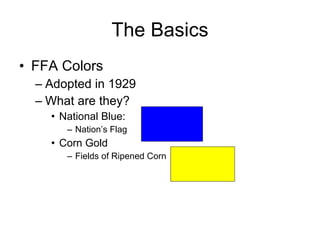
The Basics FFA Colors Adopted in 1929 What are they? National Blue: Nation’s Flag Corn Gold Fields of Ripened Corn
The Basics The FFA Salute You’ve done this one a time or two! “ I pledge allegiance to the flag of the United States of America and to the Republic for which it stands, one nation under God, indivisible, with liberty and justice for all.”
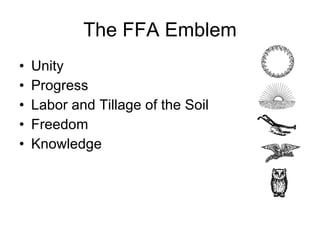
The FFA Emblem Unity Progress Labor and Tillage of the Soil Freedom Knowledge
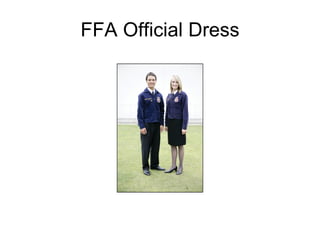
FFA Official Dress
FFA Creed I believe in the future of agriculture, with a faith born not of words but of deeds - achievements won by the present and past generations of agriculturists; in the promise of better days through better ways, even as the better things we now enjoy have come to us from the struggles of former years.
I believe that to live and work on a good farm, or to be engaged in other agricultural pursuits, is pleasant as well as challenging; for I know the joys and discomforts of agricultural life and hold an inborn fondness for those associations which, even in hours of discouragement, I cannot deny.
I believe in leadership from ourselves and respect from others. I believe in my own ability to work efficiently and think clearly, with such knowledge and skill as I can secure, and in the ability of progressive agriculturists to serve our own and the public interest in producing and marketing the product of our toil.
I believe in less dependence on begging and more power in bargaining; in the life abundant and enough honest wealth to help make it so--for others as well as myself; in less need for charity and more of it when needed; in being happy myself and playing square with those whose happiness depends upon me.
I believe that American agriculture can and will hold true to the best traditions of our national life and that I can exert an influence in my home and community which will stand solid for my part in that inspiring task.
FFA Degrees Recognize active members for participation and skill acquisition Discovery Greenhand Chapter State American
Fish Eating well Feed 1 ½ cups to catfish Feed ½ cup to tilapia & koi EC – if falls below 3.00 – add 1 scoop of salt directly to tank Need to fully exchange every day! – Fill cans completely
Today Degree Applications Greenhand: 9 th  graders Chapter: 10 th  – 11th State: Have chapter degree Non-FFA members: Seniors – scholarships Others - resumes

1 4 Job Applications

  • 1.
    Careers in NatResources Career: Wildlife Biologist Website http://www.worksmart.ca.gov/tips_application.html Complete the worksheet
  • 2.
    Wildlife Biologist Studythe origins, behavior, diseases, genetics, and life processes of animals and wildlife. Must conduct wildlife research and management, collection and analysis of biological data determine the environmental effects of present and potential use of land and water areas Job Description for Virginia Starting salary: $32,000, max salary $108,000
  • 3.
    Wildlife Biologist Education:Masters of Science in applied biology: Zoology, Soils, Wildlife, Forestry, Environmental Science, Computers, Statistics, Genetics etc. Job outlook – slight growth, currently 20,000 jobs nationwide Entry level – data collection (graduate students) Mid-level – area management Upper-levels – state government Many jobs in the west – National Parks
  • 4.
    Careers Project –Due Friday Select a career Research: Description Entry and education requirements Career progression Where you could live/work Salary expectations Job outlook Find jobs advertising or offers on-line for this career. Print out job description & requirements Collect or create everything required to apply. For example: Completed job application Resume Letter of reference Diploma(s)
  • 5.
    Career Project Prepareeither: 3-4 page report on your potential career Or A 15 minute presentation on you career Or Find a guest speaker who has that career and is willing to speak to the class about it. Due Friday
  • 6.
    Career websites http://www.khake.com/Explore careers in Agriculture or Natural resources. Decide the career for your report during class today
  • 7.
    Job Applications Firstimpressions are important. Remember to bring everything with you that you will need when filling out applications. Ball point pens (black or blue ink) Your fact sheet Copies of your resume Your completed application is a reflection of you. Make it a good one! Employers use applications to decide who to interview
  • 8.
    Filling Out ApplicationsRead the entire application form first: especially the instructions Be polite when requesting or submitting an application. Be honest in your answers. Use blue or black ink pens. Have a fact sheet Print clearly and legibly. Apply for a specific position, not "anything," Leave no blanks. Write "Does Not Apply" (or "N/A") Read and check the application for completeness before turning it in to the employer. Be sure to sign and date the application. Mail or turn the application into the correct person or place.
  • 9.
    Personal Data In the name field, be sure to note in what order the employer wants your first and last names. Print neatly. Use an address where you can receive mail. Provide your telephone number with an area code. If you use a message number, make sure that everyone at that number knows what to say for you or that the message on a message machine is appropriate. Be sure that you meet the health requirements for the job. If a physical examination is a condition of employment, the employer must pay for it and can only request it after you are hired. All applications ask for information about the schools you've attended. List your education , detailing any special courses. If you have any professional certification, licenses, or registrations, ie. special class driver's license. List any hobbies or interests you may have. This will provide the employer with additional information about related skills. If possible, avoid entering birth dates or school graduation dates on an application.
  • 10.
    Work Data Alwaysfill in the space for the "Position Desired." Never write "any" or "will do anything!" It is acceptable to list more than one position. In the salary desired field write "open" or "negotiable“ Don’t put in a salary figure that might be too high or too low. In the availability field write "immediately," if you are available to start right away. If you are currently employed, indicate that you are available to start after giving two weeks notice. Giving two weeks notice makes it more likely that you will get a good reference from the employer. Be knowledgeable about the hours required for the job.
  • 11.
    Work Experience Giveyour job title and dates of employment; the name, address, and phone number of the employer; and a description of your duties. Might need your salary and your supervisor's name. Include part-time and full-time jobs. Make sure that the dates of employment don't overlap or conflict. Highlight any club activities, or volunteer work, or organizations you belong to, that may relate to the job you are seeking. List any special skills, abilities, experience and/or training that relate to the position you want. Always talk to your references before beginning your work search, to ask permission to use their names, addresses, and phone numbers on your application(s). Former employers, business acquaintances, teachers, and the clergy are all acceptable references. Be sure to keep your reference list updated and let them know when you find a job.
  • 12.
    Leaving Jobs Ifasked for the reason you left a job, use positive phrases "to take a job with more responsibility," "moved," "seasonal," "business closed," "job or contract ended," "temporary work," " laid off," " reorganization," "returned to school," " or "career change." Avoid negative words "fired," "quit," "absenteeism," or "tardiness."
  • 13.
    Mistakes Not followingdirections Misspelled words Crossed out writing Not printed Wrinkled or messy application form Incomplete information or unanswered questions Not applying for a specific position Application not turned in by the deadline Use of troublesome words, such as "quit" or "fired" Forgetting to sign the application
  • 14.
    Fact Sheet Findout all information before going to put in your application Keep the form – just use it to copy information Update it with names, addresses and phone numbers Be detailed in duties preformed Complete the worksheet now
  • 15.
  • 16.
  • 17.
    The Agricultural EducationProgram 3 Parts: Classroom/Laboratory Hands-on learning – school does apply to the real world! FFA Student organization to use what’s learned in class SAE Ag-related work or learning experience outside of class Classroom / Laboratory FFA SAE AgEd
  • 18.
    The Agricultural EducationProgram FFA is one piece of the complete program! Classroom / Laboratory AgEd FFA SAE
  • 19.
    FFA Mission Whatis FFA all about? FFA makes a positive difference in the lives of students by developing their potential for… Premier Leadership , Personal Growth and Career Success …through agricultural education.
  • 20.
    What is FFA?Premier Leadership Leadership is Influence Action Relationship Vision Character Awareness Continuous Improvement
  • 21.
    What is FFA?Personal Growth The positive evolution of the whole person. Physical Growth Social Growth Mental Growth Emotional Growth Spiritual Growth
  • 22.
    What is FFA?Career Success Continuously demonstrating those qualities, attributes and skills necessary to succeed in, or further prepare for, a chosen profession while effectively contributing to society. Communication Decision Making Flexibility/Adaptability Technical/Functional Skills in Agriculture
  • 23.
    What is FFA?Beyond the Mission… Lead Travel Earn Money Be Part of the Team/Family Serve the Community Succeed Have Fun!
  • 24.
  • 25.
    The Basics FFAMission 3 Significant Levels Local State National Sometimes districts, regions and areas
  • 26.
    FFA Organization StructureFederation: Schools in Fauquier, Culpeper, Madison, Prince William Area: Central Schools in green Local Chapter Chapter Members Chapter Officers Chapter Advisor Chapter Advisory Committee School Administration and Board of Education State Association Chapter Delegates State Officers State Advisor and State Leaders State Department of Education National FFA Organization State Delegates National Officers National Advisory Leaders National Board of Directors U.S. Department of Education You! An FFA Member!
  • 27.
    The Basics Levelsof FFA Membership Like moving from pre-school to elementary to middle school to high school 4 levels for membership Enter a new level as we get older and more experienced
  • 28.
    The Basics Levelsof FFA Membership Active Middle and High School Enrolled in an Ag Ed Class Paid FFA dues Collegiate Post-high school Pursuing an ag-related career or interest in the future of the agricultural industry Paid FFA dues
  • 29.
    The Basics Levelsof FFA Membership Alumni Past FFA members and supporters of FFA Paid FFA alumni dues 40,000 members across the United States 4. Honorary FFA supporter who’s gone above and beyond the necessary Nominated to receive the membership – no dues
  • 30.
    The Basics FFAMotto 12 words for FFA members to live by: Learning to Do, Doing to Learn, Earning to Live, Living to Serve What does it mean?
  • 31.
    The Basics FFAColors Adopted in 1929 What are they? National Blue: Nation’s Flag Corn Gold Fields of Ripened Corn
  • 32.
    The Basics TheFFA Salute You’ve done this one a time or two! “ I pledge allegiance to the flag of the United States of America and to the Republic for which it stands, one nation under God, indivisible, with liberty and justice for all.”
  • 33.
    The FFA EmblemUnity Progress Labor and Tillage of the Soil Freedom Knowledge
  • 34.
  • 35.
    FFA Creed Ibelieve in the future of agriculture, with a faith born not of words but of deeds - achievements won by the present and past generations of agriculturists; in the promise of better days through better ways, even as the better things we now enjoy have come to us from the struggles of former years.
  • 36.
    I believe thatto live and work on a good farm, or to be engaged in other agricultural pursuits, is pleasant as well as challenging; for I know the joys and discomforts of agricultural life and hold an inborn fondness for those associations which, even in hours of discouragement, I cannot deny.
  • 37.
    I believe inleadership from ourselves and respect from others. I believe in my own ability to work efficiently and think clearly, with such knowledge and skill as I can secure, and in the ability of progressive agriculturists to serve our own and the public interest in producing and marketing the product of our toil.
  • 38.
    I believe inless dependence on begging and more power in bargaining; in the life abundant and enough honest wealth to help make it so--for others as well as myself; in less need for charity and more of it when needed; in being happy myself and playing square with those whose happiness depends upon me.
  • 39.
    I believe thatAmerican agriculture can and will hold true to the best traditions of our national life and that I can exert an influence in my home and community which will stand solid for my part in that inspiring task.
  • 40.
    FFA Degrees Recognizeactive members for participation and skill acquisition Discovery Greenhand Chapter State American
  • 41.
    Fish Eating wellFeed 1 ½ cups to catfish Feed ½ cup to tilapia & koi EC – if falls below 3.00 – add 1 scoop of salt directly to tank Need to fully exchange every day! – Fill cans completely
  • 42.
    Today Degree ApplicationsGreenhand: 9 th graders Chapter: 10 th – 11th State: Have chapter degree Non-FFA members: Seniors – scholarships Others - resumes

Editor's Notes

  • #9 Employers review the information on job applications when deciding who to schedule for job interviews. Remember that employers often judge the appearance of an application as a clue to how much importance you put on the quality of your work.Here are some helpful tips to follow when completing applications