“ Job Search Strategies in a Tight Economy” Spring 2010 Jill Parker, Director of Career Services Karen Obringer, Career Counselor in Career Services
Overview of Workshop Job Search Strategies in a Tight Economy Workshop Resumes & Transferable Skills References Cover Letters Networking Job Searching Interviewing Coping with Job Loss Discussion / Questions
Why do we need a resume? The purpose of a resume is to get  an interview , not a job.  Once you get in the door, it's your personality and discussion of your education and lifetime of experiences that will get you the job.
Two Types of Resumes Chronological     This format is good for people with extensive work experience either with one company or a few companies, usually in the field in which they are seeking employment. Work and educational experience is listed in reverse order of occurrence, beginning with the most recent dates and working back. Combination This format is good for career changers, those with gaps in employment and those who want to clearly sell specific skills paralleling the needs of the employer.  (Page 25) This focuses on skill clusters, rather than describing the jobs as you list your work history.
Formatting / Appearance NO Templates! Make your name stand out with a bold, larger font size (usually 14-20 point font) Use standard fonts such as Times New Roman, Arial, or Courier Type Size: 10 – 12 point font White, beige, or light gray quality bond paper  Length should generally be one page unless you have extensive experience or graduate school work. If you go to a second page, put your name and p. 2 at the top right Don’t use “fun” or “cute” graphics or logos
Formatting / Appearance Make it “reader friendly” (15-30 seconds) No high school information – Keep things current! Only go back 10 years, UNLESS it is relevant—then, the dates can be listed as “prior to 2000” No personal information (family, hobbies, date of birth, etc.) Don’t use first-person language (I am seeking a job, my education…) Use action verbs Adhere to the Rule of Thumb
Sections of a Resume Contact Information (appropriate email address) Objective or Summary of Qualifications Education Relevant/Work/Professional/Volunteer Experience Honors/Awards/Activities Professional Affiliations Professional Development (Workshops / Conferences) Skills (Languages / Computer) **Please note that this is for a typical chronological resume.  The order may differ for a combination resume.
Contact Information Name Address (Present and Permanent when appropriate) Phone Number Email Address  EXAMPLES: JANE M. SMITH 123 Any Street Fort Wayne, IN 46835 (260) 555-1212 [email_address]   CHRIS SMITH 83 Prospect Road    Fort Wayne, IN 46807    (260) 432-8975    csmith@gmail.com
Objective  Avoid vague statements- be specific Keep it employer-focused No first-person language Sample Objective: Special Education position with Fort Wayne Community Schools
Summary of Qualifications Summary describes your qualifications Tailor to the job description Example: Career Guide example, pgs. 10 & 25
Education List colleges and universities beginning with the most recent first Name the institution(s) including city and state (i.e., Indiana University - Fort Wayne, IN) List degree and date anticipated List GPA if 3.0 or above If it has been more than 5 years since you graduated, you can delete the date Example: Bachelor of Science in Secondary Education , May 2007 Indiana University, Fort Wayne, IN Concentration: Adolescent/Young Adult Minor: Language Arts
Work / Professional Experience List all significant experience that pertains to the job you are seeking Begin with most recent or  relevant  experience (see Career Guide)  Categorize your experiences in a way that pertains to the job you are seeking (i.e., Student Teaching Experience, Coaching Experience, Related Experience, skill clusters on a combination resume, etc.)
Work / Professional Experience, cont . Action Verbs Quantify and Qualify (i.e., how many) Bullet points should answer WHAT and WHY Go to the Occupational Outlook Handbook: http://www.bls.gov/oco/   Look at an old job description
Volunteer Experience Hospitals, Non-Profits, Fundraisers, etc. What was your role? ****  Just make sure that it is relevant!
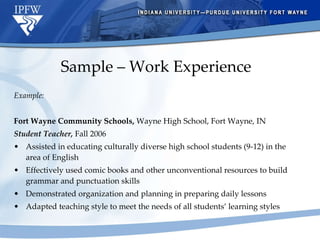
Sample – Work Experience Example: Fort Wayne Community Schools,  Wayne High School, Fort Wayne, IN Student Teacher,  Fall 2006 Assisted in educating culturally diverse high school students (9-12) in the area of English Effectively used comic books and other unconventional resources to build grammar and punctuation skills Demonstrated organization and planning in preparing daily lessons Adapted teaching style to meet the needs of all students’ learning styles
Skills Clusters in a Combination Resume Transferable skills (p. 14 & 15) Examples:  Customer Service Skills, Communication Skills, Management Skills Within each skill cluster: list the relevant job duties don’t have to mention to which job it applies
Professional Development / Activities List the name of the organization along with your status (treasurer, member, etc.) and year of membership (since 2006) in reverse chronological order List activities you have done or are doing that would be of interest to the employer Example: Activities and Honors National Council for Exceptional Children, member 2006- present  Educators for Excellence, IPFW, member, 2005- present National Collegiate Education Award Winner, 2006
Skills SKILLS Language:  Conversant in Spanish Computer:  Microsoft Word, Excel, PowerPoint
Additional Resume Resources Occupational Outlook Handbook www.bls.gov IPFW Career Services Website- Sample Resumes / CV’s http://www.ipfw.edu/career   Resume Critique Appointment with a Career Counselor (Express Lane)
References Typically 3-4 people who you know professionally Not friends or family members Give references a “heads up” that you are job  searching so that they are prepared when they get phone calls, and send them a copy of your resume Use a separate page for your references—don’t make it part of your resume (see Career Guide)
What is a Cover Letter? Personalized  introduction of yourself to a specific employer Demonstration of your written communication skills Explanation of how your skills and experience fit the requirements of the position
Should I always send a  cover letter? Strongly encouraged by some employers, downplayed by others. Bottom line: It doesn’t hurt to send one. Address the specific ways in which your skills and experiences match the needs of the position. Pick out what the ad says and address it in the letter.
Cover Letter Format : Paragraph 1 Name the position for which you are applying, and how you learned about it.  Mention the name of a person (if any) who referred you to the organization. If no position is currently open, indicate that you’re interested in learning more about opportunities with their company. ( Letter of Inquiry)
Cover Letter Format : Paragraph 2 Explain how your skills/experiences match their needs. Give examples of skills and achievements and how they will transfer to the position. Comment on your knowledge of the company, and why you’re interested in working for them.
Cover Letter Format : Paragraph 3 Refer to the enclosed resume. Tell the contact person that you will call on a specified date, and that you are available for a personal interview at her/his convenience. Make it easy for the person to contact you. Re-state the phone number and email listed on your resume.
Cover Letter Tips Be specific, target and tailor your letter for each position! Never address a cover letter with “To Whom It May Concern.” Do your research, and address the letter to a specific HR person. Spell names correctly!  Have someone read through a draft of your letter to make sure it’s concise and error-free. Follow-up as specified in your letter. For an example of an email cover letter, see p. 39 in the Career Guide.
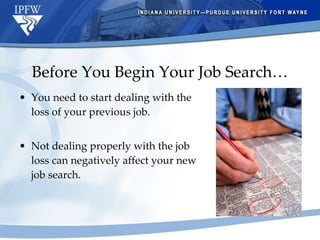
Before You Begin Your Job Search… You need to start dealing with the loss of your previous job. Not dealing properly with the job loss can negatively affect your new job search.
How Employers Hire Recruitment (job fairs, word of mouth, and internal posted positions, advertisements – page 47) Screening – narrow the pool of applicants (desired / preferred) Selection – get interview = you are qualified…looking for a “fit” The Hiring Structure – varies depending on company size and industry / # of people you meet with and hiring timeline Today’s Job Market = More Structured & Selective. Online databases
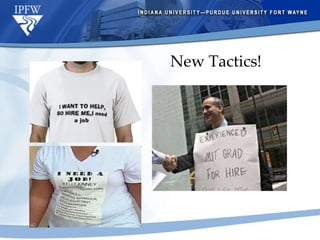
New Tactics!
Tapping ALL Resources A job search is like a full-time job… Job Fairs (NICE Expo – April 15 th  @ Ivy Tech) Yellow Pages Newspaper College Career Offices Workforce Development Offices Community Agencies Employment Agencies Social Networking Sites (e.g., LinkedIn)
Tapping ALL Resources Cont’d Professional Associations / Listservs Volunteering Online Websites: www.ipfw.edu/jobzone   (JobZone) www.indeed.com www.ipfw.edu/career/students/exploring/major.shtml Websites that allow you to post your resume:  www.ipfw.edu/career/students/job/JobBoardWebSites.shtml
Tapping ALL Resources Cont’d Chamber of Commerce www.fwchamber.org   Write a “Letter of Inquiry” – Page 37 * You never know whose desk your resume may land on when you send it in…
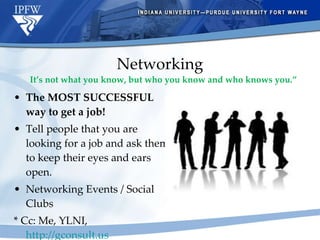
Networking The MOST SUCCESSFUL way to get a job! Tell people that you are looking for a job and ask them to keep their eyes and ears open. Networking Events / Social Clubs * Cc: Me, YLNI,  http://gconsult.us   It’s not what you know, but who you know and who knows you.”
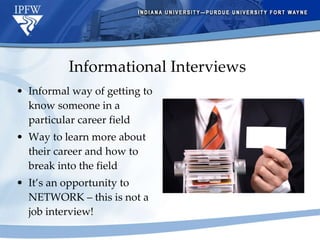
Informational Interviews Informal way of getting to know someone in a particular career field Way to learn more about their career and how to break into the field It’s an opportunity to NETWORK – this is not a job interview!
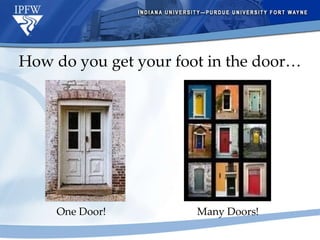
How do you get your foot in the door… One Door! Many Doors!
Job Search = Frustration = New Techniques Make sure your technical and communication skills are as strong as possible Engage a "kind critic" to honestly assess your image as a job candidate Become an active user of LinkedIn.com  (a social networking website) Play up your assets, whatever they are Don't ever put yourself – or your age – down Networking = conferences, workshops, seminars, etc.
Tips for the Job Search Think of your job search as a job: Get up, shower, get dressed, go to a place where you can “work” on the job search. Plan, set goals, and use a spreadsheet to track your activities and progress. Stay positive…if you really want to work for a particular employer, check back with them every few months. Always follow up. Be polite to the receptionists / clerical staff.
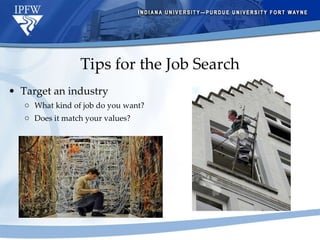
Tips for the Job Search Target an industry  What kind of job do you want? Does it match your values?
Researching Companies Read their mission statement, goals, strategic plans, etc. Read the “about us” on the web site and see what degree/ background people have Look over the annual report. “ Google” the company, or check the local online newspapers ( www.fortwayne.com ) to see if there have been any recent news articles about the company. Check out  www.glassdoor.com  for company information, insider info about interviewing process, etc.
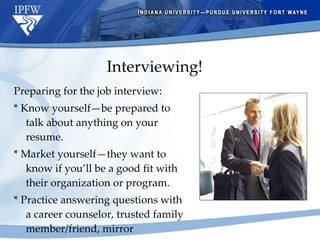
Interviewing! Preparing for the job interview: * Know yourself—be prepared to talk about anything on your resume. * Market yourself—they want to know if you’ll be a good fit with their organization or program. * Practice answering questions with a career counselor, trusted family member/friend, mirror
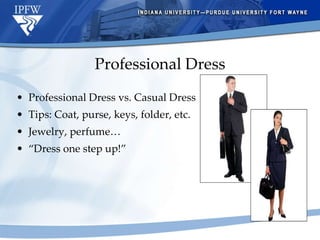
Professional Dress Professional Dress vs. Casual Dress Tips: Coat, purse, keys, folder, etc. Jewelry, perfume… “ Dress one step up!”
Before the Interview Practice, practice, practice!  You don’t want to sound rehearsed, but you want to have practiced enough to feel confident that you can answer the questions well. Bring extra copies of your resume. List of your top “selling points”
The Interview Make sure you arrive a few minutes early. Greet the recruiter by Mr./Ms./Dr. and his or her last name. Offer a firm handshake and a smile. Make eye contact with the recruiter and answer questions in a clear voice.  Work to establish a rapport with the recruiter—engage in small talk to break the ice.
Don’t Bad-Mouth Anyone (including the company that laid you off): This will only make YOU look bad—your goal is to always remain professional.  Answer all shaky questions honestly. Employers can find out what is and if it is not the truth—don’t risk your reputation because you don’t know how to handle a difficult question. The Interview
Techniques & Tips Rephrase the question Say, “That is a good question…” Ask them to repeat the question Go “full circle” Maintain eye contact comfortably Mirror them Do NOT ask about salary or benefits Mention your “selling” list Say, “I noticed on your website…”
Behavioral Interview Questions What you did in the past will predict how you act in the future SOAR Model – Page 65
Questions to Ask the Employer Remember that you are also interviewing the employer. Bring a list with you (usually 3-5 questions) = interested and prepared! Hint:  Ask what the next step is in the hiring process gives you an idea of how quickly they will make the decision, and allow you to restate your interest in the position
Final Interview Advice Reiterate your interest Show your excitement Thank them for their time Ask them when you can expect to hear from them Sell yourself….your skills, education, experience Send a thank-you letter (24 hours)
Coping with the Loss of a Job Talk to a counselor, pastor, etc. to vent and process the feelings resulting from your job loss. Set daily or weekly measurable goals to ensure that you are making progress with your job search. Take a break from your job search to regroup and stay positive.  Engage in activities you enjoy (working out, cooking, etc.) to keep a positive outlook. Keep a journal.
Expectations Expect rejection…Don’t take it personally. Call and ask for feedback. Maybe they hired an internal candidate. Expect the process to move SLOWLY. Take the initiative, follow up, etc. Expect to expand your search outside of Allen County, or even outside of northeast Indiana. Expect to become frustrated (if you aren’t already), but have a plan / goal to keep you focused and moving forward.
Questions? Office of Career Services www.ipfw.edu/career 260-481-0689

Job Search Strategies in a Tight Economy

  • 1.
    “ Job SearchStrategies in a Tight Economy” Spring 2010 Jill Parker, Director of Career Services Karen Obringer, Career Counselor in Career Services
  • 2.
    Overview of WorkshopJob Search Strategies in a Tight Economy Workshop Resumes & Transferable Skills References Cover Letters Networking Job Searching Interviewing Coping with Job Loss Discussion / Questions
  • 3.
    Why do weneed a resume? The purpose of a resume is to get an interview , not a job. Once you get in the door, it's your personality and discussion of your education and lifetime of experiences that will get you the job.
  • 4.
    Two Types ofResumes Chronological This format is good for people with extensive work experience either with one company or a few companies, usually in the field in which they are seeking employment. Work and educational experience is listed in reverse order of occurrence, beginning with the most recent dates and working back. Combination This format is good for career changers, those with gaps in employment and those who want to clearly sell specific skills paralleling the needs of the employer. (Page 25) This focuses on skill clusters, rather than describing the jobs as you list your work history.
  • 5.
    Formatting / AppearanceNO Templates! Make your name stand out with a bold, larger font size (usually 14-20 point font) Use standard fonts such as Times New Roman, Arial, or Courier Type Size: 10 – 12 point font White, beige, or light gray quality bond paper Length should generally be one page unless you have extensive experience or graduate school work. If you go to a second page, put your name and p. 2 at the top right Don’t use “fun” or “cute” graphics or logos
  • 6.
    Formatting / AppearanceMake it “reader friendly” (15-30 seconds) No high school information – Keep things current! Only go back 10 years, UNLESS it is relevant—then, the dates can be listed as “prior to 2000” No personal information (family, hobbies, date of birth, etc.) Don’t use first-person language (I am seeking a job, my education…) Use action verbs Adhere to the Rule of Thumb
  • 7.
    Sections of aResume Contact Information (appropriate email address) Objective or Summary of Qualifications Education Relevant/Work/Professional/Volunteer Experience Honors/Awards/Activities Professional Affiliations Professional Development (Workshops / Conferences) Skills (Languages / Computer) **Please note that this is for a typical chronological resume. The order may differ for a combination resume.
  • 8.
    Contact Information NameAddress (Present and Permanent when appropriate) Phone Number Email Address EXAMPLES: JANE M. SMITH 123 Any Street Fort Wayne, IN 46835 (260) 555-1212 [email_address] CHRIS SMITH 83 Prospect Road  Fort Wayne, IN 46807  (260) 432-8975  csmith@gmail.com
  • 9.
    Objective Avoidvague statements- be specific Keep it employer-focused No first-person language Sample Objective: Special Education position with Fort Wayne Community Schools
  • 10.
    Summary of QualificationsSummary describes your qualifications Tailor to the job description Example: Career Guide example, pgs. 10 & 25
  • 11.
    Education List collegesand universities beginning with the most recent first Name the institution(s) including city and state (i.e., Indiana University - Fort Wayne, IN) List degree and date anticipated List GPA if 3.0 or above If it has been more than 5 years since you graduated, you can delete the date Example: Bachelor of Science in Secondary Education , May 2007 Indiana University, Fort Wayne, IN Concentration: Adolescent/Young Adult Minor: Language Arts
  • 12.
    Work / ProfessionalExperience List all significant experience that pertains to the job you are seeking Begin with most recent or relevant experience (see Career Guide) Categorize your experiences in a way that pertains to the job you are seeking (i.e., Student Teaching Experience, Coaching Experience, Related Experience, skill clusters on a combination resume, etc.)
  • 13.
    Work / ProfessionalExperience, cont . Action Verbs Quantify and Qualify (i.e., how many) Bullet points should answer WHAT and WHY Go to the Occupational Outlook Handbook: http://www.bls.gov/oco/ Look at an old job description
  • 14.
    Volunteer Experience Hospitals,Non-Profits, Fundraisers, etc. What was your role? **** Just make sure that it is relevant!
  • 15.
    Sample – WorkExperience Example: Fort Wayne Community Schools, Wayne High School, Fort Wayne, IN Student Teacher, Fall 2006 Assisted in educating culturally diverse high school students (9-12) in the area of English Effectively used comic books and other unconventional resources to build grammar and punctuation skills Demonstrated organization and planning in preparing daily lessons Adapted teaching style to meet the needs of all students’ learning styles
  • 16.
    Skills Clusters ina Combination Resume Transferable skills (p. 14 & 15) Examples: Customer Service Skills, Communication Skills, Management Skills Within each skill cluster: list the relevant job duties don’t have to mention to which job it applies
  • 17.
    Professional Development /Activities List the name of the organization along with your status (treasurer, member, etc.) and year of membership (since 2006) in reverse chronological order List activities you have done or are doing that would be of interest to the employer Example: Activities and Honors National Council for Exceptional Children, member 2006- present Educators for Excellence, IPFW, member, 2005- present National Collegiate Education Award Winner, 2006
  • 18.
    Skills SKILLS Language: Conversant in Spanish Computer: Microsoft Word, Excel, PowerPoint
  • 19.
    Additional Resume ResourcesOccupational Outlook Handbook www.bls.gov IPFW Career Services Website- Sample Resumes / CV’s http://www.ipfw.edu/career Resume Critique Appointment with a Career Counselor (Express Lane)
  • 20.
    References Typically 3-4people who you know professionally Not friends or family members Give references a “heads up” that you are job searching so that they are prepared when they get phone calls, and send them a copy of your resume Use a separate page for your references—don’t make it part of your resume (see Career Guide)
  • 21.
    What is aCover Letter? Personalized introduction of yourself to a specific employer Demonstration of your written communication skills Explanation of how your skills and experience fit the requirements of the position
  • 22.
    Should I alwayssend a cover letter? Strongly encouraged by some employers, downplayed by others. Bottom line: It doesn’t hurt to send one. Address the specific ways in which your skills and experiences match the needs of the position. Pick out what the ad says and address it in the letter.
  • 23.
    Cover Letter Format: Paragraph 1 Name the position for which you are applying, and how you learned about it. Mention the name of a person (if any) who referred you to the organization. If no position is currently open, indicate that you’re interested in learning more about opportunities with their company. ( Letter of Inquiry)
  • 24.
    Cover Letter Format: Paragraph 2 Explain how your skills/experiences match their needs. Give examples of skills and achievements and how they will transfer to the position. Comment on your knowledge of the company, and why you’re interested in working for them.
  • 25.
    Cover Letter Format: Paragraph 3 Refer to the enclosed resume. Tell the contact person that you will call on a specified date, and that you are available for a personal interview at her/his convenience. Make it easy for the person to contact you. Re-state the phone number and email listed on your resume.
  • 26.
    Cover Letter TipsBe specific, target and tailor your letter for each position! Never address a cover letter with “To Whom It May Concern.” Do your research, and address the letter to a specific HR person. Spell names correctly! Have someone read through a draft of your letter to make sure it’s concise and error-free. Follow-up as specified in your letter. For an example of an email cover letter, see p. 39 in the Career Guide.
  • 27.
    Before You BeginYour Job Search… You need to start dealing with the loss of your previous job. Not dealing properly with the job loss can negatively affect your new job search.
  • 28.
    How Employers HireRecruitment (job fairs, word of mouth, and internal posted positions, advertisements – page 47) Screening – narrow the pool of applicants (desired / preferred) Selection – get interview = you are qualified…looking for a “fit” The Hiring Structure – varies depending on company size and industry / # of people you meet with and hiring timeline Today’s Job Market = More Structured & Selective. Online databases
  • 29.
  • 30.
    Tapping ALL ResourcesA job search is like a full-time job… Job Fairs (NICE Expo – April 15 th @ Ivy Tech) Yellow Pages Newspaper College Career Offices Workforce Development Offices Community Agencies Employment Agencies Social Networking Sites (e.g., LinkedIn)
  • 31.
    Tapping ALL ResourcesCont’d Professional Associations / Listservs Volunteering Online Websites: www.ipfw.edu/jobzone (JobZone) www.indeed.com www.ipfw.edu/career/students/exploring/major.shtml Websites that allow you to post your resume: www.ipfw.edu/career/students/job/JobBoardWebSites.shtml
  • 32.
    Tapping ALL ResourcesCont’d Chamber of Commerce www.fwchamber.org Write a “Letter of Inquiry” – Page 37 * You never know whose desk your resume may land on when you send it in…
  • 33.
    Networking The MOSTSUCCESSFUL way to get a job! Tell people that you are looking for a job and ask them to keep their eyes and ears open. Networking Events / Social Clubs * Cc: Me, YLNI, http://gconsult.us It’s not what you know, but who you know and who knows you.”
  • 34.
    Informational Interviews Informalway of getting to know someone in a particular career field Way to learn more about their career and how to break into the field It’s an opportunity to NETWORK – this is not a job interview!
  • 35.
    How do youget your foot in the door… One Door! Many Doors!
  • 36.
    Job Search =Frustration = New Techniques Make sure your technical and communication skills are as strong as possible Engage a "kind critic" to honestly assess your image as a job candidate Become an active user of LinkedIn.com (a social networking website) Play up your assets, whatever they are Don't ever put yourself – or your age – down Networking = conferences, workshops, seminars, etc.
  • 37.
    Tips for theJob Search Think of your job search as a job: Get up, shower, get dressed, go to a place where you can “work” on the job search. Plan, set goals, and use a spreadsheet to track your activities and progress. Stay positive…if you really want to work for a particular employer, check back with them every few months. Always follow up. Be polite to the receptionists / clerical staff.
  • 38.
    Tips for theJob Search Target an industry What kind of job do you want? Does it match your values?
  • 39.
    Researching Companies Readtheir mission statement, goals, strategic plans, etc. Read the “about us” on the web site and see what degree/ background people have Look over the annual report. “ Google” the company, or check the local online newspapers ( www.fortwayne.com ) to see if there have been any recent news articles about the company. Check out www.glassdoor.com for company information, insider info about interviewing process, etc.
  • 40.
    Interviewing! Preparing forthe job interview: * Know yourself—be prepared to talk about anything on your resume. * Market yourself—they want to know if you’ll be a good fit with their organization or program. * Practice answering questions with a career counselor, trusted family member/friend, mirror
  • 41.
    Professional Dress ProfessionalDress vs. Casual Dress Tips: Coat, purse, keys, folder, etc. Jewelry, perfume… “ Dress one step up!”
  • 42.
    Before the InterviewPractice, practice, practice! You don’t want to sound rehearsed, but you want to have practiced enough to feel confident that you can answer the questions well. Bring extra copies of your resume. List of your top “selling points”
  • 43.
    The Interview Makesure you arrive a few minutes early. Greet the recruiter by Mr./Ms./Dr. and his or her last name. Offer a firm handshake and a smile. Make eye contact with the recruiter and answer questions in a clear voice. Work to establish a rapport with the recruiter—engage in small talk to break the ice.
  • 44.
    Don’t Bad-Mouth Anyone(including the company that laid you off): This will only make YOU look bad—your goal is to always remain professional. Answer all shaky questions honestly. Employers can find out what is and if it is not the truth—don’t risk your reputation because you don’t know how to handle a difficult question. The Interview
  • 45.
    Techniques & TipsRephrase the question Say, “That is a good question…” Ask them to repeat the question Go “full circle” Maintain eye contact comfortably Mirror them Do NOT ask about salary or benefits Mention your “selling” list Say, “I noticed on your website…”
  • 46.
    Behavioral Interview QuestionsWhat you did in the past will predict how you act in the future SOAR Model – Page 65
  • 47.
    Questions to Askthe Employer Remember that you are also interviewing the employer. Bring a list with you (usually 3-5 questions) = interested and prepared! Hint: Ask what the next step is in the hiring process gives you an idea of how quickly they will make the decision, and allow you to restate your interest in the position
  • 48.
    Final Interview AdviceReiterate your interest Show your excitement Thank them for their time Ask them when you can expect to hear from them Sell yourself….your skills, education, experience Send a thank-you letter (24 hours)
  • 49.
    Coping with theLoss of a Job Talk to a counselor, pastor, etc. to vent and process the feelings resulting from your job loss. Set daily or weekly measurable goals to ensure that you are making progress with your job search. Take a break from your job search to regroup and stay positive. Engage in activities you enjoy (working out, cooking, etc.) to keep a positive outlook. Keep a journal.
  • 50.
    Expectations Expect rejection…Don’ttake it personally. Call and ask for feedback. Maybe they hired an internal candidate. Expect the process to move SLOWLY. Take the initiative, follow up, etc. Expect to expand your search outside of Allen County, or even outside of northeast Indiana. Expect to become frustrated (if you aren’t already), but have a plan / goal to keep you focused and moving forward.
  • 51.
    Questions? Office ofCareer Services www.ipfw.edu/career 260-481-0689