Energy from atoms
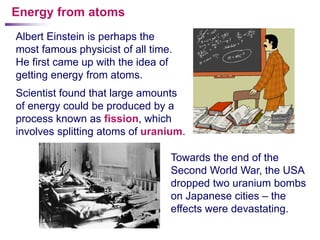
Albert Einstein is perhaps the
most famous physicist of all time.
He first came up with the idea of
getting energy from atoms.
Scientist found that large amounts
of energy could be produced by a
process known as fission, which
involves splitting atoms of uranium.

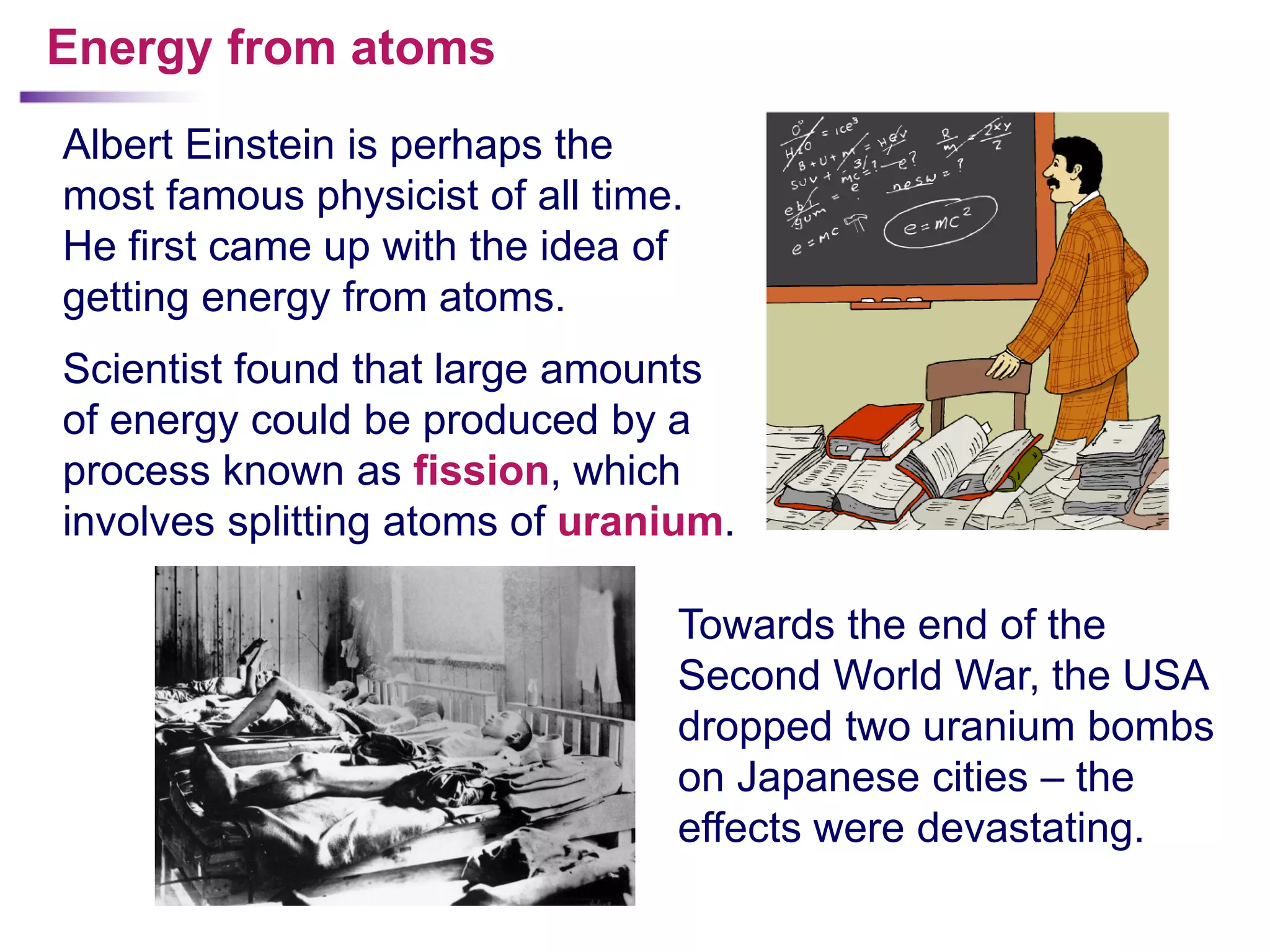
                                 Towards the end of the
                                 Second World War, the USA
                                 dropped two uranium bombs
                                 on Japanese cities – the
                                 effects were devastating.
How do we get energy from atoms?
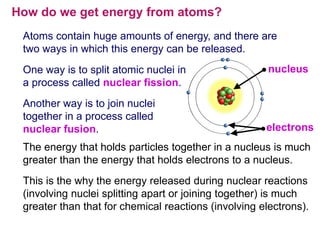
 Atoms contain huge amounts of energy, and there are
 two ways in which this energy can be released.
 One way is to split atomic nuclei in                  nucleus
 a process called nuclear fission.
 Another way is to join nuclei
 together in a process called
 nuclear fusion.                                      electrons
 The energy that holds particles together in a nucleus is much
 greater than the energy that holds electrons to a nucleus.
 This is the why the energy released during nuclear reactions
 (involving nuclei splitting apart or joining together) is much
 greater than that for chemical reactions (involving electrons).
Einstein and E = mc2
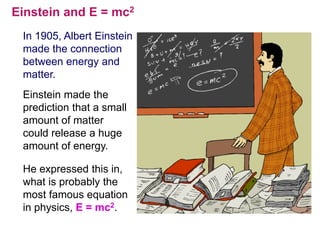
 In 1905, Albert Einstein
 made the connection
 between energy and
 matter.
 Einstein made the
 prediction that a small
 amount of matter
 could release a huge
 amount of energy.

 He expressed this in,
 what is probably the
 most famous equation
 in physics, E = mc2.
Why do fuel rods have to be replaced?
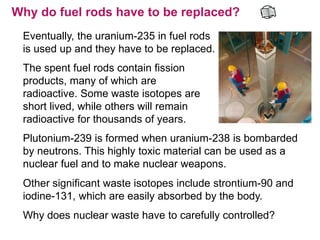
 Eventually, the uranium-235 in fuel rods
 is used up and they have to be replaced.
 The spent fuel rods contain fission
 products, many of which are
 radioactive. Some waste isotopes are
 short lived, while others will remain
 radioactive for thousands of years.
 Plutonium-239 is formed when uranium-238 is bombarded
 by neutrons. This highly toxic material can be used as a
 nuclear fuel and to make nuclear weapons.
 Other significant waste isotopes include strontium-90 and
 iodine-131, which are easily absorbed by the body.
 Why does nuclear waste have to carefully controlled?
How is nuclear waste dealt with?
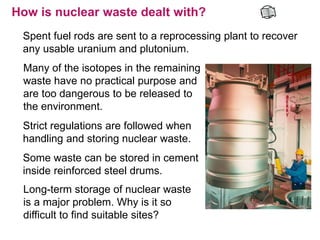
 Spent fuel rods are sent to a reprocessing plant to recover
 any usable uranium and plutonium.
 Many of the isotopes in the remaining
 waste have no practical purpose and
 are too dangerous to be released to
 the environment.
 Strict regulations are followed when
 handling and storing nuclear waste.
 Some waste can be stored in cement
 inside reinforced steel drums.
 Long-term storage of nuclear waste
 is a major problem. Why is it so
 difficult to find suitable sites?

1.

  • 1.
    Energy from atoms AlbertEinstein is perhaps the most famous physicist of all time. He first came up with the idea of getting energy from atoms. Scientist found that large amounts of energy could be produced by a process known as fission, which involves splitting atoms of uranium. Towards the end of the Second World War, the USA dropped two uranium bombs on Japanese cities – the effects were devastating.
  • 2.
    How do weget energy from atoms? Atoms contain huge amounts of energy, and there are two ways in which this energy can be released. One way is to split atomic nuclei in nucleus a process called nuclear fission. Another way is to join nuclei together in a process called nuclear fusion. electrons The energy that holds particles together in a nucleus is much greater than the energy that holds electrons to a nucleus. This is the why the energy released during nuclear reactions (involving nuclei splitting apart or joining together) is much greater than that for chemical reactions (involving electrons).
  • 3.
    Einstein and E= mc2 In 1905, Albert Einstein made the connection between energy and matter. Einstein made the prediction that a small amount of matter could release a huge amount of energy. He expressed this in, what is probably the most famous equation in physics, E = mc2.
  • 4.
    Why do fuelrods have to be replaced? Eventually, the uranium-235 in fuel rods is used up and they have to be replaced. The spent fuel rods contain fission products, many of which are radioactive. Some waste isotopes are short lived, while others will remain radioactive for thousands of years. Plutonium-239 is formed when uranium-238 is bombarded by neutrons. This highly toxic material can be used as a nuclear fuel and to make nuclear weapons. Other significant waste isotopes include strontium-90 and iodine-131, which are easily absorbed by the body. Why does nuclear waste have to carefully controlled?
  • 5.
    How is nuclearwaste dealt with? Spent fuel rods are sent to a reprocessing plant to recover any usable uranium and plutonium. Many of the isotopes in the remaining waste have no practical purpose and are too dangerous to be released to the environment. Strict regulations are followed when handling and storing nuclear waste. Some waste can be stored in cement inside reinforced steel drums. Long-term storage of nuclear waste is a major problem. Why is it so difficult to find suitable sites?