What`s season?
 A season is a division of the year, marked by changes
  in weather, ecology, and hours of daylight.
 Seasons result from the yearly revolution of the Earth
  around the Sun and the tilt of the Earth's axis relative
  to the plane of revolution. In temperate and polar
  regions, the seasons are marked by changes in the
  intensity of sunlight that reaches the Earth's
  surface, variations of which may cause animals to go
  into hibernation or to migrate, and plants to be
  dormant.
SPRING
 Spring is one of the four temperate seasons, the
 transition period between winter and summer.
 Spring and "springtime" refer to the season, and
 broadly to ideas of rebirth, renewal and
 regrowth. The specific definition of the exact
 timing of "spring" varies according to local
 climate, cultures and customs. At the
 spring equinox, days are close to 12 hours long
 with day length increasing as the season
 progresses.
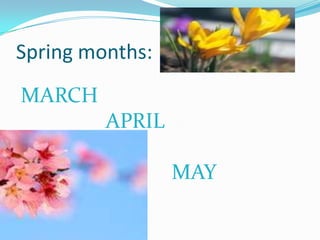
Spring months:
MARCH
         APRIL

MAY              MAY
SUMMER
 Summer is the warmest of the
 four temperate seasons, between spring and autumn.
 At the summer solstice, the days are longest and the
 nights are shortest, with day-length decreasing as the
 season progresses after the solstice. The date of the
 beginning of summer varies according to
 climate, culture, and tradition, but when it is summer
 in the Northern Hemisphere it is winter in
 the Southern Hemisphere, and vice versa.
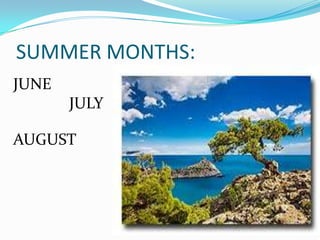
SUMMER MONTHS:
JUNE
       JULY

AUGUST
AUTUMN
 Autumn, also termed as “fall” in North America is an intermediary
    phase in between summer and winter. Autumn is a specific season in
    the temperate zone. The end of summer signifies the arrival of
    autumn. Autumn is characterized by mellowness. Autumn leaves
    have a reddish tinge which falls away during this season thereby paving
    the way for further growth.
     Autumn commences in the month of August or September in the
    north, while in the southern part, the season of autumn arrives in the
    month of March. This is a time when trees get rid of their old look in
    the process of shedding leaves. All these year, a particular belief has
    prevailed among the astrologers that September Equinox indicates the
    beginning of autumn which end with the December Solstice in the
    northern parts of the world. In the southern part, the arrival of autumn
    is indicated by the March Equinox and ends with the June Solstice.

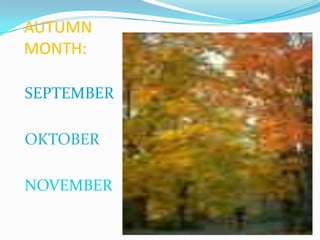
AUTUMN
MONTH:

SEPTEMBER

OKTOBER

NOVEMBER
Winter is the coldest season of the year in temperate
climates, between autumn and spring. At the winter solstice, the days
are shortest and the nights are longest, with days lengthening as the
season progresses after the solstice. Migration is a common effect of
winter upon animals, notably birds. However, the majority of birds do
not migrate—the cardinal and European Robin, for example.
Some butterflies also migrate seasonally.
Hibernation is a state of reduced metabolic activity during the winter.
Some animals "sleep" during winter and only come out when the warm
weather returns; e.g., gophers, frogs, snakes, and bats.
Some animals store food for the winter and live on it instead of
hibernating completely. This is the case
for squirrels, beavers, skunks, badgers, and raccoons.
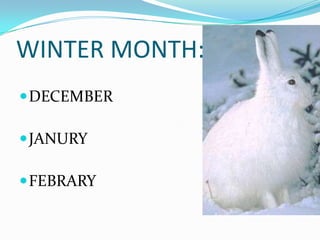
WINTER MONTH:
 DECEMBER

 JANURY

 FEBRARY
THANK YOU FOR YOUR ATTENTION

презентация1

  • 2.
    What`s season?  Aseason is a division of the year, marked by changes in weather, ecology, and hours of daylight.  Seasons result from the yearly revolution of the Earth around the Sun and the tilt of the Earth's axis relative to the plane of revolution. In temperate and polar regions, the seasons are marked by changes in the intensity of sunlight that reaches the Earth's surface, variations of which may cause animals to go into hibernation or to migrate, and plants to be dormant.
  • 4.
    SPRING  Spring isone of the four temperate seasons, the transition period between winter and summer. Spring and "springtime" refer to the season, and broadly to ideas of rebirth, renewal and regrowth. The specific definition of the exact timing of "spring" varies according to local climate, cultures and customs. At the spring equinox, days are close to 12 hours long with day length increasing as the season progresses.
  • 5.
    Spring months: MARCH APRIL MAY MAY
  • 6.
    SUMMER  Summer isthe warmest of the four temperate seasons, between spring and autumn. At the summer solstice, the days are longest and the nights are shortest, with day-length decreasing as the season progresses after the solstice. The date of the beginning of summer varies according to climate, culture, and tradition, but when it is summer in the Northern Hemisphere it is winter in the Southern Hemisphere, and vice versa.
  • 7.
  • 8.
    AUTUMN  Autumn, alsotermed as “fall” in North America is an intermediary phase in between summer and winter. Autumn is a specific season in the temperate zone. The end of summer signifies the arrival of autumn. Autumn is characterized by mellowness. Autumn leaves have a reddish tinge which falls away during this season thereby paving the way for further growth. Autumn commences in the month of August or September in the north, while in the southern part, the season of autumn arrives in the month of March. This is a time when trees get rid of their old look in the process of shedding leaves. All these year, a particular belief has prevailed among the astrologers that September Equinox indicates the beginning of autumn which end with the December Solstice in the northern parts of the world. In the southern part, the arrival of autumn is indicated by the March Equinox and ends with the June Solstice. 
  • 9.
  • 10.
    Winter is thecoldest season of the year in temperate climates, between autumn and spring. At the winter solstice, the days are shortest and the nights are longest, with days lengthening as the season progresses after the solstice. Migration is a common effect of winter upon animals, notably birds. However, the majority of birds do not migrate—the cardinal and European Robin, for example. Some butterflies also migrate seasonally. Hibernation is a state of reduced metabolic activity during the winter. Some animals "sleep" during winter and only come out when the warm weather returns; e.g., gophers, frogs, snakes, and bats. Some animals store food for the winter and live on it instead of hibernating completely. This is the case for squirrels, beavers, skunks, badgers, and raccoons.
  • 11.
  • 12.
    THANK YOU FORYOUR ATTENTION