1_1_5 Clases Apoyo SSD3
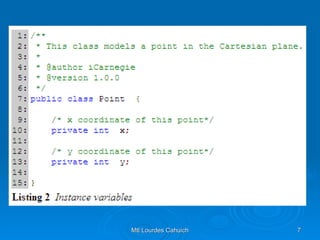
class Point
Classes Just about any real-life object will require a collection of primitives, rather than just one, to model it.  To make such objects manageable and coherent in a program, Java provides the  class  construct.
Classes Not only can a class serve to collect together related  data  into a single, coherent unit, it can also include  methods , or descriptions of the behavior of that collection.
Classes Collecting together the attributes and behaviors of an object into a coherent aggregate is called  encapsulation .  This forms the basis of what is known as object-based programming
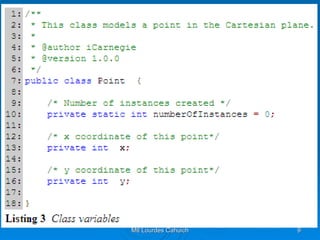
Data Data are the "stuff" of classes-the tangibles. Data are collected together in a class so that they may exist and appear as a whole.  Data in classes are often referred to as fields of the class.
 
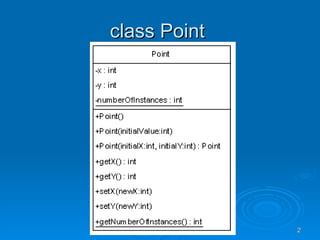
Data This is a class definition introducing a new type, Point.  It proceeds to define what objects of type Point will contain, namely two integers, x and y.  There is no relationship between, for example, x in one object and x in another.  This guarantees the integrity of individual objects
 
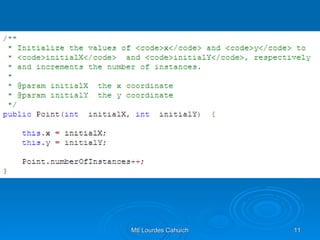
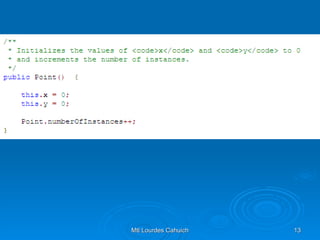
Constructors Instance variables come into existence as objects are created.  As stated, objects get their own personal copies of instance variables.  In order to initialize instance variables, and hence, objects, constructors are used.  A constructor is a named group of statements executed each time an object is created.
 
Constructors The keyword this is a reference to the current object.  When accessing instance variables within an instance method or a constructor, the keyword  this  can be used to make it clear that you are referring to an instance variable. A class may contain several constructors, so long as the argument lists are unique.
 
Methods While data describe what an object "is", methods describe what an object "does".  Like data, two kinds of methods exist. Instance, or non-static, methods exist for the purpose of individual objects. An instance method must be called by an object, and it serves the individual object that made the call.


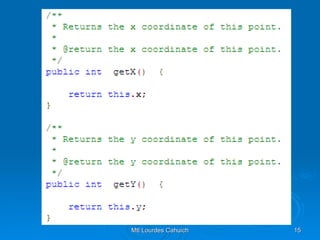
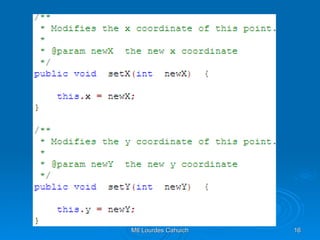
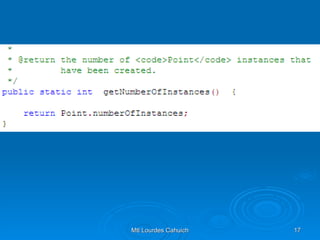
Methods Notice that the static method  getNumberOfInstances  does not access instance data.  In fact, static methods do not even have access to such data, since they are not a part of any object. getX, getY, setX, and setY on the other hand, are instance methods, and thus have access to the data residing in the object that invokes them.
Methods Method definitions contain the following parts. return-type  name(argument-list)  body The return-type indicates the type of value returned by the method.  A special primitive type, not previously mentioned, is the void type. void is used to indicate that a method returns no value. It is not possible to create variables of type void. Its role is limited.

1 1 5 Clases

  • 1.
  • 2.
  • 3.
    Classes Just aboutany real-life object will require a collection of primitives, rather than just one, to model it. To make such objects manageable and coherent in a program, Java provides the  class  construct.
  • 4.
    Classes Not onlycan a class serve to collect together related  data  into a single, coherent unit, it can also include  methods , or descriptions of the behavior of that collection.
  • 5.
    Classes Collecting togetherthe attributes and behaviors of an object into a coherent aggregate is called  encapsulation . This forms the basis of what is known as object-based programming
  • 6.
    Data Data arethe "stuff" of classes-the tangibles. Data are collected together in a class so that they may exist and appear as a whole. Data in classes are often referred to as fields of the class.
  • 7.
  • 8.
    Data This isa class definition introducing a new type, Point. It proceeds to define what objects of type Point will contain, namely two integers, x and y. There is no relationship between, for example, x in one object and x in another. This guarantees the integrity of individual objects
  • 9.
  • 10.
    Constructors Instance variablescome into existence as objects are created. As stated, objects get their own personal copies of instance variables. In order to initialize instance variables, and hence, objects, constructors are used. A constructor is a named group of statements executed each time an object is created.
  • 11.
  • 12.
    Constructors The keyword this isa reference to the current object. When accessing instance variables within an instance method or a constructor, the keyword  this  can be used to make it clear that you are referring to an instance variable. A class may contain several constructors, so long as the argument lists are unique.
  • 13.
  • 14.
    Methods While datadescribe what an object "is", methods describe what an object "does". Like data, two kinds of methods exist. Instance, or non-static, methods exist for the purpose of individual objects. An instance method must be called by an object, and it serves the individual object that made the call.
  • 15.
  • 16.
  • 17.
  • 18.
    Methods Notice thatthe static method getNumberOfInstances does not access instance data. In fact, static methods do not even have access to such data, since they are not a part of any object. getX, getY, setX, and setY on the other hand, are instance methods, and thus have access to the data residing in the object that invokes them.
  • 19.
    Methods Method definitionscontain the following parts. return-type name(argument-list) body The return-type indicates the type of value returned by the method. A special primitive type, not previously mentioned, is the void type. void is used to indicate that a method returns no value. It is not possible to create variables of type void. Its role is limited.