Classes and Objects in Java
1
Basics of Classes in Java
Contents
 Introduce to classes and objects in
Java.
 Understand how some of the OO
concepts learnt so far are supported in
Java.
 Understand important features in Java
classes.
2
Introduction
 Java is a true OO language and therefore
the underlying structure of all Java
programs is classes.
3
Introduction
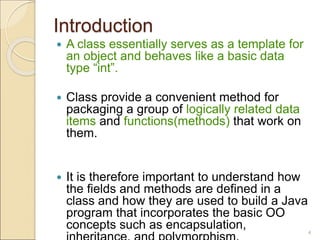
 A class essentially serves as a template for
an object and behaves like a basic data
type “int”.
 Class provide a convenient method for
packaging a group of logically related data
items and functions(methods) that work on
them.
 It is therefore important to understand how
the fields and methods are defined in a
class and how they are used to build a Java
program that incorporates the basic OO
concepts such as encapsulation, 4
Classes
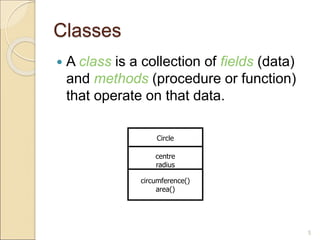
 A class is a collection of fields (data)
and methods (procedure or function)
that operate on that data.
5
Circle
centre
radius
circumference()
area()
Classes
 The basic syntax for a class definition:
6
class ClassName [extends SuperClassName]
{
[fields declaration]
[methods declaration]
}
Adding Fields: Class Circle with
fields
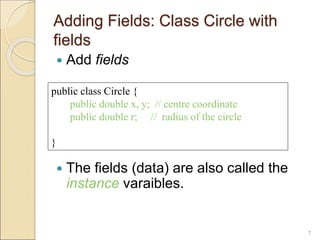
 Add fields
 The fields (data) are also called the
instance varaibles.
7
public class Circle {
public double x, y; // centre coordinate
public double r; // radius of the circle
}
Adding Methods
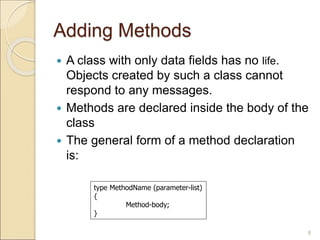
 A class with only data fields has no life.
Objects created by such a class cannot
respond to any messages.
 Methods are declared inside the body of the
class
 The general form of a method declaration
is:
8
type MethodName (parameter-list)
{
Method-body;
}
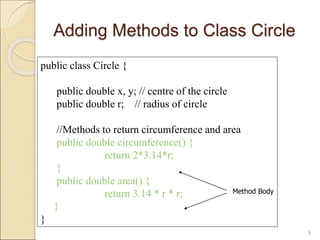
Adding Methods to Class Circle
9
public class Circle {
public double x, y; // centre of the circle
public double r; // radius of circle
//Methods to return circumference and area
public double circumference() {
return 2*3.14*r;
}
public double area() {
return 3.14 * r * r;
}
}
Method Body
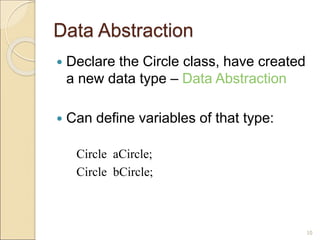
Data Abstraction
 Declare the Circle class, have created
a new data type – Data Abstraction
 Can define variables of that type:
Circle aCircle;
Circle bCircle;
10
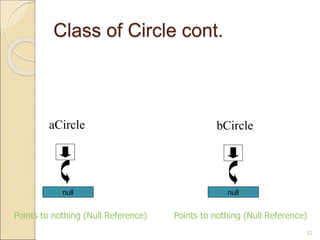
Class of Circle cont.
11
aCircle
Points to nothing (Null Reference)
bCircle
Points to nothing (Null Reference)
null null
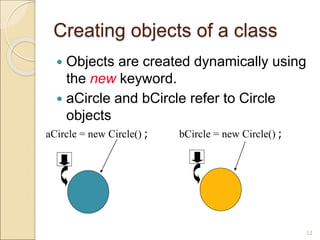
Creating objects of a class
 Objects are created dynamically using
the new keyword.
 aCircle and bCircle refer to Circle
objects
12
bCircle = new Circle() ;
aCircle = new Circle() ;
13
Creating objects of a class
aCircle = new Circle();
bCircle = new Circle() ;
bCircle = aCircle;
14
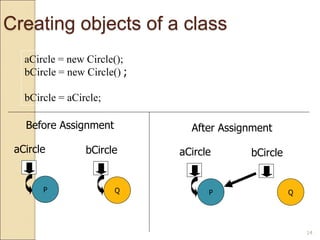
Creating objects of a class
aCircle = new Circle();
bCircle = new Circle() ;
bCircle = aCircle;
P
aCircle
Q
bCircle
Before Assignment
P
aCircle
Q
bCircle
After Assignment
Automatic garbage collection
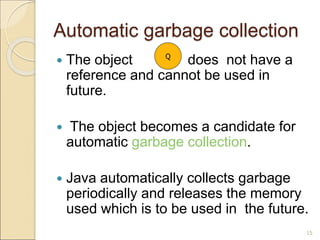
 The object does not have a
reference and cannot be used in
future.
 The object becomes a candidate for
automatic garbage collection.
 Java automatically collects garbage
periodically and releases the memory
used which is to be used in the future.
15
Q
Accessing Object/Circle Data
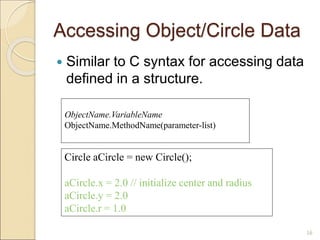
 Similar to C syntax for accessing data
defined in a structure.
16
Circle aCircle = new Circle();
aCircle.x = 2.0 // initialize center and radius
aCircle.y = 2.0
aCircle.r = 1.0
ObjectName.VariableName
ObjectName.MethodName(parameter-list)
Executing Methods in
Object/Circle
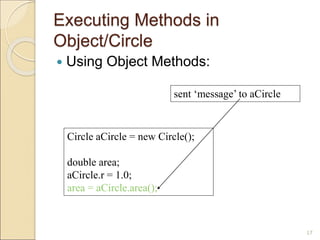
 Using Object Methods:
17
Circle aCircle = new Circle();
double area;
aCircle.r = 1.0;
area = aCircle.area();
sent ‘message’ to aCircle
Using Circle Class
// Circle.java: Contains both Circle class and its user class
//Add Circle class code here
class MyMain
{
public static void main(String args[])
{
Circle aCircle; // creating reference
aCircle = new Circle(); // creating object
aCircle.x = 10; // assigning value to data field
aCircle.y = 20;
aCircle.r = 5;
double area = aCircle.area(); // invoking method
double circumf = aCircle.circumference();
System.out.println("Radius="+aCircle.r+" Area="+area);
System.out.println("Radius="+aCircle.r+" Circumference ="+circumf);
}
}
18
$>java MyMain
Radius=5.0 Area=78.5
Radius=5.0 Circumference =31.400000000000002
Summary
 Classes, objects, and methods are the
basic components used in Java
programming.
 We have discussed:
◦ How to define a class
◦ How to create objects
◦ How to add data fields and methods to classes
◦ How to access data fields and methods to
classes
19

Unit 1 Part - 2 Class Object.ppt

  • 1.
    Classes and Objectsin Java 1 Basics of Classes in Java
  • 2.
    Contents  Introduce toclasses and objects in Java.  Understand how some of the OO concepts learnt so far are supported in Java.  Understand important features in Java classes. 2
  • 3.
    Introduction  Java isa true OO language and therefore the underlying structure of all Java programs is classes. 3
  • 4.
    Introduction  A classessentially serves as a template for an object and behaves like a basic data type “int”.  Class provide a convenient method for packaging a group of logically related data items and functions(methods) that work on them.  It is therefore important to understand how the fields and methods are defined in a class and how they are used to build a Java program that incorporates the basic OO concepts such as encapsulation, 4
  • 5.
    Classes  A classis a collection of fields (data) and methods (procedure or function) that operate on that data. 5 Circle centre radius circumference() area()
  • 6.
    Classes  The basicsyntax for a class definition: 6 class ClassName [extends SuperClassName] { [fields declaration] [methods declaration] }
  • 7.
    Adding Fields: ClassCircle with fields  Add fields  The fields (data) are also called the instance varaibles. 7 public class Circle { public double x, y; // centre coordinate public double r; // radius of the circle }
  • 8.
    Adding Methods  Aclass with only data fields has no life. Objects created by such a class cannot respond to any messages.  Methods are declared inside the body of the class  The general form of a method declaration is: 8 type MethodName (parameter-list) { Method-body; }
  • 9.
    Adding Methods toClass Circle 9 public class Circle { public double x, y; // centre of the circle public double r; // radius of circle //Methods to return circumference and area public double circumference() { return 2*3.14*r; } public double area() { return 3.14 * r * r; } } Method Body
  • 10.
    Data Abstraction  Declarethe Circle class, have created a new data type – Data Abstraction  Can define variables of that type: Circle aCircle; Circle bCircle; 10
  • 11.
    Class of Circlecont. 11 aCircle Points to nothing (Null Reference) bCircle Points to nothing (Null Reference) null null
  • 12.
    Creating objects ofa class  Objects are created dynamically using the new keyword.  aCircle and bCircle refer to Circle objects 12 bCircle = new Circle() ; aCircle = new Circle() ;
  • 13.
    13 Creating objects ofa class aCircle = new Circle(); bCircle = new Circle() ; bCircle = aCircle;
  • 14.
    14 Creating objects ofa class aCircle = new Circle(); bCircle = new Circle() ; bCircle = aCircle; P aCircle Q bCircle Before Assignment P aCircle Q bCircle After Assignment
  • 15.
    Automatic garbage collection The object does not have a reference and cannot be used in future.  The object becomes a candidate for automatic garbage collection.  Java automatically collects garbage periodically and releases the memory used which is to be used in the future. 15 Q
  • 16.
    Accessing Object/Circle Data Similar to C syntax for accessing data defined in a structure. 16 Circle aCircle = new Circle(); aCircle.x = 2.0 // initialize center and radius aCircle.y = 2.0 aCircle.r = 1.0 ObjectName.VariableName ObjectName.MethodName(parameter-list)
  • 17.
    Executing Methods in Object/Circle Using Object Methods: 17 Circle aCircle = new Circle(); double area; aCircle.r = 1.0; area = aCircle.area(); sent ‘message’ to aCircle
  • 18.
    Using Circle Class //Circle.java: Contains both Circle class and its user class //Add Circle class code here class MyMain { public static void main(String args[]) { Circle aCircle; // creating reference aCircle = new Circle(); // creating object aCircle.x = 10; // assigning value to data field aCircle.y = 20; aCircle.r = 5; double area = aCircle.area(); // invoking method double circumf = aCircle.circumference(); System.out.println("Radius="+aCircle.r+" Area="+area); System.out.println("Radius="+aCircle.r+" Circumference ="+circumf); } } 18 $>java MyMain Radius=5.0 Area=78.5 Radius=5.0 Circumference =31.400000000000002
  • 19.
    Summary  Classes, objects,and methods are the basic components used in Java programming.  We have discussed: ◦ How to define a class ◦ How to create objects ◦ How to add data fields and methods to classes ◦ How to access data fields and methods to classes 19