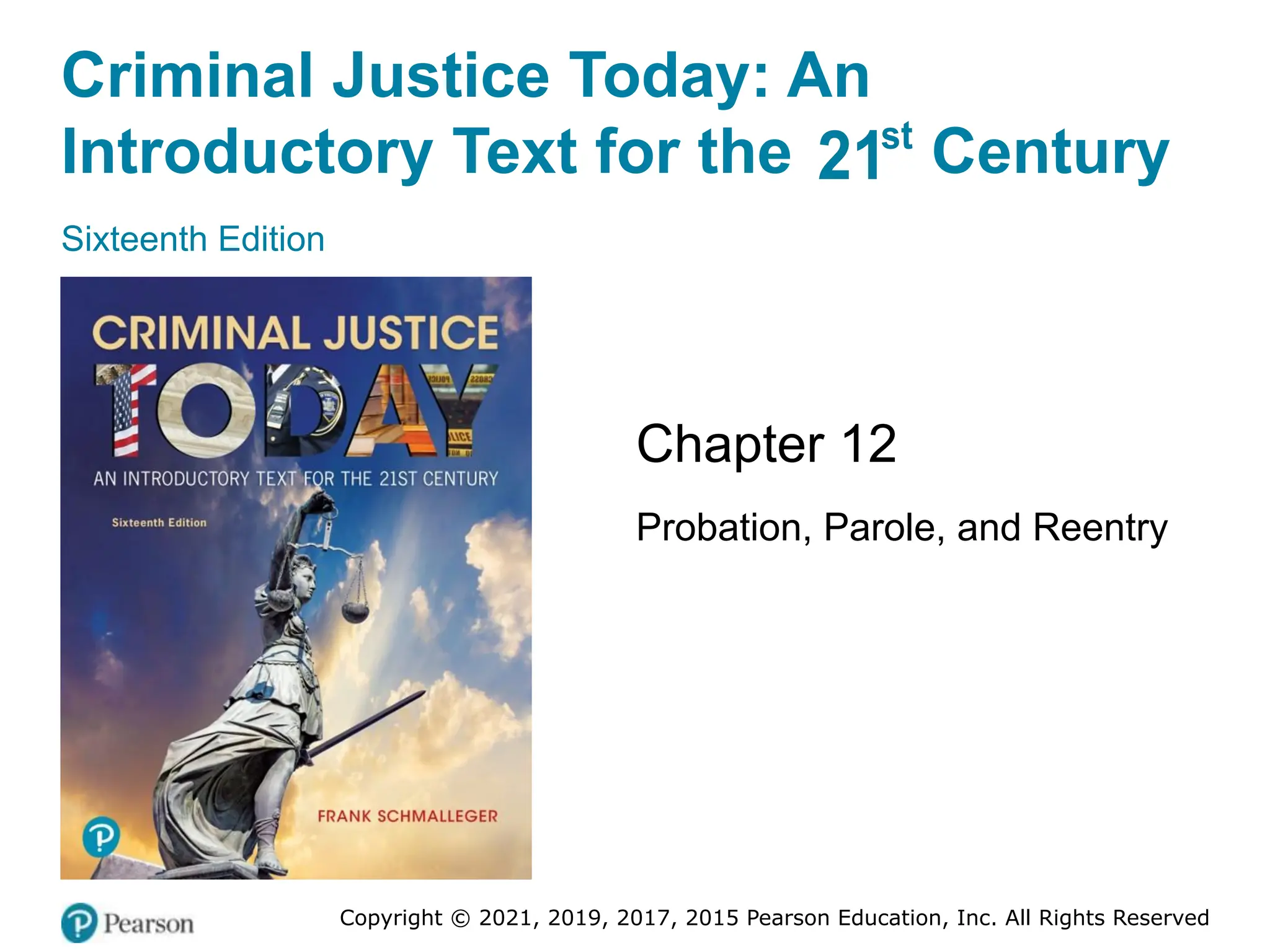
Criminal Justice Today: An
Introductory Text for the Twenty First Century
Sixteenth Edition
Chapter 12
Probation, Parole, and Reentry
Copyright © 2021, 2019, 2017, 2015 Pearson Education, Inc. All Rights Reserved
Introduction
‱ Community corrections
– Program-based sanctions that permit convicted
offenders to remain in the community under conditional
supervision as an alternative to incarceration
– Includes probation, parole, home confinement, and
electronic monitoring
– The type of restriction depends on the sentence.
â–ȘRegular probation is less restrictive than ISP → house
arrest → electronic monitoring → halfway house →
shock incarceration/boot camp
Copyright © 2021, 2019, 2017, 2015 Pearson Education, Inc. All Rights Reserved
What Is Probation?
‱ Probation = a court-ordered sentence served under
supervision in the community
– Suspended sentence = probation violations may send a
probationer back to prison
‱ History of probation
– “Binding over for good behavior” (14th century)
â–Șcertain offender entrusted to citizens
– John Augustus, first probation officer (Boston, 1850s)
– Led to probation as a widely-used form of community
supervision
– Adopted by all states, federal government by 1925
Copyright © 2021, 2019, 2017, 2015 Pearson Education, Inc. All Rights Reserved
The Extent of Probation
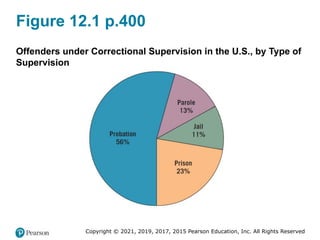
‱ Most common form of criminal sentencing in the U.S. today
– Over half of all offenders under court ordered supervision in
the U.S. are on probation
– Why do you think probation is so commonly used?
‱ Slightly more than half of the offenders discharged from probation
successfully met the conditions of supervision
‱ Even violent offenders have a one in five chance of being granted
probation

– particularly if the prosecutor’s evidence is weak or when a plea
bargain is accepted in lieu of a jury trial.
Copyright © 2021, 2019, 2017, 2015 Pearson Education, Inc. All Rights Reserved
Figure 12.1 p.400
Offenders under Correctional Supervision in the U.S., by Type of
Supervision
Copyright © 2021, 2019, 2017, 2015 Pearson Education, Inc. All Rights Reserved
Probation Conditions
‱ Individuals on probation must agree to abide by court-mandated conditions of
probation
‱ Violation of conditions may lead to probation revocation
‱ Two Types
– (1) General conditions apply to all probationers
â–Șobey all laws, maintain employment, remain within the jurisdiction of
the court, possess no firearms, allow the probation officer to visit at
home or at work,
– (2) Special conditions - mandated by a judge who feels that the
probationer needs particular guidance or control
â–Șsurrender his or her driver’s license; submit to reasonable warrantless
and unannounced searches by a PO; supply breath, urine, or blood
samples as needed for drug or alcohol testing; complete a specified
number of hours of community service; or pass the general
equivalency diploma (GED) test within a specified time.
Copyright © 2021, 2019, 2017, 2015 Pearson Education, Inc. All Rights Reserved
Probation Conditions
‱ Alice was convicted of drunk driving (her second
offense) and the judge sentenced her to probation. She
had to abide by the general conditions of probation in
that jurisdiction, which included meeting with her
probation officer once a month, obeying all laws, and
maintaining employment. The judge added two specific
conditions to her probation. First, she was required to
attend Alcoholics Anonymous meetings once a week.
Second, she had to attend a victim-impact panel. At
these panels, offenders listen to survivors of
drunk-driving accidents talk about the harm caused by
the crime.
Copyright © 2021, 2019, 2017, 2015 Pearson Education, Inc. All Rights Reserved
You Decide p.401
‱ In 2017, an Idaho judge sentenced 19-year-old Cody Herrera to 5 to 15 years
in prison for statutory rape, but suspended the sentence and ordered him to
attend a six-month rehabilitation program while on probation. As a condition of
Herrera’s probation, Judge Stoker ordered him to remain celibate and to refrain
from sexual activity until he was married. During the trial Herrera told the judge
that he had had 34 sexual partners.
‱ A similar story comes from Wisconsin, where Circuit Court judge Tim Boyle
ordered 44-year-old Corey Curtis to stop procreating until he could support his
nine children whom he had fathered with six different women. The judge
imposed the requirement on Curtis in 2012 as a condition of a three-year
probationary term, citing the fact that he owed more than $90,000 in back child
support.
‱ Critics of both the Herrera and Curtis cases point to the 1942 federal case of
Skinner v. Oklahoma, which overturned Oklahoma’s Habitual Criminal
Sterilization Act and established procreation as a fundamental constitutional
right.
– You Decide = Did the judges in these cases go too far in setting
special conditions of probation? Why or why not
Copyright © 2021, 2019, 2017, 2015 Pearson Education, Inc. All Rights Reserved
What Is Parole? (1 of 4)
‱ Parole
– Conditional supervised early release of inmates from
correctional confinement
– Strategy of prison reentry to the community from
prison
‱ Differs from probation in both purpose and implementation
– Probation is a sentence, parole is a
correctional strategy
Copyright © 2021, 2019, 2017, 2015 Pearson Education, Inc. All Rights Reserved
What Is Parole? (2 of 4)
‱ Probation
– Probationers generally avoid incarceration
– Sentencing option available to a judge
– Sentencing strategy
‱ Parole
– Parolees have been incarcerated
– Administrative decision by paroling authority
– Correctional strategy
Copyright © 2021, 2019, 2017, 2015 Pearson Education, Inc. All Rights Reserved
What Is Parole? (3 of 4)
‱ Two major parole decision-making models used by states
– Parole board
â–Ș State paroling authority that grants parole based on the
board members’ judgment and assessment
â–Ș Discretionary parole
â–Ș https://www.parole.pa.gov/Pages/default.aspx
– Statutory decrees
â–Ș Mandatory release with release dates near completion
of sentence, minus time off for good behavior
â–Ș Most common reentry model
Copyright © 2021, 2019, 2017, 2015 Pearson Education, Inc. All Rights Reserved
What Is Parole? (4 of 4)
‱ Currently seeing movement away from release by parole
boards
– Some states have abolished discretionary release
completely or for some offenses
– Do you agree with this?
‱ Medical parole
– Used for offenders deemed low risk due to serious physical
or mental health condition
– Form of reentry that is on the increase
– Do you agree with this?
‱Parole Board Hearing
– https://www.youtube.com/watch?v=X0-E-jkgMEA
Copyright © 2021, 2019, 2017, 2015 Pearson Education, Inc. All Rights Reserved
The Extent of Parole (1 of 2)
‱ Parolees are one of the smallest categories of offenders under correctional
supervision
‱ Reluctance to use parole linked to ineffectiveness of rehabilitation in prison
‱ About 25% of inmates released from prison are paroled by a parole board
‱ States operating under determinate sentencing guidelines often require that
inmates serve a short period of time, such as 90 days, on reentry parole (a
form of supervised mandatory release).
– Mandatory parole releases have increased 91% since 1990
– Typically involve a very small amount of time on parole or no time at all.
– As a result, determinate sentencing schemes have resulted in a reduction
in the average time spent under post-prison supervision.
– They have, however, had little or no impact on the actual number of
offenders released from prison.
Copyright © 2021, 2019, 2017, 2015 Pearson Education, Inc. All Rights Reserved
Figure 12.2 p.405
Federal Post-Conviction Supervision, by Type
Source: Federal Probation System.
Note: Numbers do not total 100 due to rounding.
Copyright © 2021, 2019, 2017, 2015 Pearson Education, Inc. All Rights Reserved
The Extent of Parole (2 of 2)
‱ Slightly more than half of parolees complete it successfully
‱ Parole violation
– An act or failure to act by a parolee that does not
conform to the conditions of parole
– Can result in offender being returned to prison
Copyright © 2021, 2019, 2017, 2015 Pearson Education, Inc. All Rights Reserved
Parole Conditions
‱ Conditions of parole similar to conditions of probation
– General conditions usually include agreement not to leave the state,
obey extradition requests from other jurisdictions, periodically report to
parole officers,
– Restitution
â–ȘCourt requirement that convicted offender pay money or provide
services to victim
â–ȘFrequently included as a condition of parole
‱ Parole revocation
– The administrative action of removing a person from parole in response
to a violation of conditions
– Revocation hearing - hearing held before a neutral hearing body to
determine whether a parolee or probationer has violated the conditions
and requirements of parole or probation
– About 16% of adults on parole have their conditional release revoked
each year
Copyright © 2021, 2019, 2017, 2015 Pearson Education, Inc. All Rights Reserved
Parole Conditions
‱ Most common reasons for revocation
– Failure to report as required
– Failure to participate in required treatment program
– Alcohol/drug abuse while under supervision
‱ Non-revocable parole (NRP)
– Designed to safely reduce state prison populations
– Offenders on NRP may not be returned to prison
– Not eligible for NRP are: ex offenders, validated gang
members, serious felons, and prisoners found guilty of
serious disciplinary offenses are not eligible for NRP.
– Risk assessment tool used to determine who is eligible
Copyright © 2021, 2019, 2017, 2015 Pearson Education, Inc. All Rights Reserved
Advantages of Probation and Parole
p. 406
‱ Lower cost
‱ Increased employment
‱ Restitution
‱ Community support
‱ Reduced risk of criminal socialization
‱ Increased use of community services
‱ Increased opportunity for rehabilitation
Copyright © 2021, 2019, 2017, 2015 Pearson Education, Inc. All Rights Reserved
Disadvantages of Probation and
Parole p.406
‱ Relative lack of punishment
‱ Increased risk to the community
‱ Increased social costs
‱ Discriminatory and unequal effects
Copyright © 2021, 2019, 2017, 2015 Pearson Education, Inc. All Rights Reserved
The Legal Environment
‱ Liability of probation officers and parole boards for
criminal actions of offenders they supervise or whom
they have released
– Most experts agree that parole board members cannot
be sued unless release decisions are grossly
negligent or wantonly reckless
– members of parole boards have generally been
immune to lawsuits arising from “bad” release decision
Copyright © 2021, 2019, 2017, 2015 Pearson Education, Inc. All Rights Reserved
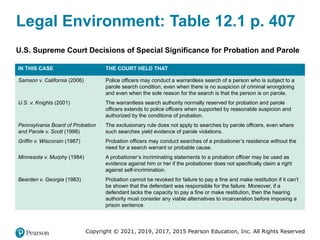
Legal Environment: Table 12.1 p. 407
U.S. Supreme Court Decisions of Special Significance for Probation and Parole
IN THIS CASE THE COURT HELD THAT
Samson v. California (2006) Police officers may conduct a warrantless search of a person who is subject to a
parole search condition, even when there is no suspicion of criminal wrongdoing
and even when the sole reason for the search is that the person is on parole.
U.S. v. Knights (2001) The warrantless search authority normally reserved for probation and parole
officers extends to police officers when supported by reasonable suspicion and
authorized by the conditions of probation.
Pennsylvania Board of Probation
and Parole v. Scott (1998)
The exclusionary rule does not apply to searches by parole officers, even where
such searches yield evidence of parole violations.
Griffin v. Wisconsin (1987) Probation officers may conduct searches of a probationer’s residence without the
need for a search warrant or probable cause.
Minnesota v. Murphy (1984) A probationer’s incriminating statements to a probation officer may be used as
evidence against him or her if the probationer does not specifically claim a right
against self-incrimination.
Bearden v. Georgia (1983) Probation cannot be revoked for failure to pay a fine and make restitution if it can’t
be shown that the defendant was responsible for the failure. Moreover, if a
defendant lacks the capacity to pay a fine or make restitution, then the hearing
authority must consider any viable alternatives to incarceration before imposing a
prison sentence.
Copyright © 2021, 2019, 2017, 2015 Pearson Education, Inc. All Rights Reserved
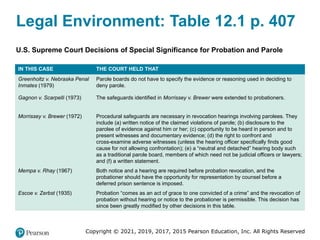
Legal Environment: Table 12.1 p. 407
U.S. Supreme Court Decisions of Special Significance for Probation and Parole
IN THIS CASE THE COURT HELD THAT
Greenholtz v. Nebraska Penal
Inmates (1979)
Parole boards do not have to specify the evidence or reasoning used in deciding to
deny parole.
Gagnon v. Scarpelli (1973) The safeguards identified in Morrissey v. Brewer were extended to probationers.
Morrissey v. Brewer (1972) Procedural safeguards are necessary in revocation hearings involving parolees. They
include (a) written notice of the claimed violations of parole; (b) disclosure to the
parolee of evidence against him or her; (c) opportunity to be heard in person and to
present witnesses and documentary evidence; (d) the right to confront and
cross-examine adverse witnesses (unless the hearing officer specifically finds good
cause for not allowing confrontation); (e) a “neutral and detached” hearing body such
as a traditional parole board, members of which need not be judicial officers or lawyers;
and (f) a written statement.
Mempa v. Rhay (1967) Both notice and a hearing are required before probation revocation, and the
probationer should have the opportunity for representation by counsel before a
deferred prison sentence is imposed.
Escoe v. Zerbst (1935) Probation “comes as an act of grace to one convicted of a crime” and the revocation of
probation without hearing or notice to the probationer is permissible. This decision has
since been greatly modified by other decisions in this table.
Copyright © 2021, 2019, 2017, 2015 Pearson Education, Inc. All Rights Reserved
The Job of Probation and Parole Officers
‱ Four main functions
– (1) Intake procedures
– (2) Diagnosis and needs assessment
– (3) Client supervision
– (4) Presentence investigations
‱ Emphasis on confidentiality but communications between officer and client not privileged
‱ Challenges
– Need to balance two conflicting sets of duties
â–ȘProvide quasi-social work services
â–ȘHandle custodial responsibilities
– Large caseloads
– Lack of career mobility
– High stress levels
Copyright © 2021, 2019, 2017, 2015 Pearson Education, Inc. All Rights Reserved
Intermediate Sanctions
‱ Sentencing alternatives that fall between imprisonment
and probationary release
‱ Main advantages
– Less expensive than imprisonment
– Socially cost-effective
– Provide flexibility
Copyright © 2021, 2019, 2017, 2015 Pearson Education, Inc. All Rights Reserved
Split Sentencing
‱ A sentence explicitly requiring the offender to serve a
period of confinement followed by a period of probation
‱ A typical split sentence is 90 days in jail, followed by two
years of supervised probation
‱ Frequently given to minor drug offenders
Copyright © 2021, 2019, 2017, 2015 Pearson Education, Inc. All Rights Reserved
Shock Probation and Shock Parole
‱ Shock probation
– Offender serves a relatively short period of time in custody and is
released to probation
– Unlike split sentencing, shock probation clients must apply for
probationary release and cannot be certain of the judges decision
â–ȘIf probation is ordered it may come as shock to the offender
â–ȘThe hope is that the unexpected reprieve will cause the
offender to steer clear of future criminal involvement
‱ Shock parole
– Similar to shock probation but is an administrative decision made
by paroling authority
– Parole boards or their representatives may order an inmate’s early
release, hoping that the brief exposure to prison has reoriented
the offender’s life in a positive direction.
Copyright © 2021, 2019, 2017, 2015 Pearson Education, Inc. All Rights Reserved
Boot Camps
‱ Popular in the 1990s
‱ Structured rehabilitation program designed for young or
first-time offenders
‱ Combine military-style discipline with educational and
vocational training
‱ Research suggests the impact of boot camps on offender
recidivism is negligible
‱ Largely discontinued today
Copyright © 2021, 2019, 2017, 2015 Pearson Education, Inc. All Rights Reserved
Mixed Sentencing and Community Service
‱ Mixed sentencing
– Requires a convicted offender to serve weekends in a
confinement facility and receive probation supervision
during the week
‱ Community service
– Requires offenders to spend part of their time working
for a community agency
Copyright © 2021, 2019, 2017, 2015 Pearson Education, Inc. All Rights Reserved
Intensive Supervision of Probationers
and parolees (ISP)
‱Strictest form of probation
‱Involves frequent face-to-face contact between the
correctional client and the probation/parole officer
‱Research suggests that IPS programs can be effective at
reducing recidivism
Copyright © 2021, 2019, 2017, 2015 Pearson Education, Inc. All Rights Reserved
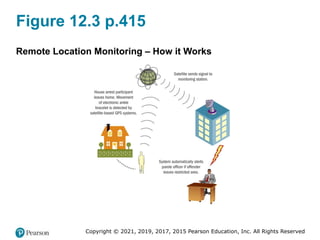
Home Confinement and Remote Location
Monitoring (1 of 2)
‱ Home confinement/house arrest
– Offenders are confined to their own residences
– Uses remote location monitoring to track offenders
‱ Valuable alternative for offenders with special needs
‱ Levels of federal home confinement
– Curfew
– Home detention
– Home incarceration
Copyright © 2021, 2019, 2017, 2015 Pearson Education, Inc. All Rights Reserved
Home Confinement and Remote Location
Monitoring (2 of 2)
‱ Advantages of house arrest
– Cost-effective response to high cost of imprisonment
– Socially cost-effective – decreases opportunity for
negative socialization that occurs in prison
– Monitoring significantly reduces likelihood of failure
under community supervision
‱ Criticisms of house arrest
– May endanger the public
– May provide little or no actual punishment
Copyright © 2021, 2019, 2017, 2015 Pearson Education, Inc. All Rights Reserved
Figure 12.3 p.415
Remote Location Monitoring – How it Works
Copyright © 2021, 2019, 2017, 2015 Pearson Education, Inc. All Rights Reserved
Changes in Reentry Policies
‱ Almost 2 out of every 3 people released from prison are
rearrested within three years of release
‱ Issues creating barriers to successful reentry
– 75% of those released have history of substance
abuse
– 2/3 have no high school diploma
– Diminished employment opportunities
– Over 1/3 have physical or mental disability
– High rate of serious mental illness
Copyright © 2021, 2019, 2017, 2015 Pearson Education, Inc. All Rights Reserved
Changes in Reentry Policies
‱ Reentry courts - formed to address the challenges faced
by individuals returning to society after incarceration
– Specialized courts combining intensive judicial
oversight with rehabilitative services
– Reentry court judges oversee offender’s supervised
release into the community
– Courts offer array of reintegration services to which
participants can be referred
Copyright © 2021, 2019, 2017, 2015 Pearson Education, Inc. All Rights Reserved
Changes in Reentry Policies (4 of 4)
‱ Second Chance Act (2008)
– Authorized $400 million in federal funds between
2008-12 to assist offenders reentering the community
– Funded prison-to-community transition services and
programs
– Research on reentry courts funded by Act does not
tend to show significant impact on recidivism
‱ FIRST STEP Act (2018)
Copyright © 2021, 2019, 2017, 2015 Pearson Education, Inc. All Rights Reserved
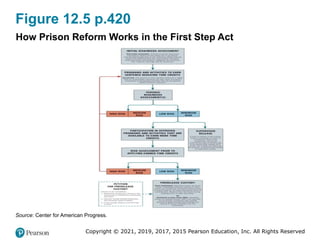
Figure 12.5 p.420
How Prison Reform Works in the First Step Act
Source: Center for American Progress.

Chapter 12 Powerpoint Presentation Criminal Justice Ch 12

  • 1.
    Criminal Justice Today:An Introductory Text for the Twenty First Century Sixteenth Edition Chapter 12 Probation, Parole, and Reentry Copyright © 2021, 2019, 2017, 2015 Pearson Education, Inc. All Rights Reserved
  • 2.
    Copyright © 2021,2019, 2017, 2015 Pearson Education, Inc. All Rights Reserved Introduction ‱ Community corrections – Program-based sanctions that permit convicted offenders to remain in the community under conditional supervision as an alternative to incarceration – Includes probation, parole, home confinement, and electronic monitoring – The type of restriction depends on the sentence. â–ȘRegular probation is less restrictive than ISP → house arrest → electronic monitoring → halfway house → shock incarceration/boot camp
  • 3.
    Copyright © 2021,2019, 2017, 2015 Pearson Education, Inc. All Rights Reserved What Is Probation? ‱ Probation = a court-ordered sentence served under supervision in the community – Suspended sentence = probation violations may send a probationer back to prison ‱ History of probation – “Binding over for good behavior” (14th century) â–Șcertain offender entrusted to citizens – John Augustus, first probation officer (Boston, 1850s) – Led to probation as a widely-used form of community supervision – Adopted by all states, federal government by 1925
  • 4.
    Copyright © 2021,2019, 2017, 2015 Pearson Education, Inc. All Rights Reserved The Extent of Probation ‱ Most common form of criminal sentencing in the U.S. today – Over half of all offenders under court ordered supervision in the U.S. are on probation – Why do you think probation is so commonly used? ‱ Slightly more than half of the offenders discharged from probation successfully met the conditions of supervision ‱ Even violent offenders have a one in five chance of being granted probation
 – particularly if the prosecutor’s evidence is weak or when a plea bargain is accepted in lieu of a jury trial.
  • 5.
    Copyright © 2021,2019, 2017, 2015 Pearson Education, Inc. All Rights Reserved Figure 12.1 p.400 Offenders under Correctional Supervision in the U.S., by Type of Supervision
  • 6.
    Copyright © 2021,2019, 2017, 2015 Pearson Education, Inc. All Rights Reserved Probation Conditions ‱ Individuals on probation must agree to abide by court-mandated conditions of probation ‱ Violation of conditions may lead to probation revocation ‱ Two Types – (1) General conditions apply to all probationers â–Șobey all laws, maintain employment, remain within the jurisdiction of the court, possess no firearms, allow the probation officer to visit at home or at work, – (2) Special conditions - mandated by a judge who feels that the probationer needs particular guidance or control â–Șsurrender his or her driver’s license; submit to reasonable warrantless and unannounced searches by a PO; supply breath, urine, or blood samples as needed for drug or alcohol testing; complete a specified number of hours of community service; or pass the general equivalency diploma (GED) test within a specified time.
  • 7.
    Copyright © 2021,2019, 2017, 2015 Pearson Education, Inc. All Rights Reserved Probation Conditions ‱ Alice was convicted of drunk driving (her second offense) and the judge sentenced her to probation. She had to abide by the general conditions of probation in that jurisdiction, which included meeting with her probation officer once a month, obeying all laws, and maintaining employment. The judge added two specific conditions to her probation. First, she was required to attend Alcoholics Anonymous meetings once a week. Second, she had to attend a victim-impact panel. At these panels, offenders listen to survivors of drunk-driving accidents talk about the harm caused by the crime.
  • 8.
    Copyright © 2021,2019, 2017, 2015 Pearson Education, Inc. All Rights Reserved You Decide p.401 ‱ In 2017, an Idaho judge sentenced 19-year-old Cody Herrera to 5 to 15 years in prison for statutory rape, but suspended the sentence and ordered him to attend a six-month rehabilitation program while on probation. As a condition of Herrera’s probation, Judge Stoker ordered him to remain celibate and to refrain from sexual activity until he was married. During the trial Herrera told the judge that he had had 34 sexual partners. ‱ A similar story comes from Wisconsin, where Circuit Court judge Tim Boyle ordered 44-year-old Corey Curtis to stop procreating until he could support his nine children whom he had fathered with six different women. The judge imposed the requirement on Curtis in 2012 as a condition of a three-year probationary term, citing the fact that he owed more than $90,000 in back child support. ‱ Critics of both the Herrera and Curtis cases point to the 1942 federal case of Skinner v. Oklahoma, which overturned Oklahoma’s Habitual Criminal Sterilization Act and established procreation as a fundamental constitutional right. – You Decide = Did the judges in these cases go too far in setting special conditions of probation? Why or why not
  • 9.
    Copyright © 2021,2019, 2017, 2015 Pearson Education, Inc. All Rights Reserved What Is Parole? (1 of 4) ‱ Parole – Conditional supervised early release of inmates from correctional confinement – Strategy of prison reentry to the community from prison ‱ Differs from probation in both purpose and implementation – Probation is a sentence, parole is a correctional strategy
  • 10.
    Copyright © 2021,2019, 2017, 2015 Pearson Education, Inc. All Rights Reserved What Is Parole? (2 of 4) ‱ Probation – Probationers generally avoid incarceration – Sentencing option available to a judge – Sentencing strategy ‱ Parole – Parolees have been incarcerated – Administrative decision by paroling authority – Correctional strategy
  • 11.
    Copyright © 2021,2019, 2017, 2015 Pearson Education, Inc. All Rights Reserved What Is Parole? (3 of 4) ‱ Two major parole decision-making models used by states – Parole board â–Ș State paroling authority that grants parole based on the board members’ judgment and assessment â–Ș Discretionary parole â–Ș https://www.parole.pa.gov/Pages/default.aspx – Statutory decrees â–Ș Mandatory release with release dates near completion of sentence, minus time off for good behavior â–Ș Most common reentry model
  • 12.
    Copyright © 2021,2019, 2017, 2015 Pearson Education, Inc. All Rights Reserved What Is Parole? (4 of 4) ‱ Currently seeing movement away from release by parole boards – Some states have abolished discretionary release completely or for some offenses – Do you agree with this? ‱ Medical parole – Used for offenders deemed low risk due to serious physical or mental health condition – Form of reentry that is on the increase – Do you agree with this? ‱Parole Board Hearing – https://www.youtube.com/watch?v=X0-E-jkgMEA
  • 13.
    Copyright © 2021,2019, 2017, 2015 Pearson Education, Inc. All Rights Reserved The Extent of Parole (1 of 2) ‱ Parolees are one of the smallest categories of offenders under correctional supervision ‱ Reluctance to use parole linked to ineffectiveness of rehabilitation in prison ‱ About 25% of inmates released from prison are paroled by a parole board ‱ States operating under determinate sentencing guidelines often require that inmates serve a short period of time, such as 90 days, on reentry parole (a form of supervised mandatory release). – Mandatory parole releases have increased 91% since 1990 – Typically involve a very small amount of time on parole or no time at all. – As a result, determinate sentencing schemes have resulted in a reduction in the average time spent under post-prison supervision. – They have, however, had little or no impact on the actual number of offenders released from prison.
  • 14.
    Copyright © 2021,2019, 2017, 2015 Pearson Education, Inc. All Rights Reserved Figure 12.2 p.405 Federal Post-Conviction Supervision, by Type Source: Federal Probation System. Note: Numbers do not total 100 due to rounding.
  • 15.
    Copyright © 2021,2019, 2017, 2015 Pearson Education, Inc. All Rights Reserved The Extent of Parole (2 of 2) ‱ Slightly more than half of parolees complete it successfully ‱ Parole violation – An act or failure to act by a parolee that does not conform to the conditions of parole – Can result in offender being returned to prison
  • 16.
    Copyright © 2021,2019, 2017, 2015 Pearson Education, Inc. All Rights Reserved Parole Conditions ‱ Conditions of parole similar to conditions of probation – General conditions usually include agreement not to leave the state, obey extradition requests from other jurisdictions, periodically report to parole officers, – Restitution â–ȘCourt requirement that convicted offender pay money or provide services to victim â–ȘFrequently included as a condition of parole ‱ Parole revocation – The administrative action of removing a person from parole in response to a violation of conditions – Revocation hearing - hearing held before a neutral hearing body to determine whether a parolee or probationer has violated the conditions and requirements of parole or probation – About 16% of adults on parole have their conditional release revoked each year
  • 17.
    Copyright © 2021,2019, 2017, 2015 Pearson Education, Inc. All Rights Reserved Parole Conditions ‱ Most common reasons for revocation – Failure to report as required – Failure to participate in required treatment program – Alcohol/drug abuse while under supervision ‱ Non-revocable parole (NRP) – Designed to safely reduce state prison populations – Offenders on NRP may not be returned to prison – Not eligible for NRP are: ex offenders, validated gang members, serious felons, and prisoners found guilty of serious disciplinary offenses are not eligible for NRP. – Risk assessment tool used to determine who is eligible
  • 18.
    Copyright © 2021,2019, 2017, 2015 Pearson Education, Inc. All Rights Reserved Advantages of Probation and Parole p. 406 ‱ Lower cost ‱ Increased employment ‱ Restitution ‱ Community support ‱ Reduced risk of criminal socialization ‱ Increased use of community services ‱ Increased opportunity for rehabilitation
  • 19.
    Copyright © 2021,2019, 2017, 2015 Pearson Education, Inc. All Rights Reserved Disadvantages of Probation and Parole p.406 ‱ Relative lack of punishment ‱ Increased risk to the community ‱ Increased social costs ‱ Discriminatory and unequal effects
  • 20.
    Copyright © 2021,2019, 2017, 2015 Pearson Education, Inc. All Rights Reserved The Legal Environment ‱ Liability of probation officers and parole boards for criminal actions of offenders they supervise or whom they have released – Most experts agree that parole board members cannot be sued unless release decisions are grossly negligent or wantonly reckless – members of parole boards have generally been immune to lawsuits arising from “bad” release decision
  • 21.
    Copyright © 2021,2019, 2017, 2015 Pearson Education, Inc. All Rights Reserved Legal Environment: Table 12.1 p. 407 U.S. Supreme Court Decisions of Special Significance for Probation and Parole IN THIS CASE THE COURT HELD THAT Samson v. California (2006) Police officers may conduct a warrantless search of a person who is subject to a parole search condition, even when there is no suspicion of criminal wrongdoing and even when the sole reason for the search is that the person is on parole. U.S. v. Knights (2001) The warrantless search authority normally reserved for probation and parole officers extends to police officers when supported by reasonable suspicion and authorized by the conditions of probation. Pennsylvania Board of Probation and Parole v. Scott (1998) The exclusionary rule does not apply to searches by parole officers, even where such searches yield evidence of parole violations. Griffin v. Wisconsin (1987) Probation officers may conduct searches of a probationer’s residence without the need for a search warrant or probable cause. Minnesota v. Murphy (1984) A probationer’s incriminating statements to a probation officer may be used as evidence against him or her if the probationer does not specifically claim a right against self-incrimination. Bearden v. Georgia (1983) Probation cannot be revoked for failure to pay a fine and make restitution if it can’t be shown that the defendant was responsible for the failure. Moreover, if a defendant lacks the capacity to pay a fine or make restitution, then the hearing authority must consider any viable alternatives to incarceration before imposing a prison sentence.
  • 22.
    Copyright © 2021,2019, 2017, 2015 Pearson Education, Inc. All Rights Reserved Legal Environment: Table 12.1 p. 407 U.S. Supreme Court Decisions of Special Significance for Probation and Parole IN THIS CASE THE COURT HELD THAT Greenholtz v. Nebraska Penal Inmates (1979) Parole boards do not have to specify the evidence or reasoning used in deciding to deny parole. Gagnon v. Scarpelli (1973) The safeguards identified in Morrissey v. Brewer were extended to probationers. Morrissey v. Brewer (1972) Procedural safeguards are necessary in revocation hearings involving parolees. They include (a) written notice of the claimed violations of parole; (b) disclosure to the parolee of evidence against him or her; (c) opportunity to be heard in person and to present witnesses and documentary evidence; (d) the right to confront and cross-examine adverse witnesses (unless the hearing officer specifically finds good cause for not allowing confrontation); (e) a “neutral and detached” hearing body such as a traditional parole board, members of which need not be judicial officers or lawyers; and (f) a written statement. Mempa v. Rhay (1967) Both notice and a hearing are required before probation revocation, and the probationer should have the opportunity for representation by counsel before a deferred prison sentence is imposed. Escoe v. Zerbst (1935) Probation “comes as an act of grace to one convicted of a crime” and the revocation of probation without hearing or notice to the probationer is permissible. This decision has since been greatly modified by other decisions in this table.
  • 23.
    Copyright © 2021,2019, 2017, 2015 Pearson Education, Inc. All Rights Reserved The Job of Probation and Parole Officers ‱ Four main functions – (1) Intake procedures – (2) Diagnosis and needs assessment – (3) Client supervision – (4) Presentence investigations ‱ Emphasis on confidentiality but communications between officer and client not privileged ‱ Challenges – Need to balance two conflicting sets of duties â–ȘProvide quasi-social work services â–ȘHandle custodial responsibilities – Large caseloads – Lack of career mobility – High stress levels
  • 24.
    Copyright © 2021,2019, 2017, 2015 Pearson Education, Inc. All Rights Reserved Intermediate Sanctions ‱ Sentencing alternatives that fall between imprisonment and probationary release ‱ Main advantages – Less expensive than imprisonment – Socially cost-effective – Provide flexibility
  • 25.
    Copyright © 2021,2019, 2017, 2015 Pearson Education, Inc. All Rights Reserved Split Sentencing ‱ A sentence explicitly requiring the offender to serve a period of confinement followed by a period of probation ‱ A typical split sentence is 90 days in jail, followed by two years of supervised probation ‱ Frequently given to minor drug offenders
  • 26.
    Copyright © 2021,2019, 2017, 2015 Pearson Education, Inc. All Rights Reserved Shock Probation and Shock Parole ‱ Shock probation – Offender serves a relatively short period of time in custody and is released to probation – Unlike split sentencing, shock probation clients must apply for probationary release and cannot be certain of the judges decision â–ȘIf probation is ordered it may come as shock to the offender â–ȘThe hope is that the unexpected reprieve will cause the offender to steer clear of future criminal involvement ‱ Shock parole – Similar to shock probation but is an administrative decision made by paroling authority – Parole boards or their representatives may order an inmate’s early release, hoping that the brief exposure to prison has reoriented the offender’s life in a positive direction.
  • 27.
    Copyright © 2021,2019, 2017, 2015 Pearson Education, Inc. All Rights Reserved Boot Camps ‱ Popular in the 1990s ‱ Structured rehabilitation program designed for young or first-time offenders ‱ Combine military-style discipline with educational and vocational training ‱ Research suggests the impact of boot camps on offender recidivism is negligible ‱ Largely discontinued today
  • 28.
    Copyright © 2021,2019, 2017, 2015 Pearson Education, Inc. All Rights Reserved Mixed Sentencing and Community Service ‱ Mixed sentencing – Requires a convicted offender to serve weekends in a confinement facility and receive probation supervision during the week ‱ Community service – Requires offenders to spend part of their time working for a community agency
  • 29.
    Copyright © 2021,2019, 2017, 2015 Pearson Education, Inc. All Rights Reserved Intensive Supervision of Probationers and parolees (ISP) ‱Strictest form of probation ‱Involves frequent face-to-face contact between the correctional client and the probation/parole officer ‱Research suggests that IPS programs can be effective at reducing recidivism
  • 30.
    Copyright © 2021,2019, 2017, 2015 Pearson Education, Inc. All Rights Reserved Home Confinement and Remote Location Monitoring (1 of 2) ‱ Home confinement/house arrest – Offenders are confined to their own residences – Uses remote location monitoring to track offenders ‱ Valuable alternative for offenders with special needs ‱ Levels of federal home confinement – Curfew – Home detention – Home incarceration
  • 31.
    Copyright © 2021,2019, 2017, 2015 Pearson Education, Inc. All Rights Reserved Home Confinement and Remote Location Monitoring (2 of 2) ‱ Advantages of house arrest – Cost-effective response to high cost of imprisonment – Socially cost-effective – decreases opportunity for negative socialization that occurs in prison – Monitoring significantly reduces likelihood of failure under community supervision ‱ Criticisms of house arrest – May endanger the public – May provide little or no actual punishment
  • 32.
    Copyright © 2021,2019, 2017, 2015 Pearson Education, Inc. All Rights Reserved Figure 12.3 p.415 Remote Location Monitoring – How it Works
  • 33.
    Copyright © 2021,2019, 2017, 2015 Pearson Education, Inc. All Rights Reserved Changes in Reentry Policies ‱ Almost 2 out of every 3 people released from prison are rearrested within three years of release ‱ Issues creating barriers to successful reentry – 75% of those released have history of substance abuse – 2/3 have no high school diploma – Diminished employment opportunities – Over 1/3 have physical or mental disability – High rate of serious mental illness
  • 34.
    Copyright © 2021,2019, 2017, 2015 Pearson Education, Inc. All Rights Reserved Changes in Reentry Policies ‱ Reentry courts - formed to address the challenges faced by individuals returning to society after incarceration – Specialized courts combining intensive judicial oversight with rehabilitative services – Reentry court judges oversee offender’s supervised release into the community – Courts offer array of reintegration services to which participants can be referred
  • 35.
    Copyright © 2021,2019, 2017, 2015 Pearson Education, Inc. All Rights Reserved Changes in Reentry Policies (4 of 4) ‱ Second Chance Act (2008) – Authorized $400 million in federal funds between 2008-12 to assist offenders reentering the community – Funded prison-to-community transition services and programs – Research on reentry courts funded by Act does not tend to show significant impact on recidivism ‱ FIRST STEP Act (2018)
  • 36.
    Copyright © 2021,2019, 2017, 2015 Pearson Education, Inc. All Rights Reserved Figure 12.5 p.420 How Prison Reform Works in the First Step Act Source: Center for American Progress.