Justifying
circumstances
Intended Learning Outcome.
• To learn the principles behind the
justifying circumstances.
• To fully integrate the principles in
relation to the subject of criminal law.
CIRCUMSTANCES THAT AFFECT
CRIMINAL LIABILITY
• Justifying (Art. 11)
• Exempting (Art. 12)
• Mitigating (Art. 13)
• Aggravating (Art. 14)
• Alternative (Art. 15)
• Absolutory causes (Minority,Art. 280 last par., violent insanity,
Art. 332, Art. 344)
Imputability vs. Responsibility
• While an act may be
imputable to a person,
it may not necessarily
mean that he would be
responsible for the
same.
Art. 11. Justifying circumstances
• In accordance with the law.
• The actor is not considered to have violated
the law.
• No criminal or civil liability.
• No crime committed.
Burden of proving justifying
circumstances
In justifying circumstances, the actor admits to the commission
of the act but interposes a justifying circumstance. He,
therefore, has the burden of proving the existence of such
circumstance.
Justifying circumstances
1. Self-defense
2. Defense of relatives
3. Defense of strangers
4. Avoidance of a greater evil or injury
5. Fulfillment of duty/lawful exercise of right or office
6. Obedience to an order issued for some lawful
purpose
Self-defense
In defense of his person or rights.
Basis:
• State cannot protect all of its citizens all of the time.
• It is a natural reaction to resist any invasion of a person or his
rights.
Defense of person or rights
Person includes danger to one’s:
- life
- limb
Rights includes:
- right to property
Self-defense, requisites
1. Unlawful aggression (indispensable);
2. Reasonable necessity of the means
employed to prevent or repel it;
3. Lack of sufficient provocation on the part of
the person defending himself.
Self-defense.
• When the accused interposes self-
defense, he must prove that:
1) he was not the unlawful aggressor;
2) there was lack of sufficient provocation on
his part; and
3) he employed reasonable means to prevent
or repel the aggression. (People v. Santos
y Santos, G.R. No. 232244 (Notice), June
19, 2019)
Most important element.
• Although all these elements must
concur, self-defense is perched in proof
of unlawful aggression on the part of
the victim. Without it, there can be
no self-defense, complete or
incomplete. (Pp vs Santos)
Unlawful aggression
• This is a condition sine qua non. An
essential and indispensable requisite.
• No unlawful aggression, no self-defense
whether complete or incomplete.
• The aggression must be unlawful and
actual.
Most important element.
• “The most important among all the elements is … unlawful
aggression. …“There can be no self-defense unless there was
unlawful aggression from the person injured or killed by the
accused; for otherwise, there is nothing to prevent or repel.”
• Pp vs Concillado, GR No. 181204, November 28, 2011
Aggression must be unlawful
• “It cannot be said that there was a
previous unlawful aggression…”
• “…taking into consideration the fact that
the purpose of the deceased in so doing
was to succeed in capturing and arresting
the appellant …”
• Pp vs Gayrama, GR No. 39270,
39271,October 30, 1934.
Lawful aggression
• “…that assault was natural and
lawful, for the reason that it was
made by a deceived and offended
husband …and if he had killed his
wife and the other defendant, he
would have exercised a lawful
right, …”
• Pp vs Merced, G.R. No. 14170,
November 23, 1918
Aggression must be actual
• An actual assault, or
• Threat of an assault of
an:
• immediate and imminent;
• offensive and positively
strong showing the
wrongful intent to cause
an injury.
Aggression – actual or imminent
• Jurisprudence states that not every form or degree of
aggression justifies a claim of self-defense. For unlawful
aggression to be appreciated, there must be an actual, sudden,
and unexpected attack or imminent danger thereof, not merely
a threatening or intimidating attitude, as against the one
claiming self-defense.
• Pp vs Matibag, GR No. 206381, 25 Mar 2015.
Actual aggression
• Unlawful aggression contemplates an
actual, sudden and unexpected attack on
the life and limb … and not merely a
threatening or intimidating attitude. The
attack must be real, or at least imminent.
• Baxinela vs Pp, G.R. No. 149652, Mar 24, 2006
Actual or imminent
• Actual – assault
with a cane. (US vs
Laurel)
• Imminent – rocking
a boat coupled with
threats of capsizing
the same. (Pp vs
Cabungcal)
Famous fighting words.
• … an offensive act positively determining
the intent of the aggressor to cause an
injury shall have been made.
• A mere threatening or intimidating
attitude is not sufficient…
• Pp vs. Macaso, G.R. No. L-30489, June 30,
1975
UNSA MAN
IMO GUSTO
HA!!!
No interval.
• If any time intervened … the latter's actions would cease to have the
true character of a real defense, which, … requires primarily and as
an essential condition that the attack be immediately present.”
• US vs. Ferrer, G.R. No. 60, Nov 8, 1901.
The nature, character, location and
extent of wound/injuries.
• Wounds/injuries on the victim
would usually indicate whether
self-defense is credible or not.
• Wounds/injuries on the
accused are not as
determinative as the injuries
on the victim.
He attacked
me.
Wounds on person defending not
necessary.
• …the superficiality of the nature of the wounds inflicted on the
accused does not, per se, negate self-defense. Indeed, to prove
self-defense, the actual wounding of the person defending
himself is not necessary.
• Cano vs Pp, G.R. No. 155258, Oct 7, 2003
Age and condition of alleged aggressor
• Accused was 24 while victim
was a sexagenarian (Diaz)
• The victim was 55 years old,
seriously injured, lost his right
hand (Ardiza)
He attacked
me.
Behavior immediately after the incident
Failure to interpose self-defense after:
surrendering – Manansala
confession – De la Cruz
Physical findings
• Accused claims that when he stabbed the
victim they were facing each other. The
factual findings establish that the wounds
were in the back of the victim. (Dorico)
• The victim still had his gun tucked inside
the waistband of the pants and received
13 gunshot wounds. (Perez)
Unlawful aggression must exist at the time
of the act constituting self-defense.
• "a fleeing man is not dangerous
to the one from whom he flees.''
• (Pp vs Alconga, April 30, 1947,
G.R. No. L-162)
Self-defense vs. Retaliation
• Retaliation is not the same as
self-defense. …the
aggression … already ceased
when the accused attacked
him.
Defense of rights
• Right to chastity:
• Jaurigue – incomplete, no
reasonable necessity.
• Dela Cruz – complete, no other
means to defend herself.
• Right to property:
• Actual attack on the person in lawful
possession of the property. (Art.
249 NCC)
Defense of rights
Home:
“Violent entry … at nighttime…”
“… ready and looking for trouble…”
“… shows aggression instead of fear…”
Circumstances should still show unlawful
aggression.
Unlawful aggression (Dec. Sup. Ct
Spain)
• Aiming a revolver at someone with the intention
of shooting him.
• Retreating two steps and placing his hand in his
pocket indicating his purpose to commit an
assault with a weapon.
• Opening a knife and making a motion as if to
make an attack.
Reasonable necessity
The second requisite in self-defense is reasonable necessity in
the means employed to prevent or repel the unlawful
aggression.
Elements
There must be reasonable necessity in both:
• Course of action taken by the person defending;
• Means used.
Determined by:
 Existence of unlawful aggression and
 The nature and extent of the aggression.
Does not mean absolute necessity.
• Reasonable necessity of the means
employed to repel the unlawful
aggression does not mean absolute
necessity.
• … cannot have sufficient tranquility of
mind to think, calculate and make
comparisons…
• People v. Olarbe y Balihango, G.R. No.
227421, July 23, 2018.
Nature and extent of aggression
Striking a person on the head with a lead pipe causing death –
mauled with fist blows by several men. (Ocaña)
Shooting a person who was playing a practical joke – place was
dark and uninhabited, “Lie down and give me your money or
else you die” (Sup. Ct. Spain)
Emergency and self-preservation.
• It should be borne in mind that in
emergencies of this kind human nature
does not act upon processes of formal
reason but in obedience to the instinct of
self-preservation…
• Pp vs. Lara, G.R. No. 24014, October 16,
1925
Multiple blows
• … it would be impossible to say that a
second or third blow was unnecessary …
it appearing that the accused instantly
and without hesitation inflicted all the
wounds at or about the same time.”
• Pp vs Macasaet, G.R. No. 11718, October
31, 1916
Reasonable necessity in the means
used.
• Rational necessity to employ the means
used.
• Perfect equality is not required.
• Rational equivalence is what is
required.
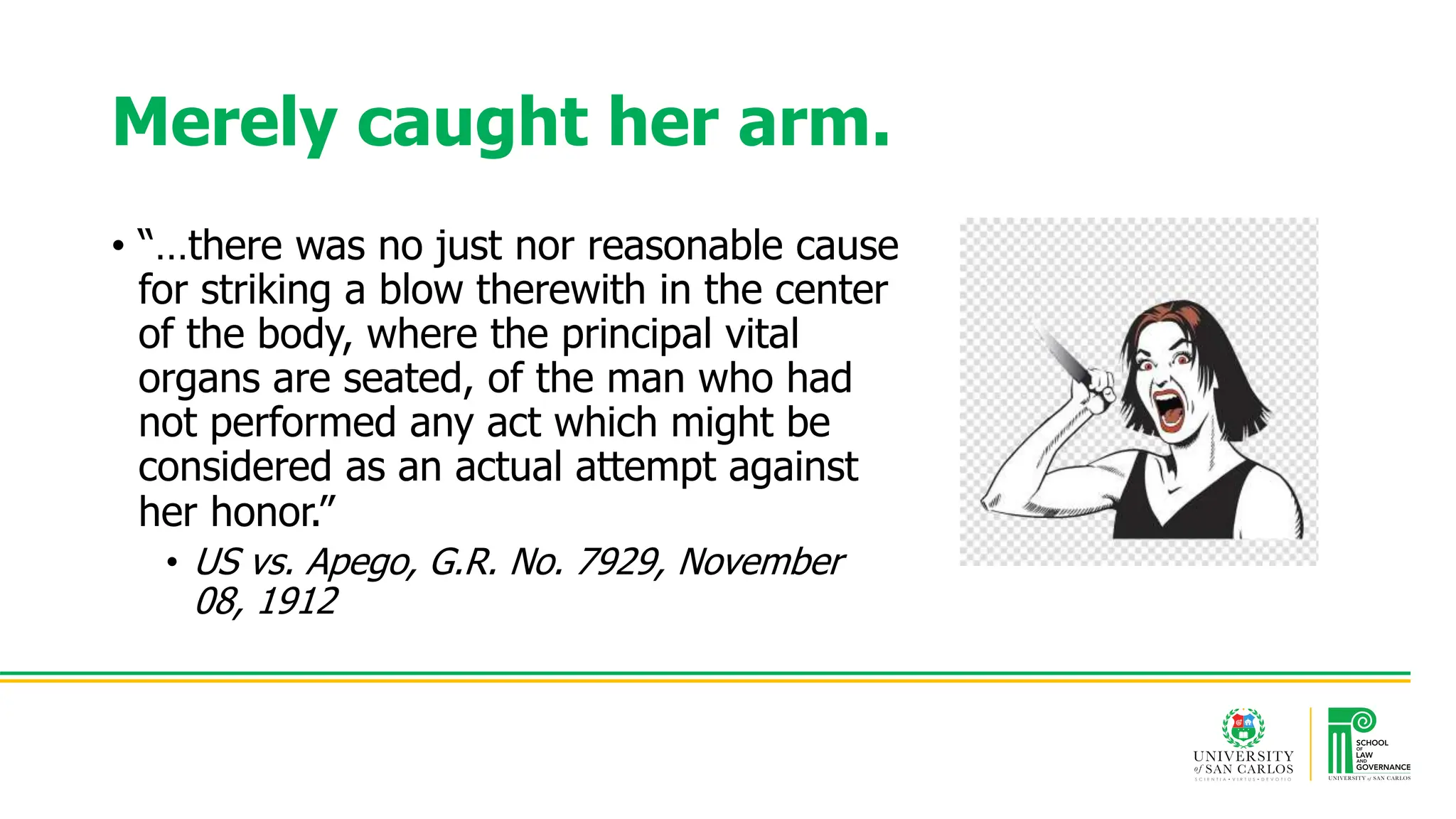
Merely caught her arm.
• “…there was no just nor reasonable cause
for striking a blow therewith in the center
of the body, where the principal vital
organs are seated, of the man who had
not performed any act which might be
considered as an actual attempt against
her honor.”
• US vs. Apego, G.R. No. 7929, November
08, 1912
Rational equivalence
• Nature and quality of the weapon used;
• Physical condition, character, and size;
• Other circumstances of both aggressor
and person defending himself.
• Place and occasion of assault.
Rational equivalence, rationale.
• … borne by necessity … the person
defending himself is not expected to
think coolly and clearly.
• …not expected to control his blow or
draw a distinction as to the injury that
would result after he delivers his blow.
Weapons
• Using more dangerous weapons
would not preclude reasonable
necessity, if it cannot be shown
that:
1) Other means were available, or
2) If there were other means, he
could coolly choose the less deadly
weapon to repel the assault.
Nature of the weapon used.
• … defendant could not then have reasonably believed that it was
necessary to kill his assailant in order to repel the attack.
• “It is an instrument shaped like a small chisel (escoplo) with no
point or cutting edge on either side, and is used for the purpose of
taking out the contents of betel nuts or the like.”
• US vs Mendoza, G.R. No. 1098, Apr 6, 1903.
US vs Mack, G.R. No. L-3515, October
03, 1907
“…not reasonably be excepted to
take the chance that mere ordinary
force would be used in striking, or
that the blow would be given upon
some protected part of his body, or
that the cutting edge of the blade
was not keen enough to give him
his death blow.”
US vs Mack, G.R. No. L-3515, October
03, 1907
“…in the shades of night the
defendant, with his adversary
advancing upon him and within a
few feet of striking distance,”
“The reasonable and natural thing
for him to do under the
circumstances was to fire at the
body of his opponent…
US vs Mack, G.R. No. L-3515, October
03, 1907
• “Not every wound which proves
fatal is sufficient to stop an
enemy's attack, and … until the
assailant fell to the ground it can
be said that the accused was out
of danger. Even a wounded man
with a drawn bolo in his hand
might prove to be no mean
antagonist at close quarters.”
Physical condition, character and size of
the opposing parties.
• “One is not required, when hard
pressed, to draw fine distinctions
as to the extent of the injury
which a reckless and infuriated
assailant might probably inflict
upon him…”
• (Pp vs. Ignacio, G.R. No. 40140,
November 27, 1933)
When attacked by an unarmed
assailant/s
“… such as the very violence of the attack or a great disparity in
the age or physical ability of the parties, … and justify him in
employing a deadly weapon in self-defense.” (Ignacio)
Think coolly and calmly.
• Under such conditions, an accused
cannot be expected to reflect coolly
nor wait after each blow to determine
the effects thereof.
• CANO vs. PEOPLE, G.R. No. 155258, Oct
7, 2003
Private individual vs. law enforcement
officer
• Private individual – prevent or repel
aggression.
• Law enforcement officer – overcome his
opponent.
Lack of sufficient provocation
• The person defending must
not have by his unjust
conduct provoked the
aggression sought to be
repelled or prevented.
There are 4 situations where the 3rd
requisite is considered present:
1. No provocation.
2. Provocation was not sufficient.
3. Was not given by the person defending himself.
4. Was not immediate or proximate.
Proportionate and adequate.
• “There is sufficient provocation when it is proportionate to the
act of aggression and adequate to stir the aggressor to its
commission.”
• Alconga.
Need not be an act of violence
• Challenging one to come out of the house to fight.
• (US v McCray, 2 Phil 545, Pp vs Valencia, L-58426, Oct 31, 1984)
• Hurling insults or imputing the utterance of vulgar language.
• (Pp vs Sotelo, 55 Phil 403)
• But a petty question of pride does not justify wounding or killing
an opponent.
• (“Why are you calling me?” Pp v. Dolfo)
• Forcibly trying to kiss the sister of the deceased.
• (Getida, CA)
Admits to the offense charged
• By pleading self-defense, an accused
admits the killing, and thereby
assumes the burden to establish his plea
of self-defense by credible, clear and
convincing evidence; otherwise, his
conviction will follow from his admission of
killing the victim.
• Pp vs Nugas, GR No. 172606, November 23,
2011
Pp vs Genosa, G.R. No. 135981, Jan 15,
2004.
First, each of the phases of the cycle of violence must be proven
to have characterized at least two battering episodes between
the appellant and her intimate partner.
Pp vs Genosa, G.R. No. 135981, Jan 15,
2004.
Second, the final acute battering episode preceding the killing of
the batterer must have produced in the battered person’s mind
an actual fear of an imminent harm from her batterer and an
honest belief that she needed to use force in order to save her
life.
Pp vs Genosa, G.R. No. 135981, Jan 15,
2004.
Third, at the time of the killing, the batterer must have posed
probable -- not necessarily immediate and actual -- grave harm
to the accused, based on the history of violence perpetrated by
the former against the latter.
Battered Woman Syndrome
• In 27 March 2004 R.A. 9262 took effect.
• Sec. 26. Battered Woman Syndrome as a defense. – Victim-
survivors who are found by the courts to be suffering from
battered woman syndrome do not incur any criminal and civil
liability notwithstanding the absence of any of the elements for
justifying circumstances of self-defense under the Revised Penal
Code.
Defense of relatives
• Spouse
• Ascendant
• Descendant
• Legitimate, natural, or adopted bro or sis
• Relatives by affinity in the same degrees
• Parents-in-law
• Son or daughter-in-law
• Bro or sis-in-law
• Relatives by consanguinity w/in 4th degree
Defense of relatives
The same in self-defense:
1) Unlawful aggression and
2) Reasonable necessity.
3) “In case there is sufficient provocation,
the person defending had no part therein”
In defense of their father.
• “…in defense of their father who was fatally wounded at the
time. They honestly believed, and had good grounds upon
which to found their belief, that Santiago would continue his
attack upon their father.”
• US vs Esmedia, G.R. No. L-5749, October 21, 1910
Motivated by revenge.
• “It cannot be said, therefore, that in attacking Samuel, Toring
was impelled by pure compassion or beneficence or the lawful
desire to avenge the immediate wrong inflicted on his cousin.
Rather, he was motivated by revenge …”
• Pp vs Toring, G.R. No. 56358, October 26, 1990
Defense of strangers
1. Unlawful aggression;
2. Reasonable necessity;
3. “The person defending be not
induced by revenge, resentment
or other evil motive.”
Induced by revenge.
• … the nature and number of wounds inflicted
by the accused are constantly and
unremittingly considered as important indicia
…
• In the instant case, Paquito’s wounds serve
to tell us that petitioner was induced by
revenge, resentment or other evil motive and
that he was set on killing the victim.
• Cabuslay vs. Pp, G.R. No. 129875, Sept. 30, 2005.
Avoidance of Greater Evil or Injury
• … requisites should be complied with:
1) the evil sought to be avoided actually exists;
2) the injury feared be greater than that done to avoid it; and
3) there be no other practical and less harmful means of preventing it.
• People v. Punzalan, Jr., G.R. No. 199892, December 10, 2012.
Cannot be invoked
• Negligence,
• No evil to be avoided, or
• Violation of law by the actor.
No criminal liability but there is civil
liability
Art. 101. Rules regarding civil liability in certain cases. -
x x x
“Second: In cases falling within subdivision 4 of Article 11, the
persons for whose benefit the harm has been prevented shall be
civilly liable in proportion to the benefit which they may have
received.
Insuring the killing.
• “…was designed to insure the
killing of Geminiano de Leon
without any risk to his assailants.”
• “Juan Padernal was not avoiding
any evil when he sought to disable
Marianito.”
• Pp vs Ricohermoso, G.R. Nos. L-
30527-28, March 29, 1974
For whose benefit…
• “… the damage caused … was
brought about mainly because of the
desire of driver … to avoid greater
evil or harm,…”
• “this company is one of those for
whose benefit a greater harm has
been prevented”
• Tan vs Standard Vacuum, G.R. No. L-
4160, July 29, 1952
Anticipated.
• “…the evil sought to be avoided is
merely expected or anticipated. If the
evil sought to be avoided is merely
expected or anticipated or may
happen in the future, this defense is
not applicable.”
• Ty vs Pp, G.R. No. 149275, Sept 27, 2004
Fulfillment of Duty or Lawful Exercise of
Right or Office
Requisites:
1. The accused acted in the performance of a duty or lawful
exercise of a right or office.
2. That the injury caused or the offense committed be the
necessary consequence of the due performance of duty or
the lawful exercise of such right or office.
Fulfillment of duty
The prevailing jurisprudence is in
favor of policemen and guards
who shoot prisoners who attempt
to escape (Delima, Valcorza,
Lagata, Magno).
Self-defense vs. Fulfillment of Duty
• “Self-defense is based on the
principle of self-preservation from
mortal harm, while fulfillment of
duty is premised on the due
performance of duty.”
• Cabanlig vs Sandiganbayan, G.R. No.
148431, Jul 28, 2005
Cabanlig
• A policeman in the performance of duty is
justified in using such force as is reasonably
necessary to secure and detain the offender,
overcome his resistance, prevent his escape,
recapture him if he escapes, and protect
himself from bodily harm.
Obedience to an order issued for some
lawful purpose
Requisites:
1. An order has been issued by a superior.
2. The order must be for some lawful purpose.
3. The means used to carry out the order must be lawful.
Illegal orders, the subordinate is liable
except when:
• He is not aware that the
order is illegal; and
• He is not negligent.
Obeyed in good faith…
• It appearing that the charge is the heinous crime of murder,
and that the accused-appellants acted upon orders, of a
superior officers that they, as military subordinates, could not
question, and obeyed in good faith, without being aware of
their illegality, without any fault or negligence on their part, we
can not say that criminal intent has been established
• Pp vs Beronilla, G.R. No. L-4445, February 28, 1955

1 Justifying Circumstances Criminal law 1

  • 1.
  • 2.
    Intended Learning Outcome. •To learn the principles behind the justifying circumstances. • To fully integrate the principles in relation to the subject of criminal law.
  • 3.
    CIRCUMSTANCES THAT AFFECT CRIMINALLIABILITY • Justifying (Art. 11) • Exempting (Art. 12) • Mitigating (Art. 13) • Aggravating (Art. 14) • Alternative (Art. 15) • Absolutory causes (Minority,Art. 280 last par., violent insanity, Art. 332, Art. 344)
  • 4.
    Imputability vs. Responsibility •While an act may be imputable to a person, it may not necessarily mean that he would be responsible for the same.
  • 5.
    Art. 11. Justifyingcircumstances • In accordance with the law. • The actor is not considered to have violated the law. • No criminal or civil liability. • No crime committed.
  • 6.
    Burden of provingjustifying circumstances In justifying circumstances, the actor admits to the commission of the act but interposes a justifying circumstance. He, therefore, has the burden of proving the existence of such circumstance.
  • 7.
    Justifying circumstances 1. Self-defense 2.Defense of relatives 3. Defense of strangers 4. Avoidance of a greater evil or injury 5. Fulfillment of duty/lawful exercise of right or office 6. Obedience to an order issued for some lawful purpose
  • 8.
    Self-defense In defense ofhis person or rights. Basis: • State cannot protect all of its citizens all of the time. • It is a natural reaction to resist any invasion of a person or his rights.
  • 9.
    Defense of personor rights Person includes danger to one’s: - life - limb Rights includes: - right to property
  • 10.
    Self-defense, requisites 1. Unlawfulaggression (indispensable); 2. Reasonable necessity of the means employed to prevent or repel it; 3. Lack of sufficient provocation on the part of the person defending himself.
  • 11.
    Self-defense. • When theaccused interposes self- defense, he must prove that: 1) he was not the unlawful aggressor; 2) there was lack of sufficient provocation on his part; and 3) he employed reasonable means to prevent or repel the aggression. (People v. Santos y Santos, G.R. No. 232244 (Notice), June 19, 2019)
  • 12.
    Most important element. •Although all these elements must concur, self-defense is perched in proof of unlawful aggression on the part of the victim. Without it, there can be no self-defense, complete or incomplete. (Pp vs Santos)
  • 13.
    Unlawful aggression • Thisis a condition sine qua non. An essential and indispensable requisite. • No unlawful aggression, no self-defense whether complete or incomplete. • The aggression must be unlawful and actual.
  • 14.
    Most important element. •“The most important among all the elements is … unlawful aggression. …“There can be no self-defense unless there was unlawful aggression from the person injured or killed by the accused; for otherwise, there is nothing to prevent or repel.” • Pp vs Concillado, GR No. 181204, November 28, 2011
  • 15.
    Aggression must beunlawful • “It cannot be said that there was a previous unlawful aggression…” • “…taking into consideration the fact that the purpose of the deceased in so doing was to succeed in capturing and arresting the appellant …” • Pp vs Gayrama, GR No. 39270, 39271,October 30, 1934.
  • 16.
    Lawful aggression • “…thatassault was natural and lawful, for the reason that it was made by a deceived and offended husband …and if he had killed his wife and the other defendant, he would have exercised a lawful right, …” • Pp vs Merced, G.R. No. 14170, November 23, 1918
  • 17.
    Aggression must beactual • An actual assault, or • Threat of an assault of an: • immediate and imminent; • offensive and positively strong showing the wrongful intent to cause an injury.
  • 18.
    Aggression – actualor imminent • Jurisprudence states that not every form or degree of aggression justifies a claim of self-defense. For unlawful aggression to be appreciated, there must be an actual, sudden, and unexpected attack or imminent danger thereof, not merely a threatening or intimidating attitude, as against the one claiming self-defense. • Pp vs Matibag, GR No. 206381, 25 Mar 2015.
  • 19.
    Actual aggression • Unlawfulaggression contemplates an actual, sudden and unexpected attack on the life and limb … and not merely a threatening or intimidating attitude. The attack must be real, or at least imminent. • Baxinela vs Pp, G.R. No. 149652, Mar 24, 2006
  • 20.
    Actual or imminent •Actual – assault with a cane. (US vs Laurel) • Imminent – rocking a boat coupled with threats of capsizing the same. (Pp vs Cabungcal)
  • 21.
    Famous fighting words. •… an offensive act positively determining the intent of the aggressor to cause an injury shall have been made. • A mere threatening or intimidating attitude is not sufficient… • Pp vs. Macaso, G.R. No. L-30489, June 30, 1975 UNSA MAN IMO GUSTO HA!!!
  • 22.
    No interval. • Ifany time intervened … the latter's actions would cease to have the true character of a real defense, which, … requires primarily and as an essential condition that the attack be immediately present.” • US vs. Ferrer, G.R. No. 60, Nov 8, 1901.
  • 23.
    The nature, character,location and extent of wound/injuries. • Wounds/injuries on the victim would usually indicate whether self-defense is credible or not. • Wounds/injuries on the accused are not as determinative as the injuries on the victim. He attacked me.
  • 24.
    Wounds on persondefending not necessary. • …the superficiality of the nature of the wounds inflicted on the accused does not, per se, negate self-defense. Indeed, to prove self-defense, the actual wounding of the person defending himself is not necessary. • Cano vs Pp, G.R. No. 155258, Oct 7, 2003
  • 25.
    Age and conditionof alleged aggressor • Accused was 24 while victim was a sexagenarian (Diaz) • The victim was 55 years old, seriously injured, lost his right hand (Ardiza) He attacked me.
  • 26.
    Behavior immediately afterthe incident Failure to interpose self-defense after: surrendering – Manansala confession – De la Cruz
  • 27.
    Physical findings • Accusedclaims that when he stabbed the victim they were facing each other. The factual findings establish that the wounds were in the back of the victim. (Dorico) • The victim still had his gun tucked inside the waistband of the pants and received 13 gunshot wounds. (Perez)
  • 28.
    Unlawful aggression mustexist at the time of the act constituting self-defense. • "a fleeing man is not dangerous to the one from whom he flees.'' • (Pp vs Alconga, April 30, 1947, G.R. No. L-162)
  • 29.
    Self-defense vs. Retaliation •Retaliation is not the same as self-defense. …the aggression … already ceased when the accused attacked him.
  • 30.
    Defense of rights •Right to chastity: • Jaurigue – incomplete, no reasonable necessity. • Dela Cruz – complete, no other means to defend herself. • Right to property: • Actual attack on the person in lawful possession of the property. (Art. 249 NCC)
  • 31.
    Defense of rights Home: “Violententry … at nighttime…” “… ready and looking for trouble…” “… shows aggression instead of fear…” Circumstances should still show unlawful aggression.
  • 32.
    Unlawful aggression (Dec.Sup. Ct Spain) • Aiming a revolver at someone with the intention of shooting him. • Retreating two steps and placing his hand in his pocket indicating his purpose to commit an assault with a weapon. • Opening a knife and making a motion as if to make an attack.
  • 33.
    Reasonable necessity The secondrequisite in self-defense is reasonable necessity in the means employed to prevent or repel the unlawful aggression.
  • 34.
    Elements There must bereasonable necessity in both: • Course of action taken by the person defending; • Means used. Determined by:  Existence of unlawful aggression and  The nature and extent of the aggression.
  • 35.
    Does not meanabsolute necessity. • Reasonable necessity of the means employed to repel the unlawful aggression does not mean absolute necessity. • … cannot have sufficient tranquility of mind to think, calculate and make comparisons… • People v. Olarbe y Balihango, G.R. No. 227421, July 23, 2018.
  • 36.
    Nature and extentof aggression Striking a person on the head with a lead pipe causing death – mauled with fist blows by several men. (Ocaña) Shooting a person who was playing a practical joke – place was dark and uninhabited, “Lie down and give me your money or else you die” (Sup. Ct. Spain)
  • 37.
    Emergency and self-preservation. •It should be borne in mind that in emergencies of this kind human nature does not act upon processes of formal reason but in obedience to the instinct of self-preservation… • Pp vs. Lara, G.R. No. 24014, October 16, 1925
  • 38.
    Multiple blows • …it would be impossible to say that a second or third blow was unnecessary … it appearing that the accused instantly and without hesitation inflicted all the wounds at or about the same time.” • Pp vs Macasaet, G.R. No. 11718, October 31, 1916
  • 39.
    Reasonable necessity inthe means used. • Rational necessity to employ the means used. • Perfect equality is not required. • Rational equivalence is what is required.
  • 40.
    Merely caught herarm. • “…there was no just nor reasonable cause for striking a blow therewith in the center of the body, where the principal vital organs are seated, of the man who had not performed any act which might be considered as an actual attempt against her honor.” • US vs. Apego, G.R. No. 7929, November 08, 1912
  • 41.
    Rational equivalence • Natureand quality of the weapon used; • Physical condition, character, and size; • Other circumstances of both aggressor and person defending himself. • Place and occasion of assault.
  • 42.
    Rational equivalence, rationale. •… borne by necessity … the person defending himself is not expected to think coolly and clearly. • …not expected to control his blow or draw a distinction as to the injury that would result after he delivers his blow.
  • 43.
    Weapons • Using moredangerous weapons would not preclude reasonable necessity, if it cannot be shown that: 1) Other means were available, or 2) If there were other means, he could coolly choose the less deadly weapon to repel the assault.
  • 44.
    Nature of theweapon used. • … defendant could not then have reasonably believed that it was necessary to kill his assailant in order to repel the attack. • “It is an instrument shaped like a small chisel (escoplo) with no point or cutting edge on either side, and is used for the purpose of taking out the contents of betel nuts or the like.” • US vs Mendoza, G.R. No. 1098, Apr 6, 1903.
  • 45.
    US vs Mack,G.R. No. L-3515, October 03, 1907 “…not reasonably be excepted to take the chance that mere ordinary force would be used in striking, or that the blow would be given upon some protected part of his body, or that the cutting edge of the blade was not keen enough to give him his death blow.”
  • 46.
    US vs Mack,G.R. No. L-3515, October 03, 1907 “…in the shades of night the defendant, with his adversary advancing upon him and within a few feet of striking distance,” “The reasonable and natural thing for him to do under the circumstances was to fire at the body of his opponent…
  • 47.
    US vs Mack,G.R. No. L-3515, October 03, 1907 • “Not every wound which proves fatal is sufficient to stop an enemy's attack, and … until the assailant fell to the ground it can be said that the accused was out of danger. Even a wounded man with a drawn bolo in his hand might prove to be no mean antagonist at close quarters.”
  • 48.
    Physical condition, characterand size of the opposing parties. • “One is not required, when hard pressed, to draw fine distinctions as to the extent of the injury which a reckless and infuriated assailant might probably inflict upon him…” • (Pp vs. Ignacio, G.R. No. 40140, November 27, 1933)
  • 49.
    When attacked byan unarmed assailant/s “… such as the very violence of the attack or a great disparity in the age or physical ability of the parties, … and justify him in employing a deadly weapon in self-defense.” (Ignacio)
  • 50.
    Think coolly andcalmly. • Under such conditions, an accused cannot be expected to reflect coolly nor wait after each blow to determine the effects thereof. • CANO vs. PEOPLE, G.R. No. 155258, Oct 7, 2003
  • 51.
    Private individual vs.law enforcement officer • Private individual – prevent or repel aggression. • Law enforcement officer – overcome his opponent.
  • 52.
    Lack of sufficientprovocation • The person defending must not have by his unjust conduct provoked the aggression sought to be repelled or prevented.
  • 53.
    There are 4situations where the 3rd requisite is considered present: 1. No provocation. 2. Provocation was not sufficient. 3. Was not given by the person defending himself. 4. Was not immediate or proximate.
  • 54.
    Proportionate and adequate. •“There is sufficient provocation when it is proportionate to the act of aggression and adequate to stir the aggressor to its commission.” • Alconga.
  • 55.
    Need not bean act of violence • Challenging one to come out of the house to fight. • (US v McCray, 2 Phil 545, Pp vs Valencia, L-58426, Oct 31, 1984) • Hurling insults or imputing the utterance of vulgar language. • (Pp vs Sotelo, 55 Phil 403) • But a petty question of pride does not justify wounding or killing an opponent. • (“Why are you calling me?” Pp v. Dolfo) • Forcibly trying to kiss the sister of the deceased. • (Getida, CA)
  • 56.
    Admits to theoffense charged • By pleading self-defense, an accused admits the killing, and thereby assumes the burden to establish his plea of self-defense by credible, clear and convincing evidence; otherwise, his conviction will follow from his admission of killing the victim. • Pp vs Nugas, GR No. 172606, November 23, 2011
  • 57.
    Pp vs Genosa,G.R. No. 135981, Jan 15, 2004. First, each of the phases of the cycle of violence must be proven to have characterized at least two battering episodes between the appellant and her intimate partner.
  • 58.
    Pp vs Genosa,G.R. No. 135981, Jan 15, 2004. Second, the final acute battering episode preceding the killing of the batterer must have produced in the battered person’s mind an actual fear of an imminent harm from her batterer and an honest belief that she needed to use force in order to save her life.
  • 59.
    Pp vs Genosa,G.R. No. 135981, Jan 15, 2004. Third, at the time of the killing, the batterer must have posed probable -- not necessarily immediate and actual -- grave harm to the accused, based on the history of violence perpetrated by the former against the latter.
  • 60.
    Battered Woman Syndrome •In 27 March 2004 R.A. 9262 took effect. • Sec. 26. Battered Woman Syndrome as a defense. – Victim- survivors who are found by the courts to be suffering from battered woman syndrome do not incur any criminal and civil liability notwithstanding the absence of any of the elements for justifying circumstances of self-defense under the Revised Penal Code.
  • 61.
    Defense of relatives •Spouse • Ascendant • Descendant • Legitimate, natural, or adopted bro or sis • Relatives by affinity in the same degrees • Parents-in-law • Son or daughter-in-law • Bro or sis-in-law • Relatives by consanguinity w/in 4th degree
  • 62.
    Defense of relatives Thesame in self-defense: 1) Unlawful aggression and 2) Reasonable necessity. 3) “In case there is sufficient provocation, the person defending had no part therein”
  • 63.
    In defense oftheir father. • “…in defense of their father who was fatally wounded at the time. They honestly believed, and had good grounds upon which to found their belief, that Santiago would continue his attack upon their father.” • US vs Esmedia, G.R. No. L-5749, October 21, 1910
  • 64.
    Motivated by revenge. •“It cannot be said, therefore, that in attacking Samuel, Toring was impelled by pure compassion or beneficence or the lawful desire to avenge the immediate wrong inflicted on his cousin. Rather, he was motivated by revenge …” • Pp vs Toring, G.R. No. 56358, October 26, 1990
  • 65.
    Defense of strangers 1.Unlawful aggression; 2. Reasonable necessity; 3. “The person defending be not induced by revenge, resentment or other evil motive.”
  • 66.
    Induced by revenge. •… the nature and number of wounds inflicted by the accused are constantly and unremittingly considered as important indicia … • In the instant case, Paquito’s wounds serve to tell us that petitioner was induced by revenge, resentment or other evil motive and that he was set on killing the victim. • Cabuslay vs. Pp, G.R. No. 129875, Sept. 30, 2005.
  • 67.
    Avoidance of GreaterEvil or Injury • … requisites should be complied with: 1) the evil sought to be avoided actually exists; 2) the injury feared be greater than that done to avoid it; and 3) there be no other practical and less harmful means of preventing it. • People v. Punzalan, Jr., G.R. No. 199892, December 10, 2012.
  • 68.
    Cannot be invoked •Negligence, • No evil to be avoided, or • Violation of law by the actor.
  • 69.
    No criminal liabilitybut there is civil liability Art. 101. Rules regarding civil liability in certain cases. - x x x “Second: In cases falling within subdivision 4 of Article 11, the persons for whose benefit the harm has been prevented shall be civilly liable in proportion to the benefit which they may have received.
  • 70.
    Insuring the killing. •“…was designed to insure the killing of Geminiano de Leon without any risk to his assailants.” • “Juan Padernal was not avoiding any evil when he sought to disable Marianito.” • Pp vs Ricohermoso, G.R. Nos. L- 30527-28, March 29, 1974
  • 71.
    For whose benefit… •“… the damage caused … was brought about mainly because of the desire of driver … to avoid greater evil or harm,…” • “this company is one of those for whose benefit a greater harm has been prevented” • Tan vs Standard Vacuum, G.R. No. L- 4160, July 29, 1952
  • 72.
    Anticipated. • “…the evilsought to be avoided is merely expected or anticipated. If the evil sought to be avoided is merely expected or anticipated or may happen in the future, this defense is not applicable.” • Ty vs Pp, G.R. No. 149275, Sept 27, 2004
  • 73.
    Fulfillment of Dutyor Lawful Exercise of Right or Office Requisites: 1. The accused acted in the performance of a duty or lawful exercise of a right or office. 2. That the injury caused or the offense committed be the necessary consequence of the due performance of duty or the lawful exercise of such right or office.
  • 74.
    Fulfillment of duty Theprevailing jurisprudence is in favor of policemen and guards who shoot prisoners who attempt to escape (Delima, Valcorza, Lagata, Magno).
  • 75.
    Self-defense vs. Fulfillmentof Duty • “Self-defense is based on the principle of self-preservation from mortal harm, while fulfillment of duty is premised on the due performance of duty.” • Cabanlig vs Sandiganbayan, G.R. No. 148431, Jul 28, 2005
  • 76.
    Cabanlig • A policemanin the performance of duty is justified in using such force as is reasonably necessary to secure and detain the offender, overcome his resistance, prevent his escape, recapture him if he escapes, and protect himself from bodily harm.
  • 77.
    Obedience to anorder issued for some lawful purpose Requisites: 1. An order has been issued by a superior. 2. The order must be for some lawful purpose. 3. The means used to carry out the order must be lawful.
  • 78.
    Illegal orders, thesubordinate is liable except when: • He is not aware that the order is illegal; and • He is not negligent.
  • 79.
    Obeyed in goodfaith… • It appearing that the charge is the heinous crime of murder, and that the accused-appellants acted upon orders, of a superior officers that they, as military subordinates, could not question, and obeyed in good faith, without being aware of their illegality, without any fault or negligence on their part, we can not say that criminal intent has been established • Pp vs Beronilla, G.R. No. L-4445, February 28, 1955