Online Educa Berlin 2007

Enabling Teachers in Higher Education to Develop their Own
Simulations: The Virtual City of Cyberdam
Pieter van der Hijden MSc, Stichting RechtenOnline (Foundation Law Online) & Sofos Consultancy, Amsterdam,
The Netherlands.


Welcome to Cyberdam
Welcome to Cyberdam, the Dutch virtual city with its history of 12 centuries, its old city centre, its variety of old
and new neighbourhoods, its industrial area's, inland harbour and its surroundings with their interesting social
and economic potentials. This city is populated with about one hundred firms, institutions, government
agencies and households.


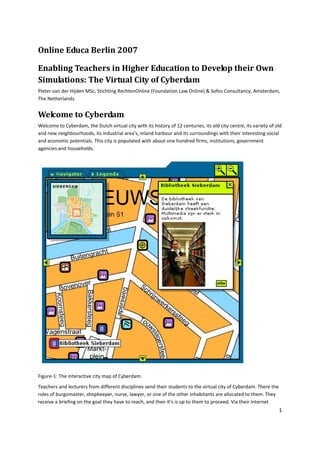
Figure-1: The interactive city map of Cyberdam.
Teachers and lecturers from different disciplines send their students to the virtual city of Cyberdam. There the
roles of burgomaster, shopkeeper, nurse, lawyer, or one of the other inhabitants are allocated to them. They
receive a briefing on the goal they have to reach, and then it’s is up to them to proceed. Via their Internet
                                                                                                                   1
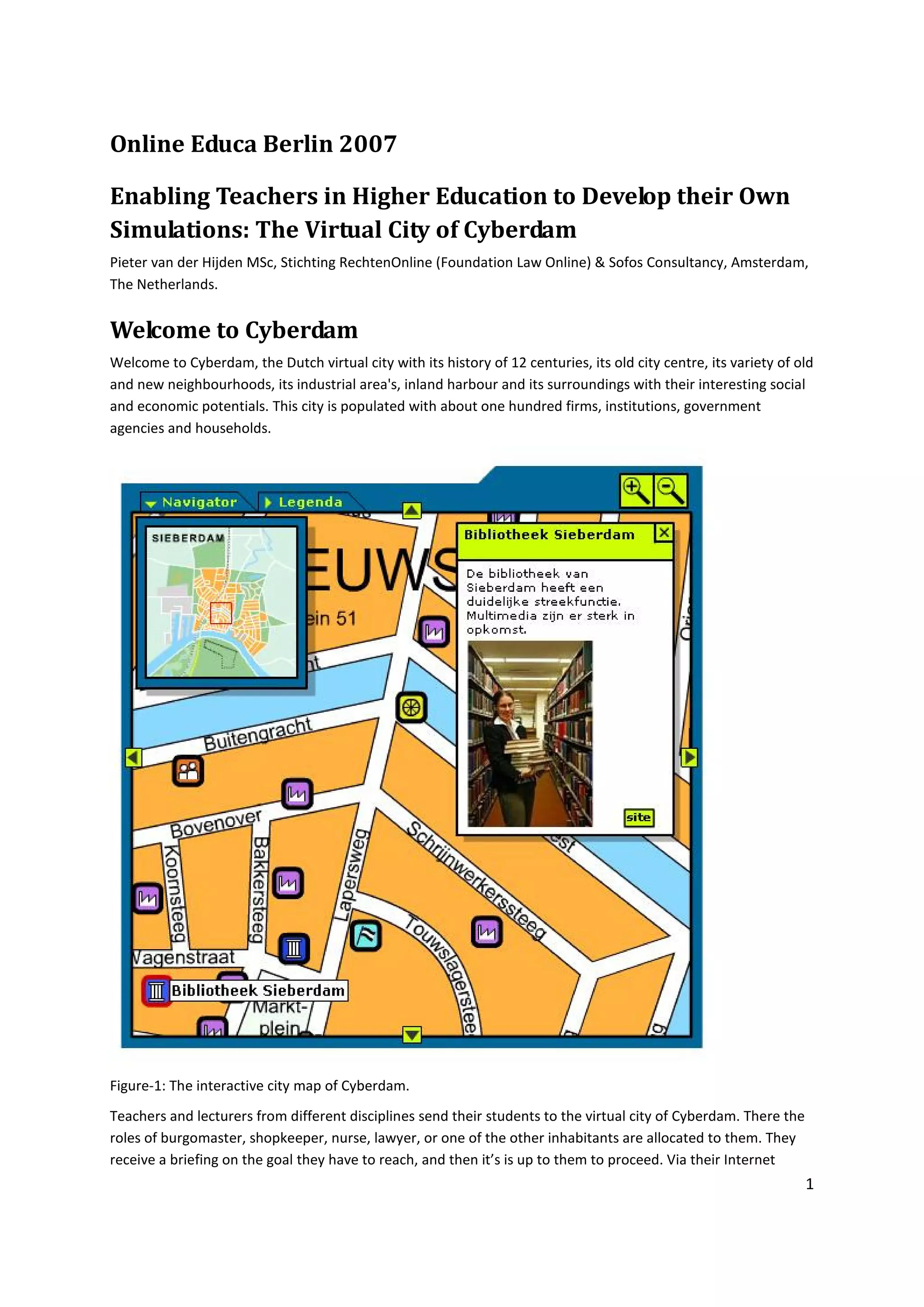
browser they have access to their "dashboard" where they can read their instructions and send and receive
messages to and from other roles. These other roles are played by their peers, maybe by their teacher or even
by an external expert. As the game session proceeds, the instructions may change. The game session ends
when time is up and/or the goal has been reached. Cyberdam illustrates the potential of multi-user online
gaming for education and training [Van der Hijden et al., 2006].


Figure-2: The Cyberdam game session home page ("dashboard").
As participants do not have to be online at the same time, a typical session with a Cyberdam-game may take a
whole week, while the actual playing time for each participant may be only a couple of hours. One of the game
sessions took an elapsed time period of 5-7 weeks with classroom sessions once a week. These face-to-face
sessions were used for inter-role meetings and other synchronous activities like mini-critiques. During the
week, the students participated online in an asynchronous way again [Van der Hijden, 2005].
The Cyberdam-system comes with an interactive 2D city map giving access to background information on each
of its inhabitants, like a "Yellow Pages" directory and underlying web sites. Teachers can develop their own
games by defining roles, steps-of-play and instructions. The software offers the tools to start (parallel) game
sessions, to monitor them and to intervene when necessary.


Backstage
The free and open source package Sieberdam/ROCS, now called Cyberdam, was first released in December
2004. During 2005 and 2006 it was applied in three different projects, involving about 15 educational institutes
at various levels and representing a variety of disciplines. Especially the KODOS-project led to systematic

                                                                                                                2
evaluations. They showed that the participants (higher education students) were not video gamers by nature,
as often was expected. Their appreciation for the system was just about sufficient and many points for
improvement were mentioned. Nevertheless, most of them liked the new mode of learning and they praised
the improved student/teacher interaction, especially during the face-to-face sessions [Bekebrede, 2007]. A
close look at the first generation of Cyberdam games revealed that the teachers who developed them only
used a limited set of the available system functions while they filled a wish list with new functions. Further, the
technical platform chosen turned out to be not very robust. To conclude: Cyberdam 1 was a promising concept,
but a critical review and reconstruction effort was desirable.
The Cyberdam 2 project is now under way (2007-2009). It will improve the Cyberdam-software, develop 25
new ready-made Cyberdam games and establish an organisation to keep Cyberdam safe and sound in the
future as well. A variety of higher education institutes, a publisher and a software house are involved in this
ongoing project.


Teachers at work
A teacher can work with a Cyberdam-game in four different modes: 1. developing a Cyberdam game
(preferably as a team), 2. adapting an existing game, 3. running a Cyberdam game (starting sessions, acting as
game master), and 4. playing a role in a game session.
The most complex of these modes is the first one: developing a Cyberdam game. To make this manageable we
strongly advise to subdivide the development effort into four subsequent phases: a. a definition phase to
analyse the objectives and define the requirements the new game has to meet, b. a design phase, to specify
the game in detail, c. a realisation phase, to prepare all the materials and to enter the game into the Cyberdam-
system, d. an implementation phase to transfer the game to the organisation that is going to use it.
The project is developing tools and techniques to support the teacher in each mode of operation and in each of
the phases of the development process.


Credits
Ardcalloch by Paul Maharg [Maharg, 2003] inspired the VSNU Program RechtenOnline to fund (2003-2004)
three projects aimed at the development of a Dutch equivalent: 1. the Dutch virtual City of Sieberdam, 2. the e-
learning suite for asynchronous workflow based group simulations ROCS, and 3. the integrated
Sieberdam/ROCS [Holzhauer et al., 2004]. Rudi Holzhauer (project management, content authorship, and
design), Martin de Wit (Flash programming), Willem Mieras (visual design), and Sander Gellaerts (student-
assistant) developed Sieberdam. Aernout Schmidt and Jeroen Leijen (project management and design), Lokman
Tsui (design), Peter van Schijndel (design), and Collaboraid ApS København (software development) developed
ROCS. Pieter van der Hijden (consultant to both projects) integrated Sieberdam and ROCS into
Sieberdam/ROCS and extended the system (project management and design), together with Jarkko Laine
(software development) and the former Sieberdam and ROCS project teams [Van der Hijden, 2004]. The Dutch
Stichting RechtenOnline (Foundation Law Online) now is the owner of the product.
During 2005 and 2006 Sieberdam/ROCS was applied in three different projects: 1. SURFfoundation sponsored
the KODOS-project [Mayer et al., 2007], 2. Senter/Novem the ISOSIM-project and 3. Digitale Universiteit the
Virtuele Wijk (Virtual City Quarter) project [Van Haaster, 2007].
The owner of Sieberdam/ROCS, the Dutch Stichting RechtenOnline (Foundation Law Online) successfully won a
competition organised by the Dutch government program M&ICT (Social Sectors and ICT). From January 2007 -
June 2009 it will execute the project called "LieVW - Leren in een Virtuele Wereld" (Learning in a virtual world).
This project renamed Sieberdam/ROCS to Cyberdam. It aims at Cyberdam 2: improving the Cyberdam-software
[Van der Hijden, 2007], developing 25 new Cyberdam games and establishing an organisation to keep

                                                                                                                  3
Cyberdam safe and sound in the future as well. Project managers are Diny Peters and Pieter van der Hijden.
Project partners are: E-Merge, Hogeschool Rotterdam, Hogeschool Utrecht, Strathclyde University Glasgow,
Delft University of Technology, Universiteit Leiden, Thieme Meulenhoff (publisher) and IJsfontein Interactive
Media (software house).
All results will become available as free and open source software under BSD license.


References
All information on Cyberdam and its predecessor Sieberdam/ROCS (including links to Cyberdam user manuals,
both in Dutch and in English) can be found through the Cyberdam website: http://www.cyberdam.nl.
Bekebrede et al., 2007; Playing with multi-actor systems: Evaluation results of the Railway District online
       simulation-game in Sieberdam/ROCS; Geertje Bekebrede et al.; paper presented at the 38th Annual
       Conference of the International Simulation and Gaming Association (ISAGA); Nijmegen, The
       Netherlands, 9-13 July 2007.
Holzhauer et al. 2004; Sieberdam/ROCS; Rudi Holzhauer, Jeroen Leijen, Aernout Schmidt; Erasmusuniversiteit
       Rotterdam / Universiteit Leiden; 2004.
Maharg, 2003; Virtual Communities on the Web; Transactional Learning and Teaching; Paul Maharg; in: Aan het
        werk met ICT in het academisch onderwijs - RechtenOnline (At work with ICT in academic education -
        Law Online); Anton Vedder (ed.); Wolf Legal Publishers, Nijmegen, The Netherlands, 2003.
Mayer et al., 2007; Spelend leren in virtuele werelden; bouwstenen vor online gaming in het academisch
        onderwijs (Playful learning in virtual worlds; building blocks for online gaming in academic education);
        Igor Mayer, Karen Stegers-Jager, Geertje Bekebrede; Wolters-Noordhoff, Groningen, The Netherlands,
        2007.
Van der Hijden, 2004; Sieberdam/ROCS Specifications for Design 1.0; Pieter van der Hijden; Stichting
        RechtenOnline, Tilburg, The Netherlands, 2004.
Van der Hijden, 2005; On the Development of Asynchronous Workflow- based Group Simulations; Pieter van
        der Hijden; paper presented at the 36th Annual Conference of the International Simulation and
        Gaming Association (ISAGA); Atlanta GA, USA; June 27th - July 4th 2005.
Van der Hijden, 2006; TOGA - Tools for Online Gaming: a framework for research and development of the next
        generation of learning experiences; Pieter van der Hijden, Rob Nadolski, Aad Slootmaker, Colin
        Tattersall; paper presented at Online Educa, Berlin, Germany, 2006.
Van der Hijden, 2007; Cyberdam 2.0 - Functional Specifications; Pieter van der Hijden, Stichting RechtenOnline,
        Tilburg, The Netherlands, 2007.
Van Haaster, 2007; Narrativity and multimodality in Social Work: designing the future positive; Kees van
       Haaster; paper presented at the 38th Annual Conference of the International Simulation and Gaming
       Association (ISAGA); Nijmegen, The Netherlands, 9-13 July 2007.


                                                                                                                4

Enabling Teachers in Higher Education to Develop their Own Simulations: The Virtual City of Cyberdam

  • 1.
    Online Educa Berlin2007 Enabling Teachers in Higher Education to Develop their Own Simulations: The Virtual City of Cyberdam Pieter van der Hijden MSc, Stichting RechtenOnline (Foundation Law Online) & Sofos Consultancy, Amsterdam, The Netherlands. Welcome to Cyberdam Welcome to Cyberdam, the Dutch virtual city with its history of 12 centuries, its old city centre, its variety of old and new neighbourhoods, its industrial area's, inland harbour and its surroundings with their interesting social and economic potentials. This city is populated with about one hundred firms, institutions, government agencies and households. Figure-1: The interactive city map of Cyberdam. Teachers and lecturers from different disciplines send their students to the virtual city of Cyberdam. There the roles of burgomaster, shopkeeper, nurse, lawyer, or one of the other inhabitants are allocated to them. They receive a briefing on the goal they have to reach, and then it’s is up to them to proceed. Via their Internet 1
  • 2.
    browser they haveaccess to their "dashboard" where they can read their instructions and send and receive messages to and from other roles. These other roles are played by their peers, maybe by their teacher or even by an external expert. As the game session proceeds, the instructions may change. The game session ends when time is up and/or the goal has been reached. Cyberdam illustrates the potential of multi-user online gaming for education and training [Van der Hijden et al., 2006]. Figure-2: The Cyberdam game session home page ("dashboard"). As participants do not have to be online at the same time, a typical session with a Cyberdam-game may take a whole week, while the actual playing time for each participant may be only a couple of hours. One of the game sessions took an elapsed time period of 5-7 weeks with classroom sessions once a week. These face-to-face sessions were used for inter-role meetings and other synchronous activities like mini-critiques. During the week, the students participated online in an asynchronous way again [Van der Hijden, 2005]. The Cyberdam-system comes with an interactive 2D city map giving access to background information on each of its inhabitants, like a "Yellow Pages" directory and underlying web sites. Teachers can develop their own games by defining roles, steps-of-play and instructions. The software offers the tools to start (parallel) game sessions, to monitor them and to intervene when necessary. Backstage The free and open source package Sieberdam/ROCS, now called Cyberdam, was first released in December 2004. During 2005 and 2006 it was applied in three different projects, involving about 15 educational institutes at various levels and representing a variety of disciplines. Especially the KODOS-project led to systematic 2
  • 3.
    evaluations. They showedthat the participants (higher education students) were not video gamers by nature, as often was expected. Their appreciation for the system was just about sufficient and many points for improvement were mentioned. Nevertheless, most of them liked the new mode of learning and they praised the improved student/teacher interaction, especially during the face-to-face sessions [Bekebrede, 2007]. A close look at the first generation of Cyberdam games revealed that the teachers who developed them only used a limited set of the available system functions while they filled a wish list with new functions. Further, the technical platform chosen turned out to be not very robust. To conclude: Cyberdam 1 was a promising concept, but a critical review and reconstruction effort was desirable. The Cyberdam 2 project is now under way (2007-2009). It will improve the Cyberdam-software, develop 25 new ready-made Cyberdam games and establish an organisation to keep Cyberdam safe and sound in the future as well. A variety of higher education institutes, a publisher and a software house are involved in this ongoing project. Teachers at work A teacher can work with a Cyberdam-game in four different modes: 1. developing a Cyberdam game (preferably as a team), 2. adapting an existing game, 3. running a Cyberdam game (starting sessions, acting as game master), and 4. playing a role in a game session. The most complex of these modes is the first one: developing a Cyberdam game. To make this manageable we strongly advise to subdivide the development effort into four subsequent phases: a. a definition phase to analyse the objectives and define the requirements the new game has to meet, b. a design phase, to specify the game in detail, c. a realisation phase, to prepare all the materials and to enter the game into the Cyberdam- system, d. an implementation phase to transfer the game to the organisation that is going to use it. The project is developing tools and techniques to support the teacher in each mode of operation and in each of the phases of the development process. Credits Ardcalloch by Paul Maharg [Maharg, 2003] inspired the VSNU Program RechtenOnline to fund (2003-2004) three projects aimed at the development of a Dutch equivalent: 1. the Dutch virtual City of Sieberdam, 2. the e- learning suite for asynchronous workflow based group simulations ROCS, and 3. the integrated Sieberdam/ROCS [Holzhauer et al., 2004]. Rudi Holzhauer (project management, content authorship, and design), Martin de Wit (Flash programming), Willem Mieras (visual design), and Sander Gellaerts (student- assistant) developed Sieberdam. Aernout Schmidt and Jeroen Leijen (project management and design), Lokman Tsui (design), Peter van Schijndel (design), and Collaboraid ApS København (software development) developed ROCS. Pieter van der Hijden (consultant to both projects) integrated Sieberdam and ROCS into Sieberdam/ROCS and extended the system (project management and design), together with Jarkko Laine (software development) and the former Sieberdam and ROCS project teams [Van der Hijden, 2004]. The Dutch Stichting RechtenOnline (Foundation Law Online) now is the owner of the product. During 2005 and 2006 Sieberdam/ROCS was applied in three different projects: 1. SURFfoundation sponsored the KODOS-project [Mayer et al., 2007], 2. Senter/Novem the ISOSIM-project and 3. Digitale Universiteit the Virtuele Wijk (Virtual City Quarter) project [Van Haaster, 2007]. The owner of Sieberdam/ROCS, the Dutch Stichting RechtenOnline (Foundation Law Online) successfully won a competition organised by the Dutch government program M&ICT (Social Sectors and ICT). From January 2007 - June 2009 it will execute the project called "LieVW - Leren in een Virtuele Wereld" (Learning in a virtual world). This project renamed Sieberdam/ROCS to Cyberdam. It aims at Cyberdam 2: improving the Cyberdam-software [Van der Hijden, 2007], developing 25 new Cyberdam games and establishing an organisation to keep 3
  • 4.
    Cyberdam safe andsound in the future as well. Project managers are Diny Peters and Pieter van der Hijden. Project partners are: E-Merge, Hogeschool Rotterdam, Hogeschool Utrecht, Strathclyde University Glasgow, Delft University of Technology, Universiteit Leiden, Thieme Meulenhoff (publisher) and IJsfontein Interactive Media (software house). All results will become available as free and open source software under BSD license. References All information on Cyberdam and its predecessor Sieberdam/ROCS (including links to Cyberdam user manuals, both in Dutch and in English) can be found through the Cyberdam website: http://www.cyberdam.nl. Bekebrede et al., 2007; Playing with multi-actor systems: Evaluation results of the Railway District online simulation-game in Sieberdam/ROCS; Geertje Bekebrede et al.; paper presented at the 38th Annual Conference of the International Simulation and Gaming Association (ISAGA); Nijmegen, The Netherlands, 9-13 July 2007. Holzhauer et al. 2004; Sieberdam/ROCS; Rudi Holzhauer, Jeroen Leijen, Aernout Schmidt; Erasmusuniversiteit Rotterdam / Universiteit Leiden; 2004. Maharg, 2003; Virtual Communities on the Web; Transactional Learning and Teaching; Paul Maharg; in: Aan het werk met ICT in het academisch onderwijs - RechtenOnline (At work with ICT in academic education - Law Online); Anton Vedder (ed.); Wolf Legal Publishers, Nijmegen, The Netherlands, 2003. Mayer et al., 2007; Spelend leren in virtuele werelden; bouwstenen vor online gaming in het academisch onderwijs (Playful learning in virtual worlds; building blocks for online gaming in academic education); Igor Mayer, Karen Stegers-Jager, Geertje Bekebrede; Wolters-Noordhoff, Groningen, The Netherlands, 2007. Van der Hijden, 2004; Sieberdam/ROCS Specifications for Design 1.0; Pieter van der Hijden; Stichting RechtenOnline, Tilburg, The Netherlands, 2004. Van der Hijden, 2005; On the Development of Asynchronous Workflow- based Group Simulations; Pieter van der Hijden; paper presented at the 36th Annual Conference of the International Simulation and Gaming Association (ISAGA); Atlanta GA, USA; June 27th - July 4th 2005. Van der Hijden, 2006; TOGA - Tools for Online Gaming: a framework for research and development of the next generation of learning experiences; Pieter van der Hijden, Rob Nadolski, Aad Slootmaker, Colin Tattersall; paper presented at Online Educa, Berlin, Germany, 2006. Van der Hijden, 2007; Cyberdam 2.0 - Functional Specifications; Pieter van der Hijden, Stichting RechtenOnline, Tilburg, The Netherlands, 2007. Van Haaster, 2007; Narrativity and multimodality in Social Work: designing the future positive; Kees van Haaster; paper presented at the 38th Annual Conference of the International Simulation and Gaming Association (ISAGA); Nijmegen, The Netherlands, 9-13 July 2007. 4