The Functioning of
Marine Ecosystems
A fisheries perspective
Philippe Cury
Lynne Shannon
Yunne-Jai Shin
Definition of Marine EcosystemsDefinition of Marine Ecosystems
• The term “Ecosystem” is recentThe term “Ecosystem” is recent
(Tansley 1935)(Tansley 1935)
• An ecosystem is defined as “aAn ecosystem is defined as “a
spatially explicit unit of earth thatspatially explicit unit of earth that
includes all of the organisms, alongincludes all of the organisms, along
with all the components of thewith all the components of the
abiotic environment within itsabiotic environment within its
boundaries” (Likens 1992)boundaries” (Likens 1992)
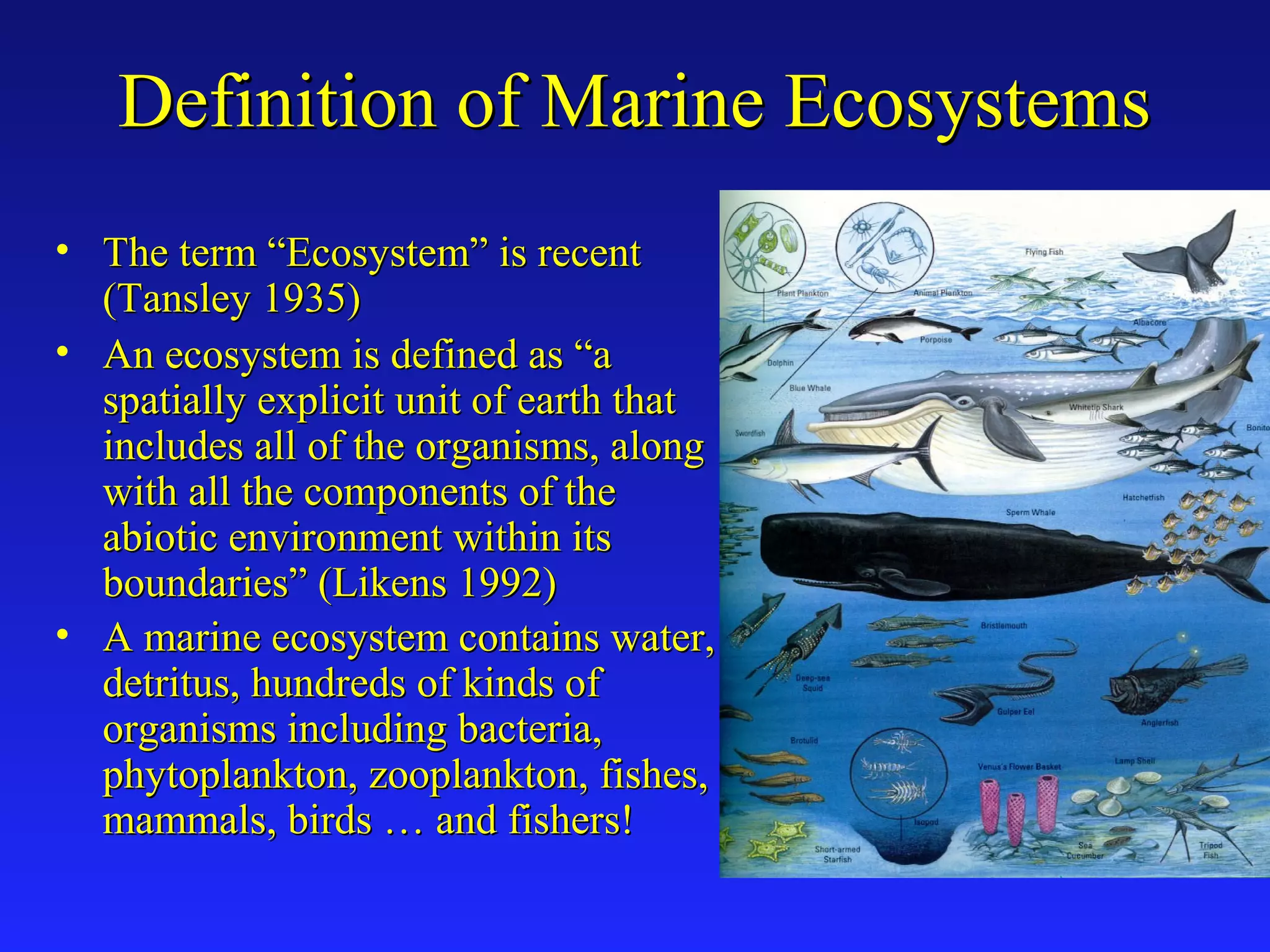
• A marine ecosystem contains water,A marine ecosystem contains water,
detritus, hundreds of kinds ofdetritus, hundreds of kinds of
organisms including bacteria,organisms including bacteria,
phytoplankton, zooplankton, fishes,phytoplankton, zooplankton, fishes,
mammals, birds … and fishers!mammals, birds … and fishers!
Ecosystem as an ‘Uncomfortable’ large scale Unit
for Ecological studies but an Integrative level for
Fisheries Management
• Ecosystems have no apparent boundaries and lack the
sort of clear objective or purpose that can be ascribed to
other, more tractable, biological or ecological entities
(e.g. cell, individual or population): there is no clear
objective function to maximize
• However the ecosystem is now viewed as an integrative
level, and its overall complexity is perceived as critical
to its sustainability
Questions Regarding the Exploitation
of Marine Ecosystems :
• Which species are most critical, and which
ecological processes are most sensitive to
exploitation?
• Does the removal of top predators have a strong
impact on lower trophic levels?
• Does heavy exploitation of forage species, such
as anchovies and sardines, cause changes in the
functioning of upwelling ecosystems?
The key to answering these
questions and exploring
whether general principles
apply lies in understanding
the energy flow in the
ecosystem
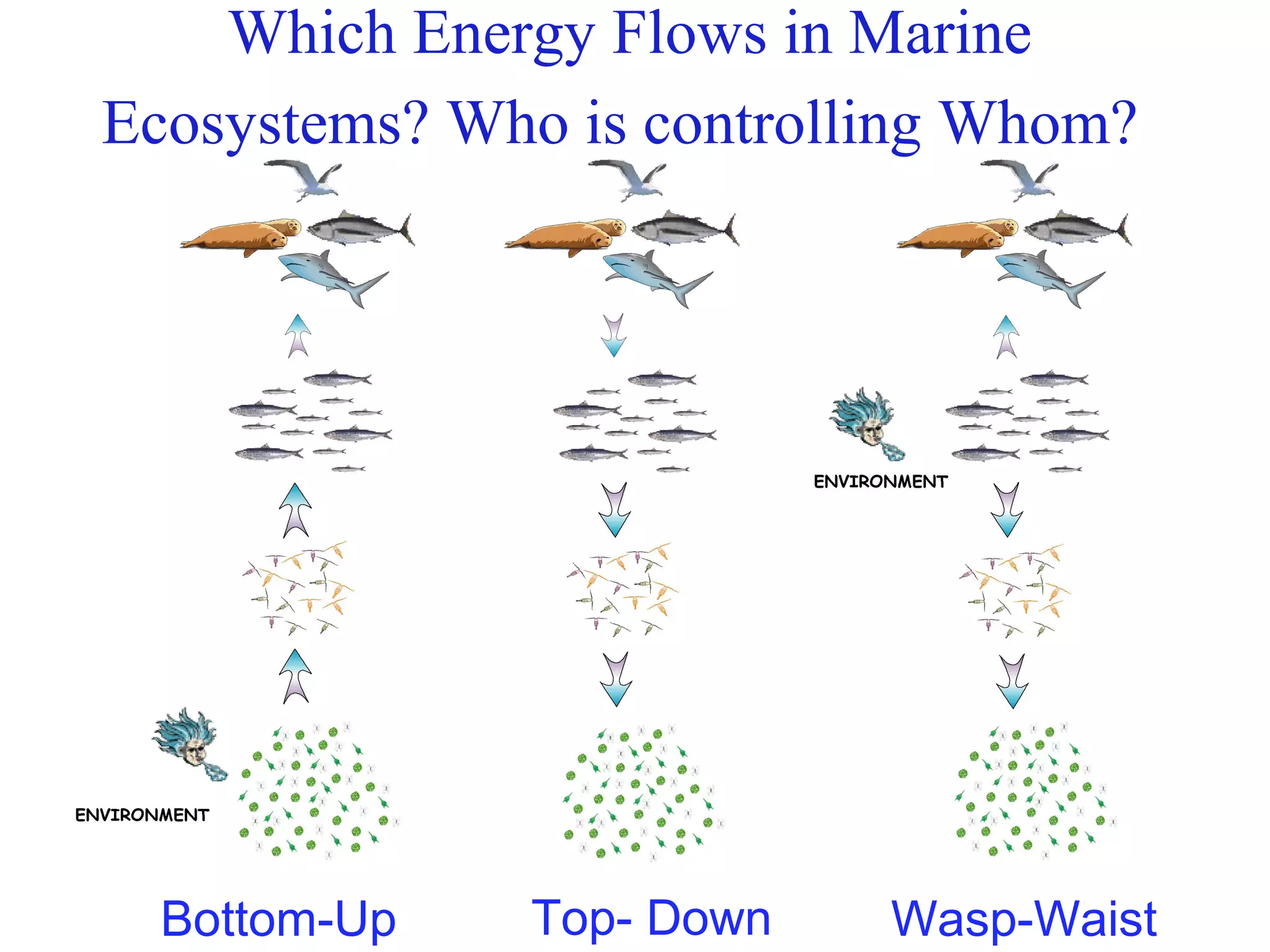
Which Energy Flows in Marine
Ecosystems? Who is controlling Whom?
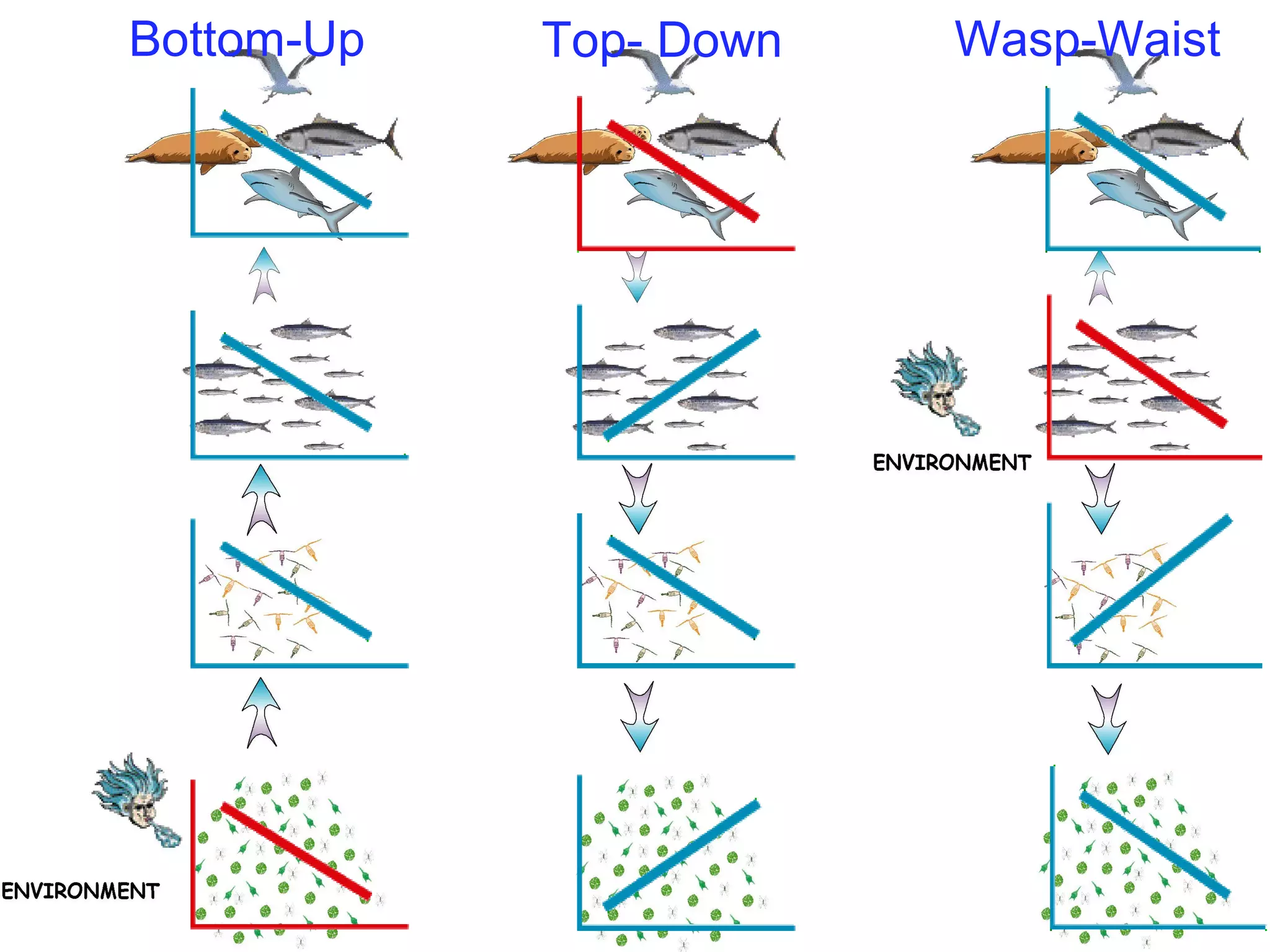
Bottom-Up Top- Down Wasp-Waist
Bottom-up ControlBottom-up Control
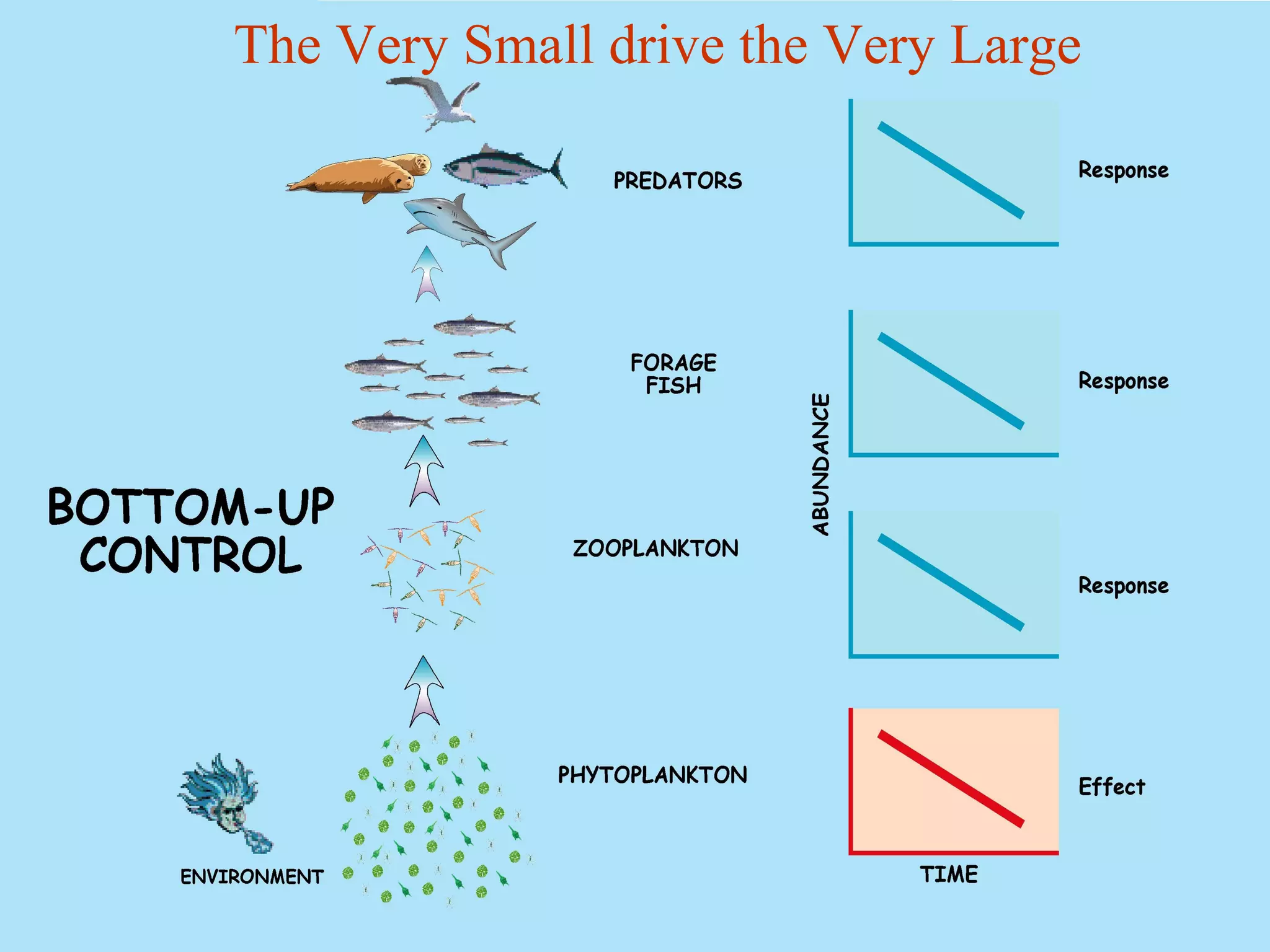
The Very Small drive the Very Large
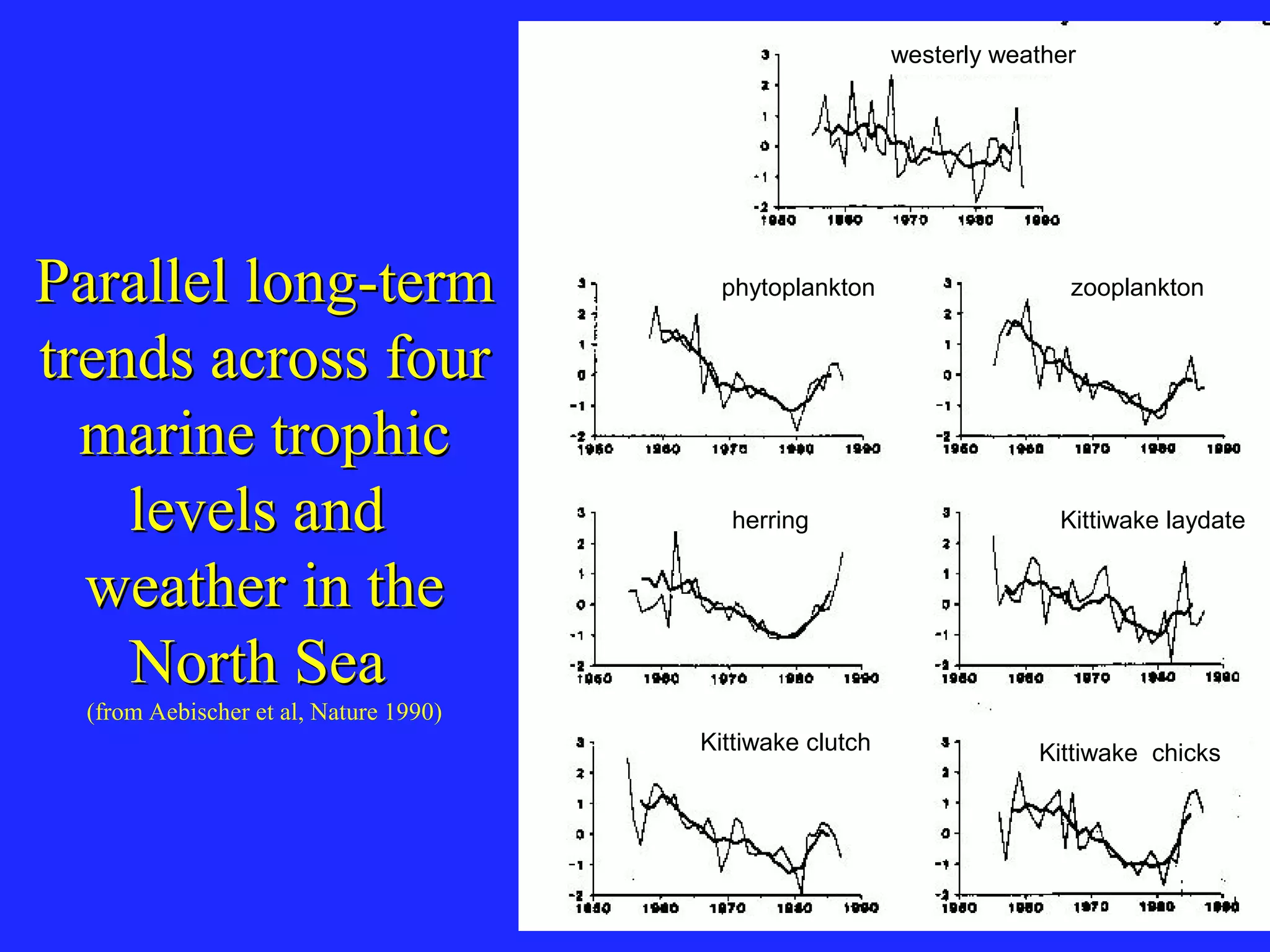
Parallel long-termParallel long-term
trends across fourtrends across four
marine trophicmarine trophic
levels andlevels and
weather in theweather in the
North SeaNorth Sea
(from Aebischer et al, Nature 1990)
westerly weather
phytoplankton zooplankton
herring Kittiwake laydate
Kittiwake clutch Kittiwake chicks
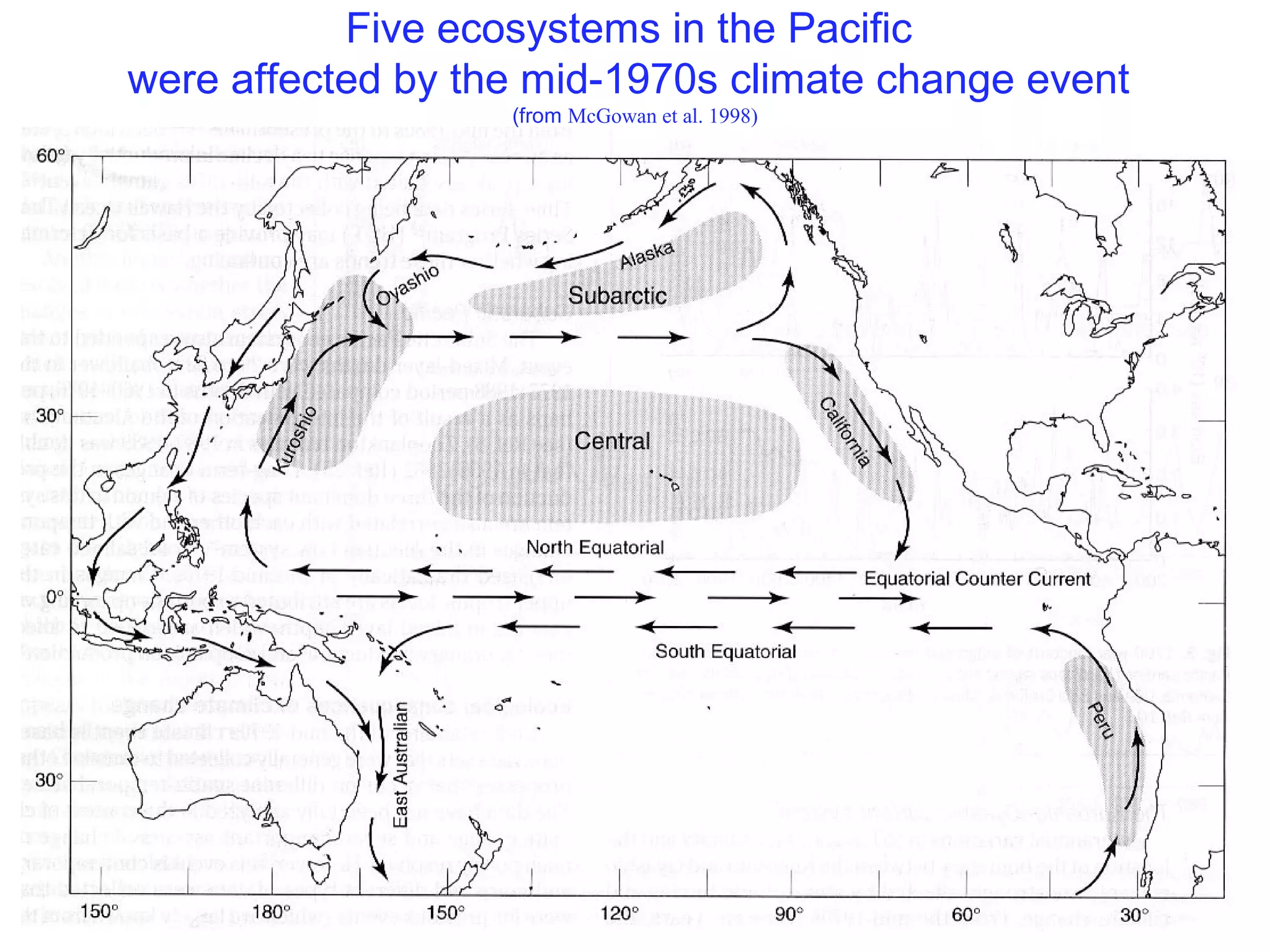
Five ecosystems in the Pacific
were affected by the mid-1970s climate change event
(from McGowan et al. 1998)
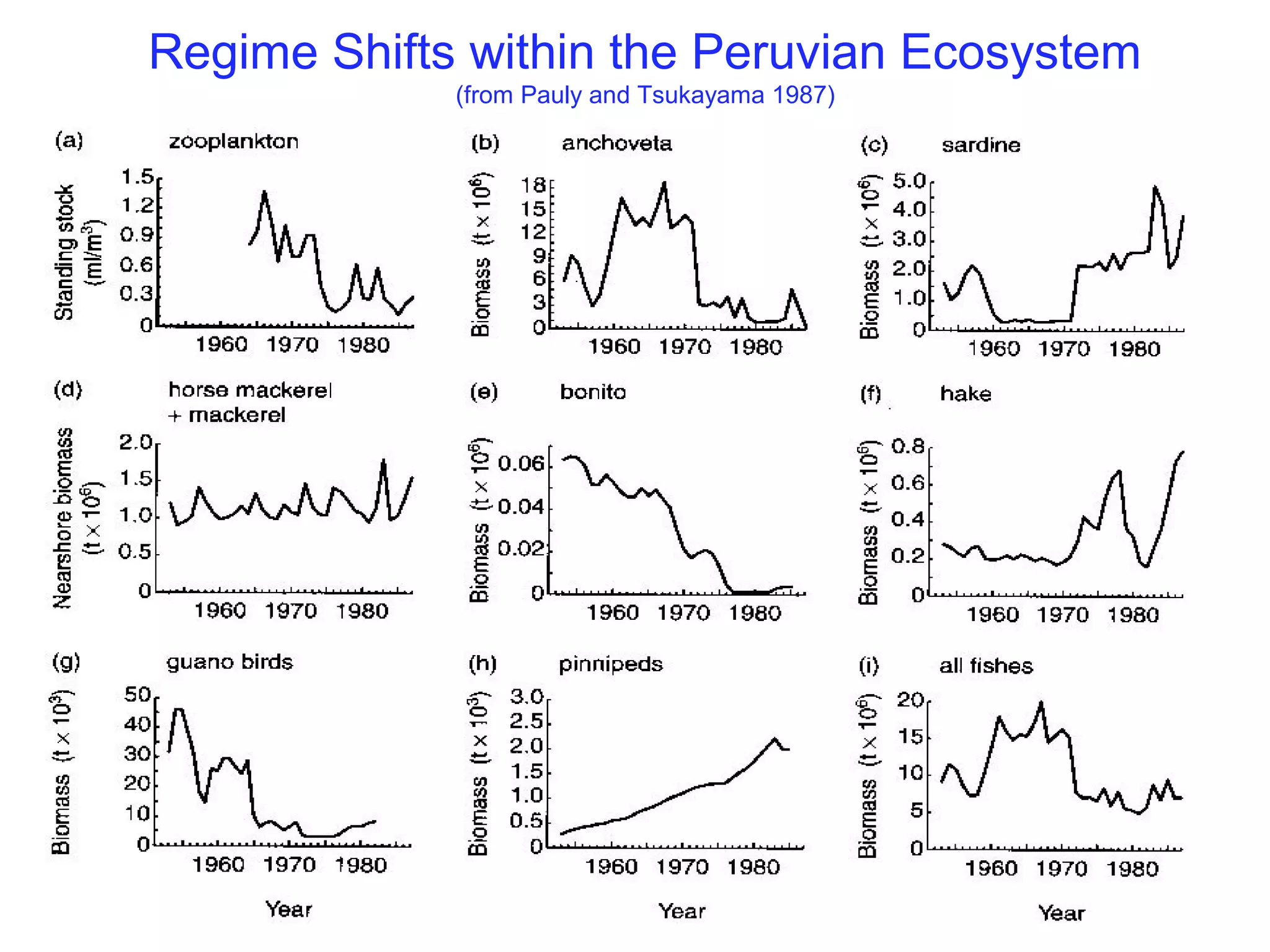
Regime Shifts within the Peruvian Ecosystem
(from Pauly and Tsukayama 1987)
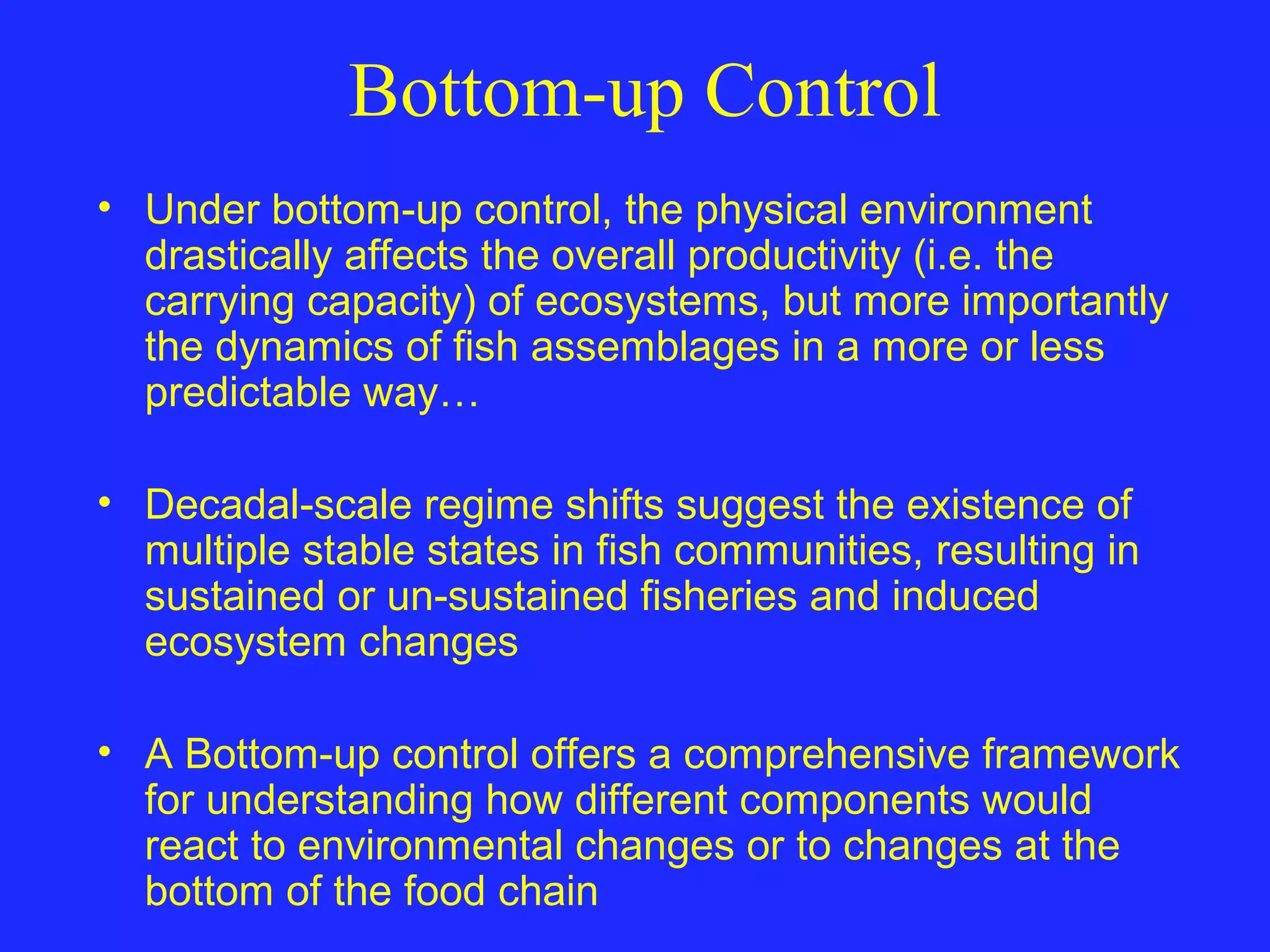
Bottom-up Control
• Under bottom-up control, the physical environment
drastically affects the overall productivity (i.e. the
carrying capacity) of ecosystems, but more importantly
the dynamics of fish assemblages in a more or less
predictable way…
• Decadal-scale regime shifts suggest the existence of
multiple stable states in fish communities, resulting in
sustained or un-sustained fisheries and induced
ecosystem changes
• A Bottom-up control offers a comprehensive framework
for understanding how different components would
react to environmental changes or to changes at the
bottom of the food chain
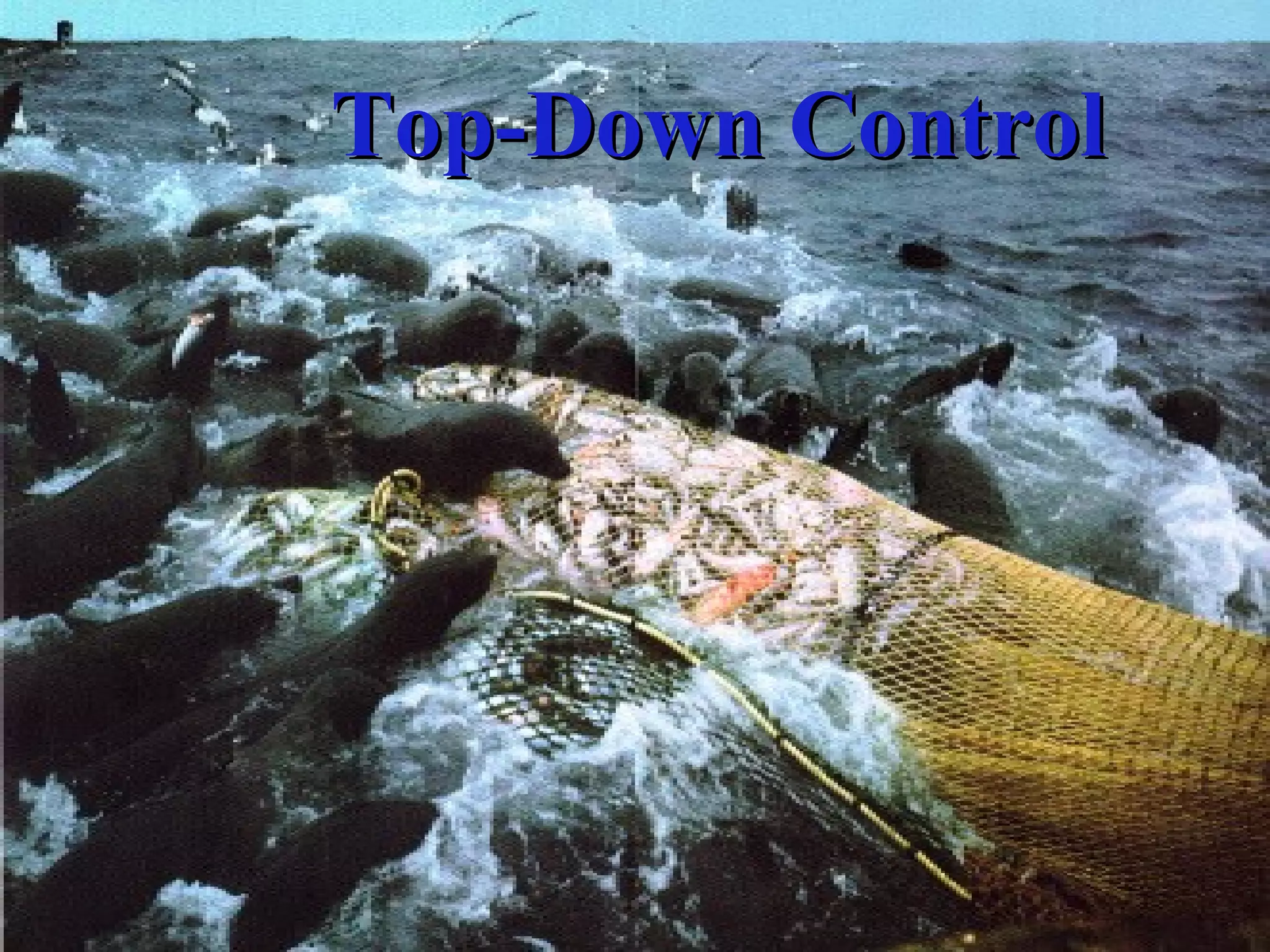
Top-Down ControlTop-Down Control
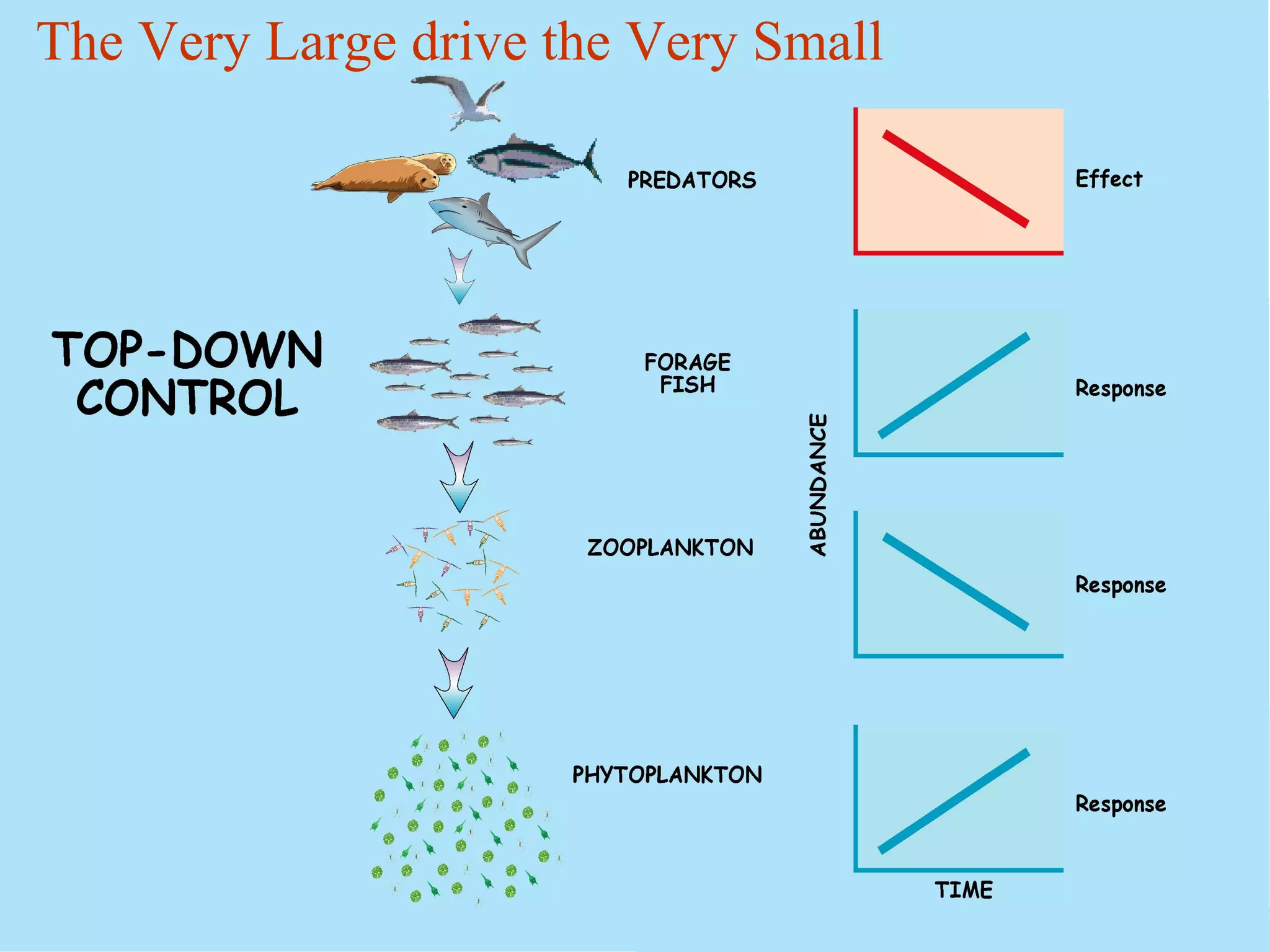
The Very Large drive the Very Small
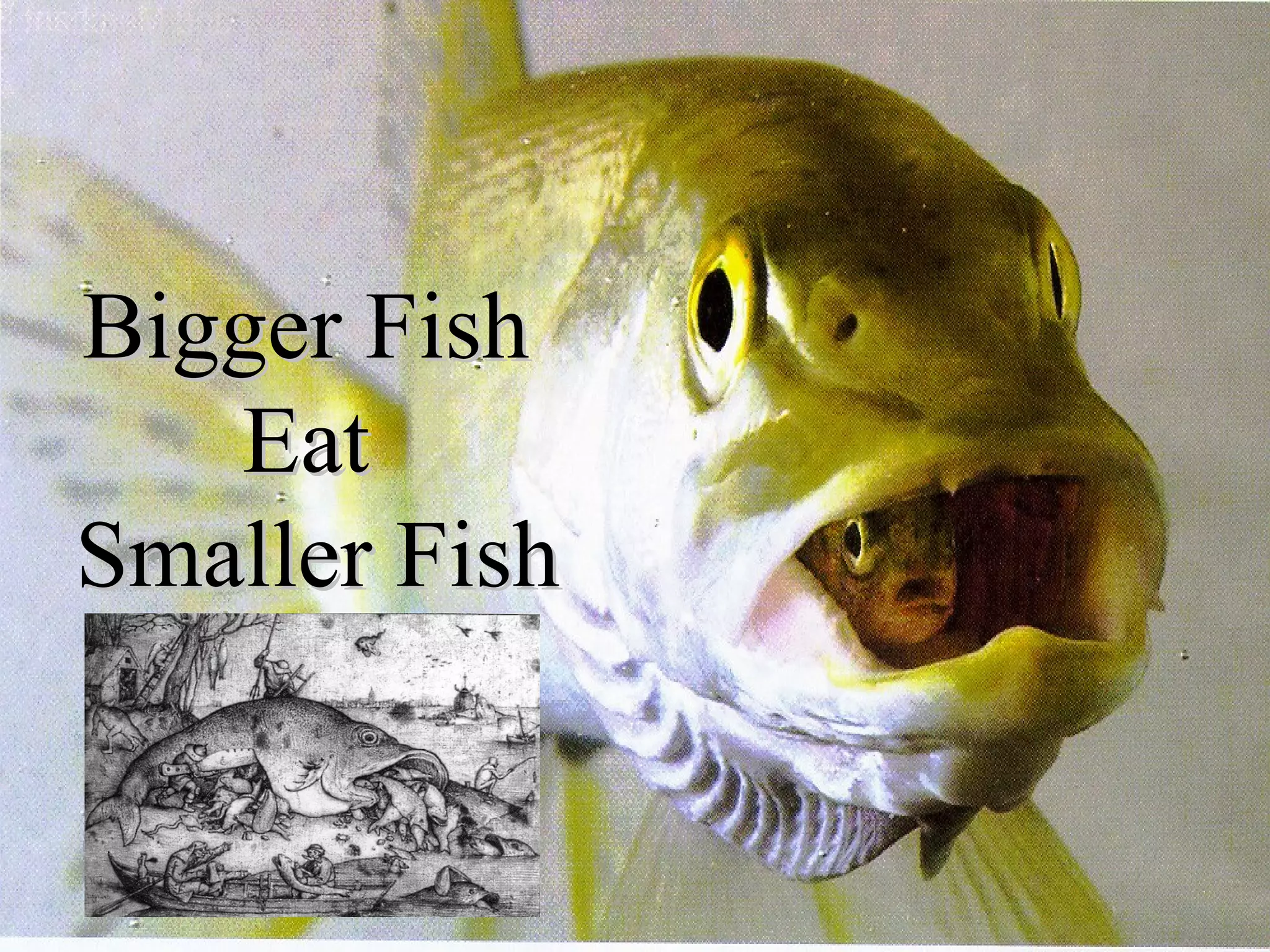
Bigger FishBigger Fish
EatEat
Smaller FishSmaller Fish
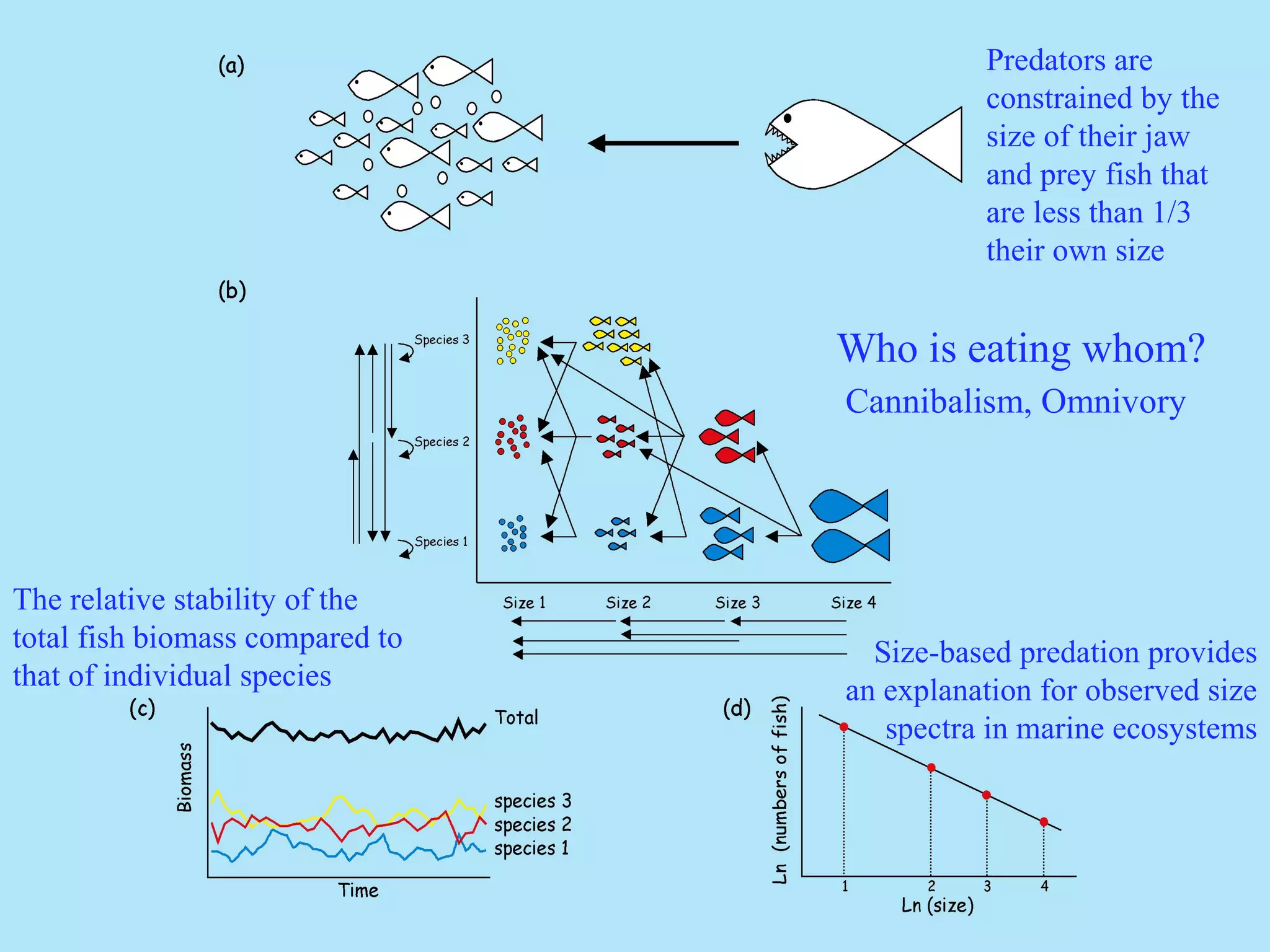
Predators are
constrained by the
size of their jaw
and prey fish that
are less than 1/3
their own size
Who is eating whom?
Cannibalism, Omnivory
The relative stability of the
total fish biomass compared to
that of individual species
Size-based predation provides
an explanation for observed size
spectra in marine ecosystems
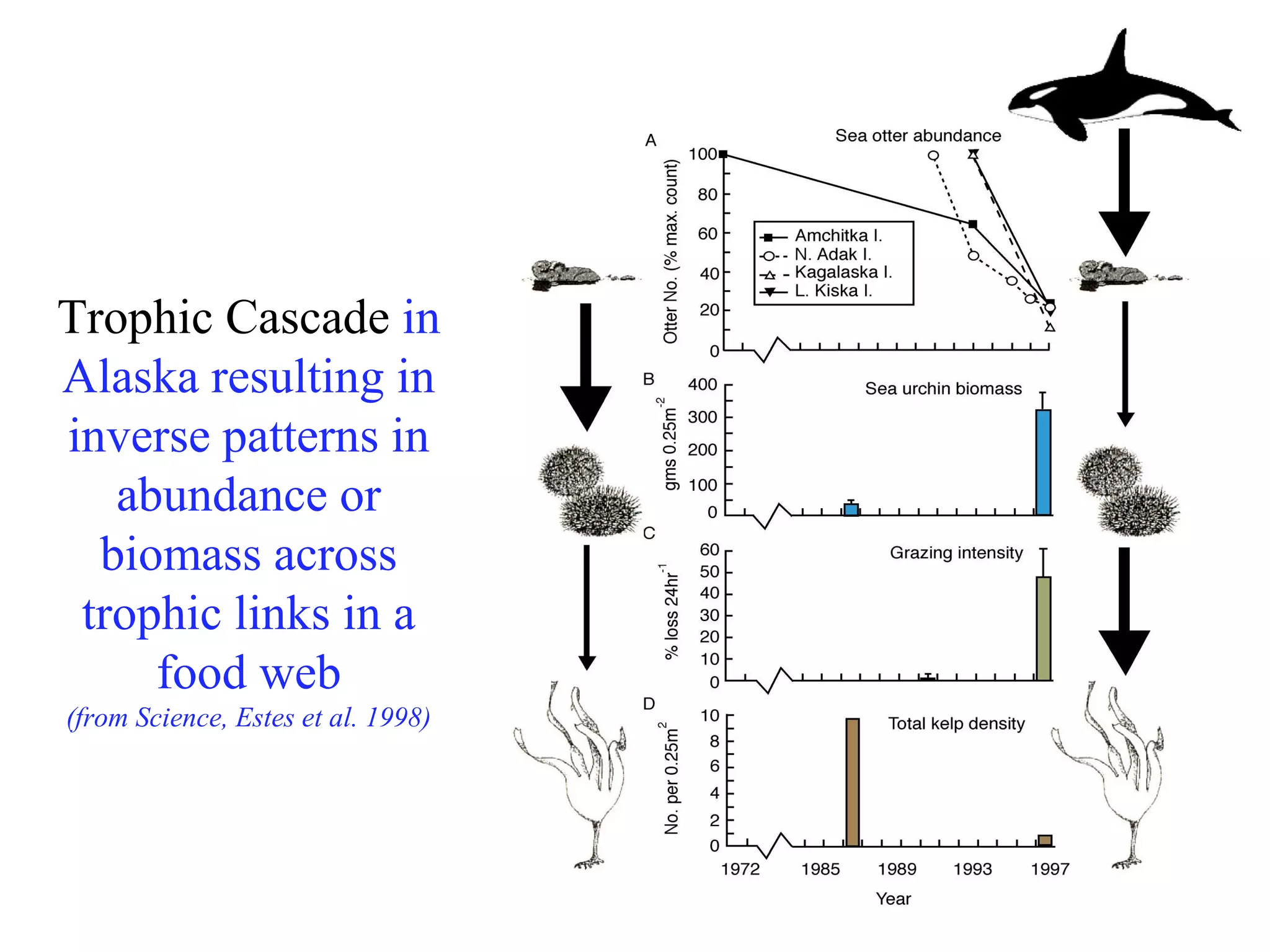
Trophic Cascade in
Alaska resulting in
inverse patterns in
abundance or
biomass across
trophic links in a
food web
(from Science, Estes et al. 1998)
Top-Down Control
• A top-down control can help to understand several
observed ecological patterns at an ecosystem level
when removing top predators
• Not all cascades propagate to lower trophic levels or
have significant impacts on ecosystem processes as
numerous compensatory mechanisms dampen or
eliminate them
• Fishing usually greatly reduces the abundance of top
predators, and it stands to reason that the abundance
of prey populations and their effects on marine
communities will increase after release from predator
control
Wasp-Waist ControlWasp-Waist Control
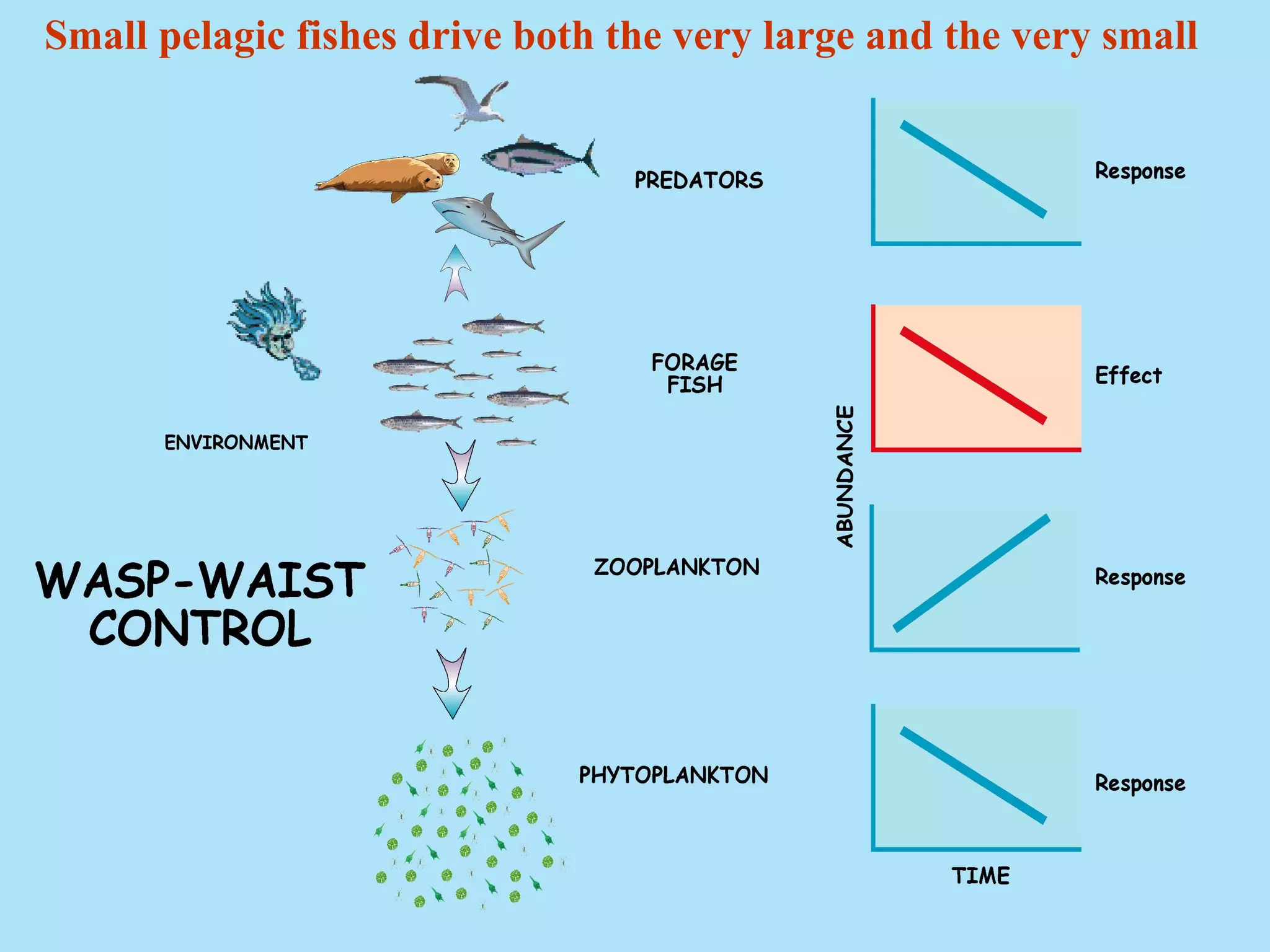
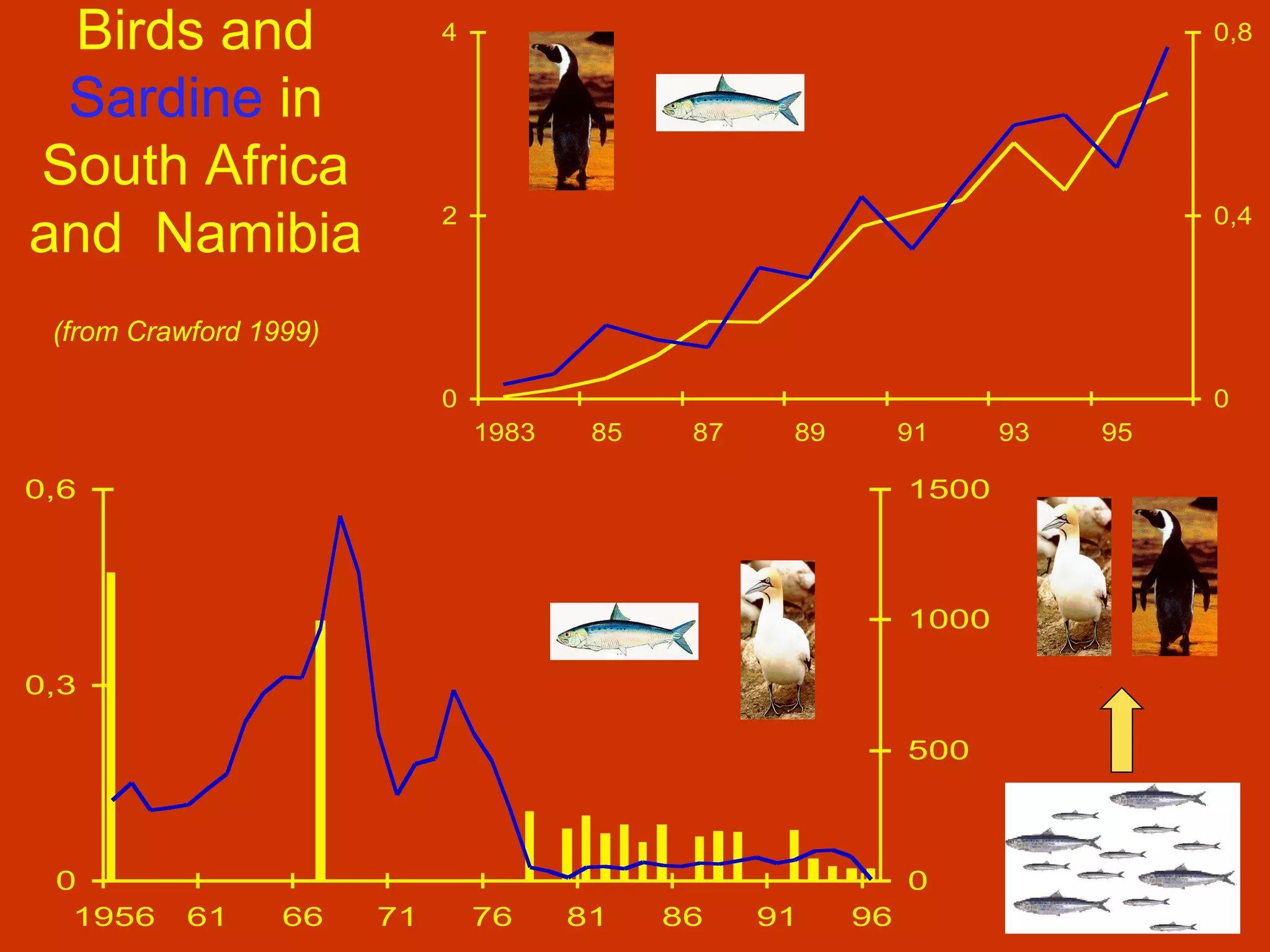
Small pelagic fishes drive both the very large and the very small
Birds and
Sardine in
South Africa
and Namibia
(from Crawford 1999)
0
2
4
1983 85 87 89 91 93 95
0
0,4
0,8
0
0,3
0,6
1956 61 66 71 76 81 86 91 96
0
500
1000
1500
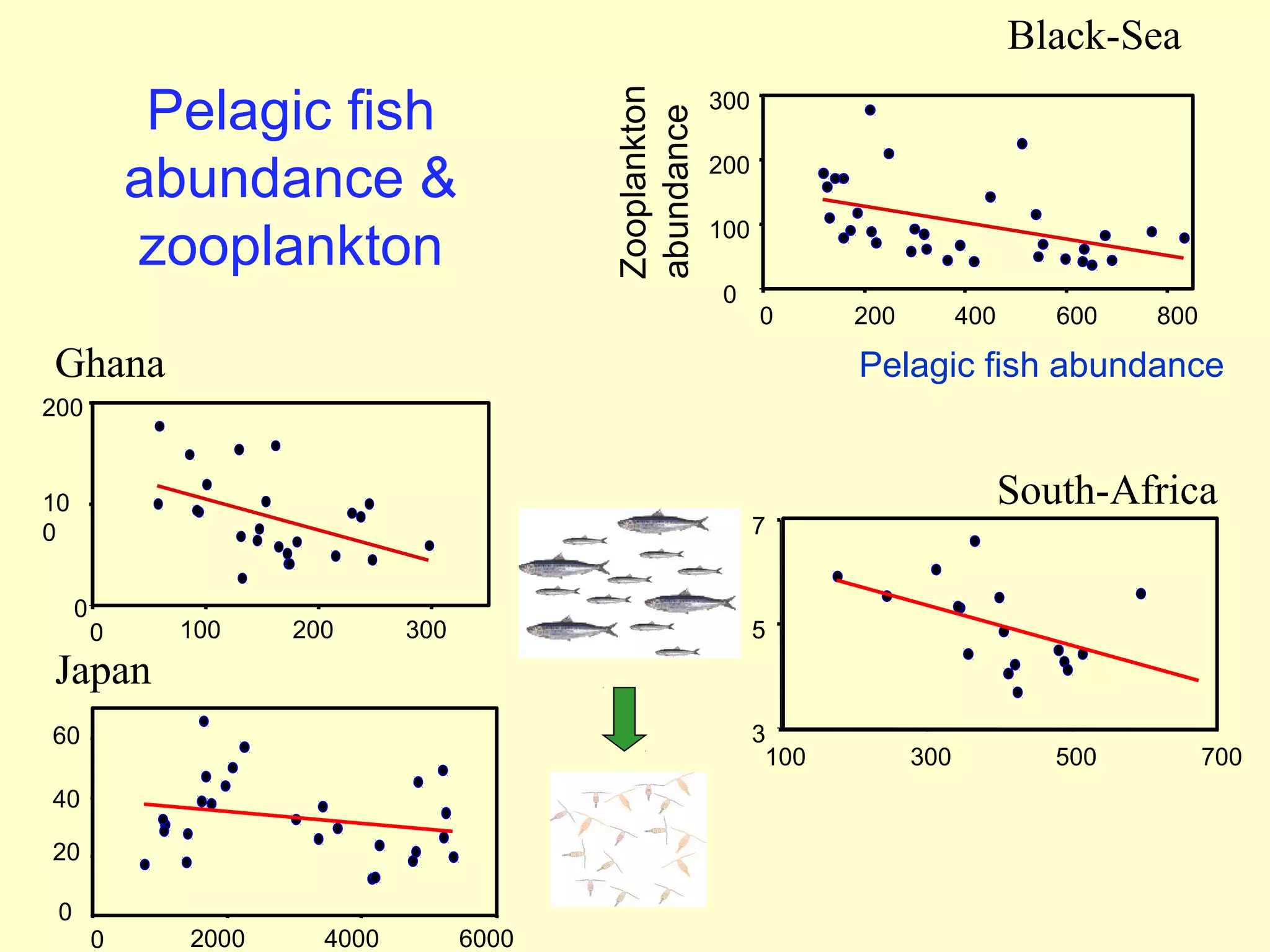
Pelagic fish
abundance &
zooplankton
Ghana
Japan
South-Africa
Black-Sea
0
10
0
200
0 100 200 300
0
20
40
60
0 2000 4000 6000
0
100
200
300
0 200 400 600 800
3
5
7
100 300 500 700
Pelagic fish abundance
Zooplankton
abundance
Wasp-Waist Control
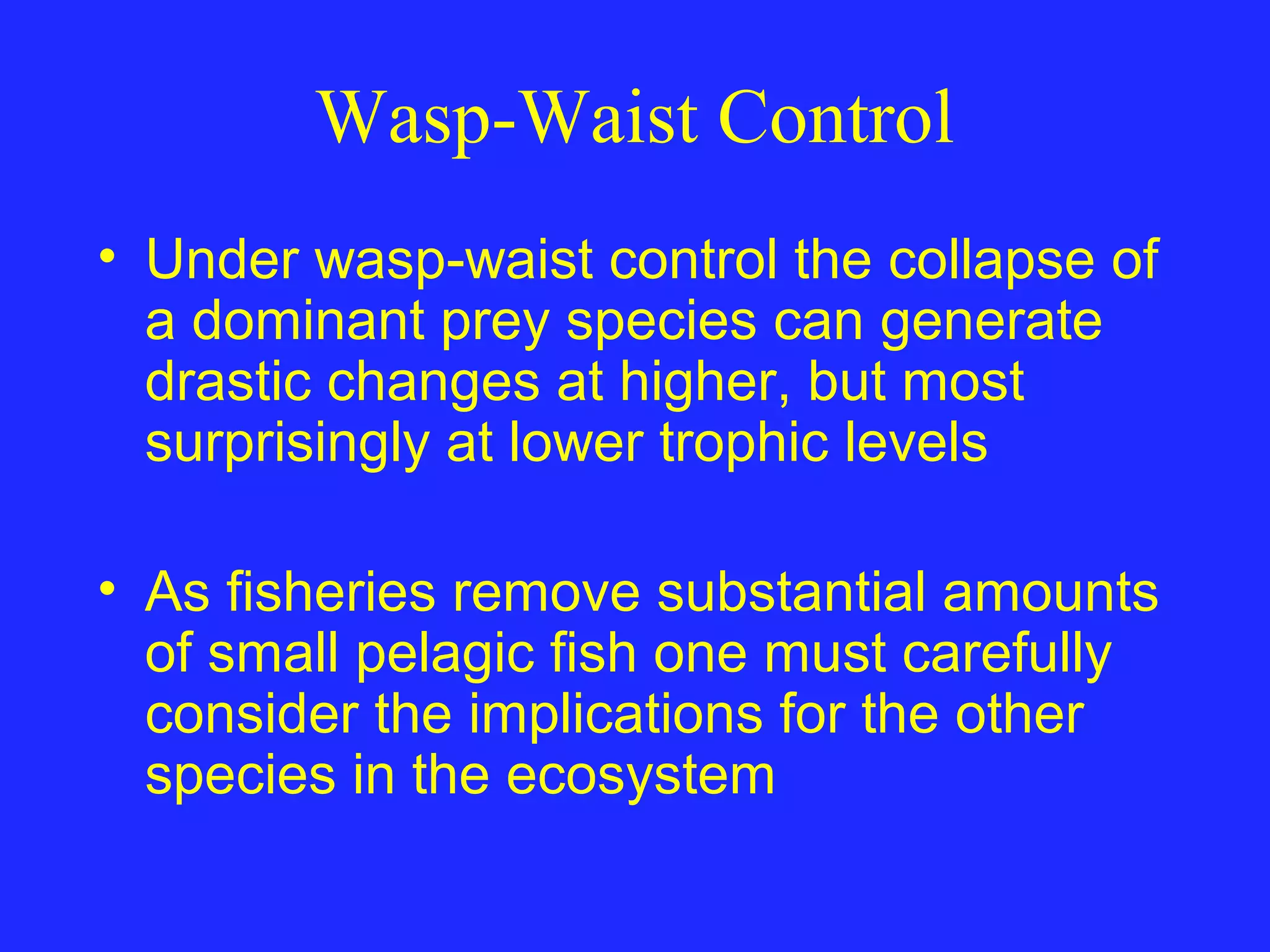
• Under wasp-waist control the collapse of
a dominant prey species can generate
drastic changes at higher, but most
surprisingly at lower trophic levels
• As fisheries remove substantial amounts
of small pelagic fish one must carefully
consider the implications for the other
species in the ecosystem
Bottom-Up Top- Down Wasp-Waist
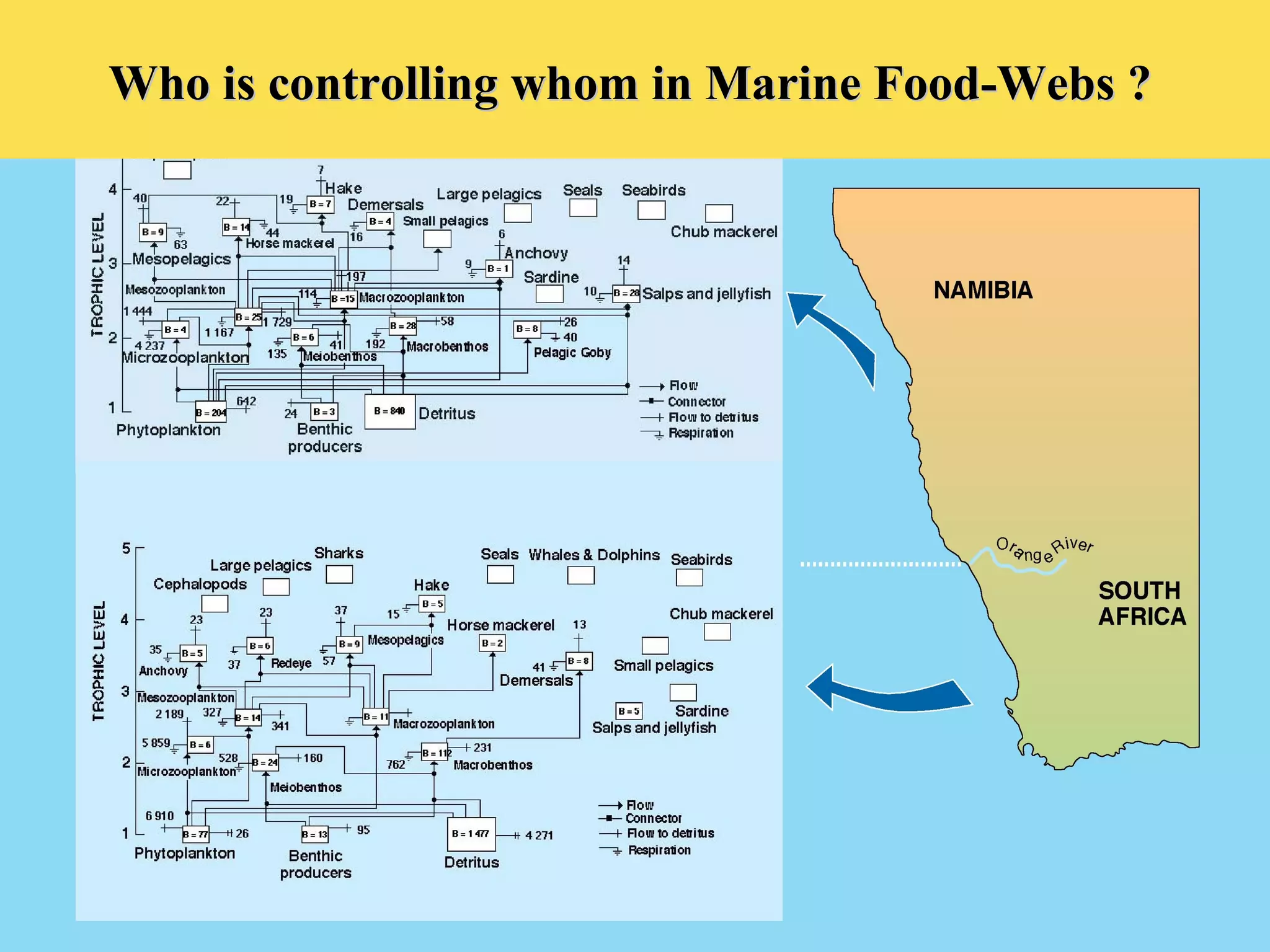
Who is controlling whom in Marine Food-Webs ?Who is controlling whom in Marine Food-Webs ?
No General Theory can beNo General Theory can be
ascribed to the Functioning ofascribed to the Functioning of
Marine EcosystemsMarine Ecosystems
the ability to predict ecosystemthe ability to predict ecosystem
behavior is limitedbehavior is limited
However ecosystems are neither totallyHowever ecosystems are neither totally
predictable nor totally unpredictable :predictable nor totally unpredictable :
tentative generalisations can be proposedtentative generalisations can be proposed
• Control by the environment (bottom-up control)Control by the environment (bottom-up control)
predominatespredominates
• Control by predators (top-down control) plays aControl by predators (top-down control) plays a
role in dampening ecosystem-level fluctuationsrole in dampening ecosystem-level fluctuations
• Trophic cascades are seldom found, except inTrophic cascades are seldom found, except in
lakes, or in marine hard substrata ecosystems andlakes, or in marine hard substrata ecosystems and
mainly for less complex food-websmainly for less complex food-webs
• Wasp-waist control is most probable in upwellingWasp-waist control is most probable in upwelling
systems.systems.
From ‘common sense’ and ‘pet concept’ toward an operational framework forFrom ‘common sense’ and ‘pet concept’ toward an operational framework for
dealing with responsible fisheries in marine ecosystems?dealing with responsible fisheries in marine ecosystems?
• These difficulties do not mean that an ecosystem approachThese difficulties do not mean that an ecosystem approach
to fisheries management should be abandoned or that weto fisheries management should be abandoned or that we
should just wait for more additional results on the functioningshould just wait for more additional results on the functioning
of ecosystemsof ecosystems
• Major steps are urgently needed, that will define anMajor steps are urgently needed, that will define an
operational framework for dealing with responsible fisheriesoperational framework for dealing with responsible fisheries
in marine ecosystems, for example by using ecosystem-in marine ecosystems, for example by using ecosystem-
based indicators and reference pointsbased indicators and reference points
• This is a complex issue that needs to integrate our simplisticThis is a complex issue that needs to integrate our simplistic
and disparate views of nature and to reach major stepsand disparate views of nature and to reach major steps
towards incorporating our recent and incomplete, buttowards incorporating our recent and incomplete, but
consequential, theoretical background on the functioning ofconsequential, theoretical background on the functioning of
marine ecosystemsmarine ecosystems
‘Not only is the science incomplete,
but the [eco]system itself is a moving
target, evolving because of the
impact of management and the
progressive expansion of the scale of
human influences on the planet’
Holling C.S. (1995)

07cury

  • 1.
    The Functioning of MarineEcosystems A fisheries perspective Philippe Cury Lynne Shannon Yunne-Jai Shin
  • 2.
    Definition of MarineEcosystemsDefinition of Marine Ecosystems • The term “Ecosystem” is recentThe term “Ecosystem” is recent (Tansley 1935)(Tansley 1935) • An ecosystem is defined as “aAn ecosystem is defined as “a spatially explicit unit of earth thatspatially explicit unit of earth that includes all of the organisms, alongincludes all of the organisms, along with all the components of thewith all the components of the abiotic environment within itsabiotic environment within its boundaries” (Likens 1992)boundaries” (Likens 1992) • A marine ecosystem contains water,A marine ecosystem contains water, detritus, hundreds of kinds ofdetritus, hundreds of kinds of organisms including bacteria,organisms including bacteria, phytoplankton, zooplankton, fishes,phytoplankton, zooplankton, fishes, mammals, birds … and fishers!mammals, birds … and fishers!
  • 3.
    Ecosystem as an‘Uncomfortable’ large scale Unit for Ecological studies but an Integrative level for Fisheries Management • Ecosystems have no apparent boundaries and lack the sort of clear objective or purpose that can be ascribed to other, more tractable, biological or ecological entities (e.g. cell, individual or population): there is no clear objective function to maximize • However the ecosystem is now viewed as an integrative level, and its overall complexity is perceived as critical to its sustainability
  • 4.
    Questions Regarding theExploitation of Marine Ecosystems : • Which species are most critical, and which ecological processes are most sensitive to exploitation? • Does the removal of top predators have a strong impact on lower trophic levels? • Does heavy exploitation of forage species, such as anchovies and sardines, cause changes in the functioning of upwelling ecosystems?
  • 5.
    The key toanswering these questions and exploring whether general principles apply lies in understanding the energy flow in the ecosystem
  • 6.
    Which Energy Flowsin Marine Ecosystems? Who is controlling Whom? Bottom-Up Top- Down Wasp-Waist
  • 7.
  • 8.
    The Very Smalldrive the Very Large
  • 9.
    Parallel long-termParallel long-term trendsacross fourtrends across four marine trophicmarine trophic levels andlevels and weather in theweather in the North SeaNorth Sea (from Aebischer et al, Nature 1990) westerly weather phytoplankton zooplankton herring Kittiwake laydate Kittiwake clutch Kittiwake chicks
  • 10.
    Five ecosystems inthe Pacific were affected by the mid-1970s climate change event (from McGowan et al. 1998)
  • 11.
    Regime Shifts withinthe Peruvian Ecosystem (from Pauly and Tsukayama 1987)
  • 12.
    Bottom-up Control • Underbottom-up control, the physical environment drastically affects the overall productivity (i.e. the carrying capacity) of ecosystems, but more importantly the dynamics of fish assemblages in a more or less predictable way… • Decadal-scale regime shifts suggest the existence of multiple stable states in fish communities, resulting in sustained or un-sustained fisheries and induced ecosystem changes • A Bottom-up control offers a comprehensive framework for understanding how different components would react to environmental changes or to changes at the bottom of the food chain
  • 13.
  • 14.
    The Very Largedrive the Very Small
  • 15.
  • 16.
    Predators are constrained bythe size of their jaw and prey fish that are less than 1/3 their own size Who is eating whom? Cannibalism, Omnivory The relative stability of the total fish biomass compared to that of individual species Size-based predation provides an explanation for observed size spectra in marine ecosystems
  • 17.
    Trophic Cascade in Alaskaresulting in inverse patterns in abundance or biomass across trophic links in a food web (from Science, Estes et al. 1998)
  • 18.
    Top-Down Control • Atop-down control can help to understand several observed ecological patterns at an ecosystem level when removing top predators • Not all cascades propagate to lower trophic levels or have significant impacts on ecosystem processes as numerous compensatory mechanisms dampen or eliminate them • Fishing usually greatly reduces the abundance of top predators, and it stands to reason that the abundance of prey populations and their effects on marine communities will increase after release from predator control
  • 19.
  • 20.
    Small pelagic fishesdrive both the very large and the very small
  • 21.
    Birds and Sardine in SouthAfrica and Namibia (from Crawford 1999) 0 2 4 1983 85 87 89 91 93 95 0 0,4 0,8 0 0,3 0,6 1956 61 66 71 76 81 86 91 96 0 500 1000 1500
  • 22.
    Pelagic fish abundance & zooplankton Ghana Japan South-Africa Black-Sea 0 10 0 200 0100 200 300 0 20 40 60 0 2000 4000 6000 0 100 200 300 0 200 400 600 800 3 5 7 100 300 500 700 Pelagic fish abundance Zooplankton abundance
  • 23.
    Wasp-Waist Control • Underwasp-waist control the collapse of a dominant prey species can generate drastic changes at higher, but most surprisingly at lower trophic levels • As fisheries remove substantial amounts of small pelagic fish one must carefully consider the implications for the other species in the ecosystem
  • 24.
  • 25.
    Who is controllingwhom in Marine Food-Webs ?Who is controlling whom in Marine Food-Webs ?
  • 26.
    No General Theorycan beNo General Theory can be ascribed to the Functioning ofascribed to the Functioning of Marine EcosystemsMarine Ecosystems the ability to predict ecosystemthe ability to predict ecosystem behavior is limitedbehavior is limited
  • 27.
    However ecosystems areneither totallyHowever ecosystems are neither totally predictable nor totally unpredictable :predictable nor totally unpredictable : tentative generalisations can be proposedtentative generalisations can be proposed • Control by the environment (bottom-up control)Control by the environment (bottom-up control) predominatespredominates • Control by predators (top-down control) plays aControl by predators (top-down control) plays a role in dampening ecosystem-level fluctuationsrole in dampening ecosystem-level fluctuations • Trophic cascades are seldom found, except inTrophic cascades are seldom found, except in lakes, or in marine hard substrata ecosystems andlakes, or in marine hard substrata ecosystems and mainly for less complex food-websmainly for less complex food-webs • Wasp-waist control is most probable in upwellingWasp-waist control is most probable in upwelling systems.systems.
  • 28.
    From ‘common sense’and ‘pet concept’ toward an operational framework forFrom ‘common sense’ and ‘pet concept’ toward an operational framework for dealing with responsible fisheries in marine ecosystems?dealing with responsible fisheries in marine ecosystems? • These difficulties do not mean that an ecosystem approachThese difficulties do not mean that an ecosystem approach to fisheries management should be abandoned or that weto fisheries management should be abandoned or that we should just wait for more additional results on the functioningshould just wait for more additional results on the functioning of ecosystemsof ecosystems • Major steps are urgently needed, that will define anMajor steps are urgently needed, that will define an operational framework for dealing with responsible fisheriesoperational framework for dealing with responsible fisheries in marine ecosystems, for example by using ecosystem-in marine ecosystems, for example by using ecosystem- based indicators and reference pointsbased indicators and reference points • This is a complex issue that needs to integrate our simplisticThis is a complex issue that needs to integrate our simplistic and disparate views of nature and to reach major stepsand disparate views of nature and to reach major steps towards incorporating our recent and incomplete, buttowards incorporating our recent and incomplete, but consequential, theoretical background on the functioning ofconsequential, theoretical background on the functioning of marine ecosystemsmarine ecosystems
  • 29.
    ‘Not only isthe science incomplete, but the [eco]system itself is a moving target, evolving because of the impact of management and the progressive expansion of the scale of human influences on the planet’ Holling C.S. (1995)

Editor's Notes

  • #2 Good Morning Ladies and Gentlemen I am going to develop here several theoretical aspects of the functioning of marine ecosystems using a fisheries perspective This is a paper that I did with Lynne Shannon from MCM - South- Africa and Yunne Shin from IRD - France
  • #3 The term “Ecosystem” is recent and dates back to the thirties An ecosystem is defined quite vaguely as “a spatially explicit unit of earth OR OCEAN that includes all of the organisms, along with all the components of the abiotic environment within its boundaries” Consequently a marine ecosystem contains water, detritus, hundreds of kinds of organisms including bacteria, phytoplankton, zooplankton, fishes, mammals, birds … and fishers! And All these components are connected within a complex food web through dynamic interactions which is coupled with the physical environment
  • #4 Ecosystems have no apparent boundaries and lack the sort of clear objective or purpose that can be ascribed to other, more tractable, biological or ecological entities (e.g. cell, individual or population) ): No clear objective function to maximize … except perhaps the ‘future’ that we would like to ascribe to the ecosystem However the ecosystem is now viewed as an integrative level, and its overall complexity is perceived as critical to its sustainability Ecosystem is Uncomfortable large scale Unit for Ecological studies but an Integrative level for Fisheries Management
  • #5 And Important questions need to be addressed when exploiting marine ecosystems such as: Which species are most critical, and which ecological processes are most sensitive to exploitation? Does the removal of top predators have a strong impact on lower trophic levels? Does heavy exploitation of forage species, such as anchovies and sardines, cause changes in the functioning of upwelling ecosystems?
  • #6 The key to answering these questions and exploring whether general principles apply lies in understanding the energy flows and how it is controlled in the ecosystem
  • #7 Different types of control have been identified in marine ecosystems: in 1887 Hensen Used an analogy with agriculture where crop yields can be predicted from the control of the input, then he made the assumption that food supply regulates adult fish stocks, In other words, in a Bottom-up control the regulation of food-web components is made by primary producers. In this case the energy flow is controlled from the bottom up to the top Species mostly interact through predation . In a top-down control, which means the regulation of lower food-web components by one or several upper-level predators, is considered to be critical in the functioning of marine ecosystems. In this case the energy flow is controlled from the top down to the bottom. in several marine systems there is a mid-trophic level, occupied by a limited number small pelagic fish species, those are dominant populations which vary radically in abundance. They can exert a major control on energy flows, and this is called wasp–waist control. In this case the energy flow is controlled up and down from the middle.
  • #8 Now I would like to illustrate these different types of control and and we start with the bottom up control
  • #9 Primary Productivity, strongly coupled with the physical environment, is the driving force under a bottom-up approach, in this case the very small drive the very large the primary production, here the control factor is the red line and the responses are the blue line. In the present case the physical environment is for example less favourable, it then controls the decrease in abundance of the phytoplankton, which in turn has a negative impact on the abundance of the zooplankton. The diminution of the zooplankton controls the decrease in abundance of the prey fish, which itself leads to a decrease in the abundance of the predators . Parallel long term changes can be observed at different trophic levels
  • #10 Parallel long-term trends were found across four marine trophic levels and weather in the North Sea suggesting a bottom up control Even though the mechanisms behind the parallelism on trends remain unclear, the effect of the environment was identified as the driving force for structuring several components of the ecosystem.
  • #11 Five ecosystems in the Pacific were affected by the mid-1970s climate change event Ecosystems are connected and respond to drastic environmental changes However the mechanisms by which climate exerts its influence vary as components of the ecosystem are constrained by different limiting environmental factors. Thus similar species at the same trophic level may respond quite differently to climate change Findings from one system cannot necessarily be extrapolated to others, and predicting the effects of global-scale environmental change on ecosystems does not appear to be simple.
  • #12 If we focus now on the Peruvian EcosystemPrimary production seems to have affected the anchoveta as well as the overall fish productivity in the Peruvian ecosystem. But to interpret the responses of other fish populations like sardine, horse mackerel or hake is not simple
  • #13 Under bottom-up control, the physical environment drastically affects the overall productivity (i.e. the carrying capacity) of ecosystems, but more importantly the dynamics of fish assemblages in a more or less predictable way… Decadal-scale regime shifts suggest the existence of multiple stable states in fish communities, resulting in sustained or un-sustained fisheries and induced ecosystem changes A Bottom-up control offers a comprehensive framework for understanding how different components would react to environmental changes or to changes at the bottom of the food chain
  • #14 Lets explore now the effect of predation on ecosystem dynamics
  • #15 Most species interact through predation, and in the case of the top-down control the very large drive the very small the predators, I.e. the control factor is in red line and the responses are in blue lines. The decreasing size of the top predator populations lead to a reduced predation on the prey that leads to an increase in the abundance of the prey fish. The increase predation of the fish prey on the zooplankton lead to a decrease in the population size. The diminution of the zooplankton abundance reduces the grazing pressure on the phytoplankton which consequently becomes more abundant.
  • #16 Predation is recognized as a key structuring process in aquatic ecosystems And due to their streamlined body shape without any prehensile appendices, this conducts to the admitted rule in the marine environment that bigger fish eat smaller fish (in the terrestrial environment you will see a lion eating a bigger animal, you will never see a fish eating a bigger fish)
  • #17 Predators are constrained by the size of their jaw and prey fish that are less than 1/3 their own size Who is eating whom? :we have here three different fish species in yellow, red and blue, due to their feeding strategy cannibalism is frequent, omnivory as well, as one species will feed on smaller sizes of other species, but it also a fact that a herring for example can prey on eggs or larvae of a cod Altogether this gives a complex dynamics of interaction that can help to explain two different patterns: Size-based predation provides an explanation for observed size spectra in marine ecosystems The relative stability of the total fish biomass compared to that of individual species
  • #18 Not all species are equal some species are particular important for the functioning of the ecosystem, they are called keystone species Otters are keystone species When they are abundant they feed on sea urchin and by limiting the sea urchin population the kelp density becomes high When the killer whales prey on them, the abundance of otters diminish, the biomass of sea urchin then increases and the kelp forest become scarce. This process is called a Trophic Cascade resulting in inverse patterns in abundance across trophic links in a food web
  • #19 A top-down control can help to understand several observed ecological patterns at an ecosystem level when removing top predators Not all cascades propagate to lower trophic levels or have significant impacts on ecosystem processes as numerous compensatory mechanisms dampen or eliminate them Fishing usually greatly reduces the abundance of top predators, and it stands to reason that the abundance of prey populations and their effects on marine communities will increase after release from predator control
  • #20 Let s explore now the role of dominant forage fish species within ecosystems
  • #21 Small pelagic fish may exert a major control on energy flows in upwelling ecosystems, and this has been called wasp–waist control. Then Small pelagic fishes drive both the very large and the very small The abundance of the forage fish (sardine and anchovy) which is under the dependence of the environment, controls both the abundance of the predators and of the primary production.
  • #22 In nature this is difficult to be a predator And the abundance of two marine birds (Penguin and Gannets) closely follows the abundance of their favourite prey , the sardine In South Africa when sardine came back so did the penguins In Namibia the collapse of the sardine stock in the seventies was followed by a collapse of the gannets The abundance of sardine in those two ecosystems control the abundance of marine birds
  • #23 More surprisingly it appears that the abundance of pelagic fish species can alter the abundance of their prey, the zooplankton Higher abundances of fish are then associated with low abundance of zooplankton , this appears to be the case in the Black sea, Ghana, South Africa and Japan
  • #24 Under wasp-waist control the collapse of a dominant prey species can generate drastic changes at higher, but most surprisingly at lower trophic levels As fisheries remove substantial amounts of small pelagic fish one must carefully consider the implications for the other species in the ecosystem
  • #25 Considering top-down, bottom-up or wasp-waist type of controls produces different ecosystem dynamics, and consequently different possible ecosystem responses to fisheries activity and management Let’s take an example: in all three examples top predators decrease in abundance as a result of only fishing if we consider a top down control, as a result of both fishing and the environment if we consider bottom-up control or as a result of a combined effect of fishing and less forage fish considering the wasp waist control
  • #26 Most ecosystems are not purely top-down or bottom up or wasp waist but a mixture of these controls Who is controlling whom in Marine Food-Webs is a key question that has only received a few preliminary answers until now How such ecosystems in the Benguela will react to changes top fish predators abundance or to an increase in prey species abundance is still an open question.
  • #27 This is no General Theory can be ascribed to the Functioning of Marine Ecosystems (and there will not be) And our ability to predict ecosystem behavior is most of the time limited, like for any complex dynamical system
  • #28 However ecosystems are neither totally predictable nor totally unpredictable : tentative generalisations can be proposed Control by the environment (bottom-up control) predominates Control by predators (top-down control) plays a role in dampening ecosystem-level fluctuations Trophic cascades are seldom found, except in lakes, or in marine hard substrata ecosystems and mainly for less complex food-webs Wasp-waist control is most probable in upwelling systems.
  • #29 These difficulties do not mean that an ecosystem approach to fisheries management should be abandoned or that we should just wait for more additional results on the functioning of ecosystems Major steps are urgently needed, that will define an ecological framework for dealing with responsible fisheries in marine ecosystems, for example by using ecosystem indicators and reference points This is a complex issue that needs to integrate our simplistic and disparate views of nature and to reach major steps towards incorporating our recent and incomplete, but consequential, theoretical background on the functioning of marine ecosystems
  • #30 Thank you for your attention