2020 WATER QUALITY-(B&C)
Marine& Estuary
KAREN LANCOUR
National Bio Rules
Committee Chairman
C. Robyn Fischer
National Event
Supervisor
2.
Event Rules –2020
DISCLAIMER
This presentation was prepared using draft rules.
There may be some changes in the final copy of
the rules. The rules which will be in your Coaches
Manual and Student Manuals will be the official
rules.
3.
Event Rules –2020
• BE SURE TO CHECK THE 2020 EVENT
RULES FOR EVENT PARAMETERS
AND TOPICS FOR EACH
COMPETITION LEVEL
4.
SOSI
TRAINING MATERIALS
• TrainingPower Point – content overview
• 6 Training Handouts – overview, general
principles, each section of competition
• Sample Tournament – sample problems with
key
• Event Supervisor Guide – prep tips, event
needs, and scoring tips
• Coral Reef extras
• Online textbook
5.
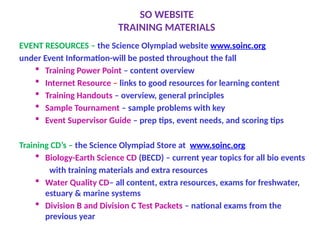
SO WEBSITE
TRAINING MATERIALS
EVENTRESOURCES – the Science Olympiad website www.soinc.org
under Event Information-will be posted throughout the fall
Training Power Point – content overview
Internet Resource – links to good resources for learning content
Training Handouts – overview, general principles
Sample Tournament – sample problems with key
Event Supervisor Guide – prep tips, event needs, and scoring tips
Training CD’s – the Science Olympiad Store at www.soinc.org
Biology-Earth Science CD (BECD) – current year topics for all bio events
with training materials and extra resources
Water Quality CD– all content, extra resources, exams for freshwater,
estuary & marine systems
Division B and Division C Test Packets – national exams from the
previous year
6.
Game Plan
1. Usethe POWERPOINT for an overview
2. Study the HANDOUTS – for background information and content
3. Use the INTERNET RESOURCES and CD’S for more help – see the
Science Olympiad National website at www.soinc.org under event
information and the Science Olympiad store
4. Prepare a RESOURCE BINDER and use OTHER TOOLS to LEARN THE
CONTENT FOR EACH SECTION OF THE COMPETITION AND
MAKE YOUR SALINOMETER
5. Prepare your ONE PAGE OF NOTES for effective use in competition
6. Do PRACTICE ACTIVITIES to prepare for doing a competition
7. Do the SAMPLE TOURNAMENT under timed conditions to experience
being timed in competition.
8. Prepare and do PRACTICE STATIONS, OLD TESTS, and
INVITATIONALS –to master knowledge, teamwork, and using your page
of notes effectively under timed conditions.
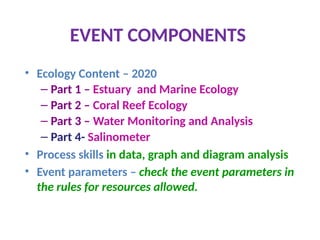
EVENT COMPONENTS
• EcologyContent – 2020
– Part 1 – Estuary and Marine Ecology
– Part 2 – Coral Reef Ecology
– Part 3 – Water Monitoring and Analysis
– Part 4- Salinometer
• Process skills in data, graph and diagram analysis
• Event parameters – check the event parameters in
the rules for resources allowed.
9.
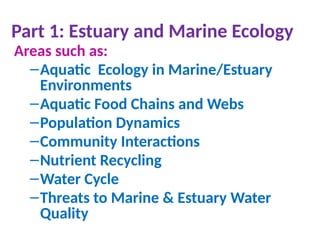
Part 1: Estuaryand Marine Ecology
Areas such as:
–Aquatic Ecology in Marine/Estuary
Environments
–Aquatic Food Chains and Webs
–Population Dynamics
–Community Interactions
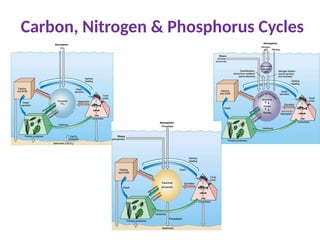
–Nutrient Recycling
–Water Cycle
–Threats to Marine & Estuary Water
Quality
10.
General Principles ofAquatic Ecology
ECOLOGY – how organisms interact with one
another and with their environment
ENVIRONMENT – living and non-living
components
• ABIOTIC – non-living component or
physical factors as soil, rainfall, sunlight,
temperatures
• BIOTIC – living component are other
organisms.
11.
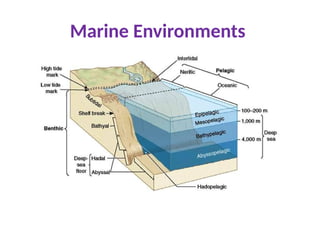
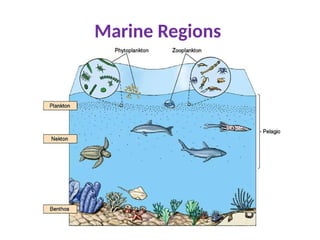
Marine Ecology
• Abiotic
–Non-living part of the environment
• Biotic
– Living part of the environment
– interdependence of all organisms living in the
ocean, in shallow coastal waters, and on the
seashore
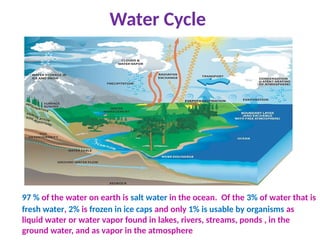
Water Cycle
97 %of the water on earth is salt water in the ocean. Of the 3% of water that is
fresh water, 2% is frozen in ice caps and only 1% is usable by organisms as
liquid water or water vapor found in lakes, rivers, streams, ponds , in the
ground water, and as vapor in the atmosphere
14.
Unique Qualities ofPure Water
The Unique Nature of Pure Water
Water is 775 times as dense as air at 0 o
C
Water is found on earth in three forms –
liquid, solid and gas
Density – maximum density is at 4o
C not
at freeing point of 0o
C and expands as it
freezes so ice floats
The H20 molecule is polar and hydrogen
bonding is present
Water is a polar molecule; one end is
positively charged and the other is
negatively charged
Cohesion of water molecules at the
surface of a body of water (surface
tension) is very high
15.
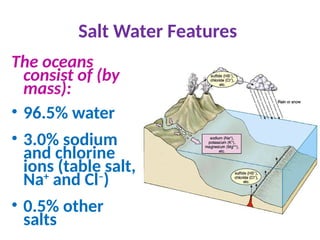
Salt Water Features
Theoceans
consist of (by
mass):
• 96.5% water
• 3.0% sodium
and chlorine
ions (table salt,
Na+
and Cl–
)
• 0.5% other
salts
Food Chain
• Producer
•1st
order Consumer or
Herbivore
• 2nd
order Consumer or 1st
order Carnivore
• 3rd
order Consumer or 2nd
order Carnivore
• 4th
order Consumer or 3rd
order Carnivore
• Decomposers – consume
dead and decaying matter
as bacteria
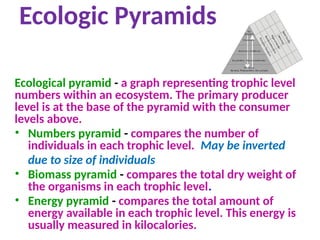
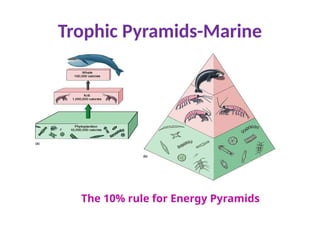
Ecologic Pyramids
Ecological pyramid- a graph representing trophic level
numbers within an ecosystem. The primary producer
level is at the base of the pyramid with the consumer
levels above.
• Numbers pyramid - compares the number of
individuals in each trophic level. May be inverted
due to size of individuals
• Biomass pyramid - compares the total dry weight of
the organisms in each trophic level.
• Energy pyramid - compares the total amount of
energy available in each trophic level. This energy is
usually measured in kilocalories.
Threats to MarineEcosystems
• Oil spills and their ecological disasters
• Marine dumping of wastes – plastic and
other wastes
• Dredging Wastes
• Overfishing
• Ocean acidification reducing calcium
carbonate
• Population displacement
• Mangrove Destruction
• Bycatch – marine wildlife unintentionally
caught as sea turtles, porpoises, albatross,
crabs, starfish & fish
• Whaling is still a problem though strides are
being make
24.
Threats to OceanHealth
• Marine Pollution
• Habitat Destruction
• Overfishing and Exploitation
• Climate Change
• Sea Temperature Rise
• Ocean Acidification
• Invasive Species
• Ocean Dead Zones
25.
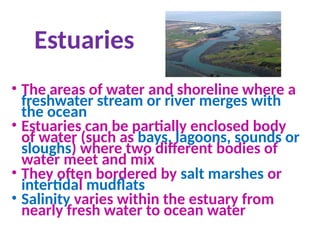
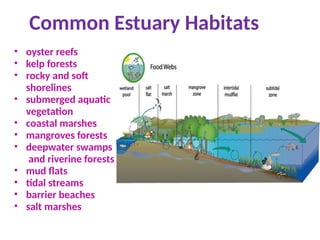
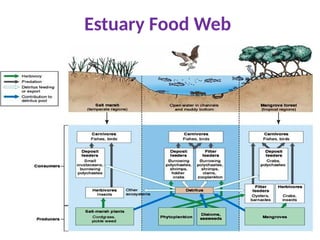
Estuaries
• The areasof water and shoreline where a
freshwater stream or river merges with
the ocean
• Estuaries can be partially enclosed body
of water (such as bays, lagoons, sounds or
sloughs) where two different bodies of
water meet and mix
• They often bordered by salt marshes or
intertidal mudflats
• Salinity varies within the estuary from
nearly fresh water to ocean water
26.
Importance of Estuaries
•Of the 32 largest cities in the world, 22 are located on
estuaries
• Many animal species rely on estuaries for nesting and
breeding
• Most of the fish and shellfish eaten in the United States,
including salmon, herring, and oysters, complete at
least part of their life cycles in estuaries
• Estuaries filter out sediments and pollutants from rivers
and streams before they flow into the ocean, providing
cleaner waters for humans and marine life
• Humans also rely on estuaries for recreation, jobs, and
even our homes
• Coastal development, introduction of invasive species,
over fishing, dams, and global climate change have led
to a decline in the health of estuaries, making them one
of the most threatened ecosystems on Earth
27.
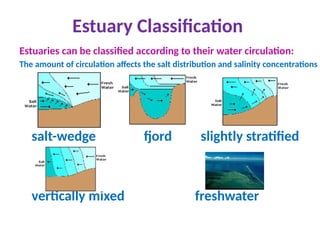
Estuary Classification
Estuaries canbe classified according to their water circulation:
The amount of circulation affects the salt distribution and salinity concentrations
salt-wedge fjord slightly stratified
vertically mixed freshwater
Adaptation of Organisms
–Physiological adaptations
• How organisms adapt to the environment by
changes in metabolism, behavior and other
characteristics.
–The genes of the organism remains
unchanged
–The adaptation is not passed onto its
progeny
– Evolutionary adaptations
• Over generations, species adapt to the
environment through natural selection.
–Genetic differences of an individual
organism that makes it better adapted to
its environment are passed onto the
organism’s progeny
30.
Adaptations of EstuaryOrganisms
Salinity, temperature, water levels and light levels vary
along the length of an estuary
• shutting up shells, digging borrows and excretion of
excess salts
• fish maintain water balance by actively drinking salt
water
• increasing their respiratory water flow and increase
oxygen consumption
• mechanisms to deal with high energy winds and
waves
• most efficient tree is low, with numerous crowded
branches
• the tree may include flattening of the trunk, root and
branches in a plan parallel to the wind direction
Threats to EstuariesEPA
• Too many nutrients
• Pathogens
• Toxic chemicals
• Habitat loss
• Invasive Species
• Changes in water
flow
34.
Point and Non-PointPollution Sources
• Pollutants pose a large threat to estuarine
organisms
• Pollutants are introduced into estuaries from either
point sources or non-point sources.
Point sources are clearly defined, localized inputs
such as pipes, industrial plants, sewer systems,
oil spills from tankers, and aquaculture ventures.
Non-point sources are indistinct inputs that do
not have a clearly defined source, such as runoff
of petroleum products from roadways or
pesticides from farmland.
A majority of pollutants find their way into
estuaries from non-point sources
Non-point sources are harder to detect and
control
Reduction of pollution requires substantial
individual and collective efforts
• The federal and state governments regulate them.
35.
Estuary Preservation
• Ensuringthe health of our estuaries is vital to
the survival of the plant and animal
communities
• To preserve our estuaries, the National
Estuarine Research Reserve System was
established to protect more than 1.3 million
acres of estuarine habitat for long-term
research, monitoring, education, and
stewardship throughout the coastal United
States.
36.
Part 2: CoralReef Ecology
• Examine coral reefs and the effects of pollution on reef
ecosystems
• Topics that may be included are
coral reef biology
growth and reproduction
zooxanthellae
reef fish communities
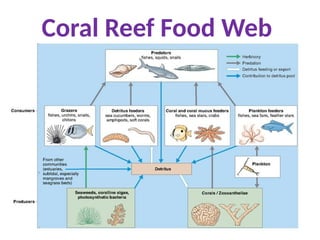
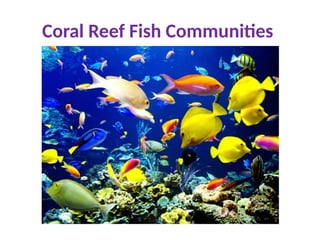
reef ecosystem
health indicators
the importance of coral reefs
problems associated with pollution
management of reef systems
37.
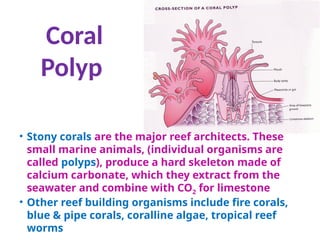
Coral
Polyp
• Stony coralsare the major reef architects. These
small marine animals, (individual organisms are
called polyps), produce a hard skeleton made of
calcium carbonate, which they extract from the
seawater and combine with CO2 for limestone
• Other reef building organisms include fire corals,
blue & pipe corals, coralline algae, tropical reef
worms
38.
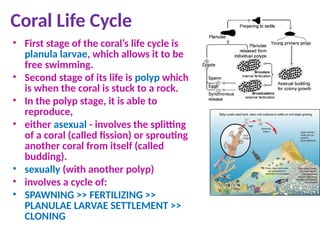
Coral Life Cycle
•First stage of the coral’s life cycle is
planula larvae, which allows it to be
free swimming.
• Second stage of its life is polyp which
is when the coral is stuck to a rock.
• In the polyp stage, it is able to
reproduce,
• either asexual - involves the splitting
of a coral (called fission) or sprouting
another coral from itself (called
budding).
• sexually (with another polyp)
• involves a cycle of:
• SPAWNING >> FERTILIZING >>
PLANULAE LARVAE SETTLEMENT >>
CLONING
39.
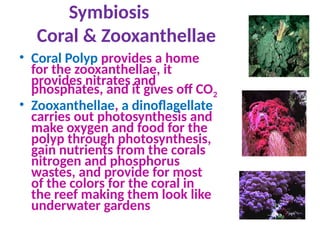
Symbiosis
Coral & Zooxanthellae
•Coral Polyp provides a home
for the zooxanthellae, it
provides nitrates and
phosphates, and it gives off CO2
• Zooxanthellae, a dinoflagellate
carries out photosynthesis and
make oxygen and food for the
polyp through photosynthesis,
gain nutrients from the corals
nitrogen and phosphorus
wastes, and provide for most
of the colors for the coral in
the reef making them look like
underwater gardens
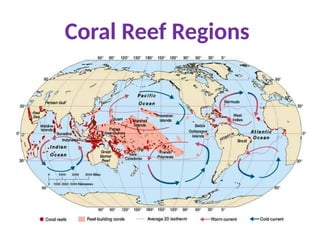
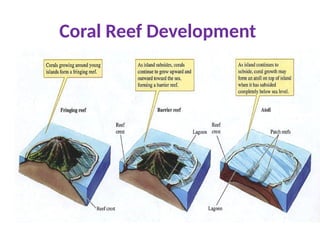
Requirements for ReefFormation
• Solid structure for the base with a hard
substrate for attachment
• Warm water temperatures > 20°C (68°F)
and oceanic salinities
• High Light Levels
• Clear waters with high water transparency
• Low nutrient waters - low in phosphate
and nitrogen nutrients
• Good water circulation with moderate
wave action to disperse wastes and bring
oxygen and plankton to the reef
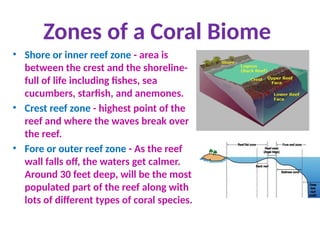
Zones of aCoral Biome
• Shore or inner reef zone - area is
between the crest and the shoreline-
full of life including fishes, sea
cucumbers, starfish, and anemones.
• Crest reef zone - highest point of the
reef and where the waves break over
the reef.
• Fore or outer reef zone - As the reef
wall falls off, the waters get calmer.
Around 30 feet deep, will be the most
populated part of the reef along with
lots of different types of coral species.
44.
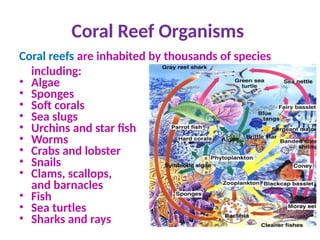
Coral Reef Organisms
Coralreefs are inhabited by thousands of species
including:
• Algae
• Sponges
• Soft corals
• Sea slugs
• Urchins and star fish
• Worms
• Crabs and lobster
• Snails
• Clams, scallops,
and barnacles
• Fish
• Sea turtles
• Sharks and rays
Coral Reef Management
•Fisheries regulation
• Marine protected areas
• Coastal zoning
• The problem of ecosystem phase-shifts
(how if corals die and area is taken over
by algae, it achieves a new steady state
and is very difficult for corals to re-
colonize)
55.
Coral Reef RestorationPrograms
• Several restorations programs are operating
with much success
• Hawaii program
• Florida Program
• NOAA
56.
Part 3: WaterMonitoring
• Understand and interpret data
related to testing procedures
and purposes for water testing
(No actual testing)
Part 4: Salinometer
• Build and demonstrate a
salinometer capable of testing
saltwater (1-10%)
57.
Chemical Analysis
• Salinity- only actual testing with salinometer in Part 4
• Temperature
• Aragonite Saturation - for marine esp. coral reefs
• pH
• Turbidity – Light Saturation in marine environments
• Dissolved oxygen
• Biochemical oxygen demand
• Phosphates
• Nitrates
• Total solids
• Fecal Coliform
Their relationship to one another – note: the Water
Quality Index used for freshwater does not apply to
marine. Regions have their own marine water quality
index.
58.
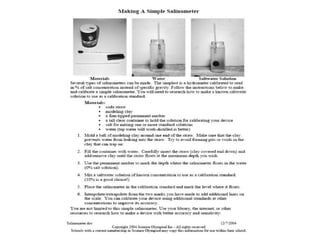
Part 4: Salinomter–
• Salinometers-calibrated to read in % of
salt concentration
• Materials –
soda straw
modeling clay
a fine-tipped permanent marker
a tall clear container to hold
the solution for calibrating your
device
salt for mixing one or more
standard solutions
water (tap water will work-distilled
is better)
59.
SALINOMETER TIPS
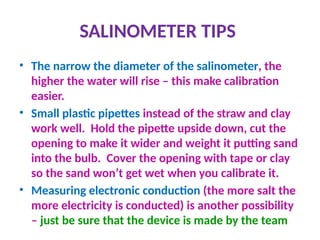
• Thenarrow the diameter of the salinometer, the
higher the water will rise – this make calibration
easier.
• Small plastic pipettes instead of the straw and clay
work well. Hold the pipette upside down, cut the
opening to make it wider and weight it putting sand
into the bulb. Cover the opening with tape or clay
so the sand won’t get wet when you calibrate it.
• Measuring electronic conduction (the more salt the
more electricity is conducted) is another possibility
– just be sure that the device is made by the team