Towards Immune Modulation
against Vulnerable Plaque
Göran K Hansson
Center for Molecular Medicine
Karolinska Institutet
Stockholm, Sweden
Vulnerable Plaque Symposium
Chicago, IL, November 2002
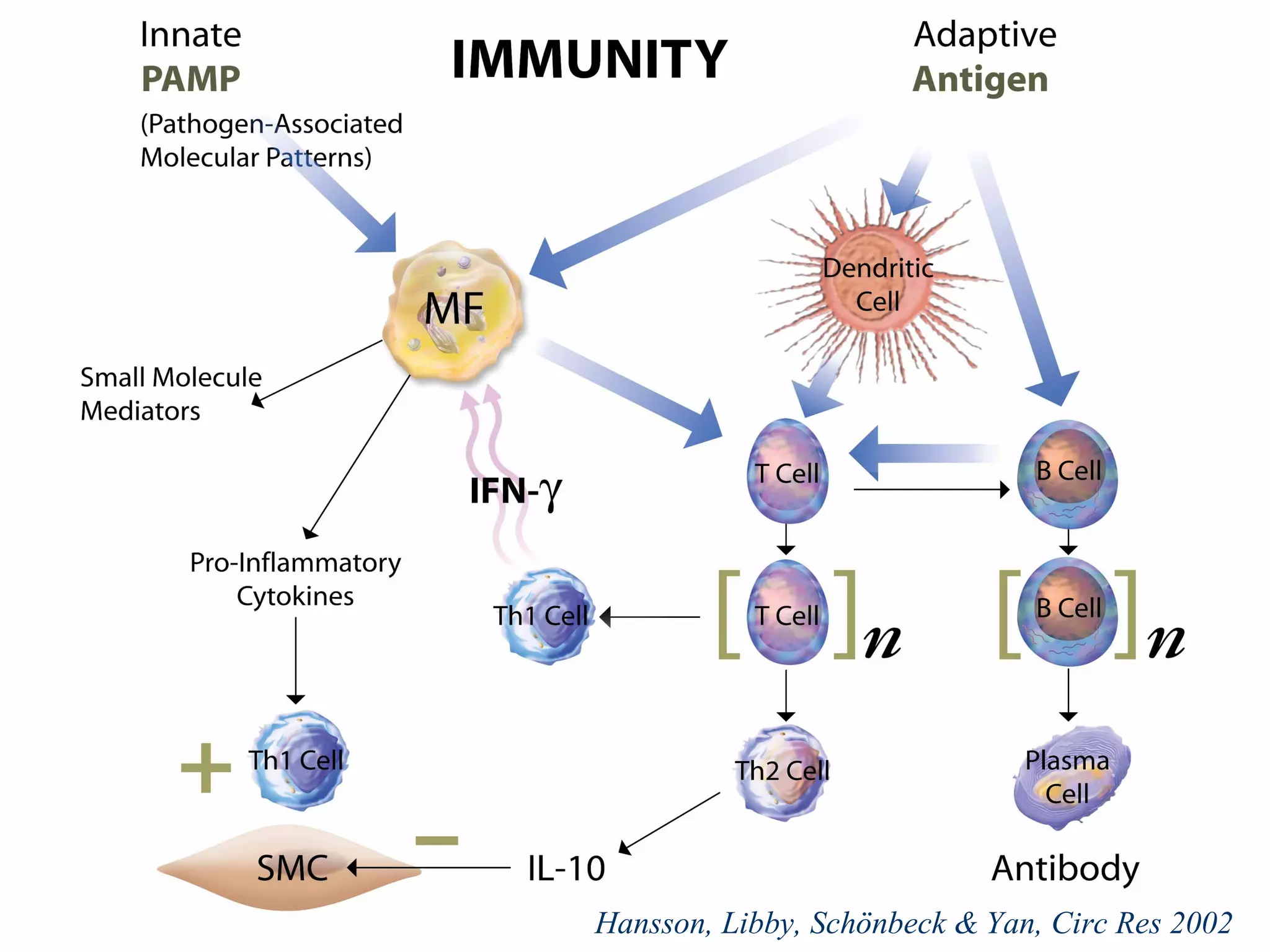
Hansson, Libby, Schönbeck & Yan, Circ Res 2002
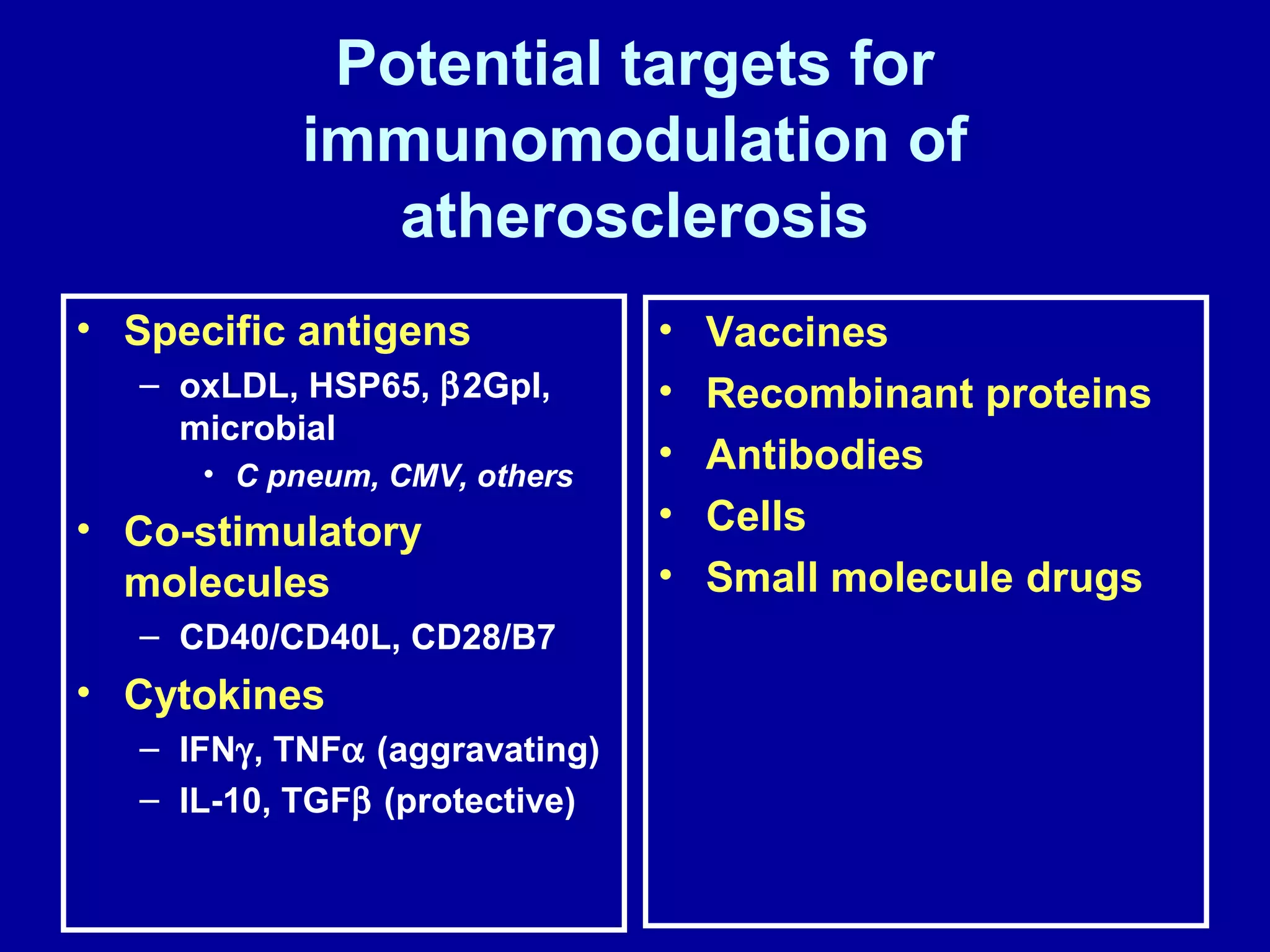
Potential targets for
immunomodulation of
atherosclerosis
• Specific antigens
– oxLDL, HSP65, β2GpI,
microbial
• C pneum, CMV, others
• Co-stimulatory
molecules
– CD40/CD40L, CD28/B7
• Cytokines
– IFNγ, TNFα (aggravating)
– IL-10, TGFβ (protective)
• Vaccines
• Recombinant proteins
• Antibodies
• Cells
• Small molecule drugs
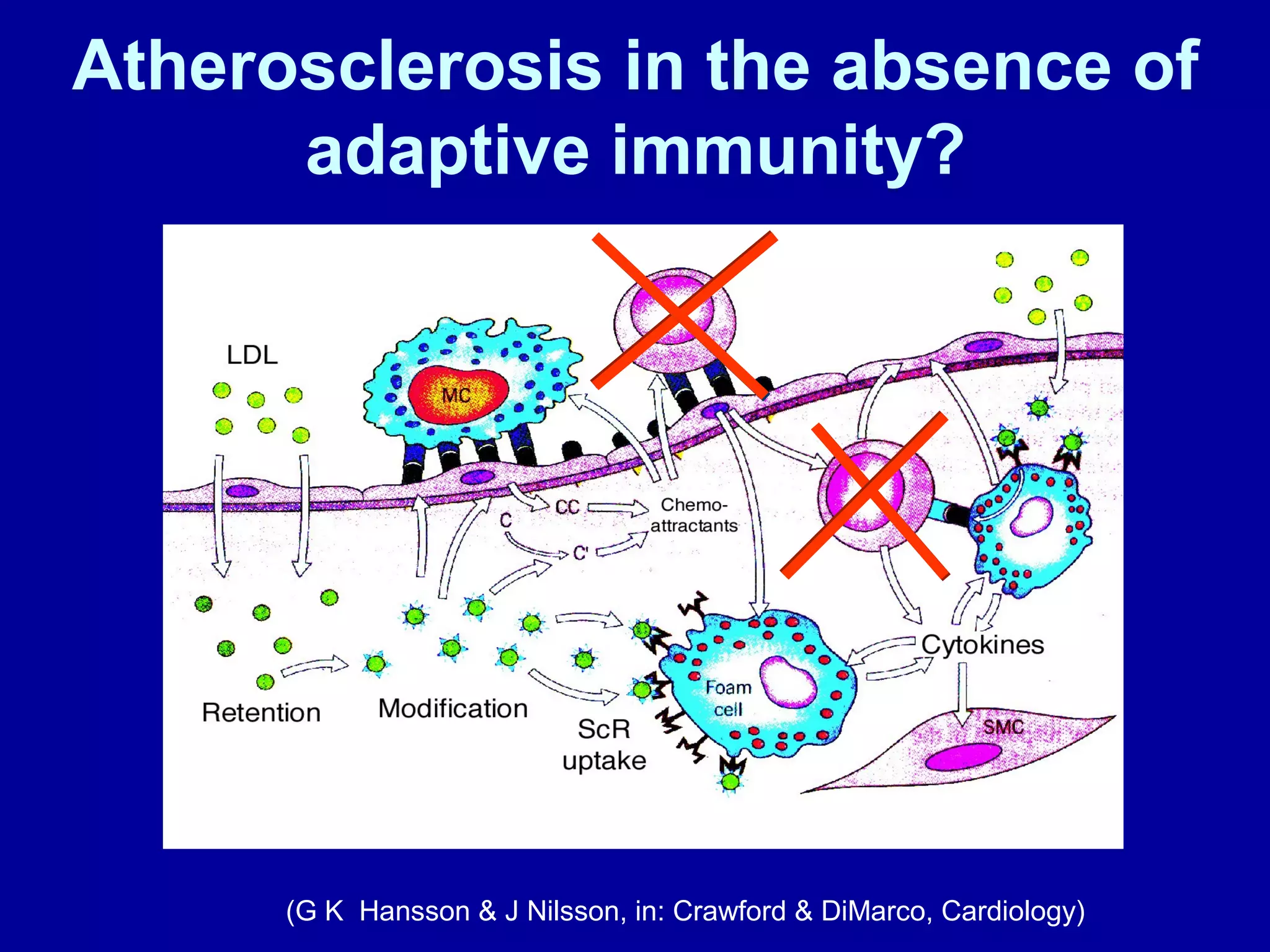
Atherosclerosis in the absence of
adaptive immunity?
(G K Hansson & J Nilsson, in: Crawford & DiMarco, Cardiology)
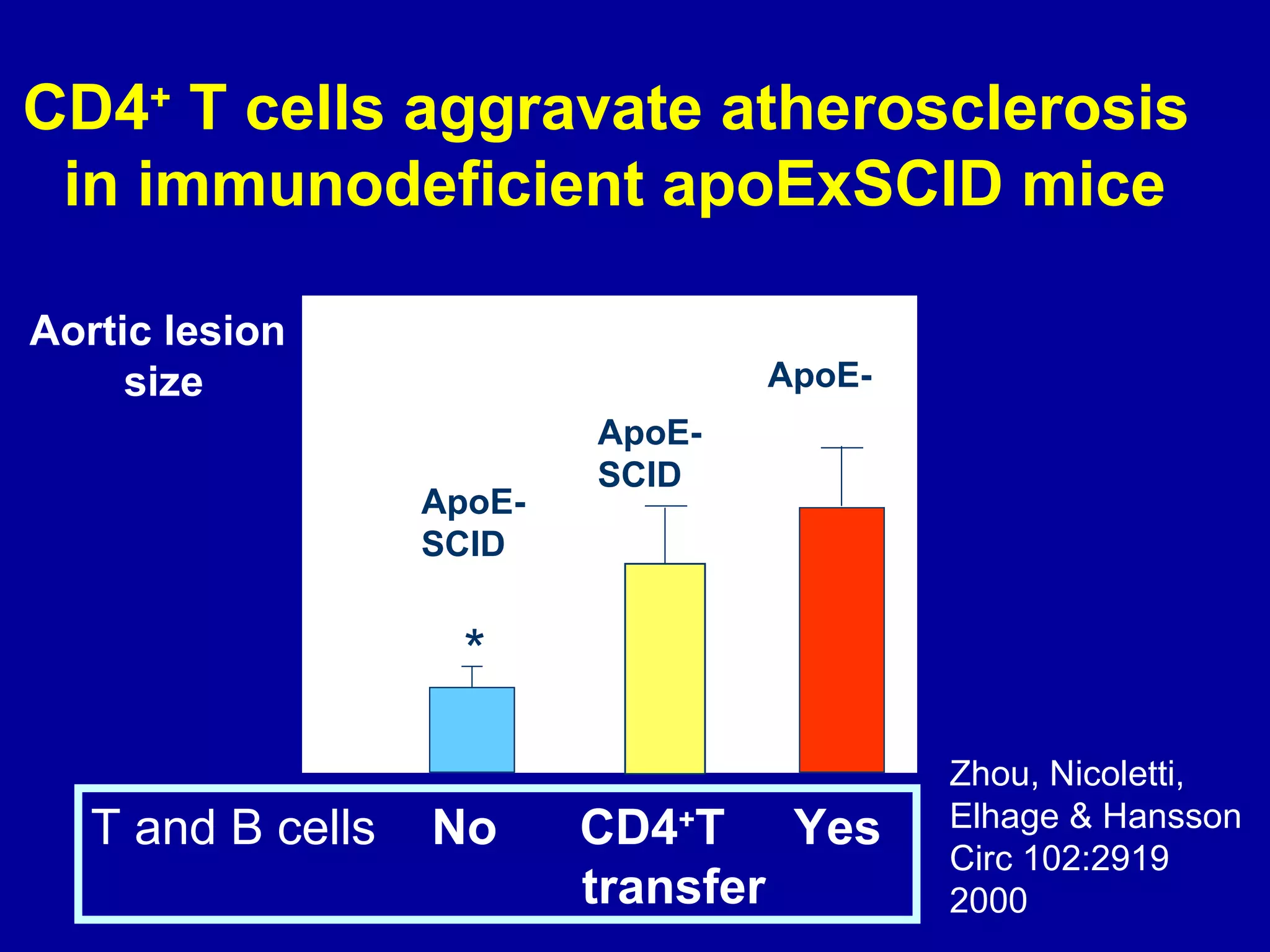
CD4+
T cells aggravate atherosclerosis
in immunodeficient apoExSCID mice
*
ApoE-
SCID
ApoE-
T and B cells No CD4+
T Yes
transfer
Aortic lesion
size
Zhou, Nicoletti,
Elhage & Hansson
Circ 102:2919
2000
ApoE-
SCID
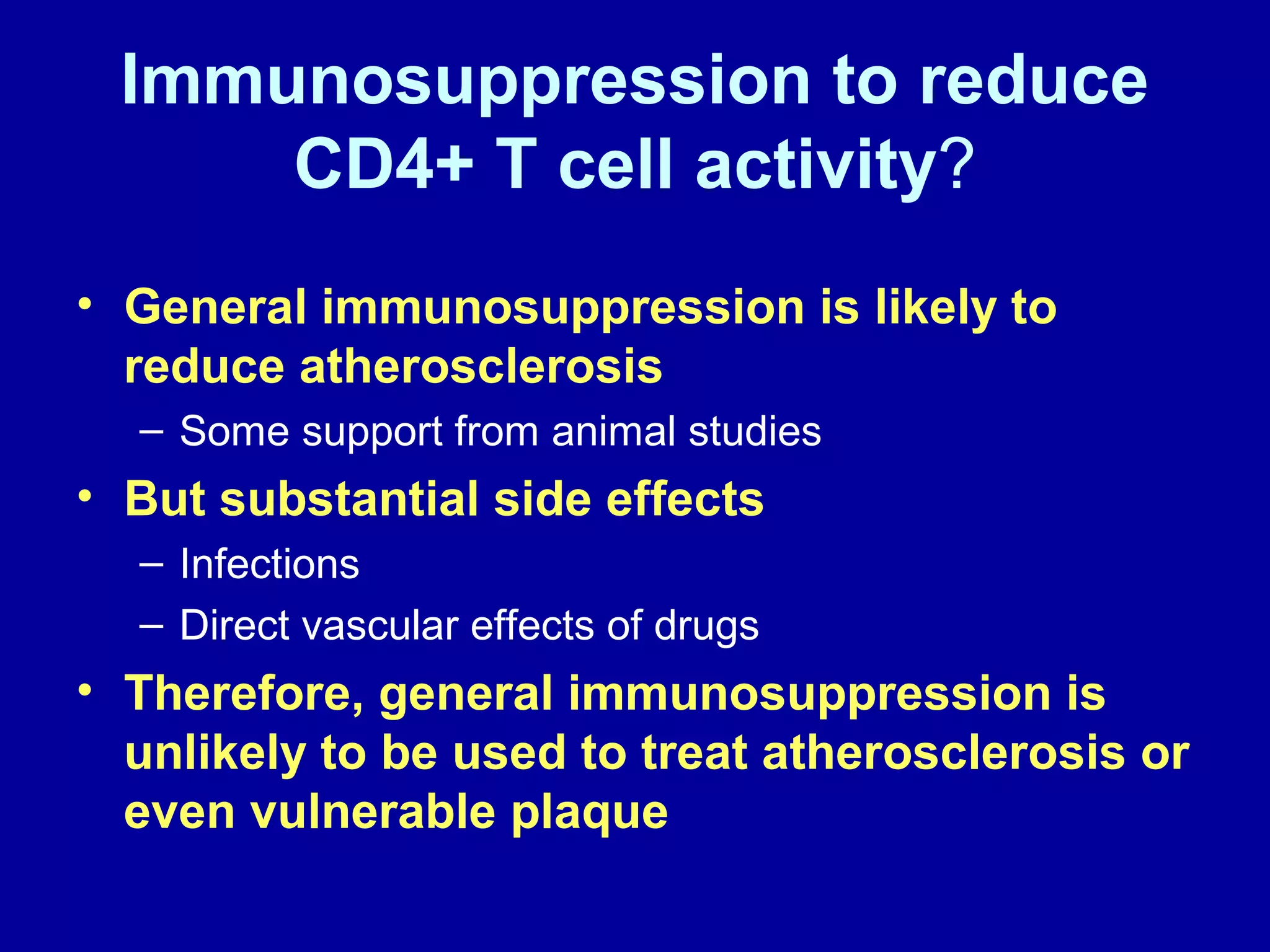
Immunosuppression to reduce
CD4+ T cell activity?
• General immunosuppression is likely to
reduce atherosclerosis
– Some support from animal studies
• But substantial side effects
– Infections
– Direct vascular effects of drugs
• Therefore, general immunosuppression is
unlikely to be used to treat atherosclerosis or
even vulnerable plaque
Complexity of immune
regulatory networks
• Counterbalancing cell subsets
• Idiotypic antibody networks
• Regulatory cytokines
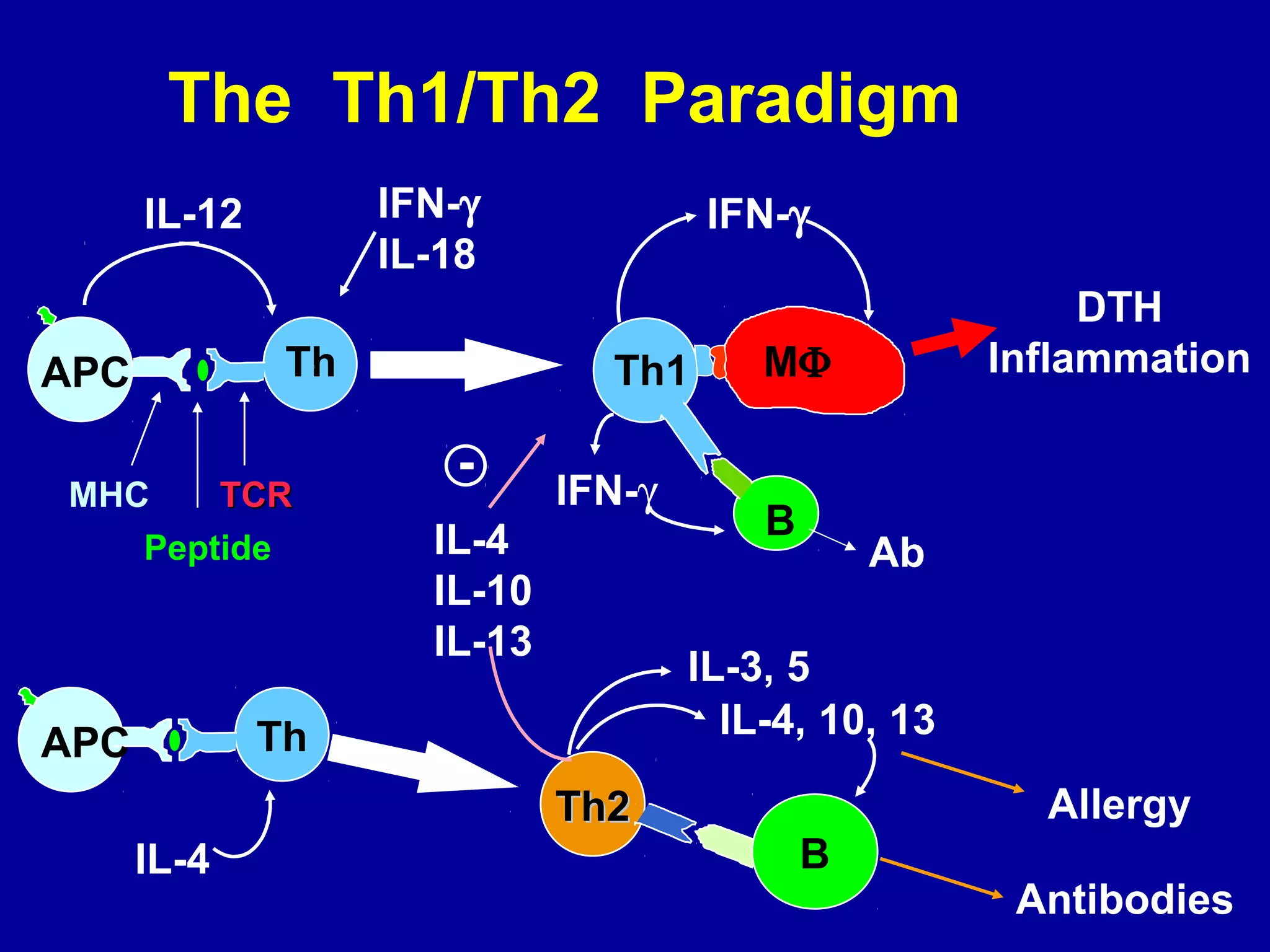
The Th1/Th2 Paradigm
Th
IL-12
MHC
Peptide
TCRTCR
IFN-γ
IL-18
Th1
IFN-γ
MΦ
IFN-γ
B
Ab
DTH
InflammationAPC
APC Th
IL-4
Th2Th2
B
IL-3, 5
IL-4
IL-10
IL-13
-
IL-4, 10, 13
Antibodies
Allergy
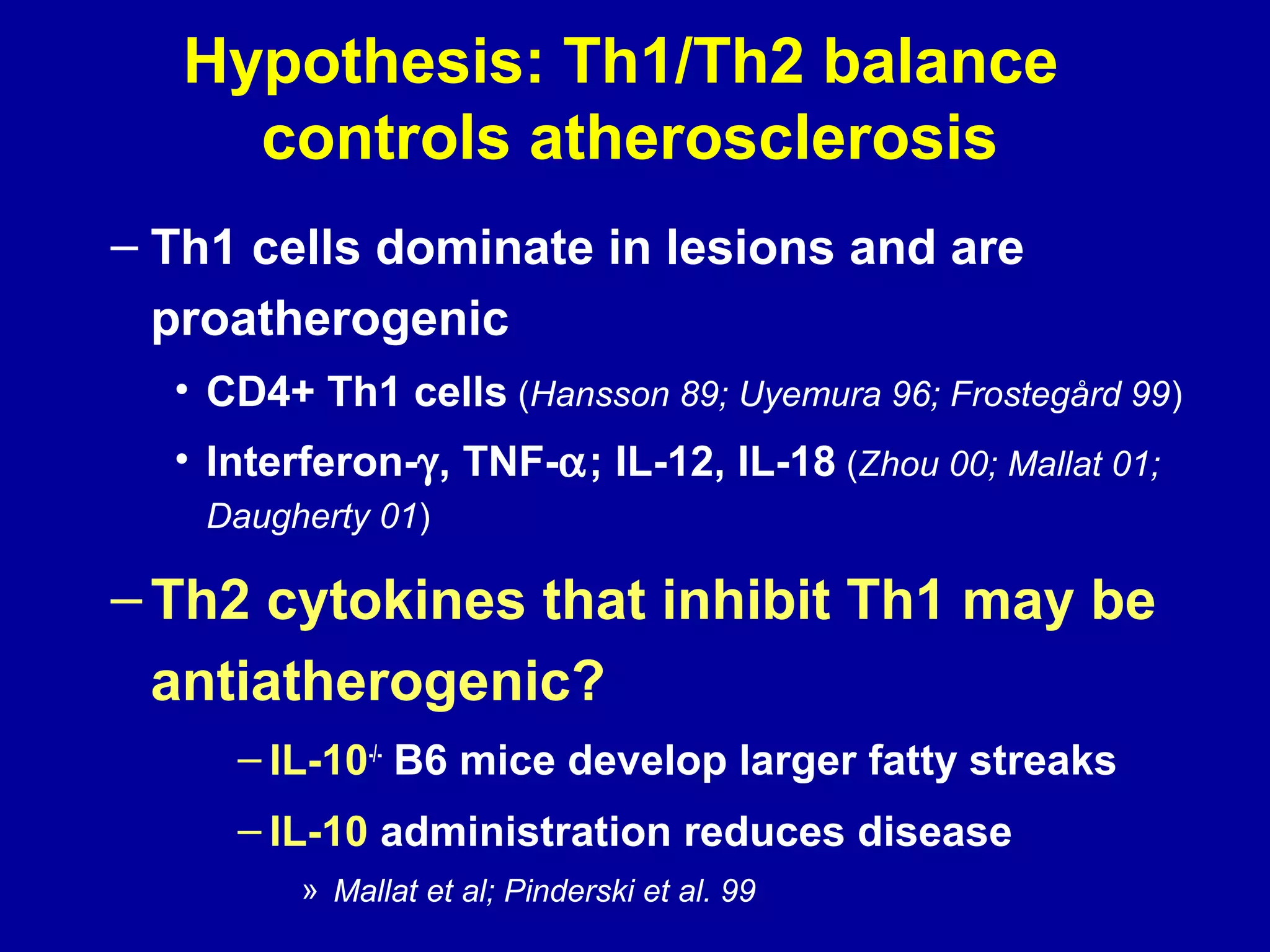
Hypothesis: Th1/Th2 balance
controls atherosclerosis
– Th1 cells dominate in lesions and are
proatherogenic
• CD4+ Th1 cells (Hansson 89; Uyemura 96; Frostegård 99)
• Interferon-γ, TNF-α; IL-12, IL-18 (Zhou 00; Mallat 01;
Daugherty 01)
–Th2 cytokines that inhibit Th1 may be
antiatherogenic?
– IL-10-/-
B6 mice develop larger fatty streaks
– IL-10 administration reduces disease
» Mallat et al; Pinderski et al. 99
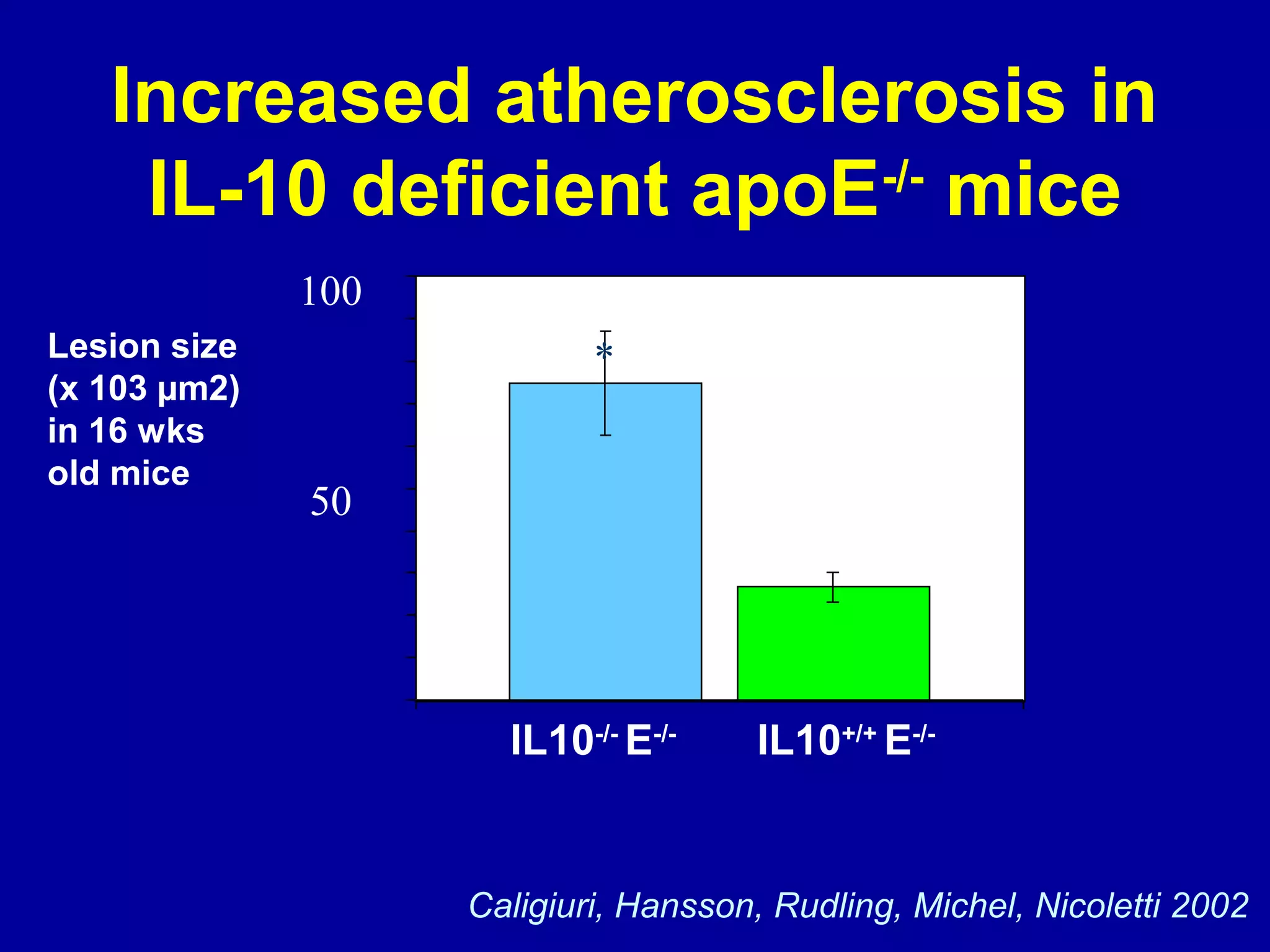
Increased atherosclerosis in
IL-10 deficient apoE-/-
mice
IL10-/-
E-/-
IL10+/+
E-/-
Caligiuri, Hansson, Rudling, Michel, Nicoletti 2002
*
100
50
Lesion size
(x 103 µm2)
in 16 wks
old mice
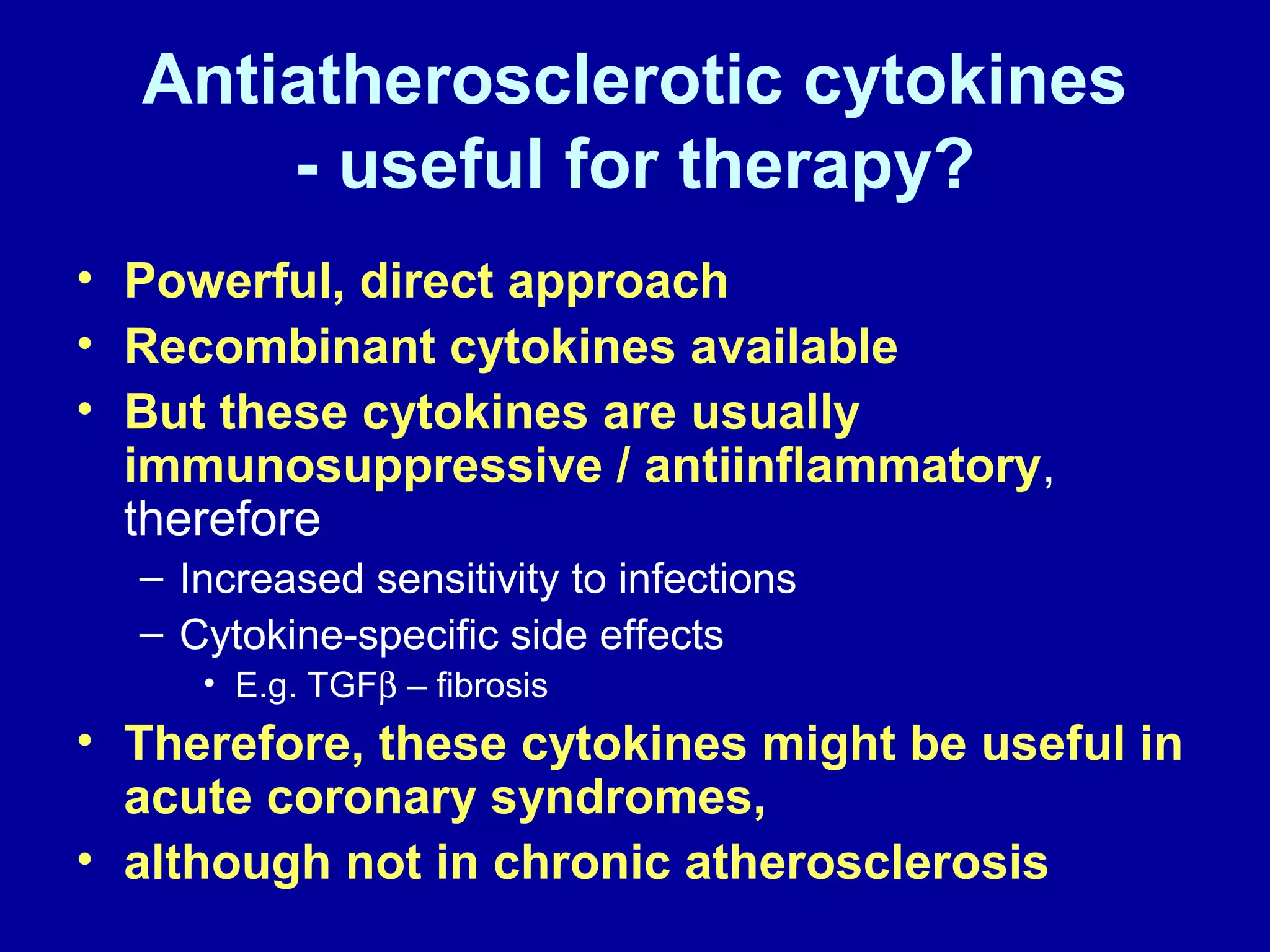
Antiatherosclerotic cytokines
- useful for therapy?
• Powerful, direct approach
• Recombinant cytokines available
• But these cytokines are usually
immunosuppressive / antiinflammatory,
therefore
– Increased sensitivity to infections
– Cytokine-specific side effects
• E.g. TGFβ – fibrosis
• Therefore, these cytokines might be useful in
acute coronary syndromes,
• although not in chronic atherosclerosis
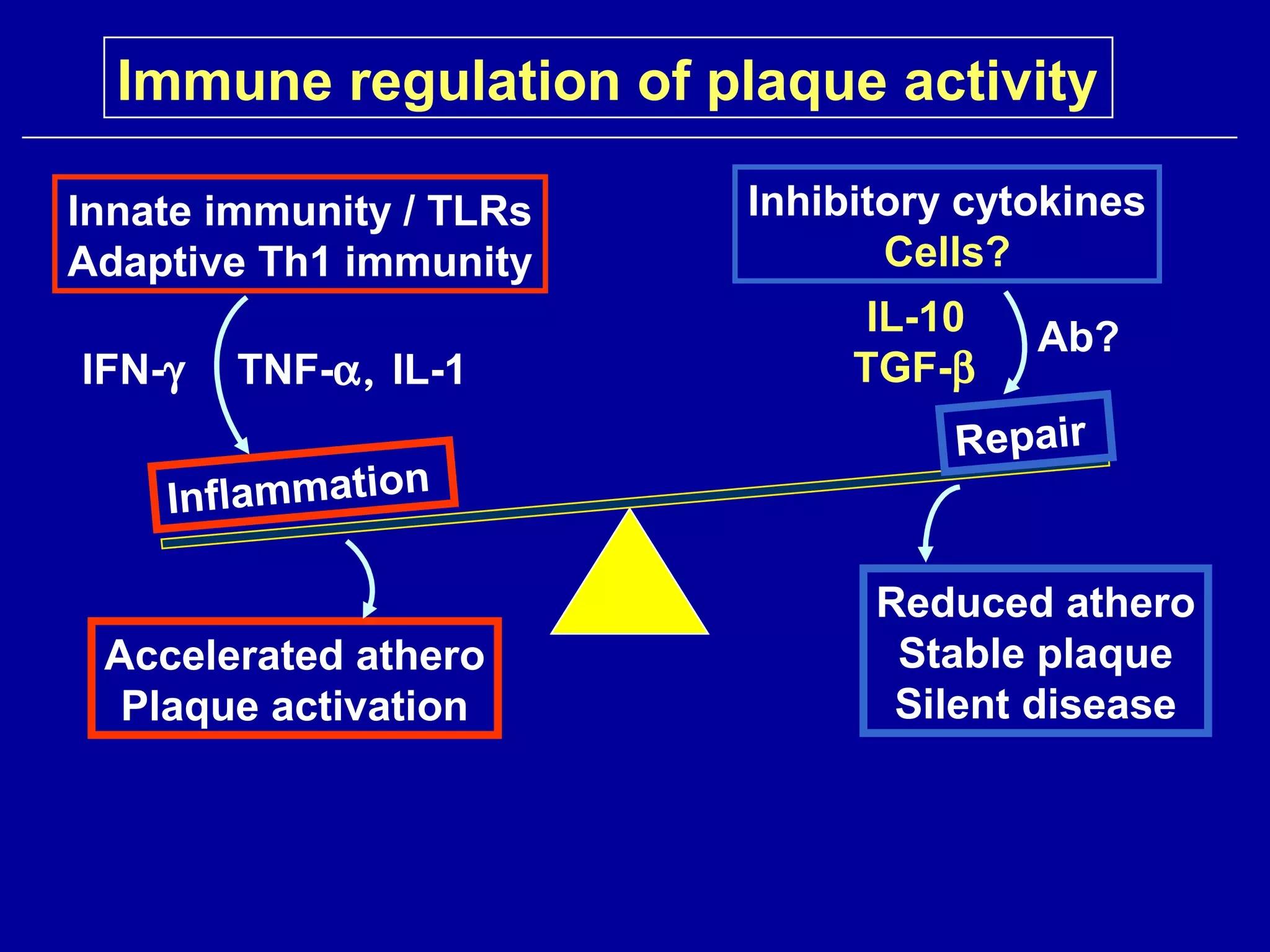
Inflammation
Repair
Innate immunity / TLRs
Adaptive Th1 immunity
IFN-γ TNF-α, IL-1
Inhibitory cytokines
Cells?
IL-10
TGF-β
Ab?
Accelerated athero
Plaque activation
Reduced athero
Stable plaque
Silent disease
Immune regulation of plaque activity
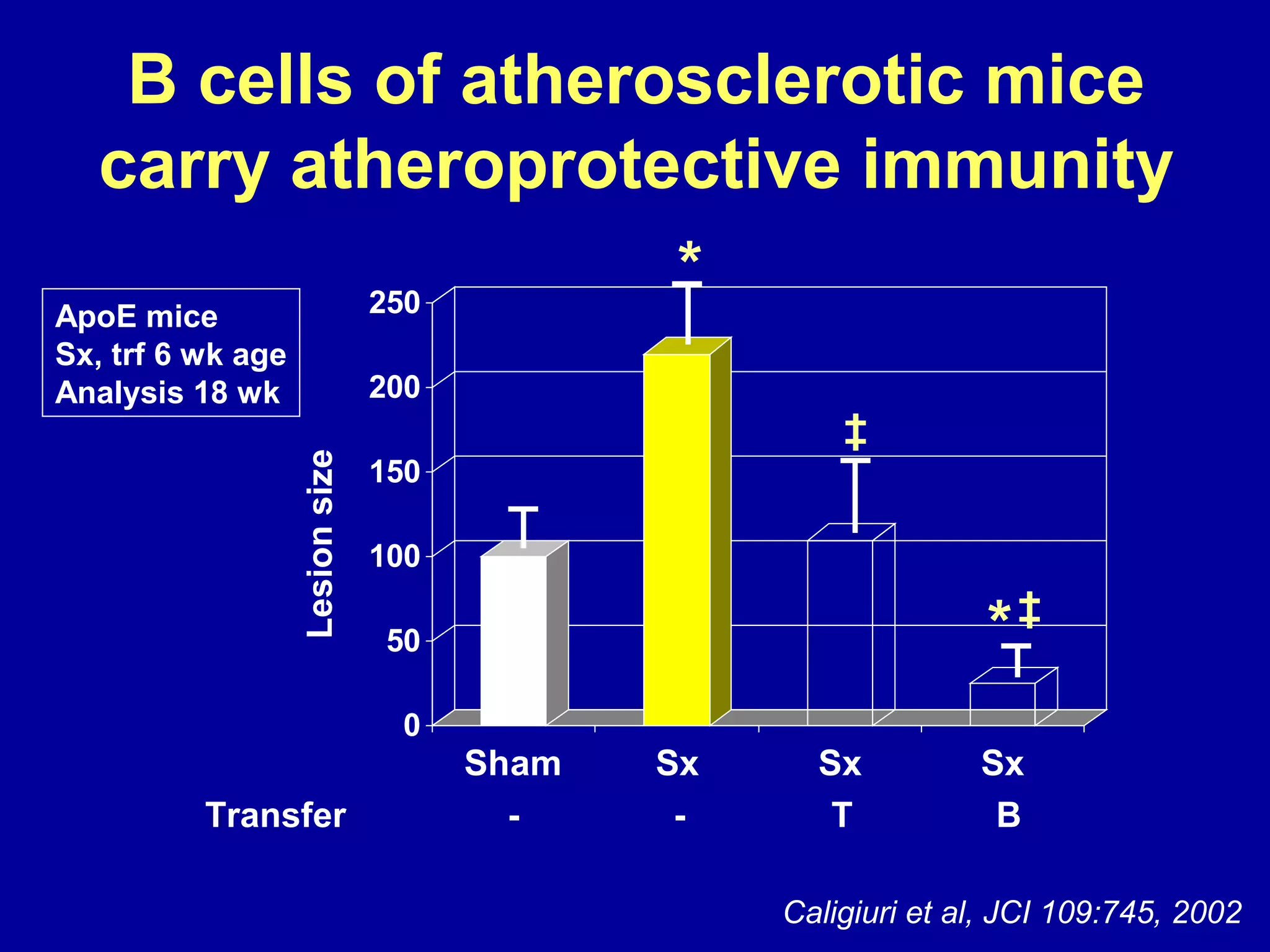
B cells of atherosclerotic mice
carry atheroprotective immunity
0
50
100
150
200
250
Sham Sx Sx Sx
Transfer - - T B
*
*
‡
‡
Lesionsize
Caligiuri et al, JCI 109:745, 2002
ApoE mice
Sx, trf 6 wk age
Analysis 18 wk
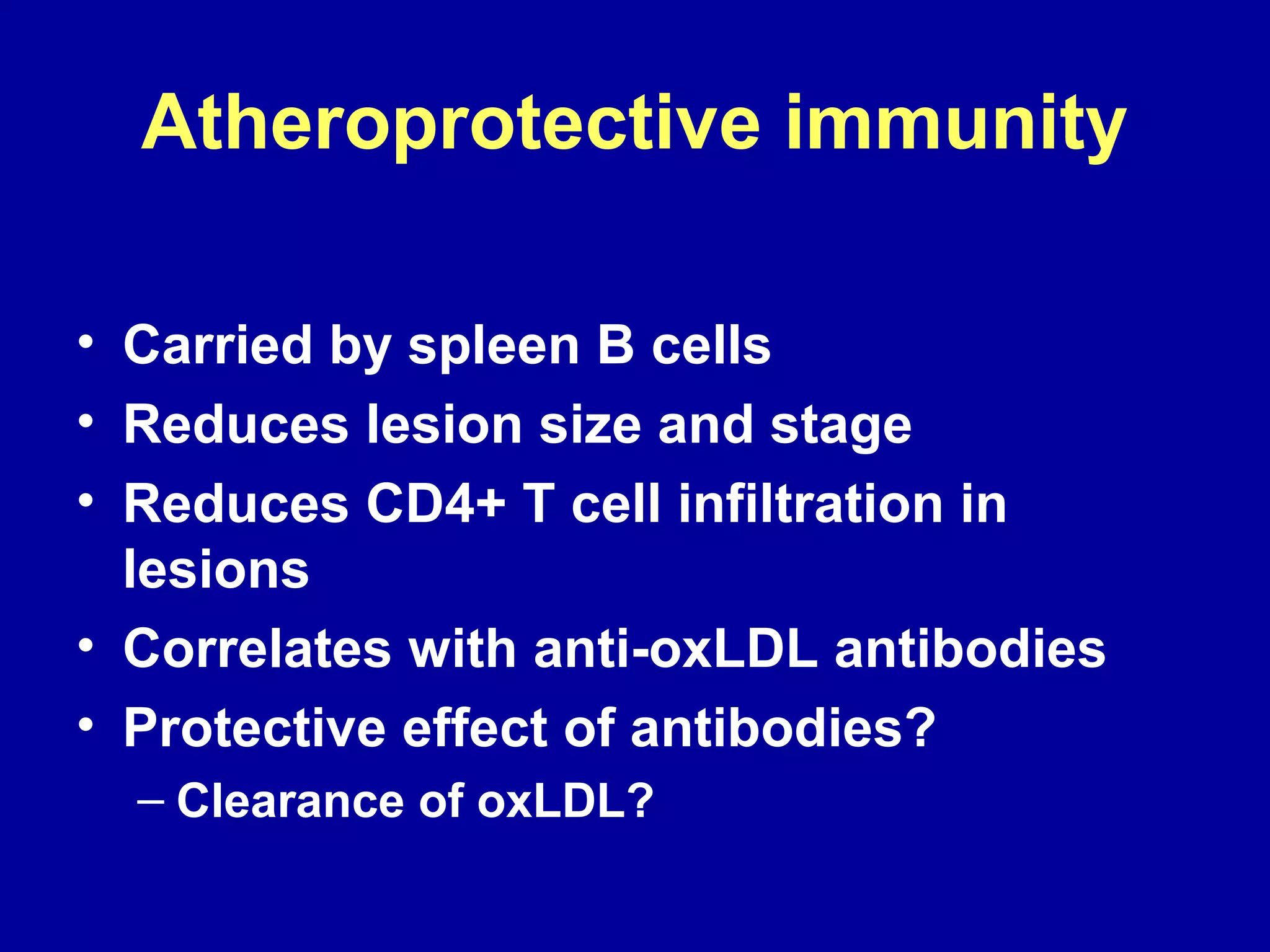
Atheroprotective immunity
• Carried by spleen B cells
• Reduces lesion size and stage
• Reduces CD4+ T cell infiltration in
lesions
• Correlates with anti-oxLDL antibodies
• Protective effect of antibodies?
– Clearance of oxLDL?
Protective immunity against
atherosclerosis
• Can we induce it by immunization?
• A vaccination strategy
against atherosclerosis?
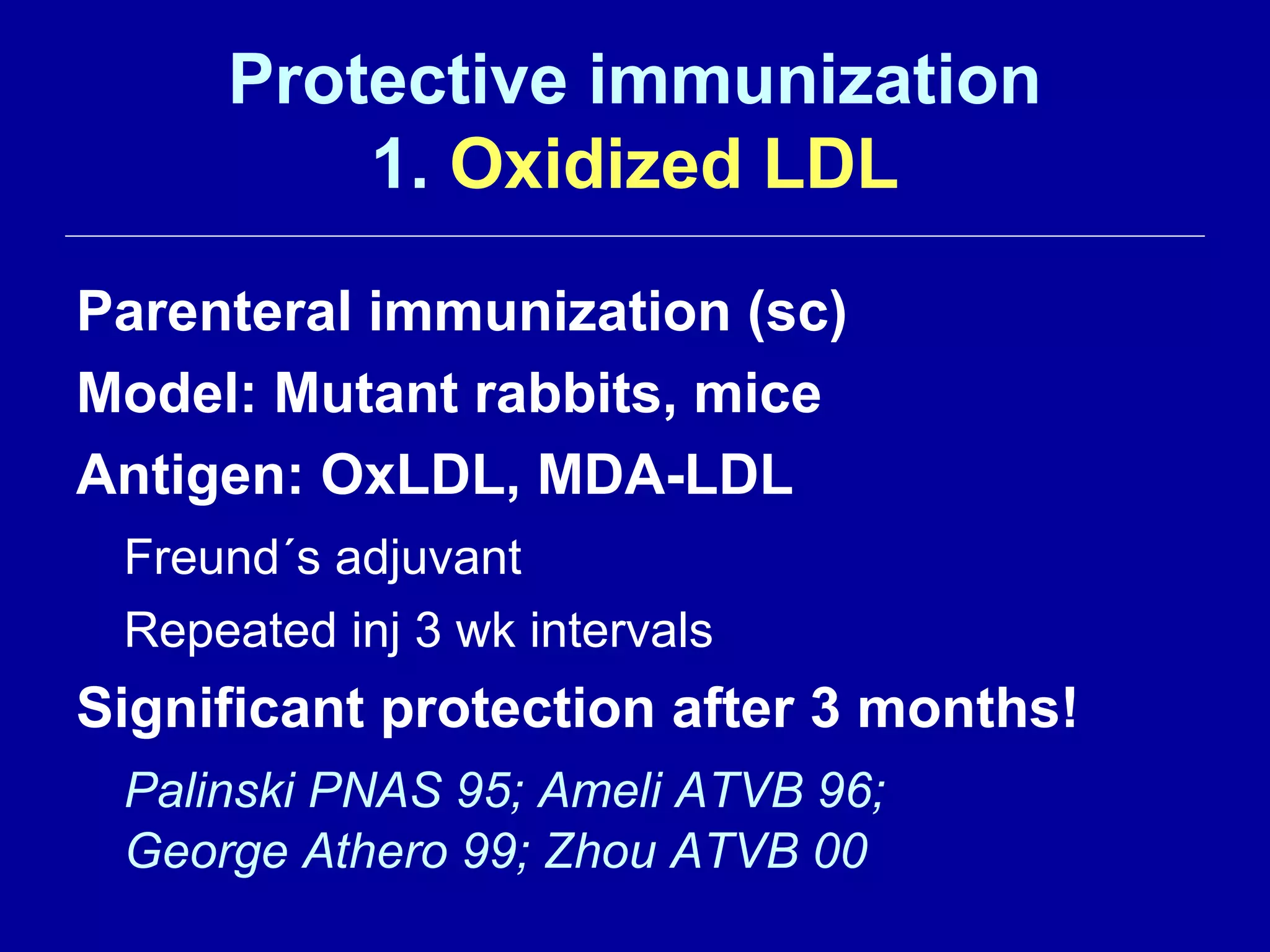
Protective immunization
1. Oxidized LDL
Parenteral immunization (sc)
Model: Mutant rabbits, mice
Antigen: OxLDL, MDA-LDL
Freund´s adjuvant
Repeated inj 3 wk intervals
Significant protection after 3 months!
Palinski PNAS 95; Ameli ATVB 96;
George Athero 99; Zhou ATVB 00
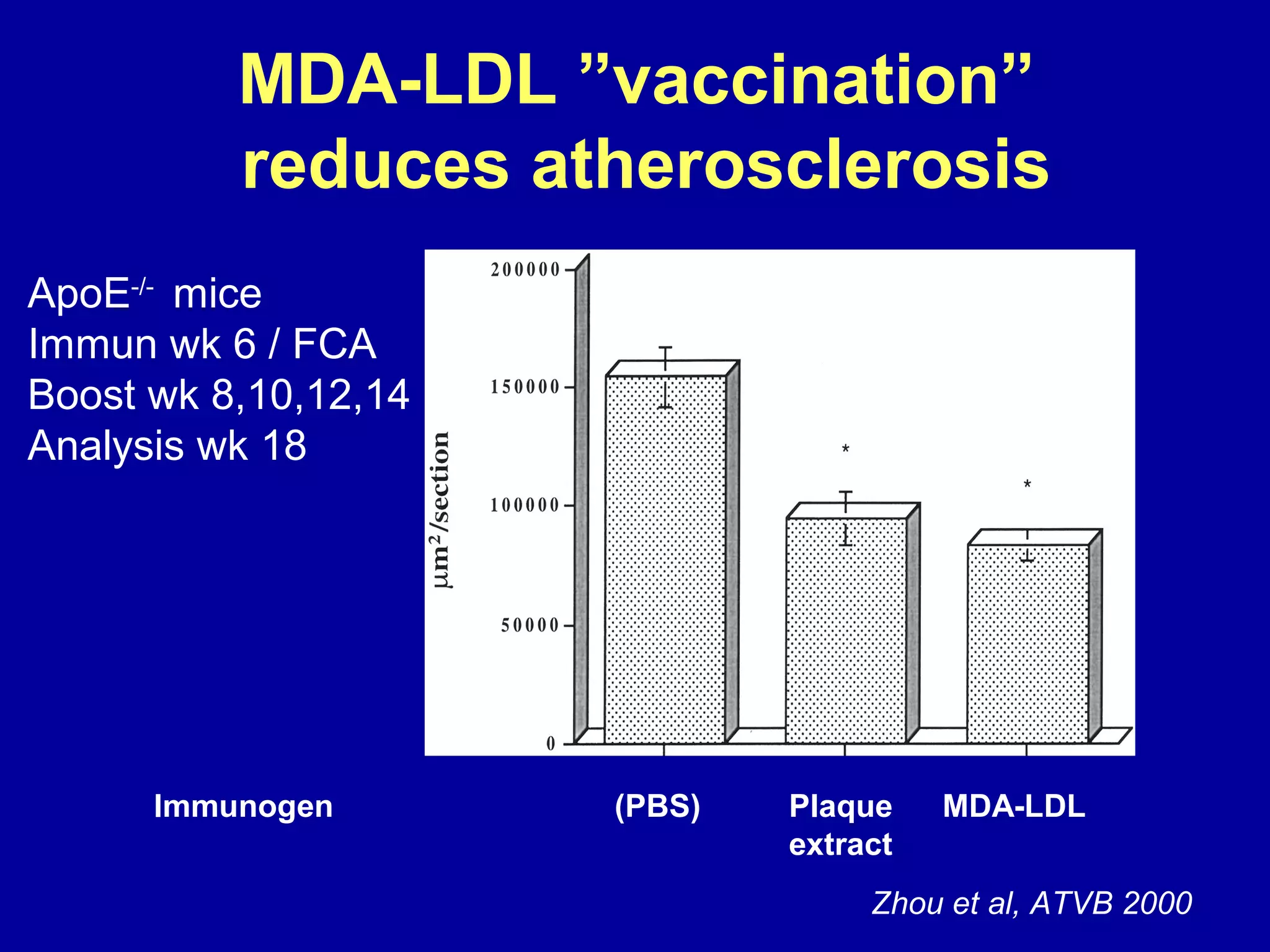
MDA-LDL ”vaccination”
reduces atherosclerosis
Immunogen (PBS) Plaque MDA-LDL
extract
ApoE-/-
mice
Immun wk 6 / FCA
Boost wk 8,10,12,14
Analysis wk 18
Zhou et al, ATVB 2000
Protective immunization
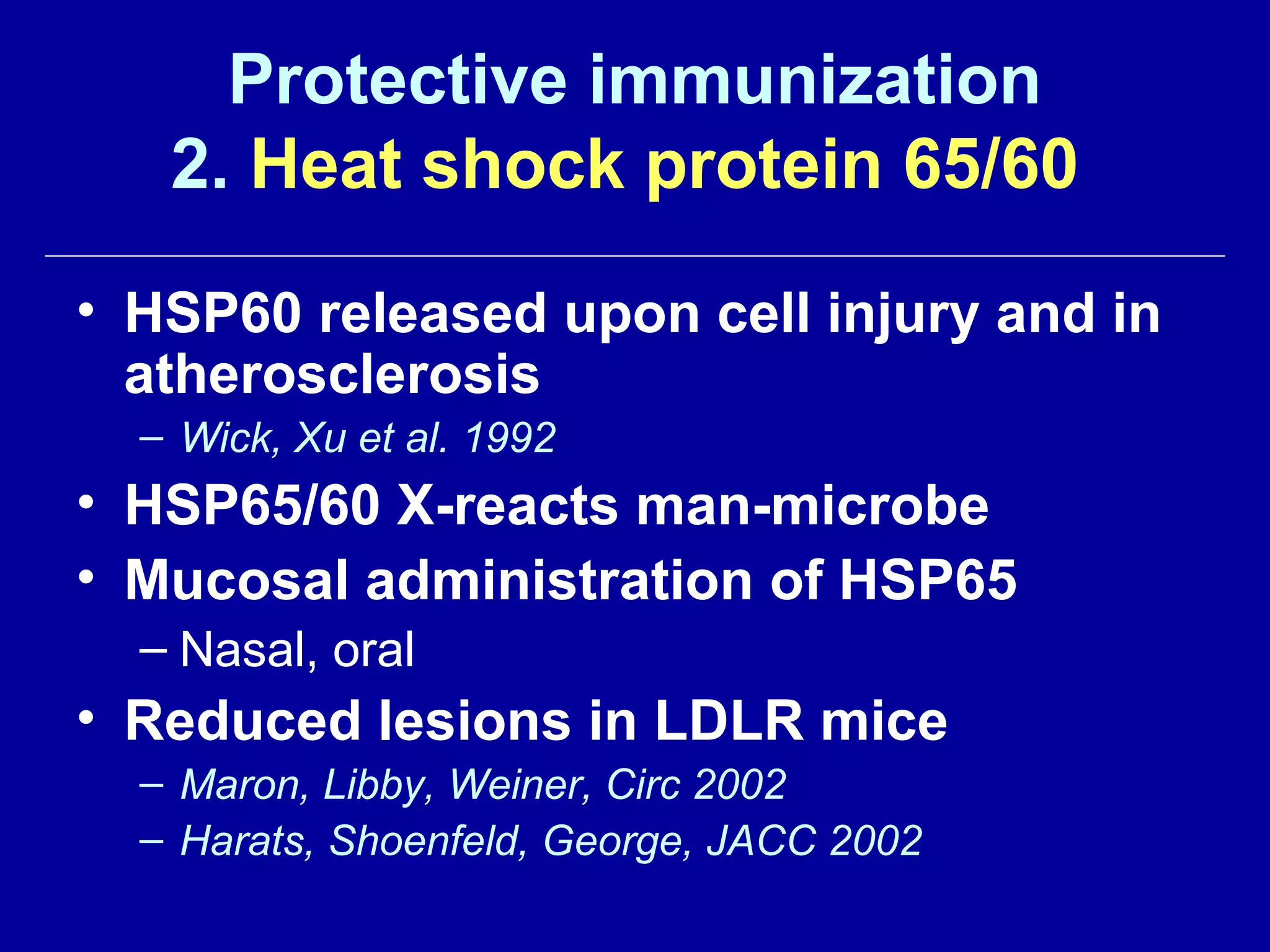
2. Heat shock protein 65/60
• HSP60 released upon cell injury and in
atherosclerosis
– Wick, Xu et al. 1992
• HSP65/60 X-reacts man-microbe
• Mucosal administration of HSP65
– Nasal, oral
• Reduced lesions in LDLR mice
– Maron, Libby, Weiner, Circ 2002
– Harats, Shoenfeld, George, JACC 2002
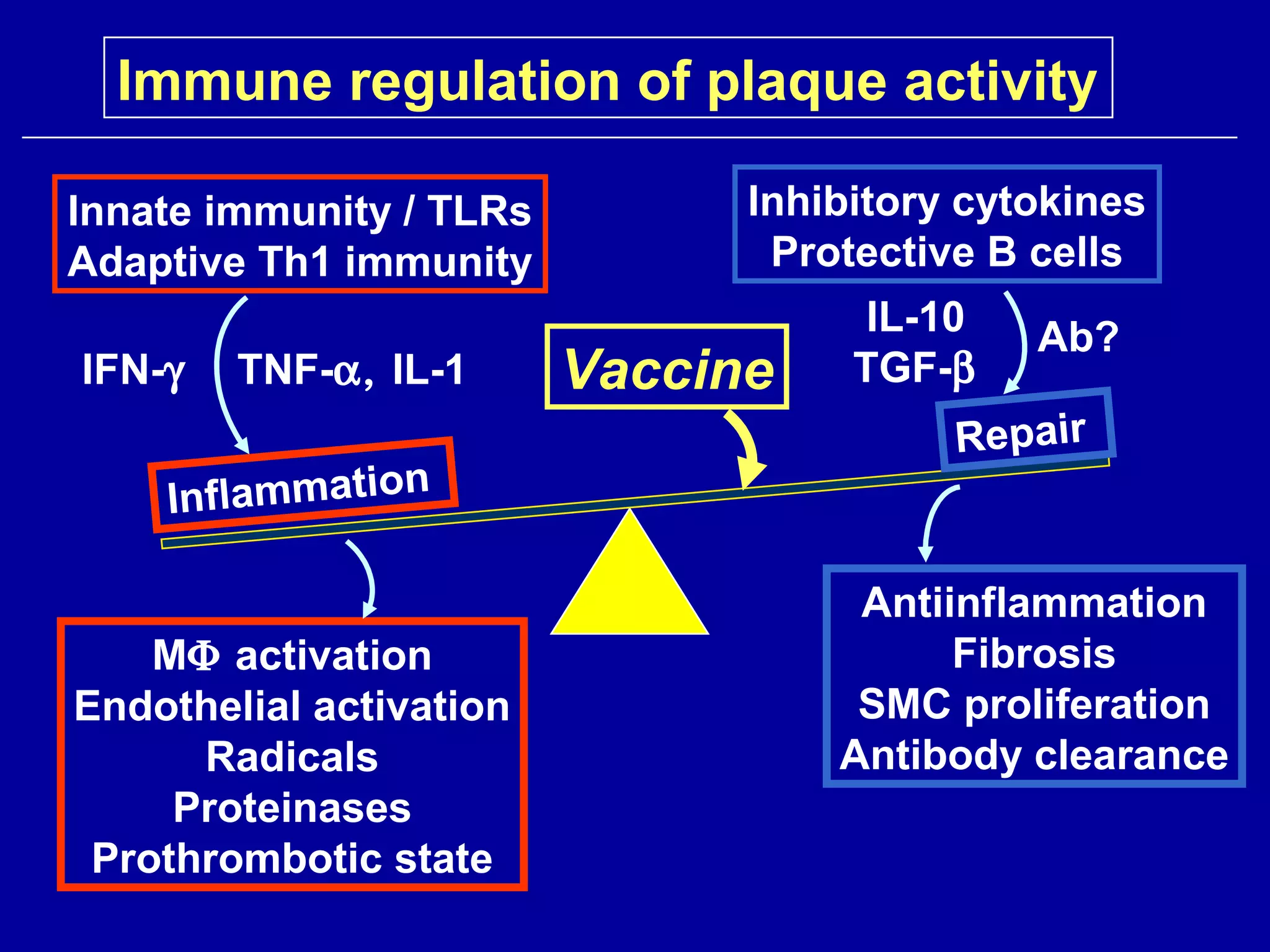
Inflammation
Repair
Innate immunity / TLRs
Adaptive Th1 immunity
IFN-γ TNF-α, IL-1
Inhibitory cytokines
Protective B cells
IL-10
TGF-β
Ab?
MΦ activation
Endothelial activation
Radicals
Proteinases
Prothrombotic state
Antiinflammation
Fibrosis
SMC proliferation
Antibody clearance
Immune regulation of plaque activity
Vaccine
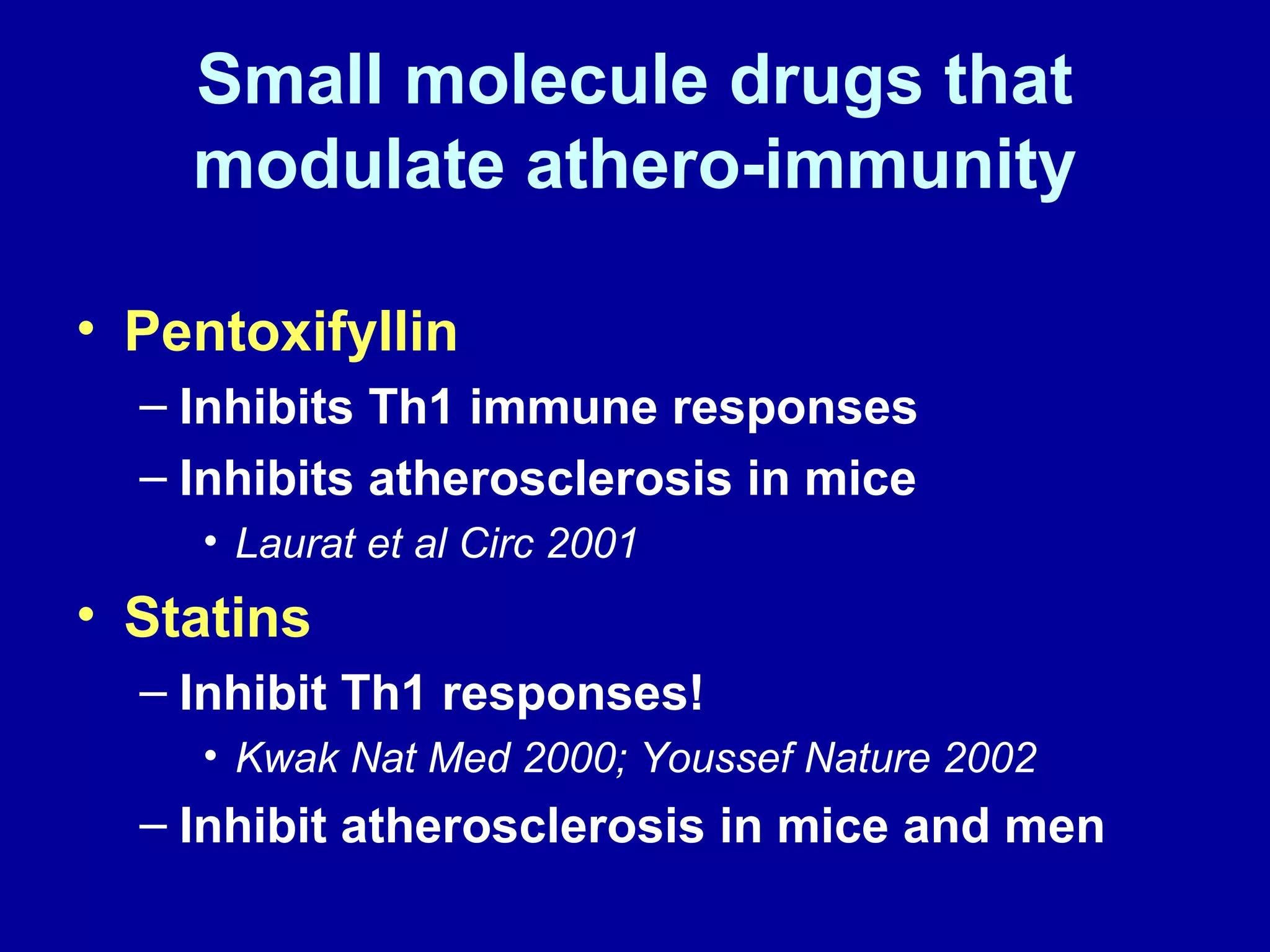
Small molecule drugs that
modulate athero-immunity
• Pentoxifyllin
– Inhibits Th1 immune responses
– Inhibits atherosclerosis in mice
• Laurat et al Circ 2001
• Statins
– Inhibit Th1 responses!
• Kwak Nat Med 2000; Youssef Nature 2002
– Inhibit atherosclerosis in mice and men
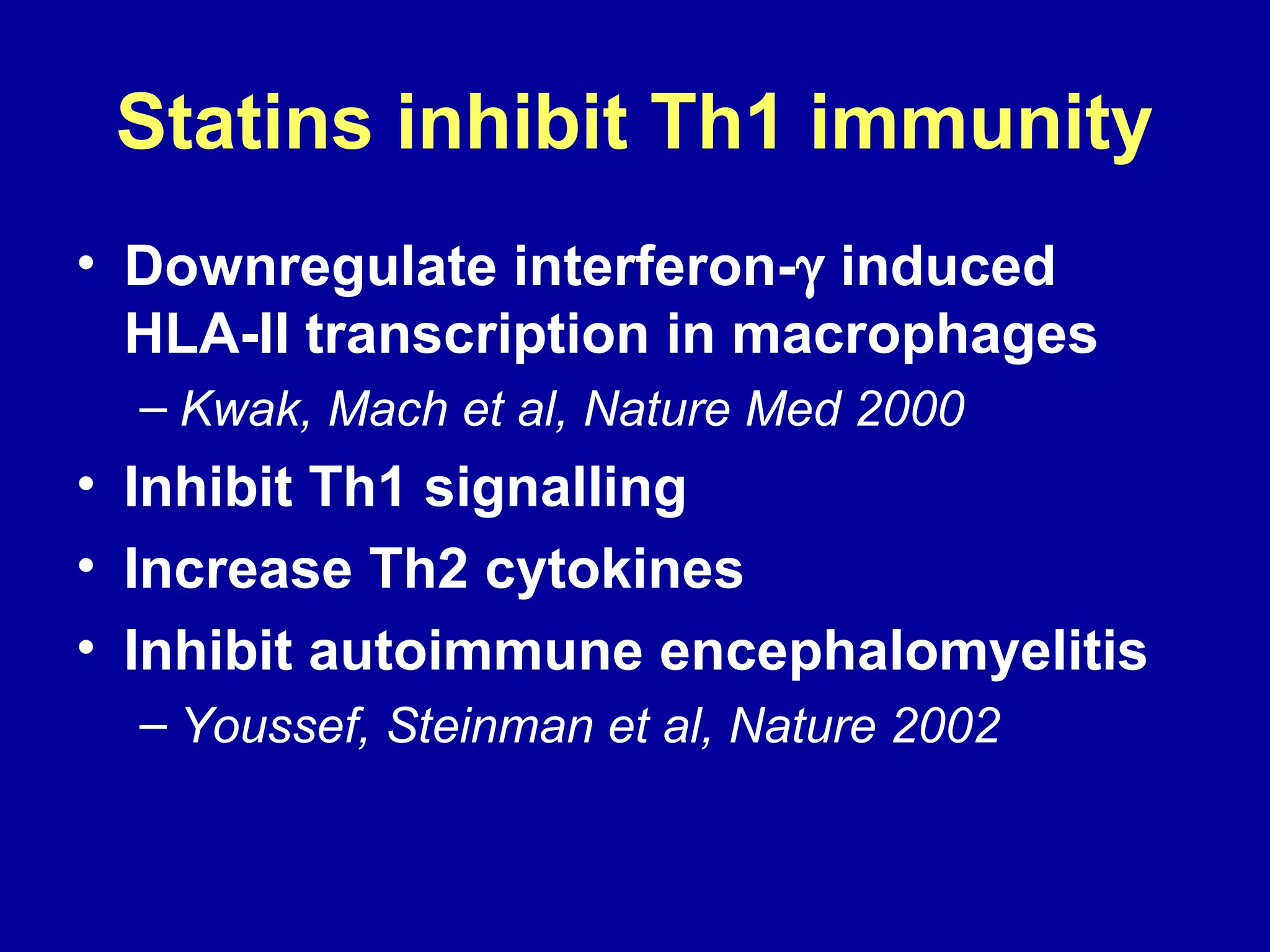
Statins inhibit Th1 immunity
• Downregulate interferon-γ induced
HLA-II transcription in macrophages
– Kwak, Mach et al, Nature Med 2000
• Inhibit Th1 signalling
• Increase Th2 cytokines
• Inhibit autoimmune encephalomyelitis
– Youssef, Steinman et al, Nature 2002
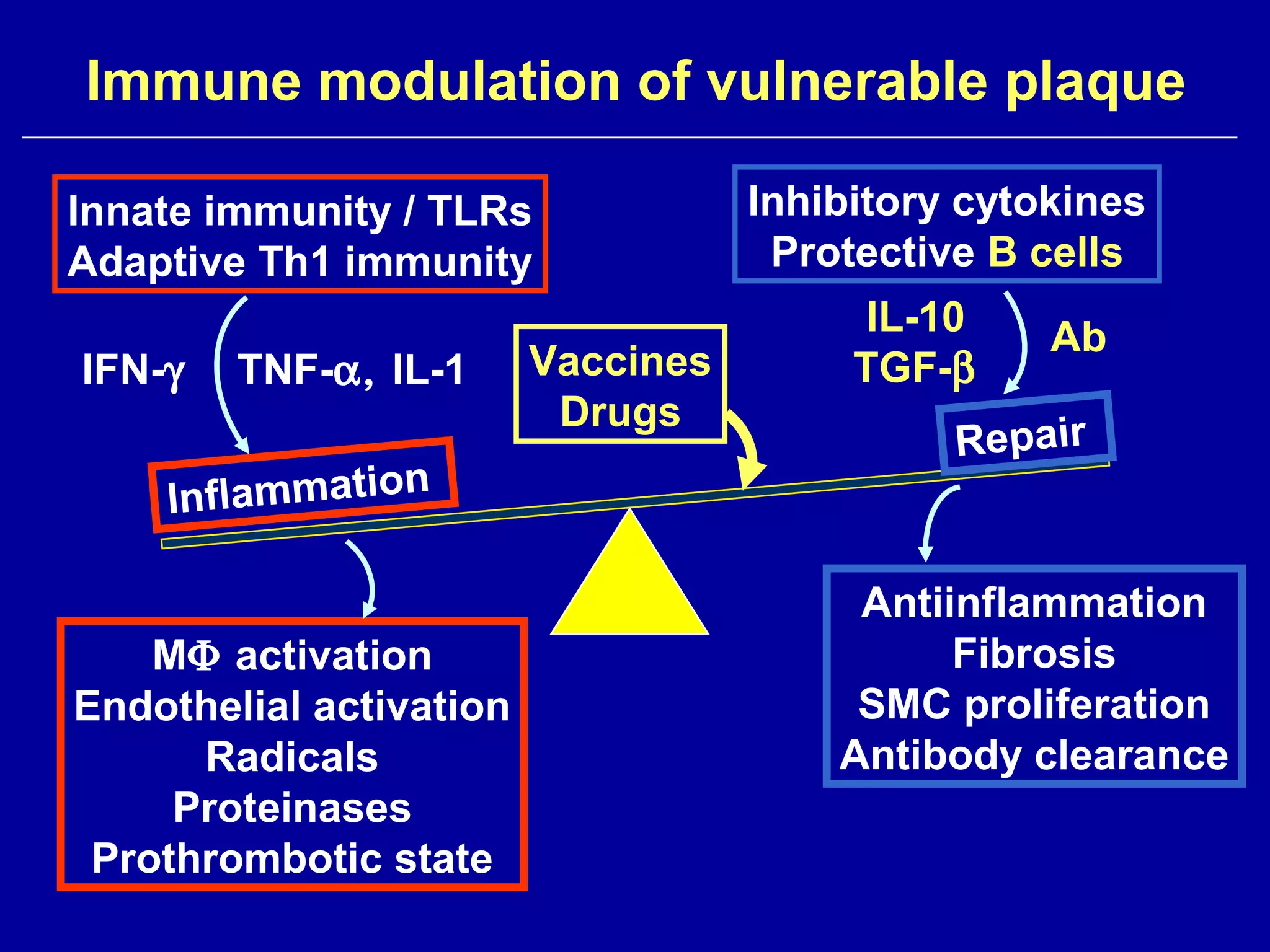
Inflammation
Repair
Innate immunity / TLRs
Adaptive Th1 immunity
IFN-γ TNF-α, IL-1
Inhibitory cytokines
Protective B cells
IL-10
TGF-β
Ab
MΦ activation
Endothelial activation
Radicals
Proteinases
Prothrombotic state
Antiinflammation
Fibrosis
SMC proliferation
Antibody clearance
Immune modulation of vulnerable plaque
Vaccines
Drugs

075 immune modulation

  • 1.
    Towards Immune Modulation againstVulnerable Plaque Göran K Hansson Center for Molecular Medicine Karolinska Institutet Stockholm, Sweden Vulnerable Plaque Symposium Chicago, IL, November 2002
  • 2.
    Hansson, Libby, Schönbeck& Yan, Circ Res 2002
  • 3.
    Potential targets for immunomodulationof atherosclerosis • Specific antigens – oxLDL, HSP65, β2GpI, microbial • C pneum, CMV, others • Co-stimulatory molecules – CD40/CD40L, CD28/B7 • Cytokines – IFNγ, TNFα (aggravating) – IL-10, TGFβ (protective) • Vaccines • Recombinant proteins • Antibodies • Cells • Small molecule drugs
  • 4.
    Atherosclerosis in theabsence of adaptive immunity? (G K Hansson & J Nilsson, in: Crawford & DiMarco, Cardiology)
  • 5.
    CD4+ T cells aggravateatherosclerosis in immunodeficient apoExSCID mice * ApoE- SCID ApoE- T and B cells No CD4+ T Yes transfer Aortic lesion size Zhou, Nicoletti, Elhage & Hansson Circ 102:2919 2000 ApoE- SCID
  • 6.
    Immunosuppression to reduce CD4+T cell activity? • General immunosuppression is likely to reduce atherosclerosis – Some support from animal studies • But substantial side effects – Infections – Direct vascular effects of drugs • Therefore, general immunosuppression is unlikely to be used to treat atherosclerosis or even vulnerable plaque
  • 7.
    Complexity of immune regulatorynetworks • Counterbalancing cell subsets • Idiotypic antibody networks • Regulatory cytokines
  • 8.
    The Th1/Th2 Paradigm Th IL-12 MHC Peptide TCRTCR IFN-γ IL-18 Th1 IFN-γ MΦ IFN-γ B Ab DTH InflammationAPC APCTh IL-4 Th2Th2 B IL-3, 5 IL-4 IL-10 IL-13 - IL-4, 10, 13 Antibodies Allergy
  • 9.
    Hypothesis: Th1/Th2 balance controlsatherosclerosis – Th1 cells dominate in lesions and are proatherogenic • CD4+ Th1 cells (Hansson 89; Uyemura 96; Frostegård 99) • Interferon-γ, TNF-α; IL-12, IL-18 (Zhou 00; Mallat 01; Daugherty 01) –Th2 cytokines that inhibit Th1 may be antiatherogenic? – IL-10-/- B6 mice develop larger fatty streaks – IL-10 administration reduces disease » Mallat et al; Pinderski et al. 99
  • 10.
    Increased atherosclerosis in IL-10deficient apoE-/- mice IL10-/- E-/- IL10+/+ E-/- Caligiuri, Hansson, Rudling, Michel, Nicoletti 2002 * 100 50 Lesion size (x 103 µm2) in 16 wks old mice
  • 11.
    Antiatherosclerotic cytokines - usefulfor therapy? • Powerful, direct approach • Recombinant cytokines available • But these cytokines are usually immunosuppressive / antiinflammatory, therefore – Increased sensitivity to infections – Cytokine-specific side effects • E.g. TGFβ – fibrosis • Therefore, these cytokines might be useful in acute coronary syndromes, • although not in chronic atherosclerosis
  • 12.
    Inflammation Repair Innate immunity /TLRs Adaptive Th1 immunity IFN-γ TNF-α, IL-1 Inhibitory cytokines Cells? IL-10 TGF-β Ab? Accelerated athero Plaque activation Reduced athero Stable plaque Silent disease Immune regulation of plaque activity
  • 13.
    B cells ofatherosclerotic mice carry atheroprotective immunity 0 50 100 150 200 250 Sham Sx Sx Sx Transfer - - T B * * ‡ ‡ Lesionsize Caligiuri et al, JCI 109:745, 2002 ApoE mice Sx, trf 6 wk age Analysis 18 wk
  • 14.
    Atheroprotective immunity • Carriedby spleen B cells • Reduces lesion size and stage • Reduces CD4+ T cell infiltration in lesions • Correlates with anti-oxLDL antibodies • Protective effect of antibodies? – Clearance of oxLDL?
  • 15.
    Protective immunity against atherosclerosis •Can we induce it by immunization? • A vaccination strategy against atherosclerosis?
  • 16.
    Protective immunization 1. OxidizedLDL Parenteral immunization (sc) Model: Mutant rabbits, mice Antigen: OxLDL, MDA-LDL Freund´s adjuvant Repeated inj 3 wk intervals Significant protection after 3 months! Palinski PNAS 95; Ameli ATVB 96; George Athero 99; Zhou ATVB 00
  • 17.
    MDA-LDL ”vaccination” reduces atherosclerosis Immunogen(PBS) Plaque MDA-LDL extract ApoE-/- mice Immun wk 6 / FCA Boost wk 8,10,12,14 Analysis wk 18 Zhou et al, ATVB 2000
  • 18.
    Protective immunization 2. Heatshock protein 65/60 • HSP60 released upon cell injury and in atherosclerosis – Wick, Xu et al. 1992 • HSP65/60 X-reacts man-microbe • Mucosal administration of HSP65 – Nasal, oral • Reduced lesions in LDLR mice – Maron, Libby, Weiner, Circ 2002 – Harats, Shoenfeld, George, JACC 2002
  • 19.
    Inflammation Repair Innate immunity /TLRs Adaptive Th1 immunity IFN-γ TNF-α, IL-1 Inhibitory cytokines Protective B cells IL-10 TGF-β Ab? MΦ activation Endothelial activation Radicals Proteinases Prothrombotic state Antiinflammation Fibrosis SMC proliferation Antibody clearance Immune regulation of plaque activity Vaccine
  • 20.
    Small molecule drugsthat modulate athero-immunity • Pentoxifyllin – Inhibits Th1 immune responses – Inhibits atherosclerosis in mice • Laurat et al Circ 2001 • Statins – Inhibit Th1 responses! • Kwak Nat Med 2000; Youssef Nature 2002 – Inhibit atherosclerosis in mice and men
  • 21.
    Statins inhibit Th1immunity • Downregulate interferon-γ induced HLA-II transcription in macrophages – Kwak, Mach et al, Nature Med 2000 • Inhibit Th1 signalling • Increase Th2 cytokines • Inhibit autoimmune encephalomyelitis – Youssef, Steinman et al, Nature 2002
  • 22.
    Inflammation Repair Innate immunity /TLRs Adaptive Th1 immunity IFN-γ TNF-α, IL-1 Inhibitory cytokines Protective B cells IL-10 TGF-β Ab MΦ activation Endothelial activation Radicals Proteinases Prothrombotic state Antiinflammation Fibrosis SMC proliferation Antibody clearance Immune modulation of vulnerable plaque Vaccines Drugs