Blood Physiology Carolina C. Jerez, MD Dept. of Physiology
 
Stages in Hematopoiesis Mesoblastic phase Yolk sac Blood islands near the aorta
Hematopoiesis Hepatic stage : continue untll birth ; by the third month the peak for both eryhropoiesis and granulopoiesis will be reached Splenic activity also starts here The thymus is the first organ of the lymphatic system to develop fully in the fetus; continue to enlarge until childhood
The medullary phase Medullary production starts with the ossification and development of the marrow within the core of the bone Clavicle first to demonstrate marrow hematopoietic activity By the 6 th  month the marrow become the primary site of hematopoiesis Measurable products : various stages of maturation of all cell lines;EPO; fetal Hgb ;adult Hgb
The hematopoietic microenvironment A carbon dioxide atmosphere Wet sticky surface where the cells anchor Normal population of red marrow cells  necessary for interaction Provides the growth factors, cytokines and extracellular matrix which helpregulate hematopoiesis
The Liver Synthesizing and providing transport proteins;storing essential minerals and vitamins utilized in DNA and RNA synthesis, conjugating bilirubin from hemoglobin degradation, transporting the bilirubin to the small intestine
The SPLEEN The largest lymphoid organ in the body It is vital but not essential for life There are three zones The white pulp > the red pulp The marginal zone  Splenomegaly is observed in various diseases like ; chronic leukemias, genetically defective RBC, HGB, thalassemias, malaria
Lymph Nodes Formation of new lymphocytes from the germinal centers Processing of specific immunoglobulin Filtration of particulate matter, debris, bacteria entering the lymph nodes
The Thymus Has 2 portions > the cortex; waiting zone; densely populated by lymphocytes from the bone marrow  with no surface markers The medulla : holding zone; contains 5% mature T lymphocytes,
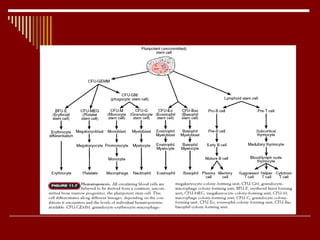
The stem cell theory @ types of Stem cells :  > undifferentiated or pluripotent or totipotent cells : capable of self renewal, and differentiation to progenitor cells committed to either lymphoid or myeloid lineage > progenitor cells : give rise to recognizable lineage –specific recursor cells; called CFU1 or CFU-GEMM
 
Cytokines Diverse group of soluble proteins which modulates the functional activities of the cell Most are glycoproteins and include the interleukins, lymphokines, monokines, interferrons, chemokines, CSF, Responsible for trafficking of mature blood cells( stimulation, inhibition, production, differentiation ) > prevents apoptosis
 
Erythrocyte production and destruction Erythron : all stages of the red cell in designated areas of the body( bone marrow, circulating red cells, vascular spaces within the specific organs Erythropoietin : thermostable, nondialyzable glycoprotein which has A. CHO unit which conveys specificity B. terminal sialic acid for its biologic activity in vivo
Functions of erythropoietin Regulates the 3 reduction division  of normoblastic production Shortens the time of division maturation process Increases the rate of the pentose phosphate shunt Assists in the egression of the mature red cell Stimulates the early release of shift reticulocyte Increases the rate of hemoglobin syntheis
Factors stimulating EPO release Hypoxia or decrease in oxygen tension Testosterone EPO can be measured by immunoassay Plasma values : 3-8 mU /ml to maintain steady erythropoiesis 2000-3000 mU/ml is necessary to compensate a severe hemolytic process or blood loss
Anti=erythropoietin antibodiess Type 1 : neutralizes the biological activity of EPO Type !! Causes hemagglutination
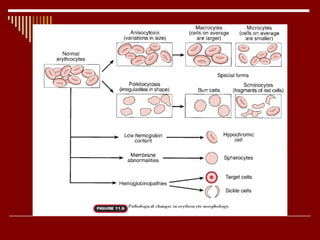
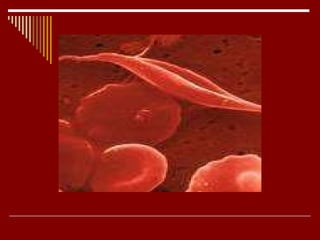
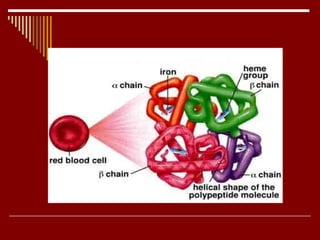
The mature red cell 7-8 micro m in diameter ; 1.5-2,5 micro m thick Cell membrane  functions Maintain cell shape deformability Suppporting skeletal system for surface antigen Transports essential ions and gases The membrane proteins Integral Peripheral : spectrin, actin, ankyrin, G3PD


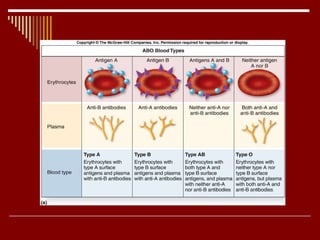
Blood Groups ABO Rh Other minor blood groups Proper blood typing and cross matching Major X match: Donor red cell x recipient serum Minor X matching Donor serum X recipients red cell
 
Case:” Nanlalata” A 45 year old female called her physician complaining of fatigue, shortness of breath on exertion, and general malaise. She requested some B12 shots to make her feel better’ the physician asked for an appointement to determine what was really wrong with her.
Anemia A reduction of more than 10% from the normal value for the total nuimber of RBC , amount of hemoglobin and RBC mass of a particular patient Good history : diet, drug ingestion, exposurre to chemicals, occupation, hobbies, travel, bleeding history, ethnic groups, family history of disease, jaundice Good physical examination
Laboratory tests Complete blood count with cell indices Rbc count MCV MCH MCHC RDW Reticulocyte count Bone marrow examination
Mechanisms of Anemia Ineffective erythropoiesis : production of progenitor cells that are defective and are destroyed prior to or shortly after leaving the bone marrow Insufficient erythropoiesis: quantitative lack of erythroid precursors in the marrow (aplastic anemia)
Physiologic adaptation to the Anemias Rapid delivery of oxygen to the tissues by : > increased in heart rate > increased respiratory rate Increased cardiac output Increased in 2,3 BPG
Polycythemia Neoplastic clonal MPD that expresses with panmyelosis in the bone marrow and increases RBC, WBC and platelets in the peripheral blood Splenomegaly is common Neoplastic clonal stem cells are sensitive to the presence of EPO
 
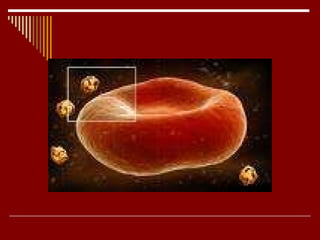
Ode to a red cell Erythrocyte, erythrocyte, Thou General Physiologists’ delight! Thy gently rounded biconcavity Arouses wonder, not depravity. Thy subtle shape proclaims an adaptation To Dr. Roughton’s diffusional equation. And Biochemists still persist in hopin’ You’re more than just a bag of hemoglobin. When comes Hemolysis; as come it must to most; You’ll make a very pretty red cell ghost!   - Alan C. Burton
Thank you! Mwaauh..

071709 Blood Physiology

  • 1.
    Blood Physiology CarolinaC. Jerez, MD Dept. of Physiology
  • 2.
  • 3.
    Stages in HematopoiesisMesoblastic phase Yolk sac Blood islands near the aorta
  • 4.
    Hematopoiesis Hepatic stage: continue untll birth ; by the third month the peak for both eryhropoiesis and granulopoiesis will be reached Splenic activity also starts here The thymus is the first organ of the lymphatic system to develop fully in the fetus; continue to enlarge until childhood
  • 5.
    The medullary phaseMedullary production starts with the ossification and development of the marrow within the core of the bone Clavicle first to demonstrate marrow hematopoietic activity By the 6 th month the marrow become the primary site of hematopoiesis Measurable products : various stages of maturation of all cell lines;EPO; fetal Hgb ;adult Hgb
  • 6.
    The hematopoietic microenvironmentA carbon dioxide atmosphere Wet sticky surface where the cells anchor Normal population of red marrow cells necessary for interaction Provides the growth factors, cytokines and extracellular matrix which helpregulate hematopoiesis
  • 7.
    The Liver Synthesizingand providing transport proteins;storing essential minerals and vitamins utilized in DNA and RNA synthesis, conjugating bilirubin from hemoglobin degradation, transporting the bilirubin to the small intestine
  • 8.
    The SPLEEN Thelargest lymphoid organ in the body It is vital but not essential for life There are three zones The white pulp > the red pulp The marginal zone Splenomegaly is observed in various diseases like ; chronic leukemias, genetically defective RBC, HGB, thalassemias, malaria
  • 9.
    Lymph Nodes Formationof new lymphocytes from the germinal centers Processing of specific immunoglobulin Filtration of particulate matter, debris, bacteria entering the lymph nodes
  • 10.
    The Thymus Has2 portions > the cortex; waiting zone; densely populated by lymphocytes from the bone marrow with no surface markers The medulla : holding zone; contains 5% mature T lymphocytes,
  • 11.
    The stem celltheory @ types of Stem cells : > undifferentiated or pluripotent or totipotent cells : capable of self renewal, and differentiation to progenitor cells committed to either lymphoid or myeloid lineage > progenitor cells : give rise to recognizable lineage –specific recursor cells; called CFU1 or CFU-GEMM
  • 12.
  • 13.
    Cytokines Diverse groupof soluble proteins which modulates the functional activities of the cell Most are glycoproteins and include the interleukins, lymphokines, monokines, interferrons, chemokines, CSF, Responsible for trafficking of mature blood cells( stimulation, inhibition, production, differentiation ) > prevents apoptosis
  • 14.
  • 15.
    Erythrocyte production anddestruction Erythron : all stages of the red cell in designated areas of the body( bone marrow, circulating red cells, vascular spaces within the specific organs Erythropoietin : thermostable, nondialyzable glycoprotein which has A. CHO unit which conveys specificity B. terminal sialic acid for its biologic activity in vivo
  • 16.
    Functions of erythropoietinRegulates the 3 reduction division of normoblastic production Shortens the time of division maturation process Increases the rate of the pentose phosphate shunt Assists in the egression of the mature red cell Stimulates the early release of shift reticulocyte Increases the rate of hemoglobin syntheis
  • 17.
    Factors stimulating EPOrelease Hypoxia or decrease in oxygen tension Testosterone EPO can be measured by immunoassay Plasma values : 3-8 mU /ml to maintain steady erythropoiesis 2000-3000 mU/ml is necessary to compensate a severe hemolytic process or blood loss
  • 18.
    Anti=erythropoietin antibodiess Type1 : neutralizes the biological activity of EPO Type !! Causes hemagglutination
  • 19.
    The mature redcell 7-8 micro m in diameter ; 1.5-2,5 micro m thick Cell membrane functions Maintain cell shape deformability Suppporting skeletal system for surface antigen Transports essential ions and gases The membrane proteins Integral Peripheral : spectrin, actin, ankyrin, G3PD
  • 20.
  • 21.
  • 22.
  • 23.
    Blood Groups ABORh Other minor blood groups Proper blood typing and cross matching Major X match: Donor red cell x recipient serum Minor X matching Donor serum X recipients red cell
  • 24.
  • 25.
    Case:” Nanlalata” A45 year old female called her physician complaining of fatigue, shortness of breath on exertion, and general malaise. She requested some B12 shots to make her feel better’ the physician asked for an appointement to determine what was really wrong with her.
  • 26.
    Anemia A reductionof more than 10% from the normal value for the total nuimber of RBC , amount of hemoglobin and RBC mass of a particular patient Good history : diet, drug ingestion, exposurre to chemicals, occupation, hobbies, travel, bleeding history, ethnic groups, family history of disease, jaundice Good physical examination
  • 27.
    Laboratory tests Completeblood count with cell indices Rbc count MCV MCH MCHC RDW Reticulocyte count Bone marrow examination
  • 28.
    Mechanisms of AnemiaIneffective erythropoiesis : production of progenitor cells that are defective and are destroyed prior to or shortly after leaving the bone marrow Insufficient erythropoiesis: quantitative lack of erythroid precursors in the marrow (aplastic anemia)
  • 29.
    Physiologic adaptation tothe Anemias Rapid delivery of oxygen to the tissues by : > increased in heart rate > increased respiratory rate Increased cardiac output Increased in 2,3 BPG
  • 30.
    Polycythemia Neoplastic clonalMPD that expresses with panmyelosis in the bone marrow and increases RBC, WBC and platelets in the peripheral blood Splenomegaly is common Neoplastic clonal stem cells are sensitive to the presence of EPO
  • 31.
  • 32.
    Ode to ared cell Erythrocyte, erythrocyte, Thou General Physiologists’ delight! Thy gently rounded biconcavity Arouses wonder, not depravity. Thy subtle shape proclaims an adaptation To Dr. Roughton’s diffusional equation. And Biochemists still persist in hopin’ You’re more than just a bag of hemoglobin. When comes Hemolysis; as come it must to most; You’ll make a very pretty red cell ghost! - Alan C. Burton
  • 33.