Threats to surfing


International Symposium on the Protection of Waves
  Biarritz, France and San Sebastian-Donostia, Spain
                  October 24-25, 2011

                       Dr Neil Lazarow
     Visitor, Fenner School of Environment and Society
                Australian National University
Scope of presentation
• The contested coast
  –   Key coastal management challenges
• Surfing Capital and key threats
• Recreation
  – Preferences and specialisation
  – Surfing Capital and Recreation Management
• Threats and management strategies
• Discussion and opportunities
• Framework to manage Surfing Capital
Pressures on the coast
• Population - growth and expansion of
  settlement footprint
• Development – changes and expansion in
  industry and land use types
• Natural Capital – changes in the natural
  resource base, including from climate change
  and climate variability (local to global scale)
¿Cómo se enfrentan los problemas?
Utilizando la metodología NISDES

•    NEGANDO lo que existe
•    IMPROVISANDO soluciones
•    SUBESTIMANDO el problema
•    DESAUTORIZANDO a los expertos
•    EQUIVOCANDOSE en la aplicación
•    SORPRENDIENDOSE de los resultados
Dr Eduardo A. Vallarino, UMDP, 2010
Case study locations /
country of origin GFTP
       surveys
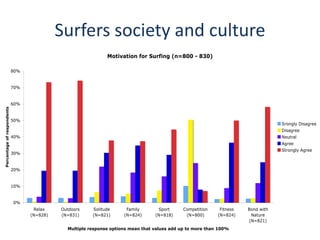
Surfers society and culture
                                                              Motivation for Surfing (n=800 - 830)

                            80%


                            70%


                            60%
Percentage of respondents


                            50%
                                                                                                                                   Srongly Disagree
                                                                                                                                   Disagree
                            40%                                                                                                    Neutral
                                                                                                                                   Agree
                                                                                                                                   Strongly Agree
                            30%


                            20%


                            10%


                            0%
                                   Relax    Outdoors    Solitude      Family       Sport     Competition     Fitness   Bond with
                                  (N=828)   (N=831)     (N=821)      (N=824)      (N=818)     (N=800)       (N=824)     Nature
                                                                                                                       (N=821)
                                              Multiple response options mean that values add up to more than 100%
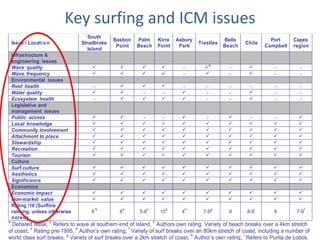
Key surfing and ICM issues
                                   South
                                             Bastion   Palm          Kirra    Asbury                Bells               Port     Capes
    Issue / Locati o n          Stradbroke                                              Trestles            Chile
                                              Point    Beach         Point     Park                 Beach             Campbell   region
                                   Island
    Infrastructure &
    engineering issues
                                                                                               a
    Wave quality                    ü          ü        ü             ü         -         ü           -      ü           -         -
    Wave frequency                  ü          ü        ü             ü         -         ü           -      ü           -         -
    Environmental issues
    Reef health                     -          ü        ü             ü         -          -          -      -           -         -
    Water quality                   ü          ü        -             -         ü          -          -      ü           -         -
    Ecosystem health                -          ü        ü             ü         ü          -          -      ü           -         -
    Legislative and
    management issues
    Public access                   ü          ü        -             -         ü          -         ü       -           -         ü
    Local knowledge                 ü          ü        ü             ü         ü          ü         ü       ü           ü         ü
    Community involvement           ü          ü        ü             ü         ü          ü         ü       ü           ü         ü
    Attachment to place             ü          ü        ü             ü         ü          ü         ü       ü           ü         ü
    Stewardship                     ü          ü        ü             ü         ü          ü         ü       ü           ü         ü
    Recreation                      ü          ü        ü             ü         ü          ü         ü       ü           ü         ü
    Tourism                         ü          ü        ü             ü         ü          ü         ü       ü           ü         ü
    Culture
    Surf culture                    ü          ü        ü             ü         ü          ü         ü       ü           ü         ü
    Aesthetics                      ü          ü        ü             ü         ü          ü         ü       ü           ü         ü
    Significance                    ü          ü        ü             ü         ü          ü         ü       ü           ü         ü
    Economics
    Economic impact                 ü          ü        ü             ü         ü          ü         ü       ü           ü         ü
    Non-market value                ü          ü        ü             ü         ü          ü         ü       ü           ü         ü
    Rating /10 (Surfline
                                        b          e         c            d         h           g                 i                     f
    ranking, unless otherwise       8          6       5-6           10         4         7-9        9      8-9          8        7-9
    noted)
a                    b                                           c
 Debated issue, Refers to wave at southern end of island, Authors own rating. Variety of beach breaks over a 4km stretch
         d                 e                      f
of coast, Rating pre-1995, Author’s own rating, Variety of surf breaks over an 80km stretch of coast, including a number of
                        g                                                   h                    i
world class surf breaks, Variety of surf breaks over a 2km stretch of coast, Author’s own rating, Refers to Punta de Lobos.
Free-rider
Romanticised notions of the sea rarely engage with, relate to or ‘genuinely
recognise the economic, social or cultural issues that threaten it (Stocker,
2009) ’.

The ecosystem services provided by the ocean have for many years absorbed
our waste and our pollution (how many times have coastal managers heard the phrases
‘out of sight out of mind’ or ‘dilution is the solution to pollution’).

On the one hand, the ocean has been used as a dumping ground for toxic
waste, sewage and munitions and on the other hand we rely on the ocean for
food, recreation and open-space, the ocean drives climatic conditions and the
sea is the source of dreams and inspirations for so many.

Nowhere is the principle of the ‘free-rider’ better exemplified (and
encouraged through poor policy and laws) than in our relationship with the
ocean.
Typology of Surfing Capital
Item            Description                   Natural or human impact

Wave quality    Dominant local view of        •   Construction of coastal protection/amenity structures (for example,
                how the wave breaks.              groynes, seawalls, piers, seawalls, riverwalls, breakwaters, artificial
                Both beauty and physical          reefs)
                form become assessable.       •   Sand management (for example, beach fill, dredging, sandbar
Wave            ‘Surfable’ waves                  grooming)
frequency       measured against an
                accepted standard.
Environmental   Environmental or                  Biological impacts (for example, water quality or nutrient loading)
                biophysical conditions            Climate change/variability (for example, temperature change, sea level
                that may mitigate against         rise, less or more storms less or more often)
                a surfers’ physical health.       Amenity of the surrounding built and natural environment
                                                  Marine predators (for example, sharks)
Experiential    Societal conditions               Legislation/regulation that might grant, restrict or control access (for
                surrounding the surfing           example, community title, private property, payment strategies, craft
                experience.                       registration, proficiency requirement, policing)
                                                  Code of ethics i.e. road rules for the surf
                                                  Signage & education strategies
                                                  Surf rage, aggression, intimidation
                                                  Self-regulation/localism/lore
                                                  Mentoring, sharing, physical activity, challenge, joy and laughter, well-
                                                  being, community spirit, Self-fulfilment
                                                  Local aesthetic
                                                  Risk, safety
Preferences and specialisation
• The importance of preferences
• Ritual potential of surfing
  – Personal relevance
  – Scenes / collective expression
• Serious leisure
• Specialisation
• Subculture seduction
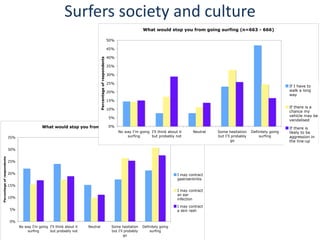
Surfers society and culture
                                                                                                                                    What would stop you from going surfing (n=663 - 666)

                                                                                                               50%

                                                                                                               45%

                                                                                                               40%


                                                                                   Percentage of respondents
                                                                                                               35%

                                                                                                               30%

                                                                                                               25%
                                                                                                                                                                                                                 If I have to
                                                                                                               20%                                                                                               walk a long
                                                                                                                                                                                                                 way
                                                                                                               15%
                                                                                                                                                                                                                 If there is a
                                                                                                               10%
                                                                                                                                                                                                                 chance my
                                                                                                                                                                                                                 vehicle may be
                                                                                                               5%
                                                                                                                                                                                                                 vandalised
                                                What would stop you from going surfing (n=663 - 666)
                                                                            0%
                                                                                                                                                                                                                 If there is
                                                                                                                     No way I'm going I'll think about it       Neutral   Some hesitation     Definitely going   likely to be
                            35%                                                                                          surfing      but probably not                    but I'll probably       surfing        aggression in
                                                                                                                                                                                  go                             the line-up

                            30%
Percentage of respondents


                            25%


                            20%                                                                                                                        I may contract
                                                                                                                                                       gastroentiritis
                            15%
                                                                                                                                                       I may contract
                                                                                                                                                       an ear
                            10%                                                                                                                        infection
                                                                                                                                                       I may contract
                            5%                                                                                                                         a skin rash

                            0%
                                  No way I'm going I'll think about it   Neutral                                Some hesitation     Definitely going
                                      surfing      but probably not                                             but I'll probably       surfing
                                                                                                                        go
Surfbreaks
Surf break type                   Bastion Point, Australia
Headland or Pointbreak            •   Independent review sought by community
Beach break                           finds that the preferred option “will place
                                      the groyne across the end of the outer
River mouth or estuary bar
                                      break, imposing an additional hazard to
Reef break                            surfers as well as destroying part of the
Ledges (including Bomboras)           break.”
Sea mount                         •   EES states that there are “opposing views
Tidal bore                            about the impact that the breakwater
                                      walls will have on surf further out..… The
                                      ‘region then becomes a more attractive
                                      place for the type of visitor who is family
                                      orientated and with young children, or
                                      teenagers who are interested in taking up
                                      surfing as a sport.”
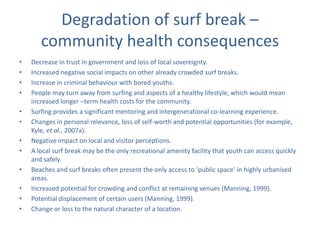
Degradation of surf break –
       community health consequences
•   Decrease in trust in government and loss of local sovereignty.
•   Increased negative social impacts on other already crowded surf breaks.
•   Increase in criminal behaviour with bored youths.
•   People may turn away from surfing and aspects of a healthy lifestyle, which would mean
    increased longer –term health costs for the community.
•   Surfing provides a significant mentoring and intergenerational co-learning experience.
•   Changes in personal relevance, loss of self-worth and potential opportunities (for example,
    Kyle, et al., 2007a).
•   Negative impact on local and visitor perceptions.
•   A local surf break may be the only recreational amenity facility that youth can access quickly
    and safely.
•   Beaches and surf breaks often present the only access to ‘public space’ in highly urbanised
    areas.
•   Increased potential for crowding and conflict at remaining venues (Manning, 1999).
•   Potential displacement of certain users (Manning, 1999).
•   Change or loss to the natural character of a location.
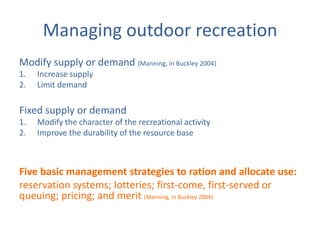
Managing outdoor recreation
Modify supply or demand (Manning, in Buckley 2004)
1.   Increase supply
2.   Limit demand

Fixed supply or demand
1.   Modify the character of the recreational activity
2.   Improve the durability of the resource base


Five basic management strategies to ration and allocate use:
reservation systems; lotteries; first-come, first-served or
queuing; pricing; and merit (Manning, in Buckley 2004)
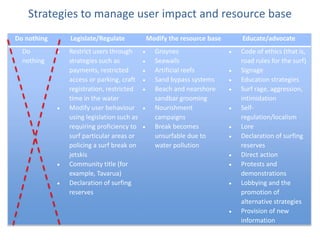
Strategies to manage user impact and resource base
Do nothing   Legislate/Regulate          Modify the resource base   Educate/advocate
  Do         Restrict users through        Groynes                  Code of ethics (that is,
  nothing    strategies such as            Seawalls                 road rules for the surf)
             payments, restricted          Artificial reefs         Signage
             access or parking, craft      Sand bypass systems      Education strategies
             registration, restricted      Beach and nearshore      Surf rage, aggression,
             time in the water             sandbar grooming         intimidation
             Modify user behaviour         Nourishment              Self-
             using legislation such as     campaigns                regulation/localism
             requiring proficiency to      Break becomes            Lore
             surf particular areas or      unsurfable due to        Declaration of surfing
             policing a surf break on      water pollution          reserves
             jetskis                                                Direct action
             Community title (for                                   Protests and
             example, Tavarua)                                      demonstrations
             Declaration of surfing                                 Lobbying and the
             reserves                                               promotion of
                                                                    alternative strategies
                                                                    Provision of new
                                                                    information
Legislation / regulation
• New Zealand – National Coastal Policy Statement
• Australia – Exclusion zones in southwest Western
  Australia
• USA – restricted access for surfing in New Jersey (up to
  2003)
• Australia – shared zoning for surfers, swimmers and
  boats at Bastion Point
• Surfing Reserves and Sanctuaries
   – NSR
   – WSR
   – Bells
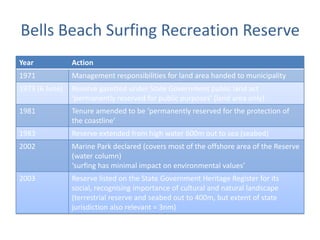
Bells Beach Surfing Recreation Reserve
Year            Action
1971            Management responsibilities for land area handed to municipality
1973 (6 June)   Reserve gazetted under State Government public land act
                ‘permanently reserved for public purposes’ (land area only)
1981            Tenure amended to be ‘permanently reserved for the protection of
                the coastline’
1983            Reserve extended from high water 600m out to sea (seabed)
2002            Marine Park declared (covers most of the offshore area of the Reserve
                (water column)
                ‘surfing has minimal impact on environmental values’
2003            Reserve listed on the State Government Heritage Register for its
                social, recognising importance of cultural and natural landscape
                (terrestrial reserve and seabed out to 400m, but extent of state
                jurisdiction also relevant = 3nm)
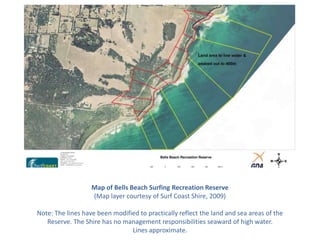
Map of Bells Beach Surfing Recreation Reserve
                   (Map layer courtesy of Surf Coast Shire, 2009)

Note: The lines have been modified to practically reflect the land and sea areas of the
   Reserve. The Shire has no management responsibilities seaward of high water.
                                Lines approximate.
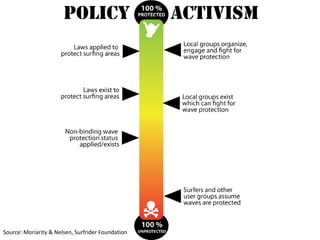
Source: Moriarity & Nelsen, Surfrider Foundation
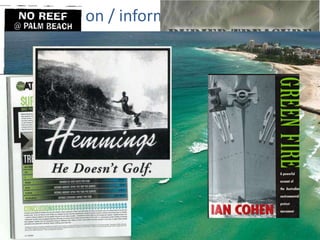
Education / information / advocacy
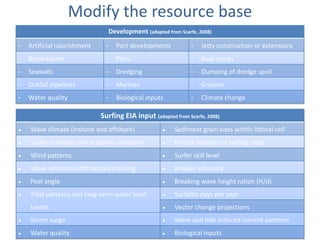
Modify the resource base
                                   Development (adapted from Scarfe, 2008)

•   Artificial nourishment     •     Port developments            •   Jetty construction or extensions
•   Breakwaters                •     Piers                        •   Boat ramps
•   Seawalls                   •     Dredging                     •   Dumping of dredge spoil
•   Outfall pipelines          •     Marinas                      •   Groynes
•   Water quality              •     Biological inputs            •   Climate change

                             Surfing EIA input (adapted from Scarfe, 2008)
    Wave climate (inshore and offshore)                    Sediment grain sizes within littoral cell
    Surfer numbers and seasonal variations                 Precise location of surfing rides
    Wind patterns                                          Surfer skill level
    Wave refraction/diffraction/shoaling                   Breaker intensity
    Peel angle                                             Breaking wave height ration (H/d)
    Tidal patterns and long-term water level               Surfable days per year
    trends                                                 Vector change projections
    Storm surge                                            Wave and tide induced current patterns
    Water quality                                          Biological inputs
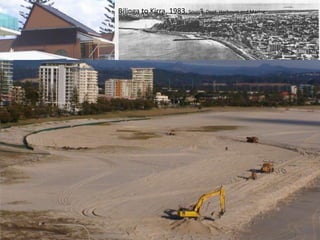
Bilinga to Kirra, 1983. Source: Dept. Harbours and Marine


                           Source: Isla


Source: Vallarino          Source: ICM
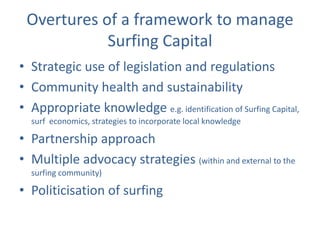
Overtures of a framework to manage
            Surfing Capital
• Strategic use of legislation and regulations
• Community health and sustainability
• Appropriate knowledge e.g. identification of Surfing Capital,
  surf economics, strategies to incorporate local knowledge

• Partnership approach
• Multiple advocacy strategies (within and external to the
  surfing community)

• Politicisation of surfing
Merci
          Gracias
        Thank You
Neil.Lazarow@anu.edu.au
Some useful references
•   Lazarow, N. 2010. Managing and Valuing Coastal Resources: An Examination of the
    Importance of Local Knowledge and Surf Breaks to Coastal Communities. Fenner School of
    Environment and Society. Canberra, Australian National University. PhD Thesis.
•   Lazarow, N., Miller, M. L., & Blackwell, B. 2008. The Value of Recreational Surfing to Society.
    Tourism in Marine Environments, 5(2-3), p.145-158.
•   Manning, R.E. (2004). Managing Impacts of Ecotourism Through Use Rationing and
    Allocation. In R. Buckley (Ed.), Environmental impacts of ecotourism (273-286). UK: CAB
    International.
•   Rosenblatt, B., Unger, B., & Mencinsky, A. (2005). How to Save a Surf Break? The Story of
    Sandy Hook, New Jersey. In G. Hening (Ed.), Groundswell Society: Surfing, Art, Science and
    Issues Conference, Conference. Groundswell Society. Location, 78-93.
•   Scarfe, B. (2008). The Value, Scarcity, and Fragility of Surfing Breaks. Unpublished PhD Thesis,
    University of Waikato, Hamilton.
•   Stebbins, R.A. (1979). Amateurs: On the Margin Between Work and Leisure. Beverley Hills:
    Sage Publications.
•   Stocker, L. (2009). Sea, Self and Sustainability. Life Writing, 6(1), 133-141.
Synthesis and implications for ICM and
            sustainability
1.  Relationship between NRM outcomes and community/place
2.  Public involvement processes
3.  Post-policy partnerships
4.  Access to knowledge through partnership approaches
5.  Capacity to review of develop meaningful policy
6.  Sustainability requires purposeful and sustained effort
7.  Effective engagement requires specialist skills
8.  Environmental policy experiments are rarely compatible with policy
    cycles
9. Politicised nature of decision-making is often uneven
10. Politicisation of coastal issues many improve the allocation of resources

Threats to Waves and Protection Strategies - Neil LAZAROW

  • 1.
    Threats to surfing InternationalSymposium on the Protection of Waves Biarritz, France and San Sebastian-Donostia, Spain October 24-25, 2011 Dr Neil Lazarow Visitor, Fenner School of Environment and Society Australian National University
  • 2.
    Scope of presentation •The contested coast – Key coastal management challenges • Surfing Capital and key threats • Recreation – Preferences and specialisation – Surfing Capital and Recreation Management • Threats and management strategies • Discussion and opportunities • Framework to manage Surfing Capital
  • 3.
    Pressures on thecoast • Population - growth and expansion of settlement footprint • Development – changes and expansion in industry and land use types • Natural Capital – changes in the natural resource base, including from climate change and climate variability (local to global scale)
  • 4.
    ¿Cómo se enfrentanlos problemas? Utilizando la metodología NISDES • NEGANDO lo que existe • IMPROVISANDO soluciones • SUBESTIMANDO el problema • DESAUTORIZANDO a los expertos • EQUIVOCANDOSE en la aplicación • SORPRENDIENDOSE de los resultados Dr Eduardo A. Vallarino, UMDP, 2010
  • 5.
    Case study locations/ country of origin GFTP surveys
  • 6.
    Surfers society andculture Motivation for Surfing (n=800 - 830) 80% 70% 60% Percentage of respondents 50% Srongly Disagree Disagree 40% Neutral Agree Strongly Agree 30% 20% 10% 0% Relax Outdoors Solitude Family Sport Competition Fitness Bond with (N=828) (N=831) (N=821) (N=824) (N=818) (N=800) (N=824) Nature (N=821) Multiple response options mean that values add up to more than 100%
  • 7.
    Key surfing andICM issues South Bastion Palm Kirra Asbury Bells Port Capes Issue / Locati o n Stradbroke Trestles Chile Point Beach Point Park Beach Campbell region Island Infrastructure & engineering issues a Wave quality ü ü ü ü - ü - ü - - Wave frequency ü ü ü ü - ü - ü - - Environmental issues Reef health - ü ü ü - - - - - - Water quality ü ü - - ü - - ü - - Ecosystem health - ü ü ü ü - - ü - - Legislative and management issues Public access ü ü - - ü - ü - - ü Local knowledge ü ü ü ü ü ü ü ü ü ü Community involvement ü ü ü ü ü ü ü ü ü ü Attachment to place ü ü ü ü ü ü ü ü ü ü Stewardship ü ü ü ü ü ü ü ü ü ü Recreation ü ü ü ü ü ü ü ü ü ü Tourism ü ü ü ü ü ü ü ü ü ü Culture Surf culture ü ü ü ü ü ü ü ü ü ü Aesthetics ü ü ü ü ü ü ü ü ü ü Significance ü ü ü ü ü ü ü ü ü ü Economics Economic impact ü ü ü ü ü ü ü ü ü ü Non-market value ü ü ü ü ü ü ü ü ü ü Rating /10 (Surfline b e c d h g i f ranking, unless otherwise 8 6 5-6 10 4 7-9 9 8-9 8 7-9 noted) a b c Debated issue, Refers to wave at southern end of island, Authors own rating. Variety of beach breaks over a 4km stretch d e f of coast, Rating pre-1995, Author’s own rating, Variety of surf breaks over an 80km stretch of coast, including a number of g h i world class surf breaks, Variety of surf breaks over a 2km stretch of coast, Author’s own rating, Refers to Punta de Lobos.
  • 8.
    Free-rider Romanticised notions ofthe sea rarely engage with, relate to or ‘genuinely recognise the economic, social or cultural issues that threaten it (Stocker, 2009) ’. The ecosystem services provided by the ocean have for many years absorbed our waste and our pollution (how many times have coastal managers heard the phrases ‘out of sight out of mind’ or ‘dilution is the solution to pollution’). On the one hand, the ocean has been used as a dumping ground for toxic waste, sewage and munitions and on the other hand we rely on the ocean for food, recreation and open-space, the ocean drives climatic conditions and the sea is the source of dreams and inspirations for so many. Nowhere is the principle of the ‘free-rider’ better exemplified (and encouraged through poor policy and laws) than in our relationship with the ocean.
  • 9.
    Typology of SurfingCapital Item Description Natural or human impact Wave quality Dominant local view of • Construction of coastal protection/amenity structures (for example, how the wave breaks. groynes, seawalls, piers, seawalls, riverwalls, breakwaters, artificial Both beauty and physical reefs) form become assessable. • Sand management (for example, beach fill, dredging, sandbar Wave ‘Surfable’ waves grooming) frequency measured against an accepted standard. Environmental Environmental or Biological impacts (for example, water quality or nutrient loading) biophysical conditions Climate change/variability (for example, temperature change, sea level that may mitigate against rise, less or more storms less or more often) a surfers’ physical health. Amenity of the surrounding built and natural environment Marine predators (for example, sharks) Experiential Societal conditions Legislation/regulation that might grant, restrict or control access (for surrounding the surfing example, community title, private property, payment strategies, craft experience. registration, proficiency requirement, policing) Code of ethics i.e. road rules for the surf Signage & education strategies Surf rage, aggression, intimidation Self-regulation/localism/lore Mentoring, sharing, physical activity, challenge, joy and laughter, well- being, community spirit, Self-fulfilment Local aesthetic Risk, safety
  • 10.
    Preferences and specialisation •The importance of preferences • Ritual potential of surfing – Personal relevance – Scenes / collective expression • Serious leisure • Specialisation • Subculture seduction
  • 11.
    Surfers society andculture What would stop you from going surfing (n=663 - 666) 50% 45% 40% Percentage of respondents 35% 30% 25% If I have to 20% walk a long way 15% If there is a 10% chance my vehicle may be 5% vandalised What would stop you from going surfing (n=663 - 666) 0% If there is No way I'm going I'll think about it Neutral Some hesitation Definitely going likely to be 35% surfing but probably not but I'll probably surfing aggression in go the line-up 30% Percentage of respondents 25% 20% I may contract gastroentiritis 15% I may contract an ear 10% infection I may contract 5% a skin rash 0% No way I'm going I'll think about it Neutral Some hesitation Definitely going surfing but probably not but I'll probably surfing go
  • 12.
    Surfbreaks Surf break type Bastion Point, Australia Headland or Pointbreak • Independent review sought by community Beach break finds that the preferred option “will place the groyne across the end of the outer River mouth or estuary bar break, imposing an additional hazard to Reef break surfers as well as destroying part of the Ledges (including Bomboras) break.” Sea mount • EES states that there are “opposing views Tidal bore about the impact that the breakwater walls will have on surf further out..… The ‘region then becomes a more attractive place for the type of visitor who is family orientated and with young children, or teenagers who are interested in taking up surfing as a sport.”
  • 13.
    Degradation of surfbreak – community health consequences • Decrease in trust in government and loss of local sovereignty. • Increased negative social impacts on other already crowded surf breaks. • Increase in criminal behaviour with bored youths. • People may turn away from surfing and aspects of a healthy lifestyle, which would mean increased longer –term health costs for the community. • Surfing provides a significant mentoring and intergenerational co-learning experience. • Changes in personal relevance, loss of self-worth and potential opportunities (for example, Kyle, et al., 2007a). • Negative impact on local and visitor perceptions. • A local surf break may be the only recreational amenity facility that youth can access quickly and safely. • Beaches and surf breaks often present the only access to ‘public space’ in highly urbanised areas. • Increased potential for crowding and conflict at remaining venues (Manning, 1999). • Potential displacement of certain users (Manning, 1999). • Change or loss to the natural character of a location.
  • 14.
    Managing outdoor recreation Modifysupply or demand (Manning, in Buckley 2004) 1. Increase supply 2. Limit demand Fixed supply or demand 1. Modify the character of the recreational activity 2. Improve the durability of the resource base Five basic management strategies to ration and allocate use: reservation systems; lotteries; first-come, first-served or queuing; pricing; and merit (Manning, in Buckley 2004)
  • 15.
    Strategies to manageuser impact and resource base Do nothing Legislate/Regulate Modify the resource base Educate/advocate Do Restrict users through Groynes Code of ethics (that is, nothing strategies such as Seawalls road rules for the surf) payments, restricted Artificial reefs Signage access or parking, craft Sand bypass systems Education strategies registration, restricted Beach and nearshore Surf rage, aggression, time in the water sandbar grooming intimidation Modify user behaviour Nourishment Self- using legislation such as campaigns regulation/localism requiring proficiency to Break becomes Lore surf particular areas or unsurfable due to Declaration of surfing policing a surf break on water pollution reserves jetskis Direct action Community title (for Protests and example, Tavarua) demonstrations Declaration of surfing Lobbying and the reserves promotion of alternative strategies Provision of new information
  • 16.
    Legislation / regulation •New Zealand – National Coastal Policy Statement • Australia – Exclusion zones in southwest Western Australia • USA – restricted access for surfing in New Jersey (up to 2003) • Australia – shared zoning for surfers, swimmers and boats at Bastion Point • Surfing Reserves and Sanctuaries – NSR – WSR – Bells
  • 17.
    Bells Beach SurfingRecreation Reserve Year Action 1971 Management responsibilities for land area handed to municipality 1973 (6 June) Reserve gazetted under State Government public land act ‘permanently reserved for public purposes’ (land area only) 1981 Tenure amended to be ‘permanently reserved for the protection of the coastline’ 1983 Reserve extended from high water 600m out to sea (seabed) 2002 Marine Park declared (covers most of the offshore area of the Reserve (water column) ‘surfing has minimal impact on environmental values’ 2003 Reserve listed on the State Government Heritage Register for its social, recognising importance of cultural and natural landscape (terrestrial reserve and seabed out to 400m, but extent of state jurisdiction also relevant = 3nm)
  • 18.
    Map of BellsBeach Surfing Recreation Reserve (Map layer courtesy of Surf Coast Shire, 2009) Note: The lines have been modified to practically reflect the land and sea areas of the Reserve. The Shire has no management responsibilities seaward of high water. Lines approximate.
  • 19.
    Source: Moriarity &Nelsen, Surfrider Foundation
  • 20.
  • 21.
    Modify the resourcebase Development (adapted from Scarfe, 2008) • Artificial nourishment • Port developments • Jetty construction or extensions • Breakwaters • Piers • Boat ramps • Seawalls • Dredging • Dumping of dredge spoil • Outfall pipelines • Marinas • Groynes • Water quality • Biological inputs • Climate change Surfing EIA input (adapted from Scarfe, 2008) Wave climate (inshore and offshore) Sediment grain sizes within littoral cell Surfer numbers and seasonal variations Precise location of surfing rides Wind patterns Surfer skill level Wave refraction/diffraction/shoaling Breaker intensity Peel angle Breaking wave height ration (H/d) Tidal patterns and long-term water level Surfable days per year trends Vector change projections Storm surge Wave and tide induced current patterns Water quality Biological inputs
  • 22.
    Bilinga to Kirra,1983. Source: Dept. Harbours and Marine Source: Isla Source: Vallarino Source: ICM
  • 23.
    Overtures of aframework to manage Surfing Capital • Strategic use of legislation and regulations • Community health and sustainability • Appropriate knowledge e.g. identification of Surfing Capital, surf economics, strategies to incorporate local knowledge • Partnership approach • Multiple advocacy strategies (within and external to the surfing community) • Politicisation of surfing
  • 24.
    Merci Gracias Thank You Neil.Lazarow@anu.edu.au
  • 25.
    Some useful references • Lazarow, N. 2010. Managing and Valuing Coastal Resources: An Examination of the Importance of Local Knowledge and Surf Breaks to Coastal Communities. Fenner School of Environment and Society. Canberra, Australian National University. PhD Thesis. • Lazarow, N., Miller, M. L., & Blackwell, B. 2008. The Value of Recreational Surfing to Society. Tourism in Marine Environments, 5(2-3), p.145-158. • Manning, R.E. (2004). Managing Impacts of Ecotourism Through Use Rationing and Allocation. In R. Buckley (Ed.), Environmental impacts of ecotourism (273-286). UK: CAB International. • Rosenblatt, B., Unger, B., & Mencinsky, A. (2005). How to Save a Surf Break? The Story of Sandy Hook, New Jersey. In G. Hening (Ed.), Groundswell Society: Surfing, Art, Science and Issues Conference, Conference. Groundswell Society. Location, 78-93. • Scarfe, B. (2008). The Value, Scarcity, and Fragility of Surfing Breaks. Unpublished PhD Thesis, University of Waikato, Hamilton. • Stebbins, R.A. (1979). Amateurs: On the Margin Between Work and Leisure. Beverley Hills: Sage Publications. • Stocker, L. (2009). Sea, Self and Sustainability. Life Writing, 6(1), 133-141.
  • 26.
    Synthesis and implicationsfor ICM and sustainability 1. Relationship between NRM outcomes and community/place 2. Public involvement processes 3. Post-policy partnerships 4. Access to knowledge through partnership approaches 5. Capacity to review of develop meaningful policy 6. Sustainability requires purposeful and sustained effort 7. Effective engagement requires specialist skills 8. Environmental policy experiments are rarely compatible with policy cycles 9. Politicised nature of decision-making is often uneven 10. Politicisation of coastal issues many improve the allocation of resources

Editor's Notes

  • #4 Population growth and expansion of settlement footprint arising from the existing population base, migration from other regions and changes in settlement patterns within coastal nodes, which has an impact on coastal resources;Development and changes in industry and land use including the expansion of existing industries (goods and services) such as harbours and port facilities and the development and expansion of new industries (for example, Information Technology, hospitality and tourism), which has an impact on coastal resources; andNatural or human induced changes to the coastal ecosystems and the natural capital base, including from climate change and climate variability.
  • #11 Kyle et al (2007) argue that understanding the meanings people associate with a particular place provides insight on why individuals and groups value particular resources’. In other words, ‘recreationists’ themselves play a crucial role in the process of constructing experience.
  • #16 Consistent with Government policy options across a range of areas:InformationDirect investmentIncentivesCoercion / regulationBut who’s responsibility is it?There are some classic examples of each of these 3 strategies and many of you are the architects of these successful activities. My intention here is to give you an idea of the scope and shape of these initiatives because you’re going to hear directly from many of the sources here at this conference.Then I’ll briefly describe some aspects of a couple of processes I was involved in. The strong message is that we very rarely employ just one technique and are most successful when we engage on multiple fronts / agendas
  • #18 However, it was only in 1996 that officers from the SCS and the Bells Beach Advisory Committee began developing the vision for Bells Beach Surfing Reserve. The Vision Statement for the Bells Beach Surfing Recreation Reserve states that: Bells Beach is unlike anywhere else in the world, it is a unique part of the Australian coastline and has a special place in surfing culture. The Surf Coast community acknowledges the importance of Bells Beach and seeks to protect and enhance the reserve’s natural assets and those of the
  • #21 Education, information, direct action, lobbying