DISCUSS THE CONTENTION THAT
SURFING IN THE 21ST CENTURY
CAN BE SUSTAINABLE.
Introduction
• Sustainability
• History
• Definition
• Advantages and Disadvantages of Sustainable Development
• Sustainable Surfing
• Sustainable Culture
• McKnight
• Whilden and Stewart
• Sustainable Tourism
• Conclusion
• References
Sustainability
• History of sustainability
• In 1962, Rachel Carson published “Silent Spring”
• In 1968, Paul Ehrlich published “Population Bomb”
• In 1972, the UN Conference was held in Stockholm
• In 1980, the Independent Commission International Development publishes “North: South” – A
Programme for Survival”
• In 1983, the World Commission on Environment and Development forms, chaired by Norwegian Prime
Minister Gro Harlem Bruntland
• In 1987, the “Our Common Future” the Bruntland Report was finally published
• In 1992 the UN Conference on Environment and Development (UNCED) was held in Rio de Janeiro
• In 2002 where the World Summit on Sustainable Development was “held in Johannesburg
• Finally, 2012 or Rio +20, this was about an Institutional change for Sustainable Development and the
Green Economy.
• (IISD, 2012)
Sustainability continued…
• Bruntland (1984) definition:
• “Sustainable development is development that meets the needs of the present without
compromising the ability of future generations to meet their own needs.”
• Advantages:
• People are accepting this concept;
• Sustainability gives everyone a focal point;
• It is an orchestration of sciences.
• Disadvantages:
• It is an oxymoron;
• Doesn’t have one definition;
• Can be a means for ongoing legitimisation of global approaches of development.
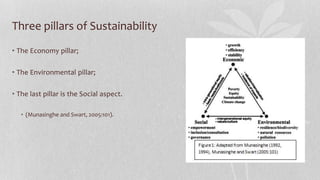
Three pillars of Sustainability
• The Economy pillar;
• The Environmental pillar;
• The last pillar is the Social aspect.
• (Munasinghe and Swart, 2005:101).
Sustainable Surfing
• “The earliest recorded surfing in Britain so far is 1890, but we have had contact with surfing
as far back as at least 1769.”
• (Museum of British Surfing, 2015)
• “It seemed clear that the surfing world was at a tipping point, that sustainability was an
inevitable, if distant, destination for the broader surfing world and its residents.”
• (Borne and Ponting, 2015)
Sustainable Culture
• Bob McKnight – Quicksilver and Sustainability: The View from the Top.
• Sustainability finally hit them when Jeff Wilson came to work.
• Yvon Chouinard’s ideas were being established.
• His sister started ‘Quiksilver Foundation’.
• Got all the designers and manufactures to start thinking about sustainability.
• “Since 2006, the company has struggled with profitability, so we need to turn Quiksilver around”
(McKnight, in Borne and Ponting, 2015:56).
• So they started to hire people who only thought how to be sustainable, how important the concept is and how
much they cared about it.
• Even though they are becoming a sustainable company, you know they struggling with finance, they
cant afford to give 1% to the planet, they place it back into the company.
• Sustainable product are more expensive then normal products.
Sustainable Culture
• Kevin Whilden and Michael Stewart – Transforming Surf Culture Towards Sustainability – A
Deep Blue Life.
• Plastic littering, agricultural and sewage water discharge, over-fishing and coastal habitat destruction,
all affect the ocean but the worst is carbon dioxide.
• Heat gain also effects “heat stress to corals and also changes global ocean circulation patterns that
drive global climate and ocean nutrient” (Whilden and Stewart, in Borne and Ponting, 2015).
• The ECOBOARD Project
• The sales of the ECOBOARD has increased to 400% per year.
• “Environmental Benefits: ECOBOARDs must have a significant and meaningful reduction in environmental
impact as measured by factors such as lifecycle CO2 emissions and toxic chemical/VOC emissions”
• (Sustainable Surf: ECOBOARDS: 2015)
• The Deep Blue Life
• Established in 2014, to help educate surfers on real life threats.
• To help life an ocean friendly lifestyle, there are some strategies that are recommended.
Sustainable Culture
• Two different types of culture
• McKnight looks into the business internal culture
• Whilden and Stewart look into the surfing culture, a culture every surfer integrates into
• International Conference in Helsinki 6th -8th May 2015
• (Culture Sustainability, 2015)
Sustainable Tourism
• Sean Brody - Sustainable Stoke: Liberia
• Went to Liberia in 2009, to take surf photos for National Geographic TV Show: On Surfari
• In 2010 started Surf Resource Network
• In 2012 opened Kwepunha Retereat
• Social Impact Business
• Sustainable Surf Tourism and Community Health
• Community Support – From the Bottom up and Top down
• Surfing Tourism
• The Ripple Effect
• Youngsters getting involved
Sustainable Tourism
• Jess Ponting – The Audacity of Stoke: Surfing the Ivory Tower
• Didn’t have any intention of going into academia, “it was more gravitational” (Ponting
2015, quoted in Borne and Ponting 2015)
• Realised that there was a need for sustainable tourism
• He identified the problems
• He they design six key areas that help promise for helping to drive a positive change in surf
tourism
1. Theoretical Framework
2. Practical Analytical Framework
3. Sustainable Surf Tourism Certification
4. Sustainable Surf Tourism Study Aboard Classes
5. SurfCredits
Sustainable Tourism
• Different views of Sustainable Tourism
• Brody focused on how individuals can help boost the local economy by using sustainable
surfing
• Ponting uses academia work, by producing a theory to help and to see why undeveloped
countries need sustainable surfing.
• “A 2012 report by The Travel Foundation and Forum for the Future found that 75% of
consumers want a more responsible holiday”
• (Sustainable Tourism, 2015)
Conclusion
• By just looking into two parts of sustainable surfing you can see that it helping individuals
to become sustainable
• Surfing has be alive in for centuries, and no one really knows when it first started, but
sustainable surfing is a concept that just happened.
• Sustainable Tourism and Culture are just two points of the ever expanding sustainable
surfing concept.
• Tourism is so important for undeveloped countries
• Culture is needed not just in the local communities, but you need a sustainable culture in business as
well.
• Overall, surfing is becoming sustainable and in some parts is sustainable. Now they have
realised how to become sustainable, they and even everyone needs to help to implement it.
References
• Borne, G. and Ponting, J., (2015) Sustainable Stoke: Transitions to Sustainability in the Surfing World.
Plymouth: University of Plymouth Press
• Brundtland,H.,(1987) Report of the World Commission on Environment and Development: Our Common
Future (Online) Available from: http://www.un-documents.net/our-common-future.pdf (Accessed on 10th
March 2015)
• Culture Sustainability. (2015) Culture(s) in Sustainable Futures: theories, policies, practices. (Online)
Available from: http://www.culturalsustainability.eu/helsinki2015/About-the-conference (Accessed on
17th March 2015)
• International Institution for Sustainable Development. (2012). Sustainable Development Timeline. (Online)
Available from: http://www.iisd.org/pdf/2012/sd_timeline_2012.pdf (Accessed on 10th March 2015)
• Munasinghe, M. and Swart, R., (2005) Primer on Climate Change and Sustainable Development: Facts, Policy
Analysis and Applications. Cambridge: Cambridge University Press 2005
• Museum of British Surfing. (2015) British Surfing History. (Online) Available from:
http://www.museumofbritishsurfing.org.uk/british-surfing-history/ (Accessed on 17th March 2015)
• Sustainable Surf: ECOBOARDS. (2015) ECOBOARD Project Benchmark. (Online) Available from:
http://www.sustainablesurf.org/ecoboard/benchmark/ (Accessed on 11th March 2015)
• Sustainable Tourism. (2015) Sustainable Tourism: Resources. (Online) Available from:
http://www.sustainabletourism.net/resources.html (Accessed on 17th March 2015)

Sustainability and Surfing 1

  • 1.
    DISCUSS THE CONTENTIONTHAT SURFING IN THE 21ST CENTURY CAN BE SUSTAINABLE.
  • 2.
    Introduction • Sustainability • History •Definition • Advantages and Disadvantages of Sustainable Development • Sustainable Surfing • Sustainable Culture • McKnight • Whilden and Stewart • Sustainable Tourism • Conclusion • References
  • 3.
    Sustainability • History ofsustainability • In 1962, Rachel Carson published “Silent Spring” • In 1968, Paul Ehrlich published “Population Bomb” • In 1972, the UN Conference was held in Stockholm • In 1980, the Independent Commission International Development publishes “North: South” – A Programme for Survival” • In 1983, the World Commission on Environment and Development forms, chaired by Norwegian Prime Minister Gro Harlem Bruntland • In 1987, the “Our Common Future” the Bruntland Report was finally published • In 1992 the UN Conference on Environment and Development (UNCED) was held in Rio de Janeiro • In 2002 where the World Summit on Sustainable Development was “held in Johannesburg • Finally, 2012 or Rio +20, this was about an Institutional change for Sustainable Development and the Green Economy. • (IISD, 2012)
  • 4.
    Sustainability continued… • Bruntland(1984) definition: • “Sustainable development is development that meets the needs of the present without compromising the ability of future generations to meet their own needs.” • Advantages: • People are accepting this concept; • Sustainability gives everyone a focal point; • It is an orchestration of sciences. • Disadvantages: • It is an oxymoron; • Doesn’t have one definition; • Can be a means for ongoing legitimisation of global approaches of development.
  • 5.
    Three pillars ofSustainability • The Economy pillar; • The Environmental pillar; • The last pillar is the Social aspect. • (Munasinghe and Swart, 2005:101).
  • 6.
    Sustainable Surfing • “Theearliest recorded surfing in Britain so far is 1890, but we have had contact with surfing as far back as at least 1769.” • (Museum of British Surfing, 2015) • “It seemed clear that the surfing world was at a tipping point, that sustainability was an inevitable, if distant, destination for the broader surfing world and its residents.” • (Borne and Ponting, 2015)
  • 7.
    Sustainable Culture • BobMcKnight – Quicksilver and Sustainability: The View from the Top. • Sustainability finally hit them when Jeff Wilson came to work. • Yvon Chouinard’s ideas were being established. • His sister started ‘Quiksilver Foundation’. • Got all the designers and manufactures to start thinking about sustainability. • “Since 2006, the company has struggled with profitability, so we need to turn Quiksilver around” (McKnight, in Borne and Ponting, 2015:56). • So they started to hire people who only thought how to be sustainable, how important the concept is and how much they cared about it. • Even though they are becoming a sustainable company, you know they struggling with finance, they cant afford to give 1% to the planet, they place it back into the company. • Sustainable product are more expensive then normal products.
  • 8.
    Sustainable Culture • KevinWhilden and Michael Stewart – Transforming Surf Culture Towards Sustainability – A Deep Blue Life. • Plastic littering, agricultural and sewage water discharge, over-fishing and coastal habitat destruction, all affect the ocean but the worst is carbon dioxide. • Heat gain also effects “heat stress to corals and also changes global ocean circulation patterns that drive global climate and ocean nutrient” (Whilden and Stewart, in Borne and Ponting, 2015). • The ECOBOARD Project • The sales of the ECOBOARD has increased to 400% per year. • “Environmental Benefits: ECOBOARDs must have a significant and meaningful reduction in environmental impact as measured by factors such as lifecycle CO2 emissions and toxic chemical/VOC emissions” • (Sustainable Surf: ECOBOARDS: 2015) • The Deep Blue Life • Established in 2014, to help educate surfers on real life threats. • To help life an ocean friendly lifestyle, there are some strategies that are recommended.
  • 9.
    Sustainable Culture • Twodifferent types of culture • McKnight looks into the business internal culture • Whilden and Stewart look into the surfing culture, a culture every surfer integrates into • International Conference in Helsinki 6th -8th May 2015 • (Culture Sustainability, 2015)
  • 10.
    Sustainable Tourism • SeanBrody - Sustainable Stoke: Liberia • Went to Liberia in 2009, to take surf photos for National Geographic TV Show: On Surfari • In 2010 started Surf Resource Network • In 2012 opened Kwepunha Retereat • Social Impact Business • Sustainable Surf Tourism and Community Health • Community Support – From the Bottom up and Top down • Surfing Tourism • The Ripple Effect • Youngsters getting involved
  • 11.
    Sustainable Tourism • JessPonting – The Audacity of Stoke: Surfing the Ivory Tower • Didn’t have any intention of going into academia, “it was more gravitational” (Ponting 2015, quoted in Borne and Ponting 2015) • Realised that there was a need for sustainable tourism • He identified the problems • He they design six key areas that help promise for helping to drive a positive change in surf tourism 1. Theoretical Framework 2. Practical Analytical Framework 3. Sustainable Surf Tourism Certification 4. Sustainable Surf Tourism Study Aboard Classes 5. SurfCredits
  • 12.
    Sustainable Tourism • Differentviews of Sustainable Tourism • Brody focused on how individuals can help boost the local economy by using sustainable surfing • Ponting uses academia work, by producing a theory to help and to see why undeveloped countries need sustainable surfing. • “A 2012 report by The Travel Foundation and Forum for the Future found that 75% of consumers want a more responsible holiday” • (Sustainable Tourism, 2015)
  • 13.
    Conclusion • By justlooking into two parts of sustainable surfing you can see that it helping individuals to become sustainable • Surfing has be alive in for centuries, and no one really knows when it first started, but sustainable surfing is a concept that just happened. • Sustainable Tourism and Culture are just two points of the ever expanding sustainable surfing concept. • Tourism is so important for undeveloped countries • Culture is needed not just in the local communities, but you need a sustainable culture in business as well. • Overall, surfing is becoming sustainable and in some parts is sustainable. Now they have realised how to become sustainable, they and even everyone needs to help to implement it.
  • 14.
    References • Borne, G.and Ponting, J., (2015) Sustainable Stoke: Transitions to Sustainability in the Surfing World. Plymouth: University of Plymouth Press • Brundtland,H.,(1987) Report of the World Commission on Environment and Development: Our Common Future (Online) Available from: http://www.un-documents.net/our-common-future.pdf (Accessed on 10th March 2015) • Culture Sustainability. (2015) Culture(s) in Sustainable Futures: theories, policies, practices. (Online) Available from: http://www.culturalsustainability.eu/helsinki2015/About-the-conference (Accessed on 17th March 2015) • International Institution for Sustainable Development. (2012). Sustainable Development Timeline. (Online) Available from: http://www.iisd.org/pdf/2012/sd_timeline_2012.pdf (Accessed on 10th March 2015) • Munasinghe, M. and Swart, R., (2005) Primer on Climate Change and Sustainable Development: Facts, Policy Analysis and Applications. Cambridge: Cambridge University Press 2005 • Museum of British Surfing. (2015) British Surfing History. (Online) Available from: http://www.museumofbritishsurfing.org.uk/british-surfing-history/ (Accessed on 17th March 2015) • Sustainable Surf: ECOBOARDS. (2015) ECOBOARD Project Benchmark. (Online) Available from: http://www.sustainablesurf.org/ecoboard/benchmark/ (Accessed on 11th March 2015) • Sustainable Tourism. (2015) Sustainable Tourism: Resources. (Online) Available from: http://www.sustainabletourism.net/resources.html (Accessed on 17th March 2015)