Systems thinking and
research assessment – how
might we work with wicked
problems?
Lou Woodley
Director – Center for Scientific Collaboration
and Community Engagement
louwoodley@cscce.org
@LouWoodley
DORA / HHMI Research Assessment meeting – October 2019
Why is change so hard?
Culture change
…is often a “wicked” problem:
• Requires addressing the whole system
• Likely involves addressing multiple underlying structural elements
• Requires more than one intervention – strategies that target a single issue are
unlikely to be effective alone
• Has multiple interconnected elements
• One size doesn’t fit all – need to understand the contexts in which we’re
working
Ever feel like you’re playing whack-a-mole with a system at equilibrium?
DORA / HHMI Research Assessment meeting – October 2019
Where does systems
thinking come in?
Systems Thinking
…is an approach that encourages us to a take a more holistic or systemic view of
how different factors relate to one another within a whole.
• Encourages us to move away from a focus on individual events or simplistic
cause and effect scenarios to focus on the bigger picture
• Allows us to see multiple components in relationship at once
• Can indicate inputs we may have missed
• May make it easier to understand delays – or escalations - in the system
• Can suggest points of leverage for interventions
DORA / HHMI Research Assessment meeting – October 2019
How do we adopt a systems perspective?
Three shifts are required to get to a systems
perspective:
BIG PICTURE - Move from focusing only on our part
of the system to seeing more of the whole system.
PERSONAL RESPONSIBILITY - Move from hoping
others will change first to identifying where we
have agency to change ourselves.
SYSTEMS STRUCTURE - Move from focusing on
individual events (fires, crises) to understanding
and redesigning the deeper systems structures that
cause these events.
- “Thinking in Systems” by Donella Meadows
Two ways to start working
with systems thinking
1. Systems archetypes
DORA / HHMI Research Assessment meeting – October 2019
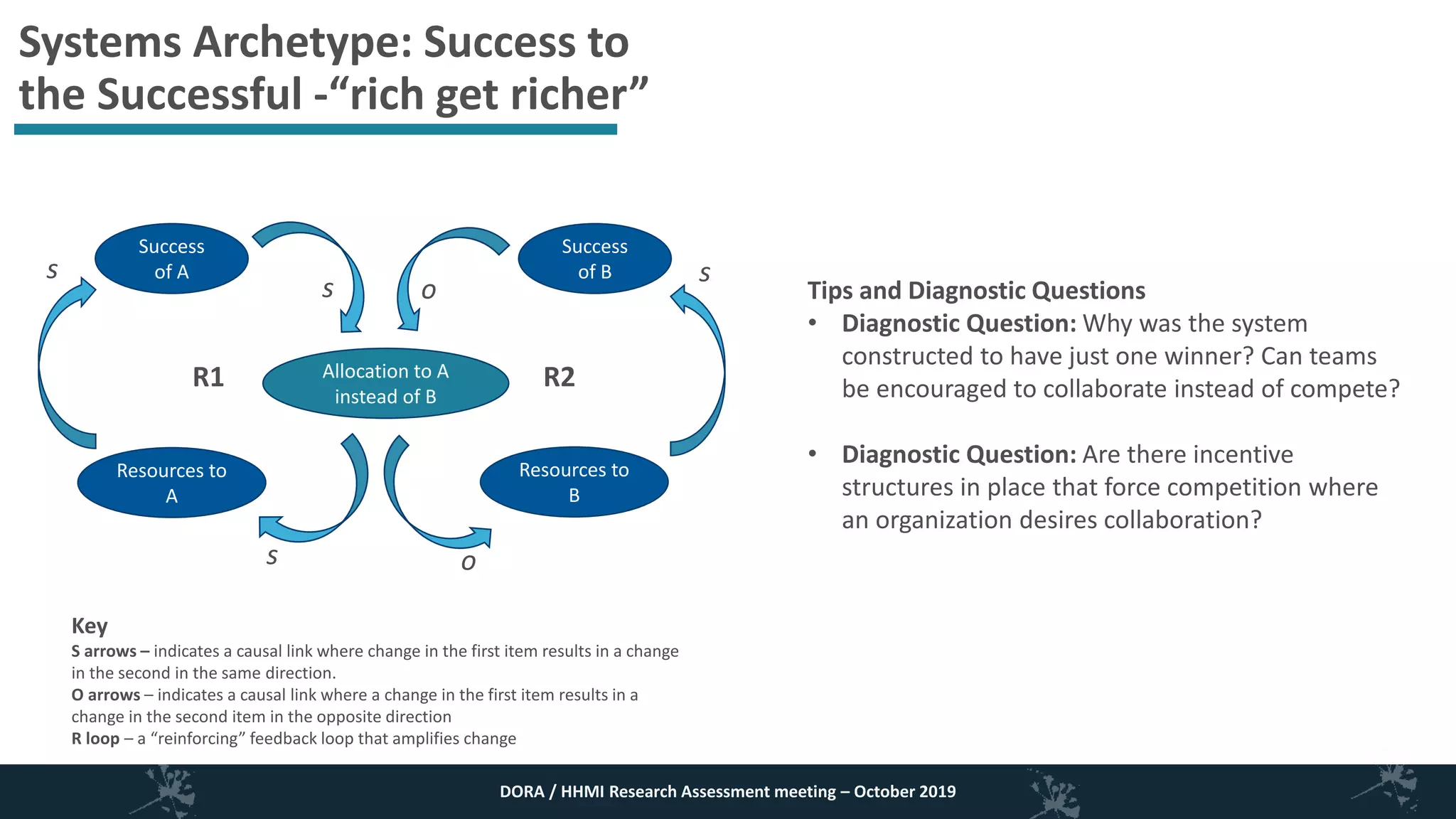
Systems Archetype: Success to
the Successful -“rich get richer”
Tips and Diagnostic Questions
• Diagnostic Question: Why was the system
constructed to have just one winner? Can teams
be encouraged to collaborate instead of compete?
• Diagnostic Question: Are there incentive
structures in place that force competition where
an organization desires collaboration?
Key
S arrows – indicates a causal link where change in the first item results in a change
in the second in the same direction.
O arrows – indicates a causal link where a change in the first item results in a
change in the second item in the opposite direction
R loop – a “reinforcing” feedback loop that amplifies change
Allocation to A
instead of B
Success
of A
R2
R1
s
s o
Success
of B
Resources to
A
Resources to
B
s
o
s
Two ways to start working
with systems thinking
2. The iceberg model
DORA / HHMI Research Assessment meeting – October 2019
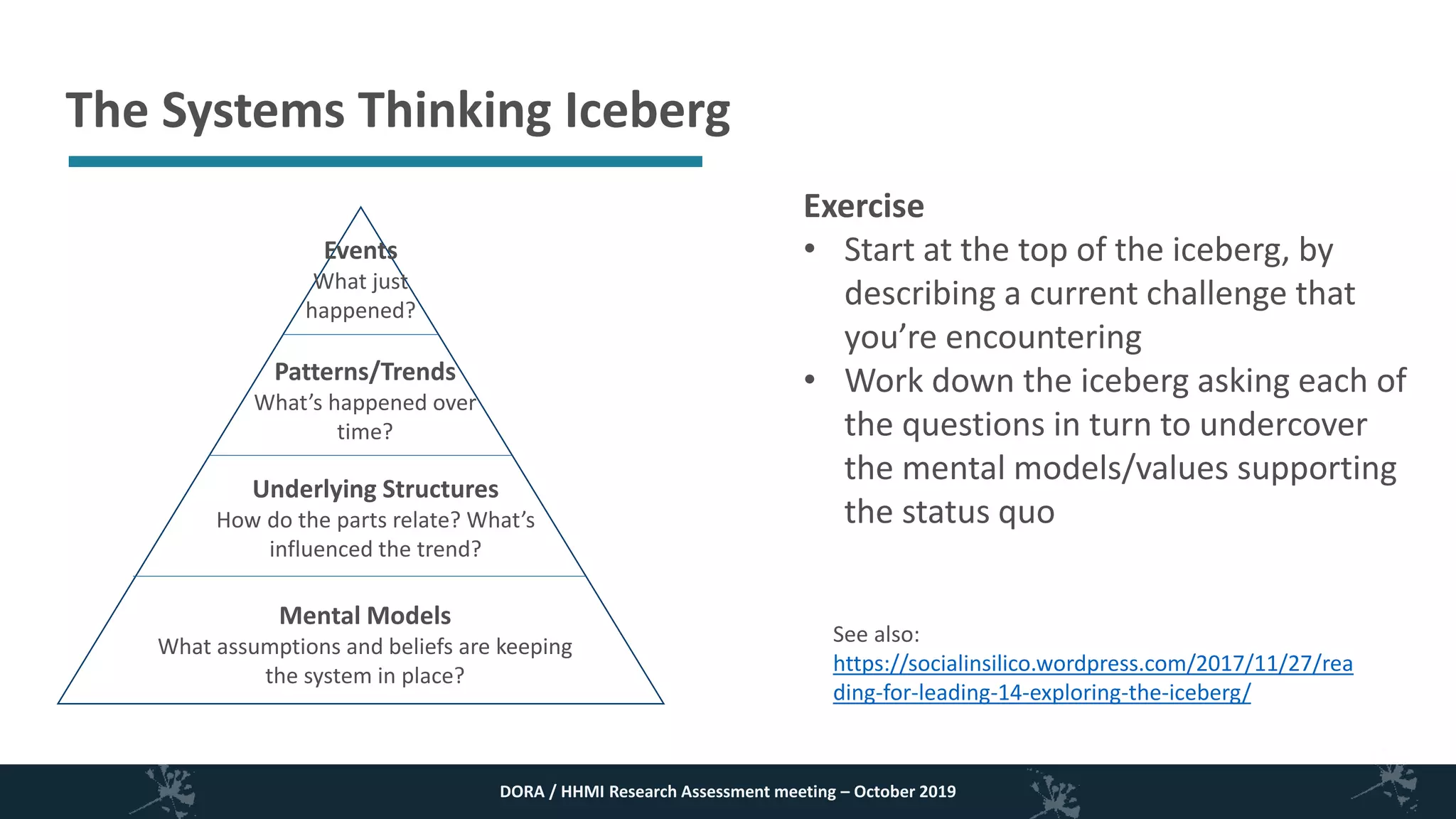
The Systems Thinking Iceberg
Exercise
• Start at the top of the iceberg, by
describing a current challenge that
you’re encountering
• Work down the iceberg asking each of
the questions in turn to undercover
the mental models/values supporting
the status quo
See also:
https://socialinsilico.wordpress.com/2017/11/27/rea
ding-for-leading-14-exploring-the-iceberg/
Events
What just
happened?
Patterns/Trends
What’s happened over
time?
Underlying Structures
How do the parts relate? What’s
influenced the trend?
Mental Models
What assumptions and beliefs are keeping
the system in place?
Further reading
• Thinking in Systems – Donella Meadows
• The Fifth Discipline – Peter Senge
• Systems Thinking for Social Change – Peter Stroh
• The Systems Thinker website: https://thesystemsthinker.com

05WOODLEY-DORA-HHMI-systems-thinking-slides.pptx

  • 1.
    Systems thinking and researchassessment – how might we work with wicked problems? Lou Woodley Director – Center for Scientific Collaboration and Community Engagement louwoodley@cscce.org @LouWoodley
  • 2.
    DORA / HHMIResearch Assessment meeting – October 2019 Why is change so hard? Culture change …is often a “wicked” problem: • Requires addressing the whole system • Likely involves addressing multiple underlying structural elements • Requires more than one intervention – strategies that target a single issue are unlikely to be effective alone • Has multiple interconnected elements • One size doesn’t fit all – need to understand the contexts in which we’re working Ever feel like you’re playing whack-a-mole with a system at equilibrium?
  • 3.
    DORA / HHMIResearch Assessment meeting – October 2019 Where does systems thinking come in? Systems Thinking …is an approach that encourages us to a take a more holistic or systemic view of how different factors relate to one another within a whole. • Encourages us to move away from a focus on individual events or simplistic cause and effect scenarios to focus on the bigger picture • Allows us to see multiple components in relationship at once • Can indicate inputs we may have missed • May make it easier to understand delays – or escalations - in the system • Can suggest points of leverage for interventions
  • 4.
    DORA / HHMIResearch Assessment meeting – October 2019 How do we adopt a systems perspective? Three shifts are required to get to a systems perspective: BIG PICTURE - Move from focusing only on our part of the system to seeing more of the whole system. PERSONAL RESPONSIBILITY - Move from hoping others will change first to identifying where we have agency to change ourselves. SYSTEMS STRUCTURE - Move from focusing on individual events (fires, crises) to understanding and redesigning the deeper systems structures that cause these events. - “Thinking in Systems” by Donella Meadows
  • 5.
    Two ways tostart working with systems thinking 1. Systems archetypes
  • 6.
    DORA / HHMIResearch Assessment meeting – October 2019 Systems Archetype: Success to the Successful -“rich get richer” Tips and Diagnostic Questions • Diagnostic Question: Why was the system constructed to have just one winner? Can teams be encouraged to collaborate instead of compete? • Diagnostic Question: Are there incentive structures in place that force competition where an organization desires collaboration? Key S arrows – indicates a causal link where change in the first item results in a change in the second in the same direction. O arrows – indicates a causal link where a change in the first item results in a change in the second item in the opposite direction R loop – a “reinforcing” feedback loop that amplifies change Allocation to A instead of B Success of A R2 R1 s s o Success of B Resources to A Resources to B s o s
  • 7.
    Two ways tostart working with systems thinking 2. The iceberg model
  • 8.
    DORA / HHMIResearch Assessment meeting – October 2019 The Systems Thinking Iceberg Exercise • Start at the top of the iceberg, by describing a current challenge that you’re encountering • Work down the iceberg asking each of the questions in turn to undercover the mental models/values supporting the status quo See also: https://socialinsilico.wordpress.com/2017/11/27/rea ding-for-leading-14-exploring-the-iceberg/ Events What just happened? Patterns/Trends What’s happened over time? Underlying Structures How do the parts relate? What’s influenced the trend? Mental Models What assumptions and beliefs are keeping the system in place?
  • 9.
    Further reading • Thinkingin Systems – Donella Meadows • The Fifth Discipline – Peter Senge • Systems Thinking for Social Change – Peter Stroh • The Systems Thinker website: https://thesystemsthinker.com