Multiple Inheritance


Traditional (C++-like) implementation of multiple inheritance has several
issues:
      the diamond problem,


  Michal P´se (CTU in Prague)
          ıˇ                    Object Programming Lect. 5: Multiple Inheritance   October 26, 2010   2 / 11
Multiple Inheritance


Traditional (C++-like) implementation of multiple inheritance has several
issues:
      the diamond problem,
      name clashes,


  Michal P´se (CTU in Prague)
          ıˇ                    Object Programming Lect. 5: Multiple Inheritance   October 26, 2010   2 / 11
Multiple Inheritance


Traditional (C++-like) implementation of multiple inheritance has several
issues:
      the diamond problem,
      name clashes,
      glue code and


  Michal P´se (CTU in Prague)
          ıˇ                    Object Programming Lect. 5: Multiple Inheritance   October 26, 2010   2 / 11
Multiple Inheritance


Traditional (C++-like) implementation of multiple inheritance has several
issues:
      the diamond problem,
      name clashes,
      glue code and
      initialization order.


  Michal P´se (CTU in Prague)
          ıˇ                    Object Programming Lect. 5: Multiple Inheritance   October 26, 2010   2 / 11
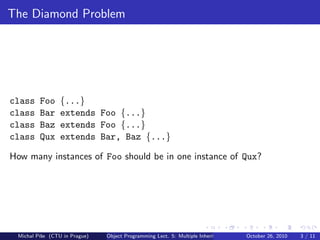
The Diamond Problem


class    Foo     {...}
class    Bar     extends Foo {...}
class    Baz     extends Foo {...}
class    Qux     extends Bar, Baz {...}

How many instances of Foo should be in one instance of Qux?


 Michal P´se (CTU in Prague)
         ıˇ                    Object Programming Lect. 5: Multiple Inheritance   October 26, 2010   3 / 11
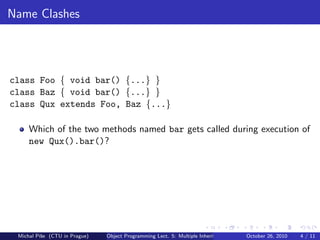
Name Clashes


class Foo { void bar() {...} }
class Baz { void bar() {...} }
class Qux extends Foo, Baz {...}

     Which of the two methods named bar gets called during execution of
     new Qux().bar()?


 Michal P´se (CTU in Prague)
         ıˇ                    Object Programming Lect. 5: Multiple Inheritance   October 26, 2010   4 / 11
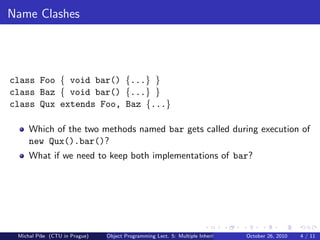
Name Clashes


class Foo { void bar() {...} }
class Baz { void bar() {...} }
class Qux extends Foo, Baz {...}

     Which of the two methods named bar gets called during execution of
     new Qux().bar()?
     What if we need to keep both implementations of bar?


 Michal P´se (CTU in Prague)
         ıˇ                    Object Programming Lect. 5: Multiple Inheritance   October 26, 2010   4 / 11
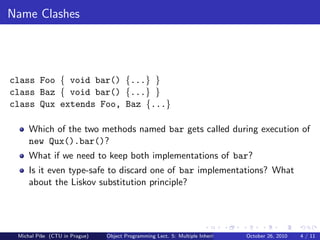
Name Clashes


class Foo { void bar() {...} }
class Baz { void bar() {...} }
class Qux extends Foo, Baz {...}

     Which of the two methods named bar gets called during execution of
     new Qux().bar()?
     What if we need to keep both implementations of bar?
     Is it even type-safe to discard one of bar implementations? What
     about the Liskov substitution principle?


 Michal P´se (CTU in Prague)
         ıˇ                    Object Programming Lect. 5: Multiple Inheritance   October 26, 2010   4 / 11
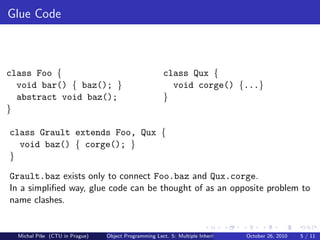
Glue Code


class Foo {                                           class Qux {
  void bar() { baz(); }                                 void corge() {...}
  abstract void baz();                                }
}

class Grault extends Foo, Qux {
  void baz() { corge(); }
}

Grault.baz exists only to connect Foo.baz and Qux.corge.
In a simplified way, glue code can be thought of as an opposite problem to
name clashes.


  Michal P´se (CTU in Prague)
          ıˇ                    Object Programming Lect. 5: Multiple Inheritance   October 26, 2010   5 / 11
Initialization Order


In which order should we dispatch parent constructors when there are
circular dependencies?


  Michal P´se (CTU in Prague)
          ıˇ                    Object Programming Lect. 5: Multiple Inheritance   October 26, 2010   6 / 11
The Need for Multiple Inheritance


Do we even need multiple inheritance? Is it worth the trouble?
      Yes.


  Michal P´se (CTU in Prague)
          ıˇ                    Object Programming Lect. 5: Multiple Inheritance   October 26, 2010   7 / 11
The Need for Multiple Inheritance


Do we even need multiple inheritance? Is it worth the trouble?
      Yes.
      Units of reuse are smaller than units of instantiation. To
      compose a class, many smaller reusable chunks of code need to be
      composed together.


  Michal P´se (CTU in Prague)
          ıˇ                    Object Programming Lect. 5: Multiple Inheritance   October 26, 2010   7 / 11
The Need for Multiple Inheritance


Do we even need multiple inheritance? Is it worth the trouble?
      Yes.
      Units of reuse are smaller than units of instantiation. To
      compose a class, many smaller reusable chunks of code need to be
      composed together.
      The alternative is code duplication.


  Michal P´se (CTU in Prague)
          ıˇ                    Object Programming Lect. 5: Multiple Inheritance   October 26, 2010   7 / 11
Traits


A recent multiple inheritance model.

When inheriting, traits allow to
      create method aliases (to partially resolve name clashes and name
      mismatches),


  Michal P´se (CTU in Prague)
          ıˇ                    Object Programming Lect. 5: Multiple Inheritance   October 26, 2010   8 / 11
Traits


A recent multiple inheritance model.

When inheriting, traits allow to
      create method aliases (to partially resolve name clashes and name
      mismatches),
      drop methods (to get rid of unwanted functionality or to avoid the
      diamond problem) and


  Michal P´se (CTU in Prague)
          ıˇ                    Object Programming Lect. 5: Multiple Inheritance   October 26, 2010   8 / 11
Traits


A recent multiple inheritance model.

When inheriting, traits allow to
      create method aliases (to partially resolve name clashes and name
      mismatches),
      drop methods (to get rid of unwanted functionality or to avoid the
      diamond problem) and
      break the Liskov substitution principle (they do not imply
      subtyping and therefore subsumption is not an issue).


  Michal P´se (CTU in Prague)
          ıˇ                    Object Programming Lect. 5: Multiple Inheritance   October 26, 2010   8 / 11
Eiffel’s Multiple Inheritance


Eiffel approach:
      allow method renaming (name clashes can be resolved while
      sticking to the Liskov substitution principle) and


  Michal P´se (CTU in Prague)
          ıˇ                    Object Programming Lect. 5: Multiple Inheritance   October 26, 2010   9 / 11
Eiffel’s Multiple Inheritance


Eiffel approach:
      allow method renaming (name clashes can be resolved while
      sticking to the Liskov substitution principle) and
      utilize static type information to keep track of method renaming.


  Michal P´se (CTU in Prague)
          ıˇ                    Object Programming Lect. 5: Multiple Inheritance   October 26, 2010   9 / 11
CZ (Cubic Zirconia)


     Two kinds of inheritance hierarchies: extends and requires.


 Michal P´se (CTU in Prague)
         ıˇ                    Object Programming Lect. 5: Multiple Inheritance   October 26, 2010   10 / 11
CZ (Cubic Zirconia)


     Two kinds of inheritance hierarchies: extends and requires.
     Extends hierarchy can not contain cycles.


 Michal P´se (CTU in Prague)
         ıˇ                    Object Programming Lect. 5: Multiple Inheritance   October 26, 2010   10 / 11
CZ (Cubic Zirconia)


     Two kinds of inheritance hierarchies: extends and requires.
     Extends hierarchy can not contain cycles.
     Initialization is based on extends hierarchy.


 Michal P´se (CTU in Prague)
         ıˇ                    Object Programming Lect. 5: Multiple Inheritance   October 26, 2010   10 / 11
See


St´phane Ducasse, Oscar Nierstrasz, Nathanael Sch¨rli, Roel Wuyts, and
  e                                              a
Andrew P. Black. Traits: A mechanism for fine-grained reuse. ACM
Transanctions on Programming Languages and Systems 28, 2 (March
2006), 331–388. http://doi.acm.org/10.1145/1119479.1119483
Donna Malayeri and Jonathan Aldrich. CZ: multiple inheritance
without diamonds. In Proceeding of the 24th ACM SIGPLAN conference
on Object oriented programming systems languages and applications
(OOPSLA ’09). 21–40.
http://doi.acm.org/10.1145/1640089.1640092


 Michal P´se (CTU in Prague)
         ıˇ                    Object Programming Lect. 5: Multiple Inheritance   October 26, 2010   11 / 11

Multiple Inheritance

  • 2.
    Multiple Inheritance Traditional (C++-like)implementation of multiple inheritance has several issues: the diamond problem, Michal P´se (CTU in Prague) ıˇ Object Programming Lect. 5: Multiple Inheritance October 26, 2010 2 / 11
  • 3.
    Multiple Inheritance Traditional (C++-like)implementation of multiple inheritance has several issues: the diamond problem, name clashes, Michal P´se (CTU in Prague) ıˇ Object Programming Lect. 5: Multiple Inheritance October 26, 2010 2 / 11
  • 4.
    Multiple Inheritance Traditional (C++-like)implementation of multiple inheritance has several issues: the diamond problem, name clashes, glue code and Michal P´se (CTU in Prague) ıˇ Object Programming Lect. 5: Multiple Inheritance October 26, 2010 2 / 11
  • 5.
    Multiple Inheritance Traditional (C++-like)implementation of multiple inheritance has several issues: the diamond problem, name clashes, glue code and initialization order. Michal P´se (CTU in Prague) ıˇ Object Programming Lect. 5: Multiple Inheritance October 26, 2010 2 / 11
  • 6.
    The Diamond Problem class Foo {...} class Bar extends Foo {...} class Baz extends Foo {...} class Qux extends Bar, Baz {...} How many instances of Foo should be in one instance of Qux? Michal P´se (CTU in Prague) ıˇ Object Programming Lect. 5: Multiple Inheritance October 26, 2010 3 / 11
  • 7.
    Name Clashes class Foo{ void bar() {...} } class Baz { void bar() {...} } class Qux extends Foo, Baz {...} Which of the two methods named bar gets called during execution of new Qux().bar()? Michal P´se (CTU in Prague) ıˇ Object Programming Lect. 5: Multiple Inheritance October 26, 2010 4 / 11
  • 8.
    Name Clashes class Foo{ void bar() {...} } class Baz { void bar() {...} } class Qux extends Foo, Baz {...} Which of the two methods named bar gets called during execution of new Qux().bar()? What if we need to keep both implementations of bar? Michal P´se (CTU in Prague) ıˇ Object Programming Lect. 5: Multiple Inheritance October 26, 2010 4 / 11
  • 9.
    Name Clashes class Foo{ void bar() {...} } class Baz { void bar() {...} } class Qux extends Foo, Baz {...} Which of the two methods named bar gets called during execution of new Qux().bar()? What if we need to keep both implementations of bar? Is it even type-safe to discard one of bar implementations? What about the Liskov substitution principle? Michal P´se (CTU in Prague) ıˇ Object Programming Lect. 5: Multiple Inheritance October 26, 2010 4 / 11
  • 10.
    Glue Code class Foo{ class Qux { void bar() { baz(); } void corge() {...} abstract void baz(); } } class Grault extends Foo, Qux { void baz() { corge(); } } Grault.baz exists only to connect Foo.baz and Qux.corge. In a simplified way, glue code can be thought of as an opposite problem to name clashes. Michal P´se (CTU in Prague) ıˇ Object Programming Lect. 5: Multiple Inheritance October 26, 2010 5 / 11
  • 11.
    Initialization Order In whichorder should we dispatch parent constructors when there are circular dependencies? Michal P´se (CTU in Prague) ıˇ Object Programming Lect. 5: Multiple Inheritance October 26, 2010 6 / 11
  • 12.
    The Need forMultiple Inheritance Do we even need multiple inheritance? Is it worth the trouble? Yes. Michal P´se (CTU in Prague) ıˇ Object Programming Lect. 5: Multiple Inheritance October 26, 2010 7 / 11
  • 13.
    The Need forMultiple Inheritance Do we even need multiple inheritance? Is it worth the trouble? Yes. Units of reuse are smaller than units of instantiation. To compose a class, many smaller reusable chunks of code need to be composed together. Michal P´se (CTU in Prague) ıˇ Object Programming Lect. 5: Multiple Inheritance October 26, 2010 7 / 11
  • 14.
    The Need forMultiple Inheritance Do we even need multiple inheritance? Is it worth the trouble? Yes. Units of reuse are smaller than units of instantiation. To compose a class, many smaller reusable chunks of code need to be composed together. The alternative is code duplication. Michal P´se (CTU in Prague) ıˇ Object Programming Lect. 5: Multiple Inheritance October 26, 2010 7 / 11
  • 15.
    Traits A recent multipleinheritance model. When inheriting, traits allow to create method aliases (to partially resolve name clashes and name mismatches), Michal P´se (CTU in Prague) ıˇ Object Programming Lect. 5: Multiple Inheritance October 26, 2010 8 / 11
  • 16.
    Traits A recent multipleinheritance model. When inheriting, traits allow to create method aliases (to partially resolve name clashes and name mismatches), drop methods (to get rid of unwanted functionality or to avoid the diamond problem) and Michal P´se (CTU in Prague) ıˇ Object Programming Lect. 5: Multiple Inheritance October 26, 2010 8 / 11
  • 17.
    Traits A recent multipleinheritance model. When inheriting, traits allow to create method aliases (to partially resolve name clashes and name mismatches), drop methods (to get rid of unwanted functionality or to avoid the diamond problem) and break the Liskov substitution principle (they do not imply subtyping and therefore subsumption is not an issue). Michal P´se (CTU in Prague) ıˇ Object Programming Lect. 5: Multiple Inheritance October 26, 2010 8 / 11
  • 18.
    Eiffel’s Multiple Inheritance Eiffelapproach: allow method renaming (name clashes can be resolved while sticking to the Liskov substitution principle) and Michal P´se (CTU in Prague) ıˇ Object Programming Lect. 5: Multiple Inheritance October 26, 2010 9 / 11
  • 19.
    Eiffel’s Multiple Inheritance Eiffelapproach: allow method renaming (name clashes can be resolved while sticking to the Liskov substitution principle) and utilize static type information to keep track of method renaming. Michal P´se (CTU in Prague) ıˇ Object Programming Lect. 5: Multiple Inheritance October 26, 2010 9 / 11
  • 20.
    CZ (Cubic Zirconia) Two kinds of inheritance hierarchies: extends and requires. Michal P´se (CTU in Prague) ıˇ Object Programming Lect. 5: Multiple Inheritance October 26, 2010 10 / 11
  • 21.
    CZ (Cubic Zirconia) Two kinds of inheritance hierarchies: extends and requires. Extends hierarchy can not contain cycles. Michal P´se (CTU in Prague) ıˇ Object Programming Lect. 5: Multiple Inheritance October 26, 2010 10 / 11
  • 22.
    CZ (Cubic Zirconia) Two kinds of inheritance hierarchies: extends and requires. Extends hierarchy can not contain cycles. Initialization is based on extends hierarchy. Michal P´se (CTU in Prague) ıˇ Object Programming Lect. 5: Multiple Inheritance October 26, 2010 10 / 11
  • 23.
    See St´phane Ducasse, OscarNierstrasz, Nathanael Sch¨rli, Roel Wuyts, and e a Andrew P. Black. Traits: A mechanism for fine-grained reuse. ACM Transanctions on Programming Languages and Systems 28, 2 (March 2006), 331–388. http://doi.acm.org/10.1145/1119479.1119483 Donna Malayeri and Jonathan Aldrich. CZ: multiple inheritance without diamonds. In Proceeding of the 24th ACM SIGPLAN conference on Object oriented programming systems languages and applications (OOPSLA ’09). 21–40. http://doi.acm.org/10.1145/1640089.1640092 Michal P´se (CTU in Prague) ıˇ Object Programming Lect. 5: Multiple Inheritance October 26, 2010 11 / 11