CSE P505 Autumn2016 Dan Grossman 2
Lecture 10
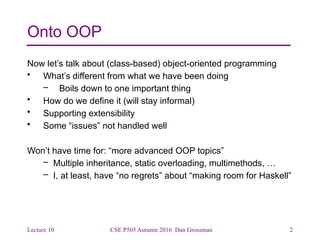
Onto OOP
Now let’s talk about (class-based) object-oriented programming
• What’s different from what we have been doing
– Boils down to one important thing
• How do we define it (will stay informal)
• Supporting extensibility
• Some “issues” not handled well
Won’t have time for: “more advanced OOP topics”
– Multiple inheritance, static overloading, multimethods, …
– I, at least, have “no regrets” about “making room for Haskell”
3.
CSE P505 Autumn2016 Dan Grossman 3
Lecture 10
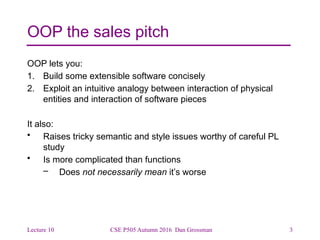
OOP the sales pitch
OOP lets you:
1. Build some extensible software concisely
2. Exploit an intuitive analogy between interaction of physical
entities and interaction of software pieces
It also:
• Raises tricky semantic and style issues worthy of careful PL
study
• Is more complicated than functions
– Does not necessarily mean it’s worse
4.
CSE P505 Autumn2016 Dan Grossman 4
Lecture 10
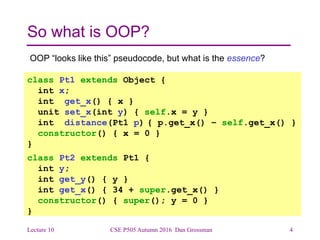
So what is OOP?
OOP “looks like this” pseudocode, but what is the essence?
class Pt1 extends Object {
int x;
int get_x() { x }
unit set_x(int y) { self.x = y }
int distance(Pt1 p) { p.get_x() – self.get_x() }
constructor() { x = 0 }
}
class Pt2 extends Pt1 {
int y;
int get_y() { y }
int get_x() { 34 + super.get_x() }
constructor() { super(); y = 0 }
}
5.
CSE P505 Autumn2016 Dan Grossman 5
Lecture 10
Class-based OOP
In (pure) class-based OOP:
1. Every value is an object
2. Objects communicate via messages (handled by methods)
3. Objects have their own [private] state
4. Every object is an instance of a class
5. A class describes its instances’ behavior
6.
CSE P505 Autumn2016 Dan Grossman 6
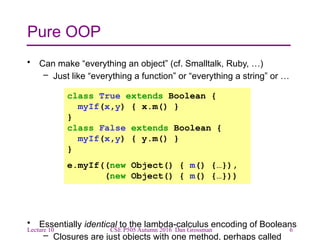
Pure OOP
• Can make “everything an object” (cf. Smalltalk, Ruby, …)
– Just like “everything a function” or “everything a string” or …
• Essentially identical to the lambda-calculus encoding of Booleans
– Closures are just objects with one method, perhaps called
Lecture 10
class True extends Boolean {
myIf(x,y) { x.m() }
}
class False extends Boolean {
myIf(x,y) { y.m() }
}
e.myIf((new Object() { m() {…}),
(new Object() { m() {…}))
7.
CSE P505 Autumn2016 Dan Grossman 7
Lecture 10
OOP can mean many things
Why is this approach such a popular way to structure software?
• Implicit self/this ?
• An ADT (private fields)?
• Inheritance: method/field extension, method override?
• Dynamic dispatch?
• Subtyping? [will do types after the rest, like earlier in course]
• All the above (plus constructor(s)) in one (class) definition
Design question: Better to have small orthogonal features or one
“do it all” feature?
Anyway, let’s consider how “unique to OO” each is…
8.
CSE P505 Autumn2016 Dan Grossman 8
Lecture 10
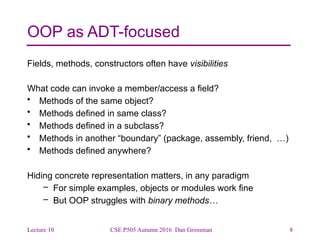
OOP as ADT-focused
Fields, methods, constructors often have visibilities
What code can invoke a member/access a field?
• Methods of the same object?
• Methods defined in same class?
• Methods defined in a subclass?
• Methods in another “boundary” (package, assembly, friend, …)
• Methods defined anywhere?
Hiding concrete representation matters, in any paradigm
– For simple examples, objects or modules work fine
– But OOP struggles with binary methods…
9.
CSE P505 Autumn2016 Dan Grossman 9
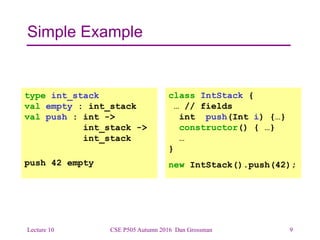
Simple Example
Lecture 10
class IntStack {
… // fields
int push(Int i) {…}
constructor() { …}
…
}
new IntStack().push(42);
type int_stack
val empty : int_stack
val push : int ->
int_stack ->
int_stack
push 42 empty
10.
CSE P505 Autumn2016 Dan Grossman 10
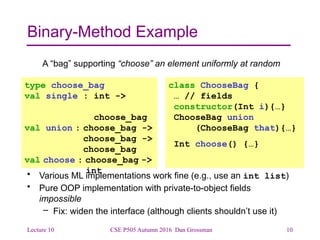
Binary-Method Example
A “bag” supporting “choose” an element uniformly at random
• Various ML implementations work fine (e.g., use an int list)
• Pure OOP implementation with private-to-object fields
impossible
– Fix: widen the interface (although clients shouldn’t use it)
Lecture 10
class ChooseBag {
… // fields
constructor(Int i){…}
ChooseBag union
(ChooseBag that){…}
Int choose() {…}
type choose_bag
val single : int ->
choose_bag
val union : choose_bag ->
choose_bag ->
choose_bag
val choose : choose_bag ->
int
11.
CSE P505 Autumn2016 Dan Grossman 11
Lecture 10
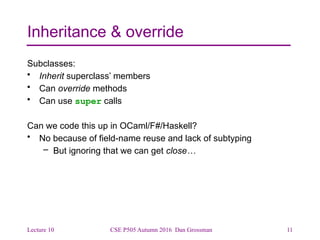
Inheritance & override
Subclasses:
• Inherit superclass’ members
• Can override methods
• Can use super calls
Can we code this up in OCaml/F#/Haskell?
• No because of field-name reuse and lack of subtyping
– But ignoring that we can get close…
12.
CSE P505 Autumn2016 Dan Grossman 12
Lecture 10
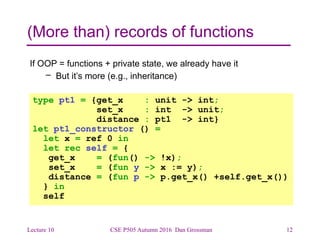
(More than) records of functions
If OOP = functions + private state, we already have it
– But it’s more (e.g., inheritance)
type pt1 = {get_x : unit -> int;
set_x : int -> unit;
distance : pt1 -> int}
let pt1_constructor () =
let x = ref 0 in
let rec self = {
get_x = (fun() -> !x);
set_x = (fun y -> x := y);
distance = (fun p -> p.get_x() +self.get_x())
} in
self
13.
CSE P505 Autumn2016 Dan Grossman 13
Lecture 10
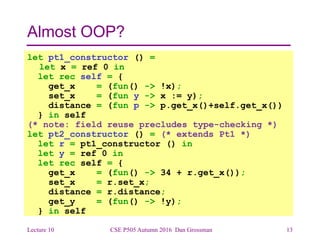
Almost OOP?
let pt1_constructor () =
let x = ref 0 in
let rec self = {
get_x = (fun() -> !x);
set_x = (fun y -> x := y);
distance = (fun p -> p.get_x()+self.get_x())
} in self
(* note: field reuse precludes type-checking *)
let pt2_constructor () = (* extends Pt1 *)
let r = pt1_constructor () in
let y = ref 0 in
let rec self = {
get_x = (fun() -> 34 + r.get_x());
set_x = r.set_x;
distance = r.distance;
get_y = (fun() -> !y);
} in self
14.
CSE P505 Autumn2016 Dan Grossman 14
Lecture 10
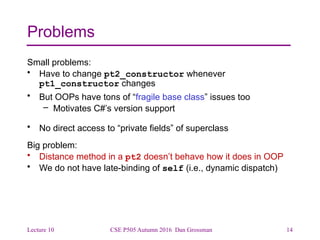
Problems
Small problems:
• Have to change pt2_constructor whenever
pt1_constructor changes
• But OOPs have tons of “fragile base class” issues too
– Motivates C#’s version support
• No direct access to “private fields” of superclass
Big problem:
• Distance method in a pt2 doesn’t behave how it does in OOP
• We do not have late-binding of self (i.e., dynamic dispatch)
15.
CSE P505 Autumn2016 Dan Grossman 15
Lecture 10
The essence
Claims so far:
Class-based objects are:
• So-so ADTs
• Some syntactic sugar for extension and override
And:
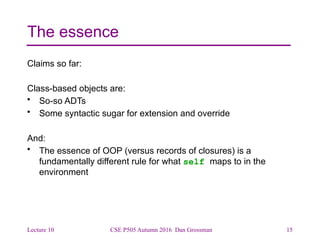
• The essence of OOP (versus records of closures) is a
fundamentally different rule for what self maps to in the
environment
16.
CSE P505 Autumn2016 Dan Grossman 16
Lecture 10
More on late-binding
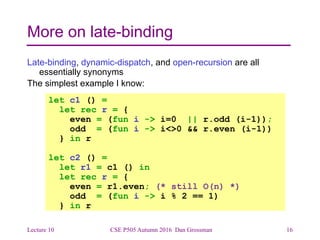
Late-binding, dynamic-dispatch, and open-recursion are all
essentially synonyms
The simplest example I know:
let c1 () =
let rec r = {
even = (fun i -> i=0 || r.odd (i-1));
odd = (fun i -> i<>0 && r.even (i-1))
} in r
let c2 () =
let r1 = c1 () in
let rec r = {
even = r1.even; (* still O(n) *)
odd = (fun i -> i % 2 == 1)
} in r
17.
CSE P505 Autumn2016 Dan Grossman 17
Lecture 10
More on late-binding
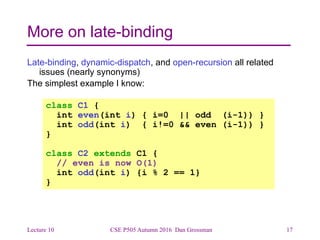
Late-binding, dynamic-dispatch, and open-recursion all related
issues (nearly synonyms)
The simplest example I know:
class C1 {
int even(int i) { i=0 || odd (i-1)) }
int odd(int i) { i!=0 && even (i-1)) }
}
class C2 extends C1 {
// even is now O(1)
int odd(int i) {i % 2 == 1}
}
18.
CSE P505 Autumn2016 Dan Grossman 18
Lecture 10
The big debate
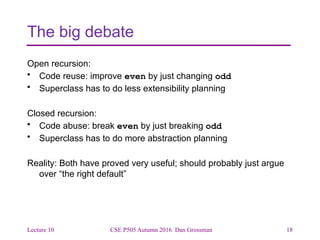
Open recursion:
• Code reuse: improve even by just changing odd
• Superclass has to do less extensibility planning
Closed recursion:
• Code abuse: break even by just breaking odd
• Superclass has to do more abstraction planning
Reality: Both have proved very useful; should probably just argue
over “the right default”
19.
CSE P505 Autumn2016 Dan Grossman 19
Lecture 10
Our plan
• Dynamic dispatch is the essence of OOP
• How can we define/implement dynamic dispatch?
– Basics, not super-optimized versions (see P501)
• How do we use/misuse overriding?
– Functional vs. OOP extensibility
– Revenge of binary methods
• Types for objects
– Our prior study of subtyping mostly suffices
– Subclasses vs. subtypes
20.
CSE P505 Autumn2016 Dan Grossman 20
Lecture 10
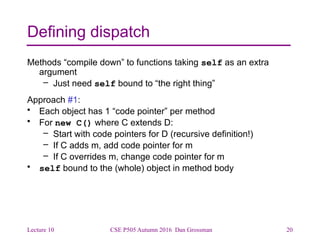
Defining dispatch
Methods “compile down” to functions taking self as an extra
argument
– Just need self bound to “the right thing”
Approach #1:
• Each object has 1 “code pointer” per method
• For new C() where C extends D:
– Start with code pointers for D (recursive definition!)
– If C adds m, add code pointer for m
– If C overrides m, change code pointer for m
• self bound to the (whole) object in method body
21.
CSE P505 Autumn2016 Dan Grossman 21
Lecture 10
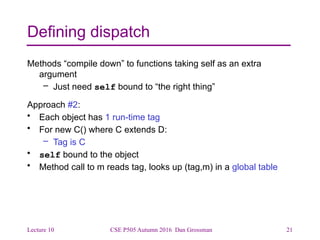
Defining dispatch
Methods “compile down” to functions taking self as an extra
argument
– Just need self bound to “the right thing”
Approach #2:
• Each object has 1 run-time tag
• For new C() where C extends D:
– Tag is C
• self bound to the object
• Method call to m reads tag, looks up (tag,m) in a global table
22.
CSE P505 Autumn2016 Dan Grossman 22
Lecture 10
Which approach?
• The two approaches are very similar
– Just trade space for time via indirection
• vtable pointers are a fast encoding of approach #2
• This “definition” is low-level, but with overriding, simpler models
are probably wrong
23.
CSE P505 Autumn2016 Dan Grossman 23
Lecture 10
Our plan
• Dynamic dispatch is the essence of OOP
• How can we define/implement dynamic dispatch?
– Basics, not super-optimized versions (see P501)
• How do we use/misuse overriding?
– Functional vs. OOP extensibility
– Revenge of binary methods
• Types for objects
– Our prior study of subtyping mostly suffices
– Subclasses vs. subtypes
24.
CSE P505 Autumn2016 Dan Grossman 24
Lecture 10
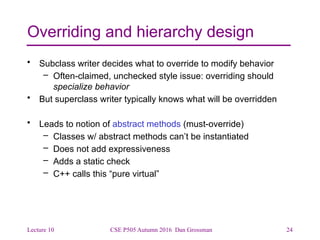
Overriding and hierarchy design
• Subclass writer decides what to override to modify behavior
– Often-claimed, unchecked style issue: overriding should
specialize behavior
• But superclass writer typically knows what will be overridden
• Leads to notion of abstract methods (must-override)
– Classes w/ abstract methods can’t be instantiated
– Does not add expressiveness
– Adds a static check
– C++ calls this “pure virtual”
25.
CSE P505 Autumn2016 Dan Grossman 25
Lecture 10
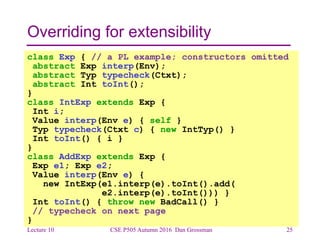
Overriding for extensibility
class Exp { // a PL example; constructors omitted
abstract Exp interp(Env);
abstract Typ typecheck(Ctxt);
abstract Int toInt();
}
class IntExp extends Exp {
Int i;
Value interp(Env e) { self }
Typ typecheck(Ctxt c) { new IntTyp() }
Int toInt() { i }
}
class AddExp extends Exp {
Exp e1; Exp e2;
Value interp(Env e) {
new IntExp(e1.interp(e).toInt().add(
e2.interp(e).toInt())) }
Int toInt() { throw new BadCall() }
// typecheck on next page
}
26.
CSE P505 Autumn2016 Dan Grossman 26
Lecture 10
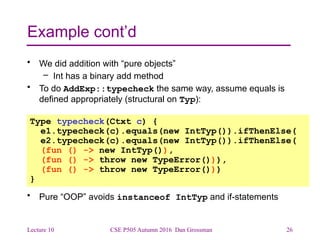
Example cont’d
• We did addition with “pure objects”
– Int has a binary add method
• To do AddExp::typecheck the same way, assume equals is
defined appropriately (structural on Typ):
Type typecheck(Ctxt c) {
e1.typecheck(c).equals(new IntTyp()).ifThenElse(
e2.typecheck(c).equals(new IntTyp()).ifThenElse(
(fun () -> new IntTyp()),
(fun () -> throw new TypeError())),
(fun () -> throw new TypeError()))
}
• Pure “OOP” avoids instanceof IntTyp and if-statements
27.
CSE P505 Autumn2016 Dan Grossman 27
Lecture 10
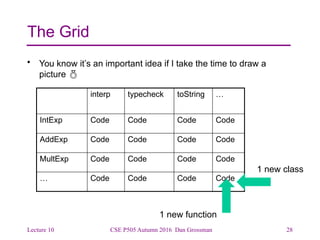
More extension
• Now suppose we want MultExp
– No change to existing code, unlike OCaml!
– In OCaml, can “prepare” with “Else of ‘a” constructor
[not shown]
• Now suppose we want a toString method
– Must change all existing classes, unlike OCaml!
– In OOP, can “prepare” with a “Visitor pattern” [not shown]
• Extensibility has many dimensions – most require forethought!
28.
CSE P505 Autumn2016 Dan Grossman 28
Lecture 10
The Grid
• You know it’s an important idea if I take the time to draw a
picture
interp typecheck toString …
IntExp Code Code Code Code
AddExp Code Code Code Code
MultExp Code Code Code Code
… Code Code Code Code
1 new function
1 new class
29.
CSE P505 Autumn2016 Dan Grossman 29
Lecture 10
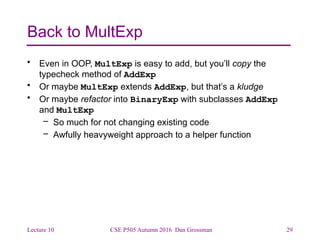
Back to MultExp
• Even in OOP, MultExp is easy to add, but you’ll copy the
typecheck method of AddExp
• Or maybe MultExp extends AddExp, but that’s a kludge
• Or maybe refactor into BinaryExp with subclasses AddExp
and MultExp
– So much for not changing existing code
– Awfully heavyweight approach to a helper function
30.
CSE P505 Autumn2016 Dan Grossman 30
Lecture 10
Our plan
• Dynamic dispatch is the essence of OOP
• How can we define/implement dynamic dispatch?
– Basics, not super-optimized versions (see P501)
• How do we use/misuse overriding?
– Functional vs. OOP extensibility
– Revenge of binary methods
• Types for objects
– Our prior study of subtyping mostly suffices
– Subclasses vs. subtypes
31.
CSE P505 Autumn2016 Dan Grossman 31
The equals mess
• Equals is very common and important (cf. Java, C#, …)
• But it’s a binary method and does not work well when combined
with subclassing and overriding
• Summarize an hour-long lecture (!!) in a sophomore-level course*
(CSE331) in the next 5 minutes…
• [Focus on Java, which I know better]
*It’s not the == vs. .equals lecture – that’s in an earlier course
Acknowledgments for slides 31-36: CSE331 instructors, particularly Michael D. Ernst
Lecture 10
32.
CSE P505 Autumn2016 Dan Grossman 32
How equals should behave
Documented contract for subclasses of class Object is sensible:
“reflexive, symmetric, transitive” [and more, not shown here]
Reflexive a.equals(a) == true
– Confusing if an object does not equal itself
Symmetric a.equals(b) b.equals(a)
– Confusing if order-of-arguments matters
Transitive a.equals(b) b.equals(c)
a.equals(c)
– Confusing again to violate centuries of logical reasoning
Lecture 10
33.
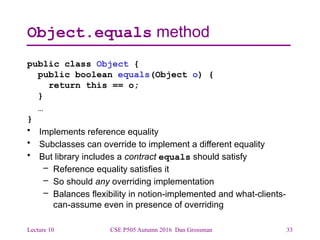
Object.equals method
public classObject {
public boolean equals(Object o) {
return this == o;
}
…
}
• Implements reference equality
• Subclasses can override to implement a different equality
• But library includes a contract equals should satisfy
– Reference equality satisfies it
– So should any overriding implementation
– Balances flexibility in notion-implemented and what-clients-
can-assume even in presence of overriding
33
CSE P505 Autumn 2016 Dan Grossman
Lecture 10
34.
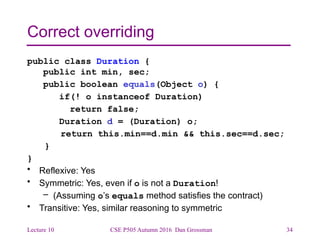
Correct overriding
public classDuration {
public int min, sec;
public boolean equals(Object o) {
if(! o instanceof Duration)
return false;
Duration d = (Duration) o;
return this.min==d.min && this.sec==d.sec;
}
}
• Reflexive: Yes
• Symmetric: Yes, even if o is not a Duration!
– (Assuming o’s equals method satisfies the contract)
• Transitive: Yes, similar reasoning to symmetric
CSE P505 Autumn 2016 Dan Grossman 34
Lecture 10
35.
CSE P505 Autumn2016 Dan Grossman 35
But then you are stuck
• Only “correct” for the contract approach below is “ignore
nanoseconds”, which is probably not what you want
class NanoDuration extends Duration {
public int nano;
public NanoDuration(int min, int sec, int nano){
super(min,sec);
this.nano = nano;
}
public boolean equals(Object o) { ????? }
…
}
• Any use of nanoseconds breaks symmetry or transitivity or both
– When comparing a mix of Duration and NanoDuration
• Can change Duration’s equals to be “false” for any subclass of
Duration, but that’s not what you want [for other subclasses]
Lecture 10
36.
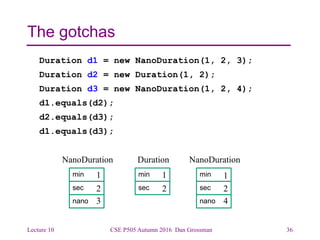
The gotchas
CSE P505Autumn 2016 Dan Grossman 36
Duration d1 = new NanoDuration(1, 2, 3);
Duration d2 = new Duration(1, 2);
Duration d3 = new NanoDuration(1, 2, 4);
d1.equals(d2);
d2.equals(d3);
d1.equals(d3);
NanoDuration
min
sec
nano
1
2
3
Duration
min
sec
1
2
NanoDuration
min
sec
nano
1
2
4
Lecture 10
37.
CSE P505 Autumn2016 Dan Grossman 37
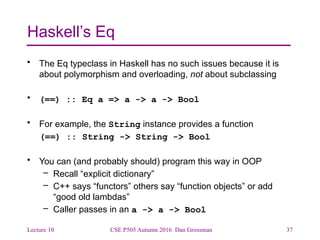
Haskell’s Eq
• The Eq typeclass in Haskell has no such issues because it is
about polymorphism and overloading, not about subclassing
• (==) :: Eq a => a -> a -> Bool
• For example, the String instance provides a function
(==) :: String -> String -> Bool
• You can (and probably should) program this way in OOP
– Recall “explicit dictionary”
– C++ says “functors” others say “function objects” or add
“good old lambdas”
– Caller passes in an a -> a -> Bool
Lecture 10
38.
CSE P505 Autumn2016 Dan Grossman 38
Lecture 10
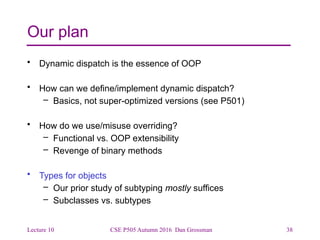
Our plan
• Dynamic dispatch is the essence of OOP
• How can we define/implement dynamic dispatch?
– Basics, not super-optimized versions (see P501)
• How do we use/misuse overriding?
– Functional vs. OOP extensibility
– Revenge of binary methods
• Types for objects
– Our prior study of subtyping mostly suffices
– Subclasses vs. subtypes
39.
CSE P505 Autumn2016 Dan Grossman 39
Lecture 10
Typechecking
Remember “my religion”:
To talk about types, first discuss “what are we preventing”
1. In pure OOP, stuck if we need to interpret v.m(v1,…,vn) and
v has no m method (taking n args)
• “No such method” error
2. Also if ambiguous: multiple methods with same name and
there is no “best choice”
• “No best match” error
• Arises with static overloading and multimethods [omitted]
40.
CSE P505 Autumn2016 Dan Grossman 40
Lecture 10
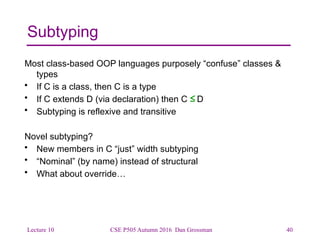
Subtyping
Most class-based OOP languages purposely “confuse” classes &
types
• If C is a class, then C is a type
• If C extends D (via declaration) then C ≤ D
• Subtyping is reflexive and transitive
Novel subtyping?
• New members in C “just” width subtyping
• “Nominal” (by name) instead of structural
• What about override…
41.
CSE P505 Autumn2016 Dan Grossman 41
Lecture 10
Subtyping, continued
• If C extends D, overriding m, what do we need:
– Arguments contravariant (assume less)
– Result covariant (provide more)
• Many “real” languages are more restrictive
– Often in favor of static overloading
• Some languages (e.g., Eiffel, TypeScript) try to be more flexible
– At expense of run-time checks/casts
Good we studied this in a simpler setting!
– Little new to say – just “records of [immutable] methods”
42.
CSE P505 Autumn2016 Dan Grossman 42
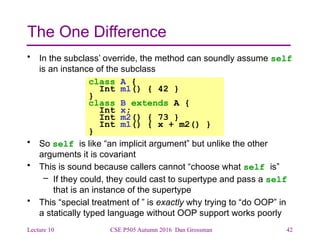
The One Difference
• In the subclass’ override, the method can soundly assume self
is an instance of the subclass
• So self is like “an implicit argument” but unlike the other
arguments it is covariant
• This is sound because callers cannot “choose what self is”
– If they could, they could cast to supertype and pass a self
that is an instance of the supertype
• This “special treatment of ” is exactly why trying to “do OOP” in
a statically typed language without OOP support works poorly
Lecture 10
class A {
Int m1() { 42 }
}
class B extends A {
Int x;
Int m2() { 73 }
Int m1() { x + m2() }
}
43.
CSE P505 Autumn2016 Dan Grossman 43
Lecture 10
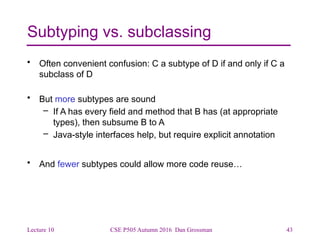
Subtyping vs. subclassing
• Often convenient confusion: C a subtype of D if and only if C a
subclass of D
• But more subtypes are sound
– If A has every field and method that B has (at appropriate
types), then subsume B to A
– Java-style interfaces help, but require explicit annotation
• And fewer subtypes could allow more code reuse…
44.
CSE P505 Autumn2016 Dan Grossman 44
Lecture 10
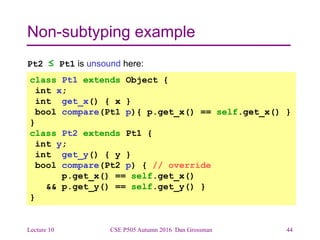
Non-subtyping example
Pt2 ≤ Pt1 is unsound here:
class Pt1 extends Object {
int x;
int get_x() { x }
bool compare(Pt1 p){ p.get_x() == self.get_x() }
}
class Pt2 extends Pt1 {
int y;
int get_y() { y }
bool compare(Pt2 p) { // override
p.get_x() == self.get_x()
&& p.get_y() == self.get_y() }
}
45.
CSE P505 Autumn2016 Dan Grossman 45
Lecture 10
What happened
• Could inherit code without being a subtype
• Cannot always do this
– what if get_x called self.compare with a Pt1
Possible solutions:
– Re-typecheck get_x in subclass
– Use a really fancy type system
– Don’t override compare
• Moral: Not suggesting “subclassing not subtyping” is useful, but
the concepts of inheritance and subtyping are orthogonal
46.
CSE P505 Autumn2016 Dan Grossman 46
Lecture 10
Now what?
• That’s basic class-based OOP
– Note: Not all OOPLs use classes
(Javascript, Self, Cecil, …)
• Now I’d love to do some “fancy” stuff…
– Multiple inheritance; multiple interfaces
– Static overloading
– Multimethods
– Revenge of bounded polymorphism
… but we are out of time for the quarter!
… so let’s wrap-up…
47.
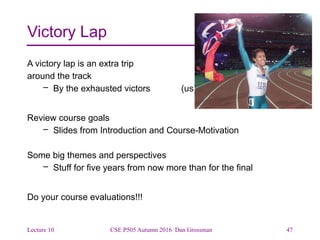
CSE P505 Autumn2016 Dan Grossman 47
Victory Lap
A victory lap is an extra trip
around the track
– By the exhausted victors (us)
Review course goals
– Slides from Introduction and Course-Motivation
Some big themes and perspectives
– Stuff for five years from now more than for the final
Do your course evaluations!!!
Lecture 10
48.
CSE P505 Autumn2016 Dan Grossman 48
Thanks!
• To you! (On top of your day jobs!)
• To John! (On top of your research!)
• To “Caryl and the kids who managed 9 bedtimes without me”
Lecture 10
49.
CSE P505 Autumn2016 Dan Grossman 49
Lecture 10
Course [incomplete] summary
• Functional programming, datatypes, modularity, etc.
• Defining languages is hard but worth it
– Interpretation vs. translation
– Inference rules vs. a PL for the metalanguage
• Features we investigated
– Mutable variables (and loops)
– Higher-order functions, scope
– Pairs and sums
– Continuations
– Monads
– Typeclasses
– Objects
• Types restrict programs (often a good thing (!) then
counterbalanced via flavors of polymorphism)
50.
CSE P505 Autumn2016 Dan Grossman 50
[Now a few slides unedited from Lecture 1 that probably make a lot
more sense now]
Lecture 10
51.
CSE P505 Autumn2016 Dan Grossman 51
Lecture 1
OCaml
• OCaml is an awesome, high-level language
• We’ll use a small core subset that is well-suited to manipulating
recursive data structures (like programs)
• Tutorial will demonstrate its mostly functional nature
– Most data immutable
– Recursion instead of loops
– Lots of passing/returning functions
• Again, will support F# as a fine alternative
52.
CSE P505 Autumn2016 Dan Grossman 52
Last Motivation: “Fan Mail”
This class has changed the way I think about programming - even
if I don’t get to use all of the concepts we explored in OCaml (I
work in C++ most of the time), understanding more of the theory
makes a tremendous difference to how I go about solving a
problem.
Lecture 1
53.
CSE P505 Autumn2016 Dan Grossman 53
Lecture 1
Picking a language
Admittedly, semantics can be far down the priority list:
• What libraries are available?
• What do management, clients want?
• What is the de facto industry standard?
• What does my team already know?
• Who will I be able to recruit?
But:
• Nice thing about class: we get to ignore all that
• Technology leaders affect the answers
• Sound reasoning about programs requires semantics
– Mission-critical code doesn’t “seem to be right”
– Blame: the compiler vendor or you?
54.
CSE P505 Autumn2016 Dan Grossman 54
Lecture 1
Academic languages
Aren’t academic languages worthless?
• Yes: fewer jobs, less tool support, etc.
– But a lot has changed in the last decade
• No:
– Knowing them makes you a better programmer
– Java did not exist in 1993; what doesn’t exist now
– Eventual vindication (on the leading edge):
garbage-collection, generics, function closures, iterators,
universal data format, … (what’s next?)
– We don’t conquer; we assimilate
• And get no credit (fine by me)
– Functional programming is “finally cool”-ish
55.
CSE P505 Autumn2016 Dan Grossman 55
Lecture 1
“But I don’t do languages”
Aren’t languages somebody else’s problem?
• If you design an extensible software system or a non-trivial API,
you'll end up designing a (small?) programming language!
• Another view: A language is an API with few functions but
sophisticated data. Conversely, an interface is just a stupid
programming language…
56.
CSE P505 Autumn2016 Dan Grossman 56
[Now 1.5 more slides]
Lecture 10
57.
CSE P505 Autumn2016 Dan Grossman 57
Lecture 10
Penultimate slide
• We largely avoided:
– Subjective non-science (“I like curly braces”)
– Real-world issues (“cool libraries / tricks in language X”)
• Focused on:
– Concepts that almost every language has, including the next
fad that doesn’t exist yet
– Connections (objects and closures are different, but not
totally different)
– Reference implementations, not fast or industrial-strength
ones
– “Cool stuff” (e.g., Curry-Howard, laziness, …)
58.
CSE P505 Autumn2016 Dan Grossman 58
Lecture 10
Questions?
Questions?
About PL, the exam, life, etc.?
[Oh, and reminder: do your course evaluation by Sunday midnight!]

![CSE P505 Autumn 2016 Dan Grossman 5
Lecture 10
Class-based OOP
In (pure) class-based OOP:
1. Every value is an object
2. Objects communicate via messages (handled by methods)
3. Objects have their own [private] state
4. Every object is an instance of a class
5. A class describes its instances’ behavior](https://image.slidesharecdn.com/lec10-250922005831-c2234307/85/Software-Design-Implementation-object-course-5-320.jpg)
![CSE P505 Autumn 2016 Dan Grossman 7
Lecture 10
OOP can mean many things
Why is this approach such a popular way to structure software?
• Implicit self/this ?
• An ADT (private fields)?
• Inheritance: method/field extension, method override?
• Dynamic dispatch?
• Subtyping? [will do types after the rest, like earlier in course]
• All the above (plus constructor(s)) in one (class) definition
Design question: Better to have small orthogonal features or one
“do it all” feature?
Anyway, let’s consider how “unique to OO” each is…](https://image.slidesharecdn.com/lec10-250922005831-c2234307/85/Software-Design-Implementation-object-course-7-320.jpg)
![CSE P505 Autumn 2016 Dan Grossman 27
Lecture 10
More extension
• Now suppose we want MultExp
– No change to existing code, unlike OCaml!
– In OCaml, can “prepare” with “Else of ‘a” constructor
[not shown]
• Now suppose we want a toString method
– Must change all existing classes, unlike OCaml!
– In OOP, can “prepare” with a “Visitor pattern” [not shown]
• Extensibility has many dimensions – most require forethought!](https://image.slidesharecdn.com/lec10-250922005831-c2234307/85/Software-Design-Implementation-object-course-27-320.jpg)
![CSE P505 Autumn 2016 Dan Grossman 31
The equals mess
• Equals is very common and important (cf. Java, C#, …)
• But it’s a binary method and does not work well when combined
with subclassing and overriding
• Summarize an hour-long lecture (!!) in a sophomore-level course*
(CSE331) in the next 5 minutes…
• [Focus on Java, which I know better]
*It’s not the == vs. .equals lecture – that’s in an earlier course
Acknowledgments for slides 31-36: CSE331 instructors, particularly Michael D. Ernst
Lecture 10](https://image.slidesharecdn.com/lec10-250922005831-c2234307/85/Software-Design-Implementation-object-course-31-320.jpg)
![CSE P505 Autumn 2016 Dan Grossman 32
How equals should behave
Documented contract for subclasses of class Object is sensible:
“reflexive, symmetric, transitive” [and more, not shown here]
Reflexive a.equals(a) == true
– Confusing if an object does not equal itself
Symmetric a.equals(b) b.equals(a)
– Confusing if order-of-arguments matters
Transitive a.equals(b) b.equals(c)
a.equals(c)
– Confusing again to violate centuries of logical reasoning
Lecture 10](https://image.slidesharecdn.com/lec10-250922005831-c2234307/85/Software-Design-Implementation-object-course-32-320.jpg)
![CSE P505 Autumn 2016 Dan Grossman 35
But then you are stuck
• Only “correct” for the contract approach below is “ignore
nanoseconds”, which is probably not what you want
class NanoDuration extends Duration {
public int nano;
public NanoDuration(int min, int sec, int nano){
super(min,sec);
this.nano = nano;
}
public boolean equals(Object o) { ????? }
…
}
• Any use of nanoseconds breaks symmetry or transitivity or both
– When comparing a mix of Duration and NanoDuration
• Can change Duration’s equals to be “false” for any subclass of
Duration, but that’s not what you want [for other subclasses]
Lecture 10](https://image.slidesharecdn.com/lec10-250922005831-c2234307/85/Software-Design-Implementation-object-course-35-320.jpg)
![CSE P505 Autumn 2016 Dan Grossman 39
Lecture 10
Typechecking
Remember “my religion”:
To talk about types, first discuss “what are we preventing”
1. In pure OOP, stuck if we need to interpret v.m(v1,…,vn) and
v has no m method (taking n args)
• “No such method” error
2. Also if ambiguous: multiple methods with same name and
there is no “best choice”
• “No best match” error
• Arises with static overloading and multimethods [omitted]](https://image.slidesharecdn.com/lec10-250922005831-c2234307/85/Software-Design-Implementation-object-course-39-320.jpg)
![CSE P505 Autumn 2016 Dan Grossman 41
Lecture 10
Subtyping, continued
• If C extends D, overriding m, what do we need:
– Arguments contravariant (assume less)
– Result covariant (provide more)
• Many “real” languages are more restrictive
– Often in favor of static overloading
• Some languages (e.g., Eiffel, TypeScript) try to be more flexible
– At expense of run-time checks/casts
Good we studied this in a simpler setting!
– Little new to say – just “records of [immutable] methods”](https://image.slidesharecdn.com/lec10-250922005831-c2234307/85/Software-Design-Implementation-object-course-41-320.jpg)
![CSE P505 Autumn 2016 Dan Grossman 49
Lecture 10
Course [incomplete] summary
• Functional programming, datatypes, modularity, etc.
• Defining languages is hard but worth it
– Interpretation vs. translation
– Inference rules vs. a PL for the metalanguage
• Features we investigated
– Mutable variables (and loops)
– Higher-order functions, scope
– Pairs and sums
– Continuations
– Monads
– Typeclasses
– Objects
• Types restrict programs (often a good thing (!) then
counterbalanced via flavors of polymorphism)](https://image.slidesharecdn.com/lec10-250922005831-c2234307/85/Software-Design-Implementation-object-course-49-320.jpg)
![CSE P505 Autumn 2016 Dan Grossman 50
[Now a few slides unedited from Lecture 1 that probably make a lot
more sense now]
Lecture 10](https://image.slidesharecdn.com/lec10-250922005831-c2234307/85/Software-Design-Implementation-object-course-50-320.jpg)
![CSE P505 Autumn 2016 Dan Grossman 56
[Now 1.5 more slides]
Lecture 10](https://image.slidesharecdn.com/lec10-250922005831-c2234307/85/Software-Design-Implementation-object-course-56-320.jpg)
![CSE P505 Autumn 2016 Dan Grossman 58
Lecture 10
Questions?
Questions?
About PL, the exam, life, etc.?
[Oh, and reminder: do your course evaluation by Sunday midnight!]](https://image.slidesharecdn.com/lec10-250922005831-c2234307/85/Software-Design-Implementation-object-course-58-320.jpg)


