International Journal of Recent Research in Interdisciplinary Sciences (IJRRIS) 
Vol. 1, Issue 1, pp: (35-46), Month: April - June 2014, Available at: www.paperpublications.org 
Page | 35 
Paper Publications 
Improved Spider Algorithm for Solving Optimal Reactive Power Dispatch Problem 
1K. Lenin, 2Dr.B.Ravindhranath Reddy 
1Research Scholar, JNTU, Hyderabad, India. 
2Deputy Executive Engineer, Jawaharlal Nehru Technological University Kukatpally, Hyderabad 500 085, India 
Abstract: In this paper improved spider algorithm (ISA) is projected to solve the optimal reactive power dispatch (ORPD) Problem. Stimulated by the societal spiders, we suggest a new Improved Spider Algorithm (ISA) to solve ORPD problem. The structure is chiefly based on the foraging approach of social spiders, which make use of the vibrations spread over the spider web to decide the position of preys. The simulation results demonstrate high-quality performance of ISA in solving an optimal reactive power dispatch problem. The projected algorithm has been tested on IEEE 30 bus system and compared to other specified algorithms. Results show that ISA is more efficient than other algorithms to reduce the real power loss and to enhance the voltage profile index. 
Keywords: spider algorithm, swarm intelligence, evolutionary computation, optimal reactive power, Transmission loss. 
1. INTRODUCTION 
In recent years the optimal reactive power dispatch (ORPD) problem has received huge attention as a result of the enhancement on economy and security of power system operation. Solutions of ORPD problem intend to minimize object functions such as fuel cost, power system loses, etc. while satisfying a number of constraints like limits of bus voltages, tap settings of transformers, reactive and active power of power resources and transmission lines and a number of controllable Variables [1, 2]. In the literature, many methods for solving the ORPD problem have been done up to now. At the beginning, several classical methods such as gradient based [3], interior point [4], linear programming [5] and quadratic programming [6] have been effectively used in order to solve the ORPD problem. However, these methods have some disadvantages in the procedure of solving the complex ORPD problem. Drawbacks of these algorithms can be declared insecure convergence properties, extended execution time, and algorithmic intricacy. In addition, the solution can be trapped in local minima [1, 7]. In order to triumph over these disadvantages, researches have been effectively applied evolutionary and heuristic algorithms such as Genetic Algorithm (GA) [2], Differential Evolution (DE) [8] and Particle Swarm Optimization (PSO) [9]. Voltage stability evaluation using modal analysis [10] is used as the indicator of voltage stability. At present several types of Evolutionary algorithm (EA) have been extensively employed to solve real world combinatorial problems. These algorithms reveal reasonable performance compared with conventional optimization techniques, particularly when applied to solve non-convex optimization problems [11]. In the past decade, swarm intelligence, a fresh kind of evolutionary computing technique, has fascinated much research interest [12]. Swarm intelligence is chiefly concerned with the methodology to model the behaviour of social animals and insects for problem solving. Researchers develop optimization algorithms by mimicking the behaviour of ants, bees, bacteria, fireflies and other organisms. The thrust of creating such algorithms was provided by the rising needs to solve optimization problems that were very complicated or even considered as obdurate. Among all spiders has been a chief research subject in bionic engineering for several years. Conversely, the majority of research interrelated to spiders focused on the simulation of its walking pattern to design robots [13]. A probable motive for this is that a majority of the spiders observed are lonely [14], which means that they spend most of their lives without intermingle with others of their species. Conversely, among the 35 000 spider species observed and described by scientists, some species are societal. These spiders live in groups, e.g. Mallos gregalis and Oecobius civitas. Based on these social spiders, this paper formulates a new global optimization method to solve the ORPD problem. Spiders are air-breathing arthropods. They have eight legs and chelicerae with fangs.
International Journal of Recent Research in Interdisciplinary Sciences (IJRRIS) 
Vol. 1, Issue 1, pp: (35-46), Month: April - June 2014, Available at: www.paperpublications.org 
Page | 36 
Paper Publications 
They use an extensive range of different strategies for foraging, and most of them sense prey by sensing vibrations. Spiders have long been known to be very responsive to vibratory stimulation, as vibrations on their webs notify them of the capture of prey. If the vibrations are in a defined range of frequency, spiders attack the vibration source. The social spiders can also distinguish vibrations generated by the prey with ones generated by other spiders [15]. The social spiders submissively receive the vibrations produced by other spiders on the same web to have an apparent view of the web. This is one of the exclusive characteristics which differentiates the social spiders from other organisms as the latter habitually exchange information actively, which decreases the information loss to some degree but augments the energy used for contact [16]. In this paper, enthused by the social behaviour of the social spiders, particularly their foraging behavior, we put forward a new Improved Spider Algorithm (ISA) to solve ORPD problem. The foraging behaviour of the social spider can be explained as the mutual movement of the spiders towards the food source location. The spiders receive and analyses the vibrations proliferated on the web to decide the potential direction of a food source [17]. In this procedure, the spiders help each other to move towards the prey. We exploit this natural behaviour to perform optimization over the search space in ISA. The crowd living phenomenon has been studied intensively in animal behaviour ecology. One of the causes that animals congregate and live together are to augment the possibility of successful foraging and diminish the energy cost in this process [18]. In order to smooth the progress of the analysis of social foraging behaviour, researchers projected two foraging models: information sharing (IS) model [19] and producer-scrounger (PS) model [20]. The individuals below the IS model execute individual searching and look for for opportunity to join other individuals concurrently. In the PS model, the individuals are alienated into leaders and followers. Since there is no leader in social spiders [21], it seems the IS model is more appropriate, and we use this model to manage the searching pattern of ISA. Swarm intelligence algorithms imitate the methods in nature to drive a search for the optimal solution. The performance of ISA has been evaluated in standard IEEE 30 bus test system and the results analysis shows that our proposed approach outperforms all approaches investigated in this paper. 
2. VOLTAGE STABILITY EVALUATION 
2.1. Modal analysis for voltage stability evaluation 
The linearized steady state system power flow equations are given by. 
[ ] [ ] (1) 
Where 
ΔP = Incremental change in bus real power. 
ΔQ = Incremental change in bus reactive 
Power injection 
Δ = incremental change in bus voltage angle. 
ΔV = Incremental change in bus voltage Magnitude 
Jp , J PV , J Q , J QV jacobian matrix are the sub-matrixes of the System voltage stability is affected by both P and Q. However at each operating point we keep P constant and evaluate voltage stability by considering incremental relationship between Q and V. 
To reduce (1), let ΔP = 0 , then. 
[ ] (2) 
(3) 
Where 
( ) (4) 
is called the reduced Jacobian matrix of the system.
International Journal of Recent Research in Interdisciplinary Sciences (IJRRIS) 
Vol. 1, Issue 1, pp: (35-46), Month: April - June 2014, Available at: www.paperpublications.org 
Page | 37 
Paper Publications 
A. Modes of Voltage instability: 
Voltage Stability characteristics of the system can be identified by computing the eigen values and eigen vectors 
Let 
(5) 
Where, 
= right eigenvector matrix of JR 
= left eigenvector matrix of JR 
∧ = diagonal eigenvalue matrix of JR and 
(6) 
From (3) and (6), we have 
(7) 
or 
Σ (8) 
Where i is the ith column right eigenvector and the ith row left eigenvector of JR. 
i is the ith eigen value of JR. 
The ith modal reactive power variation is, 
(9) 
where, 
Σ (10) 
Where 
ji is the jth element of i 
The corresponding ith modal voltage variation is 
[ ⁄] (11) 
In (8), let ΔQ = ek where ek has all its elements zero except the kth one being 1. Then, 
Σ (12) 
k th element of 
V –Q sensitivity at bus k 
Σ Σ (13) 
3. PROBLEM FORMULATION 
The objectives of the reactive power dispatch problem considered here is to minimize the system real power loss and maximize the static voltage stability margins (SVSM). 
3.1Minimization of Real Power Loss 
Minimization of the real power loss (Ploss) in transmission lines of a power system is mathematically stated as follows. 
Σ (14)
International Journal of Recent Research in Interdisciplinary Sciences (IJRRIS) 
Vol. 1, Issue 1, pp: (35-46), Month: April - June 2014, Available at: www.paperpublications.org 
Page | 38 
Paper Publications 
Where n is the number of transmission lines, gk is the conductance of branch k, Vi and Vj are voltage magnitude at bus i and bus j, and ij is the voltage angle difference between bus i and bus j. 
3.2Minimization of Voltage Deviation 
Minimization of the Deviations in voltage magnitudes (VD) at load buses is mathematically stated as follows. 
Minimize VD = Σ| | (15) 
Where nl is the number of load busses and Vk is the voltage magnitude at bus k. 
3.3System Constraints 
In the minimization process of objective functions, some problem constraints which one is equality and others are inequality had to be met. Objective functions are subjected to these constraints shown below. 
Load flow equality constraints: 
– Σ [ ] (16) 
Σ [ ] (17) 
where, nb is the number of buses, PG and QG are the real and reactive power of the generator, PD and QD are the real and reactive load of the generator, and Gij and Bij are the mutual conductance and susceptance between bus i and bus j. 
Generator bus voltage (VGi) inequality constraint: 
(18) 
Load bus voltage (VLi) inequality constraint: 
(19) 
Switchable reactive power compensations (QCi) inequality constraint: 
(20) 
Reactive power generation (QGi) inequality constraint: 
(21) 
Transformers tap setting (Ti) inequality constraint: 
(22) 
Transmission line flow (SLi) inequality constraint: 
(23) 
Where, nc, ng and nt are numbers of the switchable reactive power sources, generators and transformers. 
4. IMPROVED SPIDER ALGORITHM 
In ISA, we formulate the explore space of the optimization problem as a hyper-dimensional spider web. Every position on the web symbolizes a feasible solution to the optimization problem and all feasible solutions to the problem have equivalent positions on this web. The web as well serves the transmission media of the vibrations created by the spiders. Each spider on the web grasp a position and the quality of the solution is based on the objective function, and characterized by the potential of finding a food source at the position. The spiders can move liberally on the web.
International Journal of Recent Research in Interdisciplinary Sciences (IJRRIS) 
Vol. 1, Issue 1, pp: (35-46), Month: April - June 2014, Available at: www.paperpublications.org 
Page | 39 
Paper Publications 
However, they cannot go away from the web as the positions off the web represent infeasible solutions to the optimization problem. When a spider shifts to a new position, it creates a vibration which is propagated over the web. Each vibration holds the information of one spider and other spiders can get the information upon receiving the vibration. 
A. Spider 
The spiders are the agent of ISA to execute optimization. At the beginning of the algorithm, a pre-defined number of spiders are placed on the web. Each spider (s) holds a memory, storing the following individual information: 
1) The location of (s) on the web. 
2) The fitness of the present position of (s). 
3) The goal vibration of (s) in the previous iteration. 
The first two types of information explain the individual situation of (s), while the third type of information is concerned in directing (s) to new-fangled positions. 
Based on observations, spiders are found to have very precise senses of vibration. In addition, they can divide different vibrations promulgated on the same web and sense their relevant intensities [21]. In ISA, a spider will create a vibration when it reaches a new-fangled position different from the previous one. The concentration of the vibration is connected with the fitness of the position. The vibration will propagate over the web and other spiders can sense it. In such a way, the spiders on the same web distribute their personal information with others to form a combined social knowledge. 
B. Vibration 
Vibration is a very significant concept in ISA. It is one of the key characteristics that distinguish ISA from other algorithms. In ISA, we use two properties to describe a vibration, namely the source position and the source concentration of the vibration. The source position is defined by the explore space of the optimization problem, and we define the concentration of a vibration in the range [0, +∞]. Every time a spider moves to a new position, it produces a vibration at its present position. We define the position of spider a at time t as Pa (t), or simply as Pa if the argument is t. We further use I (Pa, Pb , t) to represent the vibration concentration sensed by a spider at position Pb at time t and the source of the vibration is at position Pa. Thus I (Ps, Ps, t) defines the concentration of the vibration created by spider s at the source position. This vibration concentration at the source position is associated with the fitness of this position f (Ps), and we define the concentration value as follows: 
{ ( ) ⁄ ⁄ (24) 
Where Cmax is a confidently large constant selected such that all possible fitness values of the maximization problem are smaller than Cmax, and Cmin is a assertively small constant such that all possible fitness values of the minimization problem is larger than Cmin. Equation (24) guarantees that the probable vibration intensities of any optimization problem are all positive values. It further assurance that a better fitness value, i.e. larger for maximization or smaller for minimization problem, corresponds to larger vibration concentration. 
C. Intensity Attenuation 
As a form of energy, vibration attenuates over time and distance. This physical occurrence is accounted for in the design of ISA by two equations. 
1) Attenuation over Distance: We define the vibration attenuation over distance as follows. We describe the distance between spider a and b as D (Pa,Pb), and the maximum distance between two points in the search space as Dmax. The description of Dmax can be problem dependent, and we use the following equation for simplicity: 
‖ ̅ ‖ (25) 
Where ̅ is the upper bound of the search space and is the lower bound of the search space. p indicates that we use p- norm as the technique to compute the distance between spiders, i.e.,
International Journal of Recent Research in Interdisciplinary Sciences (IJRRIS) 
Vol. 1, Issue 1, pp: (35-46), Month: April - June 2014, Available at: www.paperpublications.org 
Page | 40 
Paper Publications 
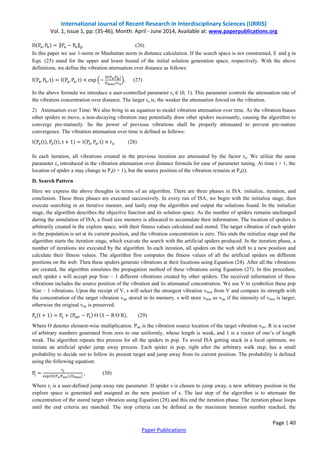
‖ ‖ (26) 
In this paper we use 1-norm or Manhattan norm in distance calculation. If the search space is not constrained, ̅ and in Eqn. (25) stand for the upper and lower bound of the initial solution generation space, respectively. With the above definitions, we define the vibration attenuation over distance as follows: 
( ) (27) 
In the above formula we introduce a user-controlled parameter ra (0, 1). This parameter controls the attenuation rate of the vibration concentration over distance. The larger ra is, the weaker the attenuation forced on the vibration. 
2) Attenuation over Time: We also bring in an equation to model vibration attenuation over time. As the vibration biases other spiders to move, a non-decaying vibration may potentially draw other spiders incessantly, causing the algorithm to converge pre-maturely. So the power of previous vibrations shall be properly attenuated to prevent pre-mature convergence. The vibration attenuation over time is defined as follows: 
(28) 
In each iteration, all vibrations created in the previous iteration are attenuated by the factor ra. We utilize the same parameter ra introduced in the vibration attenuation over distance formula for ease of parameter tuning. At time t + 1, the location of spider a may change to Pa(t + 1), but the source position of the vibration remains at Pa(t). 
D. Search Pattern 
Here we express the above thoughts in terms of an algorithm. There are three phases in ISA: initialize, iteration, and conclusion. These three phases are executed successively. In every run of ISA, we begin with the initialize stage, then execute searching in an iterative manner, and lastly stop the algorithm and output the solutions found. In the initialize stage, the algorithm describes the objective function and its solution space. As the number of spiders remains unchanged during the simulation of ISA, a fixed size memory is allocated to accumulate their information. The location of spiders is arbitrarily created in the explore space, with their fitness values calculated and stored. The target vibration of each spider in the population is set at its current position, and the vibration concentration is zero. This ends the initialize stage and the algorithm starts the iteration stage, which execute the search with the artificial spiders produced. In the iteration phase, a number of iterations are executed by the algorithm. In each iteration, all spiders on the web shift to a new position and calculate their fitness values. The algorithm first computes the fitness values of all the artificial spiders on different positions on the web. Then these spiders generate vibrations at their locations using Equation (24). After all the vibrations are created, the algorithm simulates the propagation method of these vibrations using Equation (27). In this procedure, each spider s will accept pop Size – 1 different vibrations created by other spiders. The received information of these vibrations includes the source position of the vibration and its attenuated concentration. We use V to symbolize these pop Size − 1 vibrations. Upon the receipt of V, s will select the strongest vibration vbest from V and compare its strength with the concentration of the target vibration vtar stored in its memory. s will store vbest as vtar if the intensity of vbest is larger, otherwise the original vtar is preserved. 
(29) 
Where denotes element-wise multiplication. Ptar is the vibration source location of the target vibration vtar. R is a vector of arbitrary numbers generated from zero to one uniformly, whose length is weak, and 1 is a vector of one’s of length weak. The algorithm repeats this process for all the spiders in pop. To avoid ISA getting stuck in a local optimum, we initiate an artificial spider jump away process. Each spider in pop, right after the arbitrary walk step, has a small probability to decide not to follow its present target and jump away from its current position. The probability is defined using the following equation: 
(30) 
Where rj is a user-defined jump away rate parameter. If spider s is chosen to jump away, a new arbitrary position in the explore space is generated and assigned as the new position of s. The last step of the algorithm is to attenuate the concentration of the stored target vibration using Equation (28) and this end the iteration phase. The iteration phase loops until the end criteria are matched. The stop criteria can be defined as the maximum iteration number reached, the
International Journal of Recent Research in Interdisciplinary Sciences (IJRRIS) 
Vol. 1, Issue 1, pp: (35-46), Month: April - June 2014, Available at: www.paperpublications.org 
Page | 41 
Paper Publications 
maximum CPU time used, the error rate reached, the maximum number of iterations with no development on the best fitness value. After the iteration phase, the algorithm outputs the best solution with the best fitness established. 
The above three phases comprise the complete algorithm of ISA. 
Algorithm - Improved Spider Algorithm for ORPD problem 
1: Assign values to the parameters of ISA. 
2: Create the population of spiders pop and allocate memory for them. 
3: Initialize vtar for every spider. 
4: while stopping criteria not met do 
5: for every spider s in pop do 
6: compute the fitness value of s. 
7: create a vibration at the position of s. 
8: end for 
9: For every spider s in pop do 
10: Compute the concentration of the vibrations V created by other spiders. 
11: pick the strongest vibration vbest from V . 
12: if the concentration of vbest is larger than vtar then 
13: Gather vbest as vtar. 
14: end if 
15: Carry out a arbitrary walk towards vtar. 
16: create a arbitrary number r from [0,1]. 
17: if r < pj then 
18: allot an arbitrary position to s. 
19: end if 
20: alleviate the concentration of vtar. 
21: end for 
22: end while 
23: Display Output – when best solution found. 
5. SIMULATION RESULTS 
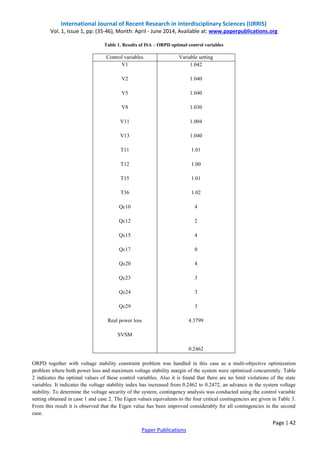
The accurateness of the projected ISA method is demonstrated by testing it on standard IEEE-30 bus system. The IEEE- 30 bus system has 6 generator buses, 24 load buses and 41 transmission lines of which four branches are (6-9), (6-10) , (4- 12) and (28-27) - are with the tap setting transformers. The lower voltage magnitude limits at all buses are 0.95 p.u. and the upper limits are 1.1 for all the PV buses and 1.05 p.u. for all the PQ buses and the reference bus. The simulation results have been presented in Tables 1, 2, 3 &4. And in the Table 5 shows the proposed algorithm powerfully reduces the real power losses when compared to other given algorithms. The optimal values of the control variables along with the minimum loss obtained are given in Table 1. Corresponding to this control variable setting, it was found that there are no limit violations in any of the state variables.
International Journal of Recent Research in Interdisciplinary Sciences (IJRRIS) 
Vol. 1, Issue 1, pp: (35-46), Month: April - June 2014, Available at: www.paperpublications.org 
Page | 42 
Paper Publications 
Table 1. Results of ISA – ORPD optimal control variables 
Control variables 
Variable setting 
V1 
V2 
V5 
V8 
V11 
V13 
T11 
T12 
T15 
T36 
Qc10 
Qc12 
Qc15 
Qc17 
Qc20 
Qc23 
Qc24 
Qc29 
Real power loss 
SVSM 
1.042 
1.040 
1.040 
1.030 
1.004 
1.040 
1.01 
1.00 
1.01 
1.02 
4 
2 
4 
0 
4 
3 
3 
3 
4.3799 
0.2462 
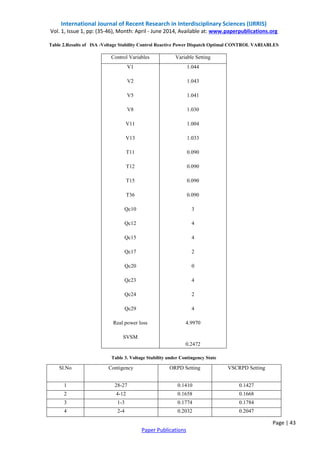
ORPD together with voltage stability constraint problem was handled in this case as a multi-objective optimization problem where both power loss and maximum voltage stability margin of the system were optimized concurrently. Table 2 indicates the optimal values of these control variables. Also it is found that there are no limit violations of the state variables. It indicates the voltage stability index has increased from 0.2462 to 0.2472, an advance in the system voltage stability. To determine the voltage security of the system, contingency analysis was conducted using the control variable setting obtained in case 1 and case 2. The Eigen values equivalents to the four critical contingencies are given in Table 3. From this result it is observed that the Eigen value has been improved considerably for all contingencies in the second case.
International Journal of Recent Research in Interdisciplinary Sciences (IJRRIS) 
Vol. 1, Issue 1, pp: (35-46), Month: April - June 2014, Available at: www.paperpublications.org 
Page | 43 
Paper Publications 
Table 2.Results of ISA -Voltage Stability Control Reactive Power Dispatch Optimal CONTROL VARIABLES 
Control Variables 
Variable Setting 
V1 
V2 
V5 
V8 
V11 
V13 
T11 
T12 
T15 
T36 
Qc10 
Qc12 
Qc15 
Qc17 
Qc20 
Qc23 
Qc24 
Qc29 
Real power loss 
SVSM 
1.044 
1.043 
1.041 
1.030 
1.004 
1.033 
0.090 
0.090 
0.090 
0.090 
3 
4 
4 
2 
0 
4 
2 
4 
4.9970 
0.2472 
Table 3. Voltage Stability under Contingency State 
Sl.No 
Contigency 
ORPD Setting 
VSCRPD Setting 
1 
28-27 
0.1410 
0.1427 
2 
4-12 
0.1658 
0.1668 
3 
1-3 
0.1774 
0.1784 
4 
2-4 
0.2032 
0.2047
International Journal of Recent Research in Interdisciplinary Sciences (IJRRIS) 
Vol. 1, Issue 1, pp: (35-46), Month: April - June 2014, Available at: www.paperpublications.org 
Page | 44 
Paper Publications 
Table 4. Limit Violation Checking Of State Variables 
State variables 
limits 
ORPD 
VSCRPD 
Lower 
upper 
Q1 
-20 
152 
1.3422 
-1.3269 
Q2 
-20 
61 
8.9900 
9.8232 
Q5 
-15 
49.92 
25.920 
26.001 
Q8 
-10 
63.52 
38.8200 
40.802 
Q11 
-15 
42 
2.9300 
5.002 
Q13 
-15 
48 
8.1025 
6.033 
V3 
0.95 
1.05 
1.0372 
1.0392 
V4 
0.95 
1.05 
1.0307 
1.0328 
V6 
0.95 
1.05 
1.0282 
1.0298 
V7 
0.95 
1.05 
1.0101 
1.0152 
V9 
0.95 
1.05 
1.0462 
1.0412 
V10 
0.95 
1.05 
1.0482 
1.0498 
V12 
0.95 
1.05 
1.0400 
1.0466 
V14 
0.95 
1.05 
1.0474 
1.0443 
V15 
0.95 
1.05 
1.0457 
1.0413 
V16 
0.95 
1.05 
1.0426 
1.0405 
V17 
0.95 
1.05 
1.0382 
1.0396 
V18 
0.95 
1.05 
1.0392 
1.0400 
V19 
0.95 
1.05 
1.0381 
1.0394 
V20 
0.95 
1.05 
1.0112 
1.0194 
V21 
0.95 
1.05 
1.0435 
1.0243 
V22 
0.95 
1.05 
1.0448 
1.0396 
V23 
0.95 
1.05 
1.0472 
1.0372 
V24 
0.95 
1.05 
1.0484 
1.0372 
V25 
0.95 
1.05 
1.0142 
1.0192 
V26 
0.95 
1.05 
1.0494 
1.0422 
V27 
0.95 
1.05 
1.0472 
1.0452 
V28 
0.95 
1.05 
1.0243 
1.0283 
V29 
0.95 
1.05 
1.0439 
1.0419 
V30 
0.95 
1.05 
1.0418 
1.0397 
Table 5. Comparison of Real Power Loss 
Method 
Minimum loss 
Evolutionary programming[22] 
5.0159 
Genetic algorithm[23] 
4.665 
Real coded GA with Lindex as 
SVSM[24] 
4.568 
Real coded genetic algorithm[25] 
4.5015 
Proposed ISA method 
4.3799
International Journal of Recent Research in Interdisciplinary Sciences (IJRRIS) 
Vol. 1, Issue 1, pp: (35-46), Month: April - June 2014, Available at: www.paperpublications.org 
Page | 45 
Paper Publications 
6. CONCLUSION 
In this paper, one of the recently developed stochastic algorithms ISA has been demonstrated and applied to solve optimal reactive power dispatch problem. The problem has been formulated as a constrained optimization problem. Different objective functions have been utilized to minimize real power loss and the voltage profile has been enhanced within the limits. The proposed approach has been tested on the IEEE 30-bus power system and the simulation results indicate the effectiveness and robustness of the proposed algorithm to solve optimal reactive power dispatch problem. 
REFERENCES 
[1] M. A. Abido, J. M. Bakhashwain, “A novel multiobjective evolutionaryalgorithm for optimal reactive power dispatch problem,” in proc. Electronics, Circuits and Systems conf., vol. 3, pp. 1054-1057, 2003. 
[2] W. N. W. Abdullah, H. Saibon, A. A. M. Zain, K. L. Lo, “GeneticAlgorithm for Optimal Reactive Power Dispatch,” in proc. EnergyManagement and Power Delivery conf., vol. 1, pp. 160-164, 1998. 
[3] K. Y. Lee, Y. M. Park, J. L. Ortiz, “Fuel-cost minimisation for both realandreactive-power dispatches,” in proc. Generation, Transmission and Distribution conf., vol. 131, pp. 85-93, 1984. 
[4] S. Granville, “Optimal Reactive Dispatch Trough Interior PointMethods,” IEEE Trans. on Power Systems, vol. 9, pp. 136-146, 1994. 
[5] N. I. Deeb, S. M. Shahidehpour, “An Efficient Technique for ReactivePower Dispatch Using a Revised Linear Programming Approach,” Electric Power System Research, vol. 15, pp. 121-134, 1988. 
[6] N. Grudinin, “Reactive Power Optimization Using Successive QuadraticProgramming Method,” IEEE Trans. on Power Systems, vol. 13, pp. 1219-1225, 1998. 
[7] M. A. Abido, “Optimal Power Flow Using Particle SwarmOptimization,” Electrical Power and Energy Systems, vol. 24, pp. 563-571, 2002. 
[8] Abou El Ela, M. A. Abido, S. R. Spea, “Differential EvolutionAlgorithm for Optimal Reactive Power Dispatch,” Electric Power Systems Research, vol. 81, pp. 458-464, 2011. 
[9] V. Miranda, N. Fonseca, “EPSO-Evolutionary Particle SwarmOptimization, A New Algorithm with Applications in Power Systems,” in Proc. of Transmission and Distribution conf., vol. 2, pp. 745-750,2002. 
[10] C.A. Canizares , A.C.Z.de Souza and V.H. Quintana , “ Comparison of performance indices for detection of proximity to voltage collapse ,’’ vol. 11. no.3 , pp.1441-1450, Aug 1996 . 
[11] E.-G. Talbi, Metaheuristics: From Design to Implementation. Wiley, 2009. 
[12] R. S. Parpinelli and H. S. Lopes, “New inspirations in swarm intelligence: a survey,” Int. J. Bio-Inspired Computation, vol. 3, no. 1, pp. 1–16, Jan. 2011. 
[13] M. Yim, Y. Zhang, and D. Duff, “Modular robots,” IEEE Spectrum, vol. 39, no. 2, pp. 30–34, Aug. 2002. 
[14] R. Foelix, Biology of Spiders. 198 Madison Ave. NY, New York, 10016: Oxford University Press, 1996. 
[15] F. Schaber, S. N. Gorb, and F. G. Barth, “Force transformation in spider strain sensors: White light interferometry.” J. Royal Society Interface, vol. 9, no. 71, pp. 1254–1264, Jun. 2012. 
[16] R. Cocroft, “The public world of insect vibrational communication,” Molecular Ecology, vol. 10, pp. 2041–2043, May 2011. 
[17] F. Fernndez Campn, “Group foraging in the colonial spider parawixia bistriata (araneidae): effect of resource levels and prey size,” Animal Behaviour, vol. 74, no. 5, pp. 1551–1562, Nov. 2007. 
[18] J. House, K. Landis, and D. Umberson, “Social relationships and health,” Science, vol. 241, no. 4865, pp. 540–545, 1988. 
[19] W. Clark and M. Mangel, “Foraging and flocking strategies: Information in an uncertain environment,” The American Naturalist, vol. 123, no. 5, pp. 626–641, 1984.
International Journal of Recent Research in Interdisciplinary Sciences (IJRRIS) 
Vol. 1, Issue 1, pp: (35-46), Month: April - June 2014, Available at: www.paperpublications.org 
Page | 46 
Paper Publications 
[20] Barnard and R. Sibly, “Producers and scroungers: A general model and its application to captive flocks of house sparrows,” Animal Behaviour, vol. 29, no. 2, pp. 543–550, May 1981. 
[21] G. Uetz, “Foraging strategies of spiders,” Trends in Ecology and Evolution, vol. 7, no. 5, pp. 155–159, 1992. 
[22] Wu Q H, Ma J T. Power system optimal reactive power dispatch using evolutionary programming. IEEE Transactions on power systems 1995; 10(3): 1243-1248 . 
[23] S.Durairaj, D.Devaraj, P.S.Kannan ,’ Genetic algorithm applications to optimal reactive power dispatch with voltage stability enhancement’ , IE(I) Journal-EL Vol 87,September 2006. 
[24] D.Devaraj,’ Improved genetic algorithm for multi – objective reactive power dispatch problem’ European Transactions on electrical power 2007 ; 17: 569-581. 
[25] P. Aruna Jeyanthy and Dr. D. Devaraj “Optimal Reactive Power Dispatch for Voltage Stability Enhancement Using Real Coded Genetic Algorithm” International Journal of Computer and Electrical Engineering, Vol. 2, No. 4, August, 2010 1793-8163. 
Author’s Biography: 
Bhumanapally. Ravindhranath Reddy, Born on 3rd September, 1969. Got his B.Tech in Electrical & Electronics Engineering from the J.N.T.U. College of Engg., Anantapur in the year 1991. Completed his M.Tech in Energy Systems in IPGSR of J.N.T. University Hyderabad in the year 1997. Obtained his doctoral degree from JNTUA, Anantapur University in the field of Electrical Power Systems. Published 12 Research Papers and presently guiding 6 Ph.D. Scholars. He was specialized in Power Systems, High Voltage Engineering and Control Systems. His research interests include Simulation studies on Transients of different power system equipment. 
K.Lenin has received his B.E., Degree, electrical and electronics engineering in 1999 from university of madras, Chennai, India and M.E., Degree in power systems in 2000 from Annamalai University, TamilNadu, India. Presently pursuing Ph.D., degree at JNTU, Hyderabad,India.

Improved Spider Algorithm for Solving Optimal Reactive Power Dispatch Problem

  • 1.
    International Journal ofRecent Research in Interdisciplinary Sciences (IJRRIS) Vol. 1, Issue 1, pp: (35-46), Month: April - June 2014, Available at: www.paperpublications.org Page | 35 Paper Publications Improved Spider Algorithm for Solving Optimal Reactive Power Dispatch Problem 1K. Lenin, 2Dr.B.Ravindhranath Reddy 1Research Scholar, JNTU, Hyderabad, India. 2Deputy Executive Engineer, Jawaharlal Nehru Technological University Kukatpally, Hyderabad 500 085, India Abstract: In this paper improved spider algorithm (ISA) is projected to solve the optimal reactive power dispatch (ORPD) Problem. Stimulated by the societal spiders, we suggest a new Improved Spider Algorithm (ISA) to solve ORPD problem. The structure is chiefly based on the foraging approach of social spiders, which make use of the vibrations spread over the spider web to decide the position of preys. The simulation results demonstrate high-quality performance of ISA in solving an optimal reactive power dispatch problem. The projected algorithm has been tested on IEEE 30 bus system and compared to other specified algorithms. Results show that ISA is more efficient than other algorithms to reduce the real power loss and to enhance the voltage profile index. Keywords: spider algorithm, swarm intelligence, evolutionary computation, optimal reactive power, Transmission loss. 1. INTRODUCTION In recent years the optimal reactive power dispatch (ORPD) problem has received huge attention as a result of the enhancement on economy and security of power system operation. Solutions of ORPD problem intend to minimize object functions such as fuel cost, power system loses, etc. while satisfying a number of constraints like limits of bus voltages, tap settings of transformers, reactive and active power of power resources and transmission lines and a number of controllable Variables [1, 2]. In the literature, many methods for solving the ORPD problem have been done up to now. At the beginning, several classical methods such as gradient based [3], interior point [4], linear programming [5] and quadratic programming [6] have been effectively used in order to solve the ORPD problem. However, these methods have some disadvantages in the procedure of solving the complex ORPD problem. Drawbacks of these algorithms can be declared insecure convergence properties, extended execution time, and algorithmic intricacy. In addition, the solution can be trapped in local minima [1, 7]. In order to triumph over these disadvantages, researches have been effectively applied evolutionary and heuristic algorithms such as Genetic Algorithm (GA) [2], Differential Evolution (DE) [8] and Particle Swarm Optimization (PSO) [9]. Voltage stability evaluation using modal analysis [10] is used as the indicator of voltage stability. At present several types of Evolutionary algorithm (EA) have been extensively employed to solve real world combinatorial problems. These algorithms reveal reasonable performance compared with conventional optimization techniques, particularly when applied to solve non-convex optimization problems [11]. In the past decade, swarm intelligence, a fresh kind of evolutionary computing technique, has fascinated much research interest [12]. Swarm intelligence is chiefly concerned with the methodology to model the behaviour of social animals and insects for problem solving. Researchers develop optimization algorithms by mimicking the behaviour of ants, bees, bacteria, fireflies and other organisms. The thrust of creating such algorithms was provided by the rising needs to solve optimization problems that were very complicated or even considered as obdurate. Among all spiders has been a chief research subject in bionic engineering for several years. Conversely, the majority of research interrelated to spiders focused on the simulation of its walking pattern to design robots [13]. A probable motive for this is that a majority of the spiders observed are lonely [14], which means that they spend most of their lives without intermingle with others of their species. Conversely, among the 35 000 spider species observed and described by scientists, some species are societal. These spiders live in groups, e.g. Mallos gregalis and Oecobius civitas. Based on these social spiders, this paper formulates a new global optimization method to solve the ORPD problem. Spiders are air-breathing arthropods. They have eight legs and chelicerae with fangs.
  • 2.
    International Journal ofRecent Research in Interdisciplinary Sciences (IJRRIS) Vol. 1, Issue 1, pp: (35-46), Month: April - June 2014, Available at: www.paperpublications.org Page | 36 Paper Publications They use an extensive range of different strategies for foraging, and most of them sense prey by sensing vibrations. Spiders have long been known to be very responsive to vibratory stimulation, as vibrations on their webs notify them of the capture of prey. If the vibrations are in a defined range of frequency, spiders attack the vibration source. The social spiders can also distinguish vibrations generated by the prey with ones generated by other spiders [15]. The social spiders submissively receive the vibrations produced by other spiders on the same web to have an apparent view of the web. This is one of the exclusive characteristics which differentiates the social spiders from other organisms as the latter habitually exchange information actively, which decreases the information loss to some degree but augments the energy used for contact [16]. In this paper, enthused by the social behaviour of the social spiders, particularly their foraging behavior, we put forward a new Improved Spider Algorithm (ISA) to solve ORPD problem. The foraging behaviour of the social spider can be explained as the mutual movement of the spiders towards the food source location. The spiders receive and analyses the vibrations proliferated on the web to decide the potential direction of a food source [17]. In this procedure, the spiders help each other to move towards the prey. We exploit this natural behaviour to perform optimization over the search space in ISA. The crowd living phenomenon has been studied intensively in animal behaviour ecology. One of the causes that animals congregate and live together are to augment the possibility of successful foraging and diminish the energy cost in this process [18]. In order to smooth the progress of the analysis of social foraging behaviour, researchers projected two foraging models: information sharing (IS) model [19] and producer-scrounger (PS) model [20]. The individuals below the IS model execute individual searching and look for for opportunity to join other individuals concurrently. In the PS model, the individuals are alienated into leaders and followers. Since there is no leader in social spiders [21], it seems the IS model is more appropriate, and we use this model to manage the searching pattern of ISA. Swarm intelligence algorithms imitate the methods in nature to drive a search for the optimal solution. The performance of ISA has been evaluated in standard IEEE 30 bus test system and the results analysis shows that our proposed approach outperforms all approaches investigated in this paper. 2. VOLTAGE STABILITY EVALUATION 2.1. Modal analysis for voltage stability evaluation The linearized steady state system power flow equations are given by. [ ] [ ] (1) Where ΔP = Incremental change in bus real power. ΔQ = Incremental change in bus reactive Power injection Δ = incremental change in bus voltage angle. ΔV = Incremental change in bus voltage Magnitude Jp , J PV , J Q , J QV jacobian matrix are the sub-matrixes of the System voltage stability is affected by both P and Q. However at each operating point we keep P constant and evaluate voltage stability by considering incremental relationship between Q and V. To reduce (1), let ΔP = 0 , then. [ ] (2) (3) Where ( ) (4) is called the reduced Jacobian matrix of the system.
  • 3.
    International Journal ofRecent Research in Interdisciplinary Sciences (IJRRIS) Vol. 1, Issue 1, pp: (35-46), Month: April - June 2014, Available at: www.paperpublications.org Page | 37 Paper Publications A. Modes of Voltage instability: Voltage Stability characteristics of the system can be identified by computing the eigen values and eigen vectors Let (5) Where, = right eigenvector matrix of JR = left eigenvector matrix of JR ∧ = diagonal eigenvalue matrix of JR and (6) From (3) and (6), we have (7) or Σ (8) Where i is the ith column right eigenvector and the ith row left eigenvector of JR. i is the ith eigen value of JR. The ith modal reactive power variation is, (9) where, Σ (10) Where ji is the jth element of i The corresponding ith modal voltage variation is [ ⁄] (11) In (8), let ΔQ = ek where ek has all its elements zero except the kth one being 1. Then, Σ (12) k th element of V –Q sensitivity at bus k Σ Σ (13) 3. PROBLEM FORMULATION The objectives of the reactive power dispatch problem considered here is to minimize the system real power loss and maximize the static voltage stability margins (SVSM). 3.1Minimization of Real Power Loss Minimization of the real power loss (Ploss) in transmission lines of a power system is mathematically stated as follows. Σ (14)
  • 4.
    International Journal ofRecent Research in Interdisciplinary Sciences (IJRRIS) Vol. 1, Issue 1, pp: (35-46), Month: April - June 2014, Available at: www.paperpublications.org Page | 38 Paper Publications Where n is the number of transmission lines, gk is the conductance of branch k, Vi and Vj are voltage magnitude at bus i and bus j, and ij is the voltage angle difference between bus i and bus j. 3.2Minimization of Voltage Deviation Minimization of the Deviations in voltage magnitudes (VD) at load buses is mathematically stated as follows. Minimize VD = Σ| | (15) Where nl is the number of load busses and Vk is the voltage magnitude at bus k. 3.3System Constraints In the minimization process of objective functions, some problem constraints which one is equality and others are inequality had to be met. Objective functions are subjected to these constraints shown below. Load flow equality constraints: – Σ [ ] (16) Σ [ ] (17) where, nb is the number of buses, PG and QG are the real and reactive power of the generator, PD and QD are the real and reactive load of the generator, and Gij and Bij are the mutual conductance and susceptance between bus i and bus j. Generator bus voltage (VGi) inequality constraint: (18) Load bus voltage (VLi) inequality constraint: (19) Switchable reactive power compensations (QCi) inequality constraint: (20) Reactive power generation (QGi) inequality constraint: (21) Transformers tap setting (Ti) inequality constraint: (22) Transmission line flow (SLi) inequality constraint: (23) Where, nc, ng and nt are numbers of the switchable reactive power sources, generators and transformers. 4. IMPROVED SPIDER ALGORITHM In ISA, we formulate the explore space of the optimization problem as a hyper-dimensional spider web. Every position on the web symbolizes a feasible solution to the optimization problem and all feasible solutions to the problem have equivalent positions on this web. The web as well serves the transmission media of the vibrations created by the spiders. Each spider on the web grasp a position and the quality of the solution is based on the objective function, and characterized by the potential of finding a food source at the position. The spiders can move liberally on the web.
  • 5.
    International Journal ofRecent Research in Interdisciplinary Sciences (IJRRIS) Vol. 1, Issue 1, pp: (35-46), Month: April - June 2014, Available at: www.paperpublications.org Page | 39 Paper Publications However, they cannot go away from the web as the positions off the web represent infeasible solutions to the optimization problem. When a spider shifts to a new position, it creates a vibration which is propagated over the web. Each vibration holds the information of one spider and other spiders can get the information upon receiving the vibration. A. Spider The spiders are the agent of ISA to execute optimization. At the beginning of the algorithm, a pre-defined number of spiders are placed on the web. Each spider (s) holds a memory, storing the following individual information: 1) The location of (s) on the web. 2) The fitness of the present position of (s). 3) The goal vibration of (s) in the previous iteration. The first two types of information explain the individual situation of (s), while the third type of information is concerned in directing (s) to new-fangled positions. Based on observations, spiders are found to have very precise senses of vibration. In addition, they can divide different vibrations promulgated on the same web and sense their relevant intensities [21]. In ISA, a spider will create a vibration when it reaches a new-fangled position different from the previous one. The concentration of the vibration is connected with the fitness of the position. The vibration will propagate over the web and other spiders can sense it. In such a way, the spiders on the same web distribute their personal information with others to form a combined social knowledge. B. Vibration Vibration is a very significant concept in ISA. It is one of the key characteristics that distinguish ISA from other algorithms. In ISA, we use two properties to describe a vibration, namely the source position and the source concentration of the vibration. The source position is defined by the explore space of the optimization problem, and we define the concentration of a vibration in the range [0, +∞]. Every time a spider moves to a new position, it produces a vibration at its present position. We define the position of spider a at time t as Pa (t), or simply as Pa if the argument is t. We further use I (Pa, Pb , t) to represent the vibration concentration sensed by a spider at position Pb at time t and the source of the vibration is at position Pa. Thus I (Ps, Ps, t) defines the concentration of the vibration created by spider s at the source position. This vibration concentration at the source position is associated with the fitness of this position f (Ps), and we define the concentration value as follows: { ( ) ⁄ ⁄ (24) Where Cmax is a confidently large constant selected such that all possible fitness values of the maximization problem are smaller than Cmax, and Cmin is a assertively small constant such that all possible fitness values of the minimization problem is larger than Cmin. Equation (24) guarantees that the probable vibration intensities of any optimization problem are all positive values. It further assurance that a better fitness value, i.e. larger for maximization or smaller for minimization problem, corresponds to larger vibration concentration. C. Intensity Attenuation As a form of energy, vibration attenuates over time and distance. This physical occurrence is accounted for in the design of ISA by two equations. 1) Attenuation over Distance: We define the vibration attenuation over distance as follows. We describe the distance between spider a and b as D (Pa,Pb), and the maximum distance between two points in the search space as Dmax. The description of Dmax can be problem dependent, and we use the following equation for simplicity: ‖ ̅ ‖ (25) Where ̅ is the upper bound of the search space and is the lower bound of the search space. p indicates that we use p- norm as the technique to compute the distance between spiders, i.e.,
  • 6.
    International Journal ofRecent Research in Interdisciplinary Sciences (IJRRIS) Vol. 1, Issue 1, pp: (35-46), Month: April - June 2014, Available at: www.paperpublications.org Page | 40 Paper Publications ‖ ‖ (26) In this paper we use 1-norm or Manhattan norm in distance calculation. If the search space is not constrained, ̅ and in Eqn. (25) stand for the upper and lower bound of the initial solution generation space, respectively. With the above definitions, we define the vibration attenuation over distance as follows: ( ) (27) In the above formula we introduce a user-controlled parameter ra (0, 1). This parameter controls the attenuation rate of the vibration concentration over distance. The larger ra is, the weaker the attenuation forced on the vibration. 2) Attenuation over Time: We also bring in an equation to model vibration attenuation over time. As the vibration biases other spiders to move, a non-decaying vibration may potentially draw other spiders incessantly, causing the algorithm to converge pre-maturely. So the power of previous vibrations shall be properly attenuated to prevent pre-mature convergence. The vibration attenuation over time is defined as follows: (28) In each iteration, all vibrations created in the previous iteration are attenuated by the factor ra. We utilize the same parameter ra introduced in the vibration attenuation over distance formula for ease of parameter tuning. At time t + 1, the location of spider a may change to Pa(t + 1), but the source position of the vibration remains at Pa(t). D. Search Pattern Here we express the above thoughts in terms of an algorithm. There are three phases in ISA: initialize, iteration, and conclusion. These three phases are executed successively. In every run of ISA, we begin with the initialize stage, then execute searching in an iterative manner, and lastly stop the algorithm and output the solutions found. In the initialize stage, the algorithm describes the objective function and its solution space. As the number of spiders remains unchanged during the simulation of ISA, a fixed size memory is allocated to accumulate their information. The location of spiders is arbitrarily created in the explore space, with their fitness values calculated and stored. The target vibration of each spider in the population is set at its current position, and the vibration concentration is zero. This ends the initialize stage and the algorithm starts the iteration stage, which execute the search with the artificial spiders produced. In the iteration phase, a number of iterations are executed by the algorithm. In each iteration, all spiders on the web shift to a new position and calculate their fitness values. The algorithm first computes the fitness values of all the artificial spiders on different positions on the web. Then these spiders generate vibrations at their locations using Equation (24). After all the vibrations are created, the algorithm simulates the propagation method of these vibrations using Equation (27). In this procedure, each spider s will accept pop Size – 1 different vibrations created by other spiders. The received information of these vibrations includes the source position of the vibration and its attenuated concentration. We use V to symbolize these pop Size − 1 vibrations. Upon the receipt of V, s will select the strongest vibration vbest from V and compare its strength with the concentration of the target vibration vtar stored in its memory. s will store vbest as vtar if the intensity of vbest is larger, otherwise the original vtar is preserved. (29) Where denotes element-wise multiplication. Ptar is the vibration source location of the target vibration vtar. R is a vector of arbitrary numbers generated from zero to one uniformly, whose length is weak, and 1 is a vector of one’s of length weak. The algorithm repeats this process for all the spiders in pop. To avoid ISA getting stuck in a local optimum, we initiate an artificial spider jump away process. Each spider in pop, right after the arbitrary walk step, has a small probability to decide not to follow its present target and jump away from its current position. The probability is defined using the following equation: (30) Where rj is a user-defined jump away rate parameter. If spider s is chosen to jump away, a new arbitrary position in the explore space is generated and assigned as the new position of s. The last step of the algorithm is to attenuate the concentration of the stored target vibration using Equation (28) and this end the iteration phase. The iteration phase loops until the end criteria are matched. The stop criteria can be defined as the maximum iteration number reached, the
  • 7.
    International Journal ofRecent Research in Interdisciplinary Sciences (IJRRIS) Vol. 1, Issue 1, pp: (35-46), Month: April - June 2014, Available at: www.paperpublications.org Page | 41 Paper Publications maximum CPU time used, the error rate reached, the maximum number of iterations with no development on the best fitness value. After the iteration phase, the algorithm outputs the best solution with the best fitness established. The above three phases comprise the complete algorithm of ISA. Algorithm - Improved Spider Algorithm for ORPD problem 1: Assign values to the parameters of ISA. 2: Create the population of spiders pop and allocate memory for them. 3: Initialize vtar for every spider. 4: while stopping criteria not met do 5: for every spider s in pop do 6: compute the fitness value of s. 7: create a vibration at the position of s. 8: end for 9: For every spider s in pop do 10: Compute the concentration of the vibrations V created by other spiders. 11: pick the strongest vibration vbest from V . 12: if the concentration of vbest is larger than vtar then 13: Gather vbest as vtar. 14: end if 15: Carry out a arbitrary walk towards vtar. 16: create a arbitrary number r from [0,1]. 17: if r < pj then 18: allot an arbitrary position to s. 19: end if 20: alleviate the concentration of vtar. 21: end for 22: end while 23: Display Output – when best solution found. 5. SIMULATION RESULTS The accurateness of the projected ISA method is demonstrated by testing it on standard IEEE-30 bus system. The IEEE- 30 bus system has 6 generator buses, 24 load buses and 41 transmission lines of which four branches are (6-9), (6-10) , (4- 12) and (28-27) - are with the tap setting transformers. The lower voltage magnitude limits at all buses are 0.95 p.u. and the upper limits are 1.1 for all the PV buses and 1.05 p.u. for all the PQ buses and the reference bus. The simulation results have been presented in Tables 1, 2, 3 &4. And in the Table 5 shows the proposed algorithm powerfully reduces the real power losses when compared to other given algorithms. The optimal values of the control variables along with the minimum loss obtained are given in Table 1. Corresponding to this control variable setting, it was found that there are no limit violations in any of the state variables.
  • 8.
    International Journal ofRecent Research in Interdisciplinary Sciences (IJRRIS) Vol. 1, Issue 1, pp: (35-46), Month: April - June 2014, Available at: www.paperpublications.org Page | 42 Paper Publications Table 1. Results of ISA – ORPD optimal control variables Control variables Variable setting V1 V2 V5 V8 V11 V13 T11 T12 T15 T36 Qc10 Qc12 Qc15 Qc17 Qc20 Qc23 Qc24 Qc29 Real power loss SVSM 1.042 1.040 1.040 1.030 1.004 1.040 1.01 1.00 1.01 1.02 4 2 4 0 4 3 3 3 4.3799 0.2462 ORPD together with voltage stability constraint problem was handled in this case as a multi-objective optimization problem where both power loss and maximum voltage stability margin of the system were optimized concurrently. Table 2 indicates the optimal values of these control variables. Also it is found that there are no limit violations of the state variables. It indicates the voltage stability index has increased from 0.2462 to 0.2472, an advance in the system voltage stability. To determine the voltage security of the system, contingency analysis was conducted using the control variable setting obtained in case 1 and case 2. The Eigen values equivalents to the four critical contingencies are given in Table 3. From this result it is observed that the Eigen value has been improved considerably for all contingencies in the second case.
  • 9.
    International Journal ofRecent Research in Interdisciplinary Sciences (IJRRIS) Vol. 1, Issue 1, pp: (35-46), Month: April - June 2014, Available at: www.paperpublications.org Page | 43 Paper Publications Table 2.Results of ISA -Voltage Stability Control Reactive Power Dispatch Optimal CONTROL VARIABLES Control Variables Variable Setting V1 V2 V5 V8 V11 V13 T11 T12 T15 T36 Qc10 Qc12 Qc15 Qc17 Qc20 Qc23 Qc24 Qc29 Real power loss SVSM 1.044 1.043 1.041 1.030 1.004 1.033 0.090 0.090 0.090 0.090 3 4 4 2 0 4 2 4 4.9970 0.2472 Table 3. Voltage Stability under Contingency State Sl.No Contigency ORPD Setting VSCRPD Setting 1 28-27 0.1410 0.1427 2 4-12 0.1658 0.1668 3 1-3 0.1774 0.1784 4 2-4 0.2032 0.2047
  • 10.
    International Journal ofRecent Research in Interdisciplinary Sciences (IJRRIS) Vol. 1, Issue 1, pp: (35-46), Month: April - June 2014, Available at: www.paperpublications.org Page | 44 Paper Publications Table 4. Limit Violation Checking Of State Variables State variables limits ORPD VSCRPD Lower upper Q1 -20 152 1.3422 -1.3269 Q2 -20 61 8.9900 9.8232 Q5 -15 49.92 25.920 26.001 Q8 -10 63.52 38.8200 40.802 Q11 -15 42 2.9300 5.002 Q13 -15 48 8.1025 6.033 V3 0.95 1.05 1.0372 1.0392 V4 0.95 1.05 1.0307 1.0328 V6 0.95 1.05 1.0282 1.0298 V7 0.95 1.05 1.0101 1.0152 V9 0.95 1.05 1.0462 1.0412 V10 0.95 1.05 1.0482 1.0498 V12 0.95 1.05 1.0400 1.0466 V14 0.95 1.05 1.0474 1.0443 V15 0.95 1.05 1.0457 1.0413 V16 0.95 1.05 1.0426 1.0405 V17 0.95 1.05 1.0382 1.0396 V18 0.95 1.05 1.0392 1.0400 V19 0.95 1.05 1.0381 1.0394 V20 0.95 1.05 1.0112 1.0194 V21 0.95 1.05 1.0435 1.0243 V22 0.95 1.05 1.0448 1.0396 V23 0.95 1.05 1.0472 1.0372 V24 0.95 1.05 1.0484 1.0372 V25 0.95 1.05 1.0142 1.0192 V26 0.95 1.05 1.0494 1.0422 V27 0.95 1.05 1.0472 1.0452 V28 0.95 1.05 1.0243 1.0283 V29 0.95 1.05 1.0439 1.0419 V30 0.95 1.05 1.0418 1.0397 Table 5. Comparison of Real Power Loss Method Minimum loss Evolutionary programming[22] 5.0159 Genetic algorithm[23] 4.665 Real coded GA with Lindex as SVSM[24] 4.568 Real coded genetic algorithm[25] 4.5015 Proposed ISA method 4.3799
  • 11.
    International Journal ofRecent Research in Interdisciplinary Sciences (IJRRIS) Vol. 1, Issue 1, pp: (35-46), Month: April - June 2014, Available at: www.paperpublications.org Page | 45 Paper Publications 6. CONCLUSION In this paper, one of the recently developed stochastic algorithms ISA has been demonstrated and applied to solve optimal reactive power dispatch problem. The problem has been formulated as a constrained optimization problem. Different objective functions have been utilized to minimize real power loss and the voltage profile has been enhanced within the limits. The proposed approach has been tested on the IEEE 30-bus power system and the simulation results indicate the effectiveness and robustness of the proposed algorithm to solve optimal reactive power dispatch problem. REFERENCES [1] M. A. Abido, J. M. Bakhashwain, “A novel multiobjective evolutionaryalgorithm for optimal reactive power dispatch problem,” in proc. Electronics, Circuits and Systems conf., vol. 3, pp. 1054-1057, 2003. [2] W. N. W. Abdullah, H. Saibon, A. A. M. Zain, K. L. Lo, “GeneticAlgorithm for Optimal Reactive Power Dispatch,” in proc. EnergyManagement and Power Delivery conf., vol. 1, pp. 160-164, 1998. [3] K. Y. Lee, Y. M. Park, J. L. Ortiz, “Fuel-cost minimisation for both realandreactive-power dispatches,” in proc. Generation, Transmission and Distribution conf., vol. 131, pp. 85-93, 1984. [4] S. Granville, “Optimal Reactive Dispatch Trough Interior PointMethods,” IEEE Trans. on Power Systems, vol. 9, pp. 136-146, 1994. [5] N. I. Deeb, S. M. Shahidehpour, “An Efficient Technique for ReactivePower Dispatch Using a Revised Linear Programming Approach,” Electric Power System Research, vol. 15, pp. 121-134, 1988. [6] N. Grudinin, “Reactive Power Optimization Using Successive QuadraticProgramming Method,” IEEE Trans. on Power Systems, vol. 13, pp. 1219-1225, 1998. [7] M. A. Abido, “Optimal Power Flow Using Particle SwarmOptimization,” Electrical Power and Energy Systems, vol. 24, pp. 563-571, 2002. [8] Abou El Ela, M. A. Abido, S. R. Spea, “Differential EvolutionAlgorithm for Optimal Reactive Power Dispatch,” Electric Power Systems Research, vol. 81, pp. 458-464, 2011. [9] V. Miranda, N. Fonseca, “EPSO-Evolutionary Particle SwarmOptimization, A New Algorithm with Applications in Power Systems,” in Proc. of Transmission and Distribution conf., vol. 2, pp. 745-750,2002. [10] C.A. Canizares , A.C.Z.de Souza and V.H. Quintana , “ Comparison of performance indices for detection of proximity to voltage collapse ,’’ vol. 11. no.3 , pp.1441-1450, Aug 1996 . [11] E.-G. Talbi, Metaheuristics: From Design to Implementation. Wiley, 2009. [12] R. S. Parpinelli and H. S. Lopes, “New inspirations in swarm intelligence: a survey,” Int. J. Bio-Inspired Computation, vol. 3, no. 1, pp. 1–16, Jan. 2011. [13] M. Yim, Y. Zhang, and D. Duff, “Modular robots,” IEEE Spectrum, vol. 39, no. 2, pp. 30–34, Aug. 2002. [14] R. Foelix, Biology of Spiders. 198 Madison Ave. NY, New York, 10016: Oxford University Press, 1996. [15] F. Schaber, S. N. Gorb, and F. G. Barth, “Force transformation in spider strain sensors: White light interferometry.” J. Royal Society Interface, vol. 9, no. 71, pp. 1254–1264, Jun. 2012. [16] R. Cocroft, “The public world of insect vibrational communication,” Molecular Ecology, vol. 10, pp. 2041–2043, May 2011. [17] F. Fernndez Campn, “Group foraging in the colonial spider parawixia bistriata (araneidae): effect of resource levels and prey size,” Animal Behaviour, vol. 74, no. 5, pp. 1551–1562, Nov. 2007. [18] J. House, K. Landis, and D. Umberson, “Social relationships and health,” Science, vol. 241, no. 4865, pp. 540–545, 1988. [19] W. Clark and M. Mangel, “Foraging and flocking strategies: Information in an uncertain environment,” The American Naturalist, vol. 123, no. 5, pp. 626–641, 1984.
  • 12.
    International Journal ofRecent Research in Interdisciplinary Sciences (IJRRIS) Vol. 1, Issue 1, pp: (35-46), Month: April - June 2014, Available at: www.paperpublications.org Page | 46 Paper Publications [20] Barnard and R. Sibly, “Producers and scroungers: A general model and its application to captive flocks of house sparrows,” Animal Behaviour, vol. 29, no. 2, pp. 543–550, May 1981. [21] G. Uetz, “Foraging strategies of spiders,” Trends in Ecology and Evolution, vol. 7, no. 5, pp. 155–159, 1992. [22] Wu Q H, Ma J T. Power system optimal reactive power dispatch using evolutionary programming. IEEE Transactions on power systems 1995; 10(3): 1243-1248 . [23] S.Durairaj, D.Devaraj, P.S.Kannan ,’ Genetic algorithm applications to optimal reactive power dispatch with voltage stability enhancement’ , IE(I) Journal-EL Vol 87,September 2006. [24] D.Devaraj,’ Improved genetic algorithm for multi – objective reactive power dispatch problem’ European Transactions on electrical power 2007 ; 17: 569-581. [25] P. Aruna Jeyanthy and Dr. D. Devaraj “Optimal Reactive Power Dispatch for Voltage Stability Enhancement Using Real Coded Genetic Algorithm” International Journal of Computer and Electrical Engineering, Vol. 2, No. 4, August, 2010 1793-8163. Author’s Biography: Bhumanapally. Ravindhranath Reddy, Born on 3rd September, 1969. Got his B.Tech in Electrical & Electronics Engineering from the J.N.T.U. College of Engg., Anantapur in the year 1991. Completed his M.Tech in Energy Systems in IPGSR of J.N.T. University Hyderabad in the year 1997. Obtained his doctoral degree from JNTUA, Anantapur University in the field of Electrical Power Systems. Published 12 Research Papers and presently guiding 6 Ph.D. Scholars. He was specialized in Power Systems, High Voltage Engineering and Control Systems. His research interests include Simulation studies on Transients of different power system equipment. K.Lenin has received his B.E., Degree, electrical and electronics engineering in 1999 from university of madras, Chennai, India and M.E., Degree in power systems in 2000 from Annamalai University, TamilNadu, India. Presently pursuing Ph.D., degree at JNTU, Hyderabad,India.