
Philippe LAURENT Senior Researcher at the   CRID (Centre de Recherches Informatique et Droit / University of Namur)  Lawyer at the Brussels Bar   (Marx, Van Ranst, Vermeersch & Partners ) A quick insight into FLOSS licences compatibility issues MVVP
In a broad sense  “Compatibility” of FLOSS licences could be described as : “ the characteristic of two (or more) licences according to which the codes distributed under these licences may be put together in order to create a bigger distributable software” +  : * this definitions takes into account many of the combination possibilities “ BSD and GPL are compatible” “ BSD and Apache are compatible” “ LGPL and Mozilla  may, in some cases,  be compatible” -  : * this definition does not take into account the  result of the combination * It creates a  false idea of reciprocity , which could lead to legal mistakes Compatibility (broad sense)
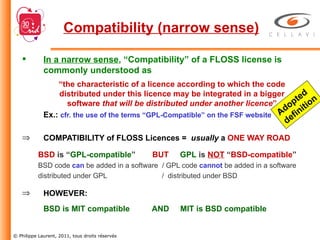
In a narrow sense , “Compatibility” of a FLOSS license is commonly understood as “ the characteristic of a licence according to which the code distributed under this licence may be integrated in a bigger software  that will be distributed under another licence ” Ex.:  cfr. the use of the terms “GPL-Compatible” on the FSF website COMPATIBILITY of FLOSS Licences =  usually  a  ONE WAY ROAD BSD  is “ GPL-compatible ”    BUT   GPL  is  NOT  “ BSD-compatible ” BSD code  can  be added in a software  / GPL code  cannot  be added in a software distributed under GPL   /  distributed under BSD HOWEVER: BSD is MIT compatible  AND  MIT is BSD compatible Compatibility (narrow sense) Adopted definition
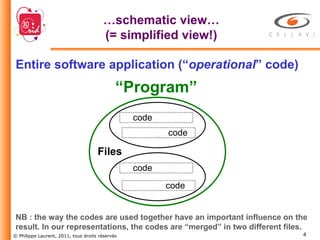
… schematic view… (= simplified view!) Entire software application (“ operational ” code) NB : the way the codes are used together have an important influence on the  result. In our representations, the codes are “merged” in two different files. “ Program” Files code code code code
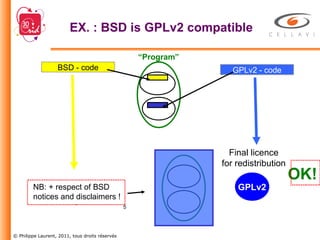
EX. : BSD is GPLv2 compatible BSD - code GPLv2 - code GPLv2 NB: + respect of BSD notices and disclaimers ! OK! “ Program” Final licence for redistribution
Incompatibility Incompatibility   is due to contradictory obligations provided in the different licences under which two codes to be merged are distributed. It can be due to clauses of a multitude of kinds. Basically : anything that puts the licensee in a position where he cannot fulfill at the same time any and all his/her obligations under both licences.
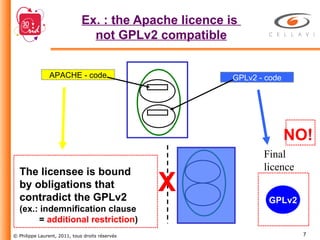
Ex. : the Apache licence is  not GPLv2 compatible Final licence GPLv2 APACHE - code GPLv2 - code X The licensee is bound  by obligations that contradict the GPLv2 (ex.: indemnification clause =  additional restriction ) NO!
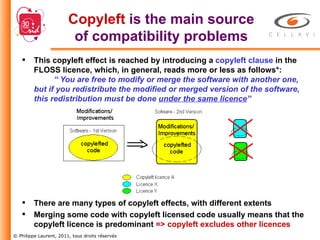
Copyleft  is the main source of compatibility problems This copyleft effect is reached by introducing a  copyleft clause  in the FLOSS licence, which, in general, reads more or less as follows*: “ You are free to modify or merge the software with another one, but if you redistribute the modified or merged version of the software, this redistribution must be done  under the same licence ” There are many types of copyleft effects, with different extents Merging some code with copyleft licensed code usually means that the copyleft licence is predominant  => copyleft excludes other licences
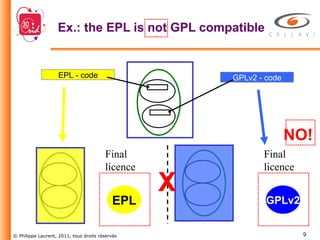
Ex.: the EPL is not GPL compatible EPL - code GPLv2 - code Final licence GPLv2 X Final licence EPL NO!
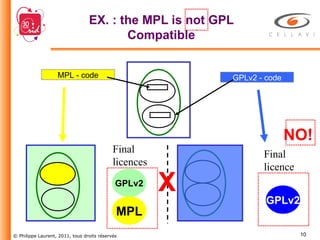
EX. : the MPL is not GPL Compatible GPLv2 MPL Final licences Final licence GPLv2 MPL - code GPLv2 - code X NO!
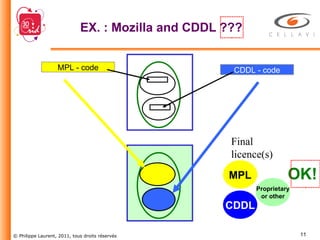
EX. : Mozilla and CDDL ??? MPL - code CDDL - code CDDL MPL Proprietary or other Final licence(s) OK!
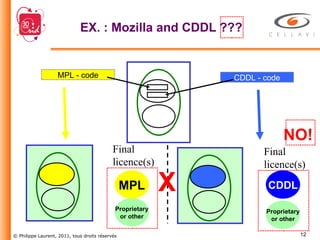
EX. : Mozilla and CDDL ??? Proprietary or other MPL Final licence(s) MPL - code CDDL - code X Proprietary or other Final licence(s) CDDL NO!
CLAUSES TO SOLVE COMPATIBILITY PROBLEMS Ex.: - GPLv3  - EUPL
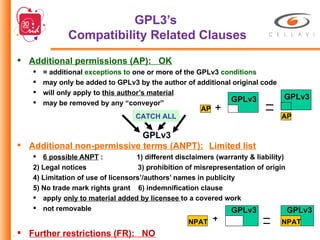
GPL3’s  Compatibility Related Clauses Additional permissions (AP):  OK = additional  exceptions to   one or more of the GPLv3  conditions may only be added to GPLv3 by the author of additional original code will only apply to  this author’s material may be removed by any “conveyor” Additional non-permissive terms (ANPT): Limited list 6 possible ANPT  :  1) different disclaimers (warranty & liability) 2) Legal notices  3) prohibition of misrepresentation of origin 4) Limitation of use of licensors’/authors’ names in publicity 5) No trade mark rights grant  6) indemnification clause apply  only to material added by licensee  to a covered work not removable Further restrictions (FR):  NO GPLv3 GPLv3 AP AP GPLv3 CATCH ALL GPLv3 NPAT GPLv3 NPAT
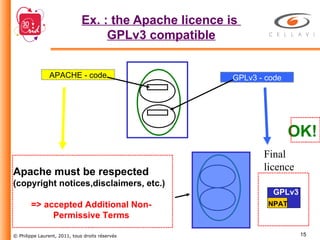
Ex. : the Apache licence is  GPLv3 compatible Final licence APACHE - code GPLv3 - code Apache must be respected  (copyright notices,disclaimers, etc.) => accepted Additional Non-Permissive Terms OK! GPLv3 NPAT
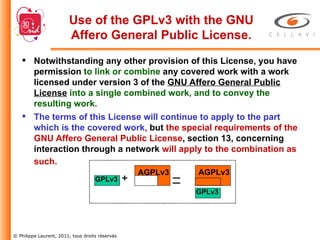
Use of the GPLv3 with the GNU Affero General Public License. Notwithstanding any other provision of this License, you have permission  to link or combine   any covered work with a work licensed under version 3 of the  GNU Affero General Public License   into a single combined work, and to convey the resulting work .  The terms of this License will continue to apply to the part which is the covered work ,  but  the special requirements of the GNU Affero General Public License , section 13, concerning interaction through a network  will apply to the combination as such .   AGPLv3 AGPLv3 GPLv3 GPLv3
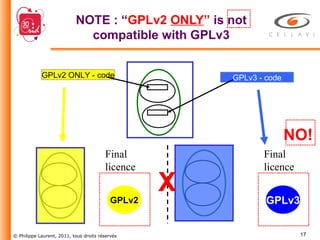
NOTE : “ GPLv2  ONLY ”  is not compatible with GPLv3 GPLv2 ONLY - code GPLv3 - code Final licence GPLv3 X Final licence GPLv2 NO!
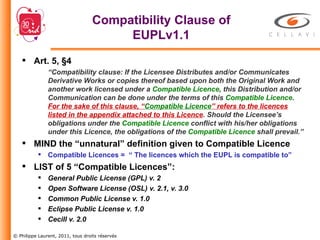
Compatibility Clause of EUPLv1.1 Art. 5, §4 “ Compatibility clause: If the Licensee Distributes and/or Communicates Derivative Works or copies thereof based upon both the Original Work and another work licensed under a  Compatible Licence , this Distribution and/or Communication can be done under the terms of this  Compatible Licence .  For the sake of this clause, “ Compatible Licence ” refers to the licences listed in the appendix attached to this Licence . Should the Licensee’s obligations under the  Compatible Licence  conflict with his/her obligations under this Licence, the obligations of the  Compatible Licence  shall prevail.” MIND the “unnatural” definition given to Compatible Licence Compatible Licences =  “ The licences which the EUPL is compatible to” LIST of 5 “Compatible Licences”: General Public License (GPL) v. 2  Open Software License (OSL) v. 2.1, v. 3.0  Common Public License v. 1.0  Eclipse Public License v. 1.0  Cecill v. 2.0
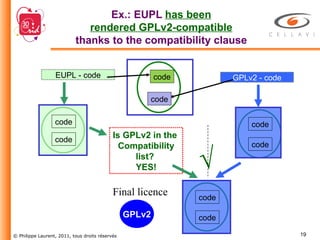
Ex.: EUPL  has been rendered GPLv2-compatible thanks to the compatibility clause EUPL - code GPLv2 - code Final licence GPLv2 code code code code code code Is GPLv2 in the  Compatibility list?  YES! code code √
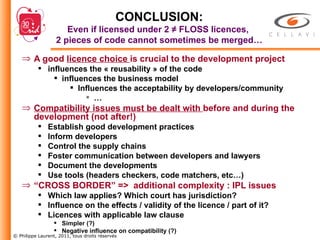
CONCLUSION: Even if licensed under 2 ≠ FLOSS licences,  2 pieces of code cannot sometimes be merged… A good  licence choice  is crucial to the development project influences the « reusability » of the code influences the business model Influences the acceptability by developers/community … Compatibility issues must be dealt with  before and during the development (not after!) Establish good development practices Inform developers Control the supply chains Foster communication between developers and lawyers Document the developments Use tools (headers checkers, code matchers, etc…) “ CROSS BORDER” =>  additional complexity : IPL issues Which law applies? Which court has jurisdiction? Influence on the effects / validity of the licence / part of it? Licences with applicable law clause Simpler (?) Negative influence on compatibility (?)
Thanks for your attention ! Senior Researcher at CRID F.U.N.D.P. Email :  [email_address] http://www.crid.be Attorney at Law Lawyer at the Brussels Bar Email :  [email_address] http://www.mvvp.be Philippe LAURENT MVVP

ePractice workshop on Open Source Software, 7 April 2011 - Philippe Laurent

  • 1.
    Philippe LAURENT SeniorResearcher at the CRID (Centre de Recherches Informatique et Droit / University of Namur) Lawyer at the Brussels Bar (Marx, Van Ranst, Vermeersch & Partners ) A quick insight into FLOSS licences compatibility issues MVVP
  • 2.
    In a broadsense “Compatibility” of FLOSS licences could be described as : “ the characteristic of two (or more) licences according to which the codes distributed under these licences may be put together in order to create a bigger distributable software” + : * this definitions takes into account many of the combination possibilities “ BSD and GPL are compatible” “ BSD and Apache are compatible” “ LGPL and Mozilla may, in some cases, be compatible” - : * this definition does not take into account the result of the combination * It creates a false idea of reciprocity , which could lead to legal mistakes Compatibility (broad sense)
  • 3.
    In a narrowsense , “Compatibility” of a FLOSS license is commonly understood as “ the characteristic of a licence according to which the code distributed under this licence may be integrated in a bigger software that will be distributed under another licence ” Ex.: cfr. the use of the terms “GPL-Compatible” on the FSF website COMPATIBILITY of FLOSS Licences = usually a ONE WAY ROAD BSD is “ GPL-compatible ” BUT GPL is NOT “ BSD-compatible ” BSD code can be added in a software / GPL code cannot be added in a software distributed under GPL / distributed under BSD HOWEVER: BSD is MIT compatible AND MIT is BSD compatible Compatibility (narrow sense) Adopted definition
  • 4.
    … schematic view…(= simplified view!) Entire software application (“ operational ” code) NB : the way the codes are used together have an important influence on the result. In our representations, the codes are “merged” in two different files. “ Program” Files code code code code
  • 5.
    EX. : BSDis GPLv2 compatible BSD - code GPLv2 - code GPLv2 NB: + respect of BSD notices and disclaimers ! OK! “ Program” Final licence for redistribution
  • 6.
    Incompatibility Incompatibility is due to contradictory obligations provided in the different licences under which two codes to be merged are distributed. It can be due to clauses of a multitude of kinds. Basically : anything that puts the licensee in a position where he cannot fulfill at the same time any and all his/her obligations under both licences.
  • 7.
    Ex. : theApache licence is not GPLv2 compatible Final licence GPLv2 APACHE - code GPLv2 - code X The licensee is bound by obligations that contradict the GPLv2 (ex.: indemnification clause = additional restriction ) NO!
  • 8.
    Copyleft isthe main source of compatibility problems This copyleft effect is reached by introducing a copyleft clause in the FLOSS licence, which, in general, reads more or less as follows*: “ You are free to modify or merge the software with another one, but if you redistribute the modified or merged version of the software, this redistribution must be done under the same licence ” There are many types of copyleft effects, with different extents Merging some code with copyleft licensed code usually means that the copyleft licence is predominant => copyleft excludes other licences
  • 9.
    Ex.: the EPLis not GPL compatible EPL - code GPLv2 - code Final licence GPLv2 X Final licence EPL NO!
  • 10.
    EX. : theMPL is not GPL Compatible GPLv2 MPL Final licences Final licence GPLv2 MPL - code GPLv2 - code X NO!
  • 11.
    EX. : Mozillaand CDDL ??? MPL - code CDDL - code CDDL MPL Proprietary or other Final licence(s) OK!
  • 12.
    EX. : Mozillaand CDDL ??? Proprietary or other MPL Final licence(s) MPL - code CDDL - code X Proprietary or other Final licence(s) CDDL NO!
  • 13.
    CLAUSES TO SOLVECOMPATIBILITY PROBLEMS Ex.: - GPLv3 - EUPL
  • 14.
    GPL3’s CompatibilityRelated Clauses Additional permissions (AP): OK = additional exceptions to one or more of the GPLv3 conditions may only be added to GPLv3 by the author of additional original code will only apply to this author’s material may be removed by any “conveyor” Additional non-permissive terms (ANPT): Limited list 6 possible ANPT : 1) different disclaimers (warranty & liability) 2) Legal notices 3) prohibition of misrepresentation of origin 4) Limitation of use of licensors’/authors’ names in publicity 5) No trade mark rights grant 6) indemnification clause apply only to material added by licensee to a covered work not removable Further restrictions (FR): NO GPLv3 GPLv3 AP AP GPLv3 CATCH ALL GPLv3 NPAT GPLv3 NPAT
  • 15.
    Ex. : theApache licence is GPLv3 compatible Final licence APACHE - code GPLv3 - code Apache must be respected (copyright notices,disclaimers, etc.) => accepted Additional Non-Permissive Terms OK! GPLv3 NPAT
  • 16.
    Use of theGPLv3 with the GNU Affero General Public License. Notwithstanding any other provision of this License, you have permission to link or combine any covered work with a work licensed under version 3 of the GNU Affero General Public License into a single combined work, and to convey the resulting work . The terms of this License will continue to apply to the part which is the covered work , but the special requirements of the GNU Affero General Public License , section 13, concerning interaction through a network will apply to the combination as such . AGPLv3 AGPLv3 GPLv3 GPLv3
  • 17.
    NOTE : “GPLv2 ONLY ” is not compatible with GPLv3 GPLv2 ONLY - code GPLv3 - code Final licence GPLv3 X Final licence GPLv2 NO!
  • 18.
    Compatibility Clause ofEUPLv1.1 Art. 5, §4 “ Compatibility clause: If the Licensee Distributes and/or Communicates Derivative Works or copies thereof based upon both the Original Work and another work licensed under a Compatible Licence , this Distribution and/or Communication can be done under the terms of this Compatible Licence . For the sake of this clause, “ Compatible Licence ” refers to the licences listed in the appendix attached to this Licence . Should the Licensee’s obligations under the Compatible Licence conflict with his/her obligations under this Licence, the obligations of the Compatible Licence shall prevail.” MIND the “unnatural” definition given to Compatible Licence Compatible Licences = “ The licences which the EUPL is compatible to” LIST of 5 “Compatible Licences”: General Public License (GPL) v. 2 Open Software License (OSL) v. 2.1, v. 3.0 Common Public License v. 1.0 Eclipse Public License v. 1.0 Cecill v. 2.0
  • 19.
    Ex.: EUPL has been rendered GPLv2-compatible thanks to the compatibility clause EUPL - code GPLv2 - code Final licence GPLv2 code code code code code code Is GPLv2 in the Compatibility list? YES! code code √
  • 20.
    CONCLUSION: Even iflicensed under 2 ≠ FLOSS licences, 2 pieces of code cannot sometimes be merged… A good licence choice is crucial to the development project influences the « reusability » of the code influences the business model Influences the acceptability by developers/community … Compatibility issues must be dealt with before and during the development (not after!) Establish good development practices Inform developers Control the supply chains Foster communication between developers and lawyers Document the developments Use tools (headers checkers, code matchers, etc…) “ CROSS BORDER” => additional complexity : IPL issues Which law applies? Which court has jurisdiction? Influence on the effects / validity of the licence / part of it? Licences with applicable law clause Simpler (?) Negative influence on compatibility (?)
  • 21.
    Thanks for yourattention ! Senior Researcher at CRID F.U.N.D.P. Email : [email_address] http://www.crid.be Attorney at Law Lawyer at the Brussels Bar Email : [email_address] http://www.mvvp.be Philippe LAURENT MVVP