I can infer that
waves carry
energy.
LEARNING TARGET
2022
WAVE MOTION
Defined as disturbance that travels
through space and matter transferring
energy from one place to another.
WHAT IS WAVE?
THROUGH MEDIUM- material through
which the wave travels.
WHAT IS WAVE?
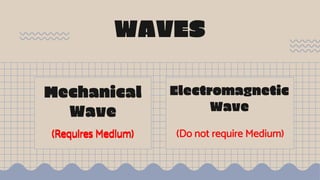
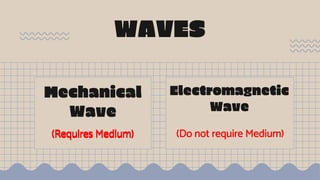
Mechanical
Wave
Electromagnetic
Wave
WAVES
(Requires Medium)
(Requires Medium) (Do not require Medium)
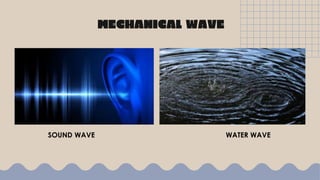
MECHANICAL WAVE
SOUND WAVE WATER WAVE
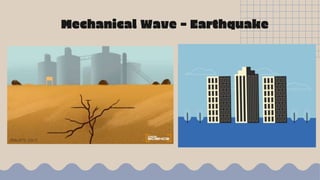
Mechanical Wave - Earthquake
THROUGH MEDIUM- material through
which the wave travels.
WHAT IS WAVE?
01
TRANSVERSE
WAVES
MECHANICAL WAVES
02
LONGITUDINAL
WAVES
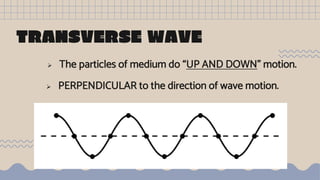
TRANSVERSE WAVE
 The particles of medium do “UP AND DOWN” motion.
 PERPENDICULAR to the direction of wave motion.
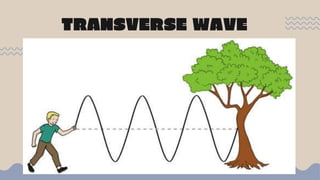
TRANSVERSE WAVE
TRANSVERSE WAVE
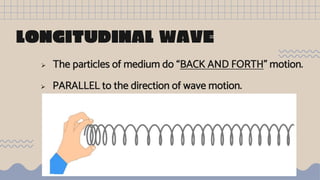
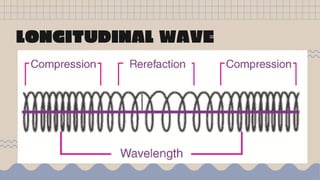
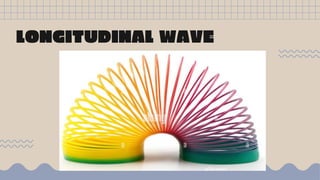
LONGITUDINAL WAVE
 The particles of medium do “BACK AND FORTH” motion.
 PARALLEL to the direction of wave motion.
LONGITUDINAL WAVE
LONGITUDINAL WAVE
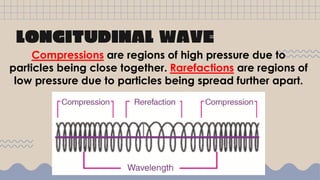
Compressions are regions of high pressure due to
particles being close together. Rarefactions are regions of
low pressure due to particles being spread further apart.
LONGITUDINAL WAVE
Mechanical
Wave
Electromagnetic
Wave
WAVES
(Requires Medium)
(Requires Medium) (Do not require Medium)
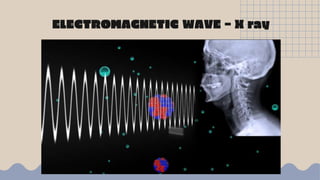
ELECTROMAGNETIC WAVE – X ray
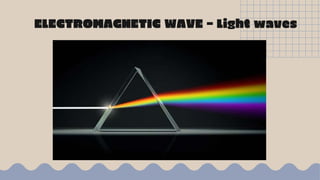
ELECTROMAGNETIC WAVE – Light waves
CHARACTERISTICS
OF
WAVES
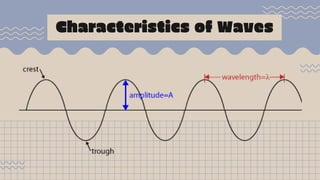
Characteristics of Waves
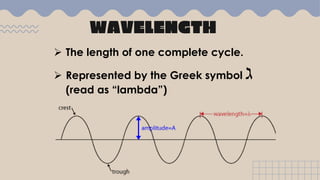
WAVELENGTH
 The length of one complete cycle.
 Represented by the Greek symbol ℷ
(read as “lambda”)
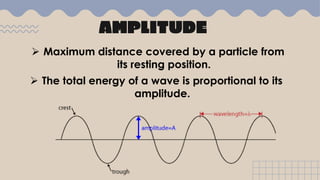
AMPLITUDE
 Maximum distance covered by a particle from
its resting position.
 The total energy of a wave is proportional to its
amplitude.
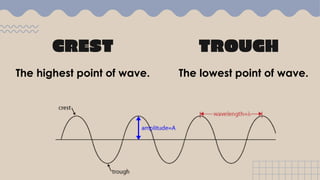
CREST
The highest point of wave.
TROUGH
The lowest point of wave.
WAVE VELOCITY
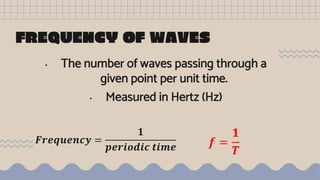
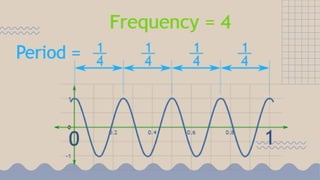
FREQUENCY OF WAVES
• The number of waves passing through a
given point per unit time.
• Measured in Hertz (Hz)
𝑭𝒓𝒆𝒒𝒖𝒆𝒏𝒄𝒚 =
𝟏
𝒑𝒆𝒓𝒊𝒐𝒅𝒊𝒄 𝒕𝒊𝒎𝒆 𝒇 =
𝟏
𝑻
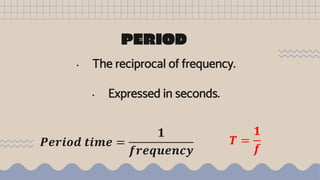
PERIOD
• The reciprocal of frequency.
• Expressed in seconds.
𝑷𝒆𝒓𝒊𝒐𝒅 𝒕𝒊𝒎𝒆 =
𝟏
𝒇𝒓𝒆𝒒𝒖𝒆𝒏𝒄𝒚
𝑻 =
𝟏
𝒇
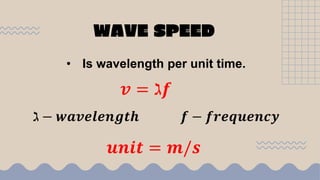
WAVE SPEED
• Is wavelength per unit time.
𝒗 = ℷ𝒇
ℷ − 𝒘𝒂𝒗𝒆𝒍𝒆𝒏𝒈𝒕𝒉 𝒇 − 𝒇𝒓𝒆𝒒𝒖𝒆𝒏𝒄𝒚
𝒖𝒏𝒊𝒕 = 𝒎/𝒔
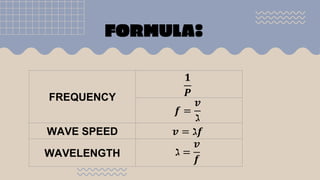
FORMULA:
FREQUENCY
𝟏
𝑷
𝒇 =
𝒗
ℷ
WAVE SPEED 𝒗 = ℷ𝒇
WAVELENGTH ℷ =
𝒗
𝒇
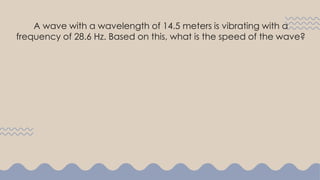
A wave with a wavelength of 14.5 meters is vibrating with a
frequency of 28.6 Hz. Based on this, what is the speed of the wave?
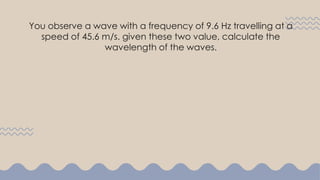
You observe a wave with a frequency of 9.6 Hz travelling at a
speed of 45.6 m/s. given these two value, calculate the
wavelength of the waves.
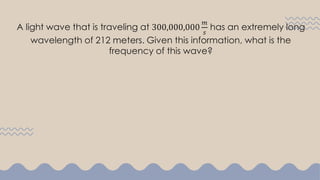
A light wave that is traveling at 300,000,000
𝑚
𝑠
has an extremely long
wavelength of 212 meters. Given this information, what is the
frequency of this wave?
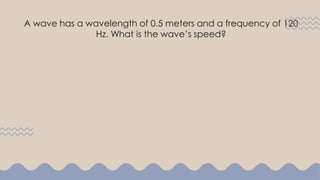
A wave has a wavelength of 0.5 meters and a frequency of 120
Hz. What is the wave’s speed?
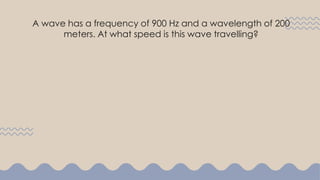
A wave has a frequency of 900 Hz and a wavelength of 200
meters. At what speed is this wave travelling?
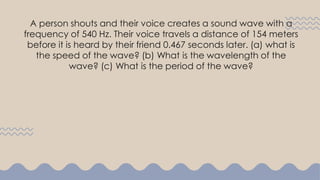
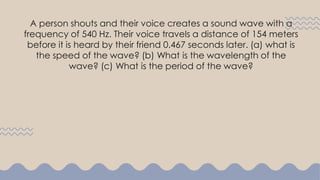
A person shouts and their voice creates a sound wave with a
frequency of 540 Hz. Their voice travels a distance of 154 meters
before it is heard by their friend 0.467 seconds later. (a) what is
the speed of the wave? (b) What is the wavelength of the
wave? (c) What is the period of the wave?
A person shouts and their voice creates a sound wave with a
frequency of 540 Hz. Their voice travels a distance of 154 meters
before it is heard by their friend 0.467 seconds later. (a) what is
the speed of the wave? (b) What is the wavelength of the
wave? (c) What is the period of the wave?

03-Waves.pptx

Editor's Notes

  • #6 WAVES transfer energy not the matter.
  • #7 WAVES transfer energy not the matter.
  • #8 Throwing a rock in a pond of water produces a wave. When the rock touches the water, circular ripples are created from the place of disturbance. The energy that the rock possessed is transferred into the water molecules. However, the rock itself does not leave the water.
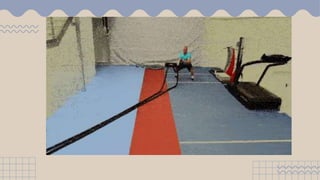
  • #9 If you tie one end of a rope on a hook and jerk the other end once, a disturbance will travel along the wave pulse will be produced. Jerking it up and down several times will produce waive train. The rope acts as the medium through which the wave propagates.
  • #10 Mechanical Wave is a wave that is not capable of transmitting energy through vacuum. It needs a material/medium such as solid, liquid, or gas to transport its energy from one location to another. Example: Water waves created in a pond and sound waves produced by musical instruement. Unlike mechanical wave, electromagnetic wave is the type of wave that can transmit energy even without any material medium.
  • #12 The medium for seismic waves is the Earth. A medium is any substance that a wave travels through. Since seismic waves travel through Earth, this is their medium.
  • #13 WAVES transfer energy not the matter.
  • #22 Mechanical Wave is a wave that is not capable of transmitting energy through vacuum. It needs a material/medium such as solid, liquid, or gas to transport its energy from one location to another. Example: Water waves created in a pond and sound waves produced by musical instruement. Unlike mechanical wave, electromagnetic wave is the type of wave that can transmit energy even without any material medium.
  • #23 X-rays are a form of electromagnetic radiation similar to radio waves, microwaves, visible light and gamma rays. X-ray photons are highly energetic and have enough energy to break up molecules and hence damage living cells. When X-rays hit a material some are absorbed and others pass through.
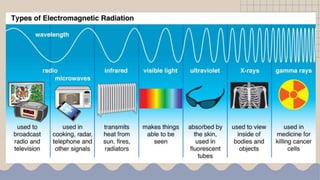
  • #24 Electromagnetic Spectrum is an arrangement of electromagnetic waves according to wavelength or frequency.
  • #25 Electromagnetic Spectrum is an arrangement of electromagnetic waves according to wavelength or frequency.
  • #27 WAVES transfer energy not the matter.
  • #28 One complete wave is equal to one wavelength. It is the measure of a distance between a crest and the adjacent crest or a through and the adjacent through in a transverse wave.
  • #29 Positive amplitude is the distance from rest to crest while negative amplitude is the distance from rest to trough. The greater amplitude, the greater the amount of energy carried by the wave.
  • #30 One complete wave is equal to one wavelength. It is the measure of a distance between a crest and the adjacent crest or a through and the adjacent through in a transverse wave.
  • #37 V=lambda times frequency V=(14.5)(28.6)
  • #38 45.6/9.6=4.8 m
  • #39 300,000,000/212
  • #42 v=d/t=154/0.467=330 m/s Lambda=v/f=330/540=0.611 meters T=1/f=1/540 Hz=1.85x10^-3 seconds
  • #43 v=d/t=154/0.467=330 m/s Lambda=v/f=330/540=0.611 meters T=1/f=1/540 Hz=1.85x10^-3 seconds