Introductio
n to Waves
Exploring the types
of waves and their
properties
Think
About It
How does your voice travel
from your mouth to your
friend's ears when you are
having a conversation?
Answer Key
When you speak, your vocal
cords vibrate, producing
sound waves that move
through the air as
compressions and
rarefactions.
Think About It
These sound waves reach
your friend's ears, causing
their eardrums to vibrate,
which their brain interprets
as sound.
Your voice creates sound
waves, which are vibrations
that travel through the air.
Today,
you
will...
01
02
03
04 Describe what an
electromagnetic wave is, and
explain its properties and
components.
Identify the distinguishing
characteristics of waves and the
features of both longitudinal
and transverse waves.
Define the terms amplitude,
wavelength, and frequency, and
identify where they are located
on a wave diagram.
Relate wave velocity to
frequency and wavelength.
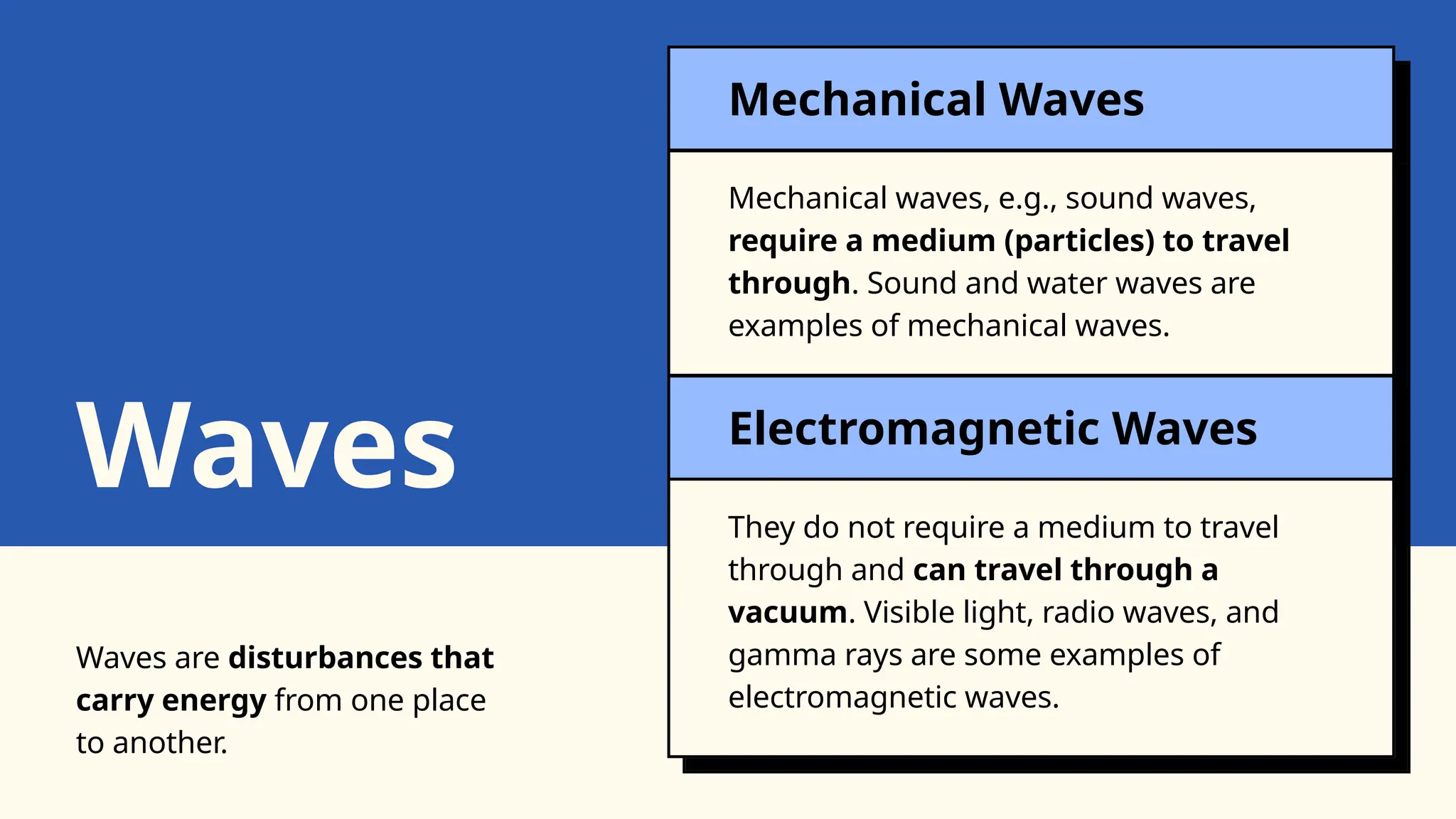
Electromagnetic Waves
Waves
Waves are disturbances that
carry energy from one place
to another.
Mechanical Waves
Mechanical waves, e.g., sound waves,
require a medium (particles) to travel
through. Sound and water waves are
examples of mechanical waves.
They do not require a medium to travel
through and can travel through a
vacuum. Visible light, radio waves, and
gamma rays are some examples of
electromagnetic waves.
rarefaction
compression
Longitudinal
Mechanical waves are generally
categorised into two main
types: longitudinal and
transverse waves.
Longitudinal Waves
• Vibrations occur parallel to the direction
the wave travels
• Have regions of compression and
rarefaction moving through the medium
direction of wave
propagation
direction of vibration
PUSHING A SLINKY BACKWARDS AND FORWARDS
PRODUCES A LONGITUDINAL WAVE.
MECHANICAL WAVES:
rarefaction
Longitudinal
MECHANICAL WAVES: A sound wave is a longitudinal wave. It is
produced when the air surrounding a
vibrating object also vibrates.
The air particles produce a series of
compressions and rarefactions, which then
travel and enter the receiver’s ear.
SOUND TRAVELS THROUGH THE VIBRATION OF AIR PARTICLES.
compression
In transverse waves, the
vibrations occur at right angles
to the wave’s direction.
Only the energy, not the
particles, is transferred
through the medium.
direction of wave
propagation
direction of vibration
Transverse
MECHANICAL WAVES:
SHAKING A ROPE UP AND DOWN PRODUCES A
TRANSVERSE WAVE.
Electromagnetic Waves
Electromagnetic waves are transverse
waves. It is characterised by oscillating
electric and magnetic fields at right
angles to the direction of wave travel.
These waves travel at a speed of 3.0 ×
10 m/s in a vacuum.
The electromagnetic spectrum can be
divided into seven groups: radio wave,
microwave, infrared light, visible light,
ultraviolet light, x-ray, and gamma ray.
Radio Microwave Infrared Gamma ray
X-ray
Ultraviolet
Visible
The division between some
categories are distinct, but some
bands overlap (e.g., infrared,
visible, and ultraviolet)
8
mechanical wave
electromagnetic wave
longitudinal wave
electromagnetic wave
Learning
Check
During an earthquake, P-waves (or primary
waves) travel the fastest. It can travel through
any type of material and leaves a trail of
compressions and rarefactions through the
medium. What type of wave are P-waves?
A
B
C
D
Learning Check
Answer Key
undisturbed medium
compression
rarefaction
P-waves, or primary waves, are
mechanical waves because they require
a medium (solid, liquid, or gas) to
propagate.
Since they create a series of rarefactions
and compressions, the vibration of the
particles in the medium is in the same
direction as wave propagation. Thus, P-
waves fall under longitudinal waves.
direction of wave propagation
crest
through
rest or
equilibriu
m position
The undisturbed position of the
particles if they do not vibrate
Otherwise known as the peak, the
highest point of a wave
Parts of a Wave
The lowest point of a wave
Crest
Trough
Rest or Equilibrium
Position
direction of wave
propagation
amplitude
Amplitude
It is the maximum disturbance
from the crest of the wave from
its rest position. It represents
the wave's height.
The unit for amplitude (A) is
metres (m).
PARTS OF A WAVE:
direction of
wave travel
one wavelength
Wavelength
It is a set distance that
represents the full cycle of a
wave. It can be measured from
crest to crest, from trough to
trough, or any two consecutive
points in the wave cycle.
The unit for wavelength
(λ, Greek letter lambda) is
metres (m).
PARTS OF A WAVE:
direction of
wave travel
low frequency
high frequency
Frequency
It is the number of waves
passing a specific point per
second.
The unit of frequency is hertz
(Hz), which is equal to 1 cycle
per second (1/s).
PARTS OF A WAVE:
Longitudinal
Waves
PARTS OF A WAVE:
Amplitude - the closer the particles are in
the area of compression, the greater the
amplitude
Wavelength - the distance between two
consecutive points (between two
compressions or two rarefactions)
Longitudinal waves also exhibit
wavelength and amplitude.
one wavelength
A B
Compare these two waves in
terms of frequency,
wavelength, and amplitude.
Learning
Check
Answer Key
A B
amplitude amplitude
wavelength wavelength
• same amplitude as B
• longer wavelength
• lower frequency
• same amplitude as A
• shorter wavelength
• higher frequency
Learning Check
slower wave faster wave
(longer wavelength,
lower frequency)
(shorter wavelength,
higher frequency)
direction of wave travel
Velocity of a Wave
Wave speed, or velocity, is defined
as the distance a wave travels
per second. We can also define
wave speed as the rate at which
energy is transferred through a
medium.
The unit for wave velocity is
metres per second (m/s).
Medium 1 Medium 2
When calculating wave velocity we
use the following formula:
The velocity of a wave depends on its frequency
and wavelength.
wave velocity in m/s = frequency in Hertz or 1/s
× wavelength in m
Calculating Velocity of a Wave
Calculating
Velocity of a
Wave:
Sample
Problem
While at the beach, you observed that the
waves hit he shore at a frequency of 0.5 waves
per second. You also estimated the distance
between the crests of the waves to be 2
metres.
What is the velocity of the waves as they travel
towards the shore?
v = × 2 m
s
0.5
v = 1 m/s
Here's the information given:
v = f × λ
The wave travels at 1 m/s towards the shore.
Calculating
Velocity of a
Wave:
Sample
Problem
frequency (f) = 0.5 waves per second = 0.5/s
wavelength (λ) = 2 m
Now, we plug these values into the formula:
Bats use sound waves to detect
insects. Suppose a bat sends out a
100-kHz sound wave at a speed of
343 m/s. What is the wavelength of
the sound wave?
Learning
Check
f = 100 kHz = 100,000 Hz or 100,000/s
v = 343 m/s
Given:
Find:
λ = ?
Equation:
v = fλ λ =
f
v
Learning Check Answer Key
Solution:
λ =
100,000/s
343 m/s
λ =
100,000/s
343 m/s
λ = 0.00343 m
The sound wave produced by the bat has
a wavelength of 0.00343 m or 0.343
cm.
Waves can be grouped as mechanical
and electromagnetic waves. In terms of
propagation, waves can be grouped as
transverse or longitudinal.
Types of Waves
Waves have amplitude, wavelength,
frequency, and velocity. Changes in one
property can affect the other features.
Parts of a Wave
Summary
It is a disturbance that transfers energy.
Wave
To calculate the velocity of a wave,
multiply the frequency with the
wavelength (v = fλ).
Velocity of a Wave
Create a poster in Canva showing
the properties and applications of
each component of the
electromagnetic spectrum.
Assignment
set:nAE_gaaJTCk set:nAFPc5WQLds
set:nAFfHEKHNnw
Use these icons and illustrations in your Canva
Presentation. Happy designing! Don't forget to
delete this page before presenting.
Resource Page
Try this background for online class.
*Please delete this section before downloading.
B for blur
D for a drumroll
O for bubbles
U for unveil
C for confetti
M for mic drop
Q for quiet
Any number from
0-9 for a timer
Press these
keys while
on Present
mode!

Introduction to Waves Education Presentation in 0 Green Style.pptx

  • 1.
    Introductio n to Waves Exploringthe types of waves and their properties
  • 2.
    Think About It How doesyour voice travel from your mouth to your friend's ears when you are having a conversation?
  • 3.
    Answer Key When youspeak, your vocal cords vibrate, producing sound waves that move through the air as compressions and rarefactions. Think About It These sound waves reach your friend's ears, causing their eardrums to vibrate, which their brain interprets as sound. Your voice creates sound waves, which are vibrations that travel through the air.
  • 4.
    Today, you will... 01 02 03 04 Describe whatan electromagnetic wave is, and explain its properties and components. Identify the distinguishing characteristics of waves and the features of both longitudinal and transverse waves. Define the terms amplitude, wavelength, and frequency, and identify where they are located on a wave diagram. Relate wave velocity to frequency and wavelength.
  • 5.
    Electromagnetic Waves Waves Waves aredisturbances that carry energy from one place to another. Mechanical Waves Mechanical waves, e.g., sound waves, require a medium (particles) to travel through. Sound and water waves are examples of mechanical waves. They do not require a medium to travel through and can travel through a vacuum. Visible light, radio waves, and gamma rays are some examples of electromagnetic waves.
  • 6.
    rarefaction compression Longitudinal Mechanical waves aregenerally categorised into two main types: longitudinal and transverse waves. Longitudinal Waves • Vibrations occur parallel to the direction the wave travels • Have regions of compression and rarefaction moving through the medium direction of wave propagation direction of vibration PUSHING A SLINKY BACKWARDS AND FORWARDS PRODUCES A LONGITUDINAL WAVE. MECHANICAL WAVES:
  • 7.
    rarefaction Longitudinal MECHANICAL WAVES: Asound wave is a longitudinal wave. It is produced when the air surrounding a vibrating object also vibrates. The air particles produce a series of compressions and rarefactions, which then travel and enter the receiver’s ear. SOUND TRAVELS THROUGH THE VIBRATION OF AIR PARTICLES. compression
  • 8.
    In transverse waves,the vibrations occur at right angles to the wave’s direction. Only the energy, not the particles, is transferred through the medium. direction of wave propagation direction of vibration Transverse MECHANICAL WAVES: SHAKING A ROPE UP AND DOWN PRODUCES A TRANSVERSE WAVE.
  • 9.
    Electromagnetic Waves Electromagnetic wavesare transverse waves. It is characterised by oscillating electric and magnetic fields at right angles to the direction of wave travel. These waves travel at a speed of 3.0 × 10 m/s in a vacuum. The electromagnetic spectrum can be divided into seven groups: radio wave, microwave, infrared light, visible light, ultraviolet light, x-ray, and gamma ray. Radio Microwave Infrared Gamma ray X-ray Ultraviolet Visible The division between some categories are distinct, but some bands overlap (e.g., infrared, visible, and ultraviolet) 8
  • 10.
    mechanical wave electromagnetic wave longitudinalwave electromagnetic wave Learning Check During an earthquake, P-waves (or primary waves) travel the fastest. It can travel through any type of material and leaves a trail of compressions and rarefactions through the medium. What type of wave are P-waves? A B C D
  • 11.
    Learning Check Answer Key undisturbedmedium compression rarefaction P-waves, or primary waves, are mechanical waves because they require a medium (solid, liquid, or gas) to propagate. Since they create a series of rarefactions and compressions, the vibration of the particles in the medium is in the same direction as wave propagation. Thus, P- waves fall under longitudinal waves. direction of wave propagation
  • 12.
    crest through rest or equilibriu m position Theundisturbed position of the particles if they do not vibrate Otherwise known as the peak, the highest point of a wave Parts of a Wave The lowest point of a wave Crest Trough Rest or Equilibrium Position direction of wave propagation
  • 13.
    amplitude Amplitude It is themaximum disturbance from the crest of the wave from its rest position. It represents the wave's height. The unit for amplitude (A) is metres (m). PARTS OF A WAVE: direction of wave travel
  • 14.
    one wavelength Wavelength It isa set distance that represents the full cycle of a wave. It can be measured from crest to crest, from trough to trough, or any two consecutive points in the wave cycle. The unit for wavelength (λ, Greek letter lambda) is metres (m). PARTS OF A WAVE: direction of wave travel
  • 15.
    low frequency high frequency Frequency Itis the number of waves passing a specific point per second. The unit of frequency is hertz (Hz), which is equal to 1 cycle per second (1/s). PARTS OF A WAVE:
  • 16.
    Longitudinal Waves PARTS OF AWAVE: Amplitude - the closer the particles are in the area of compression, the greater the amplitude Wavelength - the distance between two consecutive points (between two compressions or two rarefactions) Longitudinal waves also exhibit wavelength and amplitude. one wavelength
  • 17.
    A B Compare thesetwo waves in terms of frequency, wavelength, and amplitude. Learning Check
  • 18.
    Answer Key A B amplitudeamplitude wavelength wavelength • same amplitude as B • longer wavelength • lower frequency • same amplitude as A • shorter wavelength • higher frequency Learning Check
  • 19.
    slower wave fasterwave (longer wavelength, lower frequency) (shorter wavelength, higher frequency) direction of wave travel Velocity of a Wave Wave speed, or velocity, is defined as the distance a wave travels per second. We can also define wave speed as the rate at which energy is transferred through a medium. The unit for wave velocity is metres per second (m/s). Medium 1 Medium 2
  • 20.
    When calculating wavevelocity we use the following formula: The velocity of a wave depends on its frequency and wavelength. wave velocity in m/s = frequency in Hertz or 1/s × wavelength in m Calculating Velocity of a Wave
  • 21.
    Calculating Velocity of a Wave: Sample Problem Whileat the beach, you observed that the waves hit he shore at a frequency of 0.5 waves per second. You also estimated the distance between the crests of the waves to be 2 metres. What is the velocity of the waves as they travel towards the shore?
  • 22.
    v = ×2 m s 0.5 v = 1 m/s Here's the information given: v = f × λ The wave travels at 1 m/s towards the shore. Calculating Velocity of a Wave: Sample Problem frequency (f) = 0.5 waves per second = 0.5/s wavelength (λ) = 2 m Now, we plug these values into the formula:
  • 23.
    Bats use soundwaves to detect insects. Suppose a bat sends out a 100-kHz sound wave at a speed of 343 m/s. What is the wavelength of the sound wave? Learning Check
  • 24.
    f = 100kHz = 100,000 Hz or 100,000/s v = 343 m/s Given: Find: λ = ? Equation: v = fλ λ = f v Learning Check Answer Key Solution: λ = 100,000/s 343 m/s λ = 100,000/s 343 m/s λ = 0.00343 m The sound wave produced by the bat has a wavelength of 0.00343 m or 0.343 cm.
  • 25.
    Waves can begrouped as mechanical and electromagnetic waves. In terms of propagation, waves can be grouped as transverse or longitudinal. Types of Waves Waves have amplitude, wavelength, frequency, and velocity. Changes in one property can affect the other features. Parts of a Wave Summary It is a disturbance that transfers energy. Wave To calculate the velocity of a wave, multiply the frequency with the wavelength (v = fλ). Velocity of a Wave
  • 26.
    Create a posterin Canva showing the properties and applications of each component of the electromagnetic spectrum. Assignment
  • 27.
    set:nAE_gaaJTCk set:nAFPc5WQLds set:nAFfHEKHNnw Use theseicons and illustrations in your Canva Presentation. Happy designing! Don't forget to delete this page before presenting. Resource Page
  • 28.
    Try this backgroundfor online class. *Please delete this section before downloading.
  • 29.
    B for blur Dfor a drumroll O for bubbles U for unveil C for confetti M for mic drop Q for quiet Any number from 0-9 for a timer Press these keys while on Present mode!