PCI Express® 3.0 PHY Electrical
Layer Requirements
Dan Froelich
Intel Corporation
Dan Froelich
Intel Corporation
* Third party marks and brands are the property of their respective owners.
Copyright © 2008, PCI-SIG, All Rights Reserved 2
PCI-SIG Confidential
Agenda
ƒ PHY Requirements
ƒ Preliminary Jitter Budget
ƒ Statistical Simulation Tools
ƒ 3.0 PHY Rate
ƒ Transmitter Specification
9 PLL Bandwidth
9 Reference Location
9 Timing Parameters
9 Equalization
ƒ Reference Clock Specification
ƒ Receiver Specification
ƒ Major Form Factor Work Areas
ƒ Next Steps
Copyright © 2008, PCI-SIG, All Rights Reserved 3
PCI-SIG Confidential
PCIe® 3.0 Electrical Requirements
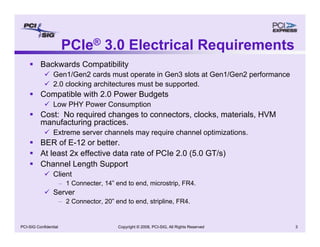
ƒ Backwards Compatibility
9 Gen1/Gen2 cards must operate in Gen3 slots at Gen1/Gen2 performance
9 2.0 clocking architectures must be supported.
ƒ Compatible with 2.0 Power Budgets
9 Low PHY Power Consumption
ƒ Cost: No required changes to connectors, clocks, materials, HVM
manufacturing practices.
9 Extreme server channels may require channel optimizations.
ƒ BER of E-12 or better.
ƒ At least 2x effective data rate of PCIe 2.0 (5.0 GT/s)
ƒ Channel Length Support
9 Client
– 1 Connecter, 14” end to end, microstrip, FR4.
9 Server
– 2 Connector, 20” end to end, stripline, FR4.
Copyright © 2008, PCI-SIG, All Rights Reserved 4
PCI-SIG Confidential
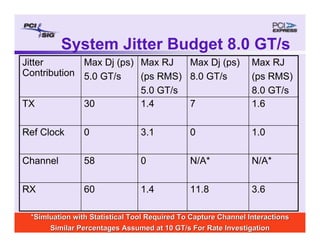
System Jitter Budget 8.0 GT/s
*
*Simluation
Simluation with Statistical Tool Required To Capture Channel Interactions
with Statistical Tool Required To Capture Channel Interactions
Similar Percentages Assumed at 10 GT/s For Rate Investigation
1.6
7
1.4
30
TX
3.6
11.8
1.4
60
RX
N/A*
N/A*
0
58
Channel
1.0
0
3.1
0
Ref Clock
Max RJ
(ps RMS)
8.0 GT/s
Max Dj (ps)
8.0 GT/s
Max RJ
(ps RMS)
5.0 GT/s
Max Dj (ps)
5.0 GT/s
Jitter
Contribution
Copyright © 2008, PCI-SIG, All Rights Reserved 5
PCI-SIG Confidential
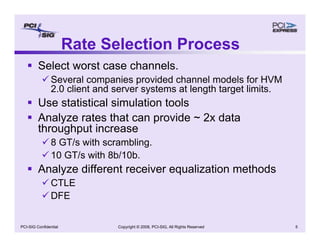
Rate Selection Process
ƒ Select worst case channels.
9 Several companies provided channel models for HVM
2.0 client and server systems at length target limits.
ƒ Use statistical simulation tools
ƒ Analyze rates that can provide ~ 2x data
throughput increase
9 8 GT/s with scrambling.
9 10 GT/s with 8b/10b.
ƒ Analyze different receiver equalization methods
9 CTLE
9 DFE
Copyright © 2008, PCI-SIG, All Rights Reserved 6
PCI-SIG Confidential
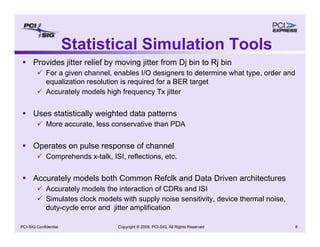
ƒ Provides jitter relief by moving jitter from Dj bin to Rj bin
9 For a given channel, enables I/O designers to determine what type, order and
equalization resolution is required for a BER target
9 Accurately models high frequency Tx jitter
ƒ Uses statistically weighted data patterns
9 More accurate, less conservative than PDA
ƒ Operates on pulse response of channel
9 Comprehends x-talk, ISI, reflections, etc.
ƒ Accurately models both Common Refclk and Data Driven architectures
9 Accurately models the interaction of CDRs and ISI
9 Simulates clock models with supply noise sensitivity, device thermal noise,
duty-cycle error and jitter amplification
Statistical Simulation Tools
Copyright © 2008, PCI-SIG, All Rights Reserved 7
PCI-SIG Confidential
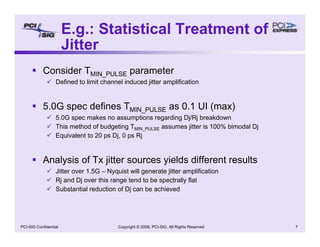
ƒ Consider TMIN_PULSE parameter
9 Defined to limit channel induced jitter amplification
ƒ 5.0G spec defines TMIN_PULSE as 0.1 UI (max)
9 5.0G spec makes no assumptions regarding Dj/Rj breakdown
9 This method of budgeting TMIN_PULSE assumes jitter is 100% bimodal Dj
9 Equivalent to 20 ps Dj, 0 ps Rj
ƒ Analysis of Tx jitter sources yields different results
9 Jitter over 1.5G – Nyquist will generate jitter amplification
9 Rj and Dj over this range tend to be spectrally flat
9 Substantial reduction of Dj can be achieved
E.g.: Statistical Treatment of
Jitter
Copyright © 2008, PCI-SIG, All Rights Reserved 8
PCI-SIG Confidential
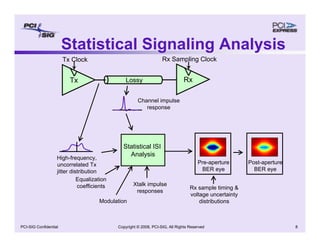
Lossy Rx
Tx
Rx Sampling Clock
Tx Clock
Statistical ISI
Analysis
High-frequency,
uncorrelated Tx
jitter distribution
Channel impulse
response
Equalization
coefficients Xtalk impulse
responses
Modulation
Pre-aperture
BER eye
Rx sample timing &
voltage uncertainty
distributions
Post-aperture
BER eye
Statistical Signaling Analysis
Copyright © 2008, PCI-SIG, All Rights Reserved 9
PCI-SIG Confidential
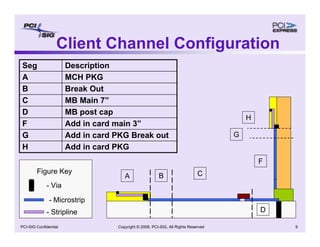
Client Channel Configuration
- Via
- Microstrip
- Stripline
Figure Key
Add in card PKG
H
Add in card PKG Break out
G
Add in card main 3”
F
MB post cap
D
MB Main 7”
C
Break Out
B
MCH PKG
A
Description
Seg
A C
B
D
F
H
G
Copyright © 2008, PCI-SIG, All Rights Reserved 10
PCI-SIG Confidential
4”
Receiver package
Receiver package
Add in Card
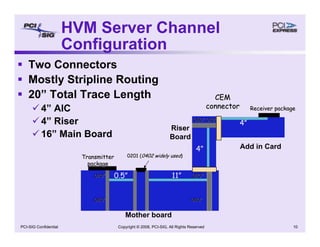
HVM Server Channel
Configuration
ƒ Two Connectors
ƒ Mostly Stripline Routing
ƒ 20” Total Trace Length
9 4” AIC
9 4” Riser
9 16” Main Board
11”
Riser
Board
4”
Mother board
.020
.020”
”
.050
.050”
”
.050
.050”
”
Transmitter
Transmitter
package
package
CEM
CEM
connector
connector
.010
.010”
”
.020
.020”
”
.050
.050”
”
0201 (
0201 (0402 widely used
0402 widely used)
)
0.5”
Copyright © 2008, PCI-SIG, All Rights Reserved 11
PCI-SIG Confidential
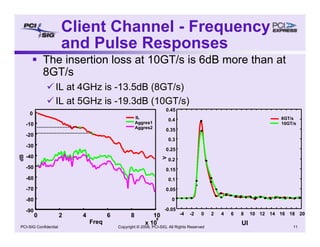
Client Channel - Frequency
and Pulse Responses
ƒ The insertion loss at 10GT/s is 6dB more than at
8GT/s
9 IL at 4GHz is -13.5dB (8GT/s)
9 IL at 5GHz is -19.3dB (10GT/s)
0 2 4 6 8 10
x 10
9
-90
-80
-70
-60
-50
-40
-30
-20
-10
0
Freq
dB
IL
Aggres1
Aggres2
-0.05
0
0.05
0.1
0.15
0.2
0.25
0.3
0.35
0.4
0.45
-4 -2 0 2 4 6 8 10 12 14 16 18 20
UI
V
8GT/s
10GT/s
Copyright © 2008, PCI-SIG, All Rights Reserved 12
PCI-SIG Confidential
8GT/s
ps
Voltage
20 40 60 80 100 120
0.1
-0.05
0
-0.05
-0.1
-0.15 -12
-10
-8
-6
-4
-2
0
0.15
4 5 6 7 8
0
0.1
0.2
0.3
0.4
Time (nsec)
Amplitude
(V)
EQ pulse response
Un-EQ pulse response
ps
0.1
-0.05
0
-0.05
-0.1
-0.15 -12
-10
-8
-6
-4
-2
0
0.15
0
0.1
0.2
0.3
0.4
Amplitude
(V)
TX = [0.69 -0.31]
TX = [0.9 -0.1]
DFE =[0.1563 0.0781 0.0352 0 0.0156 0.0117]
Time (nsec)
10GT/s
EQ pulse response
Un-EQ pulse
response
4 5 6
20 40 60 80 100
TX = [1]
DFE =[1:6]
TX = [1]
EH = 16mV
EW = 10ps
EH = 27mV
EW = 11ps
Voltage
different equalization settings
Sample BER Eye Diagrams
1.0 UI
1.0 UI
Copyright © 2008, PCI-SIG, All Rights Reserved 13
PCI-SIG Confidential
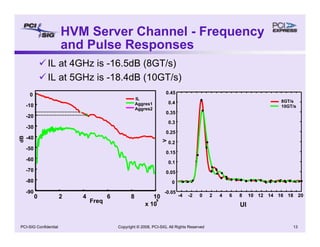
HVM Server Channel - Frequency
and Pulse Responses
9 IL at 4GHz is -16.5dB (8GT/s)
9 IL at 5GHz is -18.4dB (10GT/s)
0 2 4 6 8 10
x 10
9
-90
-80
-70
-60
-50
-40
-30
-20
-10
0
Freq
dB
IL
Aggres1
Aggres2
-0.05
0
0.05
0.1
0.15
0.2
0.25
0.3
0.35
0.4
0.45
V
8GT/s
10GT/s
-4 -2 0 2 4 6 8 10 12 14 16 18 20
UI
Copyright © 2008, PCI-SIG, All Rights Reserved 14
PCI-SIG Confidential
TX EQ
CTLE
DFE
Pass
Fail
[1]
1st
[1]
1st
[2 3]
[1]
[1 2]
[1]
[1-4 ]
[1]
[1-6 ]
Eye
Height
(V)
[1]
1st
8GT/s
10GT/s
-0.14
-0.12
-0.1
-0.08
-0.06
-0.04
-0.02
0
0.02
0.04
Equalization Sweep
20” Server Channel
Simulation Results (Nominal)
Power & Area
Power & Area
Pass
Fail
-0.1
-0.05
0
0.05
0.1
0.15
0.2
0.25
TX EQ
CTLE
DFE
[1]
1st
[1]
1st
[2 3]
[1]
[1 2]
[1]
[1-4 ]
[1]
[1-6 ]
[1]
1st
8GT/s
10GT/s
Eye
Height
(V)
7” Client Channel
Power & Area
Power & Area
TX EQ
CTLE
DFE
[1]
1st
[1]
1st
[2 3]
[1]
[1 2]
[1]
[1-4 ]
[1]
[1-6 ]
Eye
Height
(V)
Equalization Sweep
[1]
1st
-0.04
-0.02
0
0.02
0.04
0.06
0.08
8GT/s
10GT/s Pass
Fail
14” Client Channel
Power & Area
Power & Area
Copyright © 2008, PCI-SIG, All Rights Reserved 15
PCI-SIG Confidential
Simulation Results (Est W/C)
TX EQ
CTLE
DFE
[1]
1st
[1]
1st
[2 3]
[1]
[1 2]
[1]
[1-4 ]
[1]
[1-6 ]
Eye
Height
(V)
Equalization Sweep
[1]
1st
-0.04
-0.02
0
0.02
0.04
0.06
0.08
8GT/s
10GT/s
Pass
Fail
14” Client Channel
Power & Area
Power & Area
TX EQ
CTLE
DFE
Pass
Fail
[1]
1st
[1]
1st
[2 3]
[1]
[1 2]
[1]
[1-4 ]
[1]
[1-6 ]
Eye
Height
(V)
[1]
1st
8GT/s
10GT/s
-0.14
-0.12
-0.1
-0.08
-0.06
-0.04
-0.02
0
0.02
0.04
Equalization Sweep
20” Server Channel
Power & Area
Power & Area
Pass
Fail
-0.1
-0.05
0
0.05
0.1
0.15
0.2
0.25
TX EQ
CTLE
DFE
[1]
1st
[1]
1st
[2 3]
[1]
[1 2]
[1]
[1-4 ]
[1]
[1-6 ]
[1]
1st
8GT/s
10GT/s
Eye
Height
(V)
7” Client Channel
Power & Area
Power & Area
Copyright © 2008, PCI-SIG, All Rights Reserved 16
PCI-SIG Confidential
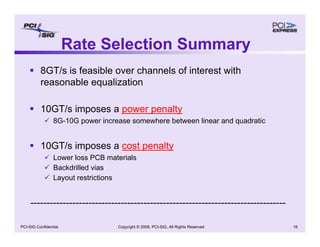
Rate Selection Summary
ƒ 8GT/s is feasible over channels of interest with
reasonable equalization
ƒ 10GT/s imposes a power penalty
9 8G-10G power increase somewhere between linear and quadratic
ƒ 10GT/s imposes a cost penalty
9 Lower loss PCB materials
9 Backdrilled vias
9 Layout restrictions
-------------------------------------------------------------------------------
Copyright © 2008, PCI-SIG, All Rights Reserved 17
PCI-SIG Confidential
PCIe 3.0 Tx Spec Subsection
ƒ Transmitter Electrical parameters
9 Transmit PLL Characteristics
9 Tx Specification Location
9 Tx Timing Specifications
9 Adaptive TX Equalization?
Copyright © 2008, PCI-SIG, All Rights Reserved 18
PCI-SIG Confidential
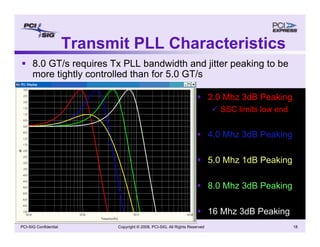
Transmit PLL Characteristics
ƒ 8.0 GT/s requires Tx PLL bandwidth and jitter peaking to be
more tightly controlled than for 5.0 GT/s
ƒ 2.0 Mhz 3dB Peaking
9 SSC limits low end
ƒ 4.0 Mhz 3dB Peaking
ƒ 5.0 Mhz 1dB Peaking
ƒ 8.0 Mhz 3dB Peaking
ƒ 16 Mhz 3dB Peaking
Copyright © 2008, PCI-SIG, All Rights Reserved 19
PCI-SIG Confidential
Base Spec TX Spec Location
ƒ TX specification at silicon pins (2.0 base location)
9 Too difficult to quantify package interaction with unknown channel
ƒ TX specification at die pad
9 Current spec direction
9 All relevant parameters can be specified at point that is independent of
package and channel
9 Direct measurements not possible
– Standard de-embedding algorithm/methodology needed in base spec.
ƒ TX specification at the end of reference channel(s)
9 Other option discussed in EWG
9 TX is compliant if it can produce passing signaling through a worst case
channel(s)
9 Can a small number of reference channels capture all worst case
Tx/package/channel interactions?
9 Contributions from various TX variables not clearly separated
Copyright © 2008, PCI-SIG, All Rights Reserved 20
PCI-SIG Confidential
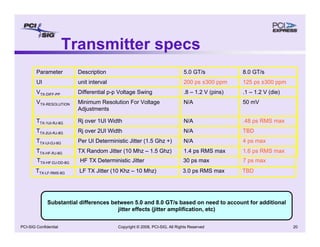
Transmitter specs
1.6 ps RMS max
1.4 ps RMS max
TX Random Jitter (10 Mhz – 1.5 Ghz)
TTX-HF-RJ-8G
4 ps max
N/A
Per UI Deterministic Jitter (1.5 Ghz +)
TTX-UI-DJ-8G
TBD
N/A
Rj over 2UI Width
TTX-2UI-RJ-8G
.48 ps RMS max
N/A
Rj over 1UI Width
TTX-1UI-RJ-8G
50 mV
N/A
Minimum Resolution For Voltage
Adjustments
VTX-RESOLUTION
.1 – 1.2 V (die)
.8 – 1.2 V (pins)
Differential p-p Voltage Swing
VTX-DIFF-PP
125 ps ±300 ppm
200 ps ±300 ppm
unit interval
UI
8.0 GT/s
5.0 GT/s
Description
Parameter
Substantial differences between 5.0 and 8.0 GT/s based on need to account for additional
jitter effects (jitter amplification, etc)
TTX-HF-DJ-DD-8G HF TX Deterministic Jitter 30 ps max 7 ps max
TTX-LF-RMS-8G LF TX Jitter (10 Khz – 10 Mhz) 3.0 ps RMS max TBD
Copyright © 2008, PCI-SIG, All Rights Reserved 21
PCI-SIG Confidential
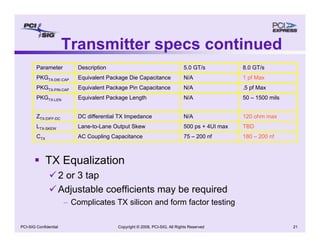
Transmitter specs continued
180 – 200 nf
75 – 200 nf
AC Coupling Capacitance
CTX
TBD
500 ps + 4UI max
Lane-to-Lane Output Skew
LTX-SKEW
120 ohm max
N/A
DC differential TX Impedance
ZTX-DIFF-DC
50 – 1500 mils
N/A
Equivalent Package Length
PKGTX-LEN
.5 pf Max
N/A
Equivalent Package Pin Capacitance
PKGTX-PIN-CAP
1 pf Max
N/A
Equivalent Package Die Capacitance
PKGTX-DIE-CAP
8.0 GT/s
5.0 GT/s
Description
Parameter
ƒ TX Equalization
9 2 or 3 tap
9 Adjustable coefficients may be required
– Complicates TX silicon and form factor testing
Copyright © 2008, PCI-SIG, All Rights Reserved 22
PCI-SIG Confidential
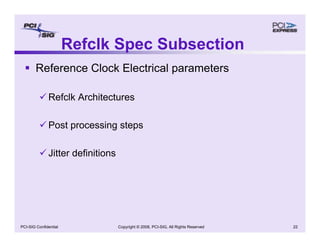
Refclk Spec Subsection
ƒ Reference Clock Electrical parameters
9 Refclk Architectures
9 Post processing steps
9 Jitter definitions
Copyright © 2008, PCI-SIG, All Rights Reserved 23
PCI-SIG Confidential
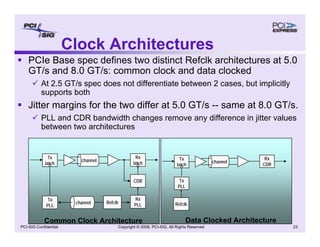
Clock Architectures
ƒ PCIe Base spec defines two distinct Refclk architectures at 5.0
GT/s and 8.0 GT/s: common clock and data clocked
9 At 2.5 GT/s spec does not differentiate between 2 cases, but implicitly
supports both
ƒ Jitter margins for the two differ at 5.0 GT/s -- same at 8.0 GT/s.
9 PLL and CDR bandwidth changes remove any difference in jitter values
between two architectures
Rx
latch
CDR
Rx
PLL
Tx
latch
Tx
PLL
channel
Refclk
channel
Rx
CDR
channel
Tx
latch
Tx
PLL
Refclk
Common Clock Architecture Data Clocked Architecture
Copyright © 2008, PCI-SIG, All Rights Reserved 24
PCI-SIG Confidential
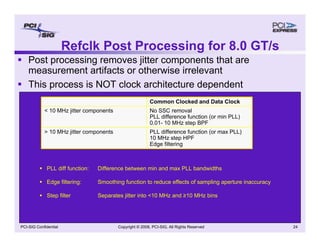
Refclk Post Processing for 8.0 GT/s
ƒ Post processing removes jitter components that are
measurement artifacts or otherwise irrelevant
ƒ This process is NOT clock architecture dependent
PLL difference function (or max PLL)
10 MHz step HPF
Edge filtering
> 10 MHz jitter components
No SSC removal
PLL difference function (or min PLL)
0.01- 10 MHz step BPF
< 10 MHz jitter components
Common Clocked and Data Clock
ƒ PLL diff function: Difference between min and max PLL bandwidths
ƒ Edge filtering: Smoothing function to reduce effects of sampling aperture inaccuracy
ƒ Step filter Separates jitter into <10 MHz and ≥10 MHz bins
Copyright © 2008, PCI-SIG, All Rights Reserved 25
PCI-SIG Confidential
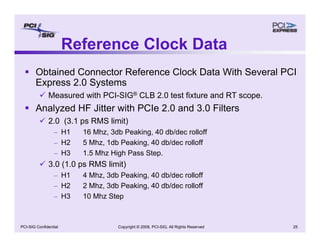
Reference Clock Data
ƒ Obtained Connector Reference Clock Data With Several PCI
Express 2.0 Systems
9 Measured with PCI-SIG® CLB 2.0 test fixture and RT scope.
ƒ Analyzed HF Jitter with PCIe 2.0 and 3.0 Filters
9 2.0 (3.1 ps RMS limit)
– H1 16 Mhz, 3db Peaking, 40 db/dec rolloff
– H2 5 Mhz, 1db Peaking, 40 db/dec rolloff
– H3 1.5 Mhz High Pass Step.
9 3.0 (1.0 ps RMS limit)
– H1 4 Mhz, 3db Peaking, 40 db/dec rolloff
– H2 2 Mhz, 3db Peaking, 40 db/dec rolloff
– H3 10 Mhz Step
Copyright © 2008, PCI-SIG, All Rights Reserved 26
PCI-SIG Confidential
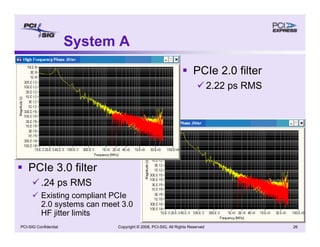
System A
ƒ PCIe 2.0 filter
9 2.22 ps RMS
ƒ PCIe 3.0 filter
9 .24 ps RMS
9 Existing compliant PCIe
2.0 systems can meet 3.0
HF jitter limits
Copyright © 2008, PCI-SIG, All Rights Reserved 27
PCI-SIG Confidential
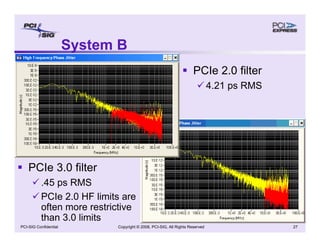
System B
ƒ PCIe 2.0 filter
9 4.21 ps RMS
ƒ PCIe 3.0 filter
9 .45 ps RMS
9 PCIe 2.0 HF limits are
often more restrictive
than 3.0 limits
Copyright © 2008, PCI-SIG, All Rights Reserved 28
PCI-SIG Confidential
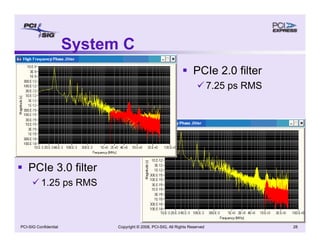
System C
ƒ PCIe 2.0 filter
9 7.25 ps RMS
ƒ PCIe 3.0 filter
9 1.25 ps RMS
Copyright © 2008, PCI-SIG, All Rights Reserved 29
PCI-SIG Confidential
PCIe 3.0 Channel Spec – Major
Changes
ƒ Tx package defined in terms of CDIE, CPAD, and a swept length
ƒ Rx package defined in terms of CDIE, CPAD, and a swept length
ƒ Tx jitter is defined in terms of Dj and an Rj distribution
ƒ Statistical simulation tools used to capture TX, channel, RX
interactions
ƒ A reference Rx equalization algorithm is applied to raw data as
it appears at the Rx die pad
Copyright © 2008, PCI-SIG, All Rights Reserved 30
PCI-SIG Confidential
PCIe 3.0 Rx Spec Subsection
ƒ PCIe 3.0 Receiver Specification
9 Major Change Summary
9 Scrambling Impact
9 RX Measurement Methodology
Copyright © 2008, PCI-SIG, All Rights Reserved 31
PCI-SIG Confidential
Major RX Specification Changes
ƒ Jitter and voltage limits referenced to die pad
ƒ Rx PLL bandwidth reduced to 2-4 Mhz.
ƒ RX CDR bandwidth increased to 10 Mhz minimum.
ƒ Jitter defined with bandlimited TJ and Dj components
ƒ RX return loss replaced with CDIE, CPIN, CLENGTH
ƒ Jitter measured after applying inverse equalization
algorithm
Copyright © 2008, PCI-SIG, All Rights Reserved 32
PCI-SIG Confidential
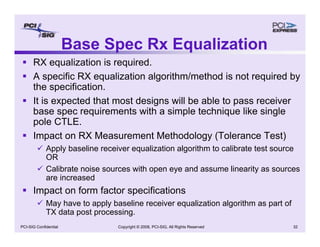
Base Spec Rx Equalization
ƒ RX equalization is required.
ƒ A specific RX equalization algorithm/method is not required by
the specification.
ƒ It is expected that most designs will be able to pass receiver
base spec requirements with a simple technique like single
pole CTLE.
ƒ Impact on RX Measurement Methodology (Tolerance Test)
9 Apply baseline receiver equalization algorithm to calibrate test source
OR
9 Calibrate noise sources with open eye and assume linearity as sources
are increased
ƒ Impact on form factor specifications
9 May have to apply baseline receiver equalization algorithm as part of
TX data post processing.
Copyright © 2008, PCI-SIG, All Rights Reserved 33
PCI-SIG Confidential
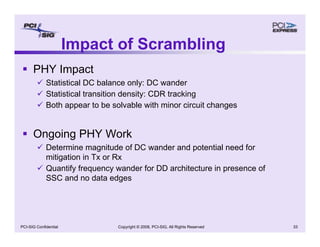
ƒ PHY Impact
9 Statistical DC balance only: DC wander
9 Statistical transition density: CDR tracking
9 Both appear to be solvable with minor circuit changes
ƒ Ongoing PHY Work
9 Determine magnitude of DC wander and potential need for
mitigation in Tx or Rx
9 Quantify frequency wander for DD architecture in presence of
SSC and no data edges
Impact of Scrambling
Copyright © 2008, PCI-SIG, All Rights Reserved 34
PCI-SIG Confidential
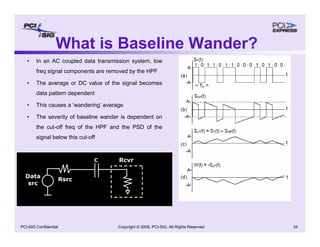
What is Baseline Wander?
• In an AC coupled data transmission system, low
freq signal components are removed by the HPF
• The average or DC value of the signal becomes
data pattern dependent
• This causes a ‘wandering’ average
• The severity of baseline wander is dependent on
the cut-off freq of the HPF and the PSD of the
signal below this cut-off
C
Data
src
Rsrc
Rcvr
Copyright © 2008, PCI-SIG, All Rights Reserved 35
PCI-SIG Confidential
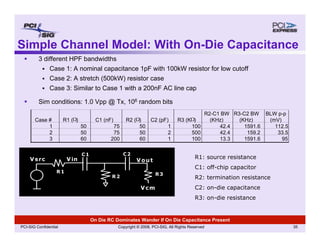
Simple Channel Model: With On-Die Capacitance
ƒ 3 different HPF bandwidths
ƒ Case 1: A nominal capacitance 1pF with 100kW resistor for low cutoff
ƒ Case 2: A stretch (500kW) resistor case
ƒ Case 3: Similar to Case 1 with a 200nF AC line cap
ƒ Sim conditions: 1.0 Vpp @ Tx, 106 random bits
Vcm
Vout
R1
R2
C1 C2
R3
Vin
Vsrc R1: source resistance
C1: off-chip capacitor
R2: termination resistance
C2: on-die capacitance
R3: on-die resistance
Case # R1 (Ω) C1 (nF) R2 (Ω) C2 (pF) R3 (KΩ)
R2-C1 BW
(KHz)
R3-C2 BW
(KHz)
BLW p-p
(mV)
1 50 75 50 1 100 42.4 1591.6 112.5
2 50 75 50 2 500 42.4 159.2 33.5
3 60 200 60 1 100 13.3 1591.6 95
On Die RC Dominates Wander If On Die Capacitance Present
Copyright © 2008, PCI-SIG, All Rights Reserved 36
PCI-SIG Confidential
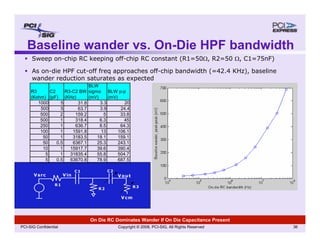
Baseline wander vs. On-Die HPF bandwidth
Vcm
Vout
R1
R2
C1 C2
R3
Vin
Vsrc
ƒ Sweep on-chip RC keeping off-chip RC constant (R1=50Ω, R2=50 Ω, C1=75nF)
ƒ As on-die HPF cut-off freq approaches off-chip bandwidth (=42.4 KHz), baseline
wander reduction saturates as expected
R3
(Kohm)
C2
(pF)
R3-C2 BW
(KHz)
BLW
sigma
(mV)
BLW p-p
(mV)
1000 5 31.8 3.3 20
500 5 63.7 3.9 24.4
500 2 159.2 5 33.8
500 1 318.4 6.3 45
250 1 636.7 8.5 64.3
100 1 1591.8 13 106.1
50 1 3183.5 18.1 159.1
50 0.5 6367.1 25.3 243.1
10 1 15917.7 39.6 390.4
5 1 31835.4 55.8 504.7
5 0.5 63670.8 78.9 687.5
On Die RC Dominates Wander If On Die Capacitance Present
Copyright © 2008, PCI-SIG, All Rights Reserved 37
PCI-SIG Confidential
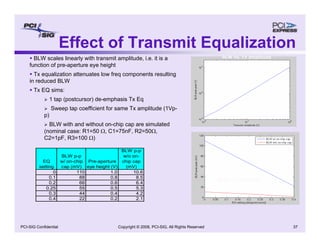
Effect of Transmit Equalization
ƒ BLW scales linearly with transmit amplitude, i.e. it is a
function of pre-aperture eye height
ƒ Tx equalization attenuates low freq components resulting
in reduced BLW
ƒ Tx EQ sims:
¾ 1 tap (postcursor) de-emphasis Tx Eq
¾ Sweep tap coefficient for same Tx amplitude (1Vp-
p)
¾ BLW with and without on-chip cap are simulated
(nominal case: R1=50 Ω, C1=75nF, R2=50Ω,
C2=1pF, R3=100 Ω)
BLW vs. Tx amplitude
EQ
setting
BLW p-p
w/ on-chip
cap (mV)
Pre-aperture
eye height (V)
BLW p-p
w/o on-
chip cap
(mV)
0 110 1.0 10.6
0.1 88 0.8 8.5
0.2 66 0.6 6.4
0.25 55 0.5 5.3
0.3 44 0.4 4.2
0.4 22 0.2 2.1
BLW vs. EQ setting
Copyright © 2008, PCI-SIG, All Rights Reserved 38
PCI-SIG Confidential
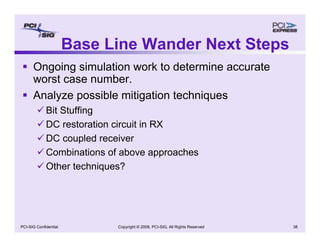
Base Line Wander Next Steps
ƒ Ongoing simulation work to determine accurate
worst case number.
ƒ Analyze possible mitigation techniques
9 Bit Stuffing
9 DC restoration circuit in RX
9 DC coupled receiver
9 Combinations of above approaches
9 Other techniques?
Copyright © 2008, PCI-SIG, All Rights Reserved 39
PCI-SIG Confidential
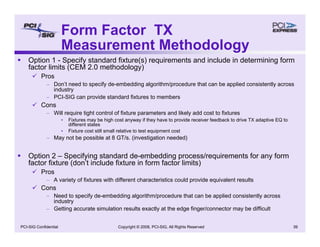
Form Factor TX
Measurement Methodology
ƒ Option 1 - Specify standard fixture(s) requirements and include in determining form
factor limits (CEM 2.0 methodology)
9 Pros
– Don’t need to specify de-embedding algorithm/procedure that can be applied consistently across
industry
– PCI-SIG can provide standard fixtures to members
9 Cons
– Will require tight control of fixture parameters and likely add cost to fixtures
• Fixtures may be high cost anyway if they have to provide receiver feedback to drive TX adaptive EQ to
different states
• Fixture cost still small relative to test equipment cost
– May not be possible at 8 GT/s. (investigation needed)
ƒ Option 2 – Specifying standard de-embedding process/requirements for any form
factor fixture (don’t include fixture in form factor limits)
9 Pros
– A variety of fixtures with different characteristics could provide equivalent results
9 Cons
– Need to specify de-embedding algorithm/procedure that can be applied consistently across
industry
– Getting accurate simulation results exactly at the edge finger/connector may be difficult
Copyright © 2008, PCI-SIG, All Rights Reserved 40
PCI-SIG Confidential
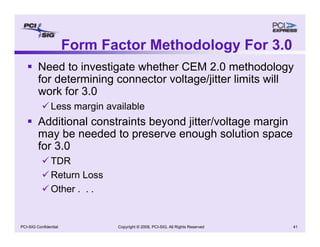
Form Factor Reference Clock Testing
ƒ Option 1 – Test Reference Clock Separately
9 Pros
– Simpler measurement setup than dual port
9 Cons
– Removes ability to trade off clock and data jitter at system level
– Must account for not having a clean reference clock for standard motherboard TX test
ƒ Option 2 – Use Dual Port Simultaneously Clock/Data (Methodology Specified in
CEM 2.0)
9 Pros
– Allows tradeoff of data and clock jitter at system level
– Don’t have to worry about how to test real motherboard without clean clock
– No issues testing with SSC on
9 Cons
– More complex measurement setup – but already proven for CEM 2.0
– Ability to trade off clock and data jitter adds little relief with clock jitter budget at 1 ps Rj (RSS
with other other parts of RJ budget)
Copyright © 2008, PCI-SIG, All Rights Reserved 41
PCI-SIG Confidential
Form Factor Methodology For 3.0
ƒ Need to investigate whether CEM 2.0 methodology
for determining connector voltage/jitter limits will
work for 3.0
9 Less margin available
ƒ Additional constraints beyond jitter/voltage margin
may be needed to preserve enough solution space
for 3.0
9 TDR
9 Return Loss
9 Other . . .
Copyright © 2008, PCI-SIG, All Rights Reserved 42
PCI-SIG Confidential
Major Work Items Upcoming
ƒ Demonstrate method of de-embedding to die pad
9 Good progress: several options being evaluated
ƒ Close on Tx equalization choices
9 Trainable vs. fixed coefficients
ƒ Resolve DC wander effects
9 Rx voltage margin, effective CDR BW impact
ƒ Long server channel mitigation costs/effectiveness
Copyright © 2008, PCI-SIG, All Rights Reserved 43
PCI-SIG Confidential
Future Plans
ƒ Rev0.3
9 Data rate, encoding set
9 Tx, Rx parameter tables
9 Being reviewed by EWG now
ƒ Rev0.5
9 Tx, Rx reference planes
defined
9 All parameters defined
9 Tx, Rx equalization defined
ƒ Rev0.7
9 All parameter values stable
9 Statistical scripts included in
spec
ƒ Rev0.9
9 Minor formatting/typo edits
Backup
Backup
Copyright © 2008, PCI-SIG, All Rights Reserved 45
PCI-SIG Confidential
CEM 2.0 Methodology Review
Copyright © 2008, PCI-SIG, All Rights Reserved 46
PCI-SIG Confidential
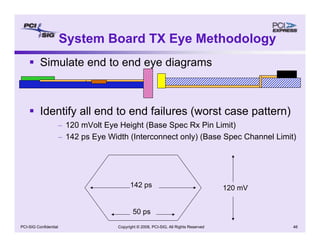
System Board TX Eye Methodology
ƒ Simulate end to end eye diagrams
ƒ Identify all end to end failures (worst case pattern)
– 120 mVolt Eye Height (Base Spec Rx Pin Limit)
– 142 ps Eye Width (Interconnect only) (Base Spec Channel Limit)
50 ps
142 ps 120 mV
Copyright © 2008, PCI-SIG, All Rights Reserved 47
PCI-SIG Confidential
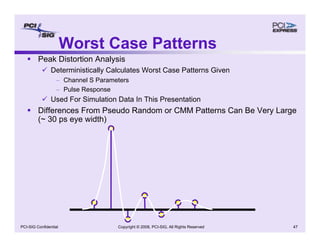
Worst Case Patterns
ƒ Peak Distortion Analysis
9 Deterministically Calculates Worst Case Patterns Given
– Channel S Parameters
– Pulse Response
9 Used For Simulation Data In This Presentation
ƒ Differences From Pseudo Random or CMM Patterns Can Be Very Large
(~ 30 ps eye width)
Copyright © 2008, PCI-SIG, All Rights Reserved 48
PCI-SIG Confidential
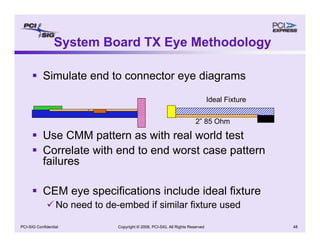
System Board TX Eye Methodology
ƒ Simulate end to connector eye diagrams
ƒ Use CMM pattern as with real world test
ƒ Correlate with end to end worst case pattern
failures
ƒ CEM eye specifications include ideal fixture
9 No need to de-embed if similar fixture used
2” 85 Ohm
Ideal Fixture
Copyright © 2008, PCI-SIG, All Rights Reserved 49
PCI-SIG Confidential
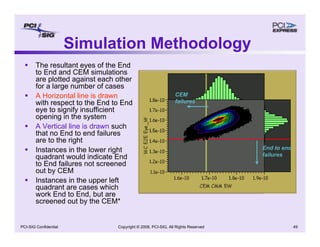
Simulation Methodology
ƒ The resultant eyes of the End
to End and CEM simulations
are plotted against each other
for a large number of cases
ƒ A Horizontal line is drawn
with respect to the End to End
eye to signify insufficient
opening in the system
ƒ A Vertical line is drawn such
that no End to end failures
are to the right
ƒ Instances in the lower right
quadrant would indicate End
to End failures not screened
out by CEM
ƒ Instances in the upper left
quadrant are cases which
work End to End, but are
screened out by the CEM*
End to end
failures
CEM
failures

03_PCIe_3.0_PHY_Electrical_Layer_Requirements_Final[1].pdf

  • 1.
    PCI Express® 3.0PHY Electrical Layer Requirements Dan Froelich Intel Corporation Dan Froelich Intel Corporation * Third party marks and brands are the property of their respective owners.
  • 2.
    Copyright © 2008,PCI-SIG, All Rights Reserved 2 PCI-SIG Confidential Agenda ƒ PHY Requirements ƒ Preliminary Jitter Budget ƒ Statistical Simulation Tools ƒ 3.0 PHY Rate ƒ Transmitter Specification 9 PLL Bandwidth 9 Reference Location 9 Timing Parameters 9 Equalization ƒ Reference Clock Specification ƒ Receiver Specification ƒ Major Form Factor Work Areas ƒ Next Steps
  • 3.
    Copyright © 2008,PCI-SIG, All Rights Reserved 3 PCI-SIG Confidential PCIe® 3.0 Electrical Requirements ƒ Backwards Compatibility 9 Gen1/Gen2 cards must operate in Gen3 slots at Gen1/Gen2 performance 9 2.0 clocking architectures must be supported. ƒ Compatible with 2.0 Power Budgets 9 Low PHY Power Consumption ƒ Cost: No required changes to connectors, clocks, materials, HVM manufacturing practices. 9 Extreme server channels may require channel optimizations. ƒ BER of E-12 or better. ƒ At least 2x effective data rate of PCIe 2.0 (5.0 GT/s) ƒ Channel Length Support 9 Client – 1 Connecter, 14” end to end, microstrip, FR4. 9 Server – 2 Connector, 20” end to end, stripline, FR4.
  • 4.
    Copyright © 2008,PCI-SIG, All Rights Reserved 4 PCI-SIG Confidential System Jitter Budget 8.0 GT/s * *Simluation Simluation with Statistical Tool Required To Capture Channel Interactions with Statistical Tool Required To Capture Channel Interactions Similar Percentages Assumed at 10 GT/s For Rate Investigation Similar Percentages Assumed at 10 GT/s For Rate Investigation 1.6 7 1.4 30 TX 3.6 11.8 1.4 60 RX N/A* N/A* 0 58 Channel 1.0 0 3.1 0 Ref Clock Max RJ (ps RMS) 8.0 GT/s Max Dj (ps) 8.0 GT/s Max RJ (ps RMS) 5.0 GT/s Max Dj (ps) 5.0 GT/s Jitter Contribution
  • 5.
    Copyright © 2008,PCI-SIG, All Rights Reserved 5 PCI-SIG Confidential Rate Selection Process ƒ Select worst case channels. 9 Several companies provided channel models for HVM 2.0 client and server systems at length target limits. ƒ Use statistical simulation tools ƒ Analyze rates that can provide ~ 2x data throughput increase 9 8 GT/s with scrambling. 9 10 GT/s with 8b/10b. ƒ Analyze different receiver equalization methods 9 CTLE 9 DFE
  • 6.
    Copyright © 2008,PCI-SIG, All Rights Reserved 6 PCI-SIG Confidential ƒ Provides jitter relief by moving jitter from Dj bin to Rj bin 9 For a given channel, enables I/O designers to determine what type, order and equalization resolution is required for a BER target 9 Accurately models high frequency Tx jitter ƒ Uses statistically weighted data patterns 9 More accurate, less conservative than PDA ƒ Operates on pulse response of channel 9 Comprehends x-talk, ISI, reflections, etc. ƒ Accurately models both Common Refclk and Data Driven architectures 9 Accurately models the interaction of CDRs and ISI 9 Simulates clock models with supply noise sensitivity, device thermal noise, duty-cycle error and jitter amplification Statistical Simulation Tools
  • 7.
    Copyright © 2008,PCI-SIG, All Rights Reserved 7 PCI-SIG Confidential ƒ Consider TMIN_PULSE parameter 9 Defined to limit channel induced jitter amplification ƒ 5.0G spec defines TMIN_PULSE as 0.1 UI (max) 9 5.0G spec makes no assumptions regarding Dj/Rj breakdown 9 This method of budgeting TMIN_PULSE assumes jitter is 100% bimodal Dj 9 Equivalent to 20 ps Dj, 0 ps Rj ƒ Analysis of Tx jitter sources yields different results 9 Jitter over 1.5G – Nyquist will generate jitter amplification 9 Rj and Dj over this range tend to be spectrally flat 9 Substantial reduction of Dj can be achieved E.g.: Statistical Treatment of Jitter
  • 8.
    Copyright © 2008,PCI-SIG, All Rights Reserved 8 PCI-SIG Confidential Lossy Rx Tx Rx Sampling Clock Tx Clock Statistical ISI Analysis High-frequency, uncorrelated Tx jitter distribution Channel impulse response Equalization coefficients Xtalk impulse responses Modulation Pre-aperture BER eye Rx sample timing & voltage uncertainty distributions Post-aperture BER eye Statistical Signaling Analysis
  • 9.
    Copyright © 2008,PCI-SIG, All Rights Reserved 9 PCI-SIG Confidential Client Channel Configuration - Via - Microstrip - Stripline Figure Key Add in card PKG H Add in card PKG Break out G Add in card main 3” F MB post cap D MB Main 7” C Break Out B MCH PKG A Description Seg A C B D F H G
  • 10.
    Copyright © 2008,PCI-SIG, All Rights Reserved 10 PCI-SIG Confidential 4” Receiver package Receiver package Add in Card HVM Server Channel Configuration ƒ Two Connectors ƒ Mostly Stripline Routing ƒ 20” Total Trace Length 9 4” AIC 9 4” Riser 9 16” Main Board 11” Riser Board 4” Mother board .020 .020” ” .050 .050” ” .050 .050” ” Transmitter Transmitter package package CEM CEM connector connector .010 .010” ” .020 .020” ” .050 .050” ” 0201 ( 0201 (0402 widely used 0402 widely used) ) 0.5”
  • 11.
    Copyright © 2008,PCI-SIG, All Rights Reserved 11 PCI-SIG Confidential Client Channel - Frequency and Pulse Responses ƒ The insertion loss at 10GT/s is 6dB more than at 8GT/s 9 IL at 4GHz is -13.5dB (8GT/s) 9 IL at 5GHz is -19.3dB (10GT/s) 0 2 4 6 8 10 x 10 9 -90 -80 -70 -60 -50 -40 -30 -20 -10 0 Freq dB IL Aggres1 Aggres2 -0.05 0 0.05 0.1 0.15 0.2 0.25 0.3 0.35 0.4 0.45 -4 -2 0 2 4 6 8 10 12 14 16 18 20 UI V 8GT/s 10GT/s
  • 12.
    Copyright © 2008,PCI-SIG, All Rights Reserved 12 PCI-SIG Confidential 8GT/s ps Voltage 20 40 60 80 100 120 0.1 -0.05 0 -0.05 -0.1 -0.15 -12 -10 -8 -6 -4 -2 0 0.15 4 5 6 7 8 0 0.1 0.2 0.3 0.4 Time (nsec) Amplitude (V) EQ pulse response Un-EQ pulse response ps 0.1 -0.05 0 -0.05 -0.1 -0.15 -12 -10 -8 -6 -4 -2 0 0.15 0 0.1 0.2 0.3 0.4 Amplitude (V) TX = [0.69 -0.31] TX = [0.9 -0.1] DFE =[0.1563 0.0781 0.0352 0 0.0156 0.0117] Time (nsec) 10GT/s EQ pulse response Un-EQ pulse response 4 5 6 20 40 60 80 100 TX = [1] DFE =[1:6] TX = [1] EH = 16mV EW = 10ps EH = 27mV EW = 11ps Voltage different equalization settings Sample BER Eye Diagrams 1.0 UI 1.0 UI
  • 13.
    Copyright © 2008,PCI-SIG, All Rights Reserved 13 PCI-SIG Confidential HVM Server Channel - Frequency and Pulse Responses 9 IL at 4GHz is -16.5dB (8GT/s) 9 IL at 5GHz is -18.4dB (10GT/s) 0 2 4 6 8 10 x 10 9 -90 -80 -70 -60 -50 -40 -30 -20 -10 0 Freq dB IL Aggres1 Aggres2 -0.05 0 0.05 0.1 0.15 0.2 0.25 0.3 0.35 0.4 0.45 V 8GT/s 10GT/s -4 -2 0 2 4 6 8 10 12 14 16 18 20 UI
  • 14.
    Copyright © 2008,PCI-SIG, All Rights Reserved 14 PCI-SIG Confidential TX EQ CTLE DFE Pass Fail [1] 1st [1] 1st [2 3] [1] [1 2] [1] [1-4 ] [1] [1-6 ] Eye Height (V) [1] 1st 8GT/s 10GT/s -0.14 -0.12 -0.1 -0.08 -0.06 -0.04 -0.02 0 0.02 0.04 Equalization Sweep 20” Server Channel Simulation Results (Nominal) Power & Area Power & Area Pass Fail -0.1 -0.05 0 0.05 0.1 0.15 0.2 0.25 TX EQ CTLE DFE [1] 1st [1] 1st [2 3] [1] [1 2] [1] [1-4 ] [1] [1-6 ] [1] 1st 8GT/s 10GT/s Eye Height (V) 7” Client Channel Power & Area Power & Area TX EQ CTLE DFE [1] 1st [1] 1st [2 3] [1] [1 2] [1] [1-4 ] [1] [1-6 ] Eye Height (V) Equalization Sweep [1] 1st -0.04 -0.02 0 0.02 0.04 0.06 0.08 8GT/s 10GT/s Pass Fail 14” Client Channel Power & Area Power & Area
  • 15.
    Copyright © 2008,PCI-SIG, All Rights Reserved 15 PCI-SIG Confidential Simulation Results (Est W/C) TX EQ CTLE DFE [1] 1st [1] 1st [2 3] [1] [1 2] [1] [1-4 ] [1] [1-6 ] Eye Height (V) Equalization Sweep [1] 1st -0.04 -0.02 0 0.02 0.04 0.06 0.08 8GT/s 10GT/s Pass Fail 14” Client Channel Power & Area Power & Area TX EQ CTLE DFE Pass Fail [1] 1st [1] 1st [2 3] [1] [1 2] [1] [1-4 ] [1] [1-6 ] Eye Height (V) [1] 1st 8GT/s 10GT/s -0.14 -0.12 -0.1 -0.08 -0.06 -0.04 -0.02 0 0.02 0.04 Equalization Sweep 20” Server Channel Power & Area Power & Area Pass Fail -0.1 -0.05 0 0.05 0.1 0.15 0.2 0.25 TX EQ CTLE DFE [1] 1st [1] 1st [2 3] [1] [1 2] [1] [1-4 ] [1] [1-6 ] [1] 1st 8GT/s 10GT/s Eye Height (V) 7” Client Channel Power & Area Power & Area
  • 16.
    Copyright © 2008,PCI-SIG, All Rights Reserved 16 PCI-SIG Confidential Rate Selection Summary ƒ 8GT/s is feasible over channels of interest with reasonable equalization ƒ 10GT/s imposes a power penalty 9 8G-10G power increase somewhere between linear and quadratic ƒ 10GT/s imposes a cost penalty 9 Lower loss PCB materials 9 Backdrilled vias 9 Layout restrictions -------------------------------------------------------------------------------
  • 17.
    Copyright © 2008,PCI-SIG, All Rights Reserved 17 PCI-SIG Confidential PCIe 3.0 Tx Spec Subsection ƒ Transmitter Electrical parameters 9 Transmit PLL Characteristics 9 Tx Specification Location 9 Tx Timing Specifications 9 Adaptive TX Equalization?
  • 18.
    Copyright © 2008,PCI-SIG, All Rights Reserved 18 PCI-SIG Confidential Transmit PLL Characteristics ƒ 8.0 GT/s requires Tx PLL bandwidth and jitter peaking to be more tightly controlled than for 5.0 GT/s ƒ 2.0 Mhz 3dB Peaking 9 SSC limits low end ƒ 4.0 Mhz 3dB Peaking ƒ 5.0 Mhz 1dB Peaking ƒ 8.0 Mhz 3dB Peaking ƒ 16 Mhz 3dB Peaking
  • 19.
    Copyright © 2008,PCI-SIG, All Rights Reserved 19 PCI-SIG Confidential Base Spec TX Spec Location ƒ TX specification at silicon pins (2.0 base location) 9 Too difficult to quantify package interaction with unknown channel ƒ TX specification at die pad 9 Current spec direction 9 All relevant parameters can be specified at point that is independent of package and channel 9 Direct measurements not possible – Standard de-embedding algorithm/methodology needed in base spec. ƒ TX specification at the end of reference channel(s) 9 Other option discussed in EWG 9 TX is compliant if it can produce passing signaling through a worst case channel(s) 9 Can a small number of reference channels capture all worst case Tx/package/channel interactions? 9 Contributions from various TX variables not clearly separated
  • 20.
    Copyright © 2008,PCI-SIG, All Rights Reserved 20 PCI-SIG Confidential Transmitter specs 1.6 ps RMS max 1.4 ps RMS max TX Random Jitter (10 Mhz – 1.5 Ghz) TTX-HF-RJ-8G 4 ps max N/A Per UI Deterministic Jitter (1.5 Ghz +) TTX-UI-DJ-8G TBD N/A Rj over 2UI Width TTX-2UI-RJ-8G .48 ps RMS max N/A Rj over 1UI Width TTX-1UI-RJ-8G 50 mV N/A Minimum Resolution For Voltage Adjustments VTX-RESOLUTION .1 – 1.2 V (die) .8 – 1.2 V (pins) Differential p-p Voltage Swing VTX-DIFF-PP 125 ps ±300 ppm 200 ps ±300 ppm unit interval UI 8.0 GT/s 5.0 GT/s Description Parameter Substantial differences between 5.0 and 8.0 GT/s based on need to account for additional jitter effects (jitter amplification, etc) TTX-HF-DJ-DD-8G HF TX Deterministic Jitter 30 ps max 7 ps max TTX-LF-RMS-8G LF TX Jitter (10 Khz – 10 Mhz) 3.0 ps RMS max TBD
  • 21.
    Copyright © 2008,PCI-SIG, All Rights Reserved 21 PCI-SIG Confidential Transmitter specs continued 180 – 200 nf 75 – 200 nf AC Coupling Capacitance CTX TBD 500 ps + 4UI max Lane-to-Lane Output Skew LTX-SKEW 120 ohm max N/A DC differential TX Impedance ZTX-DIFF-DC 50 – 1500 mils N/A Equivalent Package Length PKGTX-LEN .5 pf Max N/A Equivalent Package Pin Capacitance PKGTX-PIN-CAP 1 pf Max N/A Equivalent Package Die Capacitance PKGTX-DIE-CAP 8.0 GT/s 5.0 GT/s Description Parameter ƒ TX Equalization 9 2 or 3 tap 9 Adjustable coefficients may be required – Complicates TX silicon and form factor testing
  • 22.
    Copyright © 2008,PCI-SIG, All Rights Reserved 22 PCI-SIG Confidential Refclk Spec Subsection ƒ Reference Clock Electrical parameters 9 Refclk Architectures 9 Post processing steps 9 Jitter definitions
  • 23.
    Copyright © 2008,PCI-SIG, All Rights Reserved 23 PCI-SIG Confidential Clock Architectures ƒ PCIe Base spec defines two distinct Refclk architectures at 5.0 GT/s and 8.0 GT/s: common clock and data clocked 9 At 2.5 GT/s spec does not differentiate between 2 cases, but implicitly supports both ƒ Jitter margins for the two differ at 5.0 GT/s -- same at 8.0 GT/s. 9 PLL and CDR bandwidth changes remove any difference in jitter values between two architectures Rx latch CDR Rx PLL Tx latch Tx PLL channel Refclk channel Rx CDR channel Tx latch Tx PLL Refclk Common Clock Architecture Data Clocked Architecture
  • 24.
    Copyright © 2008,PCI-SIG, All Rights Reserved 24 PCI-SIG Confidential Refclk Post Processing for 8.0 GT/s ƒ Post processing removes jitter components that are measurement artifacts or otherwise irrelevant ƒ This process is NOT clock architecture dependent PLL difference function (or max PLL) 10 MHz step HPF Edge filtering > 10 MHz jitter components No SSC removal PLL difference function (or min PLL) 0.01- 10 MHz step BPF < 10 MHz jitter components Common Clocked and Data Clock ƒ PLL diff function: Difference between min and max PLL bandwidths ƒ Edge filtering: Smoothing function to reduce effects of sampling aperture inaccuracy ƒ Step filter Separates jitter into <10 MHz and ≥10 MHz bins
  • 25.
    Copyright © 2008,PCI-SIG, All Rights Reserved 25 PCI-SIG Confidential Reference Clock Data ƒ Obtained Connector Reference Clock Data With Several PCI Express 2.0 Systems 9 Measured with PCI-SIG® CLB 2.0 test fixture and RT scope. ƒ Analyzed HF Jitter with PCIe 2.0 and 3.0 Filters 9 2.0 (3.1 ps RMS limit) – H1 16 Mhz, 3db Peaking, 40 db/dec rolloff – H2 5 Mhz, 1db Peaking, 40 db/dec rolloff – H3 1.5 Mhz High Pass Step. 9 3.0 (1.0 ps RMS limit) – H1 4 Mhz, 3db Peaking, 40 db/dec rolloff – H2 2 Mhz, 3db Peaking, 40 db/dec rolloff – H3 10 Mhz Step
  • 26.
    Copyright © 2008,PCI-SIG, All Rights Reserved 26 PCI-SIG Confidential System A ƒ PCIe 2.0 filter 9 2.22 ps RMS ƒ PCIe 3.0 filter 9 .24 ps RMS 9 Existing compliant PCIe 2.0 systems can meet 3.0 HF jitter limits
  • 27.
    Copyright © 2008,PCI-SIG, All Rights Reserved 27 PCI-SIG Confidential System B ƒ PCIe 2.0 filter 9 4.21 ps RMS ƒ PCIe 3.0 filter 9 .45 ps RMS 9 PCIe 2.0 HF limits are often more restrictive than 3.0 limits
  • 28.
    Copyright © 2008,PCI-SIG, All Rights Reserved 28 PCI-SIG Confidential System C ƒ PCIe 2.0 filter 9 7.25 ps RMS ƒ PCIe 3.0 filter 9 1.25 ps RMS
  • 29.
    Copyright © 2008,PCI-SIG, All Rights Reserved 29 PCI-SIG Confidential PCIe 3.0 Channel Spec – Major Changes ƒ Tx package defined in terms of CDIE, CPAD, and a swept length ƒ Rx package defined in terms of CDIE, CPAD, and a swept length ƒ Tx jitter is defined in terms of Dj and an Rj distribution ƒ Statistical simulation tools used to capture TX, channel, RX interactions ƒ A reference Rx equalization algorithm is applied to raw data as it appears at the Rx die pad
  • 30.
    Copyright © 2008,PCI-SIG, All Rights Reserved 30 PCI-SIG Confidential PCIe 3.0 Rx Spec Subsection ƒ PCIe 3.0 Receiver Specification 9 Major Change Summary 9 Scrambling Impact 9 RX Measurement Methodology
  • 31.
    Copyright © 2008,PCI-SIG, All Rights Reserved 31 PCI-SIG Confidential Major RX Specification Changes ƒ Jitter and voltage limits referenced to die pad ƒ Rx PLL bandwidth reduced to 2-4 Mhz. ƒ RX CDR bandwidth increased to 10 Mhz minimum. ƒ Jitter defined with bandlimited TJ and Dj components ƒ RX return loss replaced with CDIE, CPIN, CLENGTH ƒ Jitter measured after applying inverse equalization algorithm
  • 32.
    Copyright © 2008,PCI-SIG, All Rights Reserved 32 PCI-SIG Confidential Base Spec Rx Equalization ƒ RX equalization is required. ƒ A specific RX equalization algorithm/method is not required by the specification. ƒ It is expected that most designs will be able to pass receiver base spec requirements with a simple technique like single pole CTLE. ƒ Impact on RX Measurement Methodology (Tolerance Test) 9 Apply baseline receiver equalization algorithm to calibrate test source OR 9 Calibrate noise sources with open eye and assume linearity as sources are increased ƒ Impact on form factor specifications 9 May have to apply baseline receiver equalization algorithm as part of TX data post processing.
  • 33.
    Copyright © 2008,PCI-SIG, All Rights Reserved 33 PCI-SIG Confidential ƒ PHY Impact 9 Statistical DC balance only: DC wander 9 Statistical transition density: CDR tracking 9 Both appear to be solvable with minor circuit changes ƒ Ongoing PHY Work 9 Determine magnitude of DC wander and potential need for mitigation in Tx or Rx 9 Quantify frequency wander for DD architecture in presence of SSC and no data edges Impact of Scrambling
  • 34.
    Copyright © 2008,PCI-SIG, All Rights Reserved 34 PCI-SIG Confidential What is Baseline Wander? • In an AC coupled data transmission system, low freq signal components are removed by the HPF • The average or DC value of the signal becomes data pattern dependent • This causes a ‘wandering’ average • The severity of baseline wander is dependent on the cut-off freq of the HPF and the PSD of the signal below this cut-off C Data src Rsrc Rcvr
  • 35.
    Copyright © 2008,PCI-SIG, All Rights Reserved 35 PCI-SIG Confidential Simple Channel Model: With On-Die Capacitance ƒ 3 different HPF bandwidths ƒ Case 1: A nominal capacitance 1pF with 100kW resistor for low cutoff ƒ Case 2: A stretch (500kW) resistor case ƒ Case 3: Similar to Case 1 with a 200nF AC line cap ƒ Sim conditions: 1.0 Vpp @ Tx, 106 random bits Vcm Vout R1 R2 C1 C2 R3 Vin Vsrc R1: source resistance C1: off-chip capacitor R2: termination resistance C2: on-die capacitance R3: on-die resistance Case # R1 (Ω) C1 (nF) R2 (Ω) C2 (pF) R3 (KΩ) R2-C1 BW (KHz) R3-C2 BW (KHz) BLW p-p (mV) 1 50 75 50 1 100 42.4 1591.6 112.5 2 50 75 50 2 500 42.4 159.2 33.5 3 60 200 60 1 100 13.3 1591.6 95 On Die RC Dominates Wander If On Die Capacitance Present
  • 36.
    Copyright © 2008,PCI-SIG, All Rights Reserved 36 PCI-SIG Confidential Baseline wander vs. On-Die HPF bandwidth Vcm Vout R1 R2 C1 C2 R3 Vin Vsrc ƒ Sweep on-chip RC keeping off-chip RC constant (R1=50Ω, R2=50 Ω, C1=75nF) ƒ As on-die HPF cut-off freq approaches off-chip bandwidth (=42.4 KHz), baseline wander reduction saturates as expected R3 (Kohm) C2 (pF) R3-C2 BW (KHz) BLW sigma (mV) BLW p-p (mV) 1000 5 31.8 3.3 20 500 5 63.7 3.9 24.4 500 2 159.2 5 33.8 500 1 318.4 6.3 45 250 1 636.7 8.5 64.3 100 1 1591.8 13 106.1 50 1 3183.5 18.1 159.1 50 0.5 6367.1 25.3 243.1 10 1 15917.7 39.6 390.4 5 1 31835.4 55.8 504.7 5 0.5 63670.8 78.9 687.5 On Die RC Dominates Wander If On Die Capacitance Present
  • 37.
    Copyright © 2008,PCI-SIG, All Rights Reserved 37 PCI-SIG Confidential Effect of Transmit Equalization ƒ BLW scales linearly with transmit amplitude, i.e. it is a function of pre-aperture eye height ƒ Tx equalization attenuates low freq components resulting in reduced BLW ƒ Tx EQ sims: ¾ 1 tap (postcursor) de-emphasis Tx Eq ¾ Sweep tap coefficient for same Tx amplitude (1Vp- p) ¾ BLW with and without on-chip cap are simulated (nominal case: R1=50 Ω, C1=75nF, R2=50Ω, C2=1pF, R3=100 Ω) BLW vs. Tx amplitude EQ setting BLW p-p w/ on-chip cap (mV) Pre-aperture eye height (V) BLW p-p w/o on- chip cap (mV) 0 110 1.0 10.6 0.1 88 0.8 8.5 0.2 66 0.6 6.4 0.25 55 0.5 5.3 0.3 44 0.4 4.2 0.4 22 0.2 2.1 BLW vs. EQ setting
  • 38.
    Copyright © 2008,PCI-SIG, All Rights Reserved 38 PCI-SIG Confidential Base Line Wander Next Steps ƒ Ongoing simulation work to determine accurate worst case number. ƒ Analyze possible mitigation techniques 9 Bit Stuffing 9 DC restoration circuit in RX 9 DC coupled receiver 9 Combinations of above approaches 9 Other techniques?
  • 39.
    Copyright © 2008,PCI-SIG, All Rights Reserved 39 PCI-SIG Confidential Form Factor TX Measurement Methodology ƒ Option 1 - Specify standard fixture(s) requirements and include in determining form factor limits (CEM 2.0 methodology) 9 Pros – Don’t need to specify de-embedding algorithm/procedure that can be applied consistently across industry – PCI-SIG can provide standard fixtures to members 9 Cons – Will require tight control of fixture parameters and likely add cost to fixtures • Fixtures may be high cost anyway if they have to provide receiver feedback to drive TX adaptive EQ to different states • Fixture cost still small relative to test equipment cost – May not be possible at 8 GT/s. (investigation needed) ƒ Option 2 – Specifying standard de-embedding process/requirements for any form factor fixture (don’t include fixture in form factor limits) 9 Pros – A variety of fixtures with different characteristics could provide equivalent results 9 Cons – Need to specify de-embedding algorithm/procedure that can be applied consistently across industry – Getting accurate simulation results exactly at the edge finger/connector may be difficult
  • 40.
    Copyright © 2008,PCI-SIG, All Rights Reserved 40 PCI-SIG Confidential Form Factor Reference Clock Testing ƒ Option 1 – Test Reference Clock Separately 9 Pros – Simpler measurement setup than dual port 9 Cons – Removes ability to trade off clock and data jitter at system level – Must account for not having a clean reference clock for standard motherboard TX test ƒ Option 2 – Use Dual Port Simultaneously Clock/Data (Methodology Specified in CEM 2.0) 9 Pros – Allows tradeoff of data and clock jitter at system level – Don’t have to worry about how to test real motherboard without clean clock – No issues testing with SSC on 9 Cons – More complex measurement setup – but already proven for CEM 2.0 – Ability to trade off clock and data jitter adds little relief with clock jitter budget at 1 ps Rj (RSS with other other parts of RJ budget)
  • 41.
    Copyright © 2008,PCI-SIG, All Rights Reserved 41 PCI-SIG Confidential Form Factor Methodology For 3.0 ƒ Need to investigate whether CEM 2.0 methodology for determining connector voltage/jitter limits will work for 3.0 9 Less margin available ƒ Additional constraints beyond jitter/voltage margin may be needed to preserve enough solution space for 3.0 9 TDR 9 Return Loss 9 Other . . .
  • 42.
    Copyright © 2008,PCI-SIG, All Rights Reserved 42 PCI-SIG Confidential Major Work Items Upcoming ƒ Demonstrate method of de-embedding to die pad 9 Good progress: several options being evaluated ƒ Close on Tx equalization choices 9 Trainable vs. fixed coefficients ƒ Resolve DC wander effects 9 Rx voltage margin, effective CDR BW impact ƒ Long server channel mitigation costs/effectiveness
  • 43.
    Copyright © 2008,PCI-SIG, All Rights Reserved 43 PCI-SIG Confidential Future Plans ƒ Rev0.3 9 Data rate, encoding set 9 Tx, Rx parameter tables 9 Being reviewed by EWG now ƒ Rev0.5 9 Tx, Rx reference planes defined 9 All parameters defined 9 Tx, Rx equalization defined ƒ Rev0.7 9 All parameter values stable 9 Statistical scripts included in spec ƒ Rev0.9 9 Minor formatting/typo edits
  • 44.
  • 45.
    Copyright © 2008,PCI-SIG, All Rights Reserved 45 PCI-SIG Confidential CEM 2.0 Methodology Review
  • 46.
    Copyright © 2008,PCI-SIG, All Rights Reserved 46 PCI-SIG Confidential System Board TX Eye Methodology ƒ Simulate end to end eye diagrams ƒ Identify all end to end failures (worst case pattern) – 120 mVolt Eye Height (Base Spec Rx Pin Limit) – 142 ps Eye Width (Interconnect only) (Base Spec Channel Limit) 50 ps 142 ps 120 mV
  • 47.
    Copyright © 2008,PCI-SIG, All Rights Reserved 47 PCI-SIG Confidential Worst Case Patterns ƒ Peak Distortion Analysis 9 Deterministically Calculates Worst Case Patterns Given – Channel S Parameters – Pulse Response 9 Used For Simulation Data In This Presentation ƒ Differences From Pseudo Random or CMM Patterns Can Be Very Large (~ 30 ps eye width)
  • 48.
    Copyright © 2008,PCI-SIG, All Rights Reserved 48 PCI-SIG Confidential System Board TX Eye Methodology ƒ Simulate end to connector eye diagrams ƒ Use CMM pattern as with real world test ƒ Correlate with end to end worst case pattern failures ƒ CEM eye specifications include ideal fixture 9 No need to de-embed if similar fixture used 2” 85 Ohm Ideal Fixture
  • 49.
    Copyright © 2008,PCI-SIG, All Rights Reserved 49 PCI-SIG Confidential Simulation Methodology ƒ The resultant eyes of the End to End and CEM simulations are plotted against each other for a large number of cases ƒ A Horizontal line is drawn with respect to the End to End eye to signify insufficient opening in the system ƒ A Vertical line is drawn such that no End to end failures are to the right ƒ Instances in the lower right quadrant would indicate End to End failures not screened out by CEM ƒ Instances in the upper left quadrant are cases which work End to End, but are screened out by the CEM* End to end failures CEM failures