

CS193P - Lecture 3
           iPhone Application Development

           Custom Classes
           Object Lifecycle
           Autorelease
           Properties


Tuesday, January 12, 2010                   1
Announcements
        • Assignments 1A and 1B due Wednesday 1/13 at 11:59 PM
            ■ Enrolled Stanford students can email cs193p@cs.stanford.edu
              with any questions
            ■ Submit early! Instructions on the website...

                 ■   Delete the “build” directory manually, Xcode won’t do it


Tuesday, January 12, 2010                                                       2
Announcements
        • Assignments 2A and 2B due Wednesday 1/20 at 11:59 PM
            ■   2A: Continuation of Foundation tool
                 ■ Add custom class
                 ■ Basic memory management

            ■   2B: Beginning of first iPhone application
                 ■ Topics to be covered on Thursday, 1/14
                 ■ Assignment contains extensive walkthrough


Tuesday, January 12, 2010                                        3
Enrolled students & iTunes U
        • Lectures have begun showing up on iTunes U
        • Lead time is longer than last year
        • Come to class!!
            ■   Lectures may not post in time for assignments


Tuesday, January 12, 2010                                       4
Office Hours
        • Paul’s office hours: Thursday 2-4, Gates B26B
        • David’s office hours: Mondays 4-6pm: Gates 360


Tuesday, January 12, 2010                                  5
Today’s Topics
        • Questions from Assignment 1A or 1B?
        • Creating Custom Classes
        • Object Lifecycle
        • Autorelease
        • Objective-C Properties


Tuesday, January 12, 2010                       6
Custom Classes


Tuesday, January 12, 2010   7
Design Phase


Tuesday, January 12, 2010   8
Design Phase
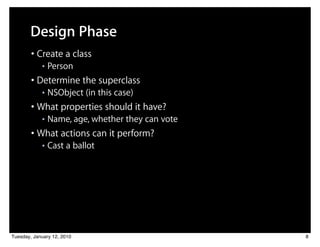
        • Create a class
            ■   Person


Tuesday, January 12, 2010   8
Design Phase
        • Create a class
            ■   Person
        • Determine the superclass
            ■   NSObject (in this case)


Tuesday, January 12, 2010                 8
Design Phase
        • Create a class
            ■   Person
        • Determine the superclass
            ■   NSObject (in this case)
        • What properties should it have?
            ■   Name, age, whether they can vote


Tuesday, January 12, 2010                          8
Design Phase
        • Create a class
            ■   Person
        • Determine the superclass
            ■   NSObject (in this case)
        • What properties should it have?
            ■   Name, age, whether they can vote
        • What actions can it perform?
            ■   Cast a ballot


Tuesday, January 12, 2010                          8
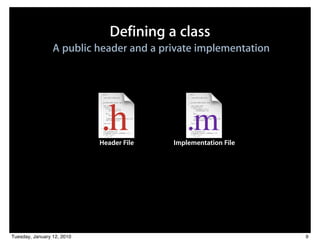
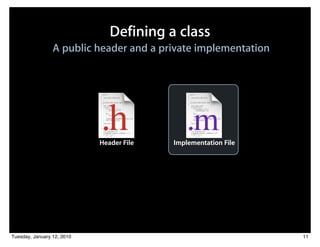
Defining a class
                 A public header and a private implementation


                            Header File   Implementation File


Tuesday, January 12, 2010                                       9
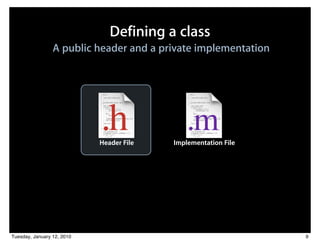
Defining a class
                 A public header and a private implementation


                            Header File   Implementation File


Tuesday, January 12, 2010                                       9
Class interface declared in header file


Tuesday, January 12, 2010                        10
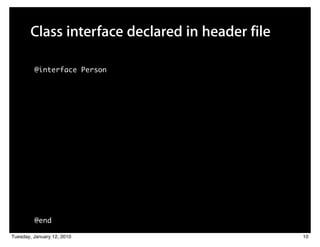
Class interface declared in header file

         @interface Person


         @end

Tuesday, January 12, 2010                        10
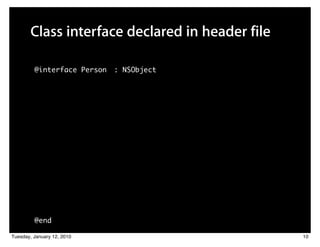
Class interface declared in header file

         @interface Person   : NSObject


         @end

Tuesday, January 12, 2010                        10
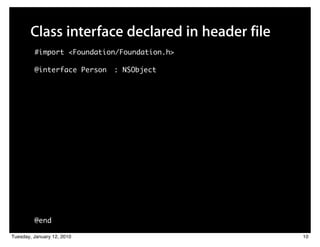
Class interface declared in header file
         #import <Foundation/Foundation.h>

         @interface Person   : NSObject


         @end

Tuesday, January 12, 2010                        10
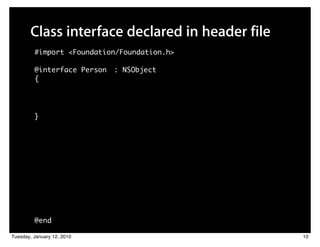
Class interface declared in header file
         #import <Foundation/Foundation.h>

         @interface Person   : NSObject
         {


         }


         @end

Tuesday, January 12, 2010                        10
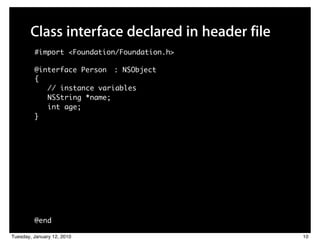
Class interface declared in header file
         #import <Foundation/Foundation.h>

         @interface Person : NSObject
         {
            // instance variables
            NSString *name;
            int age;
         }


         @end

Tuesday, January 12, 2010                        10
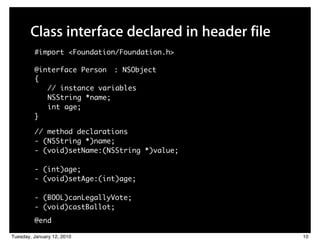
Class interface declared in header file
         #import <Foundation/Foundation.h>

         @interface Person : NSObject
         {
            // instance variables
            NSString *name;
            int age;
         }

         // method declarations
         - (NSString *)name;
         - (void)setName:(NSString *)value;

         - (int)age;
         - (void)setAge:(int)age;

         - (BOOL)canLegallyVote;
         - (void)castBallot;
         @end

Tuesday, January 12, 2010                        10
Defining a class
                 A public header and a private implementation


                            Header File   Implementation File


Tuesday, January 12, 2010                                       11
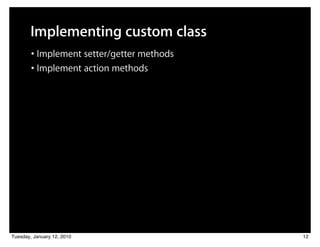
Implementing custom class
        • Implement setter/getter methods
        • Implement action methods


Tuesday, January 12, 2010                   12
Class Implementation


Tuesday, January 12, 2010     13
Class Implementation
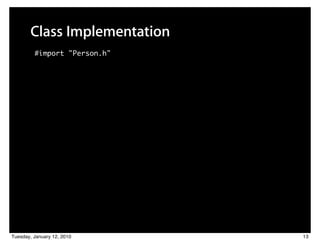
         #import "Person.h"


Tuesday, January 12, 2010     13
Class Implementation
         #import "Person.h"

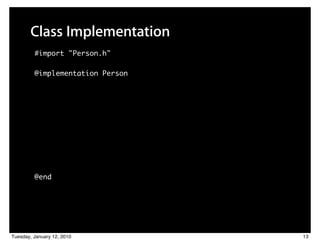
         @implementation Person


         @end


Tuesday, January 12, 2010         13
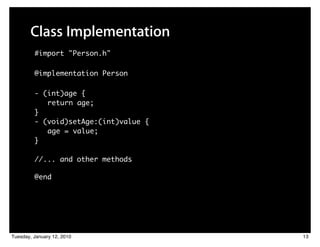
Class Implementation
         #import "Person.h"

         @implementation Person

         - (int)age {
            return age;
         }
         - (void)setAge:(int)value {
            age = value;
         }

         //... and other methods

         @end


Tuesday, January 12, 2010              13
Calling your own methods


Tuesday, January 12, 2010         14
Calling your own methods
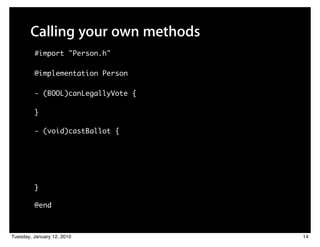
         #import "Person.h"

         @implementation Person

         - (BOOL)canLegallyVote {

         }

         - (void)castBallot {


         }

         @end


Tuesday, January 12, 2010           14
Calling your own methods
         #import "Person.h"

         @implementation Person

         - (BOOL)canLegallyVote {
            return ([self age] >= 18);
         }

         - (void)castBallot {


         }

         @end


Tuesday, January 12, 2010                14
Calling your own methods
         #import "Person.h"

         @implementation Person

         - (BOOL)canLegallyVote {
            return ([self age] >= 18);
         }

         - (void)castBallot {
               if ([self canLegallyVote]) {
               	 	 // do voting stuff
               } else {
               	 	 NSLog (@“I’m not allowed to vote!”);
               }
         }

         @end


Tuesday, January 12, 2010                                 14
Superclass methods
        • As we just saw, objects have an implicit variable named “self”
            ■   Like “this” in Java and C++
        • Can also invoke superclass methods using “super”


Tuesday, January 12, 2010                                                  15
Superclass methods
        • As we just saw, objects have an implicit variable named “self”
            ■   Like “this” in Java and C++
        • Can also invoke superclass methods using “super”
                - (void)doSomething {
                  // Call superclass implementation first
                  [super doSomething];

                    // Then do our custom behavior
                    int foo = bar;
                    // ...
                }


Tuesday, January 12, 2010                                                  15
Object Lifecycle


Tuesday, January 12, 2010   16
Object Lifecycle
        • Creating objects
        • Memory management
        • Destroying objects


Tuesday, January 12, 2010      17
Object Creation


Tuesday, January 12, 2010   18
Object Creation
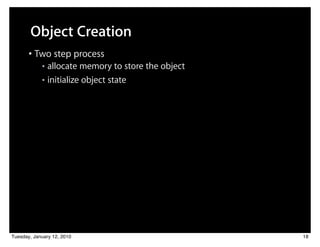
       • Two step process
            ■ allocate memory to store the object
            ■ initialize object state


Tuesday, January 12, 2010                           18
Object Creation
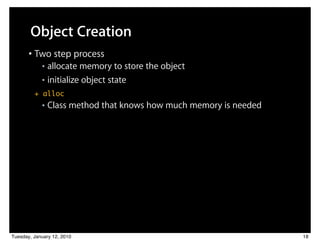
       • Two step process
            ■ allocate memory to store the object
            ■ initialize object state

         + alloc
            ■   Class method that knows how much memory is needed


Tuesday, January 12, 2010                                           18
Object Creation
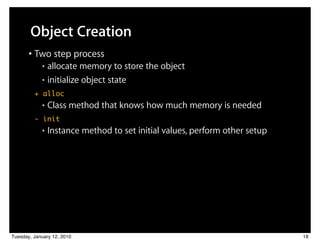
       • Two step process
            ■ allocate memory to store the object
            ■ initialize object state

         + alloc
            ■   Class method that knows how much memory is needed
         - init
            ■   Instance method to set initial values, perform other setup


Tuesday, January 12, 2010                                                    18
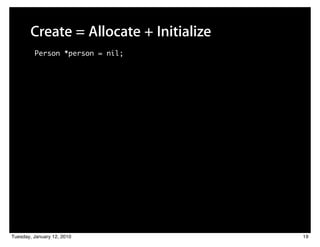
Create = Allocate + Initialize


Tuesday, January 12, 2010               19
Create = Allocate + Initialize
         Person *person = nil;


Tuesday, January 12, 2010               19
Create = Allocate + Initialize
         Person *person = nil;

         person = [[Person alloc] init];


Tuesday, January 12, 2010                  19
Implementing your own -init method
         #import "Person.h"

         @implementation Person


         @end


Tuesday, January 12, 2010                   20
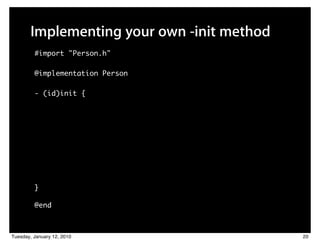
Implementing your own -init method
         #import "Person.h"

         @implementation Person

         - (id)init {


         }

         @end


Tuesday, January 12, 2010                   20
Implementing your own -init method
         #import "Person.h"

         @implementation Person

         - (id)init {
           // allow superclass to initialize its state first
           if (self = [super init]) {


             }

             return self;
         }

         @end


Tuesday, January 12, 2010                                      20
Implementing your own -init method
         #import "Person.h"

         @implementation Person

         - (id)init {
           // allow superclass to initialize its state first
           if (self = [super init]) {
                     age = 0;
                     name = @“Bob”;

                     // do other initialization...
             }

             return self;
         }

         @end


Tuesday, January 12, 2010                                      20
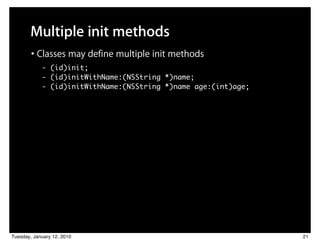
Multiple init methods
        • Classes may define multiple init methods
            - (id)init;
            - (id)initWithName:(NSString *)name;
            - (id)initWithName:(NSString *)name age:(int)age;


Tuesday, January 12, 2010                                       21
Multiple init methods
        • Classes may define multiple init methods
            - (id)init;
            - (id)initWithName:(NSString *)name;
            - (id)initWithName:(NSString *)name age:(int)age;


        • Less specific ones typically call more specific with default values
            - (id)init {
                return [self initWithName:@“No Name”];
            }

            - (id)initWithName:(NSString *)name {
                return [self initWithName:name age:0];
            }


Tuesday, January 12, 2010                                                       21
Finishing Up With an Object
         Person *person = nil;

         person = [[Person alloc] init];


Tuesday, January 12, 2010                  22
Finishing Up With an Object
         Person *person = nil;

         person = [[Person alloc] init];

         [person setName:@“Jimmy Jones”];
         [person setAge:32];

         [person castBallot];
         [person doSomethingElse];


Tuesday, January 12, 2010                   22
Finishing Up With an Object
         Person *person = nil;

         person = [[Person alloc] init];

         [person setName:@“Jimmy Jones”];
         [person setAge:32];

         [person castBallot];
         [person doSomethingElse];

         // What do we do with person when we’re done?


Tuesday, January 12, 2010                                22
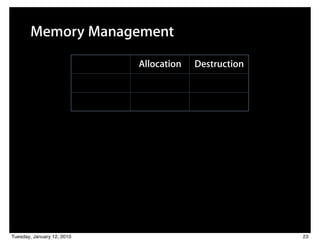
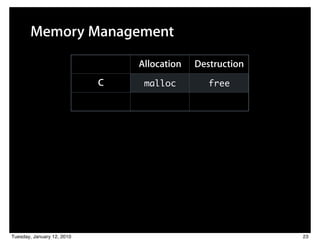
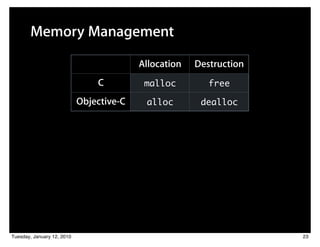
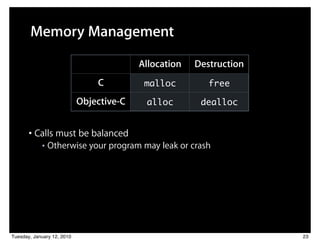
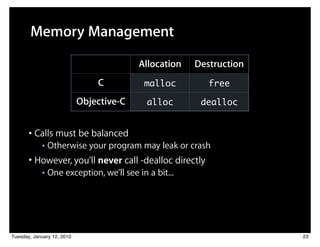
Memory Management

                                          Allocation   Destruction
                                C          malloc         free

                            Objective-C    alloc        dealloc


Tuesday, January 12, 2010                                            23
Memory Management

                                          Allocation   Destruction
                                C          malloc         free

                            Objective-C    alloc        dealloc


Tuesday, January 12, 2010                                            23
Memory Management

                                          Allocation   Destruction
                                C          malloc         free

                            Objective-C    alloc        dealloc


Tuesday, January 12, 2010                                            23
Memory Management

                                          Allocation   Destruction
                                C          malloc         free

                            Objective-C    alloc        dealloc


       • Calls must be balanced
            ■   Otherwise your program may leak or crash


Tuesday, January 12, 2010                                            23
Memory Management

                                          Allocation   Destruction
                                C          malloc         free

                            Objective-C     alloc       dealloc


       • Calls must be balanced
            ■   Otherwise your program may leak or crash
       • However, you’ll never call -dealloc directly
            ■   One exception, we’ll see in a bit...


Tuesday, January 12, 2010                                            23
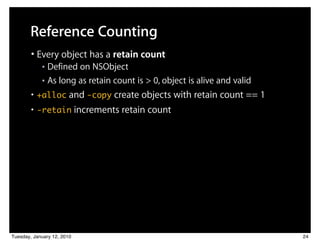
Reference Counting


Tuesday, January 12, 2010   24
Reference Counting
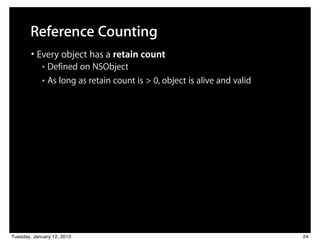
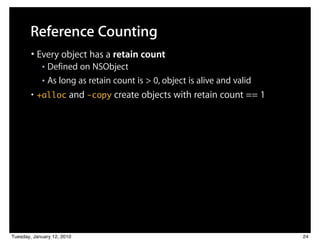
        • Every object has a retain count
            ■ Defined on NSObject
            ■ As long as retain count is > 0, object is alive and valid


Tuesday, January 12, 2010                                                 24
Reference Counting
        • Every object has a retain count
            ■ Defined on NSObject
            ■ As long as retain count is > 0, object is alive and valid


        • +alloc and -copy create objects with retain count == 1


Tuesday, January 12, 2010                                                 24
Reference Counting
        • Every object has a retain count
            ■ Defined on NSObject
            ■ As long as retain count is > 0, object is alive and valid


        • +alloc and -copy create objects with retain count == 1
        • -retain increments retain count


Tuesday, January 12, 2010                                                 24
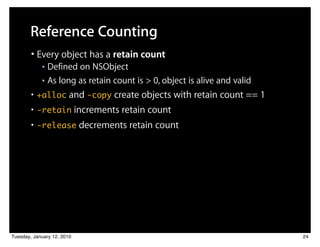
Reference Counting
        • Every object has a retain count
            ■ Defined on NSObject
            ■ As long as retain count is > 0, object is alive and valid


        • +alloc and -copy create objects with retain count == 1
        • -retain increments retain count
        • -release decrements retain count


Tuesday, January 12, 2010                                                 24
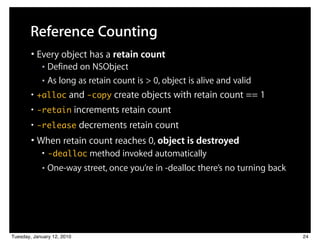
Reference Counting
        • Every object has a retain count
            ■ Defined on NSObject
            ■ As long as retain count is > 0, object is alive and valid


        • +alloc and -copy create objects with retain count == 1
        • -retain increments retain count
        • -release decrements retain count
        • When retain count reaches 0, object is destroyed
            • -dealloc method invoked automatically
            ■   One-way street, once you’re in -dealloc there’s no turning back


Tuesday, January 12, 2010                                                         24
Balanced Calls
         Person *person = nil;

         person = [[Person alloc] init];


Tuesday, January 12, 2010                  25
Balanced Calls
         Person *person = nil;

         person = [[Person alloc] init];

         [person setName:@“Jimmy Jones”];
         [person setAge:32];

         [person castBallot];
         [person doSomethingElse];


Tuesday, January 12, 2010                   25
Balanced Calls
         Person *person = nil;

         person = [[Person alloc] init];

         [person setName:@“Jimmy Jones”];
         [person setAge:32];

         [person castBallot];
         [person doSomethingElse];

         // When we’re done with person, release it
         [person release];   // person will be destroyed here


Tuesday, January 12, 2010                                       25
Reference counting in action


Tuesday, January 12, 2010             26
Reference counting in action
         Person *person = [[Person alloc] init];


Tuesday, January 12, 2010                          26
Reference counting in action
         Person *person = [[Person alloc] init];

               Retain count begins at 1 with +alloc


Tuesday, January 12, 2010                             26
Reference counting in action
         Person *person = [[Person alloc] init];

               Retain count begins at 1 with +alloc
         [person retain];


Tuesday, January 12, 2010                             26
Reference counting in action
         Person *person = [[Person alloc] init];

               Retain count begins at 1 with +alloc
         [person retain];

               Retain count increases to 2 with -retain


Tuesday, January 12, 2010                                 26
Reference counting in action
         Person *person = [[Person alloc] init];

               Retain count begins at 1 with +alloc
         [person retain];

               Retain count increases to 2 with -retain
         [person release];


Tuesday, January 12, 2010                                 26
Reference counting in action
         Person *person = [[Person alloc] init];

               Retain count begins at 1 with +alloc
         [person retain];

               Retain count increases to 2 with -retain
         [person release];

               Retain count decreases to 1 with -release


Tuesday, January 12, 2010                                  26
Reference counting in action
         Person *person = [[Person alloc] init];

               Retain count begins at 1 with +alloc
         [person retain];

               Retain count increases to 2 with -retain
         [person release];

               Retain count decreases to 1 with -release
         [person release];


Tuesday, January 12, 2010                                  26
Reference counting in action
         Person *person = [[Person alloc] init];

               Retain count begins at 1 with +alloc
         [person retain];

               Retain count increases to 2 with -retain
         [person release];

               Retain count decreases to 1 with -release
         [person release];

               Retain count decreases to 0, -dealloc automatically called


Tuesday, January 12, 2010                                                   26
Messaging deallocated objects


Tuesday, January 12, 2010              27
Messaging deallocated objects
           Person *person = [[Person alloc] init];
           // ...
           [person release]; // Object is deallocated


Tuesday, January 12, 2010                               27
Messaging deallocated objects
           Person *person = [[Person alloc] init];
           // ...
           [person release]; // Object is deallocated


           [person doSomething]; // Crash!


Tuesday, January 12, 2010                               27
Messaging deallocated objects
           Person *person = [[Person alloc] init];
           // ...
           [person release]; // Object is deallocated


Tuesday, January 12, 2010                               27
Messaging deallocated objects
           Person *person = [[Person alloc] init];
           // ...
           [person release]; // Object is deallocated
           person = nil;


Tuesday, January 12, 2010                               27
Messaging deallocated objects
           Person *person = [[Person alloc] init];
           // ...
           [person release]; // Object is deallocated
           person = nil;

           [person doSomething]; // No effect


Tuesday, January 12, 2010                               27
Implementing a -dealloc method
         #import "Person.h"

         @implementation Person


         @end


Tuesday, January 12, 2010               28
Implementing a -dealloc method
         #import "Person.h"

         @implementation Person

         - (void)dealloc {


         }

         @end


Tuesday, January 12, 2010               28
Implementing a -dealloc method
         #import "Person.h"

         @implementation Person

         - (void)dealloc {
              // Do any cleanup that’s necessary
              // ...


         }

         @end


Tuesday, January 12, 2010                          28
Implementing a -dealloc method
         #import "Person.h"

         @implementation Person

         - (void)dealloc {
              // Do any cleanup that’s necessary
              // ...

                 // when we’re done, call super to clean us up
                 [super dealloc];
         }

         @end


Tuesday, January 12, 2010                                        28
Object Lifecycle Recap
       • Objects begin with a retain count of 1
       • Increase and decrease with -retain and -release
       • When retain count reaches 0, object deallocated automatically
       • You never call dealloc explicitly in your code
            ■ Exception is calling -[super dealloc]
            ■ You only deal with alloc, copy, retain, release


Tuesday, January 12, 2010                                                29
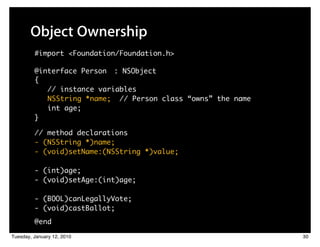
Object Ownership
         #import <Foundation/Foundation.h>

         @interface Person : NSObject
         {
            // instance variables
            NSString *name; // Person class “owns” the name
            int age;
         }

         // method declarations
         - (NSString *)name;
         - (void)setName:(NSString *)value;

         - (int)age;
         - (void)setAge:(int)age;

         - (BOOL)canLegallyVote;
         - (void)castBallot;
         @end

Tuesday, January 12, 2010                                     30
Object Ownership
         #import "Person.h"

         @implementation Person


         @end


Tuesday, January 12, 2010         31
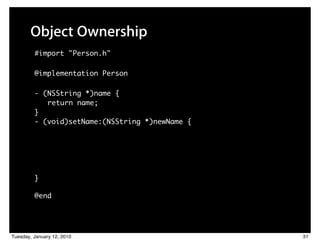
Object Ownership
         #import "Person.h"

         @implementation Person

         - (NSString *)name {
            return name;
         }
         - (void)setName:(NSString *)newName {


         }

         @end


Tuesday, January 12, 2010                        31
Object Ownership
         #import "Person.h"

         @implementation Person

         - (NSString *)name {
            return name;
         }
         - (void)setName:(NSString *)newName {
               if (name != newName) {
                   [name release];
                   name = [newName retain];
                    // name’s retain count has been bumped up by 1
               }
         }

         @end


Tuesday, January 12, 2010                                            31
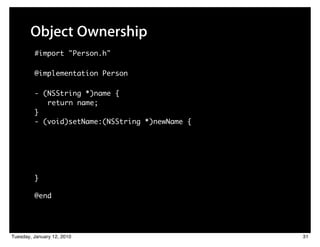
Object Ownership
         #import "Person.h"

         @implementation Person

         - (NSString *)name {
            return name;
         }
         - (void)setName:(NSString *)newName {


         }

         @end


Tuesday, January 12, 2010                        31
Object Ownership
         #import "Person.h"

         @implementation Person

         - (NSString *)name {
            return name;
         }
         - (void)setName:(NSString *)newName {
               if (name != newName) {
                   [name release];
                   name = [newName copy];
                    // name has retain count of 1, we own it
               }
         }

         @end


Tuesday, January 12, 2010                                      31
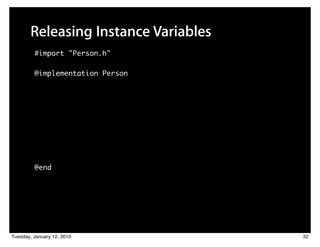
Releasing Instance Variables
         #import "Person.h"

         @implementation Person


         @end


Tuesday, January 12, 2010             32
Releasing Instance Variables
         #import "Person.h"

         @implementation Person

         - (void)dealloc {


         }

         @end


Tuesday, January 12, 2010             32
Releasing Instance Variables
         #import "Person.h"

         @implementation Person

         - (void)dealloc {
             // Do any cleanup that’s necessary
              [name release];


         }

         @end


Tuesday, January 12, 2010                         32
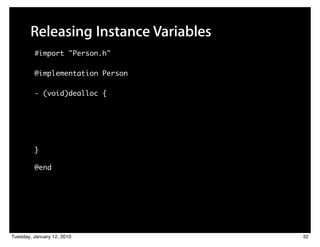
Releasing Instance Variables
         #import "Person.h"

         @implementation Person

         - (void)dealloc {
             // Do any cleanup that’s necessary
              [name release];

                 // when we’re done, call super to clean us up
                 [super dealloc];
         }

         @end


Tuesday, January 12, 2010                                        32
Autorelease


Tuesday, January 12, 2010   33
Returning a newly created object
             - (NSString *)fullName {
                NSString *result;

                   result = [[NSString alloc] initWithFormat:@“%@ %@”,
                         	 	    	    	 	 	 	 	 	 	 firstName, lastName];


                   return result;
             }


Tuesday, January 12, 2010                                                  34
Returning a newly created object
             - (NSString *)fullName {
                NSString *result;

                   result = [[NSString alloc] initWithFormat:@“%@ %@”,
                         	 	    	    	 	 	 	 	 	 	 firstName, lastName];


                   return result;
             }


                                Wrong: result is leaked!


Tuesday, January 12, 2010                                                  34
Returning a newly created object
             - (NSString *)fullName {
                NSString *result;

                   result = [[NSString alloc] initWithFormat:@“%@ %@”,
                         	 	    	    	 	 	 	 	 	 	 firstName, lastName];
                   [result release];

                   return result;
             }


Tuesday, January 12, 2010                                                  34
Returning a newly created object
             - (NSString *)fullName {
                NSString *result;

                   result = [[NSString alloc] initWithFormat:@“%@ %@”,
                         	 	    	    	 	 	 	 	 	 	 firstName, lastName];
                   [result release];

                   return result;
             }


                            Wrong: result is released too early!
                            Method returns bogus value


Tuesday, January 12, 2010                                                  34
Returning a newly created object
             - (NSString *)fullName {
                NSString *result;

                   result = [[NSString alloc] initWithFormat:@“%@ %@”,
                         	 	    	    	 	 	 	 	 	 	 firstName, lastName];


                   return result;
             }


Tuesday, January 12, 2010                                                  34
Returning a newly created object
             - (NSString *)fullName {
                NSString *result;

                   result = [[NSString alloc] initWithFormat:@“%@ %@”,
                         	 	    	    	 	 	 	 	 	 	 firstName, lastName];
                   [result autorelease];

                   return result;
             }


Tuesday, January 12, 2010                                                  34
Returning a newly created object
             - (NSString *)fullName {
                NSString *result;

                   result = [[NSString alloc] initWithFormat:@“%@ %@”,
                         	 	    	    	 	 	 	 	 	 	 firstName, lastName];
                   [result autorelease];

                   return result;
             }


                     Just right: result is released, but not right away
                     Caller gets valid object and could retain if needed


Tuesday, January 12, 2010                                                  34
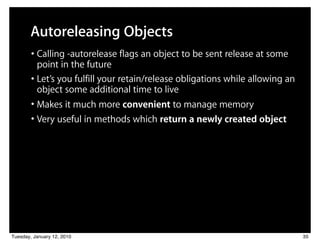
Autoreleasing Objects
        • Calling -autorelease flags an object to be sent release at some
          point in the future
        • Let’s you fulfill your retain/release obligations while allowing an
          object some additional time to live
        • Makes it much more convenient to manage memory
        • Very useful in methods which return a newly created object


Tuesday, January 12, 2010                                                       35
Method Names & Autorelease


Tuesday, January 12, 2010           36
Method Names & Autorelease
        • Methods whose names includes alloc, copy, or new
          return a retained object that the caller needs to release


Tuesday, January 12, 2010                                             36
Method Names & Autorelease
        • Methods whose names includes alloc, copy, or new
          return a retained object that the caller needs to release
          NSMutableString *string = [[NSMutableString alloc] init];
          // We are responsible for calling -release or -autorelease
          [string autorelease];


Tuesday, January 12, 2010                                              36
Method Names & Autorelease
        • Methods whose names includes alloc, copy, or new
          return a retained object that the caller needs to release
          NSMutableString *string = [[NSMutableString alloc] init];
          // We are responsible for calling -release or -autorelease
          [string autorelease];


        • All other methods return autoreleased objects


Tuesday, January 12, 2010                                              36
Method Names & Autorelease
        • Methods whose names includes alloc, copy, or new
          return a retained object that the caller needs to release
          NSMutableString *string = [[NSMutableString alloc] init];
          // We are responsible for calling -release or -autorelease
          [string autorelease];


        • All other methods return autoreleased objects
          NSMutableString *string = [NSMutableString string];
          // The method name doesn’t indicate that we need to release it
          // So don’t- we’re cool!


Tuesday, January 12, 2010                                                  36
Method Names & Autorelease
        • Methods whose names includes alloc, copy, or new
          return a retained object that the caller needs to release
          NSMutableString *string = [[NSMutableString alloc] init];
          // We are responsible for calling -release or -autorelease
          [string autorelease];


        • All other methods return autoreleased objects
          NSMutableString *string = [NSMutableString string];
          // The method name doesn’t indicate that we need to release it
          // So don’t- we’re cool!


        • This is a convention- follow it in methods you define!


Tuesday, January 12, 2010                                                  36
How does -autorelease work?


Tuesday, January 12, 2010            37
How does -autorelease work?
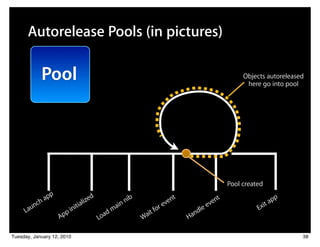
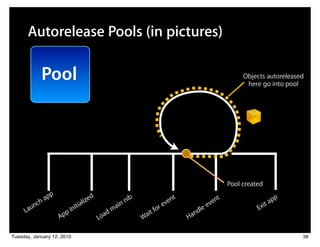
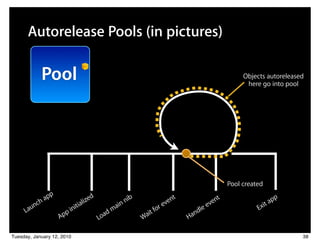
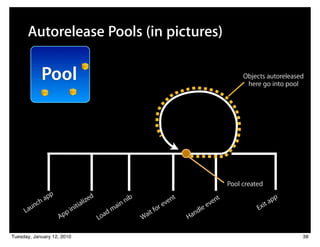
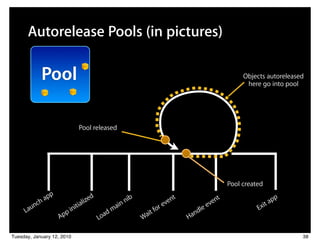
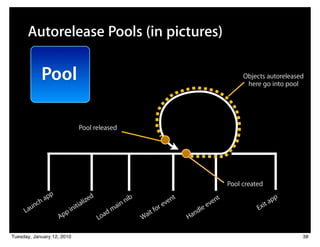
        • Object is added to current autorelease pool


Tuesday, January 12, 2010                               37
How does -autorelease work?
        • Object is added to current autorelease pool
        • Autorelease pools track objects scheduled to be released
            ■   When the pool itself is released, it sends -release to all its objects


Tuesday, January 12, 2010                                                                37
How does -autorelease work?
        • Object is added to current autorelease pool
        • Autorelease pools track objects scheduled to be released
            ■   When the pool itself is released, it sends -release to all its objects
        • UIKit automatically wraps a pool around every event dispatch


Tuesday, January 12, 2010                                                                37
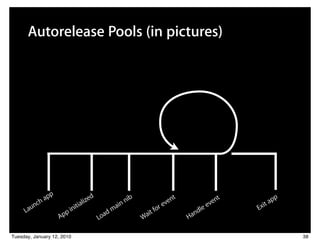
Autorelease Pools (in pictures)


                 pp                  d
              ha                lize                      nib                nt               en
                                                                                                t          pp
         nc                  ia                     i   n                 ve                 v        it a
       au                 nit                      a                   ore                lee       Ex
     L                  pi                  a   dm                 it f                nd
                      Ap                 Lo                     Wa                Ha

Tuesday, January 12, 2010                                                                                       38
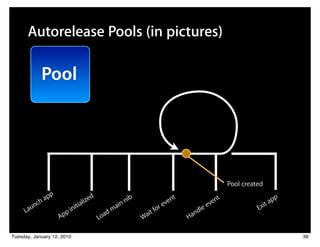
Autorelease Pools (in pictures)

              Pool


                                                                                                    Pool created
                 pp                  d
              ha                lize                      nib                nt               en
                                                                                                t                       pp
         nc                  ia                     i   n                 ve                 v                     it a
       au                 nit                      a                   ore                lee                 Ex
     L                  pi                  a   dm                 it f                nd
                      Ap                 Lo                     Wa                Ha

Tuesday, January 12, 2010                                                                                                    38
Autorelease Pools (in pictures)

              Pool                                                                                       Objects autoreleased
                                                                                                          here go into pool


                                                                                                    Pool created
                 pp                  d
              ha                lize                      nib                nt               en
                                                                                                t                       pp
         nc                  ia                     i   n                 ve                 v                     it a
       au                 nit                      a                   ore                lee                 Ex
     L                  pi                  a   dm                 it f                nd
                      Ap                 Lo                     Wa                Ha

Tuesday, January 12, 2010                                                                                                    38
Autorelease Pools (in pictures)

              Pool                                                                                       Objects autoreleased
                                                                                                          here go into pool


                                                                                                    Pool created
                 pp                  d
              ha                lize                      nib                nt               en
                                                                                                t                       pp
         nc                  ia                     i   n                 ve                 v                     it a
       au                 nit                      a                   ore                lee                 Ex
     L                  pi                  a   dm                 it f                nd
                      Ap                 Lo                     Wa                Ha

Tuesday, January 12, 2010                                                                                                    38
Autorelease Pools (in pictures)

              Pool                                                                                       Objects autoreleased
                                                                                                          here go into pool


                                                                                                         [object
                                                                                                         autorelease];


                                                                                                    Pool created
                 pp                  d
              ha                lize                      nib                nt               en
                                                                                                t                       pp
         nc                  ia                     i   n                 ve                 v                     it a
       au                 nit                      a                   ore                lee                 Ex
     L                  pi                  a   dm                 it f                nd
                      Ap                 Lo                     Wa                Ha

Tuesday, January 12, 2010                                                                                                    38
Autorelease Pools (in pictures)

              Pool                                                                                       Objects autoreleased
                                                                                                          here go into pool


                                                                                                    Pool created
                 pp                  d
              ha                lize                      nib                nt               en
                                                                                                t                       pp
         nc                  ia                     i   n                 ve                 v                     it a
       au                 nit                      a                   ore                lee                 Ex
     L                  pi                  a   dm                 it f                nd
                      Ap                 Lo                     Wa                Ha

Tuesday, January 12, 2010                                                                                                    38
Autorelease Pools (in pictures)

              Pool                                                                                       Objects autoreleased
                                                                                                          here go into pool


                                                                                                    Pool created
                 pp                  d
              ha                lize                      nib                nt               en
                                                                                                t                       pp
         nc                  ia                     i   n                 ve                 v                     it a
       au                 nit                      a                   ore                lee                 Ex
     L                  pi                  a   dm                 it f                nd
                      Ap                 Lo                     Wa                Ha

Tuesday, January 12, 2010                                                                                                    38
Autorelease Pools (in pictures)

              Pool                                                                                       Objects autoreleased
                                                                                                          here go into pool


                              Pool released


                                                                                                    Pool created
                 pp                  d
              ha                lize                      nib                nt               en
                                                                                                t                       pp
         nc                  ia                     i   n                 ve                 v                     it a
       au                 nit                      a                   ore                lee                 Ex
     L                  pi                  a   dm                 it f                nd
                      Ap                 Lo                     Wa                Ha

Tuesday, January 12, 2010                                                                                                    38
Autorelease Pools (in pictures)
                                                [object release];


              Pool                              [object release];
                                                                                                         Objects autoreleased
                                                                                                          here go into pool


   [object release];
                 Pool released


                                                                                                    Pool created
                 pp                  d
              ha                lize                      nib                nt               en
                                                                                                t                       pp
         nc                  ia                     i   n                 ve                 v                     it a
       au                 nit                      a                   ore                lee                 Ex
     L                  pi                  a   dm                 it f                nd
                      Ap                 Lo                     Wa                Ha

Tuesday, January 12, 2010                                                                                                    38
Autorelease Pools (in pictures)

              Pool                                                                                       Objects autoreleased
                                                                                                          here go into pool


                              Pool released


                                                                                                    Pool created
                 pp                  d
              ha                lize                      nib                nt               en
                                                                                                t                       pp
         nc                  ia                     i   n                 ve                 v                     it a
       au                 nit                      a                   ore                lee                 Ex
     L                  pi                  a   dm                 it f                nd
                      Ap                 Lo                     Wa                Ha

Tuesday, January 12, 2010                                                                                                    38
Hanging Onto an Autoreleased Object
        • Many methods return autoreleased objects
            ■ Remember the naming conventions...
            ■ They’re hanging out in the pool and will get released later


        • If you need to hold onto those objects you need to retain them
            ■   Bumps up the retain count before the release happens


Tuesday, January 12, 2010                                                   39
Hanging Onto an Autoreleased Object
        • Many methods return autoreleased objects
            ■ Remember the naming conventions...
            ■ They’re hanging out in the pool and will get released later


        • If you need to hold onto those objects you need to retain them
            ■   Bumps up the retain count before the release happens

                name = [NSMutableString string];

                // We want to name to remain valid!
                [name retain];

                // ...
                // Eventually, we’ll release it (maybe in our -dealloc?)
                [name release];


Tuesday, January 12, 2010                                                   39
Side Note: Garbage Collection
        • Autorelease is not garbage collection
        • Objective-C on iPhone OS does not have garbage collection


Tuesday, January 12, 2010                                             40
Objective-C Properties


Tuesday, January 12, 2010        41
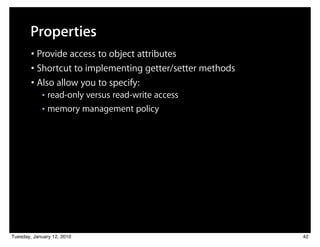
Properties
        • Provide access to object attributes
        • Shortcut to implementing getter/setter methods
        • Also allow you to specify:
            ■ read-only versus read-write access
            ■ memory management policy


Tuesday, January 12, 2010                                  42
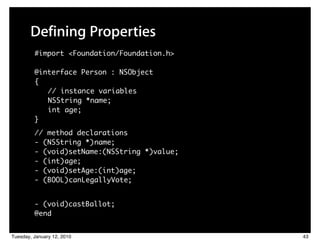
Defining Properties
         #import <Foundation/Foundation.h>

         @interface Person : NSObject
         {
            // instance variables
            NSString *name;
            int age;
         }
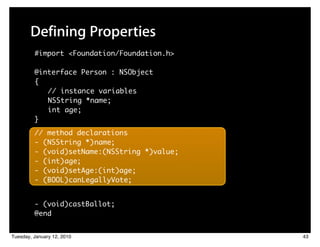
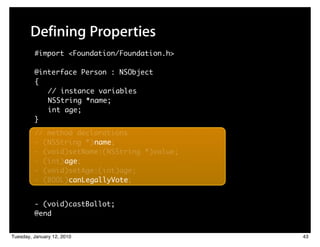
         // method declarations
         - (NSString *) name;
         - (void)setName:(NSString *)value;
         - (int) age;
         - (void)setAge:(int)age;
         - (BOOL) canLegallyVote;


         - (void)castBallot;
         @end


Tuesday, January 12, 2010                     43
Defining Properties
         #import <Foundation/Foundation.h>

         @interface Person : NSObject
         {
            // instance variables
            NSString *name;
            int age;
         }
         // method declarations
         - (NSString *) name;
         - (void)setName:(NSString *)value;
         - (int) age;
         - (void)setAge:(int)age;
         - (BOOL) canLegallyVote;


         - (void)castBallot;
         @end


Tuesday, January 12, 2010                     43
Defining Properties
         #import <Foundation/Foundation.h>

         @interface Person : NSObject
         {
            // instance variables
            NSString *name;
            int age;
         }
         // method declarations
         - (NSString *) name;
         - (void)setName:(NSString *)value;
         - (int) age;
         - (void)setAge:(int)age;
         - (BOOL) canLegallyVote;


         - (void)castBallot;
         @end


Tuesday, January 12, 2010                     43
Defining Properties
         #import <Foundation/Foundation.h>

         @interface Person : NSObject
         {
            // instance variables
            NSString *name;
            int age;
         }


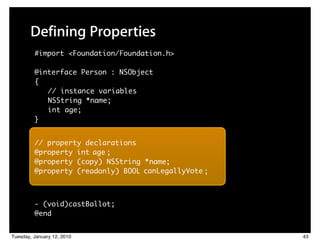
         // property declarations
         @property int age ;
         @property (copy) NSString * name;
         @property (readonly) BOOL canLegallyVote ;


         - (void)castBallot;
         @end


Tuesday, January 12, 2010                             43
Defining Properties
         #import <Foundation/Foundation.h>

         @interface Person : NSObject
         {
            // instance variables
            NSString *name;
            int age;
         }


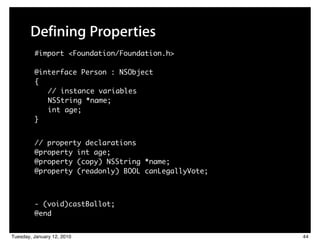
         // property declarations
         @property int age;
         @property (copy) NSString *name;
         @property (readonly) BOOL canLegallyVote;


         - (void)castBallot;
         @end


Tuesday, January 12, 2010                            44
Synthesizing Properties
         @implementation Person

         - (int)age {
            return age;
         }
         - (void)setAge:(int)value {
            age = value;
         }
         - (NSString *)name {
             return name;
         }
         - (void)setName:(NSString *)value {
             if (value != name) {
                 [name release];
                 name = [value copy];
             }
         }
         - (void)canLegallyVote { ...


Tuesday, January 12, 2010                      45
Synthesizing Properties
         @implementation Person

         - (int)age {
            return age;
         }
         - (void)setAge:(int)value {
            age = value;
         }
         - (NSString *)name {
             return name;
         }
         - (void)setName:(NSString *)value {
             if (value != name) {
                 [name release];
                 name = [value copy];
             }
         }
         - (void)canLegallyVote { ...


Tuesday, January 12, 2010                      45
Synthesizing Properties
         @implementation Person

         - (int)age {
                age
            return age;
         }
         - (void)setAge:(int)value {
            age = value;
         }
         - (NSString *)name {
                       name
             return name;
         }
         - (void)setName:(NSString *)value {
             if (value != name) {
                 [name release];
                 name = [value copy];
             }
         }
         - (void)canLegallyVote { ...


Tuesday, January 12, 2010                      45
Synthesizing Properties
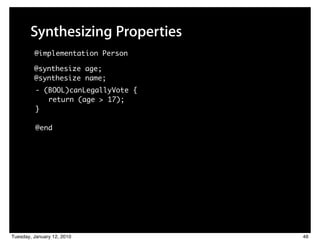
         @implementation Person

         @synthesize age;
         @synthesize name;
          - (BOOL)canLegallyVote {
             return (age > 17);
          }

          @end


Tuesday, January 12, 2010            46
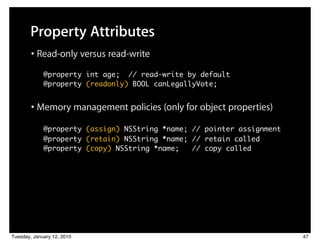
Property Attributes
        • Read-only versus read-write
          ! @property int age; // read-write by default
          	 @property (readonly) BOOL canLegallyVote;


        • Memory management policies (only for object properties)
            @property (assign) NSString *name; // pointer assignment
          	 @property (retain) NSString *name; // retain called
          	 @property (copy) NSString *name;   // copy called


Tuesday, January 12, 2010                                              47
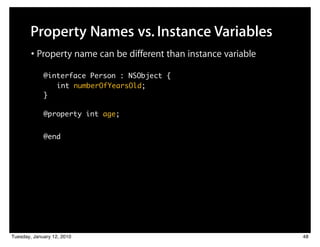
Property Names vs. Instance Variables
        • Property name can be different than instance variable
            @interface Person : NSObject {
          	 	 	 int numberOfYearsOld;
          	}

          	 @property int age;


          	 @end


Tuesday, January 12, 2010                                         48
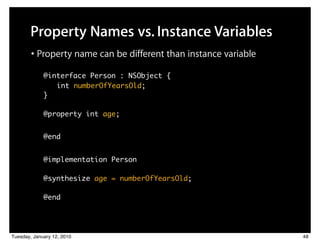
Property Names vs. Instance Variables
        • Property name can be different than instance variable
             @interface Person : NSObject {
           	 	 	 int numberOfYearsOld;
           	}

           	 @property int age;


           	 @end


       	     @implementation Person

       	     @synthesize age = numberOfYearsOld;

       	     @end


Tuesday, January 12, 2010                                         48
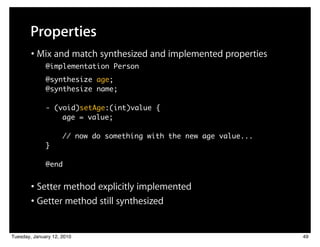
Properties
        • Mix and match synthesized and implemented properties
              @implementation Person
              @synthesize age;
              @synthesize name;

              - (void)setAge:(int)value {
                  age = value;

                     // now do something with the new age value...
              }

              @end


        • Setter method explicitly implemented
        • Getter method still synthesized

Tuesday, January 12, 2010                                            49
Properties In Practice
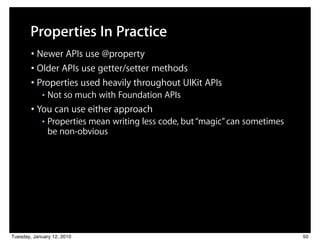
        • Newer APIs use @property
        • Older APIs use getter/setter methods
        • Properties used heavily throughout UIKit APIs
            ■   Not so much with Foundation APIs
        • You can use either approach
            ■   Properties mean writing less code, but “magic” can sometimes
                be non-obvious


Tuesday, January 12, 2010                                                      50
Dot Syntax and self
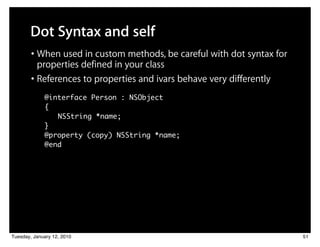
        • When used in custom methods, be careful with dot syntax for
          properties defined in your class
        • References to properties and ivars behave very differently
             @interface Person : NSObject
             {
                NSString *name;
             }
             @property (copy) NSString *name;
             @end


Tuesday, January 12, 2010                                               51
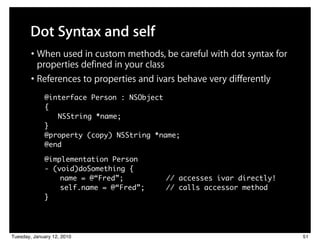
Dot Syntax and self
        • When used in custom methods, be careful with dot syntax for
          properties defined in your class
        • References to properties and ivars behave very differently
             @interface Person : NSObject
             {
                NSString *name;
             }
             @property (copy) NSString *name;
             @end

             @implementation Person
             - (void)doSomething {
             	 	 name = @“Fred”;         // accesses ivar directly!
             	 	 self.name = @“Fred”;    // calls accessor method
             }


Tuesday, January 12, 2010                                               51
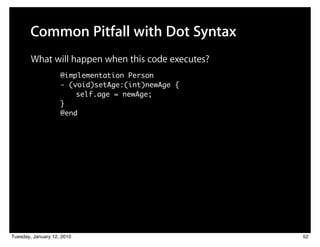
Common Pitfall with Dot Syntax
        What will happen when this code executes?
                    @implementation Person
                    - (void)setAge:(int)newAge {
                    	 	 self.age = newAge;
                    }
                    @end


Tuesday, January 12, 2010                           52
Common Pitfall with Dot Syntax
        What will happen when this code executes?
                    @implementation Person
                    - (void)setAge:(int)newAge {
                    	 	 self.age = newAge;
                    }
                    @end

        This is equivalent to:
                    @implementation Person
                    - (void)setAge:(int)newAge {
                    	 	 [self setAge:newAge]; // Infinite loop!
                    }
                    @end


Tuesday, January 12, 2010                                         52
Further Reading
        • Objective-C 2.0 Programming Language
            ■ “Defining a Class”
            ■ “Declared Properties”


        • Memory Management Programming Guide for Cocoa


Tuesday, January 12, 2010                                 53
Questions?


Tuesday, January 12, 2010   54

03 Custom Classes

  • 1.
    CS193P - Lecture3 iPhone Application Development Custom Classes Object Lifecycle Autorelease Properties Tuesday, January 12, 2010 1
  • 2.
    Announcements • Assignments 1A and 1B due Wednesday 1/13 at 11:59 PM ■ Enrolled Stanford students can email cs193p@cs.stanford.edu with any questions ■ Submit early! Instructions on the website... ■ Delete the “build” directory manually, Xcode won’t do it Tuesday, January 12, 2010 2
  • 3.
    Announcements • Assignments 2A and 2B due Wednesday 1/20 at 11:59 PM ■ 2A: Continuation of Foundation tool ■ Add custom class ■ Basic memory management ■ 2B: Beginning of first iPhone application ■ Topics to be covered on Thursday, 1/14 ■ Assignment contains extensive walkthrough Tuesday, January 12, 2010 3
  • 4.
    Enrolled students &iTunes U • Lectures have begun showing up on iTunes U • Lead time is longer than last year • Come to class!! ■ Lectures may not post in time for assignments Tuesday, January 12, 2010 4
  • 5.
    Office Hours • Paul’s office hours: Thursday 2-4, Gates B26B • David’s office hours: Mondays 4-6pm: Gates 360 Tuesday, January 12, 2010 5
  • 6.
    Today’s Topics • Questions from Assignment 1A or 1B? • Creating Custom Classes • Object Lifecycle • Autorelease • Objective-C Properties Tuesday, January 12, 2010 6
  • 7.
  • 8.
  • 9.
    Design Phase • Create a class ■ Person Tuesday, January 12, 2010 8
  • 10.
    Design Phase • Create a class ■ Person • Determine the superclass ■ NSObject (in this case) Tuesday, January 12, 2010 8
  • 11.
    Design Phase • Create a class ■ Person • Determine the superclass ■ NSObject (in this case) • What properties should it have? ■ Name, age, whether they can vote Tuesday, January 12, 2010 8
  • 12.
    Design Phase • Create a class ■ Person • Determine the superclass ■ NSObject (in this case) • What properties should it have? ■ Name, age, whether they can vote • What actions can it perform? ■ Cast a ballot Tuesday, January 12, 2010 8
  • 13.
    Defining a class A public header and a private implementation Header File Implementation File Tuesday, January 12, 2010 9
  • 14.
    Defining a class A public header and a private implementation Header File Implementation File Tuesday, January 12, 2010 9
  • 15.
    Class interface declaredin header file Tuesday, January 12, 2010 10
  • 16.
    Class interface declaredin header file @interface Person @end Tuesday, January 12, 2010 10
  • 17.
    Class interface declaredin header file @interface Person : NSObject @end Tuesday, January 12, 2010 10
  • 18.
    Class interface declaredin header file #import <Foundation/Foundation.h> @interface Person : NSObject @end Tuesday, January 12, 2010 10
  • 19.
    Class interface declaredin header file #import <Foundation/Foundation.h> @interface Person : NSObject { } @end Tuesday, January 12, 2010 10
  • 20.
    Class interface declaredin header file #import <Foundation/Foundation.h> @interface Person : NSObject { // instance variables NSString *name; int age; } @end Tuesday, January 12, 2010 10
  • 21.
    Class interface declaredin header file #import <Foundation/Foundation.h> @interface Person : NSObject { // instance variables NSString *name; int age; } // method declarations - (NSString *)name; - (void)setName:(NSString *)value; - (int)age; - (void)setAge:(int)age; - (BOOL)canLegallyVote; - (void)castBallot; @end Tuesday, January 12, 2010 10
  • 22.
    Defining a class A public header and a private implementation Header File Implementation File Tuesday, January 12, 2010 11
  • 23.
    Implementing custom class • Implement setter/getter methods • Implement action methods Tuesday, January 12, 2010 12
  • 24.
  • 25.
    Class Implementation #import "Person.h" Tuesday, January 12, 2010 13
  • 26.
    Class Implementation #import "Person.h" @implementation Person @end Tuesday, January 12, 2010 13
  • 27.
    Class Implementation #import "Person.h" @implementation Person - (int)age { return age; } - (void)setAge:(int)value { age = value; } //... and other methods @end Tuesday, January 12, 2010 13
  • 28.
    Calling your ownmethods Tuesday, January 12, 2010 14
  • 29.
    Calling your ownmethods #import "Person.h" @implementation Person - (BOOL)canLegallyVote { } - (void)castBallot { } @end Tuesday, January 12, 2010 14
  • 30.
    Calling your ownmethods #import "Person.h" @implementation Person - (BOOL)canLegallyVote { return ([self age] >= 18); } - (void)castBallot { } @end Tuesday, January 12, 2010 14
  • 31.
    Calling your ownmethods #import "Person.h" @implementation Person - (BOOL)canLegallyVote { return ([self age] >= 18); } - (void)castBallot { if ([self canLegallyVote]) { // do voting stuff } else { NSLog (@“I’m not allowed to vote!”); } } @end Tuesday, January 12, 2010 14
  • 32.
    Superclass methods • As we just saw, objects have an implicit variable named “self” ■ Like “this” in Java and C++ • Can also invoke superclass methods using “super” Tuesday, January 12, 2010 15
  • 33.
    Superclass methods • As we just saw, objects have an implicit variable named “self” ■ Like “this” in Java and C++ • Can also invoke superclass methods using “super” - (void)doSomething { // Call superclass implementation first [super doSomething]; // Then do our custom behavior int foo = bar; // ... } Tuesday, January 12, 2010 15
  • 34.
  • 35.
    Object Lifecycle • Creating objects • Memory management • Destroying objects Tuesday, January 12, 2010 17
  • 36.
  • 37.
    Object Creation • Two step process ■ allocate memory to store the object ■ initialize object state Tuesday, January 12, 2010 18
  • 38.
    Object Creation • Two step process ■ allocate memory to store the object ■ initialize object state + alloc ■ Class method that knows how much memory is needed Tuesday, January 12, 2010 18
  • 39.
    Object Creation • Two step process ■ allocate memory to store the object ■ initialize object state + alloc ■ Class method that knows how much memory is needed - init ■ Instance method to set initial values, perform other setup Tuesday, January 12, 2010 18
  • 40.
    Create = Allocate+ Initialize Tuesday, January 12, 2010 19
  • 41.
    Create = Allocate+ Initialize Person *person = nil; Tuesday, January 12, 2010 19
  • 42.
    Create = Allocate+ Initialize Person *person = nil; person = [[Person alloc] init]; Tuesday, January 12, 2010 19
  • 43.
    Implementing your own-init method #import "Person.h" @implementation Person @end Tuesday, January 12, 2010 20
  • 44.
    Implementing your own-init method #import "Person.h" @implementation Person - (id)init { } @end Tuesday, January 12, 2010 20
  • 45.
    Implementing your own-init method #import "Person.h" @implementation Person - (id)init { // allow superclass to initialize its state first if (self = [super init]) { } return self; } @end Tuesday, January 12, 2010 20
  • 46.
    Implementing your own-init method #import "Person.h" @implementation Person - (id)init { // allow superclass to initialize its state first if (self = [super init]) { age = 0; name = @“Bob”; // do other initialization... } return self; } @end Tuesday, January 12, 2010 20
  • 47.
    Multiple init methods • Classes may define multiple init methods - (id)init; - (id)initWithName:(NSString *)name; - (id)initWithName:(NSString *)name age:(int)age; Tuesday, January 12, 2010 21
  • 48.
    Multiple init methods • Classes may define multiple init methods - (id)init; - (id)initWithName:(NSString *)name; - (id)initWithName:(NSString *)name age:(int)age; • Less specific ones typically call more specific with default values - (id)init { return [self initWithName:@“No Name”]; } - (id)initWithName:(NSString *)name { return [self initWithName:name age:0]; } Tuesday, January 12, 2010 21
  • 49.
    Finishing Up Withan Object Person *person = nil; person = [[Person alloc] init]; Tuesday, January 12, 2010 22
  • 50.
    Finishing Up Withan Object Person *person = nil; person = [[Person alloc] init]; [person setName:@“Jimmy Jones”]; [person setAge:32]; [person castBallot]; [person doSomethingElse]; Tuesday, January 12, 2010 22
  • 51.
    Finishing Up Withan Object Person *person = nil; person = [[Person alloc] init]; [person setName:@“Jimmy Jones”]; [person setAge:32]; [person castBallot]; [person doSomethingElse]; // What do we do with person when we’re done? Tuesday, January 12, 2010 22
  • 52.
    Memory Management Allocation Destruction C malloc free Objective-C alloc dealloc Tuesday, January 12, 2010 23
  • 53.
    Memory Management Allocation Destruction C malloc free Objective-C alloc dealloc Tuesday, January 12, 2010 23
  • 54.
    Memory Management Allocation Destruction C malloc free Objective-C alloc dealloc Tuesday, January 12, 2010 23
  • 55.
    Memory Management Allocation Destruction C malloc free Objective-C alloc dealloc • Calls must be balanced ■ Otherwise your program may leak or crash Tuesday, January 12, 2010 23
  • 56.
    Memory Management Allocation Destruction C malloc free Objective-C alloc dealloc • Calls must be balanced ■ Otherwise your program may leak or crash • However, you’ll never call -dealloc directly ■ One exception, we’ll see in a bit... Tuesday, January 12, 2010 23
  • 57.
  • 58.
    Reference Counting • Every object has a retain count ■ Defined on NSObject ■ As long as retain count is > 0, object is alive and valid Tuesday, January 12, 2010 24
  • 59.
    Reference Counting • Every object has a retain count ■ Defined on NSObject ■ As long as retain count is > 0, object is alive and valid • +alloc and -copy create objects with retain count == 1 Tuesday, January 12, 2010 24
  • 60.
    Reference Counting • Every object has a retain count ■ Defined on NSObject ■ As long as retain count is > 0, object is alive and valid • +alloc and -copy create objects with retain count == 1 • -retain increments retain count Tuesday, January 12, 2010 24
  • 61.
    Reference Counting • Every object has a retain count ■ Defined on NSObject ■ As long as retain count is > 0, object is alive and valid • +alloc and -copy create objects with retain count == 1 • -retain increments retain count • -release decrements retain count Tuesday, January 12, 2010 24
  • 62.
    Reference Counting • Every object has a retain count ■ Defined on NSObject ■ As long as retain count is > 0, object is alive and valid • +alloc and -copy create objects with retain count == 1 • -retain increments retain count • -release decrements retain count • When retain count reaches 0, object is destroyed • -dealloc method invoked automatically ■ One-way street, once you’re in -dealloc there’s no turning back Tuesday, January 12, 2010 24
  • 63.
    Balanced Calls Person *person = nil; person = [[Person alloc] init]; Tuesday, January 12, 2010 25
  • 64.
    Balanced Calls Person *person = nil; person = [[Person alloc] init]; [person setName:@“Jimmy Jones”]; [person setAge:32]; [person castBallot]; [person doSomethingElse]; Tuesday, January 12, 2010 25
  • 65.
    Balanced Calls Person *person = nil; person = [[Person alloc] init]; [person setName:@“Jimmy Jones”]; [person setAge:32]; [person castBallot]; [person doSomethingElse]; // When we’re done with person, release it [person release]; // person will be destroyed here Tuesday, January 12, 2010 25
  • 66.
    Reference counting inaction Tuesday, January 12, 2010 26
  • 67.
    Reference counting inaction Person *person = [[Person alloc] init]; Tuesday, January 12, 2010 26
  • 68.
    Reference counting inaction Person *person = [[Person alloc] init]; Retain count begins at 1 with +alloc Tuesday, January 12, 2010 26
  • 69.
    Reference counting inaction Person *person = [[Person alloc] init]; Retain count begins at 1 with +alloc [person retain]; Tuesday, January 12, 2010 26
  • 70.
    Reference counting inaction Person *person = [[Person alloc] init]; Retain count begins at 1 with +alloc [person retain]; Retain count increases to 2 with -retain Tuesday, January 12, 2010 26
  • 71.
    Reference counting inaction Person *person = [[Person alloc] init]; Retain count begins at 1 with +alloc [person retain]; Retain count increases to 2 with -retain [person release]; Tuesday, January 12, 2010 26
  • 72.
    Reference counting inaction Person *person = [[Person alloc] init]; Retain count begins at 1 with +alloc [person retain]; Retain count increases to 2 with -retain [person release]; Retain count decreases to 1 with -release Tuesday, January 12, 2010 26
  • 73.
    Reference counting inaction Person *person = [[Person alloc] init]; Retain count begins at 1 with +alloc [person retain]; Retain count increases to 2 with -retain [person release]; Retain count decreases to 1 with -release [person release]; Tuesday, January 12, 2010 26
  • 74.
    Reference counting inaction Person *person = [[Person alloc] init]; Retain count begins at 1 with +alloc [person retain]; Retain count increases to 2 with -retain [person release]; Retain count decreases to 1 with -release [person release]; Retain count decreases to 0, -dealloc automatically called Tuesday, January 12, 2010 26
  • 75.
  • 76.
    Messaging deallocated objects Person *person = [[Person alloc] init]; // ... [person release]; // Object is deallocated Tuesday, January 12, 2010 27
  • 77.
    Messaging deallocated objects Person *person = [[Person alloc] init]; // ... [person release]; // Object is deallocated [person doSomething]; // Crash! Tuesday, January 12, 2010 27
  • 78.
    Messaging deallocated objects Person *person = [[Person alloc] init]; // ... [person release]; // Object is deallocated Tuesday, January 12, 2010 27
  • 79.
    Messaging deallocated objects Person *person = [[Person alloc] init]; // ... [person release]; // Object is deallocated person = nil; Tuesday, January 12, 2010 27
  • 80.
    Messaging deallocated objects Person *person = [[Person alloc] init]; // ... [person release]; // Object is deallocated person = nil; [person doSomething]; // No effect Tuesday, January 12, 2010 27
  • 81.
    Implementing a -deallocmethod #import "Person.h" @implementation Person @end Tuesday, January 12, 2010 28
  • 82.
    Implementing a -deallocmethod #import "Person.h" @implementation Person - (void)dealloc { } @end Tuesday, January 12, 2010 28
  • 83.
    Implementing a -deallocmethod #import "Person.h" @implementation Person - (void)dealloc { // Do any cleanup that’s necessary // ... } @end Tuesday, January 12, 2010 28
  • 84.
    Implementing a -deallocmethod #import "Person.h" @implementation Person - (void)dealloc { // Do any cleanup that’s necessary // ... // when we’re done, call super to clean us up [super dealloc]; } @end Tuesday, January 12, 2010 28
  • 85.
    Object Lifecycle Recap • Objects begin with a retain count of 1 • Increase and decrease with -retain and -release • When retain count reaches 0, object deallocated automatically • You never call dealloc explicitly in your code ■ Exception is calling -[super dealloc] ■ You only deal with alloc, copy, retain, release Tuesday, January 12, 2010 29
  • 86.
    Object Ownership #import <Foundation/Foundation.h> @interface Person : NSObject { // instance variables NSString *name; // Person class “owns” the name int age; } // method declarations - (NSString *)name; - (void)setName:(NSString *)value; - (int)age; - (void)setAge:(int)age; - (BOOL)canLegallyVote; - (void)castBallot; @end Tuesday, January 12, 2010 30
  • 87.
    Object Ownership #import "Person.h" @implementation Person @end Tuesday, January 12, 2010 31
  • 88.
    Object Ownership #import "Person.h" @implementation Person - (NSString *)name { return name; } - (void)setName:(NSString *)newName { } @end Tuesday, January 12, 2010 31
  • 89.
    Object Ownership #import "Person.h" @implementation Person - (NSString *)name { return name; } - (void)setName:(NSString *)newName { if (name != newName) { [name release]; name = [newName retain]; // name’s retain count has been bumped up by 1 } } @end Tuesday, January 12, 2010 31
  • 90.
    Object Ownership #import "Person.h" @implementation Person - (NSString *)name { return name; } - (void)setName:(NSString *)newName { } @end Tuesday, January 12, 2010 31
  • 91.
    Object Ownership #import "Person.h" @implementation Person - (NSString *)name { return name; } - (void)setName:(NSString *)newName { if (name != newName) { [name release]; name = [newName copy]; // name has retain count of 1, we own it } } @end Tuesday, January 12, 2010 31
  • 92.
    Releasing Instance Variables #import "Person.h" @implementation Person @end Tuesday, January 12, 2010 32
  • 93.
    Releasing Instance Variables #import "Person.h" @implementation Person - (void)dealloc { } @end Tuesday, January 12, 2010 32
  • 94.
    Releasing Instance Variables #import "Person.h" @implementation Person - (void)dealloc { // Do any cleanup that’s necessary [name release]; } @end Tuesday, January 12, 2010 32
  • 95.
    Releasing Instance Variables #import "Person.h" @implementation Person - (void)dealloc { // Do any cleanup that’s necessary [name release]; // when we’re done, call super to clean us up [super dealloc]; } @end Tuesday, January 12, 2010 32
  • 96.
  • 97.
    Returning a newlycreated object - (NSString *)fullName { NSString *result; result = [[NSString alloc] initWithFormat:@“%@ %@”, firstName, lastName]; return result; } Tuesday, January 12, 2010 34
  • 98.
    Returning a newlycreated object - (NSString *)fullName { NSString *result; result = [[NSString alloc] initWithFormat:@“%@ %@”, firstName, lastName]; return result; } Wrong: result is leaked! Tuesday, January 12, 2010 34
  • 99.
    Returning a newlycreated object - (NSString *)fullName { NSString *result; result = [[NSString alloc] initWithFormat:@“%@ %@”, firstName, lastName]; [result release]; return result; } Tuesday, January 12, 2010 34
  • 100.
    Returning a newlycreated object - (NSString *)fullName { NSString *result; result = [[NSString alloc] initWithFormat:@“%@ %@”, firstName, lastName]; [result release]; return result; } Wrong: result is released too early! Method returns bogus value Tuesday, January 12, 2010 34
  • 101.
    Returning a newlycreated object - (NSString *)fullName { NSString *result; result = [[NSString alloc] initWithFormat:@“%@ %@”, firstName, lastName]; return result; } Tuesday, January 12, 2010 34
  • 102.
    Returning a newlycreated object - (NSString *)fullName { NSString *result; result = [[NSString alloc] initWithFormat:@“%@ %@”, firstName, lastName]; [result autorelease]; return result; } Tuesday, January 12, 2010 34
  • 103.
    Returning a newlycreated object - (NSString *)fullName { NSString *result; result = [[NSString alloc] initWithFormat:@“%@ %@”, firstName, lastName]; [result autorelease]; return result; } Just right: result is released, but not right away Caller gets valid object and could retain if needed Tuesday, January 12, 2010 34
  • 104.
    Autoreleasing Objects • Calling -autorelease flags an object to be sent release at some point in the future • Let’s you fulfill your retain/release obligations while allowing an object some additional time to live • Makes it much more convenient to manage memory • Very useful in methods which return a newly created object Tuesday, January 12, 2010 35
  • 105.
    Method Names &Autorelease Tuesday, January 12, 2010 36
  • 106.
    Method Names &Autorelease • Methods whose names includes alloc, copy, or new return a retained object that the caller needs to release Tuesday, January 12, 2010 36
  • 107.
    Method Names &Autorelease • Methods whose names includes alloc, copy, or new return a retained object that the caller needs to release NSMutableString *string = [[NSMutableString alloc] init]; // We are responsible for calling -release or -autorelease [string autorelease]; Tuesday, January 12, 2010 36
  • 108.
    Method Names &Autorelease • Methods whose names includes alloc, copy, or new return a retained object that the caller needs to release NSMutableString *string = [[NSMutableString alloc] init]; // We are responsible for calling -release or -autorelease [string autorelease]; • All other methods return autoreleased objects Tuesday, January 12, 2010 36
  • 109.
    Method Names &Autorelease • Methods whose names includes alloc, copy, or new return a retained object that the caller needs to release NSMutableString *string = [[NSMutableString alloc] init]; // We are responsible for calling -release or -autorelease [string autorelease]; • All other methods return autoreleased objects NSMutableString *string = [NSMutableString string]; // The method name doesn’t indicate that we need to release it // So don’t- we’re cool! Tuesday, January 12, 2010 36
  • 110.
    Method Names &Autorelease • Methods whose names includes alloc, copy, or new return a retained object that the caller needs to release NSMutableString *string = [[NSMutableString alloc] init]; // We are responsible for calling -release or -autorelease [string autorelease]; • All other methods return autoreleased objects NSMutableString *string = [NSMutableString string]; // The method name doesn’t indicate that we need to release it // So don’t- we’re cool! • This is a convention- follow it in methods you define! Tuesday, January 12, 2010 36
  • 111.
    How does -autoreleasework? Tuesday, January 12, 2010 37
  • 112.
    How does -autoreleasework? • Object is added to current autorelease pool Tuesday, January 12, 2010 37
  • 113.
    How does -autoreleasework? • Object is added to current autorelease pool • Autorelease pools track objects scheduled to be released ■ When the pool itself is released, it sends -release to all its objects Tuesday, January 12, 2010 37
  • 114.
    How does -autoreleasework? • Object is added to current autorelease pool • Autorelease pools track objects scheduled to be released ■ When the pool itself is released, it sends -release to all its objects • UIKit automatically wraps a pool around every event dispatch Tuesday, January 12, 2010 37
  • 115.
    Autorelease Pools (inpictures) pp d ha lize nib nt en t pp nc ia i n ve v it a au nit a ore lee Ex L pi a dm it f nd Ap Lo Wa Ha Tuesday, January 12, 2010 38
  • 116.
    Autorelease Pools (inpictures) Pool Pool created pp d ha lize nib nt en t pp nc ia i n ve v it a au nit a ore lee Ex L pi a dm it f nd Ap Lo Wa Ha Tuesday, January 12, 2010 38
  • 117.
    Autorelease Pools (inpictures) Pool Objects autoreleased here go into pool Pool created pp d ha lize nib nt en t pp nc ia i n ve v it a au nit a ore lee Ex L pi a dm it f nd Ap Lo Wa Ha Tuesday, January 12, 2010 38
  • 118.
    Autorelease Pools (inpictures) Pool Objects autoreleased here go into pool Pool created pp d ha lize nib nt en t pp nc ia i n ve v it a au nit a ore lee Ex L pi a dm it f nd Ap Lo Wa Ha Tuesday, January 12, 2010 38
  • 119.
    Autorelease Pools (inpictures) Pool Objects autoreleased here go into pool [object autorelease]; Pool created pp d ha lize nib nt en t pp nc ia i n ve v it a au nit a ore lee Ex L pi a dm it f nd Ap Lo Wa Ha Tuesday, January 12, 2010 38
  • 120.
    Autorelease Pools (inpictures) Pool Objects autoreleased here go into pool Pool created pp d ha lize nib nt en t pp nc ia i n ve v it a au nit a ore lee Ex L pi a dm it f nd Ap Lo Wa Ha Tuesday, January 12, 2010 38
  • 121.
    Autorelease Pools (inpictures) Pool Objects autoreleased here go into pool Pool created pp d ha lize nib nt en t pp nc ia i n ve v it a au nit a ore lee Ex L pi a dm it f nd Ap Lo Wa Ha Tuesday, January 12, 2010 38
  • 122.
    Autorelease Pools (inpictures) Pool Objects autoreleased here go into pool Pool released Pool created pp d ha lize nib nt en t pp nc ia i n ve v it a au nit a ore lee Ex L pi a dm it f nd Ap Lo Wa Ha Tuesday, January 12, 2010 38
  • 123.
    Autorelease Pools (inpictures) [object release]; Pool [object release]; Objects autoreleased here go into pool [object release]; Pool released Pool created pp d ha lize nib nt en t pp nc ia i n ve v it a au nit a ore lee Ex L pi a dm it f nd Ap Lo Wa Ha Tuesday, January 12, 2010 38
  • 124.
    Autorelease Pools (inpictures) Pool Objects autoreleased here go into pool Pool released Pool created pp d ha lize nib nt en t pp nc ia i n ve v it a au nit a ore lee Ex L pi a dm it f nd Ap Lo Wa Ha Tuesday, January 12, 2010 38
  • 125.
    Hanging Onto anAutoreleased Object • Many methods return autoreleased objects ■ Remember the naming conventions... ■ They’re hanging out in the pool and will get released later • If you need to hold onto those objects you need to retain them ■ Bumps up the retain count before the release happens Tuesday, January 12, 2010 39
  • 126.
    Hanging Onto anAutoreleased Object • Many methods return autoreleased objects ■ Remember the naming conventions... ■ They’re hanging out in the pool and will get released later • If you need to hold onto those objects you need to retain them ■ Bumps up the retain count before the release happens name = [NSMutableString string]; // We want to name to remain valid! [name retain]; // ... // Eventually, we’ll release it (maybe in our -dealloc?) [name release]; Tuesday, January 12, 2010 39
  • 127.
    Side Note: GarbageCollection • Autorelease is not garbage collection • Objective-C on iPhone OS does not have garbage collection Tuesday, January 12, 2010 40
  • 128.
  • 129.
    Properties • Provide access to object attributes • Shortcut to implementing getter/setter methods • Also allow you to specify: ■ read-only versus read-write access ■ memory management policy Tuesday, January 12, 2010 42
  • 130.
    Defining Properties #import <Foundation/Foundation.h> @interface Person : NSObject { // instance variables NSString *name; int age; } // method declarations - (NSString *) name; - (void)setName:(NSString *)value; - (int) age; - (void)setAge:(int)age; - (BOOL) canLegallyVote; - (void)castBallot; @end Tuesday, January 12, 2010 43
  • 131.
    Defining Properties #import <Foundation/Foundation.h> @interface Person : NSObject { // instance variables NSString *name; int age; } // method declarations - (NSString *) name; - (void)setName:(NSString *)value; - (int) age; - (void)setAge:(int)age; - (BOOL) canLegallyVote; - (void)castBallot; @end Tuesday, January 12, 2010 43
  • 132.
    Defining Properties #import <Foundation/Foundation.h> @interface Person : NSObject { // instance variables NSString *name; int age; } // method declarations - (NSString *) name; - (void)setName:(NSString *)value; - (int) age; - (void)setAge:(int)age; - (BOOL) canLegallyVote; - (void)castBallot; @end Tuesday, January 12, 2010 43
  • 133.
    Defining Properties #import <Foundation/Foundation.h> @interface Person : NSObject { // instance variables NSString *name; int age; } // property declarations @property int age ; @property (copy) NSString * name; @property (readonly) BOOL canLegallyVote ; - (void)castBallot; @end Tuesday, January 12, 2010 43
  • 134.
    Defining Properties #import <Foundation/Foundation.h> @interface Person : NSObject { // instance variables NSString *name; int age; } // property declarations @property int age; @property (copy) NSString *name; @property (readonly) BOOL canLegallyVote; - (void)castBallot; @end Tuesday, January 12, 2010 44
  • 135.
    Synthesizing Properties @implementation Person - (int)age { return age; } - (void)setAge:(int)value { age = value; } - (NSString *)name { return name; } - (void)setName:(NSString *)value { if (value != name) { [name release]; name = [value copy]; } } - (void)canLegallyVote { ... Tuesday, January 12, 2010 45
  • 136.
    Synthesizing Properties @implementation Person - (int)age { return age; } - (void)setAge:(int)value { age = value; } - (NSString *)name { return name; } - (void)setName:(NSString *)value { if (value != name) { [name release]; name = [value copy]; } } - (void)canLegallyVote { ... Tuesday, January 12, 2010 45
  • 137.
    Synthesizing Properties @implementation Person - (int)age { age return age; } - (void)setAge:(int)value { age = value; } - (NSString *)name { name return name; } - (void)setName:(NSString *)value { if (value != name) { [name release]; name = [value copy]; } } - (void)canLegallyVote { ... Tuesday, January 12, 2010 45
  • 138.
    Synthesizing Properties @implementation Person @synthesize age; @synthesize name; - (BOOL)canLegallyVote { return (age > 17); } @end Tuesday, January 12, 2010 46
  • 139.
    Property Attributes • Read-only versus read-write ! @property int age; // read-write by default @property (readonly) BOOL canLegallyVote; • Memory management policies (only for object properties) @property (assign) NSString *name; // pointer assignment @property (retain) NSString *name; // retain called @property (copy) NSString *name; // copy called Tuesday, January 12, 2010 47
  • 140.
    Property Names vs.Instance Variables • Property name can be different than instance variable @interface Person : NSObject { int numberOfYearsOld; } @property int age; @end Tuesday, January 12, 2010 48
  • 141.
    Property Names vs.Instance Variables • Property name can be different than instance variable @interface Person : NSObject { int numberOfYearsOld; } @property int age; @end @implementation Person @synthesize age = numberOfYearsOld; @end Tuesday, January 12, 2010 48
  • 142.
    Properties • Mix and match synthesized and implemented properties @implementation Person @synthesize age; @synthesize name; - (void)setAge:(int)value { age = value; // now do something with the new age value... } @end • Setter method explicitly implemented • Getter method still synthesized Tuesday, January 12, 2010 49
  • 143.
    Properties In Practice • Newer APIs use @property • Older APIs use getter/setter methods • Properties used heavily throughout UIKit APIs ■ Not so much with Foundation APIs • You can use either approach ■ Properties mean writing less code, but “magic” can sometimes be non-obvious Tuesday, January 12, 2010 50
  • 144.
    Dot Syntax andself • When used in custom methods, be careful with dot syntax for properties defined in your class • References to properties and ivars behave very differently @interface Person : NSObject { NSString *name; } @property (copy) NSString *name; @end Tuesday, January 12, 2010 51
  • 145.
    Dot Syntax andself • When used in custom methods, be careful with dot syntax for properties defined in your class • References to properties and ivars behave very differently @interface Person : NSObject { NSString *name; } @property (copy) NSString *name; @end @implementation Person - (void)doSomething { name = @“Fred”; // accesses ivar directly! self.name = @“Fred”; // calls accessor method } Tuesday, January 12, 2010 51
  • 146.
    Common Pitfall withDot Syntax What will happen when this code executes? @implementation Person - (void)setAge:(int)newAge { self.age = newAge; } @end Tuesday, January 12, 2010 52
  • 147.
    Common Pitfall withDot Syntax What will happen when this code executes? @implementation Person - (void)setAge:(int)newAge { self.age = newAge; } @end This is equivalent to: @implementation Person - (void)setAge:(int)newAge { [self setAge:newAge]; // Infinite loop! } @end Tuesday, January 12, 2010 52
  • 148.
    Further Reading • Objective-C 2.0 Programming Language ■ “Defining a Class” ■ “Declared Properties” • Memory Management Programming Guide for Cocoa Tuesday, January 12, 2010 53
  • 149.