
Module 01
Test Planning
Topics
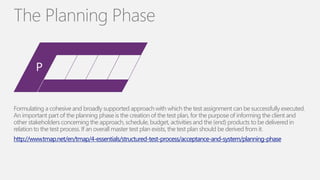
Formulating a cohesiveand broadly supported approach with which the test assignment can be successfully executed.
An important part of the planning phase is the creation of the test plan, for the purpose of informing the client and
other stakeholdersconcerning the approach, schedule, budget, activities and the (end) products to be delivered in
relation to the test process.If an overall master test plan exists, the test plan should be derived from it.
http://www.tmap.net/en/tmap/4-essentials/structured-test-process/acceptance-and-system/planning-phase
The Planning Phase
The Master Test Plan
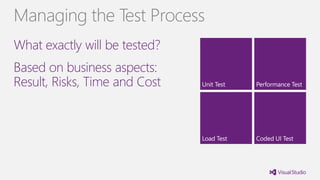
What exactly will be tested?
Based on business aspects:
Result, Risks, Time and Cost
Managing the Test Process
Unit Test
Load Test
Performance Test
Coded UI Test
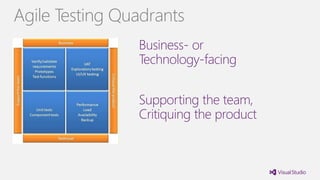
Business- or
Technology-facing
Supporting the team,
Critiquing the product
Agile Testing Quadrants
Performance &
Load Tests
Security Tests
‘ility’ Tests
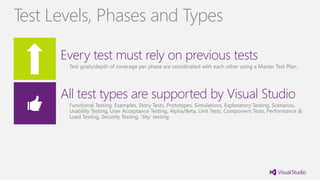
Test Levels, Phases and Types
Every test must rely on previous tests
Test goals/depth of coverage per phase are coordinated with each other using a Master Test Plan.
All test types are supported by Visual Studio
Functional Testing, Examples, Story Tests, Prototypes, Simulations, Exploratory Testing, Scenarios,
Usability Testing, User Acceptance Testing, Alpha/Beta, Unit Tests, Component Tests, Performance &
Load Testing, Security Testing, ‘ility’ testing.
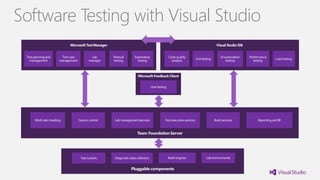
Software Testing with Visual Studio
Demo
Visual Studio Test Types:
Overview
Don‘t Test Twice!
Save Effort and Money with a
good Master Test Plan!
The Product Backlog
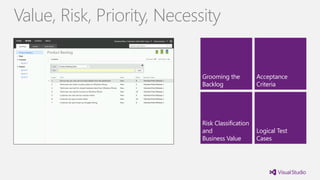
Value, Risk, Priority, Necessity
Grooming the
Backlog
Risk Classification
and
Business Value
Acceptance
Criteria
Logical Test
Cases
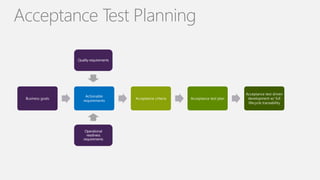
Acceptance Test Planning
Business goals
Actionable
requirements
Acceptance criteria Acceptance test plan
Acceptance test driven
development w/ full
lifecycle traceability
Title/Description
(describing the story)
Narrative: As a [role] I want [feature] so that [benefit].
Acceptance Criteria
(presented as scenarios)
Given [context]
and [some more context]...
When [event]
then [outcome] and [another outcome]...
Acceptance Criteria
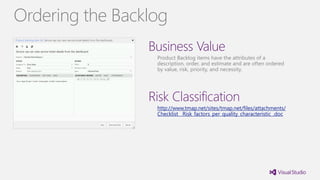
Business Value
Product Backlog items have the attributes of a
description, order, and estimate and are often ordered
by value, risk, priority, and necessity.
Risk Classification
http://www.tmap.net/sites/tmap.net/files/attachments/
Checklist__Risk_factors_per_quality_characteristic_.doc
Ordering the Backlog
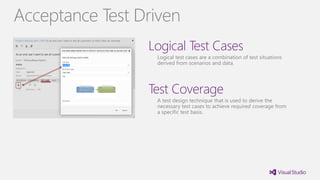
Logical Test Cases
Logical test cases are a combination of test situations
derived from scenarios and data.
Test Coverage
A test design technique that is used to derive the
necessary test cases to achieve required coverage from
a specific test basis.
Acceptance Test Driven
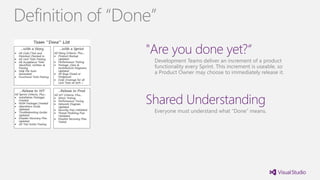
"Are you done yet?“
Development Teams deliver an increment of a product
functionality every Sprint. This increment is useable, so
a Product Owner may choose to immediately release it.
Shared Understanding
Everyone must understand what “Done” means.
Definition of “Done”
Demo
Planning the Project and
Testing Effort
Groom the Backlog!
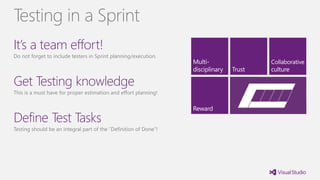
Testing in a Sprint
It’s a team effort!
Do not forget to include testers in Sprint planning/execution.
Get Testing knowledge
This is a must have for proper estimation and effort planning!
Define Test Tasks
Testing should be an integral part of the “Definition of Done”!
Testing in a Sprint
To obtain, with the client’s agreement, a test basis that is of sufficient quality for designing the test cases. In order to
determine this, a testability review of the test basis is carried out during this phase, which will provide insight into the
testability of the system.
http://www.tmap.net/en/tmap/4-essentials/structured-test-process/acceptance-and-system/preparation-phase
The Preparation Phase
Define test tasks
during the sprint
planning meeting.
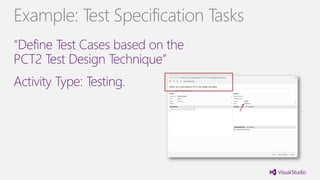
“Define Test Cases based on the
PCT2 Test Design Technique”
Activity Type: Testing.
Example: Test Specification Tasks
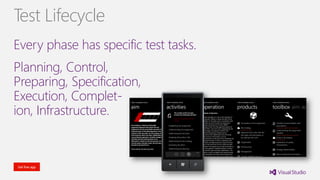
Every phase has specific test tasks.
Planning, Control,
Preparing, Specification,
Execution, Complet-
ion, Infrastructure.
Test Lifecycle
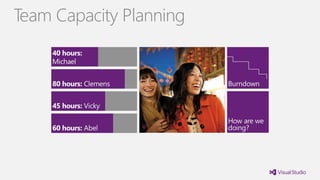
Team Capacity Planning
Demo
Planning the Sprint.
SCRUM Boards
Always Read the
SCRUM Board!
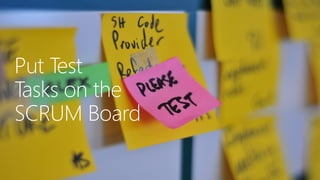
Put Test
Tasks on the
SCRUM Board
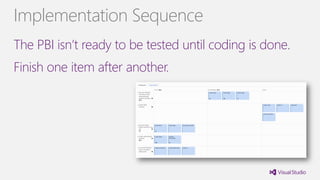
The PBI isn’t ready to be tested until coding is done.
Finish one item after another.
Implementation Sequence
02   test planning

02 test planning

  • 1.
  • 2.
  • 3.
    Formulating a cohesiveandbroadly supported approach with which the test assignment can be successfully executed. An important part of the planning phase is the creation of the test plan, for the purpose of informing the client and other stakeholdersconcerning the approach, schedule, budget, activities and the (end) products to be delivered in relation to the test process.If an overall master test plan exists, the test plan should be derived from it. http://www.tmap.net/en/tmap/4-essentials/structured-test-process/acceptance-and-system/planning-phase The Planning Phase
  • 4.
  • 5.
    What exactly willbe tested? Based on business aspects: Result, Risks, Time and Cost Managing the Test Process Unit Test Load Test Performance Test Coded UI Test
  • 6.
    Business- or Technology-facing Supporting theteam, Critiquing the product Agile Testing Quadrants Performance & Load Tests Security Tests ‘ility’ Tests
  • 7.
    Test Levels, Phasesand Types Every test must rely on previous tests Test goals/depth of coverage per phase are coordinated with each other using a Master Test Plan. All test types are supported by Visual Studio Functional Testing, Examples, Story Tests, Prototypes, Simulations, Exploratory Testing, Scenarios, Usability Testing, User Acceptance Testing, Alpha/Beta, Unit Tests, Component Tests, Performance & Load Testing, Security Testing, ‘ility’ testing.
  • 8.
    Software Testing withVisual Studio
  • 9.
    Demo Visual Studio TestTypes: Overview
  • 10.
    Don‘t Test Twice! SaveEffort and Money with a good Master Test Plan!
  • 11.
  • 12.
    Value, Risk, Priority,Necessity Grooming the Backlog Risk Classification and Business Value Acceptance Criteria Logical Test Cases
  • 13.
    Acceptance Test Planning Businessgoals Actionable requirements Acceptance criteria Acceptance test plan Acceptance test driven development w/ full lifecycle traceability
  • 14.
    Title/Description (describing the story) Narrative:As a [role] I want [feature] so that [benefit]. Acceptance Criteria (presented as scenarios) Given [context] and [some more context]... When [event] then [outcome] and [another outcome]... Acceptance Criteria
  • 15.
    Business Value Product Backlogitems have the attributes of a description, order, and estimate and are often ordered by value, risk, priority, and necessity. Risk Classification http://www.tmap.net/sites/tmap.net/files/attachments/ Checklist__Risk_factors_per_quality_characteristic_.doc Ordering the Backlog
  • 16.
    Logical Test Cases Logicaltest cases are a combination of test situations derived from scenarios and data. Test Coverage A test design technique that is used to derive the necessary test cases to achieve required coverage from a specific test basis. Acceptance Test Driven
  • 17.
    "Are you doneyet?“ Development Teams deliver an increment of a product functionality every Sprint. This increment is useable, so a Product Owner may choose to immediately release it. Shared Understanding Everyone must understand what “Done” means. Definition of “Done”
  • 18.
    Demo Planning the Projectand Testing Effort
  • 19.
  • 20.
  • 21.
    It’s a teameffort! Do not forget to include testers in Sprint planning/execution. Get Testing knowledge This is a must have for proper estimation and effort planning! Define Test Tasks Testing should be an integral part of the “Definition of Done”! Testing in a Sprint
  • 22.
    To obtain, withthe client’s agreement, a test basis that is of sufficient quality for designing the test cases. In order to determine this, a testability review of the test basis is carried out during this phase, which will provide insight into the testability of the system. http://www.tmap.net/en/tmap/4-essentials/structured-test-process/acceptance-and-system/preparation-phase The Preparation Phase
  • 23.
    Define test tasks duringthe sprint planning meeting.
  • 24.
    “Define Test Casesbased on the PCT2 Test Design Technique” Activity Type: Testing. Example: Test Specification Tasks
  • 25.
    Every phase hasspecific test tasks. Planning, Control, Preparing, Specification, Execution, Complet- ion, Infrastructure. Test Lifecycle
  • 26.
  • 27.
  • 28.
  • 29.
  • 30.
    Put Test Tasks onthe SCRUM Board
  • 31.
    The PBI isn’tready to be tested until coding is done. Finish one item after another. Implementation Sequence