Retail Banking
A few things MBA student  must know
Two types of students  Type A  MBA nahin to kuchh nahin  Type B  Kuchh Nahin to MBA Identify your type  Have you ever thought?  Why PG degree from a university gets one low paid job and PG in Business Management gets one a high paid job ?
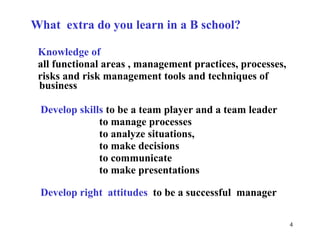
What  extra do you learn in a B school?  Knowledge of   all functional areas , management practices, processes,  risks and risk management tools and techniques of  business  Develop skills  to be a team player and a team leader to manage processes to analyze situations, to make decisions to communicate  to make presentations Develop right  attitudes   to be a successful  manager
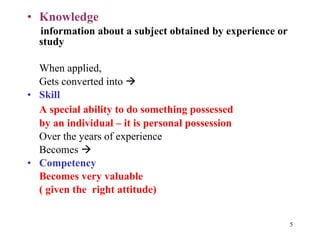
Knowledge   information about a subject obtained by experience or study When applied,  Gets converted into   Skill  A special ability to do something possessed  by an individual – it is personal possession Over the years of experience  Becomes   Competency  Becomes very valuable  ( given the  right attitude)
It is  OUR ATTITUDE  towards Life and  Work that makes OUR Life 100% ! ! ! Attitude  Feeling or opinion about something or someone  or a way of behaving that follows from this feeling or opinion
Why do some people seem to reach the top of the  corporate ladder easily, while others remain stuck on the middle-management rung? Dr. Martin Seligman, an authority on optimism discovered that  attitude was a  better predictor  of success than I.Q., education and most other factors . Some positive attitudes Life is so wonderful. I have ambition in life.   I will make it to the top, and  I  am in  charge of making it  happen. (auto suggestion to computer in brain ) Hard work comes first, luck comes later.  I think I can. (Confidence) I will Come forward  to Go forward My opportunity monitor is never turned off.
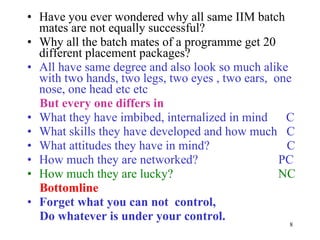
Have you ever wondered why all same IIM batch mates are not equally successful? Why all the batch mates of a programme get 20 different placement packages? All have same degree and also look so much alike with two hands, two legs, two eyes , two ears,  one nose, one head etc etc But every one differs in What they have imbibed, internalized in mind  C What skills they have developed and how much  C What attitudes they have in mind?  C  How much they are networked?  PC How much they are lucky?  NC Bottomline Forget what you can not  control,  Do whatever is under your control.
Retail Banking
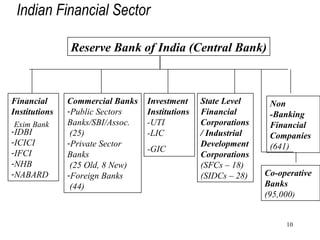
Commercial Banks Public Sectors Banks/SBI/Assoc. (25) Private Sector Banks (25 Old, 8 New) Foreign Banks (44) Investment Institutions -UTI -LIC -GIC   Financial  Institutions IDBI ICICI IFCI NHB NABARD  Non -Banking Financial Companies (641) State Level Financial  Corporations/ Industrial Development Corporations (SFCs – 18) (SIDCs – 28) Co-operative Banks (95,000 ) Indian Financial Sector   Reserve Bank of India (Central Bank) Exim Bank
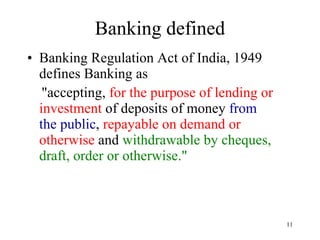
Banking defined Banking Regulation Act of India, 1949 defines Banking as "accepting,  for the purpose of lending or investment  of deposits of money  from the public ,  repayable on demand or otherwise  and  withdrawable by cheques, draft, order or otherwise."
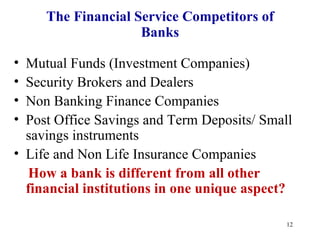
The Financial Service Competitors of Banks Mutual Funds (Investment Companies) Security Brokers and Dealers Non Banking Finance Companies Post Office Savings and Term Deposits/ Small savings instruments Life and Non Life Insurance Companies How a bank is different from all other financial institutions in one unique aspect?
Various Kinds of Banking/ Banks  Scheduled Banks  Non Scheduled Banks included in the Second Schedule of Reserve Bank of  India(RBI) Act, 1934, which satisfy the criteria laid down  vide section 42 (6) (a) of the Act.
Based of different Principles and goals Commercial Banking  Co-operative Banking Development Banking  Investment /Merchant  Banking Commercial Banks  are functioning on commercial basis with profit motive
The co-operative banking   to the supplement the village money lender.  Divided into 4 components Based on principle of co-operation State Co-operative Banks   Central Co-operative Banks  Primary Agriculture Credit Societies  State Land Development Banks  Land Development Banks  Primary Land Development Banks  Primary Agricultural Development Banks  Urban Co-operative Banks
DEVELOPMENT BANKING Development of some specific sectors of economy Industrial Finance Corporation of India (IFCI)  Industrial Development Bank of India (IDBI)  Industrial Credit and Investment Corporation of India  (ICICI)  Industrial Investment Bank of India (IIBI)  Small Industries Development Bank of India (SIDBI)  National Bank for Agriculture and Rural Development  (NABARD)  Export Import Bank of India  National Housing Bank
Independent investment banks Merill Lynch Morgan Stanley
Commercial Banking Based on Geography , delivery channel Branch Banking  Virtual Banking Internet Banking  Mobile Banking
Virtual Banking  First fully virtual bank -mBank (POLAND)  "Internet banking services are increasingly popular. Even though virtual banks began operating in Poland only a few years ago, they have already enlisted way over half a million clients between them. Another fully virtual bank in Poland is Inteligo,  which started operations in May 2001
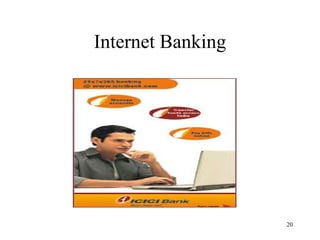
Internet Banking
Narrow Banking Banking for limited purposes/ Restricted banking Commercial Banking activities alone  – no investment banking, Advisory, consulting etc Accepting of deposits alone and no  Loaning – Moratorium / weak banks
Universal Banking provides entire range of financial  services
Citi Group– a universal bank Fifteen years ago, when Kundapur Vaman Kamath, the CEO of ICICI Bank,spoke about his ambitions to make his bank (then called just ICICI) a universal bank, selling every conceivable financial product, he created flutter.  Financial sector reforms in India had just kicked in, but even the biggest players in financial services were confined to neatly fenced territories.  Was Kamath ahead of his time?
ICICI Bank functions as a universal bank through itself and its associate companies in the areas of corporate finance,  commercial banking,  investment banking,  asset management,  non-banking finance,  investor services,  broking and insurance.
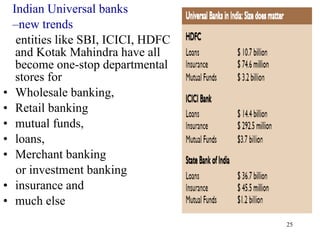
Indian Universal banks   – new trends entities like SBI, ICICI, HDFC and Kotak Mahindra have all become one-stop departmental stores for Wholesale banking, Retail banking mutual funds,  loans,  Merchant banking  or investment banking insurance and  much else
Financial conglomerates Large financial services conglomerates that combine commercial banking and investment banking, and sometimes insurance   and all other financial services  Citigroup HSBC ABN Amro Allianz (Dresdner Kleinwort)  Bank of America (Banc of America Securities)  BNP Paribas  Barclays
Central Banks are non-commercial bodies or government agencies often charged with  controlling interest rates  and money supply  across the whole economy.  They act as  lenders of the last resort   in event of a crisis of liquidity with any banks or all b anks
Retail banking  Wholesale banking
Retail Banking   is typically a  mass market banking  where individual customers use local branches of larger commercial banks.  It is segment of commercial banking. Liabilities Wealth  Management Assets Fee Based Personal Loans Credit Cards Mortgage loans Auto  loans Checking Accounts Savings Accounts Time Deposit
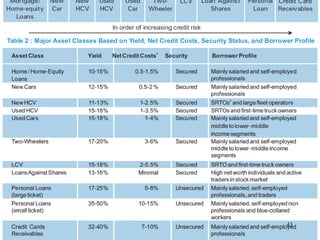
Retail Banking Loan Products: Auto Car Loans Loans against Securities Personal Loans Credit Cards 2-Wheeler Loans Commercial Vehicles Finance Home Loans Small Ticket Personal Loans Retail Business Banking Other Products / Services: POS Terminals Debit Cards Depository Accounts Mutual Fund Sales Insurance Sales Investment Advice Corporate Salary Account NRI Services Bill Payment Services Wholesale Banking Commercial Banking: Working Capital Credit Substitutes Term Loans  Bill Collection Forex & Derivatives Wholesale Deposits Letters of Credit Guarantees Key Segments : Large corporate   Supply Chain Emerging Corporates   Financial Institutions   Government   Agriculture Commodities Treasury Products: Foreign Exchange Debt Securities Derivatives  Equities Deposit Products: Savings Accounts Current Accounts Fixed Deposits Other Functions: Asset Liability Management Statutory Reserve Management Transactional Banking: Cash Management Custodial Services Clearing Bank Services  Correspondent Banking Tax Collections Banker to public issues
Business Model of Retail Banking Strategic Business Unit SBU (MBO targets) – Pvt  Banks/Foreign Banks Department approach - Majority of PSBs Integrated approach No distinction but effort to tap Retail business potential ( Earlier approach)  Indian Banks go for Positioning  platform-  one of top three among peers Foreign Banks go by business objectives  --targets for customer, business and profits Exit - BNP Paribas 1990 and existed later
What constitutes Retail Assets and Liabilities? Retail Liabilities Deposits :  1. Saving Accounts and variants,  2. Current  Accounts and variants 3. Retail Term deposits / Recurring Deposits 4. Combination Accounts  of  Savings/ Current / Term Deposits
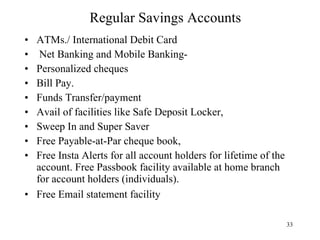
Regular Savings Accounts ATMs./ International Debit Card  Net Banking and Mobile Banking- Personalized cheques  Bill Pay.  Funds Transfer/payment Avail of facilities like Safe Deposit Locker,  Sweep In and Super Saver  Free Payable-at-Par cheque book,  Free Insta Alerts for all account holders for lifetime of the account. Free Passbook facility available at home branch for account holders (individuals).  Free Email statement facility
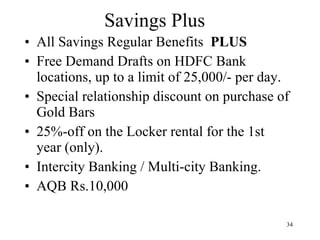
Savings Plus All Savings Regular Benefits  PLUS Free Demand Drafts on HDFC Bank locations, up to a limit of 25,000/- per day. Special relationship discount on purchase of Gold Bars 25%-off on the Locker rental for the 1st year (only). Intercity Banking / Multi-city Banking. AQB Rs.10,000
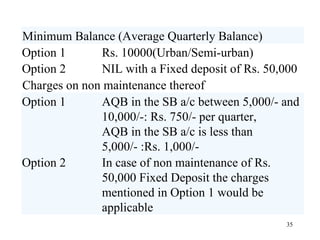
Minimum Balance (Average Quarterly Balance) Option 1 Rs. 10000(Urban/Semi-urban) Option 2 NIL with a Fixed deposit of Rs. 50,000 Charges on non maintenance thereof Option 1 AQB in the SB a/c between 5,000/- and 10,000/-: Rs. 750/- per quarter, AQB in the SB a/c is less than 5,000/- :Rs. 1,000/- Option 2 In case of non maintenance of Rs. 50,000 Fixed Deposit the charges mentioned in Option 1 would be applicable
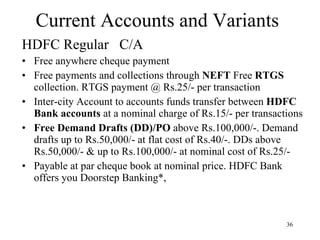
Current Accounts and Variants HDFC Regular  C/A  Free anywhere cheque payment  Free payments and collections through  NEFT  Free  RTGS  collection. RTGS payment @ Rs.25/- per transaction  Inter-city Account to accounts funds transfer between  HDFC Bank accounts  at a nominal charge of Rs.15/- per transactions Free Demand Drafts (DD)/PO  above Rs.100,000/-. Demand drafts up to Rs.50,000/- at flat cost of Rs.40/-. DDs above Rs.50,000/- & up to Rs.100,000/- at nominal cost of Rs.25/-  Payable at par cheque book at nominal price. HDFC Bank offers you Doorstep Banking*,
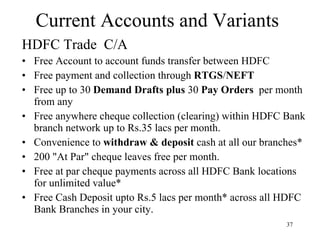
Current Accounts and Variants HDFC Trade  C/A  Free Account to account funds transfer between HDFC Free payment and collection through  RTGS / NEFT   Free up to 30  Demand Drafts plus  30  Pay Orders  per month from any  Free anywhere cheque collection (clearing) within HDFC Bank branch network up to Rs.35 lacs per month.  Convenience to  withdraw & deposit  cash at all our branches*  200 "At Par" cheque leaves free per month.  Free at par cheque payments across all HDFC Bank locations for unlimited value*  Free Cash Deposit upto Rs.5 lacs per month* across all HDFC Bank Branches in your city.
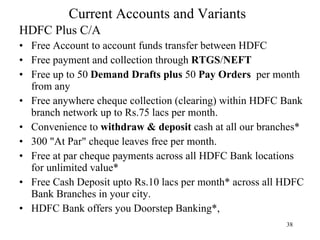
Current Accounts and Variants HDFC Plus C/A  Free Account to account funds transfer between HDFC Free payment and collection through  RTGS / NEFT   Free up to 50  Demand Drafts plus  50  Pay Orders  per month from any  Free anywhere cheque collection (clearing) within HDFC Bank branch network up to Rs.75 lacs per month.  Convenience to  withdraw & deposit  cash at all our branches*  300 "At Par" cheque leaves free per month.  Free at par cheque payments across all HDFC Bank locations for unlimited value*  Free Cash Deposit upto Rs.10 lacs per month* across all HDFC Bank Branches in your city.  HDFC Bank offers you Doorstep Banking*,
Flexi Current Cash Deposit and Anywhere Transaction limits are a multiple of the balance you maintain(AMB)in your Current Account. Min AMB Rs. 75,000 Transaction Dynamic Free Limits*  Cash Deposit at Home Branch Location Rs. (10 times AMB) Anywhere Collections & Funds Transfer (35 times AMB)  Free RTGS/NEFT Transactions.  Free 40 Demand Drafts & Free 40 Pay Orders issued from any HDFC Bank Branch* Apex  Max
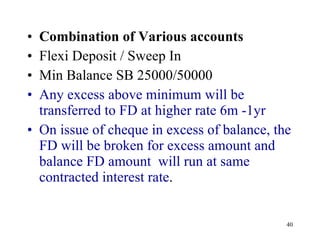
Combination of Various accounts Flexi Deposit / Sweep In Min Balance SB 25000/50000 Any excess above minimum will be transferred to FD at higher rate 6m -1yr On issue of cheque in excess of balance, the FD will be broken for excess amount and balance FD amount  will run at same contracted interest rate .
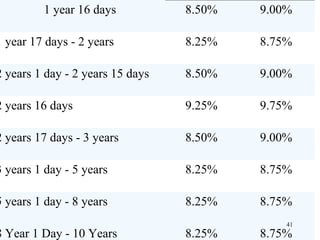
1 year 16 days 8.50% 9.00% 1 year 17 days - 2 years 8.25% 8.75% 2 years 1 day - 2 years 15 days 8.50% 9.00% 2 years 16 days 9.25% 9.75% 2 years 17 days - 3 years 8.50% 9.00% 3 years 1 day - 5 years 8.25% 8.75% 5 years 1 day - 8 years 8.25% 8.75% 8 Year 1 Day - 10 Years 8.25% 8.75%
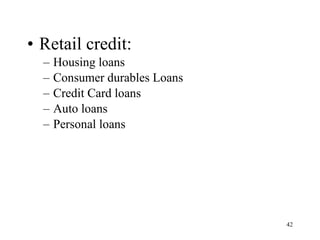
Retail credit: Housing loans Consumer durables Loans Credit Card loans Auto loans Personal loans
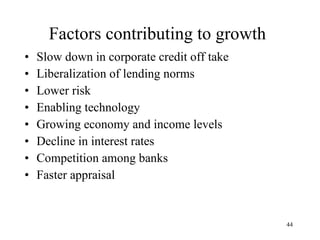
Factors contributing to growth Slow down in corporate credit off take Liberalization of lending norms Lower risk Enabling technology Growing economy and income levels Decline in interest rates Competition among banks Faster appraisal
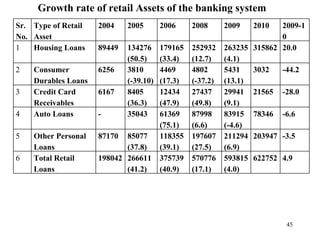
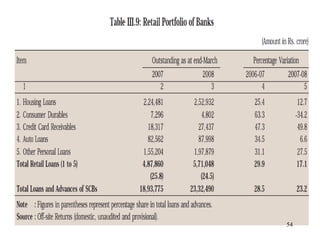
Growth rate of retail Assets of the banking system   Sr. No. Type of Retail Asset 2004 2005 2006 2008 2009 2010 2009-10 1 Housing Loans 89449 134276 (50.5) 179165 (33.4) 252932 (12.7) 263235 (4.1) 315862 20.0 2 Consumer Durables Loans 6256 3810 (-39.10) 4469 (17.3) 4802 (-37.2) 5431 (13.1) 3032 -44.2 3 Credit Card Receivables 6167 8405 (36.3) 12434 (47.9) 27437 (49.8) 29941 (9.1) 21565 -28.0 4 Auto Loans - 35043 61369 (75.1) 87998 (6.6) 83915 (-4.6) 78346 -6.6 5 Other Personal Loans 87170 85077 (37.8) 118355 (39.1) 197607 (27.5) 211294 (6.9) 203947 -3.5 6 Total Retail Loans 198042 266611 (41.2) 375739 (40.9) 570776 (17.1) 593815 (4.0) 622752 4.9
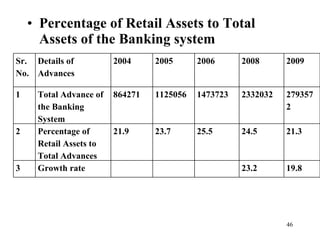
Percentage of Retail Assets to Total Assets of the Banking system Sr. No. Details of Advances 2004 2005 2006 2008 2009 1 Total Advance of the Banking System 864271 1125056 1473723 2332032 2793572 2 Percentage of Retail Assets to Total Advances 21.9 23.7 25.5 24.5 21.3 3 Growth rate 23.2 19.8
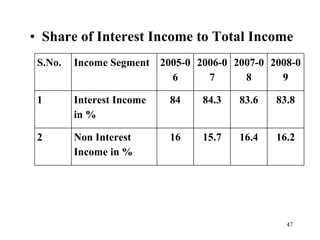
Share of Interest Income to Total Income S.No. Income Segment 2005-06 2006-07 2007-08 2008-09 1 Interest Income in % 84 84.3 83.6 83.8 2 Non Interest Income in % 16 15.7 16.4 16.2
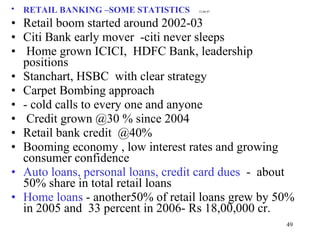
RETAIL BANKING –SOME STATISTICS   12.06.07   Retail boom started around 2002-03 Citi Bank early mover  -citi never sleeps Home grown ICICI,  HDFC Bank, leadership positions  Stanchart, HSBC  with clear strategy  Carpet Bombing approach - cold calls to every one and anyone  Credit grown @30 % since 2004 Retail bank credit  @40% Booming economy , low interest rates and growing consumer confidence Auto loans, personal loans, credit card dues   -  about 50% share in total retail loans Home loans  - another50% of retail loans grew by 50% in 2005 and  33 percent in 2006- Rs 18,00,000 cr.
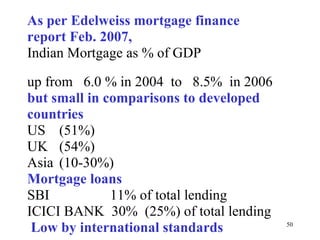
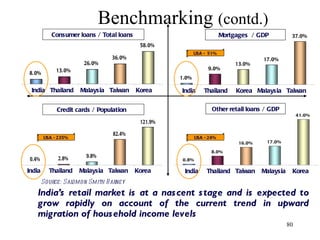
As per Edelweiss mortgage finance  report   Feb. 2007, Indian Mortgage as % of GDP  up from  6.0 % in 2004  to  8.5%  in 2006  but small in comparisons to developed  countries US  (51%)  UK  (54%) Asia  (10-30%) Mortgage loans SBI  11% of total lending ICICI BANK  30%  (25%) of total lending Low by international standards
Trends – Recent past – 2004-05 Banks are increasing their dominance in housing finance and capturing the market share of the housing finance companies.  During 2004-05, the market share of banks stood at 62%, against the 33% by Housing finance companies;  Despite this phenomenal growth in India, the housing loan as a percentage of GDP at 4.91% indicates low penetration when compared to other countries like Malaysia (17%) and Thailand (9%).
Trends – Recent past – 2004-05 Retail lending constitutes just 12.36% of the Indian banking system.  Given this macroeconomic scenario, the share of retail banking will grow dramatically and it is expected that about 35% of the incremental growth in net credit will come from retail banking.  In the next five years ie till 2010, retail banking is expected to grow by a CAGR of 25% to touch the figure of Rs575,000 crore.
Trends – Recent past – 2004-05 During 2004-05 retail contributed 42% of overall credit growth.  Growing at the CAGR of 35% over last 5 years the retail asset size touched Rs1,89,000 crore.
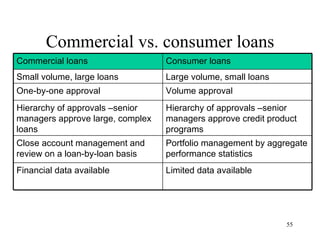
Commercial vs. consumer loans Commercial loans Consumer loans Small volume, large loans Large volume, small loans One-by-one approval  Volume approval Hierarchy of approvals –senior managers approve large, complex loans Hierarchy of approvals –senior managers approve credit product programs Close account management and review on a loan-by-loan basis Portfolio management by aggregate performance statistics Financial data available Limited data available
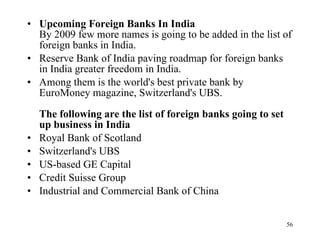
Upcoming Foreign Banks In India   By 2009 few more names is going to be added in the list of foreign banks in India.  Reserve Bank of India paving roadmap for foreign banks in India greater freedom in India.  Among them is the world's best private bank by EuroMoney magazine, Switzerland's UBS.  The following are the list of foreign banks going to set up business in India   Royal Bank of Scotland  Switzerland's UBS  US-based GE Capital  Credit Suisse Group  Industrial and Commercial Bank of China
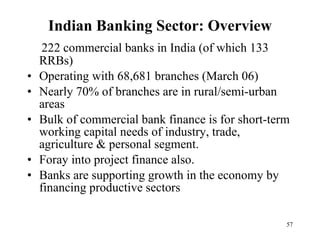
Indian Banking Sector: Overview 222 commercial banks in India (of which 133 RRBs) Operating with 68,681 branches (March 06) Nearly 70% of branches are in rural/semi-urban areas Bulk of commercial bank finance is for short-term working capital needs of industry, trade, agriculture & personal segment.  Foray into project finance also. Banks are supporting growth in the economy by financing productive sectors
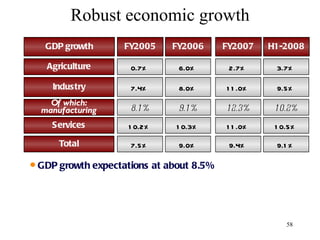
Robust economic growth Agriculture FY2005 0.7% Industry 7.4% Of which: manufacturing 8.1% Services 10.2% GDP growth GDP growth expectations at about 8.5% Total 7.5% FY2006 6.0% 8.0% 9.1% 10.3% 9.0% FY2007 2.7% 11.0% 12.3% 11.0% 9.4% H1-2008 3.7% 9.5% 10.2% 10.5% 9.1%
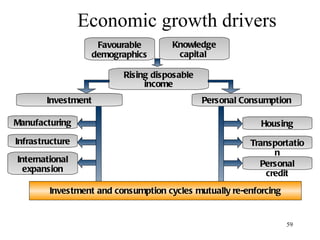
Economic growth drivers Favourable demographics Manufacturing Infrastructure Knowledge capital  International expansion Rising disposable income Investment Personal Consumption Housing Transportation Personal credit Investment and consumption cycles mutually re-enforcing
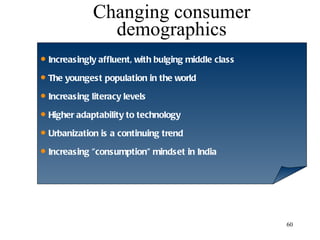
Changing consumer demographics Increasingly affluent, with bulging middle class  The youngest population in the world Increasing literacy levels Higher adaptability to technology Urbanization is a continuing trend Increasing "consumption" mindset in India
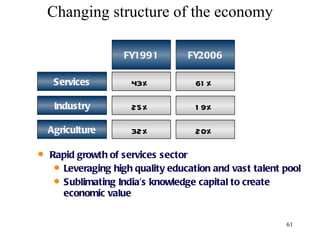
Changing structure of the economy FY1991 FY2006 Services Industry Agriculture 43% 61% 25% 32% 19% 20% Rapid growth of services sector Leveraging high quality education and vast talent pool Sublimating India’s knowledge capital to create economic value
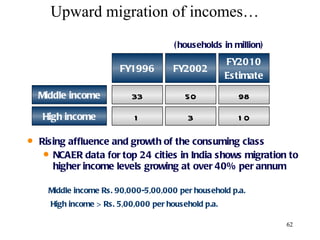
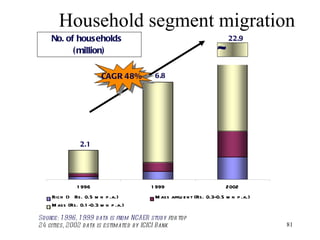
Upward migration of incomes… FY1996 FY2002 Middle income High income 33 50 1 3 Rising affluence and growth of the consuming class NCAER data for top 24 cities in India shows migration to higher income levels growing at over 40% per annum FY2010 Estimate 98 10 (households in million) Middle income Rs. 90,000-5,00,000 per household p.a. High income > Rs. 5,00,000 per household p.a.
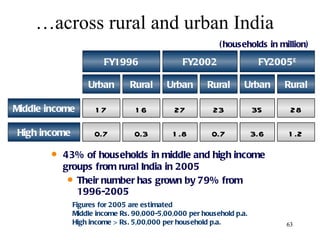
… across rural and urban India FY1996 FY2002 17 16 0.7 0.3 27 1.8 (households in million) 23 0.7 Urban Rural Urban Rural 43% of households in middle and high income groups from rural India in 2005 Their number has grown by 79% from 1996-2005 High income Middle income Figures for 2005 are estimated Middle income Rs. 90,000-5,00,000 per household p.a. High income > Rs. 5,00,000 per household p.a.  FY2005 E 35 3.6 28 1.2 Urban Rural
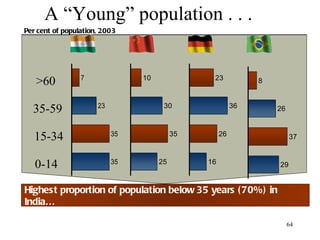
A “Young” population . . .  Highest proportion of population below 35 years (70%) in India Per cent of population, 2003 >60 35-59 15-34 0-14 Highest proportion of population below 35 years (70%) in India …
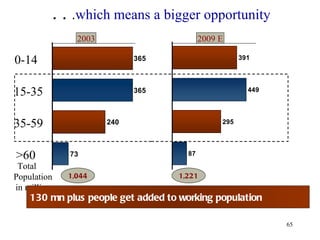
. .  . which means a bigger opportunity 0-14 15-35 35-59 >60 2003 2009 E Total Population in million 1,044 1,221 130 mn plus people get added to working population
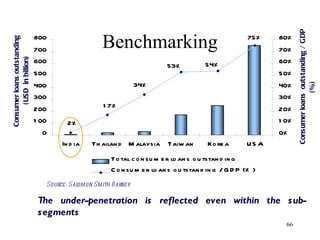
Benchmarking The under-penetration is reflected even within the sub-segments Consumer loans outstanding  (USD  in billion) Consumer loans  outstanding / GDP (%) Source: Salomon Smith Barney
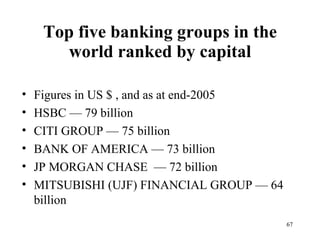
Top five banking groups in the world ranked by capital Figures in US $ , and as at end-2005 HSBC — 79 billion  CITI GROUP — 75 billion  BANK OF AMERICA — 73 billion  JP MORGAN CHASE  — 72 billion  MITSUBISHI (UJF) FINANCIAL GROUP — 64 billion
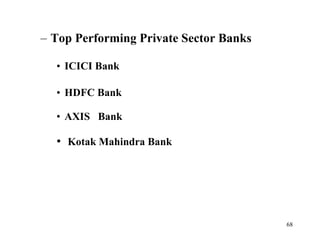
Top Performing Private Sector Banks ICICI Bank HDFC Bank AXIS  Bank Kotak Mahindra Bank
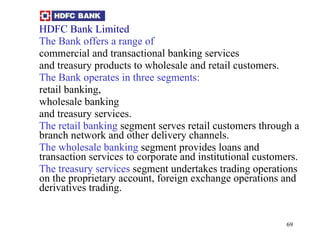
HDFC Bank Limited   The Bank offers a range of commercial and transactional banking services  and treasury products to wholesale and retail customers.  The Bank operates in three segments: retail banking, wholesale banking  and treasury services.  The retail banking  segment serves retail customers through a branch network and other delivery channels.  The wholesale banking  segment provides loans and transaction services to corporate and institutional customers.  The treasury services  segment undertakes trading operations on the proprietary account, foreign exchange operations and derivatives trading.
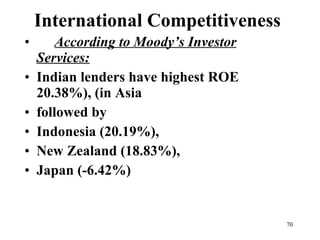
International Competitiveness According to Moody’s Investor Services: Indian lenders have highest ROE 20.38%), (in Asia  followed by Indonesia (20.19%), New Zealand (18.83%),  Japan (-6.42%)
RELATIVE STRENGTH AND RESILIENCE OF INDIAN BANKS IN ASIA   By Standard & Poor -Indian banking ahead of  China,  Indonesia,  Philippines and Vietnam. But the banking industries of Australia, New Zealand, Singapore, Hong Kong and Japan, and even Malaysia, South Korea, Taiwan and Thailand are ahead of India.
Average gross bad loans  as share of total loans: India (8.18%),  Phillipines (15.05%),  Thailand (13.08%),  China(11.80%)  and Malaysia (9.73%).
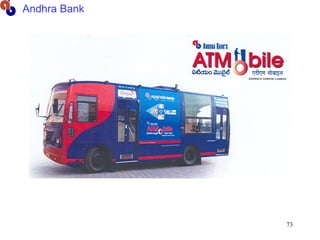
Andhra Bank
Value Added Services Insurance linked savings deposits – Abhaya, Abhaya Gold, Jeevan Abhaya, Jeevan Prakash,  Jeevan Prakash plus, Arogyadaan, AB Flex etc. offered. Bancassurance – Tied up with LIC and United Insurance companies for sale of Life and non-life products. Associated for sale of Mutual Fund products with major companies. Introduced Depository participatory services. Cash Management Service covered 84 customers in 123 branches. Turnover for the year crossed Rs.1147 Crore. Andhra Bank
Value  Added Services   (Contd..) *  Introduced 8 a.m. to 8 p.m. and 7 day Banking in select  branches  to extend  the Service hours to clientele. *  Opened  a  Representative Office in Dubai to coordinate with  NRIs  for  increasing  our  NRI  customer  base. *  Imparting training  to Agriculturists,  Rural Un- employed youth on vocational courses by our 9 Rural Development Institutes Andhra Bank
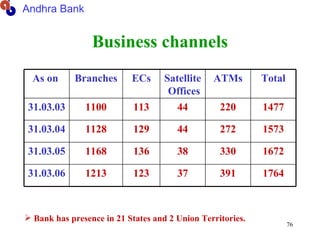
Business channels Andhra Bank Bank has presence in 21 States and 2 Union Territories. As on  Branches ECs Satellite  Offices ATMs Total 31.03.03 1100 113 44 220 1477 31.03.04 1128 129 44 272 1573 31.03.05 1168 136 38 330 1672 31.03.06 1213 123 37 391 1764
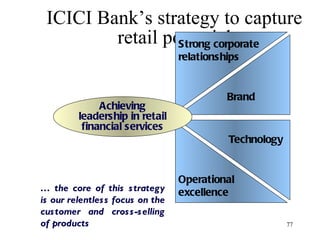
ICICI Bank’s strategy to capture retail potential Achieving leadership in retail financial services …  the core of this strategy is our relentless focus on the customer and cross-selling of products Strong corporate  relationships  Brand Technology Operational excellence
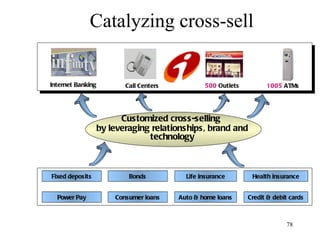
Catalyzing cross-sell Internet Banking Call Centers 500  Outlets 1005  ATMs Customized cross-selling  by leveraging relationships, brand and technology Bonds Life insurance Health insurance Fixed deposits Consumer loans Auto & home loans Credit & debit cards Power Pay
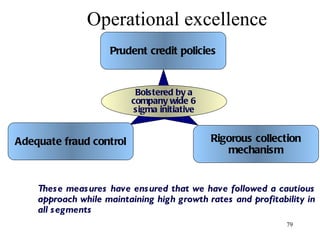
Operational excellence These measures have ensured that we have followed a cautious approach while maintaining high growth rates and profitability in all segments Prudent credit policies Adequate fraud control Rigorous collection mechanism Bolstered by a company wide 6 sigma initiative
Benchmarking  (contd.) Consumer loans / Total loans  Mortgages  / GDP  USA -  51% USA - 235% Other retail loans / GDP Credit cards / Population  USA - 24% India’s retail market is at a nascent stage and is expected to grow rapidly on account of the current trend in upward migration of household income levels Source: Salomon Smith Barney India  Thailand  Malaysia  Taiwan  Korea India  Thailand  Malaysia  Taiwan  Korea India  Thailand  Korea  Malaysia  Taiwan India  Thailand  Taiwan  Malaysia  Korea
Household segment migration 2.1 6.8  Source: 1996, 1999 data is from NCAER study  for top 24 cities, 2002 data is estimated by ICICI Bank ~ CAGR 48% 22.9 No. of households  (million)
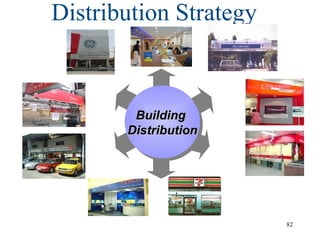
Distribution Strategy Building  Distribution
After interest rates have hardened  to 14% (floating) and 12%(fixed) in 2006-07, it has cooled the surge in retail bank loans. average tenors increased from 150 months in 2001 to 173 months in 2006.  In growth phase and competition, lending norms were eased and riskier borrowers mopped up thus possibility of higher NPAs is there. (CRISIL) ate 90s
Liberalization, economic growth, changing demographics, and technological advancements have fueled the growth of retail banking in India. The product range in retail banking includes four broad categories: liability products, asset products, credit cards/debit cards, and investment products. Liability products include savings accounts, no-frills accounts, current accounts, fixed deposit/term deposits, and recurring deposits. Asset products include all kinds of retail loans, such as housing loans, personal loans, education loans, gold loans, loans to senior citizens, property and mortgage loans, vehicle loans, and agricultural loans. The investment products include investments in mutual funds, insurance policies, and pension plans. These are discussed in subsequent chapters.
Indian Banking Sector Banking in India has its origin as early as the vedic period. It is believed that the transistion from money lending to banking must have occurred even before Manu, the great Hindu Jurist, who has devoted a section of his work to deposits and advances and laid down rules relating to rates of interest. During the Mogul period, the indegenous bankers played a very important role in lending money and financing foreign trade and commerce. During the days of the East India Company, it was the turn of the agency houses to carry on the banking business. The General Bank of India was the first Joint Stock Bank to be established in the year 1786. The others which followed were the Bank of Hindustan and the Bengal Bank. The Bank of Hindustan is reported to have continued till 1906 while the other two failed in the meantime. In the first half of the 19th century the East India Company established three banks; the Bank of Bengal in 1809, the Bank of Bombay in 1840 and the Bank of Madras in 1843. These three banks also known as Presidency Banks, were independent units and functioned well. These three banks were amalgamated in 1920 and a new bank, the Imperial Bank of India was established on 27th January 1921. With the passing of the State Bank of India Act in 1955 the undertaking of the Imperial Bank of India was taken over by the newly constituted State Bank of India. The Reserve Bank which is the Central Bank was created in 1935 by passing Reserve Bank of India Act 1934. In the wake of the Swadeshi Movement, a number of banks with Indian management were established in the country namely, Punjab National Bank Ltd, Bank of India Ltd, Canara Bank Ltd, Indian Bank Ltd, the Bank of Baroda Ltd, the Central Bank of India Ltd. On July 19, 1969, 14 major banks of the country were nationalised and in 15th April 1980 six more commercial private sector banks were also taken over by the government. Today the commercial banking system in India may be distinguished into :
As the bargaining power of a retail customer is less than that of a corporate customer, banks tend to charge the same price/interest rate for all retail customers, with the exception of high-value segments (HNIs and NRIs).  Banks set the price for liability products, without the interference of the RBI.  Asset products are priced based on the prime lending rates set by banks for each asset category. Overt pricing and covert pricing are the two different approaches to pricing.
The promotion of retail banking products is done through various avenues of promotion, such as advertising, sales promotion, personal selling, brand building, public relations, telemarketing, direct sales, and direct-response advertising.  The common distribution channels in retail banking are branches, ATMs, the Internet, phone banking, and mobile banking, EFTPOS, direct selling agents (DSAs), call centers, and distribution network of alliance partners. There are some overlaps between the promotional avenues and distribution channels. For example, telemarketing and personal selling may be outsourced to DSAs.  Cross-selling helps the banks to increase their sales by selling different products to existing clients. It helps improve customer retention, reduce the cost of customer acquisition, and enhance customer lifetime profitability. Cross-selling also helps the customers in terms of reduced prices, faster and easier processing, and customized products. However, excessive cross-selling would be viewed by the customer as harassment.
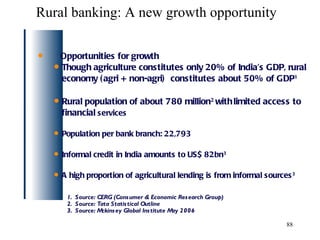
Rural banking: A new growth opportunity Source: CERG (Consumer & Economic Research Group) Source: Tata Statistical Outline Source: Mckinsey Global Institute May 2006 Opportunities for growth Though agriculture constitutes only 20% of India’s GDP, rural economy (agri + non-agri)  constitutes about 50% of GDP 1 Rural population of about 780 million 2  with   limited access to financial  services Population per bank branch: 22,793 Informal credit in India amounts to US$ 82bn 3 A high proportion of agricultural lending is from informal sources 3
Special needs Doorstep banking Flexibility in timings Low value and high volume of transactions Limited background information and proof of income Require simple processes with minimum documentation However, banking in rural India is challenging …
Conventional banking not suited to meet these demands High costs of delivery through traditional channels High transaction costs Dependence on documentation and financial history Inflexible procedures
… and requires a comprehensive approach Multiple products Low-income customers require full range of services: credit, transaction banking, investment and risk mitigation Multiple channels Branches at selected locations Franchisees, internet kiosks, MFI partners Deep penetration of the market Using a combination of channels to completely cover selected areas Rapid-scale up To reduce average operating costs
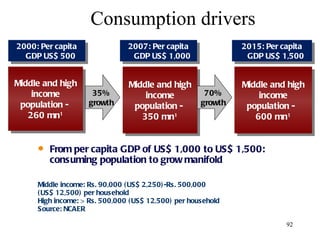
Consumption drivers Middle income: Rs. 90,000 (US$ 2,250)-Rs. 500,000  (US$ 12,500) per household High income: > Rs. 500,000 (US$ 12,500) per household Source: NCAER  Middle and high income population -  260 mn 1 Middle and high income population -  350 mn 1 2000: Per capita GDP US$ 500 2007: Per capita GDP US$ 1,000 35% growth From per capita GDP of US$ 1,000 to US$ 1,500: consuming population to grow manifold Middle and high income population -  600 mn 1 2015: Per capita GDP US$ 1,500 70% growth
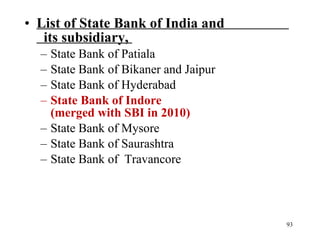
List of State Bank of India and  its subsidiary,  State Bank of Patiala State Bank of Bikaner and Jaipur State Bank of Hyderabad State Bank of Indore  (merged with SBI in 2010) State Bank of Mysore State Bank of Saurashtra State Bank of  Travancore
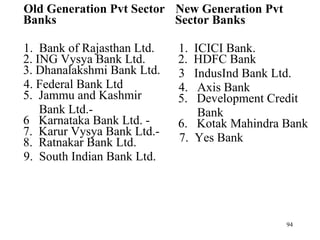
Old Generation Pvt Sector Banks  1.  Bank of Rajasthan Ltd.  2. ING Vysya Bank Ltd.  3. Dhanalakshmi Bank Ltd.  4. Federal Bank Ltd  5.  Jammu and Kashmir  Bank Ltd.-  6  Karnataka Bank Ltd. -  7.  Karur Vysya Bank Ltd.-  8.  Ratnakar Bank Ltd.  9.  South Indian Bank Ltd. New Generation Pvt Sector Banks  1.  ICICI Bank.   2.  HDFC Bank 3  IndusInd Bank Ltd. 4.  Axis Bank   5.  Development Credit  Bank   6.  Kotak Mahindra Bank  7.  Yes Bank
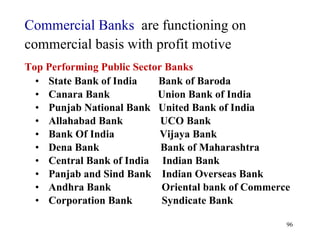
Commercial Banks  are functioning on commercial basis with profit motive   Top Performing Public Sector Banks State Bank of India  Bank of Baroda Canara Bank  Union Bank of India Punjab National Bank  United Bank of India Allahabad Bank  UCO Bank Bank Of India  Vijaya Bank Dena Bank  Bank of Maharashtra Central Bank of India  Indian Bank Panjab and Sind Bank  Indian Overseas Bank Andhra Bank  Oriental bank of Commerce  Corporation Bank  Syndicate Bank

02 iintroduction to retail banking 2011

  • 1.
  • 2.
    A few thingsMBA student must know
  • 3.
    Two types ofstudents Type A MBA nahin to kuchh nahin Type B Kuchh Nahin to MBA Identify your type Have you ever thought? Why PG degree from a university gets one low paid job and PG in Business Management gets one a high paid job ?
  • 4.
    What extrado you learn in a B school? Knowledge of all functional areas , management practices, processes, risks and risk management tools and techniques of business Develop skills to be a team player and a team leader to manage processes to analyze situations, to make decisions to communicate to make presentations Develop right attitudes to be a successful manager
  • 5.
    Knowledge information about a subject obtained by experience or study When applied, Gets converted into  Skill A special ability to do something possessed by an individual – it is personal possession Over the years of experience Becomes  Competency Becomes very valuable ( given the right attitude)
  • 6.
    It is OUR ATTITUDE towards Life and Work that makes OUR Life 100% ! ! ! Attitude Feeling or opinion about something or someone or a way of behaving that follows from this feeling or opinion
  • 7.
    Why do somepeople seem to reach the top of the corporate ladder easily, while others remain stuck on the middle-management rung? Dr. Martin Seligman, an authority on optimism discovered that attitude was a better predictor of success than I.Q., education and most other factors . Some positive attitudes Life is so wonderful. I have ambition in life. I will make it to the top, and I am in charge of making it happen. (auto suggestion to computer in brain ) Hard work comes first, luck comes later. I think I can. (Confidence) I will Come forward to Go forward My opportunity monitor is never turned off.
  • 8.
    Have you everwondered why all same IIM batch mates are not equally successful? Why all the batch mates of a programme get 20 different placement packages? All have same degree and also look so much alike with two hands, two legs, two eyes , two ears, one nose, one head etc etc But every one differs in What they have imbibed, internalized in mind C What skills they have developed and how much C What attitudes they have in mind? C How much they are networked? PC How much they are lucky? NC Bottomline Forget what you can not control, Do whatever is under your control.
  • 9.
  • 10.
    Commercial Banks PublicSectors Banks/SBI/Assoc. (25) Private Sector Banks (25 Old, 8 New) Foreign Banks (44) Investment Institutions -UTI -LIC -GIC Financial Institutions IDBI ICICI IFCI NHB NABARD Non -Banking Financial Companies (641) State Level Financial Corporations/ Industrial Development Corporations (SFCs – 18) (SIDCs – 28) Co-operative Banks (95,000 ) Indian Financial Sector Reserve Bank of India (Central Bank) Exim Bank
  • 11.
    Banking defined BankingRegulation Act of India, 1949 defines Banking as "accepting, for the purpose of lending or investment of deposits of money from the public , repayable on demand or otherwise and withdrawable by cheques, draft, order or otherwise."
  • 12.
    The Financial ServiceCompetitors of Banks Mutual Funds (Investment Companies) Security Brokers and Dealers Non Banking Finance Companies Post Office Savings and Term Deposits/ Small savings instruments Life and Non Life Insurance Companies How a bank is different from all other financial institutions in one unique aspect?
  • 13.
    Various Kinds ofBanking/ Banks Scheduled Banks Non Scheduled Banks included in the Second Schedule of Reserve Bank of India(RBI) Act, 1934, which satisfy the criteria laid down vide section 42 (6) (a) of the Act.
  • 14.
    Based of differentPrinciples and goals Commercial Banking Co-operative Banking Development Banking Investment /Merchant Banking Commercial Banks are functioning on commercial basis with profit motive
  • 15.
    The co-operative banking to the supplement the village money lender. Divided into 4 components Based on principle of co-operation State Co-operative Banks Central Co-operative Banks Primary Agriculture Credit Societies State Land Development Banks Land Development Banks Primary Land Development Banks Primary Agricultural Development Banks Urban Co-operative Banks
  • 16.
    DEVELOPMENT BANKING Developmentof some specific sectors of economy Industrial Finance Corporation of India (IFCI) Industrial Development Bank of India (IDBI) Industrial Credit and Investment Corporation of India (ICICI) Industrial Investment Bank of India (IIBI) Small Industries Development Bank of India (SIDBI) National Bank for Agriculture and Rural Development (NABARD) Export Import Bank of India National Housing Bank
  • 17.
    Independent investment banksMerill Lynch Morgan Stanley
  • 18.
    Commercial Banking Basedon Geography , delivery channel Branch Banking Virtual Banking Internet Banking Mobile Banking
  • 19.
    Virtual Banking First fully virtual bank -mBank (POLAND) "Internet banking services are increasingly popular. Even though virtual banks began operating in Poland only a few years ago, they have already enlisted way over half a million clients between them. Another fully virtual bank in Poland is Inteligo, which started operations in May 2001
  • 20.
  • 21.
    Narrow Banking Bankingfor limited purposes/ Restricted banking Commercial Banking activities alone – no investment banking, Advisory, consulting etc Accepting of deposits alone and no Loaning – Moratorium / weak banks
  • 22.
    Universal Banking providesentire range of financial services
  • 23.
    Citi Group– auniversal bank Fifteen years ago, when Kundapur Vaman Kamath, the CEO of ICICI Bank,spoke about his ambitions to make his bank (then called just ICICI) a universal bank, selling every conceivable financial product, he created flutter. Financial sector reforms in India had just kicked in, but even the biggest players in financial services were confined to neatly fenced territories. Was Kamath ahead of his time?
  • 24.
    ICICI Bank functionsas a universal bank through itself and its associate companies in the areas of corporate finance, commercial banking, investment banking, asset management, non-banking finance, investor services, broking and insurance.
  • 25.
    Indian Universal banks – new trends entities like SBI, ICICI, HDFC and Kotak Mahindra have all become one-stop departmental stores for Wholesale banking, Retail banking mutual funds, loans, Merchant banking or investment banking insurance and much else
  • 26.
    Financial conglomerates Largefinancial services conglomerates that combine commercial banking and investment banking, and sometimes insurance and all other financial services Citigroup HSBC ABN Amro Allianz (Dresdner Kleinwort) Bank of America (Banc of America Securities) BNP Paribas Barclays
  • 27.
    Central Banks arenon-commercial bodies or government agencies often charged with controlling interest rates and money supply across the whole economy. They act as lenders of the last resort in event of a crisis of liquidity with any banks or all b anks
  • 28.
    Retail banking Wholesale banking
  • 29.
    Retail Banking is typically a mass market banking where individual customers use local branches of larger commercial banks. It is segment of commercial banking. Liabilities Wealth Management Assets Fee Based Personal Loans Credit Cards Mortgage loans Auto loans Checking Accounts Savings Accounts Time Deposit
  • 30.
    Retail Banking LoanProducts: Auto Car Loans Loans against Securities Personal Loans Credit Cards 2-Wheeler Loans Commercial Vehicles Finance Home Loans Small Ticket Personal Loans Retail Business Banking Other Products / Services: POS Terminals Debit Cards Depository Accounts Mutual Fund Sales Insurance Sales Investment Advice Corporate Salary Account NRI Services Bill Payment Services Wholesale Banking Commercial Banking: Working Capital Credit Substitutes Term Loans Bill Collection Forex & Derivatives Wholesale Deposits Letters of Credit Guarantees Key Segments : Large corporate Supply Chain Emerging Corporates Financial Institutions Government Agriculture Commodities Treasury Products: Foreign Exchange Debt Securities Derivatives Equities Deposit Products: Savings Accounts Current Accounts Fixed Deposits Other Functions: Asset Liability Management Statutory Reserve Management Transactional Banking: Cash Management Custodial Services Clearing Bank Services Correspondent Banking Tax Collections Banker to public issues
  • 31.
    Business Model ofRetail Banking Strategic Business Unit SBU (MBO targets) – Pvt Banks/Foreign Banks Department approach - Majority of PSBs Integrated approach No distinction but effort to tap Retail business potential ( Earlier approach) Indian Banks go for Positioning platform- one of top three among peers Foreign Banks go by business objectives --targets for customer, business and profits Exit - BNP Paribas 1990 and existed later
  • 32.
    What constitutes RetailAssets and Liabilities? Retail Liabilities Deposits : 1. Saving Accounts and variants, 2. Current Accounts and variants 3. Retail Term deposits / Recurring Deposits 4. Combination Accounts of Savings/ Current / Term Deposits
  • 33.
    Regular Savings AccountsATMs./ International Debit Card Net Banking and Mobile Banking- Personalized cheques Bill Pay. Funds Transfer/payment Avail of facilities like Safe Deposit Locker, Sweep In and Super Saver Free Payable-at-Par cheque book, Free Insta Alerts for all account holders for lifetime of the account. Free Passbook facility available at home branch for account holders (individuals). Free Email statement facility
  • 34.
    Savings Plus AllSavings Regular Benefits PLUS Free Demand Drafts on HDFC Bank locations, up to a limit of 25,000/- per day. Special relationship discount on purchase of Gold Bars 25%-off on the Locker rental for the 1st year (only). Intercity Banking / Multi-city Banking. AQB Rs.10,000
  • 35.
    Minimum Balance (AverageQuarterly Balance) Option 1 Rs. 10000(Urban/Semi-urban) Option 2 NIL with a Fixed deposit of Rs. 50,000 Charges on non maintenance thereof Option 1 AQB in the SB a/c between 5,000/- and 10,000/-: Rs. 750/- per quarter, AQB in the SB a/c is less than 5,000/- :Rs. 1,000/- Option 2 In case of non maintenance of Rs. 50,000 Fixed Deposit the charges mentioned in Option 1 would be applicable
  • 36.
    Current Accounts andVariants HDFC Regular C/A Free anywhere cheque payment Free payments and collections through NEFT Free RTGS collection. RTGS payment @ Rs.25/- per transaction Inter-city Account to accounts funds transfer between HDFC Bank accounts at a nominal charge of Rs.15/- per transactions Free Demand Drafts (DD)/PO above Rs.100,000/-. Demand drafts up to Rs.50,000/- at flat cost of Rs.40/-. DDs above Rs.50,000/- & up to Rs.100,000/- at nominal cost of Rs.25/- Payable at par cheque book at nominal price. HDFC Bank offers you Doorstep Banking*,
  • 37.
    Current Accounts andVariants HDFC Trade C/A Free Account to account funds transfer between HDFC Free payment and collection through RTGS / NEFT Free up to 30 Demand Drafts plus 30 Pay Orders per month from any Free anywhere cheque collection (clearing) within HDFC Bank branch network up to Rs.35 lacs per month. Convenience to withdraw & deposit cash at all our branches* 200 "At Par" cheque leaves free per month. Free at par cheque payments across all HDFC Bank locations for unlimited value* Free Cash Deposit upto Rs.5 lacs per month* across all HDFC Bank Branches in your city.
  • 38.
    Current Accounts andVariants HDFC Plus C/A Free Account to account funds transfer between HDFC Free payment and collection through RTGS / NEFT Free up to 50 Demand Drafts plus 50 Pay Orders per month from any Free anywhere cheque collection (clearing) within HDFC Bank branch network up to Rs.75 lacs per month. Convenience to withdraw & deposit cash at all our branches* 300 "At Par" cheque leaves free per month. Free at par cheque payments across all HDFC Bank locations for unlimited value* Free Cash Deposit upto Rs.10 lacs per month* across all HDFC Bank Branches in your city. HDFC Bank offers you Doorstep Banking*,
  • 39.
    Flexi Current CashDeposit and Anywhere Transaction limits are a multiple of the balance you maintain(AMB)in your Current Account. Min AMB Rs. 75,000 Transaction Dynamic Free Limits* Cash Deposit at Home Branch Location Rs. (10 times AMB) Anywhere Collections & Funds Transfer (35 times AMB) Free RTGS/NEFT Transactions. Free 40 Demand Drafts & Free 40 Pay Orders issued from any HDFC Bank Branch* Apex Max
  • 40.
    Combination of Variousaccounts Flexi Deposit / Sweep In Min Balance SB 25000/50000 Any excess above minimum will be transferred to FD at higher rate 6m -1yr On issue of cheque in excess of balance, the FD will be broken for excess amount and balance FD amount will run at same contracted interest rate .
  • 41.
    1 year 16days 8.50% 9.00% 1 year 17 days - 2 years 8.25% 8.75% 2 years 1 day - 2 years 15 days 8.50% 9.00% 2 years 16 days 9.25% 9.75% 2 years 17 days - 3 years 8.50% 9.00% 3 years 1 day - 5 years 8.25% 8.75% 5 years 1 day - 8 years 8.25% 8.75% 8 Year 1 Day - 10 Years 8.25% 8.75%
  • 42.
    Retail credit: Housingloans Consumer durables Loans Credit Card loans Auto loans Personal loans
  • 44.
    Factors contributing togrowth Slow down in corporate credit off take Liberalization of lending norms Lower risk Enabling technology Growing economy and income levels Decline in interest rates Competition among banks Faster appraisal
  • 45.
    Growth rate ofretail Assets of the banking system   Sr. No. Type of Retail Asset 2004 2005 2006 2008 2009 2010 2009-10 1 Housing Loans 89449 134276 (50.5) 179165 (33.4) 252932 (12.7) 263235 (4.1) 315862 20.0 2 Consumer Durables Loans 6256 3810 (-39.10) 4469 (17.3) 4802 (-37.2) 5431 (13.1) 3032 -44.2 3 Credit Card Receivables 6167 8405 (36.3) 12434 (47.9) 27437 (49.8) 29941 (9.1) 21565 -28.0 4 Auto Loans - 35043 61369 (75.1) 87998 (6.6) 83915 (-4.6) 78346 -6.6 5 Other Personal Loans 87170 85077 (37.8) 118355 (39.1) 197607 (27.5) 211294 (6.9) 203947 -3.5 6 Total Retail Loans 198042 266611 (41.2) 375739 (40.9) 570776 (17.1) 593815 (4.0) 622752 4.9
  • 46.
    Percentage of RetailAssets to Total Assets of the Banking system Sr. No. Details of Advances 2004 2005 2006 2008 2009 1 Total Advance of the Banking System 864271 1125056 1473723 2332032 2793572 2 Percentage of Retail Assets to Total Advances 21.9 23.7 25.5 24.5 21.3 3 Growth rate 23.2 19.8
  • 47.
    Share of InterestIncome to Total Income S.No. Income Segment 2005-06 2006-07 2007-08 2008-09 1 Interest Income in % 84 84.3 83.6 83.8 2 Non Interest Income in % 16 15.7 16.4 16.2
  • 49.
    RETAIL BANKING –SOMESTATISTICS 12.06.07 Retail boom started around 2002-03 Citi Bank early mover -citi never sleeps Home grown ICICI, HDFC Bank, leadership positions Stanchart, HSBC with clear strategy Carpet Bombing approach - cold calls to every one and anyone Credit grown @30 % since 2004 Retail bank credit @40% Booming economy , low interest rates and growing consumer confidence Auto loans, personal loans, credit card dues - about 50% share in total retail loans Home loans - another50% of retail loans grew by 50% in 2005 and 33 percent in 2006- Rs 18,00,000 cr.
  • 50.
    As per Edelweissmortgage finance report Feb. 2007, Indian Mortgage as % of GDP up from 6.0 % in 2004 to 8.5% in 2006 but small in comparisons to developed countries US (51%) UK (54%) Asia (10-30%) Mortgage loans SBI 11% of total lending ICICI BANK 30% (25%) of total lending Low by international standards
  • 51.
    Trends – Recentpast – 2004-05 Banks are increasing their dominance in housing finance and capturing the market share of the housing finance companies. During 2004-05, the market share of banks stood at 62%, against the 33% by Housing finance companies; Despite this phenomenal growth in India, the housing loan as a percentage of GDP at 4.91% indicates low penetration when compared to other countries like Malaysia (17%) and Thailand (9%).
  • 52.
    Trends – Recentpast – 2004-05 Retail lending constitutes just 12.36% of the Indian banking system. Given this macroeconomic scenario, the share of retail banking will grow dramatically and it is expected that about 35% of the incremental growth in net credit will come from retail banking. In the next five years ie till 2010, retail banking is expected to grow by a CAGR of 25% to touch the figure of Rs575,000 crore.
  • 53.
    Trends – Recentpast – 2004-05 During 2004-05 retail contributed 42% of overall credit growth. Growing at the CAGR of 35% over last 5 years the retail asset size touched Rs1,89,000 crore.
  • 55.
    Commercial vs. consumerloans Commercial loans Consumer loans Small volume, large loans Large volume, small loans One-by-one approval Volume approval Hierarchy of approvals –senior managers approve large, complex loans Hierarchy of approvals –senior managers approve credit product programs Close account management and review on a loan-by-loan basis Portfolio management by aggregate performance statistics Financial data available Limited data available
  • 56.
    Upcoming Foreign BanksIn India By 2009 few more names is going to be added in the list of foreign banks in India. Reserve Bank of India paving roadmap for foreign banks in India greater freedom in India. Among them is the world's best private bank by EuroMoney magazine, Switzerland's UBS. The following are the list of foreign banks going to set up business in India Royal Bank of Scotland Switzerland's UBS US-based GE Capital Credit Suisse Group Industrial and Commercial Bank of China
  • 57.
    Indian Banking Sector:Overview 222 commercial banks in India (of which 133 RRBs) Operating with 68,681 branches (March 06) Nearly 70% of branches are in rural/semi-urban areas Bulk of commercial bank finance is for short-term working capital needs of industry, trade, agriculture & personal segment. Foray into project finance also. Banks are supporting growth in the economy by financing productive sectors
  • 58.
    Robust economic growthAgriculture FY2005 0.7% Industry 7.4% Of which: manufacturing 8.1% Services 10.2% GDP growth GDP growth expectations at about 8.5% Total 7.5% FY2006 6.0% 8.0% 9.1% 10.3% 9.0% FY2007 2.7% 11.0% 12.3% 11.0% 9.4% H1-2008 3.7% 9.5% 10.2% 10.5% 9.1%
  • 59.
    Economic growth driversFavourable demographics Manufacturing Infrastructure Knowledge capital International expansion Rising disposable income Investment Personal Consumption Housing Transportation Personal credit Investment and consumption cycles mutually re-enforcing
  • 60.
    Changing consumer demographicsIncreasingly affluent, with bulging middle class The youngest population in the world Increasing literacy levels Higher adaptability to technology Urbanization is a continuing trend Increasing "consumption" mindset in India
  • 61.
    Changing structure ofthe economy FY1991 FY2006 Services Industry Agriculture 43% 61% 25% 32% 19% 20% Rapid growth of services sector Leveraging high quality education and vast talent pool Sublimating India’s knowledge capital to create economic value
  • 62.
    Upward migration ofincomes… FY1996 FY2002 Middle income High income 33 50 1 3 Rising affluence and growth of the consuming class NCAER data for top 24 cities in India shows migration to higher income levels growing at over 40% per annum FY2010 Estimate 98 10 (households in million) Middle income Rs. 90,000-5,00,000 per household p.a. High income > Rs. 5,00,000 per household p.a.
  • 63.
    … across ruraland urban India FY1996 FY2002 17 16 0.7 0.3 27 1.8 (households in million) 23 0.7 Urban Rural Urban Rural 43% of households in middle and high income groups from rural India in 2005 Their number has grown by 79% from 1996-2005 High income Middle income Figures for 2005 are estimated Middle income Rs. 90,000-5,00,000 per household p.a. High income > Rs. 5,00,000 per household p.a. FY2005 E 35 3.6 28 1.2 Urban Rural
  • 64.
    A “Young” population. . . Highest proportion of population below 35 years (70%) in India Per cent of population, 2003 >60 35-59 15-34 0-14 Highest proportion of population below 35 years (70%) in India …
  • 65.
    . . . which means a bigger opportunity 0-14 15-35 35-59 >60 2003 2009 E Total Population in million 1,044 1,221 130 mn plus people get added to working population
  • 66.
    Benchmarking The under-penetrationis reflected even within the sub-segments Consumer loans outstanding (USD in billion) Consumer loans outstanding / GDP (%) Source: Salomon Smith Barney
  • 67.
    Top five bankinggroups in the world ranked by capital Figures in US $ , and as at end-2005 HSBC — 79 billion CITI GROUP — 75 billion BANK OF AMERICA — 73 billion JP MORGAN CHASE — 72 billion MITSUBISHI (UJF) FINANCIAL GROUP — 64 billion
  • 68.
    Top Performing PrivateSector Banks ICICI Bank HDFC Bank AXIS Bank Kotak Mahindra Bank
  • 69.
    HDFC Bank Limited The Bank offers a range of commercial and transactional banking services and treasury products to wholesale and retail customers. The Bank operates in three segments: retail banking, wholesale banking and treasury services. The retail banking segment serves retail customers through a branch network and other delivery channels. The wholesale banking segment provides loans and transaction services to corporate and institutional customers. The treasury services segment undertakes trading operations on the proprietary account, foreign exchange operations and derivatives trading.
  • 70.
    International Competitiveness Accordingto Moody’s Investor Services: Indian lenders have highest ROE 20.38%), (in Asia followed by Indonesia (20.19%), New Zealand (18.83%), Japan (-6.42%)
  • 71.
    RELATIVE STRENGTH ANDRESILIENCE OF INDIAN BANKS IN ASIA By Standard & Poor -Indian banking ahead of China, Indonesia, Philippines and Vietnam. But the banking industries of Australia, New Zealand, Singapore, Hong Kong and Japan, and even Malaysia, South Korea, Taiwan and Thailand are ahead of India.
  • 72.
    Average gross badloans as share of total loans: India (8.18%), Phillipines (15.05%), Thailand (13.08%), China(11.80%) and Malaysia (9.73%).
  • 73.
  • 74.
    Value Added ServicesInsurance linked savings deposits – Abhaya, Abhaya Gold, Jeevan Abhaya, Jeevan Prakash, Jeevan Prakash plus, Arogyadaan, AB Flex etc. offered. Bancassurance – Tied up with LIC and United Insurance companies for sale of Life and non-life products. Associated for sale of Mutual Fund products with major companies. Introduced Depository participatory services. Cash Management Service covered 84 customers in 123 branches. Turnover for the year crossed Rs.1147 Crore. Andhra Bank
  • 75.
    Value AddedServices (Contd..) * Introduced 8 a.m. to 8 p.m. and 7 day Banking in select branches to extend the Service hours to clientele. * Opened a Representative Office in Dubai to coordinate with NRIs for increasing our NRI customer base. * Imparting training to Agriculturists, Rural Un- employed youth on vocational courses by our 9 Rural Development Institutes Andhra Bank
  • 76.
    Business channels AndhraBank Bank has presence in 21 States and 2 Union Territories. As on Branches ECs Satellite Offices ATMs Total 31.03.03 1100 113 44 220 1477 31.03.04 1128 129 44 272 1573 31.03.05 1168 136 38 330 1672 31.03.06 1213 123 37 391 1764
  • 77.
    ICICI Bank’s strategyto capture retail potential Achieving leadership in retail financial services … the core of this strategy is our relentless focus on the customer and cross-selling of products Strong corporate relationships Brand Technology Operational excellence
  • 78.
    Catalyzing cross-sell InternetBanking Call Centers 500 Outlets 1005 ATMs Customized cross-selling by leveraging relationships, brand and technology Bonds Life insurance Health insurance Fixed deposits Consumer loans Auto & home loans Credit & debit cards Power Pay
  • 79.
    Operational excellence Thesemeasures have ensured that we have followed a cautious approach while maintaining high growth rates and profitability in all segments Prudent credit policies Adequate fraud control Rigorous collection mechanism Bolstered by a company wide 6 sigma initiative
  • 80.
    Benchmarking (contd.)Consumer loans / Total loans Mortgages / GDP USA - 51% USA - 235% Other retail loans / GDP Credit cards / Population USA - 24% India’s retail market is at a nascent stage and is expected to grow rapidly on account of the current trend in upward migration of household income levels Source: Salomon Smith Barney India Thailand Malaysia Taiwan Korea India Thailand Malaysia Taiwan Korea India Thailand Korea Malaysia Taiwan India Thailand Taiwan Malaysia Korea
  • 81.
    Household segment migration2.1 6.8 Source: 1996, 1999 data is from NCAER study for top 24 cities, 2002 data is estimated by ICICI Bank ~ CAGR 48% 22.9 No. of households (million)
  • 82.
  • 83.
    After interest rateshave hardened to 14% (floating) and 12%(fixed) in 2006-07, it has cooled the surge in retail bank loans. average tenors increased from 150 months in 2001 to 173 months in 2006. In growth phase and competition, lending norms were eased and riskier borrowers mopped up thus possibility of higher NPAs is there. (CRISIL) ate 90s
  • 84.
    Liberalization, economic growth,changing demographics, and technological advancements have fueled the growth of retail banking in India. The product range in retail banking includes four broad categories: liability products, asset products, credit cards/debit cards, and investment products. Liability products include savings accounts, no-frills accounts, current accounts, fixed deposit/term deposits, and recurring deposits. Asset products include all kinds of retail loans, such as housing loans, personal loans, education loans, gold loans, loans to senior citizens, property and mortgage loans, vehicle loans, and agricultural loans. The investment products include investments in mutual funds, insurance policies, and pension plans. These are discussed in subsequent chapters.
  • 85.
    Indian Banking SectorBanking in India has its origin as early as the vedic period. It is believed that the transistion from money lending to banking must have occurred even before Manu, the great Hindu Jurist, who has devoted a section of his work to deposits and advances and laid down rules relating to rates of interest. During the Mogul period, the indegenous bankers played a very important role in lending money and financing foreign trade and commerce. During the days of the East India Company, it was the turn of the agency houses to carry on the banking business. The General Bank of India was the first Joint Stock Bank to be established in the year 1786. The others which followed were the Bank of Hindustan and the Bengal Bank. The Bank of Hindustan is reported to have continued till 1906 while the other two failed in the meantime. In the first half of the 19th century the East India Company established three banks; the Bank of Bengal in 1809, the Bank of Bombay in 1840 and the Bank of Madras in 1843. These three banks also known as Presidency Banks, were independent units and functioned well. These three banks were amalgamated in 1920 and a new bank, the Imperial Bank of India was established on 27th January 1921. With the passing of the State Bank of India Act in 1955 the undertaking of the Imperial Bank of India was taken over by the newly constituted State Bank of India. The Reserve Bank which is the Central Bank was created in 1935 by passing Reserve Bank of India Act 1934. In the wake of the Swadeshi Movement, a number of banks with Indian management were established in the country namely, Punjab National Bank Ltd, Bank of India Ltd, Canara Bank Ltd, Indian Bank Ltd, the Bank of Baroda Ltd, the Central Bank of India Ltd. On July 19, 1969, 14 major banks of the country were nationalised and in 15th April 1980 six more commercial private sector banks were also taken over by the government. Today the commercial banking system in India may be distinguished into :
  • 86.
    As the bargainingpower of a retail customer is less than that of a corporate customer, banks tend to charge the same price/interest rate for all retail customers, with the exception of high-value segments (HNIs and NRIs). Banks set the price for liability products, without the interference of the RBI. Asset products are priced based on the prime lending rates set by banks for each asset category. Overt pricing and covert pricing are the two different approaches to pricing.
  • 87.
    The promotion ofretail banking products is done through various avenues of promotion, such as advertising, sales promotion, personal selling, brand building, public relations, telemarketing, direct sales, and direct-response advertising. The common distribution channels in retail banking are branches, ATMs, the Internet, phone banking, and mobile banking, EFTPOS, direct selling agents (DSAs), call centers, and distribution network of alliance partners. There are some overlaps between the promotional avenues and distribution channels. For example, telemarketing and personal selling may be outsourced to DSAs. Cross-selling helps the banks to increase their sales by selling different products to existing clients. It helps improve customer retention, reduce the cost of customer acquisition, and enhance customer lifetime profitability. Cross-selling also helps the customers in terms of reduced prices, faster and easier processing, and customized products. However, excessive cross-selling would be viewed by the customer as harassment.
  • 88.
    Rural banking: Anew growth opportunity Source: CERG (Consumer & Economic Research Group) Source: Tata Statistical Outline Source: Mckinsey Global Institute May 2006 Opportunities for growth Though agriculture constitutes only 20% of India’s GDP, rural economy (agri + non-agri) constitutes about 50% of GDP 1 Rural population of about 780 million 2 with limited access to financial services Population per bank branch: 22,793 Informal credit in India amounts to US$ 82bn 3 A high proportion of agricultural lending is from informal sources 3
  • 89.
    Special needs Doorstepbanking Flexibility in timings Low value and high volume of transactions Limited background information and proof of income Require simple processes with minimum documentation However, banking in rural India is challenging …
  • 90.
    Conventional banking notsuited to meet these demands High costs of delivery through traditional channels High transaction costs Dependence on documentation and financial history Inflexible procedures
  • 91.
    … and requiresa comprehensive approach Multiple products Low-income customers require full range of services: credit, transaction banking, investment and risk mitigation Multiple channels Branches at selected locations Franchisees, internet kiosks, MFI partners Deep penetration of the market Using a combination of channels to completely cover selected areas Rapid-scale up To reduce average operating costs
  • 92.
    Consumption drivers Middleincome: Rs. 90,000 (US$ 2,250)-Rs. 500,000 (US$ 12,500) per household High income: > Rs. 500,000 (US$ 12,500) per household Source: NCAER Middle and high income population - 260 mn 1 Middle and high income population - 350 mn 1 2000: Per capita GDP US$ 500 2007: Per capita GDP US$ 1,000 35% growth From per capita GDP of US$ 1,000 to US$ 1,500: consuming population to grow manifold Middle and high income population - 600 mn 1 2015: Per capita GDP US$ 1,500 70% growth
  • 93.
    List of StateBank of India and its subsidiary, State Bank of Patiala State Bank of Bikaner and Jaipur State Bank of Hyderabad State Bank of Indore (merged with SBI in 2010) State Bank of Mysore State Bank of Saurashtra State Bank of Travancore
  • 94.
    Old Generation PvtSector Banks 1. Bank of Rajasthan Ltd. 2. ING Vysya Bank Ltd. 3. Dhanalakshmi Bank Ltd. 4. Federal Bank Ltd 5. Jammu and Kashmir Bank Ltd.- 6 Karnataka Bank Ltd. - 7. Karur Vysya Bank Ltd.- 8. Ratnakar Bank Ltd. 9. South Indian Bank Ltd. New Generation Pvt Sector Banks 1. ICICI Bank. 2. HDFC Bank 3 IndusInd Bank Ltd. 4. Axis Bank 5. Development Credit Bank 6. Kotak Mahindra Bank 7. Yes Bank
  • 96.
    Commercial Banks are functioning on commercial basis with profit motive Top Performing Public Sector Banks State Bank of India Bank of Baroda Canara Bank Union Bank of India Punjab National Bank United Bank of India Allahabad Bank UCO Bank Bank Of India Vijaya Bank Dena Bank Bank of Maharashtra Central Bank of India Indian Bank Panjab and Sind Bank Indian Overseas Bank Andhra Bank Oriental bank of Commerce Corporation Bank Syndicate Bank

Editor's Notes

  • #58 PSBs are the largest category & comprise: SBI & Associates 19 nationalised banks 173 RRBs Private Sector banks: In addition to 24 pvt sector banks existing before 1993 9 ‘new’ pvt sector banks are operational Foreign Banks At end Dec 2005 there are 36 foreign bank swith 233 branches
  • #65 More than 1/3rd of the Indian population is below 14 years of age, compared to less than 1/4th for China. Less that 10% of the population is above 40 years, versus over 15% for China. This has implications on g
  • #89 Rural GDP would include: * The production of facilities/factories of corporates located at rural areas The above would be tapped by ICICI Bank through CBG and SMEG through their relationships. An estimation of the market size can be obtained by ascertaining the size of the organized manufacturing sector within the rural economy. The estimated size of the Rural Non-Agri market which would be catered through CBG and SMEG would be Rs. 3.00 Tn (66% of the manufacturing GDP of Rs. 4.55 Tn). Therefore the RMAG part of the Rural Non-Agri GDP would be approximately Rs. 5.4 Tn .