Copyright 2013 by Pearson Education
Building Java Programs
Chapter 1
Lecture 1-1: Introduction; Basic Java Programs
reading: 1.1 - 1.3
Copyright 2013 by Pearson Education
2
Programming
 program: A set of instructions
to be carried out by a computer.
 program execution: The act of
carrying out the instructions
contained in a program.
 programming language: A systematic set of rules used
to describe computations in a format that is editable by
humans.
Copyright 2013 by Pearson Education
3
Course principles
 Lots of resources and people who want to help you
 Deliberate topic progression
 Coherence between lectures, sections, labs, homework,
exams
 What you do will determine what you learn
Copyright 2013 by Pearson Education
4
Take this course if you…
 … like solving tricky problems
 … like building things
 … (will) work with large data sets
 … are curious about how Facebook, Google, etc work
 … have never written a computer program before
 … are shopping around for a major
 142 is a good predictor of who will enjoy and succeed in CSE
Copyright 2013 by Pearson Education
5
Why Java?
 Relatively simple
 Object-oriented
 Pre-written software
 Platform independent (Mac, Windows…)
 Widely used
 #1 in popularity ie
http://www.tiobe.com/index.php/content/paperinfo/tpci/index.
html
Copyright 2013 by Pearson Education
6
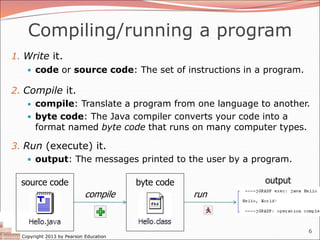
Compiling/running a program
1. Write it.
 code or source code: The set of instructions in a program.
2. Compile it.
• compile: Translate a program from one language to another.
 byte code: The Java compiler converts your code into a
format named byte code that runs on many computer types.
3. Run (execute) it.
 output: The messages printed to the user by a program.
source code
compile
byte code
run
output
Copyright 2013 by Pearson Education
7
A Java program
public class Hello {
public static void main(String[] args) {
System.out.println("Hello, world!");
System.out.println();
System.out.println("This program produces");
System.out.println("four lines of output");
}
}
 Its output:
Hello, world!
This program produces
four lines of output
Copyright 2013 by Pearson Education
8
Structure of a Java program
public class name {
public static void main(String[] args) {
statement;
statement;
...
statement;
}
}
 Every executable Java program consists of a class,
 that contains a method named main,
 that contains the statements (commands) to be executed.
class: a program
statement: a command to be executed
method: a named group
of statements
Copyright 2013 by Pearson Education
9
System.out.println
 A statement that prints a line of output on the console.
 pronounced "print-linn"
 sometimes called a "println statement" for short
 Two ways to use System.out.println :
• System.out.println("text");
Prints the given message as output.
• System.out.println();
Prints a blank line of output.
Copyright 2013 by Pearson Education
10
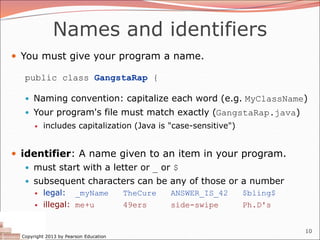
Names and identifiers
 You must give your program a name.
public class GangstaRap {
 Naming convention: capitalize each word (e.g. MyClassName)
 Your program's file must match exactly (GangstaRap.java)
 includes capitalization (Java is "case-sensitive")
 identifier: A name given to an item in your program.
 must start with a letter or _ or $
 subsequent characters can be any of those or a number
 legal: _myName TheCure ANSWER_IS_42 $bling$
 illegal: me+u 49ers side-swipe Ph.D's
Copyright 2013 by Pearson Education
11
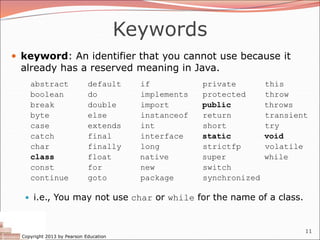
Keywords
 keyword: An identifier that you cannot use because it
already has a reserved meaning in Java.
abstract default if private this
boolean do implements protected throw
break double import public throws
byte else instanceof return transient
case extends int short try
catch final interface static void
char finally long strictfp volatile
class float native super while
const for new switch
continue goto package synchronized
 i.e., You may not use char or while for the name of a class.
Copyright 2013 by Pearson Education
12
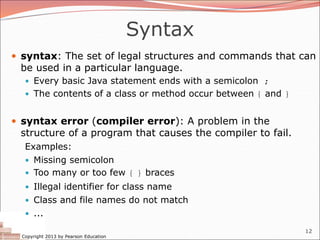
Syntax
 syntax: The set of legal structures and commands that can
be used in a particular language.
 Every basic Java statement ends with a semicolon ;
 The contents of a class or method occur between { and }
 syntax error (compiler error): A problem in the
structure of a program that causes the compiler to fail.
Examples:
 Missing semicolon
 Too many or too few { } braces
 Illegal identifier for class name
 Class and file names do not match
 ...
Copyright 2013 by Pearson Education
13
Syntax error example
1 public class Hello {
2 pooblic static void main(String[] args) {
3 System.owt.println("Hello, world!")_
4 }
5 }
 Compiler output:
Hello.java:2: <identifier> expected
pooblic static void main(String[] args) {
^
Hello.java:3: ';' expected
}
^
2 errors
 The compiler shows the line number where it found the error.
 The error messages can be tough to understand!
Copyright 2013 by Pearson Education
14
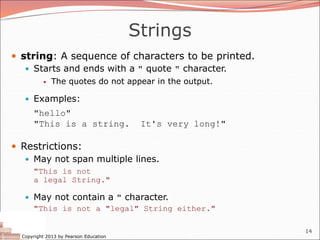
Strings
 string: A sequence of characters to be printed.
 Starts and ends with a " quote " character.
 The quotes do not appear in the output.
 Examples:
"hello"
"This is a string. It's very long!"
 Restrictions:
 May not span multiple lines.
"This is not
a legal String."
 May not contain a " character.
"This is not a "legal" String either."
Copyright 2013 by Pearson Education
15
Escape sequences
 escape sequence: A special sequence of characters used
to represent certain special characters in a string.
t tab character
n new line character
" quotation mark character
 backslash character
 Example:
System.out.println("hellonhowtare "you"?");
 Output:
hello
how are "you"?
Copyright 2013 by Pearson Education
16
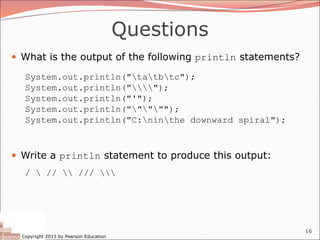
Questions
 What is the output of the following println statements?
System.out.println("tatbtc");
System.out.println("");
System.out.println("'");
System.out.println(""""");
System.out.println("C:ninthe downward spiral");
 Write a println statement to produce this output:
/  //  ///
Copyright 2013 by Pearson Education
17
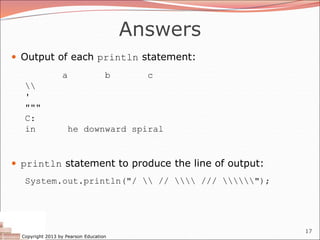
Answers
 Output of each println statement:
a b c

'
"""
C:
in he downward spiral
 println statement to produce the line of output:
System.out.println("/  //  /// ");
Copyright 2013 by Pearson Education
18
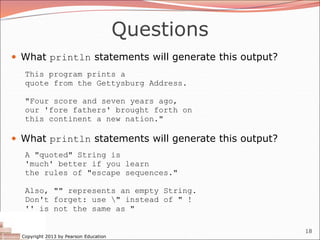
Questions
 What println statements will generate this output?
This program prints a
quote from the Gettysburg Address.
"Four score and seven years ago,
our 'fore fathers' brought forth on
this continent a new nation."
 What println statements will generate this output?
A "quoted" String is
'much' better if you learn
the rules of "escape sequences."
Also, "" represents an empty String.
Don't forget: use " instead of " !
'' is not the same as "
Copyright 2013 by Pearson Education
19
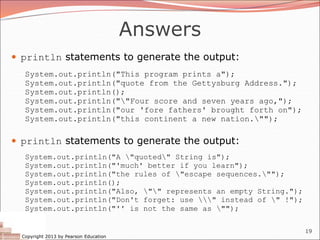
Answers
 println statements to generate the output:
System.out.println("This program prints a");
System.out.println("quote from the Gettysburg Address.");
System.out.println();
System.out.println(""Four score and seven years ago,");
System.out.println("our 'fore fathers' brought forth on");
System.out.println("this continent a new nation."");
 println statements to generate the output:
System.out.println("A "quoted" String is");
System.out.println("'much' better if you learn");
System.out.println("the rules of "escape sequences."");
System.out.println();
System.out.println("Also, "" represents an empty String.");
System.out.println("Don't forget: use " instead of " !");
System.out.println("'' is not the same as "");

01-ch01-1-println.ppt java introduction one

  • 1.
    Copyright 2013 byPearson Education Building Java Programs Chapter 1 Lecture 1-1: Introduction; Basic Java Programs reading: 1.1 - 1.3
  • 2.
    Copyright 2013 byPearson Education 2 Programming  program: A set of instructions to be carried out by a computer.  program execution: The act of carrying out the instructions contained in a program.  programming language: A systematic set of rules used to describe computations in a format that is editable by humans.
  • 3.
    Copyright 2013 byPearson Education 3 Course principles  Lots of resources and people who want to help you  Deliberate topic progression  Coherence between lectures, sections, labs, homework, exams  What you do will determine what you learn
  • 4.
    Copyright 2013 byPearson Education 4 Take this course if you…  … like solving tricky problems  … like building things  … (will) work with large data sets  … are curious about how Facebook, Google, etc work  … have never written a computer program before  … are shopping around for a major  142 is a good predictor of who will enjoy and succeed in CSE
  • 5.
    Copyright 2013 byPearson Education 5 Why Java?  Relatively simple  Object-oriented  Pre-written software  Platform independent (Mac, Windows…)  Widely used  #1 in popularity ie http://www.tiobe.com/index.php/content/paperinfo/tpci/index. html
  • 6.
    Copyright 2013 byPearson Education 6 Compiling/running a program 1. Write it.  code or source code: The set of instructions in a program. 2. Compile it. • compile: Translate a program from one language to another.  byte code: The Java compiler converts your code into a format named byte code that runs on many computer types. 3. Run (execute) it.  output: The messages printed to the user by a program. source code compile byte code run output
  • 7.
    Copyright 2013 byPearson Education 7 A Java program public class Hello { public static void main(String[] args) { System.out.println("Hello, world!"); System.out.println(); System.out.println("This program produces"); System.out.println("four lines of output"); } }  Its output: Hello, world! This program produces four lines of output
  • 8.
    Copyright 2013 byPearson Education 8 Structure of a Java program public class name { public static void main(String[] args) { statement; statement; ... statement; } }  Every executable Java program consists of a class,  that contains a method named main,  that contains the statements (commands) to be executed. class: a program statement: a command to be executed method: a named group of statements
  • 9.
    Copyright 2013 byPearson Education 9 System.out.println  A statement that prints a line of output on the console.  pronounced "print-linn"  sometimes called a "println statement" for short  Two ways to use System.out.println : • System.out.println("text"); Prints the given message as output. • System.out.println(); Prints a blank line of output.
  • 10.
    Copyright 2013 byPearson Education 10 Names and identifiers  You must give your program a name. public class GangstaRap {  Naming convention: capitalize each word (e.g. MyClassName)  Your program's file must match exactly (GangstaRap.java)  includes capitalization (Java is "case-sensitive")  identifier: A name given to an item in your program.  must start with a letter or _ or $  subsequent characters can be any of those or a number  legal: _myName TheCure ANSWER_IS_42 $bling$  illegal: me+u 49ers side-swipe Ph.D's
  • 11.
    Copyright 2013 byPearson Education 11 Keywords  keyword: An identifier that you cannot use because it already has a reserved meaning in Java. abstract default if private this boolean do implements protected throw break double import public throws byte else instanceof return transient case extends int short try catch final interface static void char finally long strictfp volatile class float native super while const for new switch continue goto package synchronized  i.e., You may not use char or while for the name of a class.
  • 12.
    Copyright 2013 byPearson Education 12 Syntax  syntax: The set of legal structures and commands that can be used in a particular language.  Every basic Java statement ends with a semicolon ;  The contents of a class or method occur between { and }  syntax error (compiler error): A problem in the structure of a program that causes the compiler to fail. Examples:  Missing semicolon  Too many or too few { } braces  Illegal identifier for class name  Class and file names do not match  ...
  • 13.
    Copyright 2013 byPearson Education 13 Syntax error example 1 public class Hello { 2 pooblic static void main(String[] args) { 3 System.owt.println("Hello, world!")_ 4 } 5 }  Compiler output: Hello.java:2: <identifier> expected pooblic static void main(String[] args) { ^ Hello.java:3: ';' expected } ^ 2 errors  The compiler shows the line number where it found the error.  The error messages can be tough to understand!
  • 14.
    Copyright 2013 byPearson Education 14 Strings  string: A sequence of characters to be printed.  Starts and ends with a " quote " character.  The quotes do not appear in the output.  Examples: "hello" "This is a string. It's very long!"  Restrictions:  May not span multiple lines. "This is not a legal String."  May not contain a " character. "This is not a "legal" String either."
  • 15.
    Copyright 2013 byPearson Education 15 Escape sequences  escape sequence: A special sequence of characters used to represent certain special characters in a string. t tab character n new line character " quotation mark character backslash character  Example: System.out.println("hellonhowtare "you"?");  Output: hello how are "you"?
  • 16.
    Copyright 2013 byPearson Education 16 Questions  What is the output of the following println statements? System.out.println("tatbtc"); System.out.println(""); System.out.println("'"); System.out.println("""""); System.out.println("C:ninthe downward spiral");  Write a println statement to produce this output: / // ///
  • 17.
    Copyright 2013 byPearson Education 17 Answers  Output of each println statement: a b c ' """ C: in he downward spiral  println statement to produce the line of output: System.out.println("/ // /// ");
  • 18.
    Copyright 2013 byPearson Education 18 Questions  What println statements will generate this output? This program prints a quote from the Gettysburg Address. "Four score and seven years ago, our 'fore fathers' brought forth on this continent a new nation."  What println statements will generate this output? A "quoted" String is 'much' better if you learn the rules of "escape sequences." Also, "" represents an empty String. Don't forget: use " instead of " ! '' is not the same as "
  • 19.
    Copyright 2013 byPearson Education 19 Answers  println statements to generate the output: System.out.println("This program prints a"); System.out.println("quote from the Gettysburg Address."); System.out.println(); System.out.println(""Four score and seven years ago,"); System.out.println("our 'fore fathers' brought forth on"); System.out.println("this continent a new nation."");  println statements to generate the output: System.out.println("A "quoted" String is"); System.out.println("'much' better if you learn"); System.out.println("the rules of "escape sequences.""); System.out.println(); System.out.println("Also, "" represents an empty String."); System.out.println("Don't forget: use " instead of " !"); System.out.println("'' is not the same as "");