545 TECHNOLOGY SQUARE; CAMBRIDGE, MASSACHUSETTS 02139 (617) 253-5851
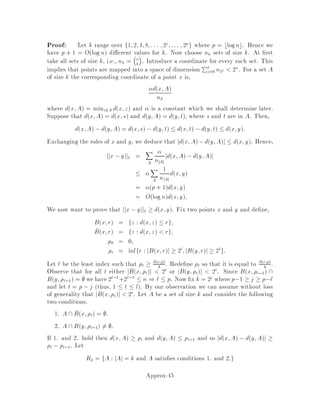
MASSACHUSETTS
INSTITUTE OF
TECHNOLOGY
LABORATORY FOR
COMPUTER SCIENCE
MIT LCS RSS-27
Advanced Algorithms
Michel X. Goemans
December, 1994
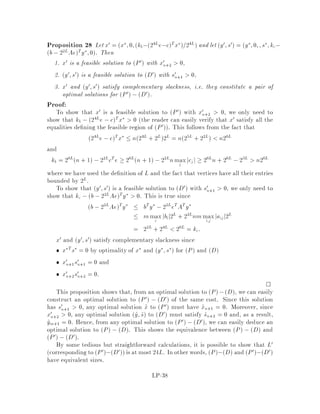
This document has been made available free of charge via ftp from the
MIT Laboratory for Computer Science.
Preface
This document consists of the lecture notes for 6.854J 18.415J Advanced
Algorithms as it was taught by Michel Goemans in the Fall 1994. The notes
are for the most part based on notes scribed by students during the last four
years, with help from the teaching assistants, Marios Papaefthymiou Fall
1990, Michael Klugerman Fall 1991 and 1992, Esther Jesurum Fall 1993
and Matthew Andrews Fall 1994. The notes are not meant to be in polished
form, and they probably contain several errors and omissions. Rather, they are
intended to be an aid in teaching and or studying a few advanced topics in the
design and analysis of algorithms. Part of these notes have not been covered
in class, but have been included for completeness. Also, some topics which
have been covered in the past but not this year such as basis reduction for
lattices have been omitted. The topics covered this year are online algorithms,
randomized algorithms, linear programming, network ow, and approximation
algorithms. A few new results have been covered for the rst time this year,
such as the result of Koutsoupias and Papadimitriou on the competitivenessof
the work function algorithm for the k-server problem, and the approximation
algorithm of Linial, London and Rabinovich and Aumann and Rabani for the
multicommodity cut problem using embeddings of metrics.
Help from the following certainly incomplete list of scribes is acknowl-
edged: M. Andrews, R. Blumofe. C. Celebiler, A. Chou, L. Feeney, F. Garcia,
L. Girod, D. Gupta, J. Huang, J. Kleinberg, M. Klugerman, M. Kiwi, J.
Kucan, J. Leo, X. Luo, Y. Ma, P. McCorquodale, R. Ostrovsky, S. Raghavan,
K. Randall, A. Russell, I. Saias, R. Sidney, E. Soylemez, R. Sundaram, S.
Toledo, L. Tucker-Kellogg D. Wald, D. Williamson, D. Wilson, E. Wolf and
Y. Yin.
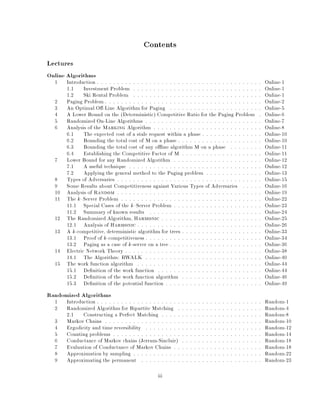
Contents
Lectures
Online Algorithms
1 Introduction : : : : : : : : : : : : : : : : : : : : : : : : : : : : : : : : : : : : : : : : : Online-1
1.1 Investment Problem : : : : : : : : : : : : : : : : : : : : : : : : : : : : : : : : Online-1
1.2 Ski Rental Problem : : : : : : : : : : : : : : : : : : : : : : : : : : : : : : : : Online-1
2 Paging Problem : : : : : : : : : : : : : : : : : : : : : : : : : : : : : : : : : : : : : : : Online-2
3 An Optimal O -Line Algorithm for Paging : : : : : : : : : : : : : : : : : : : : : : : Online-5
4 A Lower Bound on the Deterministic Competitive Ratio for the Paging Problem : Online-6
5 Randomized On-Line Algorithms : : : : : : : : : : : : : : : : : : : : : : : : : : : : : Online-7
6 Analysis of the Marking Algorithm : : : : : : : : : : : : : : : : : : : : : : : : : : : Online-8
6.1 The expected cost of a stale request within a phase : : : : : : : : : : : : : : : Online-10
6.2 Bounding the total cost of M on a phase : : : : : : : : : : : : : : : : : : : : : Online-10
6.3 Bounding the total cost of any o ine algorithm M on a phase : : : : : : : : Online-11
6.4 Establishing the Competitive Factor of M : : : : : : : : : : : : : : : : : : : : Online-11
7 Lower Bound for any Randomized Algorithm : : : : : : : : : : : : : : : : : : : : : : Online-12
7.1 A useful technique : : : : : : : : : : : : : : : : : : : : : : : : : : : : : : : : : Online-12
7.2 Applying the general method to the Paging problem : : : : : : : : : : : : : : Online-13
8 Types of Adversaries : : : : : : : : : : : : : : : : : : : : : : : : : : : : : : : : : : : : Online-15
9 Some Results about Competitiveness against Various Types of Adversaries : : : : : Online-16
10 Analysis of Random : : : : : : : : : : : : : : : : : : : : : : : : : : : : : : : : : : : : Online-19
11 The k Server Problem : : : : : : : : : : : : : : : : : : : : : : : : : : : : : : : : : : : Online-22
11.1 Special Cases of the k Server Problem : : : : : : : : : : : : : : : : : : : : : : Online-23
11.2 Summary of known results : : : : : : : : : : : : : : : : : : : : : : : : : : : : Online-24
12 The Randomized Algorithm, Harmonic : : : : : : : : : : : : : : : : : : : : : : : : : Online-25
12.1 Analysis of Harmonic : : : : : : : : : : : : : : : : : : : : : : : : : : : : : : : Online-26
13 A k-competitive, deterministic algorithm for trees : : : : : : : : : : : : : : : : : : : : Online-33
13.1 Proof of k-competitiveness : : : : : : : : : : : : : : : : : : : : : : : : : : : : : Online-34
13.2 Paging as a case of k-server on a tree : : : : : : : : : : : : : : : : : : : : : : : Online-36
14 Electric Network Theory : : : : : : : : : : : : : : : : : : : : : : : : : : : : : : : : : : Online-38
14.1 The Algorithm: RWALK : : : : : : : : : : : : : : : : : : : : : : : : : : : : : Online-40
15 The work function algorithm : : : : : : : : : : : : : : : : : : : : : : : : : : : : : : : Online-44
15.1 De nition of the work function : : : : : : : : : : : : : : : : : : : : : : : : : : Online-44
15.2 De nition of the work function algorithm : : : : : : : : : : : : : : : : : : : : Online-46
15.3 De nition of the potential function : : : : : : : : : : : : : : : : : : : : : : : : Online-49
Randomized Algorithms
1 Introduction : : : : : : : : : : : : : : : : : : : : : : : : : : : : : : : : : : : : : : : : : Random-1
2 Randomized Algorithm for Bipartite Matching : : : : : : : : : : : : : : : : : : : : : Random-4
2.1 Constructing a Perfect Matching : : : : : : : : : : : : : : : : : : : : : : : : : Random-8
3 Markov Chains : : : : : : : : : : : : : : : : : : : : : : : : : : : : : : : : : : : : : : : Random-10
4 Ergodicity and time reversibility : : : : : : : : : : : : : : : : : : : : : : : : : : : : : Random-12
5 Counting problems : : : : : : : : : : : : : : : : : : : : : : : : : : : : : : : : : : : : : Random-14
6 Conductance of Markov chains Jerrum-Sinclair : : : : : : : : : : : : : : : : : : : : Random-18
7 Evaluation of Conductance of Markov Chains : : : : : : : : : : : : : : : : : : : : : : Random-18
8 Approximation by sampling : : : : : : : : : : : : : : : : : : : : : : : : : : : : : : : : Random-22
9 Approximating the permanent : : : : : : : : : : : : : : : : : : : : : : : : : : : : : : Random-23
iii
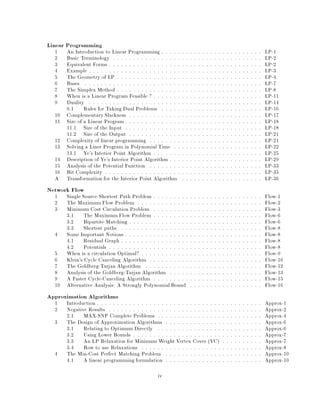
Linear Programming
1 An Introduction to Linear Programming : : : : : : : : : : : : : : : : : : : : : : : : : LP-1
2 Basic Terminology : : : : : : : : : : : : : : : : : : : : : : : : : : : : : : : : : : : : : LP-2
3 Equivalent Forms : : : : : : : : : : : : : : : : : : : : : : : : : : : : : : : : : : : : : : LP-2
4 Example : : : : : : : : : : : : : : : : : : : : : : : : : : : : : : : : : : : : : : : : : : : LP-3
5 The Geometry of LP : : : : : : : : : : : : : : : : : : : : : : : : : : : : : : : : : : : : LP-4
6 Bases : : : : : : : : : : : : : : : : : : : : : : : : : : : : : : : : : : : : : : : : : : : : LP-7
7 The Simplex Method : : : : : : : : : : : : : : : : : : : : : : : : : : : : : : : : : : : : LP-8
8 When is a Linear Program Feasible ? : : : : : : : : : : : : : : : : : : : : : : : : : : : LP-11
9 Duality : : : : : : : : : : : : : : : : : : : : : : : : : : : : : : : : : : : : : : : : : : : LP-14
9.1 Rules for Taking Dual Problems : : : : : : : : : : : : : : : : : : : : : : : : : LP-16
10 Complementary Slackness : : : : : : : : : : : : : : : : : : : : : : : : : : : : : : : : : LP-17
11 Size of a Linear Program : : : : : : : : : : : : : : : : : : : : : : : : : : : : : : : : : : LP-18
11.1 Size of the Input : : : : : : : : : : : : : : : : : : : : : : : : : : : : : : : : : : LP-18
11.2 Size of the Output : : : : : : : : : : : : : : : : : : : : : : : : : : : : : : : : : LP-21
12 Complexity of linear programming : : : : : : : : : : : : : : : : : : : : : : : : : : : : LP-21
13 Solving a Liner Program in Polynomial Time : : : : : : : : : : : : : : : : : : : : : : LP-22
13.1 Ye's Interior Point Algorithm : : : : : : : : : : : : : : : : : : : : : : : : : : : LP-25
14 Description of Ye's Interior Point Algorithm : : : : : : : : : : : : : : : : : : : : : : : LP-29
15 Analysis of the Potential Function : : : : : : : : : : : : : : : : : : : : : : : : : : : : LP-33
16 Bit Complexity : : : : : : : : : : : : : : : : : : : : : : : : : : : : : : : : : : : : : : : LP-35
A Transformation for the Interior Point Algorithm : : : : : : : : : : : : : : : : : : : : LP-36
Network Flow
1 Single Source Shortest Path Problem : : : : : : : : : : : : : : : : : : : : : : : : : : : Flow-1
2 The Maximum Flow Problem : : : : : : : : : : : : : : : : : : : : : : : : : : : : : : : Flow-2
3 Minimum Cost Circulation Problem : : : : : : : : : : : : : : : : : : : : : : : : : : : Flow-3
3.1 The Maximum Flow Problem : : : : : : : : : : : : : : : : : : : : : : : : : : : Flow-6
3.2 Bipartite Matching : : : : : : : : : : : : : : : : : : : : : : : : : : : : : : : : : Flow-6
3.3 Shortest paths : : : : : : : : : : : : : : : : : : : : : : : : : : : : : : : : : : : Flow-8
4 Some Important Notions : : : : : : : : : : : : : : : : : : : : : : : : : : : : : : : : : : Flow-8
4.1 Residual Graph : : : : : : : : : : : : : : : : : : : : : : : : : : : : : : : : : : : Flow-8
4.2 Potentials : : : : : : : : : : : : : : : : : : : : : : : : : : : : : : : : : : : : : : Flow-8
5 When is a circulation Optimal? : : : : : : : : : : : : : : : : : : : : : : : : : : : : : : Flow-9
6 Klein's Cycle Canceling Algorithm : : : : : : : : : : : : : : : : : : : : : : : : : : : : Flow-10
7 The Goldberg-Tarjan Algorithm : : : : : : : : : : : : : : : : : : : : : : : : : : : : : Flow-12
8 Analysis of the Goldberg-Tarjan Algorithm : : : : : : : : : : : : : : : : : : : : : : : Flow-13
9 A Faster Cycle-Canceling Algorithm : : : : : : : : : : : : : : : : : : : : : : : : : : : Flow-15
10 Alternative Analysis: A Strongly Polynomial Bound : : : : : : : : : : : : : : : : : : Flow-16
Approximation Algorithms
1 Introduction : : : : : : : : : : : : : : : : : : : : : : : : : : : : : : : : : : : : : : : : : Approx-1
2 Negative Results : : : : : : : : : : : : : : : : : : : : : : : : : : : : : : : : : : : : : : Approx-2
2.1 MAX-SNP Complete Problems : : : : : : : : : : : : : : : : : : : : : : : : : : Approx-4
3 The Design of Approximation Algorithms : : : : : : : : : : : : : : : : : : : : : : : : Approx-6
3.1 Relating to Optimum Directly : : : : : : : : : : : : : : : : : : : : : : : : : : Approx-6
3.2 Using Lower Bounds : : : : : : : : : : : : : : : : : : : : : : : : : : : : : : : : Approx-7
3.3 An LP Relaxation for Minimum Weight Vertex Cover VC : : : : : : : : : : Approx-7
3.4 How to use Relaxations : : : : : : : : : : : : : : : : : : : : : : : : : : : : : : Approx-8
4 The Min-Cost Perfect Matching Problem : : : : : : : : : : : : : : : : : : : : : : : : Approx-10
4.1 A linear programming formulation : : : : : : : : : : : : : : : : : : : : : : : : Approx-10
iv
4.2 From forest to perfect matching : : : : : : : : : : : : : : : : : : : : : : : : : : Approx-12
4.3 The algorithm : : : : : : : : : : : : : : : : : : : : : : : : : : : : : : : : : : : Approx-13
4.4 Analysis of the algorithm : : : : : : : : : : : : : : : : : : : : : : : : : : : : : Approx-14
4.5 A simulated run of the algorithm : : : : : : : : : : : : : : : : : : : : : : : : : Approx-16
4.6 Final Steps of Algorithm and Proof of Correctness : : : : : : : : : : : : : : : Approx-17
4.7 Some implementation details : : : : : : : : : : : : : : : : : : : : : : : : : : : Approx-20
5 Approximating MAX-CUT : : : : : : : : : : : : : : : : : : : : : : : : : : : : : : : : Approx-21
5.1 Randomized 0.878 Algorithm : : : : : : : : : : : : : : : : : : : : : : : : : : : Approx-23
5.2 Choosing a good set of vectors : : : : : : : : : : : : : : : : : : : : : : : : : : Approx-25
5.3 The Algorithm : : : : : : : : : : : : : : : : : : : : : : : : : : : : : : : : : : : Approx-25
5.4 Solving P  : : : : : : : : : : : : : : : : : : : : : : : : : : : : : : : : : : : : : Approx-26
5.5 Remarks : : : : : : : : : : : : : : : : : : : : : : : : : : : : : : : : : : : : : : : Approx-27
6 Bin Packing and P k Cmax : : : : : : : : : : : : : : : : : : : : : : : : : : : : : : : : Approx-28
6.1 Approximation algorithm for P jjCmax : : : : : : : : : : : : : : : : : : : : : : Approx-29
7 Randomized Rounding for Multicommodity Flows : : : : : : : : : : : : : : : : : : : Approx-33
7.1 Reformulating the problem : : : : : : : : : : : : : : : : : : : : : : : : : : : : Approx-34
7.2 The algorithm : : : : : : : : : : : : : : : : : : : : : : : : : : : : : : : : : : : Approx-35
7.3 Cherno bound : : : : : : : : : : : : : : : : : : : : : : : : : : : : : : : : : : : Approx-35
7.4 Analysis of the R-T algorithm : : : : : : : : : : : : : : : : : : : : : : : : : : Approx-36
7.5 Derandomization : : : : : : : : : : : : : : : : : : : : : : : : : : : : : : : : : : Approx-37
8 Multicommodity Flow : : : : : : : : : : : : : : : : : : : : : : : : : : : : : : : : : : : Approx-38
8.1 Reducing multicommodity ow cut questions to embedding questions : : : : Approx-41
8.2 Embedding metrics into `1 : : : : : : : : : : : : : : : : : : : : : : : : : : : : Approx-44
v
vi
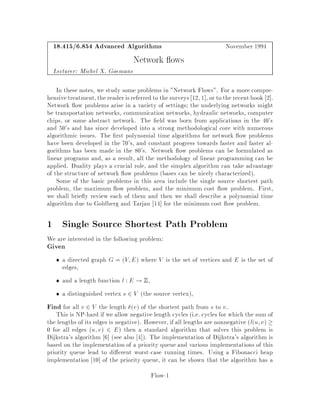
18.415 6.854 Advanced Algorithms September 1994
On-Line Algorithms
Lecturer: Michel X. Goemans
1 Introduction
The rst topic we will cover in this course is on-line algorithms. The concept of on-
line algorithms has been around for quite some time it was for example present in
the seventies in the bin packing literature, see 13, 20 , but it has been a fairly hot
research area since the publication of the landmark paper by Sleator and Tarjan 19
in 1985.
Typically when we solve problems and design algorithms we assume that we know
all the data a priori. However in many practical situations this may not be true and
rather than have the input in advance it may be presented to us as we proceed. We
give below some examples to motivate the topic of on-line algorithms.
1.1 Investment Problem
Consider an investor with a given sum of money which he wishes to invest so as to
maximizehis gain at the end of a speci ed period of time. He has a variety of options:
he may keep funds in a money market account, he may buy certi cates of deposit
or he may invest in the stock market. He can keep a mixed portfolio and he can
reallocate his assets during the course of the investment period. Now in the o ine
case he has full information about the behaviour of the various nancial and capital
markets and so can compute an optimal strategy to maximize his pro t. An on-line
algorithm, however, is a strategy which at each point in time decides what portfolio
to maintain based only on past information and with no knowledge whatsoever about
the future. The pro t generated is a determinantof the quality of the on-line strategy.
We will see later how exactly to quantify this quality by introducing the notion of
competitive analysis.
1.2 Ski Rental Problem
Consider the following scenario: you are a skier and, each day, need to either rent
skis for $1 or buy a pair of skis for $T which will last for the rest of the season.
Unfortunately, you do not know when the ski season will end. If you knew a priori
the length of the season this is the o ine case say L then it is obvious that you
should rent if L T and buy if L  T. On the other hand, an on-line strategy for
Online-1
this problem would rst x an integer k, and then rent for k days and buy on day
k + 1 if it has the opportunity.
At this point we must pause and decide how to evaluate the performance of on-line
algorithms? One way to analyze such algorithms is to assume that the input is given
according to a certain probability distribution, and compute the expected behavior of
the algorithm based on this distribution. However we wish to avoid making assump-
tions about input distributions. The analytic machinery we present will not demand
that the inputs come from some known distribution, but instead will compare the
performance of the on-line algorithm with that of the best o ine algorithm. This
notion of comparison is called competitive analysis and was introduced by Sleator
and Tarjan 19 .
De nition 1 An on-line algorithm A is -competitive if for all input sequences ,
CA   CMIN , where CA  is the cost of the on-line strategy A for and
CMIN  is the cost of the optimal o ine algorithm for .
Let us now reconsider the ski rental problem in the light of the above de nition.
One strategy is to buy on the rst day. This strategy is T-competitive and the worst
input sequence is obtained when L = 1. Another on-line strategy is to rent for the
rst T , 1 days and then buy. If L T the cost of the on-line and optimal o ine
strategy is the same. If L  T the cost of the on-line strategy is 2T ,1 and the cost
of the optimal o ine strategy is T. Hence this algorithm is 2 , 1=T-competitive
and it is fairly easy to show that it is the optimal on-line algorithm.
In many cases, the de nition of competitiveness is slightly relaxed by imposing
that CA   CMIN  + c for some constant c independent of .
2 Paging Problem
This is a problemwhicharises in systemsoftware. Wehavea two levelmemorydivided
into pages of xed size. There are k pages in fast memory while the remaining pages
are in slow memory. The input sequence in this problem are requests to pages
1; 2; 3  . If the request for a page i is in fast memory then we need not do
anything, otherwise we have a page fault and are faced with the problem of deciding
which page in the fast memory to swap with i. Our cost in this case is the number of
page faults. An on-line algorithm for this problem decides in the case of a page fault
which page to remove from fast memory without any information of the subsequent
page requests. For example, here are some possible on-line strategies:
LIFO Last-In-First-Out: remove the page most recently placed in fast memory.
FIFO First-In-First-Out: remove the page that has been in memory longest.
LRU Least-Recently-Used: replace the page whose most recent access is earliest.
Online-2
LFU Least-Frequently-Used: replace the page that has been accessed the least.
FWF Flush-When-Full: remove any unmarked page and mark the requested page.
Whenever all pages in fast memory are marked, unmark them all.
Let us consider the LIFO strategy for the paging problem. Consider an input
sequence of two pages p and q repeatedly requested one after the other. It is easy to
see that LIFO is not -competitive for any . We say that LIFO is not competitive.
A similar comment can be made about LFU.
In the theorem to follow we will show that there exist k-competitive strategies
where k is the size of the fast memory. Later, we shall show that this is the best
possible and we shall also characterize MIN - the optimal o ine algorithm.
Theorem 1 LRU is k-competitive.
Proof:
Note that by de nition of our problem, both LRU and MIN have the same initial
con guration in fast memory i.e. the same k pages in fast memory. We must show
that for any k initial pages in fast memory, and for all , CLRU   k CMIN .
Let us examine actions of LRU for any particular xed . Let us divide the input
sequence into phases:
= 1;::: ; i| z
rst page fault
; i+1;::: ; j
| z
phase 1
; j+1;::: ; l
| z
phase 2
;:::
where each phase contains exactly k page faults, ending with a page fault. For
example, the rst phase ends with j where
j = minft : LRU has k page faults in i+1;::: ; tg
Let us consider a cost of a single phase for both LRU and MIN. By de nition,
LRU makes k faults. We argue that MIN must make at least one page fault on each
phase. Let us consider two di erent cases.
Case 1: during the same phase, LRU faults twice on some page p. Thus, the phase
looks likes this:
::: ; i+1;::: ;
all k pages in fast memory have been requested before second request to p
z |
p1 = p| z
rst page fault p
;::: ; p2 = p| z
the second page fault of p
; ::: ; j ;:::
Notice that after the rst page fault to page p, p is brought into fast memory
and is later replaced by some other page only if p becomes the least recently
used page in fast memory by de nition of LRU. Hence, if there is another
page fault to p, it means that all other k pages that are resident in fast memory
just before p2 came after the rst page fault to p but before the second request
to p. Thus, in this case, k + 1 di erent pages have been requested in a phase.
This, however, forces MIN to make at least one page fault in every phase , i.e.
CMIN  1 for every phase.
Online-3
Case 2: LRU faults on k di erent pages. Here, we consider two sub-cases, depending
on the last page-fault say on p which occurred before the beginning of current
phase:
i = p| z
last page fault before current phase
; i+1;::: ; j
| z
current phase
;
Case 2a: In a current phase, there is a page-fault to page p.
i = p| z
last page fault before current phase
; i+1;::: ;p;::: ; j
| z
current phase
;
This case is very similar to case 1. In particular, before the second page
fault to p occurs, there must have been k requests to pages other then p,
to force p to be swapped out. Thus, during the current phase there are a
total of k + 1 di erent page requests. Thus CMINphase  1.
Case 2b: In a current phase, there is no page-fault to page p.
i = p; i+1;::: ; j
| z
current phase with no page fault on p
Let us consider MIN's behavior. Before the phase starts it must have p
in its fast memory, and other k , 1 locations which we don't care about.
Notice, however, that during current phase, k di erent requests arrive,
none of them are p. Thus, to accommodate all of them, MIN must get rid
of p, hence CMINphase  1 as well.
Thus, for every phase, MIN must pay at least one page fault, wile LRU pays k faults.
However, what about the very rst page fault, before the beginning of the rst phase?
Observe that both LRU and MIN start in the same con guration. Hence, the rst
time there is a request to page which in not in memory, it is in fact not in memory
for both LRU and MIN. Hence they both must do a page fault. 
Remark 1 Notice that essentially the same argument goes for FIFO in order to
show that FIFO is also k-competitive.
The above theoremwas provedbySleator and Tarjan 19 . Noticethat inthe above
proof we have not used explicitly what is the optimal o ine strategy MIN. We have
only related the cost of the on-line algorithm under consideration to a lower bound
on the cost of any on-line algorithm. This observation might seem elementary but
comparing to a lower bound is a very typical technique in the analysis of algorithms
not just on-line algorithms but also, as we shall see later in the class, approximation
algorithms.
The moral of the above proof-technique could be summarized as follows: we can
view competitiveness as a game between A's strategy and an adversary who comes
Online-4
up with very bad inputs to A, knowing ahead of time A's strategy. That is, we can
view it as a game between a player A, and an adversary. The adversary make the
rst move by selecting 1 and then the player has to process this request. Then the
adversary selects as his second move 2 and the player processes 2 and so on. Of
course, the adversary knowing A's strategy in advance can simulate the game and
therefore can nd ahead of time and play the most nasty sequence for A.
3 An Optimal O -Line Algorithm for Paging
In this section, we determine an optimal o -line paging algorithm. We consider an
o -line algorithm which we call longest forward distance or LFD. When LFD must
service a page fault it removes the page, among the pages currently in memory,whose
next request comes last.
Theorem 2 Belady 1  LFD is an optimal o -line algorithm for paging.
Proof:
By contradiction: assume that there is an algorithm MIN superior to LFD. Let
= 1 2 ::: n be a sequence so that CLFD  CMIN . At some point in the
sequence the two algorithms diverge. Let i be the page request which initiates this
divergence. Before processing i the two algorithms have the same pages in memory
so that i must be a fault for both. Since they diverge at i, they discard di erent
pages to service i. Let q be the page that LFD discards and p the page that MIN
discards. Let t be the rst time after i that MIN discards q. We will alter MIN's
behavior between i and t to create a new algorithm MIN*. MIN* will service i
the same way that LFD does by removal of q and will satisfy CMIN   CMIN .
By the de nition of LFD, the next request to p, say a, comes before the next
request to q, say b, so that
= 1 ::: i ::: a = p::: b = q::: n
MIN* services i by discarding q as does LFD. After processing i, then, MIN*
and MIN share exactly k,1 pages of memory. As we describe the behavior of MIN*
we will argue that, until MIN and MIN* converge, they share exactly k,1 pages of
memory. MIN* behaves as follows:
case 1: i t b. We describe how MIN* services a page request l for i l t.
By induction on l, we will show that MIN and MIN* share exactly k,1 pages
of memory. This implies that there is a unique page e which MIN* has in fast
memory but MIN does not. Initially, i.e. for l = i+ 1, this page e is p.
l 6= e: When l 6= e, MIN faults exactly when MIN* faults. When there is a
fault, MIN* discards the same page that MIN does recall that MIN does
Online-5
not discard q until time t so that MIN* can always do this. If MIN and
MIN* shared k , 1 pages before the request of l then they share k , 1
pages afterwards.
l = e: When l = e, MIN faults but MIN* does not. In this case, MIN
replaces some page with e. Again, if MIN and MIN* shared k ,1 pages
before the request of l then they share k ,1 pages afterwards.
Finally, to service t, which is a fault for both, MIN* discards e. Since MIN
by de nition discards q, MIN and MIN* again have converged. From the
above descriptions, it is clear that CMIN   CMIN .
case 2: t  b. In this case, MIN* follows the same strategy as above for l where
i l b. Notice that the same analysis is applicable and, upon arrival at
b = q, MIN and MIN* have exactly k , 1 pages in common. Further notice
that, since p is requested before q, the events described in the  l = e portion of
the above discussion have taken place at least once so that CMIN 1 ::: b,1
CMIN 1 ::: b,1. By de nition, MIN does not fault on b = q. MIN* does and
replaces e the unique page which it has in memory that MIN does not with q.
MIN* and MIN then have the same pages in memory after servicing b. MIN*
then behaves as MIN does for the remainder of . Since CMIN 1 ::: b,1
CMIN 1 ::: b,1, CMIN   CMIN , as desired.
We conclude that CLFD 1 ::: i  CMIN 1 ::: i, an optimal strategy, and by
induction that CLFD   CMIN . 
4 A Lower Bound on the Deterministic Compet-
itive Ratio for the Paging Problem
We show a lower bound of k for the competitive ratio of any deterministic on-line
algorithm for the paging problem. We conclude that LRU is an optimal deterministic
on-line algorithm for this problem.
Theorem 3 For all on-line algorithms A there is a sequence of requests A =
A
1 ::: A
n so that CA A  k  CLFD A. This sequence A can in fact be chosen
from a universe of only k + 1 pages.
Proof:
Given A, let A
i be the unique page excluded from the k-page memoryof A after
servicing A
1 ::: A
i,1. With this sequence A faults on every request. Then, assuming
that the memory of A begins in some full initial state, we have that for all pre xes
of A, CA  = j j. For LFD, however, we have:
Online-6
Lemma 4 For all nite sequences chosen from a universe of k+1 pages CLFD  
j j
k .
Proof of Lemma:
Suppose that i induces a page fault for LFD. We show that LFD incurs no page
faults on any of i+1;::: ; i+k,1. Let p be the page which LFD discards to service
i. Since there are exactly k + 1 pages, the next fault of LFD must be made on a
request to p. Notice that every other page in memory before the service of i must
be requested before p is next requested p is, by de nition, requested last among these
pages. Hence at least k ,1 requests separate i from the next fault, as desired. 
Let be a pre x of A of length kl. Then CA  = kl  kCLFD  so that A is,
at best, k-competitive. 
Remark 2 FIFO is also a k-competitive on-line algorithm for the paging problem
and so is also optimal.
5 Randomized On-Line Algorithms
The on-line algorithms we have discussed up to this point have been deterministic.
One shortcoming of such algorithms is that an adversary can always exactly determine
the behavior of the algorithm for an input . This leads to diabolical inputs like
that crafted in the previous theorem. This motivates the introduction of the class
of randomized on-line algorithms which will have better behavior in this respect.
Informally, a randomized on-line algorithm is simply an on-line algorithm that has
access to a random coin. Formally,
De nition 2 A randomized on-line algorithm A is a probability distribution fAxg
on a space of deterministic on-line algorithms.
Notice that when we talk about randomized on-line algorithms, we must decide
what informationtheadversary is allowedto have. If wewish to say that the adversary
does not see any coin- ips of the algorithm or, equivalently, that the adversary must
select his nasty sequence in advance, when he has no knowledge of the actual pages
removed from memory then we de ne
De nition 3 An oblivious adversary knows the distribution on the deterministic on-
line algorithms induced by A, but has no access to its coin-tosses.
The above de nition also implies that the adversary can not inspect which pages
A holds in his fast memory. Equivalently, this means that the oblivious adversary
must construct his nasty sequence before the game between him and randomized
A starts. Thus, notice that against an oblivious adversary, randomization is useful
in order to hide the status of the on-line algorithm. The notion of competitiveness is
now de ned as follows:
Online-7
De nition 4 A randomized on-line algorithm A distributed over deterministic on-
line algorithms fAxg has a competitive ratio of against any oblivious adversary
if
9c;8 ;Expx
CAx    CMIN  + c:
The additional constant c is introduced to account for possible di erencesin the initial
con guration of the on-line algorithm and the adversary.
We introduce two randomized on-line paging algorithms:
Random: Random services page faults by discarding a random page, i.e. a page
selected uniformly from the pages in fast memory.
Marking: Initially, all pages are marked. When a page p is requested,
1. If p is not in memory then
If all pages in memory are marked then unmark all pages
Swap p with a uniformly selected unmarked page in memory.
2. Mark page p in memory.
We will rst focus on Marking. We will show that
By using randomization, Marking achieves a competitive ratio of 2Hk against
an oblivious adversary, where Hk = 1+ 1
2
+:::+ 1
k is the k-th harmonic number.
Marking'scompetitiveratio is nearly optimalin that no randomizedalgorithm
has competitiveratio betterthan Hk. In proving this, we willintroduce a general
method of proving lower bounds for randomized competitive algorithms against
an oblivious adversary.
Both results are due to Fiat et al. 9 .
6 Analysis of the Marking Algorithm
Theorem 5 Marking is a 2Hk-competitive paging algorithm against any oblivious
adversary, where Hk = Pk
i=1
1
i is the kth harmonic number.
In other words, we need to show that
8 ;Exp CM   2HkCMIN ;
where M for conciseness denotes Marking. This implicitly assumes that M and
MIN have initially the same pages in fast memory otherwise, we would have an
additional constant c. To prove this competitiveness, we need to prove an upper
bound on the LHS and a lower bound on the RHS, and show that the inequality still
holds.
We begin by xing the input sequence and by then dividing it into phases as
follows.
Online-8
The rst phase begins on the rst page fault.
The i + 1-st phase starts on the request following the last request of phase i.
If phase p starts on ip then it ends on ip+1,1 where jf ip;::: ; ip+1gj = k + 1
but jf ip ;::: ; ip+1,1gj = k.
Thus, in a phase, exactly k distinct pages are requested.
Notice that the initial portion before the rst phase costs nothing. Hence the cost
of M on is the sum of the costs of M on all phases of .
Beforewe go any further letus understand the dynamicsof a phase by thefollowing
remarks. Let us denote by Si the set of pages that were in memory just before phase
i begins.
Remark 1: Once a page has been accessed in a phase it is marked and hence
will remain in memory till the end of the phase. Thus we may pay a price of 1 for a
page q only if this is is the rst time q is accessed during this phase and if q is not in
memory.
Remark 2: We claim that at the end or the beginning of every phase the k
pages in fast memory are all marked and correspond to the k distinct pages requested
during that phase. This can easily be shown by induction. At the beginning of the
rst phase all pages in fast memoryare marked since no page fault has yet occurred.
By induction, one can thus assume that the rst request in a phase will cause a page
fault this is true for phase 1 and, for later phases, this follows by induction from the
claim applied to the previous phase. Then, during the phase, the k distinct pages
requested will be marked and will remain in fast memory until the end of the phase,
proving the inductive statement.
Remark 3: Obviously, the de nition of a phase does not depend on the coin-
tosses of M but only on the input sequence. In other words, the same input sequence
will always be divided in exactlythe same way into phases regardless of the coin-tosses
of M. The coin-tosses only a ect the dynamics of M's behavior within a phase. Also
see remark 2, Si does not depend on the coin-tosses Si is simply the k distinct
requested pages in phase i ,1.
By these remarks we can focus on the k distinct pages accessed in phase i; for
each such page, we only concentrate on the rst time this page is accessed since only
such rst-time requests can cost us anything. We divide such rst time requests into
two categories.
Clean Requests: These are requests to pages that did not belong to Si. We
have to pay a price of 1 for each such request regardless of the coin-tosses.
Stale Requests: These are requests to pages that belonged to set Si at the
beginning of the phase. Unfortunately, such a page may have been ejected to
make room for a clean page. If it is still around, we pay 0 or else we pay 1.
Thus our rst major task is to nd the expected cost of a stale request.
Online-9
Since a phase consists of requests to exactly k distinct pages, if there are l clean
requests then there must be k ,l stale requests.
6.1 The expected cost of a stale request within a phase
Consider a typical stale request j to page p within phase i. Assume there have been
s stale requests and c clean requests so far in the phase. We wish to nd the expected
cost of this request in terms of c and s. To do so, we need the probability that page
p is still in memory after s stale and c clean requests. Notice that since this is the
rst time we are accessing p, p is unmarked.
Now what do we know? We know that the pages requested by the s stale requests
are in Si, by de nition of a stale request. Furthermore, since requested pages are
marked, the stale pages will not be removed until the end of the phase, therefore they
are in fast memory at time j ,1. This means that both fast memory at time j , 1
and Si contain all of these s stale pages. Therefore, the c clean requests now occupy c
uniformly distributed slots from the remaining k,s slots. Now we can easily compute
the expected cost of a stale request. It is the probability that the requested page is
one of the c pages which is no longer in fast memory due to the clean requests. There
are k ,s candidates for these pages. Hence:
Exp CM j = c
k ,s:
6.2 Bounding the total cost of M on a phase
We summarize the last section as follows:
Lemma 6 The expected cost of the s + 1-st stale request in a phase is equal to c
k,s
where c is the number of preceding clean requests in this phase.
Suppose we know that there are li clean requests within phase i. Recall that li is
de ned purely in terms of the input sequence see Remark 3 and does not depend
on the coin-tosses.
Then there must be k,li stale requests within this phase. Clearly the number of
clean requests preceding any stale request is no more than li. Using this and the last
lemma and summing over all k , li stale requests the expected cost of all the stale
requests on the phase is no more than D where
D = li
k + li
k ,1 + :::+ li
k ,k ,li ,1:
Also the cost of all all clean requests is exactly li since each clean request costs 1.
Hence the total expected cost of M on phase i is no more than D + li. Now
D + li = li1 + 1
li + 1 + 1
li + 2 + ::: + 1
k  liHk:
In summary:
Online-10
Lemma 7 The expected cost of M on phase i of is no more than liHk where Hk =
1 + 1
2
+ :::+ 1
k is the k ,th Harmonic number.
6.3 Bounding the total cost of any o ine algorithm M on a
phase
Consider any o ine algorithm A. Let us simulate A and M on the same input se-
quence . As before we can divide into phases de ned by the execution of M. Let
us de ne a potential function i which is the number of pages in A's memory that
are not in M's memory just before Phase i begins. Notice that this potential function
is well-de ned because the pages in M's memory at the start of Phase i is determined
by and not by the coin-tosses of M. see Remark 3 again!.
We know that M receives li clean requests in phase i. By the de nition of clean
requests these were not in M's memory at the start of Phase i. Hence at least li ,i
of these pages are also not in A's memory at the start of Phase i. Thus if we let
CiA be the cost of A during phase i we have
Lemma 8 CiA  li ,i.
Next, by de nition A has i+1 pages at the end of Phase i that are not in M's
memory. Thus M has a set Pi of i+1 pages at the end of Phase i that are not in A's
memory. But each page in M's memory at the end of Phase i was accessed in Phase
i. Thus all pages in Pi must have been in A0s memory at some time during Phase i
but they have been ejected by the end of the phase. Each ejection costs 1 and thus
CiA must be at least jPij = i+1. Thus:
Lemma 9 CiA  i+1.
We can easily combine Lemmas 8 and 9 to get the more useful bound of CiA 
1
2
li ,i + i+1. If we now amortize this bound over the rst n phases, we see that
CA  1
2l1 ,1 + 2 + l2 ,2 + 3 ::: + ln ,n + n+1
= 1
2
nX
i=1
li ,1 + n+1:
Since n+1  0 and we assume that 1 = 0, we derive:
Lemma 10 CA  1
2
Pn
i=1 li
6.4 Establishing the Competitive Factor of M
From Lemma 7 the total expected cost of M on input is at most Hk
P
i li. Also from
Lemma 10 the total cost of any o ine algorithm A on input is at least 0:5P
i li.
Thus M is 2Hk competitive.
Online-11
7 Lower Bound for any Randomized Algorithm
7.1 A useful technique
How do we prove a lower bound on the competitive factor even if we allow an
additional constant of a randomized algorithm against an oblivious adversary? We
do so by picking a distribution D of input sequences and evaluating the expected
cost of the best on-line algorithm and the expected cost of MIN i.e. the best o ine
algorithm on distribution D. We now develop this method.
Any randomized algorithm can be considered as a distribution A over all possible
deterministicon-line algorithms Ax. Let CH  be the cost of deterministicalgorithm
H on input . Thus when we say that A is -competitive we mean that for all ,
Expx
CAx    CMIN  + c:
Let us use j to denote the rst j elements in sequence . Assume we have a distri-
bution D over the input sequences . Fix a j. We can take expectation over input
sequences of length j using distribution D over both sides of the last equation to get
Expy
Expx
CAx  j
y  Expy
CMIN j
y + c:
We can use Fubini's theorem to exchange the two expectation quanti ers on the LHS
and derive:
Expx
Expy
CAx  j
y  Expy
CMIN j
y + c:
Let mj = MinHExpy CH j
y where the minimumis taken overdeterministicon-line
algorithms H. In other words mj is the expected cost of the best on-line deterministic
algorithm on input sequences distributed according to D. Using this de nition in the
last equation we have:
mj  Expy
CMIN j
y + c
and thus mj
Expy CMIN j
y
 + c
Expy CMIN j
y
:
Suppose D is chosen so that limj!1 Expy CMIN j
y is 1. Then:
limj!1
mj
Expy CMIN j
y
 :
What is this equation saying? It says that the competitive ratio of any randomized
algorithm against an oblivious adversary is at least as big as the ratio of the expected
cost of the best deterministicon-line algorithm to the expected cost of the best o ine
algorithm when evaluated using distribution D over large enough input sequences.
Notice that we are free to choose D to maximize this ratio.
Online-12
7.2 Applying the general method to the Paging problem
We will prove the following result using our general method.
Theorem 11 For the paging problem, if A is a randomized on-line -competitive
algorithm against an oblivious adversary then  Hk, even if there are only a total
of k + 1 pages that can be requested.
Proof:
In order to have the inequality mj  Expx Expy CAx
 j
y as tight as possible, we
choose D such that any deterministic on-line algorithm performs equally badly in
expected cost. In our case this can be obtained by choosing i uniformly among all
k + 1 pages and independent of all previous requests. Since the fast memory only
contains k pages, any deterministic algorithm will pay an expected cost of 1
k+1
for
serving i resulting in an expected cost of j
k+1
. Thus mj = j
k+1
.
Our lower bound technique therefore implies that
 limj!1
j
k + 1Expy CMIN j
y
:
Using this, we can restate the claim of our theorem as
limj!1
j
Expy CMIN j
y
= k + 1Hk:1
To prove this claim, we need to study the behavior of MIN. We divide into
stochastic phases. Phase i;i  0 consists of the requests indexed in Xi;Xi +
1;::: ;Xi+1 ,1 where X0 = 1 and Xi+1 = minft : f Xi
; Xi+1;::: ; tg = f1;::: ;k+
1gg:
Notice that the Xi are random variables since is distributed according to D
which in our case is the uniform distribution. A phase contains requests to only k
pages and hence if MIN has a page fault in some phase, the next page fault cannot
occur before the next phase. Thus the number of page faults incurred by MIN on
is at most the number of phases that occur up to time j. And hence the expected
cost incurred by MIN is at most the expected number of phases that can occur up to
time j. Hence
Expy
CMIN j
y  1 + Exp maxfp : Xp  jg :
To compute the LHS of 1 we use some results from the theory of stochastic
processes. Since the random variables fYig = fXi+1 ,Xi : i  0g are independent and
identicallydistributed, they form a so-called renewal process and by the elementary
Online-13
renewal theorem we have that
limj!1
j
1 + Exp maxfp : Xp  jg = limj!1
j
Exp maxfp : Xp  jg
= Exp lengthof phase
= Exp X1 ,1 = Exp X1 ,1:
Intuitively, this says that the expected number of phases is asymptotically equal
to the length of the sequence divided by the expected length of a phase. Removing
the expected this makes perfect sense.
We have therefore shown that
 Exp X1 ,1
k + 1 :
We now need to compute Exp X1 . By de nition, X1 = minft : f 1;::: ; tg =
f1;::: ;k + 1gg. Each i is uniformly distributed among the k + 1 pages and is
independent of j for any j 6= i. Computing Exp X1 under these circumstances is
called the coupon collector problem: Given a collection of k + 1 distinct coupons
say baseball cards, Exp X1 represents the expected number of independently and
uniformlyselectedcoupons a collector has to acquirebefore obtaining the completeset
of distinct coupons. In order to solve this problem, we introduce the random variables
Zi for 1  i  k + 1, where Zi = minft : jf 1;::: ; tgj = ig for i = 1;::: ;k + 1:
Thus Z1 = 1 and Zk+1 = X1. Note that between Zi and Zi+1, the probability
of getting a new page is k+1,i
k+1
at each step. So waiting for a new page between
Zi and Zi+1 is a Bernoulli process and the expected waiting time is k+1
k+1,i. Hence
Exp Zi+1 ,Zi = k+1
k+1,i. Thus
Exp X1 = Exp Zk+1 = k
i=1Exp Zi+1 ,Exp Zi  + Exp Z1
= 
kX
i=1
Exp Zi+1 ,Zi + 1
= k + 11 + 1
2 + 1
3 + :::+ 1
k + 1
= k + 1Hk + 1:
So  k+1Hk+1 ,1
k+1
= Hk. This completes the proof of Theorem 11. 
From Theorem 11, we see that Marking is optimal up to a factor of 2. An
optimal i.e. with competitive ration Hk randomized on-line algorithm against any
oblivious adversary has been obtained by McGeoch and Sleator 17 .
Online-14
8 Types of Adversaries
In this section, we discuss various types of adversaries for on-line algorithms and their
relative power. The de nitions and results in this and the following section are due
to Ben-David, Borodin, Karp, Tardos, and Wigderson 2 .
So far, we have analyzed the performance of a randomized on-line algorithm A
against an oblivious adversary Q. Q knows the distribution over deterministic algo-
rithms that A is using, but must generate a request sequence without knowledge
of the results of A's coin tosses. We have analyzed A's performance in terms of a
game between A and Q. Before the beginning of the game, Q selects a number n
to be the number of requests 1; 2;::: ; n which it will make. Then Q begins to
make requests and A begins to process them on-line with answers a1;a2;::: ;an. If
A is a randomized algorithm, then we think of A as making coin tosses in order to
choose each ai. But Q must make each request i with no knowledge of the previous
answers a1;::: ;ai,1. Thus, the game is not really very interesting | Q may as
well choose all the i right at the beginning. In order to make the game genuinely
interactive, we consider stronger types of adversaries, which have access to the coin
tosses of A.
De nition 5 An adaptive adversary, Q, against a randomized algorithm, A, is
an adversary which has access to A's previous coin tosses. That is, when Q selects
request i it has knowledge of A's responses a1;a2;::: ;ai,1.
For an adaptive adversary, Q, however, we give Q the task of processing the same
requests 1; 2;::: ; n given the same resources and initial conditions as A. Thus Q
incurs a cost, CQA, which is the sum of the costs of Q's responses q1;q2;::: ;qn,
even as A's cost, which we now call CAQ, is the sum of the cost of A's responses
a1;a2;::: ;an. We wish to de ne two distinct types of adaptive adversaries based
on the way in which they process these requests and the resulting di erence in their
incurred cost, CQA.
De nition 6 An adaptive o ine adversary, Q, against an algorithm, A, is an
adversary which makes a request and then gets back A's response before making its
next request. After A has responded to all the requests 1; 2;::: ; n, then Q will
process these same requests using the optimal o ine strategy, MIN. Thus CQA =
CMIN , where is the sequence of requests which Q makes.
De nition 7 An adaptive on-line adversary, Q, against an algorithm, A, is an
adversary for which both A and Q must respond to each request before Q decides
what the next request will be. The adversary, Q, learns of A's response, ai, to each
request, i, only after it has made its own response, qi, but before it has to decide
which request i+1 to make next.
Online-15
Remark 1: MIN is at least as good as any on-line strategy, so for any adaptive
on-line adversary, there is an adaptive o ine adversary which does at least as well.
Thus the concept of an adaptive o ine adversary is stronger than that of an adaptive
on-line adversary.
Remark 2: The concept of an adaptive on-line adversary is stronger than that
of an oblivious adversary.
Consider the case in which A is a randomized algorithm. Then a1;a2;::: ;an are
random variables to be determined by A's coin tosses. Since q2;q3;::: ;qn depend on
the ai's which precede them, they too are random variables. Similarly, the costs asso-
ciated with each of these responses a1;a2;::: ;an;q2;q3;::: ;qn are random variables.
Finally, the costs CAQ and CQA are random variables, since they are formed by
summing the costs of the ai's and qi's including q1, respectively. Thus in considering
how e ective A is we want to consider the expectations of these quantities, E CAQ
and E CQA .
De nition 8 A randomized algorithm, A, is -competitive against an adaptive ad-
versary, Q, if
E CAQ  E CQA :
Remark3: If A is deterministic,thereis no di erencebetweenoblivious, adaptive
o ine, and adaptive on-line adversaries.
9 Some Results about Competitiveness against Var-
ious Types of Adversaries
An adaptive o ine adversary is so strong that an algorithm which must confront an
adaptive o ine adversary is not helped by making use of randomization.
Theorem 12 If there is a randomized on-line algorithm A which is -competitive
against any adaptive o ine adversary, then there is an -competitive deterministic
on-line algorithm G.
Proof:
Let A be distributed over deterministicon-line algorithms Ax. So for any adaptive
o -line adversary Q,
Ex CAx Q , Ex CQAx  0:
Again, note the use of expectation in the second term. Q's cost is a random variable
as well, based on A's coin tosses.
We now show how to construct a deterministic on-line algorithm G so that
CG   CMIN , for any . Assume that the rst request to A is 1; we can
Online-16
restrict our attention to adversaries that start with 1. Maximizing over such adver-
saries, we obtain:
MaxQfEx CAx Q , Ex CQAx g  0:
We can now condition values on the answer a1:
Ea1 MaxQfEx CAx Q j a1 , Ex CQAx j a1 g  0:
Since this expectation is non-positive, there must exist some speci c a
1 for which the
value of the expression inside the brackets is non-positive. That is,
MaxQfEx CAx Q j a
1 , Ex CQAx j a
1 g  0:
So our deterministic algorithm G will be one that plays a
1 on request 1. Now Q
plays 2; again, we restrict our attention to adversaries that play this way. Condi-
tioning now on the choice of a2,
Ea2 MaxQfEx CAx
Q j a
1;a2 , Ex CQAx j a
1;a2 g  0:
So there must be some answer a
2 for which
MaxQfEx CAx Q j a
1a
2 , Ex CQAx j a
1a
2 g  0;
the maximum being taken over the adversaries playing 1 rst and playing 2 when
the answer to 1 is a
1. The algorithm G will play a
2:
Proceeding in this way, we obtain a sequence of answers a
1;::: ;a
i for which
MaxQfEx CAx Q j a
1 a
i , Ex CQAx j a
1 a
i g  0
until request i+1 is the special STOP request. At this point, the rst term is
the cost of our deterministic algorithm G on = 1  i+1, and the second term is
CMIN , since Q can answer the request sequence o -line.
Thus, by always playing an answer which makes the expectation non-positive, G
will be -competitive. 
Remark 4: This is merely a proof that G exists. It does not tell us how we might
construct G, but the proof can be made somewhat constructive. We won't go into
the details here.
Theorem 13 If G is an -competitive randomized on-line algorithm against any
adaptive on-line adversary and there is a -competitive randomized on-line algorithm,
H, against any oblivious adversary, then G is an -competitive randomized on-line
algorithm against any adaptive o ine adversary.
Online-17
Proof:
Let Q be any adaptive o -line adversary, and Gx, Hy denote the two randomized
on-line algorithms with their associated probability distributions. We will also use
the notation Qx to emphasize that the behavior of Q depends on the coin tosses of
G. We show a pair of inequalities which together will prove the theorem.
Consider rst that Q is playing Gx. The algorithm Hy watches from a distance
and plays along. Then Q is simply an oblivious adversary with respect to Hy, so for
all x,
Ey CHy
Qx  CQx
Gx:
Thus we have the rst of our inequalities:
ExEy CHy Qx  Ex CQx Gx :2
Now consider the case in which Q and H join forces to play against G. That
is, we form an adaptive on-line adversary Q' which generates requests according to
the strategy of Q and uses the answers h1;h2;::: of H. The cost of Q' against Gx
is CHy Qx, since Hy is being used to provide the answers; meanwhile, the cost of
Gx against Q' is simply CGx Qx, since Q' uses Q to generate the requests. G is
-competitive against any adaptive on-line adversary, so for all y,
Ex CGx Qx  Ex CHy Qx
EyEx CGx Qx  EyEx CHy Qx :
The left-hand side is independent of y, and we can swap the order of the expectations
on this right-hand side, obtaining the second inequality:
Ex CGx Qx  ExEy CHy Qx :3
Combining these two inequalities,
Ex CGx Qx  Ex CQx Gx ;
completing the proof that G is -competitive against Q. 
Corollary 14 Under the same assumptions, there is a deterministic -competitive
on-line algorithm.
Example:
For paging, there is a lower bound of k on the competitive ratio of
a deterministic on-line algorithm, but there is also an Hk-competitive
randomized on-line algorithm against any oblivious adversary. So by the
contrapositive of the corollary, there is a lower bound of k
Hk
on the compet-
itive ratio of a randomized on-line algorithm against any adaptive on-line
adversary.
Online-18
Corollary 15 If G is an -competitive randomized on-line algorithm against any
adaptive on-line adversary, then there is an 2
-competitive deterministic on-line al-
gorithm.
The corollary is true because if G is -competitive against any adaptive on-line
adversary, then G is -competitive against any oblivious adversary, and the corollary
then follows from the theorem.
This last corollary is quite striking; it says that to show the existence of a compet-
itive deterministic algorithm, we need only construct a randomized algorithm which
is competitive against an adaptive on-line adversary.
10 Analysis of Random
In previous sections, we've seen Marking used as a competitivealgorithm against an
oblivious adversary. An even simplerrandomized algorithm is Random, which, when
needed, removes a uniformly selected page from the main algorithm's fast memory.
We'll show
Theorem 16 Raghavan and Snir 18  Random R is k-competitive against
any adaptive on-line adversary Q.
The proof of the theorem uses a potential function argument, which is a funda-
mental technique in establishing competitive ratios.
Proof:
The proof is based on the idea of a potential function  which measures the
similaritybetweenthe k pages in Q's fast memoryand the k pages in R's fast memory.
More precisely, let Qi be the set of pages in Q's memory just after servicing
request i, and similarly for Ri. Then let i = jRi Qij, the size of the intersection
between Q's memory and R's.
Now, let Xi = CR i,kCQ i,ki ,i,1. The rst thing to notice is that,
for a sequence of requests 1;:::; j,
jX
i=1
Xi = CRQ ,kCQR ,kj ,0:
If we assume that all algorithms start with the same set of pages in fast memory,then
0 = k. Since no j can be greater than k, we have
jX
i=1
Xi  CRQ ,kCQR;
from which, by the linearity of expectations,
jX
i=1
E Xi  E CRQ ,kE CQR :
Online-19
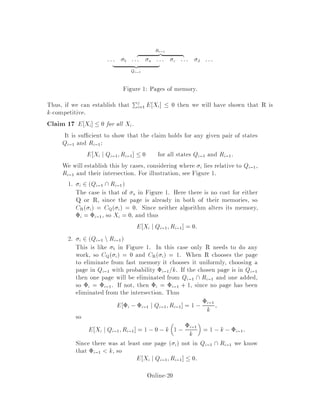
Ri,1
z |
::: b ::: a ::: c ::: d :::
| z
Qi,1
Figure 1: Pages of memory.
Thus, if we can establish that Pj
i=1 E Xi  0 then we will have shown that R is
k-competitive.
Claim 17 E Xi  0 for all Xi.
It is su cient to show that the claim holds for any given pair of states
Qi,1 and Ri,1:
E Xi j Qi,1;Ri,1  0 for all states Qi,1 and Ri,1.
We will establish this by cases, considering where i lies relative to Qi,1,
Ri,1 and their intersection. For illustration, see Figure 1.
1. i 2 Qi,1 Ri,1
The case is that of a in Figure 1. Here there is no cost for either
Q or R, since the page is already in both of their memories, so
CR i = CQ i = 0. Since neither algorithm alters its memory,
i = i,1, so Xi = 0, and thus
E Xi j Qi,1;Ri,1 = 0:
2. i 2 Qi,1 nRi,1
This is like b in Figure 1. In this case only R needs to do any
work, so CQ i = 0 and CR i = 1. When R chooses the page
to eliminate from fast memory it chooses it uniformly, choosing a
page in Qi,1 with probability i,1=k. If the chosen page is in Qi,1
then one page will be eliminated from Qi,1 Ri,1 and one added,
so i = i,1. If not, then i = i,1 + 1, since no page has been
eliminated from the intersection. Thus
E i ,i,1 j Qi,1;Ri,1 = 1 , i,1
k ;
so
E Xi j Qi,1;Ri,1 = 1 ,0 ,k
1 , i,1
k

= 1 ,k ,i,1:
Since there was at least one page  i not in Qi,1 Ri,1 we know
that i,1 k, so
E Xi j Qi,1;Ri,1  0:
Online-20
3. i 2 Ri,1 nQi,1
This is like c in Figure 1. Since only Q needs to do any work,
CQ i = 1 and CR i = 0. Now, whatever Q does in this case,
the potential i will not decrease; as in the previous case, it will
either stay the same or increase by one, so i , i,1  0. Thus
Xi  0 ,k ,k0 0, so
E Xi j Qi,1;Ri,1 0:
4. i =2 Ri,1 Qi,1
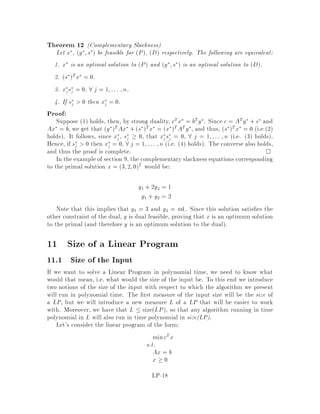
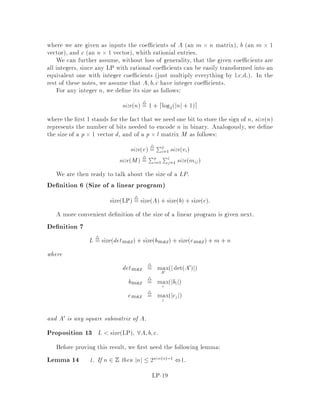
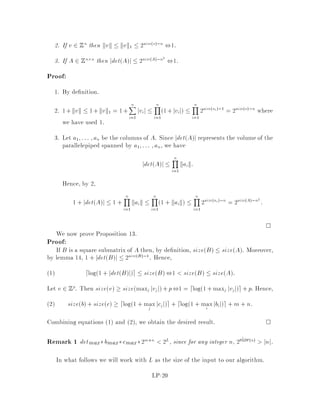
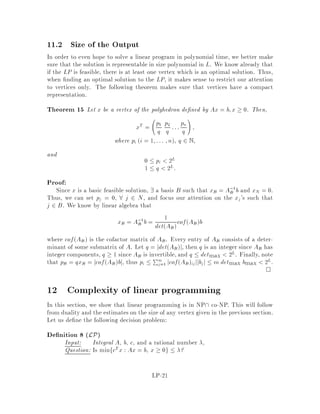
This is the case of d in Figure 1. Since both Q and R must pull i
into fast memory, CQ i = CR i = 1. Unlike the previous cases,
i may here either stay the same, go up by one, or go down by one.
Now, let's calculate the probability that i decreases by one. We
have
Pr i ,i,1  0 j Qi,1;Ri,1  1
k:
To see this, x the page that Q chooses to discard. If the page is not
in Qi,1 Ri,1 then, with probability 1, i does not decrease. If
the page is in Qi,1 Ri,1 then R will choose to discard the same
page with probability 1=k. Thus the probability in both cases is at
least 1=k. This gives us
Pr i ,i,1 0 j Qi,1;Ri,1  1 , 1
k;
so
E i ,i,1 j Qi,1;Ri,1  ,11 , 1
k:
This is enough to give us
E Xi j Qi,1;Ri,1  1 ,k1 ,k,1
1 , 1
k

= 0:

Since E Xi j Qi,1;Ri,1  0 for all Qi,1 and Ri,1, E Xi  0, so
0 
jX
i=1
E Xi  CRQ ,kCQR
which proves the theorem. 
Note that we have assumed for this analysis that the adversary doesn't change its
memory when it doesn't have to. Though we don't prove it here, it can be shown
that this type of lazy adversary is at least as strong as any other, so the assumption
is harmless.
Online-21
11 The k Server Problem
So far, we have been dealing with various concepts related to on-line algorithms, as
well as the paging problem. In this and subsequent sections, we consider another
famous problem for its apparent simplicity, the k-server problem. However, as it will
appear, much less is known for the k-server problem than for the paging problem,
although it has been extensively studied in the last few years.
The following is a practical analogy for the k server problem. Suppose we have a
city with a set of k police cars. When an emergency occurs somewhere in the city, one
police car is chosen and dispatched to the site. We ignore the length of time for the
car to travel to the site, ignore the length of time for the emergency to be handled,
and count only the distance the police car must travel. Another emergencyoccurs and
some car, maybe the same one, is chosen to travel to the next site. The emergencies
must be attended to in order, and the dispatcher does not know in advance how many
emergencies will occur where. Again, the cost function to be minimized is simply
the sum of distances that the cars must travel, over all the emergencies. To formally
analyze the k server problem, we need to de ne a metric space.
De nition 9 A metric space is a set of points V along with a distance function
d : V V  ! R such that
1. du;v  0; 8u;v 2 V .
2. du;v = 0 i u = v
3. du;v = dv;u; 8u;v 2 V
4. du;v+ dv;w  du;w; 8u;v;w 2 V .
In other words, d is nonnegative, strictly positive between di erent points, satis es
the triangle inequality, and is symmetric. Often for purposes of this problem V is
nite, but this is not obligatory.
De nition 10 The k-server problem The input is a metric space V; a set of k
servers located at points in V , and a stream of requests 1; 2;:::, each of which
is a point in V . For each request, one at a time, you must move some server from
its present location to the requested point. The goal is to minimize the total distance
travelled by all servers over the course of the stream of requests.
In general, the optimal solution to a k server problem can be computed o -line
by dynamic programming. Dynamic programming can be done in polynomial time.
Another possible approach is to construct a graph such that the n requests and the
k servers correspond to n + k distinct vertices. For those familiar with the theory of
network ows, the o -line problem can be solved as a minimum-cost ow problem on
n copies of the graph. One must construct appropriate weighted edges. The class is
invited to think about this as an exercise.
Online-22
Claim 18 For any stream of requests, on-line or o -line, only one server needs to be
moved at each request.
To show a contradiction, assume otherwise. In response to some request, i; in your
stream, you move server j to point i and, in order to minimize the overall cost, you
also move server k to some other location, perhaps to cover ground because of j's
move. If server k is never again used, then the extra move is a waste, so assume server
k is used for some subsequent request m. However, by the triangle inequality see
the de nition of a metric space, server k could have gone directly from its original
location to the point m at no more cost than stopping at the intermediate position
after request i.
We might, in general, consider algorithms which move more than one server at
a time. While we will sometimes do this for purposes of analysis, we can in general
ignore such algorithms thanks to the triangle inequality.
11.1 Special Cases of the k Server Problem
1. Paging.
The paging problem is a special case of the k-server problem, in which the k
servers are the k slots of fast memory, V is the set of pages and du;v = 1
for u 6= v. In other words, paging is just the k server problem but with a
uniform distance metric.
2. Two-headed Disk.
You have a disk with concentric tracks. Two disk-heads can be moved linearly
from track to track. The two heads are never moved to the same location and
Figure 2: Two-headed disk.
need never cross. The metric is the sum of the linear distances the two heads
have to move to service all the disk's I O requests. Note that the two heads
move exclusively on the line that is half the circumference and the disk spins to
give access to the full area.
Online-23
11.2 Summary of known results
We already have results about paging that can be used for the k server problem.
Positive results about paging can't be generalized, but since paging is a case of the
k server problem, the lower bound for paging also applies in general.
Theorem 19 Manasse-McGeoch-Sleator 16  For no metric spaces is there a
deterministic -competitive algorithm for the k-server problem such that k.
The general proof is similar to the previous proof with a uniform distance metric.
However, in the case of paging we actually have a k-competitive deterministic on-line
algorithm.
Open Problem: Whether or not there exists a k competitive deterministic al-
gorithm for the general k server problem. In fact, for some time it was unknown
whether there exists a fk-competitive algorithm, where fk is a function of k.
Theorem 20 Fiat, Rabani and Ravid 10 proved by induction on k that there is an
fk-competitive algorithm for the general k server problem, where fk = eOklog k
.
Very recently, it was shown by Koutsoupias and Papadimitriou 15 that the so-
called work-function algorithm of Chrobak and Larmore 7 is 2k ,1-competitive. It
is an open problem whether the same algorithm is in fact k-competitive.
11.2.1 Results for speci c k
k = 1 This case is trivial, since there is never any choice about which server to send.
Thus any reasonable algorithm is 1-competitive.
k = 2 There is a 2-competitive deterministicalgorithm for this case, due to Manasse,
McGeoch and Sleator 16 . Even with this small k, the algorithm is nontrivial
and would make a challenging exercise. The work function algorithm is also
known to be 2-competitive 7 . There has also been work on developing com-
petitive algorithms for 2 servers which are fast in the sense that they perform
only a constant amount of work per request 12, 4, 14 .
k = jV j,1 . Then the algorithm Balance, described later, is k-competitive 16 .
A variation of Balance is also known to be 10-competitive for the case k = 2
Irani and Rubinfeld 12 .
11.2.2 Results for speci c metric spaces
paging For paging, we've already seen a k-competitive algorithm.
line, tree For these con gurations, there is a k-competitive deterministic algorithm
5 .
circle For points on the circle, there is a deterministic k3
-competitive algorithm.
Online-24
11.2.3 Greedy
The most obvious on-line algorithm for the k-server problem is Greedy, in which
a given request is serviced by whichever server is closest at the time. The following
example, however, shows the major aw in this algorithm:
Consider two servers 1 and 2 and two additional points A and b, positioned as
follows assume something like a Euclidean metric:
1 2 a b
Now take a sequence of requests ababab:::. Greedy will attempt to service all
requests with server 2, since 2 will always be closest to both A and b, whereas an
algorithm which moves 1 to A and 2 to b, or vice versa, will su er no cost beyond
that initial movement. Thus Greedy can't be -competitive for any .
11.2.4 The Balance Algorithm
We now describe the Balance algorithm mentioned above. At all times, we keep
track of the total distance travelledso far by each server, Dserver , and try to even out
the workload among the servers. When request i arrives, it is serviced by whichever
server, x; minimizes the quantity Dx + dx;i, where Dx is the distance travelled so
far by server x, and dx;i is the distance x would have to travel to service request
i. Balance is k-competitive when jV j = k + 1. However, it is not even competitive
for k = 2. Consider indeed the following instance suggested by Jon Kleinberg. The
metric space corresponds to a rectangle abcd where da;b = dc;d = is much
smaller than db;c = da;d = . If the sequence of requests is abcdabcd:::, the
cost of Balance is per request, while the cost of MIN is per request.
A slight variation of Balance in which one minimizes Dx +2dx;i can be shown
to be 10-competitive for k = 2 12 .
12 The Randomized Algorithm, Harmonic
While Greedy doesn't work very well on its own, the intuition of sending the closest
server can be useful if we randomize it slightly. Instead of sending the closest server
every time, we can send a given server with probability inversely proportional to its
distance from the request.
Thus for a request A we can try sending a server at x with probability 1=Ndx;a
for some N. Since, if On is the set of on-line servers we want
1 =
X
x2On
1
Ndx;a
we set
N =
X
x2On
1
dx;a
Online-25
This algorithm is known as the Harmonic algorithm H. Note, once again, that in
the special case of paging this is identical to Random.
Harmonic is competitive as stated below.
Theorem 21 Grove 11  Harmonic is 5
4k2k ,2k-competitive against an adap-
tive on-line adversary.
Beforethis fairlyrecentresult, Harmonic was only known to be 317000-competitive
for k = 3 3 and 3-competitive for 2 servers 6 .
There is a known lower bound for this algorithm. Speci cally, for some adaptive
on-line adversary Q, we know that CHQ =

k+1
2

CQH, where H denotes Har-
monic so we can't hope to do better than

k+1
2

-competitiveness. It is open whether
the competitive factor for Harmonic is indeed equal to this lower bound.
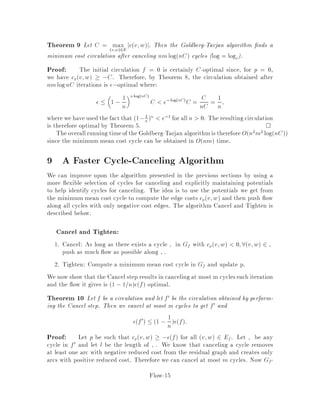
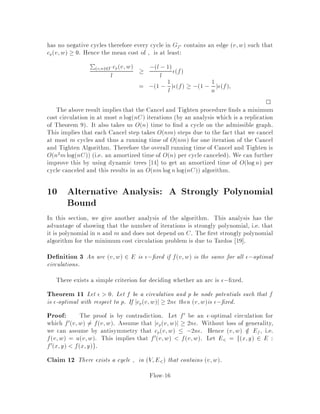
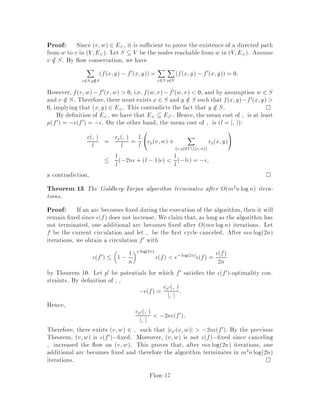
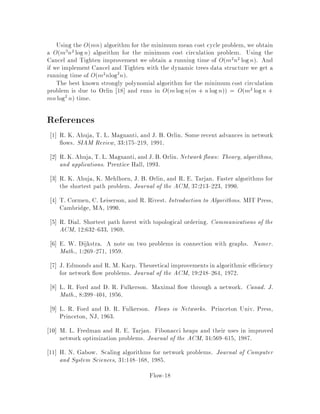
Finally, recall that we can get an 2-competitive deterministic on-line algorithm
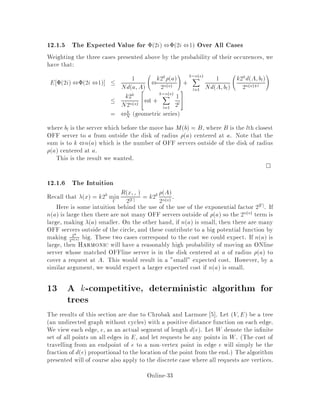
from an -competitive randomized algorithm. So this theorem will also give us a
5
4k2k ,2k2-competitivedeterministic algorithm, although the algorithm that we get
this way is far from e cient.
12.1 Analysis of Harmonic
We prove here a slightly weaker result than Grove's result.
Theorem 22 Harmonic is k22k,1-competitive against an adaptive online adver-
sary.
Proof:
In the following, let OFF denote both the servers of the online adaptive adversary
which Harmonic plays against, as well as their locations in the metric space.
σ1 σ2 σi
a1 a2 ai-1 ai
Phase 1
Phase 2
Phase 3
Phase 4 Phase 2i-1 Phase 2i+1
Phase 2i
Adversary Q
Harmonic
Figure 3: Odd and even phases of OFF vs. ON.
We de ne phases Figure 3 by:
Online-26
In the odd phase 2i,1, the online adversary moves a server to vertex A at cost
di. The adversary then makes a request i at vertex A. Note that OFF can
move its server before making the request because it is an online adversary, so
the order makes no di erence.
In the even phase 2i, the player moves an online server ai 2 ON to A and incurs
a cost of li. li is in fact a random variable since Harmonic chooses the server
to move probabilistically.
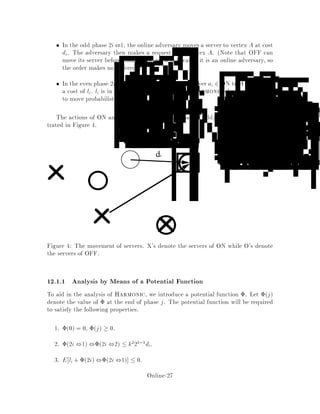
The actions of ON and OFF taken during one pair of odd even phases are illus-
trated in Figure 4.
li
Position of request,
and position of OFFline
server A after the request
Position of A
before the request
di
Figure 4: The movement of servers. X's denote the servers of ON while O's denote
the servers of OFF.
12.1.1 Analysis by Means of a Potential Function
To aid in the analysis of Harmonic, we introduce a potential function . Let j
denote the value of  at the end of phase j. The potential function will be required
to satisfy the following properties.
1. 0 = 0, j  0:
2. 2i ,1 ,2i ,2  k22k,1di:
3. E li + 2i ,2i ,1  0:
Online-27
These properties allow us to prove the competitive ratio of k22k,1 since, by sum-
ming 2. and 3., we obtain:
E Pj
i=1 li =
jX
i=1
E li
=
jX
i=1
E li + E 2i ,2i ,1 g +
jX
i=1
E 2i,1 ,2i ,2
,E 2j + E 0
 k22k,1
jX
i=1
E di
= k22k,1E
jX
i=1
di :
12.1.2 Derivation of the Potential Function 
We now obtain a potential function satisfying the above constraints.  will depend
on three factors:
1. The vertices in ON.
2. The vertices in OFF.
3. The past history of moves by ON and OFF.
 is obtained by means of a matching M mapping the vertices in ON bijectively
to the vertices in OFF. If x 2 ON then we denote by Mx 2 OFF the server in OFF
matched to x.
Initially we impose that x = Mx for all servers x in ON since ON and OFF
start with the same initial con guration of servers. This implies that 0 = 0.
In an odd phase i.e. when a server from OFF is moved, the matching is kept
unchanged.
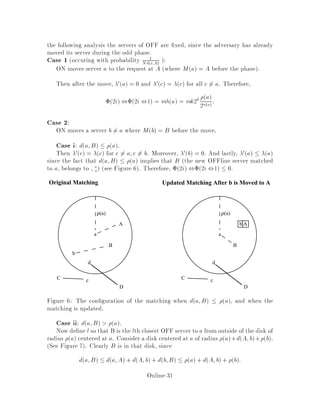
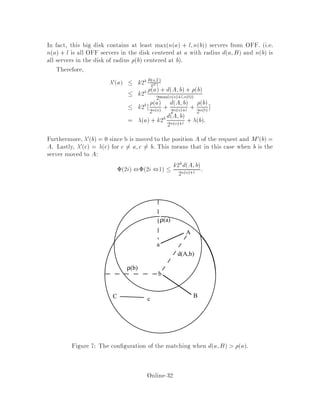
When during an even phase a server in ON is movedfrom vertexb to the position
of the OFFline server A where a request occurs and with Ma = A, the matching is
updated by the following rule: If ON moves the server b which was originally matched
to server B from OFF, then M is updated according to Ma = B and Mb = A.
We can now de ne  by:
 =
X
x2ON
x
where for ,
OFF we de ne the radius by:
Rx;, = maxY 2,
dx;Y 
Online-28
and
x = k2k min
,
OFF

Rx;,
2j,j : Mx 2 ,

:
Also de ne ,
x to be the argmin of the term in the de nition of x.
Note that x  kdx;Mx for all x since 2j,j  2k and
Rx;,  dx;Mx for any , 3 Mx.
Two nal de nitions are:
x = Rx;,
x and nx = j,j:
So x = k2k x
2nx .
12.1.3 Why we Argue on Matchings
A smallexamplenow su ces to provide an intuitivefeeling for why matchings provide
a tool for measuringthe potential di erencebetweenON and OFF. Suppose that there
are seven servers positioned as shown in Figure 5. If the adversary consistently makes
requests to the poorly matched server on the right, then the adversary will pay 0 cost,
while Harmonic will keep paying until it moves a server from the left side of the
network. In the matching, one edge will be large, and so both Rx;,
x and x will
be large until such a move is made.
Figure 5: An example of a con guration of OFF's servers O's and ON's servers
X's. If the adversary requests at the unmatched OFFline server on the right, then
Harmonic eventually pays a high cost while the adversary pays 0.
12.1.4 Proof of Properties about 
Property 1
Initially ,
x = fxg so x = 0 which means x = 0 and 0 = 0: It is clear
that j  0.
Property 2
In an odd phase, the adversary moves a server in OFF by a distance di. Let 0x
be the value of  after the move. Then
0x  k2k R0x;,
x
2,x
Online-29
where ,
x is the value from before the move and:
R0x;,
x = maxY 2,x
d0x;Y
 maxY 2,x
fdx;Y g+ di
= Rx;,
x + di:
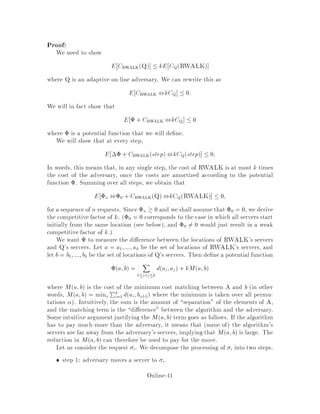
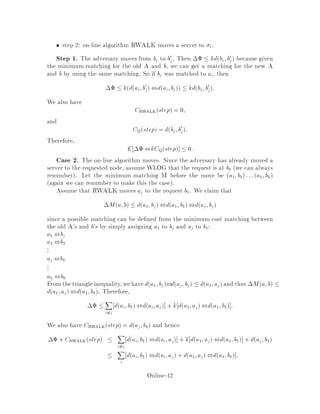
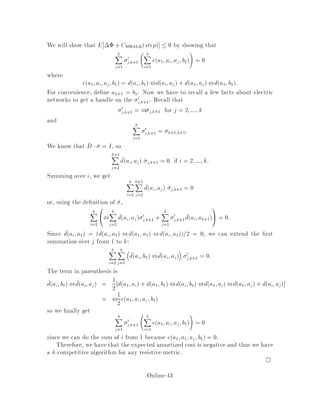
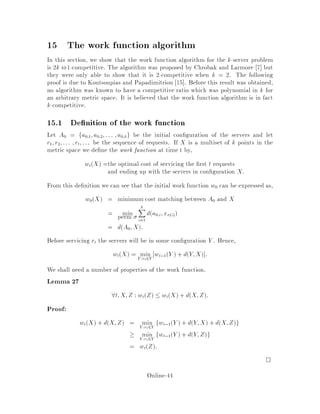
Note that the distance function is primed to indicate that Y may have moved
during the phase. However, the matching is not altered during an odd phase, so we
were able to use the same ,
x since Mx still belongs to ,
x.
Since j,
xj is at least one, we now can calculate that:
0x  k2k R0x;,
x
2j,xj
 x + k2k di
2j,xj
 x + k2k,1di:
Therefore,
2i ,1 ,2i ,2 = P
x2ON0x ,x
 kk2k,1di
 k22k,1di:
Property 3
We now need to show that E li +2i,2i,1  0: In the rest of this proof,
we shall be conditioning on P, the current position of the servers in ON and OFF.
Clearly, if the inequality is true while conditioning on P, then it will remain true
when we take the expectation over P. First consider what E lijP represents. It is the
expected distance that the server moved by Harmonic will have to travel. By the
de nition of Harmonic, we know that, given P, x 2 ON is moved with probability
1
Ndx;A.
Therefore,
E lijP = P
x2ON
1
Ndx;Adx;A
= k
N
since ON contains k servers.
So for  to satisfy property 3, we must show that
E 2i,2i ,1jP  ,E lijP = , k
N:
Because we are in an even phase, OFF already has a server at A. We will examine
the changes inthe matchingdepending on whichserverONmovesin order to approach
this problem. Each of the cases has a probability attached, and so the results of each
case can be used to determine an expected value for 2i ,2i ,1: Note that in
Online-30
the following analysis the servers of OFF are xed, since the adversary has already
moved its server during the odd phase.
Case 1 occuring with probability 1
Nda;A :
ON moves server a to the request at A where Ma = A before the phase.
Then after the move, 0a = 0 and 0c = c for all c 6= a. Therefore,
2i ,2i ,1 = ,a = ,k2k a
2na:
Case 2:
ON moves a server b 6= a where Mb = B before the move.
Case i: da;B  a:
Then 0c = c for c 6= a;c 6= b. Moreover, 0b = 0: And lastly, 0a  a
since the fact that da;B  a implies that B the new OFFline server matched
to a, belongs to ,
a see Figure 6. Therefore, 2i ,2i ,1  0.
a
A
b
B
d
D
C c
ρ(a)
Original Matching
a
Ab
B
d
D
C c
ρ(a)
Updated Matching After b is Moved to A
Figure 6: The con guration of the matching when da;B  a, and when the
matching is updated.
Case ii: da;B a:
Now de ne l so that B is the lth closest OFF server to a from outside of the disk of
radius a centered at a. Consider a disk centered at a of radius a+dA;b+ b.
See Figure 7. Clearly B is in that disk, since
da;B  da;A + dA;b+ db;B  a + dA;b+ b:
Online-31
In fact, this big disk contains at least maxna + l;nb servers from OFF. i.e.
na + l is all OFF servers in the disk centered at a with radius da;B and nb is
all servers in the disk of radius b centered at b.
Therefore,
0a  k2k Ra;,
2j,j
 k2k a + dA;b+ b
2maxna+l;nb
 k2k a
2na + dA;b
2na+l + b
2nb
= a + k2k dA;b
2na+l + b:
Furthermore, 0b = 0 since b is moved to the position A of the request and M0b =
A. Lastly, 0c = c for c 6= a;c 6= b: This means that in this case when b is the
server moved to A:
2i ,2i ,1  k2kdA;b
2na+l :
a
A
b
BC c
ρ(a)
ρ(b)
d(A,b)
Figure 7: The con guration of the matching when da;B a:
Online-32
12.1.5 The Expected Value for 2i ,2i ,1 Over All Cases
Weighting the three cases presented above by the probability of their occurences, we
have that:
E 2i ,2i ,1  1
Nda;A

,k2k a
2na
!
+
k,naX
l=1
1
NdA;bl

k2kdA;bl
2na+l
!
 k2k
N2na
2
4,1 +
k,naX
l=1
1
2l
3
5
= ,k
N geometric series
where bl is the server which before the move has Mb = B, where B is the lth closest
OFF server to a from outside the disk of radius a centered at a. Note that the
sum is to k ,na which is the number of OFF servers outside of the disk of radius
a centered at a.
This is the result we wanted.

12.1.6 The Intuition
Recall that x = k2k min,
Rx;,
2j,j = k2k A
2na :
Here is some intuition behind the use of the use of the exponential factor 2j,j. If
na is large then there are not many OFF servers outside of a so the 2na term is
large, making a smaller. On the other hand, if na is small, then there are many
OFF servers outside of the circle, and these contribute to a big potential function by
making 2k
2na big. These two cases correspond to the cost we could expect. If na is
large, then Harmonic will have a reasonably high probability of moving an ONline
server whose matched OFFline server is in the disk centered at a of radius a to
cover a request at A. This would result in a small expected cost. However, by a
similar argument, we would expect a larger expected cost if na is small.
13 A k-competitive, deterministic algorithm for
trees
The results of this section are due to Chrobak and Larmore 5 . Let V;E be a tree
an undirected graph without cycles with a positive distance function on each edge.
We view each edge, e; as an actual segment of length de. Let W denote the in nite
set of all points on all edges in E, and let requests be any points in W. The cost of
travelling from an endpoint of e to a non-vertex point in edge e will simply be the
fraction of de proportional to the location of the point from the end. The algorithm
presented will of course also apply to the discrete case where all requests are vertices.
Online-33
De nition 11 At any time, there is some request which we are trying to service.
We say that a server is active if there is no server located between it and . If there
are several servers located at the same point, with no servers located between them and
, we pick exactly one of them to be active. We can do this deterministically according
to some ordering of the servers if we like, calling the highest-priority server the active
one. Note that this de nition makes sense because the acyclic tree structure means
that there is exactly 1 path between any two points.
A
I
I
Request
A
A
A
Figure 8: Active servers are marked with an A, inactive ones with an I. Note that if
all servers move with a constant speed, the closest one at the bottom will reach the
request and the others will become inactive somewhere on the way to the request.
Our algorithm A is simple to describe: to service a request i, all active servers
move towards i at constant speed, each one stopping when one of the following is true
1. the server reaches the destination, i.
2. the server is eclipsed by another server and becomes inactive;
According to the second condition, a server that is active at the beginning of a
request might not be active later on in the request. As soon as a server sees another
server between it and i, it becomes inactive and stops moving.
13.1 Proof of k-competitiveness
We will use a potential function to show that, for any sequence 1; 2;::: of requests,
CA   kCMIN . Let t be the value of the potential function after the on-line
algorithm has processed t. Let ~t be the value of the potential function before the
on-line algorithm has processed t but after the o -line algorithm has processed it.
Suppose that the on-line servers are at postions s1;s2;::: ;sk and the o -line servers
are at positions a1;a2;::: ;ak. We de ne the potential funtion by
 =
X
i j
dsi;sj + kMs;a:
where Ms;a is the minimum cost matching between the on-line servers and the
o -line servers. i.e. Ms;a = min Pk
i=1 dai;s i where the minimumis taken over
Online-34
all permutations . Note that this is a potential function which often arises in the
analysis of algorithms for the k-server problem.
σ σ
a a
2 3
1 2
Φ Φ ΦΦ
1 1 2 2
σ1
Request is made
and an off-line
server is moved.
Server moved
by on-line
algorithm.
~ ~
Claim 23
~t ,t,1  kCMIN t;
t , ~t  ,CA t:
where A is the on-line algorithm. From this claim we can derive that t , t,1 
kCMIN t , CA t. If we take the sum over t then the left hand side telescopes
to give us  nal , 0  kCMIN  , CA . We know that 0   nal and so
CA   kCMIN  + 0. We assume that all of the on-line servers and all of the
o -line servers are initially at the same single point. This implies that 0 = 0 and
so CA   kCMIN . From this inequality we can see that the algorithm is k-
competitive. It only remains for us to prove the claim.
Proof of claim We rst consider what happens when the o -line algorithm moves
a server to the request. Choose so that Ms;a = Pk
i=1 dai;s i. Suppose that
the o -line algorithm chooses to move al to the request. Since none of the on-line
servers are moving P
i j dsi;sj does not change. Hence
~t ,t,1 = kMs;a  kdistance traveled by al to the request
= kCMIN t:
We now consider how  changes when the on-line algorithm moves its servers. Num-
ber the on-line servers so that s1;s2;::: ;sq are active and sq+1;::: ;sk are inactive.
Online-35
The active servers are all moving at the same speed towards the request. Suppose
that they all move a small distance . It is easy to see that without loss of generality
al is matched to an active server in the minimum cost matching. Recall that al is
the o -line server which is already at the request. Hence the distance between these
two servers decreases by . Also, the distance between other pairs of matching servers
increases by at most . Therefore,
M  q ,1 , = q ,2 :
We also have to consider the change in P
i j dsi;sj. Let
SI =
X
q i j
dsi;sj;
SIA =
X
iq j
dsi;sj;
SA =
X
i jq
dsi;sj:
Then,
SA = ,2

q
2
!
= 2 qq ,1
2 = , qq ,1;
SIA = k ,q ,q ,1  = k ,q 2 ,q;
SI = 0:
The rst equation comes from the fact that each pair of active servers move towards
each other by a distance ,2 . The second is true because there are k , q inactive
servers, each of which has one active server moving away from it and q , 1 mov-
ing towards it. From the above equations we derive that P
i j dsi;sj increases by
k ,q2 ,q ,qq ,1 . Hence
  k ,q2 ,q,qq ,1 + kq ,2
= ,q :
Now q is the cost incurred by the on-line algorithm when it moves its q active servers
a distance . Hence t , ~t  ,CA t which is the inequality that we were trying
to prove.
13.2 Paging as a case of k-server on a tree
Note that a special case of the k-server problem on a tree is paging. Create M
tree-vertices corresponding to the pages of main slow memory, create one dummy
tree-vertex, v, and connect v to all the other M vertices using edges of length 1
2.
Note that the cost of moving a server from one page to another is 1
2 + 1
2, the cost of
Online-36
1
2
V i
_
Figure 9: Paging as a special case of the k-server problem on a tree.
swapping. More generally, we could let the length of the edge from v to page i be
any positive function fi, obtaining the Generalized Paging problem, where the cost
of swapping pages i and j is fi + fj.
Let us consider the behavior of the above algorithm A on this special case. The
resulting algorithm for paging is known as Flush-When-Full. The interpretation
is simple if one keeps track of marked pages. When a server is at a vertex corre-
sponding to a page p, this page is considered marked. As soon as the server leaves
that vertex to go towards v, the page will be unmarked.
Initially there are k servers on k pages. These pages are thus marked. Suppose
request i causes the rst page fault. Algorithm A will then move all servers towards
v, resulting in the unmarking of all pages in fast memory. All these servers move at
constant speed towards v and thus will reach the middle vertex v at the same time.
One arbitrarily selected server at v will continue to the requested page i and the
other k ,1 will become inactive. The page i will then be marked. Later, if there is
a page fault on say j and there is at least one server at vertex v, one of these active
servers will be moved to j. In terms of paging, this is interpreted as swappping j
with an arbitrarily selected unmarked page of fast memory and then marking j. The
claim of the previous section implies that Flush-When-Full is k-competitive.
Of course we don't have to move more than one server per step. We could pre-
tend to movesserverssimultaneouslybut actually just keeptrack of where the servers
should be by keeping track of which pages of fast memory are marked and move one
server to the request-destination per step. The cost per step would be the the total
distance travelled by that server since the last time it reached a request-destination.
This way the cost per page-fault is always exactly one.
Flush-When-Full is much like Marking, except that Marking uses ran-
domization to select a server at a tie. Flush-When-Full is k-competitive while
Marking is Hk-competitive against an oblivious adversary. This shows how use-
ful a simple randomization step can be. Flush-When-Full applies to Generalized
Paging and is the only known k-competitive algorithm for that problem.
Question: Could LRU be an example of Flush-When-Full? Yes, it is. In other
words, LRU would never get rid of a marked page and thus, by carefully selecting
which unmarked page to remove from fast memory, Flush-When-Full reduces to
Online-37
LRU. To see that a marked page is never removed from fast memory by LRU, notice
that each marked page has been requested after the last request to any unmarked
page.
14 Electric Network Theory
We will use electric network theory for a randomized k-server algorithm due to Cop-
persmith, Doyle, Raghavan, and Snir 8 . Their algorithm will be k-competitive
against an adaptive on-line adversary for a subclass of metrics.
An electric network is a graph G = V;E such that each edge has weight e =
1
Re, where Re 2 R+ is called the resistance and e 2 R+ is called the conductance
of edge e. We can then ask what the e ective resistance also called the equivalent
resistance between any two vertices is, i.e. the resistance which is felt when applying
a di erence of voltage between any two vertices. The e ective conductance is the
inverse of the e ective resistance.
For resistances in series, the e ective resistance between the endpoints is equal to
the sum of the resistances. For resistances in parallel, the e ective conductance is
equal to the sum of the conductances. See Figures 10 and 11. In general, though,
these rules are not enough to determine the e ective resistance between any two
vertices in an electric network consider the case when the underlying graph is the
complete graph K4 on 4 vertices. In full generality, one has to use Kircho 's rst
law and the relation V = RI. Simply stated, the rst law says that the sum of the
currents entering a junction is equal to the sum of the currents leaving that junction.
k l
r r r1 2 x
Figure 10: Resistance in series. The e ective resistance between k and l is r1 + r2 +
:::+ rx.
k
r
r
1
2
l
ry
Figure 11: Resistances in parallel. The e ective conductance between k and l is
1
r1
+ 1
r2
+ :::+ 1
ry .
Online-38
De nition 12 A distance matrix D = dij is resistive if it is the e ective resistance
matrix of some electric network G, G = V;E.
Now let us use the e ective resistance as a metric. This is justi ed by the following
proposition.
Proposition 24 If D is resistive then D is symmetric and D satis es the triangle
inequality dij + djk  dik 8i;j;k.
The converse of this proposition is not necessarily true. A metric does not necessarily
induce a resistive distance matrix. In fact, there are metric spaces on four points that
aren't resistive. Satisfying the triangle inequality isn't enough.
Metrics which correspond to resistive distance matrices will be referred to as
resistive.
What are resistive matrices or resistive metrics? Here are two simple examples.
1. if D is 3 3, symmetric, and satis es the triangle inequality, then it is always
resistive. Hence, the above proposition is true in the converse for 33 matrices.
As an example, consider a triangular network with e ective resistances 3, 4,
and 5. See gure 12. We claim that the edge-resistances are 3
11, 2
11 and 1
11 see
gure. We verify it for the vertices 1 and 3. Consider the two paths between
these vertices. We need the e ective resistance to be 4, and thus the e ective
conductance to be 1
4. Verify that
2
11 +

1
11
3 + 11
1
!
= 11
44 = 1
4
2. a tree metricis resistive. To see this, makea tree of resistances with Rij = di;j
along the edges of the tree. Because there are no cycles, every pair of points is
connected by a series of resistances. The e ective resistance is the sum of the
edge-resistances.
11
11
11
_
_
_ 2
1
3
1
2 3
1
32
3 4
5
Figure 12: The given matrix of e ective resistances left is relabelled right as the
corresponding electrical network with resistances.
Another property of resistive metrics is given by the following lemma.
Online-39
Lemma 25 If D is resistive then any induced submatrix D0 is resistive.
How can we compute an array of conductances from D? We will not go through
the proof here, but the outline of the algorithm is as follows:
Assume D is n  n. Construct an n , 1 n ,1 matrix D such that dij =
d1i + d1j ,dij=2  0 for 2  i;j  n.
Let  = D,1.
Let ij = ,ij for i 6= j, 2  i;j  n.
Let P
j6=i ij = ii for 2  i  n. This allows us to determine i1 and 1i.
Let ii = 0 for 1  i  n.
If D is resistive, the above procedure yield a matrix of non-negative conduc-
tances.
14.1 The Algorithm: RWALK
Consider the following algorithm for the k-server problem. We have servers at
a1 :::ak, and we get a request at ak+1. Consider the distance matrix D0 among
these k +1 elements. Assuming D0 is resistive, calculate 0 and then move the server
at ai to the request with probability
Prai ! ak+1 =
0
i;k+1
P
1jk
0
j;k+1
Notice that a shorter distance corresponds to a higher conductance which in turn
corresponds to a higher probability. Thus, this algorithm is intuitivelycorrect because
we are more likely to move a server close to the request.
Theorem 26 If every induced subgraph on k + 1 points is resistive, then RWALK
is k-competitive against an adaptive on-line adversary.
Two important cases covered by this theorem are:
k-server with k = 2. RWALK can be used and is thus 2-competitive.
k-server on a tree. We know that D0 will always be resistive by Lemma 25 and
henceRWALK can be used. The theoremshows that RWALK is k-competitive
in this case.
Online-40
Proof:
We need to show
E CRWALKQ  kE CQRWALK
where Q is an adaptive on-line adversary. We can rewrite this as
E CRWALK ,kCQ  0:
We will in fact show that
E  + CRWALK ,kCQ  0
where  is a potential function that we will de ne.
We will show that at every step,
E + CRWALKstep ,kCQstep  0:
In words, this means that, in any single step, the cost of RWALK is at most k times
the cost of the adversary, once the costs are amortized according to the potential
function . Summing over all steps, we obtain that
E n ,0 + CRWALKQ ,kCQRWALK  0;
for a sequence of n requests. Since n  0 and we shall assume that 0 = 0, we derive
the competitive factor of k. 0 = 0 corresponds to the case in which all servers start
initially from the same location see below, and 0 6= 0 would just result in a weak
competitive factor of k.
We want  to measure the di erence between the locations of RWALK's servers
and Q's servers. Let a = a1;:::;ak be the set of locations of RWALK's servers, and
let b = b1;:::;bk be the set of locations of Q's servers. Then de ne a potential function
a;b =
X
1i jk
dai;aj + kMa;b
where Ma;b is the cost of the minimum cost matching between A and b in other
words, Ma;b = min Pk
i=1 dai;b i where the minimum is taken over all permu-
tations . Intuitively, the sum is the amount of separation of the elements of A,
and the matching term is the di erence between the algorithm and the adversary.
Some intuitive argument justifying the Ma;b term goes as follows. If the algorithm
has to pay much more than the adversary, it means that some of the algorithm's
servers are far away from the adversary's servers, implying that Ma;b is large. The
reduction in Ma;b can therefore be used to pay for the move.
Let us consider the request i. We decompose the processing of i into two steps.
step 1: adversary moves a server to i.
Online-41
step 2: on-line algorithm RWALK moves a server to i.
Step 1. The adversary moves from bj to b0
j. Then   kdbj;b0
j because given
the minimum matching for the old A and b, we can get a matching for the new A
and b by using the same matching. So if bj was matched to ai, then
  kdai;b0
j ,dai;bj  kdbj;b0
j:
We also have
CRWALKstep = 0;
and
CQstep = dbj;b0
j:
Therefore,
E ,kCQstep  0:
Case 2. The on-line algorithm moves. Since the adversary has already moved a
server to the requested node, assume WLOG that the request is at b1 we can always
renumber. Let the minimum matching M before the move be a1;b1:::ak;bk
again we can renumber to make this the case.
Assume that RWALK moves aj to the request b1. We claim that
Ma;b  da1;bj ,da1;b1 ,daj;bj
since a possible matching can be de ned from the minimum cost matching between
the old A's and b's by simply assigning a1 to bj and aj to b1:
a1 ,bj
a2 ,b2
...
aj ,b1
...
ak ,bk
Fromthetriangle inequality,wehaveda1;bj,daj;bj  da1;aj and thus Ma;b 
da1;aj ,da1;b1. Therefore,
 
X
i6=j
dai;b1 ,dai;aj + k da1;aj ,da1;b1 :
We also have CRWALKstep = daj;b1 and hence
 + CRWALKstep 
X
i6=j
dai;b1 ,dai;aj + k da1;aj ,da1;b1 + daj;b1

X
i
dai;b1 ,dai;aj + da1;aj ,da1;b1 :
Online-42
We will show that E + CRWALKstep  0 by showing that
kX
j=1
0
j;k+1
 kX
i=1
ea1;ai;aj;b1
!
= 0
where
ea1;ai;aj;b1 = dai;b1 ,dai;aj + da1;aj ,da1;b1:
For convenience, de ne ak+1 = b1. Now we have to recall a few facts about electric
networks to get a handle on the 0
j;k+1. Recall that
0
j;k+1 = ,j;k+1 for j = 2;:::;k
and kX
j=1
0
j;k+1 = k+1;k+1:
We know that D   = I, so
k+1X
j=2
dai;aj j;k+1 = 0 if i = 2;:::;k:
Summing over i, we get
kX
i=2
k+1X
j=2
dai;aj j;k+1 = 0
or, using the de nition of ,
kX
i=2
0
@,
kX
j=2
dai;aj 0
j;k+1 +
kX
j=1
0
j;k+1 dai;ak+1
1
A = 0:
Since dai;a1 = dai;a1 , da1;a1 , dai;a1=2 = 0, we can extend the rst
summation over j from 1 to k:
kX
i=2
kX
j=1

dai;b1 , dai;aj
 0
j;k+1 = 0:
The term in parenthesis is
dai;b1 , dai;aj = 1
2 da1;ai + da1;b1 ,dai;b1 ,da1;ai ,da1;aj + dai;aj
= ,1
2ea1;ai;aj;b1
so we nally get
kX
j=1
0
j;k+1
 kX
i=1
ea1;ai;aj;b1
!
= 0
since we can do the sum of i from 1 because ea1;a1;aj;b1 = 0.
Therefore, we have that the expected amortized cost is negative and thus we have
a k-competitive algorithm for any resistive metric.

Online-43
15 The work function algorithm
In this section, we show that the work function algorithm for the k-server problem
is 2k ,1-competitive. The algorithm was proposed by Chrobak and Larmore 7 but
they were only able to show that it is 2-competitive when k = 2. The following
proof is due to Koutsoupias and Papadimitriou 15 . Before this result was obtained,
no algorithm was known to have a competitive ratio which was polynomial in k for
an arbitrary metric space. It is believed that the work function algorithm is in fact
k-competitive.
15.1 De nition of the work function
Let A0 = fa0;1;a0;2;::: ;a0;kg be the initial con guration of the servers and let
r1;r2;::: ;rt;::: be the sequence of requests. If X is a multiset of k points in the
metric space we de ne the work function at time t by,
wtX =the optimal cost of servicing the rst t requests
and ending up with the servers in con guration X.
From this de nition we can see that the initial work function w0 can be expressed as,
w0X = minimum cost matching between A0 and X
= minperm
kX
i=1
da0;i;x i
= dA0;X:
Before servicing rt the servers will be in some con guration Y . Hence,
wtX = minY :rt2Y
wt,1Y  + dY;X :
We shall need a number of properties of the work function.
Lemma 27
8t;X;Z : wtZ  wtX + dX;Z:
Proof:
wtX + dX;Z = minY :rt2Y
fwt,1Y  + dY;X + dX;Zg
 minY :rt2Y
fwt,1Y  + dY;Zg
= wtZ:

Online-44
Lemma 28
8t;X : wtX = minx2X
fwt,1X ,x + rt + drt;xg:
Proof:
 This is obvious since if we take Y = X ,x + rt then dY;X = drt;x.
 Take the optimum Y in the de nition of wtX. Let x be the element of X
which is matched to rt in the minimum cost matching between X and Y . Let
Y 0 = X ,x+ rt. Then,
wt,1Y  + dY;X = wt,1Y  + dY;Y 0 + dx;rt
 wt,1Y 0 + dx;rt by lemma 27
 minx2X wt,1X ,x + rt + dx;rt:

Lemma 29
8t;X : wtX  wt,1X:
Proof:
wtX = wt,1Y  + dY;X for some Y
 wt,1X by lemma 27:

Lemma 30
8X : rt 2 X  wtX = wt,1X:
Proof:
From lemma 28 with x = rt we get wtX  wt,1X. Together with lemma 29
this implies the result. 
Lemma 31
8t;X : wtX = minx2X
fwtX ,x + rt + drt;xg:
Proof:
This is immediate from lemmas 28 and 30. 
Online-45
15.2 De nition of the work function algorithm
Let At,1 be the con guration of the on-line servers before rt is requested. When the
request comes in the work function algorithm moves a 2 At,1 which minimizes
wt,1At,1 ,a + rt + da;rt:
i.e. At  At,1 ,a + rt where
a := argmina2At,1 fwt,1At,1 ,a + rt + da;rtg:
Note that wt,1At,1 , a + rt + da;rt = wtAt,1. Hence if we were to move the
servers to At,1 after serving request rt then we would move the server at rt to a. The
work function algorithm does this move backwards.
For analysis purposes we assume that the on-line servers and the o -line servers
nish at the same position. If this is not the case we can repeatedly request points
where there is an o -line server but no on-line one. This does not increase the o -line
cost. It is clear from the above de nition that the on-line cost of serving rt is da;rt.
If rf is the nal request then the total o -line cost of serving all the requests is,
wfAf =
fX
t=1
wtAt ,wt,1At,1 :
We de ne the o -line pseudocost of serving request rt to be wtAt , wt,1At,1.
We then de ne the extended cost of serving request rt to be the sum of the o -line
pseudocost and the on-line cost. i.e.
extended cost = wtAt ,wt,1At,1 + da;rt:
But, by de nition of the work function algorithm, wtAt,1 = wt,1At + da;rt.
Hence,
extended cost = wtAt,1 ,wt,1At,1
 maxX fwtX ,wt,1Xg:
Note that the above equation gives an upper bound for the extended cost which is
independent of the algorithm or the location of the servers. The de nition of extended
cost means that if
extended cost  c + 1 o -line cost
then the work-function algorithm is c-competitive. We shall show that
extended cost  2k  o -line cost;
proving the desired competitive ratio.
Our next goal is to de ne a potential function w. We shall then show that, at
every request, the increase of the potential function is lower bounded by the extended
Online-46
cost and that the total increase of the potential function is upper bounded by 2k times
the o -line cost. More formally, we will show that
wt ,wt,1  maxX fwtX ,wt,1Xg;
wf  2kwfAf + c:
For this purpose, we shallneed a betterunderstanding of maxX fwtX ,wt,1Xg.
The following lemma is useful. Koutsoupias and Papadimitriou show a generalization
of this lemma which they call quasiconvexity.
Lemma 32
8t;8A;B;8a2 A;9b 2 B : wtA+ wtB  wtA ,a + b+ wtB ,b + a:
Proof:
By induction on t. When t = 0, wtX = w0X = dA0;X for all con gurations
X. Let a0 be the element of A0 which is matched with a in the minimum cost
matching between A and A0. Let b be the element of B which is matched with a0 in
the minimum cost matching between A0 and B. Then,
w0A+ w0B = dA0;A+ dA0;B
= dA0 ,a0;A,a + dA0 ,a0;B ,b + da0;a + da0;b
 dA0;A,a + b+ dA0;B ,b + a
= w0A,a + b+ w0B ,b + a:
Now assume that the lemma is true for t ,1. Then by lemma 28,

9x 2 A : wtA = wt,1A,x + rt + dx;rt;
9y 2 B : wtB = wt,1B ,y + rt + dy;rt:4
If a = x then let b = y. By de nition of wt,
wtA,x + y  wt,1A ,x + rt + dy;rt;
wtB ,y + x  wt,1B ,y + rt + dx;rt:
Hence,
wtA ,x + y + wtB ,y + x  wtA + wtB:
If a 6= x then a 2 A ,x + rt. Using the inductive hypothesis on A , x + rt and
B ,y + rt, 9b 2 B ,y + rt :
wt,1A,x + rt + wt,1B ,y + rt  wt,1A,x + rt ,a + b + wt,1B ,y + rt ,b + a
5
But,

wtA ,a+ b  wt,1A,a + b ,x + rt + dx;rt;
wtB ,b + a  wt,1B ,b + a ,y + rt + dy;rt:6
Finally, 4, 5 and 6 imply the lemma. 
Online-47
De nition 13 A is called a minimizer of the point a with respect to wt if A minimizes
wtA,P
x2A da;x.
We can rede ne maxX fwtX ,wt,1Xg as
maxX

wtX ,
X
x2X
dx;rt ,wt,1X ,
X
x2X
dx;rt

:
A minimizerof rt with respectto wt,1 would thus maximizethe second term. The next
lemma shows somewhat surprisingly that such a minimizer would in fact maximize
the entire expression.
Lemma 33 Assume that A is a minimizer of rt with respect to wt,1. Then wtA,
wt,1A = maxX fwtX ,wt,1Xg.
Proof:
We need to show that,
8B : wtA + wt,1B  wt,1A + wtB:
This is equivalent to,
8a 2 A : wt,1A,a+rt+da;rt+wt,1B  minb2B
fwt,1B ,b + rt + db;rt + wt,1Ag:
By assumption,
wt,1A,
X
x2A
dx;rt  wt,1A,a + b ,
X
y2A,a+b
dy;rt;
or,
wt,1A+ db;rt  wt,1A ,a+ b + da;rt:
Hence we only need to show that,
wt,1A,a + rt + wt,1B  minb2B
fwt,1B ,b + rt + wt,1A ,a + bg:
But by lemma 32, rt 2 A ,a + rt  9b 2 B :
wt,1A,a + rt + wt,1B  wt,1A ,a + b + wt,1B ,b + rt:

Lemma 34 Assume that A is a minimizer with respect to wt,1. Then A is also a
minimizer with respect to wt.
Online-48
Proof:
We need to show that,
8B : wtA ,
X
a2A
da;rt  wtB ,
X
b2B
db;rt;
or, for all y 2 B,
minx2A

wt,1A,x + rt + dx;rt ,
X
a2A
da;rt

 wt,1B,y+rt+dy;rt,
X
b2B
db;rt:
Since A is a minimizer of rt with respect to wt,1,
wt,1A ,
X
a2A
da;rt  wt,1B ,x+ y ,
X
b2B+x,y
db;rt;
or,
wt,1A + dx;rt ,
X
a2A
da;rt  wt,1B + x,y ,
X
b2B
db;rt + dy;rt:
Now rt 2 B ,y + rt, hence by lemma 32,
9x 2 A : wt,1A,x + rt + wt,1B ,y + x  wt,1A + wt,1B ,y + rt;
which implies that
wt,1A ,x + rt + dx;rt ,
X
a2A
da;rt  wt,1B ,y + rt + dy;rt ,
X
b2B
db;rt:

15.3 De nition of the potential function
We de ne the potential function as follows.
wt = minU
8
:kwtU +
kX
i=1
minBi
0
@wtBi ,
kX
j=1
duj;bij
1
A
9
=
;:
Thus Bi is a minimizer of ui with respect to wt.
Lemma 35 We can assume that rt 2 U when trying to minimize the above expres-
sion.
Proof:
By lemma 31,
wtU = wtU ,ul + rt + drt;ul for some ul.
Online-49
By the triangle equality,
drt;ul ,dul;bij  ,drt;bij:7
Let U0 = U ,ul + rt.
wt = minU0
8
:
kwtU0 + Pk
i=1;i6=l minBi


wtBi ,Pk
j=1 dui;bij

+ minBl


wtBl + Pk
j=1 ,dul;blj + drt;ul

:
8
But by 7,
,
kX
j=1
dul;blj + drt;ul  ,
kX
j=1
drt;blj:
Substituting this inequality into 8 gives us the required result. 
Let U;B1;B2;::: ;Bk attain the minimum in the de nition of wt. The above
lemmameans that we can assumert = ul. Hencewe can assume that Bl is a minimizer
of rt with respect to wt. Therefore by lemma 34 we can take Bl to be a minimizer of
rt with respect to wt,1. Let A = Bl. By defeinition of , we derive that
wt,1  kwt,1A +
kX
i=1
0
@wt,1Bi ,
kX
j=1
dui;bij
1
A:
Therefore, by Lemmas 29 and 32, we obtain
wt ,wt,1  wtA ,wt,1A = maxX
fwtX ,wt,1Xg:
Summing over all requests, we obtain that the total extended cost is at most wf,
w0.
We only need to upper bound this quantity in terms of the o -line cost. Let
U = Af;Bi = Af where Af is the nal location of the o -line or on-line servers.
This gives us,
wf  kwfAf + kwfAf ,
X
a2Af;b2Af
da;b
 2kwfAf:
Hence if we let c = w0 constant dependent only on the initial con guration, not
the request sequence then,
total extended cost  2kwfAf + c:
By the remarks following the de nition of extended cost this means that the work
function algorithm is 2k ,1-competitive.
Online-50
References
1 L. Belady. A study of replacement algorithms for virtual storage computers.
IBM Syst. J., 5:78 101, 1966.
2 S. Ben-David, A. Borodin, R. Karp, G. Tardos, and A. Wigderson. On the power
of randomization in on-line algorithms. Algorithmica, 11:2 14, 1990.
3 P. Berman, H. Karlo , and G. Tardos. A competitive three-server algorithm. In
Proceedings of the 1st ACM-SIAM Symposium on Discrete Algorithms, 1990.
4 M. Chrobak and L. Larmore. On fast algorithms for two servers. Journal of
Algorithms, 12:607 614, 1991.
5 M. Chrobak and L. Larmore. An optimal on-line algorithm for k-servers on trees.
SIAM Journal on Computing, 201:144 148, February 1991.
6 M. Chrobak and L. Larmore. HARMONIC is 3-competitive for 2 servers. The-
oretical Computer Science, 98:339 346, 1992.
7 M. Chrobak and L. Larmore. The server problemand on-line games. In D. Sleator
and L. McGeoch, editors, On-line algorithms, volume 7 of DIMACS Series in
Discrete Mathematics and Theoretical Computer Science, pages 11 64. AMS,
1992.
8 D. Coppersmith, P. Doyle, P. Raghavan, and M. Snir. Random walks on weighted
graphs, and application to on-line algorithms. Journal of the ACM, 40:421 453,
1993. A preliminary version appeared in the Proceedings of the 22nd STOC,
369 378, 1990.
9 A. Fiat, R. M. Karp, M. Luby, L. A. McGeoch, D. D. Sleator, and N. E. Young.
Competitive paging algorithms. Journal of Algorithms, 12:685 699, 1991.
10 A. Fiat, Y. Rabani, and Y. Ravid. Competitive k-server algorithms. In Pro-
ceedings of the 31st Annual Symposium on Foundations of Computer Science,
1990.
11 E. Grove. The harmonic online k-server algorithm is competitive. In Proceedings
of the 23rd Annual ACM Symposium on Theory of Computing, pages 260 266,
May 1991.
12 S. Irani and R. Rubinfeld. A competitive 2-server algorithm. Information Pro-
cessing Letters, 39:85 91, 1991.
13 D. Johnson. Fast algorithms for bin packing. Journal of Computer and System
Sciences, 8:272 314, 1974.
Online-51
14 J. M. Kleinberg. On-line algorithms for robot navigation and server problems.
Master's thesis, MIT, Cambridge, MA, 1994.
15 E. Koutsoupias and C. Papadimitriou. On the k-server conjecture. In Proceedings
of the 26th Annual ACM Symposium on Theory of Computing, pages 507 511,
1994.
16 M. Manasse, L. McGeoch, and D. Sleator. Competitive algorithms for server
problems. Journal of Algorithms, 11:208 230, 1990.
17 L. McGeoch and D. Sleator. A strongly competitive randomized paging algo-
rithm. Algorithmica, 6:816 825, 1991.
18 P. Raghavan and M. Snir. Memory vs. randomization in on-line algorithms. In
Proceedings of the 1989 ICALP Conference, 1989.
19 D. Sleator and R. Tarjan. Amortized e ciency of list update and paging rules.
Communications of the ACM, 282:202 208, 1985.
20 A. Yao. New algorithms for bin packing. Journal of the ACM, 27:207 227, 1980.
Online-52
18.415 6.854 Advanced Algorithms September 1994
Randomized Algorithms
Lecturer: Michel X. Goemans
1 Introduction
We have already seen some uses of randomization in the design of on-line algorithms.
In these notes, we shall describe other important illustrations of randomized algo-
rithms in other areas of the theory of algorithms. For those interested in learning
more about randomized algorithms, we strongly recommend the forthcoming book
by Motwani and Raghavan. 9 . First we shall describe some basic principles which
typically underly the construction of randomized algorithms. The description follows
a set of lectures given by R.M. Karp 7 .
1. Foiling the adversary. This does not need much explanation since this was
the main use of randomization in the context of on-line algorithms. It applies to
problems which can be viewed as a game between the algorithm designer and
the adversary. The adversary has some payo function running time of the
algorithm,cost of solution produced byalgorithm, competitiveratio, ... and the
algorithm designer tries to minimize the adversary's payo . In this framework
randomization helps in confusing the adversary. The adversary cannot predict
the algorithm's moves.
2. Abundance of witnesses. Often problems are of the type does input have
property p? for example. Is n composite?. Typically the property of inter-
est can be established by providing an object, called a witness. In some cases,
nding witnesses deterministically may be di cult. In such cases randomiza-
tion may help. For example if there exists a probability space where witnesses
are abundant then a randomized algorithm is likely to nd one by repeated
sampling. If repeated sampling yields a witness, we have a mathematical proof
that the input has the property. Otherwise we have strong evidence that the
input doesn't have the property, but no proof. A randomized algorithm which
may return an incorrect answer is called a Monte-Carlo algorithm. This is in
contrast with a Las Vegas algorithm which is guaranteed to return the correct
answer.
3. Checking an identity
For example,givena function of severalvariables fx1;::: ;xn, is fx1;::: ;xn 
0? One way to test this is to generate a random vector a1;::: ;an and evaluate
fa1;::: ;an. If its value is not 0, then clearly f 6 0.
Random-1
Suppose we can generate random vectors a1;::: ;an under some probability
distribution so that
P = Pr fa1;::: ;an = 0jf 6 0 1
2;
or any other constant bounded away from 1. Then we can determinewhether or
not f  0 with high probability. Notice that this is a special case of category 2,
since in this probability space, vectors a for which fa1;::: ;an 6= 0 constitute
witnesses.
4. Random ordering of input
The performance of an algorithm may depend upon the ordering of input data;
using randomization this dependence is removed. The classic example is Quick-
sort, which takes On2 time in the worst case but when randomized takes
Onlgn expected time, and the running time depends only on the coin tosses,
not on the input. This can be viewed as a special case of category 1. Notice that
randomized quicksort is a Las Vegas algorithm; the output is always correctly
sorted.
5. Fingerprinting
This is a technique for representing a large object by a small ngerprint. Under
appropriate circumstances, if two objects have the same ngerprint, then there
is strong evidence that they are identical.
An example is the randomized algorithm for pattern matching by Karp and
Rabin 8 . Suppose we are given a string of length n such as
randomizearandomlyrandomrandomizedrandom
and a pattern of size m such as random. The task is to nd all the places the
pattern appears in the long string.
Let us rst describe our model of computation. We assume a simpli ed version
of the unit-cost RAM model in which the standard operations +;,;;=; ;=
take one unit of time provided they are performed over a eld whose size is
polynomial in the input size. In our case, the input size is On + m = On
and thus operations on numbers with Ologn bits take only one unit of time.
A naive approach is to try starting at each location and compare the pattern
to the m characters starting at that location; this takes Onm time in our
model of computation we cannot compare two strings of m characters in O1
time unless m = Ologn. The best deterministic algorithm takes On + m
time, but it is complicated. There is, however, a fairly simple On + m time
randomized algorithm.
Say that thepattern X isa string of bitsx1;::: ;xm and similarlyY = y1;::: ;yn.
We want to compare X, viewed as a number to Yi = yi;::: ;yi+m,1. This would
Random-2
normally take Om time, but it can be done much more quickly by computing
ngerprints and comparing those. To compute ngerprints, choose a prime p.
Then the ngerprint of X is hX = X mod p and similarly hYi = Yi mod p.
Clearly hX 6= hYi  X 6= Yi. The converse is not necessarily true. Say that
we have a false match if hX = hYi but X 6= Yi. A false match occurs i p
divides jX ,Yij.
We show that if p is selected uniformly among all primes less than some thresh-
old Q then the probability of a small match is small. First how many primes p
divide jX,Yij? Well, since every prime is at least 2 and jX,Yij  2m, we must
have at most m primes dividing jX,Yij. As a result, if p is chosen uniformly at
random among fq : q prime and q  Qg then Pr hX = hYijX 6= Yi  m
Q,
where n denotes the number of primes less or equal to n. Thus, the proba-
bility that there is a false match for some i is upper bounded by n times m
Q.
Since n is asymptotically equal to n=lnn, we derive that this probability is
Olnn
n  if Q = n2m. This result can be re ned by using the following lemma
and the fact that there is a false match for some i if p divides Q
i jX,Yij  2nm.
Lemma 1 The number of primes dividing a  2n is at most n + O1.
The re ned version is the following:
Theorem 2 If p is chosen uniformly at random among fq : q prime and q  n2mg,
then the probability of a false match for some i is upper bounded by 2+O1
n .
The ngerprint has only lgn2m bits, much smaller than m. Operations on the
ngerprints can be done in O1 time in our computational model.
The advantage of this approach is that it is easy to compute hYi+1 from hYi
in O1 time:
Yi+1 = 2Yi + yi+m ,2myi
hYi+1 = 2hYi + yi+m ,2myi mod p:
One then checks if the ngerprints are equal. If they are, the algorithm claims
that a match has been found and continues. To reduce the probability of failure,
one can repeat the algorithm with another prime or several other primes and
ouput only those who were matches for all primes tried. This is thus a Monte
Carlo algorithm whose running time is On + m.
This algorithm can easily be transformed into a Las Vegas algorithm. Whenever
there is a potential match i.e. the ngerprints are equal, we compare X and
Yi directly at a cost of Om. The expected running time is now On + m +
km + nm2
n = Okm + n, where k denotes the number of real matches.
Random-3
6. Symmetry breaking
This is useful in distributed algorithms, but we won't have much to say about
it in this class. In that context, it is often necessary for several processors
to collectively decide on an action among several seemingly indistinguishable
actions, and randomization helps in this case.
7. Rapidly mixing Markov chains
These are useful for counting problems, such as counting the number of cycles in
a graph, or the number of trees, or matchings, or whatever. First, the counting
problem is transformed into a sampling problem. Markov chains can be used
to generate points of a given space at random, but we need them to converge
rapidly | such Markov chains are called rapidly mixing. This area is covered
in details in these notes.
2 Randomized Algorithm for Bipartite Matching
We now look at a randomized algorithm by Mulmuley, Vazirani and Vazirani 10 for
bipartite matching. This algorithm uses randomness to check an identity.
Call an undirected graph G = V;E bipartite if 1 V = A B and A B = ;,
and 2 for all u;v 2 E, either u 2 A and v 2 B, or u 2 B and v 2 A. An example
of a bipartite graph is shown in Figure 1.
AAAA BBBB
Figure 1: Sample bipartite graph.
A matching on G is a collection of vertex-disjoint edges. A perfect matching is a
matching that covers every vertex. Notice that we must have jAj = jBj.
We can now pose two problems:
1. Does G have a perfect matching?
2. Find a perfect matching or argue that none exists.
Both of these problems can be solved in polynomial time. In this lecture we show
how to solve the rst problem in randomized polynomial time, and next lecture we'll
Random-4
cover the second problem. These algorithms are simpler than the deterministic ones,
and lead to parallel algorithms which show the problems are in the class RNC. RNC
is Randomized NC, and NC is the complexity class of problems that can be solved
in polylogarithmic time on a number of processes polynomial in the size of the input.
No NC algorithm for either of these problems is known.
The Mulmuley, Vazirani and Vazirani randomized algorithm works as follows.
Consider the adjacency matrix A on graph G = V;E whose entries aij are de ned
as follows:
aij =

1 if i;j 2 E
0 otherwise1
where the indicesi and j correspond to verticesof the vertexsets Aand B respectively.
There exists a perfect matching in the graph G if and only if the adjacency matrix
contains a set of n 1's, no two of which are in the same column or row. In other
words, if all other entries were 0 a permutation matrix would result.
Consider the function called the permanent of A, de ned as follows:
permA =
X
permutations
 nY
i=1
ai i
!
:2
This gives the number of perfect matchings of the graph A represents. Unfortunately
the best known algorithm for computing the permanent has running time On2n.
However, note the similarity of the formula for computing the permanent to that for
the determinant of A:
detA =
X
permutations
sign 
 nY
i=1
ai i
!
:
The determinant can be computed in On3 time by using Gaussian elimination and
in Olog2n time on On3:5 processors. Note also that:
detA 6= 0  permA 6= 0 , 9 perfect matching:
Unfortunately the converse is not true.
To handle the converse, we replace each entry aij of matrix A with aijxij, where
xij is a variable. Now both detA and permA are polynomials in xij. It follows
detA  0 , permA  0 ,6 9 perfect matching:
A polynomial in 1 variable of degree n will be identically equal to 0 if and only if it
is equal to 0 at n+1 points. So, if there was only one variable, we could compute this
determinant for n + 1 values and check whether it is identically zero. Unfortunately,
we are dealing here with polynomials in several variables.
So to test whether detA  0, we will generate values for the xij and check if the
resulting matrix has detA = 0 using Gaussian elimination. If it is not 0, we know
the determinant is not equivalent to 0, so G has a perfect matching.
Random-5
Theorem 3 Let the values of the xij be independently and uniformly distributed in
1;2;::: ;2n , where n = jAj = jBj. Let A0 be the resulting matrix. Then
Pr detA0 = 0jdetA 6 0  1
2:
It follows from the theorem that if G has a perfect matching, we'll nd a witness in
k trials with probability at least 1 ,1=2k.
In fact, this theorem is just a statement about polynomials. We can restate it as
follows:
Theorem 4 Let fx1;::: ;xn be a multivariate polynomial of degree d. Let xi be
independently and uniformly distributed in f1;2;::: ;2dg. Then
Pr fx1;::: ;xn 6= 0jf 6 0  1
2:
This theorem can be used for other problems as well.
Instead of proving this theorem we'll prove a stronger version which can be used
for the second problem, that of nding the perfect matching.
Consider assigning costs cij cij 2 N to the edges i;j 2 E. De ne the cost of a
matching M as:
cM =
X
i;j2M
cij:
Now, consider the matrix A with entries aijwij, where wij = 2cij. Then:
permA =
X
M
2cM
and
detA =
X
M
signM2cM:
If a unique minimum cost matching with cost c exists then detA will be nonzero
and, in fact, it will be an odd multiple of 2c
.
We will prove that if we select the costs according to a suitable probability dis-
tribution then, with high probability, there exists a unique minimum cost matching.
Let cij be independent, identically distributed random variables with distribution
uniform in the interval 1;::: ;2m , where m = jEj. The algorithm computes detA
and claims that there is a perfect matching if and only if detA is nonzero. The only
situation in which this algorithm can err is when there is a perfect matching, but
detA = 0: This is thus a Monte-Carlo algorithm. The next theorem upper-bounds
the probability of making a mistake.
Theorem 5 Assume that there exists a perfect matching in G. Then the probability
that we will err with our algorithm is at most 1
2:
Random-6
If a higher reliability is desired then it can be attained by running multiple passes,
and only concluding that there is no perfect matching if no pass can nd one.
Proof:
We need to computePr detA = 0 . Though this quantityis di cult to compute,
we can fairly easily nd an upper bound for it. As we have seen previously,
Pr detA = 0 = 1 ,Pr detA 6= 0
 1 ,P
where
P = Pr 9 unique minimum cost matching :
Indeed, if there is a unique minimum cost matching of cost say c then detA is an
odd multiple of 2c
and, hence, non-zero. The following claim completes the proof.
Claim 6 P  1
2
Given a vector c, de ne dij to be the maximum value for cij such that
i;j is part of some minimum cost matching.
We can then draw the following inferences:
8
:
cij dij  i;jis not part of ANY minimumcost matching
cij = dij  i;jis part of SOME minimumcost matching
cij dij  i;jis part of EV ERY minimumcost matching
Thus, ifcij 6= dij for alli;j  9auniqueminimumcost matching M.
Moreover, this matching is given by M = fi;j j cij dijg.
4 3
2
5
86
2
a
b
c
e
f
d
Figure 2: Example graph for dij computations.
Figure 3 shows an example of a bipartite graph with the values of cij
assigned. Notice that in this graph c = 9. Consider the edge c;f. The
cheapest perfect matching not containing c,f has a cost of 6+8+5 = 19.
The other edges in the perfect matching containing c;f have a total
Random-7
cost of 7, so dcf = 12. Thus, it is in every perfect matching. dad = 5 =
4+3+2,2,2 = cad. Thus it is in some minimumcost matching. Finally,
dce = ,2 = 9,6,5 cce, so c;e is not in any minimumcost matching.
Therefore,
Pr uniqueminimumcost matching  Pr cij 6= dij for all i;j
= 1 ,Pr cij = dij for some i;j
 1 ,
X
i;j2E
Pr cij = dij
 1 ,m  1
2m
= 1
2:
The equation in the next to last line is justi ed by our selection of
m = jEj and the fact that dij is independent of cij, so that the probability
of cij being equal to the particular value dij is either 1
2m i dij is in the
range 1;::: ;2m or 0 otherwise. 

Notice that if we repeat the algorithm with new random cij's, then the second
trial will be independent of the rst run. Thus, we can arbitrarily reduce the error
probability of our algorithm, since the probability of error after t iterations is at most
1
2
t
.
Also, note that, in the proof, we do not make use of the assumption that we are
working with matchings. Thus, this proof technique is applicable to a wide class of
problems.
2.1 Constructing a Perfect Matching
In order to construct a perfect matching, assume that there exists a unique minimum
cost matching which we have shown to be true with probability at least 1
2 with cost
c. The determinant of A will then be an odd multiple of 2c
. By expanding the
determinant along row i, it can be computed by the following formula:
X
j
2cijaijdetAij3
where Aij is the matrix created by removing column i and row j from the matrix A
See gure 3, and the sign depends on the parity of i+j. The term in the summation
above will be an odd multiple of 2c
if i;j 2 M and an even multiple otherwise. So,
we can reconstruct a perfect matching M by letting:
M =
n
i;j j 2cijdetAij is an odd multipleof 2co
:4
Random-8
i
j
Figure 3: The Matrix Aij. The matrix Aij is formed by removing the ith column and
the jth row from the matrix A.
Note that c can be obtained since 2c
is the largest power of 2 in detA.
The algorithm we have presented can be seen to be in RNC since a determinant
can be computed in RNC.
We can apply a similar algorithm for solving the following related matching prob-
lem:
Given:
A bipartite graph G,
A coloring for each edge in G of either red or blue,
an integer k,
nd a perfect matching with exactly k red edges.
However, in contrast to the problem of nding any perfect matching, it is not known
whether this problem is in P or even NP-complete. For this problem, de ne the
entries aij of the matrix A as follows:
aij =
8
:
0 if i;j 62 E
wij if i;j isblue
wijx if i;j isred
5
where x is a variable. Both the permanent of A and the determinant of A are now
polynomials in one variable, x, and we wish to know the coe cients ck of xk. If all wij
were 1, ck would represent the number of perfect matchings with exactly k red edges.
If there does exist a perfect matching with k red eges, then Prck = 0  1
2 by the
same argument we derived the probability that detA = 0 when a perfect matching
Random-9
exists, since we can always decompose the determinant into a sum of products of
matrices with xk.
We can now compute all the ck by computing the determinant of A in n + 1
di erent points and interpolating from that data to compute the coe cients.
3 Markov Chains
A lot of recent randomized algorithms are based on the idea of rapidly mixing Markov
chains. A Markov chain is a stochastic process, i.e. a random process that evolves
with time. It is de ned by:
A set of states that we shall assume to be nite 1;::: ;N.
A transition matrix P where the entry pij represents the probability of moving
to state j when at state i, i.e. pij = Pr Xt+1 = j j Xt = i , where Xt is a random
variable denoting the state we are in at time t.
2
1
3
5
4
0.3
0.1
0.4
0.2
Figure 4: A Markov Chain.
Figure 4 partially illustrates a set of states having the following transition matrix:
P =
0
BBBBBB@
0 0 1 0 0
0:4 0:3 0:1 0 0:2
0 0:5 0 0 0:5
0:2 0:8 0 0 0
0:1 0:1 0:1 0:1 0:6
1
CCCCCCA
6
The transition matrix P satis es the following two conditions and any such matrix
is called stochastic:
P  0
X
j
pij = 1 for all i.
Random-10
Suppose we are given an initial probability distribution 0 where we denote
PrX0 = i by 0
i . Then,
1
j = PrX1 = j
=
X
i
PrX1 = j j X0 = iPrX0 = i
=
nX
i=1
pij 0
i ;
i.e.
1 = 0 P:
Repeating this argument, we obtain
s = 0 Ps:
Here, s represents the distribution after s steps. Therefore, the matrix Ps is the
so-called s-step transition matrix. Its entries are ps
ij = Pr Xt+s = j j Xt = i .
De nition 1 A Markov Chain is said to be ergodic if lims!1ps
ij = j 0 for all j
and is independent of i.
In this case,
P1 = lims!1 Ps
=
2
664
1 ::: j ::: n
... ... ...
1 ::: j ::: n
3
775
Hence,  is independent of the starting distribution 0:
 = 0 P1:
Any vector  which satis es P =  and P
i i = 1 is called a stationary distribu-
tion.
Proposition 7 For an ergodic MC,  is a stationary distribution, and moreover it
is the unique stationary distribution.
Proof:
We have already shown that 0P = 1 which implies
P1 = lims!1 Ps+1 = lims!1 PsP = P1 P
Random-11
Since 0P1 =  for any probability distribution 0, we have 0P1 = 0P1P
which implies P = . Since P  1 = 1 where 1 is the vector of 1's, we derive that
P1 1 = 1, which says that P
i i = 1.
The reason why there is a unique stationary distribution is simply because by
starting from another stationary distribution, say ~, we always remain in this distri-
bution implying that ~ = . 
Proposition 7 gives an easy way to calculate the limiting distribution of an
ergodic Markov chain from the transition matrix P. We just solve the linear system
of equations P = , P
i i = 1.
4 Ergodicity and time reversibility
Theorem 8 An MC is ergodic if and only if both of the following are true:
1. it is irreducible. That is, the underlying graph consisting of states and tran-
sitions with positive probabilities on them is strongly connected. Formally, for
all i and j there is s such that ps
ij 0.
2. the chain is aperiodic. That is, you cannot divide states into subgroups so that
you must go from one to another in succession. Formally,
gcdfs : ps
ij 0g = 1
for all i and j.
De nition 2 An ergodic MC is called time reversible TR if the chain remains
a Markov chain when you go backwards. More formally, if  is the stationary
distribution, then
ipij = jpji
for all pairs of states i and j or, in words, the expected or ergodic ow from i to j
equals the expected ow from j to i.
Proposition 9 Consider an ergodic MC. Suppose there exists such that the bal-
ance conditions are satis ed: ipij = jpji;8i;j and also, P
i i = 1. Then is the
stationary distribution, and clearly, the MC is TR.
Clearly the MC in Figure 5 is ergodic strong connectivity i.e., irreducibilityand
aperiodicity are obvious. It is clear that there exists a stationary distribution, and
we can easily guess one. Consider 1 = 1
3 and 2 = 2
3. Since one can easily verify that
 satis es the balance conditions,  must be the stationary distribution and the MC
is time-reversible.
Consider an ergodic MC which is also symmetric pij = pji as in Figure 6. Then
the stationary distribution is i = 1
N , where N is the number of states.
In these notes, we shall consider MC's that are ergodic and symmetric, and there-
fore, have a uniform stationary distribution over states.
Random-12
1 2
1/2 3/4
1/2
1/4
Figure 5: An example of an MC with a stationary distribution.
1 2
3
1/2
1/4
1/61/4
1/3
1/3
5/12
1/4
1/2
Figure 6: A symmetric ergodic MC.
Random-13
5 Counting problems
Suppose you would like to count the number of blue-eyed people on a planet. One
approach is to take some sort of census, checking everyone on the planet for blue
eyes. Usually this is not feasible. If you know the total number of people on the
planet, then you could take a sample in such a way that every person has the same
probability of being selected. This would be a uniformly selected sample of size n out
of a universe of size N. Let Y be the random variable representing the number of
individuals in this sample that have the property blue eyes, in our example. Then
we can infer that the total number of individuals with this property is approximately
Y N
n .
If the actual number of individuals with the property is pN, then we have a
Bernoulli process with n trials and success probability p. The random variable Y has
a Binomial distribution with parameters n;p. We are interested in nding out how
close Y
n is to p, and to do this we can use Cherno bounds, which are exponentially
decreasing on the tail of the distribution. Since Cherno bounds are quite useful, we
will digress for a while and derive them in some generality.
Lemma 10 Let Xi be independent Bernoulli random variables with probability of
success pi. Then, for all 0 and all t 0, we have
Pr
 nX
i=1
Xi t

 e, t
nY
i=1
E
h
e Xi
i
= e, t
nY
i=1
pie + 1 ,pi:
Proof:
Pr
 nX
i=1
Xi t

= Pr
h
e
Pn
i=1 Xi e t
i
for any 0. Moreover, this can be written as Pr Y a with Y  0: From
Markov's inequality we have
Pr Y a  E Y
a
for any nonnegative random variable. Thus,
Pr Pn
i=1 Xi t  e, tE
h
e
P
i Xi
i
= e, t Qn
i=1 E
h
e Xi
i
because of independence.
The equality then follows from the de nition of expectation. 
Setting t = 1 + E P
i Xi for some 0 and = ln1 + , we obtain:
Corollary 11 Let Xi be independent Bernoulli random variables with probability of
success pi, and let np = E Pn
i=1 Xi = Pn
i=1 pi. Then, for all 0, we have
Pr
 nX
i=1
Xi 1 + np

 1 + ,1+ np
nY
i=1
E
h
1 + Xi
i


e
1 + 1+ 
np
:
Random-14
The second inequality of the corollary follows from the fact that
E
h
1 + Xi
i
= pi1 +  + 1 ,pi = 1 + pi  e pi:
For in the range 0;1, we can simplify the above expression and write the
following more classical form of the Cherno bound:
Theorem 12 Cherno bound Let Xi be independent Bernoulli random variables
with probability of success pi, let Y = Pn
i=1 Xi, and let np = Pn
i=1 pi. Then, for
1 0, we have
Pr Y ,np np  e, 2np=3:
For other ranges of , we simply have to change the constant 1=3 appropriately
in the exponent.
Similarly, we can write a Cherno bound for the probability that Y is below the
mean.
Theorem 13 Cherno bound Let Xi be independent Bernoulli random variables
with probability of success pi, let Y = Pn
i=1 Xi, and let np = Pn
i=1 pi. Then, for
1 0, we have
Pr Y ,np np 

e
1 , 1, 
np
 e, 2np=2:
The last upper bound of e, 2=2 can be derived by a series expansion.
Let us go back to our counting problem. We can use Theorems 12 and 13 to see
what sample size n we need to ensure that the relative error in our estimate of p
is arbitrarily small. Suppose we wish to impose the bound Pr
n
jY
n ,pj p
o
 .
Imposing e, 2np=3  2, we derive that we can let the number of samples to be
n = 3
2p log 2:
Notice that n is polynomial in 1, log 1, and 1
p. If p is exponentially small, then this
may be a bad approach. For example, if we were trying to count the number of
American citizens who have dodged the draft, have become President of the country
and who are being sued for sexual harassment, we would need an exponential number
of trials.
These notions can be formalized as follows. Suppose we would like to compute an
integral number fx x represents the input.
De nition 3 An fpras fully polynomial randomized approximation scheme for fx
is a randomized algorithm which given x and outputs an integer gx such that
Pr

gx ,fx
fx 

 3
4
and runs in time polynomial in the size of the input x and in 1.
Random-15
Thus repeated sampling can be used to obtain an fpras if we can view fx as the
number of elements with some property in a universe which is only polynomially
bigger, and if we can sample uniformly from this universe. Notice that the running
time is assumed to be polynomial in 1. If we were to impose the stronger condition
that the running time be polynomial in ln 1 then we would be able to compute
fx exactly in randomized polynomial time whenever the size of the universe is
exponential in the input size simply run the fpras with equal to the inverse of the
size of the universe.
Going back to our original counting problem and assuming that p is not too small,
the question now is how to draw a uniformlyselectedindividualon the planet or more
generally a uniformly generated element in the universe under consideration. One
possible approach is to use a Markov chain where there is one state for each individual.
Assuming that each individual has at most 1000 friends, and that friendship is
symmetric, we set the transition probability from an individual to each of his friends
to be 1
2000. Then if an individual has k friends, the transition probability to himself
will be 1 , k
2000  1
2, implying that the chain is aperiodic.
If the graph of friendship is strongly connected everyone knows everyone else
through some sequence of friends of friends then this MC is ergodic, and the station-
ary distribution is the uniform distribution on states.
Recall that
lims!1 Ps = P1 =
0
BBBB@
1  j  n
1  j  n
... ... ... ... ...
1  j  n
1
CCCCA
If this limit converges quickly, we can simulate the MC for a nite number of steps
and get close to the stationary distribution. Therefore, it would be useful for us to
know the rate of convergence to the stationary distribution if we want to use Markov
chains to approximately sample for a distribution.
It turns out that the rate of convergence is related to the eigenvalues of the
transition matrix, P. Given a stochastic matrix P recall that P is stochastic if
it is nonnegative and all row sums are 1 with eigenvalues 1;::: ;N, we have the
following.
1. All jij  1. Indeed, if Pei = ei then Psei = sei, and the fact that the LHS
is bounded implies that the RHS must also be.
2. Since P is stochastic, 1 = 1 P1 = 1.
3. The MC is ergodic i jij 1 for all i 6= 1.
4. If P is symmetric then all eigenvalues are real.
Random-16
5. if P is symmetric and stochastic then if pii  1
2 for all i then i  0 for all i.
Indeed, if we let Q = 2P , I, then Q is stochastic. Hence, the ith eigenvalue
for Q, Q
i = 2i ,1, but j2i ,1j  1 implies that 0  i  1.
6. Speed of convergence
The speed of convergence is dictated by the second largest eigenvalue. For
simplicity, suppose P has N linearly independent eigenvectors. Then P can be
expressed as A,1DA where D is the diagonal matrix of eigenvalues Dii = i.
And
P2 = A,1DAA,1DA = A,1D2A;
or, in general,
Ps = A,1DsA
=
NX
i=1
s
iMi
= M1 +
NX
i=2
s
iMi
where Mi is the matrix formed by regrouping corresponding terms from the ma-
trixmultiplication. Ifthe MC is ergodic, then for i 6= 1, i 1, so lims!1 s
i = 0
implying M1 = P1. Then Ps , P1 = PN
i=2 s
iMi is dominated by the term
corresponding to max = maxi6=1 jij. More generally,
Theorem 14 Consider an ergodic time-reversible MC with stationary distribution .
Then the relative error after t steps is
 = maxi;j
jpt
ij ,jj
j
 t
max
minj j
:
In particular, for an ergodic symmetric chain with pii  1
2, we have 1 2  ::: 
N  0, so max = 2.
Corollary 15 For an ergodic symmetric MC with pii  1
2, the relative error  
if t  logN= 
log1=2.
Returning to our example: In order to calculate how many iterations are needed
until we are arbitrarily close to the uniform distribution , we need to evaluate the
second eigenvalue. For this purpose, Jerrum and Sinclair 11 have derived a rela-
tionship between the so-called conductance of the MC and max. Their result can be
viewed as an isoperimetric inequality, and its derivation is analogous to an isoperi-
metric inequality of Cheeger 4 for Riemannian manifolds, or results on expanders
by Alon 1 and Alon and Milman 2 .
Random-17
6 Conductance of Markov chainsJerrum-Sinclair
Given a set S of states, let CS denote the capacity of S, which is the probability of
being in some state in S when steady-state is reached. Speci cally,
CS =
X
i2S
i:
De ne FS, the ergodic ow out of S expected ow so that
FS =
X
i2S;j62S
ipij;
summing over transitions from S to the complement of S, S. Clearly FS  CS.
De ne S = FS=CS, which is the probability of leaving S given that we are already
in S. De ne the conductance of the MC
 := min
S:CS1
2
S:
Intuitively, if we have an MC with small conductance, then once we are in a set S,
we are stuck in S for a long time. This implies that it will take a long time to
reach the stationary distribution, so the rate of convergence will be small. We might
therefore expect that 2 will be close to 1 if the conductance is small.
Theorem 16 Jerrum-Sinclair 11  For an ergodic MC that is TR, we have
2 1 ,2=2:
Remark 1 There exist corresponding lower bounds expressing that   t
2 and 2 
1 , 2. This therefore shows that the conductance is an appropriate measure of the
speed of convergence.
7 Evaluation of Conductance of Markov Chains
Given a markov chain, the task will be to evaluate the conductance . In order to
generate Markov chains with a uniform steady state distribution and rapidly mix-
ing property, we restrict our attention to the following MC: symmetric and equal
transition probability p between states having a transition i.e. for all i 6= j, either
pij = pji = 0 or pij = pji = p. Therefore, it will have a uniform steady state distri-
bution i = 1=N, where N denotes the number of states. Instead of looking at the
MC, we can look at the underlying graph G = V;E, E = fi;j : pij = pji = pg.
For a set S of states, let S = fi;j 2 E : i 2 S;j 62 Sg, then,
CS =
X
i2S
i = 1
NjSj;
Random-18
FS =
X
i2S;j62S
ipij = p  1
Nj Sj;
S = FS
CS
= pj Sj
jSj :
De nition 4 The magni cation factor of G is
G = min
0 jSjjV j
2
j Sj
jSj :
Therefore,
 = minS
S = p  G:
In the rest of this section, we study the conductance of a simple MC, which will
be useful in the problem of counting matchings. Take a MC on states that are all
binary numbers with d bits so that the underlying graph is a d-cube with 2d states.
Two nodes are adjacent only if they di er by exactly one bit. Refer to Figure 7 for a
3-cube.
000 001
100 101
010 011
110 111
Figure 7: A 3-cube Markov chain.
If we put probabilities of 1
2d on all out-transitions then the self loops get probabil-
ities 1
2. The MC is symmetric and ergodic, so i = 1
2d . If we simulate a random walk
on this d-cube, we obtain a random d-bit number.
Claim 17 The magni cation factor of the d-cube G = 1.
Proof:
Random-19
1. G  1.
Let S1 be a vertex set of half cube e.g. all vertices with state numberstarting
with 0. Then clearly, every vertex in S1 will have exactly one edge incident to
it leaving S1. Therefore, j S1j = jS1j = jVj
2 , and
G = min
0 jSjjV j
2
j Sj
jSj  j S1j
jS1j = 1:
2. G  1.
For all x1;x2, de ne a random path between x1 and x2 selected uniformlyamong
all shortest paths between x1 and x2. For example, for
x1 = 1 0 1 1 0 1 0
x2 = 1 0 0 1 1 1 1
we rst look at the bits in which they di er 3rd, 5th and 7th. The order in
which you change these bits determines a or all shortest path in the d-cube.
Given e 2 E, by symmetry,
E  of paths through e = 1
jEj T;
where T is the total length of all shortest paths. We can compute this by rst
choosing x1 2d choices, sum up all the paths from x1from length 1 to d. For
any path p, we count it twice: x1 ! x2 and x2 ! x1. Thus,
T = 1
2 2d
dX
k=0

d
k
!
k:
This can also be written as T = 1
2  2d Pd
k=0

d
k

d , k. Taking the average of
these two expressions, we deduce that
T = 1
2 d2d
dX
k=0

d
k
!
= d22d,2:
On the other hand, jEj = 1
22d d. Hence,
E  of paths through e = T
jEj = d22d,2
d2d,1 = 2d,1:
Consider any set S. By linearity of expectations,
E  of paths intersecting S 
X
e2 S
E  of paths through e = 2d,1j Sj:
Random-20
However, the number of paths crossing S should be at least jSj  jSj. This
implies that
jSjjSj  E  of paths through S = 2d,1 j Sj:
Since jSj  jVj
2 , jSj  jVj
2 = 2d,1. Therefore, for any set S,
j Sj
jSj  jSj
2d,1  1:
So, G  1.

This gives us the conductance of the corresponding MC:  = p G = 1
2d. Then
2  1 , 2
2 = 1 , 1
8d2 . The steady-state distribution is j = 1
2d for all j. Thus, the
relative error after t steps is
 = maxi;j
pt
ij ,j
j
 t
2
minj j
 2d
1 , 1
8d2

t
:
If we want   , we shall choose t such that:
t  dln2 ,ln
,ln1 , 1
8d2 
 8d2 dln2 ,ln :
In this case, although the MC has an exponential number of states 2d, we only
need Od3 steps to generate an almost uniform state with say constant or even as
small as e,Od.
In general, let M be an ergodic, time reversible Markov chain with eqn states,
where qn is a polynomial in n n represents the size of the input. If its conductance
  1
pn, where pn is a polynomial in n, we will say that it has the rapidly mixing
property. The relative error after t steps is
t  t
2
minj j
 1 , 2
2 t
eqn  ;
To get t  , we only need to take t = 2p2n


qn + ln 1

steps, a polynomial
number in n and ln 1.
Thus a rapidly-mixing MC with uniform stationary distribution with state space
M can be used as an -sampling scheme on M:
De nition 5 A fully polynomial -sampling scheme also called an -generator for
a set M is an algorithm that runs in time polysize of input, ln 1, and outputs an
element x 2 M with probability x such that
maxx2M
x, 1
jMj  jMj:
Random-21
M is typically given implicitly by a relation i.e. on input x, M is the set of
strings y satisfying some relation x;y .
8 Approximation by sampling
We now sketch how an -sampling scheme can be used to develop a randomized
approximation algorithm for the counting problem we discussed before. To evaluate
jMj, rst we immerse M into a larger set V 
 M. Then we sample from V , and
approximate jMj
jVj by
size of M sample
size of sample :
This scheme works well if jMj is polynomially comparable to jV j. But if jMj jV j
i.e. jMj exponentially smaller than jV j, this scheme will have trouble, since in order
to obtain a small relative error in the approximation, the number of samples will
need to be so large i.e. exponential as to make this approach infeasible. See our
previous discussion for the problem of counting individuals, and our study of Cherno
bounds.
Example: Suppose we wish to approximate . If we take a square with side-
length 2 and we inscribe within it a circle of radius 1, then the ratio of the area of
the circle to the area of the square is =4. Thus the probability that a uniformly
generated point in the square belongs to the circle is precisely =4.
Figure 8: How not to calculate .
By generating points within the square at random according to a uniform distri-
bution, we can approximate  as simply 4 times the fraction of points that lie within
the circle. The accuracy of such an approximation depends on how closely we can
approximate the uniform distribution and on the number of samples. However, we
will run into trouble if we want to estimate volBn by using the same method, where
Bn = fx 2 Rn : jjxjj  1g, since the volume is exponentially smaller than the vol-
ume of the corresponding cube 2n. Nevertheless, a very nice application of rapidly
mixing markov chains is precisely in the computation of the volume of a convex body
or region 6 . To avoid the problem just mentioned, what is done is to immerse the
body whose volume V0 needs to be computed in a sequence of bodies of volumes V1,
Random-22
V2, :::, such that Vi=Vi+1 is is polynomially bounded. Then one can evaluate V0 by
the formula:
V0
Vn
= V0
V1
 V1
V2
 V2
V3
 Vn,1
Vn
:
We now show how this technique can be used to develop a fully polynomial ran-
domized approximation scheme for computing the permanent of a class of 0-1 matri-
ces.
9 Approximating the permanent
Recall that for an nn 0-1 matrix A, the permanent of A, permA, is the number of
perfect matchings in the bipartite graph G whose incidence matrix is A. It is known
that computing permA is P-complete.
In order to develop an approximation scheme for the permanent, we use the tech-
nique of approximation by sampling. As a naive adoption of this technique, we can
generate edge sets at random and count the fraction that are perfect matchings. Un-
fortunately, this scheme may resemble searching for a needle in a haystack. If the
fraction of edge sets that are perfect matchings is very small, then in order to obtain
a small relative error in the approximation, the relative error in the sampling may
need to be so small and the number of samples may need to be so large as to make
this approach infeasible.
Instead of trying to directly approximate the fraction of edge sets that are perfect
matchings, we can try to approximate a di erent ratio from which the permanent can
be computed. Speci cally, for k = 1;2;::: ;n, let Mk denote the set of matchings
with size k, and let mk = jMkj denote the number of matchings with size k. The
permanent of A is then given by permA = mn, and we can express permA as the
product of ratios:
permA = mn
mn,1
mn,1
mn,2
 m2
m1
m17
m1 = jEj. Thus, we can approximate the permanent of A by approximating the
ratios mk=mk,1 for k = 2;3;::: ;n. We write mk=mk,1 as
mk
mk,1
= uk
mk,1
,18
where uk = jUkj and Uk = Mk Mk,1 see Figure 9, and then we use an -sampling
scheme for Uk to approximate the fraction mk,1=uk. To summarize our approach, for
each k = 2;3;::: ;n, we take random samples over a uniform distribution on the set
of matchings of size k and k,1, and we count the fraction that are matchings of size
k , 1; this gives us mk,1=uk, and we use Equation 8 to get mk=mk,1. Equation 7
then gets us permA.
The following two claims establish the connection between -sampling of Uk and
approximation of the permanent of A.
Random-23
Mk
Mk−1
Uk
Figure 9: Each matching in Uk has size either k or k ,1.
Claim 18 Broder If there is a fully polynomial -sampling scheme for Uk = Mk
Mk,1, then there exists a randomized approximation scheme for mk=mk,1 that runs
in time that is polynomial in the values 1= , n, and uk=mk.
Claim 19 If for each k = 2;3;::: ;n, there is a fully polynomial -sampling scheme
for Uk, then there exists a randomized approximation scheme for the permanent of A
that runs in time that is polynomial in the values 1= , n, and maxkuk=mk.
For those graphs with maxkuk=mk bounded by a polynomial in n, Claim 19
gives us a fully polynomial randomized approximation scheme for the permanent |
provided, of course, that we can produce an -sampling scheme for Uk. In fact, it
turns out that
maxk
uk
mk
= un
mn
:
This is because fmkg is log-concave i.e. mkmk+2  m2
k+1. Thus, if we can develop
an -sampling scheme for the matchings Uk for each k = 2;3;::: ;n, then for the
class of graphs with un=mn bounded by a polynomial in n, we have an fpras for the
permanent. After developing an -sampling scheme, we will look at such a class of
graphs.
An -sampling scheme for matchings
We now turn our attention to developing an -sampling scheme for Uk = Mk Mk,1,
and it should come as no surprise that we will use the technique of rapidly mixing
Markov chains.
We now de ne a Markov chain whose states are matchings in Uk. Consider any
pair Mi;Mj of states matchings and create a transition between them according to
the following rules:
IfMi and Mj di er bythe addition or removalof a singleedge, that is, Mi4Mj =
feg for some edge e, then there is a transition from Mi to Mj and a transition
Random-24
from Mj to Mi. Both transitions have probability pij = pji = 1=2m where m
denotes the number of edges in the graph. Mi4Mj = Mi ,Mj Mj ,Mi
If Mi and Mj are both matchings of size k , 1 and they di er by removing
one edge and adding another edge that has an endpoint in common with the
removed edge, that is, Mi;Mj 2 Mk,1 and Mi4Mj = fu;v;v;wg for some
pair of edges u;v and v;w, then there is a transition from Mi to Mj and a
transition from Mj to Mi. Both transitions have probability pij = pji = 1=2m.
To complete the Markov chain, for each state Mi, we add a loop transition from Mi
to itself with probability pii set to ensure that P
j pij = 1.
It is easy to see that this Markov chain is ergodic since the self-loops imply aperi-
odicity, and irreducibility can be seen from the construction. Irreducibility implicitly
assumes the existence of some matching of size k; otherwise the chain might not be
irreducible. The proof of irreducibility indeed stems on the fact that any matching of
size k can reach any matching of size k,1, implying that one can reach any matching
from any other matching provided a matching of size k exists. This Markov chain
is time reversible and has the desired uniform steady state probability distribution,
i = 1=uk, since it is clearly symmetric. Furthermore, pii  1=2 for each state Mi,
and therefore, max = 2 which means that we can bound the relative error after t
steps by:
t  uk

1 , 2
2
!t
:
Finally, this Markov chain also has the property that pij = p = 1=2m for every
transition with i 6= j, and this property allows us to compute  by:
 = 1
2m H
where we recall that H is the magni cation of the underlying graph H not the
graph G on which we are sampling matchings.
If we could now lower bound H by H  1=pn where pn is a polynomial
in n, then since m  n2, we would have   1=p0n p0n is also a polynomial in
n, and so we would have a fully polynomial -sampling scheme for Uk. We cannot
actually show such a lower bound, but the following theorem gives us a lower bound
of H  mk=cuk c is a constant, and this, by Claim 19, is su cient to give us a
randomized approximation scheme that is polynomial in 1= , n, and un=mn.
Theorem 20 Dagum, Luby, Mihail and Vazirani 5  There exists a constant
c such that
H  1
c
mk
uk
:
Corollary 21 There exists a fully polynomial -sampling scheme for Uk provided that
uk
mk
= Onc0
 for some c0.
Random-25
A preliminary lemma is required.
Lemma 22 Let M1;M2 be matchings in a bipartite graph. Then M14M2 is a union
of vertex disjoint paths and cycles which alternate between the edges of M1 and M2.
Sketch of the proof of main result: For each pair of states M1;M2 with M1 2 Mk,1
and M2 2 Mk, we pick a random path from M1 to M2 in H as follows. By lemma 22
we can write the symmetric di erence of the matchings M1 and M2 as
M14M2 = C D E
where each element of C denotes a cycle or path in G with the same number of edges
from M1 as from M2, each element of D denotes a path in G with one more edge
from M2 than from M1, and each element of E denotes a path in G with one more
edge from M1 than from M2. Notice that there must be exactly one more element
in D than in E. We order the paths in each set at random so C1;C2;::: ;Cr is a
random permutation of the r paths or cycles in C, D1;D2;::: ;Dq is a random
permutation of the q paths in D, and E1;E2;::: ;Eq,1 is a random permutation of
the q ,1 paths in E. A path from M1 to M2 in H is then given by:
M1
HHHHj
D1
M0 = M14D1
 E1
M00 = M04E1
...
HHHHj
Dq
M000
?C1
...
?Cr
M2
Of course, M1 ! M14D1 may not actually be a transition of the chain, but M1 !
M14D1 does de ne a path of transitions if we use the edges of D1 two at a time.
The crucial part of this proof is showing that there exists a constant c such that
for any edge e of H, the expected number of paths that go through e is upper bounded
by
E number of paths through e  cmk,1:
Random-26
We will not do this part of the proof. Now if we consider any set S
V of vertices
from H, by linearity of expectation, the expected number of paths that cross from S
over to S is upper bounded by
E number of paths crossing S  cmk,1 j Sj
where we recall that S denotes the coboundary of S. Therefore, there exists some
choice for the paths such that not more than cmk,1 j Sj of them cross the boundary
of S.
S S
Mk
Mk−1
Figure 10: Partitioning Uk.
Each vertex of S is either a matching of Mk or a matching of Mk,1 and likewise
for S, so we can partition Uk as shown in Figure 10. We assume, without loss of
generality, that
jS Mkj
jSj  mk
uk
;9
and therefore,
S Mk,1
S
 mk,1
uk
10
otherwise, we exchange S and S. The number of paths that cross S must be at least
jS MkjjS Mk,1j since for any M1 2 S Mk,1, M2 2 S Mk there must be a
path from M1 to M2 which crosses from S to S. By multiplying together Inequalities
9 and 10, we have
jS Mkj S Mk,1 
mkmk,1 jSj S
u2
k
:
Random-27
But we have already seen that we can choose paths so that the number of paths
crossing the boundary of S is not more than cmk,1 j Sj. Therefore, it must be the
case that
cmk,1 j Sj 
mkmk,1 jSj S
u2
k
:
Notice that this statement is unchanged if we replace S by S. So, without loss of
generality jSj  uk
2 which implies that S  uk
2 : Hence
mk
u2
k
jSj S  mk
uk
jSj
2
which implies that
j Sj
jSj  1
2c
mk
uk
H  1
2c
mk
uk
:
A class of graphs with un=mn polynomially bounded
We nish this discussion by considering a class of graphs for which un=mn is bounded
by a polynomial in n. Speci cally, we consider the class of dense bipartite graphs. A
dense bipartite graph is a bipartite graph in which everyvertex has degree at least n=2
recall that n is number of vertices on each side of the bipartition.
We now show that for dense bipartite graphs, mn,1=mn  n2. Since un=mn =
1+mn,1=mn, this bound gives us the desired result. Consider a matching M 2 Mn,1
with edges fu1;v1;u2;v2;::: ;un,1;vn,1g so that un and vn are the two exposed
vertices. Since both un and vn have degree at least n=2, there are the following two
possibilities.
un;vn is an edge which implies that M0 := M fun;vng 2 Mn:
There exists an i for 1  i  n,1 such that both un;vi and ui;vn are edges
this follows from the pigeonhole principle. In this case M0 := M ,fui;vig
fun;vi;ui;vng 2 Mn:
Thus we can de ne a function f : Mn,1 ! Mn by letting fM = M0:
Now consider a matching M0 2 Mn, and let f,1M0 denote the set of matchings
M 2 Mn,1 such that fM = M0. For each M 2 Mn,1 such that fM = M0, M
can be obtained from M0 in one of two di erent ways.
Some pair of edges ui;vi;uj;vj are removed from M0 and replaced with a
single edge that must be either ui;vj or uj;vi. We can choose the pair of
edges to remove in

n
2

ways and we can choose the replacement edge in at most
2 ways.
Random-28
An edge ui;vi is removed from M0. This edge can be chosen in n ways.
Thus, there are at most
2

n
2
!
+ n = nn ,1 + n = n2
matchings in Mn,1 that could possibly map to M0. This means that jf,1M0j  n2
for every matching M0 2 Mn, and therefore, mn,1=mn  n2.
Thus we have shown that for dense bipartite graphs, there exists a fullypolynomial
randomized approximation schemefor the permanent. This result is tight in the sense
that graphs can be constructed such that mn,1
mn is exponential and whose vertices have
degree  n
2 , : There is also a theorem of Broder which says that
Theorem 23 Counting perfect matchings on dense bipartite graphs is P-complete.
Other applications of Markov Chains
There are other uses for Markov Chains in the design of algorithms. Of these the
most interesting is for computing the volume of convex bodies. It can be shown
that a fully polynomial randomized approximation scheme may be constructed for
this problem 6 . This is interesting because it can also be shown that one cannot
even approximate the volume to within an exponential factor of ncn for c 0:5 in
polynomial time, where n is the dimension 3 .
References
1 N. Alon. Eigenvalues and expanders. Combinatorica, 6:83 96, 1986.
2 N. Alon and V. Milman. 1, isoperimetric inequalities for graphs and supercon-
centrators. Journal of Combinatorial Theory B, 38:73 88, 1985.
3 I. B
ar
any and Z. Furedi. Computing the volume is di cult. In Proceedings of the
18th Annual ACM Symposium on Theory of Computing, pages 442 447, 1986.
4 J. Cheeger. A lower bound for the smallestvalue of the Laplacian. In R. Gunning,
editor, Problems in analysis, pages 195 199. Princeton University Press, 1970.
5 P. Dagum, M. Mihail, M. Luby, and U. Vazirani. Polytopes, permanents and
graphs with large factors. In Proceedings of the 29th Annual Symposium on
Foundations of Computer Science, pages 412 422, 1988.
6 M. Dyer, A. Frieze, and R. Kannan. A random polynomial algorithm for ap-
proximating the volume of convex bodies. Journal of the ACM, pages 1 17,
1991.
Random-29
7 R. Karp. An introduction to randomized algorithms. Discrete Applied Mathe-
matics, 34:165 201, 1991.
8 R. M. Karp and M. O. Rabin. E cient randomizedpattern-matching algorithms.
IBM Journal of Research and Development, 31:249 260, 1987.
9 R. Motwani and P. Raghavan. Randomized Algorithms. 1994.
10 K. Mulmuley, U. Vazirani, and V. Vazirani. Matching is as easy as matrix
inversion. Combinatorica, 71:105 113, 1987.
11 A. Sinclair and M. Jerrum. Approximate counting, uniform generation and
rapidly mixing markov chains. Information and Computation, 82:93 133, 1989.
Random-30
18.415 6.854 Advanced Algorithms October 1994
Linear Programming
Lecturer: Michel X. Goemans
1 An Introduction to Linear Programming
Linear programming is a very important class of problems, both algorithmically and
combinatorially. Linear programming has many applications. From an algorithmic
point-of-view, the simplex was proposed in the forties soon after the war, and was
motivated by military applications and, although it has performed very well in prac-
tice, is known to run in exponential time in the worst-case. On the other hand, since
the early seventieswhen the classes P and NP were de ned, it was observed that linear
programming is in NP co-NP although no polynomial-time algorithm was known at
that time. The rst polynomial-time algorithm, the ellipsoid algorithm, was only dis-
covered at the end of the seventies. Karmarkar's algorithm in the mid-eightieslead to
very active research in the area of interior-point methods for linear programming. We
shall present one of the numerous variations of interior-point methods in class. From
a combinatorial perspective, systems of linear inequalities were already studied at the
end of the last century by Farkas and Minkovsky. Linear programming, and especially
the notion of duality, is very important as a proof technique. We shall illustrate its
power when discussing approximation algorithms. We shall also talk about network
ow algorithms where linear programming plays a crucial role both algorithmically
and combinatorially. For a more in-depth coverage of linear programming, we refer
the reader to 1, 4, 7, 8, 5 .
A linear program is the problem of optimizing a linear objective function in the
decision variables, x1 :::xn, subject to linear equality or inequality constraints on the
xi's. In standard form, it is expressed as:
Min
nX
j=1
cjxj objective function
subject to:
nX
j=1
aijxj = bi; i = 1:::m constraints
xj  0; j = 1:::n non-negativity constraints
where faij;bi;cjg are given.
A linear program is expressed more conveniently using matrices:
mincTx subject to

Ax = b
x  0
LP-1
where
x =
0
BB@
x1
...
xn
1
CCA 2 Rn1
b =
0
BB@
b1
...
bm
1
CCA 2 Rm1
c =
0
BB@
c1
...
cn
1
CCA 2 Rn1
A =
0
BB@
a11
...
amn
1
CCA 2 Rmn
2 Basic Terminology
De nition 1 If x satis es Ax = b;x  0, then x is feasible.
De nition 2 A linear program LP is feasible if there exists a feasible solution,
otherwise it is said to be infeasible.
De nition 3 An optimal solution x is a feasible solution s.t. cTx = minfcTx :
Ax = b;x  0g.
De nition 4 LP is unbounded from below if 8 2 R; 9 a feasible x s.t. cTx  .
3 Equivalent Forms
A linear program can take on several forms. We might be maximizing instead of
minimizing. We might have a combination of equality and inequality contraints.
Some variables may be restricted to be non-positive instead of non-negative, or be
unrestricted in sign. Two forms are said to be equivalent if they have the same set of
optimal solutions or are both infeasible or both unbounded.
1. A maximization problem can be expressed as a minimization problem.
maxcTx , min,cTx
2. An equality can be represented as a pair of inequalities.
aT
i x = bi
,

aT
i x  bi
aT
i x  bi
,

aT
i x  bi
,aT
i x  ,bi
LP-2
3. By adding a slack variable, an inequality can be represented as a combination
of equality and non-negativity constraints.
aT
i x  bi , aT
i x + si = bi; si  0:
4. Non-positivity constraints can be expressed as non-negativity constraints.
To express xj  0, replace xj everywhere with ,yj and impose the condition
yj  0.
5. x may be unrestricted in sign.
If x is unrestricted in sign, i.e. non-positive or non-negative, everywhre replace
xj by x+
j ,x,
j , adding the constraints x+
j ; x,
j  0.
In general, an inequality can be represented using a combination of equality and
non-negativity constraints, and vice versa.
Using theserules, min
n
cTx s.t. Ax  bgcan be transformedinto min
n
cTx+ ,cTx,
s.t. Ax+ ,Ax, ,Is = b, x+;x,;s  0g. The former LP is said to be in canonical
form, the latter in standard form.
Conversely, an LP in standard form may be written in canonical form. min
n
cTx
s.t. Ax = b; x  0g is equivalent to min
n
cTx s.t. Ax  b, ,Ax  ,b, Ix  0g.
This may be rewritten as A0
x  b0
, where A0
=
0
B@
A
-A
I
1
CA and b0
=
0
B@
b
-b
0
1
CA.
4 Example
Consider the following linear program:
minx2 subject to
8
:
x1  2
3x1 , x2  0
x1 + x2  6
,x1 + 2x2  0
The optimal solution is 4;2 of cost 2 see Figure 1. If we were maximizing x2
instead of minimizing under the same feasible region, the resulting linear program
would be unbounded since x2 can increase arbitrarily. From this picture, the reader
should be convinced that, for any objective function for which the linear program is
bounded, there exists an optimal solution which is a corner of the feasible region.
We shall formalize this notion in the next section.
LP-3
x1
x2
x1≥2
x1+x2≥6
3x1-x2≥0
-x1+2x2≥0
(4,2)
(2,1)
(2,6)
(2,4)
Figure 1: Graph representing primal in example.
An example of an infeasible linear program can be obtained by reversing some of
the inequalities of the above LP:
x1  2
3x1 , x2  0
x1 + x2  6
,x1 + 2x2  0:
5 The Geometry of LP
Let P = fx : Ax = b; x  0g
Rn.
De nition 5 x is a vertex of P if 6 9y 6= 0 s:t: x + y; x ,y 2 P.
Theorem 1 Assume minfcTx : x 2 Pg is nite, then 8x 2 P;9 a vertex x0
such that
cTx0
 cTx.
Proof:
If x is a vertex, then take x0
= x.
If x is not a vertex, then, by de nition, 9y 6= 0 s.t. x + y; x , y 2 P. Since
Ax+ y = b and Ax ,y = b, Ay = 0.
WLOG, assume cTy  0 take either y or ,y. If cTy = 0, choose y such that 9j
s.t. yj 0. Since y 6= 0 and cTy = cT,y = 0, this must be true for either y or ,y.
Consider x + y;  0. cTx + y = cTx + cTy  cTx, since cTy is assumed
non-positive.
LP-4
x1
x2
(0,0)
(0,1)
Figure 2: A polyhedron with no vertex.
Case 1 9j such that yj 0
As  increases, component j decreases until x+ y is no longer feasible.
Choose  = minfj:yj 0gfxj=,yjg = xk=,yk. This is the largest  such that
x + y  0. Since Ay = 0, Ax + y = Ax + Ay = Ax = b. So x + y 2 P,
and moreover x + y has one more zero component, x + yk, than x.
Replace x by x + y.
Case 2 yj  0 8j
By assumption, cTy 0 and x +y is feasible for all   0, since Ax+y =
Ax+Ay = Ax = b, and x+y  x  0. But cTx+y = cTx+cTy ! ,1
as  ! 1, implying LP is unbounded, a contradiction.
Case 1 can happen at most n times, since x has n components. By induction on
the number of non-zero components of x, we obtain a vertex x0
.

Remark: The theorem was described in terms of the polyhedral set P = fx :
Ax = b : x  0g. Strictly speaking, the theorem is not true for P = fx : Ax 
bg. Indeed, such a set P might not have any vertex. For example, consider P =
fx1;x2 : 0  x2  1g see Figure 2. This polyhedron has no vertex, since for any
x 2 P, we have x + y, x , y 2 P, where y = 1; 0. It can be shown that P has a
vertex i RankA = n. Note that, if we transform a program in canonical form into
standard form, the non-negativity constraints imply that the resulting matrix A has
full column rank, since
Rank
2
64
A
-A
I
3
75 = n:
LP-5
Corollary 2 If minfcTx : Ax = b;x  0g is nite, There exists an optimal solution,
x, which is a vertex.
Proof:
Suppose not. Take an optimal solution. By Theorem 1 there exists a vertex
costing no more and this vertex must be optimal as well. 
Corollary 3 If P = fx : Ax = b;x  0g 6= ;, then P has a vertex.
Theorem 4 Let P = fx : Ax = b;x  0g. For x 2 P, let Ax be a submatrix of A
corresponding to j s.t. xj 0. Then x is a vertex i Ax has linearly independent
columns. i.e. Ax has full column rank.
Example A =
2
64
2 1 3 0
7 3 2 1
0 0 0 5
3
75 x =
2
6664
2
0
1
0
3
7775 Ax =
2
64
2 3
7 2
0 0
3
75, and x is a vertex.
Proof:
Show :i ! :ii.
Assume x is not a vertex. Then, by de nition, 9y 6= 0 s.t. x + y; x , y 2 P.
Let Ay be submatrix corresponding to non-zero components of y.
As in the proof of Theorem 1,
Ax + Ay = b
Ax , Ay = b

 Ay = 0:
Therefore, Ay has dependent columns since y 6= 0.
Moreover,
x + y  0
x , y  0

 yj = 0 whenever xj = 0:
Therefore Ay is a submatrix of Ax. Since Ay is a submatrix of Ax, Ax has
linearly dependent columns.
Show :ii ! :i.
Suppose Ax has linearly dependent columns. Then 9y s.t. Axy = 0, y 6= 0.
Extend y to Rn by adding 0 components. Then 9y 2 Rn s.t. Ay = 0; y 6= 0
and yj = 0 wherever xj = 0.
Consider y0
= y for small   0. Claim that x+ y0
; x,y0
2 P, by argument
analogous to that in Case 1 of the proof of Theorem 1, above. Hence, x is not
a vertex.

LP-6
6 Bases
Let x be a vertex of P = fx : Ax = b;x  0g. Suppose rst that jfj : xj 0gj = m
where A is m n. In this case we denote B = fj : xj 0g. Also let AB = Ax; we
use this notation not only for A and B, but also for x and for other sets of indices.
Then AB is a square matrix whose columns are linearly independent by Theorem
4, so it is non-singular. Therefore we can express x as xj = 0 if j 62 B, and since
ABxB = b, it follows that xB = A,1
B b. The variables corresponding to B will be called
basic. The others will be referred to as nonbasic. The set of indices corresponding to
nonbasic variables is denoted by N = f1;::: ;ng,B. Thus, we can write the above
as xB = A,1
B b and xN = 0.
Without loss of generality we will assume that A has full row rank, rankA = m.
Otherwise either there is a redundant constraint in the system Ax = b and we can
remove it, or the system has no solution at all.
If jfj : xj 0gj m, we can augment Ax with additional linearly independent
columns, until it is an m m submatrix of A of full rank, which we will denote AB.
In other words, although there may be less than m positive components in x, it is
convenient to always have a basis B such that jBj = m and AB is non-singular. This
enables us to always express x as we did before, xN = 0, xB = A,1
B b.
Summary x is a vertex of P i there is B
f1;::: ;ng such that jBj = m and
1. xN = 0 for N = f1;::: ;ng,B
2. AB is non-singular
3. xB = A,1
B b  0
In this case we say that x is a basic feasible solution. Note that a vertex can have
several basic feasible solution corresponding to it by augmenting fj : xj 0g in
di erent ways. A basis might not lead to any basic feasible solution since A,1
B b is
not necessarily nonnegative.
Example:
x1 + x2 + x3 = 5
2x1 ,x2 + 2x3 = 1
x1;x2;x3  0
LP-7
We can select as a basis B = f1;2g. Thus, N = f3g and
AB =

1 1
2 ,1
!
A,1
B =
 1
3
1
32
3
,1
3
!
A,1
B b =

2
3
!
x = 2;3;0
Remark. A crude upper bound on the number of vertices of P is

n
m

. This number
is exponential it is upper bounded by nm. We can come up with a tighter approx-
imation of

n,m
2m
2

, though this is still exponential. The reason why the number is
much smaller is that most basic solutions to the system Ax = b which we counted
are not feasible, that is, they do not satisfy x  0.
7 The Simplex Method
The Simplex algorithm Dantzig,1947 2 solves linear programming problems by
focusing on basic feasible solutions. The basic idea is to start from some vertex v and
look at the adjacent vertices. If an improvement in cost is possible by moving to one
of the adjacent vertices, then we do so. Thus, we will start with a bfs corresponding
to a basis B and, at each iteration, try to improvethe cost of the solution by removing
one variable from the basis and replacing it by another.
We begin the Simplex algorithm by rst rewriting our LP in the form:
min cBxB + cNxN
s.t. ABxB + ANxN = b
xB;xN  0
Here B is the basis corresponding to the bfs we are starting from. Note that, for
any solution x, xB = A,1
B b ,A,1
B ANxN and that its total cost, cTx can be speci ed
as follows:
cTx = cBxB + cNxN
= cBA,1
B b,A,1
B ANxN + cNxN
= cBA,1
B b + cN ,cBA,1
B ANxN
We denote the reduced cost of the non-basic variables by ~cN, ~cN = cN ,cBA,1
B AN,
i.e. the quantity which is the coe cient of xN above. If there is a j 2 N such that
LP-8
~cj 0, then by increasing xj up from zero we will decrease the cost the value of
the objective function. Of course xB depends on xN, and we can increase xj only as
long as all the components of xB remain positive.
So in a step of the Simplexmethod, we nd a j 2 N such that ~cj 0, and increase
it as much as possible while keeping xB  0. It is not possible any more to increase
xj, when one of the components of xB is zero. What happened is that a non-basic
variable is now positive and we include it in the basis, and one variable which was
basic is now zero, so we remove it from the basis.
If, on the other hand, there is no j 2 N such that ~cj 0, then we stop, and
the current basic feasible solution is an optimal solution. This follows from the new
expression for cTx since xN is nonnegative.
Remarks:
1. Note that some of the basic variables may be zero to begin with, and in this
case it is possible that we cannot increase xj at all. In this case we can replace
say j by k in the basis, but without moving from the vertex corresponding to
the basis. In the next step we might replace k by j, and be stuck in a loop.
Thus, we need to specify a pivoting rule to determine which index should
enter the basis, and which index should be removed from the basis.
2. While many pivoting rules including those that are used in practice can lead
to in nite loops, there is a pivoting rule which will not known as the minimal
index rule - choose the minimal j and k possible Bland, 1977 . This fact was
discovered by Bland in 1977. There are other methods of breaking ties which
eliminate in nite loops.
3. There is no known pivoting rule for which the number of pivots in the worst
case is better than exponential.
4. The question of the complexity of the Simplex algorithm and the last remark
leads to the question of what is the length of the shortest path between two
vertices of a convex polyhedron, where the path is along edges, and the length
of the path in measured in terms of the number of vertices visited.
Hirsch Conjecture: For m hyperplanes in d dimensions the length of the
shortest path between any two vertices of the arrangement is at most m ,d.
This is a very open question | there is not even a polynomial bound proven
on this length.
On the other hand, one should note that even if the Hirsch Conjecture is true,
it doesn't say much about the Simplex Algorithm, because Simplex generates
paths which are monotone with respect to the objective function, whereas the
shortest path need not be monotone.
LP-9
Recently, Kalai and others has considered a randomized pivoting rule. The
idea is to randomly permute the index columns of A and to apply the Simplex
method, always choosing the smallest j possible. In this way, it is possible to
show a subexponential bound on the expected number of pivots. This leads to
a subexponential bound for the diameter of any convex polytope de ned by m
hyperplanes in a d dimension space.
The question of the existence of a polynomial pivoting scheme is still open
though. We will see later a completely di erent algorithm which is polynomial,
although not strongly polynomial the existence of a strongly polynomial algo-
rithm for linear programming is also open. That algorithm will not move from
one vertex of the feasible domain to another like the Simplex, but will con ne
its interest to points in the interior of the feasible domain.
A visualization of the geometry of the Simplex algorithm can be obtained from
considering the algorithm in 3 dimensions see Figure 3. For a problem in the form
minfcTx : Ax  bg the feasible domain is a polyhedron in R3, and the algorithm
moves from vertex to vertex in each step or does not move at all.
Objective
function
Figure 3: Traversing the vertices of a convex body here a polyhedron in R3.
LP-10
8 When is a Linear Program Feasible ?
We now turn to another question which will lead us to important properties of linear
programming. Let us begin with some examples.
We consider linear programs of the form Ax = b, x  0. As the objective function
has no e ect on the feasibility of the program, we ignore it.
We rst restrict our attention to systems of equations i.e. we neglect the non-
negativity constraints.
Example: Consider the system of equations:
x1 + x2 + x3 = 6
2x1 + 3x2 + x3 = 8
2x1 + x2 + 3x3 = 0
and the linear combination
,4  x1 + x2 + x3 = 6
1  2x1 + 3x2 + x3 = 8
1  2x1 + x2 + 3x3 = 0
The linear combination results in the equation
0x1 + 0x2 + 0x3 = ,16
which means of course that the system of equations has no feasible solution.
In fact, an elementary theorem of linear algebra says that if a system has no
solution, there is always a vector y such as in our example y = ,4;1;1 which
proves that the system has no solution.
Theorem 5 Exactly one of the following is true for the system Ax = b:
1. There is x such that Ax = b.
2. There is y such that ATy = 0 but yTb = 1.
This is not quite enough for our purposes, because a system can be feasible,
but still have no non-negative solutions x  0. Fortunately, the following lemma
establishes the equivalent results for our system Ax = b;x  0.
Theorem 6 Farkas' Lemma Exactly one of the following is true for the system
Ax = b, x  0:
1. There is x such that Ax = b, x  0.
2. There is y such that ATy  0 but bTy 0.
LP-11
Proof:
We will rst show that the two conditions cannot happen together, and then than
at least one of them must happen.
Suppose we do have both x and y as in the statement of the theorem.
Ax = b = yTAx = yTb = xTATy = yTb
but this is a contradiction, because yTb 0, and since x  0 and ATy  0, so
xTATy  0.
The other direction is less trivial, and usually shown using properties of the Sim-
plex algorithm, mainlyduality. We willuse another tool, and later use Farkas' Lemma
to prove properties about duality in linear programming. The tool we shall use is the
Projection theorem, which we state without proof:
Theorem 7 Projection Theorem Let K be a closed convex see Figure 4 non-
empty set in Rn, and let b be any point in Rn. The projection of b onto K is a point
p 2 K that minimizes the Euclidean distance kb , pk. Then p has the property that
for all z 2 K, z ,pTb ,p  0 see Figure 5 non-empty set.
not convex convex
Figure 4: Convex and non-convex sets in R2.
We are now ready to prove the other direction of Farkas' Lemma. Assume that
there is no x such that Ax = b, x  0; we will show that there is y such that ATy  0
but yTb 0.
Let K = fAx : x  0g
Rm A is an mn matrix. K is a cone in Rm and it is
convex, non-empty and closed. According to our assumption, Ax = b, x  0 has no
solution, so b does not belong to K. Let p be the projection of b onto K.
Since p 2 K, there is a w  0 such that Aw = p. According to the Projection
Theorem, for all z 2 K, z,pTb,p  0 That is, for all x  0 Ax,pTb,p  0
We de ne y = p,b, which impliesAx,pTy  0. Since Aw = p, Ax,AwTy 
0. x,wTATy  0 for all x  0 remember that w was xed by choosing b.
LP-12
b
p
z
Figure 5: The Projection Theorem.
Set x = w +
0
BBBBBBBBBB@
0
0
...
1
...
0
1
CCCCCCCCCCA
w plus a unit vector with a 1 in the i-th row. Note that x
is non-negative, because w  0.
This will extract the i-th column of A, so we conclude that the i-th component of
ATy is non-negative ATyi  0, and since this is true for all i, ATy  0:
Now it only remains to show that yTb 0.
ytb = p,yTy = pTy,yTy Since Ax,pTy  0 for all x  0, taking x to be zero
shows that pTy  0. Since b 62 K, y = p,b 6= 0, so yTy 0. So yTb = pTy,yTy 0.

Using a very similar proof one can show the same for the canonical form:
Theorem 8 Exactly one of the following is true for the system Ax  b:
1. There is x such that Ax  b.
2. There is y  0 such that ATy = 0 but yTb 0.
The intuition behind the precise form for 2. in the previous theorem lies in the proof
that both cannot happen. The contradiction 0 = 0x = yTAx = yTAx = yTb 0
is obtained if ATy = 0 and yTb 0.
LP-13
9 Duality
Duality is the most important concept in linear programming. Duality allows to
provide a proof of optimality. This is not only important algorithmically but also it
leads to beautiful combinatorial statements. For example, consider the statement
In a graph, the smallest number of edges in a path between two spec-
i ed vertices s and t is equal to the maximum number of s , t cuts i.e.
subsets of edges whose removal disconnects s and t.
This result is a direct consequence of duality for linear programming.
Duality can be motivated by the problem of trying to nd lower bounds on the
value of the optimal solution to a linear programming problem if the problem is
a maximization problem, then we would like to nd upper bounds. We consider
problems in standard form:
min cTx
s.t. Ax = b
x  0
Suppose we wanted to obtain the best possible upper bound on the cost function.
By multiplying each equation Amx = bm by some number ym and summing up the
resulting equations, we obtain that yTAx = bTy. if we impose that the coe cient of
xj in the resulting inequality is less or equal to cj then bTy must be a lower bound on
the optimal value since xj is constrained to be nonnegative. To get the best possible
lower bound, we want to solve the following problem:
max bTy
s.t. ATy  c
This is another linear program. We call this one the dual of the original one, called
the primal. As we just argued, solving this dual LP will give us a lower bound on the
optimum value of the primal problem. Weak duality says precisely this: if we denote
the optimum value of the primal by z, z = mincTx, and the optimum value of the
dual by w, then w  z. We will use Farkas' lemma to prove strong duality which says
that these quantities are in fact equal. We will also see that, in general, the dual of
the dual is the problem.
Example:
z = min x1 + 2x2 + 4x3
x1 + x2 + 2x3 = 5
2x1 + x2 + 3x3 = 8
The rst equality gives a lower bound of 5 on the optimum value z, since x1 +2x2 +
4x3  x1 + x2 + 2x3 = 5 because of nonnegativity of the xi. We can get an even
LP-14
better lower bound by taking 3 times the rst equality minus the second one. This
gives x1 + 2x2 + 3x3 = 7  x1 + 2x2 + 4x3, implying a lower bound of 7 on z. For
x =
0
B@
3
2
0
1
CA, the objectivefunction is precisely7, implying optimality. The mechanism
of generating lower bounds is formalized by the dual linear program:
max 5y1 + 8y2
y1 + 2y2  1
y1 + y2  2
2y1 + 3y2  4
y1 represents the multiplierfor the rst constraint and y2 the multiplierfor the second
constraint, This LP's objective function also achieves a maximum value of 7 at y =
3
,1
!
.
We now formalize the notion of duality. Let P and D be the following pair of dual
linear programs:
P z = minfcTx : Ax = b;x  0g
D w = maxfbTy : ATy  cg:
P is called the primal linear program and D the dual linear program.
In the proof below, we show that the dual of the dual is the primal. In other
words, if one formulates D as a linear program in standard form i.e. in the same
form as P, its dual DD can be seen to be equivalent to the original primal P.
In any statement, we may thus replace the roles of primal and dual without a ecting
the statement.
Proof:
The dual problem D is equivalent to minf,bTy : ATy+Is = c;s  0g. Changing
forms we get minf,bTy+ +bTy, : ATy+ ,ATy,+Is = c; and y+;y,;s  0g. Taking
the dual of this we obtain: maxf,cTx : A,x  ,b;,A,x  b;I,x  0g. But
this is the same as minfcTx : Ax = b;x  0g and we are done. 
We have the following results relating w and z.
Lemma 9 Weak Duality z  w.
Proof:
Suppose x is primal feasible and y is dual feasible. Then, cTx  yTAx = yTb,
thus z = minfcTx : Ax = b;x  0g  maxfbTy : ATy  cg = w. 
From the preceding lemma we conclude that the following cases are not possible
these are dual statements:
1. P is feasible and unbounded and D feasible.
LP-15
2. P is feasible and D is feasible and unbounded.
We should point out however that both the primal and the dual might be infeasible.
To prove a stronger version of the weak duality lemma, let's recall the following
corollary of Farkas' Lemma Theorem 8:
Corollary 10 Exactly one of the following is true:
1. 9x0 : A0x0  b0.
2. 9y0  0 : A0Ty0 = 0 and b0Ty0 0.
Theorem 11 Strong Duality If P or D is feasible then z = w.
Proof:
We only need to show that z  w. Assume without loss of generality by duality
that P is feasible. If P is unbounded, then by Weak Duality, we have that z = w =
,1. Suppose P is bounded, and let x be an optimal solution, i.e. Ax = b, x  0
and cTx = z. We claim that 9y s.t. ATy  c and bTy  z. If so we are done.
Suppose no such y exists. Then, by the preceding corollary, with A0 =

AT
,bT
!
,
b0 =

c
,z
!
, x0 = y, y0 =

x

!
, 9x  0,   0 such that
Ax = b
and cTx z:
We have two cases
Case 1:  6= 0. Since we can normalize by  we can assume that  = 1. This
means that 9x  0 such that Ax = b and cTx z. But this is a contradiction
with the optimality of x.
Case 2:  = 0. This means that 9x  0 such that Ax = 0 and cTx 0. If this
is the case then 8  0; x + x is feasible for P and its cost is cTx + x =
cTx + cTx z, which is a contradiction.

9.1 Rules for Taking Dual Problems
If P is a minimization problem then D is a maximization problem. If P is a maxi-
mization problem then D is a minimization problem. In general, using the rules for
transforming a linear program into standard form, we have that the dual of P:
z = min cT
1 x1 + cT
2 x2 + cT
3 x3
LP-16
s.t.
A11x1 + A12x2 + A13x3 = b1
A21x1 + A22x2 + A23x3  b2
A31x1 + A32x2 + A33x3  b3
x1  0 ; x2  0 ; x3 UIS
where UIS means unrestricted in sign to emphasize that no constraint is on the
variable is D
w = max bT
1 y1 + bT
2 y2 + bT
3 y3
s.t.
AT
11y1 + AT
21y2 + AT
31y3  c1
AT
12y1 + AT
22y2 + AT
32y3  c2
AT
13y1 + AT
23y2 + AT
33y3 = c3
y1 UIS ; y2  0 ; y3  0
10 Complementary Slackness
Let P and D be
P z = minfcTx : Ax = b;x  0g
D w = maxfbTy : ATy  cg;
and let x be feasible in P, and y be fesible in D. Then, by weak duality, we know that
cTx  bTy. We call the di erence cTx ,bTy the duality gap. Then we have that the
duality gap is zero i x is optimal in P, and y is optimal in D. That is, the duality
gap can serve as a good measure of how close a feasible x and y are to the optimal
solutions for P and D. The duality gap will be used in the description of the interior
point method to monitor the progress towards optimality.
It is convenient to write the dual of a linear program as
D w = maxfbTy : ATy + s = c for some s  0g
Then we can write the duality gap as follows:
cTx,bTy = cTx ,xTATy
= xTc ,ATy
= xTs
since ATy + s = c.
The following theorem allows to check optimality of a primal and or a dual solu-
tion.
LP-17
Theorem 12 Complementary Slackness
Let x, y;s be feasible for P, D respectively. The following are equivalent:
1. x is an optimal solution to P and y;s is an optimal solution to D.
2. sTx = 0.
3. x
js
j = 0, 8 j = 1;::: ;n.
4. If s
j 0 then x
j = 0.
Proof:
Suppose 1 holds, then, by strong duality, cTx = bTy. Since c = ATy +s and
Ax = b, we get that yTAx +sTx = xTATy, and thus, sTx = 0 i.e 2
holds. It follows, since x
j, s
j  0, that x
js
j = 0, 8 j = 1;::: ;n i.e. 3 holds.
Hence, if s
j 0 then x
j = 0, 8 j = 1;::: ;n i.e. 4 holds. The converse also holds,
and thus the proof is complete. 
In the example of section 9, the complementary slackness equations corresponding
to the primal solution x = 3;2;0T would be:
y1 + 2y2 = 1
y1 + y2 = 2
Note that this implies that y1 = 3 and y2 = ,1. Since this solution satis es the
other constraint of the dual, y is dual feasible, proving that x is an optimum solution
to the primal and therefore y is an optimum solution to the dual.
11 Size of a Linear Program
11.1 Size of the Input
If we want to solve a Linear Program in polynomial time, we need to know what
would that mean, i.e. what would the size of the input be. To this end we introduce
two notions of the size of the input with respect to which the algorithm we present
will run in polynomial time. The rst measure of the input size will be the size of
a LP, but we will introduce a new measure L of a LP that will be easier to work
with. Moreover, we have that L  sizeLP, so that any algorithm running in time
polynomial in L will also run in time polynomial in sizeLP.
Let's consider the linear program of the form:
mincTx
s:t:
Ax = b
x  0
LP-18
where we are given as inputs the coe cients of A an m  n matrix, b an m  1
vector, and c an n 1 vector, whith rationial entries.
We can further assume, without loss of generality, that the given coe cients are
all integers, since any LP with rational coe cients can be easily transformed into an
equivalent one with integer coe cients just multiply everything by l.c.d.. In the
rest of these notes, we assume that A;b;c have integer coe cients.
For any integer n, we de ne its size as follows:
sizen 4
= 1 + dlog2jnj+ 1e
where the rst 1 stands for the fact that we need one bit to store the sign of n, sizen
represents the number of bits needed to encode n in binary. Analogously, we de ne
the size of a p 1 vector d, and of a p l matrix M as follows:
sizev 4
= Pp
i=1 sizevi
sizeM 4
= Pp
i=1
Pl
j=1 sizemij
We are then ready to talk about the size of a LP.
De nition 6 Size of a linear program
sizeLP 4
= sizeA+ sizeb + sizec:
A more convenient de nition of the size of a linear program is given next.
De nition 7
L 4
= sizedetmax + sizebmax + sizecmax + m + n
where
detmax
4
= maxA0 jdetA0j
bmax
4
= maxi
jbij
cmax
4
= maxj
jcjj
and A0 is any square submatrix of A.
Proposition 13 L sizeLP; 8A;b;c.
Before proving this result, we rst need the following lemma:
Lemma 14 1. If n 2 Zthen jnj  2sizen,1 ,1.
LP-19
2. If v 2 Zn then kvk  kvk1  2sizev,n ,1.
3. If A 2 Znn then jdetAj  2sizeA,n2
,1.
Proof:
1. By de nition.
2. 1+kvk  1+kvk1 = 1+
nX
i=1
jvij 
nY
i=1
1+jvij 
nY
i=1
2sizevi,1 = 2sizev,n where
we have used 1.
3. Let a1;::: ;an be the columns of A. Since jdetAj represents the volume of the
parallelepiped spanned by a1;::: ;an, we have
jdetAj 
nY
i=1
kaik:
Hence, by 2,
1 + jdetAj  1 +
nY
i=1
kaik 
nY
i=1
1 + kaik 
nY
i=1
2sizeai,n = 2sizeA,n2
:

We now prove Proposition 13.
Proof:
If B is a square submatrix of A then, by de nition, sizeB  sizeA. Moreover,
by lemma 14, 1 + jdetBj  2sizeB,1. Hence,
dlog1 + jdetBje  sizeB,1 sizeB  sizeA:1
Let v 2 Zp. Then sizev  sizemaxj jvjj+p,1 = dlog1+maxj jvjje+p: Hence,
sizeb+ sizec  dlog1 + maxj
jcjje+ dlog1 + maxi
jbije+ m + n:2
Combining equations 1 and 2, we obtain the desired result. 
Remark 1 detmaxbmaxcmax2m+n 2L, since for any integer n, 2sizen jnj.
In what follows we will work with L as the size of the input to our algorithm.
LP-20
11.2 Size of the Output
In order to even hope to solve a linear program in polynomial time, we better make
sure that the solution is representable in size polynomial in L. We know already that
if the LP is feasible, there is at least one vertex which is an optimal solution. Thus,
when nding an optimal solution to the LP, it makes sense to restrict our attention
to vertices only. The following theorem makes sure that vertices have a compact
representation.
Theorem 15 Let x be a vertex of the polyhedron de ned by Ax = b;x  0. Then,
xT =

p1
q
p2
q ::: pn
q
!
;
where pi i = 1;::: ;n; q 2 N;
and
0  pi 2L
1  q 2L:
Proof:
Since x is a basic feasible solution, 9 a basis B such that xB = A,1
B b and xN = 0.
Thus, we can set pj = 0, 8 j 2 N, and focus our attention on the xj's such that
j 2 B. We know by linear algebra that
xB = A,1
B b = 1
detABcofABb
where cofAB is the cofactor matrix of AB. Every entry of AB consists of a deter-
minant of some submatrix of A. Let q = jdetABj, then q is an integer since AB has
integer components, q  1 since AB is invertible, and q  detmax 2L. Finally, note
that pB = qxB = jcofABbj, thus pi  Pm
j=1 jcofABijjjbjj  m detmax bmax 2L.

12 Complexity of linear programming
In this section, we show that linear programming is in NP co-NP. This will follow
from duality and the estimates on the size of any vertex given in the previous section.
Let us de ne the following decision problem:
De nition 8 LP
Input: Integral A, b, c, and a rational number ,
Question: Is minfcTx : Ax = b, x  0g  ?
LP-21
Theorem 16 LP 2 NP co-NP
Proof:
First, we prove that LP 2 NP.
If the linear program is feasible and bounded, the certi cate for veri cation of
instances for which minfcTx : Ax = b;x  0g   is a vertex x0 of fAx = b;x  0g
s.t. cTx0  . This vertex x0 always exists since by assumption the minimumis nite.
Given x0, it is easy to check in polynomial time whether Ax0 = b and x0  0. We also
need to show that the size of such a certi cate is polynomially bounded by the size
of the input. This was shown in section 11.2.
If the linear program is feasible and unbounded, then, by strong duality, the dual
is infeasible. Using Farkas' lemma on the dual, we obtain the existence of ~x: A~x = 0,
~x  0 and cT ~x = ,1 0. Our certi cate in this case consists of both a vertex of
fAx = b, x  0g to show feasiblity and a vertex of fAx = 0, x  0, cTx = ,1g
to show unboundedness if feasible. By choosing a vertex x0 of fAx = 0, x  0,
cTx = ,1g, we insure that x0 has polynomial size again, see Section 11.2.
This proves that LP 2 NP. Notice that when the linear program is infeasible,
the answer to LP is no, but we are not responsible to o er such an answer in order
to show LP 2 NP.
Secondly, we show that LP 2 co-NP, i.e. LP 2 NP, where LP is de ned as:
Input: A, b, c, and a rational number ,
Question: Is minfcTx : Ax = b, x  0g ?
If fx : Ax = b, x  0g is nonempty, we can use strong duality to show that LP is
indeed equivalent to:
Input: A, b, c, and a rational number ,
Question: Is maxfbTy : ATy  cg ?
which is also in NP, for the same reason as LP is.
If the primal is infeasible, by Farkas' lemma we know the existence of a y s.t.
ATy  0 and bTy = ,1 0. This completes the proof of the theorem. 
13 Solving a Liner Program in Polynomial Time
The rst polynomial-time algorithm for linear programming is the so-called ellipsoid
algorithm which was proposed by Khachian in 1979 6 . The ellipsoid algorithm was in
fact rst developed for convex programming of which linear programming is a special
case in a series of papers by the russian mathematicians A.Ju. Levin and, D.B. Judin
and A.S. Nemirovskii, and is related to work of N.Z. Shor. Though of polynomial
running time, the algorithm is impractical for linear programming. Nevertheless it
has extensive theoretical applications in combinatorial optimization. For example,
the stable set problem on the so-called perfect graphs can be solved in polynomial
time using the ellipsoid algorithm. This is however a non-trivial non-combinatorial
algorithm.
LP-22
In 1984, Karmarkar presented another polynomial-time algorithm for linear pro-
gramming. His algorithm avoids the combinatorial complexity inherent in the sim-
plex algorithm of the vertices, edges and faces of the polyhedron by staying well
inside the polyhedron see Figure 13. His algorithm lead to many other algorithms
for linearprogrammingbased on similarideas. These algorithmsare known as interior
point methods.
Figure 6: Exploring the interior of a convex body.
It still remains an open question whether there exists a strongly polynomial algo-
rithm for linear programming, i.e. an algorithm whose running time depends on m
and n and not on the size of any of the entries of A, b or c.
In the rest of these notes, we discuss an interior-point method for linear program-
ming and show its polynomiality.
High-level description of an interior-point algorithm:
1. If x current solution is close to the boundary, then map the polyhedron onto
another one s.t. x is well in the interior of the new polyhedron see Figure 7.
2. Make a step in the transformed space.
3. Repeat a andb until we are close enough to an optimal solution.
Before we give description of the algorithm we give a theorem, the corollary of
which will be a key tool used in determinig when we have reached an optimal solution.
LP-23
Theorem 17 Let x1;x2 be vertices of Ax = b;
x  0:
If cTx1 6= cTx2 then jcTx1 ,cTx2j 2,2L:
Proof:
By Theorem 15, 9 qi, q2, such that 1  q1;q2 2L, and q1x1;q2x2 2 Nn. Further-
more,
jcTx1 ,cTx2j = q1cTx1
q1
, q2cTx2
q2
= q1q2cTx1 ,cTx2
q1q2
 1
q1q2
since cTx1 ,cTx2 6= 0, q1;q2  1
1
2L2L = 2,2L since q1;q2 2L.

Corollary 18Assume z = minfcTx : Ax = b;x  0| z
polyhedron P
g.
Assume x is feasible to P, and such that cTx  z + 2,2L.
Then, any vertex x0 such that cTx0  cTx is an optimal solution of the LP.
Proof:
Suppose x0 is not optimal. Then, 9x, an optimal vertex, such that cTx = z.
Since x0 is not optimal, cTx0 6= cTx, and by Theorem 17
 cTx0 ,cTx 2,2L
 cTx0 cTx + 2,2L
= Z + 2,2L
 cTx by de nition of x
 cTx0 by de nition of x0
 cTx0 cTx0;
a contradiction. 
What this corollary tells us is that we do not need to be veryprecise when choosing
an optimal vertex. More precisely we only need to compute the objective function
with error less than 2,2L. If we nd a vertex that is within that margin of error, then
it will be optimal.
LP-24
x x'
P P'
Figure 7: A centering mapping. If x is close to the boundary, we map the polyhedron
P onto another one P0, s.t. the image x0 of x is closer to the center of P0.
13.1 Ye's Interior Point Algorithm
In the rest of these notes we present Ye's 9 interior point algorithm for linear pro-
gramming. Ye'salgorithm among severalothers achievesthe best known asymptotic
running time in the literature, and our presentation incorporates some simpli cations
made by Freund 3 .
We are going to consider the following linear programming problem:
P
8
:
minimize Z = cTx
subject to Ax = b;
x  0
and its dual
D
8
:
maximize W = bTy
subject to ATy + s = c;
s  0:
The algorithm is primal-dual, meaning that it simultaneously solves both the
primal and dual problems. It keeps track of a primal solution x and a vector of dual
slacks s i.e. 9 y : ATy = c , s such that x 0 and s 0. The basic idea of this
algorithm is to stay away from the boundaries of the polyhedron the hyperplanes
xj  0 and sj  0, j = 1;2;::: ;n while approaching optimality. In other words, we
want to make the duality gap
cTx ,bTy = xTs 0
very small but stay away from the boundaries. Two tools will be used to achieve this
goal in polynomial time.
Tool 1: Scaling see Figure 7
Scaling is a crucial ingredient in interior point methods. The two types of scaling
commonly used are projective scaling the one used by Karmarkar and a ne scaling
the one we are going to use.
LP-25
Suppose the current iterate is x 0 and s 0, where x = x1;x2;::: ;xnT, then
the a ne scaling maps x to x0 as follows.
x =
0
BBBBBBBB@
x1
x2
:
:
:
xn
1
CCCCCCCCA
,! x0 =
0
BBBBBBBBB@
x1
x1x2
x2
:
:
:
xn
xn
1
CCCCCCCCCA
:
Notice this transformation maps x to e = 1;::: ;1T.
We can express the scaling transformation in matrix form as x0 = X,1
x or x =
Xx0, where
X =
0
BBBBBBB@
x1 0 0 ::: 0
0 x2 0 ::: 0
... ... ...
0 0 ::: xn,1 0
0 0 ::: 0 xn
1
CCCCCCCA
:
Using matrix notation we can rewrite the linear program P in terms of the trans-
formed variables as:
minimize Z = cTXx0
subject to AXx0 = b;
x0  0:
If we de ne c = Xc note that X = XT
 and A = AX we can get a linear program
in the original form as follows.
minimize Z = cTx0
subject to Ax0 = b;
x0  0:
We can also write the dual problem D as:
maximize W = bTy
subject to AXTy + Xs = c;
Xs  0
or, equivalently,
maximize W = bTy
subject to AT
y + s0 = c;
s0  0
LP-26
where s0 = Xs, i.e.
s0 =
0
BBBBBB@
s1x1
s2x2
:
:
snxn
1
CCCCCCA
:
One can easily see that
xjsj = x0
js0
j 8j 2 f1;::: ;ng3
and, therefore, the duality gap xTs = P
j xjsj remains unchanged under a ne scaling.
As a consequence, we will see later that one can always work equivalently in the
transformed space.
Tool 2: Potential Function
Our potential function is designed to measure how small the duality gap is and
how far the current iterate is away from the boundaries. In fact we are going to use
the following logarithmic barrier function.
De nition 9 Potential Function, Gx;s
Gx;s 4
= qlnxTs ,
nX
j=1
lnxjsj; for some q;
where q is a parameter that must be chosen appropriately.
Note that the rst term goes to ,1 as the duality gap tends to 0, and the second
term goes to +1 as xi ! 0 or si ! 0 for some i. Two questions arise immediately
concerning this potential function.
Question 1: How do we choose q?
Lemma 19 Let x;s 0 be vectors in Rn1. Then
nlnxTs ,
nX
j=1
lnxjsj  nlnn:
Proof:
Given any n positive numbers t1;::: ;tn, we know that their geometric mean does
not exceed their arithmetic mean, i.e.
0
@
nY
j=1
tj
1
A
1=n
 1
n
0
@
nX
j=1
tj
1
A
:
LP-27
Taking the logarithms of both sides we have
1
n
0
@
nX
j=1
lntj
1
A  ln
0
@
nX
j=1
tj
1
A ,lnn:
Rearranging this inequality we get
nln
0
@
nX
j=1
tj
1
A ,
0
@
nX
j=1
lntj
1
A  nlnn:
In fact the last inequality can be derived directly from the concavity of the logarith-
micfunction. The lemmafollows if we set tj = xjsj. 
Since our objective is that G ! ,1 as xTs ! 0 since our primary goal is to get
close to optimality, according to Lemma 19, we should choose some q n notice
that lnxTs ! ,1 as xTs ! 0 . In particular, if we choose q = n+1, the algorithm
will terminate after OnL iterations. In fact we are going to set q = n +
pn, which
gives us the smallest number | O
pnL | of iterations by this method.
Question 2: When can we stop?
Suppose that xTs  2,2L, then cTx , Z  cTx , bTy = xTs  2,2L, where Z is
the optimum value to the primal problem. From Corollary 18, the following claim
follows immediately.
Claim 20 If xTs  2,2L, then any vertex x satisfying cTx  cTx is optimal.
In order to nd x from x, two methods can be used. One is based on purely
algebraic techniques but is a bit cumbersome to describe, while the other the
cleanest one in literature is based upon basis reduction for lattices. We shall not
elaborate on this topic, although we'll get back to this issue when discussing basis
reduction in lattices.
Lemma 21 Let x;s be feasible primal-dual vectors such that Gx;s  ,kpnL for
some constant k. Then
xTs e,kL:
Proof:
By the de nition of Gx;s and the previous theorem we have:
,k
pnL  Gx;s
= n +
pnlnxTs ,
nX
j=1
lnxjsj

p
nlnxTs + nlnn:
LP-28
Rearranging we obtain
lnxTs  ,kL ,pnlnn
,kL:
Therefore
xTs e,kL: 
The previous lemma and claim tell us that we can stop whenever Gx;s 
,2pnL. In practice, the algorithm can terminate even earlier, so it is a good idea to
check from time to time if we can get the optimal solution right away.
Please notice that according to Equation 3 the a ne transformation does not
change the value of the potential function. Hence we can work either in the original
space or in the transformed space when we talk about the potential function.
14 Description of Ye's Interior Point Algorithm
Initialization:
Set i = 0.
Choose x0 0, s0 0, and y0 such that Ax0 = b, ATy0 + s0 = c and Gx0;s0 =
O
pnL. Details are not covered in class but can be found in the appendix. The
general idea is as follows. By augmentingthe linear program with additional variables,
it is easy to obtain a feasible solution. Moreover, by carefully choosing the augmented
linear program, it is possible to have feasible primal and dual solutions x and s such
that all xj's and sj's are large say 2L. This can be seen to result in a potential of
O
pnL.
Iteration:
while Gxi;si ,2
pnL
do
8
:
either a primal step changing xi only
or a dual step changing si only

to get xi+1;si+1
i := i + 1
The iterative step is as follows. A ne scaling maps xi;si to e;s0. In this
transformed space, the point is far away from the boundaries. Either a dual or
primal step occurs, giving ~x;~s and reducing the potential function. The point is
then mapped back to the original space, resulting in xi+1;si+1.
Next, we are going to describe precisely how the primal or dual step is made such
that
Gxi+1;si+1 ,Gxi;si  , 7
120 0
holds for either a primal or dual step, yielding an O
pnL total number of iterations.
LP-29
a a22221
Null space of A
{x:Ax=0}
g-d
g
d
Figure 8: Null space of A and gradient direction g.
In order to nd the new point ~x;~s given the current iterate e;s0 remember
we are working in the transformed space, we compute the gradient of the potential
function. This is the direction along which the value of the potential function changes
at the highest rate. Let g denote the gradient. Recall that e;s0 is the map of the
current iterate, we obtain
g = rxGx;sje;s0
= q
xTss ,
0
BB@
1=x1
...
1=xn
1
CCA
e;s0

= q
eTs0s0 ,e4
We would like to maximize the change in G, so we would like to move in the
direction of ,g. However, we must insure the new point is still feasible i.e. A~x = b.
Let d be the projection of g onto the null space fx : Ax = 0g of A. Thus, we will
move in the direction of ,d.
Claim 22 d = I ,AAAT
,1Ag.
Proof:
Since g , d is orthogonal to the null space of A, it must be the combination of
some row vectors of A. Hence we have

Ad = 0
9w; s:t: AT
w = g ,d:
This implies
LP-30
8
:
AT
w = g ,d
AAT
w = Ag
normal equations:
Solving the normal equations, we get
w = AAT
,1Ag
and
d = g ,AT
AAT
,1Ag = I ,AT
AAT
,1Ag:

A potential problem arises if g is nearly perpendicular to the null space of A. In
this case, jjdjj will be very small, and each primal step will not reduce the potential
greatly. Instead, we will perform a dual step.
In particular, if jjdjj = jjdjj2 =
p
dTd  0:4, we make a primal step as follows.
~x = e , 1
4jjdjjd
~s = s0:
Claim 23 ~x 0.
Proof:
~xj = 1 , 1
4
dj
jjdjj  3
4 0. 
This claim insures that the new iterate is still an interior point. For the similar
reason, we will see that ~s 0 when we make a dual step.
Proposition 24 When a primal step is made, G~x;~s ,Ge;s0  , 7
120.
If jjdjj 0:4, we make a dual step. Again, we calculate the gradient
h = rsGx;sje;s0
= q
eTs0e ,
0
BB@
1=s0
1
...
1=s0
n
1
CCA5
Notice that hj = gj=sj, thus h and g can be seen to be approximately in the same
direction.
Suppose the current dual feasible solution is y0;s0 such that
AT
y0 + s0 = c:
LP-31
Again, we restrict the solution to be feasible, so
AT
y + ~s = c
~s ,s0 = AT
y0 ,y
Thus, in the dual space, we move perpendicular to the null space and in the direction
of ,g ,d.
Thus, we have
~s = s0 ,g ,d
For any , 9y AT
y + ~s = c
So, we can choose  = eT s0
q and get AT
y0 + w + ~s = c.
Therefore,
~s = s0 , eTs0
q g ,d
= s0 , eTs0
q q s0
eTs0 ,e,d
= eTs0
q d + e
~x = x0 = e:
One can show that ~s 0 as we did in Claim 23. So such move is legal.
Proposition 25 When a dual step is made, G~x;~s ,Ge;s0  ,1
6
According to these two propositions, the potential function decreases by a con-
stant amount at each step. So if we start from an initial interior point x0;s0 with
Gx0;s0 = O
pnL, then after O
pnL iterations we will obtain another interior
point xj;sj with Gxj;sj  ,k
pnL. From Lemma 21, we know that the duality
gap xjTsj satis es
xjTsj  2,kL;
and the algorithm terminates by that time. Moreover, each iteration requires On3
operations. Indeed, in each iteration, the only non-trivial task is the computation of
the projected gradient d. This can be done by solving the linear system  A ATw = Ag
in On3 time using Gaussian elimination. Therefore, the overall time complexity of
this algorithm is On3:5L. By using approximate solutions to the linear systems, we
can obtain On2:5 time per iteration, and total time On3L.
LP-32
15 Analysis of the Potential Function
In this section, we prove the two propositions of the previous section, which concludes
the analysis of Ye's algorithm.
Proof of Proposition 24:
G~x;~s ,Ge;s0 = Ge , 1
4jjdjjd;~s ,Ge;s0
= qln

eTs0 , dTs0
4jjdjj
!
,
nX
j=1
ln

1 , dj
4jjdjj
!
,
nX
j=1
lns0
j ,
,qln


eTs0

+
nX
j=1
ln1 +
nX
j=1
lns0
j
= qln

1 , dTs0
4jjdjjeTs0
!
,
nX
j=1
ln

1 , dj
4jjdjj
!
:
Using the relation
,x , x2
21 ,a  ln1 ,x  ,x6
which holds for jxj  a 1, we get:
G~x;~s ,Ge;s0  , q dTs0
4jjdjjeTs0 +
nX
j=1
dj
4jjdjj +
nX
j=1
d2
j
16jjdjj2 23=4 for a = 1=4
= , q dTs0
4jjdjjeTs0 + eTd
4jjdjj + 1
24
= 1
4jjdjje , q
eTs0s0Td + 1
24
= 1
4jjdjj,gTd + 1
24
= ,jjdjj2
4jjdjj + 1
24
= ,jjdjj
4 + 1
24
 , 1
10 + 1
24
= , 7
120
:
Note that gTd = jjdjj2, since d is the projection of g. This is where we use the
fact that d is the projected gradient! 
Before proving Proposition 25, we need the following lemma.
LP-33
Lemma 26 nX
j=1
ln~sj ,nlneT ~s
n   ,2
15 :
Proof:
Using the equality ~s = 
q e + d and Equation 6, which holds for jxj  a 1, we
see that
Pn
j=1 ln~sj ,nlneT ~s
n  = Pn
j=1 ln
q 1 + dj ,nln
q 1 + eT d
n 
 Pn
j=1dj , dj2
23=5 ,neT d
n
 ,jjdjj2
6=5
 ,2
15

Proof of Proposition 25:
Using Lemma 26 and the inequality
nX
j=1
lnsj  nlneTs
n ;
which follows from the concavity of the logarithm function, we have
Ge;~s ,Ge;s0 = qlneT ~s
eTs0  ,Pn
j=1 ln~sj + Pn
j=1 lns0
j
 qlneT ~s
eTs0  + 2
15 ,nlneT ~s
n  + nlneT s0
n 
= 2
15 +
pnln eT ~s
eT s0 
On the other hand,
eT ~s = 
q n + eTd
and recall that  = eTs0,
eT ~s
eTs0 = 1
qn + eTd  1
n + pnn + 0:4
pn;
since, by Cauchy-Schwartz inequality, jeTdj  jjejjjjdjj =
pnjjdjj. Combining the
above inequalities yields
Ge;~s ,Ge;s0  2
15 +
pnln1 , 0:6pn
n+pn
 2
15 , 0:6n
n+pn
 2
15 , 3
10 = ,1
6
LP-34
since n +
pn  2n. 
This completes the analysis of Ye's algorithm.
16 Bit Complexity
Throughout the presentation of the algorithm, we assumed that all operations can
be performed exactly. This is a fairly unrealistic assumption. For example, notice
that kdk might be irrational since it involves a square root. However, none of the
thresholds we set were crucial. We could for example test whether kdk  0:4 or
kdk  0:399. To test this, we need to compute only a few bits of kdk. Also, if
we perform a primal step i.e. kdk  0:4 and compute the rst few bits of kdk so
that the resulting approximation kdkap satis es 4=5kdk  kdkap  kdk then if we go
through the analysis of the primal step performed in Proposition 1, we obtain that the
reduction in the potential function is at least 19=352 instead of the previous 7=120.
Hence, by rounding kdk we can still maintain a constant decrease in the potential
function.
Another potential problemis when using Gaussian eliminationto computethe pro-
jected gradient. We mentioned that Gaussian elimination requires On3 arithmetic
operations but we need to show that, during the computation, the numbers involved
have polynomial size. For that purpose, consider the use of Gaussian elimination to
solve a system Ax = b where
A = A1 =
0
BBBBB@
a1
11 a1
12 ::: a1
1n
a1
21 a1
22 ::: a1
2n
... ... ... ...
a1
m1 a1
m2 ::: a1
mn
1
CCCCCA
:
Assume that a11 6= 0 otherwise, we can permute rows or columns. In the rst
iteration, we substract a1
i1 =a1
11 times the rst row from row i where i = 2;::: ;m,
resulting in the following matrix:
A2 =
0
BBBBB@
a2
11 a2
12 ::: a2
1n
0 a2
22 ::: a2
2n
... ... ... ...
0 a2
m2 ::: a2
mn
1
CCCCCA
:
In general, Ai+1 is obtained by subtracting ai
ji =ai
ii times row i from row j of Ai
for j = i + 1;::: ;m.
Theorem 27 For all i  j;k, ai
jk can be written in the form detB=detC where
B and C are some submatrices of A.
LP-35
Proof:
Let Bi denote the ii submatrix of Ai consisting of the rst i entries of the rst
i rows. Let Bi
jk denote the i  i submatrix of Ai consisting of the rst i , 1 rows
and row j, and the rst i , 1 columns and column k. Since Bi and Bi
jk are upper
triangular matrices, their determinants are the products of the entries along the main
diagonal and, as a result, we have:
ai
ii = detBi
detBi,1
and
ai
jk =
detBi
jk 
detBi,1:
Moreover, remember that row operations do not a ect the determinants and, hence,
the determinants of Bi
jk and Bi,1 are also determinants of submatrices of the original
matrix A. 
Using the fact that the size of the determinantof any submatrix of A is at most the
size of the matrix A, we obtain that all numbers occuring during Gaussian elimination
require only OL bits.
Finally, we need to round the current iterates x, y and s to OL bits. Otherwise,
these vectors would require a constantly increasing number of bits as we iterate. By
rounding up x and s, we insure that these vectors are still strictly positive. It is
fairly easy to check that this rounding does not change the potential function by a
signi cant amount and so the analysis of the algorithm is still valid. Notice that now
the primal and dual constraints might be slightly violated but this can be taken care
of in the rounding step.
A Transformation for the Interior Point Algorithm
In this appendix, we show how a pair of dual linear programs
Min cTx Max bTy
P s:t: Ax = b D s:t: ATy + s = c
x  0 s  0
can be transformed so that we know a strictly feasible primalsolution x0 and a strictly
feasible vector of dual slacks s0 such that Gx0;s0 = O
pnL where
Gx;s = qlnxTs ,
nX
j=1
lnxjsj
and q = n +
pn.
LP-36
Consider the pair of dual linear programs:
Min cTx + kcxn+1
P0 s:t: Ax + b,22LAexn+1 = b
24Le ,cTx + 24Lxn+2 = kb
x  0 xn+1  0 xn+2  0
and
Min bTy + kbym+1
D0 s:t: ATy + 24Le ,cym+1 + s = c
b ,22LAeTy + sn+1 = kc
24Lym+1 + sn+2 = 0
s; sn+1; sn+2  0
where kb = 26Ln + 1 , 22LcTe is chosen in such a way that x0 = x;xn+1;xn+2 =
22Le;1;22L is a strict feasible solution to P0 and kc = 26L. Notice that y0;s0 =
y;ym+1;s;sn+1;sn+2 = 0;,1;24Le;kc;24L is a feasible solution to D0 with s0 0.
x0 and y0;s0 serve as our initial feasible solutions.
We have to show:
1. Gx0;s0 = O
p
n0L where n0 = n + 2,
2. the pair P0 ,D0 is equivalent to P ,D,
3. the input size L0 for P0 as de ned in the lecture notes does not increase too
much.
The proofs of these statements are simple but heavily use the de nition of L and
the fact that vertices have all components bounded by 2L.
We rst show 1. Notice rst that x0
js0
j = 26L for all j, implying that
Gx0;s0 = n0 +
p
n0lnx0T
s0 ,
n0
X
j=1
lnx0
js0
j
= n0 +
p
n0ln26Ln0 ,n0 ln26L
=
p
n0 ln26L + n0 +
p
n0lnn0
= O
p
n0L
In order to show that P0 , D0 are equivalent to P , D, we consider an
optimal solution x to P and an optimal solution y;s to D the case where
P or D is infeasible is considered in the problem set. Without loss of generality,
we can assume that x and y;s are vertices of the corresponding polyhedra. In
particular, this means that x
j;jy
jj;s
j 2L.
LP-37
Proposition 28 Let x0 = x;0;kb,24Le,cTx=24L and let y0;s0 = y;0;;s;kc,
b ,22LAeTy;0. Then
1. x0 is a feasible solution to P0 with x0
n+2 0,
2. y0;s0 is a feasible solution to D0 with s0
n+1 0,
3. x0 and y0;s0 satisfy complementary slackness, i.e. they constitute a pair of
optimal solutions for P0 ,D0.
Proof:
To show that x0 is a feasible solution to P0 with x0
n+2 0, we only need to
show that kb ,24Le ,cTx 0 the reader can easily verify that x0 satisfy all the
equalities de ning the feasible region of P0. This follows from the fact that
24Le ,cTx  n24L + 2L2L = n25L + 22L n26L
and
kb = 26Ln + 1 ,22LcTe  26Ln + 1 ,22Lnmaxj
jcjj  26Ln + 26L ,23L n26L
where we have used the de nition of L and the fact that vertices have all their entries
bounded by 2L.
To show that y0;s0 is a feasible solution to D0 with s0
n+1 0, we only need to
show that kc ,b ,22LAeTy 0. This is true since
b ,22LAeTy  bTy ,22LeTATy
 mmaxi
jbij2L + 22Lnmmaxi;j
jaijj2L
= 22L + 24L 26L = kc:
x0 and y0;s0 satisfy complementary slackness since
xTs = 0 by optimality of x and y;s for P and D
x0
n+1s0
n+1 = 0 and
x0
n+2s0
n+2 = 0.

This proposition shows that, from an optimal solution to P,D, we can easily
construct an optimal solution to P0 , D0 of the same cost. Since this solution
has s0
n+1 0, any optimal solution ^x to P0 must have ^xn+1 = 0. Moreover, since
x0
n+2 0, any optimal solution ^y;^s to D0 must satisfy ^sn+2 = 0 and, as a result,
^ym+1 = 0. Hence, from any optimal solution to P0 ,D0, we can easily deduce an
optimal solution to P , D. This shows the equivalence between P , D and
P0 ,D0.
By some tedious but straightforward calculations, it is possible to show that L0
corresponding to P0,D0 is at most 24L. In other words, P,D and P0,D0
have equivalent sizes.
LP-38
References
1 V. Chvatal. Linear Programming. W.H. Freeman and Company, 1983.
2 G. Dantzig. Maximization of a linear function of variables subject to linear in-
equalities. In T. Koopmans, editor, Activity Analysis of Production and Allocation,
pages 339 347. John Wiley  Sons, Inc., 1951.
3 R. M. Freund. Polynomial-time algorithms for linear programming based only
on primal scaling and project gradients of a potential function. Mathematical
Programming, 51:203 222, 1991.
4 D. Goldfarb and M. Todd. Linear programming. In Handbook in Operations Re-
search and Management Science, volume 1, pages 73 170. Elsevier Science Pub-
lishers B.V., 1989.
5 C. C. Gonzaga. Path-following methods for linear programming. SIAM Review,
34:167 224, 1992.
6 L. Khachian. A polynomial algorithm for linear programming. Doklady Akad.
Nauk USSR, 2445:1093 1096, 1979.
7 K. Murty. Linear Programming. John Wiley  Sons, 1983.
8 A. Schrijver. Theory of Linear and Integer Programming. John Wiley  Sons,
1986.
9 Y. Ye. An On3L potential reduction algorithm for linear programming. Math-
ematical Programming, 50:239 258, 1991.
LP-39
LP-40
18.415 6.854 Advanced Algorithms November 1994
Network ows
Lecturer: Michel X. Goemans
In these notes, we study some problems in Network Flows. For a more compre-
hensivetreatment,the reader isreferredto thesurveys 12,1 , or to the recentbook 2 .
Network ow problems arise in a variety of settings; the underlying networks might
be transportation networks, communication networks, hydraulic networks, computer
chips, or some abstract network. The eld was born from applications in the 40's
and 50's and has since developed into a strong methodological core with numerous
algorithmic issues. The rst polynomial time algorithms for network ow problems
have been developed in the 70's, and constant progress towards faster and faster al-
gorithms has been made in the 80's. Network ow problems can be formulated as
linear programs and, as a result, all the methodology of linear programming can be
applied. Duality plays a crucial role, and the simplex algorithm can take advantage
of the structure of network ow problems bases can be nicely characterized.
Some of the basic problems in this area include the single source shortest path
problem, the maximum ow problem, and the minimum cost ow problem. First,
we shall brie y review each of them and then we shall describe a polynomial time
algorithm due to Goldberg and Tarjan 14 for the minimum cost ow problem.
1 Single Source Shortest Path Problem
We are interested in the following problem:
Given
a directed graph G = V;E where V is the set of vertices and E is the set of
edges,
and a length function l : E ! Z,
a distinguished vertex s 2 V the source vertex,
Find for all v 2 V the length v of the shortest path from s to v.
This is NP-hard if we allow negative length cycles i.e. cycles for which the sum of
the lengths of its edges is negative. However, if all lengths are nonnegative lu;v 
0 for all edges u;v 2 E then a standard algorithm that solves this problem is
Dijkstra's algorithm 6 see also 4 . The implementation of Dijkstra's algorithm is
based on the implementation of a priority queue and various implementations of this
priority queue lead to di erent worst-case running times. Using a Fibonacci heap
implementation 10 of the priority queue, it can be shown that the algorithm has a
Flow-1
total running time of Om + nlogn where m = jEj and n = jV j. This is the best
known strongly polynomial algorithm for the single-source shortest path problem. An
algorithm is said to be strongly polynomial if
1. It performs a polynomially bounded number of operations in the number of
input data in this case m and n. We allow the operations +,-,*, and rational
division.
2. The sizes of the numbers occurring during the algorithm are polynomially
bounded in the size of the input.
There are also single-source shortest path algorithms which may not be strongly
polynomial, i.e. algorithms whose running timedepends on L = maxlu;v+1. These
algorithms may achieve a better running time than Dijkstra's algorithm, provided L
is not too large. Listed below are four such algorithms:
Dial 5 Om + nL
Johnson 16 OmloglogL
Gabow 11 Omlogd L where d = max2;dm=ne
Ahuja, Mehlhorn, Orlin, Tarjan 3 Om + n
plogL
Observe that all these algorithms except Dial's algorithm are polynomial since the
size of the input is at least logL.
If negative lengths are allowed then the problem can still be solved in polynomial
time provided that no negative length cycle exists. The algorithm of Bellman-Ford
solves this problem in Onm time.
We would like to point out that these problems are de ned on a directed graph.
An undirected shortest path problem can easily be reduced to a directed instance
by replacing every edge by bidirected edges. This reduction is ne if all lengths are
nonnegative in which case Dijkstra's algorithm can be used, but does not work if
there are edges of negative length. In this case, indeed, a negative length cycle would
be created. However, the undirected shortest path problem on an undirected graph
with possibly negative edge lengths but no negative length cycle can still be solved
in polynomial time. The algorithm is, however, fairly complicated and is based on a
reduction of the problem to nonbipartite matching.
2 The Maximum Flow Problem
Given
a directed graph G = V;E where V is the set of vertices and E is the set of
edges,
capacity uv;w  0 for v;w 2 E,
source s 2 V ,
Flow-2
sink t 2 V ,
a ow f is an assignment of values to the edges which satis es fv;w  uv;w for
all edges v;w and which satis es the ow conservation constraints
X
w:v;w2E
fv;w =
X
w:w;v2E
fw;v
for all vertices v except s and t. The goal is to nd a ow such that the net owP
w fs;w out of s P
v:s;v2E fs;v is maximum. One can easily derive that the
net ow out of s is equal to the net ow into t, and thus we could maximizethis latter
quantity as well.
All these constraints are linear constraints and the objective function is linear, so
the maximum ow problem MAX FLOW is a linear program. We could therefore
exploit the structure of the linear program to tailor the simplex algorithm. This has
been done and, in fact, although no version of the simplex algorithm is known to run
in polynomial time for general linear programs, it is known that it can be made to
run in polynomial time or even in strongly polynomial time for the maximum ow
problem. Goldfarb and Hao 15 have developed a version of the simplex which makes
at most nm pivots and run in On2m time. However, there are some more e cient
combinatorial algorithms which exploit the structure of the problem. Most known
algorithms are based on the concept of augmenting paths, introduced by Ford and
Fulkerson 8 . There are a variety of algorithms with di erent running times. The
best strongly polynomial running time of a max ow algorithm is Onmlogn2=m
due to Goldberg and Tarjan 13 .
3 Minimum Cost Circulation Problem
In the minimum cost circulation problem, we are given a directed graph G = V;E.
For each arc v;w 2 E, we are given a cost cv;w, a lower bound lv;w and an
upper bound uv;w. Throughout, we assume that l:;:;u:;: and c:;: are integral
unless mentioned otherwise. We will associate a ow f with each arc of the graph.
This ow will be required to satisfy lv;w  fv;w  uv;w and the cost of the
ow on v;w is de ned to be cv;wfv;w. This is the classical notation. However,
in our lectures, we adopt Goldberg and Tarjan's notation 14 in which every directed
arc v;w is represented by arcs v;w and w;v see Figure 1.
This will simplify the proofs later on. In this notation, the ow fw;v on w;v
is assumed to be equal to ,fv;w, i.e. the ow is antisymmetric. Using this anti-
symmetry assumption, the lower bound on the ow fv;w is equivalent to an upper
bound of ,lv;w on fw;v. Also, the cost cw;v on the arc w;v is de ned to be
,cv;w. This ensures that, if we push some ow on v;w and then decide to push
it back from w to v, we get a full refund of the cost incurred i.e. cv;wfv;w.
Notice that the total cost of the ow on the arcs v;w and w;v is equal to
Flow-3
vvvv wwww vvvv wwww
llll((((vvvv,,,,wwww)))) ≤≤≤≤ ffff((((vvvv,,,,wwww)))) ≤≤≤≤ uuuu((((vvvv,,,,wwww))))
cccc((((vvvv,,,,wwww))))
ffff((((vvvv,,,,wwww)))) ≤≤≤≤ uuuu((((vvvv,,,,wwww))))
cccc((((vvvv,,,,wwww))))
ffff((((wwww,,,,vvvv)))) ==== ----ffff((((vvvv....wwww)))) ≤≤≤≤ ----llll((((vvvv,,,,wwww)))) ==== uuuu((((wwww,,,,vvvv))))
cccc((((wwww....vvvv)))) ==== ----cccc((((vvvv,,,,wwww))))
Figure 1: Standard notation vs. Goldberg-Tarjan notation.
cv;wfv;w + cw;vfw;v = cv;wfv;w,cv;wfw;v = 2cv;wfv;w =
2cw;vfw;v.
To recapitulate, we are given a bidirected1 graph G = V;E, a capacity function
u : E ! Zand a cost function c : E ! Z. The cost function is assumed to be
antisymmetric:
cv;w = ,cw;v 8v;w 2 E:
A ow is a function f : E ,! R, which is assumed
1. to be antisymmetric, i.e. fv;w = ,fw;v, and
2. to satisfy the capacity constraints: fv;w  uv;w for all v;w 2 E.
The cost of a ow is de ned as:
c f =
X
v;w2E
cv;wuv;w:
A ow is said to be a circulation if
X
w
fv;w = 0
for all v 2 V . Using the antisymmetry constraints, this is equivalent to saying that
the ow out of vertex v minus the ow into v is equal to 0 for all v 2 V . These
conditions are thus the ow conservation constraints. The minimum cost circulation
problem is the problem of nding a circulation of minimum cost.
A closelyrelated problemto the minimumcost circulationproblemisthe minimum
cost ow problem. In this problem, we are also given a supply function b : V ! Z
satisfying P
v2V bv = 0 and the ow is required to satisfy
X
w
fv;w = bv1
for all v 2 V . The goal is to nd a ow satisfying 1 of minimumcost. The minimum
cost circulation problem is clearly a special case of the minimum cost ow problem
simply take bv = 0 for all v 2 V . However, the converse is also true. Consider
Flow-4
f(s,v)  b(v)
f(v,s)  -b(v)
s vc(s,v) = c(v,s) = 0
G
Figure 2: How to convert a minimum cost ow problem into a minimum cost circu-
lation problem.
the following transformation that converts any instance of the minimum cost ow
problem into an instance of the minimum cost circulation problem see Figure 3.
Let G0 = V 0;E0 be the graph obtained by extending G with one extra vertex, say
s, linked to all other vertices, i.e. V 0 = V fsg and E0 = E fs;v : v 2 V g fv;s :
v 2 V g. For these new edges, let cs;v = cv;s = 0 and us;v = bv = ,uv;s,
the other costs and capacities remaining unchanged. The capacities on the bidirected
edges incident to s have been chosen in such a way that, for any ow f on this
extended graph, we have fs;v = bv. Therefore, any circulation f on G0 induces
a ow on G satisfying 1 and vice versa. Since this circulation on G0 and this ow
on G have the same cost, we can solve the minimum cost ow problem by solving a
minimum cost circulation problem.
In these notes, we develop a purely combinatorial algorithm to solve the mini-
mum cost circulation problem and we will also show that this problem can be solved
in strongly polynomial time. We'd like to point out that for the minimum cost ow
or circulation problem, it is not known whether the simplex method can be adapted
to run in strongly polynomial time contrary to the case for the maximum ow prob-
lem.
In many situations, the circulation is required to be integral. This additional re-
striction is not restrictiveas indicated in the following Theorem | sometimesreferred
to as the integrality theorem.
Theorem 1 If uv;w 2 Zfor all v;w 2 E then there exists an optimal circulation
or ow with fv;w 2 Z.
Although thereare severalways to prove this result, we will deduceit later in the notes
from a simplealgorithm for the minimumcost circulation problem. More precisely,we
will show that, at every iteration of the algorithm, the current circulation is integral
and, hence, it is also integral when the algorithm terminates.
The minimum cost circulation problem has some interesting special cases as de-
scribed in the next sections. Our strongly polynomial time algorithm for the mini-
mum cost circulation problem will thus lead to strongly polynomial time algorithms
1v; w 2 E implies w; v 2 E.
Flow-5
for these special cases although more e cient algorithms can be designed for these
special cases.
3.1 The Maximum Flow Problem
The maximum ow problem is a special case of the minimumcost circulation problem.
Indeed, given an instance of the maximum ow problem, add an edge between s and
t see Figure 3.1 and de ne ut;s = 1, us;t = 0, ct;s = ,1 = ,cs;t and
cv;w = 0 for all v;w 6= s;t.
s t
...
...
u(t,s) = +
c(t,s) = -1
G
u(s,t) = 0
c(s,t) = 1
Figure 3: How to transform a maximum ow problem into a minimumcost circulation
problem.
The capacities on the bidirected edge s;t is such that ft;s  0, implying that
the ow goes from t to s. There is a one-to-one correspondence between circulations
in this extended graph and ows in the original graph satisfying all ow conservation
constraints in V nfs;tg. Moreover, the cost of any circulation in this extended graph
is exactly equal to minus the net ow out of s or into t in the original graph. As a
result, the maximum ow problem in G is equivalent to the minimumcost circulation
problem in the extended graph.
Using the integrality theorem Theorem 1, we obtain that the ow of maximum
value can be assumed to be integral whenever the capacities are integral.
3.2 Bipartite Matching
The maximum cardinality matching problem on a bipartite graph G = A;B;E
A and B denotes the bipartition of the vertex set is the problem of nding the
largest number of disjoint edges. This problem is a special case of the maximum
ow problem and, hence, of the minimumcost circulation problem. To transform the
maximumcardinality bipartite matching problem into a maximum ow problem see
Figure 3.2, we
1. direct all the edges from A to B,
2. add a source vertex s, a sink vertex t,
Flow-6
3. add the edges s;a for all vertices a 2 A and the edges b;t for all vertices
b 2 B and
4. de ne the capacity of all existing edges to be 1 and the capacity of their reverse
edges to be 0 in other words, the ow on the existing edges have a lower bound
of 0.
Bythe integralitytheorem,we know that the ow on any existingedge can be assumed
to be either 0 or 1. Therefore, to any ow f, there corresponds a matching M =
fv;w 2 E : fv;w = 1g whose cardinality is precisely equal to the net amount of
ow out of vertex s.
s t
v w
u(s,v)=
1
u(v,s)=
0
u(v,w) = 1
u(w,v) = 0
Figure 4: Maximumcardinality bipartite matching is a special case of maximum- ow.
It is also easy to construct from a matching M a ow of value jMj. As a result, any
integral ow of maximumvaluewillcorrespond to a matchingof maximumcardinality.
In fact, the minimum weighted bipartite matching problem is also a special case
of the minimum cost circulation problem. We can modify the above transformation
in the following way. De ne the cost of any edge of the original graph to be its
original cost and the cost of any new edge to be 0. Now, we can model three versions
of the minimum weighted bipartite matching problem by appropriately de ning the
capacities on the edges t;s and s;t:
1. If ut;s = n and us;t = ,n where n = jAj = jBj, we get the minimum
weighted perfect a perfect matching is a matching that covers all the vertices
matching.
2. If ut;s = n and us;t = 0, we obtain the minimum weighted matching.
3. If ut;s = k and us;t = ,k, we obtain the minimum weighted matching of
size k.
Flow-7
3.3 Shortest paths
The single source shortest path problem is also a special case of the minimum cost
ow problem. Indeed, by setting lv;w = 0 and uv;w = 1 for every edge and
letting their cost be the original cost, and introducing an edge from t to s with
ut;s = lt;s = 1 and ct;s = 0, we obtain an equivalent instance of the minimum
cost circulation problem.
4 Some Important Notions
We now go back to the minimum cost circulation problem, and before describing a
polynomial time algorithm for it, we present some useful tools.
4.1 Residual Graph
Given a minimumcost circulation problem and a circulation f, we de ne the residual
graph Gf = V;Ef with respect to f by Ef = fv;w : fv;w uv;wg. For
example, if uv;w = 5, uw;v = ,1 and fv;w = 3 hence, fw;v = ,3 by
antisymmetrythen both v;w and w;vwillbe present in Ef. However,if fv;w =
1 i.e. fw;v = ,1, only v;w will be in Ef. With respect to f, we de ne the
residual capacity of the edge v;w by
ufv;w = uv;w,fv;w:
Notice that the edges of the residual graph have a positive residual capacity.
4.2 Potentials
We associate with each vertex v a vertex potential pv. The potential of a vertex can
be interpreted as the dual variable corresponding to the ow conservation constraints
in the linear programming formulation of the problem. The reduced cost of the edge
v;w is then de ned as cpv;w := cv;w+pv,pw. Note that the reduced costs
are still antisymmetrici.e. cpw;v = cw;v+pw,pv = ,cv;w,pv+pw =
,cpv;w. Note also that the cost
c, :=
X
v;w2,
cv;w
of a directed cycle , is equal to its reduced cost
cp, =
X
v;w2,
cpv;w
since the vertex potential of any vertex v on the cycle is added and subtracted exactly
once. More generally, we have the following result.
Flow-8
Theorem 2 For any p : V ! Zand any circulation f, we have c f = cp f.
Proof: By de nition,
cp f =
X
v;w2E
cpv;wfv;w =
X
v;w2E
cv;wfv;w+
X
v;w2E
pvfv;w
,
X
v;w2E
pwfv;w
= c f +
X
v2V
pv
X
w:v;w2E
fv;w
,
X
w2V
pw
X
v:v;w2E
fv;w
= c f + 0 ,0 = c f;
since by de nition of a circulation
X
w:v;w2E
fv;w = 0. 
5 When is a circulation Optimal?
The next theorem characterizes a circulation of minimum cost.
Theorem 3 For a circulation f, the following are equivalent:
1. f is of minimum cost,
2. there are no negative reduced cost cycles in the residual graph,
3. there exist potentials p such that cpv;w  0 for v;w 2 Ef.
This is essentially strong duality, but we will not refer to linear programming in
the proof. Proof:
:2  :1:
Let , be a negative cost cycle in Ef. Let
= minv;w2,
ufv;w 0:
By pushing units of ow along ,, we mean replacing f by ~f where
~fv;w =
8
:
fv;w+ v;w 2 ,
fv;w, w;v 2 ,
fv;w otherwise
:
Notice that, as de ned, ~f also satis es the antisymmetry constraints and is a
circulation. Moreover, c  ~f = c f + c, c f. This implies that f is not
of minimum cost.
Flow-9
2  3:
Let G0 be obtained from the residual graph Gf by adding a vertex s linked to
all other vertices by edges of cost 0 the costs of these edges do not matter.
Let pv be the length of the shortest path from s to v in G0 with respect to
the costs c:;:.
This quantities are well-de ned since Gf does not contain any negative cost
directed cycle. By de nition of the shortest paths, we have pw  pv+cv;w
for all edges v;w 2 Ef. This implies that cpv;w  0 whenever v;w 2 Ef.
3  1:
The proof is by contradiction. Let f be a circulation such that c  f c  f.
Consider f0v;w = fv;w,fv;w. By de nition of the residual capacities,
f0 is a feasible circulation with respect to uf:;:. Its cost is
c f0 = cp f0 =
X
v;w2E
cpv;wf0v;w
= 2
X
v;w2E:f0
v;w 0
cpv;wf0v;w
 0;
since f0v;w 0 implies that v;w 2 Ef and, hence, cpv;w  0. This
contradicts the fact that c f0 = c f ,c f 0.

A problemis well characterized ifits decision versionbelongs to NP co,NP. The
above theoremgivesa good characterizationfor the minimumcost circulation problem
to be precise, we would also need to show that the potentials can be compactly
encoded. It also naturally leads to a simple algorithm, rst discovered by Klein 17
also known as the `Cycle Cancelling Algorithm'.
6 Klein's Cycle Canceling Algorithm
Cycle canceling algorithm Klein:
1. Let f be any circulation.
2. While Gf contains a negative cycle , do
push = minv;w2,
ufv;w along ,.
Recall that in the previous code push means that we increase the ow by
along the well oriented edges of , and decrease it by along the other edges of ,.
In Step 1, we will assume that f = 0 satis es the capacity constraints i.e. f = 0
is a circulation. If this is not the case then a circulation can be obtained by solving
Flow-10
one maximum ow problem or by modifying the instance so that a circulation can
easily be found.
The cycle canceling algorithm can be used to prove Theorem 1. The proof is by
induction. Assume that the initial circulation is chosen to be integral. Now, if at
iteration k the circulation is integral, then the residual capacities as well as are also
integral. Therefore, the circulation remains integral throughout the algorithm.
For the maximum ow problem as discussed in Section 3.1, any negative cost
directed cycle must consist of a directed path from s to t along with the arc t;s since
the only negative cost arc is t;s. Therefore, in this special case, Klein's algorithm
reduces to the well-known Ford-Fulkerson's augmenting path algorithm 8 .
Ford-Fulkerson's augmenting path algorithm:
1. Start with the zero ow: f = 0.
2. While Gf contains a directed path P from s to t do
push = minv;w2,
ufv;w along P.
In the next Theorem, we show that the cycle canceling algorithm is correct if the
costs and capacities are integral.
Theorem 4 If c : E ! Zand u : E ! Zthen Klein's algorithm terminates after
OmCU iterations where m = jEj, C is an upper bound on the absolute value of any
cost and U is an upper bound on the absolute value of any capacity. Moreover, the
resulting circulation is optimal.
Proof: Since the costs are integral, any cycle of negative cost has a cost of at most
-1. Moreover, if v;w 2 Gf then ufv;w  1 which implies that  1. Therefore,
at each iteration, the cost of the current circulation decreases by at least 1 unit. On
the other hand, since jcv;wj  C and jfv;wj  U, the absolute value of the cost
of the optimal circulation is at most mCU. Therefore, the algorithm terminates after
OmCU iterations. At that point, the residual graph does not contain any negative
cycle and, hence, by Theorem 3, the circulation is optimal. 
The bound given in Theorem 4 is however not polynomial. In fact, if the negative
cycles or the directed paths in Ford and Fulkerson's algorithm are not appropriately
chosen, the worst-case running time of the algorithm is exponential. In Figure 6, we
have an instance of the maximum ow problem in which if we augment alternatively
along the paths s , 1 ,2 ,t and s ,2 , 1 , t, the number of iterations will be 2C
since at each iteration we push only one additional unit of ow from s to t. If C = 2n,
this gives an exponential bound.
Even more surprisingly, the cycle canceling algorithm and the augmenting path
algorithm without any speci cation of which negative directed cycle or which directed
st-path to select are not correct if the capacities are irrational. In 9 , it is shown that
Flow-11
s t
1
2
c
c
c
c
1
Figure 5: Numbers on the arcs represent the capacities. The reverse arcs have zero
capacities.
the augmenting path algorithm can converge to a suboptimal ow if the capacities
are irrational and the directed paths are selected in an unfortunate way.
To obtain a polynomial running time, we therefore need to specify which negative
directed cycle to cancel. If the negative cycle resulting in the maximum cost im-
provement is selected, the number of iterations becomes polynomial. Unfortunately,
nding this cycle is NP-hard. For the maximum ow problem, however, this selection
rule reduces to nding the st-path with maximumresidual capacity. Such a path can
be found in polynomial time for example, by adapting Dijkstra's algorithm. The
resulting algorithm, due to Edmonds and Karp 7 , requires OmlogU iterations.
The time per iteration is Om amortized. Hence we can implement the algorithm
with a total running time of Om2 logU Tarjan 20 .
For a long time the question of nding a strongly polynomial algorithm and even
its existence for the minimum cost circulation problem was kept open. In 1985,

Eva Tardos 19 devised the rst such algorithm. In 1987, Goldberg and Tarjan 14
produced an improved version that we will now present.
7 The Goldberg-Tarjan Algorithm
De ne the mean cost of a cycle , to be
c,
j,j =
P
v;w2, cv;w
j,j
where j,j represents the number of arcs in ,. The minimum mean cost cycle of a
graph can be found in strongly polynomial time, namely in Onm time, by adapting
the Bellman-Ford algorithm for the all pairs shortest path problem. Let
f = min
cycles , in Ef
c,
j,j
denote the minimum mean cost of all cycles in Gf.
Goldberg-Tarjan algorithm 14 :
Flow-12
1. Let f = 0.
2. While f 0 do
push = minv;w2,
ufv;w along a minimum mean cost cycle , of Gf.
The Goldberg-Tarjan algorithm is a cycle canceling algorithm since Gf has a
negative directed cycle i f 0.
For the maximum ow problem, this algorithm reduces to the Edmonds-Karp
shortest augmenting path algorithm 7 in which the st-path with the fewest number
of arcs is selected. The Edmonds-Karp shortest augmenting path algorithm requires
Om time per augmentation and the number of augmentations is Onm. This
results in a running time of Onm2.
8 Analysis of the Goldberg-Tarjan Algorithm
Before analyzing the Goldberg-Tarjan cycle canceling algorithm, we need some de -
nitions.
De nition 1 A circulation f is -optimal if there exists p such that cpv;w  ,
for all v;w 2 Ef.
For = 0, this de nition reduces to the condition 3 of Theorem 3, and, therefore, a
0-optimal circulation is a minimum cost circulation.
De nition 2 f = minimum such that f is -optimal.
We now show that approximate optimalityis su cient when the costs are integral.
Theorem 5 If f is a circulation with f 1
n then f is optimal.
Proof: f 1
n implies that, for some potentials p, cpv;w ,1
n for all v;w 2
Ef. Therefore, any cycle , of Gf has reduced cost greater than ,j,j1
n  ,1. Since
the costs are integral and the cost of any cycle is equal to its reduced cost, we obtain
that any directed cycle of Gf has nonnegative cost. Theorem 3 implies that f is
optimal. 
The following Theorem shows that the minimum mean cost f of all cycles in
Gf represents how close the circulation f is from optimality.
Theorem 6 For any circulation f, f = , f.
Proof:
f  , f.
By de nition, there exists p such that cpv;w  , f for all v;w 2 Ef.
This implies that cp,  , fj,j for any directed cycle , of Gf. But, for any
directed cycle ,, c, = cp,. Therefore, dividing by j,j, we obtain that the
mean cost of any directed cycle of Gf is at least , f. Hence, f  , f.
Flow-13
,f  f.
To show that ,f  f, we want to construct a function p such that
cpv;w  f for all v;w 2 Ef. Let ~cv;w = cv;w + ,f for all
v;w 2 Ef. Notice that Gf has no negative cost cycle with respect to ~c:;:
since the mean cost of any directed cycle of Gf is increased by ,f. Next,
add a new node s to Gf and also arcs from s to v for all v 2 V . Let ~cs;v
be any value, say 0. Let pv be the cost with respect to ~c:;: of the shortest
path from s to v in this augmented graph. Hence, for all v;w 2 Ef, we have
pw  pv + ~cv;w = pv + cv;w,f implying that cpv;w  f.

We are now ready to analyze the algorithm. First, we show that, using f as a
measure of near-optimality, the algorithm produces circulations which are closer and
closer to optimal.
Theorem 7 Let f be a circulation and let f0 be the circulation obtained by canceling
the minimum mean cost cycle , in Ef. Then f  f0.
Proof: By de nition, there exists p such that
cpv;w  , f2
for all v;w 2 Ef. Moreover, for all v;w 2 ,, we have cpv;w = , f since,
otherwise, its mean cost would not be , f. We claim that, for the same p, 2 holds
for all v;w 2 Ef0 . Indeed, if v;w 2 Ef0 Ef, 2 certainlyholds. If v;w 2 Ef0 nEf
then w;v certainly belongs to ,. Hence, cpv;w = ,cpw;v = f  0 and 2 is
also satis ed. 
Next, we show that f decreases after a certain number of iterations.
Theorem 8 Let f be any circulation and let f0 be the circulation obtained by per-
forming m iterations of the Golberg-Tarjan algorithm. Then
f0  1 , 1
n f:
Proof: Let p be such that cpv;w  , f for all v;w 2 Ef. Let ,i be the
cycle canceled at the ith iteration. Let k be the smallest integer such that there
exists v;w 2 ,k+1 with cpv;w  0. We know that canceling a cycle removes at
least one arc with negative reduced cost from the residual graph and creates only arcs
with positive reduced cost. Therefore k  m. Let f0 be the ow obtained after k
iterations. By Theorem 6, , f0 is equal to the mean cost of ,k+1 which is:
P
v;w2,k+1 cpv;w
l  ,l ,1
l f
= ,1 , 1
l f  ,1 , 1
n f;
where l = j,k+1j. Therefore, by Theorem 7, after m iterations, f decreases by a
factor of 1 , 1
n. 
Flow-14
Theorem 9 Let C = maxv;w2E
jcv;wj: Then the Goldberg-Tarjan algorithm nds a
minimum cost circulation after canceling nmlognC cycles log = loge.
Proof: The initial circulation f = 0 is certainly C-optimal since, for p = 0,
we have cpv;w  ,C. Therefore, by Theorem 8, the circulation obtained after
nmlognC iterations is ,optimal where:
1 , 1
n

nlognC
C e,lognCC = C
nC = 1
n;
where we have used the fact that 1,1
nn e,1 for all n 0. The resulting circulation
is therefore optimal by Theorem 5. 
The overallrunning timeof the Goldberg-Tarjan algorithmis thereforeOn2m2 lognC
since the minimum mean cost cycle can be obtained in Onm time.
9 A Faster Cycle-Canceling Algorithm
We can improve upon the algorithm presented in the previous sections by using a
more exible selection of cycles for canceling and explicitly maintaining potentials
to help identify cycles for canceling. The idea is to use the potentials we get from
the minimum mean cost cycle to compute the edge costs cpv;w and then push ow
along all cycles with only negative cost edges. The algorithm Cancel and Tighten is
described below.
Cancel and Tighten:
1. Cancel: As long as there exists a cycle , in Gf with cpv;w 0;8v;w 2 ,
push as much ow as possible along ,.
2. Tighten: Compute a minimum mean cost cycle in Gf and update p.
We now show that the Cancel step results in canceling at most m cycles each iteration
and the ow it gives is 1 ,1=n f optimal.
Theorem 10 Let f be a circulation and let f0 be the circulation obtained by perform-
ing the Cancel step. Then we cancel at most m cycles to get f0 and
f0  1 , 1
n f:
Proof: Let p be such that cpv;w  , f for all v;w 2 Ef. Let , be any
cycle in f0 and let l be the length of ,. We know that canceling a cycle removes
at least one arc with negative reduced cost from the residual graph and creates only
arcs with positive reduced cost. Therefore we can cancel at most m cycles. Now Gf0
Flow-15
has no negative cycles therefore every cycle in Gf0 contains an edge v;w such that
cpv;w  0. Hence the mean cost of , is at least:
P
v;w2, cpv;w
l  ,l ,1
l f
= ,1 , 1
l f  ,1 , 1
n f;

The above result implies that the Cancel and Tighten procedure nds a minimum
cost circulation in at most nlognC iterations by an analysis which is a replication
of Theorem 9. It also takes us On time to nd a cycle on the admissible graph.
This implies that each Cancel step takes Onm steps due to the fact that we cancel
at most m cycles and thus a running time of Onm for one iteration of the Cancel
and Tighten Algorithm. Therefore the overall running time of Cancel and Tighten is
On2mlognC i.e. an amortized time of On per cycle canceled. We can further
improve this by using dynamic trees 14 to get an amortized time of Ologn per
cycle canceled and this results in an OnmlognlognC algorithm.
10 Alternative Analysis: A Strongly Polynomial
Bound
In this section, we give another analysis of the algorithm. This analysis has the
advantage of showing that the number of iterations is strongly polynomial, i.e. that
it is polynomial in n and m and does not depend on C. The rst strongly polynomial
algorithm for the minimum cost circulation problem is due to Tardos 19 .
De nition 3 An arc v;w 2 E is , xed if fv;w is the same for all ,optimal
circulations.
There exists a simple criterion for deciding whether an arc is , xed.
Theorem 11 Let 0. Let f be a circulation and p be node potentials such that f
is -optimal with respect to p. If jcpv;wj  2n then v;wis , xed.
Proof: The proof is by contradiction. Let f0 be an -optimal circulation for
which f0v;w 6= fv;w. Assume that jcpv;wj  2n . Without loss of generality,
we can assume by antisymmetry that cpv;w  ,2n . Hence v;w =2 Ef, i.e.
fv;w = uv;w. This implies that f0v;w fv;w. Let E = fx;y 2 E :
f0x;y fx;yg.
Claim 12 There exists a cycle , in V;E  that contains v;w.
Flow-16
Proof: Since v;w 2 E , it is su cient to prove the existence of a directed path
from w to v in V;E . Let S
V be the nodes reachable from w in V;E . Assume
v =2 S. By ow conservation, we have
X
x2S;y=2S
fx;y ,f0x;y =
X
x2S
X
y2V
fx;y,f0x;y = 0:
However, fv;w,f0v;w 0, i.e. fw;v,f0w;v 0, and by assumption w 2 S
and v =2 S. Therefore, there must exists x 2 S and y =2 S such that fx;y,f0x;y
0, implying that x;y 2 E . This contradicts the fact that y =2 S. 
By de nition of E , we have that E
Ef0 . Hence, the mean cost of , is at least
f0 = , f0 = , . On the other hand, the mean cost of , is l = j,j:
c,
l = cp,
l = 1
l
0
@cpv;w+
X
x;y2,nfv;wg
cpx;y
1
A
 1
l,2n + l ,1  1
l,l  = , ;
a contradiction. 
Theorem 13 The Goldberg-Tarjan algorithm terminates after Om2nlogn itera-
tions.
Proof: If an arc becomes xed during the execution of the algorithm, then it will
remain xed since f does not increase. We claim that, as long as the algorithm has
not terminated, one additional arc becomes xed after Omnlogn iterations. Let
f be the current circulation and let , be the rst cycle canceled. After mnlog2n
iterations, we obtain a circulation f0 with
f0
1 , 1
n

nlog2n
f e,log2n f = f
2n
by Theorem 10. Let p0 be potentials for which f0 satis es the f0-optimality con-
straints. By de nition of ,,
, f = cp0 ,
j,j :
Hence,
cp0 ,
j,j ,2n f0:
Therefore, there exists v;w 2 , such that jcp0 v;wj ,2n f0: By the previous
Theorem, v;w is f0, xed. Moreover, v;w is not f, xed since canceling
, increased the ow on v;w. This proves that, after mnlog2n iterations, one
additional arc becomes xed and therefore the algorithm terminates in m2nlog2n
iterations. 
Flow-17
Using the Omn algorithm for the minimummean cost cycle problem, we obtain
a Om3n2 logn algorithm for the minimum cost circulation problem. Using the
Cancel and Tighten improvement we obtain a running time of Om2n2 logn. And
if we implement Cancel and Tighten with the dynamic trees data structure we get a
running time of Om2nlog2n.
The best known strongly polynomial algorithm for the minimum cost circulation
problem is due to Orlin 18 and runs in Omlognm + nlogn = Om2 logn +
mnlog2 n time.
References
1 R. K. Ahuja, T. L. Magnanti, and J. B. Orlin. Some recent advances in network
ows. SIAM Review, 33:175 219, 1991.
2 R. K.Ahuja, T. L. Magnanti, and J. B.Orlin. Network ows: Theory, algorithms,
and applications. Prentice Hall, 1993.
3 R. K. Ahuja, K. Mehlhorn, J. B. Orlin, and R. E. Tarjan. Faster algorithms for
the shortest path problem. Journal of the ACM, 37:213 223, 1990.
4 T. Cormen, C. Leiserson, and R. Rivest. Introduction to Algorithms. MIT Press,
Cambridge, MA, 1990.
5 R. Dial. Shortest path forest with topological ordering. Communications of the
ACM, 12:632 633, 1969.
6 E. W. Dijkstra. A note on two problems in connection with graphs. Numer.
Math., 1:269 271, 1959.
7 J. Edmonds and R. M. Karp. Theoretical improvements in algorithmic e ciency
for network ow problems. Journal of the ACM, 19:248 264, 1972.
8 L. R. Ford and D. R. Fulkerson. Maximal ow through a network. Canad. J.
Math., 8:399 404, 1956.
9 L. R. Ford and D. R. Fulkerson. Flows in Networks. Princeton Univ. Press,
Princeton, NJ, 1963.
10 M. L. Fredman and R. E. Tarjan. Fibonacci heaps and their uses in improved
network optimization problems. Journal of the ACM, 34:569 615, 1987.
11 H. N. Gabow. Scaling algorithms for network problems. Journal of Computer
and System Sciences, 31:148 168, 1985.
Flow-18
12 A. V. Goldberg, E. Tardos, and R. E. Tarjan. Network ow algorithms. In
B. Korte, L. Lovasz, H. J. Promel, and A. Schrijver, editors, Paths, ows,
and VLSI-layout, volume 9 of Algorithms and Combinatorics, pages 101 164.
Springer-Verlag, 1990.
13 A. V. Goldberg and R. E. Tarjan. A new approach to the maximum ow prob-
lem. Journal of the ACM, 35:921 940, 1988. Preliminary version in Proc. 18th
Symposium on Theory of Computing, pages 136 146, 1986.
14 A. V. Goldberg and R. E. Tarjan. Finding minimum-cost circulations by cancel-
ing negative cycles. Journal of the ACM, 36:873 886, 1989. Preliminary version
in Proceedings of the 20th Annual ACM Symposium on Theory of Computing,
pages 388 397, 1987.
15 D. Goldfarb and J. Hao. A primal simplex algorithm that solves the maximum
ow problemin at most nm pivots and on2m time. Mathematical Programming,
47:353 365, 1990.
16 D. Johnson. A priority queue in which initialization and queue operations take
OloglogD. Math. Systems Theory, 15:295 309, 1982.
17 M. Klein. A primal method for minimal cost ows with applications to the as-
signment and transportation problems. Management Science, 14:205 220, 1967.
18 J. B. Orlin. A faster strongly polynomial minimum cost ow algorithm. In
Proceedings of the 20th Annual ACM Symposium on Theory of Computing, pages
377 387, 1988.
19 
E. Tardos. A strongly polynomial minimum cost circulation algorithm. Combi-
natorica, 5:247 255, 1985.
20 R. E. Tarjan. Algorithmsfor maximumnetwork ow. Mathematical Programming
Study, 26:1 11, 1986.
Flow-19
Flow-20
18.415 6.854 Advanced Algorithms November 1994
Approximation Algorithms
Lecturer: Michel X. Goemans
1 Introduction
Many of the optimization problems we would like to solve are NP-hard. There are
several ways of coping with this apparent hardness. For most problems, there are
straightforward exhaustive search algorithms, and one could try to speed up such an
algorithm. Techniques which can be used include divide-and-conquer or the re ned
branch-and-bound which allows to eliminate part of the search tree by computing, at
every node, bounds on the optimum value, dynamic programming which sometimes
leads to pseudo-polynomial algorithms, cutting plane algorithms in which one tries
to re ne a linear programming relaxation to better match the convex hull of integer
solutions, randomization, etc. Instead of trying to obtain an optimum solution, we
could also settle for a suboptimal solution. The latter approach refers to heuristic
or rule of thumb methods. The most widely used such methods involve some sort
of local search of the problem space, yielding a locally optimal solution. In fact,
heuristic methods can also be applied to polynomially solvable problems for which
existing algorithms are not e cient enough. A n10 algorithm or even a linear
time algorithm with a constant of 10100, although e cient from a complexity point
of view, will probably never get implemented because of its inherent ine ciency.
The drawback with heuristic algorithms is that it is di cult to compare them.
Which is better, which is worse? For this purpose, several kinds of analyses have
been introduced.
1. Empirical analysis. Here the heuristic is tested on a bunch of hopefully
meaningful instances, but there is no guarantee that the behavior of the heuris-
tic on these instances will be typical what does it mean to be typical?.
2. Average-case analysis, dealing with the average-case behavior of a heuristic
over some distribution of instances. The di culty with this approach is that it
can be di cultto nd a distribution that matchesthe real-lifedata an algorithm
will face. Probabilistic analyses tend to be quite hard.
3. Worst-case analysis. Here, one tries to evaluate the performance of the
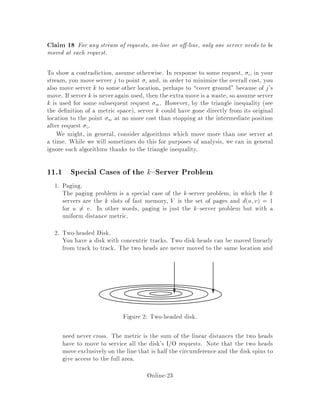
heuristic on the worst possible instance. Although this may be overly pes-
simistic, it gives a stronger guarantee about an algorithm's behavior. This is
the type of analysis we will be considering in these notes.
To this end, we introduce the following de nition:
Approx-1
De nition 1 The performance guarantee of a heuristic algorithm for a minimization
maximization problem is if the algorithm is guaranteed to deliver a solution whose
value is at most at least times the optimal value.
De nition 2 An -approximation algorithm is a polynomial time algorithm with a
performance guarantee of .
Before presenting techniques to design and analyze approximation algorithms as
well as speci c approximation algorithms, we should rst consider which performance
guarantees are unlikely to be achievable.
2 Negative Results
For somehard optimizationproblems, it is possible to show a limiton the performance
guarantee achievable in polynomial-time assuming P 6= NP. A standard method
for proving results of this form is to show that the existence of an -approximation
algorithm would allow you to solve some NP-completedecision problem in polynomial
time. Even though NP-complete problems have equivalent complexity when exact
solutions are desired, the reductions don't necessarily preserve approximability. The
class of NP-complete problems can be subdivided according to how well a problem
can be approximated.
As a rst example, for the traveling salesman problem given nonnegative lengths
on the edges of a complete graph, nd a tour | a closed walk visiting every vertex
exactly once | of minimum total length, there is no -approximation for any
unless P = NP. Indeed such an algorithm could be used to decide whether a graph
V;E has an Hamiltonian cycle simply give every edge e a length of 1 and every
non-edge a very high or in nite length .
As another example, consider the bin packing problem. You have an integer T
and weights x1;::: ;xn 2 0;T , and you want to partition them into as few sets
 bins as possible such that the sum of the weights in each set is at most T. It is
NP-complete to decide whether k bins are su cient.
In fact, there is no -approximation algorithm for this problem, for any 3=2.
To see this, consider the partition problem: given weights x1;::: ;xn 2 0;S whose
total sum is 2S, is there a partition of the weights into two sets such that the sum in
each set is S? This is the same as asking: are two bins su cient when each bin has
capacity S? If we had an -approximation algorithm  3=2, we could solve the
partition problem1. In general, if the problem of deciding whether a value is at most
k is NP-complete then there is no -approximation algorithm with k+1
k for the
problem of minimizing the value unless P = NP.
1But wait, you exclaim| isn't there a polynomial-timeapproximationscheme for the bin packing
problem? In fact, very good approximationalgorithms can be obtained for this problem if you allow
additive as well as multiplicativeconstants in your performance guarantee. It is our more restrictive
model that makes this negative result possible. See Section 6 for more details.
Approx-2
Until 1992, pedestrian arguments such as this provided essentially the only known
examples of non-approximability results. Then came a string of papers culminating
in the result of Arora, Lund, Motwani, Sudan, and Szegedy 1 based on the work of
Arora and Safra 2 . They introduced a new characterization of NP in terms of prob-
abilistically checkable proofs PCP. In the new characterization, for any language L
in NP, given the input x and a proof y of polynomial length in x, the veri er will
toss Ologn coins where n is the size of x to determine k = O1 positions or bits
in the string y to probe; based on the values of these k bits, the veri er will answer
yes or no. The new characterization shows the existence of such a veri er V and
a proof y such that i if x 2 L then there exists a proof y such that V outputs yes
independently of the random bits, ii if x =2 L then for every proof y, V outputs no
with probability at least 0:5.
From this characterization, they deduce the following negative result for MAX
3SAT: given a set of clauses with at most 3 literals per clause, nd an assignment
maximizing the number of satis ed clauses. They showed the following:
Theorem 1 For some 0, there is no 1 , -approximation algorithm2 for MAX
3SAT unless P = NP.
The proof goes as follows. Take any NP-complete language L. Consider the
veri er V given by the characterization of Arora et al. The number of possible
output of the Ologn toin cosses is S = 2Ologn which is polynomial in n. Consider
any outcome of these coin tosses. This gives k bits, say i1;::: ;ik to examine in the
proof y. Based on these k bits, V will decide whether to answer yes or no. The
condition that it answers yes can be expressed as a boolean formula on these k bits
with the Boolean variables being the bits of y. This formula can be expressed as
the disjunction  or of conjunctions  and of k literals, one for each satisfying
assignment. Equivalently, it can be written as the conjunction of disjunction of k
literals one for each rejecting assignment. Since k is O1, this latter k-SAT formula
with at most 2k clauses can be expressed as a 3-SAT formula with a constant number
of clauses and variables depending exponentially on k. More precisely, using the
classical reduction from SAT to 3-SAT, we would get a 3-SAT formula with at most
k2k clauses and variables. Call this constant number of clauses M  k2k = O1.
If x 2 L, we know that there exists a proof y such that all SM clauses obtained by
concatenating the clauses for each random outcome is satis able. However, if x =2 L,
for any y, the clauses corresponding to at least half the possible random outcomes
cannot be all satis ed. This means that if x =2 L, at least S=2 clauses cannot be
satis ed. Thus either all SM clauses can be satis ed or at most SM , S
2 clauses
can be satis ed. If we had an approximation algorithm with performance guarantee
better than 1, where = 1
2M we could decide whether x 2 L or not, in polynomial
2In our de nition of approximation algorithm, the performance guarantee is less than 1 for
maximization problems.
Approx-3
time since our construction can be carried out in polynomial time. This proves the
theorem.
The above theorem implies a host of negative results, by considering the complex-
ity class MAX-SNP. de ned by Papadimitriou and Yannakakis 21 .
Corollary 2 For any MAX-SNP-complete problem, there is an absolute constant
0 such that there is no 1 , -approximation algorithm unless P = NP.
The class of MAX-SNP problems is de ned in the next section and the corollary
is derived there. We rst give some examples of problems that are complete for
MAX-SNP.
1. MAX 2-SAT: Given a set of clauses with one or two literals each, nd an as-
signment that maximizes the number of satis ed clauses.
2. MAX k-SAT: Same as MAX 2-SAT, but each clause has up to k literals.
3. MAX CUT: Find a subset of the vertices of a graph that maximizesthe number
of edges crossing the associated cut.
4. The Travelling Salesman Problem with the triangle inequality is MAX-SNP-
hard. There is a technical snag here: MAX-SNP contains only maximization
problems, whereas TSP is a minimization problem.
2.1 MAX-SNP Complete Problems
Let's consider an alternative de nition of NP due to Fagin 9 . NP, instead of being
de ned computationally, is de ned as a set of predicates or functions on structures
G:
9S8x9y x;y;G;S
where  is a quanti er free expression. Here S corresponds to the witness or the
proof.
Consider for example the problem SAT. We are given a set of clauses, where each
clause is the disjunction of literals. A literal is a variable or its negation. We want
to know if there is a way to set the variables true or false, such that every clause is
true. Thus here G is the set of clauses, S is the set of literals to be set to true, x
represents the clauses, y represents the literals, and
x;y;G;S = PG;y;x^ y 2 S _NG;y;x ^y 62 S
Where PG;y;x is true i y appears positively in clause x, and NG;y;x is true i
y appears negated in clause x.
Approx-4
Strict NP is the set of problems in NP that can be de ned without the the third
quanti er:
9S8x x;G;S
where  is quanti er free.
An example is 3-SAT, the version of SAT in which every clause has at most 3
literals. Here x = x1;x2;x3 all possible combinations of three variables and G is
the set of possible clauses; for example x1 _ x2 _ x3, x1 _ x2 _ x3, and so forth.
Then  is a huge conjunction of statements of the form: If x1;x2;x3 appears as
x1 _ x2 _ x3, then x1 62 S _x2 2 S _x3 62 S.
Instead of asking that for each x we get x;G;S, we can ask that the number
of x's for which x;G;S is true be maximized:
maxS
jfx : x;G;Sgj
In this way, we can derive an optimization problem from an SNP predicate. These
maximization problems comprise the class MAX-SNP MAXimization, Strict NP
de ned by Papadimitriou and Yannakakis 21 . Thus, MAX 3SAT is in MAX-SNP.
Papadimitriou and Yannakakis then introduce an L-reduction L for linear, which
preserverses approximability. In particular, if P L-reduces to P0, and there exists an
-approximation algorithm for P0, then there exists a -approximation algorithm
for P, where is some constant depending on the reduction.
Given L-reductions, we can de ne MAX-SNP complete problems to be those P 2
MAX-SNP for which Q L P for all Q 2 MAX-SNP. Some examples of MAX-SNP
complete problems are MAX 3SAT, MAX 2SAT and in fact MAX kSAT for any
xed k 1, and MAX-CUT. The fact that MAX 3SAT is MAX-SNP-complete and
Theorem 1 implies the corollary mentioned previously.
For MAX 3SAT,  in the statement of Theorem 1 can be chosen can be set to
1=74 Bellare and Sudan 5 .
Minimization problems may not be able to be expressed so that they are in MAX-
SNP, but they can still be MAX-SNP hard. Examples of such problems are:
TSP with edge weights 1 and 2 i.e., di;j 2 f1;2g for all i;j. In this case,
there exists a 7=6-approximation algorithm due to Papadimitriou and Yan-
nakakis.
Steiner tree with edge weights 1 and 2.
Minimum Vertex Cover. Given a graph G = V;E, a vertex cover is a set
S
V such that u;v 2 E  u 2 S or v 2 S.
Approx-5
3 The Design of Approximation Algorithms
We now look at key ideas in the design and analysis of approximation algorithms.
We will concentrate on minimization problems, but the ideas apply equally well to
maximization problems. Since we are interested in the minimization case, we know
that an -approximation algorithm H has cost CH  COPT where COPT is the cost
of the optimal solution, and  1.
Relating CH to COPT directly can be di cult. One reason is that for NP-hard
problems, the optimum solution is not well characterized. So instead we can relate
the two in two steps:
1. LB  COPT
2. CH  LB
Here LB is a lower bound on the optimal solution.
3.1 Relating to Optimum Directly
This is not always necessary, however. One algorithm whose solution is easy to relate
directly to the optimal solution is Christo des' 6 algorithm for the TSP with the
triangle inequality di;j+dj;k  di;k for all i;j;k. This is a 3
2-approximation
algorithm, and is the best known for this problem. The algorithm is as follows:
1. Compute the minimum spanning tree T of the graph G = V;E.
2. Let O be the odd degree vertices in T. One can prove that jOj is even.
3. Compute a minimum cost perfect matching M on the graph induced by O.
4. Add the edges in M to E. Now the degree of everyvertexof G is even. Therefore
G has an Eulerian tour. Trace the tour, and takeshortcuts when thesame vertex
is reached twice. This cannot increase the cost since the triangle inequality
holds.
We claim that ZC  3
2ZTSP, where ZC is the cost of the tour produced by
Christo des' algorithm, and ZTSP is the cost of the optimal solution. The proof
is easy:
ZC
ZTSP
 ZT + ZM
ZTSP
= ZT
ZTSP
+ ZM
ZTSP
 1 + 1
2 = 3
2:
Here ZT is the cost of the minimumspanning tree and ZM is the cost of the matching.
Clearly ZT  ZTSP , since if we delete an edge of the optimal tour a spanning tree
results, and the cost of the minimum spanning tree is at most the cost of that tree.
Therefore ZT
ZTSP
 1.
Approx-6
To show ZM
ZTSP
 1
2, consider the optimal tour visiting only the vertices in O.
Clearly by the triangle inequality this is of length no more than ZTSP . There are an
even number of vertices in this tour, and so also an even number of edges, and the
tour de nes two disjoint matchings on the graph induced by O. At least one of these
has cost  1
2ZTSP, and the cost of ZM is no more than this.
3.2 Using Lower Bounds
Let
COPT = minx2S
fx:
A lower bound on COPT can be obtained by a so-called relaxation. Consider a related
optimization problem LB = minx2R gx. Then LB is a lower bound on COPT and
the optimizationproblemis called a relaxation of the original problemif the following
conditions hold:
S
R1
gx  fx for all x 2 S:2
Indeed these conditions imply
LB = minx2R
gx  minx2S
fx = COPT:
Most classical relaxations are obtained by using linear programming. However,
there are limitations as to how good an approximation LP can produce. We next
show how to use a linear programming relaxation to get a 2-approximation algorithm
for Vertex Cover, and show that this particular LP relaxation cannot give a better
approximation algorithm.
3.3 An LP Relaxation for Minimum Weight Vertex Cover
VC
A vertex cover U in a graph G = V;E is a subset of vertices such that every edge is
incident to at least one vertex in U. The vertex cover problem is de ned as follows:
Given a graph G = V;E and weight wv  0 for each vertex v, nd a vertex cover
U
V minimizing wU = P
v2U wv. Note that the problem in which nonpositive
weight vertices are allowed can be handled by including all such vertices in the cover,
deleting them and the incident edges, and nding a minimum weight cover of the
remaining graph. Although this reduction preserves optimality, it does not maintain
approximability; consider, for example, the case in which the optimum vertex cover
has 0 cost or even negative cost.
Approx-7
This can be expressed as an integer program as follows. Let xv = 1 if v 2 U
and xv = 0 otherwise. Then
COPT = minx2S
X
v2V
wvxv
where
S =

x 2 RjV j : xv+ xw  1 8v;w 2 E
xv 2 f0;1g 8v 2 V

:
We now relax S, turning the problem into a linear program:
LB = minx2R
X
v2V
wvxv
R =

x 2 RjVj : xv+ xw  1 8v;w 2 E
xv  0 8v 2 V

:
In order to show that R is a relaxation, we must show that it satis es conditions 1
and 2. Condition 1 clearly holds, as 0;1  0. Furthermore, condition 2 also holds,
since the objective function is unchanged. Thus, we can conclude that LB  COPT,
and we can prove that an algorithm H is an -approximation algorithm for VC by
showing CH  LB.
The limitation of this relaxation is that there are instances where LB  1
2COPT.
This implies that it cannot be used to show any 2, since if we could then
H would give a better answer than the optimum. One such instance is Kn: the
complete graph on n vertices, with all vertices weight 1. All the nodes but one must
be in the cover otherwise there will be an edge between two that are not, with neither
in the cover set. Thus, COPT = n ,1. The relaxation, on the other hand, can have
xv = 1
2;8v 2 V . Thus, LB  n
2, which means LB  1
2COPT.
3.4 How to use Relaxations
There are two main techniques to derive an approximately optimal solution from a
solution to the relaxed problem.
1. Rounding
Find an optimal solution x to the relaxation. Round x 2 R to an element
x0 2 S. Then prove fx0  gx which implies
fx0  LB  COPT
Often randomization is helpful, as we shall see in later sections. In this case
x 2 R is randomly rounded to some element x0 2 S so that E fx0  gx.
These algorithms can sometimes be derandomized, in which case one nds an
x00 such that fx00  E fx0 .
Approx-8
2. Primal-Dual
Consider some weak dual of the relaxation:
maxfhy : y 2 Dg  minfgx : x 2 Rg
Construct x 2 S from y 2 D such that
fx  hy  hymax  gxmin  COPT:
Notice that y can be any element of D, not necessarily an optimal solution to
the dual.
We now illustrate these techniques on the minimum weight vertex cover problem.
3.4.1 Rounding applied to VC
This is due to Hochbaum 16 . Let x be the optimal solution of the LP relaxation.
Let
U = fv 2 V : xv  1
2g
We claim U is a 2-approximation of the minimum weight VC. Clearly U is a vertex
cover, because for u;v 2 E we have xu + xv  1, which implies xu  1=2
or xv  1=2. Also X
v2U
wv 
X
v2V
wv2xv = 2LB
since 2xv  1 for all v 2 U.
3.4.2 Primal-Dual applied to VC
This is due to Bar-Yehuda and Even 4 . First formulate the dual problem. Let
y 2 RjEj; the elements of y are ye for e = u;v 2 E. The dual is:
max
X
e2E
ye
X
u:e=v;u2E
ye  wv 8v 2 V3
ye  0 8e 2 E:4
Initialize C the vertex cover to the empty set, y = 0 and F = E. The algorithm
proceeds by repeating the following two steps while F 6= ;:
1. Choose some e = u;v 2 F. Increase ye as much as possible, until inequal-
ity 3 becomes tight for u or v. Assume WLOG it is tight for u.
2. Add u to C and remove all edges incident to u from F.
Clearly C is a vertex cover. Furthermore
X
v2C
wv =
X
v2C
X
u:e=v;u2E
ye =
X
e=v;u2E
jC fv;ugjye 
X
e2E
2ye  2LB:
Approx-9
4 The Min-Cost Perfect Matching Problem
In this section, we illustrate the power of the primal-dual technique to derive approx-
imation algorithms. We consider the following problem.
De nition 3 The Minimum-Cost Perfect Matching Problem MCPMP is as fol-
lows: Given a complete graph G = V;E with jV j even and a nonnegative cost
function ce  0 on the edges e 2 E, nd a perfect matching M such that the cost
cM is minimized, where cM = P
e2M ce.
The rst polynomialtimealgorithmfor this problemwas givenbyEdmonds 8 and
has a running time of On4 where n = jV j. To date, the fastest strongly polynomial
time algorithm is due to Gabow 10 and has a running time of Onm + nlgn
where m = jEj. For dense graphs, m = n2, this algorithm gives a running time
of On3. The best weakly polynomial algorithm is due to Gabow and Tarjan 12
and runs in time Om
q
n m;nlognlognC where C is a bound on the costs ce.
For dense graphs with C = On, this bound gives an On2:5 running time.
As you might suspect from these bounds, the algorithms involved are fairly com-
plicated. Also, these algorithms are too slow for many of the instances of the problem
that arise in practice. In this section, we discuss an approximation algorithm by Goe-
mans and Williamson 13 that runs in time On2 lgn. This bound has recently
been improved by Gabow, Goemans and Williamson 11 to Onn +
pmlglgn.
Although MCPMP itself is in PTIME, this algorithm is su ciently general to give
approximations for many NP-hard problems as well.
The algorithm of Goemans and Williamson is a 2-approximation algorithm | it
outputs a perfect matching with cost not more than a factor of 2 larger than the cost
of a minimum-cost perfect matching. This algorithm requires that the costs ce make
up a metric, that is, ce must respect the triangle inequality: cij + cjk  cik for all
triples i;j;k of vertices.
4.1 A linear programming formulation
The basic idea used in the 2-approximation algorithm of Goemans and Williamson
is linear programming and duality. The min-cost perfect matching problem can be
formulated as a linear program. The algorithm does not directly solve the linear
program, but during its operation, it can compute a feasible solution to the dual
program. This dual feasible solution actually certi es the factor of 2 approximation.
Before writing down the linear program, we start with an observation.
Consider a matching M and a set S V of vertices with jSj odd. If M is a perfect
matching, then since jSj is odd, there must be some edge in the matching that has
one endpoint inside S and the other outside. In other symbols, let S be the set of
edges in E with exactly one endpoint in S; if M is a perfect matching and jSj is odd,
then M S 6= ;.
Approx-10
With this observation, we can now formulate MCPMP as a linear program:
Z =Min
X
e2E
cexe
subject to:
X
e2 S
xe  1 for all S V with jSj odd
xe  0 for all e 2 E.
We can now see that the value Z of this linear program is a lower bound on the cost
of any perfect matching. In particular, for any perfect matching M, we let
xe =
8
:
1 if e 2 M;
0 otherwise.
Clearly, this assignment is a feasible solution to the linear program, so we know that
Z  cM. This bound also applies to a minimum-cost perfect matching M, so we
have Z  cM.
Note that this is a huge linear program having one constraint for each S V of
odd cardinality. Though it is too large to be solved in polynomial time by any of the
linear programming algorithms we have seen, the ellipsoid method can actually solve
this program in polynomial time. We do not consider this solution technique; rather
we let the linear program and its dual serve as a tool for developing and analyzing
the algorithm.
We now consider the dual linear program:
Z =Max
X
S V;
jSj odd
yS
subject to:
X
S V;
e2 S
yS  ce for all e 2 E
yS  0 for all S V with jSj odd.
Note that by strong duality, the value Z of this dual linear program is the same as
the value Z of the primal program.
This dual linear program is used to verify that the perfect matching output by
the algorithm is actually within a factor of 2 of optimal. The algorithm outputs two
things:
1. a perfect matching M0, and
2. a dual feasible solution y such that
cM0  2
X
S V;
jSj odd
yS:
Approx-11
Since y is dual feasible, we know that
X
S V;
jSj odd
yS  Z  cM
where M is any perfect matching. Thus we have
cM0  2Z  2cM
where M is a min-cost perfect matching. The algorithm is therefore given that it
runs in polynomial time a 2-approximation algorithm for MCPMP.
To be precise, the algorithm need not actually output the dual feasible solution
y | it is only needed as an analysis tool to prove the factor of 2 approximation
bound. In spite of the fact that there are an exponential number of yS variables, the
algorithm could actually compute and output the yS values since it turns out that
only a polynomial number of them are non-zero. When we nally get to exhibiting
the algorithm, we will include the computation of the yS values.
4.2 From forest to perfect matching
Rather than directly compute the perfect matching M0, the algorithm rst computes
a forest F0 from which M0 can be derived. In the forest F0, all components have
even size, and furthermore, F0 is edge-minimal in the sense that if any edge of F0 is
removed, then the resulting forest has an odd size component. Additionally, the cost
of F0 is bounded by twice the value of the dual feasible solution; that is,
cF0  2
X
S V;
jSj odd
yS:
We now show how to convert F0 into a perfect matching M0 such that cM0 
cF0. The idea is as follows. Starting from the forest F0, consider any vertex v with
degree at least 3. Take two edges u;v and v;w; remove them and replace them
with the single edge u;w. Since the edge costs obey the triangle inequality, the
resulting forest must have a cost not more than cF0. Thus, if we can iterate on this
operation until all vertices have degree 1, then we have our perfect matching M0.
The only thing that can get in the way of the operation just described is a vertex
of degree 2. Fortunately, we can show that all vertices of F0 have odd degree. Notice
then that this property is preserved by the basic operation we are using. As a direct
consequence, the property that all components are even is also preserved. Therefore,
if all vertices of F0 have odd degree, we can iteration the basic operation to produce
a perfect matching M0 such that cM0  cF0. Notice that M0 is produced after
On iterations.
Lemma 3 All vertices of F0 have odd degree.
Approx-12
Proof: Suppose there is a vertex v with even degree, and let v be in component
A of F0. Removing v and all its incident edges partitions A into an even number k of
smaller components A1;A2;::: ;Ak. If all k of these components have odd size, then
it must be the case that A has odd size. But we know that A has even size | all
components of F0 have even size | so there must be a component Ai with even size.
Let vi denote the vertex in Ai such that v;vi is an edge of F0. Now if we start from
F0 and remove the edge v;vi, we separate A into two even size components. This
contradicts the edge-minimality of F0. 
4.3 The algorithm
The algorithm must now output an edge-minimalforest F0 with even size components
and be able to compute a dual feasible solution y such that cF0  2PyS.
At the highest level, the algorithm is:
1. Start with F = ;.
2. As long as there exists an odd size component of F, add an edge between two
components at least one of which has odd size.
Note that the set of components of F is initially just the set of vertices V .
The choice of edges is guided by the dual linear program shown earlier. We start
with all the dual variables equal to zero; yS = 0. Suppose at some point in the
execution we have a forest F as shown below and a dual solution y. Look at the
q
q
q
,
@
1
q
q
q
q
q
q
,
@
@
,
2
q
q@
3
q
4
q
q@
5
q
q qA
A
6
q
q
q
,
@
7
components S of odd cardinality components 1, 4, 6 and 7, in this case. For these
components, increase yS by some , leaving all other values of yS unchanged. That
is,
yS 
8
:
yS + if S is an odd size component of F
yS otherwise.
Make as large as possible while keeping yS dual feasible. By doing this, we make
the constraint on some edge e tight; for some e the constraint
X
S V;
e2 S
yS  ce
becomes
X
S V;
e2 S
yS = ce:
Approx-13
This is the edge e that we add to F. If more than one edge constraint becomes tight
simultaneously, then just arbitrarily pick one of the edges to add.
We now state the algorithm to compute F0. The steps that compute the dual
feasible solution y are commented out by placing the text in curly braces.
1 F  ;
2 C  ffig j i 2 V g fThe components of Fg
3 fLet yS  0 for all S with jSj odd.g
4 8i 2 V do di  0 fdi = P
S3i ySg
5 while 9C 2 C with jCj odd do
6 Find edge e = i;j such that i 2 Cp, j 2 Cq, p 6= q
which minimizes = ce,di,dj
Cp+Cq
where C =
n1 if jCj is odd
0 otherwise i.e., the parity of C.
7 F  F feg
8 8C 2 C with jCj odd do
9 8i 2 C do di  di+
10 fLet yC  yC + .g
11 C  C nfCp;Cqg fCp Cqg
12 F0  edge-minimal F
4.4 Analysis of the algorithm
Lemma 4 The values of the variables yS computed by the above algorithm constitute
a dual feasible solution.
Proof: We show this by induction on the while loop. Speci cally, we show that
at the start of each iteration, the values of the variables yS are feasible for the dual
linear program. We want to show that for each edge e 2 E,
X
S V;
e2 S
yS  ce:
The base case is trivial since all variables yS are initialized to zero and the cost
function ce is nonnegative. Now consider an edge e0 = i0;j0 and an iteration. There
are two cases to consider.
In the rst case, suppose both i0 and j0 are in the same component at the start
of the iteration. In this case, there is no component C 2 C for which e0 2 C.
Therefore, since the only way a variable yS gets increased is when S is a component,
none of the variables yS with e0 2 S get increased at this iteration. Bythe induction
Approx-14
hypothesis, we assume the iteration starts with
X
S V;
e0
2 S
yS  c0
e;
and therefore, since the left-hand-side of this inequality does not change during the
iteration, this inequality is also satis ed at the start of the next iteration.
In the second case, suppose i0 and j0 are in di erent components; i0 2 Cp0 and
j0 2 Cq0 at the start of the iteration. In this case, we can write
X
S V;
e0
2 S
yS =
X
S V;
i0
2S
yS +
X
S V;
j0
2S
yS
= di0 + dj0;
where di is de ned by
di =
X
S V;
i2S
yS:
The equality follows because since i0 and j0 are in di erent components, if S contains
both i0 and j0, then S is not and never has been a component; hence, for such a set
S, we have yS = 0. We know that during this iteration di0 will be incremented by
if and only if yCp0
is incremented by , and this occurs if and only if Cp0  = 1. Let
d0i0 and d0j0 be the new values of di0 and dj0 after this iteration. Then we have
d0i0 = di0 + Cp0 ; and
d0j0 = dj0 + Cq0 :
Now, by the way is chosen, we know that
 ce0 ,di0 ,dj0
Cp0  + Cq0  :
Thus, at the beginning of the next iteration we have
X
S V;
e0
2 S
yS = d0i0 + d0j0
= di0 + Cp0  + dj0 + Cq0 
= di0 + dj0 + Cp0  + Cq0 
 di0 + dj0 + ce0 ,di0 ,dj0
Cp0  + Cq0  Cp0  + Cq0 
= ce0 :
Finally, for completeness sake, we note that the constraint yS  0 is satis ed
because yS = 0 initially and  0. 
Approx-15
As a nal observation, we note that when the algorithm selects an edge e0, the
corresponding constraint in the dual linear program becomes tight. This means that
for all edges e 2 F, we have X
S V;
e2 S
yS = ce:
4.5 A simulated run of the algorithm
Since the algorithm as given can be di cult to visualize, here is an example of how
it would execute. See Figure 1.
1
2
3
4
5
6
7
8
Figure 1: A sample run of the algorithm. The various values of di are indicated by
the shaded regions around the components.
We'll assume a Euclidean distance metric to ease visualization. Now, initially, all
points 1 through 8 are in separate components, and di is0 for all i. Sincethe metric
is Euclidean distance, the rst edge to be found will be 7;8. Since both components
are of odd size, will be half the distance between them ce ,0,0=1+1. Since,
in fact, all components are of odd size, every di will be increased by this amount,
as indicated by the innermost white circle around each point. The set f7;8g now
becomes a single component of even size.
In general, we can see the next edge to be chosen by nding the pair of components
whose boundaries in the picture can be most easily made to touch. Thus, the next
edge is 3;5, since the boundaries of their regions are closest, and the resulting values
Approx-16
of di are represented by the dark gray bands around points 1 through 6. Note that
the component f7;8g does not increase its di values since it is of even size.
We continue in this way, expanding the moats around odd-sized components
until all components are of even size. Since there is an even number of vertices and
we always expand odd-sized components, we are guaranteed to reach such a point.
4.6 Final Steps of Algorithm and Proof of Correctness
Let F0 = fe 2 F : F nfeg has an odd sized componentg. We will show that the F0 so
obtained is a forest with components of even cardinality and that it is edge minimal
with respect to this property. It is obvious that F0 is a forest since F0 F and F is
a forest. We will also show that the cost of this forest F0, is less than or equal to
twice the dual solution. In section 4.2 we showed how to build a matching from this
forest with the cost of the matching less than or equal to the cost of the forest. Thus,
this gives us a 2-approximation algorithm for matching. As an example see the gure
given below.
FFFF FFFF''''
Figure 2: Example showing how to get F0 from F.
Theorem 5 Let F0 = fe 2 F : F nfeg has an odd sized componentg. Then
1. every component of F0 has an even number of vertices and F0 is edge minimal
with respect to this property..
2. P
e2F0 ce  2P
S yS.
Proof:
Let us rst show that every component of F0 has an even number of vertices.
Suppose not. Then consider the components of F. Every component of F has an
even numberof verticesby design of the algorithm. Consider a component of F0 which
has an odd number of vertices and let us denote it as T0
i. Let Ti be the component
Approx-17
that T0
i belongs to in F. Let N1;::: ;Nj be the components of F within Ti obtained
by removing T0
i see gure 3. Ti has an even number of vertices. Nk with 1  k  j
has an even number of vertices because, otherwise, the edge from Nk to T0
i would
belong to F0 by de nition. But this implies that T0
i is even, which is a contradiction.
T
T
N
N
N
N
i
i'
1
2
k
j
Figure 3: Every component of F0 has an even  of vertices.
A simple proof by contradiction shows that F0 is edge minimal. Suppose F0 is not
edge minimal. Then there is an edge or set of edges which can be removed which leave
even sized components. Consider one such edge e. It falls into one of two categories:
1. Its removal divides a component into two even sized components. But this
means that e was already removed by the de nition of F0.
2. Its removal divides a component into two odd sized components. Despite the
fact that other edges may be removed, as well, an two odd sized component will
remain in the forest. Thus, e cannot be removed.
Now let us prove the second portion of the theorem. In what follows, though we
do not explicitly notate it, when we refer to a set S of vertices, we mean a set S of
vertices with jSj odd. We observe that by the choice of the edges e in F, we have
ce =
X
S:e2 S
yS
for all e 2 F. Thus,
X
e2F0
ce =
X
e2F0
X
S:e2 S
yS
=
X
S
ySjF0 Sj
Thus we need to show, X
S
ySjF0 Sj  2
X
S
yS
Approx-18
We will show this by induction. In what follows, bear in mind that F0 is what
we have, at the end of the algorithm. We will show the above relation holds at every
iteration.
Initially, yS = 0. Thus the LHS and RHS are both zero. Thus, this is true initially.
Let us suppose it is true at any intermediate stage in the algorithm. We will show
that it will remain true in the next iteration. From one iteration to the next the only
yS that change are those with C 2 C with jCj odd. Thus if we show the increase in
the LHS is less than the RHS we are done. i.e.
X
C2C;jCj odd
jF0 Cj  2 jfC 2 C;jCj oddgj
or X
C2C;jCj odd
jF0 Cj  2jfC 2 C;jCj oddgj
Now, de ne a graph H with C 2 C as vertices, with an edge between Cp and Cq if
there exists an edge in F0 f Cp Cqg. We can partition these vertices into two
groups based on their cardinality. Those that have even cardinality and those that
have odd cardinality. Remove from this graph all vertices that have even cardinality
and are isolated they have no edges incident to them. We will denote the resulting
set of vertices of odd and even cardinality by Odd and Even respectively.
Now P
C2C;jCj odd jF0 Cj corresponds to the sum of the degrees of vertices in
Odd in the graph H. And, jfC 2 C;jCj oddgj, corresponds to the number of vertices
in odd. Thus we need to show:
X
v2Odd
dHv  2jOddj
where dHv denotes the degree of node v in the graph H. Since F0 is a forest, H is
also a forest and we have:
Number of edges in H  number of vertices in H. Or
P
v2Odd dHv+ P
v2Even dHv
2  jOddj + jEvenj
or X
v2Odd
dHv  2jOddj +
X
v2Even
2 ,dHv
We now claimthat ifv 2 Eventhen v is not a leaf. If this is true then 2,dHv 
0 for v 2 Even and so we are done.
Suppose there is a vi 2 Even which is a leaf. Consider the component C in H
that vi is contained in. By the construction of H, each tree in F0 is either contained
solely in the vertices represented by C or it is strictly outside C. Since each tree in
F0 contains an even number of vertices C does w.r.t. the original graph, as well.
So vi and C ,vi each contains an even number of vertices. As a result, removing the
Approx-19
edge between vi and C , vi would leave even sized components, thus contradicting
the minimality of F0.

T
C
N
N
N
N
i
i
1
2
k
j
Figure 4: dHv  2 for v 2 Even
4.7 Some implementation details
The algorithm can be implemented in On2 logn. For this purpose, notice that
the number of iterations is at most n , 1 since F is a forest. The components
of F can be maintained as a union- nd structure and, therefore, all mergings of
components take On n;n where is the inverse Ackermann function. In order
to get the On2 logn bound, we shall show that every iteration can be implemented
in Onlogn time.
In order to nd the edge e to add to F, we maintain a priority queue containing
the edges between di erent components of F. This initialization of this priority queue
takes On2 logn time. In order to describe the key of an edge, we need to introduce
a notion of time. The time is initially set to zero and increases by in each iteration
the time can be seen to be the maximum of di over all vertices i. The key of an
edge e = i;j is equal to the time at which we would have ce = di + dj if the
parity of the components containing i and j don't change. The edge to be selected
is therefore the edge with minimum key and can be obtained in Onlog n. When
two components merge, we need to update the keys of edges incident to the resulting
component since the parity might have changed. By keeping track of only one edge
between two components the one with smallest key, we need to update the keys of
On edges when two components merge. This can be done in Onlog n Ologn
per update.
To complete the discussion, we need to show how to go from F to F0. By per-
forming a post-order traversal of the tree and computing the parity of the subtrees
encountered in a recursive manner, this step can be implemented in On time.
Approx-20
5 Approximating MAX-CUT
In this section, we illustrate the fact that improved approximation algorithms can be
obtained by considering relaxations more sophisticated than linear ones. At the same
time, we will also illustrate the fact that rounding a solution from the relaxation in a
randomized fashion can be very useful. For this purpose, we consider approximation
algorithms for the MAX-CUT problem. The unweighted version of this problem is as
follows:
Given: A graph G = V;E.
Find: A partition S; S such that dS := j Sj is maximized.
It can be shown that this problem is NP-hard and MAX SNP-complete and so
we cannot hope for an approximation algorithm with guarantee arbitrarily close to 1
unless P = NP. In the weighted version of the problem each edge has a weight wij
and we de ne dS by,
dS =
X
i;j2E:i2S;j=2S
wij:
For simplicity we focus on the unweighted case. The results that we shall obtain will
also apply to the weighted case.
Recall that an -approximation algorithm for MAX-CUT is a polynomial time
algorithm which delivers a cut S such that dS  zMC where zMC is the value
of the optimum cut. Until 1993 the best known was 0.5 but now it is 0.878 due
to an approximation algorithm of Goemans and Williamson 14 . We shall rst of all
look at three almost identical algorithms which have an approximation ratio of 0.5.
1. Randomized construction. We select S uniformly from all subsets of V . i.e.
For each i 2 V we put i 2 S with probability 1
2 independently of j 6= i.
E dS = P
i;j2E Pr i;j 2 S by linearity of expectations
= P
i;j2E Pr i 2 S;j =2 S or i =2 S;j 2 S
= 1
2jEj:
ButclearlyzMC  jEjand so we haveE dS  1
2zMC. Notethat by comparing
our cut to jEj, the best possible bound that we could obtain is 1
2 since for Kn
the complete graph on n vertices we have jEj =

n
2

and zMC = n2
4 .
2. Greedyprocedure. Let V = f1;2;::: ;ng and let Ej = fi : i;j 2 E and i
jg. It is clear that fEj : j = 2;::: ;ng forms a partition of E. The algorithm
is:
Set S = f1g
For j = 2 to n do
if jS Ejj  1
2jEjj
then S  S fjg.
Approx-21
If we de ne Fj = Ej S then we can see that fFj : j = 2;::: ;ng is a
partition of S. By de nition of the algorithm it is clear that jFjj  jEjj
2 . By
summing over j we get dS  jEj
2  zMC
2 . In fact, the greedy algorithm can
be obtained from the randomized algorithm by using the method of conditional
expectations.
3. Local search. Say that S is locally optimum if 8i 2 S : dS , fig  dS
and 8i =2 S : dS fig  dS.
Lemma 6 If S is locally optimum then dS  jEj
2 .
Proof:
dS = 1
2
X
i2V
fnumber of edges in cut incident to ig
= 1
2
X
i2V
j S ij
 1
2
X
i2V
1
2dij
= 2
4jEj
= jEj
2 :
The inequality is true because if j S ij 1
2j ij for some i then we can
move i to the other side of the cut and get an improvement. This contradicts
local optimality. 
In local search we moveone vertex at a timefrom one side of the cut to the other
until we reach a local optimum. In the unweighted case this is a polynomial
time algorithm since the number of di erent values that a cut can take is On2.
In the weighted case the running time can be exponential. Haken and Luby 15
have shown that this can be true even for 4-regular graphs. For cubic graphs
the running time is polynomial 22 .
Over the last 15-20 years a number of small improvements were made in the approxi-
mation ratio obtainable for MAX-CUT. The ratio increased in the following manner:
1
2 ! 1
2 + 1
2m ! 1
2 + 1
2n ! 1
2 + n ,1
4m
where m = jEj and n = jV j, but asymptotically this is still 0:5.
Approx-22
5.1 Randomized 0.878 Algorithm
The algorithm that we now present is randomized but it di ers from our previous
randomized algorithm in two important ways.
The event i 2 S is not independent from the event j 2 S.
We compare the cut that we obtain to an upper bound which is better that jEj.
r
S
S
_
Figure 5: The sphere Sn.
Suppose that for each vertex i 2 V we have a vector vi 2 Rn where n = jV j. Let
Sn be the unit sphere fx 2 Rn : jjxjj = 1g. Take a point r uniformly distributed on
Sn and let S = fi 2 V : vi  r  0g Figure 5. Note that without loss of generality
jjvijj = 1. Then by linearity of expectations:
E dS =
X
i;j2E
Pr signvi r 6= signvj r :5
Lemma 7
Pr signvi r 6= signvj r = Pr random hyperplane separates vi and vj
= 
where = arccosvi vj the angle between vi and vj.
Proof: This result is easy to see but it is a little di cult to formalize. Let P be the
2-dimensional plane containing vi and vj. Then P Sn is a circle. With probability
1, H = fx : x  r = 0g intersects this circle in exactly two points s and t which are
diametrically opposed. See gure 6. By symmetry s and t are uniformly distributed
on the circle. The vectors vi and vj are separated by the hyperplane H if and only if
either s or t lies on the smaller arc between vi and vj. This happens with probability
2
2 = . 
Approx-23
s
t
v
vi
j
α
P
Figure 6: The plane P.
From equation 5 and lemma 7 we obtain:
E dS =
X
i;j2E
arccosvi vj
 :
Observe that E dS  zMC and so
maxvi
E dS  zMC;
where we maximize over all choices for the vi's. We actually have maxvi E dS =
zMC. Let T be a cut such that dT = zMC and let e be the unit vector whose rst
component is 1 and whose other components are 0. If we set
vi =

e if i 2 T
,e otherwise.
then S = T with probability 1. This means that E dS = zMC.
Corollary 8
zMC = maxjjvijj=1
X
i;j2E
arccosvi vj
 :
Unfortunately this is as di cult to solve as the original problem and so at rst glance
we have not made any progress.
Approx-24
5.2 Choosing a good set of vectors
Let f : ,1;1 ! 0;1 be a function which satis es f,1 = 1, f1 = 0. Consider
the following program:
Max
X
i;j2E
fvi vj
subject to:
P jjvijj = 1 i 2 V:
If we denote the optimal value of this program by zP then we have zMC  zP: This
is because if we have a cut T then we can let,
vi =

e if i 2 T
,e otherwise.
Hence P
i;j2E fvi vj = dT and zMC  zP follows immediately.
5.3 The Algorithm
The framework for the 0.878 approximation algorithm for MAX-CUT can now be
presented.
1. Solve P to get a set of vectors fv
1;::: ;v
ng.
2. Uniformly select r 2 Sn.
3. Set S = fi : v
i r  0g.
Theorem 9
E dS  zP  zMC
where,
= min,1x1
arccosx
fx :
Proof:
E dS =
X
i;j2E
arccosv
i v
j


X
i;j2E
fv
i v
j
= zP
 zMC:
Approx-25
We must now choose f such that P can be solved in polynomial time and is as
large as possible. We shall show that P can be solved in polynomial time whenever
f is linear and so if we de ne,
fx = 1 ,x
2
then our rst criterion is satis ed. Note that f,1 = 1 and f1 = 0. With this
choice of f,
= min,1x1
2arccosx
1 ,x
= 2arccos,0:689
1 ,,0:689
= 0:87856:
See gure 7.
0
-1 1
1
-0.689
1-x
π
arccos(x)
2
Figure 7: Calculating .
5.4 Solving P
We now turn our attention to solving:
Max
X
i;j2E
1
21 ,vi vj
subject to:
P jjvijj = 1 i 2 V:
Approx-26
Let Y = yij where yij = vi vj. Then,
jjvijj = 1  yii = 1 for all i.
yij = vi  vj  Y  0, where Y  0 means that Y is positive semi-de nite:
8x : xTY x  0. This is true because,
xTY x =
X
i
X
j
xixjvi vj
=
X
i
xivi
2
 0:
Conversely if Y  0 and yii = 1 for all i then it can be shown that there exists a set
of vi's such that yij = vi vj. Hence P is equivalent to,
Max
X
i;j2E
1
21 ,yij
subject to:
P0 Y  0
yii = 1 i 2 V:
Note that Q := fY : Y  0;yii = 1g is convex. If A  0 and B  0 then A+ B  0
and also A+B
2  0. It can be shown that maximizing a concave function over a
convex set can be done in polynomial time. Hence we can solve P0 in polynomial
time since linear functions are concave. This completes the analysis of the algorithm.
5.5 Remarks
1. The optimum Y could be irrational but in this case we can nd a solution with
an arbitrarily small error in polynomial time.
2. To solve P0 in polynomial time we could use a variation of the interior point
method for linear programming.
3. Given Y , vi can be obtained using a Cholesky factorization Y = V V T.
4. The algorithm can be derandomized using the method of conditional expecta-
tions. This is quite intricate.
5. The analysis is very nearly tight. For the 5-cycle we have zMC and zP =
5
21 + cos 
5 = 25+5p5
8 which implies that zMC
zP
= 0:88445.
Approx-27
6 Bin Packing and P k Cmax
One can push the notion of approximation algorithms a bit further than we have been
doing and de ne the notion of approximation schemes:
De nition 4 A polynomial approximation scheme pas is a family of algorithms
A : 0 such that for each 0, A is a 1 + -approximation algorithm which
runs in polynomial time in input size for xed .
De nition 5 A fully polynomial approximation scheme fpas is a pas with running
time which is polynomial both in input size and 1= .
It is known that if  is a strongly NP-complete problem, then  has no fpas unless
P = NP. From the result of Arora et al. described in Section 2, we also know that
there is no pas for any MAX ,SNP hard problem unless P = NP.
We now consider two problems which have a very similar avor; in fact, they
correspond to the same NP-complete decision problem. However, they considerably
di er in terms of approximability: one has a pas, the other does not.
Bin Packing: Given item sizes a1;a2;::: ;an  0 and a bin size of T, nd a
partition of I1;::: ;Ik of 1;::: ;n, such that P
i2Il
ai  T and k is minimized
the items in Il are assigned to bin l.
P k Cmax: Given n jobs with processing times p1;::: ;pn and m machines,
nd a partition fI1;::: ;Img of f1;::: ;ng, such that the makespan de ned as
maxiP
j2Ii
pj is minimum. The makespan represents the maximum comple-
tion time on any machine given that the jobs in Ii are assigned to machine
i.
The decision versions of the two problemsare identicaland NP-complete. However
when we consider approximation algorithms for the two problems we have completely
di erent results. In the case of the bin packing problem there is no -approximation
algorithm with 3=2, unless P = NP.
Proposition 10 There is no -approximation algorithm with 3=2, for bin pack-
ing, unless P = NP, as seen in Section 2.
However, we shall see, for P k Cmax we have -approximation algorithms for any
.
De nition 6 An algorithm A has an asymptotic performance guarantee of if
 limsup
k!1
k
Approx-28
where
k = sup
I:OPTI=k
AI
OPTI
and OPTI denotes the value of instance I and AI denotes the value returned by
algorithm A.
For P k Cmax, there is no di erence between an asymptotic performance and a per-
formance guarantee. This follows from the fact that P k Cmax satis es a scaling
property : an instance with value OPTI can be constructed by multiplying every
processing time pj by .
Using this de nition we can analogously de ne a polynomial asymptotic approx-
imation scheme paas. And a fully polynomial asymptotic approximation scheme
fpaas.
Now we will state some results to illustrate the di erence in the two problems
when we consider approximation algorithms.
1. For bin packing, there does not exist an -approximation algorithm with
3=2, unless P = NP. Therefore there is no pas for bin packing unless P = NP.
2. For P k Cmax there exists a pas. This is due to Hochbaum and Shmoys 17 .
We will study this algorithm in more detail in today's lecture.
3. For bin packing there exists a paas. Fernandez de la Vega and Lueker 7 .
4. For P k Cmax there exists no fpaasunless P = NP. This is because the existence
of a fpaas implies the existence of a fpas and the existence of a fpas is ruled out
unless P = NP because, P k Cmax is strongly NP-complete.
5. For bin packing there even exists a fpaas. This was shown by Karmarkar and
Karp 18 .
6.1 Approximation algorithm for PjjCmax
We will now present a polynomial approximation scheme for the PjjCmax scheduling
problem.
We analyze a pas for PjjCmax, discovered by Hochbaum and Shmoys 17 . The
idea is to use a relation similar to the one between an optimization problem and
its decision problem. That is, if we have a way to solve decision problem, we can
use binary search to nd the exact solution. Similarly, in order to obtain a 1 + -
approximation algorithm, we are going to use a so-called 1 + -relaxed decision
version of the problem and binary search.
De nition 7 1 + -relaxed decision version of PjjCmax is a procedure that given
and a deadline T, returns either:
Approx-29
T
1
2
m
∑ pj
m
max pj
...
...
Figure 8: List scheduling.
no | if there does not exist a schedule with makespan  T, or
yes | if a schedule with makespan  1 + T exists.
In case of yes, the actual schedule must also be provided.
Notice that in some cases both answers are valid. In such a case, we do not care
if the procedure outputs yes or no. Suppose we have such a procedure. Then we
use binary search to nd the solution. To begin our binary search, we must nd an
interval where optimal Cmax is contained. Notice that

P
j pj

=m is an average load
per machine and maxj pj is the length of the longest job. We can put a bound on
optimum Cmax as follows:
Lemma 11 Let
L = max
0
@maxj
pj;

P
j pj

m
1
A
then L  Cmax 2L.
Proof: Since the longest job must be completed, we have maxj pj  Cmax. Also,
since

P
j pj

=m is the average load, we have

P
j pj

=m  Cmax. Thus, L  Cmax.
The upper bound relies on the concept of list scheduling, which dictates that a job
is never processed on some machine, if it can be processed earlier on another machine.
That is, we require that if there is a job waiting, and an idle machine, we must use
this machine to do the job. We claim that for such a schedule Cmax 2L. Consider
the job that nishes last, say job k. Notice that when it starts, all other machines
are busy. Moreover, the time elapsed up to that point is no more than the average
Approx-30
load of the machines see Figure 8. Therefore,
Cmax 
P
j6=k pj
m + pk
P
j pj
m + maxj
pj
 2max

maxj
pj;
P
j pj
m
!
= 2L:

Now we have an interval on which to do a logarithmic binary search for Cmax.
By T1 and T2 we denote lower and upper bound pointers we are going to use in our
binary search. Clearly, T =
p
T1T2 is the midpoint in the logarithmic sense. Based
on Lemma 11, we must search for the solution in the interval L;::: ;2L . Since
we use logarithmic scale, we set logT1 = log2 L, logT2 = log2 L + 1 and logT =
1
2log2 T1 + log2 T2.
When do we stop? The idea is to use di erent value of . That is, the approxima-
tion algorithm proceeds as follows. Every time, the new interval is chosen depending
on whether the procedure for the 1 + =2-relaxed decision version returns a no
or in case of yes a schedule with makespan  1 + =2T, where T =
pT1T2
and T1;::: ;T2 is the current interval. The binary search continues until the bounds
T1;T2 satisfy the relation T21+ =2
T1
 1 + , or equivalently T2
T1
 1+
1+ =2. The number
of iterations required to satisfy this relation is Olg1= . Notice that this value is a
constant for a xed . At termination, the makespan of the schedule corresponding
to T2 will be within a factor of 1 +  of the optimal makespan.
In order to complete the analysis of the algorithm, it remains to describe the
procedure for the 1 + =2-relaxed decision procedure for any . Intuitively, if we
look at what can go wrong in list scheduling, we see that it is governed by long
jobs, since small jobs can be easily accommodated. This is the approach we take,
when designing procedure that solves the 1 + =2-relaxed decision version of the
problem. For the rest of our discussion we will denote =2 by 0.
Given fpjg; 0 and T, the procedure operates as follows:
Step 1: Remove all small jobs with pj  0T.
Step 2: Somehow to be speci ed later solve the 1+ 0-relaxed decision version of the
problem for the remaining big jobs.
Step 3: If answer in step 2 is no, then return that there does not exist a schedule with
makespan  T.
If answer in step 2 is yes, then with a deadline of 1+ 0T put back all small
jobs using list scheduling i.e. greedy strategy, one at a time. If all jobs are
Approx-31
(1+ε)ΤΤ
deadlinedeadline
Figure 9: Scheduling small jobs.
accommodated then return that schedule, else return that there does not exist a
schedule with makespan  T.
Step 3 of the algorithm gives the nal answer of the procedure. In case of a yes it
is clear that the answer is correct. In case of a no that was propagated from Step 2
it is also clear that the answer is correct. Finally, if we fail to put back all the small
jobs we must also show that the algorithm is correct. Let us look at a list schedule
in which some small jobs have been scheduled but others couldn't see Figure 9.
If we cannot accomodate all small jobs with a deadline of 1 + 0T, it means
that all machines are busy at time T since the processing time of each small job is
 0T. Hence, the average load per processor exceeds T. Therefore, the answer no
is correct.
Now, we describe Step 2 of the algorithm for pj 0T. Having eliminated the
small jobs, we obtain a constant when is xed upper bound on the number of
jobs processed on one machine. Also, we would like to have only a small number
of distinct processing times in order to be able to enumerate in polynomial time all
possible schedules. For this purpose, the idea is to use rounding. Let qj be the largest
number of the form 0T + k 02T  pj for some k 2 N. A re nement of Step 2 is the
following.
2.1 Address the decision problem: Is there a schedule for fqjg with makespan  T?
2.2 If the answer is no, then return that there does not exist a schedule with
makespan  T.
If the answer is yes, then return that schedule.
The Lemma that follows justi es the correctness of the re ned Step 2.
Lemma 12 Step 2 of the algorithm is correct.
Approx-32
Proof: If Step 2.1 returns no, then it is clear that the nal answer of Step 2
should be no, since qj  pj.
If Step 2.1 returns yes, then the total increase of the makespan due to the
replacement of qj by pj is no greater than 1= 0 02T = 0T. This is true, because
we have at most T= 0T = 1= 0 jobs per machine, and because pj  qj + 02T by
de nition. Thus, the total length of the schedule with respect to fpjg is at most
T + 0T = 1 + 0T. 
It remains to show how to solve the decision problem of Step 2.1. We can achieve
this in polynomial time using dynamic programming. Note that the input to this
decision problem is nice: We have at most P = b1= 0c jobs per machine, and at
most Q = 1 +
j1, 0
0 2
k
distinct processing times. Since 0 is considered to be xed,
we essentially have a constant number of jobs per machine and a constant number
q0
1;::: ;q0
Q of processing times. Let ~n = fn1;::: ;nQg, where ni denotes the number of
jobs whose processing timeis qi. We use the fact that the decision problemsof PjjCmax
and the bin packing problems are equivalent. Let f~n denote the minimum number
of machines needed to process ~n by time T. Finally, let R = f~r = r1;::: ;rQ :PQ
i=1 riq0
i  T;ri  ni;ri 2 N. R represents the sets of jobs that can be processed on
a single machine with a deadline of T. The recurrence for the dynamic programming
formulation of the problem is
f~n = 1 + min~r2R
f~n ,~r;
namely we need one machine to accomodate the jobs in ~r 2 R and f~n,~r machines
to accomodate the remaining jobs. In order to compute this recurrence we rst have
to compute the at most QP vectors in R. The upper bound on the size of R comes
from the fact that we have at most P jobs per machine and each job can have one of
at most Q processing times. Subsequently, for each one of the vectors in R we have
to iterate for nQ times, since ni  n and there are Q components in ~n. Thus, the
running time of Step 2.1 is On1= 02
1= 021= 0
.
From this point we can derive the overall running time of the pas in a straight-
forward manner. Since Step 2 iterates Olg1=  times and since = 2 0, the overall
running time of the algorithm is On1= 2
1= 21=  lg1= .
7 Randomized Rounding for Multicommodity Flows
In this section, we look at using randomness to approximate a certain kind of mul-
ticommodity ow problem. The problem is as follows: given a directed graph G =
V;E, with sources si 2 V and sinks ti 2 V for i = 1;::: ;k, we want to nd a
path Pi from si to ti for 1  i  k such that the width or congestion of any
edge is as small as possible. The width of an edge is de ned to be the number of
paths using that edge. This multicommodity ow problem is NP-complete in general.
Approx-33
The randomized approximation algorithm that we discuss in these notes is due to
Raghavan and Thompson 24 .
7.1 Reformulating the problem
The multicommodity ow problem can be formulated as the following integer pro-
gram:
Min W
subject to:
X
w
xiv;w,
X
w
xiw;v =
8
:
1 if v = si
,1 if v = ti
0 otherwise
i = 1;::: ;k;v 2 V;6
xiv;w 2 f0;1g i = 1;::: ;k;v;w 2 E;X
i
xiv;w  W v;w 2 E:7
Notice that constraint 6 forces the xi to de ne a path perhaps not simple from si
to ti. Constraint 7 ensures that every edge has width no greater than W, and the
overall integer program minimizes W.
We can consider the LP relaxation of this integer program by replacing the con-
straints xiv;w 2 f0;1g with xiv;w  0. The resulting linear program can be
solved in polynomial time by using interior point methods discussed earlier in the
course. The resulting solution may not be integral. For example, consider the multi-
commodity ow problem with one source and sink, and suppose that there are exactly
i edge-disjoint paths between the source and sink. If we weight the edges of each path
by 1
i i.e. set xv;w = 1
i for each edge of each path, then WLP = 1
i . The value WLP
can be no smaller: since there are i edge-disjoint paths, there is a cut in the graph
with i edges. The average ow on these edges will be 1
i , so that the width will be at
least 1
i .
The fractional solution can be decomposed into paths using ow decomposition, a
standard technique from network ow theory. Let x be such that x  0 and
X
w
xv;w,
X
w
xw;v =
8
:
a if v = si
,a if v = ti
0 otherwise.
Then we can nd paths P1;::: ;Pl from si to ti such that
1;::: ; l 2 R+
X
i
i = a
X
j:v;w2Pj
j  xv;w:
Approx-34

0104testr

  • 1.
    545 TECHNOLOGY SQUARE;CAMBRIDGE, MASSACHUSETTS 02139 (617) 253-5851 MASSACHUSETTS INSTITUTE OF TECHNOLOGY LABORATORY FOR COMPUTER SCIENCE MIT LCS RSS-27 Advanced Algorithms Michel X. Goemans December, 1994 This document has been made available free of charge via ftp from the MIT Laboratory for Computer Science.
  • 3.
    Preface This document consistsof the lecture notes for 6.854J 18.415J Advanced Algorithms as it was taught by Michel Goemans in the Fall 1994. The notes are for the most part based on notes scribed by students during the last four years, with help from the teaching assistants, Marios Papaefthymiou Fall 1990, Michael Klugerman Fall 1991 and 1992, Esther Jesurum Fall 1993 and Matthew Andrews Fall 1994. The notes are not meant to be in polished form, and they probably contain several errors and omissions. Rather, they are intended to be an aid in teaching and or studying a few advanced topics in the design and analysis of algorithms. Part of these notes have not been covered in class, but have been included for completeness. Also, some topics which have been covered in the past but not this year such as basis reduction for lattices have been omitted. The topics covered this year are online algorithms, randomized algorithms, linear programming, network ow, and approximation algorithms. A few new results have been covered for the rst time this year, such as the result of Koutsoupias and Papadimitriou on the competitivenessof the work function algorithm for the k-server problem, and the approximation algorithm of Linial, London and Rabinovich and Aumann and Rabani for the multicommodity cut problem using embeddings of metrics. Help from the following certainly incomplete list of scribes is acknowl- edged: M. Andrews, R. Blumofe. C. Celebiler, A. Chou, L. Feeney, F. Garcia, L. Girod, D. Gupta, J. Huang, J. Kleinberg, M. Klugerman, M. Kiwi, J. Kucan, J. Leo, X. Luo, Y. Ma, P. McCorquodale, R. Ostrovsky, S. Raghavan, K. Randall, A. Russell, I. Saias, R. Sidney, E. Soylemez, R. Sundaram, S. Toledo, L. Tucker-Kellogg D. Wald, D. Williamson, D. Wilson, E. Wolf and Y. Yin.
  • 5.
    Contents Lectures Online Algorithms 1 Introduction: : : : : : : : : : : : : : : : : : : : : : : : : : : : : : : : : : : : : : : : : Online-1 1.1 Investment Problem : : : : : : : : : : : : : : : : : : : : : : : : : : : : : : : : Online-1 1.2 Ski Rental Problem : : : : : : : : : : : : : : : : : : : : : : : : : : : : : : : : Online-1 2 Paging Problem : : : : : : : : : : : : : : : : : : : : : : : : : : : : : : : : : : : : : : : Online-2 3 An Optimal O -Line Algorithm for Paging : : : : : : : : : : : : : : : : : : : : : : : Online-5 4 A Lower Bound on the Deterministic Competitive Ratio for the Paging Problem : Online-6 5 Randomized On-Line Algorithms : : : : : : : : : : : : : : : : : : : : : : : : : : : : : Online-7 6 Analysis of the Marking Algorithm : : : : : : : : : : : : : : : : : : : : : : : : : : : Online-8 6.1 The expected cost of a stale request within a phase : : : : : : : : : : : : : : : Online-10 6.2 Bounding the total cost of M on a phase : : : : : : : : : : : : : : : : : : : : : Online-10 6.3 Bounding the total cost of any o ine algorithm M on a phase : : : : : : : : Online-11 6.4 Establishing the Competitive Factor of M : : : : : : : : : : : : : : : : : : : : Online-11 7 Lower Bound for any Randomized Algorithm : : : : : : : : : : : : : : : : : : : : : : Online-12 7.1 A useful technique : : : : : : : : : : : : : : : : : : : : : : : : : : : : : : : : : Online-12 7.2 Applying the general method to the Paging problem : : : : : : : : : : : : : : Online-13 8 Types of Adversaries : : : : : : : : : : : : : : : : : : : : : : : : : : : : : : : : : : : : Online-15 9 Some Results about Competitiveness against Various Types of Adversaries : : : : : Online-16 10 Analysis of Random : : : : : : : : : : : : : : : : : : : : : : : : : : : : : : : : : : : : Online-19 11 The k Server Problem : : : : : : : : : : : : : : : : : : : : : : : : : : : : : : : : : : : Online-22 11.1 Special Cases of the k Server Problem : : : : : : : : : : : : : : : : : : : : : : Online-23 11.2 Summary of known results : : : : : : : : : : : : : : : : : : : : : : : : : : : : Online-24 12 The Randomized Algorithm, Harmonic : : : : : : : : : : : : : : : : : : : : : : : : : Online-25 12.1 Analysis of Harmonic : : : : : : : : : : : : : : : : : : : : : : : : : : : : : : : Online-26 13 A k-competitive, deterministic algorithm for trees : : : : : : : : : : : : : : : : : : : : Online-33 13.1 Proof of k-competitiveness : : : : : : : : : : : : : : : : : : : : : : : : : : : : : Online-34 13.2 Paging as a case of k-server on a tree : : : : : : : : : : : : : : : : : : : : : : : Online-36 14 Electric Network Theory : : : : : : : : : : : : : : : : : : : : : : : : : : : : : : : : : : Online-38 14.1 The Algorithm: RWALK : : : : : : : : : : : : : : : : : : : : : : : : : : : : : Online-40 15 The work function algorithm : : : : : : : : : : : : : : : : : : : : : : : : : : : : : : : Online-44 15.1 De nition of the work function : : : : : : : : : : : : : : : : : : : : : : : : : : Online-44 15.2 De nition of the work function algorithm : : : : : : : : : : : : : : : : : : : : Online-46 15.3 De nition of the potential function : : : : : : : : : : : : : : : : : : : : : : : : Online-49 Randomized Algorithms 1 Introduction : : : : : : : : : : : : : : : : : : : : : : : : : : : : : : : : : : : : : : : : : Random-1 2 Randomized Algorithm for Bipartite Matching : : : : : : : : : : : : : : : : : : : : : Random-4 2.1 Constructing a Perfect Matching : : : : : : : : : : : : : : : : : : : : : : : : : Random-8 3 Markov Chains : : : : : : : : : : : : : : : : : : : : : : : : : : : : : : : : : : : : : : : Random-10 4 Ergodicity and time reversibility : : : : : : : : : : : : : : : : : : : : : : : : : : : : : Random-12 5 Counting problems : : : : : : : : : : : : : : : : : : : : : : : : : : : : : : : : : : : : : Random-14 6 Conductance of Markov chains Jerrum-Sinclair : : : : : : : : : : : : : : : : : : : : Random-18 7 Evaluation of Conductance of Markov Chains : : : : : : : : : : : : : : : : : : : : : : Random-18 8 Approximation by sampling : : : : : : : : : : : : : : : : : : : : : : : : : : : : : : : : Random-22 9 Approximating the permanent : : : : : : : : : : : : : : : : : : : : : : : : : : : : : : Random-23 iii
  • 6.
    Linear Programming 1 AnIntroduction to Linear Programming : : : : : : : : : : : : : : : : : : : : : : : : : LP-1 2 Basic Terminology : : : : : : : : : : : : : : : : : : : : : : : : : : : : : : : : : : : : : LP-2 3 Equivalent Forms : : : : : : : : : : : : : : : : : : : : : : : : : : : : : : : : : : : : : : LP-2 4 Example : : : : : : : : : : : : : : : : : : : : : : : : : : : : : : : : : : : : : : : : : : : LP-3 5 The Geometry of LP : : : : : : : : : : : : : : : : : : : : : : : : : : : : : : : : : : : : LP-4 6 Bases : : : : : : : : : : : : : : : : : : : : : : : : : : : : : : : : : : : : : : : : : : : : LP-7 7 The Simplex Method : : : : : : : : : : : : : : : : : : : : : : : : : : : : : : : : : : : : LP-8 8 When is a Linear Program Feasible ? : : : : : : : : : : : : : : : : : : : : : : : : : : : LP-11 9 Duality : : : : : : : : : : : : : : : : : : : : : : : : : : : : : : : : : : : : : : : : : : : LP-14 9.1 Rules for Taking Dual Problems : : : : : : : : : : : : : : : : : : : : : : : : : LP-16 10 Complementary Slackness : : : : : : : : : : : : : : : : : : : : : : : : : : : : : : : : : LP-17 11 Size of a Linear Program : : : : : : : : : : : : : : : : : : : : : : : : : : : : : : : : : : LP-18 11.1 Size of the Input : : : : : : : : : : : : : : : : : : : : : : : : : : : : : : : : : : LP-18 11.2 Size of the Output : : : : : : : : : : : : : : : : : : : : : : : : : : : : : : : : : LP-21 12 Complexity of linear programming : : : : : : : : : : : : : : : : : : : : : : : : : : : : LP-21 13 Solving a Liner Program in Polynomial Time : : : : : : : : : : : : : : : : : : : : : : LP-22 13.1 Ye's Interior Point Algorithm : : : : : : : : : : : : : : : : : : : : : : : : : : : LP-25 14 Description of Ye's Interior Point Algorithm : : : : : : : : : : : : : : : : : : : : : : : LP-29 15 Analysis of the Potential Function : : : : : : : : : : : : : : : : : : : : : : : : : : : : LP-33 16 Bit Complexity : : : : : : : : : : : : : : : : : : : : : : : : : : : : : : : : : : : : : : : LP-35 A Transformation for the Interior Point Algorithm : : : : : : : : : : : : : : : : : : : : LP-36 Network Flow 1 Single Source Shortest Path Problem : : : : : : : : : : : : : : : : : : : : : : : : : : : Flow-1 2 The Maximum Flow Problem : : : : : : : : : : : : : : : : : : : : : : : : : : : : : : : Flow-2 3 Minimum Cost Circulation Problem : : : : : : : : : : : : : : : : : : : : : : : : : : : Flow-3 3.1 The Maximum Flow Problem : : : : : : : : : : : : : : : : : : : : : : : : : : : Flow-6 3.2 Bipartite Matching : : : : : : : : : : : : : : : : : : : : : : : : : : : : : : : : : Flow-6 3.3 Shortest paths : : : : : : : : : : : : : : : : : : : : : : : : : : : : : : : : : : : Flow-8 4 Some Important Notions : : : : : : : : : : : : : : : : : : : : : : : : : : : : : : : : : : Flow-8 4.1 Residual Graph : : : : : : : : : : : : : : : : : : : : : : : : : : : : : : : : : : : Flow-8 4.2 Potentials : : : : : : : : : : : : : : : : : : : : : : : : : : : : : : : : : : : : : : Flow-8 5 When is a circulation Optimal? : : : : : : : : : : : : : : : : : : : : : : : : : : : : : : Flow-9 6 Klein's Cycle Canceling Algorithm : : : : : : : : : : : : : : : : : : : : : : : : : : : : Flow-10 7 The Goldberg-Tarjan Algorithm : : : : : : : : : : : : : : : : : : : : : : : : : : : : : Flow-12 8 Analysis of the Goldberg-Tarjan Algorithm : : : : : : : : : : : : : : : : : : : : : : : Flow-13 9 A Faster Cycle-Canceling Algorithm : : : : : : : : : : : : : : : : : : : : : : : : : : : Flow-15 10 Alternative Analysis: A Strongly Polynomial Bound : : : : : : : : : : : : : : : : : : Flow-16 Approximation Algorithms 1 Introduction : : : : : : : : : : : : : : : : : : : : : : : : : : : : : : : : : : : : : : : : : Approx-1 2 Negative Results : : : : : : : : : : : : : : : : : : : : : : : : : : : : : : : : : : : : : : Approx-2 2.1 MAX-SNP Complete Problems : : : : : : : : : : : : : : : : : : : : : : : : : : Approx-4 3 The Design of Approximation Algorithms : : : : : : : : : : : : : : : : : : : : : : : : Approx-6 3.1 Relating to Optimum Directly : : : : : : : : : : : : : : : : : : : : : : : : : : Approx-6 3.2 Using Lower Bounds : : : : : : : : : : : : : : : : : : : : : : : : : : : : : : : : Approx-7 3.3 An LP Relaxation for Minimum Weight Vertex Cover VC : : : : : : : : : : Approx-7 3.4 How to use Relaxations : : : : : : : : : : : : : : : : : : : : : : : : : : : : : : Approx-8 4 The Min-Cost Perfect Matching Problem : : : : : : : : : : : : : : : : : : : : : : : : Approx-10 4.1 A linear programming formulation : : : : : : : : : : : : : : : : : : : : : : : : Approx-10 iv
  • 7.
    4.2 From forestto perfect matching : : : : : : : : : : : : : : : : : : : : : : : : : : Approx-12 4.3 The algorithm : : : : : : : : : : : : : : : : : : : : : : : : : : : : : : : : : : : Approx-13 4.4 Analysis of the algorithm : : : : : : : : : : : : : : : : : : : : : : : : : : : : : Approx-14 4.5 A simulated run of the algorithm : : : : : : : : : : : : : : : : : : : : : : : : : Approx-16 4.6 Final Steps of Algorithm and Proof of Correctness : : : : : : : : : : : : : : : Approx-17 4.7 Some implementation details : : : : : : : : : : : : : : : : : : : : : : : : : : : Approx-20 5 Approximating MAX-CUT : : : : : : : : : : : : : : : : : : : : : : : : : : : : : : : : Approx-21 5.1 Randomized 0.878 Algorithm : : : : : : : : : : : : : : : : : : : : : : : : : : : Approx-23 5.2 Choosing a good set of vectors : : : : : : : : : : : : : : : : : : : : : : : : : : Approx-25 5.3 The Algorithm : : : : : : : : : : : : : : : : : : : : : : : : : : : : : : : : : : : Approx-25 5.4 Solving P : : : : : : : : : : : : : : : : : : : : : : : : : : : : : : : : : : : : : Approx-26 5.5 Remarks : : : : : : : : : : : : : : : : : : : : : : : : : : : : : : : : : : : : : : : Approx-27 6 Bin Packing and P k Cmax : : : : : : : : : : : : : : : : : : : : : : : : : : : : : : : : Approx-28 6.1 Approximation algorithm for P jjCmax : : : : : : : : : : : : : : : : : : : : : : Approx-29 7 Randomized Rounding for Multicommodity Flows : : : : : : : : : : : : : : : : : : : Approx-33 7.1 Reformulating the problem : : : : : : : : : : : : : : : : : : : : : : : : : : : : Approx-34 7.2 The algorithm : : : : : : : : : : : : : : : : : : : : : : : : : : : : : : : : : : : Approx-35 7.3 Cherno bound : : : : : : : : : : : : : : : : : : : : : : : : : : : : : : : : : : : Approx-35 7.4 Analysis of the R-T algorithm : : : : : : : : : : : : : : : : : : : : : : : : : : Approx-36 7.5 Derandomization : : : : : : : : : : : : : : : : : : : : : : : : : : : : : : : : : : Approx-37 8 Multicommodity Flow : : : : : : : : : : : : : : : : : : : : : : : : : : : : : : : : : : : Approx-38 8.1 Reducing multicommodity ow cut questions to embedding questions : : : : Approx-41 8.2 Embedding metrics into `1 : : : : : : : : : : : : : : : : : : : : : : : : : : : : Approx-44 v
  • 8.
  • 9.
    18.415 6.854 AdvancedAlgorithms September 1994 On-Line Algorithms Lecturer: Michel X. Goemans 1 Introduction The rst topic we will cover in this course is on-line algorithms. The concept of on- line algorithms has been around for quite some time it was for example present in the seventies in the bin packing literature, see 13, 20 , but it has been a fairly hot research area since the publication of the landmark paper by Sleator and Tarjan 19 in 1985. Typically when we solve problems and design algorithms we assume that we know all the data a priori. However in many practical situations this may not be true and rather than have the input in advance it may be presented to us as we proceed. We give below some examples to motivate the topic of on-line algorithms. 1.1 Investment Problem Consider an investor with a given sum of money which he wishes to invest so as to maximizehis gain at the end of a speci ed period of time. He has a variety of options: he may keep funds in a money market account, he may buy certi cates of deposit or he may invest in the stock market. He can keep a mixed portfolio and he can reallocate his assets during the course of the investment period. Now in the o ine case he has full information about the behaviour of the various nancial and capital markets and so can compute an optimal strategy to maximize his pro t. An on-line algorithm, however, is a strategy which at each point in time decides what portfolio to maintain based only on past information and with no knowledge whatsoever about the future. The pro t generated is a determinantof the quality of the on-line strategy. We will see later how exactly to quantify this quality by introducing the notion of competitive analysis. 1.2 Ski Rental Problem Consider the following scenario: you are a skier and, each day, need to either rent skis for $1 or buy a pair of skis for $T which will last for the rest of the season. Unfortunately, you do not know when the ski season will end. If you knew a priori the length of the season this is the o ine case say L then it is obvious that you should rent if L T and buy if L T. On the other hand, an on-line strategy for Online-1
  • 10.
    this problem wouldrst x an integer k, and then rent for k days and buy on day k + 1 if it has the opportunity. At this point we must pause and decide how to evaluate the performance of on-line algorithms? One way to analyze such algorithms is to assume that the input is given according to a certain probability distribution, and compute the expected behavior of the algorithm based on this distribution. However we wish to avoid making assump- tions about input distributions. The analytic machinery we present will not demand that the inputs come from some known distribution, but instead will compare the performance of the on-line algorithm with that of the best o ine algorithm. This notion of comparison is called competitive analysis and was introduced by Sleator and Tarjan 19 . De nition 1 An on-line algorithm A is -competitive if for all input sequences , CA CMIN , where CA is the cost of the on-line strategy A for and CMIN is the cost of the optimal o ine algorithm for . Let us now reconsider the ski rental problem in the light of the above de nition. One strategy is to buy on the rst day. This strategy is T-competitive and the worst input sequence is obtained when L = 1. Another on-line strategy is to rent for the rst T , 1 days and then buy. If L T the cost of the on-line and optimal o ine strategy is the same. If L T the cost of the on-line strategy is 2T ,1 and the cost of the optimal o ine strategy is T. Hence this algorithm is 2 , 1=T-competitive and it is fairly easy to show that it is the optimal on-line algorithm. In many cases, the de nition of competitiveness is slightly relaxed by imposing that CA CMIN + c for some constant c independent of . 2 Paging Problem This is a problemwhicharises in systemsoftware. Wehavea two levelmemorydivided into pages of xed size. There are k pages in fast memory while the remaining pages are in slow memory. The input sequence in this problem are requests to pages 1; 2; 3 . If the request for a page i is in fast memory then we need not do anything, otherwise we have a page fault and are faced with the problem of deciding which page in the fast memory to swap with i. Our cost in this case is the number of page faults. An on-line algorithm for this problem decides in the case of a page fault which page to remove from fast memory without any information of the subsequent page requests. For example, here are some possible on-line strategies: LIFO Last-In-First-Out: remove the page most recently placed in fast memory. FIFO First-In-First-Out: remove the page that has been in memory longest. LRU Least-Recently-Used: replace the page whose most recent access is earliest. Online-2
  • 11.
    LFU Least-Frequently-Used: replacethe page that has been accessed the least. FWF Flush-When-Full: remove any unmarked page and mark the requested page. Whenever all pages in fast memory are marked, unmark them all. Let us consider the LIFO strategy for the paging problem. Consider an input sequence of two pages p and q repeatedly requested one after the other. It is easy to see that LIFO is not -competitive for any . We say that LIFO is not competitive. A similar comment can be made about LFU. In the theorem to follow we will show that there exist k-competitive strategies where k is the size of the fast memory. Later, we shall show that this is the best possible and we shall also characterize MIN - the optimal o ine algorithm. Theorem 1 LRU is k-competitive. Proof: Note that by de nition of our problem, both LRU and MIN have the same initial con guration in fast memory i.e. the same k pages in fast memory. We must show that for any k initial pages in fast memory, and for all , CLRU k CMIN . Let us examine actions of LRU for any particular xed . Let us divide the input sequence into phases: = 1;::: ; i| z rst page fault ; i+1;::: ; j | z phase 1 ; j+1;::: ; l | z phase 2 ;::: where each phase contains exactly k page faults, ending with a page fault. For example, the rst phase ends with j where j = minft : LRU has k page faults in i+1;::: ; tg Let us consider a cost of a single phase for both LRU and MIN. By de nition, LRU makes k faults. We argue that MIN must make at least one page fault on each phase. Let us consider two di erent cases. Case 1: during the same phase, LRU faults twice on some page p. Thus, the phase looks likes this: ::: ; i+1;::: ; all k pages in fast memory have been requested before second request to p z | p1 = p| z rst page fault p ;::: ; p2 = p| z the second page fault of p ; ::: ; j ;::: Notice that after the rst page fault to page p, p is brought into fast memory and is later replaced by some other page only if p becomes the least recently used page in fast memory by de nition of LRU. Hence, if there is another page fault to p, it means that all other k pages that are resident in fast memory just before p2 came after the rst page fault to p but before the second request to p. Thus, in this case, k + 1 di erent pages have been requested in a phase. This, however, forces MIN to make at least one page fault in every phase , i.e. CMIN 1 for every phase. Online-3
  • 12.
    Case 2: LRUfaults on k di erent pages. Here, we consider two sub-cases, depending on the last page-fault say on p which occurred before the beginning of current phase: i = p| z last page fault before current phase ; i+1;::: ; j | z current phase ; Case 2a: In a current phase, there is a page-fault to page p. i = p| z last page fault before current phase ; i+1;::: ;p;::: ; j | z current phase ; This case is very similar to case 1. In particular, before the second page fault to p occurs, there must have been k requests to pages other then p, to force p to be swapped out. Thus, during the current phase there are a total of k + 1 di erent page requests. Thus CMINphase 1. Case 2b: In a current phase, there is no page-fault to page p. i = p; i+1;::: ; j | z current phase with no page fault on p Let us consider MIN's behavior. Before the phase starts it must have p in its fast memory, and other k , 1 locations which we don't care about. Notice, however, that during current phase, k di erent requests arrive, none of them are p. Thus, to accommodate all of them, MIN must get rid of p, hence CMINphase 1 as well. Thus, for every phase, MIN must pay at least one page fault, wile LRU pays k faults. However, what about the very rst page fault, before the beginning of the rst phase? Observe that both LRU and MIN start in the same con guration. Hence, the rst time there is a request to page which in not in memory, it is in fact not in memory for both LRU and MIN. Hence they both must do a page fault. Remark 1 Notice that essentially the same argument goes for FIFO in order to show that FIFO is also k-competitive. The above theoremwas provedbySleator and Tarjan 19 . Noticethat inthe above proof we have not used explicitly what is the optimal o ine strategy MIN. We have only related the cost of the on-line algorithm under consideration to a lower bound on the cost of any on-line algorithm. This observation might seem elementary but comparing to a lower bound is a very typical technique in the analysis of algorithms not just on-line algorithms but also, as we shall see later in the class, approximation algorithms. The moral of the above proof-technique could be summarized as follows: we can view competitiveness as a game between A's strategy and an adversary who comes Online-4
  • 13.
    up with verybad inputs to A, knowing ahead of time A's strategy. That is, we can view it as a game between a player A, and an adversary. The adversary make the rst move by selecting 1 and then the player has to process this request. Then the adversary selects as his second move 2 and the player processes 2 and so on. Of course, the adversary knowing A's strategy in advance can simulate the game and therefore can nd ahead of time and play the most nasty sequence for A. 3 An Optimal O -Line Algorithm for Paging In this section, we determine an optimal o -line paging algorithm. We consider an o -line algorithm which we call longest forward distance or LFD. When LFD must service a page fault it removes the page, among the pages currently in memory,whose next request comes last. Theorem 2 Belady 1 LFD is an optimal o -line algorithm for paging. Proof: By contradiction: assume that there is an algorithm MIN superior to LFD. Let = 1 2 ::: n be a sequence so that CLFD CMIN . At some point in the sequence the two algorithms diverge. Let i be the page request which initiates this divergence. Before processing i the two algorithms have the same pages in memory so that i must be a fault for both. Since they diverge at i, they discard di erent pages to service i. Let q be the page that LFD discards and p the page that MIN discards. Let t be the rst time after i that MIN discards q. We will alter MIN's behavior between i and t to create a new algorithm MIN*. MIN* will service i the same way that LFD does by removal of q and will satisfy CMIN CMIN . By the de nition of LFD, the next request to p, say a, comes before the next request to q, say b, so that = 1 ::: i ::: a = p::: b = q::: n MIN* services i by discarding q as does LFD. After processing i, then, MIN* and MIN share exactly k,1 pages of memory. As we describe the behavior of MIN* we will argue that, until MIN and MIN* converge, they share exactly k,1 pages of memory. MIN* behaves as follows: case 1: i t b. We describe how MIN* services a page request l for i l t. By induction on l, we will show that MIN and MIN* share exactly k,1 pages of memory. This implies that there is a unique page e which MIN* has in fast memory but MIN does not. Initially, i.e. for l = i+ 1, this page e is p. l 6= e: When l 6= e, MIN faults exactly when MIN* faults. When there is a fault, MIN* discards the same page that MIN does recall that MIN does Online-5
  • 14.
    not discard quntil time t so that MIN* can always do this. If MIN and MIN* shared k , 1 pages before the request of l then they share k , 1 pages afterwards. l = e: When l = e, MIN faults but MIN* does not. In this case, MIN replaces some page with e. Again, if MIN and MIN* shared k ,1 pages before the request of l then they share k ,1 pages afterwards. Finally, to service t, which is a fault for both, MIN* discards e. Since MIN by de nition discards q, MIN and MIN* again have converged. From the above descriptions, it is clear that CMIN CMIN . case 2: t b. In this case, MIN* follows the same strategy as above for l where i l b. Notice that the same analysis is applicable and, upon arrival at b = q, MIN and MIN* have exactly k , 1 pages in common. Further notice that, since p is requested before q, the events described in the l = e portion of the above discussion have taken place at least once so that CMIN 1 ::: b,1 CMIN 1 ::: b,1. By de nition, MIN does not fault on b = q. MIN* does and replaces e the unique page which it has in memory that MIN does not with q. MIN* and MIN then have the same pages in memory after servicing b. MIN* then behaves as MIN does for the remainder of . Since CMIN 1 ::: b,1 CMIN 1 ::: b,1, CMIN CMIN , as desired. We conclude that CLFD 1 ::: i CMIN 1 ::: i, an optimal strategy, and by induction that CLFD CMIN . 4 A Lower Bound on the Deterministic Compet- itive Ratio for the Paging Problem We show a lower bound of k for the competitive ratio of any deterministic on-line algorithm for the paging problem. We conclude that LRU is an optimal deterministic on-line algorithm for this problem. Theorem 3 For all on-line algorithms A there is a sequence of requests A = A 1 ::: A n so that CA A k CLFD A. This sequence A can in fact be chosen from a universe of only k + 1 pages. Proof: Given A, let A i be the unique page excluded from the k-page memoryof A after servicing A 1 ::: A i,1. With this sequence A faults on every request. Then, assuming that the memory of A begins in some full initial state, we have that for all pre xes of A, CA = j j. For LFD, however, we have: Online-6
  • 15.
    Lemma 4 Forall nite sequences chosen from a universe of k+1 pages CLFD j j k . Proof of Lemma: Suppose that i induces a page fault for LFD. We show that LFD incurs no page faults on any of i+1;::: ; i+k,1. Let p be the page which LFD discards to service i. Since there are exactly k + 1 pages, the next fault of LFD must be made on a request to p. Notice that every other page in memory before the service of i must be requested before p is next requested p is, by de nition, requested last among these pages. Hence at least k ,1 requests separate i from the next fault, as desired. Let be a pre x of A of length kl. Then CA = kl kCLFD so that A is, at best, k-competitive. Remark 2 FIFO is also a k-competitive on-line algorithm for the paging problem and so is also optimal. 5 Randomized On-Line Algorithms The on-line algorithms we have discussed up to this point have been deterministic. One shortcoming of such algorithms is that an adversary can always exactly determine the behavior of the algorithm for an input . This leads to diabolical inputs like that crafted in the previous theorem. This motivates the introduction of the class of randomized on-line algorithms which will have better behavior in this respect. Informally, a randomized on-line algorithm is simply an on-line algorithm that has access to a random coin. Formally, De nition 2 A randomized on-line algorithm A is a probability distribution fAxg on a space of deterministic on-line algorithms. Notice that when we talk about randomized on-line algorithms, we must decide what informationtheadversary is allowedto have. If wewish to say that the adversary does not see any coin- ips of the algorithm or, equivalently, that the adversary must select his nasty sequence in advance, when he has no knowledge of the actual pages removed from memory then we de ne De nition 3 An oblivious adversary knows the distribution on the deterministic on- line algorithms induced by A, but has no access to its coin-tosses. The above de nition also implies that the adversary can not inspect which pages A holds in his fast memory. Equivalently, this means that the oblivious adversary must construct his nasty sequence before the game between him and randomized A starts. Thus, notice that against an oblivious adversary, randomization is useful in order to hide the status of the on-line algorithm. The notion of competitiveness is now de ned as follows: Online-7
  • 16.
    De nition 4A randomized on-line algorithm A distributed over deterministic on- line algorithms fAxg has a competitive ratio of against any oblivious adversary if 9c;8 ;Expx CAx CMIN + c: The additional constant c is introduced to account for possible di erencesin the initial con guration of the on-line algorithm and the adversary. We introduce two randomized on-line paging algorithms: Random: Random services page faults by discarding a random page, i.e. a page selected uniformly from the pages in fast memory. Marking: Initially, all pages are marked. When a page p is requested, 1. If p is not in memory then If all pages in memory are marked then unmark all pages Swap p with a uniformly selected unmarked page in memory. 2. Mark page p in memory. We will rst focus on Marking. We will show that By using randomization, Marking achieves a competitive ratio of 2Hk against an oblivious adversary, where Hk = 1+ 1 2 +:::+ 1 k is the k-th harmonic number. Marking'scompetitiveratio is nearly optimalin that no randomizedalgorithm has competitiveratio betterthan Hk. In proving this, we willintroduce a general method of proving lower bounds for randomized competitive algorithms against an oblivious adversary. Both results are due to Fiat et al. 9 . 6 Analysis of the Marking Algorithm Theorem 5 Marking is a 2Hk-competitive paging algorithm against any oblivious adversary, where Hk = Pk i=1 1 i is the kth harmonic number. In other words, we need to show that 8 ;Exp CM 2HkCMIN ; where M for conciseness denotes Marking. This implicitly assumes that M and MIN have initially the same pages in fast memory otherwise, we would have an additional constant c. To prove this competitiveness, we need to prove an upper bound on the LHS and a lower bound on the RHS, and show that the inequality still holds. We begin by xing the input sequence and by then dividing it into phases as follows. Online-8
  • 17.
    The rst phasebegins on the rst page fault. The i + 1-st phase starts on the request following the last request of phase i. If phase p starts on ip then it ends on ip+1,1 where jf ip;::: ; ip+1gj = k + 1 but jf ip ;::: ; ip+1,1gj = k. Thus, in a phase, exactly k distinct pages are requested. Notice that the initial portion before the rst phase costs nothing. Hence the cost of M on is the sum of the costs of M on all phases of . Beforewe go any further letus understand the dynamicsof a phase by thefollowing remarks. Let us denote by Si the set of pages that were in memory just before phase i begins. Remark 1: Once a page has been accessed in a phase it is marked and hence will remain in memory till the end of the phase. Thus we may pay a price of 1 for a page q only if this is is the rst time q is accessed during this phase and if q is not in memory. Remark 2: We claim that at the end or the beginning of every phase the k pages in fast memory are all marked and correspond to the k distinct pages requested during that phase. This can easily be shown by induction. At the beginning of the rst phase all pages in fast memoryare marked since no page fault has yet occurred. By induction, one can thus assume that the rst request in a phase will cause a page fault this is true for phase 1 and, for later phases, this follows by induction from the claim applied to the previous phase. Then, during the phase, the k distinct pages requested will be marked and will remain in fast memory until the end of the phase, proving the inductive statement. Remark 3: Obviously, the de nition of a phase does not depend on the coin- tosses of M but only on the input sequence. In other words, the same input sequence will always be divided in exactlythe same way into phases regardless of the coin-tosses of M. The coin-tosses only a ect the dynamics of M's behavior within a phase. Also see remark 2, Si does not depend on the coin-tosses Si is simply the k distinct requested pages in phase i ,1. By these remarks we can focus on the k distinct pages accessed in phase i; for each such page, we only concentrate on the rst time this page is accessed since only such rst-time requests can cost us anything. We divide such rst time requests into two categories. Clean Requests: These are requests to pages that did not belong to Si. We have to pay a price of 1 for each such request regardless of the coin-tosses. Stale Requests: These are requests to pages that belonged to set Si at the beginning of the phase. Unfortunately, such a page may have been ejected to make room for a clean page. If it is still around, we pay 0 or else we pay 1. Thus our rst major task is to nd the expected cost of a stale request. Online-9
  • 18.
    Since a phaseconsists of requests to exactly k distinct pages, if there are l clean requests then there must be k ,l stale requests. 6.1 The expected cost of a stale request within a phase Consider a typical stale request j to page p within phase i. Assume there have been s stale requests and c clean requests so far in the phase. We wish to nd the expected cost of this request in terms of c and s. To do so, we need the probability that page p is still in memory after s stale and c clean requests. Notice that since this is the rst time we are accessing p, p is unmarked. Now what do we know? We know that the pages requested by the s stale requests are in Si, by de nition of a stale request. Furthermore, since requested pages are marked, the stale pages will not be removed until the end of the phase, therefore they are in fast memory at time j ,1. This means that both fast memory at time j , 1 and Si contain all of these s stale pages. Therefore, the c clean requests now occupy c uniformly distributed slots from the remaining k,s slots. Now we can easily compute the expected cost of a stale request. It is the probability that the requested page is one of the c pages which is no longer in fast memory due to the clean requests. There are k ,s candidates for these pages. Hence: Exp CM j = c k ,s: 6.2 Bounding the total cost of M on a phase We summarize the last section as follows: Lemma 6 The expected cost of the s + 1-st stale request in a phase is equal to c k,s where c is the number of preceding clean requests in this phase. Suppose we know that there are li clean requests within phase i. Recall that li is de ned purely in terms of the input sequence see Remark 3 and does not depend on the coin-tosses. Then there must be k,li stale requests within this phase. Clearly the number of clean requests preceding any stale request is no more than li. Using this and the last lemma and summing over all k , li stale requests the expected cost of all the stale requests on the phase is no more than D where D = li k + li k ,1 + :::+ li k ,k ,li ,1: Also the cost of all all clean requests is exactly li since each clean request costs 1. Hence the total expected cost of M on phase i is no more than D + li. Now D + li = li1 + 1 li + 1 + 1 li + 2 + ::: + 1 k liHk: In summary: Online-10
  • 19.
    Lemma 7 Theexpected cost of M on phase i of is no more than liHk where Hk = 1 + 1 2 + :::+ 1 k is the k ,th Harmonic number. 6.3 Bounding the total cost of any o ine algorithm M on a phase Consider any o ine algorithm A. Let us simulate A and M on the same input se- quence . As before we can divide into phases de ned by the execution of M. Let us de ne a potential function i which is the number of pages in A's memory that are not in M's memory just before Phase i begins. Notice that this potential function is well-de ned because the pages in M's memory at the start of Phase i is determined by and not by the coin-tosses of M. see Remark 3 again!. We know that M receives li clean requests in phase i. By the de nition of clean requests these were not in M's memory at the start of Phase i. Hence at least li ,i of these pages are also not in A's memory at the start of Phase i. Thus if we let CiA be the cost of A during phase i we have Lemma 8 CiA li ,i. Next, by de nition A has i+1 pages at the end of Phase i that are not in M's memory. Thus M has a set Pi of i+1 pages at the end of Phase i that are not in A's memory. But each page in M's memory at the end of Phase i was accessed in Phase i. Thus all pages in Pi must have been in A0s memory at some time during Phase i but they have been ejected by the end of the phase. Each ejection costs 1 and thus CiA must be at least jPij = i+1. Thus: Lemma 9 CiA i+1. We can easily combine Lemmas 8 and 9 to get the more useful bound of CiA 1 2 li ,i + i+1. If we now amortize this bound over the rst n phases, we see that CA 1 2l1 ,1 + 2 + l2 ,2 + 3 ::: + ln ,n + n+1 = 1 2 nX i=1 li ,1 + n+1: Since n+1 0 and we assume that 1 = 0, we derive: Lemma 10 CA 1 2 Pn i=1 li 6.4 Establishing the Competitive Factor of M From Lemma 7 the total expected cost of M on input is at most Hk P i li. Also from Lemma 10 the total cost of any o ine algorithm A on input is at least 0:5P i li. Thus M is 2Hk competitive. Online-11
  • 20.
    7 Lower Boundfor any Randomized Algorithm 7.1 A useful technique How do we prove a lower bound on the competitive factor even if we allow an additional constant of a randomized algorithm against an oblivious adversary? We do so by picking a distribution D of input sequences and evaluating the expected cost of the best on-line algorithm and the expected cost of MIN i.e. the best o ine algorithm on distribution D. We now develop this method. Any randomized algorithm can be considered as a distribution A over all possible deterministicon-line algorithms Ax. Let CH be the cost of deterministicalgorithm H on input . Thus when we say that A is -competitive we mean that for all , Expx CAx CMIN + c: Let us use j to denote the rst j elements in sequence . Assume we have a distri- bution D over the input sequences . Fix a j. We can take expectation over input sequences of length j using distribution D over both sides of the last equation to get Expy Expx CAx j y Expy CMIN j y + c: We can use Fubini's theorem to exchange the two expectation quanti ers on the LHS and derive: Expx Expy CAx j y Expy CMIN j y + c: Let mj = MinHExpy CH j y where the minimumis taken overdeterministicon-line algorithms H. In other words mj is the expected cost of the best on-line deterministic algorithm on input sequences distributed according to D. Using this de nition in the last equation we have: mj Expy CMIN j y + c and thus mj Expy CMIN j y + c Expy CMIN j y : Suppose D is chosen so that limj!1 Expy CMIN j y is 1. Then: limj!1 mj Expy CMIN j y : What is this equation saying? It says that the competitive ratio of any randomized algorithm against an oblivious adversary is at least as big as the ratio of the expected cost of the best deterministicon-line algorithm to the expected cost of the best o ine algorithm when evaluated using distribution D over large enough input sequences. Notice that we are free to choose D to maximize this ratio. Online-12
  • 21.
    7.2 Applying thegeneral method to the Paging problem We will prove the following result using our general method. Theorem 11 For the paging problem, if A is a randomized on-line -competitive algorithm against an oblivious adversary then Hk, even if there are only a total of k + 1 pages that can be requested. Proof: In order to have the inequality mj Expx Expy CAx j y as tight as possible, we choose D such that any deterministic on-line algorithm performs equally badly in expected cost. In our case this can be obtained by choosing i uniformly among all k + 1 pages and independent of all previous requests. Since the fast memory only contains k pages, any deterministic algorithm will pay an expected cost of 1 k+1 for serving i resulting in an expected cost of j k+1 . Thus mj = j k+1 . Our lower bound technique therefore implies that limj!1 j k + 1Expy CMIN j y : Using this, we can restate the claim of our theorem as limj!1 j Expy CMIN j y = k + 1Hk:1 To prove this claim, we need to study the behavior of MIN. We divide into stochastic phases. Phase i;i 0 consists of the requests indexed in Xi;Xi + 1;::: ;Xi+1 ,1 where X0 = 1 and Xi+1 = minft : f Xi ; Xi+1;::: ; tg = f1;::: ;k+ 1gg: Notice that the Xi are random variables since is distributed according to D which in our case is the uniform distribution. A phase contains requests to only k pages and hence if MIN has a page fault in some phase, the next page fault cannot occur before the next phase. Thus the number of page faults incurred by MIN on is at most the number of phases that occur up to time j. And hence the expected cost incurred by MIN is at most the expected number of phases that can occur up to time j. Hence Expy CMIN j y 1 + Exp maxfp : Xp jg : To compute the LHS of 1 we use some results from the theory of stochastic processes. Since the random variables fYig = fXi+1 ,Xi : i 0g are independent and identicallydistributed, they form a so-called renewal process and by the elementary Online-13
  • 22.
    renewal theorem wehave that limj!1 j 1 + Exp maxfp : Xp jg = limj!1 j Exp maxfp : Xp jg = Exp lengthof phase = Exp X1 ,1 = Exp X1 ,1: Intuitively, this says that the expected number of phases is asymptotically equal to the length of the sequence divided by the expected length of a phase. Removing the expected this makes perfect sense. We have therefore shown that Exp X1 ,1 k + 1 : We now need to compute Exp X1 . By de nition, X1 = minft : f 1;::: ; tg = f1;::: ;k + 1gg. Each i is uniformly distributed among the k + 1 pages and is independent of j for any j 6= i. Computing Exp X1 under these circumstances is called the coupon collector problem: Given a collection of k + 1 distinct coupons say baseball cards, Exp X1 represents the expected number of independently and uniformlyselectedcoupons a collector has to acquirebefore obtaining the completeset of distinct coupons. In order to solve this problem, we introduce the random variables Zi for 1 i k + 1, where Zi = minft : jf 1;::: ; tgj = ig for i = 1;::: ;k + 1: Thus Z1 = 1 and Zk+1 = X1. Note that between Zi and Zi+1, the probability of getting a new page is k+1,i k+1 at each step. So waiting for a new page between Zi and Zi+1 is a Bernoulli process and the expected waiting time is k+1 k+1,i. Hence Exp Zi+1 ,Zi = k+1 k+1,i. Thus Exp X1 = Exp Zk+1 = k i=1Exp Zi+1 ,Exp Zi + Exp Z1 = kX i=1 Exp Zi+1 ,Zi + 1 = k + 11 + 1 2 + 1 3 + :::+ 1 k + 1 = k + 1Hk + 1: So k+1Hk+1 ,1 k+1 = Hk. This completes the proof of Theorem 11. From Theorem 11, we see that Marking is optimal up to a factor of 2. An optimal i.e. with competitive ration Hk randomized on-line algorithm against any oblivious adversary has been obtained by McGeoch and Sleator 17 . Online-14
  • 23.
    8 Types ofAdversaries In this section, we discuss various types of adversaries for on-line algorithms and their relative power. The de nitions and results in this and the following section are due to Ben-David, Borodin, Karp, Tardos, and Wigderson 2 . So far, we have analyzed the performance of a randomized on-line algorithm A against an oblivious adversary Q. Q knows the distribution over deterministic algo- rithms that A is using, but must generate a request sequence without knowledge of the results of A's coin tosses. We have analyzed A's performance in terms of a game between A and Q. Before the beginning of the game, Q selects a number n to be the number of requests 1; 2;::: ; n which it will make. Then Q begins to make requests and A begins to process them on-line with answers a1;a2;::: ;an. If A is a randomized algorithm, then we think of A as making coin tosses in order to choose each ai. But Q must make each request i with no knowledge of the previous answers a1;::: ;ai,1. Thus, the game is not really very interesting | Q may as well choose all the i right at the beginning. In order to make the game genuinely interactive, we consider stronger types of adversaries, which have access to the coin tosses of A. De nition 5 An adaptive adversary, Q, against a randomized algorithm, A, is an adversary which has access to A's previous coin tosses. That is, when Q selects request i it has knowledge of A's responses a1;a2;::: ;ai,1. For an adaptive adversary, Q, however, we give Q the task of processing the same requests 1; 2;::: ; n given the same resources and initial conditions as A. Thus Q incurs a cost, CQA, which is the sum of the costs of Q's responses q1;q2;::: ;qn, even as A's cost, which we now call CAQ, is the sum of the cost of A's responses a1;a2;::: ;an. We wish to de ne two distinct types of adaptive adversaries based on the way in which they process these requests and the resulting di erence in their incurred cost, CQA. De nition 6 An adaptive o ine adversary, Q, against an algorithm, A, is an adversary which makes a request and then gets back A's response before making its next request. After A has responded to all the requests 1; 2;::: ; n, then Q will process these same requests using the optimal o ine strategy, MIN. Thus CQA = CMIN , where is the sequence of requests which Q makes. De nition 7 An adaptive on-line adversary, Q, against an algorithm, A, is an adversary for which both A and Q must respond to each request before Q decides what the next request will be. The adversary, Q, learns of A's response, ai, to each request, i, only after it has made its own response, qi, but before it has to decide which request i+1 to make next. Online-15
  • 24.
    Remark 1: MINis at least as good as any on-line strategy, so for any adaptive on-line adversary, there is an adaptive o ine adversary which does at least as well. Thus the concept of an adaptive o ine adversary is stronger than that of an adaptive on-line adversary. Remark 2: The concept of an adaptive on-line adversary is stronger than that of an oblivious adversary. Consider the case in which A is a randomized algorithm. Then a1;a2;::: ;an are random variables to be determined by A's coin tosses. Since q2;q3;::: ;qn depend on the ai's which precede them, they too are random variables. Similarly, the costs asso- ciated with each of these responses a1;a2;::: ;an;q2;q3;::: ;qn are random variables. Finally, the costs CAQ and CQA are random variables, since they are formed by summing the costs of the ai's and qi's including q1, respectively. Thus in considering how e ective A is we want to consider the expectations of these quantities, E CAQ and E CQA . De nition 8 A randomized algorithm, A, is -competitive against an adaptive ad- versary, Q, if E CAQ E CQA : Remark3: If A is deterministic,thereis no di erencebetweenoblivious, adaptive o ine, and adaptive on-line adversaries. 9 Some Results about Competitiveness against Var- ious Types of Adversaries An adaptive o ine adversary is so strong that an algorithm which must confront an adaptive o ine adversary is not helped by making use of randomization. Theorem 12 If there is a randomized on-line algorithm A which is -competitive against any adaptive o ine adversary, then there is an -competitive deterministic on-line algorithm G. Proof: Let A be distributed over deterministicon-line algorithms Ax. So for any adaptive o -line adversary Q, Ex CAx Q , Ex CQAx 0: Again, note the use of expectation in the second term. Q's cost is a random variable as well, based on A's coin tosses. We now show how to construct a deterministic on-line algorithm G so that CG CMIN , for any . Assume that the rst request to A is 1; we can Online-16
  • 25.
    restrict our attentionto adversaries that start with 1. Maximizing over such adver- saries, we obtain: MaxQfEx CAx Q , Ex CQAx g 0: We can now condition values on the answer a1: Ea1 MaxQfEx CAx Q j a1 , Ex CQAx j a1 g 0: Since this expectation is non-positive, there must exist some speci c a 1 for which the value of the expression inside the brackets is non-positive. That is, MaxQfEx CAx Q j a 1 , Ex CQAx j a 1 g 0: So our deterministic algorithm G will be one that plays a 1 on request 1. Now Q plays 2; again, we restrict our attention to adversaries that play this way. Condi- tioning now on the choice of a2, Ea2 MaxQfEx CAx Q j a 1;a2 , Ex CQAx j a 1;a2 g 0: So there must be some answer a 2 for which MaxQfEx CAx Q j a 1a 2 , Ex CQAx j a 1a 2 g 0; the maximum being taken over the adversaries playing 1 rst and playing 2 when the answer to 1 is a 1. The algorithm G will play a 2: Proceeding in this way, we obtain a sequence of answers a 1;::: ;a i for which MaxQfEx CAx Q j a 1 a i , Ex CQAx j a 1 a i g 0 until request i+1 is the special STOP request. At this point, the rst term is the cost of our deterministic algorithm G on = 1 i+1, and the second term is CMIN , since Q can answer the request sequence o -line. Thus, by always playing an answer which makes the expectation non-positive, G will be -competitive. Remark 4: This is merely a proof that G exists. It does not tell us how we might construct G, but the proof can be made somewhat constructive. We won't go into the details here. Theorem 13 If G is an -competitive randomized on-line algorithm against any adaptive on-line adversary and there is a -competitive randomized on-line algorithm, H, against any oblivious adversary, then G is an -competitive randomized on-line algorithm against any adaptive o ine adversary. Online-17
  • 26.
    Proof: Let Q beany adaptive o -line adversary, and Gx, Hy denote the two randomized on-line algorithms with their associated probability distributions. We will also use the notation Qx to emphasize that the behavior of Q depends on the coin tosses of G. We show a pair of inequalities which together will prove the theorem. Consider rst that Q is playing Gx. The algorithm Hy watches from a distance and plays along. Then Q is simply an oblivious adversary with respect to Hy, so for all x, Ey CHy Qx CQx Gx: Thus we have the rst of our inequalities: ExEy CHy Qx Ex CQx Gx :2 Now consider the case in which Q and H join forces to play against G. That is, we form an adaptive on-line adversary Q' which generates requests according to the strategy of Q and uses the answers h1;h2;::: of H. The cost of Q' against Gx is CHy Qx, since Hy is being used to provide the answers; meanwhile, the cost of Gx against Q' is simply CGx Qx, since Q' uses Q to generate the requests. G is -competitive against any adaptive on-line adversary, so for all y, Ex CGx Qx Ex CHy Qx EyEx CGx Qx EyEx CHy Qx : The left-hand side is independent of y, and we can swap the order of the expectations on this right-hand side, obtaining the second inequality: Ex CGx Qx ExEy CHy Qx :3 Combining these two inequalities, Ex CGx Qx Ex CQx Gx ; completing the proof that G is -competitive against Q. Corollary 14 Under the same assumptions, there is a deterministic -competitive on-line algorithm. Example: For paging, there is a lower bound of k on the competitive ratio of a deterministic on-line algorithm, but there is also an Hk-competitive randomized on-line algorithm against any oblivious adversary. So by the contrapositive of the corollary, there is a lower bound of k Hk on the compet- itive ratio of a randomized on-line algorithm against any adaptive on-line adversary. Online-18
  • 27.
    Corollary 15 IfG is an -competitive randomized on-line algorithm against any adaptive on-line adversary, then there is an 2 -competitive deterministic on-line al- gorithm. The corollary is true because if G is -competitive against any adaptive on-line adversary, then G is -competitive against any oblivious adversary, and the corollary then follows from the theorem. This last corollary is quite striking; it says that to show the existence of a compet- itive deterministic algorithm, we need only construct a randomized algorithm which is competitive against an adaptive on-line adversary. 10 Analysis of Random In previous sections, we've seen Marking used as a competitivealgorithm against an oblivious adversary. An even simplerrandomized algorithm is Random, which, when needed, removes a uniformly selected page from the main algorithm's fast memory. We'll show Theorem 16 Raghavan and Snir 18 Random R is k-competitive against any adaptive on-line adversary Q. The proof of the theorem uses a potential function argument, which is a funda- mental technique in establishing competitive ratios. Proof: The proof is based on the idea of a potential function which measures the similaritybetweenthe k pages in Q's fast memoryand the k pages in R's fast memory. More precisely, let Qi be the set of pages in Q's memory just after servicing request i, and similarly for Ri. Then let i = jRi Qij, the size of the intersection between Q's memory and R's. Now, let Xi = CR i,kCQ i,ki ,i,1. The rst thing to notice is that, for a sequence of requests 1;:::; j, jX i=1 Xi = CRQ ,kCQR ,kj ,0: If we assume that all algorithms start with the same set of pages in fast memory,then 0 = k. Since no j can be greater than k, we have jX i=1 Xi CRQ ,kCQR; from which, by the linearity of expectations, jX i=1 E Xi E CRQ ,kE CQR : Online-19
  • 28.
    Ri,1 z | ::: b::: a ::: c ::: d ::: | z Qi,1 Figure 1: Pages of memory. Thus, if we can establish that Pj i=1 E Xi 0 then we will have shown that R is k-competitive. Claim 17 E Xi 0 for all Xi. It is su cient to show that the claim holds for any given pair of states Qi,1 and Ri,1: E Xi j Qi,1;Ri,1 0 for all states Qi,1 and Ri,1. We will establish this by cases, considering where i lies relative to Qi,1, Ri,1 and their intersection. For illustration, see Figure 1. 1. i 2 Qi,1 Ri,1 The case is that of a in Figure 1. Here there is no cost for either Q or R, since the page is already in both of their memories, so CR i = CQ i = 0. Since neither algorithm alters its memory, i = i,1, so Xi = 0, and thus E Xi j Qi,1;Ri,1 = 0: 2. i 2 Qi,1 nRi,1 This is like b in Figure 1. In this case only R needs to do any work, so CQ i = 0 and CR i = 1. When R chooses the page to eliminate from fast memory it chooses it uniformly, choosing a page in Qi,1 with probability i,1=k. If the chosen page is in Qi,1 then one page will be eliminated from Qi,1 Ri,1 and one added, so i = i,1. If not, then i = i,1 + 1, since no page has been eliminated from the intersection. Thus E i ,i,1 j Qi,1;Ri,1 = 1 , i,1 k ; so E Xi j Qi,1;Ri,1 = 1 ,0 ,k
  • 29.
    1 , i,1 k =1 ,k ,i,1: Since there was at least one page i not in Qi,1 Ri,1 we know that i,1 k, so E Xi j Qi,1;Ri,1 0: Online-20
  • 30.
    3. i 2Ri,1 nQi,1 This is like c in Figure 1. Since only Q needs to do any work, CQ i = 1 and CR i = 0. Now, whatever Q does in this case, the potential i will not decrease; as in the previous case, it will either stay the same or increase by one, so i , i,1 0. Thus Xi 0 ,k ,k0 0, so E Xi j Qi,1;Ri,1 0: 4. i =2 Ri,1 Qi,1 This is the case of d in Figure 1. Since both Q and R must pull i into fast memory, CQ i = CR i = 1. Unlike the previous cases, i may here either stay the same, go up by one, or go down by one. Now, let's calculate the probability that i decreases by one. We have Pr i ,i,1 0 j Qi,1;Ri,1 1 k: To see this, x the page that Q chooses to discard. If the page is not in Qi,1 Ri,1 then, with probability 1, i does not decrease. If the page is in Qi,1 Ri,1 then R will choose to discard the same page with probability 1=k. Thus the probability in both cases is at least 1=k. This gives us Pr i ,i,1 0 j Qi,1;Ri,1 1 , 1 k; so E i ,i,1 j Qi,1;Ri,1 ,11 , 1 k: This is enough to give us E Xi j Qi,1;Ri,1 1 ,k1 ,k,1
  • 31.
    1 , 1 k =0: Since E Xi j Qi,1;Ri,1 0 for all Qi,1 and Ri,1, E Xi 0, so 0 jX i=1 E Xi CRQ ,kCQR which proves the theorem. Note that we have assumed for this analysis that the adversary doesn't change its memory when it doesn't have to. Though we don't prove it here, it can be shown that this type of lazy adversary is at least as strong as any other, so the assumption is harmless. Online-21
  • 32.
    11 The kServer Problem So far, we have been dealing with various concepts related to on-line algorithms, as well as the paging problem. In this and subsequent sections, we consider another famous problem for its apparent simplicity, the k-server problem. However, as it will appear, much less is known for the k-server problem than for the paging problem, although it has been extensively studied in the last few years. The following is a practical analogy for the k server problem. Suppose we have a city with a set of k police cars. When an emergency occurs somewhere in the city, one police car is chosen and dispatched to the site. We ignore the length of time for the car to travel to the site, ignore the length of time for the emergency to be handled, and count only the distance the police car must travel. Another emergencyoccurs and some car, maybe the same one, is chosen to travel to the next site. The emergencies must be attended to in order, and the dispatcher does not know in advance how many emergencies will occur where. Again, the cost function to be minimized is simply the sum of distances that the cars must travel, over all the emergencies. To formally analyze the k server problem, we need to de ne a metric space. De nition 9 A metric space is a set of points V along with a distance function d : V V ! R such that 1. du;v 0; 8u;v 2 V . 2. du;v = 0 i u = v 3. du;v = dv;u; 8u;v 2 V 4. du;v+ dv;w du;w; 8u;v;w 2 V . In other words, d is nonnegative, strictly positive between di erent points, satis es the triangle inequality, and is symmetric. Often for purposes of this problem V is nite, but this is not obligatory. De nition 10 The k-server problem The input is a metric space V; a set of k servers located at points in V , and a stream of requests 1; 2;:::, each of which is a point in V . For each request, one at a time, you must move some server from its present location to the requested point. The goal is to minimize the total distance travelled by all servers over the course of the stream of requests. In general, the optimal solution to a k server problem can be computed o -line by dynamic programming. Dynamic programming can be done in polynomial time. Another possible approach is to construct a graph such that the n requests and the k servers correspond to n + k distinct vertices. For those familiar with the theory of network ows, the o -line problem can be solved as a minimum-cost ow problem on n copies of the graph. One must construct appropriate weighted edges. The class is invited to think about this as an exercise. Online-22
  • 33.
    Claim 18 Forany stream of requests, on-line or o -line, only one server needs to be moved at each request. To show a contradiction, assume otherwise. In response to some request, i; in your stream, you move server j to point i and, in order to minimize the overall cost, you also move server k to some other location, perhaps to cover ground because of j's move. If server k is never again used, then the extra move is a waste, so assume server k is used for some subsequent request m. However, by the triangle inequality see the de nition of a metric space, server k could have gone directly from its original location to the point m at no more cost than stopping at the intermediate position after request i. We might, in general, consider algorithms which move more than one server at a time. While we will sometimes do this for purposes of analysis, we can in general ignore such algorithms thanks to the triangle inequality. 11.1 Special Cases of the k Server Problem 1. Paging. The paging problem is a special case of the k-server problem, in which the k servers are the k slots of fast memory, V is the set of pages and du;v = 1 for u 6= v. In other words, paging is just the k server problem but with a uniform distance metric. 2. Two-headed Disk. You have a disk with concentric tracks. Two disk-heads can be moved linearly from track to track. The two heads are never moved to the same location and Figure 2: Two-headed disk. need never cross. The metric is the sum of the linear distances the two heads have to move to service all the disk's I O requests. Note that the two heads move exclusively on the line that is half the circumference and the disk spins to give access to the full area. Online-23
  • 34.
    11.2 Summary ofknown results We already have results about paging that can be used for the k server problem. Positive results about paging can't be generalized, but since paging is a case of the k server problem, the lower bound for paging also applies in general. Theorem 19 Manasse-McGeoch-Sleator 16 For no metric spaces is there a deterministic -competitive algorithm for the k-server problem such that k. The general proof is similar to the previous proof with a uniform distance metric. However, in the case of paging we actually have a k-competitive deterministic on-line algorithm. Open Problem: Whether or not there exists a k competitive deterministic al- gorithm for the general k server problem. In fact, for some time it was unknown whether there exists a fk-competitive algorithm, where fk is a function of k. Theorem 20 Fiat, Rabani and Ravid 10 proved by induction on k that there is an fk-competitive algorithm for the general k server problem, where fk = eOklog k . Very recently, it was shown by Koutsoupias and Papadimitriou 15 that the so- called work-function algorithm of Chrobak and Larmore 7 is 2k ,1-competitive. It is an open problem whether the same algorithm is in fact k-competitive. 11.2.1 Results for speci c k k = 1 This case is trivial, since there is never any choice about which server to send. Thus any reasonable algorithm is 1-competitive. k = 2 There is a 2-competitive deterministicalgorithm for this case, due to Manasse, McGeoch and Sleator 16 . Even with this small k, the algorithm is nontrivial and would make a challenging exercise. The work function algorithm is also known to be 2-competitive 7 . There has also been work on developing com- petitive algorithms for 2 servers which are fast in the sense that they perform only a constant amount of work per request 12, 4, 14 . k = jV j,1 . Then the algorithm Balance, described later, is k-competitive 16 . A variation of Balance is also known to be 10-competitive for the case k = 2 Irani and Rubinfeld 12 . 11.2.2 Results for speci c metric spaces paging For paging, we've already seen a k-competitive algorithm. line, tree For these con gurations, there is a k-competitive deterministic algorithm 5 . circle For points on the circle, there is a deterministic k3 -competitive algorithm. Online-24
  • 35.
    11.2.3 Greedy The mostobvious on-line algorithm for the k-server problem is Greedy, in which a given request is serviced by whichever server is closest at the time. The following example, however, shows the major aw in this algorithm: Consider two servers 1 and 2 and two additional points A and b, positioned as follows assume something like a Euclidean metric: 1 2 a b Now take a sequence of requests ababab:::. Greedy will attempt to service all requests with server 2, since 2 will always be closest to both A and b, whereas an algorithm which moves 1 to A and 2 to b, or vice versa, will su er no cost beyond that initial movement. Thus Greedy can't be -competitive for any . 11.2.4 The Balance Algorithm We now describe the Balance algorithm mentioned above. At all times, we keep track of the total distance travelledso far by each server, Dserver , and try to even out the workload among the servers. When request i arrives, it is serviced by whichever server, x; minimizes the quantity Dx + dx;i, where Dx is the distance travelled so far by server x, and dx;i is the distance x would have to travel to service request i. Balance is k-competitive when jV j = k + 1. However, it is not even competitive for k = 2. Consider indeed the following instance suggested by Jon Kleinberg. The metric space corresponds to a rectangle abcd where da;b = dc;d = is much smaller than db;c = da;d = . If the sequence of requests is abcdabcd:::, the cost of Balance is per request, while the cost of MIN is per request. A slight variation of Balance in which one minimizes Dx +2dx;i can be shown to be 10-competitive for k = 2 12 . 12 The Randomized Algorithm, Harmonic While Greedy doesn't work very well on its own, the intuition of sending the closest server can be useful if we randomize it slightly. Instead of sending the closest server every time, we can send a given server with probability inversely proportional to its distance from the request. Thus for a request A we can try sending a server at x with probability 1=Ndx;a for some N. Since, if On is the set of on-line servers we want 1 = X x2On 1 Ndx;a we set N = X x2On 1 dx;a Online-25
  • 36.
    This algorithm isknown as the Harmonic algorithm H. Note, once again, that in the special case of paging this is identical to Random. Harmonic is competitive as stated below. Theorem 21 Grove 11 Harmonic is 5 4k2k ,2k-competitive against an adap- tive on-line adversary. Beforethis fairlyrecentresult, Harmonic was only known to be 317000-competitive for k = 3 3 and 3-competitive for 2 servers 6 . There is a known lower bound for this algorithm. Speci cally, for some adaptive on-line adversary Q, we know that CHQ = k+1 2 CQH, where H denotes Har- monic so we can't hope to do better than k+1 2 -competitiveness. It is open whether the competitive factor for Harmonic is indeed equal to this lower bound. Finally, recall that we can get an 2-competitive deterministic on-line algorithm from an -competitive randomized algorithm. So this theorem will also give us a 5 4k2k ,2k2-competitivedeterministic algorithm, although the algorithm that we get this way is far from e cient. 12.1 Analysis of Harmonic We prove here a slightly weaker result than Grove's result. Theorem 22 Harmonic is k22k,1-competitive against an adaptive online adver- sary. Proof: In the following, let OFF denote both the servers of the online adaptive adversary which Harmonic plays against, as well as their locations in the metric space. σ1 σ2 σi a1 a2 ai-1 ai Phase 1 Phase 2 Phase 3 Phase 4 Phase 2i-1 Phase 2i+1 Phase 2i Adversary Q Harmonic Figure 3: Odd and even phases of OFF vs. ON. We de ne phases Figure 3 by: Online-26
  • 37.
    In the oddphase 2i,1, the online adversary moves a server to vertex A at cost di. The adversary then makes a request i at vertex A. Note that OFF can move its server before making the request because it is an online adversary, so the order makes no di erence. In the even phase 2i, the player moves an online server ai 2 ON to A and incurs a cost of li. li is in fact a random variable since Harmonic chooses the server to move probabilistically. The actions of ON and OFF taken during one pair of odd even phases are illus- trated in Figure 4. li Position of request, and position of OFFline server A after the request Position of A before the request di Figure 4: The movement of servers. X's denote the servers of ON while O's denote the servers of OFF. 12.1.1 Analysis by Means of a Potential Function To aid in the analysis of Harmonic, we introduce a potential function . Let j denote the value of at the end of phase j. The potential function will be required to satisfy the following properties. 1. 0 = 0, j 0: 2. 2i ,1 ,2i ,2 k22k,1di: 3. E li + 2i ,2i ,1 0: Online-27
  • 38.
    These properties allowus to prove the competitive ratio of k22k,1 since, by sum- ming 2. and 3., we obtain: E Pj i=1 li = jX i=1 E li = jX i=1 E li + E 2i ,2i ,1 g + jX i=1 E 2i,1 ,2i ,2 ,E 2j + E 0 k22k,1 jX i=1 E di = k22k,1E jX i=1 di : 12.1.2 Derivation of the Potential Function We now obtain a potential function satisfying the above constraints. will depend on three factors: 1. The vertices in ON. 2. The vertices in OFF. 3. The past history of moves by ON and OFF. is obtained by means of a matching M mapping the vertices in ON bijectively to the vertices in OFF. If x 2 ON then we denote by Mx 2 OFF the server in OFF matched to x. Initially we impose that x = Mx for all servers x in ON since ON and OFF start with the same initial con guration of servers. This implies that 0 = 0. In an odd phase i.e. when a server from OFF is moved, the matching is kept unchanged. When during an even phase a server in ON is movedfrom vertexb to the position of the OFFline server A where a request occurs and with Ma = A, the matching is updated by the following rule: If ON moves the server b which was originally matched to server B from OFF, then M is updated according to Ma = B and Mb = A. We can now de ne by: = X x2ON x where for ,
  • 39.
    OFF we dene the radius by: Rx;, = maxY 2, dx;Y Online-28
  • 40.
  • 41.
    OFF Rx;, 2j,j : Mx2 , : Also de ne , x to be the argmin of the term in the de nition of x. Note that x kdx;Mx for all x since 2j,j 2k and Rx;, dx;Mx for any , 3 Mx. Two nal de nitions are: x = Rx;, x and nx = j,j: So x = k2k x 2nx . 12.1.3 Why we Argue on Matchings A smallexamplenow su ces to provide an intuitivefeeling for why matchings provide a tool for measuringthe potential di erencebetweenON and OFF. Suppose that there are seven servers positioned as shown in Figure 5. If the adversary consistently makes requests to the poorly matched server on the right, then the adversary will pay 0 cost, while Harmonic will keep paying until it moves a server from the left side of the network. In the matching, one edge will be large, and so both Rx;, x and x will be large until such a move is made. Figure 5: An example of a con guration of OFF's servers O's and ON's servers X's. If the adversary requests at the unmatched OFFline server on the right, then Harmonic eventually pays a high cost while the adversary pays 0. 12.1.4 Proof of Properties about Property 1 Initially , x = fxg so x = 0 which means x = 0 and 0 = 0: It is clear that j 0. Property 2 In an odd phase, the adversary moves a server in OFF by a distance di. Let 0x be the value of after the move. Then 0x k2k R0x;, x 2,x Online-29
  • 42.
    where , x isthe value from before the move and: R0x;, x = maxY 2,x d0x;Y maxY 2,x fdx;Y g+ di = Rx;, x + di: Note that the distance function is primed to indicate that Y may have moved during the phase. However, the matching is not altered during an odd phase, so we were able to use the same , x since Mx still belongs to , x. Since j, xj is at least one, we now can calculate that: 0x k2k R0x;, x 2j,xj x + k2k di 2j,xj x + k2k,1di: Therefore, 2i ,1 ,2i ,2 = P x2ON0x ,x kk2k,1di k22k,1di: Property 3 We now need to show that E li +2i,2i,1 0: In the rest of this proof, we shall be conditioning on P, the current position of the servers in ON and OFF. Clearly, if the inequality is true while conditioning on P, then it will remain true when we take the expectation over P. First consider what E lijP represents. It is the expected distance that the server moved by Harmonic will have to travel. By the de nition of Harmonic, we know that, given P, x 2 ON is moved with probability 1 Ndx;A. Therefore, E lijP = P x2ON 1 Ndx;Adx;A = k N since ON contains k servers. So for to satisfy property 3, we must show that E 2i,2i ,1jP ,E lijP = , k N: Because we are in an even phase, OFF already has a server at A. We will examine the changes inthe matchingdepending on whichserverONmovesin order to approach this problem. Each of the cases has a probability attached, and so the results of each case can be used to determine an expected value for 2i ,2i ,1: Note that in Online-30
  • 43.
    the following analysisthe servers of OFF are xed, since the adversary has already moved its server during the odd phase. Case 1 occuring with probability 1 Nda;A : ON moves server a to the request at A where Ma = A before the phase. Then after the move, 0a = 0 and 0c = c for all c 6= a. Therefore, 2i ,2i ,1 = ,a = ,k2k a 2na: Case 2: ON moves a server b 6= a where Mb = B before the move. Case i: da;B a: Then 0c = c for c 6= a;c 6= b. Moreover, 0b = 0: And lastly, 0a a since the fact that da;B a implies that B the new OFFline server matched to a, belongs to , a see Figure 6. Therefore, 2i ,2i ,1 0. a A b B d D C c ρ(a) Original Matching a Ab B d D C c ρ(a) Updated Matching After b is Moved to A Figure 6: The con guration of the matching when da;B a, and when the matching is updated. Case ii: da;B a: Now de ne l so that B is the lth closest OFF server to a from outside of the disk of radius a centered at a. Consider a disk centered at a of radius a+dA;b+ b. See Figure 7. Clearly B is in that disk, since da;B da;A + dA;b+ db;B a + dA;b+ b: Online-31
  • 44.
    In fact, thisbig disk contains at least maxna + l;nb servers from OFF. i.e. na + l is all OFF servers in the disk centered at a with radius da;B and nb is all servers in the disk of radius b centered at b. Therefore, 0a k2k Ra;, 2j,j k2k a + dA;b+ b 2maxna+l;nb k2k a 2na + dA;b 2na+l + b 2nb = a + k2k dA;b 2na+l + b: Furthermore, 0b = 0 since b is moved to the position A of the request and M0b = A. Lastly, 0c = c for c 6= a;c 6= b: This means that in this case when b is the server moved to A: 2i ,2i ,1 k2kdA;b 2na+l : a A b BC c ρ(a) ρ(b) d(A,b) Figure 7: The con guration of the matching when da;B a: Online-32
  • 45.
    12.1.5 The ExpectedValue for 2i ,2i ,1 Over All Cases Weighting the three cases presented above by the probability of their occurences, we have that: E 2i ,2i ,1 1 Nda;A ,k2k a 2na ! + k,naX l=1 1 NdA;bl k2kdA;bl 2na+l ! k2k N2na 2 4,1 + k,naX l=1 1 2l 3 5 = ,k N geometric series where bl is the server which before the move has Mb = B, where B is the lth closest OFF server to a from outside the disk of radius a centered at a. Note that the sum is to k ,na which is the number of OFF servers outside of the disk of radius a centered at a. This is the result we wanted. 12.1.6 The Intuition Recall that x = k2k min, Rx;, 2j,j = k2k A 2na : Here is some intuition behind the use of the use of the exponential factor 2j,j. If na is large then there are not many OFF servers outside of a so the 2na term is large, making a smaller. On the other hand, if na is small, then there are many OFF servers outside of the circle, and these contribute to a big potential function by making 2k 2na big. These two cases correspond to the cost we could expect. If na is large, then Harmonic will have a reasonably high probability of moving an ONline server whose matched OFFline server is in the disk centered at a of radius a to cover a request at A. This would result in a small expected cost. However, by a similar argument, we would expect a larger expected cost if na is small. 13 A k-competitive, deterministic algorithm for trees The results of this section are due to Chrobak and Larmore 5 . Let V;E be a tree an undirected graph without cycles with a positive distance function on each edge. We view each edge, e; as an actual segment of length de. Let W denote the in nite set of all points on all edges in E, and let requests be any points in W. The cost of travelling from an endpoint of e to a non-vertex point in edge e will simply be the fraction of de proportional to the location of the point from the end. The algorithm presented will of course also apply to the discrete case where all requests are vertices. Online-33
  • 46.
    De nition 11At any time, there is some request which we are trying to service. We say that a server is active if there is no server located between it and . If there are several servers located at the same point, with no servers located between them and , we pick exactly one of them to be active. We can do this deterministically according to some ordering of the servers if we like, calling the highest-priority server the active one. Note that this de nition makes sense because the acyclic tree structure means that there is exactly 1 path between any two points. A I I Request A A A Figure 8: Active servers are marked with an A, inactive ones with an I. Note that if all servers move with a constant speed, the closest one at the bottom will reach the request and the others will become inactive somewhere on the way to the request. Our algorithm A is simple to describe: to service a request i, all active servers move towards i at constant speed, each one stopping when one of the following is true 1. the server reaches the destination, i. 2. the server is eclipsed by another server and becomes inactive; According to the second condition, a server that is active at the beginning of a request might not be active later on in the request. As soon as a server sees another server between it and i, it becomes inactive and stops moving. 13.1 Proof of k-competitiveness We will use a potential function to show that, for any sequence 1; 2;::: of requests, CA kCMIN . Let t be the value of the potential function after the on-line algorithm has processed t. Let ~t be the value of the potential function before the on-line algorithm has processed t but after the o -line algorithm has processed it. Suppose that the on-line servers are at postions s1;s2;::: ;sk and the o -line servers are at positions a1;a2;::: ;ak. We de ne the potential funtion by = X i j dsi;sj + kMs;a: where Ms;a is the minimum cost matching between the on-line servers and the o -line servers. i.e. Ms;a = min Pk i=1 dai;s i where the minimumis taken over Online-34
  • 47.
    all permutations .Note that this is a potential function which often arises in the analysis of algorithms for the k-server problem. σ σ a a 2 3 1 2 Φ Φ ΦΦ 1 1 2 2 σ1 Request is made and an off-line server is moved. Server moved by on-line algorithm. ~ ~ Claim 23 ~t ,t,1 kCMIN t; t , ~t ,CA t: where A is the on-line algorithm. From this claim we can derive that t , t,1 kCMIN t , CA t. If we take the sum over t then the left hand side telescopes to give us nal , 0 kCMIN , CA . We know that 0 nal and so CA kCMIN + 0. We assume that all of the on-line servers and all of the o -line servers are initially at the same single point. This implies that 0 = 0 and so CA kCMIN . From this inequality we can see that the algorithm is k- competitive. It only remains for us to prove the claim. Proof of claim We rst consider what happens when the o -line algorithm moves a server to the request. Choose so that Ms;a = Pk i=1 dai;s i. Suppose that the o -line algorithm chooses to move al to the request. Since none of the on-line servers are moving P i j dsi;sj does not change. Hence ~t ,t,1 = kMs;a kdistance traveled by al to the request = kCMIN t: We now consider how changes when the on-line algorithm moves its servers. Num- ber the on-line servers so that s1;s2;::: ;sq are active and sq+1;::: ;sk are inactive. Online-35
  • 48.
    The active serversare all moving at the same speed towards the request. Suppose that they all move a small distance . It is easy to see that without loss of generality al is matched to an active server in the minimum cost matching. Recall that al is the o -line server which is already at the request. Hence the distance between these two servers decreases by . Also, the distance between other pairs of matching servers increases by at most . Therefore, M q ,1 , = q ,2 : We also have to consider the change in P i j dsi;sj. Let SI = X q i j dsi;sj; SIA = X iq j dsi;sj; SA = X i jq dsi;sj: Then, SA = ,2 q 2 ! = 2 qq ,1 2 = , qq ,1; SIA = k ,q ,q ,1 = k ,q 2 ,q; SI = 0: The rst equation comes from the fact that each pair of active servers move towards each other by a distance ,2 . The second is true because there are k , q inactive servers, each of which has one active server moving away from it and q , 1 mov- ing towards it. From the above equations we derive that P i j dsi;sj increases by k ,q2 ,q ,qq ,1 . Hence k ,q2 ,q,qq ,1 + kq ,2 = ,q : Now q is the cost incurred by the on-line algorithm when it moves its q active servers a distance . Hence t , ~t ,CA t which is the inequality that we were trying to prove. 13.2 Paging as a case of k-server on a tree Note that a special case of the k-server problem on a tree is paging. Create M tree-vertices corresponding to the pages of main slow memory, create one dummy tree-vertex, v, and connect v to all the other M vertices using edges of length 1 2. Note that the cost of moving a server from one page to another is 1 2 + 1 2, the cost of Online-36
  • 49.
    1 2 V i _ Figure 9:Paging as a special case of the k-server problem on a tree. swapping. More generally, we could let the length of the edge from v to page i be any positive function fi, obtaining the Generalized Paging problem, where the cost of swapping pages i and j is fi + fj. Let us consider the behavior of the above algorithm A on this special case. The resulting algorithm for paging is known as Flush-When-Full. The interpretation is simple if one keeps track of marked pages. When a server is at a vertex corre- sponding to a page p, this page is considered marked. As soon as the server leaves that vertex to go towards v, the page will be unmarked. Initially there are k servers on k pages. These pages are thus marked. Suppose request i causes the rst page fault. Algorithm A will then move all servers towards v, resulting in the unmarking of all pages in fast memory. All these servers move at constant speed towards v and thus will reach the middle vertex v at the same time. One arbitrarily selected server at v will continue to the requested page i and the other k ,1 will become inactive. The page i will then be marked. Later, if there is a page fault on say j and there is at least one server at vertex v, one of these active servers will be moved to j. In terms of paging, this is interpreted as swappping j with an arbitrarily selected unmarked page of fast memory and then marking j. The claim of the previous section implies that Flush-When-Full is k-competitive. Of course we don't have to move more than one server per step. We could pre- tend to movesserverssimultaneouslybut actually just keeptrack of where the servers should be by keeping track of which pages of fast memory are marked and move one server to the request-destination per step. The cost per step would be the the total distance travelled by that server since the last time it reached a request-destination. This way the cost per page-fault is always exactly one. Flush-When-Full is much like Marking, except that Marking uses ran- domization to select a server at a tie. Flush-When-Full is k-competitive while Marking is Hk-competitive against an oblivious adversary. This shows how use- ful a simple randomization step can be. Flush-When-Full applies to Generalized Paging and is the only known k-competitive algorithm for that problem. Question: Could LRU be an example of Flush-When-Full? Yes, it is. In other words, LRU would never get rid of a marked page and thus, by carefully selecting which unmarked page to remove from fast memory, Flush-When-Full reduces to Online-37
  • 50.
    LRU. To seethat a marked page is never removed from fast memory by LRU, notice that each marked page has been requested after the last request to any unmarked page. 14 Electric Network Theory We will use electric network theory for a randomized k-server algorithm due to Cop- persmith, Doyle, Raghavan, and Snir 8 . Their algorithm will be k-competitive against an adaptive on-line adversary for a subclass of metrics. An electric network is a graph G = V;E such that each edge has weight e = 1 Re, where Re 2 R+ is called the resistance and e 2 R+ is called the conductance of edge e. We can then ask what the e ective resistance also called the equivalent resistance between any two vertices is, i.e. the resistance which is felt when applying a di erence of voltage between any two vertices. The e ective conductance is the inverse of the e ective resistance. For resistances in series, the e ective resistance between the endpoints is equal to the sum of the resistances. For resistances in parallel, the e ective conductance is equal to the sum of the conductances. See Figures 10 and 11. In general, though, these rules are not enough to determine the e ective resistance between any two vertices in an electric network consider the case when the underlying graph is the complete graph K4 on 4 vertices. In full generality, one has to use Kircho 's rst law and the relation V = RI. Simply stated, the rst law says that the sum of the currents entering a junction is equal to the sum of the currents leaving that junction. k l r r r1 2 x Figure 10: Resistance in series. The e ective resistance between k and l is r1 + r2 + :::+ rx. k r r 1 2 l ry Figure 11: Resistances in parallel. The e ective conductance between k and l is 1 r1 + 1 r2 + :::+ 1 ry . Online-38
  • 51.
    De nition 12A distance matrix D = dij is resistive if it is the e ective resistance matrix of some electric network G, G = V;E. Now let us use the e ective resistance as a metric. This is justi ed by the following proposition. Proposition 24 If D is resistive then D is symmetric and D satis es the triangle inequality dij + djk dik 8i;j;k. The converse of this proposition is not necessarily true. A metric does not necessarily induce a resistive distance matrix. In fact, there are metric spaces on four points that aren't resistive. Satisfying the triangle inequality isn't enough. Metrics which correspond to resistive distance matrices will be referred to as resistive. What are resistive matrices or resistive metrics? Here are two simple examples. 1. if D is 3 3, symmetric, and satis es the triangle inequality, then it is always resistive. Hence, the above proposition is true in the converse for 33 matrices. As an example, consider a triangular network with e ective resistances 3, 4, and 5. See gure 12. We claim that the edge-resistances are 3 11, 2 11 and 1 11 see gure. We verify it for the vertices 1 and 3. Consider the two paths between these vertices. We need the e ective resistance to be 4, and thus the e ective conductance to be 1 4. Verify that 2 11 + 1 11 3 + 11 1 ! = 11 44 = 1 4 2. a tree metricis resistive. To see this, makea tree of resistances with Rij = di;j along the edges of the tree. Because there are no cycles, every pair of points is connected by a series of resistances. The e ective resistance is the sum of the edge-resistances. 11 11 11 _ _ _ 2 1 3 1 2 3 1 32 3 4 5 Figure 12: The given matrix of e ective resistances left is relabelled right as the corresponding electrical network with resistances. Another property of resistive metrics is given by the following lemma. Online-39
  • 52.
    Lemma 25 IfD is resistive then any induced submatrix D0 is resistive. How can we compute an array of conductances from D? We will not go through the proof here, but the outline of the algorithm is as follows: Assume D is n n. Construct an n , 1 n ,1 matrix D such that dij = d1i + d1j ,dij=2 0 for 2 i;j n. Let = D,1. Let ij = ,ij for i 6= j, 2 i;j n. Let P j6=i ij = ii for 2 i n. This allows us to determine i1 and 1i. Let ii = 0 for 1 i n. If D is resistive, the above procedure yield a matrix of non-negative conduc- tances. 14.1 The Algorithm: RWALK Consider the following algorithm for the k-server problem. We have servers at a1 :::ak, and we get a request at ak+1. Consider the distance matrix D0 among these k +1 elements. Assuming D0 is resistive, calculate 0 and then move the server at ai to the request with probability Prai ! ak+1 = 0 i;k+1 P 1jk 0 j;k+1 Notice that a shorter distance corresponds to a higher conductance which in turn corresponds to a higher probability. Thus, this algorithm is intuitivelycorrect because we are more likely to move a server close to the request. Theorem 26 If every induced subgraph on k + 1 points is resistive, then RWALK is k-competitive against an adaptive on-line adversary. Two important cases covered by this theorem are: k-server with k = 2. RWALK can be used and is thus 2-competitive. k-server on a tree. We know that D0 will always be resistive by Lemma 25 and henceRWALK can be used. The theoremshows that RWALK is k-competitive in this case. Online-40
  • 53.
    Proof: We need toshow E CRWALKQ kE CQRWALK where Q is an adaptive on-line adversary. We can rewrite this as E CRWALK ,kCQ 0: We will in fact show that E + CRWALK ,kCQ 0 where is a potential function that we will de ne. We will show that at every step, E + CRWALKstep ,kCQstep 0: In words, this means that, in any single step, the cost of RWALK is at most k times the cost of the adversary, once the costs are amortized according to the potential function . Summing over all steps, we obtain that E n ,0 + CRWALKQ ,kCQRWALK 0; for a sequence of n requests. Since n 0 and we shall assume that 0 = 0, we derive the competitive factor of k. 0 = 0 corresponds to the case in which all servers start initially from the same location see below, and 0 6= 0 would just result in a weak competitive factor of k. We want to measure the di erence between the locations of RWALK's servers and Q's servers. Let a = a1;:::;ak be the set of locations of RWALK's servers, and let b = b1;:::;bk be the set of locations of Q's servers. Then de ne a potential function a;b = X 1i jk dai;aj + kMa;b where Ma;b is the cost of the minimum cost matching between A and b in other words, Ma;b = min Pk i=1 dai;b i where the minimum is taken over all permu- tations . Intuitively, the sum is the amount of separation of the elements of A, and the matching term is the di erence between the algorithm and the adversary. Some intuitive argument justifying the Ma;b term goes as follows. If the algorithm has to pay much more than the adversary, it means that some of the algorithm's servers are far away from the adversary's servers, implying that Ma;b is large. The reduction in Ma;b can therefore be used to pay for the move. Let us consider the request i. We decompose the processing of i into two steps. step 1: adversary moves a server to i. Online-41
  • 54.
    step 2: on-linealgorithm RWALK moves a server to i. Step 1. The adversary moves from bj to b0 j. Then kdbj;b0 j because given the minimum matching for the old A and b, we can get a matching for the new A and b by using the same matching. So if bj was matched to ai, then kdai;b0 j ,dai;bj kdbj;b0 j: We also have CRWALKstep = 0; and CQstep = dbj;b0 j: Therefore, E ,kCQstep 0: Case 2. The on-line algorithm moves. Since the adversary has already moved a server to the requested node, assume WLOG that the request is at b1 we can always renumber. Let the minimum matching M before the move be a1;b1:::ak;bk again we can renumber to make this the case. Assume that RWALK moves aj to the request b1. We claim that Ma;b da1;bj ,da1;b1 ,daj;bj since a possible matching can be de ned from the minimum cost matching between the old A's and b's by simply assigning a1 to bj and aj to b1: a1 ,bj a2 ,b2 ... aj ,b1 ... ak ,bk Fromthetriangle inequality,wehaveda1;bj,daj;bj da1;aj and thus Ma;b da1;aj ,da1;b1. Therefore, X i6=j dai;b1 ,dai;aj + k da1;aj ,da1;b1 : We also have CRWALKstep = daj;b1 and hence + CRWALKstep X i6=j dai;b1 ,dai;aj + k da1;aj ,da1;b1 + daj;b1 X i dai;b1 ,dai;aj + da1;aj ,da1;b1 : Online-42
  • 55.
    We will showthat E + CRWALKstep 0 by showing that kX j=1 0 j;k+1 kX i=1 ea1;ai;aj;b1 ! = 0 where ea1;ai;aj;b1 = dai;b1 ,dai;aj + da1;aj ,da1;b1: For convenience, de ne ak+1 = b1. Now we have to recall a few facts about electric networks to get a handle on the 0 j;k+1. Recall that 0 j;k+1 = ,j;k+1 for j = 2;:::;k and kX j=1 0 j;k+1 = k+1;k+1: We know that D = I, so k+1X j=2 dai;aj j;k+1 = 0 if i = 2;:::;k: Summing over i, we get kX i=2 k+1X j=2 dai;aj j;k+1 = 0 or, using the de nition of , kX i=2 0 @, kX j=2 dai;aj 0 j;k+1 + kX j=1 0 j;k+1 dai;ak+1 1 A = 0: Since dai;a1 = dai;a1 , da1;a1 , dai;a1=2 = 0, we can extend the rst summation over j from 1 to k: kX i=2 kX j=1 dai;b1 , dai;aj 0 j;k+1 = 0: The term in parenthesis is dai;b1 , dai;aj = 1 2 da1;ai + da1;b1 ,dai;b1 ,da1;ai ,da1;aj + dai;aj = ,1 2ea1;ai;aj;b1 so we nally get kX j=1 0 j;k+1 kX i=1 ea1;ai;aj;b1 ! = 0 since we can do the sum of i from 1 because ea1;a1;aj;b1 = 0. Therefore, we have that the expected amortized cost is negative and thus we have a k-competitive algorithm for any resistive metric. Online-43
  • 56.
    15 The workfunction algorithm In this section, we show that the work function algorithm for the k-server problem is 2k ,1-competitive. The algorithm was proposed by Chrobak and Larmore 7 but they were only able to show that it is 2-competitive when k = 2. The following proof is due to Koutsoupias and Papadimitriou 15 . Before this result was obtained, no algorithm was known to have a competitive ratio which was polynomial in k for an arbitrary metric space. It is believed that the work function algorithm is in fact k-competitive. 15.1 De nition of the work function Let A0 = fa0;1;a0;2;::: ;a0;kg be the initial con guration of the servers and let r1;r2;::: ;rt;::: be the sequence of requests. If X is a multiset of k points in the metric space we de ne the work function at time t by, wtX =the optimal cost of servicing the rst t requests and ending up with the servers in con guration X. From this de nition we can see that the initial work function w0 can be expressed as, w0X = minimum cost matching between A0 and X = minperm kX i=1 da0;i;x i = dA0;X: Before servicing rt the servers will be in some con guration Y . Hence, wtX = minY :rt2Y wt,1Y + dY;X : We shall need a number of properties of the work function. Lemma 27 8t;X;Z : wtZ wtX + dX;Z: Proof: wtX + dX;Z = minY :rt2Y fwt,1Y + dY;X + dX;Zg minY :rt2Y fwt,1Y + dY;Zg = wtZ: Online-44
  • 57.
    Lemma 28 8t;X :wtX = minx2X fwt,1X ,x + rt + drt;xg: Proof: This is obvious since if we take Y = X ,x + rt then dY;X = drt;x. Take the optimum Y in the de nition of wtX. Let x be the element of X which is matched to rt in the minimum cost matching between X and Y . Let Y 0 = X ,x+ rt. Then, wt,1Y + dY;X = wt,1Y + dY;Y 0 + dx;rt wt,1Y 0 + dx;rt by lemma 27 minx2X wt,1X ,x + rt + dx;rt: Lemma 29 8t;X : wtX wt,1X: Proof: wtX = wt,1Y + dY;X for some Y wt,1X by lemma 27: Lemma 30 8X : rt 2 X wtX = wt,1X: Proof: From lemma 28 with x = rt we get wtX wt,1X. Together with lemma 29 this implies the result. Lemma 31 8t;X : wtX = minx2X fwtX ,x + rt + drt;xg: Proof: This is immediate from lemmas 28 and 30. Online-45
  • 58.
    15.2 De nitionof the work function algorithm Let At,1 be the con guration of the on-line servers before rt is requested. When the request comes in the work function algorithm moves a 2 At,1 which minimizes wt,1At,1 ,a + rt + da;rt: i.e. At At,1 ,a + rt where a := argmina2At,1 fwt,1At,1 ,a + rt + da;rtg: Note that wt,1At,1 , a + rt + da;rt = wtAt,1. Hence if we were to move the servers to At,1 after serving request rt then we would move the server at rt to a. The work function algorithm does this move backwards. For analysis purposes we assume that the on-line servers and the o -line servers nish at the same position. If this is not the case we can repeatedly request points where there is an o -line server but no on-line one. This does not increase the o -line cost. It is clear from the above de nition that the on-line cost of serving rt is da;rt. If rf is the nal request then the total o -line cost of serving all the requests is, wfAf = fX t=1 wtAt ,wt,1At,1 : We de ne the o -line pseudocost of serving request rt to be wtAt , wt,1At,1. We then de ne the extended cost of serving request rt to be the sum of the o -line pseudocost and the on-line cost. i.e. extended cost = wtAt ,wt,1At,1 + da;rt: But, by de nition of the work function algorithm, wtAt,1 = wt,1At + da;rt. Hence, extended cost = wtAt,1 ,wt,1At,1 maxX fwtX ,wt,1Xg: Note that the above equation gives an upper bound for the extended cost which is independent of the algorithm or the location of the servers. The de nition of extended cost means that if extended cost c + 1 o -line cost then the work-function algorithm is c-competitive. We shall show that extended cost 2k o -line cost; proving the desired competitive ratio. Our next goal is to de ne a potential function w. We shall then show that, at every request, the increase of the potential function is lower bounded by the extended Online-46
  • 59.
    cost and thatthe total increase of the potential function is upper bounded by 2k times the o -line cost. More formally, we will show that wt ,wt,1 maxX fwtX ,wt,1Xg; wf 2kwfAf + c: For this purpose, we shallneed a betterunderstanding of maxX fwtX ,wt,1Xg. The following lemma is useful. Koutsoupias and Papadimitriou show a generalization of this lemma which they call quasiconvexity. Lemma 32 8t;8A;B;8a2 A;9b 2 B : wtA+ wtB wtA ,a + b+ wtB ,b + a: Proof: By induction on t. When t = 0, wtX = w0X = dA0;X for all con gurations X. Let a0 be the element of A0 which is matched with a in the minimum cost matching between A and A0. Let b be the element of B which is matched with a0 in the minimum cost matching between A0 and B. Then, w0A+ w0B = dA0;A+ dA0;B = dA0 ,a0;A,a + dA0 ,a0;B ,b + da0;a + da0;b dA0;A,a + b+ dA0;B ,b + a = w0A,a + b+ w0B ,b + a: Now assume that the lemma is true for t ,1. Then by lemma 28, 9x 2 A : wtA = wt,1A,x + rt + dx;rt; 9y 2 B : wtB = wt,1B ,y + rt + dy;rt:4 If a = x then let b = y. By de nition of wt, wtA,x + y wt,1A ,x + rt + dy;rt; wtB ,y + x wt,1B ,y + rt + dx;rt: Hence, wtA ,x + y + wtB ,y + x wtA + wtB: If a 6= x then a 2 A ,x + rt. Using the inductive hypothesis on A , x + rt and B ,y + rt, 9b 2 B ,y + rt : wt,1A,x + rt + wt,1B ,y + rt wt,1A,x + rt ,a + b + wt,1B ,y + rt ,b + a 5 But, wtA ,a+ b wt,1A,a + b ,x + rt + dx;rt; wtB ,b + a wt,1B ,b + a ,y + rt + dy;rt:6 Finally, 4, 5 and 6 imply the lemma. Online-47
  • 60.
    De nition 13A is called a minimizer of the point a with respect to wt if A minimizes wtA,P x2A da;x. We can rede ne maxX fwtX ,wt,1Xg as maxX wtX , X x2X dx;rt ,wt,1X , X x2X dx;rt : A minimizerof rt with respectto wt,1 would thus maximizethe second term. The next lemma shows somewhat surprisingly that such a minimizer would in fact maximize the entire expression. Lemma 33 Assume that A is a minimizer of rt with respect to wt,1. Then wtA, wt,1A = maxX fwtX ,wt,1Xg. Proof: We need to show that, 8B : wtA + wt,1B wt,1A + wtB: This is equivalent to, 8a 2 A : wt,1A,a+rt+da;rt+wt,1B minb2B fwt,1B ,b + rt + db;rt + wt,1Ag: By assumption, wt,1A, X x2A dx;rt wt,1A,a + b , X y2A,a+b dy;rt; or, wt,1A+ db;rt wt,1A ,a+ b + da;rt: Hence we only need to show that, wt,1A,a + rt + wt,1B minb2B fwt,1B ,b + rt + wt,1A ,a + bg: But by lemma 32, rt 2 A ,a + rt 9b 2 B : wt,1A,a + rt + wt,1B wt,1A ,a + b + wt,1B ,b + rt: Lemma 34 Assume that A is a minimizer with respect to wt,1. Then A is also a minimizer with respect to wt. Online-48
  • 61.
    Proof: We need toshow that, 8B : wtA , X a2A da;rt wtB , X b2B db;rt; or, for all y 2 B, minx2A wt,1A,x + rt + dx;rt , X a2A da;rt wt,1B,y+rt+dy;rt, X b2B db;rt: Since A is a minimizer of rt with respect to wt,1, wt,1A , X a2A da;rt wt,1B ,x+ y , X b2B+x,y db;rt; or, wt,1A + dx;rt , X a2A da;rt wt,1B + x,y , X b2B db;rt + dy;rt: Now rt 2 B ,y + rt, hence by lemma 32, 9x 2 A : wt,1A,x + rt + wt,1B ,y + x wt,1A + wt,1B ,y + rt; which implies that wt,1A ,x + rt + dx;rt , X a2A da;rt wt,1B ,y + rt + dy;rt , X b2B db;rt: 15.3 De nition of the potential function We de ne the potential function as follows. wt = minU 8 :kwtU + kX i=1 minBi 0 @wtBi , kX j=1 duj;bij 1 A 9 = ;: Thus Bi is a minimizer of ui with respect to wt. Lemma 35 We can assume that rt 2 U when trying to minimize the above expres- sion. Proof: By lemma 31, wtU = wtU ,ul + rt + drt;ul for some ul. Online-49
  • 62.
    By the triangleequality, drt;ul ,dul;bij ,drt;bij:7 Let U0 = U ,ul + rt. wt = minU0 8 : kwtU0 + Pk i=1;i6=l minBi wtBi ,Pk j=1 dui;bij + minBl wtBl + Pk j=1 ,dul;blj + drt;ul : 8 But by 7, , kX j=1 dul;blj + drt;ul , kX j=1 drt;blj: Substituting this inequality into 8 gives us the required result. Let U;B1;B2;::: ;Bk attain the minimum in the de nition of wt. The above lemmameans that we can assumert = ul. Hencewe can assume that Bl is a minimizer of rt with respect to wt. Therefore by lemma 34 we can take Bl to be a minimizer of rt with respect to wt,1. Let A = Bl. By defeinition of , we derive that wt,1 kwt,1A + kX i=1 0 @wt,1Bi , kX j=1 dui;bij 1 A: Therefore, by Lemmas 29 and 32, we obtain wt ,wt,1 wtA ,wt,1A = maxX fwtX ,wt,1Xg: Summing over all requests, we obtain that the total extended cost is at most wf, w0. We only need to upper bound this quantity in terms of the o -line cost. Let U = Af;Bi = Af where Af is the nal location of the o -line or on-line servers. This gives us, wf kwfAf + kwfAf , X a2Af;b2Af da;b 2kwfAf: Hence if we let c = w0 constant dependent only on the initial con guration, not the request sequence then, total extended cost 2kwfAf + c: By the remarks following the de nition of extended cost this means that the work function algorithm is 2k ,1-competitive. Online-50
  • 63.
    References 1 L. Belady.A study of replacement algorithms for virtual storage computers. IBM Syst. J., 5:78 101, 1966. 2 S. Ben-David, A. Borodin, R. Karp, G. Tardos, and A. Wigderson. On the power of randomization in on-line algorithms. Algorithmica, 11:2 14, 1990. 3 P. Berman, H. Karlo , and G. Tardos. A competitive three-server algorithm. In Proceedings of the 1st ACM-SIAM Symposium on Discrete Algorithms, 1990. 4 M. Chrobak and L. Larmore. On fast algorithms for two servers. Journal of Algorithms, 12:607 614, 1991. 5 M. Chrobak and L. Larmore. An optimal on-line algorithm for k-servers on trees. SIAM Journal on Computing, 201:144 148, February 1991. 6 M. Chrobak and L. Larmore. HARMONIC is 3-competitive for 2 servers. The- oretical Computer Science, 98:339 346, 1992. 7 M. Chrobak and L. Larmore. The server problemand on-line games. In D. Sleator and L. McGeoch, editors, On-line algorithms, volume 7 of DIMACS Series in Discrete Mathematics and Theoretical Computer Science, pages 11 64. AMS, 1992. 8 D. Coppersmith, P. Doyle, P. Raghavan, and M. Snir. Random walks on weighted graphs, and application to on-line algorithms. Journal of the ACM, 40:421 453, 1993. A preliminary version appeared in the Proceedings of the 22nd STOC, 369 378, 1990. 9 A. Fiat, R. M. Karp, M. Luby, L. A. McGeoch, D. D. Sleator, and N. E. Young. Competitive paging algorithms. Journal of Algorithms, 12:685 699, 1991. 10 A. Fiat, Y. Rabani, and Y. Ravid. Competitive k-server algorithms. In Pro- ceedings of the 31st Annual Symposium on Foundations of Computer Science, 1990. 11 E. Grove. The harmonic online k-server algorithm is competitive. In Proceedings of the 23rd Annual ACM Symposium on Theory of Computing, pages 260 266, May 1991. 12 S. Irani and R. Rubinfeld. A competitive 2-server algorithm. Information Pro- cessing Letters, 39:85 91, 1991. 13 D. Johnson. Fast algorithms for bin packing. Journal of Computer and System Sciences, 8:272 314, 1974. Online-51
  • 64.
    14 J. M.Kleinberg. On-line algorithms for robot navigation and server problems. Master's thesis, MIT, Cambridge, MA, 1994. 15 E. Koutsoupias and C. Papadimitriou. On the k-server conjecture. In Proceedings of the 26th Annual ACM Symposium on Theory of Computing, pages 507 511, 1994. 16 M. Manasse, L. McGeoch, and D. Sleator. Competitive algorithms for server problems. Journal of Algorithms, 11:208 230, 1990. 17 L. McGeoch and D. Sleator. A strongly competitive randomized paging algo- rithm. Algorithmica, 6:816 825, 1991. 18 P. Raghavan and M. Snir. Memory vs. randomization in on-line algorithms. In Proceedings of the 1989 ICALP Conference, 1989. 19 D. Sleator and R. Tarjan. Amortized e ciency of list update and paging rules. Communications of the ACM, 282:202 208, 1985. 20 A. Yao. New algorithms for bin packing. Journal of the ACM, 27:207 227, 1980. Online-52
  • 65.
    18.415 6.854 AdvancedAlgorithms September 1994 Randomized Algorithms Lecturer: Michel X. Goemans 1 Introduction We have already seen some uses of randomization in the design of on-line algorithms. In these notes, we shall describe other important illustrations of randomized algo- rithms in other areas of the theory of algorithms. For those interested in learning more about randomized algorithms, we strongly recommend the forthcoming book by Motwani and Raghavan. 9 . First we shall describe some basic principles which typically underly the construction of randomized algorithms. The description follows a set of lectures given by R.M. Karp 7 . 1. Foiling the adversary. This does not need much explanation since this was the main use of randomization in the context of on-line algorithms. It applies to problems which can be viewed as a game between the algorithm designer and the adversary. The adversary has some payo function running time of the algorithm,cost of solution produced byalgorithm, competitiveratio, ... and the algorithm designer tries to minimize the adversary's payo . In this framework randomization helps in confusing the adversary. The adversary cannot predict the algorithm's moves. 2. Abundance of witnesses. Often problems are of the type does input have property p? for example. Is n composite?. Typically the property of inter- est can be established by providing an object, called a witness. In some cases, nding witnesses deterministically may be di cult. In such cases randomiza- tion may help. For example if there exists a probability space where witnesses are abundant then a randomized algorithm is likely to nd one by repeated sampling. If repeated sampling yields a witness, we have a mathematical proof that the input has the property. Otherwise we have strong evidence that the input doesn't have the property, but no proof. A randomized algorithm which may return an incorrect answer is called a Monte-Carlo algorithm. This is in contrast with a Las Vegas algorithm which is guaranteed to return the correct answer. 3. Checking an identity For example,givena function of severalvariables fx1;::: ;xn, is fx1;::: ;xn 0? One way to test this is to generate a random vector a1;::: ;an and evaluate fa1;::: ;an. If its value is not 0, then clearly f 6 0. Random-1
  • 66.
    Suppose we cangenerate random vectors a1;::: ;an under some probability distribution so that P = Pr fa1;::: ;an = 0jf 6 0 1 2; or any other constant bounded away from 1. Then we can determinewhether or not f 0 with high probability. Notice that this is a special case of category 2, since in this probability space, vectors a for which fa1;::: ;an 6= 0 constitute witnesses. 4. Random ordering of input The performance of an algorithm may depend upon the ordering of input data; using randomization this dependence is removed. The classic example is Quick- sort, which takes On2 time in the worst case but when randomized takes Onlgn expected time, and the running time depends only on the coin tosses, not on the input. This can be viewed as a special case of category 1. Notice that randomized quicksort is a Las Vegas algorithm; the output is always correctly sorted. 5. Fingerprinting This is a technique for representing a large object by a small ngerprint. Under appropriate circumstances, if two objects have the same ngerprint, then there is strong evidence that they are identical. An example is the randomized algorithm for pattern matching by Karp and Rabin 8 . Suppose we are given a string of length n such as randomizearandomlyrandomrandomizedrandom and a pattern of size m such as random. The task is to nd all the places the pattern appears in the long string. Let us rst describe our model of computation. We assume a simpli ed version of the unit-cost RAM model in which the standard operations +;,;;=; ;= take one unit of time provided they are performed over a eld whose size is polynomial in the input size. In our case, the input size is On + m = On and thus operations on numbers with Ologn bits take only one unit of time. A naive approach is to try starting at each location and compare the pattern to the m characters starting at that location; this takes Onm time in our model of computation we cannot compare two strings of m characters in O1 time unless m = Ologn. The best deterministic algorithm takes On + m time, but it is complicated. There is, however, a fairly simple On + m time randomized algorithm. Say that thepattern X isa string of bitsx1;::: ;xm and similarlyY = y1;::: ;yn. We want to compare X, viewed as a number to Yi = yi;::: ;yi+m,1. This would Random-2
  • 67.
    normally take Omtime, but it can be done much more quickly by computing ngerprints and comparing those. To compute ngerprints, choose a prime p. Then the ngerprint of X is hX = X mod p and similarly hYi = Yi mod p. Clearly hX 6= hYi X 6= Yi. The converse is not necessarily true. Say that we have a false match if hX = hYi but X 6= Yi. A false match occurs i p divides jX ,Yij. We show that if p is selected uniformly among all primes less than some thresh- old Q then the probability of a small match is small. First how many primes p divide jX,Yij? Well, since every prime is at least 2 and jX,Yij 2m, we must have at most m primes dividing jX,Yij. As a result, if p is chosen uniformly at random among fq : q prime and q Qg then Pr hX = hYijX 6= Yi m Q, where n denotes the number of primes less or equal to n. Thus, the proba- bility that there is a false match for some i is upper bounded by n times m Q. Since n is asymptotically equal to n=lnn, we derive that this probability is Olnn n if Q = n2m. This result can be re ned by using the following lemma and the fact that there is a false match for some i if p divides Q i jX,Yij 2nm. Lemma 1 The number of primes dividing a 2n is at most n + O1. The re ned version is the following: Theorem 2 If p is chosen uniformly at random among fq : q prime and q n2mg, then the probability of a false match for some i is upper bounded by 2+O1 n . The ngerprint has only lgn2m bits, much smaller than m. Operations on the ngerprints can be done in O1 time in our computational model. The advantage of this approach is that it is easy to compute hYi+1 from hYi in O1 time: Yi+1 = 2Yi + yi+m ,2myi hYi+1 = 2hYi + yi+m ,2myi mod p: One then checks if the ngerprints are equal. If they are, the algorithm claims that a match has been found and continues. To reduce the probability of failure, one can repeat the algorithm with another prime or several other primes and ouput only those who were matches for all primes tried. This is thus a Monte Carlo algorithm whose running time is On + m. This algorithm can easily be transformed into a Las Vegas algorithm. Whenever there is a potential match i.e. the ngerprints are equal, we compare X and Yi directly at a cost of Om. The expected running time is now On + m + km + nm2 n = Okm + n, where k denotes the number of real matches. Random-3
  • 68.
    6. Symmetry breaking Thisis useful in distributed algorithms, but we won't have much to say about it in this class. In that context, it is often necessary for several processors to collectively decide on an action among several seemingly indistinguishable actions, and randomization helps in this case. 7. Rapidly mixing Markov chains These are useful for counting problems, such as counting the number of cycles in a graph, or the number of trees, or matchings, or whatever. First, the counting problem is transformed into a sampling problem. Markov chains can be used to generate points of a given space at random, but we need them to converge rapidly | such Markov chains are called rapidly mixing. This area is covered in details in these notes. 2 Randomized Algorithm for Bipartite Matching We now look at a randomized algorithm by Mulmuley, Vazirani and Vazirani 10 for bipartite matching. This algorithm uses randomness to check an identity. Call an undirected graph G = V;E bipartite if 1 V = A B and A B = ;, and 2 for all u;v 2 E, either u 2 A and v 2 B, or u 2 B and v 2 A. An example of a bipartite graph is shown in Figure 1. AAAA BBBB Figure 1: Sample bipartite graph. A matching on G is a collection of vertex-disjoint edges. A perfect matching is a matching that covers every vertex. Notice that we must have jAj = jBj. We can now pose two problems: 1. Does G have a perfect matching? 2. Find a perfect matching or argue that none exists. Both of these problems can be solved in polynomial time. In this lecture we show how to solve the rst problem in randomized polynomial time, and next lecture we'll Random-4
  • 69.
    cover the secondproblem. These algorithms are simpler than the deterministic ones, and lead to parallel algorithms which show the problems are in the class RNC. RNC is Randomized NC, and NC is the complexity class of problems that can be solved in polylogarithmic time on a number of processes polynomial in the size of the input. No NC algorithm for either of these problems is known. The Mulmuley, Vazirani and Vazirani randomized algorithm works as follows. Consider the adjacency matrix A on graph G = V;E whose entries aij are de ned as follows: aij = 1 if i;j 2 E 0 otherwise1 where the indicesi and j correspond to verticesof the vertexsets Aand B respectively. There exists a perfect matching in the graph G if and only if the adjacency matrix contains a set of n 1's, no two of which are in the same column or row. In other words, if all other entries were 0 a permutation matrix would result. Consider the function called the permanent of A, de ned as follows: permA = X permutations nY i=1 ai i ! :2 This gives the number of perfect matchings of the graph A represents. Unfortunately the best known algorithm for computing the permanent has running time On2n. However, note the similarity of the formula for computing the permanent to that for the determinant of A: detA = X permutations sign nY i=1 ai i ! : The determinant can be computed in On3 time by using Gaussian elimination and in Olog2n time on On3:5 processors. Note also that: detA 6= 0 permA 6= 0 , 9 perfect matching: Unfortunately the converse is not true. To handle the converse, we replace each entry aij of matrix A with aijxij, where xij is a variable. Now both detA and permA are polynomials in xij. It follows detA 0 , permA 0 ,6 9 perfect matching: A polynomial in 1 variable of degree n will be identically equal to 0 if and only if it is equal to 0 at n+1 points. So, if there was only one variable, we could compute this determinant for n + 1 values and check whether it is identically zero. Unfortunately, we are dealing here with polynomials in several variables. So to test whether detA 0, we will generate values for the xij and check if the resulting matrix has detA = 0 using Gaussian elimination. If it is not 0, we know the determinant is not equivalent to 0, so G has a perfect matching. Random-5
  • 70.
    Theorem 3 Letthe values of the xij be independently and uniformly distributed in 1;2;::: ;2n , where n = jAj = jBj. Let A0 be the resulting matrix. Then Pr detA0 = 0jdetA 6 0 1 2: It follows from the theorem that if G has a perfect matching, we'll nd a witness in k trials with probability at least 1 ,1=2k. In fact, this theorem is just a statement about polynomials. We can restate it as follows: Theorem 4 Let fx1;::: ;xn be a multivariate polynomial of degree d. Let xi be independently and uniformly distributed in f1;2;::: ;2dg. Then Pr fx1;::: ;xn 6= 0jf 6 0 1 2: This theorem can be used for other problems as well. Instead of proving this theorem we'll prove a stronger version which can be used for the second problem, that of nding the perfect matching. Consider assigning costs cij cij 2 N to the edges i;j 2 E. De ne the cost of a matching M as: cM = X i;j2M cij: Now, consider the matrix A with entries aijwij, where wij = 2cij. Then: permA = X M 2cM and detA = X M signM2cM: If a unique minimum cost matching with cost c exists then detA will be nonzero and, in fact, it will be an odd multiple of 2c . We will prove that if we select the costs according to a suitable probability dis- tribution then, with high probability, there exists a unique minimum cost matching. Let cij be independent, identically distributed random variables with distribution uniform in the interval 1;::: ;2m , where m = jEj. The algorithm computes detA and claims that there is a perfect matching if and only if detA is nonzero. The only situation in which this algorithm can err is when there is a perfect matching, but detA = 0: This is thus a Monte-Carlo algorithm. The next theorem upper-bounds the probability of making a mistake. Theorem 5 Assume that there exists a perfect matching in G. Then the probability that we will err with our algorithm is at most 1 2: Random-6
  • 71.
    If a higherreliability is desired then it can be attained by running multiple passes, and only concluding that there is no perfect matching if no pass can nd one. Proof: We need to computePr detA = 0 . Though this quantityis di cult to compute, we can fairly easily nd an upper bound for it. As we have seen previously, Pr detA = 0 = 1 ,Pr detA 6= 0 1 ,P where P = Pr 9 unique minimum cost matching : Indeed, if there is a unique minimum cost matching of cost say c then detA is an odd multiple of 2c and, hence, non-zero. The following claim completes the proof. Claim 6 P 1 2 Given a vector c, de ne dij to be the maximum value for cij such that i;j is part of some minimum cost matching. We can then draw the following inferences: 8 : cij dij i;jis not part of ANY minimumcost matching cij = dij i;jis part of SOME minimumcost matching cij dij i;jis part of EV ERY minimumcost matching Thus, ifcij 6= dij for alli;j 9auniqueminimumcost matching M. Moreover, this matching is given by M = fi;j j cij dijg. 4 3 2 5 86 2 a b c e f d Figure 2: Example graph for dij computations. Figure 3 shows an example of a bipartite graph with the values of cij assigned. Notice that in this graph c = 9. Consider the edge c;f. The cheapest perfect matching not containing c,f has a cost of 6+8+5 = 19. The other edges in the perfect matching containing c;f have a total Random-7
  • 72.
    cost of 7,so dcf = 12. Thus, it is in every perfect matching. dad = 5 = 4+3+2,2,2 = cad. Thus it is in some minimumcost matching. Finally, dce = ,2 = 9,6,5 cce, so c;e is not in any minimumcost matching. Therefore, Pr uniqueminimumcost matching Pr cij 6= dij for all i;j = 1 ,Pr cij = dij for some i;j 1 , X i;j2E Pr cij = dij 1 ,m 1 2m = 1 2: The equation in the next to last line is justi ed by our selection of m = jEj and the fact that dij is independent of cij, so that the probability of cij being equal to the particular value dij is either 1 2m i dij is in the range 1;::: ;2m or 0 otherwise. Notice that if we repeat the algorithm with new random cij's, then the second trial will be independent of the rst run. Thus, we can arbitrarily reduce the error probability of our algorithm, since the probability of error after t iterations is at most 1 2 t . Also, note that, in the proof, we do not make use of the assumption that we are working with matchings. Thus, this proof technique is applicable to a wide class of problems. 2.1 Constructing a Perfect Matching In order to construct a perfect matching, assume that there exists a unique minimum cost matching which we have shown to be true with probability at least 1 2 with cost c. The determinant of A will then be an odd multiple of 2c . By expanding the determinant along row i, it can be computed by the following formula: X j 2cijaijdetAij3 where Aij is the matrix created by removing column i and row j from the matrix A See gure 3, and the sign depends on the parity of i+j. The term in the summation above will be an odd multiple of 2c if i;j 2 M and an even multiple otherwise. So, we can reconstruct a perfect matching M by letting: M = n i;j j 2cijdetAij is an odd multipleof 2co :4 Random-8
  • 73.
    i j Figure 3: TheMatrix Aij. The matrix Aij is formed by removing the ith column and the jth row from the matrix A. Note that c can be obtained since 2c is the largest power of 2 in detA. The algorithm we have presented can be seen to be in RNC since a determinant can be computed in RNC. We can apply a similar algorithm for solving the following related matching prob- lem: Given: A bipartite graph G, A coloring for each edge in G of either red or blue, an integer k, nd a perfect matching with exactly k red edges. However, in contrast to the problem of nding any perfect matching, it is not known whether this problem is in P or even NP-complete. For this problem, de ne the entries aij of the matrix A as follows: aij = 8 : 0 if i;j 62 E wij if i;j isblue wijx if i;j isred 5 where x is a variable. Both the permanent of A and the determinant of A are now polynomials in one variable, x, and we wish to know the coe cients ck of xk. If all wij were 1, ck would represent the number of perfect matchings with exactly k red edges. If there does exist a perfect matching with k red eges, then Prck = 0 1 2 by the same argument we derived the probability that detA = 0 when a perfect matching Random-9
  • 74.
    exists, since wecan always decompose the determinant into a sum of products of matrices with xk. We can now compute all the ck by computing the determinant of A in n + 1 di erent points and interpolating from that data to compute the coe cients. 3 Markov Chains A lot of recent randomized algorithms are based on the idea of rapidly mixing Markov chains. A Markov chain is a stochastic process, i.e. a random process that evolves with time. It is de ned by: A set of states that we shall assume to be nite 1;::: ;N. A transition matrix P where the entry pij represents the probability of moving to state j when at state i, i.e. pij = Pr Xt+1 = j j Xt = i , where Xt is a random variable denoting the state we are in at time t. 2 1 3 5 4 0.3 0.1 0.4 0.2 Figure 4: A Markov Chain. Figure 4 partially illustrates a set of states having the following transition matrix: P = 0 BBBBBB@ 0 0 1 0 0 0:4 0:3 0:1 0 0:2 0 0:5 0 0 0:5 0:2 0:8 0 0 0 0:1 0:1 0:1 0:1 0:6 1 CCCCCCA 6 The transition matrix P satis es the following two conditions and any such matrix is called stochastic: P 0 X j pij = 1 for all i. Random-10
  • 75.
    Suppose we aregiven an initial probability distribution 0 where we denote PrX0 = i by 0 i . Then, 1 j = PrX1 = j = X i PrX1 = j j X0 = iPrX0 = i = nX i=1 pij 0 i ; i.e. 1 = 0 P: Repeating this argument, we obtain s = 0 Ps: Here, s represents the distribution after s steps. Therefore, the matrix Ps is the so-called s-step transition matrix. Its entries are ps ij = Pr Xt+s = j j Xt = i . De nition 1 A Markov Chain is said to be ergodic if lims!1ps ij = j 0 for all j and is independent of i. In this case, P1 = lims!1 Ps = 2 664 1 ::: j ::: n ... ... ... 1 ::: j ::: n 3 775 Hence, is independent of the starting distribution 0: = 0 P1: Any vector which satis es P = and P i i = 1 is called a stationary distribu- tion. Proposition 7 For an ergodic MC, is a stationary distribution, and moreover it is the unique stationary distribution. Proof: We have already shown that 0P = 1 which implies P1 = lims!1 Ps+1 = lims!1 PsP = P1 P Random-11
  • 76.
    Since 0P1 = for any probability distribution 0, we have 0P1 = 0P1P which implies P = . Since P 1 = 1 where 1 is the vector of 1's, we derive that P1 1 = 1, which says that P i i = 1. The reason why there is a unique stationary distribution is simply because by starting from another stationary distribution, say ~, we always remain in this distri- bution implying that ~ = . Proposition 7 gives an easy way to calculate the limiting distribution of an ergodic Markov chain from the transition matrix P. We just solve the linear system of equations P = , P i i = 1. 4 Ergodicity and time reversibility Theorem 8 An MC is ergodic if and only if both of the following are true: 1. it is irreducible. That is, the underlying graph consisting of states and tran- sitions with positive probabilities on them is strongly connected. Formally, for all i and j there is s such that ps ij 0. 2. the chain is aperiodic. That is, you cannot divide states into subgroups so that you must go from one to another in succession. Formally, gcdfs : ps ij 0g = 1 for all i and j. De nition 2 An ergodic MC is called time reversible TR if the chain remains a Markov chain when you go backwards. More formally, if is the stationary distribution, then ipij = jpji for all pairs of states i and j or, in words, the expected or ergodic ow from i to j equals the expected ow from j to i. Proposition 9 Consider an ergodic MC. Suppose there exists such that the bal- ance conditions are satis ed: ipij = jpji;8i;j and also, P i i = 1. Then is the stationary distribution, and clearly, the MC is TR. Clearly the MC in Figure 5 is ergodic strong connectivity i.e., irreducibilityand aperiodicity are obvious. It is clear that there exists a stationary distribution, and we can easily guess one. Consider 1 = 1 3 and 2 = 2 3. Since one can easily verify that satis es the balance conditions, must be the stationary distribution and the MC is time-reversible. Consider an ergodic MC which is also symmetric pij = pji as in Figure 6. Then the stationary distribution is i = 1 N , where N is the number of states. In these notes, we shall consider MC's that are ergodic and symmetric, and there- fore, have a uniform stationary distribution over states. Random-12
  • 77.
    1 2 1/2 3/4 1/2 1/4 Figure5: An example of an MC with a stationary distribution. 1 2 3 1/2 1/4 1/61/4 1/3 1/3 5/12 1/4 1/2 Figure 6: A symmetric ergodic MC. Random-13
  • 78.
    5 Counting problems Supposeyou would like to count the number of blue-eyed people on a planet. One approach is to take some sort of census, checking everyone on the planet for blue eyes. Usually this is not feasible. If you know the total number of people on the planet, then you could take a sample in such a way that every person has the same probability of being selected. This would be a uniformly selected sample of size n out of a universe of size N. Let Y be the random variable representing the number of individuals in this sample that have the property blue eyes, in our example. Then we can infer that the total number of individuals with this property is approximately Y N n . If the actual number of individuals with the property is pN, then we have a Bernoulli process with n trials and success probability p. The random variable Y has a Binomial distribution with parameters n;p. We are interested in nding out how close Y n is to p, and to do this we can use Cherno bounds, which are exponentially decreasing on the tail of the distribution. Since Cherno bounds are quite useful, we will digress for a while and derive them in some generality. Lemma 10 Let Xi be independent Bernoulli random variables with probability of success pi. Then, for all 0 and all t 0, we have Pr nX i=1 Xi t e, t nY i=1 E h e Xi i = e, t nY i=1 pie + 1 ,pi: Proof: Pr nX i=1 Xi t = Pr h e Pn i=1 Xi e t i for any 0. Moreover, this can be written as Pr Y a with Y 0: From Markov's inequality we have Pr Y a E Y a for any nonnegative random variable. Thus, Pr Pn i=1 Xi t e, tE h e P i Xi i = e, t Qn i=1 E h e Xi i because of independence. The equality then follows from the de nition of expectation. Setting t = 1 + E P i Xi for some 0 and = ln1 + , we obtain: Corollary 11 Let Xi be independent Bernoulli random variables with probability of success pi, and let np = E Pn i=1 Xi = Pn i=1 pi. Then, for all 0, we have Pr nX i=1 Xi 1 + np 1 + ,1+ np nY i=1 E h 1 + Xi i e 1 + 1+ np : Random-14
  • 79.
    The second inequalityof the corollary follows from the fact that E h 1 + Xi i = pi1 + + 1 ,pi = 1 + pi e pi: For in the range 0;1, we can simplify the above expression and write the following more classical form of the Cherno bound: Theorem 12 Cherno bound Let Xi be independent Bernoulli random variables with probability of success pi, let Y = Pn i=1 Xi, and let np = Pn i=1 pi. Then, for 1 0, we have Pr Y ,np np e, 2np=3: For other ranges of , we simply have to change the constant 1=3 appropriately in the exponent. Similarly, we can write a Cherno bound for the probability that Y is below the mean. Theorem 13 Cherno bound Let Xi be independent Bernoulli random variables with probability of success pi, let Y = Pn i=1 Xi, and let np = Pn i=1 pi. Then, for 1 0, we have Pr Y ,np np e 1 , 1, np e, 2np=2: The last upper bound of e, 2=2 can be derived by a series expansion. Let us go back to our counting problem. We can use Theorems 12 and 13 to see what sample size n we need to ensure that the relative error in our estimate of p is arbitrarily small. Suppose we wish to impose the bound Pr n jY n ,pj p o . Imposing e, 2np=3 2, we derive that we can let the number of samples to be n = 3 2p log 2: Notice that n is polynomial in 1, log 1, and 1 p. If p is exponentially small, then this may be a bad approach. For example, if we were trying to count the number of American citizens who have dodged the draft, have become President of the country and who are being sued for sexual harassment, we would need an exponential number of trials. These notions can be formalized as follows. Suppose we would like to compute an integral number fx x represents the input. De nition 3 An fpras fully polynomial randomized approximation scheme for fx is a randomized algorithm which given x and outputs an integer gx such that Pr gx ,fx fx 3 4 and runs in time polynomial in the size of the input x and in 1. Random-15
  • 80.
    Thus repeated samplingcan be used to obtain an fpras if we can view fx as the number of elements with some property in a universe which is only polynomially bigger, and if we can sample uniformly from this universe. Notice that the running time is assumed to be polynomial in 1. If we were to impose the stronger condition that the running time be polynomial in ln 1 then we would be able to compute fx exactly in randomized polynomial time whenever the size of the universe is exponential in the input size simply run the fpras with equal to the inverse of the size of the universe. Going back to our original counting problem and assuming that p is not too small, the question now is how to draw a uniformlyselectedindividualon the planet or more generally a uniformly generated element in the universe under consideration. One possible approach is to use a Markov chain where there is one state for each individual. Assuming that each individual has at most 1000 friends, and that friendship is symmetric, we set the transition probability from an individual to each of his friends to be 1 2000. Then if an individual has k friends, the transition probability to himself will be 1 , k 2000 1 2, implying that the chain is aperiodic. If the graph of friendship is strongly connected everyone knows everyone else through some sequence of friends of friends then this MC is ergodic, and the station- ary distribution is the uniform distribution on states. Recall that lims!1 Ps = P1 = 0 BBBB@ 1 j n 1 j n ... ... ... ... ... 1 j n 1 CCCCA If this limit converges quickly, we can simulate the MC for a nite number of steps and get close to the stationary distribution. Therefore, it would be useful for us to know the rate of convergence to the stationary distribution if we want to use Markov chains to approximately sample for a distribution. It turns out that the rate of convergence is related to the eigenvalues of the transition matrix, P. Given a stochastic matrix P recall that P is stochastic if it is nonnegative and all row sums are 1 with eigenvalues 1;::: ;N, we have the following. 1. All jij 1. Indeed, if Pei = ei then Psei = sei, and the fact that the LHS is bounded implies that the RHS must also be. 2. Since P is stochastic, 1 = 1 P1 = 1. 3. The MC is ergodic i jij 1 for all i 6= 1. 4. If P is symmetric then all eigenvalues are real. Random-16
  • 81.
    5. if Pis symmetric and stochastic then if pii 1 2 for all i then i 0 for all i. Indeed, if we let Q = 2P , I, then Q is stochastic. Hence, the ith eigenvalue for Q, Q i = 2i ,1, but j2i ,1j 1 implies that 0 i 1. 6. Speed of convergence The speed of convergence is dictated by the second largest eigenvalue. For simplicity, suppose P has N linearly independent eigenvectors. Then P can be expressed as A,1DA where D is the diagonal matrix of eigenvalues Dii = i. And P2 = A,1DAA,1DA = A,1D2A; or, in general, Ps = A,1DsA = NX i=1 s iMi = M1 + NX i=2 s iMi where Mi is the matrix formed by regrouping corresponding terms from the ma- trixmultiplication. Ifthe MC is ergodic, then for i 6= 1, i 1, so lims!1 s i = 0 implying M1 = P1. Then Ps , P1 = PN i=2 s iMi is dominated by the term corresponding to max = maxi6=1 jij. More generally, Theorem 14 Consider an ergodic time-reversible MC with stationary distribution . Then the relative error after t steps is = maxi;j jpt ij ,jj j t max minj j : In particular, for an ergodic symmetric chain with pii 1 2, we have 1 2 ::: N 0, so max = 2. Corollary 15 For an ergodic symmetric MC with pii 1 2, the relative error if t logN= log1=2. Returning to our example: In order to calculate how many iterations are needed until we are arbitrarily close to the uniform distribution , we need to evaluate the second eigenvalue. For this purpose, Jerrum and Sinclair 11 have derived a rela- tionship between the so-called conductance of the MC and max. Their result can be viewed as an isoperimetric inequality, and its derivation is analogous to an isoperi- metric inequality of Cheeger 4 for Riemannian manifolds, or results on expanders by Alon 1 and Alon and Milman 2 . Random-17
  • 82.
    6 Conductance ofMarkov chainsJerrum-Sinclair Given a set S of states, let CS denote the capacity of S, which is the probability of being in some state in S when steady-state is reached. Speci cally, CS = X i2S i: De ne FS, the ergodic ow out of S expected ow so that FS = X i2S;j62S ipij; summing over transitions from S to the complement of S, S. Clearly FS CS. De ne S = FS=CS, which is the probability of leaving S given that we are already in S. De ne the conductance of the MC := min S:CS1 2 S: Intuitively, if we have an MC with small conductance, then once we are in a set S, we are stuck in S for a long time. This implies that it will take a long time to reach the stationary distribution, so the rate of convergence will be small. We might therefore expect that 2 will be close to 1 if the conductance is small. Theorem 16 Jerrum-Sinclair 11 For an ergodic MC that is TR, we have 2 1 ,2=2: Remark 1 There exist corresponding lower bounds expressing that t 2 and 2 1 , 2. This therefore shows that the conductance is an appropriate measure of the speed of convergence. 7 Evaluation of Conductance of Markov Chains Given a markov chain, the task will be to evaluate the conductance . In order to generate Markov chains with a uniform steady state distribution and rapidly mix- ing property, we restrict our attention to the following MC: symmetric and equal transition probability p between states having a transition i.e. for all i 6= j, either pij = pji = 0 or pij = pji = p. Therefore, it will have a uniform steady state distri- bution i = 1=N, where N denotes the number of states. Instead of looking at the MC, we can look at the underlying graph G = V;E, E = fi;j : pij = pji = pg. For a set S of states, let S = fi;j 2 E : i 2 S;j 62 Sg, then, CS = X i2S i = 1 NjSj; Random-18
  • 83.
    FS = X i2S;j62S ipij =p 1 Nj Sj; S = FS CS = pj Sj jSj : De nition 4 The magni cation factor of G is G = min 0 jSjjV j 2 j Sj jSj : Therefore, = minS S = p G: In the rest of this section, we study the conductance of a simple MC, which will be useful in the problem of counting matchings. Take a MC on states that are all binary numbers with d bits so that the underlying graph is a d-cube with 2d states. Two nodes are adjacent only if they di er by exactly one bit. Refer to Figure 7 for a 3-cube. 000 001 100 101 010 011 110 111 Figure 7: A 3-cube Markov chain. If we put probabilities of 1 2d on all out-transitions then the self loops get probabil- ities 1 2. The MC is symmetric and ergodic, so i = 1 2d . If we simulate a random walk on this d-cube, we obtain a random d-bit number. Claim 17 The magni cation factor of the d-cube G = 1. Proof: Random-19
  • 84.
    1. G 1. Let S1 be a vertex set of half cube e.g. all vertices with state numberstarting with 0. Then clearly, every vertex in S1 will have exactly one edge incident to it leaving S1. Therefore, j S1j = jS1j = jVj 2 , and G = min 0 jSjjV j 2 j Sj jSj j S1j jS1j = 1: 2. G 1. For all x1;x2, de ne a random path between x1 and x2 selected uniformlyamong all shortest paths between x1 and x2. For example, for x1 = 1 0 1 1 0 1 0 x2 = 1 0 0 1 1 1 1 we rst look at the bits in which they di er 3rd, 5th and 7th. The order in which you change these bits determines a or all shortest path in the d-cube. Given e 2 E, by symmetry, E of paths through e = 1 jEj T; where T is the total length of all shortest paths. We can compute this by rst choosing x1 2d choices, sum up all the paths from x1from length 1 to d. For any path p, we count it twice: x1 ! x2 and x2 ! x1. Thus, T = 1 2 2d dX k=0 d k ! k: This can also be written as T = 1 2 2d Pd k=0 d k d , k. Taking the average of these two expressions, we deduce that T = 1 2 d2d dX k=0 d k ! = d22d,2: On the other hand, jEj = 1 22d d. Hence, E of paths through e = T jEj = d22d,2 d2d,1 = 2d,1: Consider any set S. By linearity of expectations, E of paths intersecting S X e2 S E of paths through e = 2d,1j Sj: Random-20
  • 85.
    However, the numberof paths crossing S should be at least jSj jSj. This implies that jSjjSj E of paths through S = 2d,1 j Sj: Since jSj jVj 2 , jSj jVj 2 = 2d,1. Therefore, for any set S, j Sj jSj jSj 2d,1 1: So, G 1. This gives us the conductance of the corresponding MC: = p G = 1 2d. Then 2 1 , 2 2 = 1 , 1 8d2 . The steady-state distribution is j = 1 2d for all j. Thus, the relative error after t steps is = maxi;j pt ij ,j j t 2 minj j 2d
  • 86.
    1 , 1 8d2 t : Ifwe want , we shall choose t such that: t dln2 ,ln ,ln1 , 1 8d2 8d2 dln2 ,ln : In this case, although the MC has an exponential number of states 2d, we only need Od3 steps to generate an almost uniform state with say constant or even as small as e,Od. In general, let M be an ergodic, time reversible Markov chain with eqn states, where qn is a polynomial in n n represents the size of the input. If its conductance 1 pn, where pn is a polynomial in n, we will say that it has the rapidly mixing property. The relative error after t steps is t t 2 minj j 1 , 2 2 t eqn ; To get t , we only need to take t = 2p2n qn + ln 1 steps, a polynomial number in n and ln 1. Thus a rapidly-mixing MC with uniform stationary distribution with state space M can be used as an -sampling scheme on M: De nition 5 A fully polynomial -sampling scheme also called an -generator for a set M is an algorithm that runs in time polysize of input, ln 1, and outputs an element x 2 M with probability x such that maxx2M x, 1 jMj jMj: Random-21
  • 87.
    M is typicallygiven implicitly by a relation i.e. on input x, M is the set of strings y satisfying some relation x;y . 8 Approximation by sampling We now sketch how an -sampling scheme can be used to develop a randomized approximation algorithm for the counting problem we discussed before. To evaluate jMj, rst we immerse M into a larger set V M. Then we sample from V , and approximate jMj jVj by size of M sample size of sample : This scheme works well if jMj is polynomially comparable to jV j. But if jMj jV j i.e. jMj exponentially smaller than jV j, this scheme will have trouble, since in order to obtain a small relative error in the approximation, the number of samples will need to be so large i.e. exponential as to make this approach infeasible. See our previous discussion for the problem of counting individuals, and our study of Cherno bounds. Example: Suppose we wish to approximate . If we take a square with side- length 2 and we inscribe within it a circle of radius 1, then the ratio of the area of the circle to the area of the square is =4. Thus the probability that a uniformly generated point in the square belongs to the circle is precisely =4. Figure 8: How not to calculate . By generating points within the square at random according to a uniform distri- bution, we can approximate as simply 4 times the fraction of points that lie within the circle. The accuracy of such an approximation depends on how closely we can approximate the uniform distribution and on the number of samples. However, we will run into trouble if we want to estimate volBn by using the same method, where Bn = fx 2 Rn : jjxjj 1g, since the volume is exponentially smaller than the vol- ume of the corresponding cube 2n. Nevertheless, a very nice application of rapidly mixing markov chains is precisely in the computation of the volume of a convex body or region 6 . To avoid the problem just mentioned, what is done is to immerse the body whose volume V0 needs to be computed in a sequence of bodies of volumes V1, Random-22
  • 88.
    V2, :::, suchthat Vi=Vi+1 is is polynomially bounded. Then one can evaluate V0 by the formula: V0 Vn = V0 V1 V1 V2 V2 V3 Vn,1 Vn : We now show how this technique can be used to develop a fully polynomial ran- domized approximation scheme for computing the permanent of a class of 0-1 matri- ces. 9 Approximating the permanent Recall that for an nn 0-1 matrix A, the permanent of A, permA, is the number of perfect matchings in the bipartite graph G whose incidence matrix is A. It is known that computing permA is P-complete. In order to develop an approximation scheme for the permanent, we use the tech- nique of approximation by sampling. As a naive adoption of this technique, we can generate edge sets at random and count the fraction that are perfect matchings. Un- fortunately, this scheme may resemble searching for a needle in a haystack. If the fraction of edge sets that are perfect matchings is very small, then in order to obtain a small relative error in the approximation, the relative error in the sampling may need to be so small and the number of samples may need to be so large as to make this approach infeasible. Instead of trying to directly approximate the fraction of edge sets that are perfect matchings, we can try to approximate a di erent ratio from which the permanent can be computed. Speci cally, for k = 1;2;::: ;n, let Mk denote the set of matchings with size k, and let mk = jMkj denote the number of matchings with size k. The permanent of A is then given by permA = mn, and we can express permA as the product of ratios: permA = mn mn,1 mn,1 mn,2 m2 m1 m17 m1 = jEj. Thus, we can approximate the permanent of A by approximating the ratios mk=mk,1 for k = 2;3;::: ;n. We write mk=mk,1 as mk mk,1 = uk mk,1 ,18 where uk = jUkj and Uk = Mk Mk,1 see Figure 9, and then we use an -sampling scheme for Uk to approximate the fraction mk,1=uk. To summarize our approach, for each k = 2;3;::: ;n, we take random samples over a uniform distribution on the set of matchings of size k and k,1, and we count the fraction that are matchings of size k , 1; this gives us mk,1=uk, and we use Equation 8 to get mk=mk,1. Equation 7 then gets us permA. The following two claims establish the connection between -sampling of Uk and approximation of the permanent of A. Random-23
  • 89.
    Mk Mk−1 Uk Figure 9: Eachmatching in Uk has size either k or k ,1. Claim 18 Broder If there is a fully polynomial -sampling scheme for Uk = Mk Mk,1, then there exists a randomized approximation scheme for mk=mk,1 that runs in time that is polynomial in the values 1= , n, and uk=mk. Claim 19 If for each k = 2;3;::: ;n, there is a fully polynomial -sampling scheme for Uk, then there exists a randomized approximation scheme for the permanent of A that runs in time that is polynomial in the values 1= , n, and maxkuk=mk. For those graphs with maxkuk=mk bounded by a polynomial in n, Claim 19 gives us a fully polynomial randomized approximation scheme for the permanent | provided, of course, that we can produce an -sampling scheme for Uk. In fact, it turns out that maxk uk mk = un mn : This is because fmkg is log-concave i.e. mkmk+2 m2 k+1. Thus, if we can develop an -sampling scheme for the matchings Uk for each k = 2;3;::: ;n, then for the class of graphs with un=mn bounded by a polynomial in n, we have an fpras for the permanent. After developing an -sampling scheme, we will look at such a class of graphs. An -sampling scheme for matchings We now turn our attention to developing an -sampling scheme for Uk = Mk Mk,1, and it should come as no surprise that we will use the technique of rapidly mixing Markov chains. We now de ne a Markov chain whose states are matchings in Uk. Consider any pair Mi;Mj of states matchings and create a transition between them according to the following rules: IfMi and Mj di er bythe addition or removalof a singleedge, that is, Mi4Mj = feg for some edge e, then there is a transition from Mi to Mj and a transition Random-24
  • 90.
    from Mj toMi. Both transitions have probability pij = pji = 1=2m where m denotes the number of edges in the graph. Mi4Mj = Mi ,Mj Mj ,Mi If Mi and Mj are both matchings of size k , 1 and they di er by removing one edge and adding another edge that has an endpoint in common with the removed edge, that is, Mi;Mj 2 Mk,1 and Mi4Mj = fu;v;v;wg for some pair of edges u;v and v;w, then there is a transition from Mi to Mj and a transition from Mj to Mi. Both transitions have probability pij = pji = 1=2m. To complete the Markov chain, for each state Mi, we add a loop transition from Mi to itself with probability pii set to ensure that P j pij = 1. It is easy to see that this Markov chain is ergodic since the self-loops imply aperi- odicity, and irreducibility can be seen from the construction. Irreducibility implicitly assumes the existence of some matching of size k; otherwise the chain might not be irreducible. The proof of irreducibility indeed stems on the fact that any matching of size k can reach any matching of size k,1, implying that one can reach any matching from any other matching provided a matching of size k exists. This Markov chain is time reversible and has the desired uniform steady state probability distribution, i = 1=uk, since it is clearly symmetric. Furthermore, pii 1=2 for each state Mi, and therefore, max = 2 which means that we can bound the relative error after t steps by: t uk 1 , 2 2 !t : Finally, this Markov chain also has the property that pij = p = 1=2m for every transition with i 6= j, and this property allows us to compute by: = 1 2m H where we recall that H is the magni cation of the underlying graph H not the graph G on which we are sampling matchings. If we could now lower bound H by H 1=pn where pn is a polynomial in n, then since m n2, we would have 1=p0n p0n is also a polynomial in n, and so we would have a fully polynomial -sampling scheme for Uk. We cannot actually show such a lower bound, but the following theorem gives us a lower bound of H mk=cuk c is a constant, and this, by Claim 19, is su cient to give us a randomized approximation scheme that is polynomial in 1= , n, and un=mn. Theorem 20 Dagum, Luby, Mihail and Vazirani 5 There exists a constant c such that H 1 c mk uk : Corollary 21 There exists a fully polynomial -sampling scheme for Uk provided that uk mk = Onc0 for some c0. Random-25
  • 91.
    A preliminary lemmais required. Lemma 22 Let M1;M2 be matchings in a bipartite graph. Then M14M2 is a union of vertex disjoint paths and cycles which alternate between the edges of M1 and M2. Sketch of the proof of main result: For each pair of states M1;M2 with M1 2 Mk,1 and M2 2 Mk, we pick a random path from M1 to M2 in H as follows. By lemma 22 we can write the symmetric di erence of the matchings M1 and M2 as M14M2 = C D E where each element of C denotes a cycle or path in G with the same number of edges from M1 as from M2, each element of D denotes a path in G with one more edge from M2 than from M1, and each element of E denotes a path in G with one more edge from M1 than from M2. Notice that there must be exactly one more element in D than in E. We order the paths in each set at random so C1;C2;::: ;Cr is a random permutation of the r paths or cycles in C, D1;D2;::: ;Dq is a random permutation of the q paths in D, and E1;E2;::: ;Eq,1 is a random permutation of the q ,1 paths in E. A path from M1 to M2 in H is then given by: M1 HHHHj D1 M0 = M14D1 E1 M00 = M04E1 ... HHHHj Dq M000 ?C1 ... ?Cr M2 Of course, M1 ! M14D1 may not actually be a transition of the chain, but M1 ! M14D1 does de ne a path of transitions if we use the edges of D1 two at a time. The crucial part of this proof is showing that there exists a constant c such that for any edge e of H, the expected number of paths that go through e is upper bounded by E number of paths through e cmk,1: Random-26
  • 92.
    We will notdo this part of the proof. Now if we consider any set S
  • 93.
    V of vertices fromH, by linearity of expectation, the expected number of paths that cross from S over to S is upper bounded by E number of paths crossing S cmk,1 j Sj where we recall that S denotes the coboundary of S. Therefore, there exists some choice for the paths such that not more than cmk,1 j Sj of them cross the boundary of S. S S Mk Mk−1 Figure 10: Partitioning Uk. Each vertex of S is either a matching of Mk or a matching of Mk,1 and likewise for S, so we can partition Uk as shown in Figure 10. We assume, without loss of generality, that jS Mkj jSj mk uk ;9 and therefore, S Mk,1 S mk,1 uk 10 otherwise, we exchange S and S. The number of paths that cross S must be at least jS MkjjS Mk,1j since for any M1 2 S Mk,1, M2 2 S Mk there must be a path from M1 to M2 which crosses from S to S. By multiplying together Inequalities 9 and 10, we have jS Mkj S Mk,1 mkmk,1 jSj S u2 k : Random-27
  • 94.
    But we havealready seen that we can choose paths so that the number of paths crossing the boundary of S is not more than cmk,1 j Sj. Therefore, it must be the case that cmk,1 j Sj mkmk,1 jSj S u2 k : Notice that this statement is unchanged if we replace S by S. So, without loss of generality jSj uk 2 which implies that S uk 2 : Hence mk u2 k jSj S mk uk jSj 2 which implies that j Sj jSj 1 2c mk uk H 1 2c mk uk : A class of graphs with un=mn polynomially bounded We nish this discussion by considering a class of graphs for which un=mn is bounded by a polynomial in n. Speci cally, we consider the class of dense bipartite graphs. A dense bipartite graph is a bipartite graph in which everyvertex has degree at least n=2 recall that n is number of vertices on each side of the bipartition. We now show that for dense bipartite graphs, mn,1=mn n2. Since un=mn = 1+mn,1=mn, this bound gives us the desired result. Consider a matching M 2 Mn,1 with edges fu1;v1;u2;v2;::: ;un,1;vn,1g so that un and vn are the two exposed vertices. Since both un and vn have degree at least n=2, there are the following two possibilities. un;vn is an edge which implies that M0 := M fun;vng 2 Mn: There exists an i for 1 i n,1 such that both un;vi and ui;vn are edges this follows from the pigeonhole principle. In this case M0 := M ,fui;vig fun;vi;ui;vng 2 Mn: Thus we can de ne a function f : Mn,1 ! Mn by letting fM = M0: Now consider a matching M0 2 Mn, and let f,1M0 denote the set of matchings M 2 Mn,1 such that fM = M0. For each M 2 Mn,1 such that fM = M0, M can be obtained from M0 in one of two di erent ways. Some pair of edges ui;vi;uj;vj are removed from M0 and replaced with a single edge that must be either ui;vj or uj;vi. We can choose the pair of edges to remove in n 2 ways and we can choose the replacement edge in at most 2 ways. Random-28
  • 95.
    An edge ui;viis removed from M0. This edge can be chosen in n ways. Thus, there are at most 2 n 2 ! + n = nn ,1 + n = n2 matchings in Mn,1 that could possibly map to M0. This means that jf,1M0j n2 for every matching M0 2 Mn, and therefore, mn,1=mn n2. Thus we have shown that for dense bipartite graphs, there exists a fullypolynomial randomized approximation schemefor the permanent. This result is tight in the sense that graphs can be constructed such that mn,1 mn is exponential and whose vertices have degree n 2 , : There is also a theorem of Broder which says that Theorem 23 Counting perfect matchings on dense bipartite graphs is P-complete. Other applications of Markov Chains There are other uses for Markov Chains in the design of algorithms. Of these the most interesting is for computing the volume of convex bodies. It can be shown that a fully polynomial randomized approximation scheme may be constructed for this problem 6 . This is interesting because it can also be shown that one cannot even approximate the volume to within an exponential factor of ncn for c 0:5 in polynomial time, where n is the dimension 3 . References 1 N. Alon. Eigenvalues and expanders. Combinatorica, 6:83 96, 1986. 2 N. Alon and V. Milman. 1, isoperimetric inequalities for graphs and supercon- centrators. Journal of Combinatorial Theory B, 38:73 88, 1985. 3 I. B ar any and Z. Furedi. Computing the volume is di cult. In Proceedings of the 18th Annual ACM Symposium on Theory of Computing, pages 442 447, 1986. 4 J. Cheeger. A lower bound for the smallestvalue of the Laplacian. In R. Gunning, editor, Problems in analysis, pages 195 199. Princeton University Press, 1970. 5 P. Dagum, M. Mihail, M. Luby, and U. Vazirani. Polytopes, permanents and graphs with large factors. In Proceedings of the 29th Annual Symposium on Foundations of Computer Science, pages 412 422, 1988. 6 M. Dyer, A. Frieze, and R. Kannan. A random polynomial algorithm for ap- proximating the volume of convex bodies. Journal of the ACM, pages 1 17, 1991. Random-29
  • 96.
    7 R. Karp.An introduction to randomized algorithms. Discrete Applied Mathe- matics, 34:165 201, 1991. 8 R. M. Karp and M. O. Rabin. E cient randomizedpattern-matching algorithms. IBM Journal of Research and Development, 31:249 260, 1987. 9 R. Motwani and P. Raghavan. Randomized Algorithms. 1994. 10 K. Mulmuley, U. Vazirani, and V. Vazirani. Matching is as easy as matrix inversion. Combinatorica, 71:105 113, 1987. 11 A. Sinclair and M. Jerrum. Approximate counting, uniform generation and rapidly mixing markov chains. Information and Computation, 82:93 133, 1989. Random-30
  • 97.
    18.415 6.854 AdvancedAlgorithms October 1994 Linear Programming Lecturer: Michel X. Goemans 1 An Introduction to Linear Programming Linear programming is a very important class of problems, both algorithmically and combinatorially. Linear programming has many applications. From an algorithmic point-of-view, the simplex was proposed in the forties soon after the war, and was motivated by military applications and, although it has performed very well in prac- tice, is known to run in exponential time in the worst-case. On the other hand, since the early seventieswhen the classes P and NP were de ned, it was observed that linear programming is in NP co-NP although no polynomial-time algorithm was known at that time. The rst polynomial-time algorithm, the ellipsoid algorithm, was only dis- covered at the end of the seventies. Karmarkar's algorithm in the mid-eightieslead to very active research in the area of interior-point methods for linear programming. We shall present one of the numerous variations of interior-point methods in class. From a combinatorial perspective, systems of linear inequalities were already studied at the end of the last century by Farkas and Minkovsky. Linear programming, and especially the notion of duality, is very important as a proof technique. We shall illustrate its power when discussing approximation algorithms. We shall also talk about network ow algorithms where linear programming plays a crucial role both algorithmically and combinatorially. For a more in-depth coverage of linear programming, we refer the reader to 1, 4, 7, 8, 5 . A linear program is the problem of optimizing a linear objective function in the decision variables, x1 :::xn, subject to linear equality or inequality constraints on the xi's. In standard form, it is expressed as: Min nX j=1 cjxj objective function subject to: nX j=1 aijxj = bi; i = 1:::m constraints xj 0; j = 1:::n non-negativity constraints where faij;bi;cjg are given. A linear program is expressed more conveniently using matrices: mincTx subject to Ax = b x 0 LP-1
  • 98.
    where x = 0 BB@ x1 ... xn 1 CCA 2Rn1 b = 0 BB@ b1 ... bm 1 CCA 2 Rm1 c = 0 BB@ c1 ... cn 1 CCA 2 Rn1 A = 0 BB@ a11 ... amn 1 CCA 2 Rmn 2 Basic Terminology De nition 1 If x satis es Ax = b;x 0, then x is feasible. De nition 2 A linear program LP is feasible if there exists a feasible solution, otherwise it is said to be infeasible. De nition 3 An optimal solution x is a feasible solution s.t. cTx = minfcTx : Ax = b;x 0g. De nition 4 LP is unbounded from below if 8 2 R; 9 a feasible x s.t. cTx . 3 Equivalent Forms A linear program can take on several forms. We might be maximizing instead of minimizing. We might have a combination of equality and inequality contraints. Some variables may be restricted to be non-positive instead of non-negative, or be unrestricted in sign. Two forms are said to be equivalent if they have the same set of optimal solutions or are both infeasible or both unbounded. 1. A maximization problem can be expressed as a minimization problem. maxcTx , min,cTx 2. An equality can be represented as a pair of inequalities. aT i x = bi , aT i x bi aT i x bi , aT i x bi ,aT i x ,bi LP-2
  • 99.
    3. By addinga slack variable, an inequality can be represented as a combination of equality and non-negativity constraints. aT i x bi , aT i x + si = bi; si 0: 4. Non-positivity constraints can be expressed as non-negativity constraints. To express xj 0, replace xj everywhere with ,yj and impose the condition yj 0. 5. x may be unrestricted in sign. If x is unrestricted in sign, i.e. non-positive or non-negative, everywhre replace xj by x+ j ,x, j , adding the constraints x+ j ; x, j 0. In general, an inequality can be represented using a combination of equality and non-negativity constraints, and vice versa. Using theserules, min n cTx s.t. Ax bgcan be transformedinto min n cTx+ ,cTx, s.t. Ax+ ,Ax, ,Is = b, x+;x,;s 0g. The former LP is said to be in canonical form, the latter in standard form. Conversely, an LP in standard form may be written in canonical form. min n cTx s.t. Ax = b; x 0g is equivalent to min n cTx s.t. Ax b, ,Ax ,b, Ix 0g. This may be rewritten as A0 x b0 , where A0 = 0 B@ A -A I 1 CA and b0 = 0 B@ b -b 0 1 CA. 4 Example Consider the following linear program: minx2 subject to 8 : x1 2 3x1 , x2 0 x1 + x2 6 ,x1 + 2x2 0 The optimal solution is 4;2 of cost 2 see Figure 1. If we were maximizing x2 instead of minimizing under the same feasible region, the resulting linear program would be unbounded since x2 can increase arbitrarily. From this picture, the reader should be convinced that, for any objective function for which the linear program is bounded, there exists an optimal solution which is a corner of the feasible region. We shall formalize this notion in the next section. LP-3
  • 100.
    x1 x2 x1≥2 x1+x2≥6 3x1-x2≥0 -x1+2x2≥0 (4,2) (2,1) (2,6) (2,4) Figure 1: Graphrepresenting primal in example. An example of an infeasible linear program can be obtained by reversing some of the inequalities of the above LP: x1 2 3x1 , x2 0 x1 + x2 6 ,x1 + 2x2 0: 5 The Geometry of LP Let P = fx : Ax = b; x 0g
  • 101.
    Rn. De nition 5x is a vertex of P if 6 9y 6= 0 s:t: x + y; x ,y 2 P. Theorem 1 Assume minfcTx : x 2 Pg is nite, then 8x 2 P;9 a vertex x0 such that cTx0 cTx. Proof: If x is a vertex, then take x0 = x. If x is not a vertex, then, by de nition, 9y 6= 0 s.t. x + y; x , y 2 P. Since Ax+ y = b and Ax ,y = b, Ay = 0. WLOG, assume cTy 0 take either y or ,y. If cTy = 0, choose y such that 9j s.t. yj 0. Since y 6= 0 and cTy = cT,y = 0, this must be true for either y or ,y. Consider x + y; 0. cTx + y = cTx + cTy cTx, since cTy is assumed non-positive. LP-4
  • 102.
    x1 x2 (0,0) (0,1) Figure 2: Apolyhedron with no vertex. Case 1 9j such that yj 0 As increases, component j decreases until x+ y is no longer feasible. Choose = minfj:yj 0gfxj=,yjg = xk=,yk. This is the largest such that x + y 0. Since Ay = 0, Ax + y = Ax + Ay = Ax = b. So x + y 2 P, and moreover x + y has one more zero component, x + yk, than x. Replace x by x + y. Case 2 yj 0 8j By assumption, cTy 0 and x +y is feasible for all 0, since Ax+y = Ax+Ay = Ax = b, and x+y x 0. But cTx+y = cTx+cTy ! ,1 as ! 1, implying LP is unbounded, a contradiction. Case 1 can happen at most n times, since x has n components. By induction on the number of non-zero components of x, we obtain a vertex x0 . Remark: The theorem was described in terms of the polyhedral set P = fx : Ax = b : x 0g. Strictly speaking, the theorem is not true for P = fx : Ax bg. Indeed, such a set P might not have any vertex. For example, consider P = fx1;x2 : 0 x2 1g see Figure 2. This polyhedron has no vertex, since for any x 2 P, we have x + y, x , y 2 P, where y = 1; 0. It can be shown that P has a vertex i RankA = n. Note that, if we transform a program in canonical form into standard form, the non-negativity constraints imply that the resulting matrix A has full column rank, since Rank 2 64 A -A I 3 75 = n: LP-5
  • 103.
    Corollary 2 IfminfcTx : Ax = b;x 0g is nite, There exists an optimal solution, x, which is a vertex. Proof: Suppose not. Take an optimal solution. By Theorem 1 there exists a vertex costing no more and this vertex must be optimal as well. Corollary 3 If P = fx : Ax = b;x 0g 6= ;, then P has a vertex. Theorem 4 Let P = fx : Ax = b;x 0g. For x 2 P, let Ax be a submatrix of A corresponding to j s.t. xj 0. Then x is a vertex i Ax has linearly independent columns. i.e. Ax has full column rank. Example A = 2 64 2 1 3 0 7 3 2 1 0 0 0 5 3 75 x = 2 6664 2 0 1 0 3 7775 Ax = 2 64 2 3 7 2 0 0 3 75, and x is a vertex. Proof: Show :i ! :ii. Assume x is not a vertex. Then, by de nition, 9y 6= 0 s.t. x + y; x , y 2 P. Let Ay be submatrix corresponding to non-zero components of y. As in the proof of Theorem 1, Ax + Ay = b Ax , Ay = b Ay = 0: Therefore, Ay has dependent columns since y 6= 0. Moreover, x + y 0 x , y 0 yj = 0 whenever xj = 0: Therefore Ay is a submatrix of Ax. Since Ay is a submatrix of Ax, Ax has linearly dependent columns. Show :ii ! :i. Suppose Ax has linearly dependent columns. Then 9y s.t. Axy = 0, y 6= 0. Extend y to Rn by adding 0 components. Then 9y 2 Rn s.t. Ay = 0; y 6= 0 and yj = 0 wherever xj = 0. Consider y0 = y for small 0. Claim that x+ y0 ; x,y0 2 P, by argument analogous to that in Case 1 of the proof of Theorem 1, above. Hence, x is not a vertex. LP-6
  • 104.
    6 Bases Let xbe a vertex of P = fx : Ax = b;x 0g. Suppose rst that jfj : xj 0gj = m where A is m n. In this case we denote B = fj : xj 0g. Also let AB = Ax; we use this notation not only for A and B, but also for x and for other sets of indices. Then AB is a square matrix whose columns are linearly independent by Theorem 4, so it is non-singular. Therefore we can express x as xj = 0 if j 62 B, and since ABxB = b, it follows that xB = A,1 B b. The variables corresponding to B will be called basic. The others will be referred to as nonbasic. The set of indices corresponding to nonbasic variables is denoted by N = f1;::: ;ng,B. Thus, we can write the above as xB = A,1 B b and xN = 0. Without loss of generality we will assume that A has full row rank, rankA = m. Otherwise either there is a redundant constraint in the system Ax = b and we can remove it, or the system has no solution at all. If jfj : xj 0gj m, we can augment Ax with additional linearly independent columns, until it is an m m submatrix of A of full rank, which we will denote AB. In other words, although there may be less than m positive components in x, it is convenient to always have a basis B such that jBj = m and AB is non-singular. This enables us to always express x as we did before, xN = 0, xB = A,1 B b. Summary x is a vertex of P i there is B
  • 105.
    f1;::: ;ng suchthat jBj = m and 1. xN = 0 for N = f1;::: ;ng,B 2. AB is non-singular 3. xB = A,1 B b 0 In this case we say that x is a basic feasible solution. Note that a vertex can have several basic feasible solution corresponding to it by augmenting fj : xj 0g in di erent ways. A basis might not lead to any basic feasible solution since A,1 B b is not necessarily nonnegative. Example: x1 + x2 + x3 = 5 2x1 ,x2 + 2x3 = 1 x1;x2;x3 0 LP-7
  • 106.
    We can selectas a basis B = f1;2g. Thus, N = f3g and AB = 1 1 2 ,1 ! A,1 B = 1 3 1 32 3 ,1 3 ! A,1 B b = 2 3 ! x = 2;3;0 Remark. A crude upper bound on the number of vertices of P is n m . This number is exponential it is upper bounded by nm. We can come up with a tighter approx- imation of n,m 2m 2 , though this is still exponential. The reason why the number is much smaller is that most basic solutions to the system Ax = b which we counted are not feasible, that is, they do not satisfy x 0. 7 The Simplex Method The Simplex algorithm Dantzig,1947 2 solves linear programming problems by focusing on basic feasible solutions. The basic idea is to start from some vertex v and look at the adjacent vertices. If an improvement in cost is possible by moving to one of the adjacent vertices, then we do so. Thus, we will start with a bfs corresponding to a basis B and, at each iteration, try to improvethe cost of the solution by removing one variable from the basis and replacing it by another. We begin the Simplex algorithm by rst rewriting our LP in the form: min cBxB + cNxN s.t. ABxB + ANxN = b xB;xN 0 Here B is the basis corresponding to the bfs we are starting from. Note that, for any solution x, xB = A,1 B b ,A,1 B ANxN and that its total cost, cTx can be speci ed as follows: cTx = cBxB + cNxN = cBA,1 B b,A,1 B ANxN + cNxN = cBA,1 B b + cN ,cBA,1 B ANxN We denote the reduced cost of the non-basic variables by ~cN, ~cN = cN ,cBA,1 B AN, i.e. the quantity which is the coe cient of xN above. If there is a j 2 N such that LP-8
  • 107.
    ~cj 0, thenby increasing xj up from zero we will decrease the cost the value of the objective function. Of course xB depends on xN, and we can increase xj only as long as all the components of xB remain positive. So in a step of the Simplexmethod, we nd a j 2 N such that ~cj 0, and increase it as much as possible while keeping xB 0. It is not possible any more to increase xj, when one of the components of xB is zero. What happened is that a non-basic variable is now positive and we include it in the basis, and one variable which was basic is now zero, so we remove it from the basis. If, on the other hand, there is no j 2 N such that ~cj 0, then we stop, and the current basic feasible solution is an optimal solution. This follows from the new expression for cTx since xN is nonnegative. Remarks: 1. Note that some of the basic variables may be zero to begin with, and in this case it is possible that we cannot increase xj at all. In this case we can replace say j by k in the basis, but without moving from the vertex corresponding to the basis. In the next step we might replace k by j, and be stuck in a loop. Thus, we need to specify a pivoting rule to determine which index should enter the basis, and which index should be removed from the basis. 2. While many pivoting rules including those that are used in practice can lead to in nite loops, there is a pivoting rule which will not known as the minimal index rule - choose the minimal j and k possible Bland, 1977 . This fact was discovered by Bland in 1977. There are other methods of breaking ties which eliminate in nite loops. 3. There is no known pivoting rule for which the number of pivots in the worst case is better than exponential. 4. The question of the complexity of the Simplex algorithm and the last remark leads to the question of what is the length of the shortest path between two vertices of a convex polyhedron, where the path is along edges, and the length of the path in measured in terms of the number of vertices visited. Hirsch Conjecture: For m hyperplanes in d dimensions the length of the shortest path between any two vertices of the arrangement is at most m ,d. This is a very open question | there is not even a polynomial bound proven on this length. On the other hand, one should note that even if the Hirsch Conjecture is true, it doesn't say much about the Simplex Algorithm, because Simplex generates paths which are monotone with respect to the objective function, whereas the shortest path need not be monotone. LP-9
  • 108.
    Recently, Kalai andothers has considered a randomized pivoting rule. The idea is to randomly permute the index columns of A and to apply the Simplex method, always choosing the smallest j possible. In this way, it is possible to show a subexponential bound on the expected number of pivots. This leads to a subexponential bound for the diameter of any convex polytope de ned by m hyperplanes in a d dimension space. The question of the existence of a polynomial pivoting scheme is still open though. We will see later a completely di erent algorithm which is polynomial, although not strongly polynomial the existence of a strongly polynomial algo- rithm for linear programming is also open. That algorithm will not move from one vertex of the feasible domain to another like the Simplex, but will con ne its interest to points in the interior of the feasible domain. A visualization of the geometry of the Simplex algorithm can be obtained from considering the algorithm in 3 dimensions see Figure 3. For a problem in the form minfcTx : Ax bg the feasible domain is a polyhedron in R3, and the algorithm moves from vertex to vertex in each step or does not move at all. Objective function Figure 3: Traversing the vertices of a convex body here a polyhedron in R3. LP-10
  • 109.
    8 When isa Linear Program Feasible ? We now turn to another question which will lead us to important properties of linear programming. Let us begin with some examples. We consider linear programs of the form Ax = b, x 0. As the objective function has no e ect on the feasibility of the program, we ignore it. We rst restrict our attention to systems of equations i.e. we neglect the non- negativity constraints. Example: Consider the system of equations: x1 + x2 + x3 = 6 2x1 + 3x2 + x3 = 8 2x1 + x2 + 3x3 = 0 and the linear combination ,4 x1 + x2 + x3 = 6 1 2x1 + 3x2 + x3 = 8 1 2x1 + x2 + 3x3 = 0 The linear combination results in the equation 0x1 + 0x2 + 0x3 = ,16 which means of course that the system of equations has no feasible solution. In fact, an elementary theorem of linear algebra says that if a system has no solution, there is always a vector y such as in our example y = ,4;1;1 which proves that the system has no solution. Theorem 5 Exactly one of the following is true for the system Ax = b: 1. There is x such that Ax = b. 2. There is y such that ATy = 0 but yTb = 1. This is not quite enough for our purposes, because a system can be feasible, but still have no non-negative solutions x 0. Fortunately, the following lemma establishes the equivalent results for our system Ax = b;x 0. Theorem 6 Farkas' Lemma Exactly one of the following is true for the system Ax = b, x 0: 1. There is x such that Ax = b, x 0. 2. There is y such that ATy 0 but bTy 0. LP-11
  • 110.
    Proof: We will rstshow that the two conditions cannot happen together, and then than at least one of them must happen. Suppose we do have both x and y as in the statement of the theorem. Ax = b = yTAx = yTb = xTATy = yTb but this is a contradiction, because yTb 0, and since x 0 and ATy 0, so xTATy 0. The other direction is less trivial, and usually shown using properties of the Sim- plex algorithm, mainlyduality. We willuse another tool, and later use Farkas' Lemma to prove properties about duality in linear programming. The tool we shall use is the Projection theorem, which we state without proof: Theorem 7 Projection Theorem Let K be a closed convex see Figure 4 non- empty set in Rn, and let b be any point in Rn. The projection of b onto K is a point p 2 K that minimizes the Euclidean distance kb , pk. Then p has the property that for all z 2 K, z ,pTb ,p 0 see Figure 5 non-empty set. not convex convex Figure 4: Convex and non-convex sets in R2. We are now ready to prove the other direction of Farkas' Lemma. Assume that there is no x such that Ax = b, x 0; we will show that there is y such that ATy 0 but yTb 0. Let K = fAx : x 0g
  • 111.
    Rm A isan mn matrix. K is a cone in Rm and it is convex, non-empty and closed. According to our assumption, Ax = b, x 0 has no solution, so b does not belong to K. Let p be the projection of b onto K. Since p 2 K, there is a w 0 such that Aw = p. According to the Projection Theorem, for all z 2 K, z,pTb,p 0 That is, for all x 0 Ax,pTb,p 0 We de ne y = p,b, which impliesAx,pTy 0. Since Aw = p, Ax,AwTy 0. x,wTATy 0 for all x 0 remember that w was xed by choosing b. LP-12
  • 112.
    b p z Figure 5: TheProjection Theorem. Set x = w + 0 BBBBBBBBBB@ 0 0 ... 1 ... 0 1 CCCCCCCCCCA w plus a unit vector with a 1 in the i-th row. Note that x is non-negative, because w 0. This will extract the i-th column of A, so we conclude that the i-th component of ATy is non-negative ATyi 0, and since this is true for all i, ATy 0: Now it only remains to show that yTb 0. ytb = p,yTy = pTy,yTy Since Ax,pTy 0 for all x 0, taking x to be zero shows that pTy 0. Since b 62 K, y = p,b 6= 0, so yTy 0. So yTb = pTy,yTy 0. Using a very similar proof one can show the same for the canonical form: Theorem 8 Exactly one of the following is true for the system Ax b: 1. There is x such that Ax b. 2. There is y 0 such that ATy = 0 but yTb 0. The intuition behind the precise form for 2. in the previous theorem lies in the proof that both cannot happen. The contradiction 0 = 0x = yTAx = yTAx = yTb 0 is obtained if ATy = 0 and yTb 0. LP-13
  • 113.
    9 Duality Duality isthe most important concept in linear programming. Duality allows to provide a proof of optimality. This is not only important algorithmically but also it leads to beautiful combinatorial statements. For example, consider the statement In a graph, the smallest number of edges in a path between two spec- i ed vertices s and t is equal to the maximum number of s , t cuts i.e. subsets of edges whose removal disconnects s and t. This result is a direct consequence of duality for linear programming. Duality can be motivated by the problem of trying to nd lower bounds on the value of the optimal solution to a linear programming problem if the problem is a maximization problem, then we would like to nd upper bounds. We consider problems in standard form: min cTx s.t. Ax = b x 0 Suppose we wanted to obtain the best possible upper bound on the cost function. By multiplying each equation Amx = bm by some number ym and summing up the resulting equations, we obtain that yTAx = bTy. if we impose that the coe cient of xj in the resulting inequality is less or equal to cj then bTy must be a lower bound on the optimal value since xj is constrained to be nonnegative. To get the best possible lower bound, we want to solve the following problem: max bTy s.t. ATy c This is another linear program. We call this one the dual of the original one, called the primal. As we just argued, solving this dual LP will give us a lower bound on the optimum value of the primal problem. Weak duality says precisely this: if we denote the optimum value of the primal by z, z = mincTx, and the optimum value of the dual by w, then w z. We will use Farkas' lemma to prove strong duality which says that these quantities are in fact equal. We will also see that, in general, the dual of the dual is the problem. Example: z = min x1 + 2x2 + 4x3 x1 + x2 + 2x3 = 5 2x1 + x2 + 3x3 = 8 The rst equality gives a lower bound of 5 on the optimum value z, since x1 +2x2 + 4x3 x1 + x2 + 2x3 = 5 because of nonnegativity of the xi. We can get an even LP-14
  • 114.
    better lower boundby taking 3 times the rst equality minus the second one. This gives x1 + 2x2 + 3x3 = 7 x1 + 2x2 + 4x3, implying a lower bound of 7 on z. For x = 0 B@ 3 2 0 1 CA, the objectivefunction is precisely7, implying optimality. The mechanism of generating lower bounds is formalized by the dual linear program: max 5y1 + 8y2 y1 + 2y2 1 y1 + y2 2 2y1 + 3y2 4 y1 represents the multiplierfor the rst constraint and y2 the multiplierfor the second constraint, This LP's objective function also achieves a maximum value of 7 at y = 3 ,1 ! . We now formalize the notion of duality. Let P and D be the following pair of dual linear programs: P z = minfcTx : Ax = b;x 0g D w = maxfbTy : ATy cg: P is called the primal linear program and D the dual linear program. In the proof below, we show that the dual of the dual is the primal. In other words, if one formulates D as a linear program in standard form i.e. in the same form as P, its dual DD can be seen to be equivalent to the original primal P. In any statement, we may thus replace the roles of primal and dual without a ecting the statement. Proof: The dual problem D is equivalent to minf,bTy : ATy+Is = c;s 0g. Changing forms we get minf,bTy+ +bTy, : ATy+ ,ATy,+Is = c; and y+;y,;s 0g. Taking the dual of this we obtain: maxf,cTx : A,x ,b;,A,x b;I,x 0g. But this is the same as minfcTx : Ax = b;x 0g and we are done. We have the following results relating w and z. Lemma 9 Weak Duality z w. Proof: Suppose x is primal feasible and y is dual feasible. Then, cTx yTAx = yTb, thus z = minfcTx : Ax = b;x 0g maxfbTy : ATy cg = w. From the preceding lemma we conclude that the following cases are not possible these are dual statements: 1. P is feasible and unbounded and D feasible. LP-15
  • 115.
    2. P isfeasible and D is feasible and unbounded. We should point out however that both the primal and the dual might be infeasible. To prove a stronger version of the weak duality lemma, let's recall the following corollary of Farkas' Lemma Theorem 8: Corollary 10 Exactly one of the following is true: 1. 9x0 : A0x0 b0. 2. 9y0 0 : A0Ty0 = 0 and b0Ty0 0. Theorem 11 Strong Duality If P or D is feasible then z = w. Proof: We only need to show that z w. Assume without loss of generality by duality that P is feasible. If P is unbounded, then by Weak Duality, we have that z = w = ,1. Suppose P is bounded, and let x be an optimal solution, i.e. Ax = b, x 0 and cTx = z. We claim that 9y s.t. ATy c and bTy z. If so we are done. Suppose no such y exists. Then, by the preceding corollary, with A0 = AT ,bT ! , b0 = c ,z ! , x0 = y, y0 = x ! , 9x 0, 0 such that Ax = b and cTx z: We have two cases Case 1: 6= 0. Since we can normalize by we can assume that = 1. This means that 9x 0 such that Ax = b and cTx z. But this is a contradiction with the optimality of x. Case 2: = 0. This means that 9x 0 such that Ax = 0 and cTx 0. If this is the case then 8 0; x + x is feasible for P and its cost is cTx + x = cTx + cTx z, which is a contradiction. 9.1 Rules for Taking Dual Problems If P is a minimization problem then D is a maximization problem. If P is a maxi- mization problem then D is a minimization problem. In general, using the rules for transforming a linear program into standard form, we have that the dual of P: z = min cT 1 x1 + cT 2 x2 + cT 3 x3 LP-16
  • 116.
    s.t. A11x1 + A12x2+ A13x3 = b1 A21x1 + A22x2 + A23x3 b2 A31x1 + A32x2 + A33x3 b3 x1 0 ; x2 0 ; x3 UIS where UIS means unrestricted in sign to emphasize that no constraint is on the variable is D w = max bT 1 y1 + bT 2 y2 + bT 3 y3 s.t. AT 11y1 + AT 21y2 + AT 31y3 c1 AT 12y1 + AT 22y2 + AT 32y3 c2 AT 13y1 + AT 23y2 + AT 33y3 = c3 y1 UIS ; y2 0 ; y3 0 10 Complementary Slackness Let P and D be P z = minfcTx : Ax = b;x 0g D w = maxfbTy : ATy cg; and let x be feasible in P, and y be fesible in D. Then, by weak duality, we know that cTx bTy. We call the di erence cTx ,bTy the duality gap. Then we have that the duality gap is zero i x is optimal in P, and y is optimal in D. That is, the duality gap can serve as a good measure of how close a feasible x and y are to the optimal solutions for P and D. The duality gap will be used in the description of the interior point method to monitor the progress towards optimality. It is convenient to write the dual of a linear program as D w = maxfbTy : ATy + s = c for some s 0g Then we can write the duality gap as follows: cTx,bTy = cTx ,xTATy = xTc ,ATy = xTs since ATy + s = c. The following theorem allows to check optimality of a primal and or a dual solu- tion. LP-17
  • 117.
    Theorem 12 ComplementarySlackness Let x, y;s be feasible for P, D respectively. The following are equivalent: 1. x is an optimal solution to P and y;s is an optimal solution to D. 2. sTx = 0. 3. x js j = 0, 8 j = 1;::: ;n. 4. If s j 0 then x j = 0. Proof: Suppose 1 holds, then, by strong duality, cTx = bTy. Since c = ATy +s and Ax = b, we get that yTAx +sTx = xTATy, and thus, sTx = 0 i.e 2 holds. It follows, since x j, s j 0, that x js j = 0, 8 j = 1;::: ;n i.e. 3 holds. Hence, if s j 0 then x j = 0, 8 j = 1;::: ;n i.e. 4 holds. The converse also holds, and thus the proof is complete. In the example of section 9, the complementary slackness equations corresponding to the primal solution x = 3;2;0T would be: y1 + 2y2 = 1 y1 + y2 = 2 Note that this implies that y1 = 3 and y2 = ,1. Since this solution satis es the other constraint of the dual, y is dual feasible, proving that x is an optimum solution to the primal and therefore y is an optimum solution to the dual. 11 Size of a Linear Program 11.1 Size of the Input If we want to solve a Linear Program in polynomial time, we need to know what would that mean, i.e. what would the size of the input be. To this end we introduce two notions of the size of the input with respect to which the algorithm we present will run in polynomial time. The rst measure of the input size will be the size of a LP, but we will introduce a new measure L of a LP that will be easier to work with. Moreover, we have that L sizeLP, so that any algorithm running in time polynomial in L will also run in time polynomial in sizeLP. Let's consider the linear program of the form: mincTx s:t: Ax = b x 0 LP-18
  • 118.
    where we aregiven as inputs the coe cients of A an m n matrix, b an m 1 vector, and c an n 1 vector, whith rationial entries. We can further assume, without loss of generality, that the given coe cients are all integers, since any LP with rational coe cients can be easily transformed into an equivalent one with integer coe cients just multiply everything by l.c.d.. In the rest of these notes, we assume that A;b;c have integer coe cients. For any integer n, we de ne its size as follows: sizen 4 = 1 + dlog2jnj+ 1e where the rst 1 stands for the fact that we need one bit to store the sign of n, sizen represents the number of bits needed to encode n in binary. Analogously, we de ne the size of a p 1 vector d, and of a p l matrix M as follows: sizev 4 = Pp i=1 sizevi sizeM 4 = Pp i=1 Pl j=1 sizemij We are then ready to talk about the size of a LP. De nition 6 Size of a linear program sizeLP 4 = sizeA+ sizeb + sizec: A more convenient de nition of the size of a linear program is given next. De nition 7 L 4 = sizedetmax + sizebmax + sizecmax + m + n where detmax 4 = maxA0 jdetA0j bmax 4 = maxi jbij cmax 4 = maxj jcjj and A0 is any square submatrix of A. Proposition 13 L sizeLP; 8A;b;c. Before proving this result, we rst need the following lemma: Lemma 14 1. If n 2 Zthen jnj 2sizen,1 ,1. LP-19
  • 119.
    2. If v2 Zn then kvk kvk1 2sizev,n ,1. 3. If A 2 Znn then jdetAj 2sizeA,n2 ,1. Proof: 1. By de nition. 2. 1+kvk 1+kvk1 = 1+ nX i=1 jvij nY i=1 1+jvij nY i=1 2sizevi,1 = 2sizev,n where we have used 1. 3. Let a1;::: ;an be the columns of A. Since jdetAj represents the volume of the parallelepiped spanned by a1;::: ;an, we have jdetAj nY i=1 kaik: Hence, by 2, 1 + jdetAj 1 + nY i=1 kaik nY i=1 1 + kaik nY i=1 2sizeai,n = 2sizeA,n2 : We now prove Proposition 13. Proof: If B is a square submatrix of A then, by de nition, sizeB sizeA. Moreover, by lemma 14, 1 + jdetBj 2sizeB,1. Hence, dlog1 + jdetBje sizeB,1 sizeB sizeA:1 Let v 2 Zp. Then sizev sizemaxj jvjj+p,1 = dlog1+maxj jvjje+p: Hence, sizeb+ sizec dlog1 + maxj jcjje+ dlog1 + maxi jbije+ m + n:2 Combining equations 1 and 2, we obtain the desired result. Remark 1 detmaxbmaxcmax2m+n 2L, since for any integer n, 2sizen jnj. In what follows we will work with L as the size of the input to our algorithm. LP-20
  • 120.
    11.2 Size ofthe Output In order to even hope to solve a linear program in polynomial time, we better make sure that the solution is representable in size polynomial in L. We know already that if the LP is feasible, there is at least one vertex which is an optimal solution. Thus, when nding an optimal solution to the LP, it makes sense to restrict our attention to vertices only. The following theorem makes sure that vertices have a compact representation. Theorem 15 Let x be a vertex of the polyhedron de ned by Ax = b;x 0. Then, xT = p1 q p2 q ::: pn q ! ; where pi i = 1;::: ;n; q 2 N; and 0 pi 2L 1 q 2L: Proof: Since x is a basic feasible solution, 9 a basis B such that xB = A,1 B b and xN = 0. Thus, we can set pj = 0, 8 j 2 N, and focus our attention on the xj's such that j 2 B. We know by linear algebra that xB = A,1 B b = 1 detABcofABb where cofAB is the cofactor matrix of AB. Every entry of AB consists of a deter- minant of some submatrix of A. Let q = jdetABj, then q is an integer since AB has integer components, q 1 since AB is invertible, and q detmax 2L. Finally, note that pB = qxB = jcofABbj, thus pi Pm j=1 jcofABijjjbjj m detmax bmax 2L. 12 Complexity of linear programming In this section, we show that linear programming is in NP co-NP. This will follow from duality and the estimates on the size of any vertex given in the previous section. Let us de ne the following decision problem: De nition 8 LP Input: Integral A, b, c, and a rational number , Question: Is minfcTx : Ax = b, x 0g ? LP-21
  • 121.
    Theorem 16 LP2 NP co-NP Proof: First, we prove that LP 2 NP. If the linear program is feasible and bounded, the certi cate for veri cation of instances for which minfcTx : Ax = b;x 0g is a vertex x0 of fAx = b;x 0g s.t. cTx0 . This vertex x0 always exists since by assumption the minimumis nite. Given x0, it is easy to check in polynomial time whether Ax0 = b and x0 0. We also need to show that the size of such a certi cate is polynomially bounded by the size of the input. This was shown in section 11.2. If the linear program is feasible and unbounded, then, by strong duality, the dual is infeasible. Using Farkas' lemma on the dual, we obtain the existence of ~x: A~x = 0, ~x 0 and cT ~x = ,1 0. Our certi cate in this case consists of both a vertex of fAx = b, x 0g to show feasiblity and a vertex of fAx = 0, x 0, cTx = ,1g to show unboundedness if feasible. By choosing a vertex x0 of fAx = 0, x 0, cTx = ,1g, we insure that x0 has polynomial size again, see Section 11.2. This proves that LP 2 NP. Notice that when the linear program is infeasible, the answer to LP is no, but we are not responsible to o er such an answer in order to show LP 2 NP. Secondly, we show that LP 2 co-NP, i.e. LP 2 NP, where LP is de ned as: Input: A, b, c, and a rational number , Question: Is minfcTx : Ax = b, x 0g ? If fx : Ax = b, x 0g is nonempty, we can use strong duality to show that LP is indeed equivalent to: Input: A, b, c, and a rational number , Question: Is maxfbTy : ATy cg ? which is also in NP, for the same reason as LP is. If the primal is infeasible, by Farkas' lemma we know the existence of a y s.t. ATy 0 and bTy = ,1 0. This completes the proof of the theorem. 13 Solving a Liner Program in Polynomial Time The rst polynomial-time algorithm for linear programming is the so-called ellipsoid algorithm which was proposed by Khachian in 1979 6 . The ellipsoid algorithm was in fact rst developed for convex programming of which linear programming is a special case in a series of papers by the russian mathematicians A.Ju. Levin and, D.B. Judin and A.S. Nemirovskii, and is related to work of N.Z. Shor. Though of polynomial running time, the algorithm is impractical for linear programming. Nevertheless it has extensive theoretical applications in combinatorial optimization. For example, the stable set problem on the so-called perfect graphs can be solved in polynomial time using the ellipsoid algorithm. This is however a non-trivial non-combinatorial algorithm. LP-22
  • 122.
    In 1984, Karmarkarpresented another polynomial-time algorithm for linear pro- gramming. His algorithm avoids the combinatorial complexity inherent in the sim- plex algorithm of the vertices, edges and faces of the polyhedron by staying well inside the polyhedron see Figure 13. His algorithm lead to many other algorithms for linearprogrammingbased on similarideas. These algorithmsare known as interior point methods. Figure 6: Exploring the interior of a convex body. It still remains an open question whether there exists a strongly polynomial algo- rithm for linear programming, i.e. an algorithm whose running time depends on m and n and not on the size of any of the entries of A, b or c. In the rest of these notes, we discuss an interior-point method for linear program- ming and show its polynomiality. High-level description of an interior-point algorithm: 1. If x current solution is close to the boundary, then map the polyhedron onto another one s.t. x is well in the interior of the new polyhedron see Figure 7. 2. Make a step in the transformed space. 3. Repeat a andb until we are close enough to an optimal solution. Before we give description of the algorithm we give a theorem, the corollary of which will be a key tool used in determinig when we have reached an optimal solution. LP-23
  • 123.
    Theorem 17 Letx1;x2 be vertices of Ax = b; x 0: If cTx1 6= cTx2 then jcTx1 ,cTx2j 2,2L: Proof: By Theorem 15, 9 qi, q2, such that 1 q1;q2 2L, and q1x1;q2x2 2 Nn. Further- more, jcTx1 ,cTx2j = q1cTx1 q1 , q2cTx2 q2 = q1q2cTx1 ,cTx2 q1q2 1 q1q2 since cTx1 ,cTx2 6= 0, q1;q2 1 1 2L2L = 2,2L since q1;q2 2L. Corollary 18Assume z = minfcTx : Ax = b;x 0| z polyhedron P g. Assume x is feasible to P, and such that cTx z + 2,2L. Then, any vertex x0 such that cTx0 cTx is an optimal solution of the LP. Proof: Suppose x0 is not optimal. Then, 9x, an optimal vertex, such that cTx = z. Since x0 is not optimal, cTx0 6= cTx, and by Theorem 17 cTx0 ,cTx 2,2L cTx0 cTx + 2,2L = Z + 2,2L cTx by de nition of x cTx0 by de nition of x0 cTx0 cTx0; a contradiction. What this corollary tells us is that we do not need to be veryprecise when choosing an optimal vertex. More precisely we only need to compute the objective function with error less than 2,2L. If we nd a vertex that is within that margin of error, then it will be optimal. LP-24
  • 124.
    x x' P P' Figure7: A centering mapping. If x is close to the boundary, we map the polyhedron P onto another one P0, s.t. the image x0 of x is closer to the center of P0. 13.1 Ye's Interior Point Algorithm In the rest of these notes we present Ye's 9 interior point algorithm for linear pro- gramming. Ye'salgorithm among severalothers achievesthe best known asymptotic running time in the literature, and our presentation incorporates some simpli cations made by Freund 3 . We are going to consider the following linear programming problem: P 8 : minimize Z = cTx subject to Ax = b; x 0 and its dual D 8 : maximize W = bTy subject to ATy + s = c; s 0: The algorithm is primal-dual, meaning that it simultaneously solves both the primal and dual problems. It keeps track of a primal solution x and a vector of dual slacks s i.e. 9 y : ATy = c , s such that x 0 and s 0. The basic idea of this algorithm is to stay away from the boundaries of the polyhedron the hyperplanes xj 0 and sj 0, j = 1;2;::: ;n while approaching optimality. In other words, we want to make the duality gap cTx ,bTy = xTs 0 very small but stay away from the boundaries. Two tools will be used to achieve this goal in polynomial time. Tool 1: Scaling see Figure 7 Scaling is a crucial ingredient in interior point methods. The two types of scaling commonly used are projective scaling the one used by Karmarkar and a ne scaling the one we are going to use. LP-25
  • 125.
    Suppose the currentiterate is x 0 and s 0, where x = x1;x2;::: ;xnT, then the a ne scaling maps x to x0 as follows. x = 0 BBBBBBBB@ x1 x2 : : : xn 1 CCCCCCCCA ,! x0 = 0 BBBBBBBBB@ x1 x1x2 x2 : : : xn xn 1 CCCCCCCCCA : Notice this transformation maps x to e = 1;::: ;1T. We can express the scaling transformation in matrix form as x0 = X,1 x or x = Xx0, where X = 0 BBBBBBB@ x1 0 0 ::: 0 0 x2 0 ::: 0 ... ... ... 0 0 ::: xn,1 0 0 0 ::: 0 xn 1 CCCCCCCA : Using matrix notation we can rewrite the linear program P in terms of the trans- formed variables as: minimize Z = cTXx0 subject to AXx0 = b; x0 0: If we de ne c = Xc note that X = XT and A = AX we can get a linear program in the original form as follows. minimize Z = cTx0 subject to Ax0 = b; x0 0: We can also write the dual problem D as: maximize W = bTy subject to AXTy + Xs = c; Xs 0 or, equivalently, maximize W = bTy subject to AT y + s0 = c; s0 0 LP-26
  • 126.
    where s0 =Xs, i.e. s0 = 0 BBBBBB@ s1x1 s2x2 : : snxn 1 CCCCCCA : One can easily see that xjsj = x0 js0 j 8j 2 f1;::: ;ng3 and, therefore, the duality gap xTs = P j xjsj remains unchanged under a ne scaling. As a consequence, we will see later that one can always work equivalently in the transformed space. Tool 2: Potential Function Our potential function is designed to measure how small the duality gap is and how far the current iterate is away from the boundaries. In fact we are going to use the following logarithmic barrier function. De nition 9 Potential Function, Gx;s Gx;s 4 = qlnxTs , nX j=1 lnxjsj; for some q; where q is a parameter that must be chosen appropriately. Note that the rst term goes to ,1 as the duality gap tends to 0, and the second term goes to +1 as xi ! 0 or si ! 0 for some i. Two questions arise immediately concerning this potential function. Question 1: How do we choose q? Lemma 19 Let x;s 0 be vectors in Rn1. Then nlnxTs , nX j=1 lnxjsj nlnn: Proof: Given any n positive numbers t1;::: ;tn, we know that their geometric mean does not exceed their arithmetic mean, i.e. 0 @ nY j=1 tj 1 A 1=n 1 n 0 @ nX j=1 tj 1 A : LP-27
  • 127.
    Taking the logarithmsof both sides we have 1 n 0 @ nX j=1 lntj 1 A ln 0 @ nX j=1 tj 1 A ,lnn: Rearranging this inequality we get nln 0 @ nX j=1 tj 1 A , 0 @ nX j=1 lntj 1 A nlnn: In fact the last inequality can be derived directly from the concavity of the logarith- micfunction. The lemmafollows if we set tj = xjsj. Since our objective is that G ! ,1 as xTs ! 0 since our primary goal is to get close to optimality, according to Lemma 19, we should choose some q n notice that lnxTs ! ,1 as xTs ! 0 . In particular, if we choose q = n+1, the algorithm will terminate after OnL iterations. In fact we are going to set q = n + pn, which gives us the smallest number | O pnL | of iterations by this method. Question 2: When can we stop? Suppose that xTs 2,2L, then cTx , Z cTx , bTy = xTs 2,2L, where Z is the optimum value to the primal problem. From Corollary 18, the following claim follows immediately. Claim 20 If xTs 2,2L, then any vertex x satisfying cTx cTx is optimal. In order to nd x from x, two methods can be used. One is based on purely algebraic techniques but is a bit cumbersome to describe, while the other the cleanest one in literature is based upon basis reduction for lattices. We shall not elaborate on this topic, although we'll get back to this issue when discussing basis reduction in lattices. Lemma 21 Let x;s be feasible primal-dual vectors such that Gx;s ,kpnL for some constant k. Then xTs e,kL: Proof: By the de nition of Gx;s and the previous theorem we have: ,k pnL Gx;s = n + pnlnxTs , nX j=1 lnxjsj p nlnxTs + nlnn: LP-28
  • 128.
    Rearranging we obtain lnxTs ,kL ,pnlnn ,kL: Therefore xTs e,kL: The previous lemma and claim tell us that we can stop whenever Gx;s ,2pnL. In practice, the algorithm can terminate even earlier, so it is a good idea to check from time to time if we can get the optimal solution right away. Please notice that according to Equation 3 the a ne transformation does not change the value of the potential function. Hence we can work either in the original space or in the transformed space when we talk about the potential function. 14 Description of Ye's Interior Point Algorithm Initialization: Set i = 0. Choose x0 0, s0 0, and y0 such that Ax0 = b, ATy0 + s0 = c and Gx0;s0 = O pnL. Details are not covered in class but can be found in the appendix. The general idea is as follows. By augmentingthe linear program with additional variables, it is easy to obtain a feasible solution. Moreover, by carefully choosing the augmented linear program, it is possible to have feasible primal and dual solutions x and s such that all xj's and sj's are large say 2L. This can be seen to result in a potential of O pnL. Iteration: while Gxi;si ,2 pnL do 8 : either a primal step changing xi only or a dual step changing si only to get xi+1;si+1 i := i + 1 The iterative step is as follows. A ne scaling maps xi;si to e;s0. In this transformed space, the point is far away from the boundaries. Either a dual or primal step occurs, giving ~x;~s and reducing the potential function. The point is then mapped back to the original space, resulting in xi+1;si+1. Next, we are going to describe precisely how the primal or dual step is made such that Gxi+1;si+1 ,Gxi;si , 7 120 0 holds for either a primal or dual step, yielding an O pnL total number of iterations. LP-29
  • 129.
    a a22221 Null spaceof A {x:Ax=0} g-d g d Figure 8: Null space of A and gradient direction g. In order to nd the new point ~x;~s given the current iterate e;s0 remember we are working in the transformed space, we compute the gradient of the potential function. This is the direction along which the value of the potential function changes at the highest rate. Let g denote the gradient. Recall that e;s0 is the map of the current iterate, we obtain g = rxGx;sje;s0 = q xTss , 0 BB@ 1=x1 ... 1=xn 1 CCA e;s0 = q eTs0s0 ,e4 We would like to maximize the change in G, so we would like to move in the direction of ,g. However, we must insure the new point is still feasible i.e. A~x = b. Let d be the projection of g onto the null space fx : Ax = 0g of A. Thus, we will move in the direction of ,d. Claim 22 d = I ,AAAT ,1Ag. Proof: Since g , d is orthogonal to the null space of A, it must be the combination of some row vectors of A. Hence we have Ad = 0 9w; s:t: AT w = g ,d: This implies LP-30
  • 130.
    8 : AT w = g,d AAT w = Ag normal equations: Solving the normal equations, we get w = AAT ,1Ag and d = g ,AT AAT ,1Ag = I ,AT AAT ,1Ag: A potential problem arises if g is nearly perpendicular to the null space of A. In this case, jjdjj will be very small, and each primal step will not reduce the potential greatly. Instead, we will perform a dual step. In particular, if jjdjj = jjdjj2 = p dTd 0:4, we make a primal step as follows. ~x = e , 1 4jjdjjd ~s = s0: Claim 23 ~x 0. Proof: ~xj = 1 , 1 4 dj jjdjj 3 4 0. This claim insures that the new iterate is still an interior point. For the similar reason, we will see that ~s 0 when we make a dual step. Proposition 24 When a primal step is made, G~x;~s ,Ge;s0 , 7 120. If jjdjj 0:4, we make a dual step. Again, we calculate the gradient h = rsGx;sje;s0 = q eTs0e , 0 BB@ 1=s0 1 ... 1=s0 n 1 CCA5 Notice that hj = gj=sj, thus h and g can be seen to be approximately in the same direction. Suppose the current dual feasible solution is y0;s0 such that AT y0 + s0 = c: LP-31
  • 131.
    Again, we restrictthe solution to be feasible, so AT y + ~s = c ~s ,s0 = AT y0 ,y Thus, in the dual space, we move perpendicular to the null space and in the direction of ,g ,d. Thus, we have ~s = s0 ,g ,d For any , 9y AT y + ~s = c So, we can choose = eT s0 q and get AT y0 + w + ~s = c. Therefore, ~s = s0 , eTs0 q g ,d = s0 , eTs0 q q s0 eTs0 ,e,d = eTs0 q d + e ~x = x0 = e: One can show that ~s 0 as we did in Claim 23. So such move is legal. Proposition 25 When a dual step is made, G~x;~s ,Ge;s0 ,1 6 According to these two propositions, the potential function decreases by a con- stant amount at each step. So if we start from an initial interior point x0;s0 with Gx0;s0 = O pnL, then after O pnL iterations we will obtain another interior point xj;sj with Gxj;sj ,k pnL. From Lemma 21, we know that the duality gap xjTsj satis es xjTsj 2,kL; and the algorithm terminates by that time. Moreover, each iteration requires On3 operations. Indeed, in each iteration, the only non-trivial task is the computation of the projected gradient d. This can be done by solving the linear system A ATw = Ag in On3 time using Gaussian elimination. Therefore, the overall time complexity of this algorithm is On3:5L. By using approximate solutions to the linear systems, we can obtain On2:5 time per iteration, and total time On3L. LP-32
  • 132.
    15 Analysis ofthe Potential Function In this section, we prove the two propositions of the previous section, which concludes the analysis of Ye's algorithm. Proof of Proposition 24: G~x;~s ,Ge;s0 = Ge , 1 4jjdjjd;~s ,Ge;s0 = qln eTs0 , dTs0 4jjdjj ! , nX j=1 ln 1 , dj 4jjdjj ! , nX j=1 lns0 j , ,qln eTs0 + nX j=1 ln1 + nX j=1 lns0 j = qln 1 , dTs0 4jjdjjeTs0 ! , nX j=1 ln 1 , dj 4jjdjj ! : Using the relation ,x , x2 21 ,a ln1 ,x ,x6 which holds for jxj a 1, we get: G~x;~s ,Ge;s0 , q dTs0 4jjdjjeTs0 + nX j=1 dj 4jjdjj + nX j=1 d2 j 16jjdjj2 23=4 for a = 1=4 = , q dTs0 4jjdjjeTs0 + eTd 4jjdjj + 1 24 = 1 4jjdjje , q eTs0s0Td + 1 24 = 1 4jjdjj,gTd + 1 24 = ,jjdjj2 4jjdjj + 1 24 = ,jjdjj 4 + 1 24 , 1 10 + 1 24 = , 7 120 : Note that gTd = jjdjj2, since d is the projection of g. This is where we use the fact that d is the projected gradient! Before proving Proposition 25, we need the following lemma. LP-33
  • 133.
    Lemma 26 nX j=1 ln~sj,nlneT ~s n ,2 15 : Proof: Using the equality ~s = q e + d and Equation 6, which holds for jxj a 1, we see that Pn j=1 ln~sj ,nlneT ~s n = Pn j=1 ln q 1 + dj ,nln q 1 + eT d n Pn j=1dj , dj2 23=5 ,neT d n ,jjdjj2 6=5 ,2 15 Proof of Proposition 25: Using Lemma 26 and the inequality nX j=1 lnsj nlneTs n ; which follows from the concavity of the logarithm function, we have Ge;~s ,Ge;s0 = qlneT ~s eTs0 ,Pn j=1 ln~sj + Pn j=1 lns0 j qlneT ~s eTs0 + 2 15 ,nlneT ~s n + nlneT s0 n = 2 15 + pnln eT ~s eT s0 On the other hand, eT ~s = q n + eTd and recall that = eTs0, eT ~s eTs0 = 1 qn + eTd 1 n + pnn + 0:4 pn; since, by Cauchy-Schwartz inequality, jeTdj jjejjjjdjj = pnjjdjj. Combining the above inequalities yields Ge;~s ,Ge;s0 2 15 + pnln1 , 0:6pn n+pn 2 15 , 0:6n n+pn 2 15 , 3 10 = ,1 6 LP-34
  • 134.
    since n + pn 2n. This completes the analysis of Ye's algorithm. 16 Bit Complexity Throughout the presentation of the algorithm, we assumed that all operations can be performed exactly. This is a fairly unrealistic assumption. For example, notice that kdk might be irrational since it involves a square root. However, none of the thresholds we set were crucial. We could for example test whether kdk 0:4 or kdk 0:399. To test this, we need to compute only a few bits of kdk. Also, if we perform a primal step i.e. kdk 0:4 and compute the rst few bits of kdk so that the resulting approximation kdkap satis es 4=5kdk kdkap kdk then if we go through the analysis of the primal step performed in Proposition 1, we obtain that the reduction in the potential function is at least 19=352 instead of the previous 7=120. Hence, by rounding kdk we can still maintain a constant decrease in the potential function. Another potential problemis when using Gaussian eliminationto computethe pro- jected gradient. We mentioned that Gaussian elimination requires On3 arithmetic operations but we need to show that, during the computation, the numbers involved have polynomial size. For that purpose, consider the use of Gaussian elimination to solve a system Ax = b where A = A1 = 0 BBBBB@ a1 11 a1 12 ::: a1 1n a1 21 a1 22 ::: a1 2n ... ... ... ... a1 m1 a1 m2 ::: a1 mn 1 CCCCCA : Assume that a11 6= 0 otherwise, we can permute rows or columns. In the rst iteration, we substract a1 i1 =a1 11 times the rst row from row i where i = 2;::: ;m, resulting in the following matrix: A2 = 0 BBBBB@ a2 11 a2 12 ::: a2 1n 0 a2 22 ::: a2 2n ... ... ... ... 0 a2 m2 ::: a2 mn 1 CCCCCA : In general, Ai+1 is obtained by subtracting ai ji =ai ii times row i from row j of Ai for j = i + 1;::: ;m. Theorem 27 For all i j;k, ai jk can be written in the form detB=detC where B and C are some submatrices of A. LP-35
  • 135.
    Proof: Let Bi denotethe ii submatrix of Ai consisting of the rst i entries of the rst i rows. Let Bi jk denote the i i submatrix of Ai consisting of the rst i , 1 rows and row j, and the rst i , 1 columns and column k. Since Bi and Bi jk are upper triangular matrices, their determinants are the products of the entries along the main diagonal and, as a result, we have: ai ii = detBi detBi,1 and ai jk = detBi jk detBi,1: Moreover, remember that row operations do not a ect the determinants and, hence, the determinants of Bi jk and Bi,1 are also determinants of submatrices of the original matrix A. Using the fact that the size of the determinantof any submatrix of A is at most the size of the matrix A, we obtain that all numbers occuring during Gaussian elimination require only OL bits. Finally, we need to round the current iterates x, y and s to OL bits. Otherwise, these vectors would require a constantly increasing number of bits as we iterate. By rounding up x and s, we insure that these vectors are still strictly positive. It is fairly easy to check that this rounding does not change the potential function by a signi cant amount and so the analysis of the algorithm is still valid. Notice that now the primal and dual constraints might be slightly violated but this can be taken care of in the rounding step. A Transformation for the Interior Point Algorithm In this appendix, we show how a pair of dual linear programs Min cTx Max bTy P s:t: Ax = b D s:t: ATy + s = c x 0 s 0 can be transformed so that we know a strictly feasible primalsolution x0 and a strictly feasible vector of dual slacks s0 such that Gx0;s0 = O pnL where Gx;s = qlnxTs , nX j=1 lnxjsj and q = n + pn. LP-36
  • 136.
    Consider the pairof dual linear programs: Min cTx + kcxn+1 P0 s:t: Ax + b,22LAexn+1 = b 24Le ,cTx + 24Lxn+2 = kb x 0 xn+1 0 xn+2 0 and Min bTy + kbym+1 D0 s:t: ATy + 24Le ,cym+1 + s = c b ,22LAeTy + sn+1 = kc 24Lym+1 + sn+2 = 0 s; sn+1; sn+2 0 where kb = 26Ln + 1 , 22LcTe is chosen in such a way that x0 = x;xn+1;xn+2 = 22Le;1;22L is a strict feasible solution to P0 and kc = 26L. Notice that y0;s0 = y;ym+1;s;sn+1;sn+2 = 0;,1;24Le;kc;24L is a feasible solution to D0 with s0 0. x0 and y0;s0 serve as our initial feasible solutions. We have to show: 1. Gx0;s0 = O p n0L where n0 = n + 2, 2. the pair P0 ,D0 is equivalent to P ,D, 3. the input size L0 for P0 as de ned in the lecture notes does not increase too much. The proofs of these statements are simple but heavily use the de nition of L and the fact that vertices have all components bounded by 2L. We rst show 1. Notice rst that x0 js0 j = 26L for all j, implying that Gx0;s0 = n0 + p n0lnx0T s0 , n0 X j=1 lnx0 js0 j = n0 + p n0ln26Ln0 ,n0 ln26L = p n0 ln26L + n0 + p n0lnn0 = O p n0L In order to show that P0 , D0 are equivalent to P , D, we consider an optimal solution x to P and an optimal solution y;s to D the case where P or D is infeasible is considered in the problem set. Without loss of generality, we can assume that x and y;s are vertices of the corresponding polyhedra. In particular, this means that x j;jy jj;s j 2L. LP-37
  • 137.
    Proposition 28 Letx0 = x;0;kb,24Le,cTx=24L and let y0;s0 = y;0;;s;kc, b ,22LAeTy;0. Then 1. x0 is a feasible solution to P0 with x0 n+2 0, 2. y0;s0 is a feasible solution to D0 with s0 n+1 0, 3. x0 and y0;s0 satisfy complementary slackness, i.e. they constitute a pair of optimal solutions for P0 ,D0. Proof: To show that x0 is a feasible solution to P0 with x0 n+2 0, we only need to show that kb ,24Le ,cTx 0 the reader can easily verify that x0 satisfy all the equalities de ning the feasible region of P0. This follows from the fact that 24Le ,cTx n24L + 2L2L = n25L + 22L n26L and kb = 26Ln + 1 ,22LcTe 26Ln + 1 ,22Lnmaxj jcjj 26Ln + 26L ,23L n26L where we have used the de nition of L and the fact that vertices have all their entries bounded by 2L. To show that y0;s0 is a feasible solution to D0 with s0 n+1 0, we only need to show that kc ,b ,22LAeTy 0. This is true since b ,22LAeTy bTy ,22LeTATy mmaxi jbij2L + 22Lnmmaxi;j jaijj2L = 22L + 24L 26L = kc: x0 and y0;s0 satisfy complementary slackness since xTs = 0 by optimality of x and y;s for P and D x0 n+1s0 n+1 = 0 and x0 n+2s0 n+2 = 0. This proposition shows that, from an optimal solution to P,D, we can easily construct an optimal solution to P0 , D0 of the same cost. Since this solution has s0 n+1 0, any optimal solution ^x to P0 must have ^xn+1 = 0. Moreover, since x0 n+2 0, any optimal solution ^y;^s to D0 must satisfy ^sn+2 = 0 and, as a result, ^ym+1 = 0. Hence, from any optimal solution to P0 ,D0, we can easily deduce an optimal solution to P , D. This shows the equivalence between P , D and P0 ,D0. By some tedious but straightforward calculations, it is possible to show that L0 corresponding to P0,D0 is at most 24L. In other words, P,D and P0,D0 have equivalent sizes. LP-38
  • 138.
    References 1 V. Chvatal.Linear Programming. W.H. Freeman and Company, 1983. 2 G. Dantzig. Maximization of a linear function of variables subject to linear in- equalities. In T. Koopmans, editor, Activity Analysis of Production and Allocation, pages 339 347. John Wiley Sons, Inc., 1951. 3 R. M. Freund. Polynomial-time algorithms for linear programming based only on primal scaling and project gradients of a potential function. Mathematical Programming, 51:203 222, 1991. 4 D. Goldfarb and M. Todd. Linear programming. In Handbook in Operations Re- search and Management Science, volume 1, pages 73 170. Elsevier Science Pub- lishers B.V., 1989. 5 C. C. Gonzaga. Path-following methods for linear programming. SIAM Review, 34:167 224, 1992. 6 L. Khachian. A polynomial algorithm for linear programming. Doklady Akad. Nauk USSR, 2445:1093 1096, 1979. 7 K. Murty. Linear Programming. John Wiley Sons, 1983. 8 A. Schrijver. Theory of Linear and Integer Programming. John Wiley Sons, 1986. 9 Y. Ye. An On3L potential reduction algorithm for linear programming. Math- ematical Programming, 50:239 258, 1991. LP-39
  • 139.
  • 140.
    18.415 6.854 AdvancedAlgorithms November 1994 Network ows Lecturer: Michel X. Goemans In these notes, we study some problems in Network Flows. For a more compre- hensivetreatment,the reader isreferredto thesurveys 12,1 , or to the recentbook 2 . Network ow problems arise in a variety of settings; the underlying networks might be transportation networks, communication networks, hydraulic networks, computer chips, or some abstract network. The eld was born from applications in the 40's and 50's and has since developed into a strong methodological core with numerous algorithmic issues. The rst polynomial time algorithms for network ow problems have been developed in the 70's, and constant progress towards faster and faster al- gorithms has been made in the 80's. Network ow problems can be formulated as linear programs and, as a result, all the methodology of linear programming can be applied. Duality plays a crucial role, and the simplex algorithm can take advantage of the structure of network ow problems bases can be nicely characterized. Some of the basic problems in this area include the single source shortest path problem, the maximum ow problem, and the minimum cost ow problem. First, we shall brie y review each of them and then we shall describe a polynomial time algorithm due to Goldberg and Tarjan 14 for the minimum cost ow problem. 1 Single Source Shortest Path Problem We are interested in the following problem: Given a directed graph G = V;E where V is the set of vertices and E is the set of edges, and a length function l : E ! Z, a distinguished vertex s 2 V the source vertex, Find for all v 2 V the length v of the shortest path from s to v. This is NP-hard if we allow negative length cycles i.e. cycles for which the sum of the lengths of its edges is negative. However, if all lengths are nonnegative lu;v 0 for all edges u;v 2 E then a standard algorithm that solves this problem is Dijkstra's algorithm 6 see also 4 . The implementation of Dijkstra's algorithm is based on the implementation of a priority queue and various implementations of this priority queue lead to di erent worst-case running times. Using a Fibonacci heap implementation 10 of the priority queue, it can be shown that the algorithm has a Flow-1
  • 141.
    total running timeof Om + nlogn where m = jEj and n = jV j. This is the best known strongly polynomial algorithm for the single-source shortest path problem. An algorithm is said to be strongly polynomial if 1. It performs a polynomially bounded number of operations in the number of input data in this case m and n. We allow the operations +,-,*, and rational division. 2. The sizes of the numbers occurring during the algorithm are polynomially bounded in the size of the input. There are also single-source shortest path algorithms which may not be strongly polynomial, i.e. algorithms whose running timedepends on L = maxlu;v+1. These algorithms may achieve a better running time than Dijkstra's algorithm, provided L is not too large. Listed below are four such algorithms: Dial 5 Om + nL Johnson 16 OmloglogL Gabow 11 Omlogd L where d = max2;dm=ne Ahuja, Mehlhorn, Orlin, Tarjan 3 Om + n plogL Observe that all these algorithms except Dial's algorithm are polynomial since the size of the input is at least logL. If negative lengths are allowed then the problem can still be solved in polynomial time provided that no negative length cycle exists. The algorithm of Bellman-Ford solves this problem in Onm time. We would like to point out that these problems are de ned on a directed graph. An undirected shortest path problem can easily be reduced to a directed instance by replacing every edge by bidirected edges. This reduction is ne if all lengths are nonnegative in which case Dijkstra's algorithm can be used, but does not work if there are edges of negative length. In this case, indeed, a negative length cycle would be created. However, the undirected shortest path problem on an undirected graph with possibly negative edge lengths but no negative length cycle can still be solved in polynomial time. The algorithm is, however, fairly complicated and is based on a reduction of the problem to nonbipartite matching. 2 The Maximum Flow Problem Given a directed graph G = V;E where V is the set of vertices and E is the set of edges, capacity uv;w 0 for v;w 2 E, source s 2 V , Flow-2
  • 142.
    sink t 2V , a ow f is an assignment of values to the edges which satis es fv;w uv;w for all edges v;w and which satis es the ow conservation constraints X w:v;w2E fv;w = X w:w;v2E fw;v for all vertices v except s and t. The goal is to nd a ow such that the net owP w fs;w out of s P v:s;v2E fs;v is maximum. One can easily derive that the net ow out of s is equal to the net ow into t, and thus we could maximizethis latter quantity as well. All these constraints are linear constraints and the objective function is linear, so the maximum ow problem MAX FLOW is a linear program. We could therefore exploit the structure of the linear program to tailor the simplex algorithm. This has been done and, in fact, although no version of the simplex algorithm is known to run in polynomial time for general linear programs, it is known that it can be made to run in polynomial time or even in strongly polynomial time for the maximum ow problem. Goldfarb and Hao 15 have developed a version of the simplex which makes at most nm pivots and run in On2m time. However, there are some more e cient combinatorial algorithms which exploit the structure of the problem. Most known algorithms are based on the concept of augmenting paths, introduced by Ford and Fulkerson 8 . There are a variety of algorithms with di erent running times. The best strongly polynomial running time of a max ow algorithm is Onmlogn2=m due to Goldberg and Tarjan 13 . 3 Minimum Cost Circulation Problem In the minimum cost circulation problem, we are given a directed graph G = V;E. For each arc v;w 2 E, we are given a cost cv;w, a lower bound lv;w and an upper bound uv;w. Throughout, we assume that l:;:;u:;: and c:;: are integral unless mentioned otherwise. We will associate a ow f with each arc of the graph. This ow will be required to satisfy lv;w fv;w uv;w and the cost of the ow on v;w is de ned to be cv;wfv;w. This is the classical notation. However, in our lectures, we adopt Goldberg and Tarjan's notation 14 in which every directed arc v;w is represented by arcs v;w and w;v see Figure 1. This will simplify the proofs later on. In this notation, the ow fw;v on w;v is assumed to be equal to ,fv;w, i.e. the ow is antisymmetric. Using this anti- symmetry assumption, the lower bound on the ow fv;w is equivalent to an upper bound of ,lv;w on fw;v. Also, the cost cw;v on the arc w;v is de ned to be ,cv;w. This ensures that, if we push some ow on v;w and then decide to push it back from w to v, we get a full refund of the cost incurred i.e. cv;wfv;w. Notice that the total cost of the ow on the arcs v;w and w;v is equal to Flow-3
  • 143.
    vvvv wwww vvvvwwww llll((((vvvv,,,,wwww)))) ≤≤≤≤ ffff((((vvvv,,,,wwww)))) ≤≤≤≤ uuuu((((vvvv,,,,wwww)))) cccc((((vvvv,,,,wwww)))) ffff((((vvvv,,,,wwww)))) ≤≤≤≤ uuuu((((vvvv,,,,wwww)))) cccc((((vvvv,,,,wwww)))) ffff((((wwww,,,,vvvv)))) ==== ----ffff((((vvvv....wwww)))) ≤≤≤≤ ----llll((((vvvv,,,,wwww)))) ==== uuuu((((wwww,,,,vvvv)))) cccc((((wwww....vvvv)))) ==== ----cccc((((vvvv,,,,wwww)))) Figure 1: Standard notation vs. Goldberg-Tarjan notation. cv;wfv;w + cw;vfw;v = cv;wfv;w,cv;wfw;v = 2cv;wfv;w = 2cw;vfw;v. To recapitulate, we are given a bidirected1 graph G = V;E, a capacity function u : E ! Zand a cost function c : E ! Z. The cost function is assumed to be antisymmetric: cv;w = ,cw;v 8v;w 2 E: A ow is a function f : E ,! R, which is assumed 1. to be antisymmetric, i.e. fv;w = ,fw;v, and 2. to satisfy the capacity constraints: fv;w uv;w for all v;w 2 E. The cost of a ow is de ned as: c f = X v;w2E cv;wuv;w: A ow is said to be a circulation if X w fv;w = 0 for all v 2 V . Using the antisymmetry constraints, this is equivalent to saying that the ow out of vertex v minus the ow into v is equal to 0 for all v 2 V . These conditions are thus the ow conservation constraints. The minimum cost circulation problem is the problem of nding a circulation of minimum cost. A closelyrelated problemto the minimumcost circulationproblemisthe minimum cost ow problem. In this problem, we are also given a supply function b : V ! Z satisfying P v2V bv = 0 and the ow is required to satisfy X w fv;w = bv1 for all v 2 V . The goal is to nd a ow satisfying 1 of minimumcost. The minimum cost circulation problem is clearly a special case of the minimum cost ow problem simply take bv = 0 for all v 2 V . However, the converse is also true. Consider Flow-4
  • 144.
    f(s,v) b(v) f(v,s) -b(v) s vc(s,v) = c(v,s) = 0 G Figure 2: How to convert a minimum cost ow problem into a minimum cost circu- lation problem. the following transformation that converts any instance of the minimum cost ow problem into an instance of the minimum cost circulation problem see Figure 3. Let G0 = V 0;E0 be the graph obtained by extending G with one extra vertex, say s, linked to all other vertices, i.e. V 0 = V fsg and E0 = E fs;v : v 2 V g fv;s : v 2 V g. For these new edges, let cs;v = cv;s = 0 and us;v = bv = ,uv;s, the other costs and capacities remaining unchanged. The capacities on the bidirected edges incident to s have been chosen in such a way that, for any ow f on this extended graph, we have fs;v = bv. Therefore, any circulation f on G0 induces a ow on G satisfying 1 and vice versa. Since this circulation on G0 and this ow on G have the same cost, we can solve the minimum cost ow problem by solving a minimum cost circulation problem. In these notes, we develop a purely combinatorial algorithm to solve the mini- mum cost circulation problem and we will also show that this problem can be solved in strongly polynomial time. We'd like to point out that for the minimum cost ow or circulation problem, it is not known whether the simplex method can be adapted to run in strongly polynomial time contrary to the case for the maximum ow prob- lem. In many situations, the circulation is required to be integral. This additional re- striction is not restrictiveas indicated in the following Theorem | sometimesreferred to as the integrality theorem. Theorem 1 If uv;w 2 Zfor all v;w 2 E then there exists an optimal circulation or ow with fv;w 2 Z. Although thereare severalways to prove this result, we will deduceit later in the notes from a simplealgorithm for the minimumcost circulation problem. More precisely,we will show that, at every iteration of the algorithm, the current circulation is integral and, hence, it is also integral when the algorithm terminates. The minimum cost circulation problem has some interesting special cases as de- scribed in the next sections. Our strongly polynomial time algorithm for the mini- mum cost circulation problem will thus lead to strongly polynomial time algorithms 1v; w 2 E implies w; v 2 E. Flow-5
  • 145.
    for these specialcases although more e cient algorithms can be designed for these special cases. 3.1 The Maximum Flow Problem The maximum ow problem is a special case of the minimumcost circulation problem. Indeed, given an instance of the maximum ow problem, add an edge between s and t see Figure 3.1 and de ne ut;s = 1, us;t = 0, ct;s = ,1 = ,cs;t and cv;w = 0 for all v;w 6= s;t. s t ... ... u(t,s) = + c(t,s) = -1 G u(s,t) = 0 c(s,t) = 1 Figure 3: How to transform a maximum ow problem into a minimumcost circulation problem. The capacities on the bidirected edge s;t is such that ft;s 0, implying that the ow goes from t to s. There is a one-to-one correspondence between circulations in this extended graph and ows in the original graph satisfying all ow conservation constraints in V nfs;tg. Moreover, the cost of any circulation in this extended graph is exactly equal to minus the net ow out of s or into t in the original graph. As a result, the maximum ow problem in G is equivalent to the minimumcost circulation problem in the extended graph. Using the integrality theorem Theorem 1, we obtain that the ow of maximum value can be assumed to be integral whenever the capacities are integral. 3.2 Bipartite Matching The maximum cardinality matching problem on a bipartite graph G = A;B;E A and B denotes the bipartition of the vertex set is the problem of nding the largest number of disjoint edges. This problem is a special case of the maximum ow problem and, hence, of the minimumcost circulation problem. To transform the maximumcardinality bipartite matching problem into a maximum ow problem see Figure 3.2, we 1. direct all the edges from A to B, 2. add a source vertex s, a sink vertex t, Flow-6
  • 146.
    3. add theedges s;a for all vertices a 2 A and the edges b;t for all vertices b 2 B and 4. de ne the capacity of all existing edges to be 1 and the capacity of their reverse edges to be 0 in other words, the ow on the existing edges have a lower bound of 0. Bythe integralitytheorem,we know that the ow on any existingedge can be assumed to be either 0 or 1. Therefore, to any ow f, there corresponds a matching M = fv;w 2 E : fv;w = 1g whose cardinality is precisely equal to the net amount of ow out of vertex s. s t v w u(s,v)= 1 u(v,s)= 0 u(v,w) = 1 u(w,v) = 0 Figure 4: Maximumcardinality bipartite matching is a special case of maximum- ow. It is also easy to construct from a matching M a ow of value jMj. As a result, any integral ow of maximumvaluewillcorrespond to a matchingof maximumcardinality. In fact, the minimum weighted bipartite matching problem is also a special case of the minimum cost circulation problem. We can modify the above transformation in the following way. De ne the cost of any edge of the original graph to be its original cost and the cost of any new edge to be 0. Now, we can model three versions of the minimum weighted bipartite matching problem by appropriately de ning the capacities on the edges t;s and s;t: 1. If ut;s = n and us;t = ,n where n = jAj = jBj, we get the minimum weighted perfect a perfect matching is a matching that covers all the vertices matching. 2. If ut;s = n and us;t = 0, we obtain the minimum weighted matching. 3. If ut;s = k and us;t = ,k, we obtain the minimum weighted matching of size k. Flow-7
  • 147.
    3.3 Shortest paths Thesingle source shortest path problem is also a special case of the minimum cost ow problem. Indeed, by setting lv;w = 0 and uv;w = 1 for every edge and letting their cost be the original cost, and introducing an edge from t to s with ut;s = lt;s = 1 and ct;s = 0, we obtain an equivalent instance of the minimum cost circulation problem. 4 Some Important Notions We now go back to the minimum cost circulation problem, and before describing a polynomial time algorithm for it, we present some useful tools. 4.1 Residual Graph Given a minimumcost circulation problem and a circulation f, we de ne the residual graph Gf = V;Ef with respect to f by Ef = fv;w : fv;w uv;wg. For example, if uv;w = 5, uw;v = ,1 and fv;w = 3 hence, fw;v = ,3 by antisymmetrythen both v;w and w;vwillbe present in Ef. However,if fv;w = 1 i.e. fw;v = ,1, only v;w will be in Ef. With respect to f, we de ne the residual capacity of the edge v;w by ufv;w = uv;w,fv;w: Notice that the edges of the residual graph have a positive residual capacity. 4.2 Potentials We associate with each vertex v a vertex potential pv. The potential of a vertex can be interpreted as the dual variable corresponding to the ow conservation constraints in the linear programming formulation of the problem. The reduced cost of the edge v;w is then de ned as cpv;w := cv;w+pv,pw. Note that the reduced costs are still antisymmetrici.e. cpw;v = cw;v+pw,pv = ,cv;w,pv+pw = ,cpv;w. Note also that the cost c, := X v;w2, cv;w of a directed cycle , is equal to its reduced cost cp, = X v;w2, cpv;w since the vertex potential of any vertex v on the cycle is added and subtracted exactly once. More generally, we have the following result. Flow-8
  • 148.
    Theorem 2 Forany p : V ! Zand any circulation f, we have c f = cp f. Proof: By de nition, cp f = X v;w2E cpv;wfv;w = X v;w2E cv;wfv;w+ X v;w2E pvfv;w , X v;w2E pwfv;w = c f + X v2V pv X w:v;w2E fv;w , X w2V pw X v:v;w2E fv;w = c f + 0 ,0 = c f; since by de nition of a circulation X w:v;w2E fv;w = 0. 5 When is a circulation Optimal? The next theorem characterizes a circulation of minimum cost. Theorem 3 For a circulation f, the following are equivalent: 1. f is of minimum cost, 2. there are no negative reduced cost cycles in the residual graph, 3. there exist potentials p such that cpv;w 0 for v;w 2 Ef. This is essentially strong duality, but we will not refer to linear programming in the proof. Proof: :2 :1: Let , be a negative cost cycle in Ef. Let = minv;w2, ufv;w 0: By pushing units of ow along ,, we mean replacing f by ~f where ~fv;w = 8 : fv;w+ v;w 2 , fv;w, w;v 2 , fv;w otherwise : Notice that, as de ned, ~f also satis es the antisymmetry constraints and is a circulation. Moreover, c ~f = c f + c, c f. This implies that f is not of minimum cost. Flow-9
  • 149.
    2 3: LetG0 be obtained from the residual graph Gf by adding a vertex s linked to all other vertices by edges of cost 0 the costs of these edges do not matter. Let pv be the length of the shortest path from s to v in G0 with respect to the costs c:;:. This quantities are well-de ned since Gf does not contain any negative cost directed cycle. By de nition of the shortest paths, we have pw pv+cv;w for all edges v;w 2 Ef. This implies that cpv;w 0 whenever v;w 2 Ef. 3 1: The proof is by contradiction. Let f be a circulation such that c f c f. Consider f0v;w = fv;w,fv;w. By de nition of the residual capacities, f0 is a feasible circulation with respect to uf:;:. Its cost is c f0 = cp f0 = X v;w2E cpv;wf0v;w = 2 X v;w2E:f0 v;w 0 cpv;wf0v;w 0; since f0v;w 0 implies that v;w 2 Ef and, hence, cpv;w 0. This contradicts the fact that c f0 = c f ,c f 0. A problemis well characterized ifits decision versionbelongs to NP co,NP. The above theoremgivesa good characterizationfor the minimumcost circulation problem to be precise, we would also need to show that the potentials can be compactly encoded. It also naturally leads to a simple algorithm, rst discovered by Klein 17 also known as the `Cycle Cancelling Algorithm'. 6 Klein's Cycle Canceling Algorithm Cycle canceling algorithm Klein: 1. Let f be any circulation. 2. While Gf contains a negative cycle , do push = minv;w2, ufv;w along ,. Recall that in the previous code push means that we increase the ow by along the well oriented edges of , and decrease it by along the other edges of ,. In Step 1, we will assume that f = 0 satis es the capacity constraints i.e. f = 0 is a circulation. If this is not the case then a circulation can be obtained by solving Flow-10
  • 150.
    one maximum owproblem or by modifying the instance so that a circulation can easily be found. The cycle canceling algorithm can be used to prove Theorem 1. The proof is by induction. Assume that the initial circulation is chosen to be integral. Now, if at iteration k the circulation is integral, then the residual capacities as well as are also integral. Therefore, the circulation remains integral throughout the algorithm. For the maximum ow problem as discussed in Section 3.1, any negative cost directed cycle must consist of a directed path from s to t along with the arc t;s since the only negative cost arc is t;s. Therefore, in this special case, Klein's algorithm reduces to the well-known Ford-Fulkerson's augmenting path algorithm 8 . Ford-Fulkerson's augmenting path algorithm: 1. Start with the zero ow: f = 0. 2. While Gf contains a directed path P from s to t do push = minv;w2, ufv;w along P. In the next Theorem, we show that the cycle canceling algorithm is correct if the costs and capacities are integral. Theorem 4 If c : E ! Zand u : E ! Zthen Klein's algorithm terminates after OmCU iterations where m = jEj, C is an upper bound on the absolute value of any cost and U is an upper bound on the absolute value of any capacity. Moreover, the resulting circulation is optimal. Proof: Since the costs are integral, any cycle of negative cost has a cost of at most -1. Moreover, if v;w 2 Gf then ufv;w 1 which implies that 1. Therefore, at each iteration, the cost of the current circulation decreases by at least 1 unit. On the other hand, since jcv;wj C and jfv;wj U, the absolute value of the cost of the optimal circulation is at most mCU. Therefore, the algorithm terminates after OmCU iterations. At that point, the residual graph does not contain any negative cycle and, hence, by Theorem 3, the circulation is optimal. The bound given in Theorem 4 is however not polynomial. In fact, if the negative cycles or the directed paths in Ford and Fulkerson's algorithm are not appropriately chosen, the worst-case running time of the algorithm is exponential. In Figure 6, we have an instance of the maximum ow problem in which if we augment alternatively along the paths s , 1 ,2 ,t and s ,2 , 1 , t, the number of iterations will be 2C since at each iteration we push only one additional unit of ow from s to t. If C = 2n, this gives an exponential bound. Even more surprisingly, the cycle canceling algorithm and the augmenting path algorithm without any speci cation of which negative directed cycle or which directed st-path to select are not correct if the capacities are irrational. In 9 , it is shown that Flow-11
  • 151.
    s t 1 2 c c c c 1 Figure 5:Numbers on the arcs represent the capacities. The reverse arcs have zero capacities. the augmenting path algorithm can converge to a suboptimal ow if the capacities are irrational and the directed paths are selected in an unfortunate way. To obtain a polynomial running time, we therefore need to specify which negative directed cycle to cancel. If the negative cycle resulting in the maximum cost im- provement is selected, the number of iterations becomes polynomial. Unfortunately, nding this cycle is NP-hard. For the maximum ow problem, however, this selection rule reduces to nding the st-path with maximumresidual capacity. Such a path can be found in polynomial time for example, by adapting Dijkstra's algorithm. The resulting algorithm, due to Edmonds and Karp 7 , requires OmlogU iterations. The time per iteration is Om amortized. Hence we can implement the algorithm with a total running time of Om2 logU Tarjan 20 . For a long time the question of nding a strongly polynomial algorithm and even its existence for the minimum cost circulation problem was kept open. In 1985, Eva Tardos 19 devised the rst such algorithm. In 1987, Goldberg and Tarjan 14 produced an improved version that we will now present. 7 The Goldberg-Tarjan Algorithm De ne the mean cost of a cycle , to be c, j,j = P v;w2, cv;w j,j where j,j represents the number of arcs in ,. The minimum mean cost cycle of a graph can be found in strongly polynomial time, namely in Onm time, by adapting the Bellman-Ford algorithm for the all pairs shortest path problem. Let f = min cycles , in Ef c, j,j denote the minimum mean cost of all cycles in Gf. Goldberg-Tarjan algorithm 14 : Flow-12
  • 152.
    1. Let f= 0. 2. While f 0 do push = minv;w2, ufv;w along a minimum mean cost cycle , of Gf. The Goldberg-Tarjan algorithm is a cycle canceling algorithm since Gf has a negative directed cycle i f 0. For the maximum ow problem, this algorithm reduces to the Edmonds-Karp shortest augmenting path algorithm 7 in which the st-path with the fewest number of arcs is selected. The Edmonds-Karp shortest augmenting path algorithm requires Om time per augmentation and the number of augmentations is Onm. This results in a running time of Onm2. 8 Analysis of the Goldberg-Tarjan Algorithm Before analyzing the Goldberg-Tarjan cycle canceling algorithm, we need some de - nitions. De nition 1 A circulation f is -optimal if there exists p such that cpv;w , for all v;w 2 Ef. For = 0, this de nition reduces to the condition 3 of Theorem 3, and, therefore, a 0-optimal circulation is a minimum cost circulation. De nition 2 f = minimum such that f is -optimal. We now show that approximate optimalityis su cient when the costs are integral. Theorem 5 If f is a circulation with f 1 n then f is optimal. Proof: f 1 n implies that, for some potentials p, cpv;w ,1 n for all v;w 2 Ef. Therefore, any cycle , of Gf has reduced cost greater than ,j,j1 n ,1. Since the costs are integral and the cost of any cycle is equal to its reduced cost, we obtain that any directed cycle of Gf has nonnegative cost. Theorem 3 implies that f is optimal. The following Theorem shows that the minimum mean cost f of all cycles in Gf represents how close the circulation f is from optimality. Theorem 6 For any circulation f, f = , f. Proof: f , f. By de nition, there exists p such that cpv;w , f for all v;w 2 Ef. This implies that cp, , fj,j for any directed cycle , of Gf. But, for any directed cycle ,, c, = cp,. Therefore, dividing by j,j, we obtain that the mean cost of any directed cycle of Gf is at least , f. Hence, f , f. Flow-13
  • 153.
    ,f f. Toshow that ,f f, we want to construct a function p such that cpv;w f for all v;w 2 Ef. Let ~cv;w = cv;w + ,f for all v;w 2 Ef. Notice that Gf has no negative cost cycle with respect to ~c:;: since the mean cost of any directed cycle of Gf is increased by ,f. Next, add a new node s to Gf and also arcs from s to v for all v 2 V . Let ~cs;v be any value, say 0. Let pv be the cost with respect to ~c:;: of the shortest path from s to v in this augmented graph. Hence, for all v;w 2 Ef, we have pw pv + ~cv;w = pv + cv;w,f implying that cpv;w f. We are now ready to analyze the algorithm. First, we show that, using f as a measure of near-optimality, the algorithm produces circulations which are closer and closer to optimal. Theorem 7 Let f be a circulation and let f0 be the circulation obtained by canceling the minimum mean cost cycle , in Ef. Then f f0. Proof: By de nition, there exists p such that cpv;w , f2 for all v;w 2 Ef. Moreover, for all v;w 2 ,, we have cpv;w = , f since, otherwise, its mean cost would not be , f. We claim that, for the same p, 2 holds for all v;w 2 Ef0 . Indeed, if v;w 2 Ef0 Ef, 2 certainlyholds. If v;w 2 Ef0 nEf then w;v certainly belongs to ,. Hence, cpv;w = ,cpw;v = f 0 and 2 is also satis ed. Next, we show that f decreases after a certain number of iterations. Theorem 8 Let f be any circulation and let f0 be the circulation obtained by per- forming m iterations of the Golberg-Tarjan algorithm. Then f0 1 , 1 n f: Proof: Let p be such that cpv;w , f for all v;w 2 Ef. Let ,i be the cycle canceled at the ith iteration. Let k be the smallest integer such that there exists v;w 2 ,k+1 with cpv;w 0. We know that canceling a cycle removes at least one arc with negative reduced cost from the residual graph and creates only arcs with positive reduced cost. Therefore k m. Let f0 be the ow obtained after k iterations. By Theorem 6, , f0 is equal to the mean cost of ,k+1 which is: P v;w2,k+1 cpv;w l ,l ,1 l f = ,1 , 1 l f ,1 , 1 n f; where l = j,k+1j. Therefore, by Theorem 7, after m iterations, f decreases by a factor of 1 , 1 n. Flow-14
  • 154.
    Theorem 9 LetC = maxv;w2E jcv;wj: Then the Goldberg-Tarjan algorithm nds a minimum cost circulation after canceling nmlognC cycles log = loge. Proof: The initial circulation f = 0 is certainly C-optimal since, for p = 0, we have cpv;w ,C. Therefore, by Theorem 8, the circulation obtained after nmlognC iterations is ,optimal where:
  • 155.
    1 , 1 n nlognC Ce,lognCC = C nC = 1 n; where we have used the fact that 1,1 nn e,1 for all n 0. The resulting circulation is therefore optimal by Theorem 5. The overallrunning timeof the Goldberg-Tarjan algorithmis thereforeOn2m2 lognC since the minimum mean cost cycle can be obtained in Onm time. 9 A Faster Cycle-Canceling Algorithm We can improve upon the algorithm presented in the previous sections by using a more exible selection of cycles for canceling and explicitly maintaining potentials to help identify cycles for canceling. The idea is to use the potentials we get from the minimum mean cost cycle to compute the edge costs cpv;w and then push ow along all cycles with only negative cost edges. The algorithm Cancel and Tighten is described below. Cancel and Tighten: 1. Cancel: As long as there exists a cycle , in Gf with cpv;w 0;8v;w 2 , push as much ow as possible along ,. 2. Tighten: Compute a minimum mean cost cycle in Gf and update p. We now show that the Cancel step results in canceling at most m cycles each iteration and the ow it gives is 1 ,1=n f optimal. Theorem 10 Let f be a circulation and let f0 be the circulation obtained by perform- ing the Cancel step. Then we cancel at most m cycles to get f0 and f0 1 , 1 n f: Proof: Let p be such that cpv;w , f for all v;w 2 Ef. Let , be any cycle in f0 and let l be the length of ,. We know that canceling a cycle removes at least one arc with negative reduced cost from the residual graph and creates only arcs with positive reduced cost. Therefore we can cancel at most m cycles. Now Gf0 Flow-15
  • 156.
    has no negativecycles therefore every cycle in Gf0 contains an edge v;w such that cpv;w 0. Hence the mean cost of , is at least: P v;w2, cpv;w l ,l ,1 l f = ,1 , 1 l f ,1 , 1 n f; The above result implies that the Cancel and Tighten procedure nds a minimum cost circulation in at most nlognC iterations by an analysis which is a replication of Theorem 9. It also takes us On time to nd a cycle on the admissible graph. This implies that each Cancel step takes Onm steps due to the fact that we cancel at most m cycles and thus a running time of Onm for one iteration of the Cancel and Tighten Algorithm. Therefore the overall running time of Cancel and Tighten is On2mlognC i.e. an amortized time of On per cycle canceled. We can further improve this by using dynamic trees 14 to get an amortized time of Ologn per cycle canceled and this results in an OnmlognlognC algorithm. 10 Alternative Analysis: A Strongly Polynomial Bound In this section, we give another analysis of the algorithm. This analysis has the advantage of showing that the number of iterations is strongly polynomial, i.e. that it is polynomial in n and m and does not depend on C. The rst strongly polynomial algorithm for the minimum cost circulation problem is due to Tardos 19 . De nition 3 An arc v;w 2 E is , xed if fv;w is the same for all ,optimal circulations. There exists a simple criterion for deciding whether an arc is , xed. Theorem 11 Let 0. Let f be a circulation and p be node potentials such that f is -optimal with respect to p. If jcpv;wj 2n then v;wis , xed. Proof: The proof is by contradiction. Let f0 be an -optimal circulation for which f0v;w 6= fv;w. Assume that jcpv;wj 2n . Without loss of generality, we can assume by antisymmetry that cpv;w ,2n . Hence v;w =2 Ef, i.e. fv;w = uv;w. This implies that f0v;w fv;w. Let E = fx;y 2 E : f0x;y fx;yg. Claim 12 There exists a cycle , in V;E that contains v;w. Flow-16
  • 157.
    Proof: Since v;w2 E , it is su cient to prove the existence of a directed path from w to v in V;E . Let S
  • 158.
    V be thenodes reachable from w in V;E . Assume v =2 S. By ow conservation, we have X x2S;y=2S fx;y ,f0x;y = X x2S X y2V fx;y,f0x;y = 0: However, fv;w,f0v;w 0, i.e. fw;v,f0w;v 0, and by assumption w 2 S and v =2 S. Therefore, there must exists x 2 S and y =2 S such that fx;y,f0x;y 0, implying that x;y 2 E . This contradicts the fact that y =2 S. By de nition of E , we have that E
  • 159.
    Ef0 . Hence,the mean cost of , is at least f0 = , f0 = , . On the other hand, the mean cost of , is l = j,j: c, l = cp, l = 1 l 0 @cpv;w+ X x;y2,nfv;wg cpx;y 1 A 1 l,2n + l ,1 1 l,l = , ; a contradiction. Theorem 13 The Goldberg-Tarjan algorithm terminates after Om2nlogn itera- tions. Proof: If an arc becomes xed during the execution of the algorithm, then it will remain xed since f does not increase. We claim that, as long as the algorithm has not terminated, one additional arc becomes xed after Omnlogn iterations. Let f be the current circulation and let , be the rst cycle canceled. After mnlog2n iterations, we obtain a circulation f0 with f0
  • 160.
    1 , 1 n nlog2n fe,log2n f = f 2n by Theorem 10. Let p0 be potentials for which f0 satis es the f0-optimality con- straints. By de nition of ,, , f = cp0 , j,j : Hence, cp0 , j,j ,2n f0: Therefore, there exists v;w 2 , such that jcp0 v;wj ,2n f0: By the previous Theorem, v;w is f0, xed. Moreover, v;w is not f, xed since canceling , increased the ow on v;w. This proves that, after mnlog2n iterations, one additional arc becomes xed and therefore the algorithm terminates in m2nlog2n iterations. Flow-17
  • 161.
    Using the Omnalgorithm for the minimummean cost cycle problem, we obtain a Om3n2 logn algorithm for the minimum cost circulation problem. Using the Cancel and Tighten improvement we obtain a running time of Om2n2 logn. And if we implement Cancel and Tighten with the dynamic trees data structure we get a running time of Om2nlog2n. The best known strongly polynomial algorithm for the minimum cost circulation problem is due to Orlin 18 and runs in Omlognm + nlogn = Om2 logn + mnlog2 n time. References 1 R. K. Ahuja, T. L. Magnanti, and J. B. Orlin. Some recent advances in network ows. SIAM Review, 33:175 219, 1991. 2 R. K.Ahuja, T. L. Magnanti, and J. B.Orlin. Network ows: Theory, algorithms, and applications. Prentice Hall, 1993. 3 R. K. Ahuja, K. Mehlhorn, J. B. Orlin, and R. E. Tarjan. Faster algorithms for the shortest path problem. Journal of the ACM, 37:213 223, 1990. 4 T. Cormen, C. Leiserson, and R. Rivest. Introduction to Algorithms. MIT Press, Cambridge, MA, 1990. 5 R. Dial. Shortest path forest with topological ordering. Communications of the ACM, 12:632 633, 1969. 6 E. W. Dijkstra. A note on two problems in connection with graphs. Numer. Math., 1:269 271, 1959. 7 J. Edmonds and R. M. Karp. Theoretical improvements in algorithmic e ciency for network ow problems. Journal of the ACM, 19:248 264, 1972. 8 L. R. Ford and D. R. Fulkerson. Maximal ow through a network. Canad. J. Math., 8:399 404, 1956. 9 L. R. Ford and D. R. Fulkerson. Flows in Networks. Princeton Univ. Press, Princeton, NJ, 1963. 10 M. L. Fredman and R. E. Tarjan. Fibonacci heaps and their uses in improved network optimization problems. Journal of the ACM, 34:569 615, 1987. 11 H. N. Gabow. Scaling algorithms for network problems. Journal of Computer and System Sciences, 31:148 168, 1985. Flow-18
  • 162.
    12 A. V.Goldberg, E. Tardos, and R. E. Tarjan. Network ow algorithms. In B. Korte, L. Lovasz, H. J. Promel, and A. Schrijver, editors, Paths, ows, and VLSI-layout, volume 9 of Algorithms and Combinatorics, pages 101 164. Springer-Verlag, 1990. 13 A. V. Goldberg and R. E. Tarjan. A new approach to the maximum ow prob- lem. Journal of the ACM, 35:921 940, 1988. Preliminary version in Proc. 18th Symposium on Theory of Computing, pages 136 146, 1986. 14 A. V. Goldberg and R. E. Tarjan. Finding minimum-cost circulations by cancel- ing negative cycles. Journal of the ACM, 36:873 886, 1989. Preliminary version in Proceedings of the 20th Annual ACM Symposium on Theory of Computing, pages 388 397, 1987. 15 D. Goldfarb and J. Hao. A primal simplex algorithm that solves the maximum ow problemin at most nm pivots and on2m time. Mathematical Programming, 47:353 365, 1990. 16 D. Johnson. A priority queue in which initialization and queue operations take OloglogD. Math. Systems Theory, 15:295 309, 1982. 17 M. Klein. A primal method for minimal cost ows with applications to the as- signment and transportation problems. Management Science, 14:205 220, 1967. 18 J. B. Orlin. A faster strongly polynomial minimum cost ow algorithm. In Proceedings of the 20th Annual ACM Symposium on Theory of Computing, pages 377 387, 1988. 19 E. Tardos. A strongly polynomial minimum cost circulation algorithm. Combi- natorica, 5:247 255, 1985. 20 R. E. Tarjan. Algorithmsfor maximumnetwork ow. Mathematical Programming Study, 26:1 11, 1986. Flow-19
  • 163.
  • 164.
    18.415 6.854 AdvancedAlgorithms November 1994 Approximation Algorithms Lecturer: Michel X. Goemans 1 Introduction Many of the optimization problems we would like to solve are NP-hard. There are several ways of coping with this apparent hardness. For most problems, there are straightforward exhaustive search algorithms, and one could try to speed up such an algorithm. Techniques which can be used include divide-and-conquer or the re ned branch-and-bound which allows to eliminate part of the search tree by computing, at every node, bounds on the optimum value, dynamic programming which sometimes leads to pseudo-polynomial algorithms, cutting plane algorithms in which one tries to re ne a linear programming relaxation to better match the convex hull of integer solutions, randomization, etc. Instead of trying to obtain an optimum solution, we could also settle for a suboptimal solution. The latter approach refers to heuristic or rule of thumb methods. The most widely used such methods involve some sort of local search of the problem space, yielding a locally optimal solution. In fact, heuristic methods can also be applied to polynomially solvable problems for which existing algorithms are not e cient enough. A n10 algorithm or even a linear time algorithm with a constant of 10100, although e cient from a complexity point of view, will probably never get implemented because of its inherent ine ciency. The drawback with heuristic algorithms is that it is di cult to compare them. Which is better, which is worse? For this purpose, several kinds of analyses have been introduced. 1. Empirical analysis. Here the heuristic is tested on a bunch of hopefully meaningful instances, but there is no guarantee that the behavior of the heuris- tic on these instances will be typical what does it mean to be typical?. 2. Average-case analysis, dealing with the average-case behavior of a heuristic over some distribution of instances. The di culty with this approach is that it can be di cultto nd a distribution that matchesthe real-lifedata an algorithm will face. Probabilistic analyses tend to be quite hard. 3. Worst-case analysis. Here, one tries to evaluate the performance of the heuristic on the worst possible instance. Although this may be overly pes- simistic, it gives a stronger guarantee about an algorithm's behavior. This is the type of analysis we will be considering in these notes. To this end, we introduce the following de nition: Approx-1
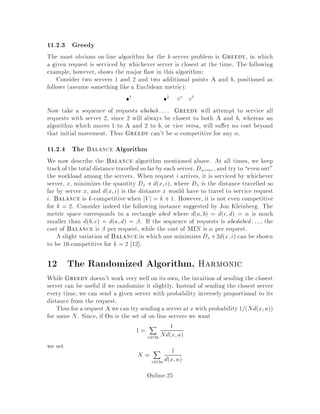
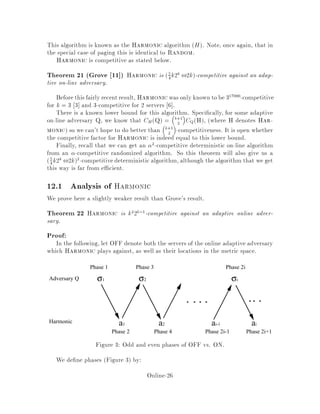
  • 165.
    De nition 1The performance guarantee of a heuristic algorithm for a minimization maximization problem is if the algorithm is guaranteed to deliver a solution whose value is at most at least times the optimal value. De nition 2 An -approximation algorithm is a polynomial time algorithm with a performance guarantee of . Before presenting techniques to design and analyze approximation algorithms as well as speci c approximation algorithms, we should rst consider which performance guarantees are unlikely to be achievable. 2 Negative Results For somehard optimizationproblems, it is possible to show a limiton the performance guarantee achievable in polynomial-time assuming P 6= NP. A standard method for proving results of this form is to show that the existence of an -approximation algorithm would allow you to solve some NP-completedecision problem in polynomial time. Even though NP-complete problems have equivalent complexity when exact solutions are desired, the reductions don't necessarily preserve approximability. The class of NP-complete problems can be subdivided according to how well a problem can be approximated. As a rst example, for the traveling salesman problem given nonnegative lengths on the edges of a complete graph, nd a tour | a closed walk visiting every vertex exactly once | of minimum total length, there is no -approximation for any unless P = NP. Indeed such an algorithm could be used to decide whether a graph V;E has an Hamiltonian cycle simply give every edge e a length of 1 and every non-edge a very high or in nite length . As another example, consider the bin packing problem. You have an integer T and weights x1;::: ;xn 2 0;T , and you want to partition them into as few sets bins as possible such that the sum of the weights in each set is at most T. It is NP-complete to decide whether k bins are su cient. In fact, there is no -approximation algorithm for this problem, for any 3=2. To see this, consider the partition problem: given weights x1;::: ;xn 2 0;S whose total sum is 2S, is there a partition of the weights into two sets such that the sum in each set is S? This is the same as asking: are two bins su cient when each bin has capacity S? If we had an -approximation algorithm 3=2, we could solve the partition problem1. In general, if the problem of deciding whether a value is at most k is NP-complete then there is no -approximation algorithm with k+1 k for the problem of minimizing the value unless P = NP. 1But wait, you exclaim| isn't there a polynomial-timeapproximationscheme for the bin packing problem? In fact, very good approximationalgorithms can be obtained for this problem if you allow additive as well as multiplicativeconstants in your performance guarantee. It is our more restrictive model that makes this negative result possible. See Section 6 for more details. Approx-2
  • 166.
    Until 1992, pedestrianarguments such as this provided essentially the only known examples of non-approximability results. Then came a string of papers culminating in the result of Arora, Lund, Motwani, Sudan, and Szegedy 1 based on the work of Arora and Safra 2 . They introduced a new characterization of NP in terms of prob- abilistically checkable proofs PCP. In the new characterization, for any language L in NP, given the input x and a proof y of polynomial length in x, the veri er will toss Ologn coins where n is the size of x to determine k = O1 positions or bits in the string y to probe; based on the values of these k bits, the veri er will answer yes or no. The new characterization shows the existence of such a veri er V and a proof y such that i if x 2 L then there exists a proof y such that V outputs yes independently of the random bits, ii if x =2 L then for every proof y, V outputs no with probability at least 0:5. From this characterization, they deduce the following negative result for MAX 3SAT: given a set of clauses with at most 3 literals per clause, nd an assignment maximizing the number of satis ed clauses. They showed the following: Theorem 1 For some 0, there is no 1 , -approximation algorithm2 for MAX 3SAT unless P = NP. The proof goes as follows. Take any NP-complete language L. Consider the veri er V given by the characterization of Arora et al. The number of possible output of the Ologn toin cosses is S = 2Ologn which is polynomial in n. Consider any outcome of these coin tosses. This gives k bits, say i1;::: ;ik to examine in the proof y. Based on these k bits, V will decide whether to answer yes or no. The condition that it answers yes can be expressed as a boolean formula on these k bits with the Boolean variables being the bits of y. This formula can be expressed as the disjunction or of conjunctions and of k literals, one for each satisfying assignment. Equivalently, it can be written as the conjunction of disjunction of k literals one for each rejecting assignment. Since k is O1, this latter k-SAT formula with at most 2k clauses can be expressed as a 3-SAT formula with a constant number of clauses and variables depending exponentially on k. More precisely, using the classical reduction from SAT to 3-SAT, we would get a 3-SAT formula with at most k2k clauses and variables. Call this constant number of clauses M k2k = O1. If x 2 L, we know that there exists a proof y such that all SM clauses obtained by concatenating the clauses for each random outcome is satis able. However, if x =2 L, for any y, the clauses corresponding to at least half the possible random outcomes cannot be all satis ed. This means that if x =2 L, at least S=2 clauses cannot be satis ed. Thus either all SM clauses can be satis ed or at most SM , S 2 clauses can be satis ed. If we had an approximation algorithm with performance guarantee better than 1, where = 1 2M we could decide whether x 2 L or not, in polynomial 2In our de nition of approximation algorithm, the performance guarantee is less than 1 for maximization problems. Approx-3
  • 167.
    time since ourconstruction can be carried out in polynomial time. This proves the theorem. The above theorem implies a host of negative results, by considering the complex- ity class MAX-SNP. de ned by Papadimitriou and Yannakakis 21 . Corollary 2 For any MAX-SNP-complete problem, there is an absolute constant 0 such that there is no 1 , -approximation algorithm unless P = NP. The class of MAX-SNP problems is de ned in the next section and the corollary is derived there. We rst give some examples of problems that are complete for MAX-SNP. 1. MAX 2-SAT: Given a set of clauses with one or two literals each, nd an as- signment that maximizes the number of satis ed clauses. 2. MAX k-SAT: Same as MAX 2-SAT, but each clause has up to k literals. 3. MAX CUT: Find a subset of the vertices of a graph that maximizesthe number of edges crossing the associated cut. 4. The Travelling Salesman Problem with the triangle inequality is MAX-SNP- hard. There is a technical snag here: MAX-SNP contains only maximization problems, whereas TSP is a minimization problem. 2.1 MAX-SNP Complete Problems Let's consider an alternative de nition of NP due to Fagin 9 . NP, instead of being de ned computationally, is de ned as a set of predicates or functions on structures G: 9S8x9y x;y;G;S where is a quanti er free expression. Here S corresponds to the witness or the proof. Consider for example the problem SAT. We are given a set of clauses, where each clause is the disjunction of literals. A literal is a variable or its negation. We want to know if there is a way to set the variables true or false, such that every clause is true. Thus here G is the set of clauses, S is the set of literals to be set to true, x represents the clauses, y represents the literals, and x;y;G;S = PG;y;x^ y 2 S _NG;y;x ^y 62 S Where PG;y;x is true i y appears positively in clause x, and NG;y;x is true i y appears negated in clause x. Approx-4
  • 168.
    Strict NP isthe set of problems in NP that can be de ned without the the third quanti er: 9S8x x;G;S where is quanti er free. An example is 3-SAT, the version of SAT in which every clause has at most 3 literals. Here x = x1;x2;x3 all possible combinations of three variables and G is the set of possible clauses; for example x1 _ x2 _ x3, x1 _ x2 _ x3, and so forth. Then is a huge conjunction of statements of the form: If x1;x2;x3 appears as x1 _ x2 _ x3, then x1 62 S _x2 2 S _x3 62 S. Instead of asking that for each x we get x;G;S, we can ask that the number of x's for which x;G;S is true be maximized: maxS jfx : x;G;Sgj In this way, we can derive an optimization problem from an SNP predicate. These maximization problems comprise the class MAX-SNP MAXimization, Strict NP de ned by Papadimitriou and Yannakakis 21 . Thus, MAX 3SAT is in MAX-SNP. Papadimitriou and Yannakakis then introduce an L-reduction L for linear, which preserverses approximability. In particular, if P L-reduces to P0, and there exists an -approximation algorithm for P0, then there exists a -approximation algorithm for P, where is some constant depending on the reduction. Given L-reductions, we can de ne MAX-SNP complete problems to be those P 2 MAX-SNP for which Q L P for all Q 2 MAX-SNP. Some examples of MAX-SNP complete problems are MAX 3SAT, MAX 2SAT and in fact MAX kSAT for any xed k 1, and MAX-CUT. The fact that MAX 3SAT is MAX-SNP-complete and Theorem 1 implies the corollary mentioned previously. For MAX 3SAT, in the statement of Theorem 1 can be chosen can be set to 1=74 Bellare and Sudan 5 . Minimization problems may not be able to be expressed so that they are in MAX- SNP, but they can still be MAX-SNP hard. Examples of such problems are: TSP with edge weights 1 and 2 i.e., di;j 2 f1;2g for all i;j. In this case, there exists a 7=6-approximation algorithm due to Papadimitriou and Yan- nakakis. Steiner tree with edge weights 1 and 2. Minimum Vertex Cover. Given a graph G = V;E, a vertex cover is a set S
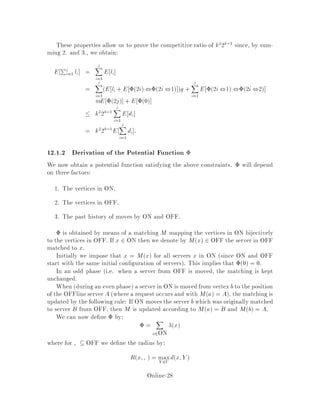
  • 169.
    V such thatu;v 2 E u 2 S or v 2 S. Approx-5
  • 170.
    3 The Designof Approximation Algorithms We now look at key ideas in the design and analysis of approximation algorithms. We will concentrate on minimization problems, but the ideas apply equally well to maximization problems. Since we are interested in the minimization case, we know that an -approximation algorithm H has cost CH COPT where COPT is the cost of the optimal solution, and 1. Relating CH to COPT directly can be di cult. One reason is that for NP-hard problems, the optimum solution is not well characterized. So instead we can relate the two in two steps: 1. LB COPT 2. CH LB Here LB is a lower bound on the optimal solution. 3.1 Relating to Optimum Directly This is not always necessary, however. One algorithm whose solution is easy to relate directly to the optimal solution is Christo des' 6 algorithm for the TSP with the triangle inequality di;j+dj;k di;k for all i;j;k. This is a 3 2-approximation algorithm, and is the best known for this problem. The algorithm is as follows: 1. Compute the minimum spanning tree T of the graph G = V;E. 2. Let O be the odd degree vertices in T. One can prove that jOj is even. 3. Compute a minimum cost perfect matching M on the graph induced by O. 4. Add the edges in M to E. Now the degree of everyvertexof G is even. Therefore G has an Eulerian tour. Trace the tour, and takeshortcuts when thesame vertex is reached twice. This cannot increase the cost since the triangle inequality holds. We claim that ZC 3 2ZTSP, where ZC is the cost of the tour produced by Christo des' algorithm, and ZTSP is the cost of the optimal solution. The proof is easy: ZC ZTSP ZT + ZM ZTSP = ZT ZTSP + ZM ZTSP 1 + 1 2 = 3 2: Here ZT is the cost of the minimumspanning tree and ZM is the cost of the matching. Clearly ZT ZTSP , since if we delete an edge of the optimal tour a spanning tree results, and the cost of the minimum spanning tree is at most the cost of that tree. Therefore ZT ZTSP 1. Approx-6
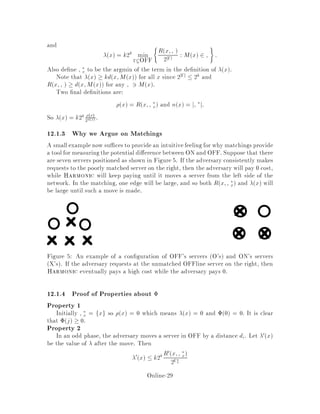
  • 171.
    To show ZM ZTSP 1 2, consider the optimal tour visiting only the vertices in O. Clearly by the triangle inequality this is of length no more than ZTSP . There are an even number of vertices in this tour, and so also an even number of edges, and the tour de nes two disjoint matchings on the graph induced by O. At least one of these has cost 1 2ZTSP, and the cost of ZM is no more than this. 3.2 Using Lower Bounds Let COPT = minx2S fx: A lower bound on COPT can be obtained by a so-called relaxation. Consider a related optimization problem LB = minx2R gx. Then LB is a lower bound on COPT and the optimizationproblemis called a relaxation of the original problemif the following conditions hold: S
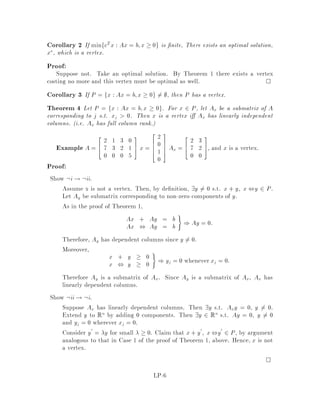
  • 172.
    R1 gx fxfor all x 2 S:2 Indeed these conditions imply LB = minx2R gx minx2S fx = COPT: Most classical relaxations are obtained by using linear programming. However, there are limitations as to how good an approximation LP can produce. We next show how to use a linear programming relaxation to get a 2-approximation algorithm for Vertex Cover, and show that this particular LP relaxation cannot give a better approximation algorithm. 3.3 An LP Relaxation for Minimum Weight Vertex Cover VC A vertex cover U in a graph G = V;E is a subset of vertices such that every edge is incident to at least one vertex in U. The vertex cover problem is de ned as follows: Given a graph G = V;E and weight wv 0 for each vertex v, nd a vertex cover U
  • 173.
    V minimizing wU= P v2U wv. Note that the problem in which nonpositive weight vertices are allowed can be handled by including all such vertices in the cover, deleting them and the incident edges, and nding a minimum weight cover of the remaining graph. Although this reduction preserves optimality, it does not maintain approximability; consider, for example, the case in which the optimum vertex cover has 0 cost or even negative cost. Approx-7
  • 174.
    This can beexpressed as an integer program as follows. Let xv = 1 if v 2 U and xv = 0 otherwise. Then COPT = minx2S X v2V wvxv where S = x 2 RjV j : xv+ xw 1 8v;w 2 E xv 2 f0;1g 8v 2 V : We now relax S, turning the problem into a linear program: LB = minx2R X v2V wvxv R = x 2 RjVj : xv+ xw 1 8v;w 2 E xv 0 8v 2 V : In order to show that R is a relaxation, we must show that it satis es conditions 1 and 2. Condition 1 clearly holds, as 0;1 0. Furthermore, condition 2 also holds, since the objective function is unchanged. Thus, we can conclude that LB COPT, and we can prove that an algorithm H is an -approximation algorithm for VC by showing CH LB. The limitation of this relaxation is that there are instances where LB 1 2COPT. This implies that it cannot be used to show any 2, since if we could then H would give a better answer than the optimum. One such instance is Kn: the complete graph on n vertices, with all vertices weight 1. All the nodes but one must be in the cover otherwise there will be an edge between two that are not, with neither in the cover set. Thus, COPT = n ,1. The relaxation, on the other hand, can have xv = 1 2;8v 2 V . Thus, LB n 2, which means LB 1 2COPT. 3.4 How to use Relaxations There are two main techniques to derive an approximately optimal solution from a solution to the relaxed problem. 1. Rounding Find an optimal solution x to the relaxation. Round x 2 R to an element x0 2 S. Then prove fx0 gx which implies fx0 LB COPT Often randomization is helpful, as we shall see in later sections. In this case x 2 R is randomly rounded to some element x0 2 S so that E fx0 gx. These algorithms can sometimes be derandomized, in which case one nds an x00 such that fx00 E fx0 . Approx-8
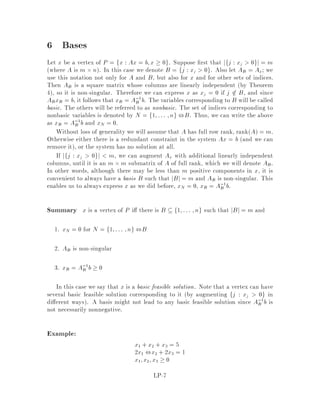
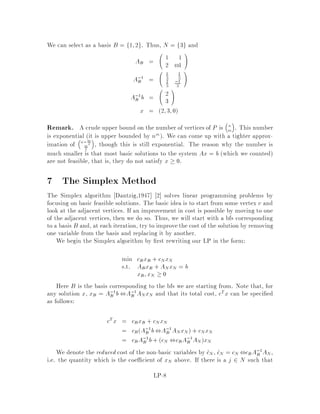
  • 175.
    2. Primal-Dual Consider someweak dual of the relaxation: maxfhy : y 2 Dg minfgx : x 2 Rg Construct x 2 S from y 2 D such that fx hy hymax gxmin COPT: Notice that y can be any element of D, not necessarily an optimal solution to the dual. We now illustrate these techniques on the minimum weight vertex cover problem. 3.4.1 Rounding applied to VC This is due to Hochbaum 16 . Let x be the optimal solution of the LP relaxation. Let U = fv 2 V : xv 1 2g We claim U is a 2-approximation of the minimum weight VC. Clearly U is a vertex cover, because for u;v 2 E we have xu + xv 1, which implies xu 1=2 or xv 1=2. Also X v2U wv X v2V wv2xv = 2LB since 2xv 1 for all v 2 U. 3.4.2 Primal-Dual applied to VC This is due to Bar-Yehuda and Even 4 . First formulate the dual problem. Let y 2 RjEj; the elements of y are ye for e = u;v 2 E. The dual is: max X e2E ye X u:e=v;u2E ye wv 8v 2 V3 ye 0 8e 2 E:4 Initialize C the vertex cover to the empty set, y = 0 and F = E. The algorithm proceeds by repeating the following two steps while F 6= ;: 1. Choose some e = u;v 2 F. Increase ye as much as possible, until inequal- ity 3 becomes tight for u or v. Assume WLOG it is tight for u. 2. Add u to C and remove all edges incident to u from F. Clearly C is a vertex cover. Furthermore X v2C wv = X v2C X u:e=v;u2E ye = X e=v;u2E jC fv;ugjye X e2E 2ye 2LB: Approx-9
  • 176.
    4 The Min-CostPerfect Matching Problem In this section, we illustrate the power of the primal-dual technique to derive approx- imation algorithms. We consider the following problem. De nition 3 The Minimum-Cost Perfect Matching Problem MCPMP is as fol- lows: Given a complete graph G = V;E with jV j even and a nonnegative cost function ce 0 on the edges e 2 E, nd a perfect matching M such that the cost cM is minimized, where cM = P e2M ce. The rst polynomialtimealgorithmfor this problemwas givenbyEdmonds 8 and has a running time of On4 where n = jV j. To date, the fastest strongly polynomial time algorithm is due to Gabow 10 and has a running time of Onm + nlgn where m = jEj. For dense graphs, m = n2, this algorithm gives a running time of On3. The best weakly polynomial algorithm is due to Gabow and Tarjan 12 and runs in time Om q n m;nlognlognC where C is a bound on the costs ce. For dense graphs with C = On, this bound gives an On2:5 running time. As you might suspect from these bounds, the algorithms involved are fairly com- plicated. Also, these algorithms are too slow for many of the instances of the problem that arise in practice. In this section, we discuss an approximation algorithm by Goe- mans and Williamson 13 that runs in time On2 lgn. This bound has recently been improved by Gabow, Goemans and Williamson 11 to Onn + pmlglgn. Although MCPMP itself is in PTIME, this algorithm is su ciently general to give approximations for many NP-hard problems as well. The algorithm of Goemans and Williamson is a 2-approximation algorithm | it outputs a perfect matching with cost not more than a factor of 2 larger than the cost of a minimum-cost perfect matching. This algorithm requires that the costs ce make up a metric, that is, ce must respect the triangle inequality: cij + cjk cik for all triples i;j;k of vertices. 4.1 A linear programming formulation The basic idea used in the 2-approximation algorithm of Goemans and Williamson is linear programming and duality. The min-cost perfect matching problem can be formulated as a linear program. The algorithm does not directly solve the linear program, but during its operation, it can compute a feasible solution to the dual program. This dual feasible solution actually certi es the factor of 2 approximation. Before writing down the linear program, we start with an observation. Consider a matching M and a set S V of vertices with jSj odd. If M is a perfect matching, then since jSj is odd, there must be some edge in the matching that has one endpoint inside S and the other outside. In other symbols, let S be the set of edges in E with exactly one endpoint in S; if M is a perfect matching and jSj is odd, then M S 6= ;. Approx-10
  • 177.
    With this observation,we can now formulate MCPMP as a linear program: Z =Min X e2E cexe subject to: X e2 S xe 1 for all S V with jSj odd xe 0 for all e 2 E. We can now see that the value Z of this linear program is a lower bound on the cost of any perfect matching. In particular, for any perfect matching M, we let xe = 8 : 1 if e 2 M; 0 otherwise. Clearly, this assignment is a feasible solution to the linear program, so we know that Z cM. This bound also applies to a minimum-cost perfect matching M, so we have Z cM. Note that this is a huge linear program having one constraint for each S V of odd cardinality. Though it is too large to be solved in polynomial time by any of the linear programming algorithms we have seen, the ellipsoid method can actually solve this program in polynomial time. We do not consider this solution technique; rather we let the linear program and its dual serve as a tool for developing and analyzing the algorithm. We now consider the dual linear program: Z =Max X S V; jSj odd yS subject to: X S V; e2 S yS ce for all e 2 E yS 0 for all S V with jSj odd. Note that by strong duality, the value Z of this dual linear program is the same as the value Z of the primal program. This dual linear program is used to verify that the perfect matching output by the algorithm is actually within a factor of 2 of optimal. The algorithm outputs two things: 1. a perfect matching M0, and 2. a dual feasible solution y such that cM0 2 X S V; jSj odd yS: Approx-11
  • 178.
    Since y isdual feasible, we know that X S V; jSj odd yS Z cM where M is any perfect matching. Thus we have cM0 2Z 2cM where M is a min-cost perfect matching. The algorithm is therefore given that it runs in polynomial time a 2-approximation algorithm for MCPMP. To be precise, the algorithm need not actually output the dual feasible solution y | it is only needed as an analysis tool to prove the factor of 2 approximation bound. In spite of the fact that there are an exponential number of yS variables, the algorithm could actually compute and output the yS values since it turns out that only a polynomial number of them are non-zero. When we nally get to exhibiting the algorithm, we will include the computation of the yS values. 4.2 From forest to perfect matching Rather than directly compute the perfect matching M0, the algorithm rst computes a forest F0 from which M0 can be derived. In the forest F0, all components have even size, and furthermore, F0 is edge-minimal in the sense that if any edge of F0 is removed, then the resulting forest has an odd size component. Additionally, the cost of F0 is bounded by twice the value of the dual feasible solution; that is, cF0 2 X S V; jSj odd yS: We now show how to convert F0 into a perfect matching M0 such that cM0 cF0. The idea is as follows. Starting from the forest F0, consider any vertex v with degree at least 3. Take two edges u;v and v;w; remove them and replace them with the single edge u;w. Since the edge costs obey the triangle inequality, the resulting forest must have a cost not more than cF0. Thus, if we can iterate on this operation until all vertices have degree 1, then we have our perfect matching M0. The only thing that can get in the way of the operation just described is a vertex of degree 2. Fortunately, we can show that all vertices of F0 have odd degree. Notice then that this property is preserved by the basic operation we are using. As a direct consequence, the property that all components are even is also preserved. Therefore, if all vertices of F0 have odd degree, we can iteration the basic operation to produce a perfect matching M0 such that cM0 cF0. Notice that M0 is produced after On iterations. Lemma 3 All vertices of F0 have odd degree. Approx-12
  • 179.
    Proof: Suppose thereis a vertex v with even degree, and let v be in component A of F0. Removing v and all its incident edges partitions A into an even number k of smaller components A1;A2;::: ;Ak. If all k of these components have odd size, then it must be the case that A has odd size. But we know that A has even size | all components of F0 have even size | so there must be a component Ai with even size. Let vi denote the vertex in Ai such that v;vi is an edge of F0. Now if we start from F0 and remove the edge v;vi, we separate A into two even size components. This contradicts the edge-minimality of F0. 4.3 The algorithm The algorithm must now output an edge-minimalforest F0 with even size components and be able to compute a dual feasible solution y such that cF0 2PyS. At the highest level, the algorithm is: 1. Start with F = ;. 2. As long as there exists an odd size component of F, add an edge between two components at least one of which has odd size. Note that the set of components of F is initially just the set of vertices V . The choice of edges is guided by the dual linear program shown earlier. We start with all the dual variables equal to zero; yS = 0. Suppose at some point in the execution we have a forest F as shown below and a dual solution y. Look at the q q q , @ 1 q q q q q q , @ @ , 2 q q@ 3 q 4 q q@ 5 q q qA A 6 q q q , @ 7 components S of odd cardinality components 1, 4, 6 and 7, in this case. For these components, increase yS by some , leaving all other values of yS unchanged. That is, yS 8 : yS + if S is an odd size component of F yS otherwise. Make as large as possible while keeping yS dual feasible. By doing this, we make the constraint on some edge e tight; for some e the constraint X S V; e2 S yS ce becomes X S V; e2 S yS = ce: Approx-13
  • 180.
    This is theedge e that we add to F. If more than one edge constraint becomes tight simultaneously, then just arbitrarily pick one of the edges to add. We now state the algorithm to compute F0. The steps that compute the dual feasible solution y are commented out by placing the text in curly braces. 1 F ; 2 C ffig j i 2 V g fThe components of Fg 3 fLet yS 0 for all S with jSj odd.g 4 8i 2 V do di 0 fdi = P S3i ySg 5 while 9C 2 C with jCj odd do 6 Find edge e = i;j such that i 2 Cp, j 2 Cq, p 6= q which minimizes = ce,di,dj Cp+Cq where C = n1 if jCj is odd 0 otherwise i.e., the parity of C. 7 F F feg 8 8C 2 C with jCj odd do 9 8i 2 C do di di+ 10 fLet yC yC + .g 11 C C nfCp;Cqg fCp Cqg 12 F0 edge-minimal F 4.4 Analysis of the algorithm Lemma 4 The values of the variables yS computed by the above algorithm constitute a dual feasible solution. Proof: We show this by induction on the while loop. Speci cally, we show that at the start of each iteration, the values of the variables yS are feasible for the dual linear program. We want to show that for each edge e 2 E, X S V; e2 S yS ce: The base case is trivial since all variables yS are initialized to zero and the cost function ce is nonnegative. Now consider an edge e0 = i0;j0 and an iteration. There are two cases to consider. In the rst case, suppose both i0 and j0 are in the same component at the start of the iteration. In this case, there is no component C 2 C for which e0 2 C. Therefore, since the only way a variable yS gets increased is when S is a component, none of the variables yS with e0 2 S get increased at this iteration. Bythe induction Approx-14
  • 181.
    hypothesis, we assumethe iteration starts with X S V; e0 2 S yS c0 e; and therefore, since the left-hand-side of this inequality does not change during the iteration, this inequality is also satis ed at the start of the next iteration. In the second case, suppose i0 and j0 are in di erent components; i0 2 Cp0 and j0 2 Cq0 at the start of the iteration. In this case, we can write X S V; e0 2 S yS = X S V; i0 2S yS + X S V; j0 2S yS = di0 + dj0; where di is de ned by di = X S V; i2S yS: The equality follows because since i0 and j0 are in di erent components, if S contains both i0 and j0, then S is not and never has been a component; hence, for such a set S, we have yS = 0. We know that during this iteration di0 will be incremented by if and only if yCp0 is incremented by , and this occurs if and only if Cp0 = 1. Let d0i0 and d0j0 be the new values of di0 and dj0 after this iteration. Then we have d0i0 = di0 + Cp0 ; and d0j0 = dj0 + Cq0 : Now, by the way is chosen, we know that ce0 ,di0 ,dj0 Cp0 + Cq0 : Thus, at the beginning of the next iteration we have X S V; e0 2 S yS = d0i0 + d0j0 = di0 + Cp0 + dj0 + Cq0 = di0 + dj0 + Cp0 + Cq0 di0 + dj0 + ce0 ,di0 ,dj0 Cp0 + Cq0 Cp0 + Cq0 = ce0 : Finally, for completeness sake, we note that the constraint yS 0 is satis ed because yS = 0 initially and 0. Approx-15
  • 182.
    As a nalobservation, we note that when the algorithm selects an edge e0, the corresponding constraint in the dual linear program becomes tight. This means that for all edges e 2 F, we have X S V; e2 S yS = ce: 4.5 A simulated run of the algorithm Since the algorithm as given can be di cult to visualize, here is an example of how it would execute. See Figure 1. 1 2 3 4 5 6 7 8 Figure 1: A sample run of the algorithm. The various values of di are indicated by the shaded regions around the components. We'll assume a Euclidean distance metric to ease visualization. Now, initially, all points 1 through 8 are in separate components, and di is0 for all i. Sincethe metric is Euclidean distance, the rst edge to be found will be 7;8. Since both components are of odd size, will be half the distance between them ce ,0,0=1+1. Since, in fact, all components are of odd size, every di will be increased by this amount, as indicated by the innermost white circle around each point. The set f7;8g now becomes a single component of even size. In general, we can see the next edge to be chosen by nding the pair of components whose boundaries in the picture can be most easily made to touch. Thus, the next edge is 3;5, since the boundaries of their regions are closest, and the resulting values Approx-16
  • 183.
    of di arerepresented by the dark gray bands around points 1 through 6. Note that the component f7;8g does not increase its di values since it is of even size. We continue in this way, expanding the moats around odd-sized components until all components are of even size. Since there is an even number of vertices and we always expand odd-sized components, we are guaranteed to reach such a point. 4.6 Final Steps of Algorithm and Proof of Correctness Let F0 = fe 2 F : F nfeg has an odd sized componentg. We will show that the F0 so obtained is a forest with components of even cardinality and that it is edge minimal with respect to this property. It is obvious that F0 is a forest since F0 F and F is a forest. We will also show that the cost of this forest F0, is less than or equal to twice the dual solution. In section 4.2 we showed how to build a matching from this forest with the cost of the matching less than or equal to the cost of the forest. Thus, this gives us a 2-approximation algorithm for matching. As an example see the gure given below. FFFF FFFF'''' Figure 2: Example showing how to get F0 from F. Theorem 5 Let F0 = fe 2 F : F nfeg has an odd sized componentg. Then 1. every component of F0 has an even number of vertices and F0 is edge minimal with respect to this property.. 2. P e2F0 ce 2P S yS. Proof: Let us rst show that every component of F0 has an even number of vertices. Suppose not. Then consider the components of F. Every component of F has an even numberof verticesby design of the algorithm. Consider a component of F0 which has an odd number of vertices and let us denote it as T0 i. Let Ti be the component Approx-17
  • 184.
    that T0 i belongsto in F. Let N1;::: ;Nj be the components of F within Ti obtained by removing T0 i see gure 3. Ti has an even number of vertices. Nk with 1 k j has an even number of vertices because, otherwise, the edge from Nk to T0 i would belong to F0 by de nition. But this implies that T0 i is even, which is a contradiction. T T N N N N i i' 1 2 k j Figure 3: Every component of F0 has an even of vertices. A simple proof by contradiction shows that F0 is edge minimal. Suppose F0 is not edge minimal. Then there is an edge or set of edges which can be removed which leave even sized components. Consider one such edge e. It falls into one of two categories: 1. Its removal divides a component into two even sized components. But this means that e was already removed by the de nition of F0. 2. Its removal divides a component into two odd sized components. Despite the fact that other edges may be removed, as well, an two odd sized component will remain in the forest. Thus, e cannot be removed. Now let us prove the second portion of the theorem. In what follows, though we do not explicitly notate it, when we refer to a set S of vertices, we mean a set S of vertices with jSj odd. We observe that by the choice of the edges e in F, we have ce = X S:e2 S yS for all e 2 F. Thus, X e2F0 ce = X e2F0 X S:e2 S yS = X S ySjF0 Sj Thus we need to show, X S ySjF0 Sj 2 X S yS Approx-18
  • 185.
    We will showthis by induction. In what follows, bear in mind that F0 is what we have, at the end of the algorithm. We will show the above relation holds at every iteration. Initially, yS = 0. Thus the LHS and RHS are both zero. Thus, this is true initially. Let us suppose it is true at any intermediate stage in the algorithm. We will show that it will remain true in the next iteration. From one iteration to the next the only yS that change are those with C 2 C with jCj odd. Thus if we show the increase in the LHS is less than the RHS we are done. i.e. X C2C;jCj odd jF0 Cj 2 jfC 2 C;jCj oddgj or X C2C;jCj odd jF0 Cj 2jfC 2 C;jCj oddgj Now, de ne a graph H with C 2 C as vertices, with an edge between Cp and Cq if there exists an edge in F0 f Cp Cqg. We can partition these vertices into two groups based on their cardinality. Those that have even cardinality and those that have odd cardinality. Remove from this graph all vertices that have even cardinality and are isolated they have no edges incident to them. We will denote the resulting set of vertices of odd and even cardinality by Odd and Even respectively. Now P C2C;jCj odd jF0 Cj corresponds to the sum of the degrees of vertices in Odd in the graph H. And, jfC 2 C;jCj oddgj, corresponds to the number of vertices in odd. Thus we need to show: X v2Odd dHv 2jOddj where dHv denotes the degree of node v in the graph H. Since F0 is a forest, H is also a forest and we have: Number of edges in H number of vertices in H. Or P v2Odd dHv+ P v2Even dHv 2 jOddj + jEvenj or X v2Odd dHv 2jOddj + X v2Even 2 ,dHv We now claimthat ifv 2 Eventhen v is not a leaf. If this is true then 2,dHv 0 for v 2 Even and so we are done. Suppose there is a vi 2 Even which is a leaf. Consider the component C in H that vi is contained in. By the construction of H, each tree in F0 is either contained solely in the vertices represented by C or it is strictly outside C. Since each tree in F0 contains an even number of vertices C does w.r.t. the original graph, as well. So vi and C ,vi each contains an even number of vertices. As a result, removing the Approx-19
  • 186.
    edge between viand C , vi would leave even sized components, thus contradicting the minimality of F0. T C N N N N i i 1 2 k j Figure 4: dHv 2 for v 2 Even 4.7 Some implementation details The algorithm can be implemented in On2 logn. For this purpose, notice that the number of iterations is at most n , 1 since F is a forest. The components of F can be maintained as a union- nd structure and, therefore, all mergings of components take On n;n where is the inverse Ackermann function. In order to get the On2 logn bound, we shall show that every iteration can be implemented in Onlogn time. In order to nd the edge e to add to F, we maintain a priority queue containing the edges between di erent components of F. This initialization of this priority queue takes On2 logn time. In order to describe the key of an edge, we need to introduce a notion of time. The time is initially set to zero and increases by in each iteration the time can be seen to be the maximum of di over all vertices i. The key of an edge e = i;j is equal to the time at which we would have ce = di + dj if the parity of the components containing i and j don't change. The edge to be selected is therefore the edge with minimum key and can be obtained in Onlog n. When two components merge, we need to update the keys of edges incident to the resulting component since the parity might have changed. By keeping track of only one edge between two components the one with smallest key, we need to update the keys of On edges when two components merge. This can be done in Onlog n Ologn per update. To complete the discussion, we need to show how to go from F to F0. By per- forming a post-order traversal of the tree and computing the parity of the subtrees encountered in a recursive manner, this step can be implemented in On time. Approx-20
  • 187.
    5 Approximating MAX-CUT Inthis section, we illustrate the fact that improved approximation algorithms can be obtained by considering relaxations more sophisticated than linear ones. At the same time, we will also illustrate the fact that rounding a solution from the relaxation in a randomized fashion can be very useful. For this purpose, we consider approximation algorithms for the MAX-CUT problem. The unweighted version of this problem is as follows: Given: A graph G = V;E. Find: A partition S; S such that dS := j Sj is maximized. It can be shown that this problem is NP-hard and MAX SNP-complete and so we cannot hope for an approximation algorithm with guarantee arbitrarily close to 1 unless P = NP. In the weighted version of the problem each edge has a weight wij and we de ne dS by, dS = X i;j2E:i2S;j=2S wij: For simplicity we focus on the unweighted case. The results that we shall obtain will also apply to the weighted case. Recall that an -approximation algorithm for MAX-CUT is a polynomial time algorithm which delivers a cut S such that dS zMC where zMC is the value of the optimum cut. Until 1993 the best known was 0.5 but now it is 0.878 due to an approximation algorithm of Goemans and Williamson 14 . We shall rst of all look at three almost identical algorithms which have an approximation ratio of 0.5. 1. Randomized construction. We select S uniformly from all subsets of V . i.e. For each i 2 V we put i 2 S with probability 1 2 independently of j 6= i. E dS = P i;j2E Pr i;j 2 S by linearity of expectations = P i;j2E Pr i 2 S;j =2 S or i =2 S;j 2 S = 1 2jEj: ButclearlyzMC jEjand so we haveE dS 1 2zMC. Notethat by comparing our cut to jEj, the best possible bound that we could obtain is 1 2 since for Kn the complete graph on n vertices we have jEj = n 2 and zMC = n2 4 . 2. Greedyprocedure. Let V = f1;2;::: ;ng and let Ej = fi : i;j 2 E and i jg. It is clear that fEj : j = 2;::: ;ng forms a partition of E. The algorithm is: Set S = f1g For j = 2 to n do if jS Ejj 1 2jEjj then S S fjg. Approx-21
  • 188.
    If we dene Fj = Ej S then we can see that fFj : j = 2;::: ;ng is a partition of S. By de nition of the algorithm it is clear that jFjj jEjj 2 . By summing over j we get dS jEj 2 zMC 2 . In fact, the greedy algorithm can be obtained from the randomized algorithm by using the method of conditional expectations. 3. Local search. Say that S is locally optimum if 8i 2 S : dS , fig dS and 8i =2 S : dS fig dS. Lemma 6 If S is locally optimum then dS jEj 2 . Proof: dS = 1 2 X i2V fnumber of edges in cut incident to ig = 1 2 X i2V j S ij 1 2 X i2V 1 2dij = 2 4jEj = jEj 2 : The inequality is true because if j S ij 1 2j ij for some i then we can move i to the other side of the cut and get an improvement. This contradicts local optimality. In local search we moveone vertex at a timefrom one side of the cut to the other until we reach a local optimum. In the unweighted case this is a polynomial time algorithm since the number of di erent values that a cut can take is On2. In the weighted case the running time can be exponential. Haken and Luby 15 have shown that this can be true even for 4-regular graphs. For cubic graphs the running time is polynomial 22 . Over the last 15-20 years a number of small improvements were made in the approxi- mation ratio obtainable for MAX-CUT. The ratio increased in the following manner: 1 2 ! 1 2 + 1 2m ! 1 2 + 1 2n ! 1 2 + n ,1 4m where m = jEj and n = jV j, but asymptotically this is still 0:5. Approx-22
  • 189.
    5.1 Randomized 0.878Algorithm The algorithm that we now present is randomized but it di ers from our previous randomized algorithm in two important ways. The event i 2 S is not independent from the event j 2 S. We compare the cut that we obtain to an upper bound which is better that jEj. r S S _ Figure 5: The sphere Sn. Suppose that for each vertex i 2 V we have a vector vi 2 Rn where n = jV j. Let Sn be the unit sphere fx 2 Rn : jjxjj = 1g. Take a point r uniformly distributed on Sn and let S = fi 2 V : vi r 0g Figure 5. Note that without loss of generality jjvijj = 1. Then by linearity of expectations: E dS = X i;j2E Pr signvi r 6= signvj r :5 Lemma 7 Pr signvi r 6= signvj r = Pr random hyperplane separates vi and vj = where = arccosvi vj the angle between vi and vj. Proof: This result is easy to see but it is a little di cult to formalize. Let P be the 2-dimensional plane containing vi and vj. Then P Sn is a circle. With probability 1, H = fx : x r = 0g intersects this circle in exactly two points s and t which are diametrically opposed. See gure 6. By symmetry s and t are uniformly distributed on the circle. The vectors vi and vj are separated by the hyperplane H if and only if either s or t lies on the smaller arc between vi and vj. This happens with probability 2 2 = . Approx-23
  • 190.
    s t v vi j α P Figure 6: Theplane P. From equation 5 and lemma 7 we obtain: E dS = X i;j2E arccosvi vj : Observe that E dS zMC and so maxvi E dS zMC; where we maximize over all choices for the vi's. We actually have maxvi E dS = zMC. Let T be a cut such that dT = zMC and let e be the unit vector whose rst component is 1 and whose other components are 0. If we set vi = e if i 2 T ,e otherwise. then S = T with probability 1. This means that E dS = zMC. Corollary 8 zMC = maxjjvijj=1 X i;j2E arccosvi vj : Unfortunately this is as di cult to solve as the original problem and so at rst glance we have not made any progress. Approx-24
  • 191.
    5.2 Choosing agood set of vectors Let f : ,1;1 ! 0;1 be a function which satis es f,1 = 1, f1 = 0. Consider the following program: Max X i;j2E fvi vj subject to: P jjvijj = 1 i 2 V: If we denote the optimal value of this program by zP then we have zMC zP: This is because if we have a cut T then we can let, vi = e if i 2 T ,e otherwise. Hence P i;j2E fvi vj = dT and zMC zP follows immediately. 5.3 The Algorithm The framework for the 0.878 approximation algorithm for MAX-CUT can now be presented. 1. Solve P to get a set of vectors fv 1;::: ;v ng. 2. Uniformly select r 2 Sn. 3. Set S = fi : v i r 0g. Theorem 9 E dS zP zMC where, = min,1x1 arccosx fx : Proof: E dS = X i;j2E arccosv i v j X i;j2E fv i v j = zP zMC: Approx-25
  • 192.
    We must nowchoose f such that P can be solved in polynomial time and is as large as possible. We shall show that P can be solved in polynomial time whenever f is linear and so if we de ne, fx = 1 ,x 2 then our rst criterion is satis ed. Note that f,1 = 1 and f1 = 0. With this choice of f, = min,1x1 2arccosx 1 ,x = 2arccos,0:689 1 ,,0:689 = 0:87856: See gure 7. 0 -1 1 1 -0.689 1-x π arccos(x) 2 Figure 7: Calculating . 5.4 Solving P We now turn our attention to solving: Max X i;j2E 1 21 ,vi vj subject to: P jjvijj = 1 i 2 V: Approx-26
  • 193.
    Let Y =yij where yij = vi vj. Then, jjvijj = 1 yii = 1 for all i. yij = vi vj Y 0, where Y 0 means that Y is positive semi-de nite: 8x : xTY x 0. This is true because, xTY x = X i X j xixjvi vj = X i xivi 2 0: Conversely if Y 0 and yii = 1 for all i then it can be shown that there exists a set of vi's such that yij = vi vj. Hence P is equivalent to, Max X i;j2E 1 21 ,yij subject to: P0 Y 0 yii = 1 i 2 V: Note that Q := fY : Y 0;yii = 1g is convex. If A 0 and B 0 then A+ B 0 and also A+B 2 0. It can be shown that maximizing a concave function over a convex set can be done in polynomial time. Hence we can solve P0 in polynomial time since linear functions are concave. This completes the analysis of the algorithm. 5.5 Remarks 1. The optimum Y could be irrational but in this case we can nd a solution with an arbitrarily small error in polynomial time. 2. To solve P0 in polynomial time we could use a variation of the interior point method for linear programming. 3. Given Y , vi can be obtained using a Cholesky factorization Y = V V T. 4. The algorithm can be derandomized using the method of conditional expecta- tions. This is quite intricate. 5. The analysis is very nearly tight. For the 5-cycle we have zMC and zP = 5 21 + cos 5 = 25+5p5 8 which implies that zMC zP = 0:88445. Approx-27
  • 194.
    6 Bin Packingand P k Cmax One can push the notion of approximation algorithms a bit further than we have been doing and de ne the notion of approximation schemes: De nition 4 A polynomial approximation scheme pas is a family of algorithms A : 0 such that for each 0, A is a 1 + -approximation algorithm which runs in polynomial time in input size for xed . De nition 5 A fully polynomial approximation scheme fpas is a pas with running time which is polynomial both in input size and 1= . It is known that if is a strongly NP-complete problem, then has no fpas unless P = NP. From the result of Arora et al. described in Section 2, we also know that there is no pas for any MAX ,SNP hard problem unless P = NP. We now consider two problems which have a very similar avor; in fact, they correspond to the same NP-complete decision problem. However, they considerably di er in terms of approximability: one has a pas, the other does not. Bin Packing: Given item sizes a1;a2;::: ;an 0 and a bin size of T, nd a partition of I1;::: ;Ik of 1;::: ;n, such that P i2Il ai T and k is minimized the items in Il are assigned to bin l. P k Cmax: Given n jobs with processing times p1;::: ;pn and m machines, nd a partition fI1;::: ;Img of f1;::: ;ng, such that the makespan de ned as maxiP j2Ii pj is minimum. The makespan represents the maximum comple- tion time on any machine given that the jobs in Ii are assigned to machine i. The decision versions of the two problemsare identicaland NP-complete. However when we consider approximation algorithms for the two problems we have completely di erent results. In the case of the bin packing problem there is no -approximation algorithm with 3=2, unless P = NP. Proposition 10 There is no -approximation algorithm with 3=2, for bin pack- ing, unless P = NP, as seen in Section 2. However, we shall see, for P k Cmax we have -approximation algorithms for any . De nition 6 An algorithm A has an asymptotic performance guarantee of if limsup k!1 k Approx-28
  • 195.
    where k = sup I:OPTI=k AI OPTI andOPTI denotes the value of instance I and AI denotes the value returned by algorithm A. For P k Cmax, there is no di erence between an asymptotic performance and a per- formance guarantee. This follows from the fact that P k Cmax satis es a scaling property : an instance with value OPTI can be constructed by multiplying every processing time pj by . Using this de nition we can analogously de ne a polynomial asymptotic approx- imation scheme paas. And a fully polynomial asymptotic approximation scheme fpaas. Now we will state some results to illustrate the di erence in the two problems when we consider approximation algorithms. 1. For bin packing, there does not exist an -approximation algorithm with 3=2, unless P = NP. Therefore there is no pas for bin packing unless P = NP. 2. For P k Cmax there exists a pas. This is due to Hochbaum and Shmoys 17 . We will study this algorithm in more detail in today's lecture. 3. For bin packing there exists a paas. Fernandez de la Vega and Lueker 7 . 4. For P k Cmax there exists no fpaasunless P = NP. This is because the existence of a fpaas implies the existence of a fpas and the existence of a fpas is ruled out unless P = NP because, P k Cmax is strongly NP-complete. 5. For bin packing there even exists a fpaas. This was shown by Karmarkar and Karp 18 . 6.1 Approximation algorithm for PjjCmax We will now present a polynomial approximation scheme for the PjjCmax scheduling problem. We analyze a pas for PjjCmax, discovered by Hochbaum and Shmoys 17 . The idea is to use a relation similar to the one between an optimization problem and its decision problem. That is, if we have a way to solve decision problem, we can use binary search to nd the exact solution. Similarly, in order to obtain a 1 + - approximation algorithm, we are going to use a so-called 1 + -relaxed decision version of the problem and binary search. De nition 7 1 + -relaxed decision version of PjjCmax is a procedure that given and a deadline T, returns either: Approx-29
  • 196.
    T 1 2 m ∑ pj m max pj ... ... Figure8: List scheduling. no | if there does not exist a schedule with makespan T, or yes | if a schedule with makespan 1 + T exists. In case of yes, the actual schedule must also be provided. Notice that in some cases both answers are valid. In such a case, we do not care if the procedure outputs yes or no. Suppose we have such a procedure. Then we use binary search to nd the solution. To begin our binary search, we must nd an interval where optimal Cmax is contained. Notice that P j pj =m is an average load per machine and maxj pj is the length of the longest job. We can put a bound on optimum Cmax as follows: Lemma 11 Let L = max 0 @maxj pj; P j pj m 1 A then L Cmax 2L. Proof: Since the longest job must be completed, we have maxj pj Cmax. Also, since P j pj =m is the average load, we have P j pj =m Cmax. Thus, L Cmax. The upper bound relies on the concept of list scheduling, which dictates that a job is never processed on some machine, if it can be processed earlier on another machine. That is, we require that if there is a job waiting, and an idle machine, we must use this machine to do the job. We claim that for such a schedule Cmax 2L. Consider the job that nishes last, say job k. Notice that when it starts, all other machines are busy. Moreover, the time elapsed up to that point is no more than the average Approx-30
  • 197.
    load of themachines see Figure 8. Therefore, Cmax P j6=k pj m + pk P j pj m + maxj pj 2max maxj pj; P j pj m ! = 2L: Now we have an interval on which to do a logarithmic binary search for Cmax. By T1 and T2 we denote lower and upper bound pointers we are going to use in our binary search. Clearly, T = p T1T2 is the midpoint in the logarithmic sense. Based on Lemma 11, we must search for the solution in the interval L;::: ;2L . Since we use logarithmic scale, we set logT1 = log2 L, logT2 = log2 L + 1 and logT = 1 2log2 T1 + log2 T2. When do we stop? The idea is to use di erent value of . That is, the approxima- tion algorithm proceeds as follows. Every time, the new interval is chosen depending on whether the procedure for the 1 + =2-relaxed decision version returns a no or in case of yes a schedule with makespan 1 + =2T, where T = pT1T2 and T1;::: ;T2 is the current interval. The binary search continues until the bounds T1;T2 satisfy the relation T21+ =2 T1 1 + , or equivalently T2 T1 1+ 1+ =2. The number of iterations required to satisfy this relation is Olg1= . Notice that this value is a constant for a xed . At termination, the makespan of the schedule corresponding to T2 will be within a factor of 1 + of the optimal makespan. In order to complete the analysis of the algorithm, it remains to describe the procedure for the 1 + =2-relaxed decision procedure for any . Intuitively, if we look at what can go wrong in list scheduling, we see that it is governed by long jobs, since small jobs can be easily accommodated. This is the approach we take, when designing procedure that solves the 1 + =2-relaxed decision version of the problem. For the rest of our discussion we will denote =2 by 0. Given fpjg; 0 and T, the procedure operates as follows: Step 1: Remove all small jobs with pj 0T. Step 2: Somehow to be speci ed later solve the 1+ 0-relaxed decision version of the problem for the remaining big jobs. Step 3: If answer in step 2 is no, then return that there does not exist a schedule with makespan T. If answer in step 2 is yes, then with a deadline of 1+ 0T put back all small jobs using list scheduling i.e. greedy strategy, one at a time. If all jobs are Approx-31
  • 198.
    (1+ε)ΤΤ deadlinedeadline Figure 9: Schedulingsmall jobs. accommodated then return that schedule, else return that there does not exist a schedule with makespan T. Step 3 of the algorithm gives the nal answer of the procedure. In case of a yes it is clear that the answer is correct. In case of a no that was propagated from Step 2 it is also clear that the answer is correct. Finally, if we fail to put back all the small jobs we must also show that the algorithm is correct. Let us look at a list schedule in which some small jobs have been scheduled but others couldn't see Figure 9. If we cannot accomodate all small jobs with a deadline of 1 + 0T, it means that all machines are busy at time T since the processing time of each small job is 0T. Hence, the average load per processor exceeds T. Therefore, the answer no is correct. Now, we describe Step 2 of the algorithm for pj 0T. Having eliminated the small jobs, we obtain a constant when is xed upper bound on the number of jobs processed on one machine. Also, we would like to have only a small number of distinct processing times in order to be able to enumerate in polynomial time all possible schedules. For this purpose, the idea is to use rounding. Let qj be the largest number of the form 0T + k 02T pj for some k 2 N. A re nement of Step 2 is the following. 2.1 Address the decision problem: Is there a schedule for fqjg with makespan T? 2.2 If the answer is no, then return that there does not exist a schedule with makespan T. If the answer is yes, then return that schedule. The Lemma that follows justi es the correctness of the re ned Step 2. Lemma 12 Step 2 of the algorithm is correct. Approx-32
  • 199.
    Proof: If Step2.1 returns no, then it is clear that the nal answer of Step 2 should be no, since qj pj. If Step 2.1 returns yes, then the total increase of the makespan due to the replacement of qj by pj is no greater than 1= 0 02T = 0T. This is true, because we have at most T= 0T = 1= 0 jobs per machine, and because pj qj + 02T by de nition. Thus, the total length of the schedule with respect to fpjg is at most T + 0T = 1 + 0T. It remains to show how to solve the decision problem of Step 2.1. We can achieve this in polynomial time using dynamic programming. Note that the input to this decision problem is nice: We have at most P = b1= 0c jobs per machine, and at most Q = 1 + j1, 0 0 2 k distinct processing times. Since 0 is considered to be xed, we essentially have a constant number of jobs per machine and a constant number q0 1;::: ;q0 Q of processing times. Let ~n = fn1;::: ;nQg, where ni denotes the number of jobs whose processing timeis qi. We use the fact that the decision problemsof PjjCmax and the bin packing problems are equivalent. Let f~n denote the minimum number of machines needed to process ~n by time T. Finally, let R = f~r = r1;::: ;rQ :PQ i=1 riq0 i T;ri ni;ri 2 N. R represents the sets of jobs that can be processed on a single machine with a deadline of T. The recurrence for the dynamic programming formulation of the problem is f~n = 1 + min~r2R f~n ,~r; namely we need one machine to accomodate the jobs in ~r 2 R and f~n,~r machines to accomodate the remaining jobs. In order to compute this recurrence we rst have to compute the at most QP vectors in R. The upper bound on the size of R comes from the fact that we have at most P jobs per machine and each job can have one of at most Q processing times. Subsequently, for each one of the vectors in R we have to iterate for nQ times, since ni n and there are Q components in ~n. Thus, the running time of Step 2.1 is On1= 02 1= 021= 0 . From this point we can derive the overall running time of the pas in a straight- forward manner. Since Step 2 iterates Olg1= times and since = 2 0, the overall running time of the algorithm is On1= 2 1= 21= lg1= . 7 Randomized Rounding for Multicommodity Flows In this section, we look at using randomness to approximate a certain kind of mul- ticommodity ow problem. The problem is as follows: given a directed graph G = V;E, with sources si 2 V and sinks ti 2 V for i = 1;::: ;k, we want to nd a path Pi from si to ti for 1 i k such that the width or congestion of any edge is as small as possible. The width of an edge is de ned to be the number of paths using that edge. This multicommodity ow problem is NP-complete in general. Approx-33
  • 200.
    The randomized approximationalgorithm that we discuss in these notes is due to Raghavan and Thompson 24 . 7.1 Reformulating the problem The multicommodity ow problem can be formulated as the following integer pro- gram: Min W subject to: X w xiv;w, X w xiw;v = 8 : 1 if v = si ,1 if v = ti 0 otherwise i = 1;::: ;k;v 2 V;6 xiv;w 2 f0;1g i = 1;::: ;k;v;w 2 E;X i xiv;w W v;w 2 E:7 Notice that constraint 6 forces the xi to de ne a path perhaps not simple from si to ti. Constraint 7 ensures that every edge has width no greater than W, and the overall integer program minimizes W. We can consider the LP relaxation of this integer program by replacing the con- straints xiv;w 2 f0;1g with xiv;w 0. The resulting linear program can be solved in polynomial time by using interior point methods discussed earlier in the course. The resulting solution may not be integral. For example, consider the multi- commodity ow problem with one source and sink, and suppose that there are exactly i edge-disjoint paths between the source and sink. If we weight the edges of each path by 1 i i.e. set xv;w = 1 i for each edge of each path, then WLP = 1 i . The value WLP can be no smaller: since there are i edge-disjoint paths, there is a cut in the graph with i edges. The average ow on these edges will be 1 i , so that the width will be at least 1 i . The fractional solution can be decomposed into paths using ow decomposition, a standard technique from network ow theory. Let x be such that x 0 and X w xv;w, X w xw;v = 8 : a if v = si ,a if v = ti 0 otherwise. Then we can nd paths P1;::: ;Pl from si to ti such that 1;::: ; l 2 R+ X i i = a X j:v;w2Pj j xv;w: Approx-34