




The Need to
Educate for Character

          © 2002 International Educational Foundation
   IEF is responsible for the content of this presentation only
            if it has not been altered from the original.
                                                                  © IEF 1
© IEF 2
Best of the 20th
Century


                   © IEF 3
Worst of the 20th
Century


                    © IEF 4
Family in Crisis

        Spouse
         and
         child
         abuse
        Infidelity
        Divorce
                      © IEF 5
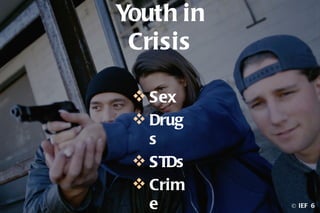
Youth in
 Crisis

  Sex
  Drug
   s
  STDs
  Crim
   e       © IEF 6
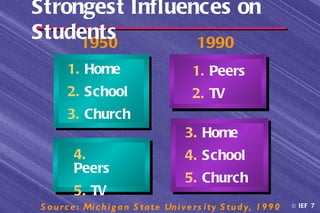
Strongest Influences on
Students
     1950        1990
        1. Home                              1. Peers
        2. School                            2. TV
        3. Church
                                           3. Home
          4.                               4. School
          Peers
                                           5. Church
          5. TV
S o u r c e : Mi c h i g a n S ta te Un i v e r s i ty S tu d y, 1 9 9 0   © IEF 7
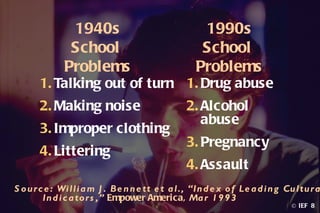
1940s                                  1990s
                School                                 School
               Problems                               Problems
       1. Talking out of turn 1. Drug abuse
       2. Making noise                             2. Alcohol
                                                      abuse
       3. Improper clothing
                                                   3. Pregnancy
       4. Littering
                                                   4. Assault
S o u r c e : Wi l l i a m J . Be n n e tt e t a l ., “In d e x o f Le a d i n g Cu l tu r a
         In d i c a to r s ,” Empower America, Ma r 1 9 9 3
                                                                                   © IEF 8
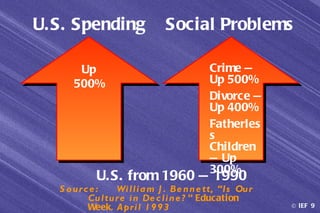
U. S. Spending                 Social Problems

       Up                                  Crime —
      500%                                 Up 500%
                                           Divorce —
                                           Up 400%
                                           Fatherles
                                           s
                                           Children
                                           — Up
                                           300%
            U. S. from 1960 — 1990
   S ourc e :    Wi l l i a m J . Be n n e tt, “Is Ou r
         Cu l tu r e i n De c l i n e ? ” Education
         Week, Apr i l 1 9 9 3                            © IEF 9
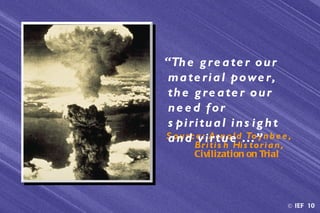
“Th e g r e a te r o u r
 m a te r i a l po we r ,
 th e g r e a te r o u r
 ne e d f or
 s pi r i tu a l i n s i g h t
S on dc e :i Ar n o l d ...” b e e ,
 a u r Br i titu e sTo yna n ,
         v r s h Hi to r i
        Civilization on Trial


                                   © IEF 10
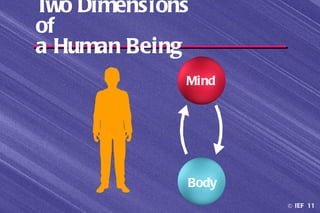
Two Dimensions
of
a Human Being
             Mind


             Body
                    © IEF 11
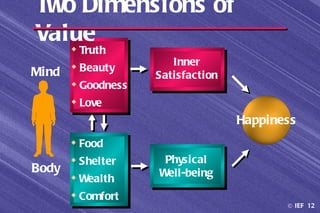
Two Dimensions of
Value
        Truth
      Beauty         Inner
Mind               Satisfaction
      Goodness
        Love
                                  Happiness
        Food
        Shelter    Physical
Body               Well-being
        Wealth
        Comfort
                                         © IEF 12
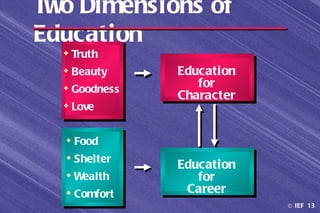
Two Dimensions of
Education
   Truth
   Beauty     Education
   Goodness      for
               Character
   Love


   Food
   Shelter
               Education
   Wealth        for
   Comfort     Career
                           © IEF 13
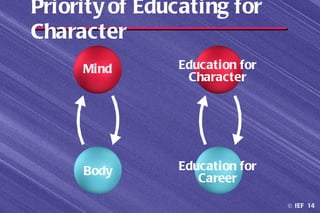
Priority of Educating for
Character
     Mind      Education for
                Character


     Body      Education for
                  Career

                               © IEF 14
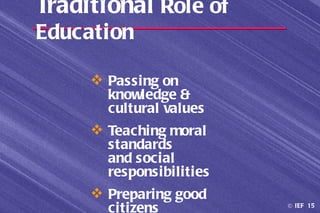
Traditional Role of
Education

      Passing on
       knowledge &
       cultural values
      Teaching moral
       standards
       and social
       responsibilities
      Preparing good
       citizens           © IEF 15
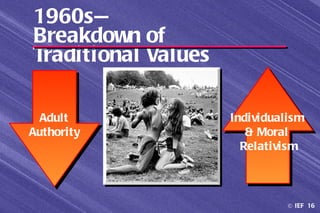
1960s—
Breakdown of
Traditional Values

  Adult              Individualism
Authority               & Moral
                       Relativism


                              © IEF 16
“ Values-Neutral”
Perspective
       Pluralism as
        moral
        equivalence
       Decline of
        religion
       Distrust of
        authority
                      © IEF 17
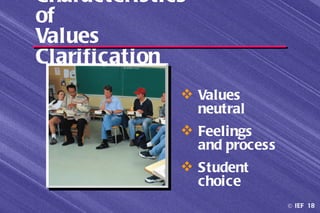
Characteristics
of
Values
Clarification
               Values
                neutral
               Feelings
                and process
               Student
                choice
                              © IEF 18
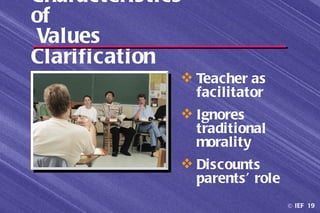
Characteristics
of
Values
Clarification
               Teacher as
                facilitator
               Ignores
                traditional
                morality
               Discounts
                parents’ role
                                © IEF 19
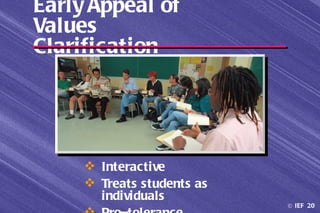
Early Appeal of
Values
Clarification


      Interactive
      Treats students as
       individuals
                            © IEF 20
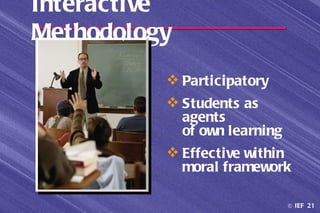
Interactive
Methodology
           Participatory
           Students as
            agents
            of own learning
           Effective within
            moral framework

                              © IEF 21
Limitations of
Values
Clarification

      No moral
       standards
      Encourages
       mediocrity
      Not character-
       building
                        © IEF 22
Why Moral Education
Went Astray
   Dubious assumptions
      “ Values –
       neutrality”
       as norm
      Pluralism
       precludes universal
       values
      Values = religion     © IEF 23
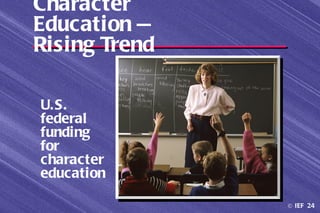
Character
Education —
Rising Trend

U. S.
federal
funding
for
character
education

               © IEF 24
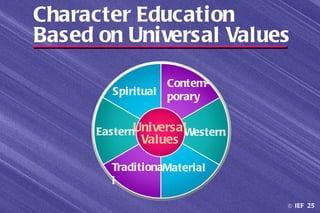
Character Education
Based on Universal Values

                  Contem-
        Spiritual porary


      EasternUniversalWestern
             Values

        TraditionaMaterial
        l

                                © IEF 25
Universal Values
Criteria

      Reversible
      Generalizable
      Compelling to
       the conscience


                        © IEF 26
Universal Values
Criteria

     Objective benefits
     Transcend cultures
     Embodied as virtues


                            © IEF 27
Common to All
Cultures


                © IEF 28
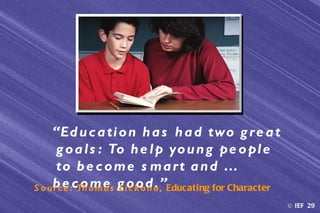
“Ed u c a ti o n h a s h a d two g r e a t
       g o a l s : To h e l p yo u n g pe o pl e
       to b e c o m e s m a r t a n d …
S o u b e :cTh o m es g ok od a , Educating for Character
      r c e o m a Li c o n .”
                                                            © IEF 29
Moral Goals of
Education

    1. Mature character
    2. Loving relationships &
    family
    3. Contribution to society

                                 © IEF 30
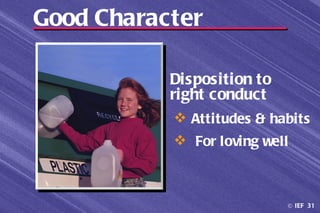
Good Character

           Disposition to
           right conduct
            Attitudes & habits
            For loving well


                            © IEF 31
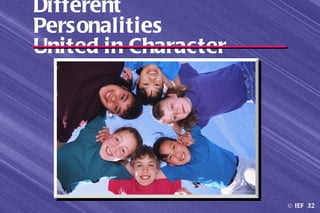
Different
Personalities
United in Character


                      © IEF 32
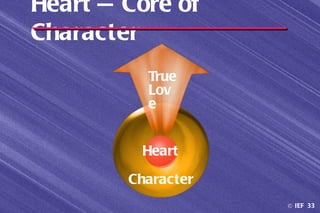
Heart — Core of
Character
          True
          Lov
          e


         Heart

        Character
                    © IEF 33
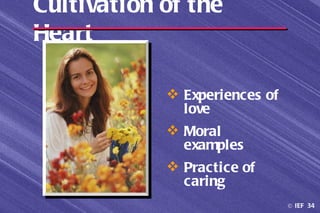
Cultivation of the
Heart

             Experiences of
              love
             Moral
              examples
             Practice of
              caring
                               © IEF 34
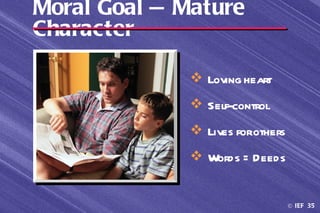
Moral Goal — Mature
Character

               Loving heart
               Self-control
               Lives forothers
               Words = Deeds


                                  © IEF 35
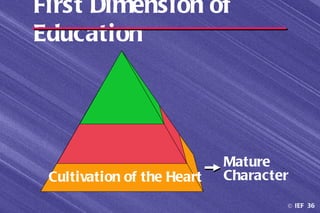
First Dimension of
Education


                            Mature
 Cultivation of the Heart   Character
                                    © IEF 36
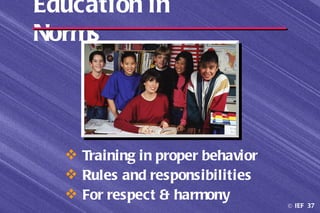
Education in
Norms


   Training in proper behavior
   Rules and responsibilities
   For respect & harmony
                                  © IEF 37
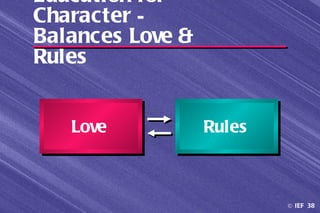
Education for
Character —
Balances Love &
Rules


   Love           Rules


                          © IEF 38
Moral Goal: Loving
Relationships &
Family
             Strong m arriages
             Effective parenting
             Ethicalpractice
             Living forhigher
              purpose
                                    © IEF 39
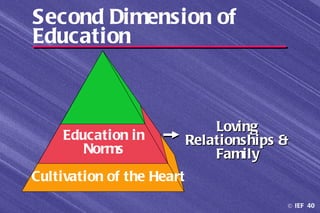
Second Dimension of
Education


                               Loving
    Education in           Relationships &
       Norms                   Family
Cultivation of the Heart
                                         © IEF 40
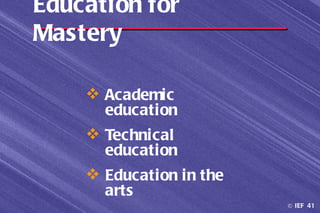
Education for
Mastery

     Academic
      education
     Technical
      education
     Education in the
      arts
                         © IEF 41
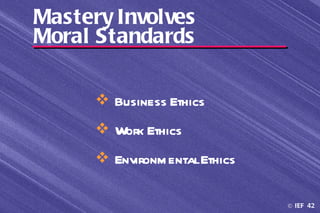
Mastery Involves
Moral Standards

       Business Ethics
       Work Ethics
       Environm entalEthics

                               © IEF 42
Mastery Involves
Concern for the
Environment


                   © IEF 43
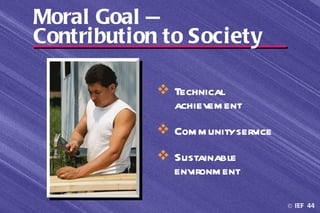
Moral Goal —
Contribution to Society

             Technical
              achievem ent
             Com m unity service
             Sustainable
              environm ent

                                    © IEF 44
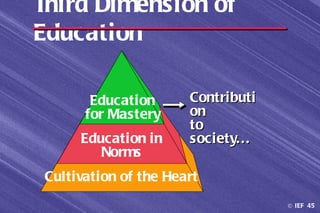
Third Dimension of
Education

        Education      Contributi
       for Mastery     on
                       to
      Education in     society. . .
         Norms
 Cultivation of the Heart
                                      © IEF 45
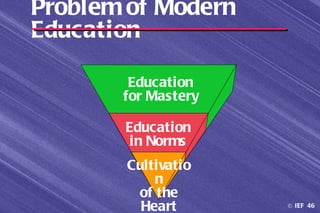
Problem of Modern
Education

        Education
       for Mastery

       Education
        in Norms
       Cultivatio
           n
        of the
         Heart       © IEF 46
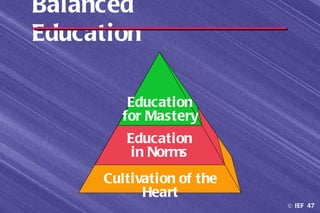
Balanced
Education

        Education
       for Mastery
        Education
         in Norms
     Cultivation of the
           Heart
                          © IEF 47

01 nec TIMD-IEF Philosophy 1