1r Quarter - Year 2016 - No. 1
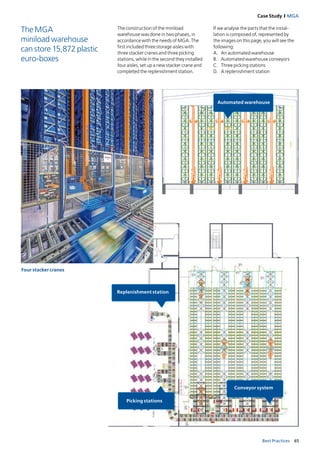
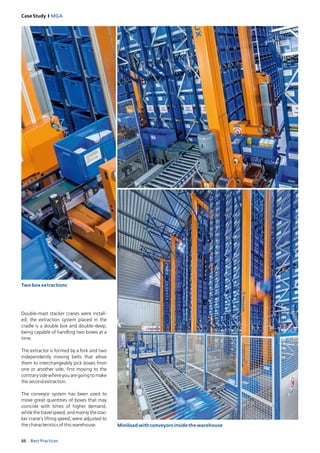
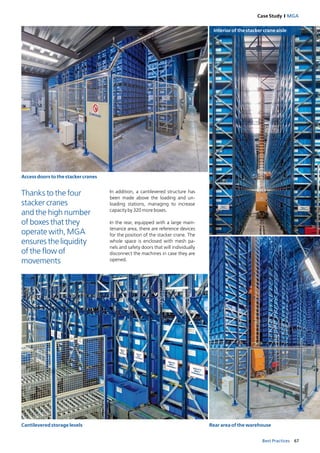
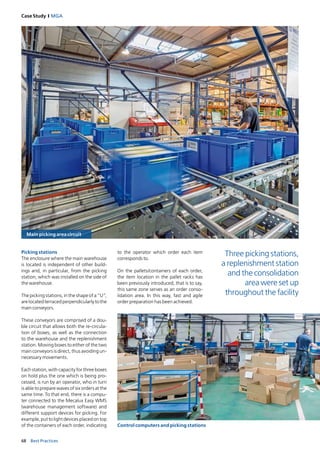
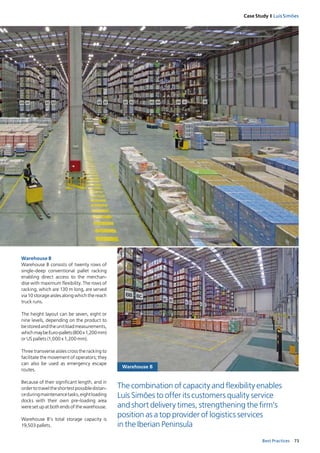
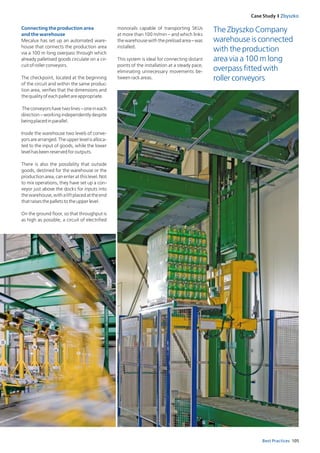
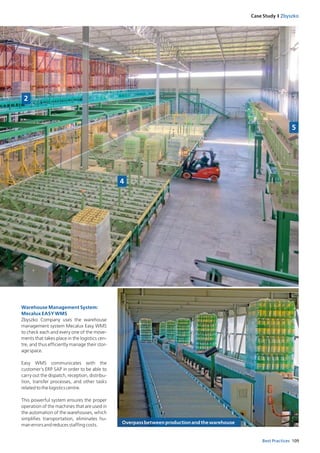
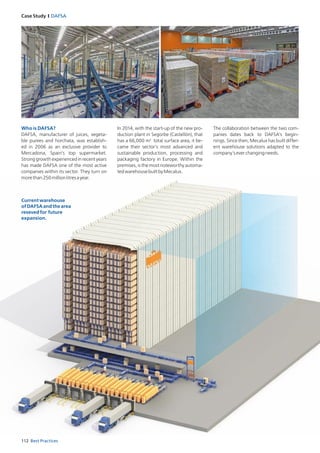
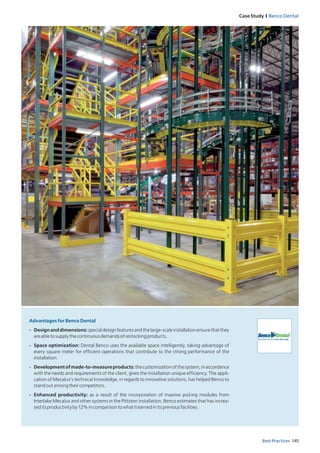
Cases Studies
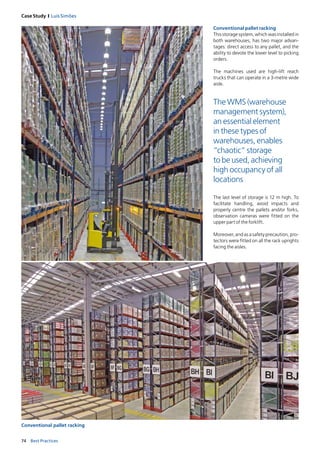
Benco Dental / DAFSA / DHL / Gioseppo / Havi Logistics
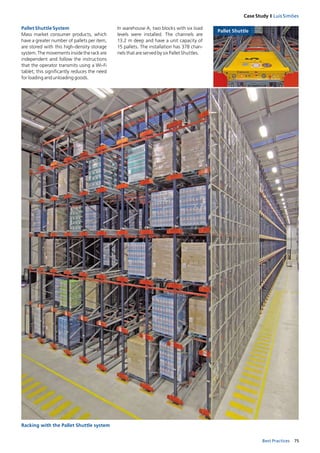
Hayat Kimya / Hemosa / Hepco Motion / Iron Mountain / Luis Simões
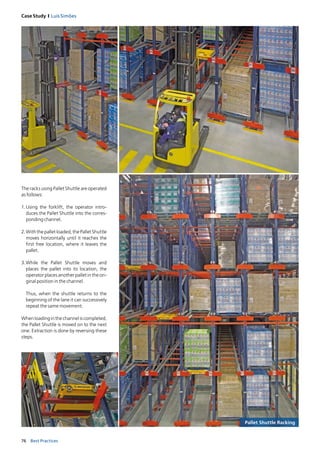
MGA / Nufri / PAVI-Groupauto / Takeda / Ypê / Zbyszko
3Best Practices
135135
111
9595
7979
Index
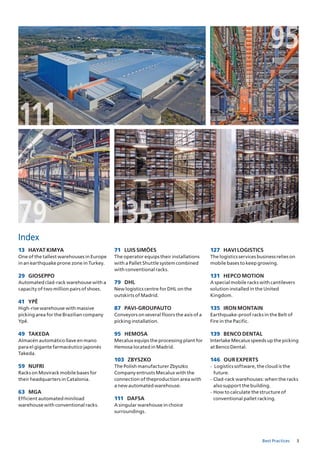
13 HAYAT KIMYA
One of the tallest warehouses in Europe
in an earthquake prone zone in Turkey.
29 GIOSEPPO
Automated clad‐rack warehouse with a
capacity of two million pairs of shoes.
41 YPÊ
High‐rise warehouse with massive
picking area for the Brazilian company
Ypê.
49 TAKEDA
Almacén automático llave en mano
para el gigante farmacéutico japonés
Takeda.
59 NUFRI
Racks on Movirack mobile bases for
their headquarters in Catalonia.
63 MGA
Efficient automated miniload
warehouse with conventional racks.
71 LUIS SIMÕES
The operator equips their installations
with a Pallet Shuttle system combined
with conventional racks.
79 DHL
New logistics centre for DHL on the
outskirts of Madrid.
87 PAVI-GROUPAUTO
Conveyors on several floors the axis of a
picking installation.
95 HEMOSA
Mecalux equips the processing plant for
Hemosa located in Madrid.
103 ZbYSZKO
The Polish manufacturer Zbyszko
Company entrusts Mecalux with the
connection of theproduction area with
a new automated warehouse.
111 DAFSA
A singular warehouse in choice
surroundings.
127 HAVI LOGISTICS
The logistics services business relies on
mobile bases to keep growing.
131 HEPCO MOTION
A special mobile racks with cantilevers
solution installed in the United
Kingdom.
135 IRON MONTAIN
Earthquake‐proof racks in the Belt of
Fire in the Pacific.
139 bENCO DENTAL
Interlake Mecalux speeds up the picking
at Benco Dental.
146 OUR ExPERTS
- Logistics software, the cloud is the
future.
- Clad‐rack warehouses: when the racks
also support the building.
- How to calculate the structure of
conventional pallet racking.
News I Mecalux
4 Best Practices
Safety in the warehouse is the foundation
onwhichtodevelopaninstallation’sday-to-
day work operations in an efficient and risk-
freeway.Therefore,Mecaluxinvestsasigni-
ficant part of its R&D resources to improve
the security devices of all its products.
The latest innovation in this respect is the
incorporation of a new junction system
between uprights and beams in Mecalux
pallet racks. This involves a connector with
a locking system, developed to provide
greater safety on the whole.
Its most outstanding contribution is the in-
tegration of a safety locking mechanism in
the actual connector, which results in two
key advantages: on the one hand, it is im-
possible for the safety device not to work
or to lose it accidentally; while on the other
hand, once it is assembled it is not possible
to remove it without the disassembly of the
entire beam. This prevents accidental or
deliberate manipulation of the connector –
with a blow by a forklift, for example – thus
avoiding the beam displacement and its
possibleconsequences,suchasthecollapse
of the load.
After successfully introducing this new
locking system into installations set up in
the United States, where Mecalux is a lea-
der in the pallet racking market, it is now
integrating it into all their projects within
Europe.
They are the only manufacturer on the
European continent to develop and incor-
porate this breakthrough device into their
storage solutions.
Keepingwithitscommitmenttoinnovation
and new technologies, Mecalux has com-
pletely updated its e-commerce portal for
Spain, offering a new design, new content
and a better user experience.
The new Mecalux Shop specialises in the di-
rect sale of metal shelving and related pro-
ducts to warehouses, workshops, offices,
archives, change rooms, etc., building on
the extensive knowledge and experience of
Mecalux within the sector.
Among the newly inte-
grated enhancements
are the following:
•	Newcategoriesand
advanced search filters which allow
you to easily find any product.
•	More information on each product:
description of main product features,
with more detailed technical information
and more pictures.
•	Makingapurchaseisstreamlinedand
speedy with a user friendly design.
•	Optimised design for smartphones and
tablets.
•	Moreadvantagesforregisteredusers:
custom offers, easy personal data admin,
order tracking, purchase history access,
etc.
Another of the key points of Mecalux Shop
is its Customer Service, with professionals
who know the product and its applica-
Safe and sound: Mecalux introduces
an innovative safety locking mechanism
Mecalux Shop:
a new look, new
clickable content
tions and that, if necessary, can help the
user to choose between different storage
solutions.
With this rejuvenation and the inclusion of
better features and navigability, Mecalux
has updated its online sales gateway
witn the steady flow of technological
breakthroughs in the field of e-commerce
and in the shifts in user enthusiasm. The
end user will benefit from the esase of use.
News I Mecalux
5Best Practices
As one of the leading companies in storage
solutions for more than 50 years, Mecalux
invests significant resources in the develop-
ment of new products and the continuous
improvement of those which are already
part of their catalogue. It always aims to in-
corporate the latest in technological inno-
vations to deliver better profitability.
So, one of the solutions that has experien-
ced the greatest amount of development
is the semi-automated Pallet Shuttle. This
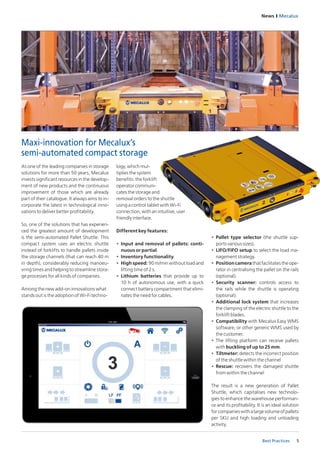
compact system uses an electric shuttle
instead of forklifts to handle pallets inside
the storage channels (that can reach 40 m
in depth), considerably reducing manoeu-
vring times and helping to streamline stora-
ge processes for all kinds of companies.
Among the new add-on innovations what
stands out is the adoption of Wi-Fi techno-
Maxi-innovation for Mecalux’s
semi-automated compact storage
logy, which mul-
tiplies the system
benefits: the forklift
operator communi-
cates the storage and
removal orders to the shuttle
using a control tablet with Wi-Fi
connection, with an intuitive, user
friendly interface.
Different key features:
•	 Input and removal of pallets: conti-
nuous or partial.
•	 Inventory functionality.
•	 High speed: 90 m/min without load and
lifting time of 2 s.
•	 Lithium batteries that provide up to
10 h of autonomous use, with a quick
connect battery compartment that elimi-
nates the need for cables.
•	 Pallet type selector (the shuttle sup-
ports various sizes).
•	 LIFO/FIFO setup to select the load ma-
nagement strategy.
•	 Positioncamerathatfacilitatestheope-
rator in centralising the pallet on the rails
(optional).
•	 Security scanner: controls access to
the rails while the shuttle is operating
(optional).
•	 Additional lock system that increases
the clamping of the electric shuttle to the
forklift blades.
•	 Compatibility with Mecalux Easy WMS
software, or other generic WMS used by
the customer.
•	 The lifting platform can receive pallets
with buckling of up to 25 mm.
•	 Tiltmeter: detects the incorrect position
of the shuttle within the channel
•	 Rescue: recovers the damaged shuttle
from within the channel
The result is a new generation of Pallet
Shuttle, which capitalises new technolo-
gies to enhance the warehouse performan-
ce and its profitability. It is an ideal solution
forcompanieswithalargevolumeofpallets
per SKU and high loading and unloading
activity.
News I Mecalux
6 Best Practices
Mecalux has had a significant presence in
Mexico for many years, with 8 sales offices.
Being local, together with the experience
of its team of professionals, has led nume-
rous Mexican companies to rely on the Easy
WMS Mecalux software, as a means to ma-
nage and capitalise their storage processes.
Among the rollout Easy WMS projects sig-
ned in Mexico in the past few months, the
following stand out:
• Grupo Acuícola Mexicano (GB-
PO). With Easy WMS they can au-
tomate the management of one of
its freezing chambers, controlling
the entries from the production li-
ne, and correct load management
using FIFO and expeditions.
• Distribución Hugo’ss. Within
its improved processes, they ha-
ve chosen the Easy WMS, which
communicates with their SAP
ERP, to speed up and streamline
their picking processes, elimina-
tingcustomerserviceerrors.
• Polioles. ELeader in the petrochemical
industry. Its main objectives are the reduc-
tion of costs and storage errors, to control
warehouse operations, product traceabili-
ty and cross-docking management.
• Diseños Labor. With Easy WMS they
can reconfigure their warehouse layout,
the improved inventory visibility, handles
information real time via bar codes and
radio frequency controls and, in general,
automate warehouse processes.
• Grupo Comrap. They use Easy WMS in
two warehouses, designed and built by
Mecalux, in Mexico DF to manage large
scale picking and fulfil their commitment to
offer excellent service to their customers.
Furthermore, two prestigious univer-
sities, the Autonomous University of
Queretaro (UTEQ) and the Auto-
nomous University of the State of
Mexico (UAEM) have acquired the
field license for Easy WMS Basic for
academic use in the Logistics degree
professorship.
The three university courses delivered in
2015, within the framework of the Mecalux
UPC classroom, were created through
the collaborative agreement between the
UPC (Universitat Politècnica de Catalunya),
the ETSEIB (Escola Tècnica Superior
d’Enginyeria Industrial) of Barcelona and
Mecalux, all being extremely reputable
parties.
Due to success, this new training modules
will be taught throughout 2016, which will
give new students the opportunity to dee-
pen their understanding of subjects such
as the development of structures, robotics
and the automation of storage facilities.
The objective of the UPC Mecalux Aula is
to train up tomorrow’s professionals and
provide them with the tools necessary to
make advances in R&D&I within the logis-
tics industry. To this end, Mecalux offers
scholarships covering course fees for UPC
master’s students, which fulfil the entry
Success, innovation & automation: the Mecalux UPC classroom
offers new courses in breakthrough logistics systems in 2016
requirements, in addition to putting the
Mecalux technological centres at their dis-
posal and offering them the possibility of
starting their career in the company.
New courses are scheduled to start in
Marchof2016,with30lecturehours,atthe
Mecalux UPC classroom premises.
Mecalux and the UPC
As a company that bases its leadership on
technological innovation, Mecalux has
for years been committed to fostering this
company-University relationship, collabo-
rating with the UPC and in particular
with the ETSEIB, since 1979. All this through
the Department of Material Resistance
(LERMA), with which it has developed an
Experimental Analysis of Characterisa-
tions program and another of Research and
Development.
Along these lines, the two entities have
promoted the creation the Mecalux UPC
Aula, as a means of consolidating long-
term collaboration in R&D&I activities and
the transfer of research results and scien-
tific dissemination within integral logistics
related topics.
For more information and to register
contact:
http://aulamecalux.upc.edu/
E-mail: aula.mecalux@upc.edu
Mecalux Easy Warehouse Management Software: a blockbuster in Mexico
Visit the Mecalux Mexico
stand in the upcoming industry
fairs at:
LogisticSummit&Expo,MéxicoDF,
onApril6th
and7th
,2016.
Expopack, México DF, from May
17th
to 20th
, 2016.
7
News I Our customers
Best Practices
In recent months, the markets of Argenti-
na and Peru have opted for the compact
storage system Pallet Shuttle by Mecalux.
This solution incorporates numerous inno-
vations to streamline the processes of the
entry and exit of goods in the warehouse. It
alsoprovidesgreatstoragecapacity,thanks
to an electric shuttle that loads and unloads
pallets in the interior of the racks, moving
autonomously along rails. 
Among the projects recently carried out in
these countries, two constructions, in parti-
cular, stand out that have combined the be-
nefits of clad-rack warehouses with those
containing Pallet Shuttle racks. 
In Argentina, Granja Tres Arroyos, one of
the major producers and exporters of fro-
zen chicken, has chosen this solution when
building their new frozen cold-storage. The
combination of a clad-rack warehouse with
the Pallet Shuttle system is particularly re-
commended in cold-storage, although, the
building is not of great height. In addition
to lowering manoeuvring times, it offers a
high storage capacity that reduces the vo-
lumetric area to be kept cool, resulting in
energy cost savings. 
On the other hand, the Mecalux Peru team
has completed the construction of another
clad-rack warehouse with Pallet Shuttle for
Medifarma, one of the top 5 pharmaceuti-
cal laboratories in Peru. In this project, gi-
ven the diversity of the products marketed,
the versatility of the system proved essen-
tial, while also increasing the number of cy-
cles per hour compared to a conventional
system. 
In both cases, it is worth noting that
although these clad-rack warehouses are
not very tall, they have also been the most
profitable option for both companies. This
is because the storage channels were cons-
tructed to the depth which was strictly ne-
Logistics chain
innovation in Argentina
and Peru: clad-rack
warehouses with Pallet
Shuttle to be built
cessary, calculated according to their requi-
red functionality.
The goal is to put new technologies and
approaches within reach all kinds of com-
panies,tomultiplytheproductivityandpro-
fitability of storage installations, achieving
maximum performance within the logistics
chain. 
Mecalux, in their effort to provide up clo-
se and personal service to its customers, are
present in Argentina with two sales offices
inBuenosAiresanda21,000m2
production
centre, while there is also a delegation in
Lima, Peru. Overall, the strength of the cus-
tomer support is second to none.
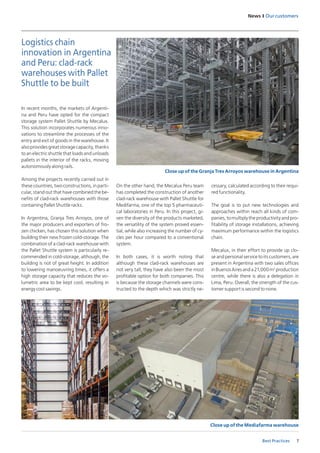
Close up of the Granja Tres Arroyos warehouse in Argentina
Close up of the Mediafarma warehouse
8
News I Our customers
Best Practices
All in the family: Mecalux expands
the Familia Group warehouse in Colombia
Familia Group, a company specialising in
personal care and hygiene products, will
expand its current clad-rack warehouse
to reach a capacity of more than 16,000
pallets.
In 2011, Mecalux erected Family Group one
of the first automated warehouses within Co-
lombia. The installation, with a capacity for
7,416 pallets and 31.2 m high, is managed by
threestackercranes.
A few years later, the company has again cho-
sen Mecalux to execute the Cájica warehouse
expansion. The objective: to reach 34.4 m in
height, increase capacity to include another
9,480 pallets, and install an additional three
stacker cranes. Moreover, recirculation is set
upthatallowsboththemanagementofinputs
fromoutsidesourcesandinternalproduction,
and also direct dispatch from the warehouse.
The warehouse management system, Easy
WMSsoftware,implementedbyMecaluxwill
alsobesupplied.
With this expansion, the Family Group ware-
housewillachievegreaterinputsandoutputs,
bringing it to the forefront of logistics within
thetissueandthepersonalhygienesector.
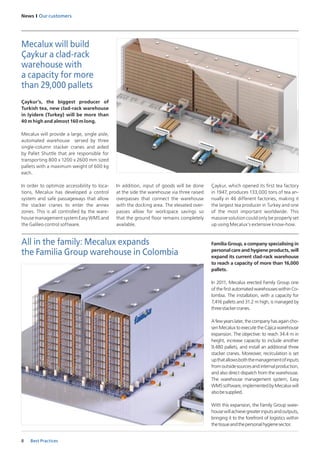
Çaykur’s, the biggest producer of
Turkish tea, new clad-rack warehouse
in Iyidere (Turkey) will be more than
40 m high and almost 160 m long.
Mecalux will provide a large, single aisle,
automated warehouse   served by three
single-column stacker cranes and aided
by Pallet Shuttle that are responsible for
transporting 800 x 1200 x 2600 mm sized
pallets with a maximum weight of 600 kg
each. 
In order to optimize accessibility to loca-
tions, Mecalux has developed a control
system and safe passageways that allow
the stacker cranes to enter the annex
zones. This is all controlled by the ware-
house management system Easy WMS and
the Galileo control software.
Mecalux will build
Çaykur a clad-rack
warehouse with
a capacity for more
than 29,000 pallets
In addition, input of goods will be done
at the side the warehouse via three raised
overpasses that connect the warehouse
with the docking area. The elevated over-
passes allow for workspace savings so
that the ground floor remains completely
available.
 
Çaykur, which opened its first tea factory
in 1947, produces 133,000 tons of tea an-
nually in 46 different factories, making it
the largest tea producer in Turkey and one
of the most important worldwide. This
massive solution could only be properly set
up using Mecalux’s extensive know-how.
9
News I Our customers
Best Practices
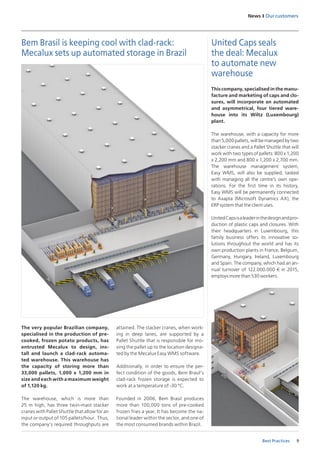
This company, specialised in the manu-
facture and marketing of caps and clo-
sures, will incorporate an automated
and asymmetrical, four tiered ware-
house into its Wiltz (Luxembourg)
plant.
The warehouse, with a capacity for more
than 5,000 pallets, will be managed by two
stacker cranes and a Pallet Shuttle that will
work with two types of pallets: 800 x 1,200
x 2,200 mm and 800 x 1,200 x 2,700 mm.
The warehouse management system,
Easy WMS, will also be supplied, tasked
with managing all the centre’s own ope-
rations. For the first time in its history,
Easy WMS will be permanently connected
to Axapta (Microsoft Dynamics AX), the
ERP system that the client uses.
UnitedCapsisaleaderinthedesignandpro-
duction of plastic caps and closures. With
their headquarters in Luxembourg, this
family business offers its innovative so-
lutions throughout the world and has its
own production plants in France, Belgium,
Germany, Hungary, Ireland, Luxembourg
and Spain. The company, which had an an-
nual turnover of 122.000.000 € in 2015,
employs more than 530 workers.
United Caps seals
the deal: Mecalux
to automate new
warehouse
The very popular Brazilian company,
specialised in the production of pre-
cooked, frozen potato products, has
entrusted Mecalux to design, ins-
tall and launch a clad-rack automa-
ted warehouse. This warehouse has
the capacity of storing more than
33,000 pallets, 1,000 x 1,200 mm in
size and each with a maximum weight
of 1,120 kg.
The warehouse, which is more than
25 m high, has three twin-mast stacker
cranes with Pallet Shuttle that allow for an
input or output of 105 pallets/hour. Thus,
the company’s required throughputs are
Bem Brasil is keeping cool with clad-rack:
Mecalux sets up automated storage in Brazil
attained. The stacker cranes, when work-
ing in deep lanes, are supported by a
Pallet Shuttle that is responsible for mo-
ving the pallet up to the location designa-
ted by the Mecalux Easy WMS software.
Additionally, in order to ensure the per-
fect condition of the goods, Bem Brasil’s
clad-rack frozen storage is expected to
work at a temperature of -30 ºC.
Founded in 2006, Bem Brasil produces
more than 100,000 tons of pre-cooked
frozen fries a year. It has become the na-
tional leader within the sector, and one of
the most consumed brands within Brazil.
10
News I Our customers
Best Practices
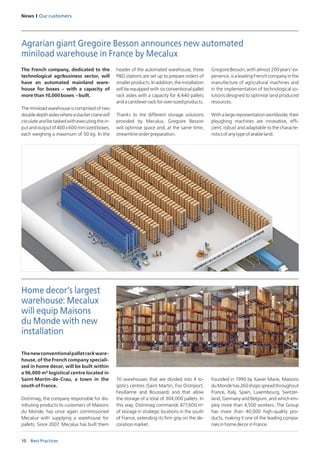
The French company, dedicated to the
technological agribusiness sector, will
have an automated mainland ware-
house for boxes – with a capacity of
morethan10,000boxes –built.
The miniload warehouse is comprised of two
doubledepthaisleswhereastackercranewill
circulateandbetaskedwithexecutingthein-
putandoutputof400x600mmsizedboxes,
each weighing a maximum of 50 kg. In the
Agrarian giant Gregoire Besson announces new automated
miniload warehouse in France by Mecalux
header of the automated warehouse, three
P&D stations are set up to prepare orders of
smallerproducts.Inaddition,theinstallation
will be equipped with six conventional pallet
rack aisles with a capacity for 4,440 pallets
andacantileverrackforover-sizedproducts.
Thanks to the different storage solutions
provided by Mecalux, Gregoire Besson
will optimise space and, at the same time,
streamline order preparation.
GregoireBesson,withalmost200years’ex-
perience,isaleadingFrenchcompanyinthe
manufacture of agricultural machines and
in the implementation of technological so-
lutions designed to optimise land produced
resources.
Withalargerepresentationworldwide,their
ploughing machines are innovative, effi-
cient, robust and adaptable to the characte-
risticsofanytypeofarableland.
Home decor’s largest
warehouse: Mecalux
will equip Maisons
du Monde with new
installation
Thenewconventionalpalletrackware-
house, of the French company speciali-
sed in home decor, will be built within
a 96,000 m² logistical centre located in
Saint-Martin-de-Crau, a town in the
south of France.
Distrimag, the company responsible for dis-
tributing products to customers of Maisons
du Monde, has once again commissioned
Mecalux with supplying a warehouse for
pallets. Since 2007, Mecalux has built them
10 warehouses that are divided into 4 lo-
gistics centres (Saint Martin, Fos Distriport,
Feuillanne and Boussard) and that allow
the storage of a total of 304,000 pallets. In
this way, Distrimag commands 477,600 m2
of storage in strategic locations in the south
of France, extending its firm grip on the de-
corationmarket.
Founded in 1990 by Xavier Marie, Maisons
duMondehas260shopsspreadthroughout
France, Italy, Spain, Luxembourg, Switzer-
land, Germany and Belgium, and which em-
ploy more than 4,500 workers. The Group
has more than 40,000 high-quality pro-
ducts, making it one of the leading compa-
niesinhomedecorinFrance.
11
News I Our customers
Best Practices
The new automated warehouse, to be
builtinthePolishtownofZarycanstore
more than 20,000 pallets, or 2.9 million
square meters of finished product.
Kronopol, one of the world’s leading pro-
ducers in wooden material manufacturing,
has commissioned Mecalux to construct
its new automated warehouse for pallets,
where the floor panels fabricated by the
company will be depo-
sited. The warehouse,
composed of four aisles
with double depth racks,
measures 30.3 m high,
32.9 m wide and 89.3 m
long. In each aisle a stac-
ker crane will circulate
that is able to move 840 x
1,410x1,200mmpallets,
with a maximum weight
of 1,075 kg each.
This installation, which
is scheduled for comple-
tion in the third quarter
Kronopol goes automated: Mecalux constructs custom
warehouse for timber products
of 2016, was the Kronopol organisation’s
most substantial investment in 2015. Its
construction,apartfromincreasingstorage
capacity by maximising available space, will
give the company a series of advantages.
Among these are complete automation,
an increase in the loading and unloading
speeds of vehicles, and the preclusion of
damagedgoodscausedbyforkliftusage.In
addition, the warehouse is also distinguis-
hed by being environmentally friendly be-
cause the solutions used will work via elec-
tricity, which will eliminate the emission of
gases.
The Polish company Kronopol, present in
more than 50 countries, has been part of
the Swiss Krono Group holding company
since 1994. Throughout this process, the
firm has become a worldwide leader in
their sector, thanks to the quality and va-
rietyoftheirtimberproductsearmarkedfor
the manufacture of interior finishings and
furniture.
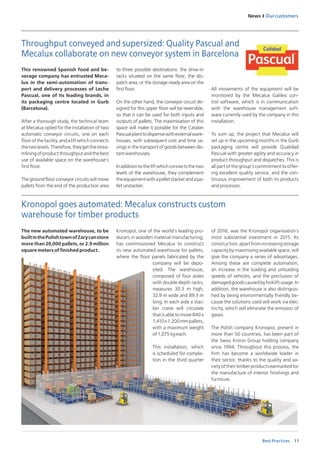
This renowned Spanish food and be-
verage company has entrusted Meca-
lux in the semi-automation of trans-
port and delivery processes of Leche
Pascual, one of its leading brands, in
its packaging centre located in Gurb
(Barcelona).
After a thorough study, the technical team
at Mecalux opted for the installation of two
automatic conveyor circuits, one on each
floorofthefacility,andaliftwhichconnects
thetwolevels.Therefore,theygetthestrea-
mlining of product throughput and the best
use of available space on the warehouse’s
first floor.
The ground floor conveyor circuits will move
pallets from the end of the production area
to three possible destinations: the drive-in
racks situated on the same floor, the dis-
patch area, or the storage-ready area on the
firstfloor.
On the other hand, the conveyor circuit de-
signed for this upper floor will be reversible,
so that it can be used for both inputs and
outputs of pallets. The maximisation of this
space will make it possible for the Catalan
Pascualplanttodispensewithexternalware-
houses, with subsequent cost and time sa-
vings in the transport of goods between dis-
tantwarehouses.
Inadditiontotheliftwhichconnectsthetwo
levels of the warehouse, they complement
theequipmentwithapalletstackerandapa-
lletunstacker.
All movements of the equipment will be
monitored by the Mecalux Galileo con-
trol software, which is in communication
with the warehouse management soft-
ware currently used by the company in this
installation.
To sum up, the project that Mecalux will
set up in the upcoming months in the Gurb
packaging centre will provide Qualidad
Pascual with greater agility and accuracy in
product throughput and dispatches. This is
all part of the group’s commitment to offer-
ing excellent quality service, and the con-
tinuous improvement of both its products
and processes.
Throughput conveyed and supersized: Quality Pascual and
Mecalux collaborate on new conveyor system in Barcelona
12
News I Our customers
Best Practices
Founded in 1983 by Jesus Gasca, STUA
in one of the most internationally recog-
nized  Spanish contemporary furniture
design companies. Recently, its opera-
tions moved to a new facility in Astiga-
rraga (Guipúzcoa) in order to boost con-
tinuousgrowth.
After assessing various options for the imple-
mentation of a storage system that best re-
solved their needs, STUA finally chose the
project submitted by Mecalux, due to the
confidence that being made in Spain and
theirextensiveexperienceconveys. 
STUA’s objectives are to gain perfect con-
trol of both their products and deliveries to
any part of the world, in addition to maximi-
se storage capacity. To fulfil these require-
ments, Mecalux has planned out a solution
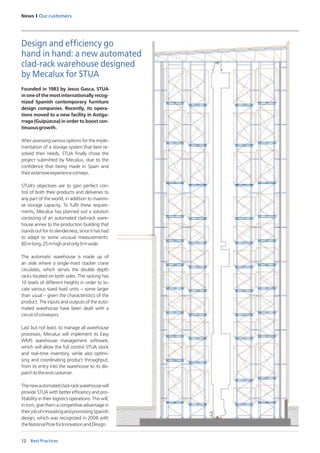
consisting of an automated clad-rack ware-
house annex to the production building that
stands out for its slenderness, since it has had
to adapt to some unusual measurements:
80mlong,25mhighandonly9mwide. 
The automatic warehouse is made up of
an aisle where a single-mast stacker crane
circulates, which serves  the double depth
racks located on both sides. The racking has 
10 levels of different heights in order to lo-
cate various sized load units – some larger
than usual – given the characteristics of the
product. The inputs and outputs of the auto-
mated warehouse have been dealt with a
circuitofconveyors. 
Last but not least, to manage all warehouse
processes, Mecalux will implement its Easy
WMS warehouse management software,
which will allow the full control STUA stock
and real-time inventory, while also optimi-
sing and coordinating product throughput,
from its entry into the warehouse to its dis-
patchtotheendcustomer. 
Thenewautomatedclad-rackwarehousewill
provide STUA with better efficiency and pro-
fitability in their logistics operations. This will,
in turn, give them a competitive advantage in
theirjobof innovatingandpromotingSpanish
design, which was recognized in 2008 with
theNationalPrizeforInnovationandDesign.
Design and efficiency go
hand in hand: a new automated
clad-rack warehouse designed
by Mecalux for STUA
13Best Practices
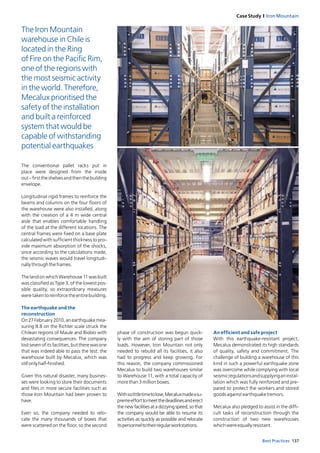
Casestudy:HayatKimya
Tallest warehouse in Europe constructed:
earthquake prone area in Turkey not an issue
for Mecalux and its partner Hayat Kimya
Location:Turkey
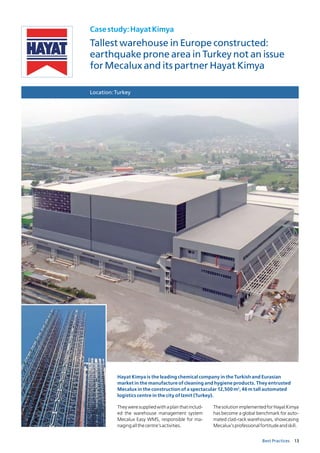
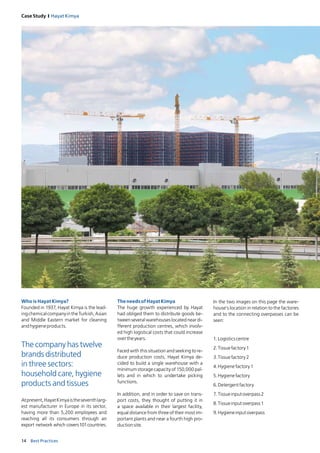
Hayat Kimya is the leading chemical company in the Turkish and Eurasian
market in the manufacture of cleaning and hygiene products. They entrusted
Mecalux in the construction of a spectacular 12,500 m2
, 46 m tall automated
logistics centre in the city of Izmit (Turkey).
Theyweresuppliedwithaplanthatinclud-
ed the warehouse management system
Mecalux Easy WMS, responsible for ma-
nagingallthecentre’sactivities.
ThesolutionimplementedforHayatKimya
has become a global benchmark for auto-
mated clad-rack warehouses, showcasing
Mecalux’sprofessionalfortitudeandskill.
14 Best Practices
Case Study I Hayat Kimya
Who is Hayat Kimya?
Founded in 1937, Hayat Kimya is the lead­
ingchemicalcompanyintheTurkish,Asian
and Middle Eastern market for cleaning
andhygieneproducts.
TheneedsofHayat Kimya
The huge growth experienced by Hayat
had obliged them to distribute goods be­
tween several warehouses located near di-
fferent production centres, which involv­
ed high logistical costs that could increase
overtheyears.
Faced with this situation and seeking to re-
duce production costs, Hayat Kimya de-
cided to build a single warehouse with a
minimum storage capacity of 150,000 pal­
lets and in which to undertake picking
functions.
In addition, and in order to save on trans-
port costs, they thought of putting it in
a space available in their largest facility,
equal distance from three of their most im-
portant plants and near a fourth high pro-
ductionsite.
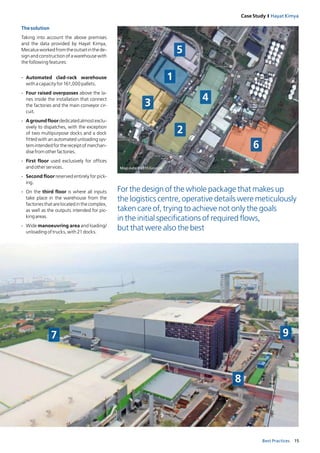
In the two images on this page the ware-
house’s location in relation to the factories
and to the connecting overpasses can be
seen:
1.	Logisticscentre
2.	Tissuefactory1
3.	Tissuefactory2 
4.	Hygienefactory1
5.	Hygienefactory
6.	Detergentfactory
7.	Tissueinputoverpass2
8.	Tissueinputoverpass1
9.	Hygieneinputoverpass
The company has twelve
brands distributed
in three sectors:
household care, hygiene
products and tissues
Atpresent,HayatKimyaistheseventhlarg-
est manufacturer in Europe in its sector,
having more than 5,200 employees and
reaching all its consumers through an
export network which covers101countries. 
15Best Practices
Case Study I Hayat Kimya
1
2
3
4
5
Thesolution
Taking into account the above premises
and the data provided by Hayat Kimya,
Mecaluxworkedfromtheoutsetinthede-
signandconstructionofawarehousewith
thefollowingfeatures:
- Automated clad-rack warehouse
withacapacityfor161,000pallets.
- Four raised overpasses above the la-
nes inside the installation that connect
the factories and the main conveyor cir-
cuit.
- Agroundfloordedicatedalmostexclu-
sively to dispatches, with the exception
of two multipurpose docks and a dock
fitted with an automated unloading sys-
temintendedforthereceiptofmerchan-
disefromotherfactories.
- First floor used exclusively for offices
andotherservices.
- Second floor reserved entirely for pick-
ing.
- On the third floor is where all inputs
take place in the warehouse from the
factoriesthatarelocatedinthecomplex,
as well as the outputs intended for pic-
kingareas.
- Wide manoeuvring area and loading/
unloadingoftrucks,with21docks.
9
8
7
For the design of the whole package that makes up
the logistics centre, operative details were meticulously
taken care of, trying to achieve not only the goals
in the initial specifications of required flows,
but that were also the best
6
Mapdata©2015Google
16 Best Practices
Case Study I Hayat Kimya
Thewarehouse
The size of the warehouse is 120 m long x
105 m wide and 46 m tall, with a total ca-
pacity that exceeds 161,000 pallets that
are 800 x 1200 mm in size and weigh a
maximum700kgeach. 
The construction system is self-support­
ing, that is to say the racks, in addition
to storing goods, have additional struc-­
tures on which sheet clad panels are
attached to that make up the building.
This forms a complete unit that is the
warehouse.
The racks must support their own weight,
the pallets stored, the wind pressure, han-
dling equipment, the seismic activity on
the basis of the coefficient indicated at the
construction site and the weight of snow
thatconformstotheregulations. 
The Hayat Kimya warehouse consists of
15 aisles with double-depth racks placed
on both sides and is 24 load levels high. In
­each aisle a 45 m high stacker crane was
set up that is responsible for the move-
ments within the warehouse, from the re-
ceptionareatoproductlocations.
Each stacker crane is equipped with a
double cradle that allows two pallets
to be moved at a time and with single-
mast construction, something unusual
for a warehouse of this height. The main­
tenance of the stacker cranes is carried out
on the side that coincides with the conve-
yorcircuit.
It is interesting to point out that in each
of the 24 load levels that integrate rack
bays, three pallets in the first position and
three other pallets in the second are stor­
ed. This is very difficult to achieve in a tall
warehouse which is located, as explained
below, in an area with such a high rate of
seismicactivity.
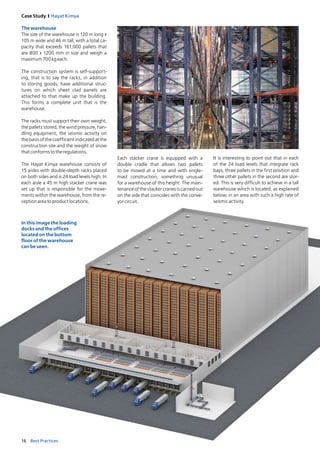
In this image the loading
docks and the offices
located on the bottom
floor of the warehouse
can be seen.
17Best Practices
Case Study I Hayat Kimya
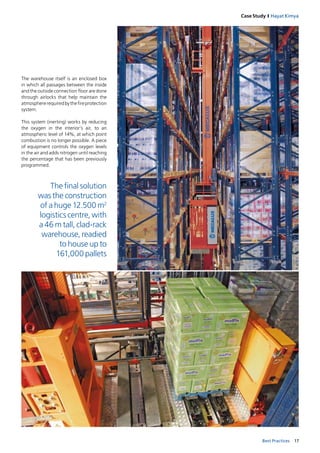
The final solution 
was the construction
of a huge 12.500 m2
logistics centre, with
a 46 m tall, clad-rack
warehouse, readied
to house up to
161,000 pallets
The warehouse itself is an enclosed box
in which all passages between the inside
and the outside connection floor are done
through airlocks that help maintain the
atmosphererequired bythefireprotection
system.
This system (inerting) works by reducing
the  oxygen in  the interior’s air, to an
atmospheric level of 14%, at which point
combustion is no longer possible. A piece
of equipment controls the oxygen levels
in the air and adds nitrogen until reaching
the percentage that has been previously
programmed.
18 Best Practices
Case Study I Hayat Kimya
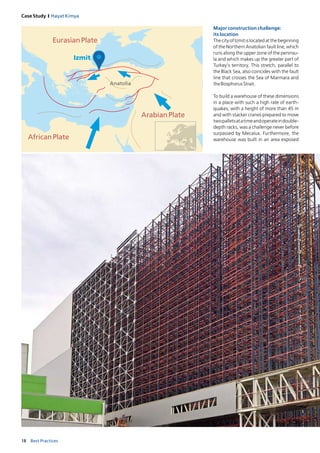
Major construction challenge:
its location 
The city of Izmit is located at the beginning
of the Northern Anatolian fault line, which
runs along the upper zone of the peninsu-
la and which makes up the greater part of
Turkey’s territory. This stretch, parallel to
the Black Sea, also coincides with the fault
line that crosses the Sea of Marmara and
theBosphorusStrait.
To build a warehouse of these dimensions
in a place with such a high rate of earth­
quakes, with a height of more than 45 m
and with stacker cranes prepared to ­move
twopalletsatatimeandoperateindouble-
depth racks, was a challenge never before
surpassed by Mecalux. Furthermore, the
warehouse was built in an area exposed
Izmit
Anatolia
AfricanPlate
ArabianPlate
EurasianPlate
19Best Practices
Case Study I Hayat Kimya
to the wind and where snowfall, although
not frequent, can be abundant when it
doesoccur.
With all these constraints, only one com-
pany with the experience and quality of
Mecalux was able to build a warehouse on
thisscale. 
By its particularities, this logistics centre
could not be built with the traditional
cold-formed profiles. Nor was it possible
to do so with a structure of standard hot
rolled profiles, due to the accuracy of as-
sembly that this installation required was
extremelyhigh.
The solution provided by Mecalux’s tech-
nical team was to combine the two con­
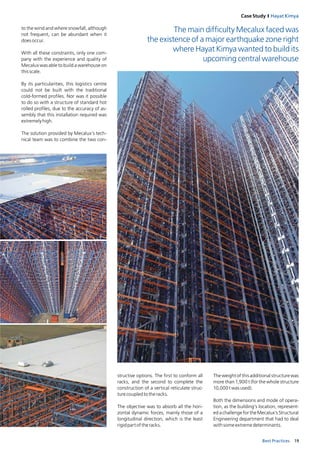
The main difficulty Mecalux faced was
the existence of a major earthquake zone right
where Hayat Kimya wanted to build its
upcoming central warehouse
structive options. The first to conform all
racks, and the second to complete the
construction of a vertical reticulate struc-
turecoupledtotheracks.
The objective was to absorb all the hori-
zontal dynamic forces, mainly those of a
longitudinal direction, which is the least
­rigidpartoftheracks.
The weight of this additional structure was
more than 1,900 t (for the whole structure
10,000twasused).
Both the dimensions and mode of opera-
tion, as the building’s location, represent­
ed a challenge for the Mecalux’s Structural
Engineering department that had to deal
withsomeextremedeterminants. 
20 Best Practices
Case Study I Hayat Kimya
20 Best Practices
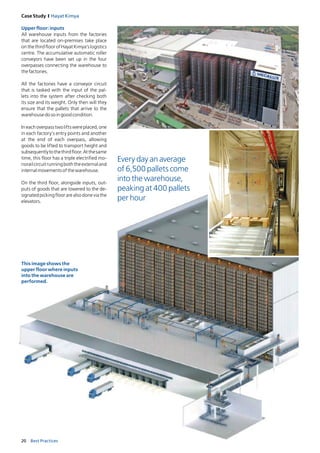
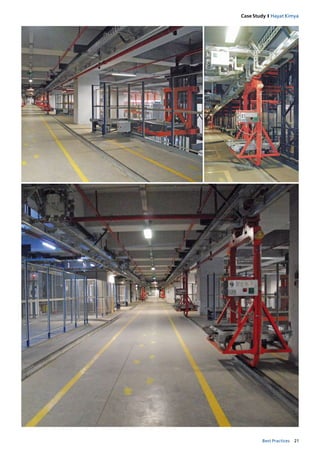
Upperfloor:inputs
All warehouse inputs from the factories
that are located on-premises take place
on the third floor of Hayat Kimya’s logistics
centre. The accumulative automatic roller
conveyors have been set up in the four
overpasses connecting the warehouse to
thefactories.
All the factories have a conveyor circuit
that is tasked with the input of the pal-
lets into the system after checking both
its size and its weight. Only then will they
ensure that the pallets that arrive to the
warehousedosoingoodcondition.
Ineachoverpasstwoliftswereplaced,one
in each factory’s entry points and another
at the end of each overpass, allowing
goods to be lifted to transport height and
subsequentlytothethirdfloor.Atthesame
time, this floor has a triple electrified mo-
norailcircuitrunningboththeexternaland
internalmovementsofthewarehouse.
On the third floor, alongside inputs, out-
puts of goods that are lowered to the de-
signated picking floor are also done via the
elevators.
Every day an average
of 6,500 pallets come
into the warehouse,
peaking at 400 pallets
per hour
This image shows the
upper floor where inputs
into the warehouse are
performed.
21Best Practices
Case Study I Hayat Kimya
22 Best Practices
Case Study I Hayat Kimya
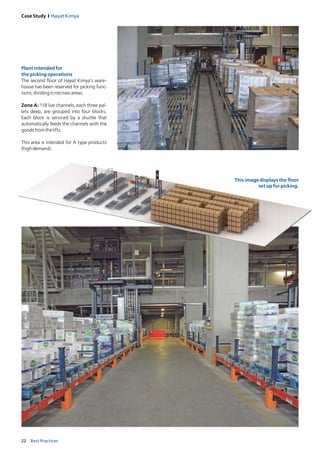
Plant intended for
the picking operations
The second floor of Hayat Kimya’s ware-
house has been reserved for picking func-
tions,dividingitintotwoareas: 
Zone A: 118 live channels, each three pal­
lets deep, are grouped into four blocks.
Each block is serviced by a shuttle that
automatically feeds the channels with the
goodsfromthelifts.
This area is intended for A type products
(highdemand).
This image displays the floor
set up for picking.
23Best Practices
Case Study I Hayat Kimya
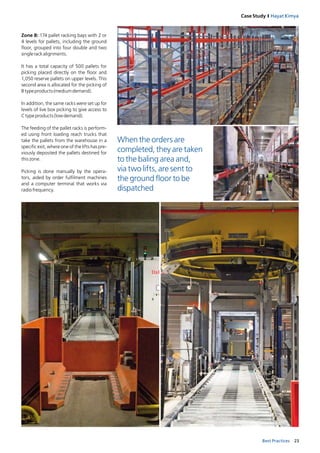
Zone B: 174 pallet racking bays with 2 or
4 levels for pallets, including the ground
floor, grouped into four double and two
singlerackalignments.
It has a total capacity of 500 pallets for
picking placed directly on the floor and
1,050 reserve pallets on upper levels. This
second area is allocated for the picking of
B typeproducts(mediumdemand).
In addition, the same racks were set up for
levels of live box picking to give access to
C typeproducts(lowdemand).
The feeding of the pallet racks is perform­
ed using front loading reach trucks that
take the pallets from the warehouse in a
specific exit, where one of the lifts has pre-
viously deposited the pallets destined for
thiszone. 
Picking is done manually by the opera-
tors, aided by order fulfilment machines
and a computer terminal that works via 
radiofrequency.
When the orders are
completed, they are taken
to the baling area and,
via two lifts, are sent to
the ground floor to be
dispatched
24 Best Practices
Case Study I Hayat Kimya
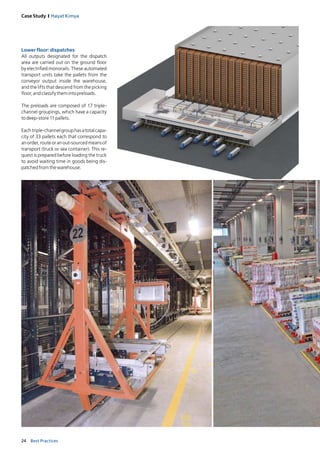
Lower floor: dispatches
All outputs designated for the dispatch
area are carried out on the ground floor
by electrified monorails. These automated
transport units take the pallets from the
conveyor output inside the warehouse,
and the lifts that descend from the picking
floor,andclassifythemintopreloads.
The preloads are composed of 17 triple-
channel groupings, which have a capacity
todeep-store11pallets.
Eachtriple-channelgrouphasatotalcapa-
city of 33 pallets each that correspond to
anorder,routeoranout-sourcedmeansof
transport (truck or sea container). This re-
quest is prepared before loading the truck
to avoid waiting time in goods being dis-
patchedfromthewarehouse.
25Best Practices
Case Study I Hayat Kimya
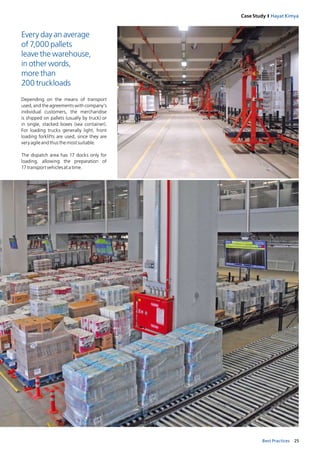
Every day an average
of 7,000 pallets
leave the warehouse,
in other words,
more than
200 truckloads
Depending on the means of transport
used, and the agreements with company’s
individual customers, the merchandise
is shipped on pallets (usually by truck) or
in single, stacked boxes (sea container).
For loading trucks generally light, front
loading forklifts are used, since they are
veryagileandthusthemostsuitable.
The dispatch area has 17 docks only for
loading, allowing the preparation of
17 transportvehiclesatatime.
26 Best Practices
Case Study I Hayat Kimya
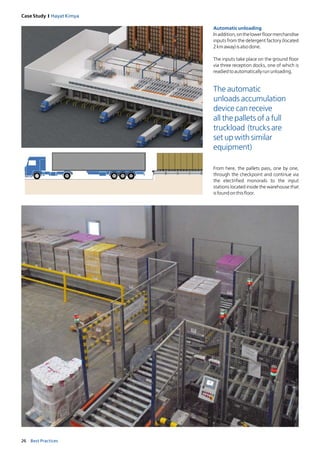
Automaticunloading
Inaddition,onthelowerfloormerchandise
inputs from the detergent factory (located
2kmaway)isalsodone.
The inputs take place on the ground floor
via three reception docks, one of which is
readiedtoautomaticallyrununloading.
From here, the pallets pass, one by one,
through the checkpoint and continue via
the electrified monorails to the input
stations located inside the warehouse that
isfoundonthisfloor.
The automatic
unloads accumulation
device can receive
all the pallets of a full
truckload (trucks are
set up with similar
equipment)
27Best Practices
Case Study I Hayat Kimya
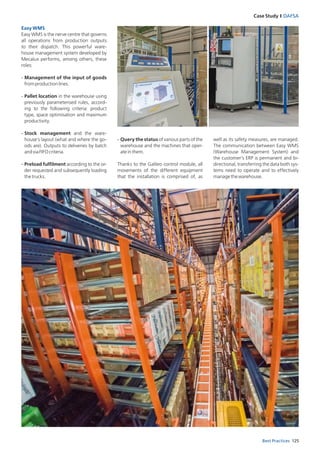
Easy WMS: the nerve centre
of the logistics centre
Alltheoperationsofthelogisticscentreare
governed by the warehouse management
system Mecalux Easy WMS and its Galileo
control software; tasked with controlling
the computers that run the transport and
thestorageofgoodstasks.
EasyWMSisalsoresponsiblefor:
- Management of goods input from its re-
ceptionatthedocks.
- Locate pallets in the warehouse using
rules previously parameterised, under
the criteriaofstreamliningandmaximum
productivity.
- Manages the stock and the warehouse
layout(whatandwherethegoodsare).
- Manages the warehouse outputs to the
pickingand/ordispatchareas.
- Manages and controls the picking opera-
tions through radio frequency terminals,
guiding the operator in the tasks to be
performed and the order to follow to op-
timiseroutes.
- Allowsthecheckingofthestatusofdiffe-
rent parts of the logistics centre, and the
various equipment that operate in it, via
queryandreportingtools.
The Easy WMS (Warehouse Management
Software) is in permanent and bi-direc-
tional connection with Hayat Kimya’s SAP
ERPsystem.
ERP
SAP
of Hayat
Mecalux Easy WMS
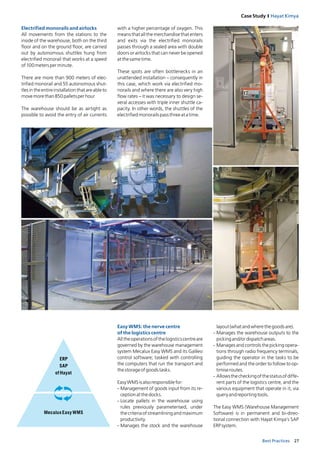
Electrified monorails and airlocks
All movements from the stations to the
inside of the warehouse, both on the third
floor and on the ground floor, are carried
out by autonomous shuttles hung from
electrified monorail that works at a speed
of100metersperminute.
There are more than 900 meters of elec-
trified monorail and 55 autonomous shut-
tlesintheentireinstallation that are able to
movemorethan850palletsperhour
The warehouse should be as airtight as
possible to avoid the entry of air currents
with a higher percentage of oxygen. This
means that all the merchandise that enters
and exits via the electrified monorails
passes through a sealed area with double
doors or airlocks that can never be opened
atthesametime.
These spots are often bottlenecks in an
unattended installation – consequently in
this case, which work via electrified mo-
norails and where there are also very high
flow rates – it was necessary to design se-
veral accesses with triple inner shuttle ca-
pacity. In other words, the shuttles of the
electrifiedmonorailspassthreeatatime.
28 Best Practices
Case Study I Hayat Kimya
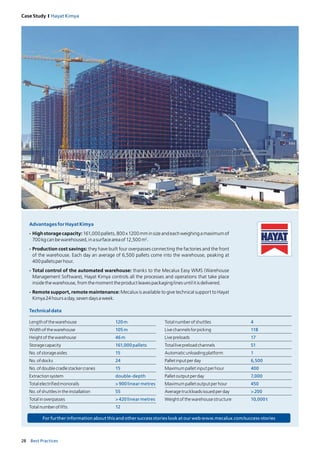
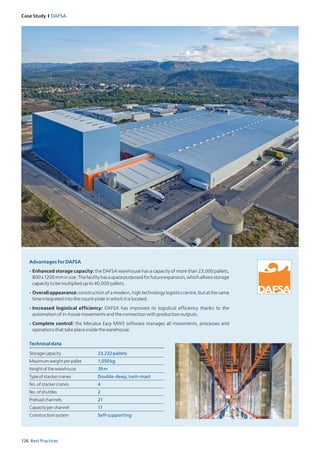
AdvantagesforHayatKimya
- Highstoragecapacity:161,000 pallets, 800 x 1200 mm in size and each weighing a maximum of
700kgcanbewarehoused,inasurfaceareaof12,500m2
.
- Production cost savings: they have built four overpasses connecting the factories and the front
of the warehouse. Each day an average of 6,500 pallets come into the warehouse, peaking at
400palletsperhour.
- Total control of the automated warehouse: thanks to the Mecalux Easy WMS (Warehouse
Management Software), Hayat Kimya controls all the processes and operations that take place
insidethewarehouse,fromthemomenttheproductleavespackaginglinesuntilitisdelivered.
- Remote support, remote maintenance: Mecalux is available to give technical support to Hayat
Kimya24hoursaday,sevendaysaweek.
Technicaldata
Lengthofthewarehouse 120m
Widthofthewarehouse 105m
Heightofthewarehouse 46m
Storagecapacity 161,000pallets
No.ofstorageaisles 15
No.ofdocks 24
No.ofdoublecradlestackercranes 15
Extractionsystem double-depth
Totalelectrifiedmonorails >900linearmetres
No.ofshuttlesintheinstallation 55
Totalinoverpasses >420linearmetres
Totalnumberoflifts 12
Totalnumberofshuttles 4
Livechannelsforpicking 118
Livepreloads 17
Totallivepreloadchannels 51
Automaticunloadingplatform 1
Palletinputperday 6,500
Maximumpalletinputperhour 400
Palletoutputperday 7,000
Maximumpalletoutputperhour 450
Averagetruckloadsissuedperday >200
Weightofthewarehousestructure 10,000t
For further information about this and other success stories look at our web www.mecalux.com/success-stories
29Best Practices
Casestudy:Gioseppo
Two million pairs of shoes: Mecalux builds
Gioseppo a clad-rack solution for footwear
Location:Spain
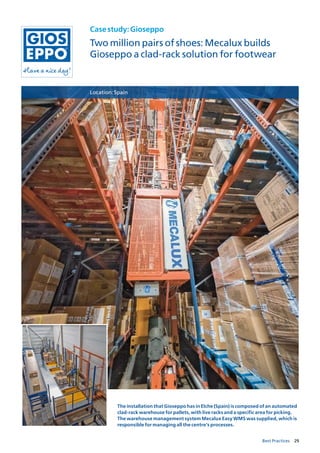
The installation that Gioseppo has in Elche (Spain) is composed of an automated
clad-rack warehouse for pallets, with live racks and a specific area for picking.
The warehouse management system Mecalux Easy WMS was supplied, which is
responsible for managing all the centre’s processes.
30 Best Practices
Case Study I Gioseppo
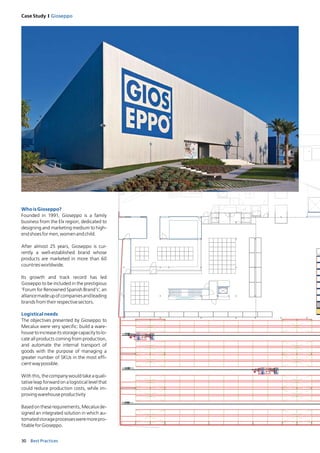
WhoisGioseppo?
Founded in 1991, Gioseppo is a family
business from the Elx region, dedicated to
designing and marketing medium to high-
endshoesformen,womenandchild.
After almost 25 years, Gioseppo is cur-
rently a well-established brand whose
products are marketed in more than 60
countriesworldwide.
Its growth and track record has led
Gioseppo to be included in the prestigious
‘Forum for Renowned Spanish Brand’s’, an
alliancemadeupofcompaniesandleading
brandsfromtheirrespectivesectors.
Logistical needs
The objectives presented by Gioseppo to
Mecalux were very specific: build a ware-
housetoincreaseitsstoragecapacitytolo-
cate all products coming from production,
and automate the internal transport of
goods with the purpose of managing a
greater number of SKUs in the most effi-
cientwaypossible.
With this, the company would take a quali-
tative leap forward on a logistical level that
could reduce production costs, while im-
provingwarehouseproductivity
Basedontheserequirements,Mecaluxde-
signed an integrated solution in which au-
tomatedstorageprocessesweremorepro-
fitableforGioseppo.
31Best Practices
Case Study I Gioseppo
3
2
1
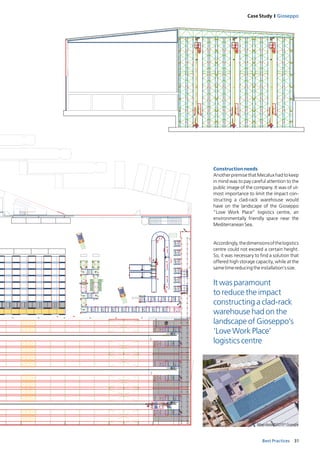
Constructionneeds
AnotherpremisethatMecaluxhadtokeep
in mind was to pay careful attention to the
public image of the company. It was of ut-
most importance to limit the impact con-
structing a clad-rack warehouse would
have on the landscape of the Gioseppo
“Love Work Place” logistics centre, an
environmentally friendly space near the
MediterraneanSea.
Accordingly,thedimensionsofthelogistics
centre could not exceed a certain height.
So, it was necessary to find a solution that
offered high storage capacity, while at the
sametimereducingtheinstallation’ssize.
It was paramount
to reduce the impact
constructing a clad-rack
warehouse had on the
landscape of Gioseppo’s
‘Love Work Place’
logistics centre
Mapdata©2015*Google
32 Best Practices
Case Study I Gioseppo
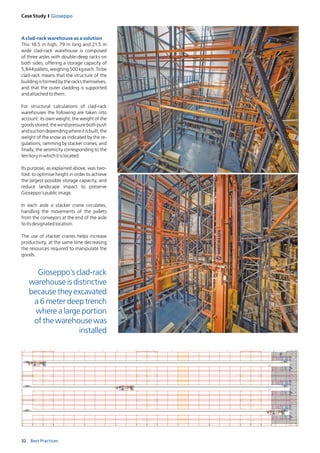
A clad-rack warehouse as a solution 
This 18.5 m high, 79 m long and 21.5 m
wide clad-rack warehouse is composed
of three aisles with double-deep racks on
both sides, offering a storage capacity of
5,844pallets,weighing500kgeach.Tobe
clad-rack means that the structure of the
buildingisformedbytheracksthemselves,
and that the outer cladding is supported
andattached tothem. 
For structural calculations of clad-rack
warehouses the following are taken into
account: its own weight; the weight of the
goodsstored;thewindpressurebothpush
andsuctiondependingwhereitisbuilt;the
weight of the snow as indicated by the re-
gulations; ramming by stacker cranes; and
finally, the seismicity corresponding to the
territoryinwhichitislocated.
Its purpose, as explained above, was two-
fold: to optimise height in order to a­chieve
the largest possible storage capacity, and
reduce landscape impact to preserve
Gioseppo’spublicimage. 
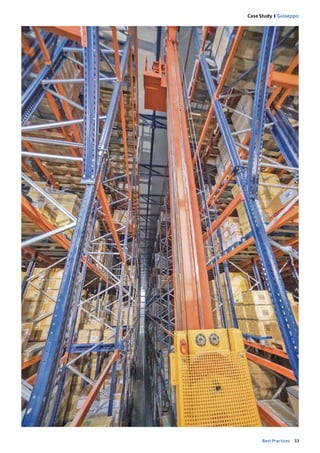
In each aisle a stacker crane circulates,
hand­ling the movements of the pallets
from the conveyors at the end of the aisle
toitsdesignatedlocation. 
The use of stacker cranes helps increase
productivity, at the same time decreasing
the resources required to manipulate the
goods.
Gioseppo’s clad-rack
warehouse is distinctive
because they excavated
a 6 meter deep trench
where a large portion
of the warehouse was
installed
3
2
1
33Best Practices
Case Study I Gioseppo
34 Best Practices
Case Study I Gioseppo
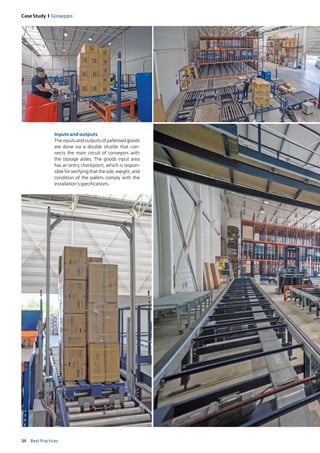
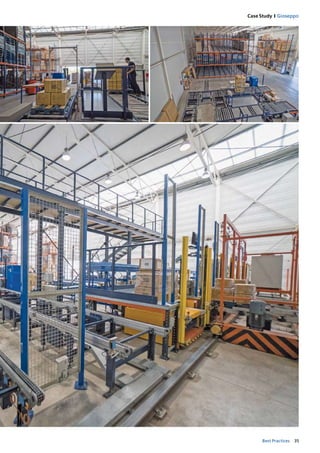
Inputs and outputs
The inputs and outputs of palletised ­goods
are done via a double shuttle that con-
nects the main circuit of conveyors with
the stor­age aisles. The goods input area
has an ­entry checkpoint, which is respon-
sible for verifying that the size, weight, and
condition of the pallets comply with the
installation’sspecifications. 
35Best Practices
Case Study I Gioseppo
36 Best Practices
Case Study I Gioseppo
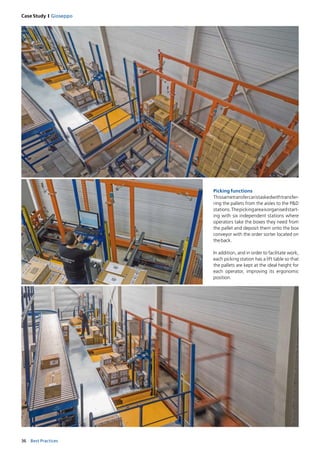
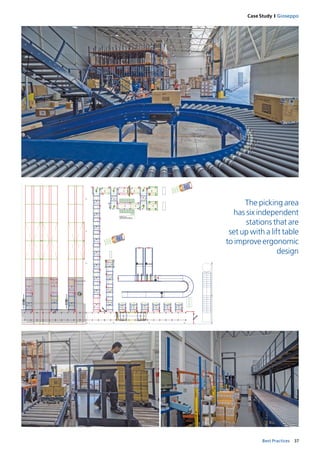
Picking functions
Thissametransfercaristaskedwithtransfer-
ring the pallets from the aisles to the P&D
stations.Thepickingareaisorganisedstart-
ing with six independent stations where
operators take the boxes they need from
the pallet and deposit them onto the box
conveyor with the order sorter located on
theback. 
In addition, and in order to facilitate work,
each picking station has a lift table so that
the pallets are kept at the ideal height for
each operator, improving its ergonomic
position. 
37Best Practices
Case Study I Gioseppo
The picking area
has six independent
stations that are
set up with a lift table
to improve ergonomic
design
38 Best Practices
Case Study I Gioseppo
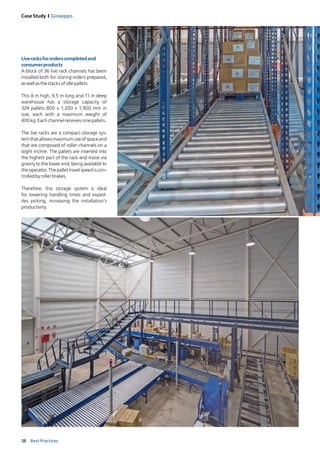
Liveracksfor orders completed and
consumerproducts
A block of 36 live rack channels has been
installed both for storing orders prepared,
aswellasthestacksofidlepallets. 
This 8 m high, 9.5 m long and 11 m deep
warehouse has a storage capacity of
324 pallets 800 x 1,200 x 1,900 mm in
size, each with a maximum weight of
400kg.Eachchannelreceivesninepallets.
The live racks are a compact storage sys-
temthatallowsmaximumuseofspaceand
that are composed of roller channels on a
slight incline. The pallets are inserted into
the highest part of the rack and move via
gravity to the lower end, being available to
theoperator.Thepallettravel speed is con-
trolledbyrollerbrakes. 
Therefore, this storage system is ideal
for lowering handling times and exped­
ites picking, increasing the installation’s
productivity. 
39Best Practices
Case Study I Gioseppo
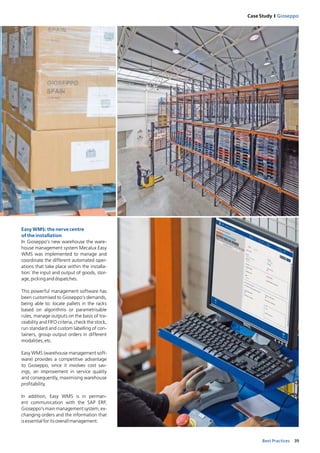
Easy WMS: the nerve centre
of the installation
In Gioseppo’s new warehouse the ware-
house management system Mecalux Easy
WMS was implemented to manage and
coordinate the different automated oper­
ations that take place within the installa-
tion: the input and output of goods, stor­
age,pickinganddispatches. 
This powerful management software has
been customised to Gioseppo’s demands,
being able to: locate pallets in the racks
­based on algorithms or parametrisable
­rules, manage outputs on the basis of tra-
ceability and FIFO criteria, check the stock,
run standard and custom labelling of con-
tainers, group output orders in different
modalities,etc. 
Easy WMS (warehouse management soft-
ware) provides a competitive advant­age
to Gioseppo, since it involves cost sav­
ings, an improvement in service quality
and consequently, maximising warehouse
profitability.
In addition, Easy WMS is in perman­
ent communication with the SAP ERP,
Gioseppo’s main management system, ex-
changing orders and the information that
isessentialforitsoverallmanagement.
40 Best Practices
Case Study I Gioseppo
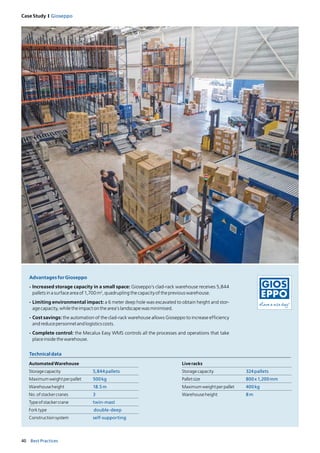
AdvantagesforGioseppo
-	Increased storage capacity in a small space: Gioseppo’s clad-rack warehouse receives 5,844
palletsinasurfaceareaof1,700m2
,quadruplingthecapacityofthepreviouswarehouse. 
-	Limiting environmental impact: a 6 meter deep hole was excavated to obtain height and stor­
agecapacity,whiletheimpactonthearea’slandscapewasminimised.
-	Cost savings: the automation of the clad-rack warehouse allows Gioseppo to increase efficiency
andreducepersonnelandlogisticscosts. 
-	Complete control: the Mecalux Easy WMS controls all the processes and operations that take
placeinsidethewarehouse. 
Technicaldata
AutomatedWarehouse
Storagecapacity 5,844pallets
Maximumweightperpallet 500kg
Warehouse height 18.5m
No.ofstackercranes  3
Typeofstackercrane twin-mast
Forktype double-deep
Constructionsystem self-supporting
Liveracks
Storagecapacity 324pallets
Palletsize  800x1,200mm
Maximumweightperpallet  400kg
Warehouseheight 	 8m
41Best Practices
Casestudy:Ypê
Wide prep area for orders: a key Mecalux
design feature for Ypê warehouse in São Paulo
Location:Brazil
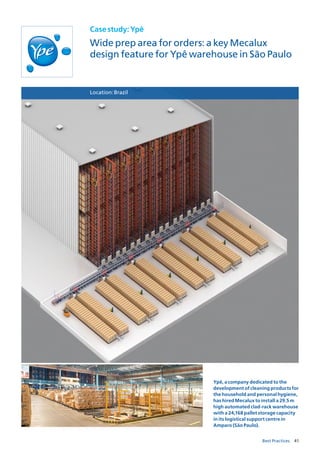
Ypê, a company dedicated to the
development of cleaning products for
the household and personal hygiene,
has hired Mecalux to install a 29.5 m
high automated clad-rack warehouse
with a 24,168 pallet storage capacity
in its logistical support centre in
Amparo (São Paulo).
42 Best Practices
Case study I Ypê
Analysingtheneeds
The main production centre of Ypê is loca-
ted in Amparo, a town close to the city of
São Paulo. The growing needs of the com-
panyrequiredtheconstructionofalargelo-
gisticscentrenexttotheproductionplants,
fromwhichtheycouldoffercomprehensive
service,andatthesametimereducecosts.
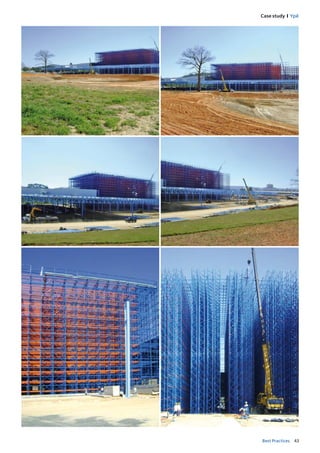
Mecalux installed the racks and structu-
res of the warehouse, the automatic inter-
nal handling equipment, the construction
of a picking area and Mecalux Easy WMS
software deployment, the warehouse
management system which governs and
controls the operations of the logistics
centre.
The collaboration of
Mecalux with Ypê has
been very close from the
development phase of the
project to its execution
43Best Practices
Case study I Ypê
44 Best Practices
Case study I Ypê
Solution adopted:
clad-rack warehouse
The most striking part of the project de-
veloped by Mecalux is the installation
of a self-supporting construction ware-
house with a total capacity of 24,168 pal-
lets, 1000 x 1200 mm in size, each with a
weightof1,300kg.
Being clad-racked, the racks are a funda-
mental part of the structure of the building
and cladding is placed on them. In addition
to its own weight, it must withstand the
pallets stored, the force of the wind on the
basis of the site characteristics, the pres-
sure of the handling equipment and the
seismic risk that corresponds to the zone in
accordancewiththecountry’sregulations.
The traditionally constructed buildings are
adjacent to Ypê’s logistics centre, just be-
sides the automated warehouse, where
available space has been set aside for futu-
reexpansion.
At present, this 29.5 m high, 107.5 m long
and 49.5 m wide warehouse has a total
of eight storage aisles, with racks on both
sides, of which five are double-depth and
threesingle-depth.
Each aisle is set up with a twin-mast stac-
ker crane that automatically performs the
movements between locations and the
mainconveyorcircuit,placedattheheader
ofthewarehouse.
Warehousearea
reservedtoexpandthestorage
capacityofYpê
45Best Practices
Case study I Ypê
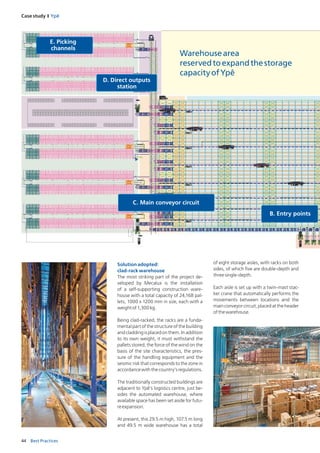
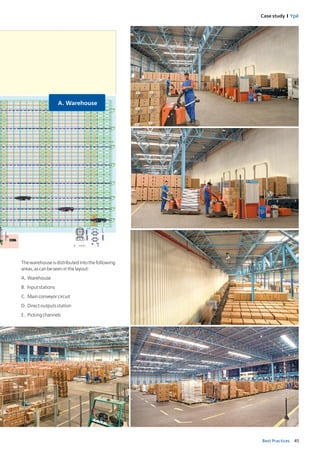
Thewarehouseisdistributedintothefollowing
areas,ascanbeseeninthelayout:
A. Warehouse
B. Inputstations
C. Mainconveyorcircuit
D. Directoutputsstation
E. Pickingchannels
46 Best Practices
Case study I Ypê
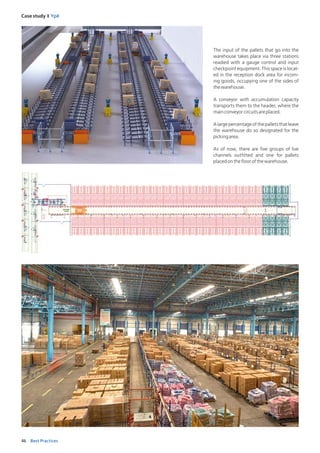
The input of the pallets that go into the
warehouse takes place via three stations
readied with a gauge control and input
checkpoint equipment. This space is locat-
ed in the reception dock area for incom-
ing goods, occupying one of the sides of
thewarehouse.
A conveyor with accumulation capacity
transports them to the header, where the
mainconveyorcircuitsareplaced.
Alargepercentageofthepalletsthatleave
the warehouse do so designated for the
pickingarea.
As of now, there are five groups of live
channels outfitted and one for pallets
placedonthefloorofthewarehouse.
Groupofpickingchannels
47Best Practices
Case study I Ypê
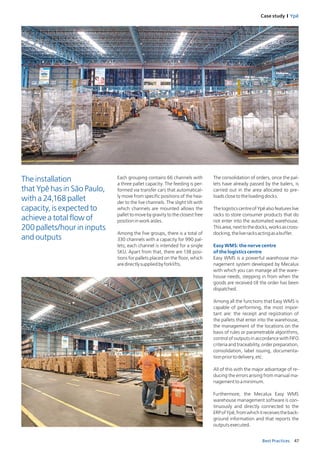
Each grouping contains 66 channels with
a three pallet capacity. The feeding is per-
formed via transfer cars that automatical-
ly move from specific positions of the hea-
der to the live channels. The slight tilt with
which channels are mounted allows the
pallet to move by gravity to the closest free
positioninworkaisles.
Among the five groups, there is a total of
330 channels with a capacity for 990 pal-
lets; each channel is intended for a single
SKU. Apart from that, there are 138 posi-
tions for pallets placed on the floor, which
aredirectlysuppliedbyforklifts.
The consolidation of orders, once the pal­
lets have already passed by the balers, is
carried out in the area allocated to pre-
loadsclosetotheloadingdocks.
The logistics centre of Ypê also features live
racks to store consumer products that do
not enter into the automated warehouse.
Thisarea,nexttothedocks,worksascross-
docking,theliveracksactingasabuffer.
Easy WMS: the nerve centre
of the logistics centre
Easy WMS is a powerful warehouse ma-
nagement system developed by Mecalux
with which you can manage all the ware-
house needs, stepping in from when the
goods are received till the order has been
dispatched.
Among all the functions that Easy WMS is
capable of performing, the most impor-
tant are: the receipt and registration of
the pallets that enter into the warehouse,
the management of the locations on the
basis of rules or parametrable algorithms,
control of outputs in accordance with FIFO
criteria and traceability, order preparation,
consolidation, label issuing, documenta-
tionpriortodelivery,etc.
All of this with the major advantage of re-
ducing the errors arising from manual ma-
nagementtoaminimum.
Furthermore, the Mecalux Easy WMS
warehouse management software is con-
tinuously and directly connected to the
ERPofYpê,fromwhichitreceivestheback-
ground information and that reports the
outputsexecuted.
The installation
that Ypê has in São Paulo,
with a 24,168 pallet
capacity, is expected to
achieve a total flow of
200 pallets/hour in inputs
and outputs
48 Best Practices
Case study I Ypê
AdvantagesforYpê
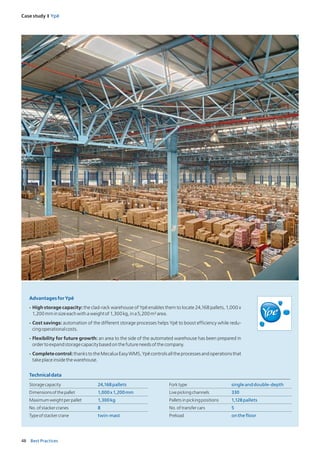
-	High storage capacity: the clad-rack warehouse of Ypê enables them to locate 24,168 pallets, 1,000 x
1,200mminsizeeachwithaweightof1,300kg,ina5,200m²area.
-	Cost savings: automation of the different storage processes helps Ypê to boost efficiency while redu-
cingoperationalcosts.
-	Flexibility for future growth: an area to the side of the automated warehouse has been prepared in
ordertoexpandstoragecapacitybasedonthefutureneedsofthecompany.
-	Completecontrol:thankstotheMecaluxEasyWMS,Ypêcontrolsalltheprocessesandoperationsthat
takeplaceinsidethewarehouse.
Technicaldata
Storagecapacity 24,168pallets
Dimensionsofthepallet 1,000x1,200mm
Maximumweightperpallet 1,300kg
No.ofstackercranes 8
Typeofstackercrane twin-mast
Forktype singleanddouble-depth
Livepickingchannels 330
Palletsinpickingpositions 1,128pallets
No.oftransfercars 5
Preload onthefloor
49Best Practices
Casestudy:Takeda
Turnkey pharmaceutics: automated warehouse
by Mecalux for Japanese partner Takeda
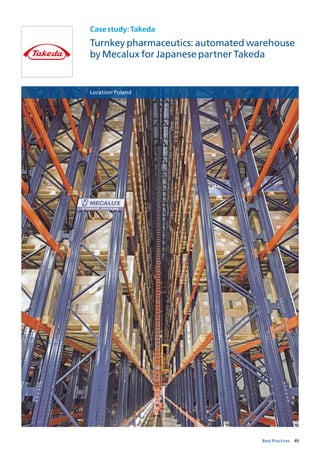
Location:Poland
50 Best Practices
Case Study I Takeda
A clad-rack warehouse as a solution
When Takeda moved forward with the ex-
pansionofitsproductioncentre,itwasvery
clear that the warehouse should be auto-
mated. This would allow for perfect con-
trol of stored goods, in addition to being­
able to achieve the maximum permissible
height, given that the space available for
warehouseconstructionwaslimited.
ThesolutionproposedbyMecaluxwasthe
construction of a 32.5 m high clad-rack
warehouse located next to the manufac­
t­uring facilities and the bay assigned to
­delivery preloading. In this type of cons-
Who is Takeda?
Takeda Pharmaceutical Company Limited,
with its headquarters in Osaka (Japan), is
a global company specialising in the inves­
t­igation of pharmaceutical products. In
the mid-twentieth century, it experienced
massive growth, making it a world leader
in the pharmaceutical industry and the
larg­estofitskindinJapan.
The company has a commercial pre­sence
in more than 70 countries, most signifi-
cantly those in Asia, North America and
Europe and emerging markets such as
­LatinAmerica,RussiaandChina.
truction, the racks themselves make up
thestructureofthewarehouse.
The installation consists of two aisles, in
which two automatic stacker cranes move
independently, handling the pallets stored
in double-deep racks (two pallets in depth
oneachlevel).Thankstotheoptimal­space
utilisation, the Takeda warehouse has a
storage capacity of more than 6,500 pal­
letsinasurfaceareaofonly950m2
.
The warehouse was equipped with a
HVAC system (Heating Ventilation Air
Conditioning) which keeps the tempera­
ture between 16 and 24 °C and prevents
the humidity level from exceeding 70%,
which is something that could affect
­goodsstored.
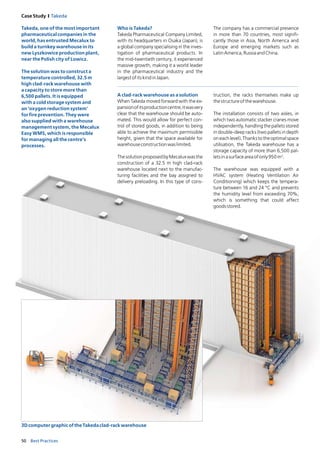
3DcomputergraphicoftheTakedaclad-rackwarehouse
Takeda, one of the most important
pharmaceutical companies in the
world, has entrusted Mecalux to
build a turnkey warehouse in its
new Lyszkowice production plant,
near the Polish city of Lowicz.
The solution was to construct a
temperature controlled, 32.5 m
high clad-rack warehouse with
a capacity to store more than
6,500 pallets. It is equipped
with a cold storage system and
an ‘oxygen reduction system’
for fire prevention. They were
also supplied with a warehouse
management system, the Mecalux
Easy WMS, which is responsible
for managing all the centre’s
processes.
51Best Practices
Case Study I Takeda
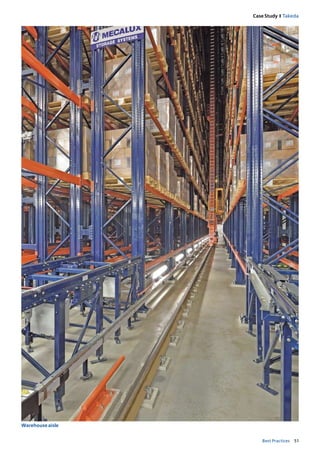
Warehouseaisle
52 Best Practices
Case Study I Takeda
Outsideviewofthewarehouse
14,505mm
32,382mm
Aninnovativefireprotectionsystem(inert-
ing) has also been used, which reduces the
amount of oxygen in the atmosphere to
15%toavoidfires.
Thepipesoftheair’shumidityandtemper­
ature control system have been installed
above, targeting the aisles and placed in
the free space between trusses in the fa-
cility.
For structural calculations of clad-rack
warehouses the following are taken into
account: its own weight; the weight of the
goodsstored;thewindpressurebothpush
and suction where it is built; the weight of
the snow as indicated by the regulations;
thrusts by stacker cranes; and finally, the
seismicity corresponding to the territory
whereitislocated.
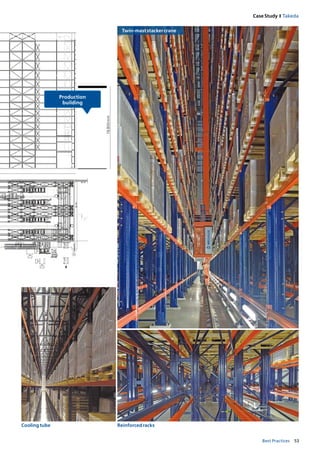
Due to the slenderness of the building
(14.5 m wide and 32.4 m high), a highly re-
inforced structure was built. Also, many
large sized anchorages have been placed
with the aim of absorbing maximum wind
pressure.
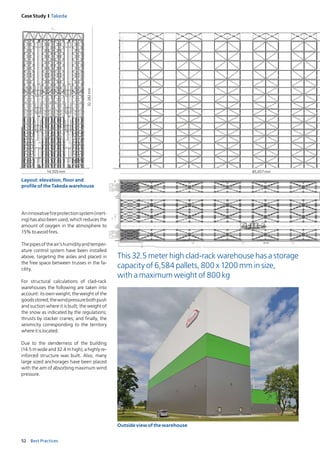
This 32.5 meter high clad-rack warehouse has a storage
capacity of 6,584 pallets, 800 x 1200 mm in size,
with a maximum weight of 800 kg
Layout: elevation, floor and
profile of the Takeda warehouse
85,657mm
53Best Practices
Case Study I Takeda
Coolingtube Reinforcedracks
Twin-maststackercrane
19,800mm
54 Best Practices
Case Study I Takeda
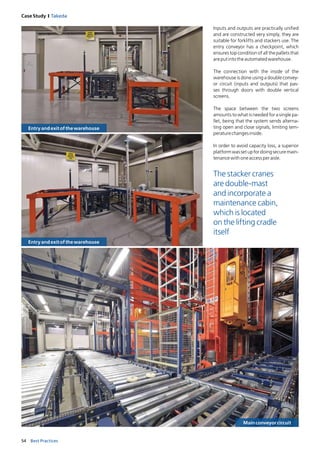
Inputs and outputs are practically unified
and are constructed very simply, they are
suitable for forklifts and stackers use. The
entry conveyor has a checkpoint, which
ensures top condition of all the pallets that
areputintotheautomatedwarehouse.
The connection with the inside of the
warehouse is done using a double convey-
or circuit (inputs and outputs) that pas-
ses through doors with double vertical
screens.
The space between the two screens
amounts to what is needed for a single pa-
llet, being that the system sends alterna-
ting open and close signals, limiting tem-
peraturechangesinside.
In order to avoid capacity loss, a superior
platformwassetupfordoingsecuremain-
tenancewithoneaccessperaisle.
Entryandexitofthewarehouse
Mainconveyorcircuit
The stacker cranes
are double-mast
and incorporate a
maintenance cabin,
which is located
on the lifting cradle
itself
Entryandexitofthewarehouse
55Best Practices
Case Study I Takeda
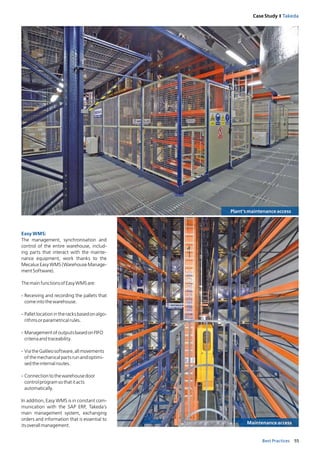
Easy WMS:
The management, synchronisation and
control of the entire warehouse, includ-
ing parts that interact with the mainte-
nance equipment, work thanks to the
Mecalux Easy WMS (Warehouse Manage-
mentSoftware).
ThemainfunctionsofEasyWMSare:
- Receiving and recording the pallets that
comeintothewarehouse.
- Palletlocationintheracksbasedonalgo-
rithmsorparametricalrules.
- ManagementofoutputsbasedonFIFO
criteriaandtraceability.
- ViatheGalileosoftware,allmovements
ofthemechanicalpartsrunandoptimi-
sedtheinternalroutes.
- Connectiontothewarehousedoor
controlprogramsothatitacts
automatically.
In addition, Easy WMS is in constant com-
munication with the SAP ERP, Takeda’s
main management system, exchanging
orders and information that is essential to
itsoverallmanagement.
Plant’smaintenanceaccess
Maintenanceaccess
56 Best Practices
Case Study I Takeda
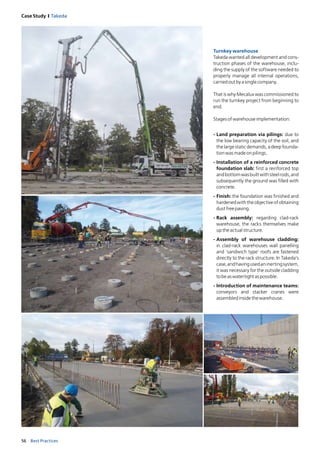
Turnkeywarehouse
Takeda wanted all development and cons-
truction phases of the warehouse, inclu-
ding the supply of the software needed to
properly manage all internal operations,
carriedoutbyasinglecompany.
That is why Mecalux was commissioned to
run the turnkey project from beginning to
end.
Stagesofwarehouseimplementation:
-	Land preparation via pilings: due to
the low bearing capacity of the soil, and
the large static demands, a deep founda-
tionwasmadeonpilings.
-	Installation of a reinforced concrete
foundation slab: first a reinforced top
andbottomwasbuiltwithsteelrods,and
subsequently the ground was filled with
concrete.
-	Finish: the foundation was finished and
hardenedwiththeobjectiveofobtaining
dustfreepaving.
-	Rack assembly: regarding clad-rack
warehouse, the racks themselves make
uptheactualstructure.
-	Assembly of warehouse cladding:
in clad-rack warehouses wall panelling
and ‘sandwich type’ roofs are fastened
directly to the rack structure. In Takeda’s
case,andhavingusedaninertingsystem,
it was necessary for the outside cladding
tobeaswatertightaspossible.
-	Introduction of maintenance teams:
conveyors and stacker cranes were
­assembledinsidethewarehouse.
57Best Practices
Case Study I Takeda
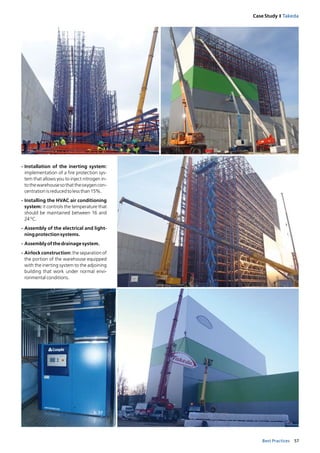
-	Installation of the inerting system:
implementation of a fire protection sys-
tem that allows you to inject nitrogen in-
tothewarehousesothattheoxygencon-
centrationisreducedtolessthan15%.
-	Installing the HVAC air conditioning
system: it controls the temperature that
should be maintained between 16 and
24 ºC.
-	Assembly of the electrical and light-
ningprotectionsystems.
-	Assemblyofthedrainagesystem.
-	Airlock construction: the separation of
the portion of the warehouse equipped
with the inerting system to the adjoining
building that work under normal envi-
ronmentalconditions.
58 Best Practices
Case Study I Takeda
AdvantagesforTakeda
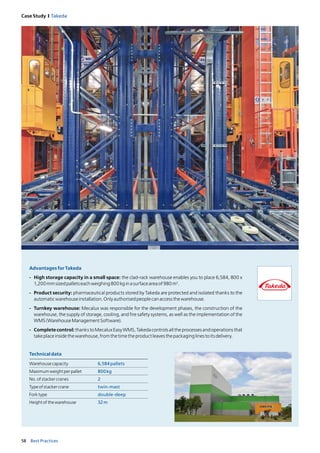
-	 High storage capacity in a small space: the clad-rack warehouse enables you to place 6,584, 800 x
1,200mmsizedpalletseachweighing800kginasurfaceareaof980m2
.
-	 Product security: pharmaceutical products stored by Takeda are protected and isolated thanks to the
automaticwarehouseinstallation.Onlyauthorisedpeoplecanaccessthewarehouse.
-	 Turnkey warehouse: Mecalux was responsible for the development phases, the construction of the
warehouse, the supply of storage, cooling, and fire safety systems, as well as the implementation of the
WMS(WarehouseManagementSoftware).
-	 Completecontrol: thanks to Mecalux Easy WMS, Takeda controls all the processes and operations that
takeplaceinsidethewarehouse,fromthetimetheproductleavesthepackaginglinestoitsdelivery.
Technicaldata
Warehousecapacity 6,584pallets
Maximumweightperpallet 800kg
No.ofstackercranes 2
Typeofstackercrane twin-mast
Forktype double-deep
Heightofthewarehouse 32m
59Best Practices
Casestudy: Nufri
Nufri has put its confidence in Mecalux yet
again by installing Movirack mobile pallet
racking in its headquarters in Catalonia
Location:Spain
Needs and the proposed solution
Nufri handles around 400 million tons of
fresh and processed materials, selling to
more than 40 countries worldwide. To
guarantee quality, personalized service,
Nufri needed a warehouse in which it
could access all its stored products in a
straightforward manner, all the while
maximizing surface area and the volume
oftheinstallations.
In response, Mecalux opted to install
Movirack mobile pallet racks of 12 m high,
converting it into one of the tallest solu-
tions of this kind and perfectly adapting it
totheneedspresentedbyNufri.
The warehouse is divided into two well-
marked areas: the first, which is small-
er in size, is set up to store products and
packaging at ambient temperature, while
the remainder of the area is cold storage
usedtostoreextracts,juicesandpurees.
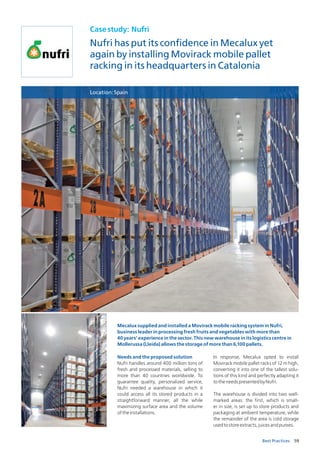
Mecalux supplied and installed a Movirack mobile racking system in Nufri,
business leader in processing fresh fruits and vegetables with more than
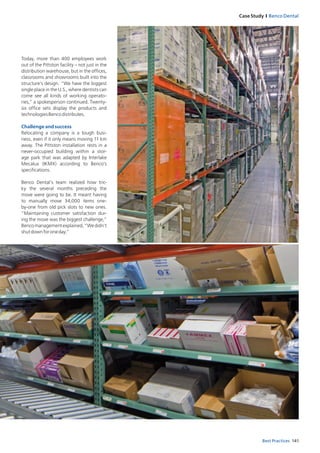
40 years’ experience in the sector. This new warehouse in its logistics centre in
Mollerussa (Lleida) allows the storage of more than 6,100 pallets.
60 Best Practices
Case Study I Nufri
Ambienttemperaturearea
Itissetuptosupplyproductionareas,from
cylindrical containers of enormous dimen-
sions, including the products necessary to
completeitsrangeofprocessing.
This area, with a storage capacity of
1,200 pallets that are 1,200 x 1,200 mm
in size and have a maximum weight of
2,100 kg each, is available with seven mo-
bilebasesandtwonon-movingracks.
BLOCK 3
BLOCK 1
BLOCK 2
Being located beside the cold storage
allows combined supply, removal and sto-
rage of processed goods, significantly opt­
imising the internal movements inside the
installation.
Providing for the future needs of the com-
pany, an area has been set up where five
more mobile pallet racks can be installed.
To that end, the floor has been fitted from
the beginning to facilitate possible pro-
gressivegrowth.
Block3:ambient
temperaturearea
The utilization of
Movirack mobile pallet
racking provides the
maximum installation
streamlining
61Best Practices
Case Study I Nufri
Coldstorage
There are a total of 31 double mobile ba-
ses and four non-moving racks which ­give
a storage capacity of 4,930 pallets 1,200 x
1,200 mm in size, and have a maximum
weight of 2,100 kg each, which conser-
ves processed materials at a controlled
temperature.
The racks are arranged in two large blocks
separated by a main gangway. Each block
has a wide work aisle that opens up be­
tween racks. To automatically open it, the
operator must only push a button via the
remotecontrol.
For the purpose of ensuring the security of
its operators and the installation in gene-
ral, the Movirack system has the following
devices: external optical safety barriers,
longitudinal photocells placed on both
sides of the bases, proximity sensors, pre-
programmed activation protocols and
emergencystopandresetbuttons.
The forklifts that are used in the refrigerat­
ed storage area are the retractable type
that makes it possible to work in an ­aisle
less than 3 m high. The last load level is
plac­ed at 10.6 m high, and the maximum
loadheightwouldreach12mhigh.
The racks have mesh shelves in them for low strength
pallets or those that are not standard size
Blocks1and2:coldstorageunit
62 Best Practices
Case Study I Nufri
Technicaldata
Storagecapacity 6,130pallets
Palletsize 1,200x1,200mm
Maximumweigthperpallet 2,100kg
No.ofmobilebases 38
Rackheight 10.6m
Totalheightwithload 12m
Workaislelength 23m
Warehousetemperature ambient/refrigerated
Advantagesforthecustomer
-	 StoragecapacityisincreasedusingaMovirackmobilepalletracksystem.
-	 Directaccesstoanypallet:theaisleopensupexactlywherethegoodsarelocated.
-	 Products are maintained in optimal condition facilitated by the parking function, which keeps
theracksslightlyapartmaintainingbetteraircirculation.
-	 Flexibilityforfutureexpansion.
63Best Practices
Case study: MGA
MGA has an efficient automated miniload
warehouse coupled with conventional
pallet racking
Location: France
For the new logistics center located in Saint-Quentin Fallavier, a town close
to the city of Lyon, MGA chose Mecalux as provider of all management and
storage systems, including an automated miniload warehouse with a capacity
of 15,872 boxes.
MGA is an important spare parts distribu­
tor with regional warehouses in different
cities within France. The priority of the
company is to offer express delivery to its
customers, generally automobile replace­
ment part wholesalers.
Inthislogisticscenter,Mecaluxhasinstalled
an automated miniload warehouse with a
specific picking area and a warehouse for
pallets placed on conventional type racks.
It has also included the implementation of
a Mecalux Easy WMS (warehouse mana­
gement software), tasked with handling
all operations, from the entry of goods till
dispatch, previously passing through the
storage and picking phases.
64 Best Practices
Case Study I MGA
Warehouse interior
Connection between the warehouse and the picking area
Warehouse for pallets: ‘A’ and bulky type product picking
Conventional pallet racks
The conventional pallet rack warehouse
is intended for bulkier products and items
with greater turnover (A type) placed
upon pallets. Racks have two inferior le­
vels to conduct direct picking from the pal­
lets, while reserves are placed on superior
levels.
This storage system is characterised by
its simplicity and capacity to adapt itself
to the needs of the company. In addition,
conventional pallet racks make it possible
to directly access each pallet, storing the
maximum number of unit loads in a safe
and organised way.
The miniload warehouse
A miniload warehouse with four aisles,
and two double­deep racks (one per side),
was installed, allowing storage of a total
of 15,872 plastic euro­boxes, 600 x 400 x
320 mm in size. The height of the racks is
12.3 m and the total admissible weight per
box is 50 kg.
All medium and small sized products are
located in the miniload warehouse, gene­
rally B and C type items. These products
are handled by four stacker cranes, three
picking stations and a replenishment
station.
65Best Practices
Case Study I MGA
Four stacker cranes
The construction of the miniload
warehouse was done in two phases, in
accordance with the needs of MGA. The
first included three storage aisles with
three stacker cranes and three picking
stations, while in the second they installed
four aisles, set up a new stacker crane and
completed the replenishment station.
If we analyse the parts that the instal­
lation is composed of, represented by
the images on this page, you will see the
following:
A.	 An automated warehouse
B.	 Automated warehouse conveyors
C.	 Three picking stations
D.	 A replenishment station
The MGA
miniload warehouse
can store 15,872 plastic
euro-boxes
66 Best Practices
Case Study I MGA
Two box extractions
Miniload with conveyors inside the warehouse
Double-mast stacker cranes were install­
ed; the extraction system placed in the
cradle is a double box and double-deep,
being capable of handling two boxes at a
time.
The extractor is formed by a fork and two
independently moving belts that allow
them to interchangeably pick boxes from
one or another side, first moving to the
contrary side where you are going to make
the second extraction.
The conveyor system has been sized to
­move great quantities of boxes that may
coincide with times of higher demand,
whilethetravelspeed,andmainlythestac­
ker crane’s lifting speed, were adjusted to
the characteristics of this warehouse.
67Best Practices
Case Study I MGA
Access doors to the stacker cranes
Interior of the stacker crane aisle
Cantilevered storage levels Rear area of the warehouse
In addition, a cantilevered structure has
been made above the loading and un­
loading stations, managing to increase
capacity by 320 more boxes.
In the rear, equipped with a large main­
tenance area, there are reference devices
for the position of the stacker crane. The
whole space is enclosed with mesh pa­
nels and safety doors that will individually
disconnect the machines in case they are
opened.
Thanks to the four
stacker cranes
and the high number
of boxes that they
operate with, MGA
ensures the liquidity
of the flow of
movements
68 Best Practices
Case Study I MGA
Main picking area circuit
Control computers and picking stations
Picking stations
The enclosure where the main warehouse
is located is independent of other build­
ings and, in particular, from the picking
station, which was installed on the side of
the warehouse.
The picking stations, in the shape of a “U”,
arelocatedterracedperpendicularlytothe
main conveyors.
These conveyors are comprised of a dou­
ble circuit that allows both the re­circula­
tion of boxes, as well as the connection
to the warehouse and the replenishment
station. Moving boxes to either of the two
main conveyors is direct, thus avoiding un­
necessary movements.
Each station, with capacity for three boxes
on hold plus the one which is being pro­
cessed, is run by an operator, who in turn
is able to prepare waves of six orders at the
same time. To that end, there is a compu­
ter connected to the Mecalux Easy WMS
(warehouse management software) and
different support devices for picking. For
example, put to light devices placed on top
of the containers of each order, indicating
to the operator which order each item
corresponds to.
On the pallets/containers of each order,
the item location in the pallet racks has
been previously introduced, that is to say,
this same zone serves as an order conso­
lidation area. In this way, fast and agile
order preparation has been achieved.
Three picking stations,
a replenishment station
and the consolidation
area were set up
throughout the facility
69Best Practices
Case Study I MGA
Put to light device
Conveyors in the picking station
Easy WMS
The Mecalux Easy WMS is the nerve center
that manages all the necessary functions
for the general operations of any type of
warehouse, regardless of its complexity.
Easy WMS (Warehouse Management
System) controls: all the inbound proces­
ses, the warehouse locations, stocks, lo­
cation rules, storage and extraction, the
pallets that have to go to picking stations,
the picking itself, returns to the ware­
house, etc. It is also able to analyze the
state of distinct parts or areas via query
and reporting tools, as well as the devices
that operate in it.
Easy WMS is in
bidirectional and
permanent connection
with the customer’s
SAP ERP
70 Best Practices
Case Study I MGA
Technical data
Storage capacity 15,872 boxes
Maximum weight per box 50 kg
No. of stacker cranes 4
Type of stacker crane double-mast
Extraction system double-deep,two boxes
Advantages for MGA
- Improved storage capacity: the MGA miniload warehouse offers a storage capacity of 15,872 boxes.
- Increased productivity: thanks to the high level of warehouse automatization, the speed of order pre­
paration has increased.
- Perfect stock control: thanks to the Mecalux Easy WMS, the company MGA can manage all move­
ments, processes and operations that take place within their warehouse.
Miniload warehouse height 12.3 m
Picking stations 3
Replenishment stations 1
Pallet capacity 1,480 pallets
Maximum weight per pallet 1,000 kg
71Best Practices
Case study: Luís Simões
Mecalux equips Luís Simões’ new
installations in Portugal with Pallet Shuttle
and conventional pallet racking
WhatisLuísSimões:
whatareitsneeds?
Luís Simões is a comprehensive transport
and logistics services operator that began
operating in 1948 in the portuguese city
of Loures.
The firm has operated in Spain for over
25years,andiscurrentlythemarketleader
in trade flows between the two countries,
with a fleet of 2,000 vehicles (owned and
outsourced) and over 1,500 employees.
According to its storage facilities expan­
sion and modernisation plan, the com­
pany commissioned Mecalux to equip
two large, newly built sites, with almost
10,000 m2
of surface area each.
Luís Simões needed to speed up the flow
of incoming and outgoing pallets in the
warehouse while, at the same time, in­
creasing storage capacity. This was need­
ed to efficiently meet the demands of both
existing and potential customers.
Location: Portugal
This warehouse, separated into
two distinct areas and built under
the “multi-client” concept, covers
a surface area of 17,500 square
metres and can supply more than
33,000 pallets.
Luís Simões performs all of its
business-related activities from
this installation, including storage
and picking, mass and capillary
distribution.
72 Best Practices
Case Study I Luís Simões
MUR
OMSM1
54321
54321
381
451
C
C
C
C
C
A
A
C
C
G
G
F
F
E
E
E
A
A
F
F
E
E
E
A
A
G
G
C
C
A
A
C
C
C
C
C
C
PROTECÇÃOLATERALDEBASTIDOR
PROTECÇÃOLATERALDEBASTIDORPROTECÇÃOLATERALDEBASTIDOR
PROTECÇÃOLATERALDEBASTIDOR
C
C
C
Seven double and one single conventio­
nal pallet racks were installed, along with
two compact racking units with the Pallet
Shuttle system. They feature six load levels
and the capacity to deep­store 15 pallets
per level.
The lower level of the conventional pallet
racking was prepared to perform picking
functions, because a high percentage of
Luís Simões’s orders require it. Moreover,
a spacious area was provided for subse­
quently consolidating the orders.
Thedocks,locatedoneitherside,havetheir
own preloading channels on the ground;
these allow access to the pallets from both
sides, thus optimising truck loading.
The conventional pallet racking has the
capacity for 10,386 pallets, and with the
Pallet Shuttle system the capacity is 5,544.
Warehouse A
Mecalux’s proposed solution
After analysing all the operations, and Luís
Simões’s needs and flows, Mecalux pro­
posed a separate solution for each build­
ing, which are interconnected and share
the same management and control centre.
Moreover, the new logistics centre has
34 loading and unloading docks, as well
as three spacious order consolidation pre­
loading areas.
Warehouse A
In Warehouse A, a semi­automatic com­
pact Pallet Shuttle system combined with
conventional racks was installed, giving
rise to two distinct storage areas, each
served by reach trucks.
73Best Practices
Case Study I Luís Simões
Warehouse B
Warehouse B
Warehouse B consists of twenty rows of
single­deep conventional pallet racking
enabling direct access to the merchan­
dise with maximum flexibility. The rows of
racking, which are 130 m long, are served
via 10 storage aisles along which the reach
truck runs.
The height layout can be seven, eight or
nine levels, depending on the product to
bestoredandtheunitloadmeasurements,
whichmaybeEuro­pallets(800x1,200mm)
or US pallets (1,000 x 1,200 mm).
Three transverse aisles cross the racking to
facilitate the movement of operators; they
can also be used as emergency escape
routes.
Because of their significant length, and in
ordertotraveltheshortestpossibledistan­
ceduringmaintenancetasks,eightloading
docks with their own pre­loading area
were set up at both ends of the warehouse.
Warehouse B’s total storage capacity is
19,503 pallets.
The combination of capacity and flexibility enables
Luís Simões to offer its customers quality service
and short delivery times, strengthening the firm’s
position as a top provider of logistics services
in the Iberian Peninsula
74 Best Practices
Case Study I Luís Simões
Conventional pallet racking
This storage system, which was installed in
both warehouses, has two major advan­
tages: direct access to any pallet, and the
ability to devote the lower level to picking
orders.
The machines used are high-lift reach
trucks that can operate in a 3-metre wide
aisle.
The last level of storage is 12 m high. To
facilitate handling, avoid impacts and
properly centre the pallets and/or forks,
observation cameras were fitted on the
upper part of the forklift.
Moreover, and as a safety precaution, pro­
tectors were fitt­ed on all the rack uprights
facing the aisles.
The WMS (warehouse
management system),
an essential element
in these types of
warehouses, enables
“chaotic” storage
to be used, achieving
high occupancy of all
locations
75Best Practices
Case Study I Luís Simões
Pallet Shuttle System
Mass market consumer products, which
have a greater number of pallets per item,
are stored with this high­density storage
system. The movements inside the rack are
independent and follow the instructions
that the operator transmits using a Wi­Fi
tablet; this significantly reduces the need
for loading and unloading goods.
Racking with the Pallet Shuttle system
Pallet Shuttle
In warehouse A, two blocks with six load
levels were installed. The channels are
13.2 m deep and have a unit capacity of
15 pallets. The installation has 378 chan­
nels that are served by six Pallet Shuttles.
76 Best Practices
Case Study I Luís Simões
Pallet Shuttle Racking
The racks using Pallet Shuttle are operated
as follows:
1. Using the forklift, the operator intro­
duces the Pallet Shuttle into the corres­
ponding channel.
2.Withthepalletloaded,thePalletShuttle
moves horizontally until it reaches the
first free location, where it leaves the
pallet.
3.While the Pallet Shuttle moves and
places the pallet into its location, the
operator places another pallet in the ori­
ginal position in the channel.
Thus, when the shuttle returns to the
beginning of the lane it can successively
repeat the same movement.
Whenloadinginthechanneliscompleted,
the Pallet Shuttle is moved on to the next
one. Extraction is done by reversing these
steps.
77Best Practices
Case Study I Luís Simões
The program to control the Pallet Shuttle is
installed on each tablet. Various functions
can be performed, including:
­ Selecting the Pallet Shuttle to be used.
­ Automated movements.
­ Manual movements for maintenance.
­ Compacting or relocating pallets, bring­
ing them closer to the exit point.
Battery charging station
Interface for operating the shuttle
­ Inventory: counts the number of pallets
stored in each channel.
­ User management: this funcionality
manages shuttle user permissions for
authorised personnel.
­ Battery charge status.
The observation camera facilitates opera­
tions conducted at heights.
A battery­charging station was installed
that can charge the batteries of six Pallet
Shuttle simultaneously. Batteries can also
be charged independently of the shuttles,
that is, the battery can be removed from
the shuttle and replaced with a previously
charged one. In this way, all the shuttles
will always be operational to fulfil the or­
ders needed.
Observation camera
78 Best Practices
Case Study I Luís Simões
Technical data
Conventional pallet racking
Pallet capacity 1,000 x 1,000 mm 26,000
Pallet capacity 1,200 x 1,200 mm 1,600
Total storage capacity 27,600 pallets
Maximum weight per pallet 1,000 kg
Maximum height of last level 12.3 m
Type of reach truck retractable
Pallet Racking with Pallet Shuttle
Pallet capacity 800 x 1,000 mm 5,550
Maximum weight per pallet 1,000 kg
Number of channels 378
Channel depth 13.2 m
Channel pallet capacity 15
Maximum height of last level 12.5 m
Number of Pallet Shuttle 6
Type of control wifi
Number of tablets 4
Type of reach truck retractable
Advantages for Luís Simões
-	 Optimaluseofspace:theflexibilityofconventionalpalletrackingandthehigh-densitystorageprovided
by the Pallet Shuttle enables a total capacity of 33,150 pallets.
-	 Increased productivity: the Pallet Shuttle increases the flow of pallets per hour and allows for greater
diversification by enabling items to be grouped by channel.
-	 Strategic positioning: this new logistics platform has given an important competitive advantage to
Luís Simões, positioning the firm as a leading logistics centre on the Atlantic coast and bolstering its drive
towards internationalisation.
For further information about this and other success stories look at our web www.mecalux.com/success-stories
79Best Practices
Casestudy:DHL
Mecalux installs a new logistics centre
for DHL on the outskirts of Madrid
Location:Spain
The warehouse, with a capacity
for more than 90,000 pallets, has
two areas allocated for palletised
products. Another, formed by a
two level high mezzanine floor, is
earmarked for hanging garments.
Its strategic location allows DHL
to respond quickly to all its main
customers’ stores within the Iberian
Peninsula (Spain and Portugal).
80 Best Practices
Case Study I DHL
Storageofproductsonpallets
Due to the fact that the majority of orders
delivered by DHL to these stores are full
boxes and they move very few pallets with
a single item type, it was necessary to allo-
cate the bottom level of the conventional
pallet racks for picking activities. Reserve
palletised goods are stored on ­higher
levels.
Handling equipment used to place the
pallets on the racks are reach trucks.
However, during order preparation, spe-
cific machines are used that have the
­ca­pacity to transport up to two pallets at­
atime.
81Best Practices
Case Study I DHL
Conventional pallet
racks are an ideal system
to quickly replenish
locations that have been
left without product
Operators maximise streamlining routes
­inside the logistics centre thanks to
the WMS (Warehouse Management
Software), which divides the warehouse
so that each operator is responsible for a
­single zone. This means that an order can
be prepared by several people at the same
time. Once their part of the order is finis-
hed, each operator will transfer it to one of
the consolidation areas according to the
assigneddock.
Full use of the racks was made to install fire
protectionsystempipelinesandsprinklers.
These coincide with the rack beams or gir-
derstowastetheminimumspacepossible.
82 Best Practices
Case Study I DHL
Assemblybyphases
Mecalux adapted to the company’s needs,
thus they decided to build the warehouse
in phases. So, DHL could make a tailored,
gradual investment as it ran each project
phase.
Aisle length forced them to build inter-
mediate passageways wide enough to
­give two pieces of handling equipment
the ­ability to cross each other at the same
point.
Each sector of the warehouse has its own
loading docks in order to avoid large dis-
placements and significantly reduce ope-
rating costs. The warehouse is also com-
partmentalisedforsecurityreasons.
The breadth of consolidation areas, and
the laying of pre-loads on the floor just
in front of their assigned dock, allows for
speedyloadingoftransportvehicles.
83Best Practices
Case Study I DHL
The total storage capacity
of more than 90,000 pallets and more
than 30,000 metres of profiles used
to hang garments on the racks
84 Best Practices
Case Study I DHL
Thegarmenthangingarea
Racks specifically for hanging garments
are on the mezzanine floor and are two,
fully interconnected, levels high. On each
floor, a space has been left without racks
to allow for the circulation and classifica-
tionofgarments.
Thankstothemezzaninefloor,theproduc-
tive surface area was multiplied, adding
two extra floors that are perfectly suited to
thespaceavailable.
The connection of the operators with the
different warehouse floors is done via a
pedestrian access staircase. On the other
hand, conveyors have stairs and spaces
specifically for automatic access to over-
head carriage that transports hanging
garments.
The Sigma profiles
used for the mezzanine
floor construction system
join all the uprights in the
installation, as well as
attach the rails
of the overhead conveyor
system to the hanging
garments
85Best Practices
Case Study I DHL
The tubes used for hanging garments
on the racks are located at an optimum
height from an ergonomic point of view
and, although they have bearings every
2.2 m, the hangers slide and are grouped
by items without producing any kind of
interference.
Boththefiresafetysystemtubes,sprinklers
andthewarehouselightingareattachedto
the structure. The overhead shuttle trans-
portation rails that are situated in the cen-
tralareaoftheaisleshangthereupon.
Spaces between
pedestrian aisles
are protected
to avoid garments
falling from one floor
to another
86 Best Practices
Case Study I DHL
Technicaldata
Conventionalpalletracking
Storagecapacity 90,000pallets
Palletsize 800x1,200mm
1,000x1,200mm
Maximumweight perpallet 1,000kg
Handlingequipment reachtruck
Orderpicker groundfloorwith
forksfor2pallets
Hunggarmentarea
Surfaceareaoccupied 3,000m2
Surfaceareaofthe3floors 9,000m2
Hangerprofiles >30,000linearmetres
AdvantagesforDHL
- Streamlining the space: the DHL warehouse is set up to store more than 90,000 pallets and more
than30,000mofhangerprofiles.
- Increased productivity: the compartmentalisation of items, the breadth of consolidation areas and
the location of pre-loading zones are some of the factors that help increase the volume and efficiency
ofthemovementofgoods.
- Cost savings: each sector has its own loading dock, thus avoiding large displacements and notably
reducingoperationcosts.
- Efficient service: thanks to this new logistics center, DHL has met the high level of service demanded
byitscustomersandiscapableofofferingfastdeliverywithouterrorsinthegoodssent.
87Best Practices
Casestudy:PAVI-Groupauto
Conveyor belts as the axis of a picking
installation distributed over several floors
Location:France
PAVI-Groupauto, a major
supplier of auto spare parts from
France, hired Mecalux
to install the necessary equipment
in its warehouse in Saint-Priest,
a town near the city of Lyon.
The supply included two levels of mezza-
nines, racking, conveyor belts and auto-
matic sorters, as well as the Mecalux Easy
WMSwarehousemanagementsystem.
88 Best Practices
Case Study I PAVI‑Groupauto
Analysing the needs
The needs of PAVI-Groupauto required
the construction of a warehouse capa-
ble of storing a large number of SKUs of
varying dimensions and characteristics, as
wellasbeinglowconsumption.
To do this, a storage system was needed
that offered optimal use of the surface
area, as well as being highly flexible and
allowingdirectaccesstoanyproduct.
The main objective of the company was
thusmet:rapidserviceforitscustomers.
Solution adopted: a conveyor circuit
The need to maximise the size of the ware-
house and the fact that most of the ­orders
consist of very few units and different
SKUs led Mecalux to propose and install
thefollowingsolution:
-	 Construction of a structure capable
of integrating two raised floors on a
2,000 m2
area, which would allow the
floorspacetobetripled.
-	 Installation, on each of the floors, of
­racking with different sizes and types of
distribution in order to suit the different
products.
-	 Implementation of a continuous and
automatic transport system connecting
all the floors. This means operators can
prepare orders by area, and transport
them to the specific sorting and consoli-
dation area after completion. The circuit
is also used to send empty boxes from
the lower level to the order preparation
stations.
-	 Replenishment of the goods directly
from the receiving container to their lo-
cations. On each floor, pallet unloading
docks have been installed on the other
sideofsafetyswingdoors.
89Best Practices
Case Study I PAVI‑Groupauto
-	 Swivel modules have also been located
at strategic points along the transport
circuitforthepassageofoperators.
-	 Installation of access stairs between
floors, enabling access and rapid eva-
cuationduringpossibleemergencies.
All of this is controlled using the Mecalux
Easy WMS warehouse management
system.
90 Best Practices
Case Study I PAVI‑Groupauto
Groundfloor
The ground floor is dedicated to bulkier
products with direct picking and does not
requiretheuseofconveyors.
Also, the high consumption products are
stored here, for which picking stations
­have been prepared adjacent to the con-
veyorbelts.
On the ground floor
the conveyor belt
borders the installation
on two sides
and is connected
to the first floor
via a ramp located
on the third side
91Best Practices
Case Study I PAVI‑Groupauto
Second and third floors
The second and third floors of the PAVI-
Groupauto warehouse have a very similar
distribution and products of identical size
arestoredonbothofthem.
In addition, the conveyor circuit on these
two floors runs along the main aisle, with
theorderpickingfinishingonthetopfloor.
92 Best Practices
Case Study I PAVI‑Groupauto
Preparation and consolidation
of orders
Roller tables have been set up and attach­
ed to both sides of the conveyors on differ­
ent parts of each floor in order to collect
the boxes containing unfinished orders
and serving at the same time as picking
stations.
Throughout the three floors, ten picking
stationshavebeensetup,eachonecorres-
ponding to a different area or sector in the
warehouse.
The boxes, once the part of the order as-
signed to a zone has been put together or
completed, are placed on the main conve-
yor circuit to be transferred to the stations
inotherareasortothesortingarea.
The circuit descends along conveyor belts
from the third floor to the bottom floor,
where the classification and consolidation
ofordersisperformed.
In this area, the operators check, pack and
draw up the packing list and the shipping
labels of the orders.To complete the oper­
ation, there are packing boxes of different
sizes,preptables,computersandprinters.
Once the orders are
completed, they are
sent to the staging areas
located opposite the
loading docks to be sorted
into dispatch routes
93Best Practices
Case Study I PAVI‑Groupauto
Easy WMS:
Warehouse Management System
The Mecalux Easy WMS (Warehouse
Management System) is responsible,
among other things, for managing all
the incoming processes, choosing the
location where the goods are received,
controlling the stock, designating the
picking functions to be performed by ­each
operator, executing the movement of the
boxesandsendingtheordersviacomputer
terminals.
The program for controlling the conveyors
is connected to the WMS itself in order to
ensure the efficient transport and alloca-
tion of boxes, eliminating human error and
reducing PAVI-Groupauto’s personnel
costs.
The conveyor belts
allow height differences
to be overcome and
movements to be
carried out at different
levels, while the swing
conveyors allow
the passage of
the operators
94 Best Practices
Case Study I PAVI‑Groupauto
Technicaldata
No.offloors 3
Surfaceareaperfloor 2,000m2
Totalsurfaceareaoccupied 6,000m2
Accessstairs 6
Conveyorlength 800m
Pickingstations 10
Automaticordersorters 4
TotalNo.ofSKUsstored 50,000
AdvantagesforPAVI-Groupauto
- Excellent use of space: it was possible to increase storage capacity and triple the floor space through
theconstructionoftworaisedfloors.
- Integratedwarehouse:eachofthepartsthatmakeupthewarehouseareintegratedwitheachother.
- Adjustable storage needs: the distribution of the racking can be changed if the turnover rate of a pro-
ductvariesorifthefutureneedsofPAVI-Groupautosorequire.
- Elimination of internal movement: as a result of the installed conveyor circuit and the optimal place-
ment of the racking, it has been possible to eliminate part of the internal movement made by the opera-
tors.Inthiswayproductivityisincreasedandhumanerrorsareminimised.
- Fast order picking: the storage system installed is highly flexible and allows the operator to have direct
accesstoanyproduct.
- Efficient picking: operators can prepare orders by area using the continuous and automatic conveyor
beltcircuitthatconnectsallthefloors.
- Perfect control of the stock: using the Mecalux Easy WMS, PAVI-Groupauto can manage all the flows,
processesandoperationsthattakeplacewithinitswarehouse.
95Best Practices
Casestudy:Hemosa
Multi-system Mecalux solution:
Hemosa’s preparation centre beefs
up automation
Location:Spain
Hemosa, a company specialised in the supply of fresh meats and pork-based
products, has entrusted Mecalux to fit out its new warehouse with the latest
automation technologies and computerisation of its manufacturing processes.
For this reason, and with the objective of offering maximum quality products,
they have installed various storage systems ranging from an automated
warehouse with Pallet Shuttle and stacker cranes to drive-in
and live pallet rackings.
96 Best Practices
Case Study I Hemosa
A totally automated version of Pallet Shuttle
has been installed which uses a stacker crane as its
transport equipment that lends to great speed
and efficient stock control
AutomatedwarehousewithPallet
Shuttle:finishedproducts
The Pallet Shuttle system is a version of
compact solutions that offers maximum
storage capacity, with the added advant­
age of having load channels with variable
depths. Pallets are transported internally
through the channels using autonomous
shuttles,hencethesystemname.
The version installed in the Hemosa ware­
house is totally automatic and uses stacker
cranes as its primary transport equipment
between warehouse entry/exits and chan­
nel locations, lending to great speed and
efficient control of both stock and opera­
tions done. The total capacity of this ware­
house is 1,050 pallets, 1,200 x 1,200 mm
insizewithamaximumweightof700kg.
The Mecalux Easy WMS is a system which
manages all operational basis in a ware­
house; starting with entry, next placement
based on parametrizable criteria and end­
ingwithsubsequentdispatch.
Stackercrane
Pallet Shuttle
97Best Practices
Case Study I Hemosa
The Pallet Shuttle is housed on the cradle
of the stacker crane in a position, slightly
inferior to the pallet support level; said
­level is made up of two motorized chains
which pick up and drop off the pallet in
the entry/exit positions. When the stacker
crane is positioned in front of the assigned
location, the shuttle raises with the pallet
on it and introduces it into the channel.
It is placed on top of the support rail in
the available location furthest from the
aisle. The profile is also prepared to make
movements guided by the Pallet Shuttle.
Extractionsaredoneininvertedorder.
In the warehouse the following elements
havebeeninstalled:
-	 Racks
-	 Stackercranes
-	 PalletShuttles
-	 Entryconveyors
-	 Exitconveyors
Thisimagerepresents
asolutionsimilartothe
oneusedintheHemosa
installation.
The Pallet Shuttle is autonomous and
charg­es its battery in the cradle of
the stacker crane in an automatic and
straightforward manner. Each shuttle has
eight wheels which provide the correct
distribution of the weight upon the profile
and which help it move smoothly from the
stacker crane into the channels. On each
side of the aisle, rails allow centering ele­
ments to facilitate the movement of the
shuttle.
98 Best Practices
Case Study I Hemosa
Pallet entry and exit
Two entry and one exit doors have been
enabled. In each of these, a conveyor is
entrusted to pick up and drop off pallets in
the position which coincides with the aisle­
wherethestackercranecirculates.
Moreover, the doors are protected by
rapid action vertical curtains that only
open via a signal sent by the Easy WMS
when the pallet passes through, avoiding
changes in the internal temperature of the
cold-storage.
When the stacker crane is positioned in
front of the conveyor, it sends a signal both
to the corresponding conveyor, as well as
to the one it carries in the cradle, in order
to act in unison and move the pallet from
one to another. It also emits a signal to the
same Pallet Shuttle when it is positioned
in front of the channel where it must per­
form, ordering its displacement and the
operationtobedone.
The two located profiles on both sides of
the channel are shaped to allow for ­double
supporting functions both to the pal­
lets ­and the guide rail, ensuring that the
shut­tlemovesalongsafely.
From the moment the operator drops off
the pallet in one of the entry points and
the system is indicated which reference it
contains, Easy WMS takes over control of
itanditsinternalmanagement.
The warehouse is a cold storage unit with
temperatures kept slightly above 0 ºC, which conserves
products deposited there in optimal condition
99Best Practices
Case Study I Hemosa
100 Best Practices
Case Study I Hemosa
Live Pallet Racking:
semi-prepared fresh products
This type of racking, as well as the Pallet
Shuttle, is incorporated within the com­
pact storage systems and also maximises
space. The peculiarity of this warehouse
is that it is composed of storage channels
with a slight incline. Each channel has ro­
llers on which the pallet, introduced into
the more inclined side, moves along via
gravity until the first position on the con­
Live pallet racking,
which is 5.5 m in height,
has the capacity to store
188 pallets, 800 x
1,200 mm in size and
weighing a maximum
of 600 kg
trary side. The velocity of pallet move­
mentsofiscontrolledviarollerbrakes.
Choosing said storage solution has to do
with the type of products stored. Racks
used for pallets with semi-prepared fresh
products that need a perfect product
turn­over (FIFO). In order to achieve effi­
cient turnover, live pallet racking is ideal
be­cause the first pallet to enter the chan­
nelisthefirsttoleave.
101Best Practices
Case Study I Hemosa
Easy WMS
This is a powerful, tried and true ware­
house management system developed
by Mecalux. It controls all internal opera­
tional basis in any warehouse, from recep­
tion to verification and location assigned
­within the warehouse, picking functions
and­finaldispatchbasedonrulesandpara­
metrizablecriteria.
Drive-in system: semi-prepared
frozen products
Racks are put together having internal
­lanes of variable depth, in which forklifts
enterwithpalletsraisedtothecorrespond­
ing height. At each level and on both
sides, profiles are ready to support the
pallets.
Moreover, conventional pallet racking has
been supplied to store other small volume
productsforinternalconsumption.
The system installed in Hemosa is meant
to store pallets of semi-prepared frozen products
and large volume consumables, like packaging
InthecaseofHemosaandinregardstothe
automated warehouse, the execution of
movements is ordered via the Galileo con­
trol module. This software takes charge of
controlling all actions which must be done
byeachmovingdevice.
The connection with ERP SAP or the gene­
ral management system of Hemosa is per­
manent and bi-directional, exchanging in­
formation and instructions that permit the
totalcontrolofalloperationsdone.
102 Best Practices
Case Study I Hemosa
Technicaldata
Automatedwarehouse
Storagecapacity 1,050pallets
Maximumweightperpallet 700kg
Warehouseheight 10m
No.ofstackercranes 1
Typeofstackercrane singlemast+PalletShuttle
Constructivesystem PalletShuttle–traditional
construction
Livepalletracking
Storagecapacity 188pallets
Maximumpalletweight 600kg
Channeldepth 6.2m
Maximumheight 5.5m
Drive­inpalletracking
Storagecapacity 426pallets
Maximumpalletweight 1,000kg
Maximumlanedepth 5m
Maximumheight 6.8m
AdvantagesforHemosa
- High-density storage: the storage capacity demanded by Hemosa has been achieved thanks to a
combinationofdistinctsystemsinstalled.
- A place for each product: a storage solution has been enabled which best adapts to the character­
istics and needs of each product that Hemosa works with, attaining perfect turnover and increased
productivity.
- Total control of the automated warehouse: Easy WMS from Mecalux controls all processes and
operations that take place within a warehouse, from the moment the product leaves the packaging
line,upuntildispatch.
103Best Practices
Casestudy:ZbyszkoCompany
A high profit automated warehouse:
200 pallets/hour and 18,000 pallets stored
Location:Poland
Aiming to keep pace with its growing
business, the company Zbyszko
wanted to expand the capacity and
agility of their warehouse in addition
to integrating their production and
storage processes. In order to meet
this demand, Mecalux built them an
automated warehouse connected to
the production plant via a 100 m long
overpass equipped with conveyors.
All this is coordinated and controlled
by the warehouse management
system Mecalux Easy WMS software.
104 Best Practices
Case Study I Zbyszko
Zbyszko Company
and their needs
Zbyszko Company, a company specialised
in the production of carbonated drinks,
soft drinks and flavoured waters, was
creat­ed by Zbigniew Bojanowicz in 1993 in
thePolishcityofBiałobrzegi.
In just 10 years, the Zbyszko Company has
experienced spectacular growth that has
made it one of the most successful Polish
manufacturers within the natural bever­
agesmarket.
The Zbyszko Company hired
Mecalux to construct its newest warehouse
located in the Polish city of Radom
In the face of its incessant headway,
Zbyszko Company has relied on Mecalux
to provide it with a new storage centre to
centralise all the company’s logistical ac­
tivities and which is equipped with the
newest, most innovative technologies in
order to deal with high production rates
and save on logistics costs. Present and fu­
turegrowthdemandit.
Speeding up internal transport was also a
crucial prerequisite of the project, creating
a direct connection between the ware­
house and the production area. This was
doneviamaximumautomationofthestor-
age processes in order to increase Zbyszko
Company’smarketcompetitiveness.
105Best Practices
Case Study I Zbyszko
Connecting the production area
and the warehouse
Mecalux has set up an automated ware­
house that connects the production area
via a 100 m long overpass through which
already palletised goods circulate on a cir­
cuitofrollerconveyors.
The checkpoint, located at the beginning
of the circuit and within the same produc­
tion area, verifies that the dimensions and
thequalityofeachpalletareappropriate.
Theconveyorshavetwolines–oneineach
direction – working independently despite
beingplacedinparallel.
Inside the warehouse two levels of conve­
yorsarearranged.Theupperlevelisalloca­
ted to the input of goods, while the lower
levelhasbeenreservedforoutputs.
There is also the possibility that outside
goods, destined for the warehouse or the
productionarea,canenteratthislevel.Not
to mix operations, they have set up a con­
veyor just above the docks for inputs into
thewarehouse,withaliftplacedattheend
thatraisesthepalletstotheupperlevel.
On the ground floor, so that throughput is
as high as possible, a circuit of electrified
The Zbyszko Company
warehouse is connected
with the production
area via a 100 m long
overpass fitted with
roller conveyors
monorails capable of transporting SKUs
at more than 100 m/min – and which links
thewarehousewiththepreloadarea–was
installed.
This system is ideal for connecting distant
points of the installation at a steady pace,
eliminating unnecessary movements be-
tweenrackareas.
106 Best Practices
Case Study I Zbyszko
Inside the warehouse
The warehouse occupies a 7,000 m2
sur­
face area and is built in a facility only 11 m
high.
The installation of stacker cranes makes it
possible to warehouse up to 18,000 pal­
letsdespitethislimitedheight.
Having few SKUs, they chose to place
double­depth racks, a very common me­
thod in automated logistics centres that
requirealargestoragecapacity.
The racks are served by eleven, fully auto­
mated stacker cranes, which move quick­
ly along their respective aisles handling
palletsweighingupto1,000kgeach.
Level5metres high Overpass
107Best Practices
Case Study I Zbyszko
The seven stacker
cranes that are located
in the middle zone
are 11 m high,
while the remaining
four left at either
end of the warehouse
have been retrofitted
to the shape of the
building, with a height
of 9 m
Groundfloor
108 Best Practices
Case Study I Zbyszko
Dispatches
The stacker cranes are responsible for au­
tomatically extracting stored goods from
the production area and bringing them to
the corresponding output conveyor. Once
on the conveyor, the electrified monorails
directed each pallet to their assigned pre­
loadarea.
There are numerous options for creating
an electrified monorail circuit. In Zbyszko
Company’s case it was decided that a sim­
ple loop circuit, operated by 21 individu­
ally controlled shuttles, was the most cost­
effective,seamlesssolution.
The software that controls the machines
is connected with the WMS (Warehouse
Management Software) throughout the
warehouse,andtothecustomer’sERP.
Theimageontherightisdifferentiatedin­
tothefollowingareas:
­ Warehouse
­ Inputsintotheupperlevel
­ Electrifiedmonorails
­ Preloadsarea
­ Inputconveyorsfromthedocks
The pallets are loaded
onto the shuttles
on one side of the circuit
and are unloaded
in the consolidation
area located
on the opposite side
1
3
Inputconveyoronupperfloor Shuttledepositinggoodsinpreloads
109Best Practices
Case Study I Zbyszko
Warehouse Management System:
Mecalux EASY WMS
Zbyszko Company uses the warehouse
management system Mecalux Easy WMS
to check each and every one of the move­
ments that takes place in the logistics cen­
tre, and thus efficiently manage their stor­
agespace.
Easy WMS communicates with the
customer’s ERP SAP in order to be able to
carry out the dispatch, reception, distribu­
tion, transfer processes, and other tasks
relatedtothelogisticscentre.
This powerful system ensures the proper
operation of the machines that are used in
the automation of the warehouses, which
simplifies transportation, eliminates hu­
manerrorsandreducesstaffingcosts.
2
4
5
Overpassbetweenproductionandthewarehouse
110 Best Practices
Case Study I Zbyszko
Technicaldata
AdvantagesforZbyszkoCompany
- Maximumspaceutilisation:thewarehouse,only11mhigh,hasan18,000palletstoragecapacityin
a7,000m2
surfacearea.
- Cost savings: the overpass that connects the warehouse to the production area allows Zbyszko to
saveinlogisticalcosts.
- Increased productivity: order preparation is fast and efficient thanks to the speed of the stacker cra­
nes,theconveyorcircuitsandtheelectrifiedmonorailsinstalled,whichcanissueupto200pallets/hour.
Storagecapacity 18,000pallets
Maximumweightperpallet 1,000kg
Heightofthewarehouse 11m
Warehousesurfacearea 7,000m2
No.ofstackercranes 11
Forktype double-depth
No.ofshuttlesontheelectrifiedmonorails 21
Lengthoftheoverpass 100m
111Best Practices
Casestudy:DAFSA
A single warehouse in choice surroundings
Location:Spain
Mecalux builds DAFSA an automated
clad-rack warehouse, in the scenic
countryside near Valencia, whose
outer finish was carefully made
to be environmentally friendly. The
new warehouse, with a capacity for
more than 23,000 pallets, is integrated
with production outputs via a two
level overpass. Mecalux Easy WMS
(Warehouse Management System)
was supplied, which is responsible for
managing all the warehouse processes.
112 Best Practices
Case Study I DAFSA
Who is DAFSA?
DAFSA, manufacturer of juices, vegeta­
ble purees and horchata, was establish­
ed in 2006 as an exclusive provider to
Mercadona, Spain’s top supermarket.
Strong growth experienced in recent years
has made DAFSA one of the most active
companies within its sector. They turn on
morethan250millionlitresayear.
In 2014, with the start­up of the new pro­
duction plant in Segorbe (Castellón), that
has a 66,000 m2
total surface area, it be­
came their sector’s most advanced and
sustainable production, processing and
packaging factory in Europe. Within the
premises, is the most noteworthy automa­
tedwarehousebuiltbyMecalux.
The collaboration between the two com­
panies dates back to DAFSA’s begin­
nings. Since then, Mecalux has built differ­
ent warehouse solutions adapted to the
company’severchangingneeds.
Currentwarehouse
ofDAFSAandthearea
resevedfor future
expansion.
113Best Practices
Case Study I DAFSA
A clad-rack warehouse:
today and beyond
The attached picture shows the design
of the warehouse installed and the space
reserved for future growth, which is in­
tended to multiply storage capacity up to
40,000palletsifneeded.
Inaclad-rackwarehouselikethis,theracks
are the building’s structure and the wall
and roof cladding is placed on them. In
addition to the building’s own weight, the
racks must bear the pallets stored and the
externalforcesindicatedbyregulations,in­
cludingwind.
DAFSA has a reserved
space with which they
can double current
storage capacity
114 Best Practices
Case Study I DAFSA
Thanks to
the warehouse design,
the second phase
could be built without
interrupting DAFSA’s
production or installation
operations
The warehouse is 39 m high, 31 m wide
and102mlongandhasfourstorageaisles.
One of these aisles was isolated from the
rest in order to store refrigerated products.
To achieve this, a specific type of construc­
tion was required aimed at integrating the
aisleintothesamefacility,butwithouthav­
ing to install components that act as cold-
bridging.
The equipment supplied by Mecalux and
the warehouse management system Easy
WMS is responsible for palletised product
movement at the end of production lines,
achieving total integration between the
factory and the warehouse. This minimises
the human intervention needed to move
thegoodsbetweendifferentareas.
115Best Practices
Case Study I DAFSA
116 Best Practices
Case Study I DAFSA
Entrance into the warehouse:
upper level
The warehouse, located on one side of the
plant, is linked to production output via a
two level overpass, leaving the middle area
forfuturegrowth.
So pallets could enter the warehouse, ele­
vators were enabled at the overpass’ end
that raise the load to the top level. Then
a circuit of automatic conveyors is res­
ponsible for transferring pallets up to the
stor­age aisle allocated by the Easy WMS
(WarehouseManagementSoftware).
Various checkpoints and set ups ensure
the size and excellent condition of the pal­
lets coming into the warehouse. Quality
control is essential, since 1,200 x 800 mm
­sized euro-pallets and medium sized 600 x
800 mm pallets are deposited in the same
warehouse.
An entry point was provided, which is served by forklifts
for products from other plants
117Best Practices
Case Study I DAFSA
118 Best Practices
Case Study I DAFSA
Inside the warehouse
High platforms were installed that coin­
cide with the overpass’ top level, on top of
whichtheaisleinputconveyorsareplaced.
The warehouse is composed of four aisles
where stacker cranes circulate. These are
responsible for making movements be­
tween locations and the conveyors for the
input and output of pallets. As mentioned
previously, one of the aisles was isolated
from the rest in order to store refrigerated
products.
Racks, double in depth, were readied on
both sides of the aisles, with 16 storage
levels adapted to store the two pallet for­
matswhichDAFSAuses.
The refrigeration equipment, fire protec­
tion systems, the stacker cranes’ upper
guides and the rest of internal equip­
ment are supported and attached to the
racks themselves forming an integral part
thereof.
119Best Practices
Case Study I DAFSA
The stacker cranes are twin­mast in nature
and incorporate a mounted booth to facil­
itate maintenance work, as shown in the
photobelowandtotheright.
The installation is distributed in the fol­
lowingareasidentifiedinthelayout:
1.Ambienttemperaturewarehouse
2.Coldstorageaisle
3.Connectionoverpass
4.Entriesfromproduction
5.Preloadsdeliveries
6.Futureexpansionofthewarehouse
The warehouse’s capacity
is for more than
23,000 pallets,
1,200 x 800 mm in size,
1,700 mm high and
weighing 1,050 kg each.
If all the pallets were
600 x 800 mm sized, the
storage capacity would
increase to more than
46,000 pallets
120 Best Practices
Case Study I DAFSA
Palletoutput:lowerlevel
Eventhoughtheoverpass’toplevelwasin­
tended for inputs only, on the lower level
outputs coexist with inputs, allowing for
duplicateflowofinputs.
The main circuit, located on the overpass’
lower floor, has dual conveyor strands to
performpalletinputandoutputtasks.
In bottom photo, of the overpass, you can
see the access point to an ambient tem­
perature aisle, followed by vertical access
­doorstothecoldstorageaisle.
The main circuit of conveyors on the lower
floor is connected via three doors with the
conveyor circuit in the dispatch area, locat­
edinanadjoiningbuilding.
Once there, two shuttles are tasked ­with
depositing the pallets in one of the pal­
let flow channels available on the ground
level.
On the overpasses’ lower level is the consolidation area of the warehouse,
where outputs and inputs exist side by side
121Best Practices
Case Study I DAFSA
122 Best Practices
Case Study I DAFSA
Deliveries
Deliveries are also segmented depending
on the product. Thereby, the part reserved
for refrigerated products is built in a closed
area that has a double preload capacity
and vertical roll-up doors that automatica­
lly open for pallets to be deposited into the
livechannels.
Inall,sevenpreloadgroupsandaquickexit
have been provided. Each group consists
of three live channels with a pallet capaci­
ty of 11 each. Between them the three full
loads,33palletsinall,fillalorry.
The channels are prepared for the pallets,
whose extraction is handled via electric
­pallettrucks.
Preload outputs coincide with the lorry
loading docks, as illustrated by the photo­
graphsonthistwo-pagespread.
A shuttle is
responsible for
connecting the output
stations with different
order consolidation
channels
123Best Practices
Case Study I DAFSA
124 Best Practices
Case Study I DAFSA
Different pallets, different solutions
Theinstallationisoutfittedtoreceive800x
1,200 mm sized euro-pallets and medium
800x600mmsizedpallets.
The use of medium sized pallets is very fre­
quent in the distribution sector, especially
for high consumption products, because
they go directly from production to linear
supermarket shelves, avoiding interim
handling.
To store 800 x 1,200 mm sized pallets of
indiscriminate depth with the utmost se­
curity, cross-ties were put in the racks, as
showninthepicturebelowontheright.
The conveyors were also adapted for me­
dium sized pallets. In the rollers, the se­
paration between them is less than usual,
while in the chain conveyors four strands
are available. Furthermore, and in order
to avoid confusion, checkpoints help to
differ­entiatethetwopallettypes.
The facility was
set up to handle and
store medium sized
pallets since the
percentage, compared
to euro-pallets, is
higher
800x600mmmediumpallet
800x1,200mmEuro-pallet
125Best Practices
Case Study I DAFSA
Easy WMS
Easy WMS is the nerve centre that governs
all operations from production outputs
to their dispatch. This powerful ware­
house management system developed by
Mecalux performs, among others, these
roles:
-	Management of the input of goods
fromproductionlines.
-	Pallet location in the warehouse using
previously parameterised rules, accord­
ing to the following criteria: product
­type, space optimisation and maximum
productivity.
-	Stock management and the ware-
house’s layout (what and where the go­
ods are). Outputs to deliveries by batch
andviaFIFOcriteria.
-	Preload fulfilment according to the or­
der requested and subsequently loading
thetrucks.
well as its safety measures, are managed.
The communication between Easy WMS
(Warehouse Management System) and
the customer’s ERP is permanent and bi­
directional, transferring the data both sys­
tems need to operate and to effectively
managethewarehouse.
-	Query the status of various parts of the
warehouse and the machines that oper­
ateinthem.
Thanks to the Galileo control module, all
movements of the different equipment
that the installation is comprised of, as
126 Best Practices
Case Study I DAFSA
Storagecapacity 23,232pallets
Maximumweightperpallet 1,050kg
Heightofthewarehouse 39m
Typeofstackercranes Double-deep,twin-mast
No.ofstackercranes 4
No.ofshuttles 2
Preloadchannels 21
Capacityperchannel 11
Constructionsystem Self-supporting
Advantages for DAFSA
- Enhanced storage capacity: the DAFSA warehouse has a capacity of more than 23,000 pallets,
800x1200mminsize.Thefacilityhasaspacepurposedforfutureexpansion,whichallowsstorage
capacity to be multiplied up to 40,000 pallets.
- Overall appearance: construction of a modern, high technology logistics centre, but at the same
time integrated into the countryside in which it is located.
- Increased logistical efficiency: DAFSA has improved its logistical efficiency thanks to the
automation of in­house movements and the connection with production outputs.
- Complete control: the Mecalux Easy MWS software manages all movements, processes and
operations that take place inside the warehouse.
Technicaldata
127Best Practices
Casestudy:HaviLogistics
Mobile racks for continued growth
at Havi Logistics
Location:Italy
Since its creation in Germany in
1981 as a small family business, Havi
Logistics has expanded its market to
become one of the leading suppliers
of integrated logistics services, with
48 distribution centres in Europe
and more than 5,000 employees. Its
customers range from restaurant
chains like McDonald’s to BP service
station kiosks. The company is
growing so fast that it has had to
expand its facility in Lodi, Italy, and it
has entrusted this project to Mecalux.
Minding the essentials
Havi’s logistics centre in Lodi, Italy, was
opened in 2009 with a capacity for 4,566
pallets. Given the company’s continuous
growth and expanding customer base –
and therefore the number of products to
be stored and distributed – it quickly out-
grew the facility. There was thus a clear
need: to multiply the useful storage space
by expanding the 4,870 m2
available in the
originalwarehouse.
Furthermore, the characteristics of Havi
Logistics’s activity had to be considered.
Havi manages the supply chain for perish-
able and non-perishable products for a
wide range of customers: frozen goods,
fruits and vegetables, meat, dairy produce
and cleaning products, amongst others.
This made it necessary to conserve stor-
age and handling areas with four different
temperature ranges, with a particular fo-
cus on preserving the cold chain through-
out the entire process to ensure optimal
safety and conservation of the food that
Havistoresanddistributesdaily.
This project began with a very clear need:
to reduce storage costs, especially in
order to accommodate new customers.
The result has been the combination of
conventionalpalletrackswithmobilerack-
ing. By combining these two kinds of
racks the size of the building needed to
work with a given volume of pallets can be
reduced.
Case study I Havi Logistics
128 Best Practices
The answer
Mecalux’s technical team calculated the
facility’s expansion and remodelling down
to the tiniest detail. Since the customer’s
priority was to multiply its storage capa-
city the Movirack mobile racks stole the
show. These racks boast optimal perfor-
mance at all temperatures. The immediate
result was to expand from the original sto-
rage capacity of 4,566 pallets to the cur-
rent capacity of 12,500 pallets, enlarging
4,870m2
ofsurfaceareato10,000m2
.
As required by the customer, the four dis-
tinct zones with different temperatures at
the Havi Logistics centre in Lodi were con-
served, but the layout of each one was
changed by implementing various storage
solutions tailored to the specifications of
thedifferentproducts:
- Dry or ambient temperature zone:
370 linear metres of Movirack mobile
racks were installed in this zone to a
height of 9 metres. This system elimi-
nates unnecessary storage aisles, as
the operator selects the aisle that he or
she needs to use, whether manually or
by remote control, and the mobile racks
move laterally on rails embedded in the
floor. This leaves the space required for
loading, unloading or picking access on
the selected racks. Push-back racks for
accumulative storage and conventional
pallet racking were also installed. In this
way, high occupancy was achieved and
goodshandlingtimewasreduced.
- Refrigerated zone: Movirack mobile
racks combined with Push-back racks
were installed here as well. This system
allows four pallets per level to be placed
in deep storage and uses the LIFO load
management method (the last pallet
in is the first out). The combination of
both systems saves a significant amount
of space and achieves high storage den-
sity while speeding the picking and re-
plenishmentofgoods,whichisessential
infreshfoodsupply.
- Freezing zone: in the cold storage area
the Movirack mobile racks make it pos-
sible to reduce the volume that must
be stored at low temperatures, thereby
saving energy. Roller and trolley push-
back racks and drive-in pallet racks were
installedtoroundoffthisarea.
- Cool dock zone: this is a lengthwise
loading and unloading zone linking
the three storage areas described. Its
function is to allow the goods to be han-
dled without breaking the cold chain,
which is kept at a temperature between
1 and 4 degrees. This mode ensures that
all products reach their destination in
perfectcondition.
- Picking area without capacity loss:
in this area there is a mix of convention-
al pallet racks, located on the sides,
with Moviracks placed inside. The mo-
bility and accessibility that the Movirack
systemoffersfreesupawideaislesothat
a forklift working with pallets can enter.
It also opens all aisles so that operators
carryoutpicking.Thereby,theareaisset
up to function both with pallets or smal-
lerproductsthatrequirepicking.
Mecalux has
implemented a
made-to-measure project
that has allowed the
Havi Logistics group
to double the useful
storage space and reap
the benefits of a Movirack
system on mobile bases
Case study I Havi Logistics
129Best Practices
Push-back system with shuttles
Push-back system with rollers
Drive-in pallet racksConventional pallet racking Movirack Mobile pallet racking
Case study I Havi Logistics
130 Best Practices
Advantages for Havi Logistics
- Increased storage capacity: the Havi Logistics warehouse has almost tripled the storage capa-
city,from4,566palletsto12,500pallets,doublingthesurfaceareafrom4,870m2
to10,000m2
- Profitablemodel:thedistributioncentreHaviLogisticshasinLodihasbecomeamodelofprofit-
abilityandefficiencythatwillallowthecompanytomanagefuturegrowthinaflexiblemanner.
- Cost savings: with the remodelling and expansion of this installation, logistics costs have been
reduced without affecting the service quality of the company and maintaining a high level of
productivity.
Technicaldata
Storagecapacity 12,500pallets
Lengthofthewarehouse 152m
Widthofthewarehouse 62,5m
Heightofthewarehouse 12m
No.ofracks 60
No.ofaisles 33
No.ofloadlevels 3,4and5
No.ofMovirackmobileracks 12double
No.ofpush-backracks 9
No.ofdrive-inracks 3
No.offixedconventionalracks 20
Palletsize 800x1,200x1,650/2,300mm
Maximumweightperpallet 1,000kg
The first diagram (A) shows the solution where
only one aisle is freed up to operate with a fork-
lift. In the second (B), this option displays when
two aisles are opened up to do picking.
A
B
For further information about this and other success stories look at our web www.mecalux.com/success-stories
131Best Practices
Casestudy:HepcoMotion
Mecalux installs a special mobile cantilever
rack solution for metallic profiles
Location:UnitedKingdom
Hepco Motion, a world leader in
the field of linear motion systems,
has expanded its storage facility in
Tiverton (Devon), with the aim of
expanding their production growth
and cutting down order fulfillment
and delivery times. To optimize
their warehouse capacity they put
their trust in Mecalux, who installed
cantilever racks on Movirack mobile
bases for them.
Case Study I Hepco Motion
132 Best Practices
Theneedsofthecustomer
Hepco Motion, a British company that is
partoftheHepcobusinessgroup,hasbran-
ches and accredited distributors through-
out the world and more than 40 years of
experience. The company offers a wide
range of products that are constantly be-
ing updated to meet the demands of their
customers within the automation and
other industrial sectors, offering all kinds
ofinnovativelinearmove­mentsolutions.
Duetotheircontinuedgrowthrate,Hepco
has recently launched an expansion of
its production and storage facility head-
quartersinTiverton,UK.
Given that the old warehouse was used
to expand production area, storage pro-
cesses were moved to a new premises ad-
jacent to the factory. In other words, the
main goal put forward by Hepco Motion
hasbeentooptimisethisnewspace,which
is53mx13.5mx6.5minsize.
Another project requirement has been the
reuse of stationary cantilever racks from
the old warehouse, so that they could be
integratedintothenewfacility.
The company entrusted Mecalux with the
development and implementation of this
storage project, so in addition to sorting
out space requirements, it also took in-
to consideration the specific nature of the
product:profilesofvariouslengths.
Given product
characteristics and
the need to maximise
storage capacity,
the solution proposed
by the Mecalux
delegation in the UK
(located in Birmingham)
was to install cantilever
racks on Movirack
mobile bases
Case Study I Hepco Motion
133Best Practices
The solution proposed by Mecalux
In all, nine Moviracks were installed,
grouped in 3 blocks of 3 racks each. Each
Movirack cantilever is 11 m long, which
allows you to make full use of the 13.5 m
widewarehouse.
The three blocks of mobile rack were inter­
spersed with the stationary cantilever
racks for heavy loads that came from the
old warehouse: two single, one on each
end of the warehouse, and 5 double, with
accessonbothsides.
A cantilever system is the best option for
the storage of different length profiles,
because the cantilever arms that support
load units allow for easy, safe handling. In
addition, it is possible to adapt them to the
size, stiffness, tolerance, weight, etc. of
thegoods.
InrespecttotheMovirackmobilebasesys-
tem, its main feature is the automatic side­
waysmovementalongrailsembeddedinto
the floor. This takes up less space by elimi-
natingunnecessaryaisles,but­withoutlos­
ing direct access to the products stored in
thewarehouse.
Consequently, each of the 3 blocks of
3 Moviracks installed only needs a single
work aisle, instead of the 4 that would be
neededinaconventionalsystem.
Takingintoaccountthatracklengthis11 m
and aisle width is 2.6 m, this amounts to an
overall space saving of more than 250 m2
,
whichhasresultedinsignificantcostsavings
intheconstructionofthenewbuilding.
The dimensions
of the warehouse
have been adjusted
to the storage system,
lining up the entry
doors with the work aisles
of the Movirack units
Case Study I Hepco Motion
134 Best Practices
Technicaldata
No.ofMovirackracks 9
No.ofrackunits 3
No.ofpossibleaisles 4perrackunit
Aislewidth 2.6m
No.ofloadlevels 7
Heightoftheloadlevels variable
Lengthofthewarehouse 53m
Widthofthewarehouse 13.5m
Heightofthewarehouse 6.5m
Racklength 11m
Rackwidth 2.4mforeachmobilebase
Rackheight 5.3m
AdvantagesforHepcoMotion
- Higher productivity: the installation of mobile bases allows faster processing of inbound and
outboundgoods,optimisingproductplacementandworkflow.
- Cost savings: the high-density nature of the mobile bases has made it possible to reduce the size
of the new industrial building, requiring less surface area to achieve the desired storage capacity.
The opportunity of combining mobile and stationary cantilever systems, by reusing old racks, has
alsoresultedincostsavings.
- Optimal warehouse management: the above benefits will improve the management of
warehouseprocesses.
135Best Practices
Casestudy:IronMountain
Earthquake-proof racking: an installation
with conventional racking on the Pacific Rim
Location:Chile
The Mecalux racks installed in Warehouse 11 of Iron Mountain, a leading
records management and archiving company, were the only ones which were
able to withstand the 8.8 magnitude earthquake in 2010 that devastated the
Chilean regions of Maule and Bio Bio. After the earthquake, Iron Mountain
commissioned Mecalux to rebuild its many damaged buildings and to build two
new warehouses with similar characteristics.
136 Best Practices
Case Study I Iron Mountain
The collaboration between the two com-
paniesbeganfivemonthsbeforetheearth-
quake, when Iron Mountain hired Mecalux
to build Warehouse 11, which holds more
than1.4millionboxes.
AssoonasMecaluxtookovertheprojectfor
Warehouse 11, the design went through a
structuralreviewthattookavarietyofconsi-
derationsintoaccount,suchaslocalseismic
regulations and fire protection, electrical
protection and safety systems. The conven-
tionalpalletrackingisdesignedwithafocus
ontheseismicresistanceoftheshelves.
Beforestartingtheinstallationoftheware-
house, the racks also went through a pre-
liminary design phase, so they would be
capable of absorbing the force generated
by any potential earthquakes. The ware-
house, divided into four floors in order
to allow manual handling of the goods,
is made up of tall, high-resistance racks
withshelvesatdifferentlevelsonwhichthe
boxescontainingthefilesaredeposited.
Access to the various floors of the ware-
house is performed by means of stairs, lifts
andwalkways.
137Best Practices
Case Study I Iron Mountain
The conventional pallet racks put in
place were designed from the inside
out–firsttheshelvesandthenthebuilding
envelope.
Longitudinal rigid frames to reinforce the
beams and columns on the four floors of
the warehouse were also installed, along
with the creation of a 4 m wide central
aisle that enables comfortable handling
of the load at the different locations. The
central frames were fixed on a base plate
calculated with sufficient thickness to pro-
vide maximum absorption of the shocks,
since according to the calculations made,
the seismic waves would travel longitudi-
nallythroughtheframes.
The land on which Warehouse 11 was built
was classified as Type 3, of the lowest pos-
sible quality, so extraordinary measures
weretakentoreinforcetheentirebuilding.
The earthquake and the
reconstruction
On 27 February 2010, an earthquake mea-
suring 8.8 on the Richter scale struck the
Chilean regions of Maule and Biobío with
devastating consequences. The company
lostsevenofitsfacilities,buttherewasone
that was indeed able to pass the test: the
warehouse built by Mecalux, which was
stillonlyhalf-finished.
Given this natural disaster, many busines-
ses were looking to store their documents
and files in more secure facilities such as
those Iron Mountain had been proven to
have.
Even so, the company needed to relo-
cate the many thousands of boxes that
were scattered on the floor, so the second
An efficient and safe project
With this earthquake-resistant project,
Mecalux demonstrated its high standards
of quality, safety and commitment. The
challenge of building a warehouse of this
kind in such a powerful earthquake zone
was overcome while complying with local
seismicregulationsandsupplyinganinstal-
lation which was fully reinforced and pre-
pared to protect the workers and stored
goodsagainstearthquaketremors.
Mecalux also pledged to assist in the diffi-
cult tasks of reconstruction through the
construction of two new warehouses
whichwereequallyresistant.
phase of construction was begun quick-
ly with the aim of storing part of those
loads. However, Iron Mountain not only
needed to rebuild all its facilities, it also
had to progress and keep growing. For
this reason, the company commissioned
Mecalux to build two warehouses similar
to Warehouse 11, with a total capacity of
morethan3millionboxes.
Withsolittletimetolose,Mecaluxmadeasu-
premeefforttomeetthedeadlinesanderect
the new facilities at a dizzying speed, so that
the company would be able to resume its
activities as quickly as possible and relocate
itspersonneltotheirregularworkstations.
The Iron Mountain
warehouse in Chile is
located in the Ring
of Fire on the Pacific Rim,
one of the regions with
the most seismic activity
in the world. Therefore,
Mecalux prioritised the
safety of the installation
and built a reinforced
system that would be
capable of withstanding
potential earthquakes
138 Best Practices
Case Study I Iron Mountain
Technicaldata
WarehouseNo.11–IronMountain
1ststage
Totalcapacity 720,000boxes
Numberofstaircases 4levels
Frameheight 12,600mm
Centralaisles 4metres
WarehouseNo.12–IronMountain
Totalcapacity 980,000boxes
Numberofstaircases 4levels
Frameheight 13,000mm
2ndstage
Totalcapacity 480,000boxes
Numberofstaircases 4levels
Frameheight 12,600mm
Centralaisles 4metres
WarehouseNo.77–SAStorbox
Totalcapacity 823,000boxes
Numberofstaircases 4levels
Frameheight 13,000mm
Advantages for Iron Mountain
-	 Securityagainstearthquakes:installationisreinforcedtowithstandanyseismicmovement.
-	 Higher capacity: the three warehouses built by Mecalux have a total capacity of more than
3millionboxes,whichfarexceedstheneedsofIronMountain.
139Best Practices
Casestudy:BencoDental
Uprooting Benco Dental: a customized
warehouse to speed up picking
Location:USA
The founder Ben Cohen put down roots
in Pennsylvania in the 1930s and formally
started Benco Dental in a modestly sized
Wilkes-Barre Township office. Benco grew
the business there for the next 30 years. In
Wilkes-Barre, the enterprise was hamper-
ed by, among other things, limited and
undersized pick locations, pockets of
scattered secondary stock, and bins with
inefficientreplenishment.
“The most bang-for-your-buck happens
when companies receive product, stick it
in its primary location and pick it,” said a
Benco spokesperson. “That’s the philoso-
phy we took when we designed the new
facility.”
In its latest move, Benco swapped a
6,400 m² installation for over 14,900 m²
just11kmawayinPittston.
In January 2010, dental equipment supplier Benco Dental teamed up with
Interlake Mecalux (IKMX) to create the nucleus of its rapidly swelling
business: a new home office doubling as a distribution centre and lavish
product showroom. After a decade that saw the Pennsylvania company open
distribution centres throughout the USA, Benco Dental’s next step was to bring
the corporation back home.
140 Best Practices
Case Study I Benco Dental
Mecalux steps in
Bob Novak, Interlake Mecalux’s North East
Market Manager, explained, explained
thathefirstgotinvolvedwithBencoDental
after one of its lift truck distributors came
to him for help designing Benco’s pick mo-
duleinFortWayne.
He noted that after IKMX’s involvement
with the Indiana installation, Benco Dental
commissioned the well-known Spanish
warehouse solutions provider to install
racksinitsfutureinstallations.
As it often does, the evolution of this pro-
cess started with Benco Dental’s concep-
tual drawings. After the sides volleyed
theirideasbackandforth,theconceptwas
whittleddowntoafinaldesign.
“We went in as the experts on pick mo-
dules and have worked with Benco ever
since,” said Novak. “It worked out pretty
well,” top Benco managers replied, re-
flecting on both Benco’s reenlistment
of Interlake Mecalux and the six-week
installation.
The fastest growing
private dental distributor
in the U.S. implemented
a pick module as part
of its expansion
and legacy
CustomizedV-shapedshelvesaboveconveyorsforquickstorageofsmallitems
141Best Practices
Case Study I Benco Dental
Today, more than 400 employees work
out of the Pittston facility – not just in the
distribution warehouse, but in the offices,
classrooms and showrooms built into the
structure’s design. “We have the biggest
single place in the U.S., where dentists can
come see all kinds of working operato-
ries,” a spokesperson continued. Twenty-
six office sets display the products and
tech­nologiesBencodistributes.
Challenge and success
Relocating a company is a tough busi-
ness, even if it only means moving 11 km
away. The Pittston installation rests in a
never-occu­pied building within a stor­
age park that was adapted by Interlake
Mecalux (IKMX) according to Benco’s
specifications.
Benco Dental’s team realized how tric-
ky the several months preceding the
­move were going to be. It meant having
to manually move 34,000 items one-
by-one from old pick slots to new ones.
“Maintaining customer satisfaction dur­
ing the move was the biggest challenge,”
Bencomanagementexplained,“Wedidn’t
shutdownforoneday.”
142 Best Practices
Case Study I Benco Dental
Benco Dental reinvented
The design and size of Benco Dental’s in­
stallation ensures that it isn’t strained by
constantrestockingdemands.Warehouse
dimensions aside, the dental product dis-
tributor uses its space wisely by also build­
ing up and canvassing each square meter
withefficientoperations.
Benco’s floor plan certainly fulfils all of its
basic requirements, but it is the system’s
bells and whistles that add a unique effi-
ciencyexclusivetothatPittstonfacility.
In addition to the improvements the racks
inherently create on the premises, the ex-
pert innovations and specialized flour-
ishes of the Pittston location optimize
production.
Mobilizing Mecalux’s knowledge into in-
novative solutions is what helped solidify
Benco. “I approached Interlake Mecalux
with a basic design in mind, they tweaked
it, and we both added some great fea-
tures,”saidakeyBencomanager.
Here are Pittston’s biggest customisa-
tions–andwhytheyarenecessary:
Adjustable decks: make it easier for any­
one to stock top shelves. The solution was
to incline the deck on the higher end of the
carton flow module by several inches and
install multiple catwalks connecting the
two. The end result is a seamlessly equal
reachforpersonnelonbothsides.
An overpass: in addition to the cat-
walks, Novak and the IKMX design crew
were able to create an overpass connect­
ing the second floor of the pick modu-
le with a structural mezzanine for greater
throughput.
Extra shelf picking area: the design al-
so called for shelf pick areas allowing for
maximised order fulfilment or just-in-ti-
me shipping. Shuffling the product out
the door or back into the system is easier
to do the more shelf picking areas one has.
Once a pallet is unloaded onto the dock,
lift trucks transport the pallets to their lo-
cationsthroughoutthemodule.
Steel-encasedflowrail:thegroundlevel
pallet flow rails were last-minute additions
designed to maintain a productive picking
speed of oversized products. It keeps pro-
duct both stored and out of the way, and
protects against possible damage done by
lifttrucks.
V-shaped shelves: Benco Dental want­
ed their smaller, slower-moving products
to be accessible to the pick area without
going to great lengths to retrieve them – a
common wish among facilities with simi-
lar products. For this, the group designed
V-shaped shelves. The 20-inch deep units
hang above the conveyor – accessible, but
outoftheway.
Bonusstorage:addingmorestoragespa-
ce to each level meant that Benco would
have extra floor space where pallet stor-
agewouldhavebeen.
The extra floor space can be used by fork-
liftstounloadadditionalgoodsfaster.
Thestockingarearises10inchesbetween
thepickingsideandthechargeside.
Pallets arrive on
the outer decks of the
module to be loaded
on to the flow rails
143Best Practices
Case Study I Benco Dental
Pickmodulesafety
How Interlake Mecalux worked with
BencoDentaltoensuresafety.
1 Safety straps. The operator is hooked
into a harness, as well as a safety strap.
The strap rides along a trolley line that
runs the length of each module level
(otherthanthegroundfloor).
2 Galvanized safety deck. Once a pallet
is fully picked, personnel relocate the
pallet. The galvanizing ensures an easy,
undamaged course of the pallet to a re-
turn lane, and the safety of personnel
belowfromwoodshards.
3 Safety netting. The netting extends
past the safety deck in order to deter
personnel from approaching the edge
of the pick module, and to protect them
iftheydo.
Theextrashelfpickingareasensure
constantquickturnaround.
Addedheightforpalletsandsteel-encased
flowrailkeepproductsafelyhoused.
The safety of the
picking installation was
fundamental throughout
the design process
1
2
3
144 Best Practices
Case Study I Benco Dental
1. Product is
received within
24 hours
Reducestoreinventoryby
optimizingthetimeitsitsinthe
factory,eliminating“change
overtime”thatwouldnormally
causedelaysatthebeginningof
theprocess.
2. Expedited
product is sent
straight to order
fulfillment
Schedulesaresynchronizedwith
demand.Ifthereisnotproduct
demand,personnelisplaced
else­where,makingmulti-skilled
employeesmoreuseful.
3. Remaining stock
is stored
With less inventory, there is
decreased risk of product damage
or expiration.
6. Product is
unloaded to dock
Fewerpiecesmeanfewerdelays.
4. Fulfilled orders loaded
and shipped
Whenproductiondemandandsupplyis
synchronizedandgoodsmovedirectlyfrom
receivingtoorderfulfillment,lessspaceisnecessary
forstorage.
5. Employee effort,
emphasis is spent elsewhere
Supplier relationships are enhanced as a company
with limited inventory will do whatever it takes to
avoid part shortages.
CYCLING THROUGH A RESPONSIVE REPLENISHMENT METHOD
Benco Dental has made it a company practice to saturate its distribution centers with efficient production strategies
including its just-in-time replenishment method. JIT is a means to reduce stored inventory by optimizing system
performance. Here is how Interlake Mecalux helped ensure Benco Dental’s efficiency:
145Best Practices
Case Study I Benco Dental
Advantages for Benco Dental
- Designanddimensions:specialdesignfeaturesandthelarge-scaleinstallationensurethatthey
areabletosupplythecontinuousdemandsofrestockingproducts.
- Space optimization: Dental Benco uses the available space intelligently, taking advantage of
every square meter for efficient operations that contribute to the strong performance of the
installation.
- Developmentofmade-to-measureproducts:thecustomizationofthesystem,inaccordance
with the needs and requirements of the client, gives the installation unique efficiency. The appli-
cation of Mecalux’s technical knowledge, in regards to innovative solutions, has helped Benco to
standoutamongtheircompetitors.
- Enhanced productivity: as a result of the incorporation of massive picking modules from
Interlake Mecalux and other systems in the Pittston installation, Benco estimates that has increa-
seditsproductivityby12%incomparisontowhatitearnedinitspreviousfacilities.
Our experts I Software
146 Best Practices
This paradigm shift has been led principa-
lly by the needs of the clients themselves,
who in light of periods of crisis have opted
for the type of solutions that only the cloud
canoffer:controlledexpenditure,versatility
and portability.
However, it is also important to take into
accountthefundamentalinfluencethatthe
evolution of technology has brought upon
us, which has made it possible to increase
the connection capacity both within loca-
lly or mobile based communications. The
social changes caused by globalisation, the
sharing of information and the need for
continuous access to information can also
not be ignored.
What do we mean when we talk
about “the cloud”?
There are many definitions for such a broad
termandthat,inthehereandnow,ispartof
almostanysolution.Perhapstheonethatco-
mes closest says that it is a “consumer tech-
nology model” (applications, computing
and storage) as a service through a network
(usually the Internet), without the need for
investments, securely and accessible from
anywhere. This virtual set up makes data
control and management more obtainable.
Key advantages
The main features that have led to this
growth in cloud based solutions are:
• Savings in the initial investment of
any project of software deployment.
The hardware infrastructure to house the
solution is eliminated, and only the equip-
ment in use is required. Nor is the initial cost
of licensing necessary, since a payment by
use and monthly service (SaaS) is applied.
• Automatic and secure application
updates. There is no need to spend several
weeks to update a company’s applications,
with problems that can result in loss of da-
ta, downtimes, etc. Updates are comple-
tely transparent and without any form of
intervention.
• Savings in maintenance costs. By
adoptingaSaaSmodel,themaintenanceof
the application and the housing of the so-
lution lies with the provider. Who is the one
responsible for hardware upkeep.
Logistics software: the cloud is the future
Due to the continuous evolution of technology, our business
landscape is changing at a high speed. One of the most important
paradigm changes that has taken place in recent years has been
caused by the software industry, with the creation of cloud-based
applications. The logistics operations of companies have quickly
adapted to this change, demanding that software applications be
implemented which are increasingly compatible with the cloud.
Our experts I Software
147Best Practices
• Flexibility. This model is ideal for busi-
nesses with fluctuating growth over time,
so that it is always possible to increase or
decrease the service you are receiving.
• Access to information from any loca-
tion. Only an Internet connection is requi-
red to be able to work remotely.
• Reduction of the implementation
times when performing a solution rollout
becauseitisunnecessaryforclientstoinstall
software to access the computer program
from an Internet browser.
• Security. The cloud does not depend on
computer equipment, so that data is not
lost in the event of portable devices being
misplaced, or because of any type of break-
down in a client’s computer. That is to say,
because the data is stored in the cloud, you
can access the information in the company,
regardless ofanythingthat happenstoyour
computer.
Some “cons”
All these features are advantages that cu-
rrently lead more than 60% of medium-si-
zedcompaniestousecloud-basedservices.
But there are also drawbacks to working in
the cloud:
•Dependenceofnetworkconnections.
For this reason, before deciding to step into
the cloud, you should verify that your net-
work infrastructure, that will support these
services, is adequate enough and even be
suretohaveacontingencyplanfornetwork
breakdowns. This way, you will get a solid
system.
• Loss of data control. This is the biggest
drawback that many companies face when
making the leap into the cloud. To upload
information into a server hosted in the clo-
ud that can be replicated in any other secu-
re backup in the recovery of a system, relo-
cation of the information is clear and this
makesmanybusinessesfearful.Thisdistrust
isbased,inpart,ontheperceptionthatdata
ismoresecureintheirownfacility,whenthe
truthisthatitiseasierfordataleakstooccur
WANLAN
HOST
LAN
CLOUD
ON-PREMISE
atadomesticlevel.Thepossibilityofaninci-
dentwithintheirownsystemsismuchmore
likely than with any cloud hosted service.
An example of evolution: Easy WMS
Fundamentally, when analysing the pros
and cons of using the cloud, it is obvious
that the future of software and services
lies within this new platform. In the coming
years, companies will increasingly rely on
adopting this technology.
Responding to the changing needs of its
customers and to this new paradigm, Me-
calux Software Solutions – Mecalux’s soft-
ware development division – has created a
new version of its Easy WMS Warehouse
Management Software, so that clients can
operate as per the architecture that they
desire to use:
• Either in the cloud, offering a cloud ser-
vice model, namely SaaS (Software as a
Service).
• Or the traditional client/server “on-pre-
mise” model, hosted in their facilities.
This way it is the client who decides which
option they feel more comfortable working
with.Andevenifyouprefertostartwiththe
traditional model, you can then jump into
the cloud or vice versa. Flexibility, is first and
foremost. u
Our experts I Clack-racks
148 Best Practices
Clad-rack warehouses
When racks also support the building
This type of constructions are integrated buildings formed by the racks themselves, whose structure is
coupled to both the roof and wall cladding. Clad-rack warehouses have achieved great importance in
the last 30 years, mainly because of the need for space optimisation, and resulting in the construction of
buildings that are taller than 45 m.
•	 The warehouse, or one of its parts, is
composed of racks that occupy the total
height of the building’s interior.
•	 Thereareusuallyheavypalletsstoredon
the racks, so calculations must be done to
withstand all the stored goods.
•	 The racks are metal structures that have
a large number of pillars (frames/uprights)
that distribute the weight evenly on the
floor of the warehouse.
•	 The forces that the racking units trans-
mit to the ground are much higher than
those that the pillars of the building trans-
mit, although individually. Each upright
transmits a much lighter load and which,
above all, is distributed.
•	 If the external forces that support the
building were transmitted to the ground
via the racks, it would add a relatively small
In order to better understand the ad-
vantages offered by building a clad-rack
warehouse, we should first consider some
features of the traditionally built ware-
houses:
•	 The building of a traditional warehouse
is formed by a supporting structure, with
its pillars, trusses, roof girders, side walls
and roofing, on which external forces
such as the wind, snow or earthquakes
act against, depending on its geographic
location.
All the forces are transmitted to the
ground through the pillars, which requi-
re the construction of load-redistribution
footings.
It is also essential to build a slab or floor
with sufficient load capacity to be able to
support the weight of the goods and han-
dling equipment.
percentage to each upright in comparison
with the loads derived from the goods.
Advantages of a clad-rack
warehouse
•	 Full use of the surface area: the ware-
house is designed at the same time as the
racksandonlyoccupiesthespacerequired,
without intermediate pillars that influence
their distribution.
•	 Optimisation of height: as with the
surface area, the height will be only that
which is required. At the same time, the
upper trusses or girders require less height
and incline being directly supported on
the racking.
•	 Maximum height of the construc-
tion: you can build to any height, it only
depends on local regulations or the scope
of the handling means which are used, be-
ing able to exceed 45 m high (which would
Our experts I Clack-racks
149Best Practices
be complex and expensive in traditional
construction).
•	 Simpler construction: the entire struc-
tureisassembledonaconcreteslab ofsuita-
ble thickness to achieve uniform distribution
of the forces on the foundation; there isn’t a
high concentration of loads
•	 Less time for completion: once the
slab is built, the entire structure and clad-
ding are progressively and concurrently
installed.
•	 Cost savings: As a general rule, the
cost of a clad-rack warehouse is less than
the more traditional racks. The greater the
construction height, the more profitable
the clad-rack system.
•	 Minimal civil works: it only requires
the construction of the slab on the ground
and, in some cases, a waterproof wall bet-
ween one and two metres high. In which
case the operations area needs to be ex-
panded for receipt and dispatch, a traditio-
nal building can be built, but of sufficient
height without reaching the total height of
the warehouse.
•	 Easily removable: being a structure
formed by standard rack elements that co-
me pre-assembled or bolted, they can be
dismounted with ease and a high percen-
tage of components recovered.
When installing a clad-rack
warehouse
The variety of applications of this type of
warehouses are very broad, although it
is particularly suitable solution in the fo-
llowing cases:
•	 Whenthewarehouseexceeds12mhigh.
•	 When the construction is of a lower, but
its use is temporary or pro-visional.
•	 Whenthemaximumoptimisationofspa-
ce and volume is required, regardless of
the height of construction that is built.
In the case of clad-rack warehouses which
are less than 12 m high, the storage sys-
tem which is often used is non-automated
Our experts I Clack-racks
150 Best Practices
9 8
37
15
46 2
compact (drive-in palletising, push-back,
Pallet Shuttle and live by gravity).
The use of conventional pallet racking, ei-
ther single or double-depth, is more com-
mon starting at this height. On the other
hand, when above 15 m high handling
machines should be automatic.
As a general rule, in the case of automated
warehouses, the best practice is to take ad-
vantage of the maximum height allowed
by local regulations. This is provided that
the amount of machines designed for the
installation makes it possible to achieve
the desired number of movements. To get
same storage capacity, you can opt for a
reduced height installation, but with more
work aisles –which involves installing mo-
re machines–or opt for a warehouse with
more height and less aisles, and therefore
less machines.
Basic components
of a clad-rack warehouse
The constructive system is very simple: the
structure is composed by the racks them-
selves on which the upper trusses, roof
girders and the side profiles are placed,
which are used for attaching the panels
that make up the walls and roofing.
When the handling equipment are au-
tomatic stacker cranes, the upper guides
are attached to the trusses, so that the
At the height of 12 m the inflection point between 	
the costs of constructing a traditional warehouse and 	
a clad-rack warehouse is usually found
1. Frame
2. Beam
3. Footplates and 	
	 anchor bolts
4. Roof trusses
5. Guide rails
6. Roof joist
7. Wall joist
8. Roof
9. Cladded walls
the structure be respected (wind actions,
roof overloads, seismic action, etc.), but
also the specific regulations for the metal
racking.
On a European level, the following regula-
tions are in force for all metal structures:
•	 EN 1990 / Basis of structural design.
•	 EN 1991 / Eurocode 1: Actions on
structures.
•	 EN 1993 / Eurocode 3: Design of steel
structures
•	 EN 1998 / Eurocode 8: Design of struc-
tures for earthquake resistance.
Logically,ineachterritorytherearedifferent
climaticactionsthatinvolvedeviationsfrom
the general rule. Moreover, certain coun-
triesrequiredifferentcalculationconditions
(for example: more stringent security co-
efficients than those specified in European
regulations).
In regard to the European regulations spe-
cific to metal racking, the following are
underscored:
•	 EN 15512 / Steel static storage systems.
Adjustable pallet racking systems. Principles
for structural design.
racks must also bear the forces that they
transmit.
How a warehouse clad-rack
is calculated
Apart from having to bear loads generated
bythegoodsstoredandtheforcesfromthe
handling machines, clad-rack warehouses
must also be designed to withstand the ac-
tions of a building, for example, the action
of the wind, overburdened roofing (main-
tenance, snow, etc.), the weight itself and
ofthewallcladding–bothcoveringandthe
facades – besides considering the seismic
coefficient that corresponds to the zone
where it is installed.
As with any civil engineering structure,
the clad-rack warehouse forms part of the
building structure. However, this involves
very specific constructions, because in
addition to the peculiarities of a building
used, the specifications of the racks must
be taken into account.
Thus, when calculating and designing the
structure of a clad-rack warehouse, not
only must each country’s rules of cons-
truction and the actions that can affect
Our experts I Clack-racks
151Best Practices
•	 EN 15620 / Steel static storage systems.
Adjustable pallet racking. Tolerances, de-
formations and clearances.
•	 EN 15635 / Steel static storage systems.
Application and maintenance of storage
equipment.
The structure of a clad-rack warehouse is
composed of thousands of junctions and
rods, so you need powerful calculation
programs to model and calculate this type
of installation in three dimensions. 3D mo-
delling is indispensable if we want to pre-
dict the torsional effects that a simplified
analysis in two dimensions cannot reveal.
Calculation programs allow.
•	 To consider the actions on the structure.
For example, the stored load is modelled
as a load evenly distributed on the beams.
It also takes into account the action of the
wind, roof overloads...
•	 To obtain the forces that the racks bear:
bending, shearing and axil moments on
each rod and each junction.
•	 Toobtainthedeformationsanddisplace-
ments of all the structure’s components.
•	 Check the suitability of the sections or
profiles hypothesised in the calculation,
applyingtheverificationformulasoutlined
in the EN 1993 and 15512 regulations.
EIn very tall facilities (25 m and upwards),
it is not enough to ensure that the profi-
les are sufficiently resistant to the forces
which they must absorb, but warehouse
displacement within the range specified
by regulation EN 15620 must also be subs-
tantiated in two dimensions.
It is important to point out that the cal-
culation of a clad-rack warehouse is an
iterative process. Which means that the
person calculating uses some profiles and,
subsequently, checks and verifies their
appropriateness. This process is repeated
until getting the most finely-honed solu-
tion possible, that meets all safety requi-
rements and that delivers maximum profi-
tability. The iterative process will be longer
or shorter depending on the experience of
the person calculating.
Civil works and assembly
The basic civil work is minimal: only the
slab on which the structure sits and the pi-
pes for the drains are required. Likewise,
depending on its use, a water-proof pe-
rimeter wall and an additional operations
Modelling for the calculation of a cross section
of the structure in 2D
Modelling for the calculation of
the structure in 3D
Our experts I Clack-racks
152 Best Practices
The slab must have suitable strength and thickness
for bearing the weight of the structure plus the goods
stored, as well as to withstand the forces produced by
external factors
slabs are built – one on top of the other –
and you install insulation between them.
At the same time, the bottom slab incor-
porates a ventilation system, or a circuit
of pipes, to prevent the foundation from
freezing.
Another determining factor is height.
When more height is required than is
allowed by applicable regulations, there
is the possibility of building part of the
warehouse in a trench. In these cases,
provisions for a hatch or door must be
made for maintenance workers and the
installation of access ladders, drains and
over-flow water pumps.
On other occasions, height will be de-
termined by factors such as the wind or
the seismicity that affects the zone. The
repercussions of this factor will be grea-
ter the higher the warehouse, the vertical
bracing has to transmit forces produced
in the structure along to the concrete slab
that makes up the floor.
area of appropriate height can be erected,
as has already been mentioned.
In the process of the structure’s assembly,
the first job that is performed on site is the
verification of the correct levelling of the
slab, after which part of the anchor plates
are placed in their final position (before
putting up the structure). Once you have
verified the correct levelling of the racks,
youcanfillthespacebetweentheplateand
the ground with a non-shrink concrete.
The next step is to assemble the structure.
You can install any type of pallet storage
system,bothsingleanddouble-depth,with
liveracks,withorwithoutPalletShuttleand
incombinationwithstackercranesortrans-
fer cars. It is also possible to install clad-rack
warehouses for boxes, particularly suited in
combination with the miniload automated
system (stacker cranes for boxes).
The assembly usually starts at the head of
the warehouse and, after putting up the
first racks and part of the cladding (the
coverings and facades), the handling ma-
chines are introduced. Then, the structure
is finished being assembled and the rest of
the cladding is placed.
The requirements of clad-rack warehouse
can vary depending on several factors. For
example, when used as cold storage, two
Our experts I Clack-racks
153Best Practices
Integration 	 	 	 	
of the warehouse
In general, warehouses are built next to
other production processes. When the
constructive system is self-supporting,
even more so if the handling machines
are automatic, the height is usually much
higher than the rest of the buildings
and the site it is located at has been well
analysed.
It is essential to install the warehouse in a
strategic zone, to simplify the flows bet-
ween the different areas that have been
connected as much as is possible. This will
be easier when it is a part of a totally new
plant, and according to the experience
and know-how of the designer.
Although the majority of the warehouses
arejoinedtotheproductionbuildings,the-
re are situations in which the warehouse
will be more distant: for logistical needs,
or future expansion, or to not eliminate in-
ner lanes. To connect the warehouse with
other buildings, you may resort to any of
these options:
1. 	Have shuttle trucks that connect the pro-
duction centres with the warehouse. The
logical thing to do in this case is that the
vehicles and the warehouse are ready to
perform unloading automatically.
2.Build an underground tunnel to connect
the two areas via conveyors.
3. Build an overpass on a raised structure.
Conclusion
The possibility of configuring the ware-
house with different types of storage sys-
tems for pallets and for boxes, both ma-
nual and automatic, allows you to respond
to all types of loading units, operations
and necessities.
In any case, only companies Mecalux’s
experience and service quality can under-
take this type of construction and offer
the best solution based on the demands,
the intended utility, the location and the
height of the construction while acting as
the sole interlocutor throughout the pro-
cess. Furthermore, Mecalux is committed
to the development of the engineering of
projects with its own team of technicians,
whether it be in the mechanical, electri-
cal, electronics or software specialist. This
helps to ensure the fulfilment of all the
technical and legal rules applicable to the
installations.
Clad-rack warehouses implemented by
Mecalux have demonstrated their effec-
tiveness in diverse sectors such as food,
automotive, pharmaceutical, spare parts,
petroleum, ceramics, metallurgy, chemical
and cosmetics products, plastic products,
logistics operators, etc. This solution is also
recommended for cold or frozen storage,
in particular when combined with automa-
ted handling systems. Thus, transforming
know-how and cold-storage into profita-
bility u
154
Our experts I Structural Calculation
Best Practices
The European EN 15512 norm, according
toitsdefinition,specifiestherequirements
for structural design applicable to con-
ventional pallet racking (selective racks)
manufactured from steel components,
designed to store palletised unit loads and
subject to essentially stationary loads. It
has become the main benchmark on this
matter, and provides additional technical
information required for the implementa-
tion of the Eurocodes.
In addition, designers must also provide
for the EN 15620, EN 15629 and EN 15635
standards as guides for the specifications
of the storage system, the required tole-
rances during assembly and the safe ope-
ration of the installation.
Likewise, conventional racks for palleti-
sed loads are metal structures, generally
formed by components made out of thin,
cold-formed, steel sheet metal. They are
able to withstand heavy loads, while the
installationisdesignedtobeaslightweight
as possible; consequently the rack’s own
weight rarely exceeds 5% of the load sto-
red in the facility’s interior.
On the other hand, it is imperative that this
type of installations for palletised loads be
versatile, to be able to adapt to different
load types. For this reason, the connec-
tions between the main parts of the struc-
ture must be adjustable, and quick and
easy to assemble.
The uprights of these structures usually
have perforations along the entire profile,
while the beams include connectors pro-
vided with hooks that fit into the perfora-
tions of these uprights.
Basic structural
components
•	 Frames: are vertical pieces composed
of two uprights joined together by beams
and cross-ties forming a lattice.
•	 Uprights: these tend to be cold-profi-
led components of thin sheet metal, with
open sections and are always perforated,
which makes them prone to distortion and
torsional type sagging.
•	 Beams: are horizontal pieces that bear
the burden of the pallets. These tend to
be cold-profiled and have connectors on
their ends for attaching them to frame
uprights.
• Connectors: are parts welded onto
the ends of beams to attach them to the
uprights. They are equipped with ho-
oks that fit into the perforations of the
uprights.
How to calculate the structure
of a conventional pallet rack
What forces must be pondered when designing metal pallet racks? How do we verify that the structure
will be suitable to withstand all loads? These and other issues are those which should be taken into
account in the design of this type of rack, with the goal of ensuring its stability and resistance, and
therefore the overall security of the installations.
Close up of the
joining of an upright
and a beam
155
Our experts I Structural Calculation
Best Practices
It includes two types of analysis:
-	 Down-aisle analysis: analysis in 2D on a
vertical layout parallel to the load aisles.
This analysis also includes the semi-rigid
connections of the upright-beam and
upright-floor, obtained by testing.
-	 Cross-aisle analysis: analysis in 2D on a
vertical layout perpendicular to the load
aisles. Usually involves the articulated
upright-floor joint.
In both cases, the global imperfection can
be modelled as:
- The tilt of the agreed uprights to the
imperfection.
- Horizontal forces at the height of
the load levels corresponding to the
imperfection.
Type of analysis according to the
classification of the structure
Thisclassificationisbasedontherelations-
hip of the expected load design in regards
to the critical load of the structure. Accor-
ding to the coefficient obtained by this re-
Calculation types: general and
individual
The calculation is carried out in two
stages:
1. General analysis of the structure
Normally filiform, two-dimensional (2D)
models with second order calculations
applying the finite element method are
used. In some types of installations, calcu-
lations are also frequently done via 3D mo-
dels in accordance with the EN 1993-1-1.
This analysis must incorporate the mode-
lling of the actual behaviour of the con-
nection between the upright-beams and
the frame-ground.
2. Individual verification of pieces
Once the overall analysis is performed, it is
vital to check the correctness of the design
byverifyingthebucklingandthetensionsof
the pieces that make up the racking.
Basically, the following items are verified:
-	General stability of the installation.
-	Stress state of frames: uprights and
diagonals.
-	Base plates: pressure on the slab and
anchorage.
- Beams: buckling and stress state.
-	Connectors.
General analysis: structural model
For general analysis, it is usual to consider
two, two-dimensional (2D) structures in
concurrent vertical and perpendicular la-
youts with respect to the storage aisles.
In the model calculation, the following re-
quirements are observed:
General analysis
•	 Filiform model.
•	 System lines through the CG (centre of
gravity)ofthegrosssection,oralsothrough
the CG of the actual cross section.
•	 Terms of section corresponding to the
gross section of the pieces (or also of the
actual cross section).
In this analysis the aim is to obtain:
-	 The internal forces on the different pie-
ces for their subsequent verification,
combining the down-aisle and cross-
aisle calculations.
-	 Checking the overall stability of the
installation.
Example of down‐aisle analysis
Example of cross‐aisle analysis
Overall analysis of a 2D structure
156
Our experts I Structural Calculation
Best Practices
lationship, the need to perform a second
order calculation will be determined.
Individual analysis: verifying
elements
Intheverificationofthedifferentelements
that make up the structure the following
concepts, among others, must be taken
into account:
Uprights - Frames - Anchorage plates
-	 Upright mainly function by compression
and flexion.
-	 The use of the reduction factor for buc-
kling, obtained by laboratory testing or
by using theoretical formulas.
-	 The internal forces obtained from the
down-aisle and cross-aisle calculations
will be jointly perpended.
-	 Axil force on the diagonals of the
frame.
-	 Axil force and momentum on uprights’
footplates.
-	 Axil and shear force on fastening ancho-
rage to the slab.
Beams - Connectors
-	 Working primarily with bending and
shearing forces.
-	 Buckling (deflection) is limited to a maxi-
mum of L/200. Occasionally, for certain
installations smaller value deflections
are required.
-	 Consideration of the cross-aisle forces
of location.
-	 Verifying the shear force and deflection
in the endplate.
Blocks of bracing - Vertical and hori-
zontal bracing - Spacers
-	 The brace diagonals work exclusively on
axil force.
-	 Verification of the deflection and shear
forces on the elements that connect the
diagonals of the vertical bracing to the
frames (bracing spacers).
-	 The actions of the bracing increases the
forces on the uprights and beams that
form part of the block of bracing or that
are adjacent to it.
-	 The eccentricity of the actions of the
vertical bracing in respect to the racks
So that the conventional
pallet racking function
safely, it is fundamental
to know the structure
you are working with,
the preventive actions
that exist and the safety
measures to keep in mind.
requires a study of the torsion beha-
viour of the elements that form part
of the block of bracing, as well as the
racks.
Actions
There are different types of actions that
may affect the strength and stability of
the racks, so that it is also imperative to
contemplate them when setting up an
installation of this kind. The actions on the
racking are classified into several groups:
Permanent actions
-	 Weight of the racks.
-	 Permanent loads and various equip-
ment supported by the racking.
Variables actions
-	 Weight of the pallets.
-	 Weight and actions due to mobile loads
on platforms and walkways.
- 	Actions due to the location of the pa-
llets (vertical + horizontal).
-	 Actions on the positioning profiles.
-	 Actions due to storage equipment
guides.
-	 Actions due to the imperfection in the
elements and assembly.
-	 Other actions arising from national re-
gulations (wind, snow, etc.).
-	 The weight of the pallets together with
the general imperfection deemed as a
157
Our experts I Structural Calculation
Best Practices
structure’s parts subject to the correspon-
ding unweighted actions (nominal loads) is
studied:
•	 Verifying the overall stability of the
struc-ture.
•	 Verifying beam deflection
Ultimate Limit State (ULS)
In each of the load cases the tensional
state of components subjected to the co-
rresponding weighted actions (affected
by factors of security) is studied. In the
verification formulas of the elements the
combination of forces (down-aisle + cross-
aisle) must be considered.
It is also necessary to ponder the uncer-
tainty as to the different actions that can
affect the racking (described previously).
To do this, there are established security
coefficients considered, for both the load
coefficient and the material, and which
can range between 1.0 and 1.5.
Some countries have specific national le-
gislation which obliges you to use greater
weighting coefficients in the facilities that
are built on its territory (A deviations).
Eccentricities
When the design and/or handling of the
storage system allows the pallets to syste-
Variable actions like weight and actions due to moving loads on
platforms and walkways.
Vertical and horizontal actions due to the placement of pallets.
considering the following actions or load
cases:
•	 Permanentactions+themostunfavour-
able variable action.
•	 Permanent actions + 0.9 x (the totality
of variable actions).
•	 Permanentactions+variables+inciden-
tals.
State Service Limit (SSL)
In each of the load cases the buckling of the
single action, which in turn is the most
relevant (unfavourable).
Accidental actions
-	 Forklift blows.
-	 Actions on security profiles.
-	 Seismic actions.
Load states and the combination
of actions
It is viewed as appropriate and sufficient
to study the two load states listed below,
158
Our experts I Structural Calculation
Best Practices
matically become off-centred, the increa-
sed load that causes this off-centring on
beams and braces must also be taken into
account in the design of the structure.
Likewise, the eccentricities of the lines of
the structural system must be observed, in
the event that they are deemed excessive.
Eccentricities in the positioning of
the pallets
-	Asymmetric position of the pallets in re-
gard to the beams.
-	Load is not evenly distributed on the
pallet.
-	Load overflow in regards to the pallet.
Eccentricities of the diagonals of the
vertical bracing
Although the diagonals of the vertical bra-
cing are not physically connected to the
racks on the junctions that form the neu-
tral lines of the uprights and the beams,
in the 2D calculations the diagonals can
be viewed as attached to these junctions,
provided that the eccentricities of the same
arekeptbelowcertainvaluesdependingon
the width of the brace and the edge of the
beams. The same happens with the diago-
nals of the frames.
Conclusion: the safety of the
installation and responsibilities
Lastly, we want to point out that in a large
part of the incidents that occur in palle-
tised installations, human error interferes
and are primarily caused by scraping or
impacts of forklifts against the racking.
On the other hand, these impacts may
represent higher than normal actions on
the racks, than those established in the EN
15512 norm.
Thus, not only is it imperative for the ma-
nufacturer to carry out a good structural
analysis and design of the installation,
but it is also makes good use of the sa-
me, so that actions against the racking
does not exceed those considered in the
installation’s structural calculation. This is
all the fruit of many years of experience,
and studies and trials by FEM (Federation
of European Maintenance) and other
agencies.
It is essential to keep in mind:
En 15620. - Steel static storage
systems. Tolerances, deformations
and clearances.
-	Flatness of the slab and its buckling un-
der load.
-	Clearancebetweenpallets,andbetween
the pallet and racks.
-	Clearance between racks and civil
works.
-	Aisle width according to the load unit,
the forklift type and the number of pallet
locations per hour.
En 15629. - Steel static storage
systems. Specification of storage
equipment.
Individual responsibilities of the different
system suppliers that make up the storage
equipment.
En 15635. - Steel static storage
systems. Application and
maintenance of storage equipment.
-	 Designation of a person responsible for
thesecurityofthestorageequipment.
-	 Safeloadsign.
-	 Education and training of the warehouse
staff.
-	 Damage to the racks and assessment of
thelevelofdamage.
-	 Regularinspections.u
Currently, all the mentioned analysis throughout this article are done via
computerised calculation programmes. Mecalux has applied their extensive
experience in design, manufacture and installation of warehouse systems to the
development of a powerful design software, capable of finding the best option
for each warehouse layout, the dimensions of the storage structures and the most
ideal profiles. In this way, optimization of capacity and cost of the warehouse is
procured, with the utmost safety.
The asymmetrical position of the pallets in respect to the beams.
Software for the structural calculation of racks
EUROPE
BELGIUM
Tel. +32 2 346 90 71
info@mecalux.be
www.mecalux.be
CZECH REPUBLIC
Tel. +420 222 524 240
info@mecalux.cz
www.mecalux.cz
FRANCE
Tel. +33 01 60 11 92 92
info@mecalux.fr
www.mecalux.fr
GERMANY
Tel. +49 (0) 2133 5065 0
info@mecalux.de
www.mecalux.de
ITALY
Tel. +39 02 98836601
info@mecalux.it
www.mecalux.it
Netherlands
info@mecalux.co.nl
www.mecalux.co.nl
AMERICA
ARGENTINA
Tel. +54 (11) 4006-4444
info@mecalux.com.ar
www.mecalux.com.ar
BRAZIL
Tel. +55 19 3809-6800
info@mecalux.com.br
www.mecalux.com.br
CHILE
Tel. +56 (2) 2827 6000
info@mecalux.cl
www.mecalux.cl
MEXICO
Tel. +52 (664) 647 22 00
info@mecalux.com.mx
www.mecalux.com.mx
PERU
Tel. +51 (1) - 422 6060
info@mecalux.pe
www.mecalux.pe
URUGUAY
Tel. +598 2683-8879
info@mecalux.com.uy
www.mecalux.com.uy
USA
Tel. 1-877-632-2589
info@interlakemecalux.com
www.interlakemecalux.com
POLAND
Tel. +48 32-331 69 66
info@mecalux.pl
www.mecalux.pl
PORTUGAL
Tel. +351 21 415 18 90
info@mecalux.pt
www.mecalux.pt
SLOVAKIA
Tel. + 421 220 545 117
info@mecalux.sk
www.mecalux.sk
SPAIN
Tel. +34 932 616 913
info@mecalux.es
www.mecalux.es
TurKEY
Tel. +90 216 706 10 15
info@mecalux.com.tr
www.mecalux.com.tr
UNITED KINGDOM
Tel. +44 0121 3336 602
info@mecalux.co.uk
www.mecalux.co.uk
HEAD OFFICE - BARCELONA (SPAIN)
Tel. +34 932 616 913 – info@mecalux.com – www.mecalux.com
MK-00203309-02/16-©MECALUX,SA

001 revista bp en

  • 1.
    1r Quarter -Year 2016 - No. 1 Cases Studies Benco Dental / DAFSA / DHL / Gioseppo / Havi Logistics Hayat Kimya / Hemosa / Hepco Motion / Iron Mountain / Luis Simões MGA / Nufri / PAVI-Groupauto / Takeda / Ypê / Zbyszko
  • 3.
    3Best Practices 135135 111 9595 7979 Index 13 HAYATKIMYA One of the tallest warehouses in Europe in an earthquake prone zone in Turkey. 29 GIOSEPPO Automated clad‐rack warehouse with a capacity of two million pairs of shoes. 41 YPÊ High‐rise warehouse with massive picking area for the Brazilian company Ypê. 49 TAKEDA Almacén automático llave en mano para el gigante farmacéutico japonés Takeda. 59 NUFRI Racks on Movirack mobile bases for their headquarters in Catalonia. 63 MGA Efficient automated miniload warehouse with conventional racks. 71 LUIS SIMÕES The operator equips their installations with a Pallet Shuttle system combined with conventional racks. 79 DHL New logistics centre for DHL on the outskirts of Madrid. 87 PAVI-GROUPAUTO Conveyors on several floors the axis of a picking installation. 95 HEMOSA Mecalux equips the processing plant for Hemosa located in Madrid. 103 ZbYSZKO The Polish manufacturer Zbyszko Company entrusts Mecalux with the connection of theproduction area with a new automated warehouse. 111 DAFSA A singular warehouse in choice surroundings. 127 HAVI LOGISTICS The logistics services business relies on mobile bases to keep growing. 131 HEPCO MOTION A special mobile racks with cantilevers solution installed in the United Kingdom. 135 IRON MONTAIN Earthquake‐proof racks in the Belt of Fire in the Pacific. 139 bENCO DENTAL Interlake Mecalux speeds up the picking at Benco Dental. 146 OUR ExPERTS - Logistics software, the cloud is the future. - Clad‐rack warehouses: when the racks also support the building. - How to calculate the structure of conventional pallet racking.
  • 4.
    News I Mecalux 4Best Practices Safety in the warehouse is the foundation onwhichtodevelopaninstallation’sday-to- day work operations in an efficient and risk- freeway.Therefore,Mecaluxinvestsasigni- ficant part of its R&D resources to improve the security devices of all its products. The latest innovation in this respect is the incorporation of a new junction system between uprights and beams in Mecalux pallet racks. This involves a connector with a locking system, developed to provide greater safety on the whole. Its most outstanding contribution is the in- tegration of a safety locking mechanism in the actual connector, which results in two key advantages: on the one hand, it is im- possible for the safety device not to work or to lose it accidentally; while on the other hand, once it is assembled it is not possible to remove it without the disassembly of the entire beam. This prevents accidental or deliberate manipulation of the connector – with a blow by a forklift, for example – thus avoiding the beam displacement and its possibleconsequences,suchasthecollapse of the load. After successfully introducing this new locking system into installations set up in the United States, where Mecalux is a lea- der in the pallet racking market, it is now integrating it into all their projects within Europe. They are the only manufacturer on the European continent to develop and incor- porate this breakthrough device into their storage solutions. Keepingwithitscommitmenttoinnovation and new technologies, Mecalux has com- pletely updated its e-commerce portal for Spain, offering a new design, new content and a better user experience. The new Mecalux Shop specialises in the di- rect sale of metal shelving and related pro- ducts to warehouses, workshops, offices, archives, change rooms, etc., building on the extensive knowledge and experience of Mecalux within the sector. Among the newly inte- grated enhancements are the following: • Newcategoriesand advanced search filters which allow you to easily find any product. • More information on each product: description of main product features, with more detailed technical information and more pictures. • Makingapurchaseisstreamlinedand speedy with a user friendly design. • Optimised design for smartphones and tablets. • Moreadvantagesforregisteredusers: custom offers, easy personal data admin, order tracking, purchase history access, etc. Another of the key points of Mecalux Shop is its Customer Service, with professionals who know the product and its applica- Safe and sound: Mecalux introduces an innovative safety locking mechanism Mecalux Shop: a new look, new clickable content tions and that, if necessary, can help the user to choose between different storage solutions. With this rejuvenation and the inclusion of better features and navigability, Mecalux has updated its online sales gateway witn the steady flow of technological breakthroughs in the field of e-commerce and in the shifts in user enthusiasm. The end user will benefit from the esase of use.
  • 5.
    News I Mecalux 5BestPractices As one of the leading companies in storage solutions for more than 50 years, Mecalux invests significant resources in the develop- ment of new products and the continuous improvement of those which are already part of their catalogue. It always aims to in- corporate the latest in technological inno- vations to deliver better profitability. So, one of the solutions that has experien- ced the greatest amount of development is the semi-automated Pallet Shuttle. This compact system uses an electric shuttle instead of forklifts to handle pallets inside the storage channels (that can reach 40 m in depth), considerably reducing manoeu- vring times and helping to streamline stora- ge processes for all kinds of companies. Among the new add-on innovations what stands out is the adoption of Wi-Fi techno- Maxi-innovation for Mecalux’s semi-automated compact storage logy, which mul- tiplies the system benefits: the forklift operator communi- cates the storage and removal orders to the shuttle using a control tablet with Wi-Fi connection, with an intuitive, user friendly interface. Different key features: • Input and removal of pallets: conti- nuous or partial. • Inventory functionality. • High speed: 90 m/min without load and lifting time of 2 s. • Lithium batteries that provide up to 10 h of autonomous use, with a quick connect battery compartment that elimi- nates the need for cables. • Pallet type selector (the shuttle sup- ports various sizes). • LIFO/FIFO setup to select the load ma- nagement strategy. • Positioncamerathatfacilitatestheope- rator in centralising the pallet on the rails (optional). • Security scanner: controls access to the rails while the shuttle is operating (optional). • Additional lock system that increases the clamping of the electric shuttle to the forklift blades. • Compatibility with Mecalux Easy WMS software, or other generic WMS used by the customer. • The lifting platform can receive pallets with buckling of up to 25 mm. • Tiltmeter: detects the incorrect position of the shuttle within the channel • Rescue: recovers the damaged shuttle from within the channel The result is a new generation of Pallet Shuttle, which capitalises new technolo- gies to enhance the warehouse performan- ce and its profitability. It is an ideal solution forcompanieswithalargevolumeofpallets per SKU and high loading and unloading activity.
  • 6.
    News I Mecalux 6Best Practices Mecalux has had a significant presence in Mexico for many years, with 8 sales offices. Being local, together with the experience of its team of professionals, has led nume- rous Mexican companies to rely on the Easy WMS Mecalux software, as a means to ma- nage and capitalise their storage processes. Among the rollout Easy WMS projects sig- ned in Mexico in the past few months, the following stand out: • Grupo Acuícola Mexicano (GB- PO). With Easy WMS they can au- tomate the management of one of its freezing chambers, controlling the entries from the production li- ne, and correct load management using FIFO and expeditions. • Distribución Hugo’ss. Within its improved processes, they ha- ve chosen the Easy WMS, which communicates with their SAP ERP, to speed up and streamline their picking processes, elimina- tingcustomerserviceerrors. • Polioles. ELeader in the petrochemical industry. Its main objectives are the reduc- tion of costs and storage errors, to control warehouse operations, product traceabili- ty and cross-docking management. • Diseños Labor. With Easy WMS they can reconfigure their warehouse layout, the improved inventory visibility, handles information real time via bar codes and radio frequency controls and, in general, automate warehouse processes. • Grupo Comrap. They use Easy WMS in two warehouses, designed and built by Mecalux, in Mexico DF to manage large scale picking and fulfil their commitment to offer excellent service to their customers. Furthermore, two prestigious univer- sities, the Autonomous University of Queretaro (UTEQ) and the Auto- nomous University of the State of Mexico (UAEM) have acquired the field license for Easy WMS Basic for academic use in the Logistics degree professorship. The three university courses delivered in 2015, within the framework of the Mecalux UPC classroom, were created through the collaborative agreement between the UPC (Universitat Politècnica de Catalunya), the ETSEIB (Escola Tècnica Superior d’Enginyeria Industrial) of Barcelona and Mecalux, all being extremely reputable parties. Due to success, this new training modules will be taught throughout 2016, which will give new students the opportunity to dee- pen their understanding of subjects such as the development of structures, robotics and the automation of storage facilities. The objective of the UPC Mecalux Aula is to train up tomorrow’s professionals and provide them with the tools necessary to make advances in R&D&I within the logis- tics industry. To this end, Mecalux offers scholarships covering course fees for UPC master’s students, which fulfil the entry Success, innovation & automation: the Mecalux UPC classroom offers new courses in breakthrough logistics systems in 2016 requirements, in addition to putting the Mecalux technological centres at their dis- posal and offering them the possibility of starting their career in the company. New courses are scheduled to start in Marchof2016,with30lecturehours,atthe Mecalux UPC classroom premises. Mecalux and the UPC As a company that bases its leadership on technological innovation, Mecalux has for years been committed to fostering this company-University relationship, collabo- rating with the UPC and in particular with the ETSEIB, since 1979. All this through the Department of Material Resistance (LERMA), with which it has developed an Experimental Analysis of Characterisa- tions program and another of Research and Development. Along these lines, the two entities have promoted the creation the Mecalux UPC Aula, as a means of consolidating long- term collaboration in R&D&I activities and the transfer of research results and scien- tific dissemination within integral logistics related topics. For more information and to register contact: http://aulamecalux.upc.edu/ E-mail: aula.mecalux@upc.edu Mecalux Easy Warehouse Management Software: a blockbuster in Mexico Visit the Mecalux Mexico stand in the upcoming industry fairs at: LogisticSummit&Expo,MéxicoDF, onApril6th and7th ,2016. Expopack, México DF, from May 17th to 20th , 2016.
  • 7.
    7 News I Ourcustomers Best Practices In recent months, the markets of Argenti- na and Peru have opted for the compact storage system Pallet Shuttle by Mecalux. This solution incorporates numerous inno- vations to streamline the processes of the entry and exit of goods in the warehouse. It alsoprovidesgreatstoragecapacity,thanks to an electric shuttle that loads and unloads pallets in the interior of the racks, moving autonomously along rails.  Among the projects recently carried out in these countries, two constructions, in parti- cular, stand out that have combined the be- nefits of clad-rack warehouses with those containing Pallet Shuttle racks.  In Argentina, Granja Tres Arroyos, one of the major producers and exporters of fro- zen chicken, has chosen this solution when building their new frozen cold-storage. The combination of a clad-rack warehouse with the Pallet Shuttle system is particularly re- commended in cold-storage, although, the building is not of great height. In addition to lowering manoeuvring times, it offers a high storage capacity that reduces the vo- lumetric area to be kept cool, resulting in energy cost savings.  On the other hand, the Mecalux Peru team has completed the construction of another clad-rack warehouse with Pallet Shuttle for Medifarma, one of the top 5 pharmaceuti- cal laboratories in Peru. In this project, gi- ven the diversity of the products marketed, the versatility of the system proved essen- tial, while also increasing the number of cy- cles per hour compared to a conventional system.  In both cases, it is worth noting that although these clad-rack warehouses are not very tall, they have also been the most profitable option for both companies. This is because the storage channels were cons- tructed to the depth which was strictly ne- Logistics chain innovation in Argentina and Peru: clad-rack warehouses with Pallet Shuttle to be built cessary, calculated according to their requi- red functionality. The goal is to put new technologies and approaches within reach all kinds of com- panies,tomultiplytheproductivityandpro- fitability of storage installations, achieving maximum performance within the logistics chain.  Mecalux, in their effort to provide up clo- se and personal service to its customers, are present in Argentina with two sales offices inBuenosAiresanda21,000m2 production centre, while there is also a delegation in Lima, Peru. Overall, the strength of the cus- tomer support is second to none. Close up of the Granja Tres Arroyos warehouse in Argentina Close up of the Mediafarma warehouse
  • 8.
    8 News I Ourcustomers Best Practices All in the family: Mecalux expands the Familia Group warehouse in Colombia Familia Group, a company specialising in personal care and hygiene products, will expand its current clad-rack warehouse to reach a capacity of more than 16,000 pallets. In 2011, Mecalux erected Family Group one of the first automated warehouses within Co- lombia. The installation, with a capacity for 7,416 pallets and 31.2 m high, is managed by threestackercranes. A few years later, the company has again cho- sen Mecalux to execute the Cájica warehouse expansion. The objective: to reach 34.4 m in height, increase capacity to include another 9,480 pallets, and install an additional three stacker cranes. Moreover, recirculation is set upthatallowsboththemanagementofinputs fromoutsidesourcesandinternalproduction, and also direct dispatch from the warehouse. The warehouse management system, Easy WMSsoftware,implementedbyMecaluxwill alsobesupplied. With this expansion, the Family Group ware- housewillachievegreaterinputsandoutputs, bringing it to the forefront of logistics within thetissueandthepersonalhygienesector. Çaykur’s, the biggest producer of Turkish tea, new clad-rack warehouse in Iyidere (Turkey) will be more than 40 m high and almost 160 m long. Mecalux will provide a large, single aisle, automated warehouse   served by three single-column stacker cranes and aided by Pallet Shuttle that are responsible for transporting 800 x 1200 x 2600 mm sized pallets with a maximum weight of 600 kg each.  In order to optimize accessibility to loca- tions, Mecalux has developed a control system and safe passageways that allow the stacker cranes to enter the annex zones. This is all controlled by the ware- house management system Easy WMS and the Galileo control software. Mecalux will build Çaykur a clad-rack warehouse with a capacity for more than 29,000 pallets In addition, input of goods will be done at the side the warehouse via three raised overpasses that connect the warehouse with the docking area. The elevated over- passes allow for workspace savings so that the ground floor remains completely available.   Çaykur, which opened its first tea factory in 1947, produces 133,000 tons of tea an- nually in 46 different factories, making it the largest tea producer in Turkey and one of the most important worldwide. This massive solution could only be properly set up using Mecalux’s extensive know-how.
  • 9.
    9 News I Ourcustomers Best Practices This company, specialised in the manu- facture and marketing of caps and clo- sures, will incorporate an automated and asymmetrical, four tiered ware- house into its Wiltz (Luxembourg) plant. The warehouse, with a capacity for more than 5,000 pallets, will be managed by two stacker cranes and a Pallet Shuttle that will work with two types of pallets: 800 x 1,200 x 2,200 mm and 800 x 1,200 x 2,700 mm. The warehouse management system, Easy WMS, will also be supplied, tasked with managing all the centre’s own ope- rations. For the first time in its history, Easy WMS will be permanently connected to Axapta (Microsoft Dynamics AX), the ERP system that the client uses. UnitedCapsisaleaderinthedesignandpro- duction of plastic caps and closures. With their headquarters in Luxembourg, this family business offers its innovative so- lutions throughout the world and has its own production plants in France, Belgium, Germany, Hungary, Ireland, Luxembourg and Spain. The company, which had an an- nual turnover of 122.000.000 € in 2015, employs more than 530 workers. United Caps seals the deal: Mecalux to automate new warehouse The very popular Brazilian company, specialised in the production of pre- cooked, frozen potato products, has entrusted Mecalux to design, ins- tall and launch a clad-rack automa- ted warehouse. This warehouse has the capacity of storing more than 33,000 pallets, 1,000 x 1,200 mm in size and each with a maximum weight of 1,120 kg. The warehouse, which is more than 25 m high, has three twin-mast stacker cranes with Pallet Shuttle that allow for an input or output of 105 pallets/hour. Thus, the company’s required throughputs are Bem Brasil is keeping cool with clad-rack: Mecalux sets up automated storage in Brazil attained. The stacker cranes, when work- ing in deep lanes, are supported by a Pallet Shuttle that is responsible for mo- ving the pallet up to the location designa- ted by the Mecalux Easy WMS software. Additionally, in order to ensure the per- fect condition of the goods, Bem Brasil’s clad-rack frozen storage is expected to work at a temperature of -30 ºC. Founded in 2006, Bem Brasil produces more than 100,000 tons of pre-cooked frozen fries a year. It has become the na- tional leader within the sector, and one of the most consumed brands within Brazil.
  • 10.
    10 News I Ourcustomers Best Practices The French company, dedicated to the technological agribusiness sector, will have an automated mainland ware- house for boxes – with a capacity of morethan10,000boxes –built. The miniload warehouse is comprised of two doubledepthaisleswhereastackercranewill circulateandbetaskedwithexecutingthein- putandoutputof400x600mmsizedboxes, each weighing a maximum of 50 kg. In the Agrarian giant Gregoire Besson announces new automated miniload warehouse in France by Mecalux header of the automated warehouse, three P&D stations are set up to prepare orders of smallerproducts.Inaddition,theinstallation will be equipped with six conventional pallet rack aisles with a capacity for 4,440 pallets andacantileverrackforover-sizedproducts. Thanks to the different storage solutions provided by Mecalux, Gregoire Besson will optimise space and, at the same time, streamline order preparation. GregoireBesson,withalmost200years’ex- perience,isaleadingFrenchcompanyinthe manufacture of agricultural machines and in the implementation of technological so- lutions designed to optimise land produced resources. Withalargerepresentationworldwide,their ploughing machines are innovative, effi- cient, robust and adaptable to the characte- risticsofanytypeofarableland. Home decor’s largest warehouse: Mecalux will equip Maisons du Monde with new installation Thenewconventionalpalletrackware- house, of the French company speciali- sed in home decor, will be built within a 96,000 m² logistical centre located in Saint-Martin-de-Crau, a town in the south of France. Distrimag, the company responsible for dis- tributing products to customers of Maisons du Monde, has once again commissioned Mecalux with supplying a warehouse for pallets. Since 2007, Mecalux has built them 10 warehouses that are divided into 4 lo- gistics centres (Saint Martin, Fos Distriport, Feuillanne and Boussard) and that allow the storage of a total of 304,000 pallets. In this way, Distrimag commands 477,600 m2 of storage in strategic locations in the south of France, extending its firm grip on the de- corationmarket. Founded in 1990 by Xavier Marie, Maisons duMondehas260shopsspreadthroughout France, Italy, Spain, Luxembourg, Switzer- land, Germany and Belgium, and which em- ploy more than 4,500 workers. The Group has more than 40,000 high-quality pro- ducts, making it one of the leading compa- niesinhomedecorinFrance.
  • 11.
    11 News I Ourcustomers Best Practices The new automated warehouse, to be builtinthePolishtownofZarycanstore more than 20,000 pallets, or 2.9 million square meters of finished product. Kronopol, one of the world’s leading pro- ducers in wooden material manufacturing, has commissioned Mecalux to construct its new automated warehouse for pallets, where the floor panels fabricated by the company will be depo- sited. The warehouse, composed of four aisles with double depth racks, measures 30.3 m high, 32.9 m wide and 89.3 m long. In each aisle a stac- ker crane will circulate that is able to move 840 x 1,410x1,200mmpallets, with a maximum weight of 1,075 kg each. This installation, which is scheduled for comple- tion in the third quarter Kronopol goes automated: Mecalux constructs custom warehouse for timber products of 2016, was the Kronopol organisation’s most substantial investment in 2015. Its construction,apartfromincreasingstorage capacity by maximising available space, will give the company a series of advantages. Among these are complete automation, an increase in the loading and unloading speeds of vehicles, and the preclusion of damagedgoodscausedbyforkliftusage.In addition, the warehouse is also distinguis- hed by being environmentally friendly be- cause the solutions used will work via elec- tricity, which will eliminate the emission of gases. The Polish company Kronopol, present in more than 50 countries, has been part of the Swiss Krono Group holding company since 1994. Throughout this process, the firm has become a worldwide leader in their sector, thanks to the quality and va- rietyoftheirtimberproductsearmarkedfor the manufacture of interior finishings and furniture. This renowned Spanish food and be- verage company has entrusted Meca- lux in the semi-automation of trans- port and delivery processes of Leche Pascual, one of its leading brands, in its packaging centre located in Gurb (Barcelona). After a thorough study, the technical team at Mecalux opted for the installation of two automatic conveyor circuits, one on each floorofthefacility,andaliftwhichconnects thetwolevels.Therefore,theygetthestrea- mlining of product throughput and the best use of available space on the warehouse’s first floor. The ground floor conveyor circuits will move pallets from the end of the production area to three possible destinations: the drive-in racks situated on the same floor, the dis- patch area, or the storage-ready area on the firstfloor. On the other hand, the conveyor circuit de- signed for this upper floor will be reversible, so that it can be used for both inputs and outputs of pallets. The maximisation of this space will make it possible for the Catalan Pascualplanttodispensewithexternalware- houses, with subsequent cost and time sa- vings in the transport of goods between dis- tantwarehouses. Inadditiontotheliftwhichconnectsthetwo levels of the warehouse, they complement theequipmentwithapalletstackerandapa- lletunstacker. All movements of the equipment will be monitored by the Mecalux Galileo con- trol software, which is in communication with the warehouse management soft- ware currently used by the company in this installation. To sum up, the project that Mecalux will set up in the upcoming months in the Gurb packaging centre will provide Qualidad Pascual with greater agility and accuracy in product throughput and dispatches. This is all part of the group’s commitment to offer- ing excellent quality service, and the con- tinuous improvement of both its products and processes. Throughput conveyed and supersized: Quality Pascual and Mecalux collaborate on new conveyor system in Barcelona
  • 12.
    12 News I Ourcustomers Best Practices Founded in 1983 by Jesus Gasca, STUA in one of the most internationally recog- nized  Spanish contemporary furniture design companies. Recently, its opera- tions moved to a new facility in Astiga- rraga (Guipúzcoa) in order to boost con- tinuousgrowth. After assessing various options for the imple- mentation of a storage system that best re- solved their needs, STUA finally chose the project submitted by Mecalux, due to the confidence that being made in Spain and theirextensiveexperienceconveys.  STUA’s objectives are to gain perfect con- trol of both their products and deliveries to any part of the world, in addition to maximi- se storage capacity. To fulfil these require- ments, Mecalux has planned out a solution consisting of an automated clad-rack ware- house annex to the production building that stands out for its slenderness, since it has had to adapt to some unusual measurements: 80mlong,25mhighandonly9mwide.  The automatic warehouse is made up of an aisle where a single-mast stacker crane circulates, which serves  the double depth racks located on both sides. The racking has  10 levels of different heights in order to lo- cate various sized load units – some larger than usual – given the characteristics of the product. The inputs and outputs of the auto- mated warehouse have been dealt with a circuitofconveyors.  Last but not least, to manage all warehouse processes, Mecalux will implement its Easy WMS warehouse management software, which will allow the full control STUA stock and real-time inventory, while also optimi- sing and coordinating product throughput, from its entry into the warehouse to its dis- patchtotheendcustomer.  Thenewautomatedclad-rackwarehousewill provide STUA with better efficiency and pro- fitability in their logistics operations. This will, in turn, give them a competitive advantage in theirjobof innovatingandpromotingSpanish design, which was recognized in 2008 with theNationalPrizeforInnovationandDesign. Design and efficiency go hand in hand: a new automated clad-rack warehouse designed by Mecalux for STUA
  • 13.
    13Best Practices Casestudy:HayatKimya Tallest warehousein Europe constructed: earthquake prone area in Turkey not an issue for Mecalux and its partner Hayat Kimya Location:Turkey Hayat Kimya is the leading chemical company in the Turkish and Eurasian market in the manufacture of cleaning and hygiene products. They entrusted Mecalux in the construction of a spectacular 12,500 m2 , 46 m tall automated logistics centre in the city of Izmit (Turkey). Theyweresuppliedwithaplanthatinclud- ed the warehouse management system Mecalux Easy WMS, responsible for ma- nagingallthecentre’sactivities. ThesolutionimplementedforHayatKimya has become a global benchmark for auto- mated clad-rack warehouses, showcasing Mecalux’sprofessionalfortitudeandskill.
  • 14.
    14 Best Practices CaseStudy I Hayat Kimya Who is Hayat Kimya? Founded in 1937, Hayat Kimya is the lead­ ingchemicalcompanyintheTurkish,Asian and Middle Eastern market for cleaning andhygieneproducts. TheneedsofHayat Kimya The huge growth experienced by Hayat had obliged them to distribute goods be­ tween several warehouses located near di- fferent production centres, which involv­ ed high logistical costs that could increase overtheyears. Faced with this situation and seeking to re- duce production costs, Hayat Kimya de- cided to build a single warehouse with a minimum storage capacity of 150,000 pal­ lets and in which to undertake picking functions. In addition, and in order to save on trans- port costs, they thought of putting it in a space available in their largest facility, equal distance from three of their most im- portant plants and near a fourth high pro- ductionsite. In the two images on this page the ware- house’s location in relation to the factories and to the connecting overpasses can be seen: 1. Logisticscentre 2. Tissuefactory1 3. Tissuefactory2  4. Hygienefactory1 5. Hygienefactory 6. Detergentfactory 7. Tissueinputoverpass2 8. Tissueinputoverpass1 9. Hygieneinputoverpass The company has twelve brands distributed in three sectors: household care, hygiene products and tissues Atpresent,HayatKimyaistheseventhlarg- est manufacturer in Europe in its sector, having more than 5,200 employees and reaching all its consumers through an export network which covers101countries. 
  • 15.
    15Best Practices Case StudyI Hayat Kimya 1 2 3 4 5 Thesolution Taking into account the above premises and the data provided by Hayat Kimya, Mecaluxworkedfromtheoutsetinthede- signandconstructionofawarehousewith thefollowingfeatures: - Automated clad-rack warehouse withacapacityfor161,000pallets. - Four raised overpasses above the la- nes inside the installation that connect the factories and the main conveyor cir- cuit. - Agroundfloordedicatedalmostexclu- sively to dispatches, with the exception of two multipurpose docks and a dock fitted with an automated unloading sys- temintendedforthereceiptofmerchan- disefromotherfactories. - First floor used exclusively for offices andotherservices. - Second floor reserved entirely for pick- ing. - On the third floor is where all inputs take place in the warehouse from the factoriesthatarelocatedinthecomplex, as well as the outputs intended for pic- kingareas. - Wide manoeuvring area and loading/ unloadingoftrucks,with21docks. 9 8 7 For the design of the whole package that makes up the logistics centre, operative details were meticulously taken care of, trying to achieve not only the goals in the initial specifications of required flows, but that were also the best 6 Mapdata©2015Google
  • 16.
    16 Best Practices CaseStudy I Hayat Kimya Thewarehouse The size of the warehouse is 120 m long x 105 m wide and 46 m tall, with a total ca- pacity that exceeds 161,000 pallets that are 800 x 1200 mm in size and weigh a maximum700kgeach.  The construction system is self-support­ ing, that is to say the racks, in addition to storing goods, have additional struc-­ tures on which sheet clad panels are attached to that make up the building. This forms a complete unit that is the warehouse. The racks must support their own weight, the pallets stored, the wind pressure, han- dling equipment, the seismic activity on the basis of the coefficient indicated at the construction site and the weight of snow thatconformstotheregulations.  The Hayat Kimya warehouse consists of 15 aisles with double-depth racks placed on both sides and is 24 load levels high. In ­each aisle a 45 m high stacker crane was set up that is responsible for the move- ments within the warehouse, from the re- ceptionareatoproductlocations. Each stacker crane is equipped with a double cradle that allows two pallets to be moved at a time and with single- mast construction, something unusual for a warehouse of this height. The main­ tenance of the stacker cranes is carried out on the side that coincides with the conve- yorcircuit. It is interesting to point out that in each of the 24 load levels that integrate rack bays, three pallets in the first position and three other pallets in the second are stor­ ed. This is very difficult to achieve in a tall warehouse which is located, as explained below, in an area with such a high rate of seismicactivity. In this image the loading docks and the offices located on the bottom floor of the warehouse can be seen.
  • 17.
    17Best Practices Case StudyI Hayat Kimya The final solution  was the construction of a huge 12.500 m2 logistics centre, with a 46 m tall, clad-rack warehouse, readied to house up to 161,000 pallets The warehouse itself is an enclosed box in which all passages between the inside and the outside connection floor are done through airlocks that help maintain the atmosphererequired bythefireprotection system. This system (inerting) works by reducing the  oxygen in  the interior’s air, to an atmospheric level of 14%, at which point combustion is no longer possible. A piece of equipment controls the oxygen levels in the air and adds nitrogen until reaching the percentage that has been previously programmed.
  • 18.
    18 Best Practices CaseStudy I Hayat Kimya Major construction challenge: its location  The city of Izmit is located at the beginning of the Northern Anatolian fault line, which runs along the upper zone of the peninsu- la and which makes up the greater part of Turkey’s territory. This stretch, parallel to the Black Sea, also coincides with the fault line that crosses the Sea of Marmara and theBosphorusStrait. To build a warehouse of these dimensions in a place with such a high rate of earth­ quakes, with a height of more than 45 m and with stacker cranes prepared to ­move twopalletsatatimeandoperateindouble- depth racks, was a challenge never before surpassed by Mecalux. Furthermore, the warehouse was built in an area exposed Izmit Anatolia AfricanPlate ArabianPlate EurasianPlate
  • 19.
    19Best Practices Case StudyI Hayat Kimya to the wind and where snowfall, although not frequent, can be abundant when it doesoccur. With all these constraints, only one com- pany with the experience and quality of Mecalux was able to build a warehouse on thisscale.  By its particularities, this logistics centre could not be built with the traditional cold-formed profiles. Nor was it possible to do so with a structure of standard hot rolled profiles, due to the accuracy of as- sembly that this installation required was extremelyhigh. The solution provided by Mecalux’s tech- nical team was to combine the two con­ The main difficulty Mecalux faced was the existence of a major earthquake zone right where Hayat Kimya wanted to build its upcoming central warehouse structive options. The first to conform all racks, and the second to complete the construction of a vertical reticulate struc- turecoupledtotheracks. The objective was to absorb all the hori- zontal dynamic forces, mainly those of a longitudinal direction, which is the least ­rigidpartoftheracks. The weight of this additional structure was more than 1,900 t (for the whole structure 10,000twasused). Both the dimensions and mode of opera- tion, as the building’s location, represent­ ed a challenge for the Mecalux’s Structural Engineering department that had to deal withsomeextremedeterminants. 
  • 20.
    20 Best Practices CaseStudy I Hayat Kimya 20 Best Practices Upperfloor:inputs All warehouse inputs from the factories that are located on-premises take place on the third floor of Hayat Kimya’s logistics centre. The accumulative automatic roller conveyors have been set up in the four overpasses connecting the warehouse to thefactories. All the factories have a conveyor circuit that is tasked with the input of the pal- lets into the system after checking both its size and its weight. Only then will they ensure that the pallets that arrive to the warehousedosoingoodcondition. Ineachoverpasstwoliftswereplaced,one in each factory’s entry points and another at the end of each overpass, allowing goods to be lifted to transport height and subsequentlytothethirdfloor.Atthesame time, this floor has a triple electrified mo- norailcircuitrunningboththeexternaland internalmovementsofthewarehouse. On the third floor, alongside inputs, out- puts of goods that are lowered to the de- signated picking floor are also done via the elevators. Every day an average of 6,500 pallets come into the warehouse, peaking at 400 pallets per hour This image shows the upper floor where inputs into the warehouse are performed.
  • 21.
  • 22.
    22 Best Practices CaseStudy I Hayat Kimya Plant intended for the picking operations The second floor of Hayat Kimya’s ware- house has been reserved for picking func- tions,dividingitintotwoareas:  Zone A: 118 live channels, each three pal­ lets deep, are grouped into four blocks. Each block is serviced by a shuttle that automatically feeds the channels with the goodsfromthelifts. This area is intended for A type products (highdemand). This image displays the floor set up for picking.
  • 23.
    23Best Practices Case StudyI Hayat Kimya Zone B: 174 pallet racking bays with 2 or 4 levels for pallets, including the ground floor, grouped into four double and two singlerackalignments. It has a total capacity of 500 pallets for picking placed directly on the floor and 1,050 reserve pallets on upper levels. This second area is allocated for the picking of B typeproducts(mediumdemand). In addition, the same racks were set up for levels of live box picking to give access to C typeproducts(lowdemand). The feeding of the pallet racks is perform­ ed using front loading reach trucks that take the pallets from the warehouse in a specific exit, where one of the lifts has pre- viously deposited the pallets destined for thiszone.  Picking is done manually by the opera- tors, aided by order fulfilment machines and a computer terminal that works via  radiofrequency. When the orders are completed, they are taken to the baling area and, via two lifts, are sent to the ground floor to be dispatched
  • 24.
    24 Best Practices CaseStudy I Hayat Kimya Lower floor: dispatches All outputs designated for the dispatch area are carried out on the ground floor by electrified monorails. These automated transport units take the pallets from the conveyor output inside the warehouse, and the lifts that descend from the picking floor,andclassifythemintopreloads. The preloads are composed of 17 triple- channel groupings, which have a capacity todeep-store11pallets. Eachtriple-channelgrouphasatotalcapa- city of 33 pallets each that correspond to anorder,routeoranout-sourcedmeansof transport (truck or sea container). This re- quest is prepared before loading the truck to avoid waiting time in goods being dis- patchedfromthewarehouse.
  • 25.
    25Best Practices Case StudyI Hayat Kimya Every day an average of 7,000 pallets leave the warehouse, in other words, more than 200 truckloads Depending on the means of transport used, and the agreements with company’s individual customers, the merchandise is shipped on pallets (usually by truck) or in single, stacked boxes (sea container). For loading trucks generally light, front loading forklifts are used, since they are veryagileandthusthemostsuitable. The dispatch area has 17 docks only for loading, allowing the preparation of 17 transportvehiclesatatime.
  • 26.
    26 Best Practices CaseStudy I Hayat Kimya Automaticunloading Inaddition,onthelowerfloormerchandise inputs from the detergent factory (located 2kmaway)isalsodone. The inputs take place on the ground floor via three reception docks, one of which is readiedtoautomaticallyrununloading. From here, the pallets pass, one by one, through the checkpoint and continue via the electrified monorails to the input stations located inside the warehouse that isfoundonthisfloor. The automatic unloads accumulation device can receive all the pallets of a full truckload (trucks are set up with similar equipment)
  • 27.
    27Best Practices Case StudyI Hayat Kimya Easy WMS: the nerve centre of the logistics centre Alltheoperationsofthelogisticscentreare governed by the warehouse management system Mecalux Easy WMS and its Galileo control software; tasked with controlling the computers that run the transport and thestorageofgoodstasks. EasyWMSisalsoresponsiblefor: - Management of goods input from its re- ceptionatthedocks. - Locate pallets in the warehouse using rules previously parameterised, under the criteriaofstreamliningandmaximum productivity. - Manages the stock and the warehouse layout(whatandwherethegoodsare). - Manages the warehouse outputs to the pickingand/ordispatchareas. - Manages and controls the picking opera- tions through radio frequency terminals, guiding the operator in the tasks to be performed and the order to follow to op- timiseroutes. - Allowsthecheckingofthestatusofdiffe- rent parts of the logistics centre, and the various equipment that operate in it, via queryandreportingtools. The Easy WMS (Warehouse Management Software) is in permanent and bi-direc- tional connection with Hayat Kimya’s SAP ERPsystem. ERP SAP of Hayat Mecalux Easy WMS Electrified monorails and airlocks All movements from the stations to the inside of the warehouse, both on the third floor and on the ground floor, are carried out by autonomous shuttles hung from electrified monorail that works at a speed of100metersperminute. There are more than 900 meters of elec- trified monorail and 55 autonomous shut- tlesintheentireinstallation that are able to movemorethan850palletsperhour The warehouse should be as airtight as possible to avoid the entry of air currents with a higher percentage of oxygen. This means that all the merchandise that enters and exits via the electrified monorails passes through a sealed area with double doors or airlocks that can never be opened atthesametime. These spots are often bottlenecks in an unattended installation – consequently in this case, which work via electrified mo- norails and where there are also very high flow rates – it was necessary to design se- veral accesses with triple inner shuttle ca- pacity. In other words, the shuttles of the electrifiedmonorailspassthreeatatime.
  • 28.
    28 Best Practices CaseStudy I Hayat Kimya AdvantagesforHayatKimya - Highstoragecapacity:161,000 pallets, 800 x 1200 mm in size and each weighing a maximum of 700kgcanbewarehoused,inasurfaceareaof12,500m2 . - Production cost savings: they have built four overpasses connecting the factories and the front of the warehouse. Each day an average of 6,500 pallets come into the warehouse, peaking at 400palletsperhour. - Total control of the automated warehouse: thanks to the Mecalux Easy WMS (Warehouse Management Software), Hayat Kimya controls all the processes and operations that take place insidethewarehouse,fromthemomenttheproductleavespackaginglinesuntilitisdelivered. - Remote support, remote maintenance: Mecalux is available to give technical support to Hayat Kimya24hoursaday,sevendaysaweek. Technicaldata Lengthofthewarehouse 120m Widthofthewarehouse 105m Heightofthewarehouse 46m Storagecapacity 161,000pallets No.ofstorageaisles 15 No.ofdocks 24 No.ofdoublecradlestackercranes 15 Extractionsystem double-depth Totalelectrifiedmonorails >900linearmetres No.ofshuttlesintheinstallation 55 Totalinoverpasses >420linearmetres Totalnumberoflifts 12 Totalnumberofshuttles 4 Livechannelsforpicking 118 Livepreloads 17 Totallivepreloadchannels 51 Automaticunloadingplatform 1 Palletinputperday 6,500 Maximumpalletinputperhour 400 Palletoutputperday 7,000 Maximumpalletoutputperhour 450 Averagetruckloadsissuedperday >200 Weightofthewarehousestructure 10,000t For further information about this and other success stories look at our web www.mecalux.com/success-stories
  • 29.
    29Best Practices Casestudy:Gioseppo Two millionpairs of shoes: Mecalux builds Gioseppo a clad-rack solution for footwear Location:Spain The installation that Gioseppo has in Elche (Spain) is composed of an automated clad-rack warehouse for pallets, with live racks and a specific area for picking. The warehouse management system Mecalux Easy WMS was supplied, which is responsible for managing all the centre’s processes.
  • 30.
    30 Best Practices CaseStudy I Gioseppo WhoisGioseppo? Founded in 1991, Gioseppo is a family business from the Elx region, dedicated to designing and marketing medium to high- endshoesformen,womenandchild. After almost 25 years, Gioseppo is cur- rently a well-established brand whose products are marketed in more than 60 countriesworldwide. Its growth and track record has led Gioseppo to be included in the prestigious ‘Forum for Renowned Spanish Brand’s’, an alliancemadeupofcompaniesandleading brandsfromtheirrespectivesectors. Logistical needs The objectives presented by Gioseppo to Mecalux were very specific: build a ware- housetoincreaseitsstoragecapacitytolo- cate all products coming from production, and automate the internal transport of goods with the purpose of managing a greater number of SKUs in the most effi- cientwaypossible. With this, the company would take a quali- tative leap forward on a logistical level that could reduce production costs, while im- provingwarehouseproductivity Basedontheserequirements,Mecaluxde- signed an integrated solution in which au- tomatedstorageprocessesweremorepro- fitableforGioseppo.
  • 31.
    31Best Practices Case StudyI Gioseppo 3 2 1 Constructionneeds AnotherpremisethatMecaluxhadtokeep in mind was to pay careful attention to the public image of the company. It was of ut- most importance to limit the impact con- structing a clad-rack warehouse would have on the landscape of the Gioseppo “Love Work Place” logistics centre, an environmentally friendly space near the MediterraneanSea. Accordingly,thedimensionsofthelogistics centre could not exceed a certain height. So, it was necessary to find a solution that offered high storage capacity, while at the sametimereducingtheinstallation’ssize. It was paramount to reduce the impact constructing a clad-rack warehouse had on the landscape of Gioseppo’s ‘Love Work Place’ logistics centre Mapdata©2015*Google
  • 32.
    32 Best Practices CaseStudy I Gioseppo A clad-rack warehouse as a solution  This 18.5 m high, 79 m long and 21.5 m wide clad-rack warehouse is composed of three aisles with double-deep racks on both sides, offering a storage capacity of 5,844pallets,weighing500kgeach.Tobe clad-rack means that the structure of the buildingisformedbytheracksthemselves, and that the outer cladding is supported andattached tothem.  For structural calculations of clad-rack warehouses the following are taken into account: its own weight; the weight of the goodsstored;thewindpressurebothpush andsuctiondependingwhereitisbuilt;the weight of the snow as indicated by the re- gulations; ramming by stacker cranes; and finally, the seismicity corresponding to the territoryinwhichitislocated. Its purpose, as explained above, was two- fold: to optimise height in order to a­chieve the largest possible storage capacity, and reduce landscape impact to preserve Gioseppo’spublicimage.  In each aisle a stacker crane circulates, hand­ling the movements of the pallets from the conveyors at the end of the aisle toitsdesignatedlocation.  The use of stacker cranes helps increase productivity, at the same time decreasing the resources required to manipulate the goods. Gioseppo’s clad-rack warehouse is distinctive because they excavated a 6 meter deep trench where a large portion of the warehouse was installed 3 2 1
  • 33.
  • 34.
    34 Best Practices CaseStudy I Gioseppo Inputs and outputs The inputs and outputs of palletised ­goods are done via a double shuttle that con- nects the main circuit of conveyors with the stor­age aisles. The goods input area has an ­entry checkpoint, which is respon- sible for verifying that the size, weight, and condition of the pallets comply with the installation’sspecifications. 
  • 35.
  • 36.
    36 Best Practices CaseStudy I Gioseppo Picking functions Thissametransfercaristaskedwithtransfer- ring the pallets from the aisles to the P&D stations.Thepickingareaisorganisedstart- ing with six independent stations where operators take the boxes they need from the pallet and deposit them onto the box conveyor with the order sorter located on theback.  In addition, and in order to facilitate work, each picking station has a lift table so that the pallets are kept at the ideal height for each operator, improving its ergonomic position. 
  • 37.
    37Best Practices Case StudyI Gioseppo The picking area has six independent stations that are set up with a lift table to improve ergonomic design
  • 38.
    38 Best Practices CaseStudy I Gioseppo Liveracksfor orders completed and consumerproducts A block of 36 live rack channels has been installed both for storing orders prepared, aswellasthestacksofidlepallets.  This 8 m high, 9.5 m long and 11 m deep warehouse has a storage capacity of 324 pallets 800 x 1,200 x 1,900 mm in size, each with a maximum weight of 400kg.Eachchannelreceivesninepallets. The live racks are a compact storage sys- temthatallowsmaximumuseofspaceand that are composed of roller channels on a slight incline. The pallets are inserted into the highest part of the rack and move via gravity to the lower end, being available to theoperator.Thepallettravel speed is con- trolledbyrollerbrakes.  Therefore, this storage system is ideal for lowering handling times and exped­ ites picking, increasing the installation’s productivity. 
  • 39.
    39Best Practices Case StudyI Gioseppo Easy WMS: the nerve centre of the installation In Gioseppo’s new warehouse the ware- house management system Mecalux Easy WMS was implemented to manage and coordinate the different automated oper­ ations that take place within the installa- tion: the input and output of goods, stor­ age,pickinganddispatches.  This powerful management software has been customised to Gioseppo’s demands, being able to: locate pallets in the racks ­based on algorithms or parametrisable ­rules, manage outputs on the basis of tra- ceability and FIFO criteria, check the stock, run standard and custom labelling of con- tainers, group output orders in different modalities,etc.  Easy WMS (warehouse management soft- ware) provides a competitive advant­age to Gioseppo, since it involves cost sav­ ings, an improvement in service quality and consequently, maximising warehouse profitability. In addition, Easy WMS is in perman­ ent communication with the SAP ERP, Gioseppo’s main management system, ex- changing orders and the information that isessentialforitsoverallmanagement.
  • 40.
    40 Best Practices CaseStudy I Gioseppo AdvantagesforGioseppo - Increased storage capacity in a small space: Gioseppo’s clad-rack warehouse receives 5,844 palletsinasurfaceareaof1,700m2 ,quadruplingthecapacityofthepreviouswarehouse.  - Limiting environmental impact: a 6 meter deep hole was excavated to obtain height and stor­ agecapacity,whiletheimpactonthearea’slandscapewasminimised. - Cost savings: the automation of the clad-rack warehouse allows Gioseppo to increase efficiency andreducepersonnelandlogisticscosts.  - Complete control: the Mecalux Easy WMS controls all the processes and operations that take placeinsidethewarehouse.  Technicaldata AutomatedWarehouse Storagecapacity 5,844pallets Maximumweightperpallet 500kg Warehouse height 18.5m No.ofstackercranes  3 Typeofstackercrane twin-mast Forktype double-deep Constructionsystem self-supporting Liveracks Storagecapacity 324pallets Palletsize  800x1,200mm Maximumweightperpallet  400kg Warehouseheight  8m
  • 41.
    41Best Practices Casestudy:Ypê Wide preparea for orders: a key Mecalux design feature for Ypê warehouse in São Paulo Location:Brazil Ypê, a company dedicated to the development of cleaning products for the household and personal hygiene, has hired Mecalux to install a 29.5 m high automated clad-rack warehouse with a 24,168 pallet storage capacity in its logistical support centre in Amparo (São Paulo).
  • 42.
    42 Best Practices Casestudy I Ypê Analysingtheneeds The main production centre of Ypê is loca- ted in Amparo, a town close to the city of São Paulo. The growing needs of the com- panyrequiredtheconstructionofalargelo- gisticscentrenexttotheproductionplants, fromwhichtheycouldoffercomprehensive service,andatthesametimereducecosts. Mecalux installed the racks and structu- res of the warehouse, the automatic inter- nal handling equipment, the construction of a picking area and Mecalux Easy WMS software deployment, the warehouse management system which governs and controls the operations of the logistics centre. The collaboration of Mecalux with Ypê has been very close from the development phase of the project to its execution
  • 43.
  • 44.
    44 Best Practices Casestudy I Ypê Solution adopted: clad-rack warehouse The most striking part of the project de- veloped by Mecalux is the installation of a self-supporting construction ware- house with a total capacity of 24,168 pal- lets, 1000 x 1200 mm in size, each with a weightof1,300kg. Being clad-racked, the racks are a funda- mental part of the structure of the building and cladding is placed on them. In addition to its own weight, it must withstand the pallets stored, the force of the wind on the basis of the site characteristics, the pres- sure of the handling equipment and the seismic risk that corresponds to the zone in accordancewiththecountry’sregulations. The traditionally constructed buildings are adjacent to Ypê’s logistics centre, just be- sides the automated warehouse, where available space has been set aside for futu- reexpansion. At present, this 29.5 m high, 107.5 m long and 49.5 m wide warehouse has a total of eight storage aisles, with racks on both sides, of which five are double-depth and threesingle-depth. Each aisle is set up with a twin-mast stac- ker crane that automatically performs the movements between locations and the mainconveyorcircuit,placedattheheader ofthewarehouse. Warehousearea reservedtoexpandthestorage capacityofYpê
  • 45.
    45Best Practices Case studyI Ypê Thewarehouseisdistributedintothefollowing areas,ascanbeseeninthelayout: A. Warehouse B. Inputstations C. Mainconveyorcircuit D. Directoutputsstation E. Pickingchannels
  • 46.
    46 Best Practices Casestudy I Ypê The input of the pallets that go into the warehouse takes place via three stations readied with a gauge control and input checkpoint equipment. This space is locat- ed in the reception dock area for incom- ing goods, occupying one of the sides of thewarehouse. A conveyor with accumulation capacity transports them to the header, where the mainconveyorcircuitsareplaced. Alargepercentageofthepalletsthatleave the warehouse do so designated for the pickingarea. As of now, there are five groups of live channels outfitted and one for pallets placedonthefloorofthewarehouse. Groupofpickingchannels
  • 47.
    47Best Practices Case studyI Ypê Each grouping contains 66 channels with a three pallet capacity. The feeding is per- formed via transfer cars that automatical- ly move from specific positions of the hea- der to the live channels. The slight tilt with which channels are mounted allows the pallet to move by gravity to the closest free positioninworkaisles. Among the five groups, there is a total of 330 channels with a capacity for 990 pal- lets; each channel is intended for a single SKU. Apart from that, there are 138 posi- tions for pallets placed on the floor, which aredirectlysuppliedbyforklifts. The consolidation of orders, once the pal­ lets have already passed by the balers, is carried out in the area allocated to pre- loadsclosetotheloadingdocks. The logistics centre of Ypê also features live racks to store consumer products that do not enter into the automated warehouse. Thisarea,nexttothedocks,worksascross- docking,theliveracksactingasabuffer. Easy WMS: the nerve centre of the logistics centre Easy WMS is a powerful warehouse ma- nagement system developed by Mecalux with which you can manage all the ware- house needs, stepping in from when the goods are received till the order has been dispatched. Among all the functions that Easy WMS is capable of performing, the most impor- tant are: the receipt and registration of the pallets that enter into the warehouse, the management of the locations on the basis of rules or parametrable algorithms, control of outputs in accordance with FIFO criteria and traceability, order preparation, consolidation, label issuing, documenta- tionpriortodelivery,etc. All of this with the major advantage of re- ducing the errors arising from manual ma- nagementtoaminimum. Furthermore, the Mecalux Easy WMS warehouse management software is con- tinuously and directly connected to the ERPofYpê,fromwhichitreceivestheback- ground information and that reports the outputsexecuted. The installation that Ypê has in São Paulo, with a 24,168 pallet capacity, is expected to achieve a total flow of 200 pallets/hour in inputs and outputs
  • 48.
    48 Best Practices Casestudy I Ypê AdvantagesforYpê - High storage capacity: the clad-rack warehouse of Ypê enables them to locate 24,168 pallets, 1,000 x 1,200mminsizeeachwithaweightof1,300kg,ina5,200m²area. - Cost savings: automation of the different storage processes helps Ypê to boost efficiency while redu- cingoperationalcosts. - Flexibility for future growth: an area to the side of the automated warehouse has been prepared in ordertoexpandstoragecapacitybasedonthefutureneedsofthecompany. - Completecontrol:thankstotheMecaluxEasyWMS,Ypêcontrolsalltheprocessesandoperationsthat takeplaceinsidethewarehouse. Technicaldata Storagecapacity 24,168pallets Dimensionsofthepallet 1,000x1,200mm Maximumweightperpallet 1,300kg No.ofstackercranes 8 Typeofstackercrane twin-mast Forktype singleanddouble-depth Livepickingchannels 330 Palletsinpickingpositions 1,128pallets No.oftransfercars 5 Preload onthefloor
  • 49.
    49Best Practices Casestudy:Takeda Turnkey pharmaceutics:automated warehouse by Mecalux for Japanese partner Takeda Location:Poland
  • 50.
    50 Best Practices CaseStudy I Takeda A clad-rack warehouse as a solution When Takeda moved forward with the ex- pansionofitsproductioncentre,itwasvery clear that the warehouse should be auto- mated. This would allow for perfect con- trol of stored goods, in addition to being­ able to achieve the maximum permissible height, given that the space available for warehouseconstructionwaslimited. ThesolutionproposedbyMecaluxwasthe construction of a 32.5 m high clad-rack warehouse located next to the manufac­ t­uring facilities and the bay assigned to ­delivery preloading. In this type of cons- Who is Takeda? Takeda Pharmaceutical Company Limited, with its headquarters in Osaka (Japan), is a global company specialising in the inves­ t­igation of pharmaceutical products. In the mid-twentieth century, it experienced massive growth, making it a world leader in the pharmaceutical industry and the larg­estofitskindinJapan. The company has a commercial pre­sence in more than 70 countries, most signifi- cantly those in Asia, North America and Europe and emerging markets such as ­LatinAmerica,RussiaandChina. truction, the racks themselves make up thestructureofthewarehouse. The installation consists of two aisles, in which two automatic stacker cranes move independently, handling the pallets stored in double-deep racks (two pallets in depth oneachlevel).Thankstotheoptimal­space utilisation, the Takeda warehouse has a storage capacity of more than 6,500 pal­ letsinasurfaceareaofonly950m2 . The warehouse was equipped with a HVAC system (Heating Ventilation Air Conditioning) which keeps the tempera­ ture between 16 and 24 °C and prevents the humidity level from exceeding 70%, which is something that could affect ­goodsstored. 3DcomputergraphicoftheTakedaclad-rackwarehouse Takeda, one of the most important pharmaceutical companies in the world, has entrusted Mecalux to build a turnkey warehouse in its new Lyszkowice production plant, near the Polish city of Lowicz. The solution was to construct a temperature controlled, 32.5 m high clad-rack warehouse with a capacity to store more than 6,500 pallets. It is equipped with a cold storage system and an ‘oxygen reduction system’ for fire prevention. They were also supplied with a warehouse management system, the Mecalux Easy WMS, which is responsible for managing all the centre’s processes.
  • 51.
    51Best Practices Case StudyI Takeda Warehouseaisle
  • 52.
    52 Best Practices CaseStudy I Takeda Outsideviewofthewarehouse 14,505mm 32,382mm Aninnovativefireprotectionsystem(inert- ing) has also been used, which reduces the amount of oxygen in the atmosphere to 15%toavoidfires. Thepipesoftheair’shumidityandtemper­ ature control system have been installed above, targeting the aisles and placed in the free space between trusses in the fa- cility. For structural calculations of clad-rack warehouses the following are taken into account: its own weight; the weight of the goodsstored;thewindpressurebothpush and suction where it is built; the weight of the snow as indicated by the regulations; thrusts by stacker cranes; and finally, the seismicity corresponding to the territory whereitislocated. Due to the slenderness of the building (14.5 m wide and 32.4 m high), a highly re- inforced structure was built. Also, many large sized anchorages have been placed with the aim of absorbing maximum wind pressure. This 32.5 meter high clad-rack warehouse has a storage capacity of 6,584 pallets, 800 x 1200 mm in size, with a maximum weight of 800 kg Layout: elevation, floor and profile of the Takeda warehouse 85,657mm
  • 53.
    53Best Practices Case StudyI Takeda Coolingtube Reinforcedracks Twin-maststackercrane 19,800mm
  • 54.
    54 Best Practices CaseStudy I Takeda Inputs and outputs are practically unified and are constructed very simply, they are suitable for forklifts and stackers use. The entry conveyor has a checkpoint, which ensures top condition of all the pallets that areputintotheautomatedwarehouse. The connection with the inside of the warehouse is done using a double convey- or circuit (inputs and outputs) that pas- ses through doors with double vertical screens. The space between the two screens amounts to what is needed for a single pa- llet, being that the system sends alterna- ting open and close signals, limiting tem- peraturechangesinside. In order to avoid capacity loss, a superior platformwassetupfordoingsecuremain- tenancewithoneaccessperaisle. Entryandexitofthewarehouse Mainconveyorcircuit The stacker cranes are double-mast and incorporate a maintenance cabin, which is located on the lifting cradle itself Entryandexitofthewarehouse
  • 55.
    55Best Practices Case StudyI Takeda Easy WMS: The management, synchronisation and control of the entire warehouse, includ- ing parts that interact with the mainte- nance equipment, work thanks to the Mecalux Easy WMS (Warehouse Manage- mentSoftware). ThemainfunctionsofEasyWMSare: - Receiving and recording the pallets that comeintothewarehouse. - Palletlocationintheracksbasedonalgo- rithmsorparametricalrules. - ManagementofoutputsbasedonFIFO criteriaandtraceability. - ViatheGalileosoftware,allmovements ofthemechanicalpartsrunandoptimi- sedtheinternalroutes. - Connectiontothewarehousedoor controlprogramsothatitacts automatically. In addition, Easy WMS is in constant com- munication with the SAP ERP, Takeda’s main management system, exchanging orders and information that is essential to itsoverallmanagement. Plant’smaintenanceaccess Maintenanceaccess
  • 56.
    56 Best Practices CaseStudy I Takeda Turnkeywarehouse Takeda wanted all development and cons- truction phases of the warehouse, inclu- ding the supply of the software needed to properly manage all internal operations, carriedoutbyasinglecompany. That is why Mecalux was commissioned to run the turnkey project from beginning to end. Stagesofwarehouseimplementation: - Land preparation via pilings: due to the low bearing capacity of the soil, and the large static demands, a deep founda- tionwasmadeonpilings. - Installation of a reinforced concrete foundation slab: first a reinforced top andbottomwasbuiltwithsteelrods,and subsequently the ground was filled with concrete. - Finish: the foundation was finished and hardenedwiththeobjectiveofobtaining dustfreepaving. - Rack assembly: regarding clad-rack warehouse, the racks themselves make uptheactualstructure. - Assembly of warehouse cladding: in clad-rack warehouses wall panelling and ‘sandwich type’ roofs are fastened directly to the rack structure. In Takeda’s case,andhavingusedaninertingsystem, it was necessary for the outside cladding tobeaswatertightaspossible. - Introduction of maintenance teams: conveyors and stacker cranes were ­assembledinsidethewarehouse.
  • 57.
    57Best Practices Case StudyI Takeda - Installation of the inerting system: implementation of a fire protection sys- tem that allows you to inject nitrogen in- tothewarehousesothattheoxygencon- centrationisreducedtolessthan15%. - Installing the HVAC air conditioning system: it controls the temperature that should be maintained between 16 and 24 ºC. - Assembly of the electrical and light- ningprotectionsystems. - Assemblyofthedrainagesystem. - Airlock construction: the separation of the portion of the warehouse equipped with the inerting system to the adjoining building that work under normal envi- ronmentalconditions.
  • 58.
    58 Best Practices CaseStudy I Takeda AdvantagesforTakeda - High storage capacity in a small space: the clad-rack warehouse enables you to place 6,584, 800 x 1,200mmsizedpalletseachweighing800kginasurfaceareaof980m2 . - Product security: pharmaceutical products stored by Takeda are protected and isolated thanks to the automaticwarehouseinstallation.Onlyauthorisedpeoplecanaccessthewarehouse. - Turnkey warehouse: Mecalux was responsible for the development phases, the construction of the warehouse, the supply of storage, cooling, and fire safety systems, as well as the implementation of the WMS(WarehouseManagementSoftware). - Completecontrol: thanks to Mecalux Easy WMS, Takeda controls all the processes and operations that takeplaceinsidethewarehouse,fromthetimetheproductleavesthepackaginglinestoitsdelivery. Technicaldata Warehousecapacity 6,584pallets Maximumweightperpallet 800kg No.ofstackercranes 2 Typeofstackercrane twin-mast Forktype double-deep Heightofthewarehouse 32m
  • 59.
    59Best Practices Casestudy: Nufri Nufrihas put its confidence in Mecalux yet again by installing Movirack mobile pallet racking in its headquarters in Catalonia Location:Spain Needs and the proposed solution Nufri handles around 400 million tons of fresh and processed materials, selling to more than 40 countries worldwide. To guarantee quality, personalized service, Nufri needed a warehouse in which it could access all its stored products in a straightforward manner, all the while maximizing surface area and the volume oftheinstallations. In response, Mecalux opted to install Movirack mobile pallet racks of 12 m high, converting it into one of the tallest solu- tions of this kind and perfectly adapting it totheneedspresentedbyNufri. The warehouse is divided into two well- marked areas: the first, which is small- er in size, is set up to store products and packaging at ambient temperature, while the remainder of the area is cold storage usedtostoreextracts,juicesandpurees. Mecalux supplied and installed a Movirack mobile racking system in Nufri, business leader in processing fresh fruits and vegetables with more than 40 years’ experience in the sector. This new warehouse in its logistics centre in Mollerussa (Lleida) allows the storage of more than 6,100 pallets.
  • 60.
    60 Best Practices CaseStudy I Nufri Ambienttemperaturearea Itissetuptosupplyproductionareas,from cylindrical containers of enormous dimen- sions, including the products necessary to completeitsrangeofprocessing. This area, with a storage capacity of 1,200 pallets that are 1,200 x 1,200 mm in size and have a maximum weight of 2,100 kg each, is available with seven mo- bilebasesandtwonon-movingracks. BLOCK 3 BLOCK 1 BLOCK 2 Being located beside the cold storage allows combined supply, removal and sto- rage of processed goods, significantly opt­ imising the internal movements inside the installation. Providing for the future needs of the com- pany, an area has been set up where five more mobile pallet racks can be installed. To that end, the floor has been fitted from the beginning to facilitate possible pro- gressivegrowth. Block3:ambient temperaturearea The utilization of Movirack mobile pallet racking provides the maximum installation streamlining
  • 61.
    61Best Practices Case StudyI Nufri Coldstorage There are a total of 31 double mobile ba- ses and four non-moving racks which ­give a storage capacity of 4,930 pallets 1,200 x 1,200 mm in size, and have a maximum weight of 2,100 kg each, which conser- ves processed materials at a controlled temperature. The racks are arranged in two large blocks separated by a main gangway. Each block has a wide work aisle that opens up be­ tween racks. To automatically open it, the operator must only push a button via the remotecontrol. For the purpose of ensuring the security of its operators and the installation in gene- ral, the Movirack system has the following devices: external optical safety barriers, longitudinal photocells placed on both sides of the bases, proximity sensors, pre- programmed activation protocols and emergencystopandresetbuttons. The forklifts that are used in the refrigerat­ ed storage area are the retractable type that makes it possible to work in an ­aisle less than 3 m high. The last load level is plac­ed at 10.6 m high, and the maximum loadheightwouldreach12mhigh. The racks have mesh shelves in them for low strength pallets or those that are not standard size Blocks1and2:coldstorageunit
  • 62.
    62 Best Practices CaseStudy I Nufri Technicaldata Storagecapacity 6,130pallets Palletsize 1,200x1,200mm Maximumweigthperpallet 2,100kg No.ofmobilebases 38 Rackheight 10.6m Totalheightwithload 12m Workaislelength 23m Warehousetemperature ambient/refrigerated Advantagesforthecustomer - StoragecapacityisincreasedusingaMovirackmobilepalletracksystem. - Directaccesstoanypallet:theaisleopensupexactlywherethegoodsarelocated. - Products are maintained in optimal condition facilitated by the parking function, which keeps theracksslightlyapartmaintainingbetteraircirculation. - Flexibilityforfutureexpansion.
  • 63.
    63Best Practices Case study:MGA MGA has an efficient automated miniload warehouse coupled with conventional pallet racking Location: France For the new logistics center located in Saint-Quentin Fallavier, a town close to the city of Lyon, MGA chose Mecalux as provider of all management and storage systems, including an automated miniload warehouse with a capacity of 15,872 boxes. MGA is an important spare parts distribu­ tor with regional warehouses in different cities within France. The priority of the company is to offer express delivery to its customers, generally automobile replace­ ment part wholesalers. Inthislogisticscenter,Mecaluxhasinstalled an automated miniload warehouse with a specific picking area and a warehouse for pallets placed on conventional type racks. It has also included the implementation of a Mecalux Easy WMS (warehouse mana­ gement software), tasked with handling all operations, from the entry of goods till dispatch, previously passing through the storage and picking phases.
  • 64.
    64 Best Practices CaseStudy I MGA Warehouse interior Connection between the warehouse and the picking area Warehouse for pallets: ‘A’ and bulky type product picking Conventional pallet racks The conventional pallet rack warehouse is intended for bulkier products and items with greater turnover (A type) placed upon pallets. Racks have two inferior le­ vels to conduct direct picking from the pal­ lets, while reserves are placed on superior levels. This storage system is characterised by its simplicity and capacity to adapt itself to the needs of the company. In addition, conventional pallet racks make it possible to directly access each pallet, storing the maximum number of unit loads in a safe and organised way. The miniload warehouse A miniload warehouse with four aisles, and two double­deep racks (one per side), was installed, allowing storage of a total of 15,872 plastic euro­boxes, 600 x 400 x 320 mm in size. The height of the racks is 12.3 m and the total admissible weight per box is 50 kg. All medium and small sized products are located in the miniload warehouse, gene­ rally B and C type items. These products are handled by four stacker cranes, three picking stations and a replenishment station.
  • 65.
    65Best Practices Case StudyI MGA Four stacker cranes The construction of the miniload warehouse was done in two phases, in accordance with the needs of MGA. The first included three storage aisles with three stacker cranes and three picking stations, while in the second they installed four aisles, set up a new stacker crane and completed the replenishment station. If we analyse the parts that the instal­ lation is composed of, represented by the images on this page, you will see the following: A. An automated warehouse B. Automated warehouse conveyors C. Three picking stations D. A replenishment station The MGA miniload warehouse can store 15,872 plastic euro-boxes
  • 66.
    66 Best Practices CaseStudy I MGA Two box extractions Miniload with conveyors inside the warehouse Double-mast stacker cranes were install­ ed; the extraction system placed in the cradle is a double box and double-deep, being capable of handling two boxes at a time. The extractor is formed by a fork and two independently moving belts that allow them to interchangeably pick boxes from one or another side, first moving to the contrary side where you are going to make the second extraction. The conveyor system has been sized to ­move great quantities of boxes that may coincide with times of higher demand, whilethetravelspeed,andmainlythestac­ ker crane’s lifting speed, were adjusted to the characteristics of this warehouse.
  • 67.
    67Best Practices Case StudyI MGA Access doors to the stacker cranes Interior of the stacker crane aisle Cantilevered storage levels Rear area of the warehouse In addition, a cantilevered structure has been made above the loading and un­ loading stations, managing to increase capacity by 320 more boxes. In the rear, equipped with a large main­ tenance area, there are reference devices for the position of the stacker crane. The whole space is enclosed with mesh pa­ nels and safety doors that will individually disconnect the machines in case they are opened. Thanks to the four stacker cranes and the high number of boxes that they operate with, MGA ensures the liquidity of the flow of movements
  • 68.
    68 Best Practices CaseStudy I MGA Main picking area circuit Control computers and picking stations Picking stations The enclosure where the main warehouse is located is independent of other build­ ings and, in particular, from the picking station, which was installed on the side of the warehouse. The picking stations, in the shape of a “U”, arelocatedterracedperpendicularlytothe main conveyors. These conveyors are comprised of a dou­ ble circuit that allows both the re­circula­ tion of boxes, as well as the connection to the warehouse and the replenishment station. Moving boxes to either of the two main conveyors is direct, thus avoiding un­ necessary movements. Each station, with capacity for three boxes on hold plus the one which is being pro­ cessed, is run by an operator, who in turn is able to prepare waves of six orders at the same time. To that end, there is a compu­ ter connected to the Mecalux Easy WMS (warehouse management software) and different support devices for picking. For example, put to light devices placed on top of the containers of each order, indicating to the operator which order each item corresponds to. On the pallets/containers of each order, the item location in the pallet racks has been previously introduced, that is to say, this same zone serves as an order conso­ lidation area. In this way, fast and agile order preparation has been achieved. Three picking stations, a replenishment station and the consolidation area were set up throughout the facility
  • 69.
    69Best Practices Case StudyI MGA Put to light device Conveyors in the picking station Easy WMS The Mecalux Easy WMS is the nerve center that manages all the necessary functions for the general operations of any type of warehouse, regardless of its complexity. Easy WMS (Warehouse Management System) controls: all the inbound proces­ ses, the warehouse locations, stocks, lo­ cation rules, storage and extraction, the pallets that have to go to picking stations, the picking itself, returns to the ware­ house, etc. It is also able to analyze the state of distinct parts or areas via query and reporting tools, as well as the devices that operate in it. Easy WMS is in bidirectional and permanent connection with the customer’s SAP ERP
  • 70.
    70 Best Practices CaseStudy I MGA Technical data Storage capacity 15,872 boxes Maximum weight per box 50 kg No. of stacker cranes 4 Type of stacker crane double-mast Extraction system double-deep,two boxes Advantages for MGA - Improved storage capacity: the MGA miniload warehouse offers a storage capacity of 15,872 boxes. - Increased productivity: thanks to the high level of warehouse automatization, the speed of order pre­ paration has increased. - Perfect stock control: thanks to the Mecalux Easy WMS, the company MGA can manage all move­ ments, processes and operations that take place within their warehouse. Miniload warehouse height 12.3 m Picking stations 3 Replenishment stations 1 Pallet capacity 1,480 pallets Maximum weight per pallet 1,000 kg
  • 71.
    71Best Practices Case study:Luís Simões Mecalux equips Luís Simões’ new installations in Portugal with Pallet Shuttle and conventional pallet racking WhatisLuísSimões: whatareitsneeds? Luís Simões is a comprehensive transport and logistics services operator that began operating in 1948 in the portuguese city of Loures. The firm has operated in Spain for over 25years,andiscurrentlythemarketleader in trade flows between the two countries, with a fleet of 2,000 vehicles (owned and outsourced) and over 1,500 employees. According to its storage facilities expan­ sion and modernisation plan, the com­ pany commissioned Mecalux to equip two large, newly built sites, with almost 10,000 m2 of surface area each. Luís Simões needed to speed up the flow of incoming and outgoing pallets in the warehouse while, at the same time, in­ creasing storage capacity. This was need­ ed to efficiently meet the demands of both existing and potential customers. Location: Portugal This warehouse, separated into two distinct areas and built under the “multi-client” concept, covers a surface area of 17,500 square metres and can supply more than 33,000 pallets. Luís Simões performs all of its business-related activities from this installation, including storage and picking, mass and capillary distribution.
  • 72.
    72 Best Practices CaseStudy I Luís Simões MUR OMSM1 54321 54321 381 451 C C C C C A A C C G G F F E E E A A F F E E E A A G G C C A A C C C C C C PROTECÇÃOLATERALDEBASTIDOR PROTECÇÃOLATERALDEBASTIDORPROTECÇÃOLATERALDEBASTIDOR PROTECÇÃOLATERALDEBASTIDOR C C C Seven double and one single conventio­ nal pallet racks were installed, along with two compact racking units with the Pallet Shuttle system. They feature six load levels and the capacity to deep­store 15 pallets per level. The lower level of the conventional pallet racking was prepared to perform picking functions, because a high percentage of Luís Simões’s orders require it. Moreover, a spacious area was provided for subse­ quently consolidating the orders. Thedocks,locatedoneitherside,havetheir own preloading channels on the ground; these allow access to the pallets from both sides, thus optimising truck loading. The conventional pallet racking has the capacity for 10,386 pallets, and with the Pallet Shuttle system the capacity is 5,544. Warehouse A Mecalux’s proposed solution After analysing all the operations, and Luís Simões’s needs and flows, Mecalux pro­ posed a separate solution for each build­ ing, which are interconnected and share the same management and control centre. Moreover, the new logistics centre has 34 loading and unloading docks, as well as three spacious order consolidation pre­ loading areas. Warehouse A In Warehouse A, a semi­automatic com­ pact Pallet Shuttle system combined with conventional racks was installed, giving rise to two distinct storage areas, each served by reach trucks.
  • 73.
    73Best Practices Case StudyI Luís Simões Warehouse B Warehouse B Warehouse B consists of twenty rows of single­deep conventional pallet racking enabling direct access to the merchan­ dise with maximum flexibility. The rows of racking, which are 130 m long, are served via 10 storage aisles along which the reach truck runs. The height layout can be seven, eight or nine levels, depending on the product to bestoredandtheunitloadmeasurements, whichmaybeEuro­pallets(800x1,200mm) or US pallets (1,000 x 1,200 mm). Three transverse aisles cross the racking to facilitate the movement of operators; they can also be used as emergency escape routes. Because of their significant length, and in ordertotraveltheshortestpossibledistan­ ceduringmaintenancetasks,eightloading docks with their own pre­loading area were set up at both ends of the warehouse. Warehouse B’s total storage capacity is 19,503 pallets. The combination of capacity and flexibility enables Luís Simões to offer its customers quality service and short delivery times, strengthening the firm’s position as a top provider of logistics services in the Iberian Peninsula
  • 74.
    74 Best Practices CaseStudy I Luís Simões Conventional pallet racking Conventional pallet racking This storage system, which was installed in both warehouses, has two major advan­ tages: direct access to any pallet, and the ability to devote the lower level to picking orders. The machines used are high-lift reach trucks that can operate in a 3-metre wide aisle. The last level of storage is 12 m high. To facilitate handling, avoid impacts and properly centre the pallets and/or forks, observation cameras were fitted on the upper part of the forklift. Moreover, and as a safety precaution, pro­ tectors were fitt­ed on all the rack uprights facing the aisles. The WMS (warehouse management system), an essential element in these types of warehouses, enables “chaotic” storage to be used, achieving high occupancy of all locations
  • 75.
    75Best Practices Case StudyI Luís Simões Pallet Shuttle System Mass market consumer products, which have a greater number of pallets per item, are stored with this high­density storage system. The movements inside the rack are independent and follow the instructions that the operator transmits using a Wi­Fi tablet; this significantly reduces the need for loading and unloading goods. Racking with the Pallet Shuttle system Pallet Shuttle In warehouse A, two blocks with six load levels were installed. The channels are 13.2 m deep and have a unit capacity of 15 pallets. The installation has 378 chan­ nels that are served by six Pallet Shuttles.
  • 76.
    76 Best Practices CaseStudy I Luís Simões Pallet Shuttle Racking The racks using Pallet Shuttle are operated as follows: 1. Using the forklift, the operator intro­ duces the Pallet Shuttle into the corres­ ponding channel. 2.Withthepalletloaded,thePalletShuttle moves horizontally until it reaches the first free location, where it leaves the pallet. 3.While the Pallet Shuttle moves and places the pallet into its location, the operator places another pallet in the ori­ ginal position in the channel. Thus, when the shuttle returns to the beginning of the lane it can successively repeat the same movement. Whenloadinginthechanneliscompleted, the Pallet Shuttle is moved on to the next one. Extraction is done by reversing these steps.
  • 77.
    77Best Practices Case StudyI Luís Simões The program to control the Pallet Shuttle is installed on each tablet. Various functions can be performed, including: ­ Selecting the Pallet Shuttle to be used. ­ Automated movements. ­ Manual movements for maintenance. ­ Compacting or relocating pallets, bring­ ing them closer to the exit point. Battery charging station Interface for operating the shuttle ­ Inventory: counts the number of pallets stored in each channel. ­ User management: this funcionality manages shuttle user permissions for authorised personnel. ­ Battery charge status. The observation camera facilitates opera­ tions conducted at heights. A battery­charging station was installed that can charge the batteries of six Pallet Shuttle simultaneously. Batteries can also be charged independently of the shuttles, that is, the battery can be removed from the shuttle and replaced with a previously charged one. In this way, all the shuttles will always be operational to fulfil the or­ ders needed. Observation camera
  • 78.
    78 Best Practices CaseStudy I Luís Simões Technical data Conventional pallet racking Pallet capacity 1,000 x 1,000 mm 26,000 Pallet capacity 1,200 x 1,200 mm 1,600 Total storage capacity 27,600 pallets Maximum weight per pallet 1,000 kg Maximum height of last level 12.3 m Type of reach truck retractable Pallet Racking with Pallet Shuttle Pallet capacity 800 x 1,000 mm 5,550 Maximum weight per pallet 1,000 kg Number of channels 378 Channel depth 13.2 m Channel pallet capacity 15 Maximum height of last level 12.5 m Number of Pallet Shuttle 6 Type of control wifi Number of tablets 4 Type of reach truck retractable Advantages for Luís Simões - Optimaluseofspace:theflexibilityofconventionalpalletrackingandthehigh-densitystorageprovided by the Pallet Shuttle enables a total capacity of 33,150 pallets. - Increased productivity: the Pallet Shuttle increases the flow of pallets per hour and allows for greater diversification by enabling items to be grouped by channel. - Strategic positioning: this new logistics platform has given an important competitive advantage to Luís Simões, positioning the firm as a leading logistics centre on the Atlantic coast and bolstering its drive towards internationalisation. For further information about this and other success stories look at our web www.mecalux.com/success-stories
  • 79.
    79Best Practices Casestudy:DHL Mecalux installsa new logistics centre for DHL on the outskirts of Madrid Location:Spain The warehouse, with a capacity for more than 90,000 pallets, has two areas allocated for palletised products. Another, formed by a two level high mezzanine floor, is earmarked for hanging garments. Its strategic location allows DHL to respond quickly to all its main customers’ stores within the Iberian Peninsula (Spain and Portugal).
  • 80.
    80 Best Practices CaseStudy I DHL Storageofproductsonpallets Due to the fact that the majority of orders delivered by DHL to these stores are full boxes and they move very few pallets with a single item type, it was necessary to allo- cate the bottom level of the conventional pallet racks for picking activities. Reserve palletised goods are stored on ­higher levels. Handling equipment used to place the pallets on the racks are reach trucks. However, during order preparation, spe- cific machines are used that have the ­ca­pacity to transport up to two pallets at­ atime.
  • 81.
    81Best Practices Case StudyI DHL Conventional pallet racks are an ideal system to quickly replenish locations that have been left without product Operators maximise streamlining routes ­inside the logistics centre thanks to the WMS (Warehouse Management Software), which divides the warehouse so that each operator is responsible for a ­single zone. This means that an order can be prepared by several people at the same time. Once their part of the order is finis- hed, each operator will transfer it to one of the consolidation areas according to the assigneddock. Full use of the racks was made to install fire protectionsystempipelinesandsprinklers. These coincide with the rack beams or gir- derstowastetheminimumspacepossible.
  • 82.
    82 Best Practices CaseStudy I DHL Assemblybyphases Mecalux adapted to the company’s needs, thus they decided to build the warehouse in phases. So, DHL could make a tailored, gradual investment as it ran each project phase. Aisle length forced them to build inter- mediate passageways wide enough to ­give two pieces of handling equipment the ­ability to cross each other at the same point. Each sector of the warehouse has its own loading docks in order to avoid large dis- placements and significantly reduce ope- rating costs. The warehouse is also com- partmentalisedforsecurityreasons. The breadth of consolidation areas, and the laying of pre-loads on the floor just in front of their assigned dock, allows for speedyloadingoftransportvehicles.
  • 83.
    83Best Practices Case StudyI DHL The total storage capacity of more than 90,000 pallets and more than 30,000 metres of profiles used to hang garments on the racks
  • 84.
    84 Best Practices CaseStudy I DHL Thegarmenthangingarea Racks specifically for hanging garments are on the mezzanine floor and are two, fully interconnected, levels high. On each floor, a space has been left without racks to allow for the circulation and classifica- tionofgarments. Thankstothemezzaninefloor,theproduc- tive surface area was multiplied, adding two extra floors that are perfectly suited to thespaceavailable. The connection of the operators with the different warehouse floors is done via a pedestrian access staircase. On the other hand, conveyors have stairs and spaces specifically for automatic access to over- head carriage that transports hanging garments. The Sigma profiles used for the mezzanine floor construction system join all the uprights in the installation, as well as attach the rails of the overhead conveyor system to the hanging garments
  • 85.
    85Best Practices Case StudyI DHL The tubes used for hanging garments on the racks are located at an optimum height from an ergonomic point of view and, although they have bearings every 2.2 m, the hangers slide and are grouped by items without producing any kind of interference. Boththefiresafetysystemtubes,sprinklers andthewarehouselightingareattachedto the structure. The overhead shuttle trans- portation rails that are situated in the cen- tralareaoftheaisleshangthereupon. Spaces between pedestrian aisles are protected to avoid garments falling from one floor to another
  • 86.
    86 Best Practices CaseStudy I DHL Technicaldata Conventionalpalletracking Storagecapacity 90,000pallets Palletsize 800x1,200mm 1,000x1,200mm Maximumweight perpallet 1,000kg Handlingequipment reachtruck Orderpicker groundfloorwith forksfor2pallets Hunggarmentarea Surfaceareaoccupied 3,000m2 Surfaceareaofthe3floors 9,000m2 Hangerprofiles >30,000linearmetres AdvantagesforDHL - Streamlining the space: the DHL warehouse is set up to store more than 90,000 pallets and more than30,000mofhangerprofiles. - Increased productivity: the compartmentalisation of items, the breadth of consolidation areas and the location of pre-loading zones are some of the factors that help increase the volume and efficiency ofthemovementofgoods. - Cost savings: each sector has its own loading dock, thus avoiding large displacements and notably reducingoperationcosts. - Efficient service: thanks to this new logistics center, DHL has met the high level of service demanded byitscustomersandiscapableofofferingfastdeliverywithouterrorsinthegoodssent.
  • 87.
    87Best Practices Casestudy:PAVI-Groupauto Conveyor beltsas the axis of a picking installation distributed over several floors Location:France PAVI-Groupauto, a major supplier of auto spare parts from France, hired Mecalux to install the necessary equipment in its warehouse in Saint-Priest, a town near the city of Lyon. The supply included two levels of mezza- nines, racking, conveyor belts and auto- matic sorters, as well as the Mecalux Easy WMSwarehousemanagementsystem.
  • 88.
    88 Best Practices CaseStudy I PAVI‑Groupauto Analysing the needs The needs of PAVI-Groupauto required the construction of a warehouse capa- ble of storing a large number of SKUs of varying dimensions and characteristics, as wellasbeinglowconsumption. To do this, a storage system was needed that offered optimal use of the surface area, as well as being highly flexible and allowingdirectaccesstoanyproduct. The main objective of the company was thusmet:rapidserviceforitscustomers. Solution adopted: a conveyor circuit The need to maximise the size of the ware- house and the fact that most of the ­orders consist of very few units and different SKUs led Mecalux to propose and install thefollowingsolution: - Construction of a structure capable of integrating two raised floors on a 2,000 m2 area, which would allow the floorspacetobetripled. - Installation, on each of the floors, of ­racking with different sizes and types of distribution in order to suit the different products. - Implementation of a continuous and automatic transport system connecting all the floors. This means operators can prepare orders by area, and transport them to the specific sorting and consoli- dation area after completion. The circuit is also used to send empty boxes from the lower level to the order preparation stations. - Replenishment of the goods directly from the receiving container to their lo- cations. On each floor, pallet unloading docks have been installed on the other sideofsafetyswingdoors.
  • 89.
    89Best Practices Case StudyI PAVI‑Groupauto - Swivel modules have also been located at strategic points along the transport circuitforthepassageofoperators. - Installation of access stairs between floors, enabling access and rapid eva- cuationduringpossibleemergencies. All of this is controlled using the Mecalux Easy WMS warehouse management system.
  • 90.
    90 Best Practices CaseStudy I PAVI‑Groupauto Groundfloor The ground floor is dedicated to bulkier products with direct picking and does not requiretheuseofconveyors. Also, the high consumption products are stored here, for which picking stations ­have been prepared adjacent to the con- veyorbelts. On the ground floor the conveyor belt borders the installation on two sides and is connected to the first floor via a ramp located on the third side
  • 91.
    91Best Practices Case StudyI PAVI‑Groupauto Second and third floors The second and third floors of the PAVI- Groupauto warehouse have a very similar distribution and products of identical size arestoredonbothofthem. In addition, the conveyor circuit on these two floors runs along the main aisle, with theorderpickingfinishingonthetopfloor.
  • 92.
    92 Best Practices CaseStudy I PAVI‑Groupauto Preparation and consolidation of orders Roller tables have been set up and attach­ ed to both sides of the conveyors on differ­ ent parts of each floor in order to collect the boxes containing unfinished orders and serving at the same time as picking stations. Throughout the three floors, ten picking stationshavebeensetup,eachonecorres- ponding to a different area or sector in the warehouse. The boxes, once the part of the order as- signed to a zone has been put together or completed, are placed on the main conve- yor circuit to be transferred to the stations inotherareasortothesortingarea. The circuit descends along conveyor belts from the third floor to the bottom floor, where the classification and consolidation ofordersisperformed. In this area, the operators check, pack and draw up the packing list and the shipping labels of the orders.To complete the oper­ ation, there are packing boxes of different sizes,preptables,computersandprinters. Once the orders are completed, they are sent to the staging areas located opposite the loading docks to be sorted into dispatch routes
  • 93.
    93Best Practices Case StudyI PAVI‑Groupauto Easy WMS: Warehouse Management System The Mecalux Easy WMS (Warehouse Management System) is responsible, among other things, for managing all the incoming processes, choosing the location where the goods are received, controlling the stock, designating the picking functions to be performed by ­each operator, executing the movement of the boxesandsendingtheordersviacomputer terminals. The program for controlling the conveyors is connected to the WMS itself in order to ensure the efficient transport and alloca- tion of boxes, eliminating human error and reducing PAVI-Groupauto’s personnel costs. The conveyor belts allow height differences to be overcome and movements to be carried out at different levels, while the swing conveyors allow the passage of the operators
  • 94.
    94 Best Practices CaseStudy I PAVI‑Groupauto Technicaldata No.offloors 3 Surfaceareaperfloor 2,000m2 Totalsurfaceareaoccupied 6,000m2 Accessstairs 6 Conveyorlength 800m Pickingstations 10 Automaticordersorters 4 TotalNo.ofSKUsstored 50,000 AdvantagesforPAVI-Groupauto - Excellent use of space: it was possible to increase storage capacity and triple the floor space through theconstructionoftworaisedfloors. - Integratedwarehouse:eachofthepartsthatmakeupthewarehouseareintegratedwitheachother. - Adjustable storage needs: the distribution of the racking can be changed if the turnover rate of a pro- ductvariesorifthefutureneedsofPAVI-Groupautosorequire. - Elimination of internal movement: as a result of the installed conveyor circuit and the optimal place- ment of the racking, it has been possible to eliminate part of the internal movement made by the opera- tors.Inthiswayproductivityisincreasedandhumanerrorsareminimised. - Fast order picking: the storage system installed is highly flexible and allows the operator to have direct accesstoanyproduct. - Efficient picking: operators can prepare orders by area using the continuous and automatic conveyor beltcircuitthatconnectsallthefloors. - Perfect control of the stock: using the Mecalux Easy WMS, PAVI-Groupauto can manage all the flows, processesandoperationsthattakeplacewithinitswarehouse.
  • 95.
    95Best Practices Casestudy:Hemosa Multi-system Mecaluxsolution: Hemosa’s preparation centre beefs up automation Location:Spain Hemosa, a company specialised in the supply of fresh meats and pork-based products, has entrusted Mecalux to fit out its new warehouse with the latest automation technologies and computerisation of its manufacturing processes. For this reason, and with the objective of offering maximum quality products, they have installed various storage systems ranging from an automated warehouse with Pallet Shuttle and stacker cranes to drive-in and live pallet rackings.
  • 96.
    96 Best Practices CaseStudy I Hemosa A totally automated version of Pallet Shuttle has been installed which uses a stacker crane as its transport equipment that lends to great speed and efficient stock control AutomatedwarehousewithPallet Shuttle:finishedproducts The Pallet Shuttle system is a version of compact solutions that offers maximum storage capacity, with the added advant­ age of having load channels with variable depths. Pallets are transported internally through the channels using autonomous shuttles,hencethesystemname. The version installed in the Hemosa ware­ house is totally automatic and uses stacker cranes as its primary transport equipment between warehouse entry/exits and chan­ nel locations, lending to great speed and efficient control of both stock and opera­ tions done. The total capacity of this ware­ house is 1,050 pallets, 1,200 x 1,200 mm insizewithamaximumweightof700kg. The Mecalux Easy WMS is a system which manages all operational basis in a ware­ house; starting with entry, next placement based on parametrizable criteria and end­ ingwithsubsequentdispatch. Stackercrane Pallet Shuttle
  • 97.
    97Best Practices Case StudyI Hemosa The Pallet Shuttle is housed on the cradle of the stacker crane in a position, slightly inferior to the pallet support level; said ­level is made up of two motorized chains which pick up and drop off the pallet in the entry/exit positions. When the stacker crane is positioned in front of the assigned location, the shuttle raises with the pallet on it and introduces it into the channel. It is placed on top of the support rail in the available location furthest from the aisle. The profile is also prepared to make movements guided by the Pallet Shuttle. Extractionsaredoneininvertedorder. In the warehouse the following elements havebeeninstalled: - Racks - Stackercranes - PalletShuttles - Entryconveyors - Exitconveyors Thisimagerepresents asolutionsimilartothe oneusedintheHemosa installation. The Pallet Shuttle is autonomous and charg­es its battery in the cradle of the stacker crane in an automatic and straightforward manner. Each shuttle has eight wheels which provide the correct distribution of the weight upon the profile and which help it move smoothly from the stacker crane into the channels. On each side of the aisle, rails allow centering ele­ ments to facilitate the movement of the shuttle.
  • 98.
    98 Best Practices CaseStudy I Hemosa Pallet entry and exit Two entry and one exit doors have been enabled. In each of these, a conveyor is entrusted to pick up and drop off pallets in the position which coincides with the aisle­ wherethestackercranecirculates. Moreover, the doors are protected by rapid action vertical curtains that only open via a signal sent by the Easy WMS when the pallet passes through, avoiding changes in the internal temperature of the cold-storage. When the stacker crane is positioned in front of the conveyor, it sends a signal both to the corresponding conveyor, as well as to the one it carries in the cradle, in order to act in unison and move the pallet from one to another. It also emits a signal to the same Pallet Shuttle when it is positioned in front of the channel where it must per­ form, ordering its displacement and the operationtobedone. The two located profiles on both sides of the channel are shaped to allow for ­double supporting functions both to the pal­ lets ­and the guide rail, ensuring that the shut­tlemovesalongsafely. From the moment the operator drops off the pallet in one of the entry points and the system is indicated which reference it contains, Easy WMS takes over control of itanditsinternalmanagement. The warehouse is a cold storage unit with temperatures kept slightly above 0 ºC, which conserves products deposited there in optimal condition
  • 99.
  • 100.
    100 Best Practices CaseStudy I Hemosa Live Pallet Racking: semi-prepared fresh products This type of racking, as well as the Pallet Shuttle, is incorporated within the com­ pact storage systems and also maximises space. The peculiarity of this warehouse is that it is composed of storage channels with a slight incline. Each channel has ro­ llers on which the pallet, introduced into the more inclined side, moves along via gravity until the first position on the con­ Live pallet racking, which is 5.5 m in height, has the capacity to store 188 pallets, 800 x 1,200 mm in size and weighing a maximum of 600 kg trary side. The velocity of pallet move­ mentsofiscontrolledviarollerbrakes. Choosing said storage solution has to do with the type of products stored. Racks used for pallets with semi-prepared fresh products that need a perfect product turn­over (FIFO). In order to achieve effi­ cient turnover, live pallet racking is ideal be­cause the first pallet to enter the chan­ nelisthefirsttoleave.
  • 101.
    101Best Practices Case StudyI Hemosa Easy WMS This is a powerful, tried and true ware­ house management system developed by Mecalux. It controls all internal opera­ tional basis in any warehouse, from recep­ tion to verification and location assigned ­within the warehouse, picking functions and­finaldispatchbasedonrulesandpara­ metrizablecriteria. Drive-in system: semi-prepared frozen products Racks are put together having internal ­lanes of variable depth, in which forklifts enterwithpalletsraisedtothecorrespond­ ing height. At each level and on both sides, profiles are ready to support the pallets. Moreover, conventional pallet racking has been supplied to store other small volume productsforinternalconsumption. The system installed in Hemosa is meant to store pallets of semi-prepared frozen products and large volume consumables, like packaging InthecaseofHemosaandinregardstothe automated warehouse, the execution of movements is ordered via the Galileo con­ trol module. This software takes charge of controlling all actions which must be done byeachmovingdevice. The connection with ERP SAP or the gene­ ral management system of Hemosa is per­ manent and bi-directional, exchanging in­ formation and instructions that permit the totalcontrolofalloperationsdone.
  • 102.
    102 Best Practices CaseStudy I Hemosa Technicaldata Automatedwarehouse Storagecapacity 1,050pallets Maximumweightperpallet 700kg Warehouseheight 10m No.ofstackercranes 1 Typeofstackercrane singlemast+PalletShuttle Constructivesystem PalletShuttle–traditional construction Livepalletracking Storagecapacity 188pallets Maximumpalletweight 600kg Channeldepth 6.2m Maximumheight 5.5m Drive­inpalletracking Storagecapacity 426pallets Maximumpalletweight 1,000kg Maximumlanedepth 5m Maximumheight 6.8m AdvantagesforHemosa - High-density storage: the storage capacity demanded by Hemosa has been achieved thanks to a combinationofdistinctsystemsinstalled. - A place for each product: a storage solution has been enabled which best adapts to the character­ istics and needs of each product that Hemosa works with, attaining perfect turnover and increased productivity. - Total control of the automated warehouse: Easy WMS from Mecalux controls all processes and operations that take place within a warehouse, from the moment the product leaves the packaging line,upuntildispatch.
  • 103.
    103Best Practices Casestudy:ZbyszkoCompany A highprofit automated warehouse: 200 pallets/hour and 18,000 pallets stored Location:Poland Aiming to keep pace with its growing business, the company Zbyszko wanted to expand the capacity and agility of their warehouse in addition to integrating their production and storage processes. In order to meet this demand, Mecalux built them an automated warehouse connected to the production plant via a 100 m long overpass equipped with conveyors. All this is coordinated and controlled by the warehouse management system Mecalux Easy WMS software.
  • 104.
    104 Best Practices CaseStudy I Zbyszko Zbyszko Company and their needs Zbyszko Company, a company specialised in the production of carbonated drinks, soft drinks and flavoured waters, was creat­ed by Zbigniew Bojanowicz in 1993 in thePolishcityofBiałobrzegi. In just 10 years, the Zbyszko Company has experienced spectacular growth that has made it one of the most successful Polish manufacturers within the natural bever­ agesmarket. The Zbyszko Company hired Mecalux to construct its newest warehouse located in the Polish city of Radom In the face of its incessant headway, Zbyszko Company has relied on Mecalux to provide it with a new storage centre to centralise all the company’s logistical ac­ tivities and which is equipped with the newest, most innovative technologies in order to deal with high production rates and save on logistics costs. Present and fu­ turegrowthdemandit. Speeding up internal transport was also a crucial prerequisite of the project, creating a direct connection between the ware­ house and the production area. This was doneviamaximumautomationofthestor- age processes in order to increase Zbyszko Company’smarketcompetitiveness.
  • 105.
    105Best Practices Case StudyI Zbyszko Connecting the production area and the warehouse Mecalux has set up an automated ware­ house that connects the production area via a 100 m long overpass through which already palletised goods circulate on a cir­ cuitofrollerconveyors. The checkpoint, located at the beginning of the circuit and within the same produc­ tion area, verifies that the dimensions and thequalityofeachpalletareappropriate. Theconveyorshavetwolines–oneineach direction – working independently despite beingplacedinparallel. Inside the warehouse two levels of conve­ yorsarearranged.Theupperlevelisalloca­ ted to the input of goods, while the lower levelhasbeenreservedforoutputs. There is also the possibility that outside goods, destined for the warehouse or the productionarea,canenteratthislevel.Not to mix operations, they have set up a con­ veyor just above the docks for inputs into thewarehouse,withaliftplacedattheend thatraisesthepalletstotheupperlevel. On the ground floor, so that throughput is as high as possible, a circuit of electrified The Zbyszko Company warehouse is connected with the production area via a 100 m long overpass fitted with roller conveyors monorails capable of transporting SKUs at more than 100 m/min – and which links thewarehousewiththepreloadarea–was installed. This system is ideal for connecting distant points of the installation at a steady pace, eliminating unnecessary movements be- tweenrackareas.
  • 106.
    106 Best Practices CaseStudy I Zbyszko Inside the warehouse The warehouse occupies a 7,000 m2 sur­ face area and is built in a facility only 11 m high. The installation of stacker cranes makes it possible to warehouse up to 18,000 pal­ letsdespitethislimitedheight. Having few SKUs, they chose to place double­depth racks, a very common me­ thod in automated logistics centres that requirealargestoragecapacity. The racks are served by eleven, fully auto­ mated stacker cranes, which move quick­ ly along their respective aisles handling palletsweighingupto1,000kgeach. Level5metres high Overpass
  • 107.
    107Best Practices Case StudyI Zbyszko The seven stacker cranes that are located in the middle zone are 11 m high, while the remaining four left at either end of the warehouse have been retrofitted to the shape of the building, with a height of 9 m Groundfloor
  • 108.
    108 Best Practices CaseStudy I Zbyszko Dispatches The stacker cranes are responsible for au­ tomatically extracting stored goods from the production area and bringing them to the corresponding output conveyor. Once on the conveyor, the electrified monorails directed each pallet to their assigned pre­ loadarea. There are numerous options for creating an electrified monorail circuit. In Zbyszko Company’s case it was decided that a sim­ ple loop circuit, operated by 21 individu­ ally controlled shuttles, was the most cost­ effective,seamlesssolution. The software that controls the machines is connected with the WMS (Warehouse Management Software) throughout the warehouse,andtothecustomer’sERP. Theimageontherightisdifferentiatedin­ tothefollowingareas: ­ Warehouse ­ Inputsintotheupperlevel ­ Electrifiedmonorails ­ Preloadsarea ­ Inputconveyorsfromthedocks The pallets are loaded onto the shuttles on one side of the circuit and are unloaded in the consolidation area located on the opposite side 1 3 Inputconveyoronupperfloor Shuttledepositinggoodsinpreloads
  • 109.
    109Best Practices Case StudyI Zbyszko Warehouse Management System: Mecalux EASY WMS Zbyszko Company uses the warehouse management system Mecalux Easy WMS to check each and every one of the move­ ments that takes place in the logistics cen­ tre, and thus efficiently manage their stor­ agespace. Easy WMS communicates with the customer’s ERP SAP in order to be able to carry out the dispatch, reception, distribu­ tion, transfer processes, and other tasks relatedtothelogisticscentre. This powerful system ensures the proper operation of the machines that are used in the automation of the warehouses, which simplifies transportation, eliminates hu­ manerrorsandreducesstaffingcosts. 2 4 5 Overpassbetweenproductionandthewarehouse
  • 110.
    110 Best Practices CaseStudy I Zbyszko Technicaldata AdvantagesforZbyszkoCompany - Maximumspaceutilisation:thewarehouse,only11mhigh,hasan18,000palletstoragecapacityin a7,000m2 surfacearea. - Cost savings: the overpass that connects the warehouse to the production area allows Zbyszko to saveinlogisticalcosts. - Increased productivity: order preparation is fast and efficient thanks to the speed of the stacker cra­ nes,theconveyorcircuitsandtheelectrifiedmonorailsinstalled,whichcanissueupto200pallets/hour. Storagecapacity 18,000pallets Maximumweightperpallet 1,000kg Heightofthewarehouse 11m Warehousesurfacearea 7,000m2 No.ofstackercranes 11 Forktype double-depth No.ofshuttlesontheelectrifiedmonorails 21 Lengthoftheoverpass 100m
  • 111.
    111Best Practices Casestudy:DAFSA A singlewarehouse in choice surroundings Location:Spain Mecalux builds DAFSA an automated clad-rack warehouse, in the scenic countryside near Valencia, whose outer finish was carefully made to be environmentally friendly. The new warehouse, with a capacity for more than 23,000 pallets, is integrated with production outputs via a two level overpass. Mecalux Easy WMS (Warehouse Management System) was supplied, which is responsible for managing all the warehouse processes.
  • 112.
    112 Best Practices CaseStudy I DAFSA Who is DAFSA? DAFSA, manufacturer of juices, vegeta­ ble purees and horchata, was establish­ ed in 2006 as an exclusive provider to Mercadona, Spain’s top supermarket. Strong growth experienced in recent years has made DAFSA one of the most active companies within its sector. They turn on morethan250millionlitresayear. In 2014, with the start­up of the new pro­ duction plant in Segorbe (Castellón), that has a 66,000 m2 total surface area, it be­ came their sector’s most advanced and sustainable production, processing and packaging factory in Europe. Within the premises, is the most noteworthy automa­ tedwarehousebuiltbyMecalux. The collaboration between the two com­ panies dates back to DAFSA’s begin­ nings. Since then, Mecalux has built differ­ ent warehouse solutions adapted to the company’severchangingneeds. Currentwarehouse ofDAFSAandthearea resevedfor future expansion.
  • 113.
    113Best Practices Case StudyI DAFSA A clad-rack warehouse: today and beyond The attached picture shows the design of the warehouse installed and the space reserved for future growth, which is in­ tended to multiply storage capacity up to 40,000palletsifneeded. Inaclad-rackwarehouselikethis,theracks are the building’s structure and the wall and roof cladding is placed on them. In addition to the building’s own weight, the racks must bear the pallets stored and the externalforcesindicatedbyregulations,in­ cludingwind. DAFSA has a reserved space with which they can double current storage capacity
  • 114.
    114 Best Practices CaseStudy I DAFSA Thanks to the warehouse design, the second phase could be built without interrupting DAFSA’s production or installation operations The warehouse is 39 m high, 31 m wide and102mlongandhasfourstorageaisles. One of these aisles was isolated from the rest in order to store refrigerated products. To achieve this, a specific type of construc­ tion was required aimed at integrating the aisleintothesamefacility,butwithouthav­ ing to install components that act as cold- bridging. The equipment supplied by Mecalux and the warehouse management system Easy WMS is responsible for palletised product movement at the end of production lines, achieving total integration between the factory and the warehouse. This minimises the human intervention needed to move thegoodsbetweendifferentareas.
  • 115.
  • 116.
    116 Best Practices CaseStudy I DAFSA Entrance into the warehouse: upper level The warehouse, located on one side of the plant, is linked to production output via a two level overpass, leaving the middle area forfuturegrowth. So pallets could enter the warehouse, ele­ vators were enabled at the overpass’ end that raise the load to the top level. Then a circuit of automatic conveyors is res­ ponsible for transferring pallets up to the stor­age aisle allocated by the Easy WMS (WarehouseManagementSoftware). Various checkpoints and set ups ensure the size and excellent condition of the pal­ lets coming into the warehouse. Quality control is essential, since 1,200 x 800 mm ­sized euro-pallets and medium sized 600 x 800 mm pallets are deposited in the same warehouse. An entry point was provided, which is served by forklifts for products from other plants
  • 117.
  • 118.
    118 Best Practices CaseStudy I DAFSA Inside the warehouse High platforms were installed that coin­ cide with the overpass’ top level, on top of whichtheaisleinputconveyorsareplaced. The warehouse is composed of four aisles where stacker cranes circulate. These are responsible for making movements be­ tween locations and the conveyors for the input and output of pallets. As mentioned previously, one of the aisles was isolated from the rest in order to store refrigerated products. Racks, double in depth, were readied on both sides of the aisles, with 16 storage levels adapted to store the two pallet for­ matswhichDAFSAuses. The refrigeration equipment, fire protec­ tion systems, the stacker cranes’ upper guides and the rest of internal equip­ ment are supported and attached to the racks themselves forming an integral part thereof.
  • 119.
    119Best Practices Case StudyI DAFSA The stacker cranes are twin­mast in nature and incorporate a mounted booth to facil­ itate maintenance work, as shown in the photobelowandtotheright. The installation is distributed in the fol­ lowingareasidentifiedinthelayout: 1.Ambienttemperaturewarehouse 2.Coldstorageaisle 3.Connectionoverpass 4.Entriesfromproduction 5.Preloadsdeliveries 6.Futureexpansionofthewarehouse The warehouse’s capacity is for more than 23,000 pallets, 1,200 x 800 mm in size, 1,700 mm high and weighing 1,050 kg each. If all the pallets were 600 x 800 mm sized, the storage capacity would increase to more than 46,000 pallets
  • 120.
    120 Best Practices CaseStudy I DAFSA Palletoutput:lowerlevel Eventhoughtheoverpass’toplevelwasin­ tended for inputs only, on the lower level outputs coexist with inputs, allowing for duplicateflowofinputs. The main circuit, located on the overpass’ lower floor, has dual conveyor strands to performpalletinputandoutputtasks. In bottom photo, of the overpass, you can see the access point to an ambient tem­ perature aisle, followed by vertical access ­doorstothecoldstorageaisle. The main circuit of conveyors on the lower floor is connected via three doors with the conveyor circuit in the dispatch area, locat­ edinanadjoiningbuilding. Once there, two shuttles are tasked ­with depositing the pallets in one of the pal­ let flow channels available on the ground level. On the overpasses’ lower level is the consolidation area of the warehouse, where outputs and inputs exist side by side
  • 121.
  • 122.
    122 Best Practices CaseStudy I DAFSA Deliveries Deliveries are also segmented depending on the product. Thereby, the part reserved for refrigerated products is built in a closed area that has a double preload capacity and vertical roll-up doors that automatica­ lly open for pallets to be deposited into the livechannels. Inall,sevenpreloadgroupsandaquickexit have been provided. Each group consists of three live channels with a pallet capaci­ ty of 11 each. Between them the three full loads,33palletsinall,fillalorry. The channels are prepared for the pallets, whose extraction is handled via electric ­pallettrucks. Preload outputs coincide with the lorry loading docks, as illustrated by the photo­ graphsonthistwo-pagespread. A shuttle is responsible for connecting the output stations with different order consolidation channels
  • 123.
  • 124.
    124 Best Practices CaseStudy I DAFSA Different pallets, different solutions Theinstallationisoutfittedtoreceive800x 1,200 mm sized euro-pallets and medium 800x600mmsizedpallets. The use of medium sized pallets is very fre­ quent in the distribution sector, especially for high consumption products, because they go directly from production to linear supermarket shelves, avoiding interim handling. To store 800 x 1,200 mm sized pallets of indiscriminate depth with the utmost se­ curity, cross-ties were put in the racks, as showninthepicturebelowontheright. The conveyors were also adapted for me­ dium sized pallets. In the rollers, the se­ paration between them is less than usual, while in the chain conveyors four strands are available. Furthermore, and in order to avoid confusion, checkpoints help to differ­entiatethetwopallettypes. The facility was set up to handle and store medium sized pallets since the percentage, compared to euro-pallets, is higher 800x600mmmediumpallet 800x1,200mmEuro-pallet
  • 125.
    125Best Practices Case StudyI DAFSA Easy WMS Easy WMS is the nerve centre that governs all operations from production outputs to their dispatch. This powerful ware­ house management system developed by Mecalux performs, among others, these roles: - Management of the input of goods fromproductionlines. - Pallet location in the warehouse using previously parameterised rules, accord­ ing to the following criteria: product ­type, space optimisation and maximum productivity. - Stock management and the ware- house’s layout (what and where the go­ ods are). Outputs to deliveries by batch andviaFIFOcriteria. - Preload fulfilment according to the or­ der requested and subsequently loading thetrucks. well as its safety measures, are managed. The communication between Easy WMS (Warehouse Management System) and the customer’s ERP is permanent and bi­ directional, transferring the data both sys­ tems need to operate and to effectively managethewarehouse. - Query the status of various parts of the warehouse and the machines that oper­ ateinthem. Thanks to the Galileo control module, all movements of the different equipment that the installation is comprised of, as
  • 126.
    126 Best Practices CaseStudy I DAFSA Storagecapacity 23,232pallets Maximumweightperpallet 1,050kg Heightofthewarehouse 39m Typeofstackercranes Double-deep,twin-mast No.ofstackercranes 4 No.ofshuttles 2 Preloadchannels 21 Capacityperchannel 11 Constructionsystem Self-supporting Advantages for DAFSA - Enhanced storage capacity: the DAFSA warehouse has a capacity of more than 23,000 pallets, 800x1200mminsize.Thefacilityhasaspacepurposedforfutureexpansion,whichallowsstorage capacity to be multiplied up to 40,000 pallets. - Overall appearance: construction of a modern, high technology logistics centre, but at the same time integrated into the countryside in which it is located. - Increased logistical efficiency: DAFSA has improved its logistical efficiency thanks to the automation of in­house movements and the connection with production outputs. - Complete control: the Mecalux Easy MWS software manages all movements, processes and operations that take place inside the warehouse. Technicaldata
  • 127.
    127Best Practices Casestudy:HaviLogistics Mobile racksfor continued growth at Havi Logistics Location:Italy Since its creation in Germany in 1981 as a small family business, Havi Logistics has expanded its market to become one of the leading suppliers of integrated logistics services, with 48 distribution centres in Europe and more than 5,000 employees. Its customers range from restaurant chains like McDonald’s to BP service station kiosks. The company is growing so fast that it has had to expand its facility in Lodi, Italy, and it has entrusted this project to Mecalux. Minding the essentials Havi’s logistics centre in Lodi, Italy, was opened in 2009 with a capacity for 4,566 pallets. Given the company’s continuous growth and expanding customer base – and therefore the number of products to be stored and distributed – it quickly out- grew the facility. There was thus a clear need: to multiply the useful storage space by expanding the 4,870 m2 available in the originalwarehouse. Furthermore, the characteristics of Havi Logistics’s activity had to be considered. Havi manages the supply chain for perish- able and non-perishable products for a wide range of customers: frozen goods, fruits and vegetables, meat, dairy produce and cleaning products, amongst others. This made it necessary to conserve stor- age and handling areas with four different temperature ranges, with a particular fo- cus on preserving the cold chain through- out the entire process to ensure optimal safety and conservation of the food that Havistoresanddistributesdaily. This project began with a very clear need: to reduce storage costs, especially in order to accommodate new customers. The result has been the combination of conventionalpalletrackswithmobilerack- ing. By combining these two kinds of racks the size of the building needed to work with a given volume of pallets can be reduced.
  • 128.
    Case study IHavi Logistics 128 Best Practices The answer Mecalux’s technical team calculated the facility’s expansion and remodelling down to the tiniest detail. Since the customer’s priority was to multiply its storage capa- city the Movirack mobile racks stole the show. These racks boast optimal perfor- mance at all temperatures. The immediate result was to expand from the original sto- rage capacity of 4,566 pallets to the cur- rent capacity of 12,500 pallets, enlarging 4,870m2 ofsurfaceareato10,000m2 . As required by the customer, the four dis- tinct zones with different temperatures at the Havi Logistics centre in Lodi were con- served, but the layout of each one was changed by implementing various storage solutions tailored to the specifications of thedifferentproducts: - Dry or ambient temperature zone: 370 linear metres of Movirack mobile racks were installed in this zone to a height of 9 metres. This system elimi- nates unnecessary storage aisles, as the operator selects the aisle that he or she needs to use, whether manually or by remote control, and the mobile racks move laterally on rails embedded in the floor. This leaves the space required for loading, unloading or picking access on the selected racks. Push-back racks for accumulative storage and conventional pallet racking were also installed. In this way, high occupancy was achieved and goodshandlingtimewasreduced. - Refrigerated zone: Movirack mobile racks combined with Push-back racks were installed here as well. This system allows four pallets per level to be placed in deep storage and uses the LIFO load management method (the last pallet in is the first out). The combination of both systems saves a significant amount of space and achieves high storage den- sity while speeding the picking and re- plenishmentofgoods,whichisessential infreshfoodsupply. - Freezing zone: in the cold storage area the Movirack mobile racks make it pos- sible to reduce the volume that must be stored at low temperatures, thereby saving energy. Roller and trolley push- back racks and drive-in pallet racks were installedtoroundoffthisarea. - Cool dock zone: this is a lengthwise loading and unloading zone linking the three storage areas described. Its function is to allow the goods to be han- dled without breaking the cold chain, which is kept at a temperature between 1 and 4 degrees. This mode ensures that all products reach their destination in perfectcondition. - Picking area without capacity loss: in this area there is a mix of convention- al pallet racks, located on the sides, with Moviracks placed inside. The mo- bility and accessibility that the Movirack systemoffersfreesupawideaislesothat a forklift working with pallets can enter. It also opens all aisles so that operators carryoutpicking.Thereby,theareaisset up to function both with pallets or smal- lerproductsthatrequirepicking. Mecalux has implemented a made-to-measure project that has allowed the Havi Logistics group to double the useful storage space and reap the benefits of a Movirack system on mobile bases
  • 129.
    Case study IHavi Logistics 129Best Practices Push-back system with shuttles Push-back system with rollers Drive-in pallet racksConventional pallet racking Movirack Mobile pallet racking
  • 130.
    Case study IHavi Logistics 130 Best Practices Advantages for Havi Logistics - Increased storage capacity: the Havi Logistics warehouse has almost tripled the storage capa- city,from4,566palletsto12,500pallets,doublingthesurfaceareafrom4,870m2 to10,000m2 - Profitablemodel:thedistributioncentreHaviLogisticshasinLodihasbecomeamodelofprofit- abilityandefficiencythatwillallowthecompanytomanagefuturegrowthinaflexiblemanner. - Cost savings: with the remodelling and expansion of this installation, logistics costs have been reduced without affecting the service quality of the company and maintaining a high level of productivity. Technicaldata Storagecapacity 12,500pallets Lengthofthewarehouse 152m Widthofthewarehouse 62,5m Heightofthewarehouse 12m No.ofracks 60 No.ofaisles 33 No.ofloadlevels 3,4and5 No.ofMovirackmobileracks 12double No.ofpush-backracks 9 No.ofdrive-inracks 3 No.offixedconventionalracks 20 Palletsize 800x1,200x1,650/2,300mm Maximumweightperpallet 1,000kg The first diagram (A) shows the solution where only one aisle is freed up to operate with a fork- lift. In the second (B), this option displays when two aisles are opened up to do picking. A B For further information about this and other success stories look at our web www.mecalux.com/success-stories
  • 131.
    131Best Practices Casestudy:HepcoMotion Mecalux installsa special mobile cantilever rack solution for metallic profiles Location:UnitedKingdom Hepco Motion, a world leader in the field of linear motion systems, has expanded its storage facility in Tiverton (Devon), with the aim of expanding their production growth and cutting down order fulfillment and delivery times. To optimize their warehouse capacity they put their trust in Mecalux, who installed cantilever racks on Movirack mobile bases for them.
  • 132.
    Case Study IHepco Motion 132 Best Practices Theneedsofthecustomer Hepco Motion, a British company that is partoftheHepcobusinessgroup,hasbran- ches and accredited distributors through- out the world and more than 40 years of experience. The company offers a wide range of products that are constantly be- ing updated to meet the demands of their customers within the automation and other industrial sectors, offering all kinds ofinnovativelinearmove­mentsolutions. Duetotheircontinuedgrowthrate,Hepco has recently launched an expansion of its production and storage facility head- quartersinTiverton,UK. Given that the old warehouse was used to expand production area, storage pro- cesses were moved to a new premises ad- jacent to the factory. In other words, the main goal put forward by Hepco Motion hasbeentooptimisethisnewspace,which is53mx13.5mx6.5minsize. Another project requirement has been the reuse of stationary cantilever racks from the old warehouse, so that they could be integratedintothenewfacility. The company entrusted Mecalux with the development and implementation of this storage project, so in addition to sorting out space requirements, it also took in- to consideration the specific nature of the product:profilesofvariouslengths. Given product characteristics and the need to maximise storage capacity, the solution proposed by the Mecalux delegation in the UK (located in Birmingham) was to install cantilever racks on Movirack mobile bases
  • 133.
    Case Study IHepco Motion 133Best Practices The solution proposed by Mecalux In all, nine Moviracks were installed, grouped in 3 blocks of 3 racks each. Each Movirack cantilever is 11 m long, which allows you to make full use of the 13.5 m widewarehouse. The three blocks of mobile rack were inter­ spersed with the stationary cantilever racks for heavy loads that came from the old warehouse: two single, one on each end of the warehouse, and 5 double, with accessonbothsides. A cantilever system is the best option for the storage of different length profiles, because the cantilever arms that support load units allow for easy, safe handling. In addition, it is possible to adapt them to the size, stiffness, tolerance, weight, etc. of thegoods. InrespecttotheMovirackmobilebasesys- tem, its main feature is the automatic side­ waysmovementalongrailsembeddedinto the floor. This takes up less space by elimi- natingunnecessaryaisles,but­withoutlos­ ing direct access to the products stored in thewarehouse. Consequently, each of the 3 blocks of 3 Moviracks installed only needs a single work aisle, instead of the 4 that would be neededinaconventionalsystem. Takingintoaccountthatracklengthis11 m and aisle width is 2.6 m, this amounts to an overall space saving of more than 250 m2 , whichhasresultedinsignificantcostsavings intheconstructionofthenewbuilding. The dimensions of the warehouse have been adjusted to the storage system, lining up the entry doors with the work aisles of the Movirack units
  • 134.
    Case Study IHepco Motion 134 Best Practices Technicaldata No.ofMovirackracks 9 No.ofrackunits 3 No.ofpossibleaisles 4perrackunit Aislewidth 2.6m No.ofloadlevels 7 Heightoftheloadlevels variable Lengthofthewarehouse 53m Widthofthewarehouse 13.5m Heightofthewarehouse 6.5m Racklength 11m Rackwidth 2.4mforeachmobilebase Rackheight 5.3m AdvantagesforHepcoMotion - Higher productivity: the installation of mobile bases allows faster processing of inbound and outboundgoods,optimisingproductplacementandworkflow. - Cost savings: the high-density nature of the mobile bases has made it possible to reduce the size of the new industrial building, requiring less surface area to achieve the desired storage capacity. The opportunity of combining mobile and stationary cantilever systems, by reusing old racks, has alsoresultedincostsavings. - Optimal warehouse management: the above benefits will improve the management of warehouseprocesses.
  • 135.
    135Best Practices Casestudy:IronMountain Earthquake-proof racking:an installation with conventional racking on the Pacific Rim Location:Chile The Mecalux racks installed in Warehouse 11 of Iron Mountain, a leading records management and archiving company, were the only ones which were able to withstand the 8.8 magnitude earthquake in 2010 that devastated the Chilean regions of Maule and Bio Bio. After the earthquake, Iron Mountain commissioned Mecalux to rebuild its many damaged buildings and to build two new warehouses with similar characteristics.
  • 136.
    136 Best Practices CaseStudy I Iron Mountain The collaboration between the two com- paniesbeganfivemonthsbeforetheearth- quake, when Iron Mountain hired Mecalux to build Warehouse 11, which holds more than1.4millionboxes. AssoonasMecaluxtookovertheprojectfor Warehouse 11, the design went through a structuralreviewthattookavarietyofconsi- derationsintoaccount,suchaslocalseismic regulations and fire protection, electrical protection and safety systems. The conven- tionalpalletrackingisdesignedwithafocus ontheseismicresistanceoftheshelves. Beforestartingtheinstallationoftheware- house, the racks also went through a pre- liminary design phase, so they would be capable of absorbing the force generated by any potential earthquakes. The ware- house, divided into four floors in order to allow manual handling of the goods, is made up of tall, high-resistance racks withshelvesatdifferentlevelsonwhichthe boxescontainingthefilesaredeposited. Access to the various floors of the ware- house is performed by means of stairs, lifts andwalkways.
  • 137.
    137Best Practices Case StudyI Iron Mountain The conventional pallet racks put in place were designed from the inside out–firsttheshelvesandthenthebuilding envelope. Longitudinal rigid frames to reinforce the beams and columns on the four floors of the warehouse were also installed, along with the creation of a 4 m wide central aisle that enables comfortable handling of the load at the different locations. The central frames were fixed on a base plate calculated with sufficient thickness to pro- vide maximum absorption of the shocks, since according to the calculations made, the seismic waves would travel longitudi- nallythroughtheframes. The land on which Warehouse 11 was built was classified as Type 3, of the lowest pos- sible quality, so extraordinary measures weretakentoreinforcetheentirebuilding. The earthquake and the reconstruction On 27 February 2010, an earthquake mea- suring 8.8 on the Richter scale struck the Chilean regions of Maule and Biobío with devastating consequences. The company lostsevenofitsfacilities,buttherewasone that was indeed able to pass the test: the warehouse built by Mecalux, which was stillonlyhalf-finished. Given this natural disaster, many busines- ses were looking to store their documents and files in more secure facilities such as those Iron Mountain had been proven to have. Even so, the company needed to relo- cate the many thousands of boxes that were scattered on the floor, so the second An efficient and safe project With this earthquake-resistant project, Mecalux demonstrated its high standards of quality, safety and commitment. The challenge of building a warehouse of this kind in such a powerful earthquake zone was overcome while complying with local seismicregulationsandsupplyinganinstal- lation which was fully reinforced and pre- pared to protect the workers and stored goodsagainstearthquaketremors. Mecalux also pledged to assist in the diffi- cult tasks of reconstruction through the construction of two new warehouses whichwereequallyresistant. phase of construction was begun quick- ly with the aim of storing part of those loads. However, Iron Mountain not only needed to rebuild all its facilities, it also had to progress and keep growing. For this reason, the company commissioned Mecalux to build two warehouses similar to Warehouse 11, with a total capacity of morethan3millionboxes. Withsolittletimetolose,Mecaluxmadeasu- premeefforttomeetthedeadlinesanderect the new facilities at a dizzying speed, so that the company would be able to resume its activities as quickly as possible and relocate itspersonneltotheirregularworkstations. The Iron Mountain warehouse in Chile is located in the Ring of Fire on the Pacific Rim, one of the regions with the most seismic activity in the world. Therefore, Mecalux prioritised the safety of the installation and built a reinforced system that would be capable of withstanding potential earthquakes
  • 138.
    138 Best Practices CaseStudy I Iron Mountain Technicaldata WarehouseNo.11–IronMountain 1ststage Totalcapacity 720,000boxes Numberofstaircases 4levels Frameheight 12,600mm Centralaisles 4metres WarehouseNo.12–IronMountain Totalcapacity 980,000boxes Numberofstaircases 4levels Frameheight 13,000mm 2ndstage Totalcapacity 480,000boxes Numberofstaircases 4levels Frameheight 12,600mm Centralaisles 4metres WarehouseNo.77–SAStorbox Totalcapacity 823,000boxes Numberofstaircases 4levels Frameheight 13,000mm Advantages for Iron Mountain - Securityagainstearthquakes:installationisreinforcedtowithstandanyseismicmovement. - Higher capacity: the three warehouses built by Mecalux have a total capacity of more than 3millionboxes,whichfarexceedstheneedsofIronMountain.
  • 139.
    139Best Practices Casestudy:BencoDental Uprooting BencoDental: a customized warehouse to speed up picking Location:USA The founder Ben Cohen put down roots in Pennsylvania in the 1930s and formally started Benco Dental in a modestly sized Wilkes-Barre Township office. Benco grew the business there for the next 30 years. In Wilkes-Barre, the enterprise was hamper- ed by, among other things, limited and undersized pick locations, pockets of scattered secondary stock, and bins with inefficientreplenishment. “The most bang-for-your-buck happens when companies receive product, stick it in its primary location and pick it,” said a Benco spokesperson. “That’s the philoso- phy we took when we designed the new facility.” In its latest move, Benco swapped a 6,400 m² installation for over 14,900 m² just11kmawayinPittston. In January 2010, dental equipment supplier Benco Dental teamed up with Interlake Mecalux (IKMX) to create the nucleus of its rapidly swelling business: a new home office doubling as a distribution centre and lavish product showroom. After a decade that saw the Pennsylvania company open distribution centres throughout the USA, Benco Dental’s next step was to bring the corporation back home.
  • 140.
    140 Best Practices CaseStudy I Benco Dental Mecalux steps in Bob Novak, Interlake Mecalux’s North East Market Manager, explained, explained thathefirstgotinvolvedwithBencoDental after one of its lift truck distributors came to him for help designing Benco’s pick mo- duleinFortWayne. He noted that after IKMX’s involvement with the Indiana installation, Benco Dental commissioned the well-known Spanish warehouse solutions provider to install racksinitsfutureinstallations. As it often does, the evolution of this pro- cess started with Benco Dental’s concep- tual drawings. After the sides volleyed theirideasbackandforth,theconceptwas whittleddowntoafinaldesign. “We went in as the experts on pick mo- dules and have worked with Benco ever since,” said Novak. “It worked out pretty well,” top Benco managers replied, re- flecting on both Benco’s reenlistment of Interlake Mecalux and the six-week installation. The fastest growing private dental distributor in the U.S. implemented a pick module as part of its expansion and legacy CustomizedV-shapedshelvesaboveconveyorsforquickstorageofsmallitems
  • 141.
    141Best Practices Case StudyI Benco Dental Today, more than 400 employees work out of the Pittston facility – not just in the distribution warehouse, but in the offices, classrooms and showrooms built into the structure’s design. “We have the biggest single place in the U.S., where dentists can come see all kinds of working operato- ries,” a spokesperson continued. Twenty- six office sets display the products and tech­nologiesBencodistributes. Challenge and success Relocating a company is a tough busi- ness, even if it only means moving 11 km away. The Pittston installation rests in a never-occu­pied building within a stor­ age park that was adapted by Interlake Mecalux (IKMX) according to Benco’s specifications. Benco Dental’s team realized how tric- ky the several months preceding the ­move were going to be. It meant having to manually move 34,000 items one- by-one from old pick slots to new ones. “Maintaining customer satisfaction dur­ ing the move was the biggest challenge,” Bencomanagementexplained,“Wedidn’t shutdownforoneday.”
  • 142.
    142 Best Practices CaseStudy I Benco Dental Benco Dental reinvented The design and size of Benco Dental’s in­ stallation ensures that it isn’t strained by constantrestockingdemands.Warehouse dimensions aside, the dental product dis- tributor uses its space wisely by also build­ ing up and canvassing each square meter withefficientoperations. Benco’s floor plan certainly fulfils all of its basic requirements, but it is the system’s bells and whistles that add a unique effi- ciencyexclusivetothatPittstonfacility. In addition to the improvements the racks inherently create on the premises, the ex- pert innovations and specialized flour- ishes of the Pittston location optimize production. Mobilizing Mecalux’s knowledge into in- novative solutions is what helped solidify Benco. “I approached Interlake Mecalux with a basic design in mind, they tweaked it, and we both added some great fea- tures,”saidakeyBencomanager. Here are Pittston’s biggest customisa- tions–andwhytheyarenecessary: Adjustable decks: make it easier for any­ one to stock top shelves. The solution was to incline the deck on the higher end of the carton flow module by several inches and install multiple catwalks connecting the two. The end result is a seamlessly equal reachforpersonnelonbothsides. An overpass: in addition to the cat- walks, Novak and the IKMX design crew were able to create an overpass connect­ ing the second floor of the pick modu- le with a structural mezzanine for greater throughput. Extra shelf picking area: the design al- so called for shelf pick areas allowing for maximised order fulfilment or just-in-ti- me shipping. Shuffling the product out the door or back into the system is easier to do the more shelf picking areas one has. Once a pallet is unloaded onto the dock, lift trucks transport the pallets to their lo- cationsthroughoutthemodule. Steel-encasedflowrail:thegroundlevel pallet flow rails were last-minute additions designed to maintain a productive picking speed of oversized products. It keeps pro- duct both stored and out of the way, and protects against possible damage done by lifttrucks. V-shaped shelves: Benco Dental want­ ed their smaller, slower-moving products to be accessible to the pick area without going to great lengths to retrieve them – a common wish among facilities with simi- lar products. For this, the group designed V-shaped shelves. The 20-inch deep units hang above the conveyor – accessible, but outoftheway. Bonusstorage:addingmorestoragespa- ce to each level meant that Benco would have extra floor space where pallet stor- agewouldhavebeen. The extra floor space can be used by fork- liftstounloadadditionalgoodsfaster. Thestockingarearises10inchesbetween thepickingsideandthechargeside. Pallets arrive on the outer decks of the module to be loaded on to the flow rails
  • 143.
    143Best Practices Case StudyI Benco Dental Pickmodulesafety How Interlake Mecalux worked with BencoDentaltoensuresafety. 1 Safety straps. The operator is hooked into a harness, as well as a safety strap. The strap rides along a trolley line that runs the length of each module level (otherthanthegroundfloor). 2 Galvanized safety deck. Once a pallet is fully picked, personnel relocate the pallet. The galvanizing ensures an easy, undamaged course of the pallet to a re- turn lane, and the safety of personnel belowfromwoodshards. 3 Safety netting. The netting extends past the safety deck in order to deter personnel from approaching the edge of the pick module, and to protect them iftheydo. Theextrashelfpickingareasensure constantquickturnaround. Addedheightforpalletsandsteel-encased flowrailkeepproductsafelyhoused. The safety of the picking installation was fundamental throughout the design process 1 2 3
  • 144.
    144 Best Practices CaseStudy I Benco Dental 1. Product is received within 24 hours Reducestoreinventoryby optimizingthetimeitsitsinthe factory,eliminating“change overtime”thatwouldnormally causedelaysatthebeginningof theprocess. 2. Expedited product is sent straight to order fulfillment Schedulesaresynchronizedwith demand.Ifthereisnotproduct demand,personnelisplaced else­where,makingmulti-skilled employeesmoreuseful. 3. Remaining stock is stored With less inventory, there is decreased risk of product damage or expiration. 6. Product is unloaded to dock Fewerpiecesmeanfewerdelays. 4. Fulfilled orders loaded and shipped Whenproductiondemandandsupplyis synchronizedandgoodsmovedirectlyfrom receivingtoorderfulfillment,lessspaceisnecessary forstorage. 5. Employee effort, emphasis is spent elsewhere Supplier relationships are enhanced as a company with limited inventory will do whatever it takes to avoid part shortages. CYCLING THROUGH A RESPONSIVE REPLENISHMENT METHOD Benco Dental has made it a company practice to saturate its distribution centers with efficient production strategies including its just-in-time replenishment method. JIT is a means to reduce stored inventory by optimizing system performance. Here is how Interlake Mecalux helped ensure Benco Dental’s efficiency:
  • 145.
    145Best Practices Case StudyI Benco Dental Advantages for Benco Dental - Designanddimensions:specialdesignfeaturesandthelarge-scaleinstallationensurethatthey areabletosupplythecontinuousdemandsofrestockingproducts. - Space optimization: Dental Benco uses the available space intelligently, taking advantage of every square meter for efficient operations that contribute to the strong performance of the installation. - Developmentofmade-to-measureproducts:thecustomizationofthesystem,inaccordance with the needs and requirements of the client, gives the installation unique efficiency. The appli- cation of Mecalux’s technical knowledge, in regards to innovative solutions, has helped Benco to standoutamongtheircompetitors. - Enhanced productivity: as a result of the incorporation of massive picking modules from Interlake Mecalux and other systems in the Pittston installation, Benco estimates that has increa- seditsproductivityby12%incomparisontowhatitearnedinitspreviousfacilities.
  • 146.
    Our experts ISoftware 146 Best Practices This paradigm shift has been led principa- lly by the needs of the clients themselves, who in light of periods of crisis have opted for the type of solutions that only the cloud canoffer:controlledexpenditure,versatility and portability. However, it is also important to take into accountthefundamentalinfluencethatthe evolution of technology has brought upon us, which has made it possible to increase the connection capacity both within loca- lly or mobile based communications. The social changes caused by globalisation, the sharing of information and the need for continuous access to information can also not be ignored. What do we mean when we talk about “the cloud”? There are many definitions for such a broad termandthat,inthehereandnow,ispartof almostanysolution.Perhapstheonethatco- mes closest says that it is a “consumer tech- nology model” (applications, computing and storage) as a service through a network (usually the Internet), without the need for investments, securely and accessible from anywhere. This virtual set up makes data control and management more obtainable. Key advantages The main features that have led to this growth in cloud based solutions are: • Savings in the initial investment of any project of software deployment. The hardware infrastructure to house the solution is eliminated, and only the equip- ment in use is required. Nor is the initial cost of licensing necessary, since a payment by use and monthly service (SaaS) is applied. • Automatic and secure application updates. There is no need to spend several weeks to update a company’s applications, with problems that can result in loss of da- ta, downtimes, etc. Updates are comple- tely transparent and without any form of intervention. • Savings in maintenance costs. By adoptingaSaaSmodel,themaintenanceof the application and the housing of the so- lution lies with the provider. Who is the one responsible for hardware upkeep. Logistics software: the cloud is the future Due to the continuous evolution of technology, our business landscape is changing at a high speed. One of the most important paradigm changes that has taken place in recent years has been caused by the software industry, with the creation of cloud-based applications. The logistics operations of companies have quickly adapted to this change, demanding that software applications be implemented which are increasingly compatible with the cloud.
  • 147.
    Our experts ISoftware 147Best Practices • Flexibility. This model is ideal for busi- nesses with fluctuating growth over time, so that it is always possible to increase or decrease the service you are receiving. • Access to information from any loca- tion. Only an Internet connection is requi- red to be able to work remotely. • Reduction of the implementation times when performing a solution rollout becauseitisunnecessaryforclientstoinstall software to access the computer program from an Internet browser. • Security. The cloud does not depend on computer equipment, so that data is not lost in the event of portable devices being misplaced, or because of any type of break- down in a client’s computer. That is to say, because the data is stored in the cloud, you can access the information in the company, regardless ofanythingthat happenstoyour computer. Some “cons” All these features are advantages that cu- rrently lead more than 60% of medium-si- zedcompaniestousecloud-basedservices. But there are also drawbacks to working in the cloud: •Dependenceofnetworkconnections. For this reason, before deciding to step into the cloud, you should verify that your net- work infrastructure, that will support these services, is adequate enough and even be suretohaveacontingencyplanfornetwork breakdowns. This way, you will get a solid system. • Loss of data control. This is the biggest drawback that many companies face when making the leap into the cloud. To upload information into a server hosted in the clo- ud that can be replicated in any other secu- re backup in the recovery of a system, relo- cation of the information is clear and this makesmanybusinessesfearful.Thisdistrust isbased,inpart,ontheperceptionthatdata ismoresecureintheirownfacility,whenthe truthisthatitiseasierfordataleakstooccur WANLAN HOST LAN CLOUD ON-PREMISE atadomesticlevel.Thepossibilityofaninci- dentwithintheirownsystemsismuchmore likely than with any cloud hosted service. An example of evolution: Easy WMS Fundamentally, when analysing the pros and cons of using the cloud, it is obvious that the future of software and services lies within this new platform. In the coming years, companies will increasingly rely on adopting this technology. Responding to the changing needs of its customers and to this new paradigm, Me- calux Software Solutions – Mecalux’s soft- ware development division – has created a new version of its Easy WMS Warehouse Management Software, so that clients can operate as per the architecture that they desire to use: • Either in the cloud, offering a cloud ser- vice model, namely SaaS (Software as a Service). • Or the traditional client/server “on-pre- mise” model, hosted in their facilities. This way it is the client who decides which option they feel more comfortable working with.Andevenifyouprefertostartwiththe traditional model, you can then jump into the cloud or vice versa. Flexibility, is first and foremost. u
  • 148.
    Our experts IClack-racks 148 Best Practices Clad-rack warehouses When racks also support the building This type of constructions are integrated buildings formed by the racks themselves, whose structure is coupled to both the roof and wall cladding. Clad-rack warehouses have achieved great importance in the last 30 years, mainly because of the need for space optimisation, and resulting in the construction of buildings that are taller than 45 m. • The warehouse, or one of its parts, is composed of racks that occupy the total height of the building’s interior. • Thereareusuallyheavypalletsstoredon the racks, so calculations must be done to withstand all the stored goods. • The racks are metal structures that have a large number of pillars (frames/uprights) that distribute the weight evenly on the floor of the warehouse. • The forces that the racking units trans- mit to the ground are much higher than those that the pillars of the building trans- mit, although individually. Each upright transmits a much lighter load and which, above all, is distributed. • If the external forces that support the building were transmitted to the ground via the racks, it would add a relatively small In order to better understand the ad- vantages offered by building a clad-rack warehouse, we should first consider some features of the traditionally built ware- houses: • The building of a traditional warehouse is formed by a supporting structure, with its pillars, trusses, roof girders, side walls and roofing, on which external forces such as the wind, snow or earthquakes act against, depending on its geographic location. All the forces are transmitted to the ground through the pillars, which requi- re the construction of load-redistribution footings. It is also essential to build a slab or floor with sufficient load capacity to be able to support the weight of the goods and han- dling equipment. percentage to each upright in comparison with the loads derived from the goods. Advantages of a clad-rack warehouse • Full use of the surface area: the ware- house is designed at the same time as the racksandonlyoccupiesthespacerequired, without intermediate pillars that influence their distribution. • Optimisation of height: as with the surface area, the height will be only that which is required. At the same time, the upper trusses or girders require less height and incline being directly supported on the racking. • Maximum height of the construc- tion: you can build to any height, it only depends on local regulations or the scope of the handling means which are used, be- ing able to exceed 45 m high (which would
  • 149.
    Our experts IClack-racks 149Best Practices be complex and expensive in traditional construction). • Simpler construction: the entire struc- tureisassembledonaconcreteslab ofsuita- ble thickness to achieve uniform distribution of the forces on the foundation; there isn’t a high concentration of loads • Less time for completion: once the slab is built, the entire structure and clad- ding are progressively and concurrently installed. • Cost savings: As a general rule, the cost of a clad-rack warehouse is less than the more traditional racks. The greater the construction height, the more profitable the clad-rack system. • Minimal civil works: it only requires the construction of the slab on the ground and, in some cases, a waterproof wall bet- ween one and two metres high. In which case the operations area needs to be ex- panded for receipt and dispatch, a traditio- nal building can be built, but of sufficient height without reaching the total height of the warehouse. • Easily removable: being a structure formed by standard rack elements that co- me pre-assembled or bolted, they can be dismounted with ease and a high percen- tage of components recovered. When installing a clad-rack warehouse The variety of applications of this type of warehouses are very broad, although it is particularly suitable solution in the fo- llowing cases: • Whenthewarehouseexceeds12mhigh. • When the construction is of a lower, but its use is temporary or pro-visional. • Whenthemaximumoptimisationofspa- ce and volume is required, regardless of the height of construction that is built. In the case of clad-rack warehouses which are less than 12 m high, the storage sys- tem which is often used is non-automated
  • 150.
    Our experts IClack-racks 150 Best Practices 9 8 37 15 46 2 compact (drive-in palletising, push-back, Pallet Shuttle and live by gravity). The use of conventional pallet racking, ei- ther single or double-depth, is more com- mon starting at this height. On the other hand, when above 15 m high handling machines should be automatic. As a general rule, in the case of automated warehouses, the best practice is to take ad- vantage of the maximum height allowed by local regulations. This is provided that the amount of machines designed for the installation makes it possible to achieve the desired number of movements. To get same storage capacity, you can opt for a reduced height installation, but with more work aisles –which involves installing mo- re machines–or opt for a warehouse with more height and less aisles, and therefore less machines. Basic components of a clad-rack warehouse The constructive system is very simple: the structure is composed by the racks them- selves on which the upper trusses, roof girders and the side profiles are placed, which are used for attaching the panels that make up the walls and roofing. When the handling equipment are au- tomatic stacker cranes, the upper guides are attached to the trusses, so that the At the height of 12 m the inflection point between the costs of constructing a traditional warehouse and a clad-rack warehouse is usually found 1. Frame 2. Beam 3. Footplates and anchor bolts 4. Roof trusses 5. Guide rails 6. Roof joist 7. Wall joist 8. Roof 9. Cladded walls the structure be respected (wind actions, roof overloads, seismic action, etc.), but also the specific regulations for the metal racking. On a European level, the following regula- tions are in force for all metal structures: • EN 1990 / Basis of structural design. • EN 1991 / Eurocode 1: Actions on structures. • EN 1993 / Eurocode 3: Design of steel structures • EN 1998 / Eurocode 8: Design of struc- tures for earthquake resistance. Logically,ineachterritorytherearedifferent climaticactionsthatinvolvedeviationsfrom the general rule. Moreover, certain coun- triesrequiredifferentcalculationconditions (for example: more stringent security co- efficients than those specified in European regulations). In regard to the European regulations spe- cific to metal racking, the following are underscored: • EN 15512 / Steel static storage systems. Adjustable pallet racking systems. Principles for structural design. racks must also bear the forces that they transmit. How a warehouse clad-rack is calculated Apart from having to bear loads generated bythegoodsstoredandtheforcesfromthe handling machines, clad-rack warehouses must also be designed to withstand the ac- tions of a building, for example, the action of the wind, overburdened roofing (main- tenance, snow, etc.), the weight itself and ofthewallcladding–bothcoveringandthe facades – besides considering the seismic coefficient that corresponds to the zone where it is installed. As with any civil engineering structure, the clad-rack warehouse forms part of the building structure. However, this involves very specific constructions, because in addition to the peculiarities of a building used, the specifications of the racks must be taken into account. Thus, when calculating and designing the structure of a clad-rack warehouse, not only must each country’s rules of cons- truction and the actions that can affect
  • 151.
    Our experts IClack-racks 151Best Practices • EN 15620 / Steel static storage systems. Adjustable pallet racking. Tolerances, de- formations and clearances. • EN 15635 / Steel static storage systems. Application and maintenance of storage equipment. The structure of a clad-rack warehouse is composed of thousands of junctions and rods, so you need powerful calculation programs to model and calculate this type of installation in three dimensions. 3D mo- delling is indispensable if we want to pre- dict the torsional effects that a simplified analysis in two dimensions cannot reveal. Calculation programs allow. • To consider the actions on the structure. For example, the stored load is modelled as a load evenly distributed on the beams. It also takes into account the action of the wind, roof overloads... • To obtain the forces that the racks bear: bending, shearing and axil moments on each rod and each junction. • Toobtainthedeformationsanddisplace- ments of all the structure’s components. • Check the suitability of the sections or profiles hypothesised in the calculation, applyingtheverificationformulasoutlined in the EN 1993 and 15512 regulations. EIn very tall facilities (25 m and upwards), it is not enough to ensure that the profi- les are sufficiently resistant to the forces which they must absorb, but warehouse displacement within the range specified by regulation EN 15620 must also be subs- tantiated in two dimensions. It is important to point out that the cal- culation of a clad-rack warehouse is an iterative process. Which means that the person calculating uses some profiles and, subsequently, checks and verifies their appropriateness. This process is repeated until getting the most finely-honed solu- tion possible, that meets all safety requi- rements and that delivers maximum profi- tability. The iterative process will be longer or shorter depending on the experience of the person calculating. Civil works and assembly The basic civil work is minimal: only the slab on which the structure sits and the pi- pes for the drains are required. Likewise, depending on its use, a water-proof pe- rimeter wall and an additional operations Modelling for the calculation of a cross section of the structure in 2D Modelling for the calculation of the structure in 3D
  • 152.
    Our experts IClack-racks 152 Best Practices The slab must have suitable strength and thickness for bearing the weight of the structure plus the goods stored, as well as to withstand the forces produced by external factors slabs are built – one on top of the other – and you install insulation between them. At the same time, the bottom slab incor- porates a ventilation system, or a circuit of pipes, to prevent the foundation from freezing. Another determining factor is height. When more height is required than is allowed by applicable regulations, there is the possibility of building part of the warehouse in a trench. In these cases, provisions for a hatch or door must be made for maintenance workers and the installation of access ladders, drains and over-flow water pumps. On other occasions, height will be de- termined by factors such as the wind or the seismicity that affects the zone. The repercussions of this factor will be grea- ter the higher the warehouse, the vertical bracing has to transmit forces produced in the structure along to the concrete slab that makes up the floor. area of appropriate height can be erected, as has already been mentioned. In the process of the structure’s assembly, the first job that is performed on site is the verification of the correct levelling of the slab, after which part of the anchor plates are placed in their final position (before putting up the structure). Once you have verified the correct levelling of the racks, youcanfillthespacebetweentheplateand the ground with a non-shrink concrete. The next step is to assemble the structure. You can install any type of pallet storage system,bothsingleanddouble-depth,with liveracks,withorwithoutPalletShuttleand incombinationwithstackercranesortrans- fer cars. It is also possible to install clad-rack warehouses for boxes, particularly suited in combination with the miniload automated system (stacker cranes for boxes). The assembly usually starts at the head of the warehouse and, after putting up the first racks and part of the cladding (the coverings and facades), the handling ma- chines are introduced. Then, the structure is finished being assembled and the rest of the cladding is placed. The requirements of clad-rack warehouse can vary depending on several factors. For example, when used as cold storage, two
  • 153.
    Our experts IClack-racks 153Best Practices Integration of the warehouse In general, warehouses are built next to other production processes. When the constructive system is self-supporting, even more so if the handling machines are automatic, the height is usually much higher than the rest of the buildings and the site it is located at has been well analysed. It is essential to install the warehouse in a strategic zone, to simplify the flows bet- ween the different areas that have been connected as much as is possible. This will be easier when it is a part of a totally new plant, and according to the experience and know-how of the designer. Although the majority of the warehouses arejoinedtotheproductionbuildings,the- re are situations in which the warehouse will be more distant: for logistical needs, or future expansion, or to not eliminate in- ner lanes. To connect the warehouse with other buildings, you may resort to any of these options: 1. Have shuttle trucks that connect the pro- duction centres with the warehouse. The logical thing to do in this case is that the vehicles and the warehouse are ready to perform unloading automatically. 2.Build an underground tunnel to connect the two areas via conveyors. 3. Build an overpass on a raised structure. Conclusion The possibility of configuring the ware- house with different types of storage sys- tems for pallets and for boxes, both ma- nual and automatic, allows you to respond to all types of loading units, operations and necessities. In any case, only companies Mecalux’s experience and service quality can under- take this type of construction and offer the best solution based on the demands, the intended utility, the location and the height of the construction while acting as the sole interlocutor throughout the pro- cess. Furthermore, Mecalux is committed to the development of the engineering of projects with its own team of technicians, whether it be in the mechanical, electri- cal, electronics or software specialist. This helps to ensure the fulfilment of all the technical and legal rules applicable to the installations. Clad-rack warehouses implemented by Mecalux have demonstrated their effec- tiveness in diverse sectors such as food, automotive, pharmaceutical, spare parts, petroleum, ceramics, metallurgy, chemical and cosmetics products, plastic products, logistics operators, etc. This solution is also recommended for cold or frozen storage, in particular when combined with automa- ted handling systems. Thus, transforming know-how and cold-storage into profita- bility u
  • 154.
    154 Our experts IStructural Calculation Best Practices The European EN 15512 norm, according toitsdefinition,specifiestherequirements for structural design applicable to con- ventional pallet racking (selective racks) manufactured from steel components, designed to store palletised unit loads and subject to essentially stationary loads. It has become the main benchmark on this matter, and provides additional technical information required for the implementa- tion of the Eurocodes. In addition, designers must also provide for the EN 15620, EN 15629 and EN 15635 standards as guides for the specifications of the storage system, the required tole- rances during assembly and the safe ope- ration of the installation. Likewise, conventional racks for palleti- sed loads are metal structures, generally formed by components made out of thin, cold-formed, steel sheet metal. They are able to withstand heavy loads, while the installationisdesignedtobeaslightweight as possible; consequently the rack’s own weight rarely exceeds 5% of the load sto- red in the facility’s interior. On the other hand, it is imperative that this type of installations for palletised loads be versatile, to be able to adapt to different load types. For this reason, the connec- tions between the main parts of the struc- ture must be adjustable, and quick and easy to assemble. The uprights of these structures usually have perforations along the entire profile, while the beams include connectors pro- vided with hooks that fit into the perfora- tions of these uprights. Basic structural components • Frames: are vertical pieces composed of two uprights joined together by beams and cross-ties forming a lattice. • Uprights: these tend to be cold-profi- led components of thin sheet metal, with open sections and are always perforated, which makes them prone to distortion and torsional type sagging. • Beams: are horizontal pieces that bear the burden of the pallets. These tend to be cold-profiled and have connectors on their ends for attaching them to frame uprights. • Connectors: are parts welded onto the ends of beams to attach them to the uprights. They are equipped with ho- oks that fit into the perforations of the uprights. How to calculate the structure of a conventional pallet rack What forces must be pondered when designing metal pallet racks? How do we verify that the structure will be suitable to withstand all loads? These and other issues are those which should be taken into account in the design of this type of rack, with the goal of ensuring its stability and resistance, and therefore the overall security of the installations. Close up of the joining of an upright and a beam
  • 155.
    155 Our experts IStructural Calculation Best Practices It includes two types of analysis: - Down-aisle analysis: analysis in 2D on a vertical layout parallel to the load aisles. This analysis also includes the semi-rigid connections of the upright-beam and upright-floor, obtained by testing. - Cross-aisle analysis: analysis in 2D on a vertical layout perpendicular to the load aisles. Usually involves the articulated upright-floor joint. In both cases, the global imperfection can be modelled as: - The tilt of the agreed uprights to the imperfection. - Horizontal forces at the height of the load levels corresponding to the imperfection. Type of analysis according to the classification of the structure Thisclassificationisbasedontherelations- hip of the expected load design in regards to the critical load of the structure. Accor- ding to the coefficient obtained by this re- Calculation types: general and individual The calculation is carried out in two stages: 1. General analysis of the structure Normally filiform, two-dimensional (2D) models with second order calculations applying the finite element method are used. In some types of installations, calcu- lations are also frequently done via 3D mo- dels in accordance with the EN 1993-1-1. This analysis must incorporate the mode- lling of the actual behaviour of the con- nection between the upright-beams and the frame-ground. 2. Individual verification of pieces Once the overall analysis is performed, it is vital to check the correctness of the design byverifyingthebucklingandthetensionsof the pieces that make up the racking. Basically, the following items are verified: - General stability of the installation. - Stress state of frames: uprights and diagonals. - Base plates: pressure on the slab and anchorage. - Beams: buckling and stress state. - Connectors. General analysis: structural model For general analysis, it is usual to consider two, two-dimensional (2D) structures in concurrent vertical and perpendicular la- youts with respect to the storage aisles. In the model calculation, the following re- quirements are observed: General analysis • Filiform model. • System lines through the CG (centre of gravity)ofthegrosssection,oralsothrough the CG of the actual cross section. • Terms of section corresponding to the gross section of the pieces (or also of the actual cross section). In this analysis the aim is to obtain: - The internal forces on the different pie- ces for their subsequent verification, combining the down-aisle and cross- aisle calculations. - Checking the overall stability of the installation. Example of down‐aisle analysis Example of cross‐aisle analysis Overall analysis of a 2D structure
  • 156.
    156 Our experts IStructural Calculation Best Practices lationship, the need to perform a second order calculation will be determined. Individual analysis: verifying elements Intheverificationofthedifferentelements that make up the structure the following concepts, among others, must be taken into account: Uprights - Frames - Anchorage plates - Upright mainly function by compression and flexion. - The use of the reduction factor for buc- kling, obtained by laboratory testing or by using theoretical formulas. - The internal forces obtained from the down-aisle and cross-aisle calculations will be jointly perpended. - Axil force on the diagonals of the frame. - Axil force and momentum on uprights’ footplates. - Axil and shear force on fastening ancho- rage to the slab. Beams - Connectors - Working primarily with bending and shearing forces. - Buckling (deflection) is limited to a maxi- mum of L/200. Occasionally, for certain installations smaller value deflections are required. - Consideration of the cross-aisle forces of location. - Verifying the shear force and deflection in the endplate. Blocks of bracing - Vertical and hori- zontal bracing - Spacers - The brace diagonals work exclusively on axil force. - Verification of the deflection and shear forces on the elements that connect the diagonals of the vertical bracing to the frames (bracing spacers). - The actions of the bracing increases the forces on the uprights and beams that form part of the block of bracing or that are adjacent to it. - The eccentricity of the actions of the vertical bracing in respect to the racks So that the conventional pallet racking function safely, it is fundamental to know the structure you are working with, the preventive actions that exist and the safety measures to keep in mind. requires a study of the torsion beha- viour of the elements that form part of the block of bracing, as well as the racks. Actions There are different types of actions that may affect the strength and stability of the racks, so that it is also imperative to contemplate them when setting up an installation of this kind. The actions on the racking are classified into several groups: Permanent actions - Weight of the racks. - Permanent loads and various equip- ment supported by the racking. Variables actions - Weight of the pallets. - Weight and actions due to mobile loads on platforms and walkways. - Actions due to the location of the pa- llets (vertical + horizontal). - Actions on the positioning profiles. - Actions due to storage equipment guides. - Actions due to the imperfection in the elements and assembly. - Other actions arising from national re- gulations (wind, snow, etc.). - The weight of the pallets together with the general imperfection deemed as a
  • 157.
    157 Our experts IStructural Calculation Best Practices structure’s parts subject to the correspon- ding unweighted actions (nominal loads) is studied: • Verifying the overall stability of the struc-ture. • Verifying beam deflection Ultimate Limit State (ULS) In each of the load cases the tensional state of components subjected to the co- rresponding weighted actions (affected by factors of security) is studied. In the verification formulas of the elements the combination of forces (down-aisle + cross- aisle) must be considered. It is also necessary to ponder the uncer- tainty as to the different actions that can affect the racking (described previously). To do this, there are established security coefficients considered, for both the load coefficient and the material, and which can range between 1.0 and 1.5. Some countries have specific national le- gislation which obliges you to use greater weighting coefficients in the facilities that are built on its territory (A deviations). Eccentricities When the design and/or handling of the storage system allows the pallets to syste- Variable actions like weight and actions due to moving loads on platforms and walkways. Vertical and horizontal actions due to the placement of pallets. considering the following actions or load cases: • Permanentactions+themostunfavour- able variable action. • Permanent actions + 0.9 x (the totality of variable actions). • Permanentactions+variables+inciden- tals. State Service Limit (SSL) In each of the load cases the buckling of the single action, which in turn is the most relevant (unfavourable). Accidental actions - Forklift blows. - Actions on security profiles. - Seismic actions. Load states and the combination of actions It is viewed as appropriate and sufficient to study the two load states listed below,
  • 158.
    158 Our experts IStructural Calculation Best Practices matically become off-centred, the increa- sed load that causes this off-centring on beams and braces must also be taken into account in the design of the structure. Likewise, the eccentricities of the lines of the structural system must be observed, in the event that they are deemed excessive. Eccentricities in the positioning of the pallets - Asymmetric position of the pallets in re- gard to the beams. - Load is not evenly distributed on the pallet. - Load overflow in regards to the pallet. Eccentricities of the diagonals of the vertical bracing Although the diagonals of the vertical bra- cing are not physically connected to the racks on the junctions that form the neu- tral lines of the uprights and the beams, in the 2D calculations the diagonals can be viewed as attached to these junctions, provided that the eccentricities of the same arekeptbelowcertainvaluesdependingon the width of the brace and the edge of the beams. The same happens with the diago- nals of the frames. Conclusion: the safety of the installation and responsibilities Lastly, we want to point out that in a large part of the incidents that occur in palle- tised installations, human error interferes and are primarily caused by scraping or impacts of forklifts against the racking. On the other hand, these impacts may represent higher than normal actions on the racks, than those established in the EN 15512 norm. Thus, not only is it imperative for the ma- nufacturer to carry out a good structural analysis and design of the installation, but it is also makes good use of the sa- me, so that actions against the racking does not exceed those considered in the installation’s structural calculation. This is all the fruit of many years of experience, and studies and trials by FEM (Federation of European Maintenance) and other agencies. It is essential to keep in mind: En 15620. - Steel static storage systems. Tolerances, deformations and clearances. - Flatness of the slab and its buckling un- der load. - Clearancebetweenpallets,andbetween the pallet and racks. - Clearance between racks and civil works. - Aisle width according to the load unit, the forklift type and the number of pallet locations per hour. En 15629. - Steel static storage systems. Specification of storage equipment. Individual responsibilities of the different system suppliers that make up the storage equipment. En 15635. - Steel static storage systems. Application and maintenance of storage equipment. - Designation of a person responsible for thesecurityofthestorageequipment. - Safeloadsign. - Education and training of the warehouse staff. - Damage to the racks and assessment of thelevelofdamage. - Regularinspections.u Currently, all the mentioned analysis throughout this article are done via computerised calculation programmes. Mecalux has applied their extensive experience in design, manufacture and installation of warehouse systems to the development of a powerful design software, capable of finding the best option for each warehouse layout, the dimensions of the storage structures and the most ideal profiles. In this way, optimization of capacity and cost of the warehouse is procured, with the utmost safety. The asymmetrical position of the pallets in respect to the beams. Software for the structural calculation of racks
  • 160.
    EUROPE BELGIUM Tel. +32 2346 90 71 info@mecalux.be www.mecalux.be CZECH REPUBLIC Tel. +420 222 524 240 info@mecalux.cz www.mecalux.cz FRANCE Tel. +33 01 60 11 92 92 info@mecalux.fr www.mecalux.fr GERMANY Tel. +49 (0) 2133 5065 0 info@mecalux.de www.mecalux.de ITALY Tel. +39 02 98836601 info@mecalux.it www.mecalux.it Netherlands info@mecalux.co.nl www.mecalux.co.nl AMERICA ARGENTINA Tel. +54 (11) 4006-4444 info@mecalux.com.ar www.mecalux.com.ar BRAZIL Tel. +55 19 3809-6800 info@mecalux.com.br www.mecalux.com.br CHILE Tel. +56 (2) 2827 6000 info@mecalux.cl www.mecalux.cl MEXICO Tel. +52 (664) 647 22 00 info@mecalux.com.mx www.mecalux.com.mx PERU Tel. +51 (1) - 422 6060 info@mecalux.pe www.mecalux.pe URUGUAY Tel. +598 2683-8879 info@mecalux.com.uy www.mecalux.com.uy USA Tel. 1-877-632-2589 info@interlakemecalux.com www.interlakemecalux.com POLAND Tel. +48 32-331 69 66 info@mecalux.pl www.mecalux.pl PORTUGAL Tel. +351 21 415 18 90 info@mecalux.pt www.mecalux.pt SLOVAKIA Tel. + 421 220 545 117 info@mecalux.sk www.mecalux.sk SPAIN Tel. +34 932 616 913 info@mecalux.es www.mecalux.es TurKEY Tel. +90 216 706 10 15 info@mecalux.com.tr www.mecalux.com.tr UNITED KINGDOM Tel. +44 0121 3336 602 info@mecalux.co.uk www.mecalux.co.uk HEAD OFFICE - BARCELONA (SPAIN) Tel. +34 932 616 913 – info@mecalux.com – www.mecalux.com MK-00203309-02/16-©MECALUX,SA