LIU Yijun
1
East or West, Cartier Stands at the Crest
‘THE MAKING OF ART' EXHIBITION
Presented by Cartier Collection and Sichuan Museum
The 30th Global Itinerant Show of Cartier Collection
The Fifth Exhibition in Mainland of China
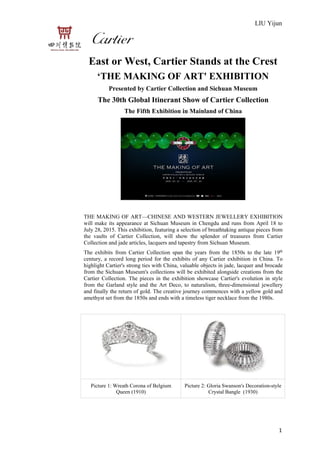
THE MAKING OF ART—CHINESE AND WESTERN JEWELLERY EXHIBITION
will make its appearance at Sichuan Museum in Chengdu and runs from April 18 to
July 28, 2015. This exhibition, featuring a selection of breathtaking antique pieces from
the vaults of Cartier Collection, will show the splendor of treasures from Cartier
Collection and jade articles, lacquers and tapestry from Sichuan Museum.
The exhibits from Cartier Collection span the years from the 1850s to the late 19th
century, a record long period for the exhibits of any Cartier exhibition in China. To
highlight Cartier's strong ties with China, valuable objects in jade, lacquer and brocade
from the Sichuan Museum's collections will be exhibited alongside creations from the
Cartier Collection. The pieces in the exhibition showcase Cartier's evolution in style
from the Garland style and the Art Deco, to naturalism, three-dimensional jewellery
and finally the return of gold. The creative journey commences with a yellow gold and
amethyst set from the 1850s and ends with a timeless tiger necklace from the 1980s.
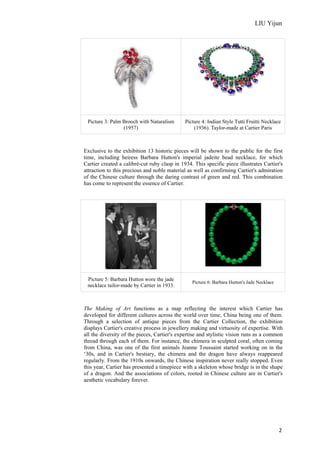
Picture 1: Wreath Corona of Belgium
Queen (1910)
Picture 2: Gloria Swanson's Decoration-style
Crystal Bangle (1930)
LIU Yijun
2
Picture 3: Palm Brooch with Naturalism
(1957)
Picture 4: Indian Style Tutti Fruitti Necklace
(1936). Taylor-made at Cartier Paris
Exclusive to the exhibition 13 historic pieces will be shown to the public for the first
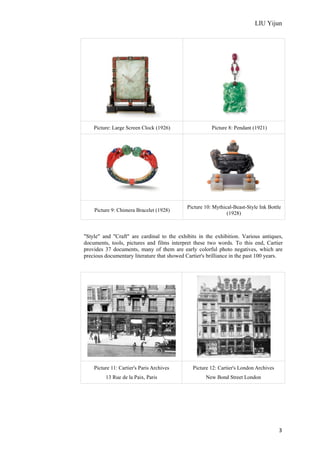
time, including heiress Barbara Hutton's imperial jadeite bead necklace, for which
Cartier created a calibré-cut ruby clasp in 1934. This specific piece illustrates Cartier's
attraction to this precious and noble material as well as confirming Cartier's admiration
of the Chinese culture through the daring contrast of green and red. This combination
has come to represent the essence of Cartier.
Picture 5: Barbara Hutton wore the jade
necklace tailor-made by Cartier in 1933.
Picture 6: Barbara Hutton's Jade Necklace
The Making of Art functions as a map reflecting the interest which Cartier has
developed for different cultures across the world over time, China being one of them.
Through a selection of antique pieces from the Cartier Collection, the exhibition
displays Cartier's creative process in jewellery making and virtuosity of expertise. With
all the diversity of the pieces, Cartier's expertise and stylistic vision runs as a common
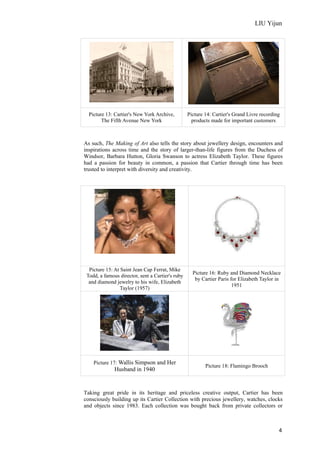
thread through each of them. For instance, the chimera in sculpted coral, often coming
from China, was one of the first animals Jeanne Toussaint started working on in the
‘30s, and in Cartier's bestiary, the chimera and the dragon have always reappeared
regularly. From the 1910s onwards, the Chinese inspiration never really stopped. Even
this year, Cartier has presented a timepiece with a skeleton whose bridge is in the shape
of a dragon. And the associations of colors, rooted in Chinese culture are in Cartier's
aesthetic vocabulary forever.
LIU Yijun
3
Picture: Large Screen Clock (1926) Picture 8: Pendant (1921)
Picture 9: Chimera Bracelet (1928)
Picture 10: Mythical-Beast-Style Ink Bottle
(1928)
"Style" and "Craft" are cardinal to the exhibits in the exhibition. Various antiques,
documents, tools, pictures and films interpret these two words. To this end, Cartier
provides 37 documents, many of them are early colorful photo negatives, which are
precious documentary literature that showed Cartier's brilliance in the past 100 years.
Picture 11: Cartier's Paris Archives
13 Rue de la Paix, Paris
Picture 12: Cartier's London Archives
New Bond Street London
LIU Yijun
4
Picture 13: Cartier's New York Archive,
The Fifth Avenue New York
Picture 14: Cartier's Grand Livre recording
products made for important customers
As such, The Making of Art also tells the story about jewellery design, encounters and
inspirations across time and the story of larger-than-life figures from the Duchess of
Windsor, Barbara Hutton, Gloria Swanson to actress Elizabeth Taylor. These figures
had a passion for beauty in common, a passion that Cartier through time has been
trusted to interpret with diversity and creativity.
Picture 15: At Saint Jean Cap Ferrat, Mike
Todd, a famous director, sent a Cartier's ruby
and diamond jewelry to his wife, Elizabeth
Taylor (1957)
Picture 16: Ruby and Diamond Necklace
by Cartier Paris for Elizabeth Taylor in
1951
Picture 17: Wallis Simpson and Her
Husband in 1940
Picture 18: Flamingo Brooch
Taking great pride in its heritage and priceless creative output, Cartier has been
consciously building up its Cartier Collection with precious jewellery, watches, clocks
and objects since 1983. Each collection was bought back from private collectors or
LIU Yijun
5
auctions. The collection boasts 1500 pieces and is still growing. All collections were
selected meticulously in terms of styles, design inspiration, materials, and craft,
ranging from jewelries, clocks and wares, whose history spans from the 1850s to the
late 20th century. The piece de resistance will be Barbara Hutton's jadeite bead necklace
that Cartier bought back at Sotheby's auction last year for $27.44 million. The Cartier
pieces will be presented juxtaposed with Chinese antiques from the museum's own
collection to highlight the transcultural exchanges that have long existed between the
East and the West.
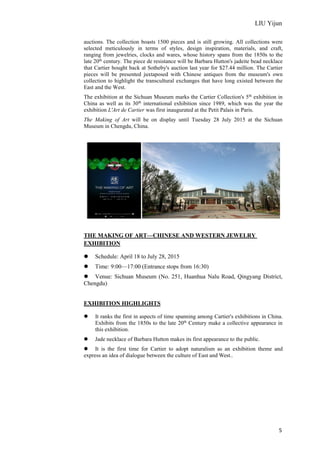
The exhibition at the Sichuan Museum marks the Cartier Collection's 5th
exhibition in
China as well as its 30th
international exhibition since 1989, which was the year the
exhibition L'Art de Cartier was first inaugurated at the Petit Palais in Paris.
The Making of Art will be on display until Tuesday 28 July 2015 at the Sichuan
Museum in Chengdu, China.
THE MAKING OF ART—CHINESE AND WESTERN JEWELRY
EXHIBITION
 Schedule: April 18 to July 28, 2015
 Time: 9:00—17:00 (Entrance stops from 16:30)
 Venue: Sichuan Museum (No. 251, Huanhua Nalu Road, Qingyang District,
Chengdu)
EXHIBITION HIGHLIGHTS
 It ranks the first in aspects of time spanning among Cartier's exhibitions in China.
Exhibits from the 1850s to the late 20th
Century make a collective appearance in
this exhibition.
 Jade necklace of Barbara Hutton makes its first appearance to the public.
 It is the first time for Cartier to adopt naturalism as an exhibition theme and
express an idea of dialogue between the culture of East and West..

卡地亚 - 无远不致 融贯东西

  • 1.
    LIU Yijun 1 East orWest, Cartier Stands at the Crest ‘THE MAKING OF ART' EXHIBITION Presented by Cartier Collection and Sichuan Museum The 30th Global Itinerant Show of Cartier Collection The Fifth Exhibition in Mainland of China THE MAKING OF ART—CHINESE AND WESTERN JEWELLERY EXHIBITION will make its appearance at Sichuan Museum in Chengdu and runs from April 18 to July 28, 2015. This exhibition, featuring a selection of breathtaking antique pieces from the vaults of Cartier Collection, will show the splendor of treasures from Cartier Collection and jade articles, lacquers and tapestry from Sichuan Museum. The exhibits from Cartier Collection span the years from the 1850s to the late 19th century, a record long period for the exhibits of any Cartier exhibition in China. To highlight Cartier's strong ties with China, valuable objects in jade, lacquer and brocade from the Sichuan Museum's collections will be exhibited alongside creations from the Cartier Collection. The pieces in the exhibition showcase Cartier's evolution in style from the Garland style and the Art Deco, to naturalism, three-dimensional jewellery and finally the return of gold. The creative journey commences with a yellow gold and amethyst set from the 1850s and ends with a timeless tiger necklace from the 1980s. Picture 1: Wreath Corona of Belgium Queen (1910) Picture 2: Gloria Swanson's Decoration-style Crystal Bangle (1930)
  • 2.
    LIU Yijun 2 Picture 3:Palm Brooch with Naturalism (1957) Picture 4: Indian Style Tutti Fruitti Necklace (1936). Taylor-made at Cartier Paris Exclusive to the exhibition 13 historic pieces will be shown to the public for the first time, including heiress Barbara Hutton's imperial jadeite bead necklace, for which Cartier created a calibré-cut ruby clasp in 1934. This specific piece illustrates Cartier's attraction to this precious and noble material as well as confirming Cartier's admiration of the Chinese culture through the daring contrast of green and red. This combination has come to represent the essence of Cartier. Picture 5: Barbara Hutton wore the jade necklace tailor-made by Cartier in 1933. Picture 6: Barbara Hutton's Jade Necklace The Making of Art functions as a map reflecting the interest which Cartier has developed for different cultures across the world over time, China being one of them. Through a selection of antique pieces from the Cartier Collection, the exhibition displays Cartier's creative process in jewellery making and virtuosity of expertise. With all the diversity of the pieces, Cartier's expertise and stylistic vision runs as a common thread through each of them. For instance, the chimera in sculpted coral, often coming from China, was one of the first animals Jeanne Toussaint started working on in the ‘30s, and in Cartier's bestiary, the chimera and the dragon have always reappeared regularly. From the 1910s onwards, the Chinese inspiration never really stopped. Even this year, Cartier has presented a timepiece with a skeleton whose bridge is in the shape of a dragon. And the associations of colors, rooted in Chinese culture are in Cartier's aesthetic vocabulary forever.
  • 3.
    LIU Yijun 3 Picture: LargeScreen Clock (1926) Picture 8: Pendant (1921) Picture 9: Chimera Bracelet (1928) Picture 10: Mythical-Beast-Style Ink Bottle (1928) "Style" and "Craft" are cardinal to the exhibits in the exhibition. Various antiques, documents, tools, pictures and films interpret these two words. To this end, Cartier provides 37 documents, many of them are early colorful photo negatives, which are precious documentary literature that showed Cartier's brilliance in the past 100 years. Picture 11: Cartier's Paris Archives 13 Rue de la Paix, Paris Picture 12: Cartier's London Archives New Bond Street London
  • 4.
    LIU Yijun 4 Picture 13:Cartier's New York Archive, The Fifth Avenue New York Picture 14: Cartier's Grand Livre recording products made for important customers As such, The Making of Art also tells the story about jewellery design, encounters and inspirations across time and the story of larger-than-life figures from the Duchess of Windsor, Barbara Hutton, Gloria Swanson to actress Elizabeth Taylor. These figures had a passion for beauty in common, a passion that Cartier through time has been trusted to interpret with diversity and creativity. Picture 15: At Saint Jean Cap Ferrat, Mike Todd, a famous director, sent a Cartier's ruby and diamond jewelry to his wife, Elizabeth Taylor (1957) Picture 16: Ruby and Diamond Necklace by Cartier Paris for Elizabeth Taylor in 1951 Picture 17: Wallis Simpson and Her Husband in 1940 Picture 18: Flamingo Brooch Taking great pride in its heritage and priceless creative output, Cartier has been consciously building up its Cartier Collection with precious jewellery, watches, clocks and objects since 1983. Each collection was bought back from private collectors or
  • 5.
    LIU Yijun 5 auctions. Thecollection boasts 1500 pieces and is still growing. All collections were selected meticulously in terms of styles, design inspiration, materials, and craft, ranging from jewelries, clocks and wares, whose history spans from the 1850s to the late 20th century. The piece de resistance will be Barbara Hutton's jadeite bead necklace that Cartier bought back at Sotheby's auction last year for $27.44 million. The Cartier pieces will be presented juxtaposed with Chinese antiques from the museum's own collection to highlight the transcultural exchanges that have long existed between the East and the West. The exhibition at the Sichuan Museum marks the Cartier Collection's 5th exhibition in China as well as its 30th international exhibition since 1989, which was the year the exhibition L'Art de Cartier was first inaugurated at the Petit Palais in Paris. The Making of Art will be on display until Tuesday 28 July 2015 at the Sichuan Museum in Chengdu, China. THE MAKING OF ART—CHINESE AND WESTERN JEWELRY EXHIBITION  Schedule: April 18 to July 28, 2015  Time: 9:00—17:00 (Entrance stops from 16:30)  Venue: Sichuan Museum (No. 251, Huanhua Nalu Road, Qingyang District, Chengdu) EXHIBITION HIGHLIGHTS  It ranks the first in aspects of time spanning among Cartier's exhibitions in China. Exhibits from the 1850s to the late 20th Century make a collective appearance in this exhibition.  Jade necklace of Barbara Hutton makes its first appearance to the public.  It is the first time for Cartier to adopt naturalism as an exhibition theme and express an idea of dialogue between the culture of East and West..