An Experiment On Effectiveness of different materials on sound insulationCC2007 Environmental Science (Group Presentation)Group Members:Wong Wai Sum , Sum (09081555A)
Li Hong Bin , Ben (10034164A)
LukWai Man , Ray (10094530A)
Lau CheokHei, Jeff (09090889A)
KanKaHim , Ken (10022177A)ContentBackground IntroductionExperiment ObjectiveExperiment ProcedureResult AnalysisFurther developmentQ & A
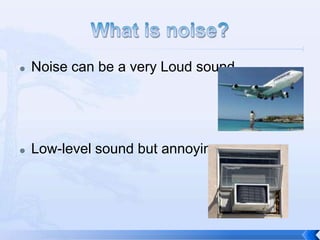
What is noise?Noise can be a very Loud soundLow-level sound but annoying
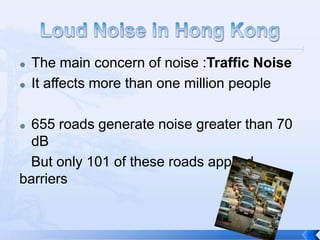
Loud Noise in Hong KongThe main concern of noise :Traffic NoiseIt affects more than one million people655 roads generate noise greater than 70 dB  But only 101 of these roads applied barriers
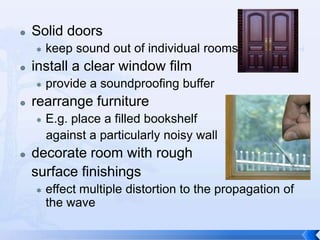
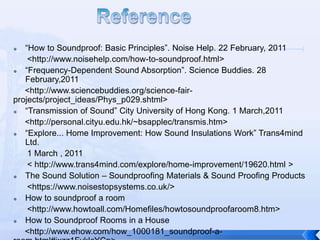
What can we do personally?Choose some good sound insulating materials to build your flat.Today, we are going to test which materials (commonly seen in our daily lives) are good at insulating sound !
Sound Insulation ExperimentObjective To compare the sound insulation ‘s effectiveness of different materials under different frequencies in term of Sound Reduction Index(R) and Transmitted coefficient (T).
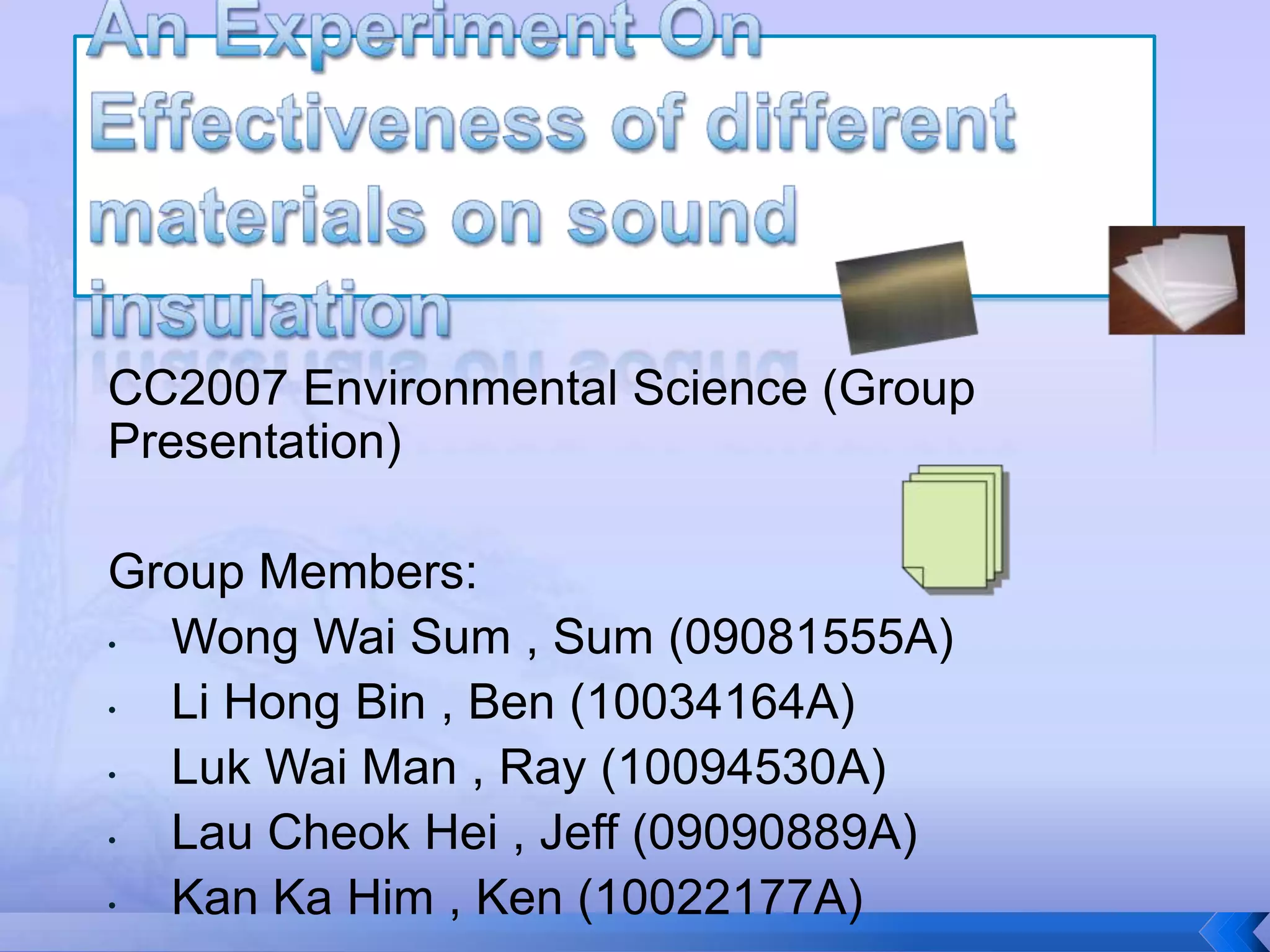
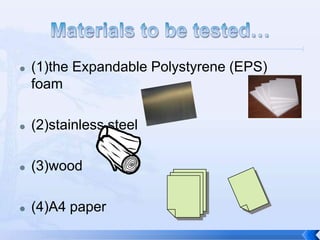
Materials to be tested…(1)the Expandable Polystyrene (EPS) foam(2)stainless steel(3)wood(4)A4 paper
What is sound??Sound is a mechanical wave also a kind of longitudinal wave which does not have Polarization(偏震)produced by vibrations of objectsrequire medium for propagation    example: air, watercannot travel in vacuum
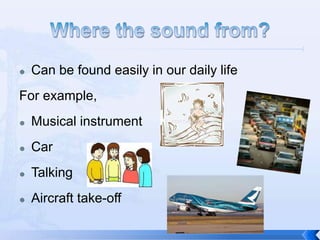
Where the sound from?Can be found easily in our daily lifeFor example,Musical instrumentCarTalkingAircraft take-off
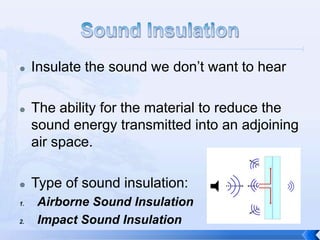
Sound InsulationInsulate the sound we don’t want to hearThe ability for the material to reduce the sound energy transmitted into an adjoining air space.Type of sound insulation:Airborne Sound InsulationImpact Sound Insulation
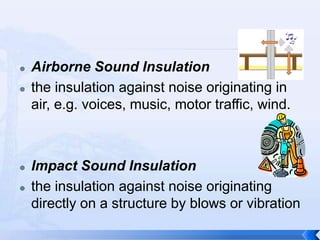
Airborne Sound Insulationthe insulation against noise originating in air, e.g. voices, music, motor traffic, wind.Impact Sound Insulationthe insulation against noise originating directly on a structure by blows or vibration
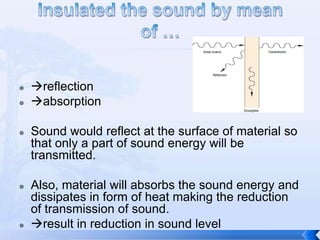
Insulated the sound by mean of …reflectionabsorptionSound would reflect at the surface of material so that only a part of sound energy will be transmitted. Also, material will absorbs the sound energy and dissipates in form of heat making the reduction of transmission of sound.result in reduction in sound level
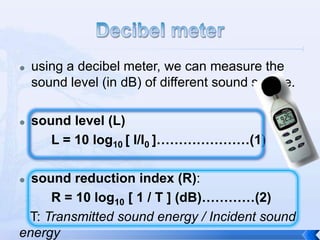
Decibel meterusing a decibel meter, we can measure the sound level (in dB) of different sound source. sound level (L)	L = 10 log10 [ I/I0 ]…………………(1)sound reduction index (R):	R = 10 log10 [ 1 / T ] (dB)…………(2)  T: Transmitted sound energy / Incident sound energy
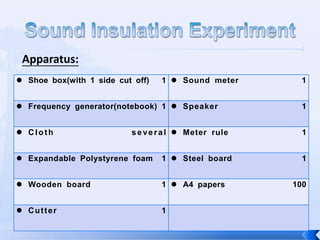
Sound Insulation ExperimentApparatus:
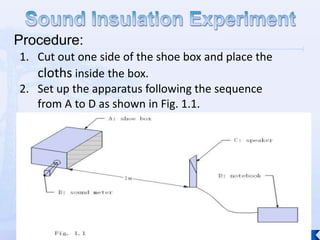
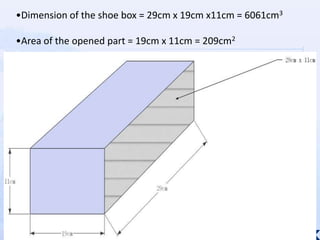
Dimension of the shoe box = 29cm x 19cm x11cm = 6061cm3
Area of the opened part = 19cm x 11cm = 209cm2Frequencies chosen:
Materials used:Sound Insulation ExperimentProcedure:Cut out one side of the shoe box and place the cloths inside the box.Set up the apparatus following the sequence from A to D as shown in Fig. 1.1.
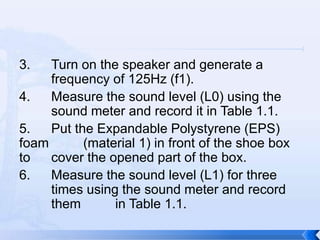
3.	Turn on the speaker and generate a 	frequency of 125Hz (f1).4.	Measure the sound level (L0) using the   	sound meter and record it in Table 1.1.5.	Put the Expandable Polystyrene (EPS) foam 	(material 1) in front of the shoe box to 	cover the opened part of the box.6.	Measure the sound level (L1) for three 	times using the sound meter and record 	them 	in Table 1.1.
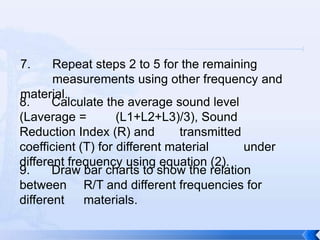
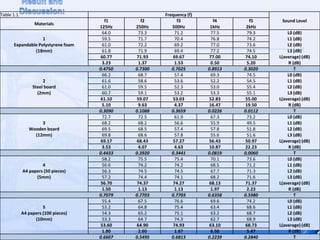
7.	Repeat steps 2 to 5 for the remaining 	measurements using other frequency and material.8.	Calculate the average sound level (Laverage= 	(L1+L2+L3)/3), Sound Reduction Index (R) and 	transmitted coefficient (T) for different material 	under different frequency using equation (2).9.	Draw bar charts to show the relation between 	R/T and different frequencies for different 	materials.
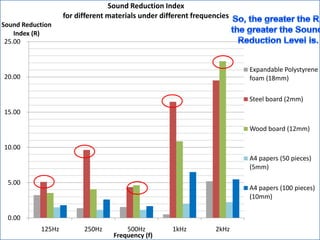
Result and Discussion:
So, the greater the R, the greater the Sound Reduction Level is.
So, the smaller the T, the greater theSound Reduction Level is.
Analysis:Assumption:
The unique sound source for the experiment is the frequency generator.
The background noise during the experiment is kept constant.
The reflection and refraction effects of sound are negligible.Sources of error:
Unstable readings of decibel meter
Impact sound can transmit through the ground to the box due to the vibration of speaker.
For the sound transmitted through the material , the sound wave can be reflected inside the shoe box, which may be noise, and it may affect the reading.The background noise may not be constant though out the experiment.
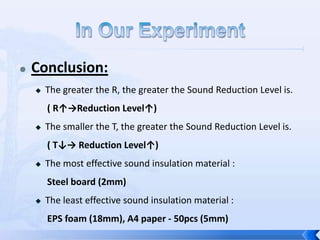
Maximum possible error of the measurement = 0.05dB x 2 = 0.1dBIn Our ExperimentConclusion:The greater the R, the greater the Sound Reduction Level is. ( R↑->Reduction Level↑)The smaller the T, the greater the Sound Reduction Level is.( T↓-> Reduction Level↑)The most effective sound insulation material :Steel board (2mm)The least effective sound insulation material :EPS foam (18mm), A4 paper - 50pcs (5mm)
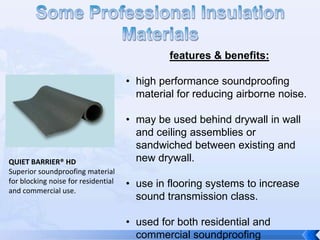
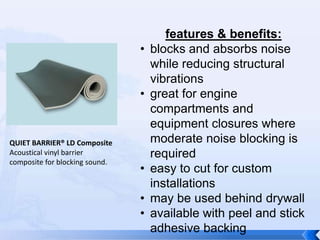
Some Professional Insulation Materialsfeatures & benefits:high performance soundproofing material for reducing airborne noise.
may be used behind drywall in wall and ceiling assemblies or sandwiched between existing and new drywall.
use in flooring systems to increase sound transmission class.
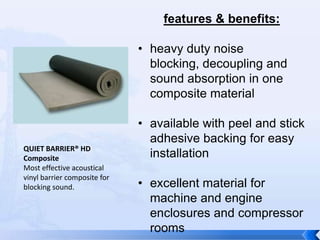
used for both residential and commercial soundproofing applications.QUIET BARRIER® HDSuperior soundproofing material for blocking noise for residential and commercial use.
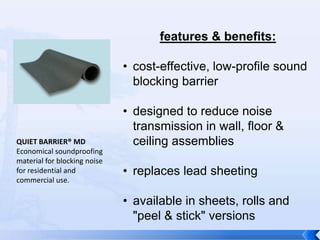
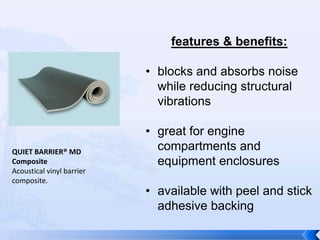
features & benefits:cost-effective, low-profile sound blocking barrier
designed to reduce noise transmission in wall, floor & ceiling assemblies
replaces lead sheeting
available in sheets, rolls and "peel & stick" versionsQUIET BARRIER® MDEconomical soundproofing material for blocking noise for residential and commercial use.
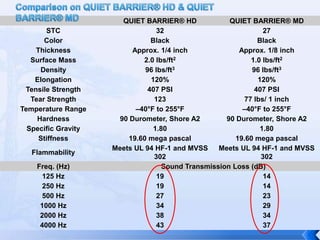
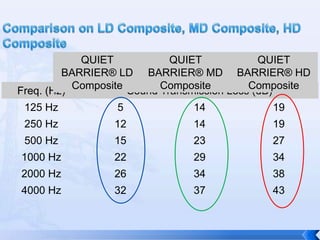
Comparison on QUIET BARRIER® HD & QUIET BARRIER® MD

Sound insulation experiment

  • 1.
    An Experiment OnEffectiveness of different materials on sound insulationCC2007 Environmental Science (Group Presentation)Group Members:Wong Wai Sum , Sum (09081555A)
  • 2.
    Li Hong Bin, Ben (10034164A)
  • 3.
    LukWai Man ,Ray (10094530A)
  • 4.
  • 5.
    KanKaHim , Ken(10022177A)ContentBackground IntroductionExperiment ObjectiveExperiment ProcedureResult AnalysisFurther developmentQ & A
  • 6.
    What is noise?Noisecan be a very Loud soundLow-level sound but annoying
  • 7.
    Loud Noise inHong KongThe main concern of noise :Traffic NoiseIt affects more than one million people655 roads generate noise greater than 70 dB But only 101 of these roads applied barriers
  • 8.
    What can wedo personally?Choose some good sound insulating materials to build your flat.Today, we are going to test which materials (commonly seen in our daily lives) are good at insulating sound !
  • 9.
    Sound Insulation ExperimentObjectiveTo compare the sound insulation ‘s effectiveness of different materials under different frequencies in term of Sound Reduction Index(R) and Transmitted coefficient (T).
  • 10.
    Materials to betested…(1)the Expandable Polystyrene (EPS) foam(2)stainless steel(3)wood(4)A4 paper
  • 11.
    What is sound??Soundis a mechanical wave also a kind of longitudinal wave which does not have Polarization(偏震)produced by vibrations of objectsrequire medium for propagation example: air, watercannot travel in vacuum
  • 12.
    Where the soundfrom?Can be found easily in our daily lifeFor example,Musical instrumentCarTalkingAircraft take-off
  • 13.
    Sound InsulationInsulate thesound we don’t want to hearThe ability for the material to reduce the sound energy transmitted into an adjoining air space.Type of sound insulation:Airborne Sound InsulationImpact Sound Insulation
  • 14.
    Airborne Sound Insulationtheinsulation against noise originating in air, e.g. voices, music, motor traffic, wind.Impact Sound Insulationthe insulation against noise originating directly on a structure by blows or vibration
  • 15.
    Insulated the soundby mean of …reflectionabsorptionSound would reflect at the surface of material so that only a part of sound energy will be transmitted. Also, material will absorbs the sound energy and dissipates in form of heat making the reduction of transmission of sound.result in reduction in sound level
  • 16.
    Decibel meterusing adecibel meter, we can measure the sound level (in dB) of different sound source. sound level (L) L = 10 log10 [ I/I0 ]…………………(1)sound reduction index (R): R = 10 log10 [ 1 / T ] (dB)…………(2) T: Transmitted sound energy / Incident sound energy
  • 17.
  • 18.
    Dimension of theshoe box = 29cm x 19cm x11cm = 6061cm3
  • 19.
    Area of theopened part = 19cm x 11cm = 209cm2Frequencies chosen:
  • 20.
    Materials used:Sound InsulationExperimentProcedure:Cut out one side of the shoe box and place the cloths inside the box.Set up the apparatus following the sequence from A to D as shown in Fig. 1.1.
  • 21.
    3. Turn on thespeaker and generate a frequency of 125Hz (f1).4. Measure the sound level (L0) using the sound meter and record it in Table 1.1.5. Put the Expandable Polystyrene (EPS) foam (material 1) in front of the shoe box to cover the opened part of the box.6. Measure the sound level (L1) for three times using the sound meter and record them in Table 1.1.
  • 22.
    7. Repeat steps 2to 5 for the remaining measurements using other frequency and material.8. Calculate the average sound level (Laverage= (L1+L2+L3)/3), Sound Reduction Index (R) and transmitted coefficient (T) for different material under different frequency using equation (2).9. Draw bar charts to show the relation between R/T and different frequencies for different materials.
  • 23.
  • 24.
    So, the greaterthe R, the greater the Sound Reduction Level is.
  • 25.
    So, the smallerthe T, the greater theSound Reduction Level is.
  • 26.
  • 27.
    The unique soundsource for the experiment is the frequency generator.
  • 28.
    The background noiseduring the experiment is kept constant.
  • 29.
    The reflection andrefraction effects of sound are negligible.Sources of error:
  • 30.
  • 31.
    Impact sound cantransmit through the ground to the box due to the vibration of speaker.
  • 32.
    For the soundtransmitted through the material , the sound wave can be reflected inside the shoe box, which may be noise, and it may affect the reading.The background noise may not be constant though out the experiment.
  • 33.
    Maximum possible errorof the measurement = 0.05dB x 2 = 0.1dBIn Our ExperimentConclusion:The greater the R, the greater the Sound Reduction Level is. ( R↑->Reduction Level↑)The smaller the T, the greater the Sound Reduction Level is.( T↓-> Reduction Level↑)The most effective sound insulation material :Steel board (2mm)The least effective sound insulation material :EPS foam (18mm), A4 paper - 50pcs (5mm)
  • 34.
    Some Professional InsulationMaterialsfeatures & benefits:high performance soundproofing material for reducing airborne noise.
  • 35.
    may be usedbehind drywall in wall and ceiling assemblies or sandwiched between existing and new drywall.
  • 36.
    use in flooringsystems to increase sound transmission class.
  • 37.
    used for bothresidential and commercial soundproofing applications.QUIET BARRIER® HDSuperior soundproofing material for blocking noise for residential and commercial use.
  • 38.
    features & benefits:cost-effective,low-profile sound blocking barrier
  • 39.
    designed to reducenoise transmission in wall, floor & ceiling assemblies
  • 40.
  • 41.
    available in sheets,rolls and "peel & stick" versionsQUIET BARRIER® MDEconomical soundproofing material for blocking noise for residential and commercial use.
  • 42.
    Comparison on QUIETBARRIER® HD & QUIET BARRIER® MD