FORKLIFT OPERATOR SAFETY
TRAINING
OBJECTIVES
• Legislation
• Introduction to the Forklift
• Pre-use checks
• Safe practice
• Loads and travel
• Load and gravity center
• Parking
• Pedestrians/walkways
• Propane
• Conclusion
LEGISLATION
• The Health and Safety at Work, etc Act 1974 (HSWA) sets the duty of the
employer to provide safe plant and equipment, safe premises and safe co-
workers, and to ensure the safety of others not employed by them.
• The Management of Health and Safety at Work Regulations 1999 (MHSWR) set
requirements to assess the hazards and risks that the worker may be exposed to,
and to ensure that they are adequately trained and informed as to any risks to
their health and safety.
• Under the Workplace (Health, Safety and Welfare) Regulations 1992, employers
must provide a safe workplace by considering access ways, lighting, ventilation
and general space requirements. It is also important that particular requirements
relevant to the use of fork lift trucks are taken into consideration. For example,
concerning the condition of floors and traffic routes, notably that they are even,
adequately drained and strong enough for the purpose of driving a fully laden
fork lift truck over them. Also, regarding the need to organise all traffic routes in
the workplace, and particularly the need to protect pedestrians from the fork lift
trucks when in use.
LEGISLATION
Provision and Use of Work Equipment Regulations 1998 (PUWER) ensures that all work equipment is
suitable for the purpose intended and that it is adequately maintained and inspected.
The following PUWER regulations are relevant to fork lift trucks.
•Regulation 4, giving a requirement to ensure the suitability of the fork lift truck for the purpose for which
it is intended to be used.
•Regulation 5, requiring that the fork lift truck is kept adequately maintained to prevent risks to health and
safety.
•Regulations 8 and 9, expanding on the requirements under the HSWA for adequate instruction,
information and training for all people having connection with the use and operation of fork lift trucks, eg
the operators, supervisors, managers and maintenance operatives.
•Regulation 25, containing the duty to ensure the safety of people carried on the fork lift truck.
•Regulation 26, requires certain types of fork lift truck to be fitted with the means to prevent it rolling over
and causing injury to the driver.
•Regulation 27, covers the requirement to reduce the risk of those fork lift trucks not covered in regulation
26 from overturning.
•Regulation 28, covering the general requirements to prevent self-propelled work equipment, such as a
fork lift truck, from causing a risk to the safety of people while it is in motion.
LEGISLATION
A fork lift truck is work equipment for lifting and lowering of loads and consequently
needs to comply with the requirements set out in the Lifting Operations and Lifting
Equipment Regulations 1998 (LOLER).
Although all the regulations are relevant to the use of fork lift trucks, the most
significant are the following, as stipulated by LOLER.
•The need to ensure that the fork lift truck is adequately strong and sufficiently
stable to lift (and, by implication, carry) the load.
•The need to ensure the safety of the equipment used to lift people, ensuring that a
proprietary cage which was designed and made for the purpose is used.
•The duty to properly organise lifting operations. The person in control of each lift,
such as a slinger or the operator of the fork lift truck, should have sufficient
competence and knowledge of the loads, local conditions and safe systems of work
to ensure safe compliance with the general procedures laid down by the
organisation in response to the risk assessment.
•The requirement for a thorough examination at intervals of:
– not more than 12 months for equipment that lifts a load
– not more than six months for equipment used to lift people (ie using a fork lift cage), or if it is a
lifting accessory, eg the chains, the forks and the mast.
FORKLIFT TRAINING
• Who needs forklift training?
– Anyone who operates a forklift
• Why is training necessary?
– Forklifts pose many hazards
• Approx. 100 deaths and 38,000 injuries/year
• Most Common accidents:
• Forklift overturns (22%)
• Worker on foot struck by forklift (20%)
• Victim crushed by forklift (16%)
• Fall from forklift (9%)
FORKLIFT/CAR
Forklift (PIT)
• 4-40K pounds
• Rear wheel steering
• High center of gravity
• Low visibility
Automobile
• 2-6K pounds
• Front wheel steering
• Low center of gravity
• Excellent visibility
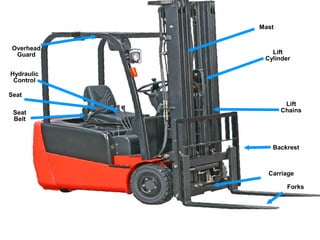
Seat
Belt
Hydraulic
Control
Overhead
Guard
Seat
Forks
Carriage
Backrest
Lift
Chains
Lift
Cylinder
Mast
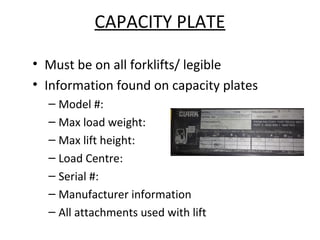
CAPACITY PLATE
• Must be on all forklifts/ legible
• Information found on capacity plates
– Model #:
– Max load weight:
– Max lift height:
– Load Centre:
– Serial #:
– Manufacturer information
– All attachments used with lift
The safety equipment you must check daily is:
PRE-USE (DAILY) CHECKS
• Rated Capacity Plate
• Fork Arms
• Carriage Plate
• Mast
• Mast Rollers/Slides
• Lift Chains
• Lift Chain Pulleys
• Hydraulics
• Hydraulic Controls
• Wheels
• Tyres
• Drive and Braking
• Steering
SAFE FORKLIFT OPERATIONS
SAFE PRACTICE
– Always perform an all round check before moving off
– Always look in the direction of travel
– Always apply handbrake and neutral before operating
hydraulics
– Never turn with the forks raised
– Never leave a load unsafe
– Always perform a pre-use check
– Do not dismount unnecessary
– Do not operate dangerously
– Do not collide with anything or anyone
SAFE PRACTICE
TIPPING FORKLIFT
• What should you do?
– Must be wearing seatbelt
– Hold tightly to steering wheel with both hands
– Keep hands and arms inside caged area
– Plant feet flat on floor and press down
– Lean in opposite direction
HANDLING LOADS
• Check the capacity to be sure the forklift can handle the load
• Check the load for weight and stability
• Lift the load 1-2 inches to test the stability of the rear wheels and the
forklift
• If the forklift struggles, set the load down and if possible break load
into smaller, more manageable loads
• When reading the weight on labels, net weight = the product only
gross weight = the product, pallet and packaging
• This process should be with the mast vertical and on level ground
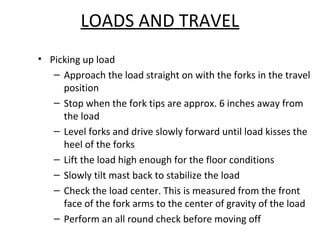
LOADS AND TRAVEL
• Picking up load
– Approach the load straight on with the forks in the travel
position
– Stop when the fork tips are approx. 6 inches away from
the load
– Level forks and drive slowly forward until load kisses the
heel of the forks
– Lift the load high enough for the floor conditions
– Slowly tilt mast back to stabilize the load
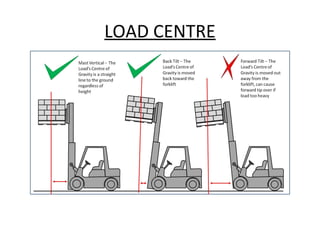
– Check the load center. This is measured from the front
face of the fork arms to the center of gravity of the load
– Perform an all round check before moving off
LOADS AND TRAVEL
• Setting down the load
– Drive to location, square up to load area and
stop about 6 inches away
– Level the forks and slowly drive forward
– Lower the load
– Perform an all round check and back straight
out until the forks clear the load by about 6
inches
– Return to travel position
LOADS AND TRAVEL
• Travel with load tilted slightly back for
stability
• Travel with the load at the proper height
• 4-6 Inches at fork tips
• 2-4 Inches at heels
• Drive in control (slow)
• Drive in reverse if you cannot see over the
load
• Never approach personnel in front of
fixed objects
CROSSING RAILWAYS, GUTTERS
ETC
STABILITY TRIANGLE
LOAD CENTRE
CARRYING CAPACITY
The trucks
maximum carrying
capacity will be
reduced when the
load centre is
increased
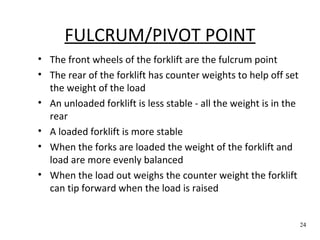
FULCRUM/PIVOT POINT
• The front wheels of the forklift are the fulcrum point
• The rear of the forklift has counter weights to help off set
the weight of the load
• An unloaded forklift is less stable - all the weight is in the
rear
• A loaded forklift is more stable
• When the forks are loaded the weight of the forklift and
load are more evenly balanced
• When the load out weighs the counter weight the forklift
can tip forward when the load is raised
24
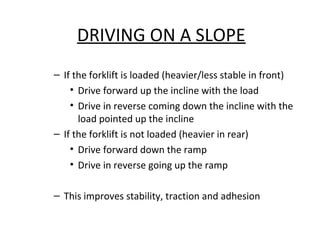
DRIVING ON A SLOPE
– If the forklift is loaded (heavier/less stable in front)
• Drive forward up the incline with the load
• Drive in reverse coming down the incline with the
load pointed up the incline
– If the forklift is not loaded (heavier in rear)
• Drive forward down the ramp
• Drive in reverse going up the ramp
– This improves stability, traction and adhesion
Loaded
DRIVING ON A SLOPE
Unloaded
DRIVING CONDITIONS
PARKING
• When parked or unattended
– Fork tips on ground, heels as low as possible
– Turn off engine
– Set parking brake
– Do not block:
• Exits
• Emergency equipment
• Signs or postings
• Walkways
PEDESTRIANS/WALKWAYS
• Pedestrians have the right of way
– Slow down at intersections
– Look before reversing
– 2 short blasts on horn when coming around blind corners
and at blind intersections
– Check mirrors at intersections if they are present in
workplace
– Never let anyone travel under the forks
PEDESTRIANS/WALKWAYS
CHANGING PROPANE
• No smoking
• Shut off cylinder valve before turning off forklift to
reduce pressure in the fuel line
• Liquid propane is approx. -40 degrees
• Wear heavy duty rubber gloves
• Wear safety glasses
• Make sure pressure relief valve points straight up
when replacing the tank
CONCLUSION
• Forklifts are more hazardous than most people
usually perceive them to be
• Pre-use checks must be performed before each
day or shift
• It is important to understand how the load will
affect the stability of the forklift
• The operator must always be on the look out for
hazards and pedestrians
https://www.youtube.com/watch?v=1vL6niO3238 Counter Balance
https://www.youtube.com/watch?v=XMcm_MZUiY8 Counter Balance
https://www.youtube.com/watch?v=nChgfwVQNfw Reach Truck
https://www.youtube.com/watch?v=ZXvWARWM-OE Reach Accident
https://www.youtube.com/watch?v=KTnGZ37sZqM Top 10 Accidents
https://www.youtube.com/watch?v=ajt6SMAAYyU FLT Accidents
VIDEO REVISION

Forklift training

  • 1.
  • 2.
    OBJECTIVES • Legislation • Introductionto the Forklift • Pre-use checks • Safe practice • Loads and travel • Load and gravity center • Parking • Pedestrians/walkways • Propane • Conclusion
  • 3.
    LEGISLATION • The Healthand Safety at Work, etc Act 1974 (HSWA) sets the duty of the employer to provide safe plant and equipment, safe premises and safe co- workers, and to ensure the safety of others not employed by them. • The Management of Health and Safety at Work Regulations 1999 (MHSWR) set requirements to assess the hazards and risks that the worker may be exposed to, and to ensure that they are adequately trained and informed as to any risks to their health and safety. • Under the Workplace (Health, Safety and Welfare) Regulations 1992, employers must provide a safe workplace by considering access ways, lighting, ventilation and general space requirements. It is also important that particular requirements relevant to the use of fork lift trucks are taken into consideration. For example, concerning the condition of floors and traffic routes, notably that they are even, adequately drained and strong enough for the purpose of driving a fully laden fork lift truck over them. Also, regarding the need to organise all traffic routes in the workplace, and particularly the need to protect pedestrians from the fork lift trucks when in use.
  • 4.
    LEGISLATION Provision and Useof Work Equipment Regulations 1998 (PUWER) ensures that all work equipment is suitable for the purpose intended and that it is adequately maintained and inspected. The following PUWER regulations are relevant to fork lift trucks. •Regulation 4, giving a requirement to ensure the suitability of the fork lift truck for the purpose for which it is intended to be used. •Regulation 5, requiring that the fork lift truck is kept adequately maintained to prevent risks to health and safety. •Regulations 8 and 9, expanding on the requirements under the HSWA for adequate instruction, information and training for all people having connection with the use and operation of fork lift trucks, eg the operators, supervisors, managers and maintenance operatives. •Regulation 25, containing the duty to ensure the safety of people carried on the fork lift truck. •Regulation 26, requires certain types of fork lift truck to be fitted with the means to prevent it rolling over and causing injury to the driver. •Regulation 27, covers the requirement to reduce the risk of those fork lift trucks not covered in regulation 26 from overturning. •Regulation 28, covering the general requirements to prevent self-propelled work equipment, such as a fork lift truck, from causing a risk to the safety of people while it is in motion.
  • 5.
    LEGISLATION A fork lifttruck is work equipment for lifting and lowering of loads and consequently needs to comply with the requirements set out in the Lifting Operations and Lifting Equipment Regulations 1998 (LOLER). Although all the regulations are relevant to the use of fork lift trucks, the most significant are the following, as stipulated by LOLER. •The need to ensure that the fork lift truck is adequately strong and sufficiently stable to lift (and, by implication, carry) the load. •The need to ensure the safety of the equipment used to lift people, ensuring that a proprietary cage which was designed and made for the purpose is used. •The duty to properly organise lifting operations. The person in control of each lift, such as a slinger or the operator of the fork lift truck, should have sufficient competence and knowledge of the loads, local conditions and safe systems of work to ensure safe compliance with the general procedures laid down by the organisation in response to the risk assessment. •The requirement for a thorough examination at intervals of: – not more than 12 months for equipment that lifts a load – not more than six months for equipment used to lift people (ie using a fork lift cage), or if it is a lifting accessory, eg the chains, the forks and the mast.
  • 6.
    FORKLIFT TRAINING • Whoneeds forklift training? – Anyone who operates a forklift • Why is training necessary? – Forklifts pose many hazards • Approx. 100 deaths and 38,000 injuries/year • Most Common accidents: • Forklift overturns (22%) • Worker on foot struck by forklift (20%) • Victim crushed by forklift (16%) • Fall from forklift (9%)
  • 7.
    FORKLIFT/CAR Forklift (PIT) • 4-40Kpounds • Rear wheel steering • High center of gravity • Low visibility Automobile • 2-6K pounds • Front wheel steering • Low center of gravity • Excellent visibility
  • 8.
  • 9.
    CAPACITY PLATE • Mustbe on all forklifts/ legible • Information found on capacity plates – Model #: – Max load weight: – Max lift height: – Load Centre: – Serial #: – Manufacturer information – All attachments used with lift
  • 10.
    The safety equipmentyou must check daily is: PRE-USE (DAILY) CHECKS • Rated Capacity Plate • Fork Arms • Carriage Plate • Mast • Mast Rollers/Slides • Lift Chains • Lift Chain Pulleys • Hydraulics • Hydraulic Controls • Wheels • Tyres • Drive and Braking • Steering
  • 11.
  • 12.
    SAFE PRACTICE – Alwaysperform an all round check before moving off – Always look in the direction of travel – Always apply handbrake and neutral before operating hydraulics – Never turn with the forks raised – Never leave a load unsafe – Always perform a pre-use check – Do not dismount unnecessary – Do not operate dangerously – Do not collide with anything or anyone
  • 13.
  • 15.
    TIPPING FORKLIFT • Whatshould you do? – Must be wearing seatbelt – Hold tightly to steering wheel with both hands – Keep hands and arms inside caged area – Plant feet flat on floor and press down – Lean in opposite direction
  • 16.
    HANDLING LOADS • Checkthe capacity to be sure the forklift can handle the load • Check the load for weight and stability • Lift the load 1-2 inches to test the stability of the rear wheels and the forklift • If the forklift struggles, set the load down and if possible break load into smaller, more manageable loads • When reading the weight on labels, net weight = the product only gross weight = the product, pallet and packaging • This process should be with the mast vertical and on level ground
  • 17.
    LOADS AND TRAVEL •Picking up load – Approach the load straight on with the forks in the travel position – Stop when the fork tips are approx. 6 inches away from the load – Level forks and drive slowly forward until load kisses the heel of the forks – Lift the load high enough for the floor conditions – Slowly tilt mast back to stabilize the load – Check the load center. This is measured from the front face of the fork arms to the center of gravity of the load – Perform an all round check before moving off
  • 18.
    LOADS AND TRAVEL •Setting down the load – Drive to location, square up to load area and stop about 6 inches away – Level the forks and slowly drive forward – Lower the load – Perform an all round check and back straight out until the forks clear the load by about 6 inches – Return to travel position
  • 19.
    LOADS AND TRAVEL •Travel with load tilted slightly back for stability • Travel with the load at the proper height • 4-6 Inches at fork tips • 2-4 Inches at heels • Drive in control (slow) • Drive in reverse if you cannot see over the load • Never approach personnel in front of fixed objects
  • 20.
  • 21.
  • 22.
  • 23.
    CARRYING CAPACITY The trucks maximumcarrying capacity will be reduced when the load centre is increased
  • 24.
    FULCRUM/PIVOT POINT • Thefront wheels of the forklift are the fulcrum point • The rear of the forklift has counter weights to help off set the weight of the load • An unloaded forklift is less stable - all the weight is in the rear • A loaded forklift is more stable • When the forks are loaded the weight of the forklift and load are more evenly balanced • When the load out weighs the counter weight the forklift can tip forward when the load is raised 24
  • 25.
    DRIVING ON ASLOPE – If the forklift is loaded (heavier/less stable in front) • Drive forward up the incline with the load • Drive in reverse coming down the incline with the load pointed up the incline – If the forklift is not loaded (heavier in rear) • Drive forward down the ramp • Drive in reverse going up the ramp – This improves stability, traction and adhesion
  • 26.
    Loaded DRIVING ON ASLOPE Unloaded
  • 27.
  • 28.
    PARKING • When parkedor unattended – Fork tips on ground, heels as low as possible – Turn off engine – Set parking brake – Do not block: • Exits • Emergency equipment • Signs or postings • Walkways
  • 29.
    PEDESTRIANS/WALKWAYS • Pedestrians havethe right of way – Slow down at intersections – Look before reversing – 2 short blasts on horn when coming around blind corners and at blind intersections – Check mirrors at intersections if they are present in workplace – Never let anyone travel under the forks
  • 30.
  • 31.
    CHANGING PROPANE • Nosmoking • Shut off cylinder valve before turning off forklift to reduce pressure in the fuel line • Liquid propane is approx. -40 degrees • Wear heavy duty rubber gloves • Wear safety glasses • Make sure pressure relief valve points straight up when replacing the tank
  • 33.
    CONCLUSION • Forklifts aremore hazardous than most people usually perceive them to be • Pre-use checks must be performed before each day or shift • It is important to understand how the load will affect the stability of the forklift • The operator must always be on the look out for hazards and pedestrians
  • 34.
    https://www.youtube.com/watch?v=1vL6niO3238 Counter Balance https://www.youtube.com/watch?v=XMcm_MZUiY8Counter Balance https://www.youtube.com/watch?v=nChgfwVQNfw Reach Truck https://www.youtube.com/watch?v=ZXvWARWM-OE Reach Accident https://www.youtube.com/watch?v=KTnGZ37sZqM Top 10 Accidents https://www.youtube.com/watch?v=ajt6SMAAYyU FLT Accidents VIDEO REVISION

Editor's Notes

  • #9 Slide Show Notes Now we’ll describe the basic features and characteristics of a forklift. This illustration shows the basic features of a typical forklift. Most forklifts have certain features in common. You need to know what these features are and how to use them properly and safely. Take a moment or two to study this illustration and identify the features of a typical forklift. Note that this illustration represents a typical forklift, however, features may vary depending on the manufacturer and model. Describe the components of a forklift at your facility, preferably with trainees looking at a forklift.
  • #13 Slide Show Notes More safety rules for traveling in a forklift include: Avoid driving over loose objects or holes; doing this could cause a tipover; Never carry passengers—they don’t have a seat or a seat belt and could get killed in an accident; Always remember that pedestrians have the right-of-way; Stay a safe distance from the edges of ramps and loading docks; Don’t eat or drink while operating a forklift; these create a distraction that is unsafe; and Never engage in horseplay on or around a forklift.