Hay Guide Chart
―Every job exists to add value to the
organization through delivering
some set of results.‖
Submitted By:
Surbhi- CHF 22
Charu Singh- CHF 06
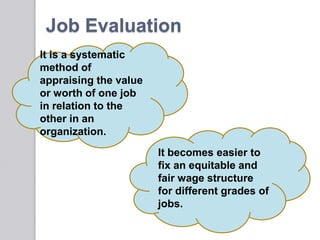
Job Evaluation
It becomes easier to
fix an equitable and
fair wage structure
for different grades of
jobs.
It is a systematic
method of
appraising the value
or worth of one job
in relation to the
other in an
organization.
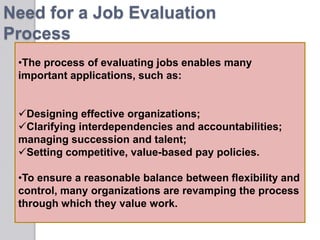
Need for a Job Evaluation
Process
•The process of evaluating jobs enables many
important applications, such as:
Designing effective organizations;
Clarifying interdependencies and accountabilities;
managing succession and talent;
Setting competitive, value-based pay policies.
•To ensure a reasonable balance between flexibility and
control, many organizations are revamping the process
through which they value work.
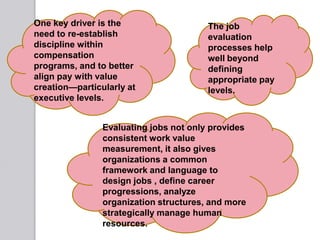
Evaluating jobs not only provides
consistent work value
measurement, it also gives
organizations a common
framework and language to
design jobs , define career
progressions, analyze
organization structures, and more
strategically manage human
resources.
The job
evaluation
processes help
well beyond
defining
appropriate pay
levels.
One key driver is the
need to re-establish
discipline within
compensation
programs, and to better
align pay with value
creation—particularly at
executive levels.
Hay Group Guide Chart – Profile Method of Job Evaluation
In the early 1950s, Edward N. Hay and Dale Purves developed a Guide
Chart- Profile method for evaluating jobs that is one of the most
popular methods used for evaluating executive, managerial and
professional positions but also widely used in evaluating
clerical, blue-collar and technician jobs.
It is based on the notion that jobs can be measured on the basis of
their relative contribution to the overall objectives of the organization.
By considering core aspects of content and context that are common
to all jobs, it provides a clear, understandable and systematic basis
for defining and comparing the requirements for all kinds of jobs at all
levels.
The Hay Method is based on the idea that jobs can be
assessed in terms of:
the knowledge required to do the job;
the analytical ability needed to solve the problems
commonly faced;
the responsibilities assigned, and;
the working conditions associated with the job.
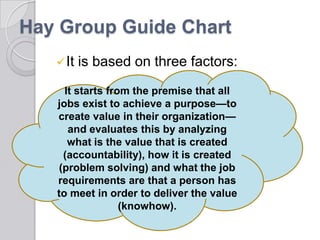
Hay Group Guide Chart
It is based on three factors:
It starts from the premise that all
jobs exist to achieve a purpose—to
create value in their organization—
and evaluates this by analyzing
what is the value that is created
(accountability), how it is created
(problem solving) and what the job
requirements are that a person has
to meet in order to deliver the value
(knowhow).
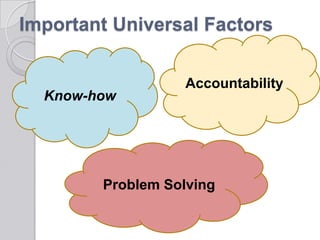
Important Universal Factors
Know-how
Problem Solving
Accountability
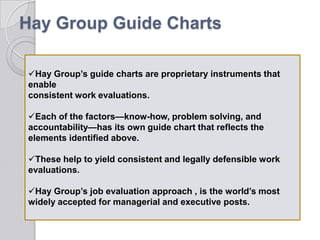
Hay Group Guide Charts
Hay Group‘s guide charts are proprietary instruments that
enable
consistent work evaluations.
Each of the factors—know-how, problem solving, and
accountability—has its own guide chart that reflects the
elements identified above.
These help to yield consistent and legally defensible work
evaluations.
Hay Group‘s job evaluation approach , is the world‘s most
widely accepted for managerial and executive posts.
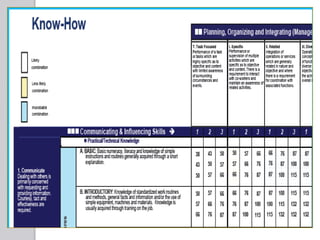
Know – How
To achieve the accountabilities of a job requires ‗know-
how‘ (or inputs), which is the sum total of every capability
or skill, however acquired, needed for fully competent job
performance.
It has three dimensions:
Practical / technical knowledge
Planning, organizing and integrating (managerial)
knowledge
Communicating and influencing skills
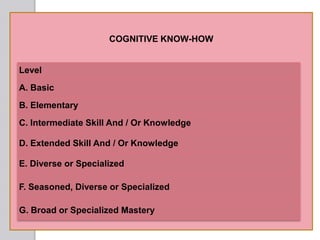
COGNITIVE KNOW-HOW
O
Level
A. Basic
B. Elementary
C. Intermediate Skill And / Or Knowledge
D. Extended Skill And / Or Knowledge
E. Diverse or Specialized
F. Seasoned, Diverse or Specialized
G. Broad or Specialized Mastery
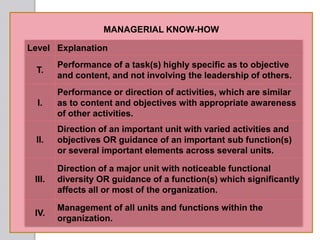
MANAGERIAL KNOW-HOW
Level Explanation
T.
Performance of a task(s) highly specific as to objective
and content, and not involving the leadership of others.
I.
Performance or direction of activities, which are similar
as to content and objectives with appropriate awareness
of other activities.
II.
Direction of an important unit with varied activities and
objectives OR guidance of an important sub function(s)
or several important elements across several units.
III.
Direction of a major unit with noticeable functional
diversity OR guidance of a function(s) which significantly
affects all or most of the organization.
IV.
Management of all units and functions within the
organization.
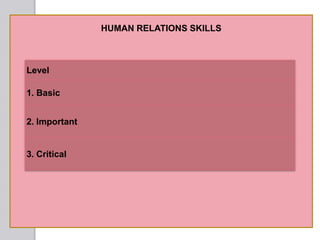
HUMAN RELATIONS SKILLS
Level
1. Basic
2. Important
3. Critical
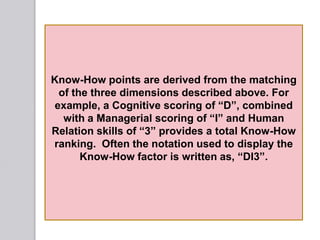
Know-How points are derived from the matching
of the three dimensions described above. For
example, a Cognitive scoring of ―D‖, combined
with a Managerial scoring of ―I‖ and Human
Relation skills of ―3‖ provides a total Know-How
ranking. Often the notation used to display the
Know-How factor is written as, ―DI3‖.
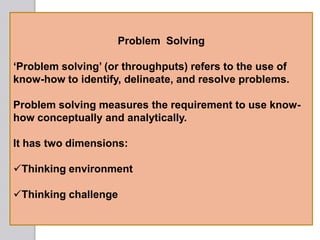
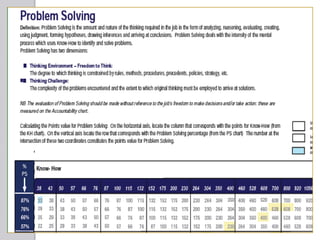
Problem Solving
‗Problem solving‘ (or throughputs) refers to the use of
know-how to identify, delineate, and resolve problems.
Problem solving measures the requirement to use know-
how conceptually and analytically.
It has two dimensions:
Thinking environment
Thinking challenge
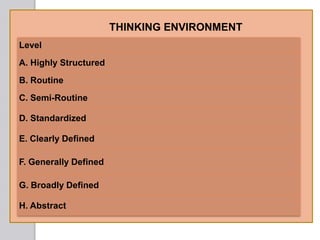
THINKING ENVIRONMENT
Level
A. Highly Structured
B. Routine
C. Semi-Routine
D. Standardized
E. Clearly Defined
F. Generally Defined
G. Broadly Defined
H. Abstract
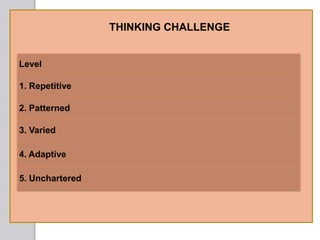
THINKING CHALLENGE
Level
1. Repetitive
2. Patterned
3. Varied
4. Adaptive
5. Unchartered
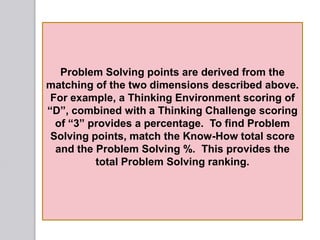
Problem Solving points are derived from the
matching of the two dimensions described above.
For example, a Thinking Environment scoring of
―D‖, combined with a Thinking Challenge scoring
of ―3‖ provides a percentage. To find Problem
Solving points, match the Know-How total score
and the Problem Solving %. This provides the
total Problem Solving ranking.
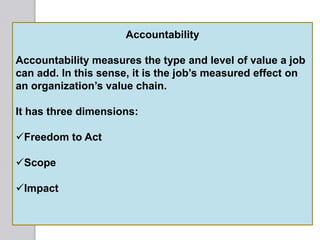
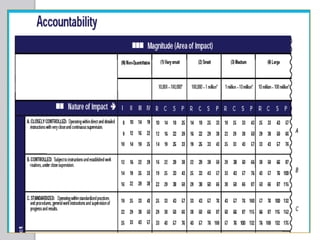
Accountability
Accountability measures the type and level of value a job
can add. In this sense, it is the job‘s measured effect on
an organization‘s value chain.
It has three dimensions:
Freedom to Act
Scope
Impact
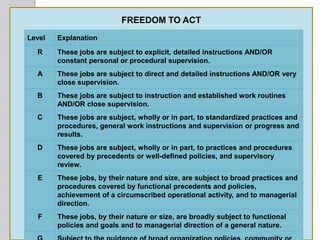
FREEDOM TO ACT
Level Explanation
R These jobs are subject to explicit, detailed instructions AND/OR
constant personal or procedural supervision.
A These jobs are subject to direct and detailed instructions AND/OR very
close supervision.
B These jobs are subject to instruction and established work routines
AND/OR close supervision.
C These jobs are subject, wholly or in part, to standardized practices and
procedures, general work instructions and supervision or progress and
results.
D These jobs are subject, wholly or in part, to practices and procedures
covered by precedents or well-defined policies, and supervisory
review.
E These jobs, by their nature and size, are subject to broad practices and
procedures covered by functional precedents and policies,
achievement of a circumscribed operational activity, and to managerial
direction.
F These jobs, by their nature or size, are broadly subject to functional
policies and goals and to managerial direction of a general nature.
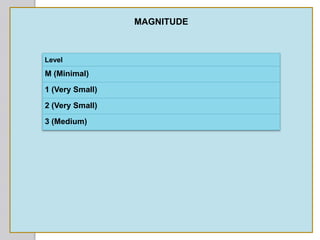
MAGNITUDE
Level
M (Minimal)
1 (Very Small)
2 (Very Small)
3 (Medium)
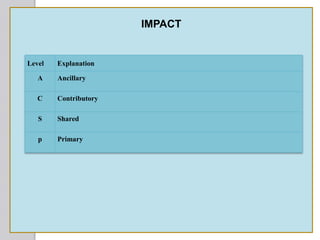
IMPACT
Level Explanation
A Ancillary
C Contributory
S Shared
p Primary
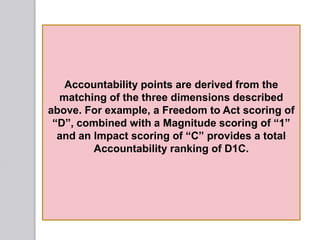
Accountability points are derived from the
matching of the three dimensions described
above. For example, a Freedom to Act scoring of
―D‖, combined with a Magnitude scoring of ―1‖
and an Impact scoring of ―C‖ provides a total
Accountability ranking of D1C.
Working Conditions
This Guide Chart measures the conditions under which the job is
performed by considering:
Physical Effort, which measures the degree of physical fatigue
that results from the combination of intensity, duration, and
frequency of any kind of physical activity required in the job.
Physical Environment, which measures the physical discomfort or
the risk of accident or ill health which results from the
combination of intensity, duration, and frequency of exposure, in
the job, to unavoidable physical and environmental factors.
Sensory Attention, which measures the intensity, duration, and
frequency of the demand, in the job, for concentration using
one or more of the five senses.
Mental Stress, which measures the degree of such things as
tension or anxiety which result from the combination of
intensity, duration, and frequency of exposure to
factors, inherent in the work process or environment, which
would typically cause stress to someone reasonably suited to
the job.
Conclusion
By focusing on the important aspects of the content of each job,
the end results which each is expected to achieve, and the
conditions under which the work is performed, the Hay Method
provides a vehicle for systematically assessing the relationships
among the various positions and determining their relative value.
Leading organizations use job evaluation as a source of
competitive advantage by improving the organization‘s ability to
manage its investment in human resources with greater
credibility, discipline, and fairness.
It is a critical management tool, extremely useful in ensuring an
organization‘s proper integration of strategy, culture, structure,
process, people, and reward.
THANK
YOU

Hay guide chart.pptx [autosaved]

  • 1.
    Hay Guide Chart ―Everyjob exists to add value to the organization through delivering some set of results.‖ Submitted By: Surbhi- CHF 22 Charu Singh- CHF 06
  • 2.
    Job Evaluation It becomeseasier to fix an equitable and fair wage structure for different grades of jobs. It is a systematic method of appraising the value or worth of one job in relation to the other in an organization.
  • 3.
    Need for aJob Evaluation Process •The process of evaluating jobs enables many important applications, such as: Designing effective organizations; Clarifying interdependencies and accountabilities; managing succession and talent; Setting competitive, value-based pay policies. •To ensure a reasonable balance between flexibility and control, many organizations are revamping the process through which they value work.
  • 4.
    Evaluating jobs notonly provides consistent work value measurement, it also gives organizations a common framework and language to design jobs , define career progressions, analyze organization structures, and more strategically manage human resources. The job evaluation processes help well beyond defining appropriate pay levels. One key driver is the need to re-establish discipline within compensation programs, and to better align pay with value creation—particularly at executive levels.
  • 5.
    Hay Group GuideChart – Profile Method of Job Evaluation In the early 1950s, Edward N. Hay and Dale Purves developed a Guide Chart- Profile method for evaluating jobs that is one of the most popular methods used for evaluating executive, managerial and professional positions but also widely used in evaluating clerical, blue-collar and technician jobs. It is based on the notion that jobs can be measured on the basis of their relative contribution to the overall objectives of the organization. By considering core aspects of content and context that are common to all jobs, it provides a clear, understandable and systematic basis for defining and comparing the requirements for all kinds of jobs at all levels.
  • 6.
    The Hay Methodis based on the idea that jobs can be assessed in terms of: the knowledge required to do the job; the analytical ability needed to solve the problems commonly faced; the responsibilities assigned, and; the working conditions associated with the job.
  • 7.
    Hay Group GuideChart It is based on three factors: It starts from the premise that all jobs exist to achieve a purpose—to create value in their organization— and evaluates this by analyzing what is the value that is created (accountability), how it is created (problem solving) and what the job requirements are that a person has to meet in order to deliver the value (knowhow).
  • 8.
  • 9.
    Hay Group GuideCharts Hay Group‘s guide charts are proprietary instruments that enable consistent work evaluations. Each of the factors—know-how, problem solving, and accountability—has its own guide chart that reflects the elements identified above. These help to yield consistent and legally defensible work evaluations. Hay Group‘s job evaluation approach , is the world‘s most widely accepted for managerial and executive posts.
  • 10.
    Know – How Toachieve the accountabilities of a job requires ‗know- how‘ (or inputs), which is the sum total of every capability or skill, however acquired, needed for fully competent job performance. It has three dimensions: Practical / technical knowledge Planning, organizing and integrating (managerial) knowledge Communicating and influencing skills
  • 11.
    COGNITIVE KNOW-HOW O Level A. Basic B.Elementary C. Intermediate Skill And / Or Knowledge D. Extended Skill And / Or Knowledge E. Diverse or Specialized F. Seasoned, Diverse or Specialized G. Broad or Specialized Mastery
  • 12.
    MANAGERIAL KNOW-HOW Level Explanation T. Performanceof a task(s) highly specific as to objective and content, and not involving the leadership of others. I. Performance or direction of activities, which are similar as to content and objectives with appropriate awareness of other activities. II. Direction of an important unit with varied activities and objectives OR guidance of an important sub function(s) or several important elements across several units. III. Direction of a major unit with noticeable functional diversity OR guidance of a function(s) which significantly affects all or most of the organization. IV. Management of all units and functions within the organization.
  • 13.
    HUMAN RELATIONS SKILLS Level 1.Basic 2. Important 3. Critical
  • 14.
    Know-How points arederived from the matching of the three dimensions described above. For example, a Cognitive scoring of ―D‖, combined with a Managerial scoring of ―I‖ and Human Relation skills of ―3‖ provides a total Know-How ranking. Often the notation used to display the Know-How factor is written as, ―DI3‖.
  • 15.
    Problem Solving ‗Problem solving‘(or throughputs) refers to the use of know-how to identify, delineate, and resolve problems. Problem solving measures the requirement to use know- how conceptually and analytically. It has two dimensions: Thinking environment Thinking challenge
  • 16.
    THINKING ENVIRONMENT Level A. HighlyStructured B. Routine C. Semi-Routine D. Standardized E. Clearly Defined F. Generally Defined G. Broadly Defined H. Abstract
  • 17.
    THINKING CHALLENGE Level 1. Repetitive 2.Patterned 3. Varied 4. Adaptive 5. Unchartered
  • 18.
    Problem Solving pointsare derived from the matching of the two dimensions described above. For example, a Thinking Environment scoring of ―D‖, combined with a Thinking Challenge scoring of ―3‖ provides a percentage. To find Problem Solving points, match the Know-How total score and the Problem Solving %. This provides the total Problem Solving ranking.
  • 19.
    Accountability Accountability measures thetype and level of value a job can add. In this sense, it is the job‘s measured effect on an organization‘s value chain. It has three dimensions: Freedom to Act Scope Impact
  • 20.
    FREEDOM TO ACT LevelExplanation R These jobs are subject to explicit, detailed instructions AND/OR constant personal or procedural supervision. A These jobs are subject to direct and detailed instructions AND/OR very close supervision. B These jobs are subject to instruction and established work routines AND/OR close supervision. C These jobs are subject, wholly or in part, to standardized practices and procedures, general work instructions and supervision or progress and results. D These jobs are subject, wholly or in part, to practices and procedures covered by precedents or well-defined policies, and supervisory review. E These jobs, by their nature and size, are subject to broad practices and procedures covered by functional precedents and policies, achievement of a circumscribed operational activity, and to managerial direction. F These jobs, by their nature or size, are broadly subject to functional policies and goals and to managerial direction of a general nature.
  • 21.
    MAGNITUDE Level M (Minimal) 1 (VerySmall) 2 (Very Small) 3 (Medium)
  • 22.
    IMPACT Level Explanation A Ancillary CContributory S Shared p Primary
  • 23.
    Accountability points arederived from the matching of the three dimensions described above. For example, a Freedom to Act scoring of ―D‖, combined with a Magnitude scoring of ―1‖ and an Impact scoring of ―C‖ provides a total Accountability ranking of D1C.
  • 27.
    Working Conditions This GuideChart measures the conditions under which the job is performed by considering: Physical Effort, which measures the degree of physical fatigue that results from the combination of intensity, duration, and frequency of any kind of physical activity required in the job. Physical Environment, which measures the physical discomfort or the risk of accident or ill health which results from the combination of intensity, duration, and frequency of exposure, in the job, to unavoidable physical and environmental factors.
  • 28.
    Sensory Attention, whichmeasures the intensity, duration, and frequency of the demand, in the job, for concentration using one or more of the five senses. Mental Stress, which measures the degree of such things as tension or anxiety which result from the combination of intensity, duration, and frequency of exposure to factors, inherent in the work process or environment, which would typically cause stress to someone reasonably suited to the job.
  • 29.
    Conclusion By focusing onthe important aspects of the content of each job, the end results which each is expected to achieve, and the conditions under which the work is performed, the Hay Method provides a vehicle for systematically assessing the relationships among the various positions and determining their relative value. Leading organizations use job evaluation as a source of competitive advantage by improving the organization‘s ability to manage its investment in human resources with greater credibility, discipline, and fairness. It is a critical management tool, extremely useful in ensuring an organization‘s proper integration of strategy, culture, structure, process, people, and reward.
  • 30.