Syllabus
• Module-3 (9Hours)
• Job Evaluation:
• The Job Evaluation Process; Obtain Job KSAOs, Qualifications,
Working Conditions, and Essential Duties; Examine Compensable
Factors Using the Rating/Weighting Evaluation Method; Determine,
Overall, Job Value; Hay Group—Pioneer in Job Evaluation;
Determining Compensation using Job Evaluation Data; Legal and
Ethical Considerations for Job Evaluation; Online Salary Survey.
3.
JOB EVALUATION:
• Jobevaluation is the systematic process of determining the relative
value of different jobs in an organization.
• The goal of job evaluation is to compare jobs with each other in order
to create a pay structure that is
• fair, equitable, and consistent for everyone.
• This ensures that everyone is paid their worth and that different jobs have
different entry and performance requirements.
• A Job Evaluation is a systematic way of determining the value/worth
of a job in relation to other jobs in an organization. It tries to make a
systematic comparison between jobs to assess their relative worth for
the purpose of establishing a rational pay structure.
4.
JOB EVALUATION:
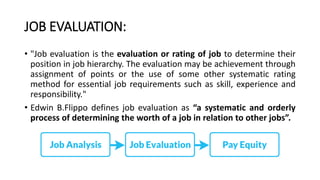
• "Jobevaluation is the evaluation or rating of job to determine their
position in job hierarchy. The evaluation may be achievement through
assignment of points or the use of some other systematic rating
method for essential job requirements such as skill, experience and
responsibility."
• Edwin B.Flippo defines job evaluation as “a systematic and orderly
process of determining the worth of a job in relation to other jobs”.
5.
JOB EVALUATION:
• Hereare some key aspects of job evaluation:
• Systematic: It follows a structured and consistent approach to ensure
fairness and transparency.
• Relative: It compares jobs against each other, not against external
benchmarks.
• Job-focused: It evaluates the job itself, independent of who holds it. It
tries to assess jobs, not people.
• Multi-faceted: It considers various factors like skills required,
knowledge, experience, responsibility level, working conditions, and
decision-making authority.
6.
OBJECTIVES OF JOBEVALUATION
• Internal Consistency:
• Eliminate pay inequities: This ensures that jobs with similar demands
and contributions are assigned to the same pay grade, regardless of
the department or seniority of the incumbent.
• Reduce grievances and complaints: By establishing a transparent and
objective basis for pay, job evaluation can minimize employee
dissatisfaction regarding unfair compensation.
• Promote internal mobility: Knowing the skills and experience
required for each pay grade can guide employees in navigating
internal career paths.
7.
OBJECTIVES OF JOBEVALUATION
• External Competitiveness:
• Attract and retain talent: By offering competitive salaries based on
the true value of jobs, organizations can attract and retain qualified
employees in a competitive market.
• Benchmark against industry standards: Job evaluation data can be
used to compare compensation practices with industry averages,
ensuring organizational competitiveness.
• Maintain legal compliance: Some regions have legal requirements for
fair compensation practices, and job evaluation can help
organizations comply with these regulations.
8.
OBJECTIVES OF JOBEVALUATION
• Decision-Making Support:
• Facilitate salary administration: Job evaluation provides a framework
for setting equitable pay ranges and making informed salary
adjustments.
• Guide training and development initiatives: Identifying the skills and
knowledge required for different job levels can inform training
programs and support employee development.
• Inform workforce planning: Understanding the relative value of
different jobs can help organizations make strategic decisions about
future staffing needs and resource allocation.
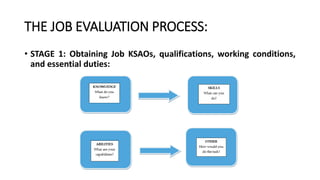
9.
THE JOB EVALUATIONPROCESS:
• STAGE 1: Obtaining Job KSAOs, qualifications, working conditions,
and essential duties:
10.
THE JOB EVALUATIONPROCESS:
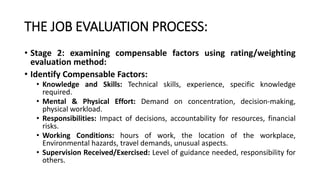
• Stage 2: examining compensable factors using rating/weighting
evaluation method:
• Identify Compensable Factors:
• Knowledge and Skills: Technical skills, experience, specific knowledge
required.
• Mental & Physical Effort: Demand on concentration, decision-making,
physical workload.
• Responsibilities: Impact of decisions, accountability for resources, financial
risks.
• Working Conditions: hours of work, the location of the workplace,
Environmental hazards, travel demands, unusual aspects.
• Supervision Received/Exercised: Level of guidance needed, responsibility for
others.
11.
THE JOB EVALUATIONPROCESS:
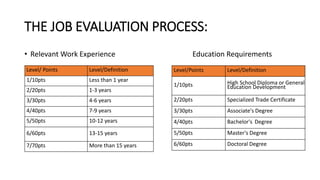
• Relevant Work Experience Education Requirements
Level/ Points Level/Definition
1/10pts Less than 1 year
2/20pts 1-3 years
3/30pts 4-6 years
4/40pts 7-9 years
5/50pts 10-12 years
6/60pts 13-15 years
7/70pts More than 15 years
Level/Points Level/Definition
1/10pts High School Diploma or General
Education Development
2/20pts Specialized Trade Certificate
3/30pts Associate's Degree
4/40pts Bachelor's Degree
5/50pts Master's Degree
6/60pts Doctoral Degree
12.
THE JOB EVALUATIONPROCESS:
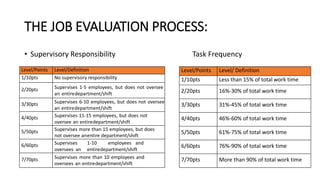
• Supervisory Responsibility Task Frequency
Level/Points Level/Definition
1/10pts No supervisory responsibility
2/20pts Supervises 1-5 employees, but does not oversee
an entiredepartment/shift
3/30pts Supervises 6-10 employees, but does not oversee
an entiredepartment/shift
4/40pts Supervises 11-15 employees, but does not
oversee an entiredepartment/shift
5/50pts Supervises more than 15 employees, but does
not oversee anentire department/shift
6/60pts Supervises 1-10 employees and
oversees an entiredepartment/shift
7/70pts Supervises more than 10 employees and
oversees an entiredepartment/shift
Level/Points Level/ Definition
1/10pts Less than 15% of total work time
2/20pts 16%-30% of total work time
3/30pts 31%-45% of total work time
4/40pts 46%-60% of total work time
5/50pts 61%-75% of total work time
6/60pts 76%-90% of total work time
7/70pts More than 90% of total work time
13.
THE JOB EVALUATIONPROCESS:
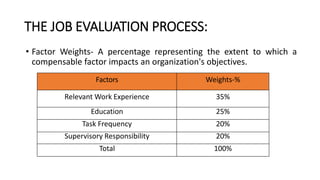
• Factor Weights- A percentage representing the extent to which a
compensable factor impacts an organization's objectives.
Factors Weights-%
Relevant Work Experience 35%
Education 25%
Task Frequency 20%
Supervisory Responsibility 20%
Total 100%
14.
STEP 3: ADDFACTOR POINTS TOGETHER TO
DETERMINE OVERALL JOB VALUE
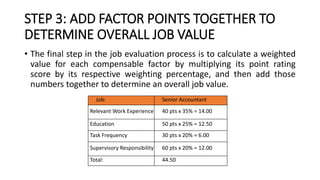
• The final step in the job evaluation process is to calculate a weighted
value for each compensable factor by multiplying its point rating
score by its respective weighting percentage, and then add those
numbers together to determine an overall job value.
Job: Senior Accountant
Relevant Work Experience 40 pts x 35% = 14.00
Education 50 pts x 25% = 12.50
Task Frequency 30 pts x 20% = 6.00
Supervisory Responsibility 60 pts x 20% = 12.00
Total: 44.50
15.
STEP 3: ADDFACTOR POINTS TOGETHER TO
DETERMINE OVERALL JOB VALUE
• Calculate Job Score: Multiply each factor score by its weight,
then sum the products to get the overall job score.
• Analyze Job Scores: Compare job scores within the
organization to determine their relative value. This helps
establish pay grades, set compensation levels, and ensure
internal consistency.
Hay Group JobEvaluation Method
The general principles of job evaluation are:
• It is the job and not the job holder that is being evaluated.
• The job is evaluated at a job standard of fully acceptable
performance.
• The job is evaluated as it is now, not what it was and not what it will
be or what it should be.
• The job is evaluated with no considerations of its present pay, grade,
how it is rank compared with other jobs. All these factors are ignored
in the job evaluation.
18.
Hay Group JobEvaluation Method
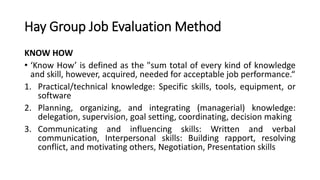
KNOW HOW
• ‘Know How’ is defined as the "sum total of every kind of knowledge
and skill, however, acquired, needed for acceptable job performance.“
1. Practical/technical knowledge: Specific skills, tools, equipment, or
software
2. Planning, organizing, and integrating (managerial) knowledge:
delegation, supervision, goal setting, coordinating, decision making
3. Communicating and influencing skills: Written and verbal
communication, Interpersonal skills: Building rapport, resolving
conflict, and motivating others, Negotiation, Presentation skills
19.
Hay Group JobEvaluation Method
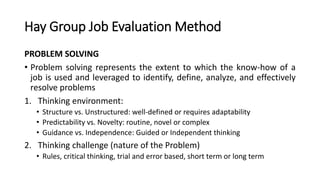
PROBLEM SOLVING
• Problem solving represents the extent to which the know-how of a
job is used and leveraged to identify, define, analyze, and effectively
resolve problems
1. Thinking environment:
• Structure vs. Unstructured: well-defined or requires adaptability
• Predictability vs. Novelty: routine, novel or complex
• Guidance vs. Independence: Guided or Independent thinking
2. Thinking challenge (nature of the Problem)
• Rules, critical thinking, trial and error based, short term or long term
20.
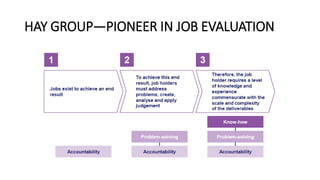
HAY GROUP—PIONEER INJOB EVALUATION
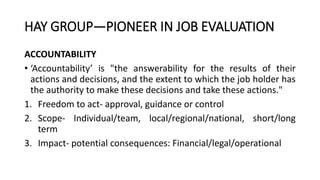
ACCOUNTABILITY
• ‘Accountability’ is "the answerability for the results of their
actions and decisions, and the extent to which the job holder has
the authority to make these decisions and take these actions."
1. Freedom to act- approval, guidance or control
2. Scope- Individual/team, local/regional/national, short/long
term
3. Impact- potential consequences: Financial/legal/operational
21.
HAY GROUP—PIONEER INJOB EVALUATION
WORKING CONDITIONS
• The environment in which the thinking takes place. ‘Working Conditions’
assess the environment in which the job is performed.
1. Physical Effort - Static vs. Dynamic, Heavy lifting vs. Light work, Exposure
to elements, uncomfortable elements
2. Physical Environment - Safety hazards, Noise levels, Comfort and
amenities
3. Sensory Attention – Visual demands, Auditory demands, Mental vigilance
4. Mental Stress - Workload and deadlines, Emotional strain, Responsibility
for others
23.
Hay Group JobEvaluation Method
• The Hay Group, was indeed a pioneer in the field of job
evaluation. Founded in 1943 by Edward N. Hay and Dale
Purves, the group developed a systematic and widely used
method for assessing the relative worth of different jobs
within an organization.
24.
Determining Compensation usingJob
Evaluation Data:
• Benchmark analysis: the process of comparing internal job data
with external job data sources to determine its market value.
1. External Data Sources:
• Benchmark analysis involves gathering external data on
compensation levels for similar jobs in your industry and
geographic region.
• This data can be sourced from various sources like salary surveys,
government databases, professional associations, and online
salary comparison tools.
25.
Determining Compensation usingJob
Evaluation Data:
2. Job Matching:
•You'll need to carefully match your jobs to the
benchmark data by considering factors like:
• Job descriptions and duties
• Required skills and experience
• Education and certification requirements
• Industry and size of the organization
• Geographic location
26.
Determining Compensation usingJob
Evaluation Data:
3. Data Analysis:
• Once you've identified relevant benchmark jobs, analyze the compensation
data to understand the prevailing salary ranges for those positions.
4. Adjusting Pay Ranges:
• Compare your current pay ranges for evaluated jobs with the benchmark
data.
• If there are significant discrepancies, you may need to adjust your pay
ranges to be more competitive with the market.
• This can involve raising the minimum and/or maximum of the pay range, or
creating new pay bands for higher-level jobs.
27.
Determining Compensation usingJob
Evaluation Data:
5. Considerations:
• While benchmarking is valuable, it's important not to simply
mirror external data.
• Factors like your organization's financial health, internal pay
equity, and talent acquisition needs should also be
considered when making compensation decisions.
• Use benchmarking as a guide to inform your salary ranges,
but ensure they are tailored to your specific context.
28.
Legal and EthicalConsiderations for Job
Evaluation:
• Discrimination
• Compliance with Labor Laws
• Transparency and Communication
• Fairness and Objectivity
• Validation and Reliability
• Job Analysis Accuracy
• Impact on Employee Motivation
29.
Online Salary Survey:
ForCandidates:
• Data Accuracy and Source
• Specificity
• Limitations
• Negotiation Tool
For Employers:
• Benchmarking:
• Recruitment and Retention
• Employee Relations:








![[EN] aon_presеentation -aon_presentation Group.pdf](https://cdn.slidesharecdn.com/ss_thumbnails/enhay-group-250309104952-d2c3ddf5-thumbnail.jpg?width=640&height=640&fit=bounds)


