Job evaluation
• A comparative process
• A judgmental process
• An analytical process
• A structured process
Job evaluation relearned
• Job evaluation should reinforce critical behaviors that the the
organization needs to demonstrate for overall effectiveness.
Traditional job evaluation systems however focus on characteristics
representative of organizations of the past
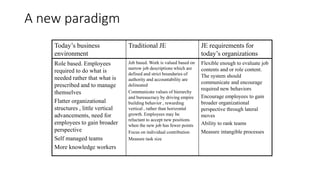
A new paradigm
Today’s business
environment
Traditional JE JE requirements for
today’s organizations
Role based. Employees
required to do what is
needed rather that what is
prescribed and to manage
themselves
Flatter organizational
structures , little vertical
advancements, need for
employees to gain broader
perspective
Self managed teams
More knowledge workers
Job based. Work is valued based on
narrow job descriptions which are
defined and strict boundaries of
authority and accountability are
delineated
Communicate values of hierarchy
and bureaucracy by driving empire
building behavior , rewarding
vertical , rather than horizontal
growth. Employees may be
reluctant to accept new positions
when the new job has fewer points
Focus on individual contribution
Measure task size
Flexible enough to evaluate job
contents and or role content.
The system should
communicate and encourage
required new behaviors
Encourage employees to gain
broader organizational
perspective through lateral
moves
Ability to rank teams
Measure intangible processes
JE – basic methodology
• Benchmark jobs
• For internal assessment and external matching
• Job evaluation factors
• Characteristics common to the range of jobs
• Job and role analysis
• Job evaluation process
• Develop a pay structure
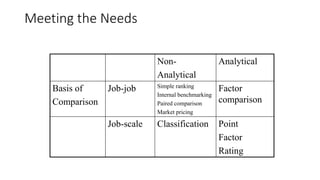
Meeting the Needs
Non-
Analytical
Analytical
Basis of
Comparison
Job-job Simple ranking
Internal benchmarking
Paired comparison
Market pricing
Factor
comparison
Job-scale Classification Point
Factor
Rating
Non-analytical job evaluation – job ranking
• Steps
• Analyse and describe jobs
• Identify key or benchmark jobs
• Rank all other jobs around these
• Divide ranked jobs into grades
• Advantages
• Quick and cheap
• Disadvantages
• Does not measure differences between jobs, not acceptable in determining
equal worth in an equal value case
Job classification
• Steps
• Decide on number and characteristics of grades
• Compare whole job with grade definition and allot jobs to grades
• Advantages
• Easy, cheap, easily understood
• Disadvantages
• Cannot cope with complex jobs or borderline cases
• Not acceptable in equal value cases
Analytical JE – point factor schemes
• Break down jobs into factors such as knowledge, skill, responsibility, dealing with
people, working conditions
• Give each factor a range of points or percentage weighting
• Maximum points for each factor are divided between levels or degrees for that
factor
• Select and analyse benchmark jobs
• Allocate points to each job under each factor
• Add together points to give a total score which represents job size
• Design grade structure
• Analyse, evaluate and grade non-benchmark jobs
• Price job grades
Point-Factor Plans
• The most commonly used type of job evaluation method
• Make the criteria for comparisons explicit, unlike ranking and
classification
• The criteria for classification (the compensable factors) are related to
the strategy of the business; they are the factors valued by or of high
worth to the firm
Point-Factor Plans
• Point factor plans all include three elements:
• Compensable factors are defined
• Degrees or level of each factor are given numerical rankings
• Factors weighted as to their relative value to the organization
• Job worth is measured by the total number of points
• The steps to follow:
• Job analysis
• Determine compensable factors
• Scale the factors
• Weight the factors
• Communications and documentation
• Apply the plan
Compensable Factors
“Characteristics in the
work that the organization
values, that help it pursue
its strategy and achieve
its objectives”
Selecting and Weighting Compensable Factors
• These should be:
• Based on the work performed
• Based on the strategy and values of the organization
• Acceptable and considered to be fair by all concerned parties
• As a result, compensable factors should be developed by each organization,
rather than using an off-the-shelf plan
• Basic group of compensable factors:
• Skill
• Effort
• Responsibility
• Working conditions
• Weighting compensable factors
Point-Factor: Pro and Con
• Point-factor systems orderly, rational, and make criteria for evaluating
jobs explicit
• Time consuming to set up (and they do need to be periodically
updated), but very simple to add new jobs
• Job evaluations may still be affected by what the evaluator already
knows or believes the market value of the job to be
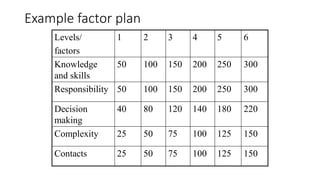
Example factor plan
Levels/
factors
1 2 3 4 5 6
Knowledge
and skills
50 100 150 200 250 300
Responsibility 50 100 150 200 250 300
Decision
making
40 80 120 140 180 220
Complexity 25 50 75 100 125 150
Contacts 25 50 75 100 125 150
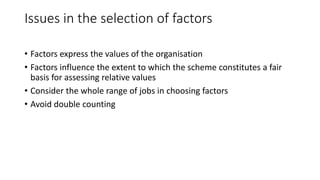
Issues in the selection of factors
• Factors express the values of the organisation
• Factors influence the extent to which the scheme constitutes a fair
basis for assessing relative values
• Consider the whole range of jobs in choosing factors
• Avoid double counting
Hay Guide Chart-Profile Method
©
• Officially known as the Hay Guide Chart-Profile Method of Job
Evaluation©, this system utilizes three factors to arrive at a job’s
evaluation. The job’s content is the sole basis for the job evaluation.
• The Hay method of job evaluation is generally understood to be a
point plan, although Hay itself does not define the guide chart-profile
method as a variation of the point method.
• The Hay guide charts have been in existence since 1951 and have
been used in over 5,000 different organizations worldwide.
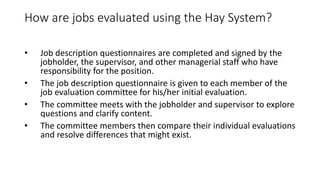
How are jobs evaluated using the Hay System?
• Job description questionnaires are completed and signed by the
jobholder, the supervisor, and other managerial staff who have
responsibility for the position.
• The job description questionnaire is given to each member of the
job evaluation committee for his/her initial evaluation.
• The committee meets with the jobholder and supervisor to explore
questions and clarify content.
• The committee members then compare their individual evaluations
and resolve differences that might exist.
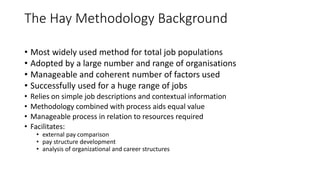
The Hay Methodology Background
• Most widely used method for total job populations
• Adopted by a large number and range of organisations
• Manageable and coherent number of factors used
• Successfully used for a huge range of jobs
• Relies on simple job descriptions and contextual information
• Methodology combined with process aids equal value
• Manageable process in relation to resources required
• Facilitates:
• external pay comparison
• pay structure development
• analysis of organizational and career structures
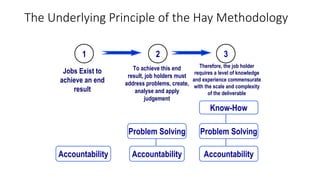
Jobs Exist to
achieve an end
result
Accountability Accountability Accountability
Problem Solving
Therefore, the job holder
requires a level of knowledge
and experience commensurate
with the scale and complexity
of the deliverable
Know-How
Problem Solving
To achieve this end
result, job holders must
address problems, create,
analyse and apply
judgement
1 3
2
The Underlying Principle of the Hay Methodology
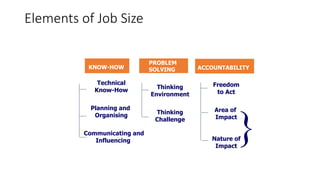
Elements of Job Size
Technical
Know-How
Planning and
Organising
Communicating and
Influencing
Freedom
to Act
Area of
Impact
Nature of
Impact
Thinking
Environment
Thinking
Challenge
PROBLEM
SOLVING
KNOW-HOW ACCOUNTABILITY
}
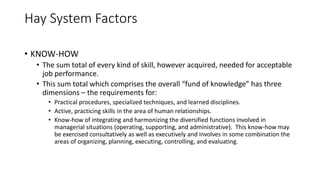
Hay System Factors
• KNOW-HOW
• The sum total of every kind of skill, however acquired, needed for acceptable
job performance.
• This sum total which comprises the overall “fund of knowledge” has three
dimensions – the requirements for:
• Practical procedures, specialized techniques, and learned disciplines.
• Active, practicing skills in the area of human relationships.
• Know-how of integrating and harmonizing the diversified functions involved in
managerial situations (operating, supporting, and administrative). This know-how may
be exercised consultatively as well as executively and involves in some combination the
areas of organizing, planning, executing, controlling, and evaluating.
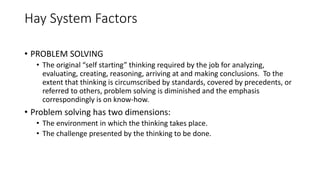
Hay System Factors
• PROBLEM SOLVING
• The original “self starting” thinking required by the job for analyzing,
evaluating, creating, reasoning, arriving at and making conclusions. To the
extent that thinking is circumscribed by standards, covered by precedents, or
referred to others, problem solving is diminished and the emphasis
correspondingly is on know-how.
• Problem solving has two dimensions:
• The environment in which the thinking takes place.
• The challenge presented by the thinking to be done.
Hay System Factors
• ACCOUNTABILITY
• The answerability for an action and for the consequences thereof. It
is the measured effect of the job on end results. It has three
dimensions in the following order of importance:
• Freedom to Act – the degree of personal or procedural control and guidance
the jobholder has.
• Job Impact on End Results – ranges from direct to indirect impact on end
results by auxiliary, contributory, shared, or primary effects.
• Magnitude – indicated by the general dynamic dollar size or accountability
area(s) most clearly affected by the job.
• A guide chart is used for each of the three factors containing
descriptive scales for each element and a numbering pattern based
on a 15 % step difference , which is an important building block in
making comparisons between jobs. Job size is the sum of the results
from the three factors. In addition , an explicit judgment is made
about the balance between the factors in each job – the profile –
which provides a valuable consistency check.
The Hay Methodology
Checks and Balances
• Profiles – how do the elements fit together
• Step differences – internal relativities
• ‘Sorethumbing’ – common sense
• Panel process – challenge perceptions
• Focus on jobs – not people or performance

Job evaluation.pptx

  • 1.
    Job evaluation • Acomparative process • A judgmental process • An analytical process • A structured process
  • 2.
    Job evaluation relearned •Job evaluation should reinforce critical behaviors that the the organization needs to demonstrate for overall effectiveness. Traditional job evaluation systems however focus on characteristics representative of organizations of the past
  • 3.
    A new paradigm Today’sbusiness environment Traditional JE JE requirements for today’s organizations Role based. Employees required to do what is needed rather that what is prescribed and to manage themselves Flatter organizational structures , little vertical advancements, need for employees to gain broader perspective Self managed teams More knowledge workers Job based. Work is valued based on narrow job descriptions which are defined and strict boundaries of authority and accountability are delineated Communicate values of hierarchy and bureaucracy by driving empire building behavior , rewarding vertical , rather than horizontal growth. Employees may be reluctant to accept new positions when the new job has fewer points Focus on individual contribution Measure task size Flexible enough to evaluate job contents and or role content. The system should communicate and encourage required new behaviors Encourage employees to gain broader organizational perspective through lateral moves Ability to rank teams Measure intangible processes
  • 4.
    JE – basicmethodology • Benchmark jobs • For internal assessment and external matching • Job evaluation factors • Characteristics common to the range of jobs • Job and role analysis • Job evaluation process • Develop a pay structure
  • 5.
    Meeting the Needs Non- Analytical Analytical Basisof Comparison Job-job Simple ranking Internal benchmarking Paired comparison Market pricing Factor comparison Job-scale Classification Point Factor Rating
  • 6.
    Non-analytical job evaluation– job ranking • Steps • Analyse and describe jobs • Identify key or benchmark jobs • Rank all other jobs around these • Divide ranked jobs into grades • Advantages • Quick and cheap • Disadvantages • Does not measure differences between jobs, not acceptable in determining equal worth in an equal value case
  • 7.
    Job classification • Steps •Decide on number and characteristics of grades • Compare whole job with grade definition and allot jobs to grades • Advantages • Easy, cheap, easily understood • Disadvantages • Cannot cope with complex jobs or borderline cases • Not acceptable in equal value cases
  • 8.
    Analytical JE –point factor schemes • Break down jobs into factors such as knowledge, skill, responsibility, dealing with people, working conditions • Give each factor a range of points or percentage weighting • Maximum points for each factor are divided between levels or degrees for that factor • Select and analyse benchmark jobs • Allocate points to each job under each factor • Add together points to give a total score which represents job size • Design grade structure • Analyse, evaluate and grade non-benchmark jobs • Price job grades
  • 9.
    Point-Factor Plans • Themost commonly used type of job evaluation method • Make the criteria for comparisons explicit, unlike ranking and classification • The criteria for classification (the compensable factors) are related to the strategy of the business; they are the factors valued by or of high worth to the firm
  • 10.
    Point-Factor Plans • Pointfactor plans all include three elements: • Compensable factors are defined • Degrees or level of each factor are given numerical rankings • Factors weighted as to their relative value to the organization • Job worth is measured by the total number of points • The steps to follow: • Job analysis • Determine compensable factors • Scale the factors • Weight the factors • Communications and documentation • Apply the plan Compensable Factors “Characteristics in the work that the organization values, that help it pursue its strategy and achieve its objectives”
  • 11.
    Selecting and WeightingCompensable Factors • These should be: • Based on the work performed • Based on the strategy and values of the organization • Acceptable and considered to be fair by all concerned parties • As a result, compensable factors should be developed by each organization, rather than using an off-the-shelf plan • Basic group of compensable factors: • Skill • Effort • Responsibility • Working conditions • Weighting compensable factors
  • 12.
    Point-Factor: Pro andCon • Point-factor systems orderly, rational, and make criteria for evaluating jobs explicit • Time consuming to set up (and they do need to be periodically updated), but very simple to add new jobs • Job evaluations may still be affected by what the evaluator already knows or believes the market value of the job to be
  • 13.
    Example factor plan Levels/ factors 12 3 4 5 6 Knowledge and skills 50 100 150 200 250 300 Responsibility 50 100 150 200 250 300 Decision making 40 80 120 140 180 220 Complexity 25 50 75 100 125 150 Contacts 25 50 75 100 125 150
  • 14.
    Issues in theselection of factors • Factors express the values of the organisation • Factors influence the extent to which the scheme constitutes a fair basis for assessing relative values • Consider the whole range of jobs in choosing factors • Avoid double counting
  • 15.
    Hay Guide Chart-ProfileMethod © • Officially known as the Hay Guide Chart-Profile Method of Job Evaluation©, this system utilizes three factors to arrive at a job’s evaluation. The job’s content is the sole basis for the job evaluation. • The Hay method of job evaluation is generally understood to be a point plan, although Hay itself does not define the guide chart-profile method as a variation of the point method. • The Hay guide charts have been in existence since 1951 and have been used in over 5,000 different organizations worldwide.
  • 16.
    How are jobsevaluated using the Hay System? • Job description questionnaires are completed and signed by the jobholder, the supervisor, and other managerial staff who have responsibility for the position. • The job description questionnaire is given to each member of the job evaluation committee for his/her initial evaluation. • The committee meets with the jobholder and supervisor to explore questions and clarify content. • The committee members then compare their individual evaluations and resolve differences that might exist.
  • 17.
    The Hay MethodologyBackground • Most widely used method for total job populations • Adopted by a large number and range of organisations • Manageable and coherent number of factors used • Successfully used for a huge range of jobs • Relies on simple job descriptions and contextual information • Methodology combined with process aids equal value • Manageable process in relation to resources required • Facilitates: • external pay comparison • pay structure development • analysis of organizational and career structures
  • 18.
    Jobs Exist to achievean end result Accountability Accountability Accountability Problem Solving Therefore, the job holder requires a level of knowledge and experience commensurate with the scale and complexity of the deliverable Know-How Problem Solving To achieve this end result, job holders must address problems, create, analyse and apply judgement 1 3 2 The Underlying Principle of the Hay Methodology
  • 19.
    Elements of JobSize Technical Know-How Planning and Organising Communicating and Influencing Freedom to Act Area of Impact Nature of Impact Thinking Environment Thinking Challenge PROBLEM SOLVING KNOW-HOW ACCOUNTABILITY }
  • 20.
    Hay System Factors •KNOW-HOW • The sum total of every kind of skill, however acquired, needed for acceptable job performance. • This sum total which comprises the overall “fund of knowledge” has three dimensions – the requirements for: • Practical procedures, specialized techniques, and learned disciplines. • Active, practicing skills in the area of human relationships. • Know-how of integrating and harmonizing the diversified functions involved in managerial situations (operating, supporting, and administrative). This know-how may be exercised consultatively as well as executively and involves in some combination the areas of organizing, planning, executing, controlling, and evaluating.
  • 21.
    Hay System Factors •PROBLEM SOLVING • The original “self starting” thinking required by the job for analyzing, evaluating, creating, reasoning, arriving at and making conclusions. To the extent that thinking is circumscribed by standards, covered by precedents, or referred to others, problem solving is diminished and the emphasis correspondingly is on know-how. • Problem solving has two dimensions: • The environment in which the thinking takes place. • The challenge presented by the thinking to be done.
  • 22.
    Hay System Factors •ACCOUNTABILITY • The answerability for an action and for the consequences thereof. It is the measured effect of the job on end results. It has three dimensions in the following order of importance: • Freedom to Act – the degree of personal or procedural control and guidance the jobholder has. • Job Impact on End Results – ranges from direct to indirect impact on end results by auxiliary, contributory, shared, or primary effects. • Magnitude – indicated by the general dynamic dollar size or accountability area(s) most clearly affected by the job.
  • 23.
    • A guidechart is used for each of the three factors containing descriptive scales for each element and a numbering pattern based on a 15 % step difference , which is an important building block in making comparisons between jobs. Job size is the sum of the results from the three factors. In addition , an explicit judgment is made about the balance between the factors in each job – the profile – which provides a valuable consistency check.
  • 24.
    The Hay Methodology Checksand Balances • Profiles – how do the elements fit together • Step differences – internal relativities • ‘Sorethumbing’ – common sense • Panel process – challenge perceptions • Focus on jobs – not people or performance