CAPITALIZATION
FOR
OIL REFINERY
PROJECT
PT. W2P’s Client
Presented by
PT. W2P MANAJEMEN BISNIS
2018
Overview
Our client is an engineering and project management company established under the laws of the
Republic of Indonesia, and pioneered since October 2004.
On July 2014, the company has transformed to Our Client with the main purpose is to provide
alternative solutions in managing the turnkey project through delivering engineering and project
management team integrated in Client’s organization.
We provide the project management and engineering services throughout the 4 phases of the
project life cycle from concept, development, implementations to close-out the Client’s larger,
complex, and high risk projects.
Vision, Mission and Objective
VISION
To be one of world-class Engineering & Project Management based company dedicated to a
better world
MISSION
Providing the best values to the stakeholders through excellent services by empowering human
capital
OBJECTIVE
To be the market leader company on oil and gas industry from Upstream to Downstream, which
is interconnected business.
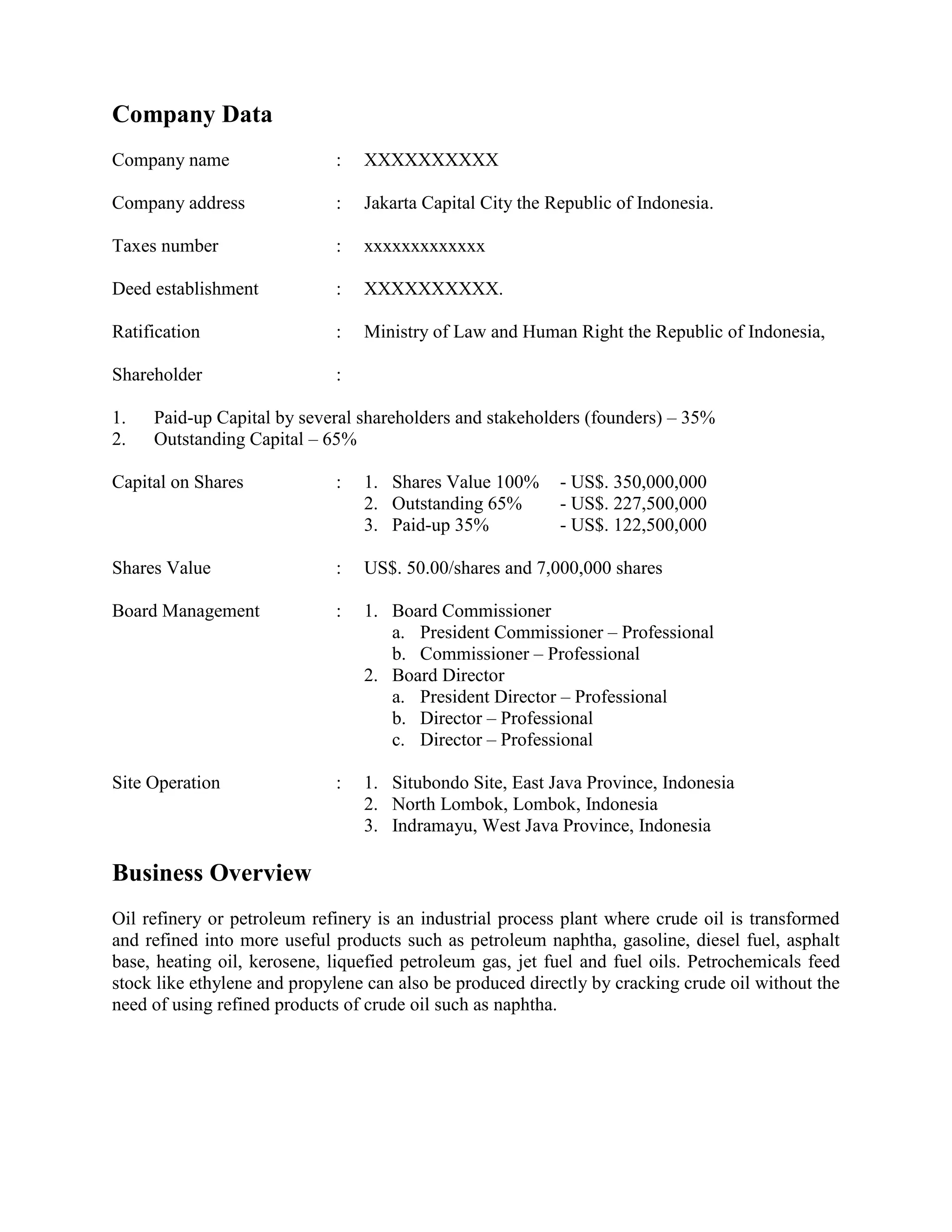
Company Data
Company name : XXXXXXXXXX
Company address : Jakarta Capital City the Republic of Indonesia.
Taxes number : xxxxxxxxxxxxx
Deed establishment : XXXXXXXXXX.
Ratification : Ministry of Law and Human Right the Republic of Indonesia,
Shareholder :
1. Paid-up Capital by several shareholders and stakeholders (founders) – 35%
2. Outstanding Capital – 65%
Capital on Shares : 1. Shares Value 100% - US$. 350,000,000
2. Outstanding 65% - US$. 227,500,000
3. Paid-up 35% - US$. 122,500,000
Shares Value : US$. 50.00/shares and 7,000,000 shares
Board Management : 1. Board Commissioner
a. President Commissioner – Professional
b. Commissioner – Professional
2. Board Director
a. President Director – Professional
b. Director – Professional
c. Director – Professional
Site Operation : 1. Situbondo Site, East Java Province, Indonesia
2. North Lombok, Lombok, Indonesia
3. Indramayu, West Java Province, Indonesia
Business Overview
Oil refinery or petroleum refinery is an industrial process plant where crude oil is transformed
and refined into more useful products such as petroleum naphtha, gasoline, diesel fuel, asphalt
base, heating oil, kerosene, liquefied petroleum gas, jet fuel and fuel oils. Petrochemicals feed
stock like ethylene and propylene can also be produced directly by cracking crude oil without the
need of using refined products of crude oil such as naphtha.
Oil refineries are typically large, sprawling industrial complexes with extensive piping running
throughout, carrying streams of fluids between large chemical processing units, such as
distillation columns. In many ways, oil refineries use much of the technology of, and can be
thought of, as types of chemical plants.
The crude oil feedstock has typically been processed by an oil production plant. There is usually
an oil depot at or near an oil refinery for the storage of incoming crude oil feedstock as well as
bulk liquid products.
Petroleum refineries are very large industrial complexes that involve many different processing
units and auxiliary facilities such as utility units and storage tanks. Each refinery has its own
unique arrangement and combination of refining processes largely determined by the refinery
location, desired products and economic considerations.
An oil refinery is considered an essential part of the downstream side of the petroleum industry.
Operation
Raw or unprocessed crude oil is not generally useful in industrial applications, although "light,
sweet" (low viscosity, low sulfur) crude oil has been used directly as a burner fuel to produce
steam for the propulsion of seagoing vessels. The lighter elements, however, form explosive
vapors in the fuel tanks and are therefore hazardous, especially in warships. Instead, the
hundreds of different hydrocarbon molecules in crude oil are separated in a refinery into
components which can be used as fuels, lubricants, and as feedstocks in petrochemical processes
that manufacture such products as plastics, detergents, solvents, elastomers and fibers such as
nylon and polyesters.
Petroleum fossil fuels are burned in internal combustion engines to provide power for ships,
automobiles, aircraft engines, lawn mowers, dirt bikes, and other machines. Different boiling
points allow the hydrocarbons to be separated by distillation. Since the lighter liquid products are
in great demand for use in internal combustion engines, a modern refinery will convert heavy
hydrocarbons and lighter gaseous elements into these higher value products.
Oil can be used in a variety of ways because it contains hydrocarbons of varying molecular
masses, forms and lengths such as paraffins, aromatics, naphthenes (or cycloalkanes), alkenes,
dienes, and alkynes. While the molecules in crude oil include different atoms such as sulfur and
nitrogen, the hydrocarbons are the most common form of molecules, which are molecules of
varying lengths and complexity made of hydrogen and carbon atoms, and a small number of
oxygen atoms. The differences in the structure of these molecules account for their varying
physical and chemical properties, and it is this variety that makes crude oil useful in a broad
range of several applications.
Once separated and purified of any contaminants and impurities, the fuel or lubricant can be sold
without further processing. Smaller molecules such as isobutane and propylene or butylenes can
be recombined to meet specific octane requirements by processes such as alkylation, or more
commonly, dimerization.
The octane grade of gasoline can also be improved by catalytic reforming, which involves
removing hydrogen from hydrocarbons producing compounds with higher octane ratings such as
aromatics. Intermediate products such as gas oils can even be reprocessed to break a heavy, long-
chained oil into a lighter short-chained one, by various forms of cracking such as fluid catalytic
cracking, thermal cracking, and hydrocracking. The final step in gasoline production is the
blending of fuels with different octane ratings, vapor pressures, and other properties to meet
product specifications. Another method for reprocessing and upgrading these intermediate
products (residual oils) uses a devolatilization process to separate usable oil from the waste
asphaltene material.
Oil refineries are large scale plants, processing about a hundred thousand to several hundred
thousand barrels of crude oil a day. Because of the high capacity, many of the units operate
continuously, as opposed to processing in batches, at steady state or nearly steady state for
months to years. The high capacity also makes process optimization and advanced process
control very desirable.
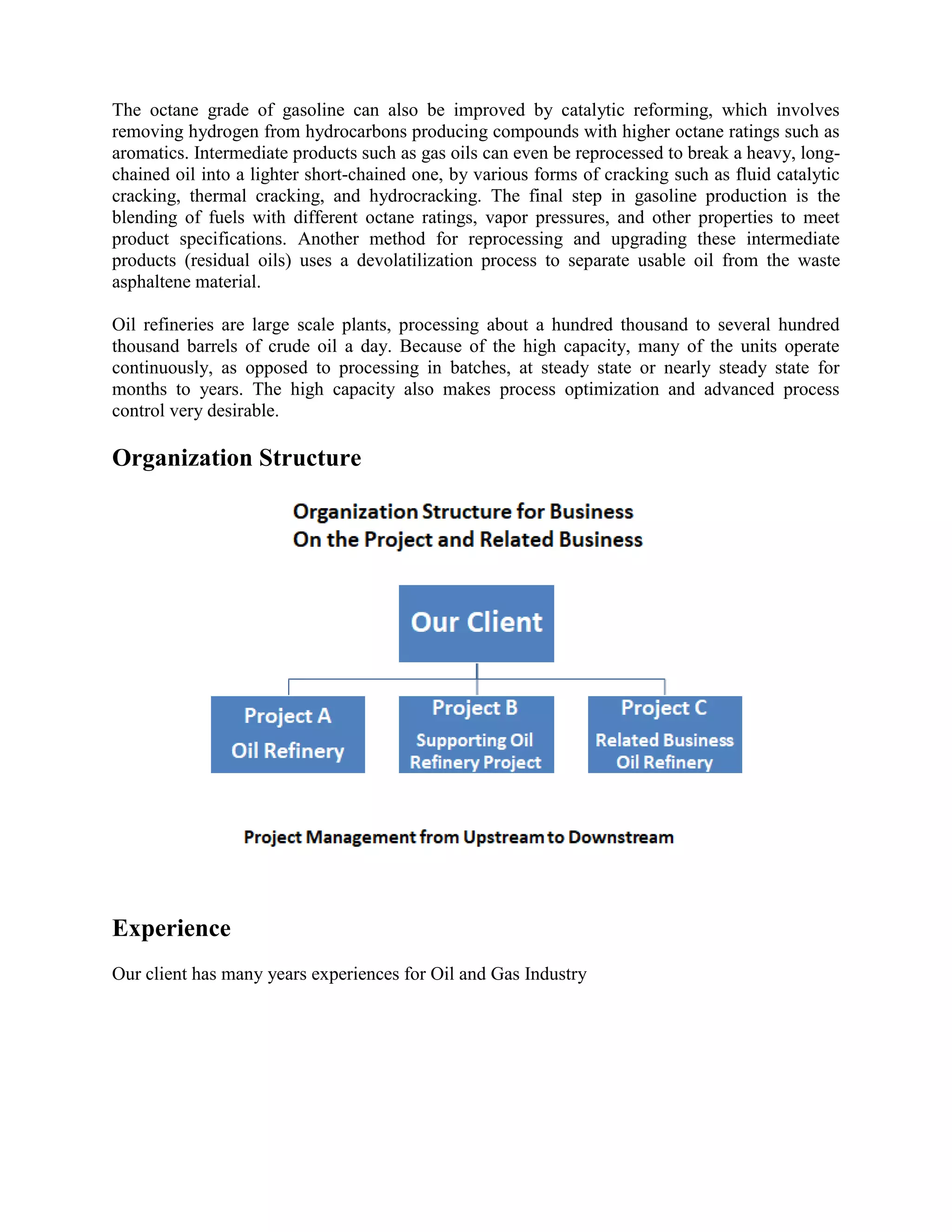
Organization Structure
Experience
Our client has many years experiences for Oil and Gas Industry
Products
Petroleum products are materials derived from crude oil (petroleum) as it is processed in oil
refineries. The majority of petroleum is converted to petroleum products, which includes several
classes of fuels.
Oil refineries also produce various intermediate products such as hydrogen, light hydrocarbons,
reformate and pyrolysis gasoline. These are not usually transported but instead are blended or
processed further on-site. Chemical plants are thus often adjacent to oil refineries or a number of
further chemical processes are integrated into it. For example, light hydrocarbons are steam-
cracked in an ethylene plant, and the produced ethylene is polymerized to produce polyethene.
Because technical reasons and environment protection demand very low sulfur content in all but
the heaviest products, it is transformed to hydrogen sulfide via catalytic hydro desulfurization
and removed from the product stream via amine gas treating. Using the Claus process, hydrogen
sulfide is afterwards transformed to elementary sulfur to be sold to the chemical industry. The
rather large heat energy freed by this process is directly used in the other parts of the refinery.
Often an electrical power plant is combined into the whole refinery process to take up the excess
heat.
According to the composition of the crude oil and depending on the demands of the market,
refineries can produce different shares of petroleum products. The largest share of oil products is
used as "energy carriers", i.e. various grades of fuel oil and gasoline. These fuels include or can
be blended to give gasoline, jet fuel, diesel fuel, heating oil, and heavier fuel oils. Heavier (less
volatile) fractions can also be used to produce asphalt, tar, paraffin wax, lubricating and other
heavy oils. Refineries also produce other chemicals, some of which are used in chemical
processes to produce plastics and other useful materials. Since petroleum often contains a few
percent sulfur-containing molecules, elemental sulfur is also often produced as a petroleum
product. Carbon, in the form of petroleum coke, and hydrogen may also be produced as
petroleum products. The hydrogen produced is often used as an intermediate product for other oil
refinery processes such as hydrocracking and hydro desulfurization.
Petroleum products are usually grouped into four categories: light distillates (LPG, gasoline,
naphtha), middle distillates (kerosene, jet fuel, diesel), heavy distillates and residuum (heavy fuel
oil, lubricating oils, wax, asphalt). These require blending various feed stocks, mixing
appropriate additives, providing short term storage, and preparation for bulk loading to trucks,
barges, product ships, and railcars. This classification is based on the way crude oil is distilled
and separated into fractions.
Gaseous fuel such as Liquified petroleum gas and propane, stored and shipped in liquid form
under pressure.
Lubricants (produces light machine oils, motor oils, and greases, adding viscosity stabilizers as
required), usually shipped in bulk to an offsite packaging plant.
Paraffin wax, used in the packaging of frozen foods, among others, may be shipped in bulk to a
site to prepare as packaged blocks. Used for wax emulsions, construction board, matches,
candles, rust protection, and vapor barriers.
Sulfur (or sulfuric acid), byproducts of sulfur removal from petroleum which may have up to a
couple percent sulfur as organic sulfur-containing compounds.
Sulfur and sulfuric acid are useful industrial materials. Sulfuric acid is usually prepared and
shipped as the acid precursor oleum.
Bulk tar shipping for offsite unit packaging for use in tar-and-gravel roofing.
Asphalt used as a binder for gravel to form asphalt concrete, which is used for paving roads, lots,
etc. An asphalt unit prepares bulk asphalt for shipment.
Petroleum coke, used in specialty carbon products like electrodes or as solid fuel.
Petrochemicals are organic compounds that are the ingredients for the chemical industry, ranging
from polymers and pharmaceuticals, including ethylene and benzene-toluene-xylenes ("BTX")
which are often sent to petrochemical plants for further processing in a variety of ways. The
petrochemicals may be olefins or their precursors, or various types of aromatic petrochemicals.
 Gasoline
 Naphtha
 Kerosene and related jet aircraft fuels
 Diesel fuel and Fuel oils
 Heat
 Electricity
Over 6,000 items are made from petroleum waste by-products including: fertilizer, floor
coverings, perfume, insecticide, petroleum jelly, soap, vitamin capsules. See link to partial list of
144 by-products listed by Ranken Energy.
Business Plan
At present, Indonesia imports about 400-450 thousand barrels of oil products per day to cover
domestic needs. A significant part of diesel fuel for ships passing along neighbouring transport
routes is also imported into the country.
The product line of Refinery will include ship diesel (about 50%) and fuel oil (about 50%).
Options of deeper processing of crude oil and construction of the second line of Refinery are also
considered.
The framework of the project includes the necessary infrastructure. CHPP (combined heat and
power plant) will be built to provide power and steam to the refinery. Local households and
enterprises will consume some of the electricity.
Design, manufacturing and procurement of the main technology and equipment of main
processes, as well as commissioning and installation supervision can be carried out by the
Consortium of Companies:
1. Indonesian Company;
2. Various companies in the worlds with many years experiences on Asia – Pacific
Client’s Partner carry out specialized construction and installation works and Our Client (local
construction companies) will perform civil works.
The rough costs are following:
- Refinery with capacity of 50 000 BPD
- Port with capacity of 4,000,000 TEU per year plus Tanks for Refinery
- Power Plants
- Gas fired Power Plant based on LNG including transmission Lines, Distribution Station,
Transformers etc
Capital Raise Goal
Capitalization will need US$. 70,000,000 (seventy million United State Dollars), to pay the
following:
1. US$. 47,000,000 (forty seven million United State Dollar) for all preparation on business
expand on Oil Refinery Project and all related project.
2. US$. 13,000,000 (thirteen million United State Dollar) for purchase the machinery,
equipment and mobilization them at the site operation of business expand.
3. US$. 10,000,000 (ten million United State Dollar) for all business support at the site of
business expand on 60 days after contract signed.
Capital Paid Up on Shares
1. Local Partners 35% 2,450,000 shares @US$.50/share US$.122,500,000
2. Shares offered 20% 1,400,000 shares @US$.50/share US$. 70,000,000
3. Outstanding 45% 3,150,000 shares @US$.50/share US$.157,500,000
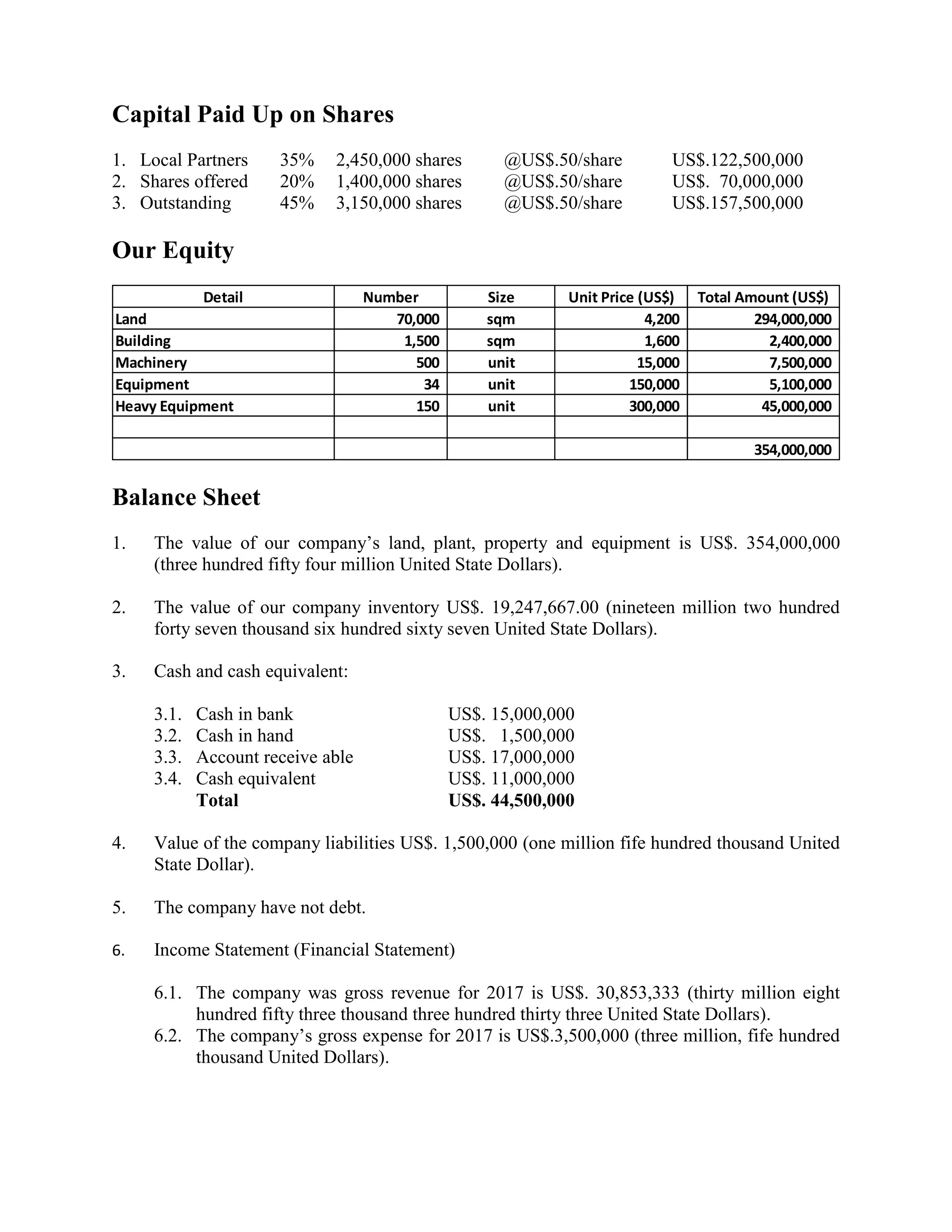
Our Equity
Balance Sheet
1. The value of our company’s land, plant, property and equipment is US$. 354,000,000
(three hundred fifty four million United State Dollars).
2. The value of our company inventory US$. 19,247,667.00 (nineteen million two hundred
forty seven thousand six hundred sixty seven United State Dollars).
3. Cash and cash equivalent:
3.1. Cash in bank US$. 15,000,000
3.2. Cash in hand US$. 1,500,000
3.3. Account receive able US$. 17,000,000
3.4. Cash equivalent US$. 11,000,000
Total US$. 44,500,000
4. Value of the company liabilities US$. 1,500,000 (one million fife hundred thousand United
State Dollar).
5. The company have not debt.
6. Income Statement (Financial Statement)
6.1. The company was gross revenue for 2017 is US$. 30,853,333 (thirty million eight
hundred fifty three thousand three hundred thirty three United State Dollars).
6.2. The company’s gross expense for 2017 is US$.3,500,000 (three million, fife hundred
thousand United Dollars).
Detail Number Size Unit Price (US$) Total Amount (US$)
Land 70,000 sqm 4,200 294,000,000
Building 1,500 sqm 1,600 2,400,000
Machinery 500 unit 15,000 7,500,000
Equipment 34 unit 150,000 5,100,000
Heavy Equipment 150 unit 300,000 45,000,000
354,000,000
6.3. The company has earning before taxes for 2017 is US$. 27,353,333 (twenty seven
thousand three hundred fifty three thousand three hundred thirty three United State
Dollars)
6.4. The company’s net income for 2017 is US$. 20,515,000 (twenty million fife hundred
fifteen thousand United State Dollars).
Our Offering
Offering or Sale Preferred Shares for 20% (twenty percent) shares:
20% (twenty percent) preferred shares of 7,000,000 (seven million) shares is 1,400,000 (one
million four hundred thousand) preferred shares, for the price US$. 70,000,000 (seventy million
United States Dollar).
Capitalization Table
Drawdown Planning
Board Management
1. Board Commissioner
a. President Commissioner – Investor
b. Commissioner – Indonesian Professional
c. Commissioner – Indonesian Professional
Percentage (%) Price (US$) Percentage (%) Price (US$)
Shares 100% 350,000,000
Paid-Up 35% 122,500,000 35% 122,500,000
Investor (Preferred Shares) - 20% 70,000,000
Outstanding (Common Shares) 65% 227,500,000 45% 157,500,000
Total 100% 350,000,000 100% 350,000,000
Before Capitalization
Shareholders
After Capitalization
Detail Percentage (%) Investment (US$) Amount (US$) Remark
Investment 70,000,000
First Drawdown 25% 17,500,000 7 days after contract signed
Second Drawdown 30% 21,000,000 30 days after contract signed
Third Drawdown 45% 31,500,000 60 days after contract signed
Total 100% 70,000,000
2. Board Director
a. President Director – Indonesian Professional
b. Director – Indonesian Professional
c. Director - Investor
Dividends
Dividends are profit sharing for shareholders based on what they have. This division will reduce
the profit and money available to the company, but the distribution of profits to the owners is
indeed the main goal of the business.
Dividends can be put together into four types:
1. Cash Dividend : The most common method for profit sharing. Paid in cash and
taxable in the year of expense.
2. Dividend Shares : Quite commonly used and used in various forms, usually
calculated based on the number of shares owned. For example,
every 100 shares owned, 5 additional shares are distributed. This
method is similar to stock split because it is done by increasing
the number of shares while reducing the value of each stock does
not change the market capitalization.
3. Dividend Property : Transferred in the form of assets. Dividend distribution in this
way is rarely done.
4. Temporary dividend : Side before the financial year of the Company ends.
Companies may not pay dividends, if in case the company wants to use profits for development
or business development.
Jakarta, May 13, 2018
PT. W2P Manajemen Bisnis
Business Advisor
SETIONO WINARDI, SH.MBA
Managing Partner
Contact:
setiono@ilm.co.id or winardi67@gmail.com. M.+6281315421509. Wa.+6287877687058

Looks for capitalization on the Oil Refinery Project

  • 1.
    CAPITALIZATION FOR OIL REFINERY PROJECT PT. W2P’sClient Presented by PT. W2P MANAJEMEN BISNIS 2018
  • 2.
    Overview Our client isan engineering and project management company established under the laws of the Republic of Indonesia, and pioneered since October 2004. On July 2014, the company has transformed to Our Client with the main purpose is to provide alternative solutions in managing the turnkey project through delivering engineering and project management team integrated in Client’s organization. We provide the project management and engineering services throughout the 4 phases of the project life cycle from concept, development, implementations to close-out the Client’s larger, complex, and high risk projects. Vision, Mission and Objective VISION To be one of world-class Engineering & Project Management based company dedicated to a better world MISSION Providing the best values to the stakeholders through excellent services by empowering human capital OBJECTIVE To be the market leader company on oil and gas industry from Upstream to Downstream, which is interconnected business.
  • 3.
    Company Data Company name: XXXXXXXXXX Company address : Jakarta Capital City the Republic of Indonesia. Taxes number : xxxxxxxxxxxxx Deed establishment : XXXXXXXXXX. Ratification : Ministry of Law and Human Right the Republic of Indonesia, Shareholder : 1. Paid-up Capital by several shareholders and stakeholders (founders) – 35% 2. Outstanding Capital – 65% Capital on Shares : 1. Shares Value 100% - US$. 350,000,000 2. Outstanding 65% - US$. 227,500,000 3. Paid-up 35% - US$. 122,500,000 Shares Value : US$. 50.00/shares and 7,000,000 shares Board Management : 1. Board Commissioner a. President Commissioner – Professional b. Commissioner – Professional 2. Board Director a. President Director – Professional b. Director – Professional c. Director – Professional Site Operation : 1. Situbondo Site, East Java Province, Indonesia 2. North Lombok, Lombok, Indonesia 3. Indramayu, West Java Province, Indonesia Business Overview Oil refinery or petroleum refinery is an industrial process plant where crude oil is transformed and refined into more useful products such as petroleum naphtha, gasoline, diesel fuel, asphalt base, heating oil, kerosene, liquefied petroleum gas, jet fuel and fuel oils. Petrochemicals feed stock like ethylene and propylene can also be produced directly by cracking crude oil without the need of using refined products of crude oil such as naphtha.
  • 4.
    Oil refineries aretypically large, sprawling industrial complexes with extensive piping running throughout, carrying streams of fluids between large chemical processing units, such as distillation columns. In many ways, oil refineries use much of the technology of, and can be thought of, as types of chemical plants. The crude oil feedstock has typically been processed by an oil production plant. There is usually an oil depot at or near an oil refinery for the storage of incoming crude oil feedstock as well as bulk liquid products. Petroleum refineries are very large industrial complexes that involve many different processing units and auxiliary facilities such as utility units and storage tanks. Each refinery has its own unique arrangement and combination of refining processes largely determined by the refinery location, desired products and economic considerations. An oil refinery is considered an essential part of the downstream side of the petroleum industry. Operation Raw or unprocessed crude oil is not generally useful in industrial applications, although "light, sweet" (low viscosity, low sulfur) crude oil has been used directly as a burner fuel to produce steam for the propulsion of seagoing vessels. The lighter elements, however, form explosive vapors in the fuel tanks and are therefore hazardous, especially in warships. Instead, the hundreds of different hydrocarbon molecules in crude oil are separated in a refinery into components which can be used as fuels, lubricants, and as feedstocks in petrochemical processes that manufacture such products as plastics, detergents, solvents, elastomers and fibers such as nylon and polyesters. Petroleum fossil fuels are burned in internal combustion engines to provide power for ships, automobiles, aircraft engines, lawn mowers, dirt bikes, and other machines. Different boiling points allow the hydrocarbons to be separated by distillation. Since the lighter liquid products are in great demand for use in internal combustion engines, a modern refinery will convert heavy hydrocarbons and lighter gaseous elements into these higher value products. Oil can be used in a variety of ways because it contains hydrocarbons of varying molecular masses, forms and lengths such as paraffins, aromatics, naphthenes (or cycloalkanes), alkenes, dienes, and alkynes. While the molecules in crude oil include different atoms such as sulfur and nitrogen, the hydrocarbons are the most common form of molecules, which are molecules of varying lengths and complexity made of hydrogen and carbon atoms, and a small number of oxygen atoms. The differences in the structure of these molecules account for their varying physical and chemical properties, and it is this variety that makes crude oil useful in a broad range of several applications. Once separated and purified of any contaminants and impurities, the fuel or lubricant can be sold without further processing. Smaller molecules such as isobutane and propylene or butylenes can be recombined to meet specific octane requirements by processes such as alkylation, or more commonly, dimerization.
  • 5.
    The octane gradeof gasoline can also be improved by catalytic reforming, which involves removing hydrogen from hydrocarbons producing compounds with higher octane ratings such as aromatics. Intermediate products such as gas oils can even be reprocessed to break a heavy, long- chained oil into a lighter short-chained one, by various forms of cracking such as fluid catalytic cracking, thermal cracking, and hydrocracking. The final step in gasoline production is the blending of fuels with different octane ratings, vapor pressures, and other properties to meet product specifications. Another method for reprocessing and upgrading these intermediate products (residual oils) uses a devolatilization process to separate usable oil from the waste asphaltene material. Oil refineries are large scale plants, processing about a hundred thousand to several hundred thousand barrels of crude oil a day. Because of the high capacity, many of the units operate continuously, as opposed to processing in batches, at steady state or nearly steady state for months to years. The high capacity also makes process optimization and advanced process control very desirable. Organization Structure Experience Our client has many years experiences for Oil and Gas Industry
  • 6.
    Products Petroleum products arematerials derived from crude oil (petroleum) as it is processed in oil refineries. The majority of petroleum is converted to petroleum products, which includes several classes of fuels. Oil refineries also produce various intermediate products such as hydrogen, light hydrocarbons, reformate and pyrolysis gasoline. These are not usually transported but instead are blended or processed further on-site. Chemical plants are thus often adjacent to oil refineries or a number of further chemical processes are integrated into it. For example, light hydrocarbons are steam- cracked in an ethylene plant, and the produced ethylene is polymerized to produce polyethene. Because technical reasons and environment protection demand very low sulfur content in all but the heaviest products, it is transformed to hydrogen sulfide via catalytic hydro desulfurization and removed from the product stream via amine gas treating. Using the Claus process, hydrogen sulfide is afterwards transformed to elementary sulfur to be sold to the chemical industry. The rather large heat energy freed by this process is directly used in the other parts of the refinery. Often an electrical power plant is combined into the whole refinery process to take up the excess heat. According to the composition of the crude oil and depending on the demands of the market, refineries can produce different shares of petroleum products. The largest share of oil products is used as "energy carriers", i.e. various grades of fuel oil and gasoline. These fuels include or can be blended to give gasoline, jet fuel, diesel fuel, heating oil, and heavier fuel oils. Heavier (less volatile) fractions can also be used to produce asphalt, tar, paraffin wax, lubricating and other heavy oils. Refineries also produce other chemicals, some of which are used in chemical processes to produce plastics and other useful materials. Since petroleum often contains a few percent sulfur-containing molecules, elemental sulfur is also often produced as a petroleum product. Carbon, in the form of petroleum coke, and hydrogen may also be produced as petroleum products. The hydrogen produced is often used as an intermediate product for other oil refinery processes such as hydrocracking and hydro desulfurization. Petroleum products are usually grouped into four categories: light distillates (LPG, gasoline, naphtha), middle distillates (kerosene, jet fuel, diesel), heavy distillates and residuum (heavy fuel oil, lubricating oils, wax, asphalt). These require blending various feed stocks, mixing appropriate additives, providing short term storage, and preparation for bulk loading to trucks, barges, product ships, and railcars. This classification is based on the way crude oil is distilled and separated into fractions. Gaseous fuel such as Liquified petroleum gas and propane, stored and shipped in liquid form under pressure.
  • 7.
    Lubricants (produces lightmachine oils, motor oils, and greases, adding viscosity stabilizers as required), usually shipped in bulk to an offsite packaging plant. Paraffin wax, used in the packaging of frozen foods, among others, may be shipped in bulk to a site to prepare as packaged blocks. Used for wax emulsions, construction board, matches, candles, rust protection, and vapor barriers. Sulfur (or sulfuric acid), byproducts of sulfur removal from petroleum which may have up to a couple percent sulfur as organic sulfur-containing compounds. Sulfur and sulfuric acid are useful industrial materials. Sulfuric acid is usually prepared and shipped as the acid precursor oleum. Bulk tar shipping for offsite unit packaging for use in tar-and-gravel roofing. Asphalt used as a binder for gravel to form asphalt concrete, which is used for paving roads, lots, etc. An asphalt unit prepares bulk asphalt for shipment. Petroleum coke, used in specialty carbon products like electrodes or as solid fuel. Petrochemicals are organic compounds that are the ingredients for the chemical industry, ranging from polymers and pharmaceuticals, including ethylene and benzene-toluene-xylenes ("BTX") which are often sent to petrochemical plants for further processing in a variety of ways. The petrochemicals may be olefins or their precursors, or various types of aromatic petrochemicals.  Gasoline  Naphtha  Kerosene and related jet aircraft fuels  Diesel fuel and Fuel oils  Heat  Electricity Over 6,000 items are made from petroleum waste by-products including: fertilizer, floor coverings, perfume, insecticide, petroleum jelly, soap, vitamin capsules. See link to partial list of 144 by-products listed by Ranken Energy.
  • 8.
    Business Plan At present,Indonesia imports about 400-450 thousand barrels of oil products per day to cover domestic needs. A significant part of diesel fuel for ships passing along neighbouring transport routes is also imported into the country. The product line of Refinery will include ship diesel (about 50%) and fuel oil (about 50%). Options of deeper processing of crude oil and construction of the second line of Refinery are also considered. The framework of the project includes the necessary infrastructure. CHPP (combined heat and power plant) will be built to provide power and steam to the refinery. Local households and enterprises will consume some of the electricity. Design, manufacturing and procurement of the main technology and equipment of main processes, as well as commissioning and installation supervision can be carried out by the Consortium of Companies: 1. Indonesian Company; 2. Various companies in the worlds with many years experiences on Asia – Pacific Client’s Partner carry out specialized construction and installation works and Our Client (local construction companies) will perform civil works. The rough costs are following: - Refinery with capacity of 50 000 BPD - Port with capacity of 4,000,000 TEU per year plus Tanks for Refinery - Power Plants - Gas fired Power Plant based on LNG including transmission Lines, Distribution Station, Transformers etc Capital Raise Goal Capitalization will need US$. 70,000,000 (seventy million United State Dollars), to pay the following: 1. US$. 47,000,000 (forty seven million United State Dollar) for all preparation on business expand on Oil Refinery Project and all related project. 2. US$. 13,000,000 (thirteen million United State Dollar) for purchase the machinery, equipment and mobilization them at the site operation of business expand. 3. US$. 10,000,000 (ten million United State Dollar) for all business support at the site of business expand on 60 days after contract signed.
  • 9.
    Capital Paid Upon Shares 1. Local Partners 35% 2,450,000 shares @US$.50/share US$.122,500,000 2. Shares offered 20% 1,400,000 shares @US$.50/share US$. 70,000,000 3. Outstanding 45% 3,150,000 shares @US$.50/share US$.157,500,000 Our Equity Balance Sheet 1. The value of our company’s land, plant, property and equipment is US$. 354,000,000 (three hundred fifty four million United State Dollars). 2. The value of our company inventory US$. 19,247,667.00 (nineteen million two hundred forty seven thousand six hundred sixty seven United State Dollars). 3. Cash and cash equivalent: 3.1. Cash in bank US$. 15,000,000 3.2. Cash in hand US$. 1,500,000 3.3. Account receive able US$. 17,000,000 3.4. Cash equivalent US$. 11,000,000 Total US$. 44,500,000 4. Value of the company liabilities US$. 1,500,000 (one million fife hundred thousand United State Dollar). 5. The company have not debt. 6. Income Statement (Financial Statement) 6.1. The company was gross revenue for 2017 is US$. 30,853,333 (thirty million eight hundred fifty three thousand three hundred thirty three United State Dollars). 6.2. The company’s gross expense for 2017 is US$.3,500,000 (three million, fife hundred thousand United Dollars). Detail Number Size Unit Price (US$) Total Amount (US$) Land 70,000 sqm 4,200 294,000,000 Building 1,500 sqm 1,600 2,400,000 Machinery 500 unit 15,000 7,500,000 Equipment 34 unit 150,000 5,100,000 Heavy Equipment 150 unit 300,000 45,000,000 354,000,000
  • 10.
    6.3. The companyhas earning before taxes for 2017 is US$. 27,353,333 (twenty seven thousand three hundred fifty three thousand three hundred thirty three United State Dollars) 6.4. The company’s net income for 2017 is US$. 20,515,000 (twenty million fife hundred fifteen thousand United State Dollars). Our Offering Offering or Sale Preferred Shares for 20% (twenty percent) shares: 20% (twenty percent) preferred shares of 7,000,000 (seven million) shares is 1,400,000 (one million four hundred thousand) preferred shares, for the price US$. 70,000,000 (seventy million United States Dollar). Capitalization Table Drawdown Planning Board Management 1. Board Commissioner a. President Commissioner – Investor b. Commissioner – Indonesian Professional c. Commissioner – Indonesian Professional Percentage (%) Price (US$) Percentage (%) Price (US$) Shares 100% 350,000,000 Paid-Up 35% 122,500,000 35% 122,500,000 Investor (Preferred Shares) - 20% 70,000,000 Outstanding (Common Shares) 65% 227,500,000 45% 157,500,000 Total 100% 350,000,000 100% 350,000,000 Before Capitalization Shareholders After Capitalization Detail Percentage (%) Investment (US$) Amount (US$) Remark Investment 70,000,000 First Drawdown 25% 17,500,000 7 days after contract signed Second Drawdown 30% 21,000,000 30 days after contract signed Third Drawdown 45% 31,500,000 60 days after contract signed Total 100% 70,000,000
  • 11.
    2. Board Director a.President Director – Indonesian Professional b. Director – Indonesian Professional c. Director - Investor Dividends Dividends are profit sharing for shareholders based on what they have. This division will reduce the profit and money available to the company, but the distribution of profits to the owners is indeed the main goal of the business. Dividends can be put together into four types: 1. Cash Dividend : The most common method for profit sharing. Paid in cash and taxable in the year of expense. 2. Dividend Shares : Quite commonly used and used in various forms, usually calculated based on the number of shares owned. For example, every 100 shares owned, 5 additional shares are distributed. This method is similar to stock split because it is done by increasing the number of shares while reducing the value of each stock does not change the market capitalization. 3. Dividend Property : Transferred in the form of assets. Dividend distribution in this way is rarely done. 4. Temporary dividend : Side before the financial year of the Company ends. Companies may not pay dividends, if in case the company wants to use profits for development or business development. Jakarta, May 13, 2018 PT. W2P Manajemen Bisnis Business Advisor SETIONO WINARDI, SH.MBA Managing Partner Contact: setiono@ilm.co.id or winardi67@gmail.com. M.+6281315421509. Wa.+6287877687058