Clinical Trial Protocol, Amendments,
Protocol deviations & violations
Dr. Amol Patil
Assistant Professor
Department of Pharmacology
PGIMER, Chandigarh
Protocol
• A system of rules that explain the correct conduct and
procedures to be followed in formal situations....
Merriam Webster
Why?
• To enumerate the research plan
• To ensure the quality
• Document for communication
• Source for a review document
• Legal document
• Part of IND application
A clinical trial protocol is a plan that meets scientific and ethical
requirements as well as good clinical practice
Points to be considered
• Research question
• Target patient population
• Design characteristics
• Treatment characteristics
• Data collection and analysis
• Ethical obligations
• Legal responsibilities
• Research management
Construction of a protocol
• General Information
• Background Information
• Aims and objectives
• Inclusion – Exclusion Criteria
• Trial design and Methodology
• Statistics
• Ethical consideration
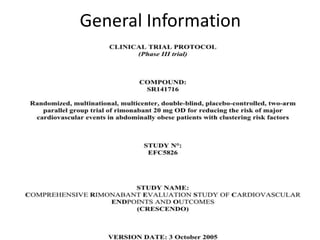
General Information
• Protocol title, protocol identifying number, and date
Example – Cresendo Study
General Information
General Information
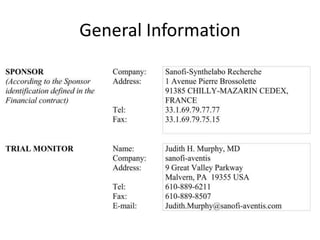
• Name and address of the sponsor and monitor
General Information
General Information
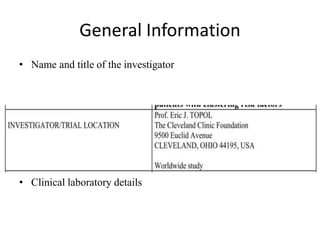
• Name and title of the investigator
• Clinical laboratory details
Background Information
• Name and description of the investigational product
• Non clinical study findings
• Summary of potential risks
• Route, Dosage and regimen
• Description of the population to be studied
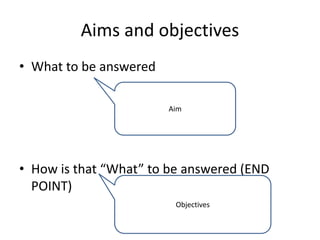
Aims and objectives
• What to be answered
• How is that “What” to be answered (END
POINT)
Aim
Objectives
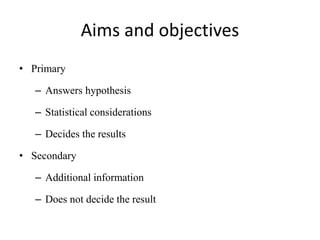
Aims and objectives
• Primary
– Answers hypothesis
– Statistical considerations
– Decides the results
• Secondary
– Additional information
– Does not decide the result
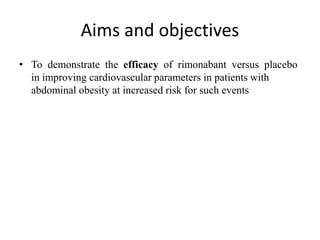
Aims and objectives
• To demonstrate the efficacy of rimonabant versus placebo
in improving cardiovascular parameters in patients with
abdominal obesity at increased risk for such events
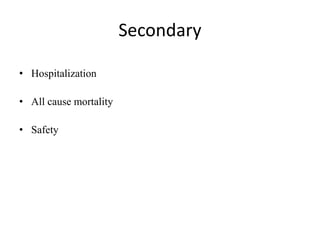
Secondary
• Hospitalization
• All cause mortality
• Safety
End point
• Results, condition or events associated with individual study
patients that are used to assess study treatments
Characteristics of Endpoint
• Easy to diagnose
– Easy to identify - no evaluator judgment needed
• Free of measurement error
– Reliable with repeated measure
• Internal validity
– Directly linked to property of interest
• External validity
– Ability to generalize to a wider population
• Clinically relevant
Surrogate Endpoint
• Surrogate endpoint – used instead of direct endpoint – ex BP
or Cholesterol LDL
• Reduction as 1˚ endpoint as opposed to a reduction in
morbidity or mortality
Primary and Secondary Endpoints
• Primary – single (may be composite) endpoint parameter for
rejection of the null hypothesis
– Regulatory implication
• Secondary- other endpoints pre-specified, may be powered for
hypothesis testing
Primary Endpoint
• Primary: First occurrence of one of the following Clinical
Events Committee-adjudicated events
– Any MI,
– Any stroke, or
– Cardiovascular death
Secondary Endpoints
• Hospitalization for cardiovascular cause
• All Cause Mortality
• All adverse events
• Heart rate and blood pressure
• Hematology and biochemistry assessments
Inclusion – Exclusion Criteria(IE)
• Should be exhaustive and not vague
• Should include potential participants
• Should exclude the population harmed by study and who
cannot demonstrate efficacy (wrong study population)
Inclusion
• Consent
• Men and women aged 55 or greater
• Presence of abdominal obesity, with a waist circumference
greater than 102 cm (40 inches) for males and greater than 88
cm (35 inches) for females
Inclusion
• Presence of at least one coronary heart disease risk equivalent
OR two major cardiovascular risk factors
Inclusion – CHD Risk Equivalent
• Recent (within the past 3 years) myocardial infarction
• H/o angina, multivessel disease or PCI
• Cerebral ishcemic event
• PAD
Inclusion – Risk factors
• Metabolic syndrome
• Asymptomatic cerebrovascular disease
• Renal artery disease
• Elevated hs-CRP
• Elevated age
Exclusion
• Obesity due to known endocrine disorder
• Bariatric surgery
• Low Calorie Diet
• Presence of other conditions
• Breast feeding women
Study Design
• Type/design of trial to be conducted
Multicenter, multinational, randomized, parallel-group, double-
blind, controlled trial of rimonabant versus placebo
Methodology
• Screening
• Randomization
• Blinding
• Treatment administration
• Baseline and follow-up
• Assessment of efficacy and safety
• Duration
• Medication
• Stopping criteria
Methodology – Treatment
Administration
• Group 1 (rimonabant 20 mg): once daily administration in
the morning of one tablet containing 20 mg of active
rimonabant
• Group 2 (rimonabant placebo) once daily administration in
the morning of one rimonabant placebo tablet
• Tablet must be administered orally in the morning before
breakfast.
Methodology - Blinding
• The two types of tablets developed (20 mg rimonabant and
placebo rimonabant) are indistinguishable, and are packaged in
identical wallet cards
Methodology - Randomization
• The Interactive Voice Response System (IVRS) center will
allocate treatment based on a pre-specified randomization list,
generated by the IVRS provider, using study center as
stratification parameter
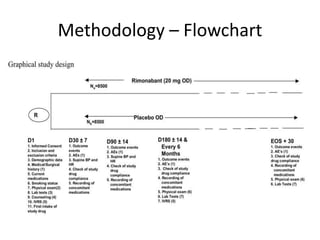
Methodology – Flowchart
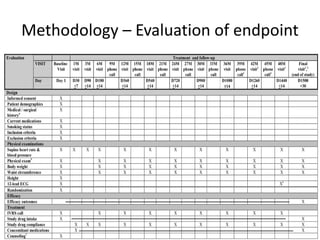
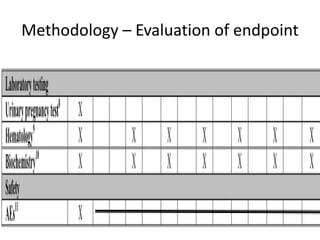
Methodology – Evaluation of endpoint
Methodology
• Definition of source data
• Permitted concomitant treatment
• Treatment compliance
• How to deal with adverse events
• How to report adverse events
• Withdrawal criteria
• Follow up after withdrawal
Statistics
• Determination of sample size
• Statistical plans
• Clinical Trial Protocol deviations
• Population analyzed
• Handling of missing data
• Subgroup analysis
• Interim analysis
Premature closure
• Results of the Clinical Trial do not appear to be scientifically
convincing
• Aim of the Clinical Trial has become outdated
• Doubtful risk/benefit ratio
Ethics and Regulations
• This Clinical Trial will be conducted in accordance with the
principles laid down by the18th World Medical Assembly
(Helsinki, 1964)
• This Clinical Trial will be conducted in compliance with all
international laws and regulations
Ethics and Regulations
• Consent procedure
• IRB approval
– Amendments
– Progress report
Quality and Control
• Responsibility of investigators
– Ensure compliance with all procedures
– Provide reliable data
• Responsibilities of the Sponsor
– Monitor - high level of ethical, scientific, technical and
regulatory quality
Quality control
• Monitor visit
– Informed consent
– Patient recruitment and follow-up
– Serious Adverse Event documentation and reporting
– Outcome events documentation and reporting
– Investigational Product allocation
– Patient compliance
– Investigational product accountability
– Quality of data
Quality Control
• Audit by sponsor
• Inspection by regulatory authorities
Others to be included
• Data handling
• Publication policy
• Finance and Insurance
• Compensation
• Confidentiality statement
• Supplements
– CRF
– ICF
– IB
– Patients information sheet
Protocol Amendments
New protocols
• New protocols can be submitted to an existing IND.
• The new study can begin once it has been submitted for review
and the study has local IRB approval.
• You can submit to the FDA and IRB in the order of your
choosing.
• The FDA submission requires a brief description of the most
clinically significant differences between the new protocol and
previously submitted protocol(s).
• While there is no window of DCGI review, it is strongly
recommended that you communicate with the DCGI and make
sure they are OK with your new protocol before going
forward.
• Please note that it is customary to send the FDA a copies of
IRB approval letters and approved ICF documents to show
that IRB requirements have been met.
Changes in a protocol
• Changes to an existing protocol should be submitted to your IND
along with a description of the changes.
• The amended study can begin once it has been submitted to the FDA
for review and the amended study has local IRB approval.
• You can submit to the FDA and IRB in the order of your choosing.
• Examples of protocol changes that must be reported include the
following=
 • Any increase in drug dosage or duration of exposure to drug
 • Any significant increase in the planned number of subjects enrolled
 • New test procedures or dropped test procedures.
While there is no window of DCGI review, it is strongly
recommended that you communicate with the DCGI and make
sure they are OK with your protocol amendment before going
forward.
Please note that it is customary to send the FDA a copies of IRB
approval letters and approved ICF documents to show that
IRB requirements have been met.
Note: A change designed to eliminate immediate hazards to
subjects may be implemented immediately as long as FDA is
subsequently notified
New investigator
• This type of amendment is relevant for multi-center studies.
• When a new site opens to enrollment, the FDA must be notified of
the new investigator (i.e. the PI at the individual site) within 30 days
of enrolling the first subject.
• This requires submission of the sites’ 1572 and the CV of the PI
from that site.
• The FDA will not ‘approve’ your new protocols, protocol changes or
new investigators.
• Notice of new investigators can be batched and submitted at 30-day
intervals. Further, when several submissions are anticipated during a
short period of time, the sponsor is encouraged to batch as a single
submission when possible
Information Amendments
• This is essential information that does not fall within the scope
of Protocol Amendments, IND Safety Reports or Annual
Reports. Examples include new technical information or the
cancellation of a study.
• This information should be submitted as needed but not more
than 30 days.
Protocol Deviations and Protocol
Violations
• A protocol deviation occurs when the activities during a study
diverge from the IRBapproved protocol; a variance from
protocol
• A protocol violation occurs when there is divergence from the
IRB-approved protocol (a deviation) that also: – reduces the
quality or completeness of the data – impacts a subject’s
safety, rights or welfare – affects the scientific integrity
Examples of Protocol Deviations
• Vital signs obtained prior to informed consent
• Weighing participant with shoes on
• Urine dipstick is completed, but not sent for formal U/A
• Targeted physical exam documented instead of complete PE
• Conjugated bilirubin, part of the protocol, is left off the lab
request form, but total bilirubin was drawn and is normal
Examples of Protocol Violations
• Inadequate informed consent
• Enrollment of subjects not meeting the inclusion /exclusion criteria
• Initiation of study procedure prior to completion of informed consent •
Unreported SAE’s
• Improper breaking of the blinding of the study
• Use of prohibited medication
• Incorrect or missing tests
• Mishandled samples
• Multiple visits missed or outside permissible windows
• Inadequate record-keeping
• Intentional deviation from the protocol, GCP or regulations by study
personnel in a non-emergency setting
• Repeated noncompliance by the subject
• Repeated deviations of the same nature
• Falsification
ICH GCP Regulations
• ICH GCP 4.5 Compliance with protocol
• 4.5.1 Investigator should conduct the trial in compliance with
the protocol agreed to and approved by an IRB
• 4.5.2 Investigator should not implement any changes or
deviations from the protocol unless agreed to by the IRB,
sponsor, etc. except when necessary to eliminate immediate
hazards to trial subjects, or when the changes are
administrative or logistical
• ICH GCP 5.20.2 If the monitoring and/or auditing identifies
serious and/or persistent noncompliance on the part of an
investigator/institution, the sponsor should terminate the
investigator’s/institution’s participation in the trial. When an
investigator’s/institution’s participation is terminated because
of non-compliance, the sponsor should notify promptly the
regulatory authority(ies).
• ICHGCP section 5.20.2, the sponsor must view protocol non-
compliance as a ‘violation’ of agreed responsibilities.
FDA / DCGI
• Does not distinguish between a violation and a deviation; all
protocol variances are violations
• Any deviation not reported and later discovered by an audit is
considered noncompliance with the FDA
Who Discovers Deviations/Violations?
• Study team
• Hospital staff:
– Nursing
– Bionutrition Staff
– Pharmacy Staff
– Regulatory Staff
• Auditors, monitors
• Participants
References
• Design and analysis of clinical trials
– SHEIN-CHUNG CHOW
• E6-ICH
• FDA
• CDSCO – Guidance for industry
Clinical trial protocol, ammendments, Protocol deviations and violations

Clinical trial protocol, ammendments, Protocol deviations and violations

  • 1.
    Clinical Trial Protocol,Amendments, Protocol deviations & violations Dr. Amol Patil Assistant Professor Department of Pharmacology PGIMER, Chandigarh
  • 2.
    Protocol • A systemof rules that explain the correct conduct and procedures to be followed in formal situations.... Merriam Webster
  • 3.
    Why? • To enumeratethe research plan • To ensure the quality • Document for communication • Source for a review document • Legal document • Part of IND application A clinical trial protocol is a plan that meets scientific and ethical requirements as well as good clinical practice
  • 4.
    Points to beconsidered • Research question • Target patient population • Design characteristics • Treatment characteristics • Data collection and analysis • Ethical obligations • Legal responsibilities • Research management
  • 5.
    Construction of aprotocol • General Information • Background Information • Aims and objectives • Inclusion – Exclusion Criteria • Trial design and Methodology • Statistics • Ethical consideration
  • 6.
    General Information • Protocoltitle, protocol identifying number, and date Example – Cresendo Study
  • 7.
  • 8.
    General Information • Nameand address of the sponsor and monitor
  • 9.
  • 10.
    General Information • Nameand title of the investigator • Clinical laboratory details
  • 11.
    Background Information • Nameand description of the investigational product • Non clinical study findings • Summary of potential risks • Route, Dosage and regimen • Description of the population to be studied
  • 12.
    Aims and objectives •What to be answered • How is that “What” to be answered (END POINT) Aim Objectives
  • 13.
    Aims and objectives •Primary – Answers hypothesis – Statistical considerations – Decides the results • Secondary – Additional information – Does not decide the result
  • 14.
    Aims and objectives •To demonstrate the efficacy of rimonabant versus placebo in improving cardiovascular parameters in patients with abdominal obesity at increased risk for such events
  • 15.
    Secondary • Hospitalization • Allcause mortality • Safety
  • 16.
    End point • Results,condition or events associated with individual study patients that are used to assess study treatments
  • 17.
    Characteristics of Endpoint •Easy to diagnose – Easy to identify - no evaluator judgment needed • Free of measurement error – Reliable with repeated measure • Internal validity – Directly linked to property of interest • External validity – Ability to generalize to a wider population • Clinically relevant
  • 18.
    Surrogate Endpoint • Surrogateendpoint – used instead of direct endpoint – ex BP or Cholesterol LDL • Reduction as 1˚ endpoint as opposed to a reduction in morbidity or mortality
  • 19.
    Primary and SecondaryEndpoints • Primary – single (may be composite) endpoint parameter for rejection of the null hypothesis – Regulatory implication • Secondary- other endpoints pre-specified, may be powered for hypothesis testing
  • 20.
    Primary Endpoint • Primary:First occurrence of one of the following Clinical Events Committee-adjudicated events – Any MI, – Any stroke, or – Cardiovascular death
  • 21.
    Secondary Endpoints • Hospitalizationfor cardiovascular cause • All Cause Mortality • All adverse events • Heart rate and blood pressure • Hematology and biochemistry assessments
  • 22.
    Inclusion – ExclusionCriteria(IE) • Should be exhaustive and not vague • Should include potential participants • Should exclude the population harmed by study and who cannot demonstrate efficacy (wrong study population)
  • 23.
    Inclusion • Consent • Menand women aged 55 or greater • Presence of abdominal obesity, with a waist circumference greater than 102 cm (40 inches) for males and greater than 88 cm (35 inches) for females
  • 24.
    Inclusion • Presence ofat least one coronary heart disease risk equivalent OR two major cardiovascular risk factors
  • 25.
    Inclusion – CHDRisk Equivalent • Recent (within the past 3 years) myocardial infarction • H/o angina, multivessel disease or PCI • Cerebral ishcemic event • PAD
  • 26.
    Inclusion – Riskfactors • Metabolic syndrome • Asymptomatic cerebrovascular disease • Renal artery disease • Elevated hs-CRP • Elevated age
  • 27.
    Exclusion • Obesity dueto known endocrine disorder • Bariatric surgery • Low Calorie Diet • Presence of other conditions • Breast feeding women
  • 28.
    Study Design • Type/designof trial to be conducted Multicenter, multinational, randomized, parallel-group, double- blind, controlled trial of rimonabant versus placebo
  • 29.
    Methodology • Screening • Randomization •Blinding • Treatment administration • Baseline and follow-up • Assessment of efficacy and safety • Duration • Medication • Stopping criteria
  • 30.
    Methodology – Treatment Administration •Group 1 (rimonabant 20 mg): once daily administration in the morning of one tablet containing 20 mg of active rimonabant • Group 2 (rimonabant placebo) once daily administration in the morning of one rimonabant placebo tablet • Tablet must be administered orally in the morning before breakfast.
  • 31.
    Methodology - Blinding •The two types of tablets developed (20 mg rimonabant and placebo rimonabant) are indistinguishable, and are packaged in identical wallet cards
  • 32.
    Methodology - Randomization •The Interactive Voice Response System (IVRS) center will allocate treatment based on a pre-specified randomization list, generated by the IVRS provider, using study center as stratification parameter
  • 33.
  • 34.
  • 35.
  • 36.
    Methodology • Definition ofsource data • Permitted concomitant treatment • Treatment compliance • How to deal with adverse events • How to report adverse events • Withdrawal criteria • Follow up after withdrawal
  • 37.
    Statistics • Determination ofsample size • Statistical plans • Clinical Trial Protocol deviations • Population analyzed • Handling of missing data • Subgroup analysis • Interim analysis
  • 38.
    Premature closure • Resultsof the Clinical Trial do not appear to be scientifically convincing • Aim of the Clinical Trial has become outdated • Doubtful risk/benefit ratio
  • 39.
    Ethics and Regulations •This Clinical Trial will be conducted in accordance with the principles laid down by the18th World Medical Assembly (Helsinki, 1964) • This Clinical Trial will be conducted in compliance with all international laws and regulations
  • 40.
    Ethics and Regulations •Consent procedure • IRB approval – Amendments – Progress report
  • 41.
    Quality and Control •Responsibility of investigators – Ensure compliance with all procedures – Provide reliable data • Responsibilities of the Sponsor – Monitor - high level of ethical, scientific, technical and regulatory quality
  • 42.
    Quality control • Monitorvisit – Informed consent – Patient recruitment and follow-up – Serious Adverse Event documentation and reporting – Outcome events documentation and reporting – Investigational Product allocation – Patient compliance – Investigational product accountability – Quality of data
  • 43.
    Quality Control • Auditby sponsor • Inspection by regulatory authorities
  • 44.
    Others to beincluded • Data handling • Publication policy • Finance and Insurance • Compensation • Confidentiality statement • Supplements – CRF – ICF – IB – Patients information sheet
  • 45.
  • 46.
    New protocols • Newprotocols can be submitted to an existing IND. • The new study can begin once it has been submitted for review and the study has local IRB approval. • You can submit to the FDA and IRB in the order of your choosing. • The FDA submission requires a brief description of the most clinically significant differences between the new protocol and previously submitted protocol(s).
  • 47.
    • While thereis no window of DCGI review, it is strongly recommended that you communicate with the DCGI and make sure they are OK with your new protocol before going forward. • Please note that it is customary to send the FDA a copies of IRB approval letters and approved ICF documents to show that IRB requirements have been met.
  • 48.
    Changes in aprotocol • Changes to an existing protocol should be submitted to your IND along with a description of the changes. • The amended study can begin once it has been submitted to the FDA for review and the amended study has local IRB approval. • You can submit to the FDA and IRB in the order of your choosing. • Examples of protocol changes that must be reported include the following=  • Any increase in drug dosage or duration of exposure to drug  • Any significant increase in the planned number of subjects enrolled  • New test procedures or dropped test procedures.
  • 49.
    While there isno window of DCGI review, it is strongly recommended that you communicate with the DCGI and make sure they are OK with your protocol amendment before going forward. Please note that it is customary to send the FDA a copies of IRB approval letters and approved ICF documents to show that IRB requirements have been met. Note: A change designed to eliminate immediate hazards to subjects may be implemented immediately as long as FDA is subsequently notified
  • 50.
    New investigator • Thistype of amendment is relevant for multi-center studies. • When a new site opens to enrollment, the FDA must be notified of the new investigator (i.e. the PI at the individual site) within 30 days of enrolling the first subject. • This requires submission of the sites’ 1572 and the CV of the PI from that site. • The FDA will not ‘approve’ your new protocols, protocol changes or new investigators. • Notice of new investigators can be batched and submitted at 30-day intervals. Further, when several submissions are anticipated during a short period of time, the sponsor is encouraged to batch as a single submission when possible
  • 51.
    Information Amendments • Thisis essential information that does not fall within the scope of Protocol Amendments, IND Safety Reports or Annual Reports. Examples include new technical information or the cancellation of a study. • This information should be submitted as needed but not more than 30 days.
  • 52.
    Protocol Deviations andProtocol Violations • A protocol deviation occurs when the activities during a study diverge from the IRBapproved protocol; a variance from protocol • A protocol violation occurs when there is divergence from the IRB-approved protocol (a deviation) that also: – reduces the quality or completeness of the data – impacts a subject’s safety, rights or welfare – affects the scientific integrity
  • 53.
    Examples of ProtocolDeviations • Vital signs obtained prior to informed consent • Weighing participant with shoes on • Urine dipstick is completed, but not sent for formal U/A • Targeted physical exam documented instead of complete PE • Conjugated bilirubin, part of the protocol, is left off the lab request form, but total bilirubin was drawn and is normal
  • 54.
    Examples of ProtocolViolations • Inadequate informed consent • Enrollment of subjects not meeting the inclusion /exclusion criteria • Initiation of study procedure prior to completion of informed consent • Unreported SAE’s • Improper breaking of the blinding of the study • Use of prohibited medication • Incorrect or missing tests • Mishandled samples • Multiple visits missed or outside permissible windows • Inadequate record-keeping • Intentional deviation from the protocol, GCP or regulations by study personnel in a non-emergency setting • Repeated noncompliance by the subject • Repeated deviations of the same nature • Falsification
  • 55.
    ICH GCP Regulations •ICH GCP 4.5 Compliance with protocol • 4.5.1 Investigator should conduct the trial in compliance with the protocol agreed to and approved by an IRB • 4.5.2 Investigator should not implement any changes or deviations from the protocol unless agreed to by the IRB, sponsor, etc. except when necessary to eliminate immediate hazards to trial subjects, or when the changes are administrative or logistical
  • 56.
    • ICH GCP5.20.2 If the monitoring and/or auditing identifies serious and/or persistent noncompliance on the part of an investigator/institution, the sponsor should terminate the investigator’s/institution’s participation in the trial. When an investigator’s/institution’s participation is terminated because of non-compliance, the sponsor should notify promptly the regulatory authority(ies). • ICHGCP section 5.20.2, the sponsor must view protocol non- compliance as a ‘violation’ of agreed responsibilities.
  • 57.
    FDA / DCGI •Does not distinguish between a violation and a deviation; all protocol variances are violations • Any deviation not reported and later discovered by an audit is considered noncompliance with the FDA
  • 58.
    Who Discovers Deviations/Violations? •Study team • Hospital staff: – Nursing – Bionutrition Staff – Pharmacy Staff – Regulatory Staff • Auditors, monitors • Participants
  • 59.
    References • Design andanalysis of clinical trials – SHEIN-CHUNG CHOW • E6-ICH • FDA • CDSCO – Guidance for industry

Editor's Notes