Summary: Chapter 2 to 6
What makes a text?
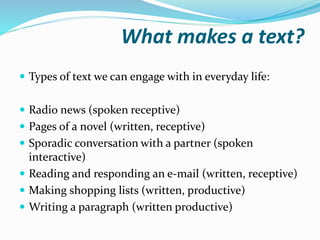
 Types of text we can engage with in everyday life:
 Radio news (spoken receptive)
 Pages of a novel (written, receptive)
 Sporadic conversation with a partner (spoken
interactive)
 Reading and responding an e-mail (written, receptive)
 Making shopping lists (written, productive)
 Writing a paragraph (written productive)
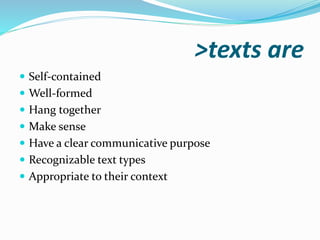
>texts are
 Self-contained
 Well-formed
 Hang together
 Make sense
 Have a clear communicative purpose
 Recognizable text types
 Appropriate to their context
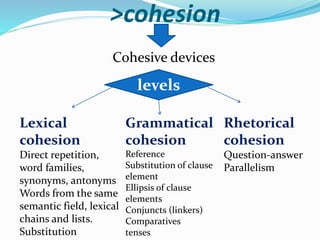
>cohesion
Cohesive devices
levels
Lexical
cohesion
Direct repetition,
word families,
synonyms, antonyms
Words from the same
semantic field, lexical
chains and lists.
Substitution
Grammatical
cohesion
Reference
Substitution of clause
element
Ellipsis of clause
elements
Conjuncts (linkers)
Comparatives
tenses
Rhetorical
cohesion
Question-answer
Parallelism
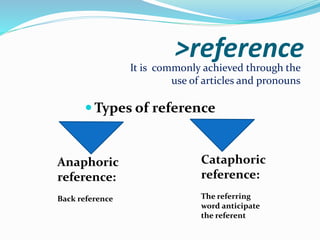
>reference
 Types of reference
It is commonly achieved through the
use of articles and pronouns
Anaphoric
reference:
Back reference
Cataphoric
reference:
The referring
word anticipate
the referent
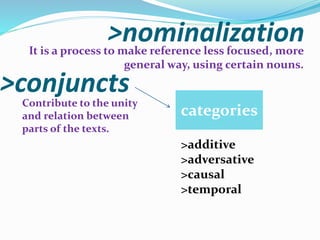
>nominalizationIt is a process to make reference less focused, more
general way, using certain nouns.
>conjunctsContribute to the unity
and relation between
parts of the texts.
categories
>additive
>adversative
>causal
>temporal
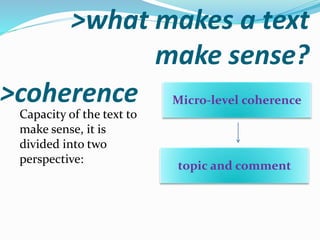
>what makes a text
make sense?
>coherence
Capacity of the text to
make sense, it is
divided into two
perspective:
Micro-level coherence
topic and comment
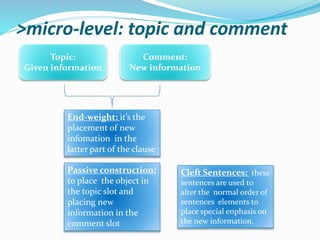
>micro-level: topic and comment
Topic:
Given information
Comment:
New information
End-weight: it’s the
placement of new
infomation in the
latter part of the clause
Passive construction:
to place the object in
the topic slot and
placing new
information in the
comment slot
Cleft Sentences: these
sentences are used to
alter the normal order of
sentences elements to
place special enphasis on
the new information.
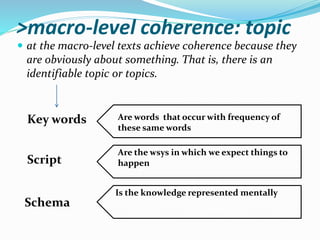
>macro-level coherence: topic
 at the macro-level texts achieve coherence because they
are obviously about something. That is, there is an
identifiable topic or topics.
Key words
Script
Schema
ArethAre words that occur with frequency of
these same words
Is the knowledge represented mentally
Are the wsys in which we expect things to
happen
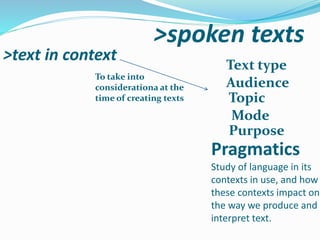
>spoken texts
>text in context
Pragmatics
Study of language in its
contexts in use, and how
these contexts impact on
the way we produce and
interpret text.
Text type
Audience
Topic
Purpose
Mode
To take into
considerationa at the
time of creating texts
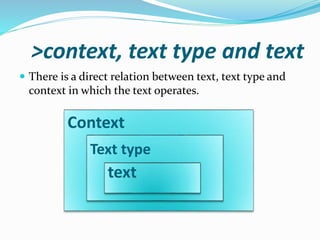
>context, text type and text
 There is a direct relation between text, text type and
context in which the text operates.
Context
Text type
text
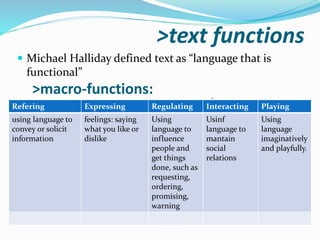
>text functions
 Michael Halliday defined text as “language that is
functional”
>macro-functions: :
Refering Expressing Regulating Interacting Playing
using language to
convey or solicit
information
feelings: saying
what you like or
dislike
Using
language to
influence
people and
get things
done, such as
requesting,
ordering,
promising,
warning
Usinf
language to
mantain
social
relations
Using
language
imaginatively
and playfully.
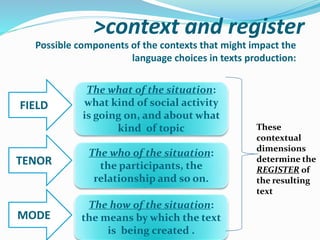
>context and register
Possible components of the contexts that might impact the
language choices in texts production:
FIELD
The what of the situation:
what kind of social activity
is going on, and about what
kind of topic
TENOR
The who of the situation:
the participants, the
relationship and so on.
MODE
The how of the situation:
the means by which the text
is being created .
These
contextual
dimensions
determine the
REGISTER of
the resulting
text
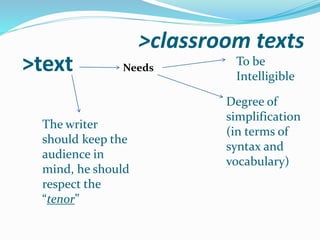
>classroom texts
>text Needs
To be
Intelligible
Degree of
simplification
(in terms of
syntax and
vocabulary)
The writer
should keep the
audience in
mind, he should
respect the
“tenor”
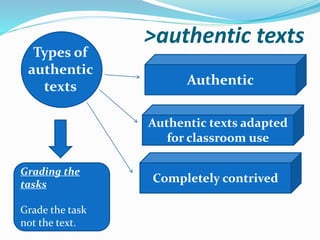
>authentic texts
Types of
authentic
texts Authentic
Authentic texts adapted
for classroom use
Completely contrived
Grading the
tasks
Grade the task
not the text.
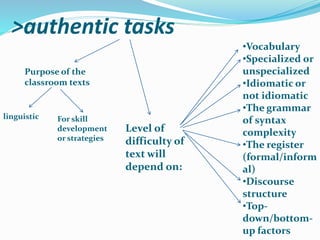
>authentic tasks
Purpose of the
classroom texts
linguistic For skill
development
or strategies
Level of
difficulty of
text will
depend on:
•Vocabulary
•Specialized or
unspecialized
•Idiomatic or
not idiomatic
•The grammar
of syntax
complexity
•The register
(formal/inform
al)
•Discourse
structure
•Top-
down/bottom-
up factors
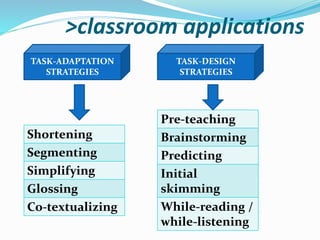
>classroom applications
TASK-ADAPTATION
STRATEGIES
TASK-DESIGN
STRATEGIES
Shortening
Segmenting
Simplifying
Glossing
Co-textualizing
Pre-teaching
Brainstorming
Predicting
Initial
skimming
While-reading /
while-listening
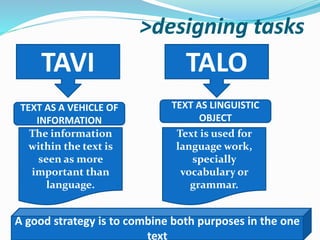
>designing tasks
TAVI TALO
TEXT AS A VEHICLE OF
INFORMATION
TEXT AS LINGUISTIC
OBJECT
The information
within the text is
seen as more
important than
language.
Text is used for
language work,
specially
vocabulary or
grammar.
A good strategy is to combine both purposes in the one
text
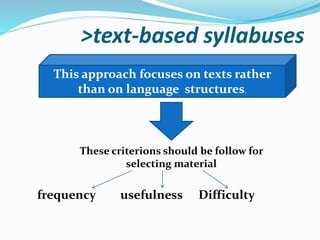
>text-based syllabuses
This approach focuses on texts rather
than on language structures.
These criterions should be follow for
selecting material
frequency usefulness Difficulty
>literary text
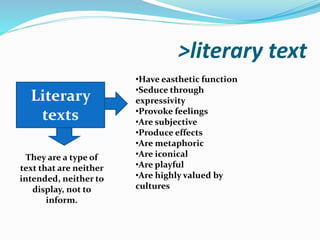
Literary
texts
They are a type of
text that are neither
intended, neither to
display, not to
inform.
•Have easthetic function
•Seduce through
expressivity
•Provoke feelings
•Are subjective
•Produce effects
•Are metaphoric
•Are iconical
•Are playful
•Are highly valued by
cultures
>bibliography
Thornbury, Scott (2005) Beyond the Sentence.
Introducing Discourse Analysis. UK,
Macmillan. Chapters 2-3-5-6-7

Beyond the sentence

  • 1.
  • 2.
    What makes atext?  Types of text we can engage with in everyday life:  Radio news (spoken receptive)  Pages of a novel (written, receptive)  Sporadic conversation with a partner (spoken interactive)  Reading and responding an e-mail (written, receptive)  Making shopping lists (written, productive)  Writing a paragraph (written productive)
  • 3.
    >texts are  Self-contained Well-formed  Hang together  Make sense  Have a clear communicative purpose  Recognizable text types  Appropriate to their context
  • 4.
    >cohesion Cohesive devices levels Lexical cohesion Direct repetition, wordfamilies, synonyms, antonyms Words from the same semantic field, lexical chains and lists. Substitution Grammatical cohesion Reference Substitution of clause element Ellipsis of clause elements Conjuncts (linkers) Comparatives tenses Rhetorical cohesion Question-answer Parallelism
  • 5.
    >reference  Types ofreference It is commonly achieved through the use of articles and pronouns Anaphoric reference: Back reference Cataphoric reference: The referring word anticipate the referent
  • 6.
    >nominalizationIt is aprocess to make reference less focused, more general way, using certain nouns. >conjunctsContribute to the unity and relation between parts of the texts. categories >additive >adversative >causal >temporal
  • 7.
    >what makes atext make sense? >coherence Capacity of the text to make sense, it is divided into two perspective: Micro-level coherence topic and comment
  • 8.
    >micro-level: topic andcomment Topic: Given information Comment: New information End-weight: it’s the placement of new infomation in the latter part of the clause Passive construction: to place the object in the topic slot and placing new information in the comment slot Cleft Sentences: these sentences are used to alter the normal order of sentences elements to place special enphasis on the new information.
  • 9.
    >macro-level coherence: topic at the macro-level texts achieve coherence because they are obviously about something. That is, there is an identifiable topic or topics. Key words Script Schema ArethAre words that occur with frequency of these same words Is the knowledge represented mentally Are the wsys in which we expect things to happen
  • 10.
    >spoken texts >text incontext Pragmatics Study of language in its contexts in use, and how these contexts impact on the way we produce and interpret text. Text type Audience Topic Purpose Mode To take into considerationa at the time of creating texts
  • 11.
    >context, text typeand text  There is a direct relation between text, text type and context in which the text operates. Context Text type text
  • 12.
    >text functions  MichaelHalliday defined text as “language that is functional” >macro-functions: : Refering Expressing Regulating Interacting Playing using language to convey or solicit information feelings: saying what you like or dislike Using language to influence people and get things done, such as requesting, ordering, promising, warning Usinf language to mantain social relations Using language imaginatively and playfully.
  • 13.
    >context and register Possiblecomponents of the contexts that might impact the language choices in texts production: FIELD The what of the situation: what kind of social activity is going on, and about what kind of topic TENOR The who of the situation: the participants, the relationship and so on. MODE The how of the situation: the means by which the text is being created . These contextual dimensions determine the REGISTER of the resulting text
  • 14.
    >classroom texts >text Needs Tobe Intelligible Degree of simplification (in terms of syntax and vocabulary) The writer should keep the audience in mind, he should respect the “tenor”
  • 15.
    >authentic texts Types of authentic textsAuthentic Authentic texts adapted for classroom use Completely contrived Grading the tasks Grade the task not the text.
  • 16.
    >authentic tasks Purpose ofthe classroom texts linguistic For skill development or strategies Level of difficulty of text will depend on: •Vocabulary •Specialized or unspecialized •Idiomatic or not idiomatic •The grammar of syntax complexity •The register (formal/inform al) •Discourse structure •Top- down/bottom- up factors
  • 17.
  • 18.
    >designing tasks TAVI TALO TEXTAS A VEHICLE OF INFORMATION TEXT AS LINGUISTIC OBJECT The information within the text is seen as more important than language. Text is used for language work, specially vocabulary or grammar. A good strategy is to combine both purposes in the one text
  • 19.
    >text-based syllabuses This approachfocuses on texts rather than on language structures. These criterions should be follow for selecting material frequency usefulness Difficulty
  • 20.
    >literary text Literary texts They area type of text that are neither intended, neither to display, not to inform. •Have easthetic function •Seduce through expressivity •Provoke feelings •Are subjective •Produce effects •Are metaphoric •Are iconical •Are playful •Are highly valued by cultures
  • 21.
    >bibliography Thornbury, Scott (2005)Beyond the Sentence. Introducing Discourse Analysis. UK, Macmillan. Chapters 2-3-5-6-7

Editor's Notes